Republic of the Philippines
Department of Education
Region IX, Zamboanga Peninsula
SCHOOLS DIVISION OF ZAMBOANGA CITY
BUSAY ELEMENTARY SCHOOL
Mercedes District
BASIC INTENSIVE READING REMEDIATION PROGRAM
For Grade 1 Learners
(BIRRM)
Prepared by:
SITTI RAQUIBA P. TANGKIAN
Teacher I
Noted by:
MARCONIE H. KALBI
Elementary School Head Teacher II
Republic of the Philippines
Department of Education
Region IX, Zamboanga Peninsula
SCHOOLS DIVISION OF ZAMBOANGA CITY
BUSAY ELEMENTARY SCHOOL
Mercedes District
MARCONIE H. KALBI
Elementary School Head Teacher II
Busay,Sacol Island
Zamboanga City ,Philippines
Sir;
The ability to read is the most important outcome of education. It is a skill that
is fundamental to success in life.Learners whose reading skill was not develop
faces difficulties not just in the academe but as well as in life. According to
Shaywitz et al.,1999,Early intervention is essential for learners who are
struggling with reading. Studies have shown that learners who receive early
reading interventions and support in Grade 1 have a higher chance of
succeeding reading than those who receive interventions later in their schooling
year. With this I am submitting this BASIC INTENSIVE READING
REMEDIATION PROGRAM For Grade 1 Learners (BIRRM) to build a strong
foundational skill in learning among Grade 1 which is believed as the crucial
stage in learning.
In this regard, I am requesting approval and execution of the aforementioned
reading program.
God bless and More Power
Very Respectfully yours,
SITTI RAQUIBA P. TANGKIAN
Teacher I
Approved by:
MARCONIE H. KALBI
Elementary School Head Teacher III
Table of Content
Content Page
I. Rationale 1
II. Framework 1
III. Roles and Responsibilities 2
IV. Stages of Reading Program Implementation
a. Assessment 3
b. Implementation
c. Monitoring and Evaluation 3
Republic of the Philippines
Department of Education
REGION IX, ZAMBOANGA PENINSULA
SCHOOLS DIVISION OF ZAMBOANGA CITY
I. RATIONALE
.
The Basic Intensive Reading Remediation Program (BIRRP) aligned the
Whole School Reading program, projects, and activities related with the Region
IX Zeal for Progress in Reading Program and ZCSDO iRead2Inspire to build a
community of readers, thus, Bawat Bata Bumabasa.
II. Framework
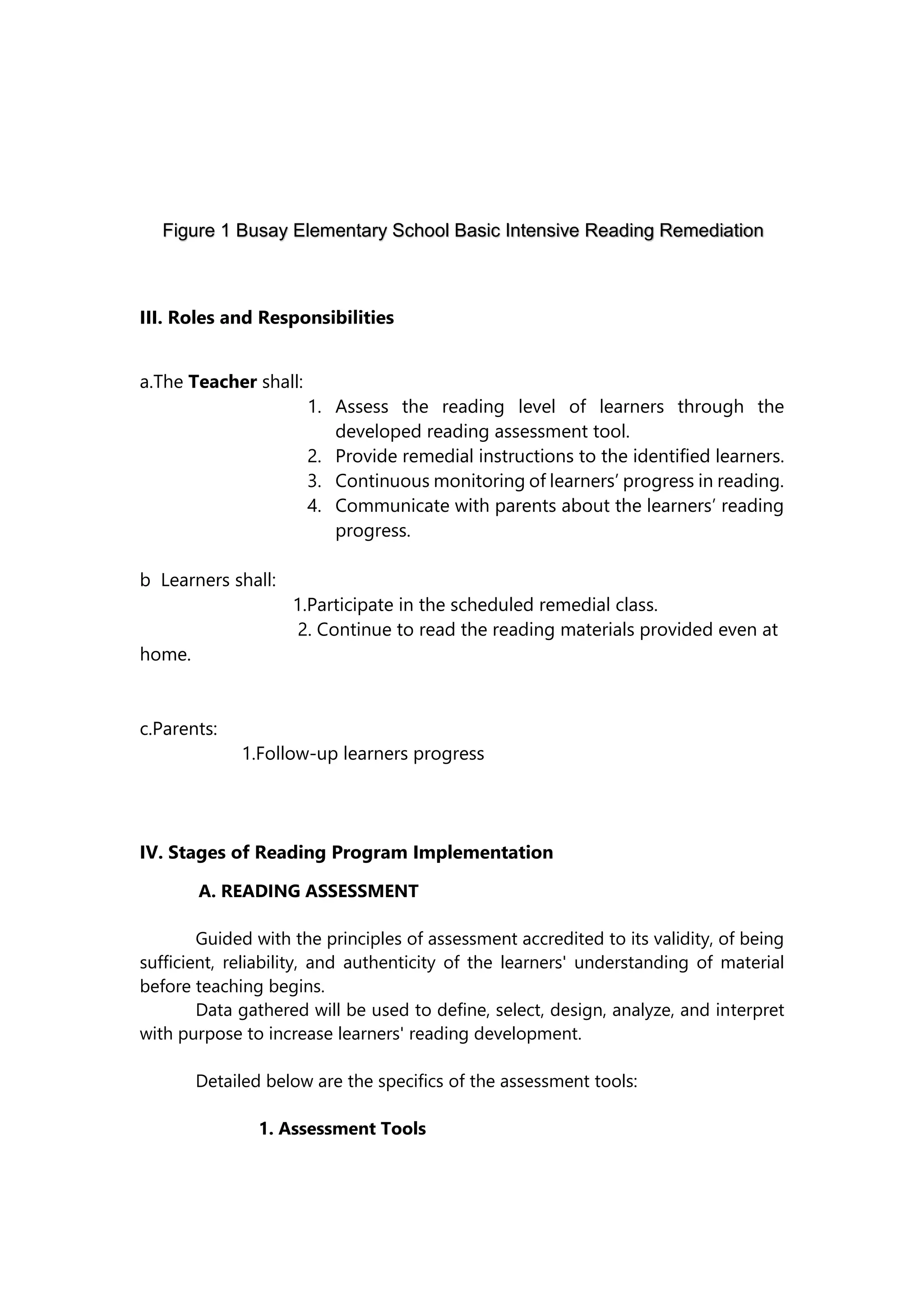
The Basic Intensive Reading Remediation Program (BIRRP) anchored on
the Region IX Zeal for Progress in Reading Program and ZCSDO iRead2Inspire.
Reading
Assessment
PHIL-IRI
EGRA
CRLA
LAC Sessions
Remedial
Reading
Reading
Enhancement
Reading
Resources
III. Roles and Responsibilities
a.The Teacher shall:
1. Assess the reading level of learners through the
developed reading assessment tool.
2. Provide remedial instructions to the identified learners.
3. Continuous monitoring of learners’ progress in reading.
4. Communicate with parents about the learners’ reading
progress.
b Learners shall:
1.Participate in the scheduled remedial class.
2. Continue to read the reading materials provided even at
home.
c.Parents:
1.Follow-up learners progress
IV. Stages of Reading Program Implementation
A. READING ASSESSMENT
Guided with the principles of assessment accredited to its validity, of being
sufficient, reliability, and authenticity of the learners' understanding of material
before teaching begins.
Data gathered will be used to define, select, design, analyze, and interpret
with purpose to increase learners' reading development.
Detailed below are the specifics of the assessment tools:
1. Assessment Tools
Figure 1 Busay Elementary School Basic Intensive Reading Remediation
Program Framework
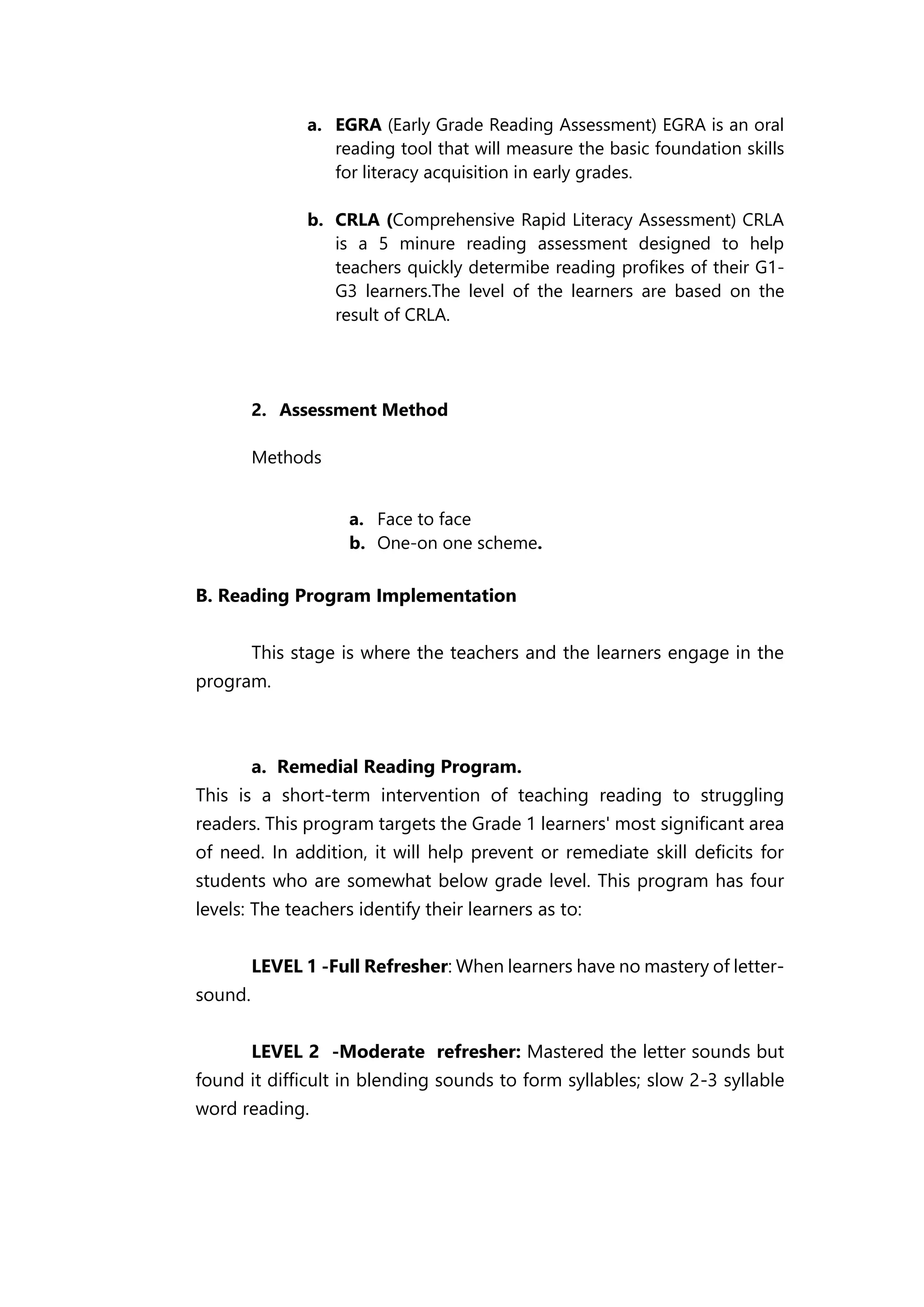
a. EGRA (Early Grade Reading Assessment) EGRA is an oral
reading tool that will measure the basic foundation skills
for literacy acquisition in early grades.
b. CRLA (Comprehensive Rapid Literacy Assessment) CRLA
is a 5 minure reading assessment designed to help
teachers quickly determibe reading profikes of their G1-
G3 learners.The level of the learners are based on the
result of CRLA.
2. Assessment Method
Methods
a. Face to face
b. One-on one scheme.
B. Reading Program Implementation
This stage is where the teachers and the learners engage in the
program.
a. Remedial Reading Program.
This is a short-term intervention of teaching reading to struggling
readers. This program targets the Grade 1 learners' most significant area
of need. In addition, it will help prevent or remediate skill deficits for
students who are somewhat below grade level. This program has four
levels: The teachers identify their learners as to:
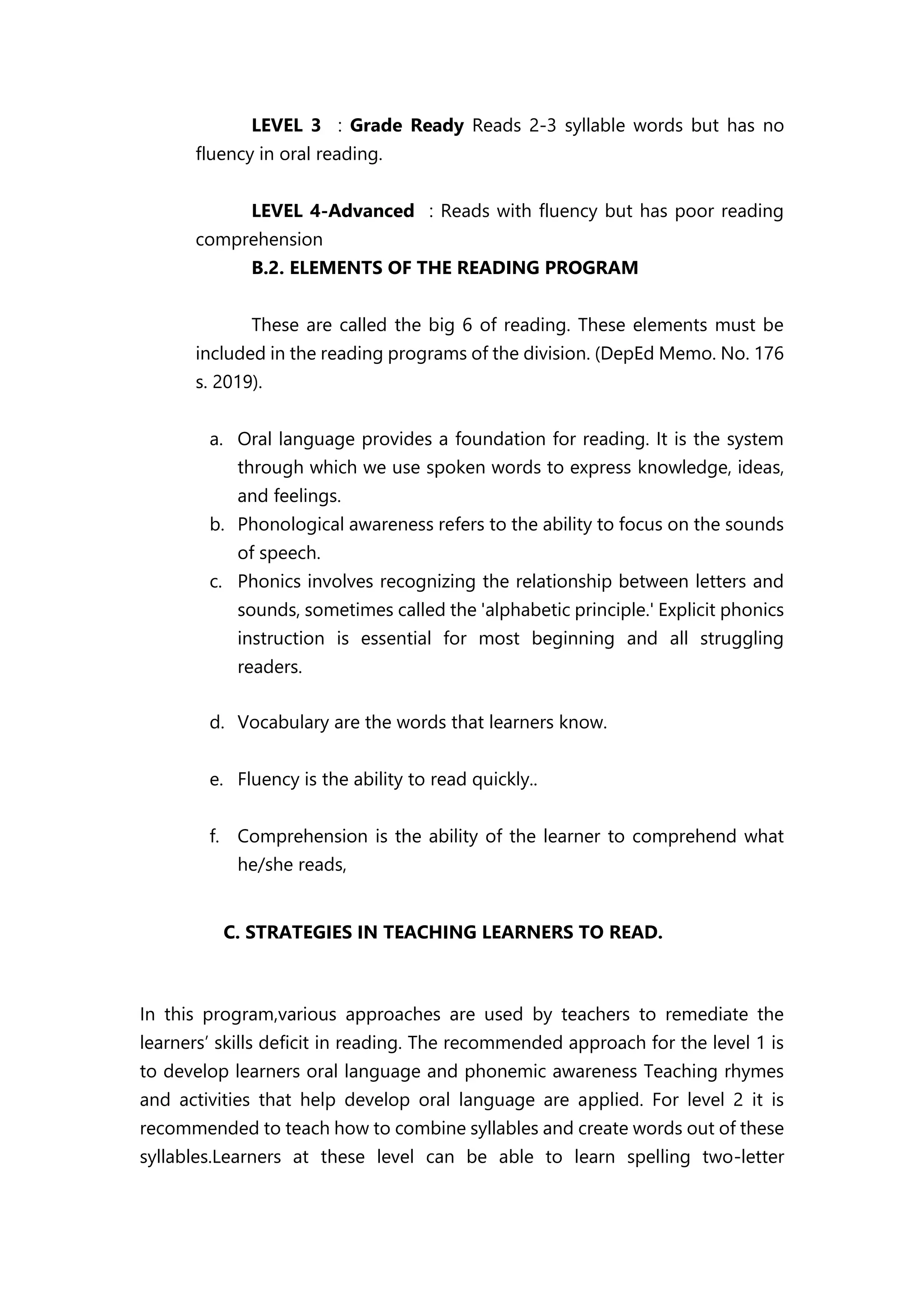
LEVEL 1 -Full Refresher: When learners have no mastery of letter-
sound.
LEVEL 2 -Moderate refresher: Mastered the letter sounds but
found it difficult in blending sounds to form syllables; slow 2-3 syllable
word reading.
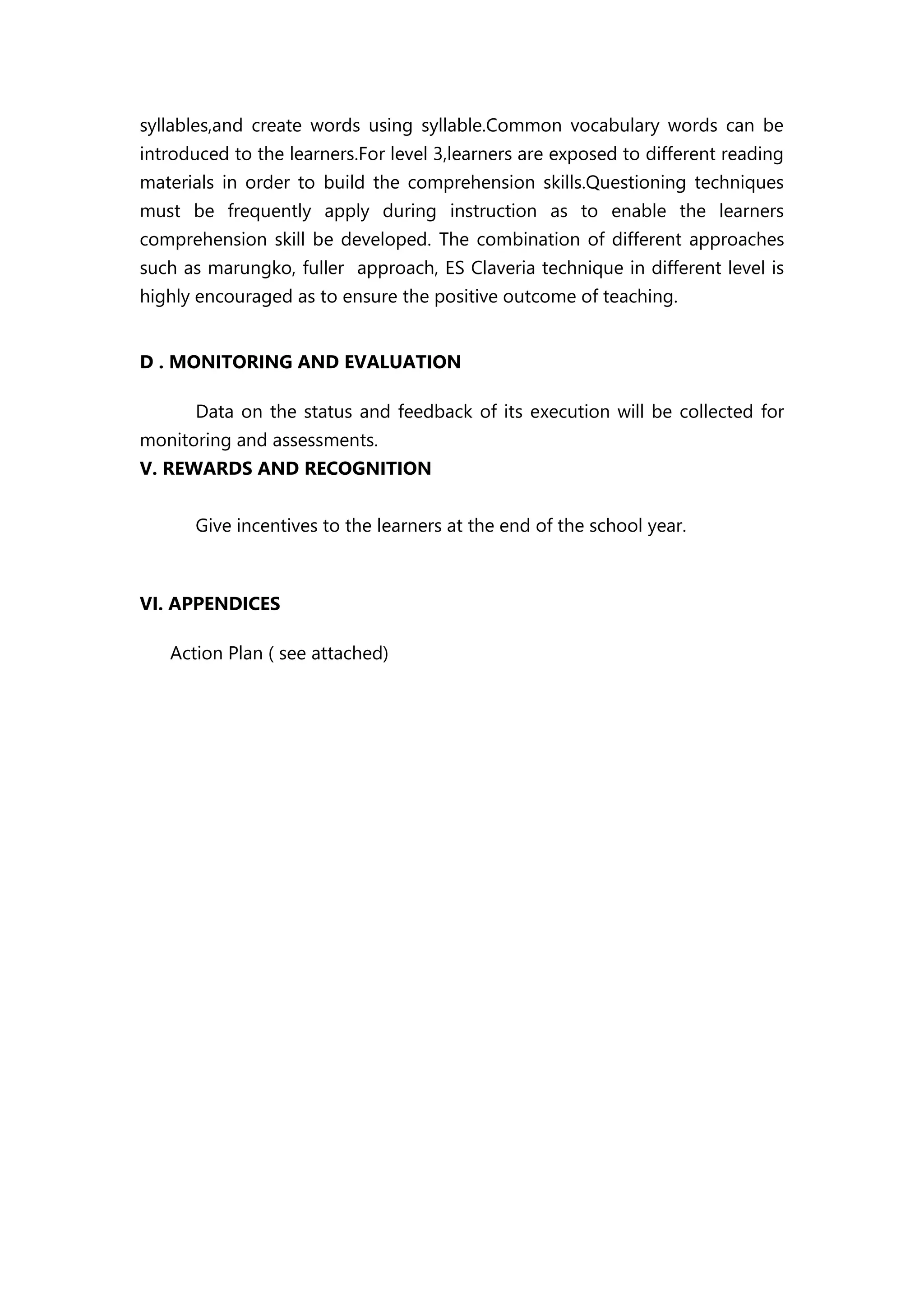
LEVEL 3 : Grade Ready Reads 2-3 syllable words but has no
fluency in oral reading.
LEVEL 4-Advanced : Reads with fluency but has poor reading
comprehension
B.2. ELEMENTS OF THE READING PROGRAM
These are called the big 6 of reading. These elements must be
included in the reading programs of the division. (DepEd Memo. No. 176
s. 2019).
a. Oral language provides a foundation for reading. It is the system
through which we use spoken words to express knowledge, ideas,
and feelings.
b. Phonological awareness refers to the ability to focus on the sounds
of speech.
c. Phonics involves recognizing the relationship between letters and
sounds, sometimes called the 'alphabetic principle.' Explicit phonics
instruction is essential for most beginning and all struggling
readers.
d. Vocabulary are the words that learners know.
e. Fluency is the ability to read quickly..
f. Comprehension is the ability of the learner to comprehend what
he/she reads,
C. STRATEGIES IN TEACHING LEARNERS TO READ.
In this program,various approaches are used by teachers to remediate the
learners’ skills deficit in reading. The recommended approach for the level 1 is
to develop learners oral language and phonemic awareness Teaching rhymes
and activities that help develop oral language are applied. For level 2 it is
recommended to teach how to combine syllables and create words out of these
syllables.Learners at these level can be able to learn spelling two-letter
syllables,and create words using syllable.Common vocabulary words can be
introduced to the learners.For level 3,learners are exposed to different reading
materials in order to build the comprehension skills.Questioning techniques
must be frequently apply during instruction as to enable the learners
comprehension skill be developed. The combination of different approaches
such as marungko, fuller approach, ES Claveria technique in different level is
highly encouraged as to ensure the positive outcome of teaching.
D . MONITORING AND EVALUATION
Data on the status and feedback of its execution will be collected for
monitoring and assessments.
V. REWARDS AND RECOGNITION
Give incentives to the learners at the end of the school year.
VI. APPENDICES
Action Plan ( see attached)
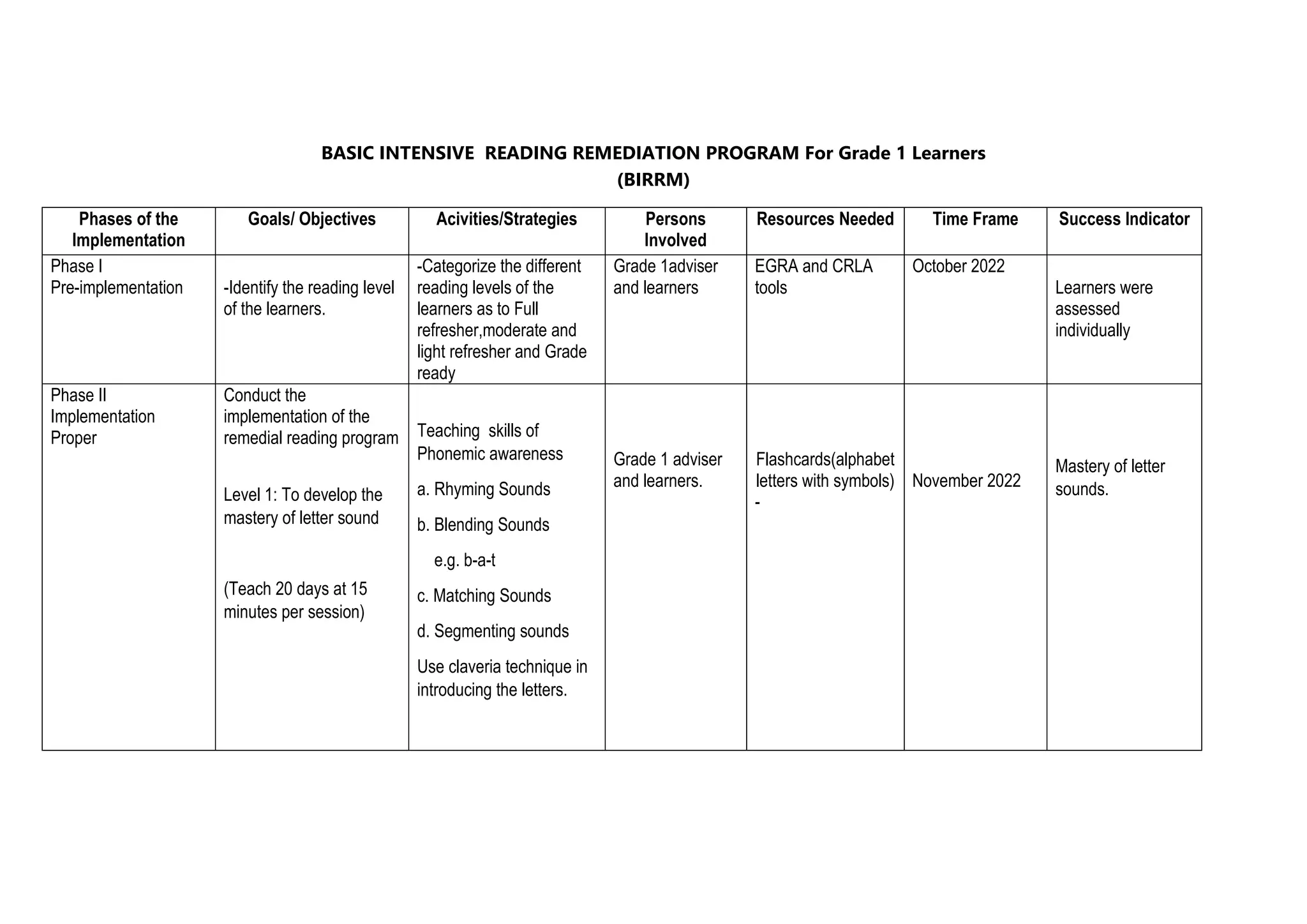
BASIC INTENSIVE READING REMEDIATION PROGRAM For Grade 1 Learners
(BIRRM)
Phases of the
Implementation
Goals/ Objectives Acivities/Strategies Persons
Involved
Resources Needed Time Frame Success Indicator
Phase I
Pre-implementation -Identify the reading level
of the learners.
-Categorize the different
reading levels of the
learners as to Full
refresher,moderate and
light refresher and Grade
ready
Grade 1adviser
and learners
EGRA and CRLA
tools
October 2022
Learners were
assessed
individually
Phase II
Implementation
Proper
Conduct the
implementation of the
remedial reading program
Level 1: To develop the
mastery of letter sound
(Teach 20 days at 15
minutes per session)
Teaching skills of
Phonemic awareness
a. Rhyming Sounds
b. Blending Sounds
e.g. b-a-t
c. Matching Sounds
d. Segmenting sounds
Use claveria technique in
introducing the letters.
Grade 1 adviser
and learners.
Flashcards(alphabet
letters with symbols)
-
November 2022
Mastery of letter
sounds.
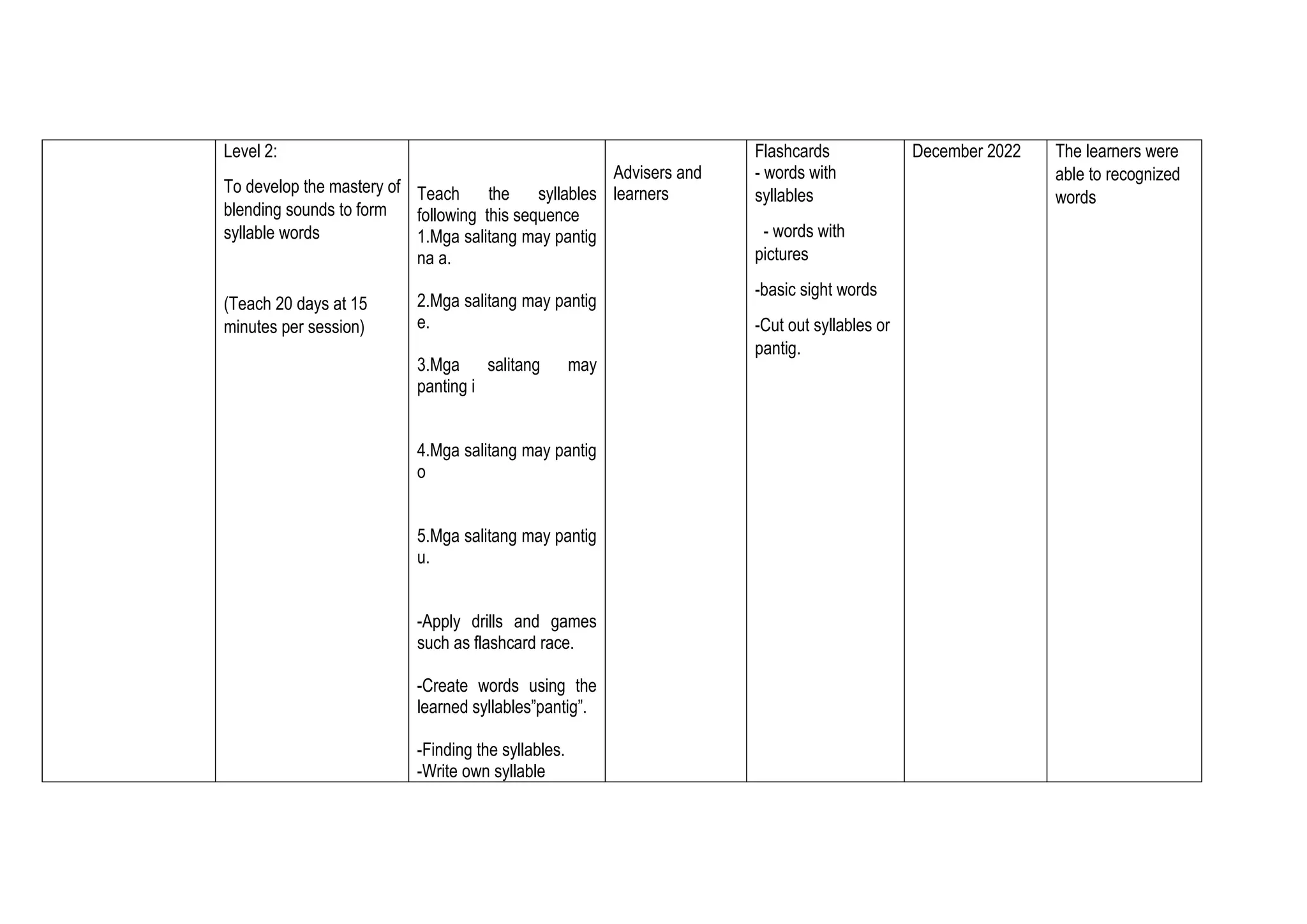
Level 2:
To develop the mastery of
blending sounds to form
syllable words
(Teach 20 days at 15
minutes per session)
Teach the syllables
following this sequence
1.Mga salitang may pantig
na a.
2.Mga salitang may pantig
e.
3.Mga salitang may
panting i
4.Mga salitang may pantig
o
5.Mga salitang may pantig
u.
-Apply drills and games
such as flashcard race.
-Create words using the
learned syllables”pantig”.
-Finding the syllables.
-Write own syllable
Advisers and
learners
Flashcards
- words with
syllables
- words with
pictures
-basic sight words
-Cut out syllables or
pantig.
December 2022 The learners were
able to recognized
words
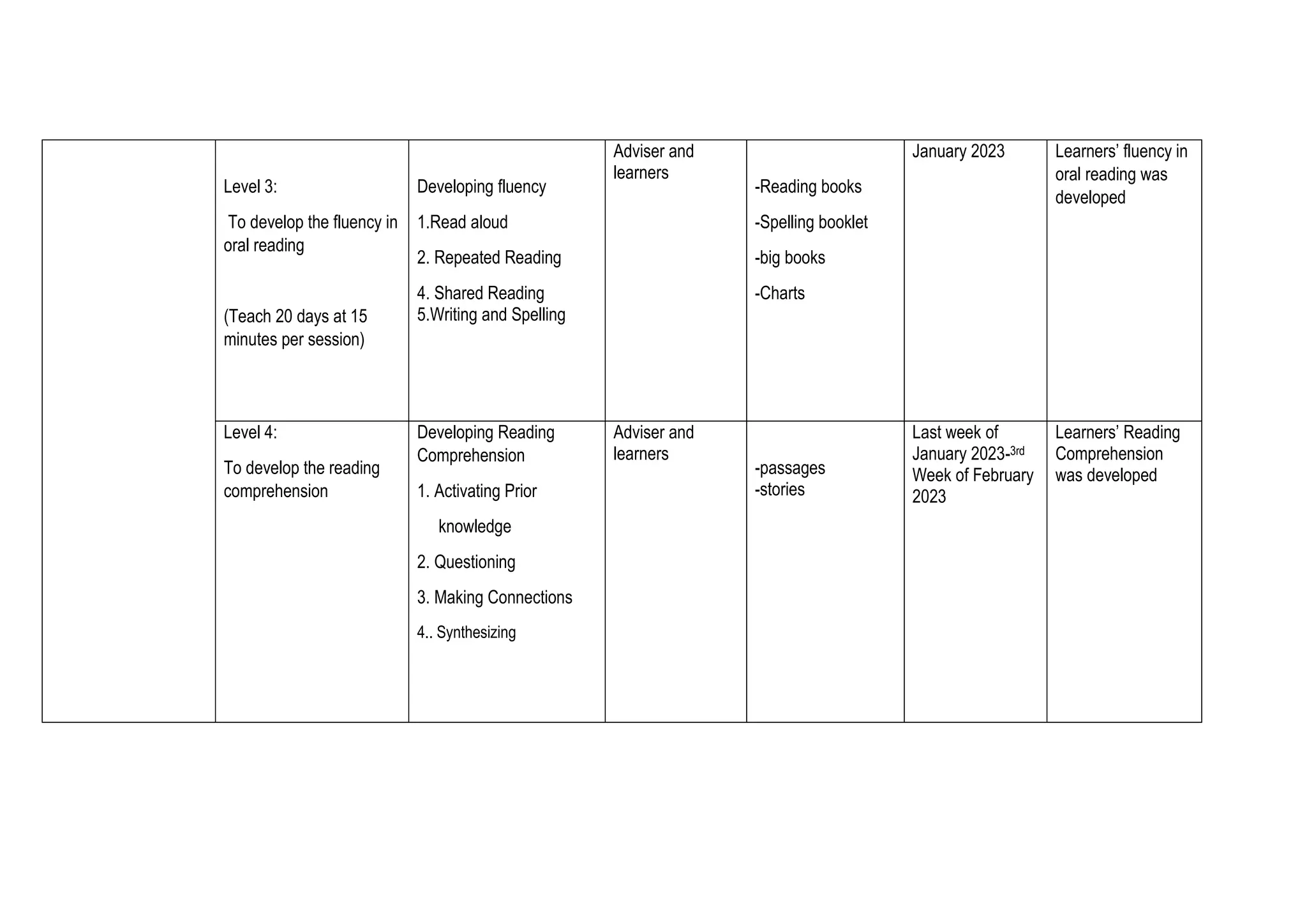
Level 3:
To develop the fluency in
oral reading
(Teach 20 days at 15
minutes per session)
Developing fluency
1.Read aloud
2. Repeated Reading
4. Shared Reading
5.Writing and Spelling
Adviser and
learners
-Reading books
-Spelling booklet
-big books
-Charts
January 2023 Learners’ fluency in
oral reading was
developed
Level 4:
To develop the reading
comprehension
Developing Reading
Comprehension
1. Activating Prior
knowledge
2. Questioning
3. Making Connections
4.. Synthesizing
Adviser and
learners
-passages
-stories
Last week of
January 2023-3rd
Week of February
2023
Learners’ Reading
Comprehension
was developed
Phase IIIPost
Implementation
• Evaluation
To evaluate the
improvement of the
learners’ reading
proficiency
Conduct the Post Reading
Assessment Advisers, and
learners
CRLA/EGRA post
assessment
Last week of
March 2022
100% of the Grade
1 llearners will be
assessed
Prepared by: Noted by:
SITTI RAQUIBA P. TANGKIAN MARCONIE H. KALBI
Reading Coordinator/Adviser ESHT-II

PROPOSAL READING RAQUI.docx

  • 1.
    Republic of thePhilippines Department of Education Region IX, Zamboanga Peninsula SCHOOLS DIVISION OF ZAMBOANGA CITY BUSAY ELEMENTARY SCHOOL Mercedes District BASIC INTENSIVE READING REMEDIATION PROGRAM For Grade 1 Learners (BIRRM) Prepared by: SITTI RAQUIBA P. TANGKIAN Teacher I Noted by: MARCONIE H. KALBI Elementary School Head Teacher II
  • 2.
    Republic of thePhilippines Department of Education Region IX, Zamboanga Peninsula SCHOOLS DIVISION OF ZAMBOANGA CITY BUSAY ELEMENTARY SCHOOL Mercedes District MARCONIE H. KALBI Elementary School Head Teacher II Busay,Sacol Island Zamboanga City ,Philippines Sir; The ability to read is the most important outcome of education. It is a skill that is fundamental to success in life.Learners whose reading skill was not develop faces difficulties not just in the academe but as well as in life. According to Shaywitz et al.,1999,Early intervention is essential for learners who are struggling with reading. Studies have shown that learners who receive early reading interventions and support in Grade 1 have a higher chance of succeeding reading than those who receive interventions later in their schooling year. With this I am submitting this BASIC INTENSIVE READING REMEDIATION PROGRAM For Grade 1 Learners (BIRRM) to build a strong foundational skill in learning among Grade 1 which is believed as the crucial stage in learning. In this regard, I am requesting approval and execution of the aforementioned reading program. God bless and More Power Very Respectfully yours, SITTI RAQUIBA P. TANGKIAN Teacher I
  • 3.
    Approved by: MARCONIE H.KALBI Elementary School Head Teacher III Table of Content Content Page I. Rationale 1 II. Framework 1 III. Roles and Responsibilities 2 IV. Stages of Reading Program Implementation a. Assessment 3 b. Implementation c. Monitoring and Evaluation 3
  • 4.
    Republic of thePhilippines Department of Education REGION IX, ZAMBOANGA PENINSULA SCHOOLS DIVISION OF ZAMBOANGA CITY I. RATIONALE . The Basic Intensive Reading Remediation Program (BIRRP) aligned the Whole School Reading program, projects, and activities related with the Region IX Zeal for Progress in Reading Program and ZCSDO iRead2Inspire to build a community of readers, thus, Bawat Bata Bumabasa. II. Framework The Basic Intensive Reading Remediation Program (BIRRP) anchored on the Region IX Zeal for Progress in Reading Program and ZCSDO iRead2Inspire. Reading Assessment PHIL-IRI EGRA CRLA LAC Sessions Remedial Reading Reading Enhancement Reading Resources
  • 5.
    III. Roles andResponsibilities a.The Teacher shall: 1. Assess the reading level of learners through the developed reading assessment tool. 2. Provide remedial instructions to the identified learners. 3. Continuous monitoring of learners’ progress in reading. 4. Communicate with parents about the learners’ reading progress. b Learners shall: 1.Participate in the scheduled remedial class. 2. Continue to read the reading materials provided even at home. c.Parents: 1.Follow-up learners progress IV. Stages of Reading Program Implementation A. READING ASSESSMENT Guided with the principles of assessment accredited to its validity, of being sufficient, reliability, and authenticity of the learners' understanding of material before teaching begins. Data gathered will be used to define, select, design, analyze, and interpret with purpose to increase learners' reading development. Detailed below are the specifics of the assessment tools: 1. Assessment Tools Figure 1 Busay Elementary School Basic Intensive Reading Remediation Program Framework
  • 6.
    a. EGRA (EarlyGrade Reading Assessment) EGRA is an oral reading tool that will measure the basic foundation skills for literacy acquisition in early grades. b. CRLA (Comprehensive Rapid Literacy Assessment) CRLA is a 5 minure reading assessment designed to help teachers quickly determibe reading profikes of their G1- G3 learners.The level of the learners are based on the result of CRLA. 2. Assessment Method Methods a. Face to face b. One-on one scheme. B. Reading Program Implementation This stage is where the teachers and the learners engage in the program. a. Remedial Reading Program. This is a short-term intervention of teaching reading to struggling readers. This program targets the Grade 1 learners' most significant area of need. In addition, it will help prevent or remediate skill deficits for students who are somewhat below grade level. This program has four levels: The teachers identify their learners as to: LEVEL 1 -Full Refresher: When learners have no mastery of letter- sound. LEVEL 2 -Moderate refresher: Mastered the letter sounds but found it difficult in blending sounds to form syllables; slow 2-3 syllable word reading.
  • 7.
    LEVEL 3 :Grade Ready Reads 2-3 syllable words but has no fluency in oral reading. LEVEL 4-Advanced : Reads with fluency but has poor reading comprehension B.2. ELEMENTS OF THE READING PROGRAM These are called the big 6 of reading. These elements must be included in the reading programs of the division. (DepEd Memo. No. 176 s. 2019). a. Oral language provides a foundation for reading. It is the system through which we use spoken words to express knowledge, ideas, and feelings. b. Phonological awareness refers to the ability to focus on the sounds of speech. c. Phonics involves recognizing the relationship between letters and sounds, sometimes called the 'alphabetic principle.' Explicit phonics instruction is essential for most beginning and all struggling readers. d. Vocabulary are the words that learners know. e. Fluency is the ability to read quickly.. f. Comprehension is the ability of the learner to comprehend what he/she reads, C. STRATEGIES IN TEACHING LEARNERS TO READ. In this program,various approaches are used by teachers to remediate the learners’ skills deficit in reading. The recommended approach for the level 1 is to develop learners oral language and phonemic awareness Teaching rhymes and activities that help develop oral language are applied. For level 2 it is recommended to teach how to combine syllables and create words out of these syllables.Learners at these level can be able to learn spelling two-letter
  • 8.
    syllables,and create wordsusing syllable.Common vocabulary words can be introduced to the learners.For level 3,learners are exposed to different reading materials in order to build the comprehension skills.Questioning techniques must be frequently apply during instruction as to enable the learners comprehension skill be developed. The combination of different approaches such as marungko, fuller approach, ES Claveria technique in different level is highly encouraged as to ensure the positive outcome of teaching. D . MONITORING AND EVALUATION Data on the status and feedback of its execution will be collected for monitoring and assessments. V. REWARDS AND RECOGNITION Give incentives to the learners at the end of the school year. VI. APPENDICES Action Plan ( see attached)
  • 10.
    BASIC INTENSIVE READINGREMEDIATION PROGRAM For Grade 1 Learners (BIRRM) Phases of the Implementation Goals/ Objectives Acivities/Strategies Persons Involved Resources Needed Time Frame Success Indicator Phase I Pre-implementation -Identify the reading level of the learners. -Categorize the different reading levels of the learners as to Full refresher,moderate and light refresher and Grade ready Grade 1adviser and learners EGRA and CRLA tools October 2022 Learners were assessed individually Phase II Implementation Proper Conduct the implementation of the remedial reading program Level 1: To develop the mastery of letter sound (Teach 20 days at 15 minutes per session) Teaching skills of Phonemic awareness a. Rhyming Sounds b. Blending Sounds e.g. b-a-t c. Matching Sounds d. Segmenting sounds Use claveria technique in introducing the letters. Grade 1 adviser and learners. Flashcards(alphabet letters with symbols) - November 2022 Mastery of letter sounds.
  • 11.
    Level 2: To developthe mastery of blending sounds to form syllable words (Teach 20 days at 15 minutes per session) Teach the syllables following this sequence 1.Mga salitang may pantig na a. 2.Mga salitang may pantig e. 3.Mga salitang may panting i 4.Mga salitang may pantig o 5.Mga salitang may pantig u. -Apply drills and games such as flashcard race. -Create words using the learned syllables”pantig”. -Finding the syllables. -Write own syllable Advisers and learners Flashcards - words with syllables - words with pictures -basic sight words -Cut out syllables or pantig. December 2022 The learners were able to recognized words
  • 13.
    Level 3: To developthe fluency in oral reading (Teach 20 days at 15 minutes per session) Developing fluency 1.Read aloud 2. Repeated Reading 4. Shared Reading 5.Writing and Spelling Adviser and learners -Reading books -Spelling booklet -big books -Charts January 2023 Learners’ fluency in oral reading was developed Level 4: To develop the reading comprehension Developing Reading Comprehension 1. Activating Prior knowledge 2. Questioning 3. Making Connections 4.. Synthesizing Adviser and learners -passages -stories Last week of January 2023-3rd Week of February 2023 Learners’ Reading Comprehension was developed
  • 14.
    Phase IIIPost Implementation • Evaluation Toevaluate the improvement of the learners’ reading proficiency Conduct the Post Reading Assessment Advisers, and learners CRLA/EGRA post assessment Last week of March 2022 100% of the Grade 1 llearners will be assessed Prepared by: Noted by: SITTI RAQUIBA P. TANGKIAN MARCONIE H. KALBI Reading Coordinator/Adviser ESHT-II