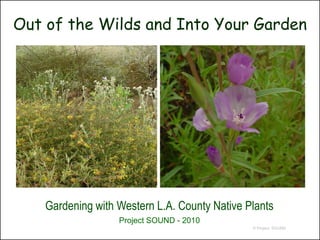
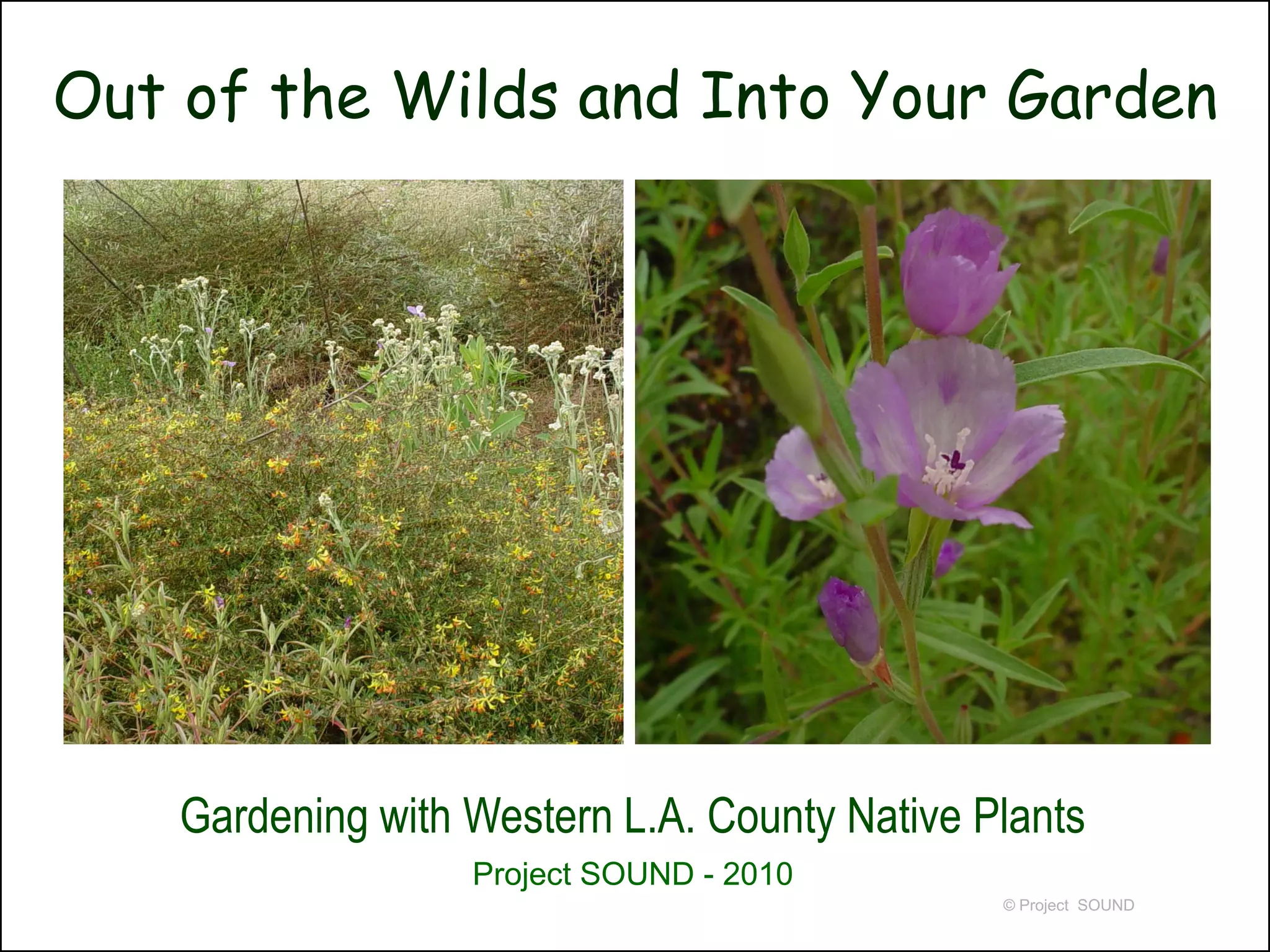
Out of the Wilds and Into Your Garden


    Gardening with Western L.A. County Native Plants
                   Project SOUND - 2010
                                               © Project SOUND
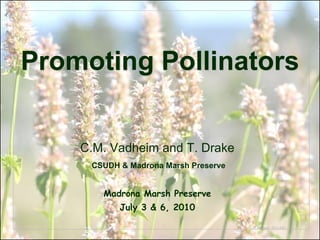
Promoting Pollinators


    C.M. Vadheim and T. Drake
     CSUDH & Madrona Marsh Preserve


       Madrona Marsh Preserve
           July 3 & 6, 2010

                                      © Project SOUND
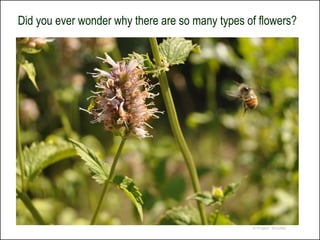
Did you ever wonder why there are so many types of flowers?


                                                 © Project SOUND
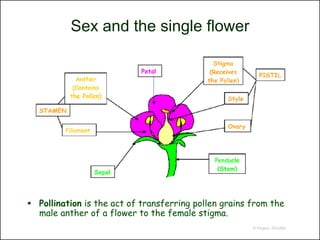
Sex and the single flower


 Pollination is the act of transferring pollen grains from the
  male anther of a flower to the female stigma.
                                                       © Project SOUND
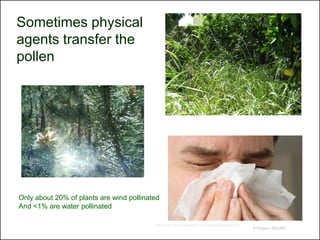
Sometimes physical
agents transfer the
pollen


Only about 20% of plants are wind pollinated
And <1% are water pollinated

                                          http://www.annerondepierre.com/wisdomarchive8.htm
                                                                                              © Project SOUND
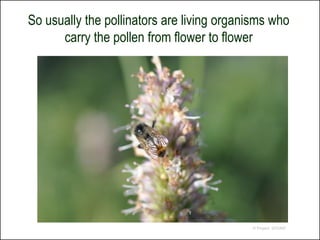
So usually the pollinators are living organisms who
      carry the pollen from flower to flower


                                           © Project SOUND
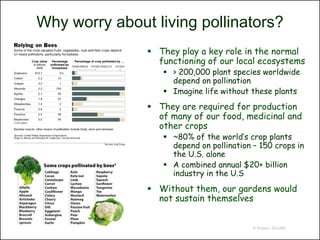
Why worry about living pollinators?
                They play a key role in the normal
                 functioning of our local ecosystems
                   > 200,000 plant species worldwide
                    depend on pollination
                   Imagine life without these plants
                They are required for production
                 of many of our food, medicinal and
                 other crops
                   ~80% of the world’s crop plants
                    depend on pollination – 150 crops in
                    the U.S. alone
                   A combined annual $20+ billion
                    industry in the U.S
                Without them, our gardens would
                 not sustain themselves


                                          © Project SOUND
 Pollinators are at risk:
                                        Non-native pollinators are
                                         vulnerable to environmental factors
                                         - limited genetic variability
                                         [Example: Honeybee Colony Collapse
                                         Disorder]
                                        Native pollinators are at risk due to
                                         habitat loss, climate change and use
                                         of pesticides
Honeybee Colony Collapse Disorder
                                     Crop production world-wide is
                                      decreasing due to decreasing
                                      numbers of pollinators
                                     So we all should be worried – and
                                      taking action
                                     The third week of June is
                                      designated National Pollinators
                                      Week (The fourth annual National
                                      Pollinator Week was June 21-27,
                                      2010)!
                                                                 © Project SOUND
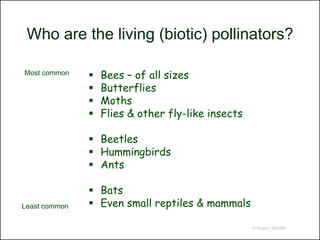
Who are the living (biotic) pollinators?
Most common       Bees – of all sizes
                  Butterflies
                  Moths
                  Flies & other fly-like insects

                Beetles
                Hummingbirds
                Ants

                Bats
Least common    Even small reptiles & mammals

                                                    © Project SOUND
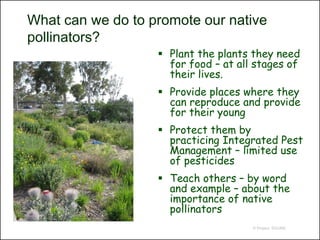
What can we do to promote our native
pollinators?
                    Plant the plants they need
                     for food – at all stages of
                     their lives.
                    Provide places where they
                     can reproduce and provide
                     for their young
                    Protect them by
                     practicing Integrated Pest
                     Management – limited use
                     of pesticides
                    Teach others – by word
                     and example – about the
                     importance of native
                     pollinators
                                      © Project SOUND
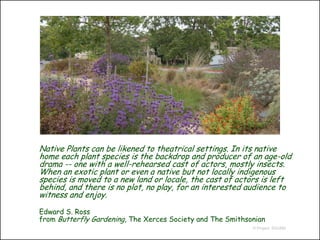
Native Plants can be likened to theatrical settings. In its native
home each plant species is the backdrop and producer of an age-old
drama -- one with a well-rehearsed cast of actors, mostly insects.
When an exotic plant or even a native but not locally indigenous
species is moved to a new land or locale, the cast of actors is left
behind, and there is no plot, no play, for an interested audience to
witness and enjoy.
Edward S. Ross
from Butterfly Gardening, The Xerces Society and The Smithsonian
                                                            © Project SOUND
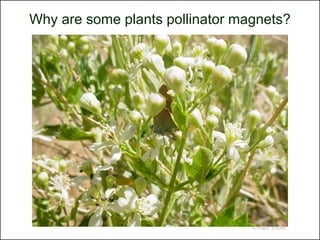
Why are some plants pollinator magnets?


                                 © Project SOUND
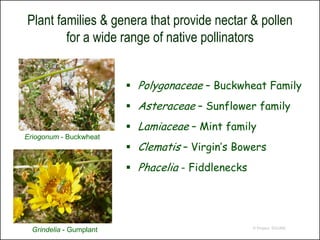
Plant families & genera that provide nectar & pollen
        for a wide range of native pollinators


                          Polygonaceae – Buckwheat Family
                          Asteraceae – Sunflower family
                          Lamiaceae – Mint family
Eriogonum - Buckwheat
                          Clematis – Virgin’s Bowers
                          Phacelia - Fiddlenecks


                                                    © Project SOUND
  Grindelia - Gumplant
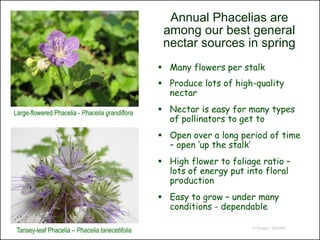
Annual Phacelias are
                                                  among our best general
                                                  nectar sources in spring
                                                  Many flowers per stalk
                                                  Produce lots of high-quality
                                                   nectar

Large-flowered Phacelia - Phacelia grandiflora    Nectar is easy for many types
                                                   of pollinators to get to
                                                  Open over a long period of time
                                                   – open ‘up the stalk’
                                                  High flower to foliage ratio –
                                                   lots of energy put into floral
                                                   production
                                                  Easy to grow – under many
                                                   conditions - dependable

 Tansey-leaf Phacelia – Phacelia tanecetifolia                         © Project SOUND
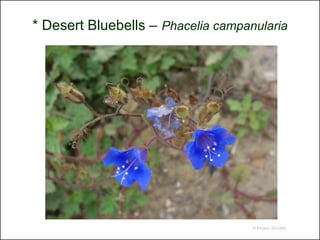
* Desert Bluebells – Phacelia campanularia


                                    © Project SOUND
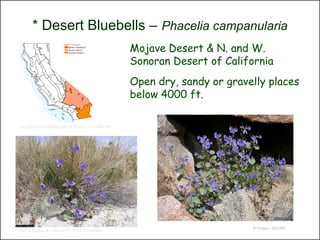
* Desert Bluebells – Phacelia campanularia
                                                                         Mojave Desert & N. and W.
                                                                          Sonoran Desert of California
                                                                         Open dry, sandy or gravelly places
                                                                          below 4000 ft.

http://ucjeps.berkeley.edu/cgi-bin/get_JM_treatment.pl?4518,4587,4601


                                                                                                  © Project SOUND
Gary A. Monroe @ USDA-NRCS PLANTS Database
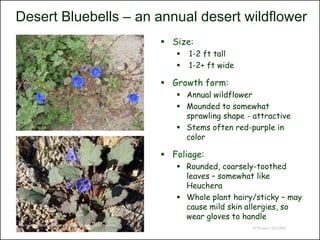
Desert Bluebells – an annual desert wildflower
                                                                                Size:
                                                                                     1-2 ft tall
                                                                                     1-2+ ft wide

                                                                                Growth form:
                                                                                   Annual wildflower
                                                                                   Mounded to somewhat
                                                                                    sprawling shape - attractive
                                                                                   Stems often red-purple in
                                                                                    color

                                                                                Foliage:
                                                                                   Rounded, coarsely-toothed
                                                                                    leaves – somewhat like
                                                                                    Heuchera
                                                                                   Whole plant hairy/sticky – may
                                                                                    cause mild skin allergies, so
                                                                                    wear gloves to handle
http://www.fireflyforest.com/flowers/1886/phacelia-campanularia-desertbells/
                                                                                                      © Project SOUND
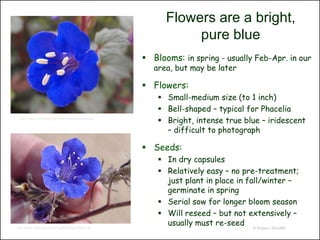
Flowers are a bright,
                                                              pure blue
                                                    Blooms: in spring - usually Feb-Apr. in our
                                                      area, but may be later

                                                    Flowers:
                                                        Small-medium size (to 1 inch)
                                                        Bell-shaped – typical for Phacelia
 http://www.hortmag.com/article/desertbluebells/
                                                        Bright, intense true blue – iridescent
                                                         – difficult to photograph

                                                    Seeds:
                                                        In dry capsules
                                                        Relatively easy – no pre-treatment;
                                                         just plant in place in fall/winter –
                                                         germinate in spring
                                                        Serial sow for longer bloom season
                                                        Will reseed – but not extensively –
http://www.delange.org/BlueBells/BlueBells.htm
                                                         usually must re-seed
                                                                                © Project SOUND
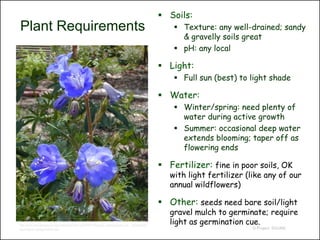
 Soils:
Plant Requirements                                                                                   Texture: any well-drained; sandy
                                                                                                      & gravelly soils great
                                                                                                     pH: any local

                                                                                                 Light:
                                                                                                     Full sun (best) to light shade

                                                                                                 Water:
                                                                                                     Winter/spring: need plenty of
                                                                                                      water during active growth
                                                                                                     Summer: occasional deep water
                                                                                                      extends blooming; taper off as
                                                                                                      flowering ends

                                                                                                 Fertilizer: fine in poor soils, OK
                                                                                                   with light fertilizer (like any of our
                                                                                                   annual wildflowers)

                                                                                                 Other: seeds need bare soil/light
                                                                                                   gravel mulch to germinate; require
http://www.theodorepayne.org/mediawiki/index.php?title=Phacelia_campanularia_var._campanulari
                                                                                                   light as germination cue.
a&printable=yes&printable=yes                                                                                             © Project SOUND
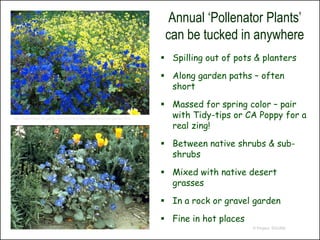
Annual ‘Pollenator Plants’
                                                                             can be tucked in anywhere
                                                                             Spilling out of pots & planters

                                                                             Along garden paths – often
                                                                              short

                                                                             Massed for spring color – pair
http://back40feet.blogspot.com/2008/06/friday-night-botanical-garden.html
                                                                              with Tidy-tips or CA Poppy for a
                                                                              real zing!

                                                                             Between native shrubs & sub-
                                                                              shrubs

                                                                             Mixed with native desert
                                                                              grasses

                                                                             In a rock or gravel garden

                                                                             Fine in hot places
                                                                                                   © Project SOUND
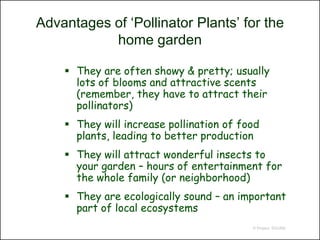
Advantages of ‘Pollinator Plants’ for the
           home garden

     They are often showy & pretty; usually
      lots of blooms and attractive scents
      (remember, they have to attract their
      pollinators)
     They will increase pollination of food
      plants, leading to better production
     They will attract wonderful insects to
      your garden – hours of entertainment for
      the whole family (or neighborhood)
     They are ecologically sound – an important
      part of local ecosystems
                                          © Project SOUND
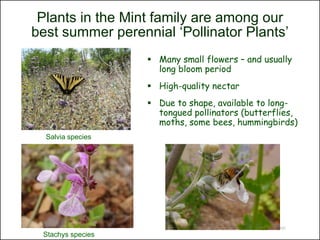
Plants in the Mint family are among our
best summer perennial ‘Pollinator Plants’
                    Many small flowers – and usually
                     long bloom period
                    High-quality nectar
                    Due to shape, available to long-
                     tongued pollinators (butterflies,
                     moths, some bees, hummingbirds)
  Salvia species


                                           © Project SOUND
 Stachys species
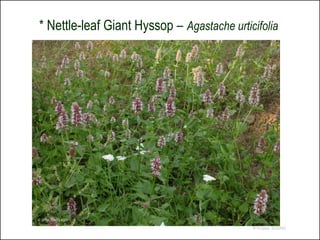
* Nettle-leaf Giant Hyssop – Agastache urticifolia


© 2004, Ben Legler

                                            © Project SOUND
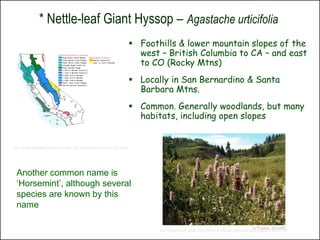
* Nettle-leaf Giant Hyssop – Agastache urticifolia
                                                                         Foothills & lower mountain slopes of the
                                                                          west – British Columbia to CA – and east
                                                                          to CO (Rocky Mtns)
                                                                         Locally in San Bernardino & Santa
                                                                          Barbara Mtns.
                                                                         Common. Generally woodlands, but many
                                                                          habitats, including open slopes


http://ucjeps.berkeley.edu/cgi-bin/get_JM_treatment.pl?4745,4753,4755


 Another common name is
 ‘Horsemint’, although several
 species are known by this
 name

                                                                                                                                          © Project SOUND
                                                                               http://lh4.ggpht.com/_6r6fAoZCPVw/R8gH16PwAnI/AAAAAAAAAKk/AkQPvdqlLzE/HPIM2277.JPG
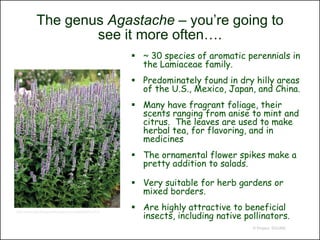
The genus Agastache – you’re going to
                   see it more often….
                                                   ~ 30 species of aromatic perennials in
                                                    the Lamiaceae family.
                                                   Predominately found in dry hilly areas
                                                    of the U.S., Mexico, Japan, and China.
                                                   Many have fragrant foliage, their
                                                    scents ranging from anise to mint and
                                                    citrus. The leaves are used to make
                                                    herbal tea, for flavoring, and in
                                                    medicines
                                                   The ornamental flower spikes make a
                                                    pretty addition to salads.

                                                   Very suitable for herb gardens or
                                                    mixed borders.
                                                   Are highly attractive to beneficial
                                                    insects, including native pollinators.
http://www.glenleagreenhouses.com/agastache.JPG


                                                                                © Project SOUND
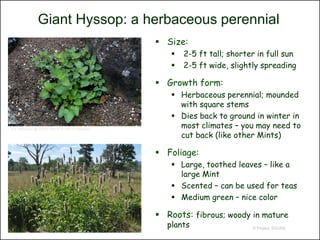
Giant Hyssop: a herbaceous perennial
                                             Size:
                                                  2-5 ft tall; shorter in full sun
                                                  2-5 ft wide, slightly spreading

                                             Growth form:
                                                Herbaceous perennial; mounded
                                                 with square stems
                                                Dies back to ground in winter in
J.S. Peterson @ USDA-NRCS PLANTS Database
                                                 most climates – you may need to
                                                 cut back (like other Mints)

                                             Foliage:
                                                Large, toothed leaves – like a
                                                 large Mint
                                                Scented – can be used for teas
                                                Medium green – nice color

                                             Roots: fibrous; woody in mature
                                              plants                  © Project SOUND
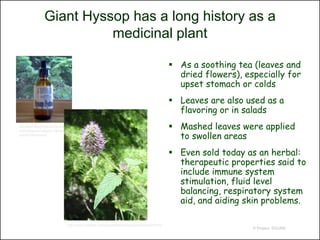
Giant Hyssop has a long history as a
                            medicinal plant

                                                                                                     As a soothing tea (leaves and
                                                                                                      dried flowers), especially for
                                                                                                      upset stomach or colds
                                                                                                     Leaves are also used as a
                                                                                                      flavoring or in salads
http://www.darcyfromtheforest.com/se
rvlet/Categories?category=Herbal+Pr
                                                                                                     Mashed leaves were applied
oducts%3AHydrosols
                                                                                                      to swollen areas
                                                                                                     Even sold today as an herbal:
                                                                                                      therapeutic properties said to
                                                                                                      include immune system
                                                                                                      stimulation, fluid level
                                                                                                      balancing, respiratory system
                                                                                                      aid, and aiding skin problems.

                                   http://www.calflora.net/recentfieldtrips/easternsierras09.html
                                                                                                                        © Project SOUND
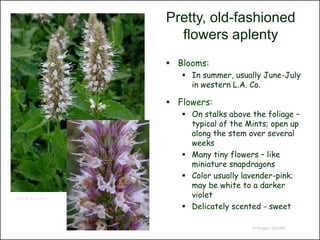
Pretty, old-fashioned
                       flowers aplenty
                      Blooms:
                         In summer, usually June-July
                          in western L.A. Co.

                      Flowers:
                         On stalks above the foliage –
                          typical of the Mints; open up
                          along the stem over several
                          weeks
                         Many tiny flowers – like
                          miniature snapdragons
                         Color usually lavender-pink;
                          may be white to a darker
© 2004, Ben Legler
                          violet
                         Delicately scented - sweet

                                          © Project SOUND
Propagation via
                                                                                    seed

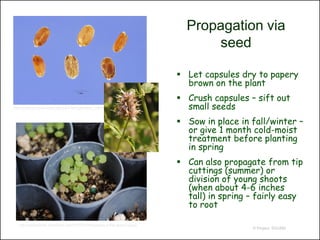
                                                                               Let capsules dry to papery
                                                                                brown on the plant
                                                                               Crush capsules – sift out
http://commons.wikimedia.org/wiki/File:Agastache_urticifolia_seeds.jpg          small seeds
                                                                               Sow in place in fall/winter –
                                                                                or give 1 month cold-moist
                                                                                treatment before planting
                                                                                in spring
                                                                               Can also propagate from tip
                                                                                cuttings (summer) or
                                                                                division of young shoots
                                                                                (when about 4-6 inches
                                                                                tall) in spring – fairly easy
                                                                                to root

   http://nativeplants.wordpress.com/2010/03/24/growing-in-the-green-house/
                                                                                                © Project SOUND
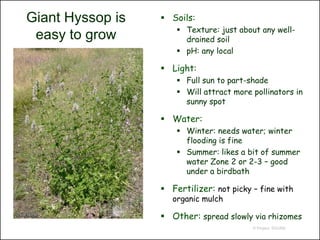
Giant Hyssop is    Soils:
                       Texture: just about any well-
 easy to grow           drained soil
                       pH: any local

                   Light:
                       Full sun to part-shade
                       Will attract more pollinators in
                        sunny spot

                   Water:
                       Winter: needs water; winter
                        flooding is fine
                       Summer: likes a bit of summer
                        water Zone 2 or 2-3 – good
                        under a birdbath

                   Fertilizer: not picky – fine with
                     organic mulch

                   Other: spread slowly via rhizomes
                                          © Project SOUND
Giant Hyssop adds a pastel
                                                                                         element to the summer garden
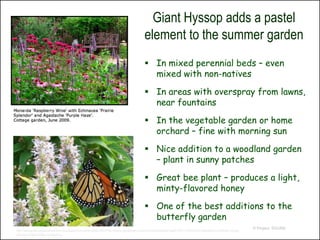
                                                                                          In mixed perennial beds – even
                                                                                           mixed with non-natives

                                                                                          In areas with overspray from lawns,
                                                                                           near fountains

                                                                                          In the vegetable garden or home
                                                                                           orchard – fine with morning sun

                                                                                          Nice addition to a woodland garden
                                                                                           – plant in sunny patches

                                                                                          Great bee plant – produces a light,
                                                                                           minty-flavored honey

                                                                                          One of the best additions to the
                                                                                           butterfly garden
                                                                                                                                                              © Project SOUND
http://webcache.googleusercontent.com/search?q=cache:qxNbk1BRhPMJ:forums.gardenweb.com/forums/load/salvia/msg021927179459.html+Agastache+urticifolia+propag
ation&cd=29&hl=en&ct=clnk&gl=us
Providing homes for native pollinators
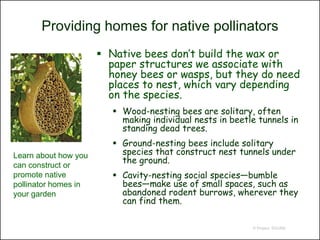
                       Native bees don’t build the wax or
                        paper structures we associate with
                        honey bees or wasps, but they do need
                        places to nest, which vary depending
                        on the species.
                          Wood-nesting bees are solitary, often
                           making individual nests in beetle tunnels in
                           standing dead trees.
                          Ground-nesting bees include solitary
Learn about how you        species that construct nest tunnels under
                           the ground.
can construct or
promote native            Cavity-nesting social species—bumble
pollinator homes in        bees—make use of small spaces, such as
your garden                abandoned rodent burrows, wherever they
                           can find them.

                                                           © Project SOUND
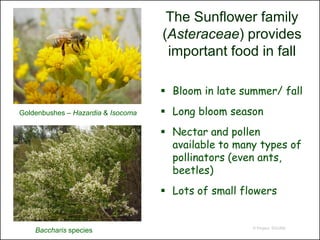
The Sunflower family
                                    (Asteraceae) provides
                                     important food in fall

                                     Bloom in late summer/ fall
Goldenbushes – Hazardia & Isocoma    Long bloom season
                                     Nectar and pollen
                                      available to many types of
                                      pollinators (even ants,
                                      beetles)
                                     Lots of small flowers


                                                      © Project SOUND
    Baccharis species
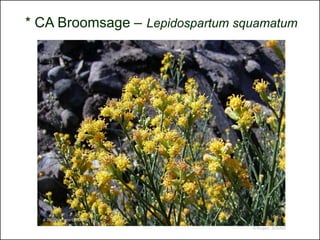
* CA Broomsage – Lepidospartum squamatum


  © 2003 BonTerra Consulting

                                 © Project SOUND
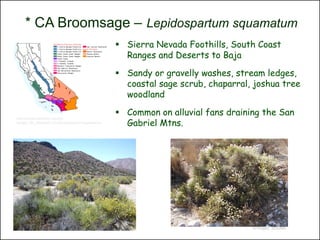
* CA Broomsage – Lepidospartum squamatum
                                                   Sierra Nevada Foothills, South Coast
                                                    Ranges and Deserts to Baja

                                                   Sandy or gravelly washes, stream ledges,
                                                    coastal sage scrub, chaparral, joshua tree
                                                    woodland

                                                   Common on alluvial fans draining the San
                                                    Gabriel Mtns.
http://ucjeps.berkeley.edu/cgi-
bin/get_JM_treatment.pl?Lepidospartum+squamatum


                                                                                  © Project SOUND
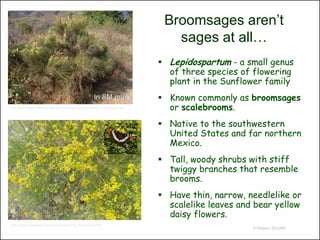
Broomsages aren’t
                                                                                     sages at all…
                                                                                   Lepidospartum - a small genus
                                                                                    of three species of flowering
                                                                                    plant in the Sunflower family
                                                          In SM mtns               Known commonly as broomsages
http://www.researchlearningcenter.com/bloom/species/Lepidospartum_squamatum.htm     or scalebrooms.
                                                                                   Native to the southwestern
                                                                                    United States and far northern
                                                                                    Mexico.
                                                                                   Tall, woody shrubs with stiff
                                                                                    twiggy branches that resemble
                                                                                    brooms.
                                                                                   Have thin, narrow, needlelike or
                                                                                    scalelike leaves and bear yellow
                                                                                    daisy flowers.
http://www.insectnet.com/photos/flora1/fl_scalebroom.htm
                                                                                                        © Project SOUND
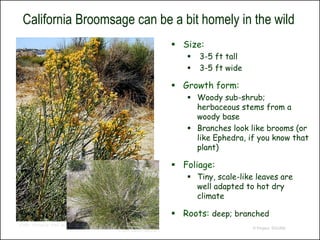
California Broomsage can be a bit homely in the wild
                                                         Size:
                                                              3-5 ft tall
                                                              3-5 ft wide

                                                         Growth form:
                                                            Woody sub-shrub;
                                                             herbaceous stems from a
                                                             woody base
                                                            Branches look like brooms (or
                                                             like Ephedra, if you know that
                                                             plant)

                                                         Foliage:
                                                            Tiny, scale-like leaves are
                                                             well adapted to hot dry
                                                             climate

                                                         Roots: deep; branched
© 2001 Thomas M. Elder, M.D.
                                                                             © Project SOUND
                               © 2009 Stanley Spencer
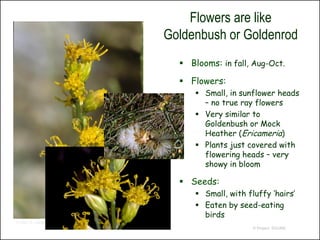
Flowers are like
                              Goldenbush or Goldenrod
                                 Blooms: in fall, Aug-Oct.

                                 Flowers:
                                     Small, in sunflower heads
                                      – no true ray flowers
                                     Very similar to
                                      Goldenbush or Mock
                                      Heather (Ericameria)
                                     Plants just covered with
                                      flowering heads – very
                                      showy in bloom

                                 Seeds:
                                     Small, with fluffy ‘hairs’
                                     Eaten by seed-eating
                                      birds
© 2004 Dr. Daniel L. Geiger
                                                    © Project SOUND
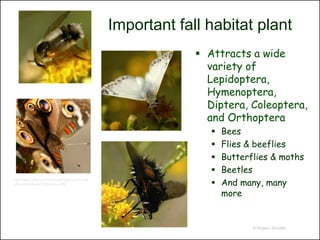
Important fall habitat plant
                                                              Attracts a wide
                                                               variety of
                                                               Lepidoptera,
                                                               Hymenoptera,
                                                               Diptera, Coleoptera,
                                                               and Orthoptera
                                                                   Bees
                                                                   Flies & beeflies
                                                                   Butterflies & moths
                                                                   Beetles
                                                                   And many, many
http://www.fotolog.com/treebeard/archive?v=da
y&month=8&year=2004&day=29


                                                                    more


                                                                           © Project SOUND
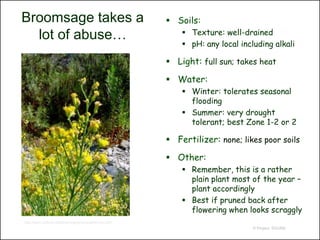
Broomsage takes a                                         Soils:
  lot of abuse…                                               Texture: well-drained
                                                              pH: any local including alkali

                                                          Light: full sun; takes heat

                                                          Water:
                                                              Winter: tolerates seasonal
                                                               flooding
                                                              Summer: very drought
                                                               tolerant; best Zone 1-2 or 2

                                                          Fertilizer: none; likes poor soils

                                                          Other:
                                                              Remember, this is a rather
                                                               plain plant most of the year –
                                                               plant accordingly
                                                              Best if pruned back after
                                                               flowering when looks scraggly
http://www.calflora.net/bloomingplants/scalebroom.html
                                                                                 © Project SOUND
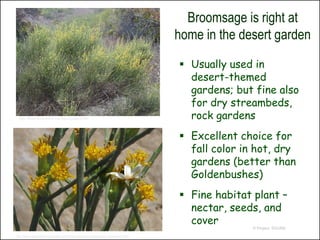
Broomsage is right at
                                                                                  home in the desert garden

                                                                                   Usually used in
                                                                                    desert-themed
                                                                                    gardens; but fine also
                                                                                    for dry streambeds,
 http://www.timetotrack.com/jay/scalebr4.htm                                        rock gardens
                                                                                   Excellent choice for
                                                                                    fall color in hot, dry
                                                                                    gardens (better than
                                                                                    Goldenbushes)
                                                                                   Fine habitat plant –
                                                                                    nectar, seeds, and
                                                                                    cover
                                                                                                 © Project SOUND

http://www.researchlearningcenter.com/bloom/species/Lepidospartum_squamatum.htm
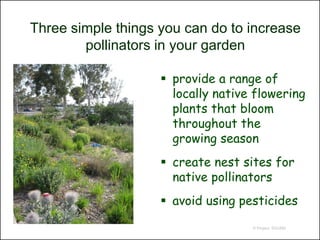
Three simple things you can do to increase
        pollinators in your garden

                     provide a range of
                      locally native flowering
                      plants that bloom
                      throughout the
                      growing season
                     create nest sites for
                      native pollinators
                     avoid using pesticides
                                    © Project SOUND
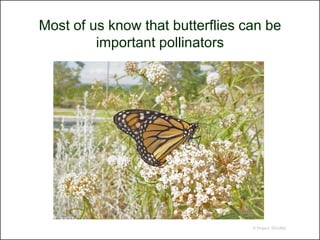
Most of us know that butterflies can be
         important pollinators


                                  © Project SOUND
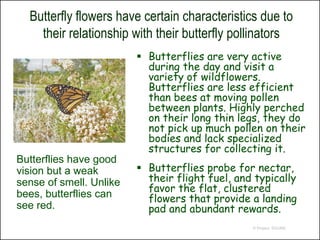
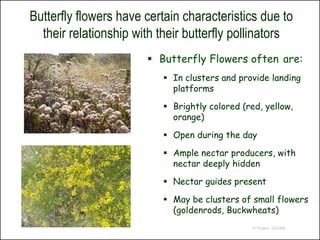
Butterfly flowers have certain characteristics due to
    their relationship with their butterfly pollinators
                          Butterflies are very active
                           during the day and visit a
                           variety of wildflowers.
                           Butterflies are less efficient
                           than bees at moving pollen
                           between plants. Highly perched
                           on their long thin legs, they do
                           not pick up much pollen on their
                           bodies and lack specialized
                           structures for collecting it.
Butterflies have good
vision but a weak         Butterflies probe for nectar,
sense of smell. Unlike     their flight fuel, and typically
                           favor the flat, clustered
bees, butterflies can      flowers that provide a landing
see red.                   pad and abundant rewards.
                                                 © Project SOUND
Butterfly flowers have certain characteristics due to
  their relationship with their butterfly pollinators
                        Butterfly Flowers often are:
                           In clusters and provide landing
                            platforms

                           Brightly colored (red, yellow,
                            orange)

                           Open during the day

                           Ample nectar producers, with
                            nectar deeply hidden

                           Nectar guides present

                           May be clusters of small flowers
                            (goldenrods, Buckwheats)
                                                © Project SOUND
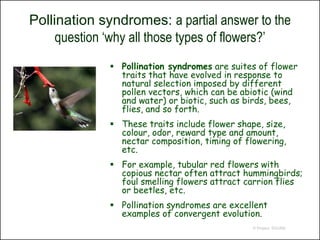
Pollination syndromes: a partial answer to the
     question ‘why all those types of flowers?’
               Pollination syndromes are suites of flower
                traits that have evolved in response to
                natural selection imposed by different
                pollen vectors, which can be abiotic (wind
                and water) or biotic, such as birds, bees,
                flies, and so forth.
               These traits include flower shape, size,
                colour, odor, reward type and amount,
                nectar composition, timing of flowering,
                etc.
               For example, tubular red flowers with
                copious nectar often attract hummingbirds;
                foul smelling flowers attract carrion flies
                or beetles, etc.
               Pollination syndromes are excellent
                examples of convergent evolution.
                                                © Project SOUND
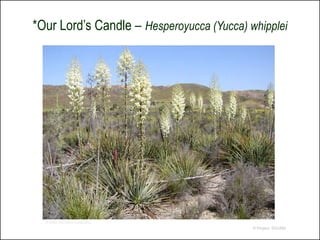
*Our Lord’s Candle – Hesperoyucca (Yucca) whipplei


  © 2003 BonTerra Consulting
                                           © Project SOUND
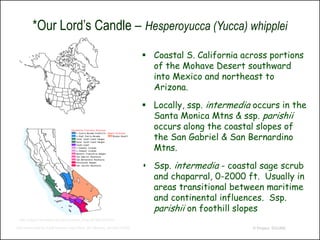
*Our Lord’s Candle – Hesperoyucca (Yucca) whipplei
                                                                        Coastal S. California across portions
                                                                         of the Mohave Desert southward
                                                                         into Mexico and northeast to
                                                                         Arizona.

                                                                        Locally, ssp. intermedia occurs in the
                                                                         Santa Monica Mtns & ssp. parishii
                                                                         occurs along the coastal slopes of
                                                                         the San Gabriel & San Bernardino
                                                                         Mtns.

                                                                        Ssp. intermedia - coastal sage scrub
                                                                         and chaparral, 0-2000 ft. Usually in
                                                                         areas transitional between maritime
                                                                         and continental influences. Ssp.
                                                                         parishii on foothill slopes
 http://ucjeps.berkeley.edu/cgi-bin/draw_jmap.pl?38c0235501

http://www.efloras.org/florataxon.aspx?flora_id=1&taxon_id=242101658                             © Project SOUND
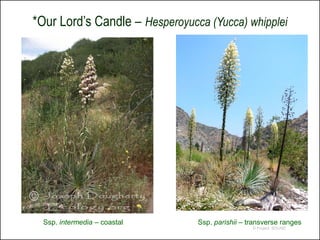
*Our Lord’s Candle – Hesperoyucca (Yucca) whipplei


                              © 2005 BonTerra Consulting


  Ssp. intermedia – coastal             Ssp. parishii – transverse ranges
                                                           © Project SOUND
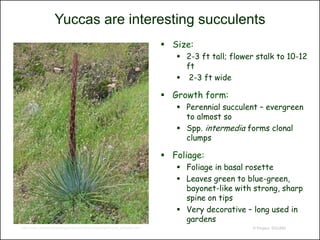
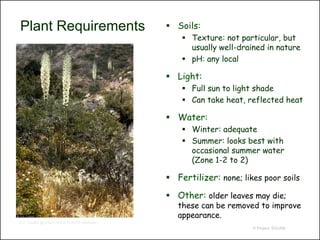
Yuccas are interesting succulents
                                                                          Size:
                                                                             2-3 ft tall; flower stalk to 10-12
                                                                              ft
                                                                             2-3 ft wide

                                                                          Growth form:
                                                                             Perennial succulent – evergreen
                                                                              to almost so
                                                                             Spp. intermedia forms clonal
                                                                              clumps

                                                                          Foliage:
                                                                             Foliage in basal rosette
                                                                             Leaves green to blue-green,
                                                                              bayonet-like with strong, sharp
                                                                              spine on tips
                                                                             Very decorative – long used in
 Glenn and Martha Vargas © California Academy of Sciences
                                                                              gardens
http://www.researchlearningcenter.com/bloom/species/Yucca_whipplei.htm                           © Project SOUND
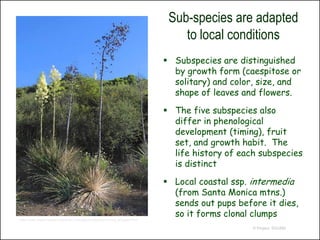
Sub-species are adapted
                                                                             to local conditions
                                                                          Subspecies are distinguished
                                                                           by growth form (caespitose or
                                                                           solitary) and color, size, and
                                                                           shape of leaves and flowers.

                                                                          The five subspecies also
                                                                           differ in phenological
                                                                           development (timing), fruit
                                                                           set, and growth habit. The
                                                                           life history of each subspecies
                                                                           is distinct

                                                                          Local coastal ssp. intermedia
                                                                           (from Santa Monica mtns.)
                                                                           sends out pups before it dies,
                                                                           so it forms clonal clumps
http://www.researchlearningcenter.com/bloom/species/Yucca_whipplei.htm

                                                                                              © Project SOUND
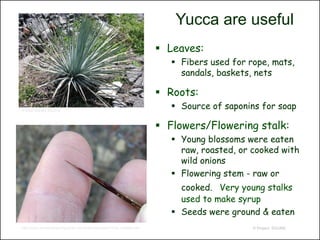
Yucca are useful
                                                                          Leaves:
                                                                             Fibers used for rope, mats,
                                                                              sandals, baskets, nets

                                                                          Roots:
© 2009 Stanley Spencer
                                                                             Source of saponins for soap

                                                                          Flowers/Flowering stalk:
                                                                             Young blossoms were eaten
                                                                              raw, roasted, or cooked with
                                                                              wild onions
                                                                             Flowering stem - raw or
                                                                              cooked. Very young stalks
                                                                              used to make syrup
                                                                             Seeds were ground & eaten
http://www.researchlearningcenter.com/bloom/species/Yucca_whipplei.htm                         © Project SOUND
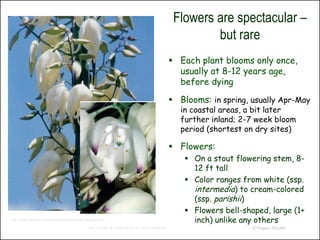
Flowers are spectacular –
                                                                                                   but rare
                                                                                           Each plant blooms only once,
                                                                                            usually at 8-12 years age,
                                                                                            before dying

                                                                                           Blooms: in spring, usually Apr-May
                                                                                             in coastal areas, a bit later
                                                                                             further inland; 2-7 week bloom
                                                                                             period (shortest on dry sites)

                                                                                           Flowers:
                                                                                               On a stout flowering stem, 8-
                                                                                                12 ft tall
                                                                                               Color ranges from white (ssp.
                                                                                                intermedia) to cream-colored
                                                                                                (ssp. parishii)
                                                                                               Flowers bell-shaped, large (1+
http://www.calflora.net/bloomingplants/chaparralyucca.html                                      inch) unlike any others
                                                G.A. Cooper @ USDA-NRCS PLANTS Database                         © Project SOUND
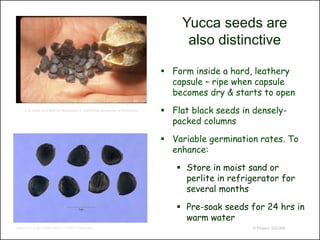
Yucca seeds are
                                                                             also distinctive

                                                                        Form inside a hard, leathery
                                                                         capsule – ripe when capsule
                                                                         becomes dry & starts to open
    J. E.(Jed) and Bonnie McClellan © California Academy of Sciences    Flat black seeds in densely-
                                                                         packed columns

                                                                        Variable germination rates. To
                                                                         enhance:

                                                                           Store in moist sand or
                                                                            perlite in refrigerator for
                                                                            several months

                                                                           Pre-soak seeds for 24 hrs in
                                                                            warm water
Steve Hurst @ USDA-NRCS PLANTS Database                                                     © Project SOUND
Plant Requirements                         Soils:
                                               Texture: not particular, but
                                                usually well-drained in nature
                                               pH: any local

                                           Light:
                                               Full sun to light shade
                                               Can take heat, reflected heat

                                           Water:
                                               Winter: adequate
                                               Summer: looks best with
                                                occasional summer water
                                                (Zone 1-2 to 2)

                                           Fertilizer: none; likes poor soils

                                           Other: older leaves may die;
                                             these can be removed to improve
                                             appearance.
G.A. Cooper @ USDA-NRCS PLANTS Database
                                                                 © Project SOUND
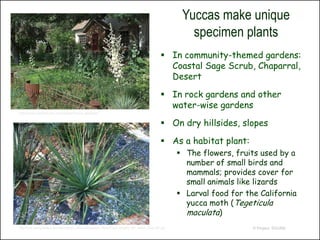
Yuccas make unique
                                                                                                            specimen plants
                                                                                                    In community-themed gardens:
                                                                                                     Coastal Sage Scrub, Chaparral,
                                                                                                     Desert

                                                                                                    In rock gardens and other
                                                                                                     water-wise gardens
http://www.baynatives.com/plants/Yucca-whipplei/


                                                                                                    On dry hillsides, slopes

                                                                                                    As a habitat plant:
                                                                                                          The flowers, fruits used by a
                                                                                                           number of small birds and
                                                                                                           mammals; provides cover for
                                                                                                           small animals like lizards
                                                                                                          Larval food for the California
                                                                                                           yucca moth (Tegeticula
                                                                                                           maculata)
http://www.bennyskaktus.dk/images/others_pictures/Alexander_Heim/Yucca_whipplei_GR_Herbst_2008_383.jpg                       © Project SOUND
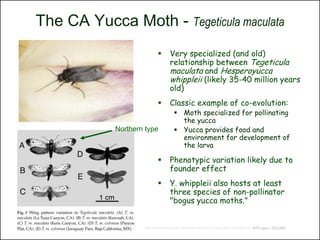
The CA Yucca Moth - Tegeticula maculata
                                 Very specialized (and old)
                                  relationship between Tegeticula
                                  maculata and Hesperoyucca
                                  whippleii (likely 35-40 million years
                                  old)
                                 Classic example of co-evolution:
                                     Moth specialized for pollinating
                                      the yucca
            Northern type            Yucca provides food and
                                      environment for development of
                                      the larva

                                 Phenotypic variation likely due to
                                  founder effect
                                 Y. whippleii also hosts at least
                                  three species of non-pollinator
                                  "bogus yucca moths."


                    http://plantecology.syr.edu/segraves/PDFs/Segraves%26Pellmyr'01.pdfProject SOUND
                                                                                    ©
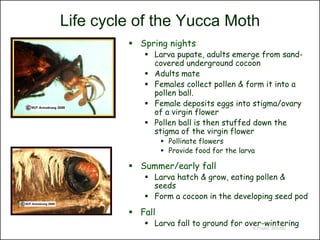
Life cycle of the Yucca Moth
          Spring nights
             Larva pupate, adults emerge from sand-
              covered underground cocoon
             Adults mate
             Females collect pollen & form it into a
              pollen ball.
             Female deposits eggs into stigma/ovary
              of a virgin flower
             Pollen ball is then stuffed down the
              stigma of the virgin flower
                   Pollinate flowers
                   Provide food for the larva

          Summer/early fall
             Larva hatch & grow, eating pollen &
              seeds
             Form a cocoon in the developing seed pod

          Fall
             Larva fall to ground for over-wintering
                                         © Project SOUND
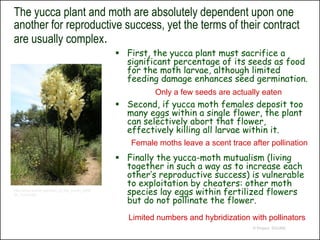
The yucca plant and moth are absolutely dependent upon one
another for reproductive success, yet the terms of their contract
are usually complex.
                                                First, the yucca plant must sacrifice a
                                                 significant percentage of its seeds as food
                                                 for the moth larvae, although limited
                                                 feeding damage enhances seed germination.
                                                         Only a few seeds are actually eaten
                                                Second, if yucca moth females deposit too
                                                 many eggs within a single flower, the plant
                                                 can selectively abort that flower,
                                                 effectively killing all larvae within it.
                                                  Female moths leave a scent trace after pollination
                                                Finally the yucca-moth mutualism (living
                                                 together in such a way as to increase each
                                                 other’s reproductive success) is vulnerable
                                                 to exploitation by cheaters: other moth
http://www.smmtc.org/plant_of_the_month_2006
                                                 species lay eggs within fertilized flowers
                                                 but do not pollinate the flower.
06_Yucca.htm


                                                  Limited numbers and hybridization with pollinators
                                                                                     © Project SOUND
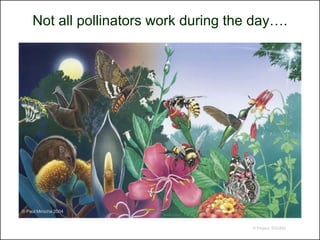
Not all pollinators work during the day….


© Paul Mirocha 2004


                                       © Project SOUND
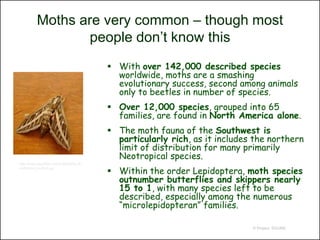
Moths are very common – though most
                   people don’t know this
                                               With over 142,000 described species
                                                worldwide, moths are a smashing
                                                evolutionary success, second among animals
                                                only to beetles in number of species.
                                               Over 12,000 species, grouped into 65
                                                families, are found in North America alone.
                                               The moth fauna of the Southwest is
                                                particularly rich, as it includes the northern
                                                limit of distribution for many primarily
                                                Neotropical species.
http://www.laspilitas.com/butterflylist_fil

                                               Within the order Lepidoptera, moth species
es/Sphinx_moth-2.jpg


                                                outnumber butterflies and skippers nearly
                                                15 to 1, with many species left to be
                                                described, especially among the numerous
                                                “microlepidopteran” families.

                                                                                 © Project SOUND
Moths & Butterflies are in the same Order

                                                                 Moths and Butterflies are very much
                                                                  alike, but there are several
                                                                  characteristics that Moths have that
                                                                  Butterflies don't:
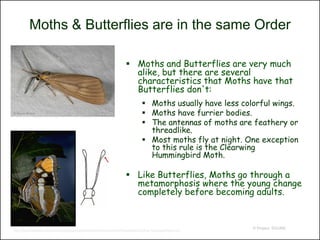
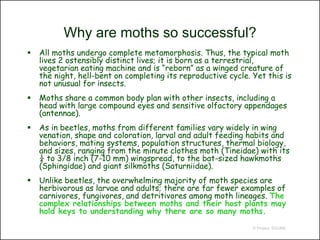
                                                                           Moths usually have less colorful wings.
                                                                           Moths have furrier bodies.
                                                                           The antennas of moths are feathery or
                                                                            threadlike.
                                                                           Most moths fly at night. One exception
                                                                            to this rule is the Clearwing
                                                                            Hummingbird Moth.

                                                                 Like Butterflies, Moths go through a
                                                                  metamorphosis where the young change
                                                                  completely before becoming adults.


                                                                                                       © Project SOUND
http://bscit.berkeley.edu/eme/lucidkeys/macromoths/Macromoth%20Key/Moths%20vs.%20butterflies.htm
Why are moths so successful?
   All moths undergo complete metamorphosis. Thus, the typical moth
    lives 2 ostensibly distinct lives; it is born as a terrestrial,
    vegetarian eating machine and is “reborn” as a winged creature of
    the night, hell-bent on completing its reproductive cycle. Yet this is
    not unusual for insects.
   Moths share a common body plan with other insects, including a
    head with large compound eyes and sensitive olfactory appendages
    (antennae).
   As in beetles, moths from different families vary widely in wing
    venation, shape and coloration, larval and adult feeding habits and
    behaviors, mating systems, population structures, thermal biology,
    and sizes, ranging from the minute clothes moth (Tineidae) with its
    ¼ to 3/8 inch (7-10 mm) wingspread, to the bat-sized hawkmoths
    (Sphingidae) and giant silkmoths (Saturniidae).
   Unlike beetles, the overwhelming majority of moth species are
    herbivorous as larvae and adults; there are far fewer examples of
    carnivores, fungivores, and detritivores among moth lineages. The
    complex relationships between moths and their host plants may
    hold keys to understanding why there are so many moths.
                                                               © Project SOUND
Moths, like butterflies, can be ‘picky eaters’
                                       The caterpillars of most moths are highly
                                        specialized - eat only one or a few plant
                                        species.
                                       Unfortunately, moth caterpillars are
                                        infamous for the exceptional cases; the
                                        decimation of crop plants by extreme
                                        generalists such as the cabbage looper
                                        (Trichoplusia ni; Noctuidae), and the
                                        destruction of wool clothing and stored
                                        grains by moths in the family Tineidae.
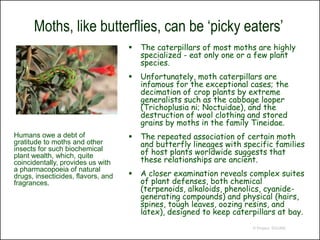
Humans owe a debt of                   The repeated association of certain moth
gratitude to moths and other            and butterfly lineages with specific families
insects for such biochemical
plant wealth, which, quite              of host plants worldwide suggests that
coincidentally, provides us with        these relationships are ancient.
a pharmacopoeia of natural
drugs, insecticides, flavors, and      A closer examination reveals complex suites
fragrances.                             of plant defenses, both chemical
                                        (terpenoids, alkaloids, phenolics, cyanide-
                                        generating compounds) and physical (hairs,
                                        spines, tough leaves, oozing resins, and
                                        latex), designed to keep caterpillars at bay.
                                                                      © Project SOUND
Moths, like butterflies, can be ‘picky eaters’
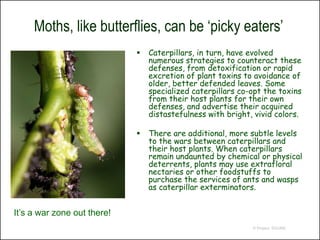
                                Caterpillars, in turn, have evolved
                                 numerous strategies to counteract these
                                 defenses, from detoxification or rapid
                                 excretion of plant toxins to avoidance of
                                 older, better defended leaves. Some
                                 specialized caterpillars co-opt the toxins
                                 from their host plants for their own
                                 defenses, and advertise their acquired
                                 distastefulness with bright, vivid colors.

                                There are additional, more subtle levels
                                 to the wars between caterpillars and
                                 their host plants. When caterpillars
                                 remain undaunted by chemical or physical
                                 deterrents, plants may use extrafloral
                                 nectaries or other foodstuffs to
                                 purchase the services of ants and wasps
                                 as caterpillar exterminators.


It’s a war zone out there!
                                                             © Project SOUND
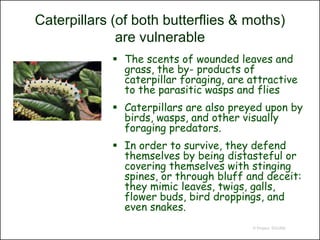
Caterpillars (of both butterflies & moths)
              are vulnerable
              The scents of wounded leaves and
               grass, the by- products of
               caterpillar foraging, are attractive
               to the parasitic wasps and flies
              Caterpillars are also preyed upon by
               birds, wasps, and other visually
               foraging predators.
              In order to survive, they defend
               themselves by being distasteful or
               covering themselves with stinging
               spines, or through bluff and deceit:
               they mimic leaves, twigs, galls,
               flower buds, bird droppings, and
               even snakes.
                                         © Project SOUND
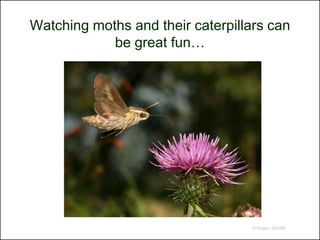
Watching moths and their caterpillars can
            be great fun…


                                   © Project SOUND
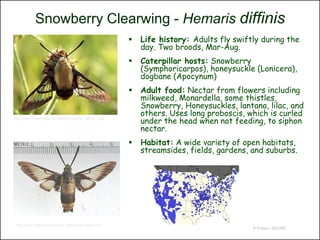
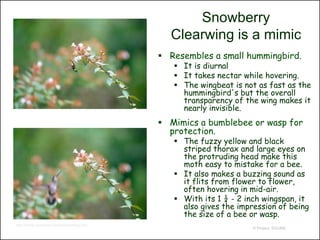
Snowberry Clearwing - Hemaris diffinis
                                                               Life history: Adults fly swiftly during the
                                                                day. Two broods, Mar-Aug.
                                                               Caterpillar hosts: Snowberry
                                                                (Symphoricarpos), honeysuckle (Lonicera),
                                                                dogbane (Apocynum)
                                                               Adult food: Nectar from flowers including
                                                                milkweed, Monardella, some thistles,
                                                                Snowberry, Honeysuckles, lantana, lilac, and
                                                                others. Uses long proboscis, which is curled
http://www.cirrusimage.com/Moths/Hemaris_diffinis_1.jpg
                                                                under the head when not feeding, to siphon
                                                                nectar.
                                                               Habitat: A wide variety of open habitats,
                                                                streamsides, fields, gardens, and suburbs.


 http://www.butterfliesunlimited.net/Species/diffinis.htm
                                                                                              © Project SOUND
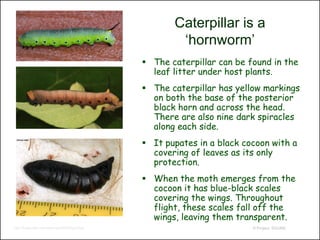
Caterpillar is a
                                                     ‘hornworm’
                                              The caterpillar can be found in the
                                               leaf litter under host plants.
                                              The caterpillar has yellow markings
                                               on both the base of the posterior
                                               black horn and across the head.
                                               There are also nine dark spiracles
                                               along each side.
                                              It pupates in a black cocoon with a
                                               covering of leaves as its only
                                               protection.
                                              When the moth emerges from the
                                               cocoon it has blue-black scales
                                               covering the wings. Throughout
                                               flight, these scales fall off the
                                               wings, leaving them transparent.
http://bugguide.net/node/view/2639/bgimage                             © Project SOUND
Snowberry
                                                   Clearwing is a mimic
                                                  Resembles a small hummingbird.
                                                     It is diurnal
                                                     It takes nectar while hovering.
                                                     The wingbeat is not as fast as the
                                                      hummingbird's but the overall
                                                      transparency of the wing makes it
                                                      nearly invisible.
                                                  Mimics a bumblebee or wasp for
                                                   protection.
                                                     The fuzzy yellow and black
                                                      striped thorax and large eyes on
                                                      the protruding head make this
                                                      moth easy to mistake for a bee.
                                                     It also makes a buzzing sound as
                                                      it flits from flower to flower,
                                                      often hovering in mid-air.
                                                     With its 1 ¼ - 2 inch wingspan, it
                                                      also gives the impression of being
                                                      the size of a bee or wasp.
http://home.centurytel.net/Arkcite/clrwing.htm
                                                                         © Project SOUND
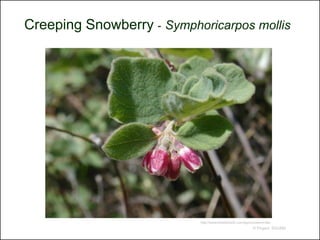
Creeping Snowberry - Symphoricarpos mollis


                           http://www.timetotrack.com/jay/snowbml.htm
                                                          © Project SOUND
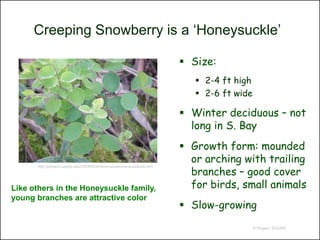
Creeping Snowberry is a ‘Honeysuckle’

                                                                              Size:
                                                                                 2-4 ft high
                                                                                 2-6 ft wide

                                                                              Winter deciduous – not
                                                                               long in S. Bay
                                                                              Growth form: mounded
                                                                               or arching with trailing
                                                                               branches – good cover
       http://polyland.calpoly.edu/OVERVIEW/Archives/derome/woodlands.html


Like others in the Honeysuckle family,                                         for birds, small animals
young branches are attractive color
                                                                              Slow-growing
                                                                                                © Project SOUND
Flowers & berries:
                                                                                understated

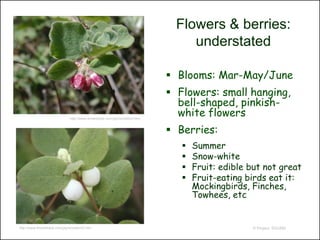
                                                                            Blooms: Mar-May/June
                                                                            Flowers: small hanging,
                                                                             bell-shaped, pinkish-
                              http://www.timetotrack.com/jay/snowbml.htm
                                                                             white flowers
                                                                            Berries:
                                                                                 Summer
                                                                                 Snow-white
                                                                                 Fruit: edible but not great
                                                                                 Fruit-eating birds eat it:
                                                                                  Mockingbirds, Finches,
                                                                                  Towhees, etc


http://www.timetotrack.com/jay/snowbml3.htm                                                      © Project SOUND
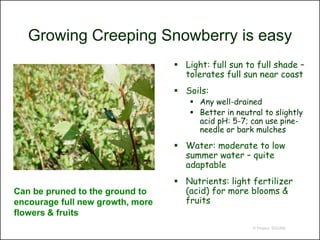
Growing Creeping Snowberry is easy
                                   Light: full sun to full shade –
                                    tolerates full sun near coast
                                   Soils:
                                       Any well-drained
                                       Better in neutral to slightly
                                        acid pH: 5-7; can use pine-
                                        needle or bark mulches

                                   Water: moderate to low
                                    summer water – quite
                                    adaptable
                                   Nutrients: light fertilizer
Can be pruned to the ground to      (acid) for more blooms &
encourage full new growth, more     fruits
flowers & fruits
                                                       © Project SOUND
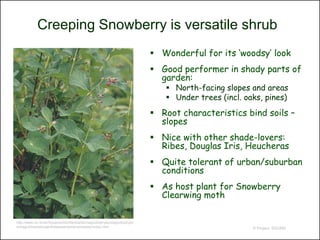
Creeping Snowberry is versatile shrub
                                                                                Wonderful for its ‘woodsy’ look
                                                                                Good performer in shady parts of
                                                                                 garden:
                                                                                   North-facing slopes and areas
                                                                                   Under trees (incl. oaks, pines)
                                                                                Root characteristics bind soils –
                                                                                 slopes
                                                                                Nice with other shade-lovers:
                                                                                 Ribes, Douglas Iris, Heucheras
                                                                                Quite tolerant of urban/suburban
                                                                                 conditions
                                                                                As host plant for Snowberry
                                                                                 Clearwing moth

http://www.nic.funet.fi/pub/sci/bio/life/plants/magnoliophyta/magnoliophytin
a/magnoliopsida/caprifoliaceae/symphoricarpos/index.html                                                 © Project SOUND
The moths of dawn
                                   and twilight
                                While earliest fossil moths
                                 suggest that they shared
                                 the world with dinosaurs
                                 and flying reptiles, we
                                 probably can never know if
                                 or when moths or their
                                 ancestors abandoned
                                 daylight for a relatively
                                 predator-free night.

                                The main night predators of
                                 moths are the bats

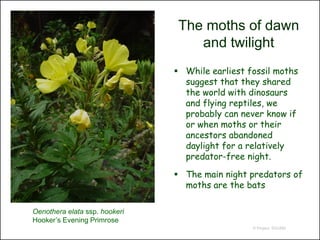
Oenothera elata ssp. hookeri
Hooker’s Evening Primrose
                                                 © Project SOUND
Moths have developed an array of strategies that enable them
        to avoid becoming evening snacks for a bat.
 Many night-flying moths have pairs of ears positioned on both
  sides of their abdomens that are tuned to exactly the sound
  frequencies emitted by hunting bats. These sensitive ears allow
  the moths to eavesdrop on the hunting cries of bats and to
  attempt to avoid them.
 Moths have two levels of escape behavior when they hear a bat:
     If their bat-detecting ears inform them that a bat is on the way, but
      still distant, the moth turns away from the direction that the cries
      are coming from and leaves the area.
     However, if the bat gets very close before it is detected, the moth
      suddenly executes a series of high-speed acrobatic maneuvers,
      usually ending in a dive for the ground or the shelter of bushes.
     Some moths confuse bats by emitting sounds similar to those emitted
      by a bat closing in on prey.
 Some moths (which don’t have ‘bat-detecting ears’) are either too
  small or too large to be suitable bat prey
 Other moths, which forage at dusk & dawn, have colors and
  sounds which communicate ‘I’m Too Toxic to Eat’    © Project SOUND
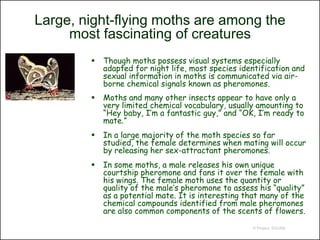
Large, night-flying moths are among the
     most fascinating of creatures
           Though moths possess visual systems especially
            adapted for night life, most species identification and
            sexual information in moths is communicated via air-
            borne chemical signals known as pheromones.
           Moths and many other insects appear to have only a
            very limited chemical vocabulary, usually amounting to
            “Hey baby, I’m a fantastic guy,” and “OK, I’m ready to
            mate.”
           In a large majority of the moth species so far
            studied, the female determines when mating will occur
            by releasing her sex-attractant pheromones.
           In some moths, a male releases his own unique
            courtship pheromone and fans it over the female with
            his wings. The female moth uses the quantity or
            quality of the male’s pheromone to assess his “quality”
            as a potential mate. It is interesting that many of the
            chemical compounds identified from male pheromones
            are also common components of the scents of flowers.
                                                    © Project SOUND
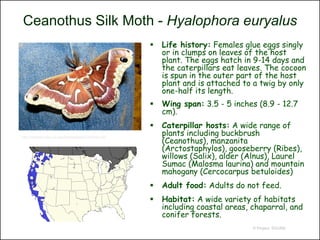
Ceanothus Silk Moth - Hyalophora euryalus
                                                            Life history: Females glue eggs singly
                                                             or in clumps on leaves of the host
                                                             plant. The eggs hatch in 9-14 days and
                                                             the caterpillars eat leaves. The cocoon
                                                             is spun in the outer part of the host
                                                             plant and is attached to a twig by only
                                                             one-half its length.
                                                            Wing span: 3.5 - 5 inches (8.9 - 12.7
                                                             cm).
                                                            Caterpillar hosts: A wide range of
                                                             plants including buckbrush
                                                             (Ceanothus), manzanita
http://nathistoc.bio.uci.edu/lepidopt/saturn/He/He.htm


                                                             (Arctostaphylos), gooseberry (Ribes),
                                                             willows (Salix), alder (Alnus), Laurel
                                                             Sumac (Malosma laurina) and mountain
                                                             mahogany (Cercocarpus betuloides)
                                                            Adult food: Adults do not feed.
                                                            Habitat: A wide variety of habitats
                                                             including coastal areas, chaparral, and
                                                             conifer forests.
                                                                                      © Project SOUND
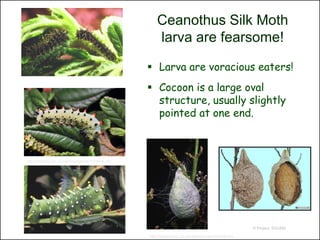
Ceanothus Silk Moth
                                                             larva are fearsome!

                                                          Larva are voracious eaters!
                                                          Cocoon is a large oval
                                                           structure, usually slightly
                                                           pointed at one end.


http://nathistoc.bio.uci.edu/lepidopt/saturn/He/He.htm


                                                                                                                  © Project SOUND

                                                         http://nathistoc.bio.uci.edu/lepidopt/saturn/He/He.htm
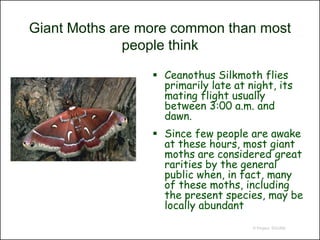
Giant Moths are more common than most
              people think

                  Ceanothus Silkmoth flies
                   primarily late at night, its
                   mating flight usually
                   between 3:00 a.m. and
                   dawn.
                  Since few people are awake
                   at these hours, most giant
                   moths are considered great
                   rarities by the general
                   public when, in fact, many
                   of these moths, including
                   the present species, may be
                   locally abundant
                                      © Project SOUND
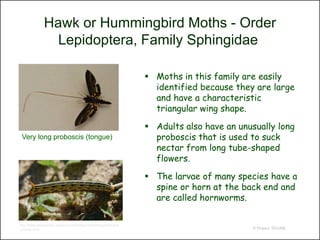
Hawk or Hummingbird Moths - Order
                 Lepidoptera, Family Sphingidae

                                                                  Moths in this family are easily
                                                                   identified because they are large
                                                                   and have a characteristic
                                                                   triangular wing shape.

                                                                  Adults also have an unusually long
 Very long proboscis (tongue)                                      proboscis that is used to suck
                                                                   nectar from long tube-shaped
                                                                   flowers.

                                                                  The larvae of many species have a
                                                                   spine or horn at the back end and
                                                                   are called hornworms.

http://www.arizonensis.org/sonoran/fieldguide/arthropoda/hyles
_lineata.html                                                                             © Project SOUND
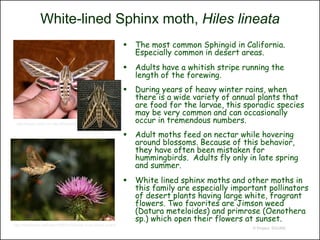
White-lined Sphinx moth, Hiles lineata
                                                                           The most common Sphingid in California.
                                                                            Especially common in desert areas.
                                                                           Adults have a whitish stripe running the
                                                                            length of the forewing.
                                                                           During years of heavy winter rains, when
                                                                            there is a wide variety of annual plants that
                                                                            are food for the larvae, this sporadic species
                                                                            may be very common and can occasionally
 http://people.uleth.ca/~dan.johnson/dj_IRF.htm
                                                                            occur in tremendous numbers.
                                                                           Adult moths feed on nectar while hovering
                                                                            around blossoms. Because of this behavior,
                                                                            they have often been mistaken for
                                                                            hummingbirds. Adults fly only in late spring
                                                                            and summer.
                                                                           White lined sphinx moths and other moths in
                                                                            this family are especially important pollinators
                                                                            of desert plants having large white, fragrant
                                                                            flowers. Two favorites are Jimson weed
                                                                            (Datura meteloides) and primrose (Oenothera
                                                                            sp.) which open their flowers at sunset.
http://fireflyforest.net/firefly/2006/03/30/white-lined-sphinx-moths/
                                                                                                            © Project SOUND
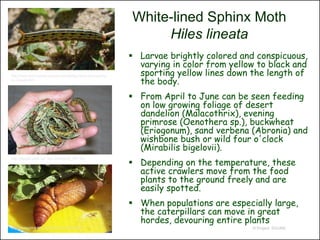
White-lined Sphinx Moth
                                                                    Hiles lineata
                                                                Larvae brightly colored and conspicuous,
                                                                 varying in color from yellow to black and
                                                                 sporting yellow lines down the length of
                                                                 the body.
http://www.arizonensis.org/sonoran/fieldguide/arthropoda/hyl
es_lineata.html


                                                                From April to June can be seen feeding
                                                                 on low growing foliage of desert
                                                                 dandelion (Malacothrix), evening
                                                                 primrose (Oenothera sp.), buckwheat
                                                                 (Eriogonum), sand verbena (Abronia) and
                                                                 wishbone bush or wild four o'clock
                                                                 (Mirabilis bigelovii).
                                                                Depending on the temperature, these
http://people.uleth.ca/~dan.johnson/dj_IRF.htm


                                                                 active crawlers move from the food
                                                                 plants to the ground freely and are
                                                                 easily spotted.
                                                                When populations are especially large,
                                                                 the caterpillars can move in great
                                                                 hordes, devouring entire plants
http://www.silkmoths.bizland.com/hlinelin.htm                                               © Project SOUND
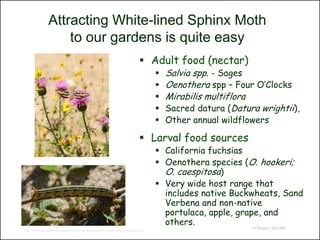
Attracting White-lined Sphinx Moth
                  to our gardens is quite easy
                                                                        Adult food (nectar)
                                                                                 Salvia spp. - Sages
                                                                                 Oenothera spp – Four O’Clocks
                                                                                 Mirabilis multiflora
                                                                                 Sacred datura (Datura wrightii),
                                                                                 Other annual wildflowers

                                                                        Larval food sources
                                                                               California fuchsias
                                                                               Oenothera species (O. hookeri;
                                                                                O. caespitosa)
                                                                               Very wide host range that
                                                                                includes native Buckwheats, Sand
                                                                                Verbena and non-native
                                                                                portulaca, apple, grape, and
                                                                                others.
                                                                                                      © Project SOUND
http://www.arizonensis.org/sonoran/fieldguide/arthropoda/hyles_lineata.html
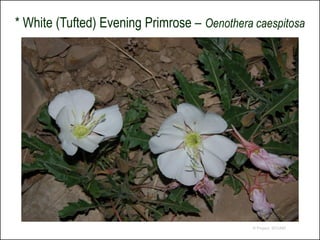
* White (Tufted) Evening Primrose – Oenothera caespitosa


                                             © Project SOUND
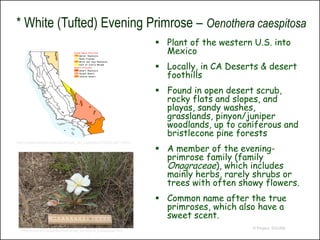
* White (Tufted) Evening Primrose – Oenothera caespitosa
                                                                         Plant of the western U.S. into
                                                                          Mexico
                                                                         Locally, in CA Deserts & desert
                                                                          foothills
                                                                         Found in open desert scrub,
                                                                          rocky flats and slopes, and
                                                                          playas, sandy washes,
                                                                          grasslands, pinyon/juniper
                                                                          woodlands, up to coniferous and
                                                                          bristlecone pine forests
http://ucjeps.berkeley.edu/cgi-bin/get_JM_treatment.pl?5263,5471,5473

                                                                         A member of the evening-
                                                                          primrose family (family
                                                                          Onagraceae), which includes
                                                                          mainly herbs, rarely shrubs or
                                                                          trees with often showy flowers.
                                                                         Common name after the true
                                                                          primroses, which also have a
                                                                          sweet scent.
                                                                                               © Project SOUND
   http://www.em.ca/garden/native/nat_oenothera_caespitosa.html
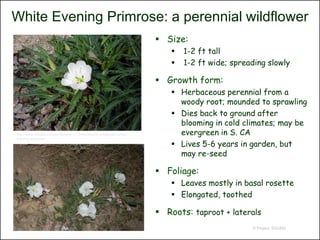
White Evening Primrose: a perennial wildflower
                                                                          Size:
                                                                                1-2 ft tall
                                                                                1-2 ft wide; spreading slowly

                                                                          Growth form:
                                                                              Herbaceous perennial from a
                                                                               woody root; mounded to sprawling
                                                                              Dies back to ground after
                                                                               blooming in cold climates; may be
http://www.fireflyforest.com/flowers/1725/oenothera-caespitosa-tufted-         evergreen in S. CA
evening-primrose/
                                                                              Lives 5-6 years in garden, but
                                                                               may re-seed

                                                                          Foliage:
                                                                              Leaves mostly in basal rosette
                                                                              Elongated, toothed

                                                                          Roots: taproot + laterals
                                                                                                   © Project SOUND
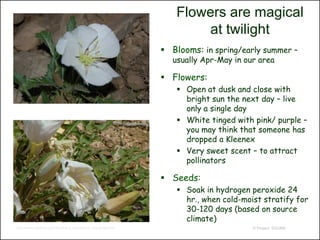
Flowers are magical
                                                                    at twilight
                                                              Blooms: in spring/early summer –
                                                               usually Apr-May in our area

                                                              Flowers:
                                                                 Open at dusk and close with
                                                                  bright sun the next day – live
                                                                  only a single day
                                                                 White tinged with pink/ purple –
                                                                  you may think that someone has
                                                                  dropped a Kleenex
                                                                 Very sweet scent – to attract
                                                                  pollinators

                                                              Seeds:
                                                                 Soak in hydrogen peroxide 24
                                                                  hr., when cold-moist stratify for
                                                                  30-120 days (based on source
                                                                  climate)
http://www.nazflora.org/Oenothera_caespitosa_marginata.htm                          © Project SOUND
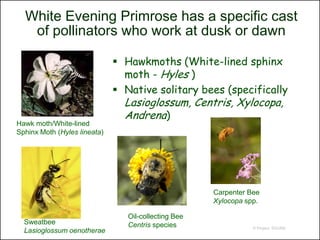
White Evening Primrose has a specific cast
   of pollinators who work at dusk or dawn

                               Hawkmoths (White-lined sphinx
                                moth - Hyles )
                               Native solitary bees (specifically
                                Lasioglossum, Centris, Xylocopa,
                                Andrena)
Hawk moth/White-lined
Sphinx Moth (Hyles lineata)


                                                      Carpenter Bee
                                                      Xylocopa spp.

                                 Oil-collecting Bee
  Sweatbee                       Centris species                 © Project SOUND
  Lasioglossum oenotherae
Moths are important pollinators in western U.S.
                Few people realize that the voracious hornworm, looper
                 and armyworm caterpillars eventually become nectar-
                 feeding adult moths that render important pollination
                 services to many of the same plants.
                Moth pollination is more prevalent in the Southwest than
                 in other regions due to warm evenings, hot daytimes,
                 favorable climate, and proximity to the moth-rich
                 canyons and thorn- scrub of northern Mexico.
                Moths visit flowers in search of nutritious rewards,
                 usually nectar, and transfer pollen as a consequence of
                 their contact with floral structures and forging
                 movements between flowers.
                Many night-blooming plant species, especially in desert
                 grasslands and dune areas, appear to be specialized for
                 moth pollination
                However, most moth-pollinated plants employ alternative
                 reproductive strategies. These include self-pollination,
                 recruiting other (diurnal, or day-active) pollinators, or
                 simply waiting for the next flowering season.
                Moth pollination is a risky proposition, and moth-flower
                 mutualisms are not very exclusive.
                                                          © Project SOUND
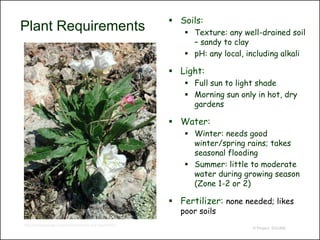
 Soils:
Plant Requirements                                               Texture: any well-drained soil
                                                                  – sandy to clay
                                                                 pH: any local, including alkali

                                                             Light:
                                                                 Full sun to light shade
                                                                 Morning sun only in hot, dry
                                                                  gardens

                                                             Water:
                                                                 Winter: needs good
                                                                  winter/spring rains; takes
                                                                  seasonal flooding
                                                                 Summer: little to moderate
                                                                  water during growing season
                                                                  (Zone 1-2 or 2)

                                                             Fertilizer: none needed; likes
                                                               poor soils
http://swbiodiversity.org/seinet/taxa/index.php?taxon=672
                                                                                  © Project SOUND
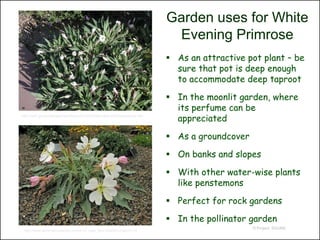
Garden uses for White
                                                                          Evening Primrose
                                                                          As an attractive pot plant – be
                                                                           sure that pot is deep enough
                                                                           to accommodate deep taproot

                                                                          In the moonlit garden, where
                                                                           its perfume can be
http://web.gccaz.edu/glendalelibrary/GLIS%20Oenothera%20caespitosa.htm
                                                                           appreciated

                                                                          As a groundcover

                                                                          On banks and slopes

                                                                          With other water-wise plants
                                                                           like penstemons

                                                                          Perfect for rock gardens

                                                                          In the pollinator garden
                                                                                              © Project SOUND
 http://www.windmillnurseryinc.com/m12_view_item.html?m12:item=119
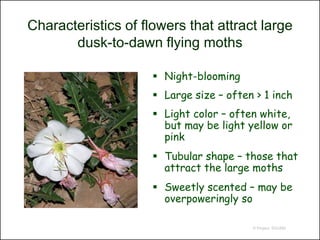
Characteristics of flowers that attract large
       dusk-to-dawn flying moths

                      Night-blooming
                      Large size – often > 1 inch
                      Light color – often white,
                       but may be light yellow or
                       pink
                      Tubular shape – those that
                       attract the large moths
                      Sweetly scented – may be
                       overpoweringly so

                                         © Project SOUND
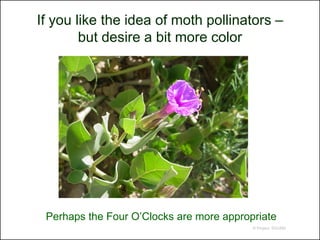
If you like the idea of moth pollinators –
        but desire a bit more color


 Perhaps the Four O’Clocks are more appropriate
                                          © Project SOUND
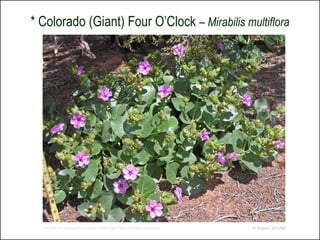
* Colorado (Giant) Four O’Clock – Mirabilis multiflora


  http://www.swcoloradowildflowers.com/pink%20enlarged%20photo%20pages/mirabilis.htm   © Project SOUND
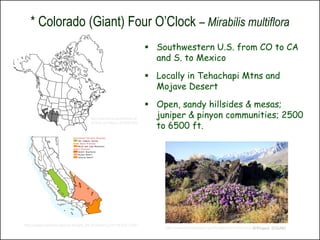
* Colorado (Giant) Four O’Clock – Mirabilis multiflora
                                                                                Southwestern U.S. from CO to CA
                                                                                 and S. to Mexico

                                                                                Locally in Tehachapi Mtns and
                                                                                 Mojave Desert

                                                                                Open, sandy hillsides & mesas;
                                        http://www.efloras.org/florataxon.as
                                                                                 juniper & pinyon communities; 2500
                                                                                 to 6500 ft.
                                        px?flora_id=1&taxon_id=242415050


http://ucjeps.berkeley.edu/cgi-bin/get_JM_treatment.pl?5194,5221,5231
                                                                                   http://www.comstockseed.com/Images/four%20oclock.JPG
                                                                                                                                    © Project SOUND
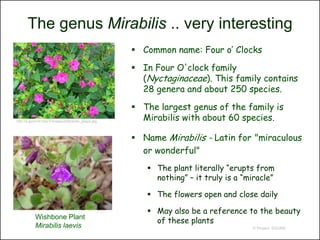
The genus Mirabilis .. very interesting
                                                         Common name: Four o’ Clocks

                                                         In Four O'clock family
                                                          (Nyctaginaceae). This family contains
                                                          28 genera and about 250 species.

                                                         The largest genus of the family is
http://a.gerard4.free.fr/images3/Mirabilis_jalapa.jpg
                                                          Mirabilis with about 60 species.

                                                         Name Mirabilis - Latin for "miraculous
                                                          or wonderful"
                                                            The plant literally “erupts from
                                                             nothing” – it truly is a “miracle”

                                                            The flowers open and close daily

                                                            May also be a reference to the beauty
            Wishbone Plant
                                                             of these plants
            Mirabilis laevis                                                            © Project SOUND
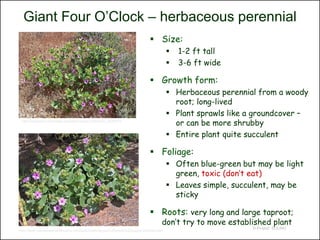
Giant Four O’Clock – herbaceous perennial
                                                                           Size:
                                                                                        1-2 ft tall
                                                                                        3-6 ft wide

                                                                           Growth form:
                                                                                      Herbaceous perennial from a woody
                                                                                       root; long-lived
                                                                                      Plant sprawls like a groundcover –
 http://commons.wikimedia.org/wiki/Category:Mirabilis_multiflora
                                                                                       or can be more shrubby
                                                                                      Entire plant quite succulent

                                                                           Foliage:
                                                                                      Often blue-green but may be light
                                                                                       green, toxic (don’t eat)
                                                                                      Leaves simple, succulent, may be
                                                                                       sticky

                                                                           Roots: very long and large taproot;
                                                                                 don’t try to move established plant
                                                                                                           © Project SOUND
http://www.swcoloradowildflowers.com/pink%20enlarged%20photo%20pages/mirabilis.htm
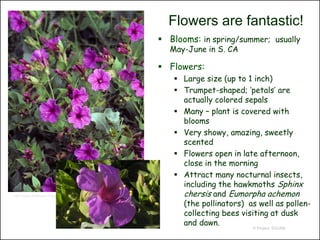
Flowers are fantastic!
                                                             Blooms: in spring/summer; usually
                                                              May-June in S. CA

                                                             Flowers:
                                                                Large size (up to 1 inch)
                                                                Trumpet-shaped; ‘petals’ are
                                                                 actually colored sepals
                                                                Many – plant is covered with
                                                                 blooms
                                                                Very showy, amazing, sweetly
                                                                 scented
                                                                Flowers open in late afternoon,
                                                                 close in the morning
                                                                Attract many nocturnal insects,
                                                                 including the hawkmoths Sphinx
http://www.wildflower.org/plants/result.php?id_plant=MIMU        chersis and Eumorpha achemon
                                                                 (the pollinators) as well as pollen-
                                                                 collecting bees visiting at dusk
                                                                 and dawn.
                                                                                    © Project SOUND
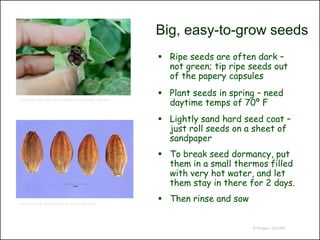
Big, easy-to-grow seeds
                                                          Ripe seeds are often dark –
                                                           not green; tip ripe seeds out
                                                           of the papery capsules
                                                          Plant seeds in spring – need
http://www.dbg.org/index.php/gardening/octobercalendar
                                                           daytime temps of 70º F
                                                          Lightly sand hard seed coat –
                                                           just roll seeds on a sheet of
                                                           sandpaper
                                                          To break seed dormancy, put
                                                           them in a small thermos filled
                                                           with very hot water, and let
                                                           them stay in there for 2 days.

Steve Hurst @ USDA-NRCS PLANTS Database
                                                          Then rinse and sow


                                                                                © Project SOUND
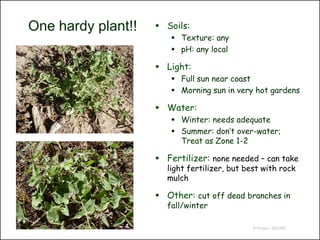
One hardy plant!!    Soils:
                         Texture: any
                         pH: any local

                     Light:
                         Full sun near coast
                         Morning sun in very hot gardens

                     Water:
                         Winter: needs adequate
                         Summer: don’t over-water;
                          Treat as Zone 1-2

                     Fertilizer: none needed – can take
                       light fertilizer, but best with rock
                       mulch

                     Other: cut off dead branches in
                       fall/winter

                                               © Project SOUND
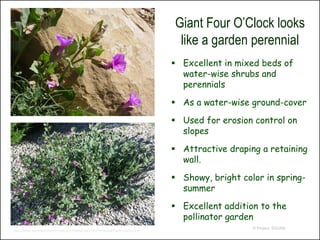
Giant Four O’Clock looks
                                                                               like a garden perennial
                                                                               Excellent in mixed beds of
                                                                                water-wise shrubs and
                                                                                perennials

                                                                               As a water-wise ground-cover

                                                                               Used for erosion control on
                                                                                slopes

                                                                               Attractive draping a retaining
                                                                                wall.

                                                                               Showy, bright color in spring-
                                                                                summer

                                                                               Excellent addition to the
                                                                                pollinator garden
                                                                                                 © Project SOUND
http://www.waterwiseplants.utah.gov/default.asp?p=PlantInfo&Plant=192&Cart=
Tips for creating an enjoyable moth garden
 Locate your ‘moth flowers’ so you can enjoy your nighttime
  experience.
    Situate your moth garden in an area that you can easily access after
     sundown, such as a porch, deck, courtyard or patio.
    Another prime location is a front-entry garden or one that borders
     a walkway, where you will see the moths when you come home.
    Extend the experience by growing night-bloomers near a window or
     in hanging baskets and window boxes so you can enjoy their
     presence and enticing night fragrances from inside your home.
 Use a combination of ‘moon garden’ plants and garden lighting to
  make your moth garden more magical and night-friendly.
    Use landscape lighting to illuminate certain features and light up a
     path.
    Or create visual impact with icicle lights weaving through an arbor
     or draped through a tree.
    Add the sound of moving water and the stage is set
 Then sit back and enjoy the show – it’s cheap and has lots of
  romance and thrills!!

                                                             © Project SOUND

Promoting pollinators 2010

  • 1.
    Out of theWilds and Into Your Garden Gardening with Western L.A. County Native Plants Project SOUND - 2010 © Project SOUND
  • 2.
    Promoting Pollinators C.M. Vadheim and T. Drake CSUDH & Madrona Marsh Preserve Madrona Marsh Preserve July 3 & 6, 2010 © Project SOUND
  • 3.
    Did you everwonder why there are so many types of flowers? © Project SOUND
  • 4.
    Sex and thesingle flower  Pollination is the act of transferring pollen grains from the male anther of a flower to the female stigma. © Project SOUND
  • 5.
    Sometimes physical agents transferthe pollen Only about 20% of plants are wind pollinated And <1% are water pollinated http://www.annerondepierre.com/wisdomarchive8.htm © Project SOUND
  • 6.
    So usually thepollinators are living organisms who carry the pollen from flower to flower © Project SOUND
  • 7.
    Why worry aboutliving pollinators?  They play a key role in the normal functioning of our local ecosystems  > 200,000 plant species worldwide depend on pollination  Imagine life without these plants  They are required for production of many of our food, medicinal and other crops  ~80% of the world’s crop plants depend on pollination – 150 crops in the U.S. alone  A combined annual $20+ billion industry in the U.S  Without them, our gardens would not sustain themselves © Project SOUND
  • 8.
     Pollinators areat risk:  Non-native pollinators are vulnerable to environmental factors - limited genetic variability [Example: Honeybee Colony Collapse Disorder]  Native pollinators are at risk due to habitat loss, climate change and use of pesticides Honeybee Colony Collapse Disorder  Crop production world-wide is decreasing due to decreasing numbers of pollinators  So we all should be worried – and taking action  The third week of June is designated National Pollinators Week (The fourth annual National Pollinator Week was June 21-27, 2010)! © Project SOUND
  • 9.
    Who are theliving (biotic) pollinators? Most common  Bees – of all sizes  Butterflies  Moths  Flies & other fly-like insects  Beetles  Hummingbirds  Ants  Bats Least common  Even small reptiles & mammals © Project SOUND
  • 10.
    What can wedo to promote our native pollinators?  Plant the plants they need for food – at all stages of their lives.  Provide places where they can reproduce and provide for their young  Protect them by practicing Integrated Pest Management – limited use of pesticides  Teach others – by word and example – about the importance of native pollinators © Project SOUND
  • 11.
    Native Plants canbe likened to theatrical settings. In its native home each plant species is the backdrop and producer of an age-old drama -- one with a well-rehearsed cast of actors, mostly insects. When an exotic plant or even a native but not locally indigenous species is moved to a new land or locale, the cast of actors is left behind, and there is no plot, no play, for an interested audience to witness and enjoy. Edward S. Ross from Butterfly Gardening, The Xerces Society and The Smithsonian © Project SOUND
  • 12.
    Why are someplants pollinator magnets? © Project SOUND
  • 13.
    Plant families &genera that provide nectar & pollen for a wide range of native pollinators  Polygonaceae – Buckwheat Family  Asteraceae – Sunflower family  Lamiaceae – Mint family Eriogonum - Buckwheat  Clematis – Virgin’s Bowers  Phacelia - Fiddlenecks © Project SOUND Grindelia - Gumplant
  • 14.
    Annual Phacelias are among our best general nectar sources in spring  Many flowers per stalk  Produce lots of high-quality nectar Large-flowered Phacelia - Phacelia grandiflora  Nectar is easy for many types of pollinators to get to  Open over a long period of time – open ‘up the stalk’  High flower to foliage ratio – lots of energy put into floral production  Easy to grow – under many conditions - dependable Tansey-leaf Phacelia – Phacelia tanecetifolia © Project SOUND
  • 15.
    * Desert Bluebells– Phacelia campanularia © Project SOUND
  • 16.
    * Desert Bluebells– Phacelia campanularia  Mojave Desert & N. and W. Sonoran Desert of California  Open dry, sandy or gravelly places below 4000 ft. http://ucjeps.berkeley.edu/cgi-bin/get_JM_treatment.pl?4518,4587,4601 © Project SOUND Gary A. Monroe @ USDA-NRCS PLANTS Database
  • 17.
    Desert Bluebells –an annual desert wildflower  Size:  1-2 ft tall  1-2+ ft wide  Growth form:  Annual wildflower  Mounded to somewhat sprawling shape - attractive  Stems often red-purple in color  Foliage:  Rounded, coarsely-toothed leaves – somewhat like Heuchera  Whole plant hairy/sticky – may cause mild skin allergies, so wear gloves to handle http://www.fireflyforest.com/flowers/1886/phacelia-campanularia-desertbells/ © Project SOUND
  • 18.
    Flowers are abright, pure blue  Blooms: in spring - usually Feb-Apr. in our area, but may be later  Flowers:  Small-medium size (to 1 inch)  Bell-shaped – typical for Phacelia http://www.hortmag.com/article/desertbluebells/  Bright, intense true blue – iridescent – difficult to photograph  Seeds:  In dry capsules  Relatively easy – no pre-treatment; just plant in place in fall/winter – germinate in spring  Serial sow for longer bloom season  Will reseed – but not extensively – http://www.delange.org/BlueBells/BlueBells.htm usually must re-seed © Project SOUND
  • 19.
     Soils: Plant Requirements  Texture: any well-drained; sandy & gravelly soils great  pH: any local  Light:  Full sun (best) to light shade  Water:  Winter/spring: need plenty of water during active growth  Summer: occasional deep water extends blooming; taper off as flowering ends  Fertilizer: fine in poor soils, OK with light fertilizer (like any of our annual wildflowers)  Other: seeds need bare soil/light gravel mulch to germinate; require http://www.theodorepayne.org/mediawiki/index.php?title=Phacelia_campanularia_var._campanulari light as germination cue. a&printable=yes&printable=yes © Project SOUND
  • 20.
    Annual ‘Pollenator Plants’ can be tucked in anywhere  Spilling out of pots & planters  Along garden paths – often short  Massed for spring color – pair http://back40feet.blogspot.com/2008/06/friday-night-botanical-garden.html with Tidy-tips or CA Poppy for a real zing!  Between native shrubs & sub- shrubs  Mixed with native desert grasses  In a rock or gravel garden  Fine in hot places © Project SOUND
  • 21.
    Advantages of ‘PollinatorPlants’ for the home garden  They are often showy & pretty; usually lots of blooms and attractive scents (remember, they have to attract their pollinators)  They will increase pollination of food plants, leading to better production  They will attract wonderful insects to your garden – hours of entertainment for the whole family (or neighborhood)  They are ecologically sound – an important part of local ecosystems © Project SOUND
  • 22.
    Plants in theMint family are among our best summer perennial ‘Pollinator Plants’  Many small flowers – and usually long bloom period  High-quality nectar  Due to shape, available to long- tongued pollinators (butterflies, moths, some bees, hummingbirds) Salvia species © Project SOUND Stachys species
  • 23.
    * Nettle-leaf GiantHyssop – Agastache urticifolia © 2004, Ben Legler © Project SOUND
  • 24.
    * Nettle-leaf GiantHyssop – Agastache urticifolia  Foothills & lower mountain slopes of the west – British Columbia to CA – and east to CO (Rocky Mtns)  Locally in San Bernardino & Santa Barbara Mtns.  Common. Generally woodlands, but many habitats, including open slopes http://ucjeps.berkeley.edu/cgi-bin/get_JM_treatment.pl?4745,4753,4755 Another common name is ‘Horsemint’, although several species are known by this name © Project SOUND http://lh4.ggpht.com/_6r6fAoZCPVw/R8gH16PwAnI/AAAAAAAAAKk/AkQPvdqlLzE/HPIM2277.JPG
  • 25.
    The genus Agastache– you’re going to see it more often….  ~ 30 species of aromatic perennials in the Lamiaceae family.  Predominately found in dry hilly areas of the U.S., Mexico, Japan, and China.  Many have fragrant foliage, their scents ranging from anise to mint and citrus. The leaves are used to make herbal tea, for flavoring, and in medicines  The ornamental flower spikes make a pretty addition to salads.  Very suitable for herb gardens or mixed borders.  Are highly attractive to beneficial insects, including native pollinators. http://www.glenleagreenhouses.com/agastache.JPG © Project SOUND
  • 26.
    Giant Hyssop: aherbaceous perennial  Size:  2-5 ft tall; shorter in full sun  2-5 ft wide, slightly spreading  Growth form:  Herbaceous perennial; mounded with square stems  Dies back to ground in winter in J.S. Peterson @ USDA-NRCS PLANTS Database most climates – you may need to cut back (like other Mints)  Foliage:  Large, toothed leaves – like a large Mint  Scented – can be used for teas  Medium green – nice color  Roots: fibrous; woody in mature plants © Project SOUND
  • 27.
    Giant Hyssop hasa long history as a medicinal plant  As a soothing tea (leaves and dried flowers), especially for upset stomach or colds  Leaves are also used as a flavoring or in salads http://www.darcyfromtheforest.com/se rvlet/Categories?category=Herbal+Pr  Mashed leaves were applied oducts%3AHydrosols to swollen areas  Even sold today as an herbal: therapeutic properties said to include immune system stimulation, fluid level balancing, respiratory system aid, and aiding skin problems. http://www.calflora.net/recentfieldtrips/easternsierras09.html © Project SOUND
  • 28.
    Pretty, old-fashioned flowers aplenty  Blooms:  In summer, usually June-July in western L.A. Co.  Flowers:  On stalks above the foliage – typical of the Mints; open up along the stem over several weeks  Many tiny flowers – like miniature snapdragons  Color usually lavender-pink; may be white to a darker © 2004, Ben Legler violet  Delicately scented - sweet © Project SOUND
  • 29.
    Propagation via seed  Let capsules dry to papery brown on the plant  Crush capsules – sift out http://commons.wikimedia.org/wiki/File:Agastache_urticifolia_seeds.jpg small seeds  Sow in place in fall/winter – or give 1 month cold-moist treatment before planting in spring  Can also propagate from tip cuttings (summer) or division of young shoots (when about 4-6 inches tall) in spring – fairly easy to root http://nativeplants.wordpress.com/2010/03/24/growing-in-the-green-house/ © Project SOUND
  • 30.
    Giant Hyssop is  Soils:  Texture: just about any well- easy to grow drained soil  pH: any local  Light:  Full sun to part-shade  Will attract more pollinators in sunny spot  Water:  Winter: needs water; winter flooding is fine  Summer: likes a bit of summer water Zone 2 or 2-3 – good under a birdbath  Fertilizer: not picky – fine with organic mulch  Other: spread slowly via rhizomes © Project SOUND
  • 31.
    Giant Hyssop addsa pastel element to the summer garden  In mixed perennial beds – even mixed with non-natives  In areas with overspray from lawns, near fountains  In the vegetable garden or home orchard – fine with morning sun  Nice addition to a woodland garden – plant in sunny patches  Great bee plant – produces a light, minty-flavored honey  One of the best additions to the butterfly garden © Project SOUND http://webcache.googleusercontent.com/search?q=cache:qxNbk1BRhPMJ:forums.gardenweb.com/forums/load/salvia/msg021927179459.html+Agastache+urticifolia+propag ation&cd=29&hl=en&ct=clnk&gl=us
  • 32.
    Providing homes fornative pollinators  Native bees don’t build the wax or paper structures we associate with honey bees or wasps, but they do need places to nest, which vary depending on the species.  Wood-nesting bees are solitary, often making individual nests in beetle tunnels in standing dead trees.  Ground-nesting bees include solitary Learn about how you species that construct nest tunnels under the ground. can construct or promote native  Cavity-nesting social species—bumble pollinator homes in bees—make use of small spaces, such as your garden abandoned rodent burrows, wherever they can find them. © Project SOUND
  • 33.
    The Sunflower family (Asteraceae) provides important food in fall  Bloom in late summer/ fall Goldenbushes – Hazardia & Isocoma  Long bloom season  Nectar and pollen available to many types of pollinators (even ants, beetles)  Lots of small flowers © Project SOUND Baccharis species
  • 34.
    * CA Broomsage– Lepidospartum squamatum © 2003 BonTerra Consulting © Project SOUND
  • 35.
    * CA Broomsage– Lepidospartum squamatum  Sierra Nevada Foothills, South Coast Ranges and Deserts to Baja  Sandy or gravelly washes, stream ledges, coastal sage scrub, chaparral, joshua tree woodland  Common on alluvial fans draining the San Gabriel Mtns. http://ucjeps.berkeley.edu/cgi- bin/get_JM_treatment.pl?Lepidospartum+squamatum © Project SOUND
  • 36.
    Broomsages aren’t sages at all…  Lepidospartum - a small genus of three species of flowering plant in the Sunflower family In SM mtns  Known commonly as broomsages http://www.researchlearningcenter.com/bloom/species/Lepidospartum_squamatum.htm or scalebrooms.  Native to the southwestern United States and far northern Mexico.  Tall, woody shrubs with stiff twiggy branches that resemble brooms.  Have thin, narrow, needlelike or scalelike leaves and bear yellow daisy flowers. http://www.insectnet.com/photos/flora1/fl_scalebroom.htm © Project SOUND
  • 37.
    California Broomsage canbe a bit homely in the wild  Size:  3-5 ft tall  3-5 ft wide  Growth form:  Woody sub-shrub; herbaceous stems from a woody base  Branches look like brooms (or like Ephedra, if you know that plant)  Foliage:  Tiny, scale-like leaves are well adapted to hot dry climate  Roots: deep; branched © 2001 Thomas M. Elder, M.D. © Project SOUND © 2009 Stanley Spencer
  • 38.
    Flowers are like Goldenbush or Goldenrod  Blooms: in fall, Aug-Oct.  Flowers:  Small, in sunflower heads – no true ray flowers  Very similar to Goldenbush or Mock Heather (Ericameria)  Plants just covered with flowering heads – very showy in bloom  Seeds:  Small, with fluffy ‘hairs’  Eaten by seed-eating birds © 2004 Dr. Daniel L. Geiger © Project SOUND
  • 39.
    Important fall habitatplant  Attracts a wide variety of Lepidoptera, Hymenoptera, Diptera, Coleoptera, and Orthoptera  Bees  Flies & beeflies  Butterflies & moths  Beetles  And many, many http://www.fotolog.com/treebeard/archive?v=da y&month=8&year=2004&day=29 more © Project SOUND
  • 40.
    Broomsage takes a  Soils: lot of abuse…  Texture: well-drained  pH: any local including alkali  Light: full sun; takes heat  Water:  Winter: tolerates seasonal flooding  Summer: very drought tolerant; best Zone 1-2 or 2  Fertilizer: none; likes poor soils  Other:  Remember, this is a rather plain plant most of the year – plant accordingly  Best if pruned back after flowering when looks scraggly http://www.calflora.net/bloomingplants/scalebroom.html © Project SOUND
  • 41.
    Broomsage is rightat home in the desert garden  Usually used in desert-themed gardens; but fine also for dry streambeds, http://www.timetotrack.com/jay/scalebr4.htm rock gardens  Excellent choice for fall color in hot, dry gardens (better than Goldenbushes)  Fine habitat plant – nectar, seeds, and cover © Project SOUND http://www.researchlearningcenter.com/bloom/species/Lepidospartum_squamatum.htm
  • 42.
    Three simple thingsyou can do to increase pollinators in your garden  provide a range of locally native flowering plants that bloom throughout the growing season  create nest sites for native pollinators  avoid using pesticides © Project SOUND
  • 43.
    Most of usknow that butterflies can be important pollinators © Project SOUND
  • 44.
    Butterfly flowers havecertain characteristics due to their relationship with their butterfly pollinators  Butterflies are very active during the day and visit a variety of wildflowers. Butterflies are less efficient than bees at moving pollen between plants. Highly perched on their long thin legs, they do not pick up much pollen on their bodies and lack specialized structures for collecting it. Butterflies have good vision but a weak  Butterflies probe for nectar, sense of smell. Unlike their flight fuel, and typically favor the flat, clustered bees, butterflies can flowers that provide a landing see red. pad and abundant rewards. © Project SOUND
  • 45.
    Butterfly flowers havecertain characteristics due to their relationship with their butterfly pollinators  Butterfly Flowers often are:  In clusters and provide landing platforms  Brightly colored (red, yellow, orange)  Open during the day  Ample nectar producers, with nectar deeply hidden  Nectar guides present  May be clusters of small flowers (goldenrods, Buckwheats) © Project SOUND
  • 46.
    Pollination syndromes: apartial answer to the question ‘why all those types of flowers?’  Pollination syndromes are suites of flower traits that have evolved in response to natural selection imposed by different pollen vectors, which can be abiotic (wind and water) or biotic, such as birds, bees, flies, and so forth.  These traits include flower shape, size, colour, odor, reward type and amount, nectar composition, timing of flowering, etc.  For example, tubular red flowers with copious nectar often attract hummingbirds; foul smelling flowers attract carrion flies or beetles, etc.  Pollination syndromes are excellent examples of convergent evolution. © Project SOUND
  • 47.
    *Our Lord’s Candle– Hesperoyucca (Yucca) whipplei © 2003 BonTerra Consulting © Project SOUND
  • 48.
    *Our Lord’s Candle– Hesperoyucca (Yucca) whipplei  Coastal S. California across portions of the Mohave Desert southward into Mexico and northeast to Arizona.  Locally, ssp. intermedia occurs in the Santa Monica Mtns & ssp. parishii occurs along the coastal slopes of the San Gabriel & San Bernardino Mtns.  Ssp. intermedia - coastal sage scrub and chaparral, 0-2000 ft. Usually in areas transitional between maritime and continental influences. Ssp. parishii on foothill slopes http://ucjeps.berkeley.edu/cgi-bin/draw_jmap.pl?38c0235501 http://www.efloras.org/florataxon.aspx?flora_id=1&taxon_id=242101658 © Project SOUND
  • 49.
    *Our Lord’s Candle– Hesperoyucca (Yucca) whipplei © 2005 BonTerra Consulting Ssp. intermedia – coastal Ssp. parishii – transverse ranges © Project SOUND
  • 50.
    Yuccas are interestingsucculents  Size:  2-3 ft tall; flower stalk to 10-12 ft  2-3 ft wide  Growth form:  Perennial succulent – evergreen to almost so  Spp. intermedia forms clonal clumps  Foliage:  Foliage in basal rosette  Leaves green to blue-green, bayonet-like with strong, sharp spine on tips  Very decorative – long used in Glenn and Martha Vargas © California Academy of Sciences gardens http://www.researchlearningcenter.com/bloom/species/Yucca_whipplei.htm © Project SOUND
  • 51.
    Sub-species are adapted to local conditions  Subspecies are distinguished by growth form (caespitose or solitary) and color, size, and shape of leaves and flowers.  The five subspecies also differ in phenological development (timing), fruit set, and growth habit. The life history of each subspecies is distinct  Local coastal ssp. intermedia (from Santa Monica mtns.) sends out pups before it dies, so it forms clonal clumps http://www.researchlearningcenter.com/bloom/species/Yucca_whipplei.htm © Project SOUND
  • 52.
    Yucca are useful  Leaves:  Fibers used for rope, mats, sandals, baskets, nets  Roots: © 2009 Stanley Spencer  Source of saponins for soap  Flowers/Flowering stalk:  Young blossoms were eaten raw, roasted, or cooked with wild onions  Flowering stem - raw or cooked. Very young stalks used to make syrup  Seeds were ground & eaten http://www.researchlearningcenter.com/bloom/species/Yucca_whipplei.htm © Project SOUND
  • 53.
    Flowers are spectacular– but rare  Each plant blooms only once, usually at 8-12 years age, before dying  Blooms: in spring, usually Apr-May in coastal areas, a bit later further inland; 2-7 week bloom period (shortest on dry sites)  Flowers:  On a stout flowering stem, 8- 12 ft tall  Color ranges from white (ssp. intermedia) to cream-colored (ssp. parishii)  Flowers bell-shaped, large (1+ http://www.calflora.net/bloomingplants/chaparralyucca.html inch) unlike any others G.A. Cooper @ USDA-NRCS PLANTS Database © Project SOUND
  • 54.
    Yucca seeds are also distinctive  Form inside a hard, leathery capsule – ripe when capsule becomes dry & starts to open J. E.(Jed) and Bonnie McClellan © California Academy of Sciences  Flat black seeds in densely- packed columns  Variable germination rates. To enhance:  Store in moist sand or perlite in refrigerator for several months  Pre-soak seeds for 24 hrs in warm water Steve Hurst @ USDA-NRCS PLANTS Database © Project SOUND
  • 55.
    Plant Requirements  Soils:  Texture: not particular, but usually well-drained in nature  pH: any local  Light:  Full sun to light shade  Can take heat, reflected heat  Water:  Winter: adequate  Summer: looks best with occasional summer water (Zone 1-2 to 2)  Fertilizer: none; likes poor soils  Other: older leaves may die; these can be removed to improve appearance. G.A. Cooper @ USDA-NRCS PLANTS Database © Project SOUND
  • 56.
    Yuccas make unique specimen plants  In community-themed gardens: Coastal Sage Scrub, Chaparral, Desert  In rock gardens and other water-wise gardens http://www.baynatives.com/plants/Yucca-whipplei/  On dry hillsides, slopes  As a habitat plant:  The flowers, fruits used by a number of small birds and mammals; provides cover for small animals like lizards  Larval food for the California yucca moth (Tegeticula maculata) http://www.bennyskaktus.dk/images/others_pictures/Alexander_Heim/Yucca_whipplei_GR_Herbst_2008_383.jpg © Project SOUND
  • 57.
    The CA YuccaMoth - Tegeticula maculata  Very specialized (and old) relationship between Tegeticula maculata and Hesperoyucca whippleii (likely 35-40 million years old)  Classic example of co-evolution:  Moth specialized for pollinating the yucca Northern type  Yucca provides food and environment for development of the larva  Phenotypic variation likely due to founder effect  Y. whippleii also hosts at least three species of non-pollinator "bogus yucca moths." http://plantecology.syr.edu/segraves/PDFs/Segraves%26Pellmyr'01.pdfProject SOUND ©
  • 58.
    Life cycle ofthe Yucca Moth  Spring nights  Larva pupate, adults emerge from sand- covered underground cocoon  Adults mate  Females collect pollen & form it into a pollen ball.  Female deposits eggs into stigma/ovary of a virgin flower  Pollen ball is then stuffed down the stigma of the virgin flower  Pollinate flowers  Provide food for the larva  Summer/early fall  Larva hatch & grow, eating pollen & seeds  Form a cocoon in the developing seed pod  Fall  Larva fall to ground for over-wintering © Project SOUND
  • 59.
    The yucca plantand moth are absolutely dependent upon one another for reproductive success, yet the terms of their contract are usually complex.  First, the yucca plant must sacrifice a significant percentage of its seeds as food for the moth larvae, although limited feeding damage enhances seed germination. Only a few seeds are actually eaten  Second, if yucca moth females deposit too many eggs within a single flower, the plant can selectively abort that flower, effectively killing all larvae within it. Female moths leave a scent trace after pollination  Finally the yucca-moth mutualism (living together in such a way as to increase each other’s reproductive success) is vulnerable to exploitation by cheaters: other moth http://www.smmtc.org/plant_of_the_month_2006 species lay eggs within fertilized flowers but do not pollinate the flower. 06_Yucca.htm Limited numbers and hybridization with pollinators © Project SOUND
  • 60.
    Not all pollinatorswork during the day…. © Paul Mirocha 2004 © Project SOUND
  • 61.
    Moths are verycommon – though most people don’t know this  With over 142,000 described species worldwide, moths are a smashing evolutionary success, second among animals only to beetles in number of species.  Over 12,000 species, grouped into 65 families, are found in North America alone.  The moth fauna of the Southwest is particularly rich, as it includes the northern limit of distribution for many primarily Neotropical species. http://www.laspilitas.com/butterflylist_fil  Within the order Lepidoptera, moth species es/Sphinx_moth-2.jpg outnumber butterflies and skippers nearly 15 to 1, with many species left to be described, especially among the numerous “microlepidopteran” families. © Project SOUND
  • 62.
    Moths & Butterfliesare in the same Order  Moths and Butterflies are very much alike, but there are several characteristics that Moths have that Butterflies don't:  Moths usually have less colorful wings.  Moths have furrier bodies.  The antennas of moths are feathery or threadlike.  Most moths fly at night. One exception to this rule is the Clearwing Hummingbird Moth.  Like Butterflies, Moths go through a metamorphosis where the young change completely before becoming adults. © Project SOUND http://bscit.berkeley.edu/eme/lucidkeys/macromoths/Macromoth%20Key/Moths%20vs.%20butterflies.htm
  • 63.
    Why are mothsso successful?  All moths undergo complete metamorphosis. Thus, the typical moth lives 2 ostensibly distinct lives; it is born as a terrestrial, vegetarian eating machine and is “reborn” as a winged creature of the night, hell-bent on completing its reproductive cycle. Yet this is not unusual for insects.  Moths share a common body plan with other insects, including a head with large compound eyes and sensitive olfactory appendages (antennae).  As in beetles, moths from different families vary widely in wing venation, shape and coloration, larval and adult feeding habits and behaviors, mating systems, population structures, thermal biology, and sizes, ranging from the minute clothes moth (Tineidae) with its ¼ to 3/8 inch (7-10 mm) wingspread, to the bat-sized hawkmoths (Sphingidae) and giant silkmoths (Saturniidae).  Unlike beetles, the overwhelming majority of moth species are herbivorous as larvae and adults; there are far fewer examples of carnivores, fungivores, and detritivores among moth lineages. The complex relationships between moths and their host plants may hold keys to understanding why there are so many moths. © Project SOUND
  • 64.
    Moths, like butterflies,can be ‘picky eaters’  The caterpillars of most moths are highly specialized - eat only one or a few plant species.  Unfortunately, moth caterpillars are infamous for the exceptional cases; the decimation of crop plants by extreme generalists such as the cabbage looper (Trichoplusia ni; Noctuidae), and the destruction of wool clothing and stored grains by moths in the family Tineidae. Humans owe a debt of  The repeated association of certain moth gratitude to moths and other and butterfly lineages with specific families insects for such biochemical plant wealth, which, quite of host plants worldwide suggests that coincidentally, provides us with these relationships are ancient. a pharmacopoeia of natural drugs, insecticides, flavors, and  A closer examination reveals complex suites fragrances. of plant defenses, both chemical (terpenoids, alkaloids, phenolics, cyanide- generating compounds) and physical (hairs, spines, tough leaves, oozing resins, and latex), designed to keep caterpillars at bay. © Project SOUND
  • 65.
    Moths, like butterflies,can be ‘picky eaters’  Caterpillars, in turn, have evolved numerous strategies to counteract these defenses, from detoxification or rapid excretion of plant toxins to avoidance of older, better defended leaves. Some specialized caterpillars co-opt the toxins from their host plants for their own defenses, and advertise their acquired distastefulness with bright, vivid colors.  There are additional, more subtle levels to the wars between caterpillars and their host plants. When caterpillars remain undaunted by chemical or physical deterrents, plants may use extrafloral nectaries or other foodstuffs to purchase the services of ants and wasps as caterpillar exterminators. It’s a war zone out there! © Project SOUND
  • 66.
    Caterpillars (of bothbutterflies & moths) are vulnerable  The scents of wounded leaves and grass, the by- products of caterpillar foraging, are attractive to the parasitic wasps and flies  Caterpillars are also preyed upon by birds, wasps, and other visually foraging predators.  In order to survive, they defend themselves by being distasteful or covering themselves with stinging spines, or through bluff and deceit: they mimic leaves, twigs, galls, flower buds, bird droppings, and even snakes. © Project SOUND
  • 67.
    Watching moths andtheir caterpillars can be great fun… © Project SOUND
  • 68.
    Snowberry Clearwing -Hemaris diffinis  Life history: Adults fly swiftly during the day. Two broods, Mar-Aug.  Caterpillar hosts: Snowberry (Symphoricarpos), honeysuckle (Lonicera), dogbane (Apocynum)  Adult food: Nectar from flowers including milkweed, Monardella, some thistles, Snowberry, Honeysuckles, lantana, lilac, and others. Uses long proboscis, which is curled http://www.cirrusimage.com/Moths/Hemaris_diffinis_1.jpg under the head when not feeding, to siphon nectar.  Habitat: A wide variety of open habitats, streamsides, fields, gardens, and suburbs. http://www.butterfliesunlimited.net/Species/diffinis.htm © Project SOUND
  • 69.
    Caterpillar is a ‘hornworm’  The caterpillar can be found in the leaf litter under host plants.  The caterpillar has yellow markings on both the base of the posterior black horn and across the head. There are also nine dark spiracles along each side.  It pupates in a black cocoon with a covering of leaves as its only protection.  When the moth emerges from the cocoon it has blue-black scales covering the wings. Throughout flight, these scales fall off the wings, leaving them transparent. http://bugguide.net/node/view/2639/bgimage © Project SOUND
  • 70.
    Snowberry Clearwing is a mimic  Resembles a small hummingbird.  It is diurnal  It takes nectar while hovering.  The wingbeat is not as fast as the hummingbird's but the overall transparency of the wing makes it nearly invisible.  Mimics a bumblebee or wasp for protection.  The fuzzy yellow and black striped thorax and large eyes on the protruding head make this moth easy to mistake for a bee.  It also makes a buzzing sound as it flits from flower to flower, often hovering in mid-air.  With its 1 ¼ - 2 inch wingspan, it also gives the impression of being the size of a bee or wasp. http://home.centurytel.net/Arkcite/clrwing.htm © Project SOUND
  • 71.
    Creeping Snowberry -Symphoricarpos mollis http://www.timetotrack.com/jay/snowbml.htm © Project SOUND
  • 72.
    Creeping Snowberry isa ‘Honeysuckle’  Size:  2-4 ft high  2-6 ft wide  Winter deciduous – not long in S. Bay  Growth form: mounded or arching with trailing branches – good cover http://polyland.calpoly.edu/OVERVIEW/Archives/derome/woodlands.html Like others in the Honeysuckle family, for birds, small animals young branches are attractive color  Slow-growing © Project SOUND
  • 73.
    Flowers & berries: understated  Blooms: Mar-May/June  Flowers: small hanging, bell-shaped, pinkish- http://www.timetotrack.com/jay/snowbml.htm white flowers  Berries:  Summer  Snow-white  Fruit: edible but not great  Fruit-eating birds eat it: Mockingbirds, Finches, Towhees, etc http://www.timetotrack.com/jay/snowbml3.htm © Project SOUND
  • 74.
    Growing Creeping Snowberryis easy  Light: full sun to full shade – tolerates full sun near coast  Soils:  Any well-drained  Better in neutral to slightly acid pH: 5-7; can use pine- needle or bark mulches  Water: moderate to low summer water – quite adaptable  Nutrients: light fertilizer Can be pruned to the ground to (acid) for more blooms & encourage full new growth, more fruits flowers & fruits © Project SOUND
  • 75.
    Creeping Snowberry isversatile shrub  Wonderful for its ‘woodsy’ look  Good performer in shady parts of garden:  North-facing slopes and areas  Under trees (incl. oaks, pines)  Root characteristics bind soils – slopes  Nice with other shade-lovers: Ribes, Douglas Iris, Heucheras  Quite tolerant of urban/suburban conditions  As host plant for Snowberry Clearwing moth http://www.nic.funet.fi/pub/sci/bio/life/plants/magnoliophyta/magnoliophytin a/magnoliopsida/caprifoliaceae/symphoricarpos/index.html © Project SOUND
  • 76.
    The moths ofdawn and twilight  While earliest fossil moths suggest that they shared the world with dinosaurs and flying reptiles, we probably can never know if or when moths or their ancestors abandoned daylight for a relatively predator-free night.  The main night predators of moths are the bats Oenothera elata ssp. hookeri Hooker’s Evening Primrose © Project SOUND
  • 77.
    Moths have developedan array of strategies that enable them to avoid becoming evening snacks for a bat.  Many night-flying moths have pairs of ears positioned on both sides of their abdomens that are tuned to exactly the sound frequencies emitted by hunting bats. These sensitive ears allow the moths to eavesdrop on the hunting cries of bats and to attempt to avoid them.  Moths have two levels of escape behavior when they hear a bat:  If their bat-detecting ears inform them that a bat is on the way, but still distant, the moth turns away from the direction that the cries are coming from and leaves the area.  However, if the bat gets very close before it is detected, the moth suddenly executes a series of high-speed acrobatic maneuvers, usually ending in a dive for the ground or the shelter of bushes.  Some moths confuse bats by emitting sounds similar to those emitted by a bat closing in on prey.  Some moths (which don’t have ‘bat-detecting ears’) are either too small or too large to be suitable bat prey  Other moths, which forage at dusk & dawn, have colors and sounds which communicate ‘I’m Too Toxic to Eat’ © Project SOUND
  • 78.
    Large, night-flying mothsare among the most fascinating of creatures  Though moths possess visual systems especially adapted for night life, most species identification and sexual information in moths is communicated via air- borne chemical signals known as pheromones.  Moths and many other insects appear to have only a very limited chemical vocabulary, usually amounting to “Hey baby, I’m a fantastic guy,” and “OK, I’m ready to mate.”  In a large majority of the moth species so far studied, the female determines when mating will occur by releasing her sex-attractant pheromones.  In some moths, a male releases his own unique courtship pheromone and fans it over the female with his wings. The female moth uses the quantity or quality of the male’s pheromone to assess his “quality” as a potential mate. It is interesting that many of the chemical compounds identified from male pheromones are also common components of the scents of flowers. © Project SOUND
  • 79.
    Ceanothus Silk Moth- Hyalophora euryalus  Life history: Females glue eggs singly or in clumps on leaves of the host plant. The eggs hatch in 9-14 days and the caterpillars eat leaves. The cocoon is spun in the outer part of the host plant and is attached to a twig by only one-half its length.  Wing span: 3.5 - 5 inches (8.9 - 12.7 cm).  Caterpillar hosts: A wide range of plants including buckbrush (Ceanothus), manzanita http://nathistoc.bio.uci.edu/lepidopt/saturn/He/He.htm (Arctostaphylos), gooseberry (Ribes), willows (Salix), alder (Alnus), Laurel Sumac (Malosma laurina) and mountain mahogany (Cercocarpus betuloides)  Adult food: Adults do not feed.  Habitat: A wide variety of habitats including coastal areas, chaparral, and conifer forests. © Project SOUND
  • 80.
    Ceanothus Silk Moth larva are fearsome!  Larva are voracious eaters!  Cocoon is a large oval structure, usually slightly pointed at one end. http://nathistoc.bio.uci.edu/lepidopt/saturn/He/He.htm © Project SOUND http://nathistoc.bio.uci.edu/lepidopt/saturn/He/He.htm
  • 81.
    Giant Moths aremore common than most people think  Ceanothus Silkmoth flies primarily late at night, its mating flight usually between 3:00 a.m. and dawn.  Since few people are awake at these hours, most giant moths are considered great rarities by the general public when, in fact, many of these moths, including the present species, may be locally abundant © Project SOUND
  • 82.
    Hawk or HummingbirdMoths - Order Lepidoptera, Family Sphingidae  Moths in this family are easily identified because they are large and have a characteristic triangular wing shape.  Adults also have an unusually long Very long proboscis (tongue) proboscis that is used to suck nectar from long tube-shaped flowers.  The larvae of many species have a spine or horn at the back end and are called hornworms. http://www.arizonensis.org/sonoran/fieldguide/arthropoda/hyles _lineata.html © Project SOUND
  • 83.
    White-lined Sphinx moth,Hiles lineata  The most common Sphingid in California. Especially common in desert areas.  Adults have a whitish stripe running the length of the forewing.  During years of heavy winter rains, when there is a wide variety of annual plants that are food for the larvae, this sporadic species may be very common and can occasionally http://people.uleth.ca/~dan.johnson/dj_IRF.htm occur in tremendous numbers.  Adult moths feed on nectar while hovering around blossoms. Because of this behavior, they have often been mistaken for hummingbirds. Adults fly only in late spring and summer.  White lined sphinx moths and other moths in this family are especially important pollinators of desert plants having large white, fragrant flowers. Two favorites are Jimson weed (Datura meteloides) and primrose (Oenothera sp.) which open their flowers at sunset. http://fireflyforest.net/firefly/2006/03/30/white-lined-sphinx-moths/ © Project SOUND
  • 84.
    White-lined Sphinx Moth Hiles lineata  Larvae brightly colored and conspicuous, varying in color from yellow to black and sporting yellow lines down the length of the body. http://www.arizonensis.org/sonoran/fieldguide/arthropoda/hyl es_lineata.html  From April to June can be seen feeding on low growing foliage of desert dandelion (Malacothrix), evening primrose (Oenothera sp.), buckwheat (Eriogonum), sand verbena (Abronia) and wishbone bush or wild four o'clock (Mirabilis bigelovii).  Depending on the temperature, these http://people.uleth.ca/~dan.johnson/dj_IRF.htm active crawlers move from the food plants to the ground freely and are easily spotted.  When populations are especially large, the caterpillars can move in great hordes, devouring entire plants http://www.silkmoths.bizland.com/hlinelin.htm © Project SOUND
  • 85.
    Attracting White-lined SphinxMoth to our gardens is quite easy  Adult food (nectar)  Salvia spp. - Sages  Oenothera spp – Four O’Clocks  Mirabilis multiflora  Sacred datura (Datura wrightii),  Other annual wildflowers  Larval food sources  California fuchsias  Oenothera species (O. hookeri; O. caespitosa)  Very wide host range that includes native Buckwheats, Sand Verbena and non-native portulaca, apple, grape, and others. © Project SOUND http://www.arizonensis.org/sonoran/fieldguide/arthropoda/hyles_lineata.html
  • 86.
    * White (Tufted)Evening Primrose – Oenothera caespitosa © Project SOUND
  • 87.
    * White (Tufted)Evening Primrose – Oenothera caespitosa  Plant of the western U.S. into Mexico  Locally, in CA Deserts & desert foothills  Found in open desert scrub, rocky flats and slopes, and playas, sandy washes, grasslands, pinyon/juniper woodlands, up to coniferous and bristlecone pine forests http://ucjeps.berkeley.edu/cgi-bin/get_JM_treatment.pl?5263,5471,5473  A member of the evening- primrose family (family Onagraceae), which includes mainly herbs, rarely shrubs or trees with often showy flowers.  Common name after the true primroses, which also have a sweet scent. © Project SOUND http://www.em.ca/garden/native/nat_oenothera_caespitosa.html
  • 88.
    White Evening Primrose:a perennial wildflower  Size:  1-2 ft tall  1-2 ft wide; spreading slowly  Growth form:  Herbaceous perennial from a woody root; mounded to sprawling  Dies back to ground after blooming in cold climates; may be http://www.fireflyforest.com/flowers/1725/oenothera-caespitosa-tufted- evergreen in S. CA evening-primrose/  Lives 5-6 years in garden, but may re-seed  Foliage:  Leaves mostly in basal rosette  Elongated, toothed  Roots: taproot + laterals © Project SOUND
  • 89.
    Flowers are magical at twilight  Blooms: in spring/early summer – usually Apr-May in our area  Flowers:  Open at dusk and close with bright sun the next day – live only a single day  White tinged with pink/ purple – you may think that someone has dropped a Kleenex  Very sweet scent – to attract pollinators  Seeds:  Soak in hydrogen peroxide 24 hr., when cold-moist stratify for 30-120 days (based on source climate) http://www.nazflora.org/Oenothera_caespitosa_marginata.htm © Project SOUND
  • 90.
    White Evening Primrosehas a specific cast of pollinators who work at dusk or dawn  Hawkmoths (White-lined sphinx moth - Hyles )  Native solitary bees (specifically Lasioglossum, Centris, Xylocopa, Andrena) Hawk moth/White-lined Sphinx Moth (Hyles lineata) Carpenter Bee Xylocopa spp. Oil-collecting Bee Sweatbee Centris species © Project SOUND Lasioglossum oenotherae
  • 91.
    Moths are importantpollinators in western U.S.  Few people realize that the voracious hornworm, looper and armyworm caterpillars eventually become nectar- feeding adult moths that render important pollination services to many of the same plants.  Moth pollination is more prevalent in the Southwest than in other regions due to warm evenings, hot daytimes, favorable climate, and proximity to the moth-rich canyons and thorn- scrub of northern Mexico.  Moths visit flowers in search of nutritious rewards, usually nectar, and transfer pollen as a consequence of their contact with floral structures and forging movements between flowers.  Many night-blooming plant species, especially in desert grasslands and dune areas, appear to be specialized for moth pollination  However, most moth-pollinated plants employ alternative reproductive strategies. These include self-pollination, recruiting other (diurnal, or day-active) pollinators, or simply waiting for the next flowering season.  Moth pollination is a risky proposition, and moth-flower mutualisms are not very exclusive. © Project SOUND
  • 92.
     Soils: Plant Requirements  Texture: any well-drained soil – sandy to clay  pH: any local, including alkali  Light:  Full sun to light shade  Morning sun only in hot, dry gardens  Water:  Winter: needs good winter/spring rains; takes seasonal flooding  Summer: little to moderate water during growing season (Zone 1-2 or 2)  Fertilizer: none needed; likes poor soils http://swbiodiversity.org/seinet/taxa/index.php?taxon=672 © Project SOUND
  • 93.
    Garden uses forWhite Evening Primrose  As an attractive pot plant – be sure that pot is deep enough to accommodate deep taproot  In the moonlit garden, where its perfume can be http://web.gccaz.edu/glendalelibrary/GLIS%20Oenothera%20caespitosa.htm appreciated  As a groundcover  On banks and slopes  With other water-wise plants like penstemons  Perfect for rock gardens  In the pollinator garden © Project SOUND http://www.windmillnurseryinc.com/m12_view_item.html?m12:item=119
  • 94.
    Characteristics of flowersthat attract large dusk-to-dawn flying moths  Night-blooming  Large size – often > 1 inch  Light color – often white, but may be light yellow or pink  Tubular shape – those that attract the large moths  Sweetly scented – may be overpoweringly so © Project SOUND
  • 95.
    If you likethe idea of moth pollinators – but desire a bit more color Perhaps the Four O’Clocks are more appropriate © Project SOUND
  • 96.
    * Colorado (Giant)Four O’Clock – Mirabilis multiflora http://www.swcoloradowildflowers.com/pink%20enlarged%20photo%20pages/mirabilis.htm © Project SOUND
  • 97.
    * Colorado (Giant)Four O’Clock – Mirabilis multiflora  Southwestern U.S. from CO to CA and S. to Mexico  Locally in Tehachapi Mtns and Mojave Desert  Open, sandy hillsides & mesas; http://www.efloras.org/florataxon.as juniper & pinyon communities; 2500 to 6500 ft. px?flora_id=1&taxon_id=242415050 http://ucjeps.berkeley.edu/cgi-bin/get_JM_treatment.pl?5194,5221,5231 http://www.comstockseed.com/Images/four%20oclock.JPG © Project SOUND
  • 98.
    The genus Mirabilis.. very interesting  Common name: Four o’ Clocks  In Four O'clock family (Nyctaginaceae). This family contains 28 genera and about 250 species.  The largest genus of the family is http://a.gerard4.free.fr/images3/Mirabilis_jalapa.jpg Mirabilis with about 60 species.  Name Mirabilis - Latin for "miraculous or wonderful"  The plant literally “erupts from nothing” – it truly is a “miracle”  The flowers open and close daily  May also be a reference to the beauty Wishbone Plant of these plants Mirabilis laevis © Project SOUND
  • 99.
    Giant Four O’Clock– herbaceous perennial  Size:  1-2 ft tall  3-6 ft wide  Growth form:  Herbaceous perennial from a woody root; long-lived  Plant sprawls like a groundcover – http://commons.wikimedia.org/wiki/Category:Mirabilis_multiflora or can be more shrubby  Entire plant quite succulent  Foliage:  Often blue-green but may be light green, toxic (don’t eat)  Leaves simple, succulent, may be sticky  Roots: very long and large taproot; don’t try to move established plant © Project SOUND http://www.swcoloradowildflowers.com/pink%20enlarged%20photo%20pages/mirabilis.htm
  • 100.
    Flowers are fantastic!  Blooms: in spring/summer; usually May-June in S. CA  Flowers:  Large size (up to 1 inch)  Trumpet-shaped; ‘petals’ are actually colored sepals  Many – plant is covered with blooms  Very showy, amazing, sweetly scented  Flowers open in late afternoon, close in the morning  Attract many nocturnal insects, including the hawkmoths Sphinx http://www.wildflower.org/plants/result.php?id_plant=MIMU chersis and Eumorpha achemon (the pollinators) as well as pollen- collecting bees visiting at dusk and dawn. © Project SOUND
  • 101.
    Big, easy-to-grow seeds  Ripe seeds are often dark – not green; tip ripe seeds out of the papery capsules  Plant seeds in spring – need http://www.dbg.org/index.php/gardening/octobercalendar daytime temps of 70º F  Lightly sand hard seed coat – just roll seeds on a sheet of sandpaper  To break seed dormancy, put them in a small thermos filled with very hot water, and let them stay in there for 2 days. Steve Hurst @ USDA-NRCS PLANTS Database  Then rinse and sow © Project SOUND
  • 102.
    One hardy plant!!  Soils:  Texture: any  pH: any local  Light:  Full sun near coast  Morning sun in very hot gardens  Water:  Winter: needs adequate  Summer: don’t over-water; Treat as Zone 1-2  Fertilizer: none needed – can take light fertilizer, but best with rock mulch  Other: cut off dead branches in fall/winter © Project SOUND
  • 103.
    Giant Four O’Clocklooks like a garden perennial  Excellent in mixed beds of water-wise shrubs and perennials  As a water-wise ground-cover  Used for erosion control on slopes  Attractive draping a retaining wall.  Showy, bright color in spring- summer  Excellent addition to the pollinator garden © Project SOUND http://www.waterwiseplants.utah.gov/default.asp?p=PlantInfo&Plant=192&Cart=
  • 104.
    Tips for creatingan enjoyable moth garden  Locate your ‘moth flowers’ so you can enjoy your nighttime experience.  Situate your moth garden in an area that you can easily access after sundown, such as a porch, deck, courtyard or patio.  Another prime location is a front-entry garden or one that borders a walkway, where you will see the moths when you come home.  Extend the experience by growing night-bloomers near a window or in hanging baskets and window boxes so you can enjoy their presence and enticing night fragrances from inside your home.  Use a combination of ‘moon garden’ plants and garden lighting to make your moth garden more magical and night-friendly.  Use landscape lighting to illuminate certain features and light up a path.  Or create visual impact with icicle lights weaving through an arbor or draped through a tree.  Add the sound of moving water and the stage is set  Then sit back and enjoy the show – it’s cheap and has lots of romance and thrills!! © Project SOUND