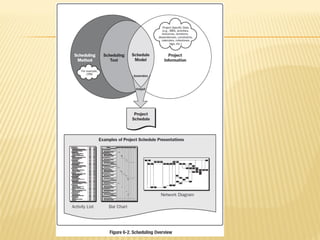
Project Time Management
Unit 6
Includes the processes required to manage
Timely completion of the project.
3
Planning
6.1 Plan Schedule management
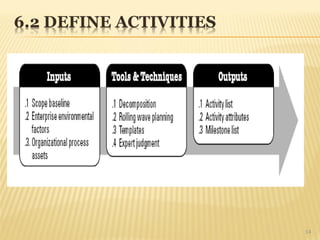
6.2 Define Activities
6.3 Sequence Activities
6.4 Estimate Activity Resources
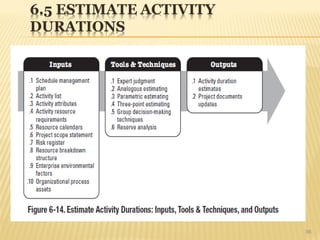
6.5 Estimate Activity Durations
6.6 Develop Schedule
Monitoring and controlling
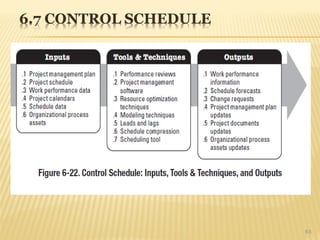
6.7 Control Schedule
6.1 Plan Schedule management
 Plan Schedule Management is the process of
establishing the policies, procedures, and
documentation for planning, developing,
managing, executing, and controlling the
project schedule. The key benefit of this
process is that it provides guidance and
direction on how the project schedule will be
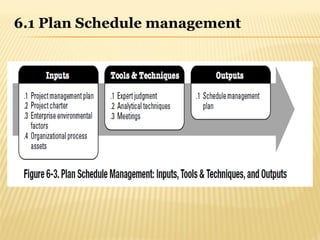
managed throughout the project. The inputs,
tools and techniques, and outputs of this
process are depicted in Figure 6-3.
 • Scope baseline. The scope baseline includes the project scope statement and
the work breakdown structure (WBS) details used for defining activities,
duration estimation, and schedule management; and Other information. Other
scheduling related cost, risk, and communications decisions from the project
management plan are used to develop the schedule.
 Project Charter Described in Section 4.1.3.1. The project charter defines the
summary milestone schedule and project approval requirements that will
influence the management of the project schedule.
 Enterprise Environmental Factors
• Organizational culture and structure can all influence schedule management;
• Resource availability and skills that may influence schedule planning;
• Project management software provides the scheduling tool and alternative possibilities for
managing the schedule;
• Published commercial information, such as resource productivity information, is often available
from commercial databases that track; and Organizational work authorization systems.
 Organizational Process Assets
 Expert Judgment
 Analytical Techniques : The Plan Schedule Management process may
involve choosing strategic options to estimate and schedule the
project such as: scheduling methodology, scheduling tools and
techniques, estimating approaches, formats, and project
management software
 Meetings : Project teams may hold planning meetings to develop the
schedule management plan. Participants at these meetings may
include the project manager, the project sponsor, selected project
team members, selected stakeholders, anyone with responsibility for
schedule planning or execution, and others as needed
 Schedule Management Plan
 Rules of performance measurement. Earned
value management (EVM) rules or other physical
measurement rules of performance measurement are
set
 Reporting formats.
 Process descriptions.
6.1 Plan Schedule management
 Identifying the specific actions to be performed to produce the
project deliverables
 Project work packages are typically decomposed into smaller
component called activities that represent the work necessary to
complete the work package.
 Activities provide a basis for estimating, scheduling, executing,
and monitoring and controlling the project work
9
10
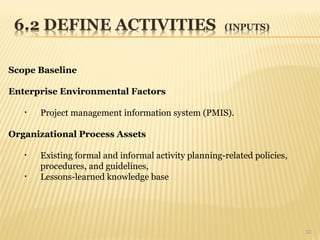
Scope Baseline
Enterprise Environmental Factors
• Project management information system (PMIS).
Organizational Process Assets
• Existing formal and informal activity planning-related policies,
procedures, and guidelines,
• Lessons-learned knowledge base
11
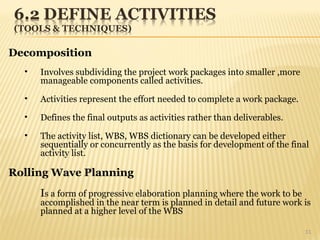
Decomposition
• Involves subdividing the project work packages into smaller ,more
manageable components called activities.
• Activities represent the effort needed to complete a work package.
• Defines the final outputs as activities rather than deliverables.
• The activity list, WBS, WBS dictionary can be developed either
sequentially or concurrently as the basis for development of the final
activity list.
Rolling Wave Planning
Is a form of progressive elaboration planning where the work to be
accomplished in the near term is planned in detail and future work is
planned at a higher level of the WBS
12
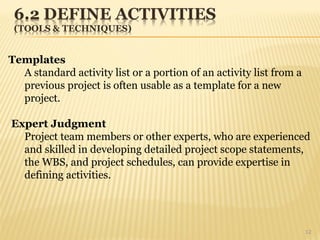
Templates
A standard activity list or a portion of an activity list from a
previous project is often usable as a template for a new
project.
Expert Judgment
Project team members or other experts, who are experienced
and skilled in developing detailed project scope statements,
the WBS, and project schedules, can provide expertise in
defining activities.
13
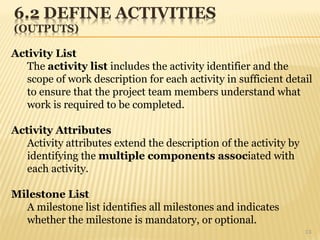
Activity List
The activity list includes the activity identifier and the
scope of work description for each activity in sufficient detail
to ensure that the project team members understand what
work is required to be completed.
Activity Attributes
Activity attributes extend the description of the activity by
identifying the multiple components associated with
each activity.
Milestone List
A milestone list identifies all milestones and indicates
whether the milestone is mandatory, or optional.
14
 Sequence activities is the process of identifying
and documenting relationships among the
project activities.
 It may be necessary to use lead or lag time
between activities to support a realistic and
achievable project schedule.
15
16
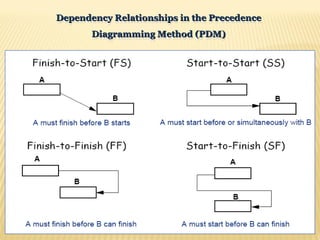
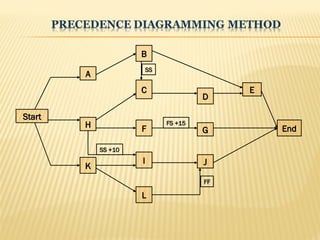
Dependency Relationships in the Precedence
Diagramming Method (PDM)
Dependency Determination
Three types of dependencies are used to define the
sequence among the activities
 Mandatory dependencies
 Those that are contractually required or inherent in the nature of the
work.
 Are also sometimes referred to as hard logic
 Discretionary dependencies ( optional )
 Discretionary dependencies are sometimes referred to as preferred,
or soft logic.
 Should be fully documented since they can create arbitrary total float
values and can Limit later scheduling options.
 External dependencies
 Involve a relationship between project activities and non-project
activities.
17
Applying Leads and Lags
A Lead
Allows an acceleration of the successor activity.
A Lag
Directs a delay in the successor activity
18
A
A
Start
Start
D
D
F
F
H
H
K
K
L
L
End
End
I
I
C
C
B
B
E
E
G
G
J
J
SS +10
SS +10
FS +15
FS +15
FF
FF
SS
SS
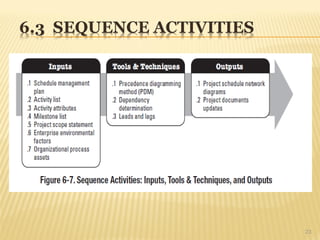
 Schedule Management Plan
 Activity List
 Activity Attributes
 Milestone List
 Project Scope Statement
 Organizational Process Assets
 Enterprise Environmental Factors
20
• Precedence Diagramming method (PDM)
• Dependency Determination
• Applying Leads and Lags
21
• Project schedule network diagram
– Are schematic displays of the project’s schedule
activities and the logical relationships among them.
– Can be produced manually or by using project
management software.
• Project document updates
Project documents that may be updated include:
• Activity lists,
• Activity attributes,
• Risk register
22
23
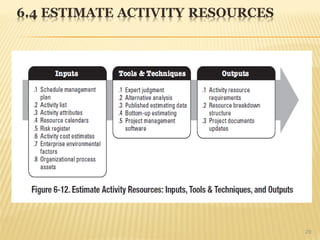
Estimate activity resources is the process of
estimating the type and quantities of material,
people, equipment, or supplies required to
perform each activity.
24
25
Schedule Management Plan
Activity List
Activity Attributes
Resource Calendars
• Specify when and how long identified project resources will be
available during the project.
Enterprise Environmental Factors
• Resource availability and skills.
Organizational Process Assets
• Policies and procedures regarding staffing,
• Policies and procedures relating to rental and purchase of supplies
and equipment, and
• Historical information regarding types of resources used for
similar work on previous projects.
26
Expert Judgment
Any group or person with specialized knowledge in resource planning
and estimating can provide such expertise.
Alternatives Analysis
Include using various levels of resources capability or skills, different
size or type of machines, different tools, and make-or-buy decisions
regarding the resources.
Published Estimating Data
Several companies routinely publish updated production rates and
unit costs of resources, and equipment for different countries, and
geographical locations within countries.
27
Bottom-Up Estimating
When an activity cannot be estimated with a reasonable degree of
confidence, the work within the activity is decomposed into more
detail. The resource needs are estimated. These estimates are then
aggregated into a total quantity for each of the activity’s resources.
Project Management Software
Project management software has the capability to help plan,
organize, and manage resources pools and develop resources
estimates
28
Activity Resource Requirements
Identifies the types and quantities of resources required for each
activity in a work package
Resource Breakdown Structure
The resource breakdown structure is a hierarchical structure of the
identified resources by resource category and resource type.
Project Document Updates
•Activity list,
•Activity attributes, and
•Resource calendars
29
• Is the process of approximating the number of work periods
needed to complete individual activities with estimated resources.
• The input for the estimates of activity duration originate from the
person or group on the project team who is most familiar with the
nature of the work in the specific activity.
• Most project management software for scheduling will handle this
situation by using project calendar and alternative work-period
resource calendars that are usually identified by the resource that
require specific work periods.
30
31
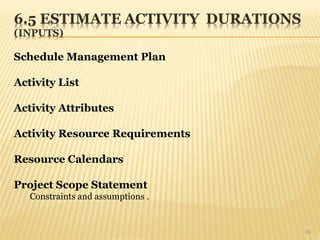
Schedule Management Plan
Activity List
Activity Attributes
Activity Resource Requirements
Resource Calendars
Project Scope Statement
Constraints and assumptions .
32
Enterprise Environmental Factors
• Duration estimating databases and other reference data,
• Productivity metrics, and
• Published commercial information.
Organizational Process Assets
• Historical duration information,
• Scheduling methodology, and
• Lessons learned.
33
Expert Judgment
Expert judgment can provide duration estimate information or recommend
maximum activity duration from prior similar projects.
Analogous Estimating
•This technique relies on the actual duration of previous similar projects as the
basis for estimating the duration of the current project.
•Generally less costly and time consuming than other techniques, but it is also
generally less accurate.
Reserve Analysis
Duration estimates may include contingency reserve, (time reserve or buffers)
into the overall project schedule to account for schedule uncertainty.
34
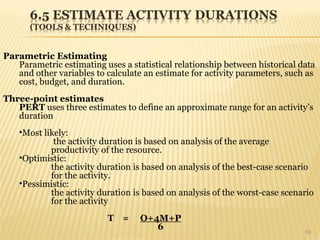
Parametric Estimating
Parametric estimating uses a statistical relationship between historical data
and other variables to calculate an estimate for activity parameters, such as
cost, budget, and duration.
Three-point estimates
PERT uses three estimates to define an approximate range for an activity’s
duration
•Most likely:
the activity duration is based on analysis of the average
productivity of the resource.
•Optimistic:
the activity duration is based on analysis of the best-case scenario
for the activity.
•Pessimistic:
the activity duration is based on analysis of the worst-case scenario
for the activity
T = O+4M+P
6
35
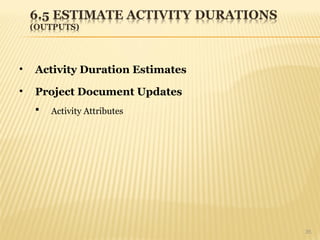
• Activity Duration Estimates
• Project Document Updates
 Activity Attributes
36
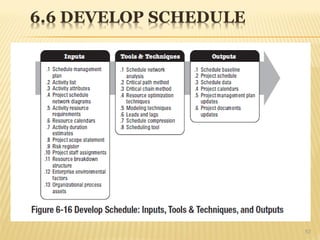
 Develop schedule is the process of analyzing
activity sequences, durations, resource
requirements, and schedule constraints to create
the project schedule.
 Developing an acceptable project schedule is
often an iterative process.
37
38
• Schedule Management Plan
• Activity List
• Activity Attributes
• Project Schedule network Diagrams
• Activity Resource Requirements
• Resource Calendars
• Activity Duration Estimates
• Project Scope Statement
• Enterprise Environmental Factors
• Organizational Process Assets
39
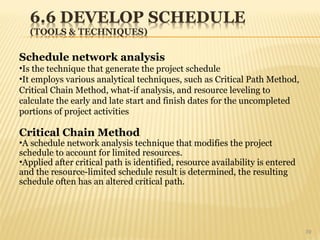
Schedule network analysis
•Is the technique that generate the project schedule
•It employs various analytical techniques, such as Critical Path Method,
Critical Chain Method, what-if analysis, and resource leveling to
calculate the early and late start and finish dates for the uncompleted
portions of project activities
Critical Chain Method
•A schedule network analysis technique that modifies the project
schedule to account for limited resources.
•Applied after critical path is identified, resource availability is entered
and the resource-limited schedule result is determined, the resulting
schedule often has an altered critical path.
40
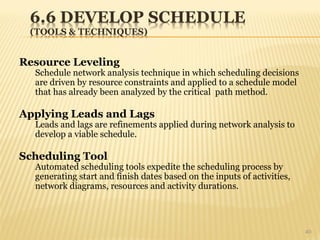
Resource Leveling
Schedule network analysis technique in which scheduling decisions
are driven by resource constraints and applied to a schedule model
that has already been analyzed by the critical path method.
Applying Leads and Lags
Leads and lags are refinements applied during network analysis to
develop a viable schedule.
Scheduling Tool
Automated scheduling tools expedite the scheduling process by
generating start and finish dates based on the inputs of activities,
network diagrams, resources and activity durations.
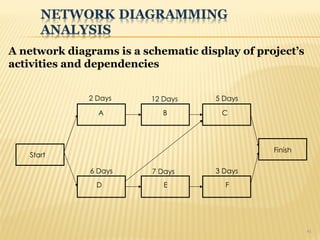
Start
Finish
A B C
D E F
2 Days 12 Days 5 Days
6 Days 7 Days 3 Days
41
A network diagrams is a schematic display of project’s
activities and dependencies
42
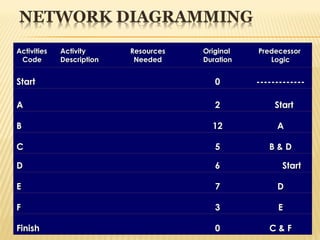
Activities
Activities
Code
Code
Activity
Activity
Description
Description
Resources
Resources
Needed
Needed
Original
Original
Duration
Duration
Predecessor
Predecessor
Logic
Logic
Start
Start 0
0 -------------
-------------
A
A 2
2 Start
Start
B
B 12
12 A
A
C
C 5
5 B & D
B & D
D
D 6
6 Start
Start
E
E 7
7 D
D
F
F 3
3 E
E
Finish
Finish 0
0 C & F
C & F
43
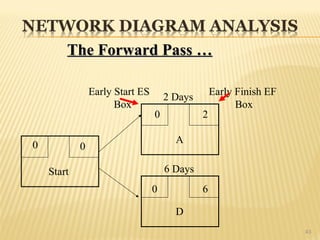
The Forward Pass …
The Forward Pass …
Start
A
D
2 Days
6 Days
0 0
Early Start ES
Box
Early Finish EF
Box
0 2
0 6
44
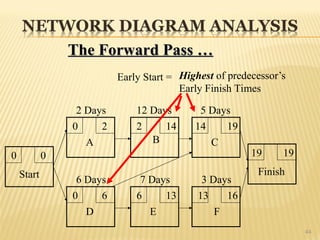
Start Finish
A B C
D E F
2 Days 12 Days 5 Days
6 Days 7 Days 3 Days
The Forward Pass …
The Forward Pass …
0
0
0
0 2 2 14 14 19
6 6 13 13 16
19 19
Highest of predecessor’s
Early Finish Times
Early Start =
45
Finish
C
F
5 Days
3 Days
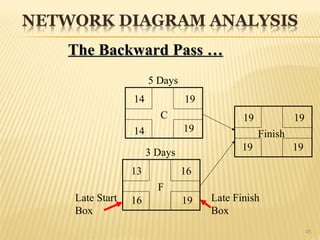
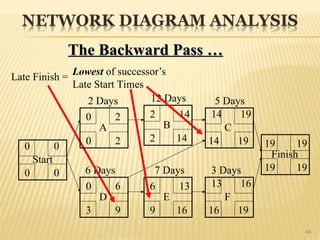
The Backward Pass …
The Backward Pass …
19 19
Late Start
Box
Late Finish
Box
13 16
14 19
14 19
16 19
19 19
46
Start Finish
A B C
D E F
2 Days 12 Days 5 Days
6 Days 7 Days 3 Days
0
0
0
0 2 2 14 14 19
6 6 13 13 16
19 19
Lowest of successor’s
Late Start Times
Late Finish =
2 14
19
16
14 19
19
19
0 0
0 2
3 9 9 16
The Backward Pass …
The Backward Pass …
47
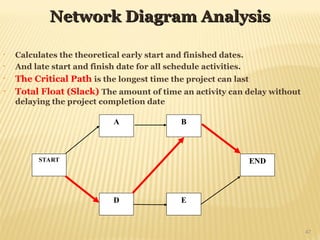
• Calculates the theoretical early start and finished dates.
• And late start and finish date for all schedule activities.
• The Critical Path is the longest time the project can last
• Total Float (Slack) The amount of time an activity can delay without
delaying the project completion date
A
START END
E
D
B
Network Diagram Analysis
48
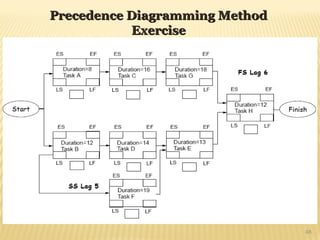
Precedence Diagramming Method
Exercise
Exercise
49
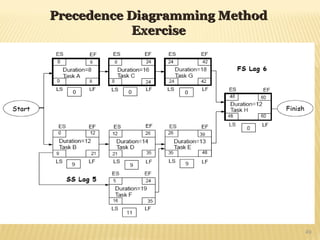
Precedence Diagramming Method
Exercise
Exercise
.
50
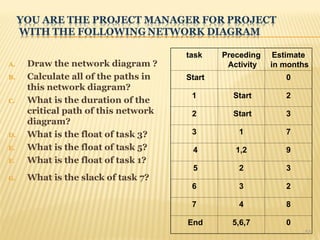
A. Draw the network diagram ?
B. Calculate all of the paths in
this network diagram?
C. What is the duration of the
critical path of this network
diagram?
D. What is the float of task 3?
E. What is the float of task 5?
F. What is the float of task 1?
G. What is the slack of task 7?
task Preceding
Activity
Estimate
in months
Start 0
1 Start 2
2 Start 3
3 1 7
4 1,2 9
5 2 3
6 3 2
7 4 8
End 5,6,7 0
51
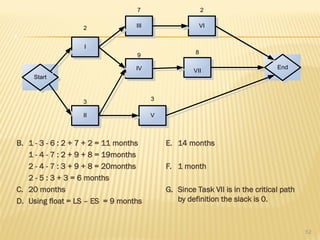
B. 1 - 3 - 6 : 2 + 7 + 2 = 11 months
1 - 4 - 7 : 2 + 9 + 8 = 19months
2 - 4 - 7 : 3 + 9 + 8 = 20months
2 - 5 : 3 + 3 = 6 months
C. 20 months
D. Using float = LS – ES = 9 months
E. 14 months
F. 1 month
G. Since Task VII is in the critical path
by definition the slack is 0.
52
Start
I
III VI
End
II
IV VII
2
7
3
8
9
V
2
3
53
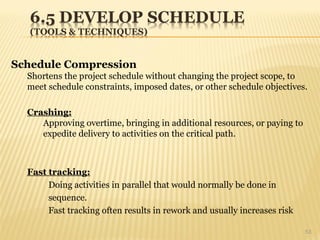
Schedule Compression
Shortens the project schedule without changing the project scope, to
meet schedule constraints, imposed dates, or other schedule 0bjectives.
Crashing:
Approving overtime, bringing in additional resources, or paying to
expedite delivery to activities on the critical path.
Fast tracking:
Doing activities in parallel that would normally be done in
sequence.
Fast tracking often results in rework and usually increases risk
54
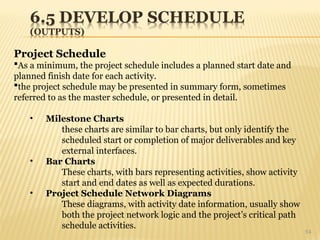
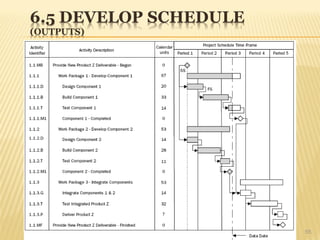
Project Schedule
As a minimum, the project schedule includes a planned start date and
planned finish date for each activity.
the project schedule may be presented in summary form, sometimes
referred to as the master schedule, or presented in detail.
• Milestone Charts
these charts are similar to bar charts, but only identify the
scheduled start or completion of major deliverables and key
external interfaces.
• Bar Charts
These charts, with bars representing activities, show activity
start and end dates as well as expected durations.
• Project Schedule Network Diagrams
These diagrams, with activity date information, usually show
both the project network logic and the project’s critical path
schedule activities.
55
56
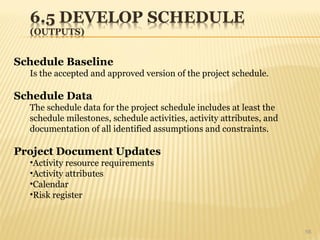
Schedule Baseline
Is the accepted and approved version of the project schedule.
Schedule Data
The schedule data for the project schedule includes at least the
schedule milestones, schedule activities, activity attributes, and
documentation of all identified assumptions and constraints.
Project Document Updates
•Activity resource requirements
•Activity attributes
•Calendar
•Risk register
57
 Determining the current status of the project
schedule
 Influencing the factors that create schedule
changes
 Determining that the schedule has changed
 Managing the actual changes when and as they
occur
58
59
• Project Management Plan
• Project Schedule
• Work Performance information
• Organizational Process Assets
60
Performance Reviews
Measure, compare, and analyze schedule performance such as actual
start and finish dates, percent complete, and remaining duration for
work in progress.
Variance analysis
•Schedule performance measurements (SV, SPI) are used to assess the
magnitude of variation to the original schedule baseline.
•The total float variance is an essential planning component to
evaluate project time performance.
61
• Project management Software
• Resource Leveling
• What-if Scenario Analysis
• Adjusting Leads and Lags
• Schedule Compression
• Scheduling Tool
62
• Work Performance measurements
• Organizational Process Assets Updates
• Change Requests
• Project management Plan Updates
 Schedule baseline
 Cost baseline
• Project Document Updates
 Project Schedule
63
64
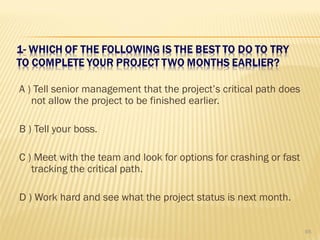
A ) Tell senior management that the project’s critical path does
not allow the project to be finished earlier.
B ) Tell your boss.
C ) Meet with the team and look for options for crashing or fast
tracking the critical path.
D ) Work hard and see what the project status is next month.
65
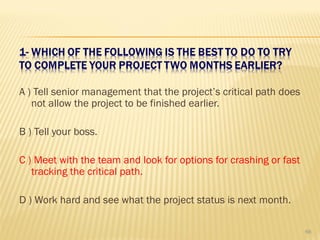
A ) Tell senior management that the project’s critical path does
not allow the project to be finished earlier.
B ) Tell your boss.
C ) Meet with the team and look for options for crashing or fast
tracking the critical path.
D ) Work hard and see what the project status is next month.
66
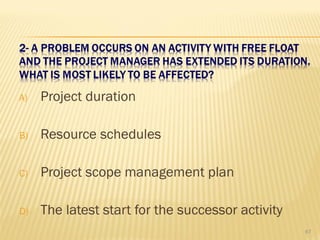
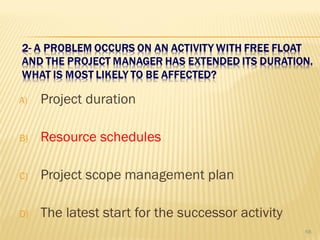
A) Project duration
B) Resource schedules
C) Project scope management plan
D) The latest start for the successor activity
67
A) Project duration
B) Resource schedules
C) Project scope management plan
D) The latest start for the successor activity
68
A) 10
B) 6
C) 3
D) 19
69
A) 10
B) 6
C) 3
D) 19
70
A) 3
B) 6
C) 7
D) 10
71
A) 3
B) 6
C) 7
D) 10
72
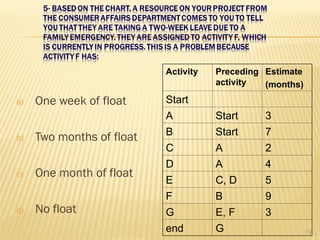
a) One week of float
b) Two months of float
c) One month of float
d) No float
Activity Preceding
activity
Estimate
(
months
)
Start
A Start 3
B Start 7
C A 2
D A 4
E C, D 5
F B 9
G E, F 3
end G 73
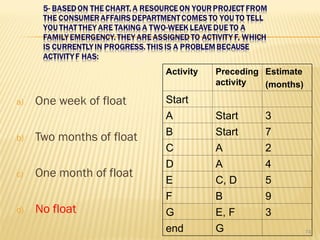
a) One week of float
b) Two months of float
c) One month of float
d) No float
Activity Preceding
activity
Estimate
(
months
)
Start
A Start 3
B Start 7
C A 2
D A 4
E C, D 5
F B 9
G E, F 3
end G 74
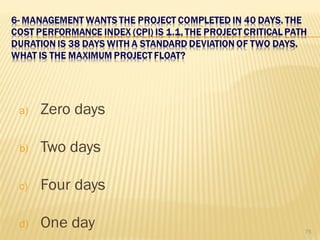
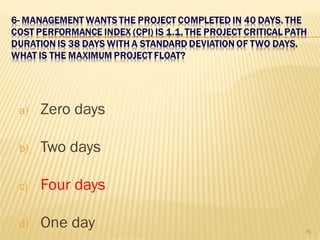
a) Zero days
b) Two days
c) Four days
d) One day 75
a) Zero days
b) Two days
c) Four days
d) One day 76
A ) project.
B ) completion date required by the customer.
C ) early start of its successor.
D ) project completion date.
77
A ) project.
B ) completion date required by the customer.
C ) early start of its successor.
D ) project completion date.
78
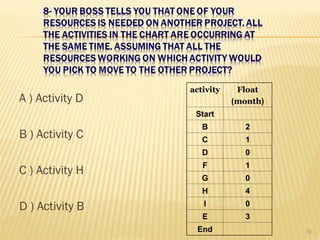
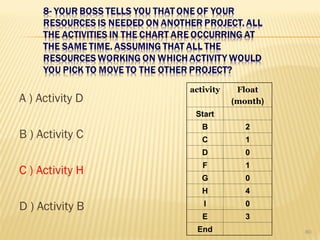
A ) Activity D
B ) Activity C
C ) Activity H
D ) Activity B
activity Float
(
month
)
Start
B 2
C 1
D 0
F 1
G 0
H 4
I 0
E 3
End 79
A ) Activity D
B ) Activity C
C ) Activity H
D ) Activity B
activity Float
(
month
)
Start
B 2
C 1
D 0
F 1
G 0
H 4
I 0
E 3
End 80
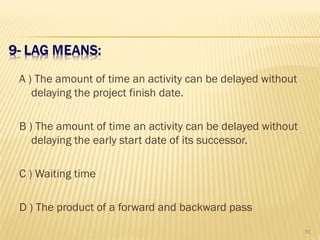
A ) The amount of time an activity can be delayed without
delaying the project finish date.
B ) The amount of time an activity can be delayed without
delaying the early start date of its successor.
C ) Waiting time
D ) The product of a forward and backward pass
81
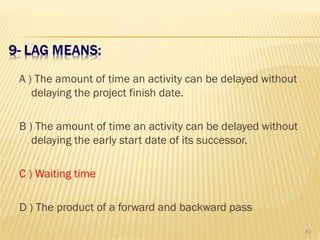
A ) The amount of time an activity can be delayed without
delaying the project finish date.
B ) The amount of time an activity can be delayed without
delaying the early start date of its successor.
C ) Waiting time
D ) The product of a forward and backward pass
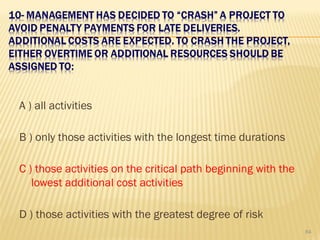
82
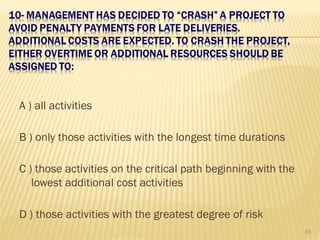
A ) all activities
B ) only those activities with the longest time durations
C ) those activities on the critical path beginning with the
lowest additional cost activities
D ) those activities with the greatest degree of risk
83
A ) all activities
B ) only those activities with the longest time durations
C ) those activities on the critical path beginning with the
lowest additional cost activities
D ) those activities with the greatest degree of risk
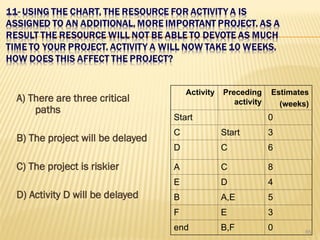
84
A) There are three critical
paths
B) The project will be delayed
C) The project is riskier
D) Activity D will be delayed
Activity Preceding
activity
Estimates
(
weeks
)
Start 0
C Start 3
D C 6
A C 8
E D 4
B A,E 5
F E 3
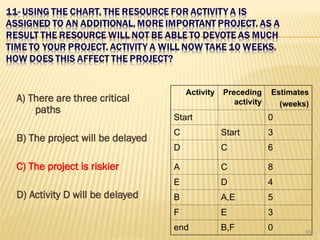
end B,F 0 85
A) There are three critical
paths
B) The project will be delayed
C) The project is riskier
D) Activity D will be delayed
Activity Preceding
activity
Estimates
(
weeks
)
Start 0
C Start 3
D C 6
A C 8
E D 4
B A,E 5
F E 3
end B,F 0 86
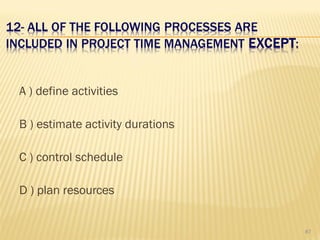
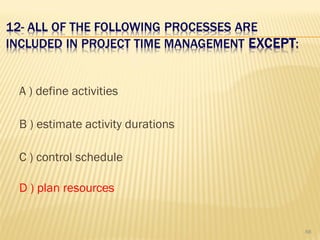
A ) define activities
B ) estimate activity durations
C ) control schedule
D ) plan resources
87
A ) define activities
B ) estimate activity durations
C ) control schedule
D ) plan resources
88
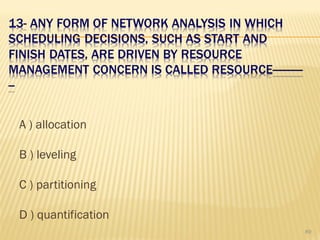
A ) allocation
B ) leveling
C ) partitioning
D ) quantification
89
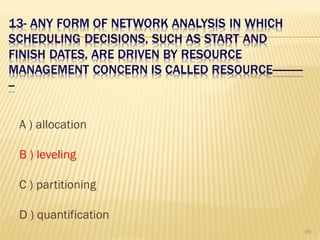
A ) allocation
B ) leveling
C ) partitioning
D ) quantification
90
91
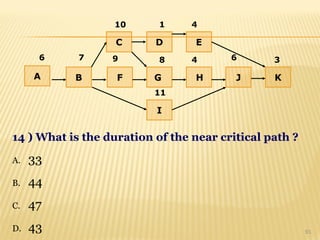
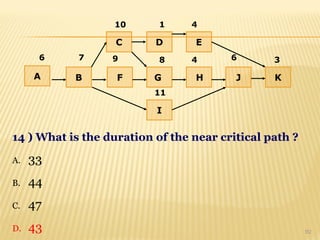
A B F G H J K
C D E
I
6 7
10 1 4
3
6
4
8
9
11
14 ) What is the duration of the near critical path ?
A. 33
B. 44
C. 47
D. 43
92
A B F G H J K
C D E
I
6 7
10 1 4
3
6
4
8
9
11
14 ) What is the duration of the near critical path ?
A. 33
B. 44
C. 47
D. 43
.
93

Project Time Management_Project Management

  • 1.
  • 3.
    Includes the processesrequired to manage Timely completion of the project. 3 Planning 6.1 Plan Schedule management 6.2 Define Activities 6.3 Sequence Activities 6.4 Estimate Activity Resources 6.5 Estimate Activity Durations 6.6 Develop Schedule Monitoring and controlling 6.7 Control Schedule
  • 4.
    6.1 Plan Schedulemanagement  Plan Schedule Management is the process of establishing the policies, procedures, and documentation for planning, developing, managing, executing, and controlling the project schedule. The key benefit of this process is that it provides guidance and direction on how the project schedule will be managed throughout the project. The inputs, tools and techniques, and outputs of this process are depicted in Figure 6-3.
  • 5.
     • Scopebaseline. The scope baseline includes the project scope statement and the work breakdown structure (WBS) details used for defining activities, duration estimation, and schedule management; and Other information. Other scheduling related cost, risk, and communications decisions from the project management plan are used to develop the schedule.  Project Charter Described in Section 4.1.3.1. The project charter defines the summary milestone schedule and project approval requirements that will influence the management of the project schedule.  Enterprise Environmental Factors • Organizational culture and structure can all influence schedule management; • Resource availability and skills that may influence schedule planning; • Project management software provides the scheduling tool and alternative possibilities for managing the schedule; • Published commercial information, such as resource productivity information, is often available from commercial databases that track; and Organizational work authorization systems.  Organizational Process Assets
  • 6.
     Expert Judgment Analytical Techniques : The Plan Schedule Management process may involve choosing strategic options to estimate and schedule the project such as: scheduling methodology, scheduling tools and techniques, estimating approaches, formats, and project management software  Meetings : Project teams may hold planning meetings to develop the schedule management plan. Participants at these meetings may include the project manager, the project sponsor, selected project team members, selected stakeholders, anyone with responsibility for schedule planning or execution, and others as needed
  • 7.
     Schedule ManagementPlan  Rules of performance measurement. Earned value management (EVM) rules or other physical measurement rules of performance measurement are set  Reporting formats.  Process descriptions.
  • 8.
  • 9.
     Identifying thespecific actions to be performed to produce the project deliverables  Project work packages are typically decomposed into smaller component called activities that represent the work necessary to complete the work package.  Activities provide a basis for estimating, scheduling, executing, and monitoring and controlling the project work 9
  • 10.
    10 Scope Baseline Enterprise EnvironmentalFactors • Project management information system (PMIS). Organizational Process Assets • Existing formal and informal activity planning-related policies, procedures, and guidelines, • Lessons-learned knowledge base
  • 11.
    11 Decomposition • Involves subdividingthe project work packages into smaller ,more manageable components called activities. • Activities represent the effort needed to complete a work package. • Defines the final outputs as activities rather than deliverables. • The activity list, WBS, WBS dictionary can be developed either sequentially or concurrently as the basis for development of the final activity list. Rolling Wave Planning Is a form of progressive elaboration planning where the work to be accomplished in the near term is planned in detail and future work is planned at a higher level of the WBS
  • 12.
    12 Templates A standard activitylist or a portion of an activity list from a previous project is often usable as a template for a new project. Expert Judgment Project team members or other experts, who are experienced and skilled in developing detailed project scope statements, the WBS, and project schedules, can provide expertise in defining activities.
  • 13.
    13 Activity List The activitylist includes the activity identifier and the scope of work description for each activity in sufficient detail to ensure that the project team members understand what work is required to be completed. Activity Attributes Activity attributes extend the description of the activity by identifying the multiple components associated with each activity. Milestone List A milestone list identifies all milestones and indicates whether the milestone is mandatory, or optional.
  • 14.
  • 15.
     Sequence activitiesis the process of identifying and documenting relationships among the project activities.  It may be necessary to use lead or lag time between activities to support a realistic and achievable project schedule. 15
  • 16.
    16 Dependency Relationships inthe Precedence Dependency Relationships in the Precedence Diagramming Method (PDM) Diagramming Method (PDM)
  • 17.
    Dependency Determination Three typesof dependencies are used to define the sequence among the activities  Mandatory dependencies  Those that are contractually required or inherent in the nature of the work.  Are also sometimes referred to as hard logic  Discretionary dependencies ( optional )  Discretionary dependencies are sometimes referred to as preferred, or soft logic.  Should be fully documented since they can create arbitrary total float values and can Limit later scheduling options.  External dependencies  Involve a relationship between project activities and non-project activities. 17
  • 18.
    Applying Leads andLags A Lead Allows an acceleration of the successor activity. A Lag Directs a delay in the successor activity 18
  • 19.
  • 20.
     Schedule ManagementPlan  Activity List  Activity Attributes  Milestone List  Project Scope Statement  Organizational Process Assets  Enterprise Environmental Factors 20
  • 21.
    • Precedence Diagrammingmethod (PDM) • Dependency Determination • Applying Leads and Lags 21
  • 22.
    • Project schedulenetwork diagram – Are schematic displays of the project’s schedule activities and the logical relationships among them. – Can be produced manually or by using project management software. • Project document updates Project documents that may be updated include: • Activity lists, • Activity attributes, • Risk register 22
  • 23.
  • 24.
    Estimate activity resourcesis the process of estimating the type and quantities of material, people, equipment, or supplies required to perform each activity. 24
  • 25.
    25 Schedule Management Plan ActivityList Activity Attributes Resource Calendars • Specify when and how long identified project resources will be available during the project. Enterprise Environmental Factors • Resource availability and skills. Organizational Process Assets • Policies and procedures regarding staffing, • Policies and procedures relating to rental and purchase of supplies and equipment, and • Historical information regarding types of resources used for similar work on previous projects.
  • 26.
    26 Expert Judgment Any groupor person with specialized knowledge in resource planning and estimating can provide such expertise. Alternatives Analysis Include using various levels of resources capability or skills, different size or type of machines, different tools, and make-or-buy decisions regarding the resources. Published Estimating Data Several companies routinely publish updated production rates and unit costs of resources, and equipment for different countries, and geographical locations within countries.
  • 27.
    27 Bottom-Up Estimating When anactivity cannot be estimated with a reasonable degree of confidence, the work within the activity is decomposed into more detail. The resource needs are estimated. These estimates are then aggregated into a total quantity for each of the activity’s resources. Project Management Software Project management software has the capability to help plan, organize, and manage resources pools and develop resources estimates
  • 28.
    28 Activity Resource Requirements Identifiesthe types and quantities of resources required for each activity in a work package Resource Breakdown Structure The resource breakdown structure is a hierarchical structure of the identified resources by resource category and resource type. Project Document Updates •Activity list, •Activity attributes, and •Resource calendars
  • 29.
  • 30.
    • Is theprocess of approximating the number of work periods needed to complete individual activities with estimated resources. • The input for the estimates of activity duration originate from the person or group on the project team who is most familiar with the nature of the work in the specific activity. • Most project management software for scheduling will handle this situation by using project calendar and alternative work-period resource calendars that are usually identified by the resource that require specific work periods. 30
  • 31.
    31 Schedule Management Plan ActivityList Activity Attributes Activity Resource Requirements Resource Calendars Project Scope Statement Constraints and assumptions .
  • 32.
    32 Enterprise Environmental Factors •Duration estimating databases and other reference data, • Productivity metrics, and • Published commercial information. Organizational Process Assets • Historical duration information, • Scheduling methodology, and • Lessons learned.
  • 33.
    33 Expert Judgment Expert judgmentcan provide duration estimate information or recommend maximum activity duration from prior similar projects. Analogous Estimating •This technique relies on the actual duration of previous similar projects as the basis for estimating the duration of the current project. •Generally less costly and time consuming than other techniques, but it is also generally less accurate. Reserve Analysis Duration estimates may include contingency reserve, (time reserve or buffers) into the overall project schedule to account for schedule uncertainty.
  • 34.
    34 Parametric Estimating Parametric estimatinguses a statistical relationship between historical data and other variables to calculate an estimate for activity parameters, such as cost, budget, and duration. Three-point estimates PERT uses three estimates to define an approximate range for an activity’s duration •Most likely: the activity duration is based on analysis of the average productivity of the resource. •Optimistic: the activity duration is based on analysis of the best-case scenario for the activity. •Pessimistic: the activity duration is based on analysis of the worst-case scenario for the activity T = O+4M+P 6
  • 35.
    35 • Activity DurationEstimates • Project Document Updates  Activity Attributes
  • 36.
  • 37.
     Develop scheduleis the process of analyzing activity sequences, durations, resource requirements, and schedule constraints to create the project schedule.  Developing an acceptable project schedule is often an iterative process. 37
  • 38.
    38 • Schedule ManagementPlan • Activity List • Activity Attributes • Project Schedule network Diagrams • Activity Resource Requirements • Resource Calendars • Activity Duration Estimates • Project Scope Statement • Enterprise Environmental Factors • Organizational Process Assets
  • 39.
    39 Schedule network analysis •Isthe technique that generate the project schedule •It employs various analytical techniques, such as Critical Path Method, Critical Chain Method, what-if analysis, and resource leveling to calculate the early and late start and finish dates for the uncompleted portions of project activities Critical Chain Method •A schedule network analysis technique that modifies the project schedule to account for limited resources. •Applied after critical path is identified, resource availability is entered and the resource-limited schedule result is determined, the resulting schedule often has an altered critical path.
  • 40.
    40 Resource Leveling Schedule networkanalysis technique in which scheduling decisions are driven by resource constraints and applied to a schedule model that has already been analyzed by the critical path method. Applying Leads and Lags Leads and lags are refinements applied during network analysis to develop a viable schedule. Scheduling Tool Automated scheduling tools expedite the scheduling process by generating start and finish dates based on the inputs of activities, network diagrams, resources and activity durations.
  • 41.
    Start Finish A B C DE F 2 Days 12 Days 5 Days 6 Days 7 Days 3 Days 41 A network diagrams is a schematic display of project’s activities and dependencies
  • 42.
  • 43.
    43 The Forward Pass… The Forward Pass … Start A D 2 Days 6 Days 0 0 Early Start ES Box Early Finish EF Box 0 2 0 6
  • 44.
    44 Start Finish A BC D E F 2 Days 12 Days 5 Days 6 Days 7 Days 3 Days The Forward Pass … The Forward Pass … 0 0 0 0 2 2 14 14 19 6 6 13 13 16 19 19 Highest of predecessor’s Early Finish Times Early Start =
  • 45.
    45 Finish C F 5 Days 3 Days TheBackward Pass … The Backward Pass … 19 19 Late Start Box Late Finish Box 13 16 14 19 14 19 16 19 19 19
  • 46.
    46 Start Finish A BC D E F 2 Days 12 Days 5 Days 6 Days 7 Days 3 Days 0 0 0 0 2 2 14 14 19 6 6 13 13 16 19 19 Lowest of successor’s Late Start Times Late Finish = 2 14 19 16 14 19 19 19 0 0 0 2 3 9 9 16 The Backward Pass … The Backward Pass …
  • 47.
    47 • Calculates thetheoretical early start and finished dates. • And late start and finish date for all schedule activities. • The Critical Path is the longest time the project can last • Total Float (Slack) The amount of time an activity can delay without delaying the project completion date A START END E D B Network Diagram Analysis Network Diagram Analysis
  • 48.
    48 Precedence Diagramming Method PrecedenceDiagramming Method Exercise Exercise
  • 49.
    49 Precedence Diagramming Method PrecedenceDiagramming Method Exercise Exercise
  • 50.
  • 51.
    A. Draw thenetwork diagram ? B. Calculate all of the paths in this network diagram? C. What is the duration of the critical path of this network diagram? D. What is the float of task 3? E. What is the float of task 5? F. What is the float of task 1? G. What is the slack of task 7? task Preceding Activity Estimate in months Start 0 1 Start 2 2 Start 3 3 1 7 4 1,2 9 5 2 3 6 3 2 7 4 8 End 5,6,7 0 51
  • 52.
    B. 1 -3 - 6 : 2 + 7 + 2 = 11 months 1 - 4 - 7 : 2 + 9 + 8 = 19months 2 - 4 - 7 : 3 + 9 + 8 = 20months 2 - 5 : 3 + 3 = 6 months C. 20 months D. Using float = LS – ES = 9 months E. 14 months F. 1 month G. Since Task VII is in the critical path by definition the slack is 0. 52 Start I III VI End II IV VII 2 7 3 8 9 V 2 3
  • 53.
    53 Schedule Compression Shortens theproject schedule without changing the project scope, to meet schedule constraints, imposed dates, or other schedule 0bjectives. Crashing: Approving overtime, bringing in additional resources, or paying to expedite delivery to activities on the critical path. Fast tracking: Doing activities in parallel that would normally be done in sequence. Fast tracking often results in rework and usually increases risk
  • 54.
    54 Project Schedule As aminimum, the project schedule includes a planned start date and planned finish date for each activity. the project schedule may be presented in summary form, sometimes referred to as the master schedule, or presented in detail. • Milestone Charts these charts are similar to bar charts, but only identify the scheduled start or completion of major deliverables and key external interfaces. • Bar Charts These charts, with bars representing activities, show activity start and end dates as well as expected durations. • Project Schedule Network Diagrams These diagrams, with activity date information, usually show both the project network logic and the project’s critical path schedule activities.
  • 55.
  • 56.
    56 Schedule Baseline Is theaccepted and approved version of the project schedule. Schedule Data The schedule data for the project schedule includes at least the schedule milestones, schedule activities, activity attributes, and documentation of all identified assumptions and constraints. Project Document Updates •Activity resource requirements •Activity attributes •Calendar •Risk register
  • 57.
  • 58.
     Determining thecurrent status of the project schedule  Influencing the factors that create schedule changes  Determining that the schedule has changed  Managing the actual changes when and as they occur 58
  • 59.
    59 • Project ManagementPlan • Project Schedule • Work Performance information • Organizational Process Assets
  • 60.
    60 Performance Reviews Measure, compare,and analyze schedule performance such as actual start and finish dates, percent complete, and remaining duration for work in progress. Variance analysis •Schedule performance measurements (SV, SPI) are used to assess the magnitude of variation to the original schedule baseline. •The total float variance is an essential planning component to evaluate project time performance.
  • 61.
    61 • Project managementSoftware • Resource Leveling • What-if Scenario Analysis • Adjusting Leads and Lags • Schedule Compression • Scheduling Tool
  • 62.
    62 • Work Performancemeasurements • Organizational Process Assets Updates • Change Requests • Project management Plan Updates  Schedule baseline  Cost baseline • Project Document Updates  Project Schedule
  • 63.
  • 64.
  • 65.
    A ) Tellsenior management that the project’s critical path does not allow the project to be finished earlier. B ) Tell your boss. C ) Meet with the team and look for options for crashing or fast tracking the critical path. D ) Work hard and see what the project status is next month. 65
  • 66.
    A ) Tellsenior management that the project’s critical path does not allow the project to be finished earlier. B ) Tell your boss. C ) Meet with the team and look for options for crashing or fast tracking the critical path. D ) Work hard and see what the project status is next month. 66
  • 67.
    A) Project duration B)Resource schedules C) Project scope management plan D) The latest start for the successor activity 67
  • 68.
    A) Project duration B)Resource schedules C) Project scope management plan D) The latest start for the successor activity 68
  • 69.
    A) 10 B) 6 C)3 D) 19 69
  • 70.
    A) 10 B) 6 C)3 D) 19 70
  • 71.
    A) 3 B) 6 C)7 D) 10 71
  • 72.
    A) 3 B) 6 C)7 D) 10 72
  • 73.
    a) One weekof float b) Two months of float c) One month of float d) No float Activity Preceding activity Estimate ( months ) Start A Start 3 B Start 7 C A 2 D A 4 E C, D 5 F B 9 G E, F 3 end G 73
  • 74.
    a) One weekof float b) Two months of float c) One month of float d) No float Activity Preceding activity Estimate ( months ) Start A Start 3 B Start 7 C A 2 D A 4 E C, D 5 F B 9 G E, F 3 end G 74
  • 75.
    a) Zero days b)Two days c) Four days d) One day 75
  • 76.
    a) Zero days b)Two days c) Four days d) One day 76
  • 77.
    A ) project. B) completion date required by the customer. C ) early start of its successor. D ) project completion date. 77
  • 78.
    A ) project. B) completion date required by the customer. C ) early start of its successor. D ) project completion date. 78
  • 79.
    A ) ActivityD B ) Activity C C ) Activity H D ) Activity B activity Float ( month ) Start B 2 C 1 D 0 F 1 G 0 H 4 I 0 E 3 End 79
  • 80.
    A ) ActivityD B ) Activity C C ) Activity H D ) Activity B activity Float ( month ) Start B 2 C 1 D 0 F 1 G 0 H 4 I 0 E 3 End 80
  • 81.
    A ) Theamount of time an activity can be delayed without delaying the project finish date. B ) The amount of time an activity can be delayed without delaying the early start date of its successor. C ) Waiting time D ) The product of a forward and backward pass 81
  • 82.
    A ) Theamount of time an activity can be delayed without delaying the project finish date. B ) The amount of time an activity can be delayed without delaying the early start date of its successor. C ) Waiting time D ) The product of a forward and backward pass 82
  • 83.
    A ) allactivities B ) only those activities with the longest time durations C ) those activities on the critical path beginning with the lowest additional cost activities D ) those activities with the greatest degree of risk 83
  • 84.
    A ) allactivities B ) only those activities with the longest time durations C ) those activities on the critical path beginning with the lowest additional cost activities D ) those activities with the greatest degree of risk 84
  • 85.
    A) There arethree critical paths B) The project will be delayed C) The project is riskier D) Activity D will be delayed Activity Preceding activity Estimates ( weeks ) Start 0 C Start 3 D C 6 A C 8 E D 4 B A,E 5 F E 3 end B,F 0 85
  • 86.
    A) There arethree critical paths B) The project will be delayed C) The project is riskier D) Activity D will be delayed Activity Preceding activity Estimates ( weeks ) Start 0 C Start 3 D C 6 A C 8 E D 4 B A,E 5 F E 3 end B,F 0 86
  • 87.
    A ) defineactivities B ) estimate activity durations C ) control schedule D ) plan resources 87
  • 88.
    A ) defineactivities B ) estimate activity durations C ) control schedule D ) plan resources 88
  • 89.
    A ) allocation B) leveling C ) partitioning D ) quantification 89
  • 90.
    A ) allocation B) leveling C ) partitioning D ) quantification 90
  • 91.
    91 A B FG H J K C D E I 6 7 10 1 4 3 6 4 8 9 11 14 ) What is the duration of the near critical path ? A. 33 B. 44 C. 47 D. 43
  • 92.
    92 A B FG H J K C D E I 6 7 10 1 4 3 6 4 8 9 11 14 ) What is the duration of the near critical path ? A. 33 B. 44 C. 47 D. 43
  • 93.

Editor's Notes

  • #43 Add activity duration to the Early Start Box to determine the Early Finish Box. Note that the to determine the Early Start Day, add one day to the Early Start Box.
  • #45 Subtract activity duration from the Late Finish Box to determine the Late Start Box. Note that the to determine the Late Start Date, add one day to the Early Start Box.