Project Management Process Technology and
Practice 1st Edition Vaidyanathan Solutions
Manual download

https://testbankdeal.com/product/project-management-process-
technology-and-practice-1st-edition-vaidyanathan-solutions-
manual/
Explore and download more test bank or solution manual
at testbankdeal.com
Here are some recommended products for you. Click the link to
download, or explore more at testbankdeal.com
Project Management Process Technology and Practice 1st
Edition Vaidyanathan Test Bank
https://testbankdeal.com/product/project-management-process-
technology-and-practice-1st-edition-vaidyanathan-test-bank/
Information Technology Project Management 9th Edition
Schwalbe Solutions Manual
https://testbankdeal.com/product/information-technology-project-
management-9th-edition-schwalbe-solutions-manual/
Information Technology Project Management 4th Edition
Marchewka Solutions Manual
https://testbankdeal.com/product/information-technology-project-
management-4th-edition-marchewka-solutions-manual/
American Government Brief 14th Edition Ansolabehere Test
Bank
https://testbankdeal.com/product/american-government-brief-14th-
edition-ansolabehere-test-bank/
Economics Canada in the Global Environment Canadian 8th
Edition Parkin Test Bank
https://testbankdeal.com/product/economics-canada-in-the-global-
environment-canadian-8th-edition-parkin-test-bank/
Oracle 11G PL SQL Programming 2nd Edition Casteel
Solutions Manual
https://testbankdeal.com/product/oracle-11g-pl-sql-programming-2nd-
edition-casteel-solutions-manual/
Payroll Accounting 2017 27th Edition Bieg Test Bank
https://testbankdeal.com/product/payroll-accounting-2017-27th-edition-
bieg-test-bank/
Organizational Communication Approaches and Processes 7th
Edition Miller Test Bank
https://testbankdeal.com/product/organizational-communication-
approaches-and-processes-7th-edition-miller-test-bank/
Essentials of Psychiatric Mental Health Nursing 1st
Edition Varcarolis Test Bank
https://testbankdeal.com/product/essentials-of-psychiatric-mental-
health-nursing-1st-edition-varcarolis-test-bank/
Essentials of Entrepreneurship and Small Business
Management 7th Edition Scarborough Solutions Manual
https://testbankdeal.com/product/essentials-of-entrepreneurship-and-
small-business-management-7th-edition-scarborough-solutions-manual/
Copyright 2013 Pearson Education, Inc. publishing as Prentice Hall. 7-1
Chapter 7
Quality and Performance
NOTES for the Instructor:
The study projects and the cases are posed as challenging assignments to students.
This study guide elaborates all the material needed to teach those study guides
and cases. The study projects can be assigned in two different ways:
a. If you want to evaluate the ability of the students to form assumptions,
research for materials, and understand the study projects, you can ask the
students to work on the study project without any additional information.
In this case, the students should be encouraged to obtain necessary
information using the Internet.
b. If you want to provide all the information, you can provide that
information shown in the following pages to solve the study projects.
Objectives
• Manage project quality as seen by quality gurus
• Determine how performance in projects are measured
• Define cost of quality
• Implement quality planning, assurance, and control in projects
• Measure project value, project performance, and project scope
Cases
• Information technology Case: SAP Project at NIBCO, Inc.
• Healthcare IT Case: Memorial Hospital of South Bend: Computerized Physician
Order Entry Project
• Financial Services IT Case: Syndicated Community Bank: Core Banking Systems
Replacement Project
• General Construction Case: Craig Constructions, Inc.: A Home Improvement
Project
Review Questions
1. Performance of a project can be defined as the execution or accomplishment of a
project to fulfill customer requirements in accordance with the project scope.
Copyright 2013 Pearson Education, Inc. publishing as Prentice Hall. 7-2
2. Project value is a relative worth or importance that is monetary in nature.
3. Quality is defined as conformance to requirements. Deming defined quality as a
predictable degree of uniformity and dependability at low cost suitable to the
market. Juran defined quality as something that satisfies customer needs. Project
quality is the degree to which a set of inherent characteristics of a project fulfill
project scope.
4. Some of the main differences are in the areas of responsibility of senior
management, SPC, and teamwork.
5. The major goal of quality management is to prevent defects. Quality management
eliminates the source of defects so that defect detection and rework do not happen
often during projects. Quality management complements project management,
which means that components of quality management including customer
satisfaction, defect prevention, continuous improvement, and management
responsibility to provide essential resources are important in project management.
Quality management is composed of quality planning, quality assurance, and
quality control. Quality management is more about process and is based on
problems related to processes.
6. The eight quality management principles include customer focus, leadership,
involvement of projects, process approach, systems approach, continual
improvement, decision making approach, and supplier relationships.
7. The quality model described in ISO/IEC 9126-1 addresses a framework for
software evaluation using the general characteristics of software. These are further
refined into sub-characteristics, which in turn are decomposed into attributes,
yielding a multilevel hierarchy. The characteristics in a quality model are non-
measurable quality factors and are used only to classify the sub-characteristics of
the model, which may be subjectively measured. The ISO/IEC 9126 standard
makes a distinction between internal quality and external quality and introduces
the quality in use.
Copyright 2013 Pearson Education, Inc. publishing as Prentice Hall. 7-3
8. Quality management is composed of quality planning, quality assurance, and
quality control.
9. Quality planning: The inputs for the quality planning are the scope document, the
requirements from stakeholders, the risk register, and the project schedule. By
using this input information, a project manager in cooperation with the quality
team can develop a quality plan for a project as the output.
Quality assurance: The inputs for quality assurance are quality planning, work
performance information, quality control measurements, and quality metrics. The
outputs of the process are asset updates, change requests, project management
plan updates, and project document updates.
Quality control: The inputs are quality metrics, approved change requests, and
organizational process assets. The outputs are quality control measurements,
validated changes, and updates to project management plans and other project
documents.
10. Benchmarking is a process to measure the performance of an organization and
compare that measure with other organizations in the same industry to understand
industry best practices.
11. A quality audit is a review of the quality plan to determine whether the project
activities comply with organizational and project policies, processes, and
procedures.
12. There are many tools and techniques used in quality control including:
• Cause-and-effect diagrams
• Run charts
• Scatter diagrams
• Histograms
• Pareto charts
• Six Sigma
• Process maps or flowcharts
• Control charts
• Statistical sampling
• Reviews, and
• Testing and inspection.
Copyright 2013 Pearson Education, Inc. publishing as Prentice Hall. 7-4
13. Testing is a procedure in which the system, product, or service is observed during
operation in order to determine whether it functions properly. Inspection is the
activity of examining the product, sub-components, or systems to determine if
they meet the design standards.
14. Process capability is a critical aspect of quality control and evaluates the ability of
a project process to meet or exceed the expectations or preset specifications.
15. Statistical sampling deals with the selection of a subset of a population in order to
gain knowledge about the whole population and to predict quality outcomes of the
population using statistics.
16. The three criteria are:
1. The level of precision
2. The level of confidence or risk, and
3. The level of variability in the attributes being measured.
17. There are a number of methods of quality reviews including:
• Expert reviews
• Peer reviews
• Team reviews
• Walk-through reviews
• Formal reviews
• Management reviews, and
• Process reviews.
18. Metrics are required in order to answer the following questions:
• Is the project is on track?
• Is the project manager sure about the progress of the project?
• Does the project manager understand the current status of the project,
schedule wise or cost wise?
• Can the project manager be sure of the performance of the project?
Teaching Points - Discussion Questions
Copyright 2013 Pearson Education, Inc. publishing as Prentice Hall. 7-5
1. What else may be considered for performance other than quality?
Performance measurement should consider many metrics that are listed in the chapter.
It should also consider measuring time and cost constraints and make sure that the
project is performing according to plan.
2. Do the three quality gurus preach the same message on quality?
Even though they preach the same message, there are variations to their quality
messages; See Table 7-1.
3. Quality audits have to be performed on each project.
Quality audits typically should be deployed in all projects large and small. However,
in reality it is not possible to do this because of added costs and time. Many industrial
projects, especially small projects, are not usually audited.
4. Is there one tool that may be used in all projects for quality control?
Analyzing using process maps is a very easy method that can be used in all projects
for quality control. The “as-is” process and the “to-be” process bring out the essence
of quality control in a very easy method especially in small projects.
5. Can we do without metrics when managing projects?
No; every project has to be measured against the measurements of selected metrics.
Proper metrics have to be identified and used. If metrics are not used in a project,
there is no way to know how a project is progressing and may not ensure the success
of the project.
6. There are differences between testing and inspection.
Yes; Testing helps to execute the software in order to test the functionality and
requirements while inspection analyzes the code based on a set of predefined rules.
7. Who decides which metrics are the best for a project: the project manager or
management?
Project manager should decide the metrics while management should help the project
manager by removing any obstacles in order to measure those metrics.
8. Should management be involved in quality management?
Yes; the management should provide leadership to encourage project managers to
manage the project quality.
Answers to Chapter Problems
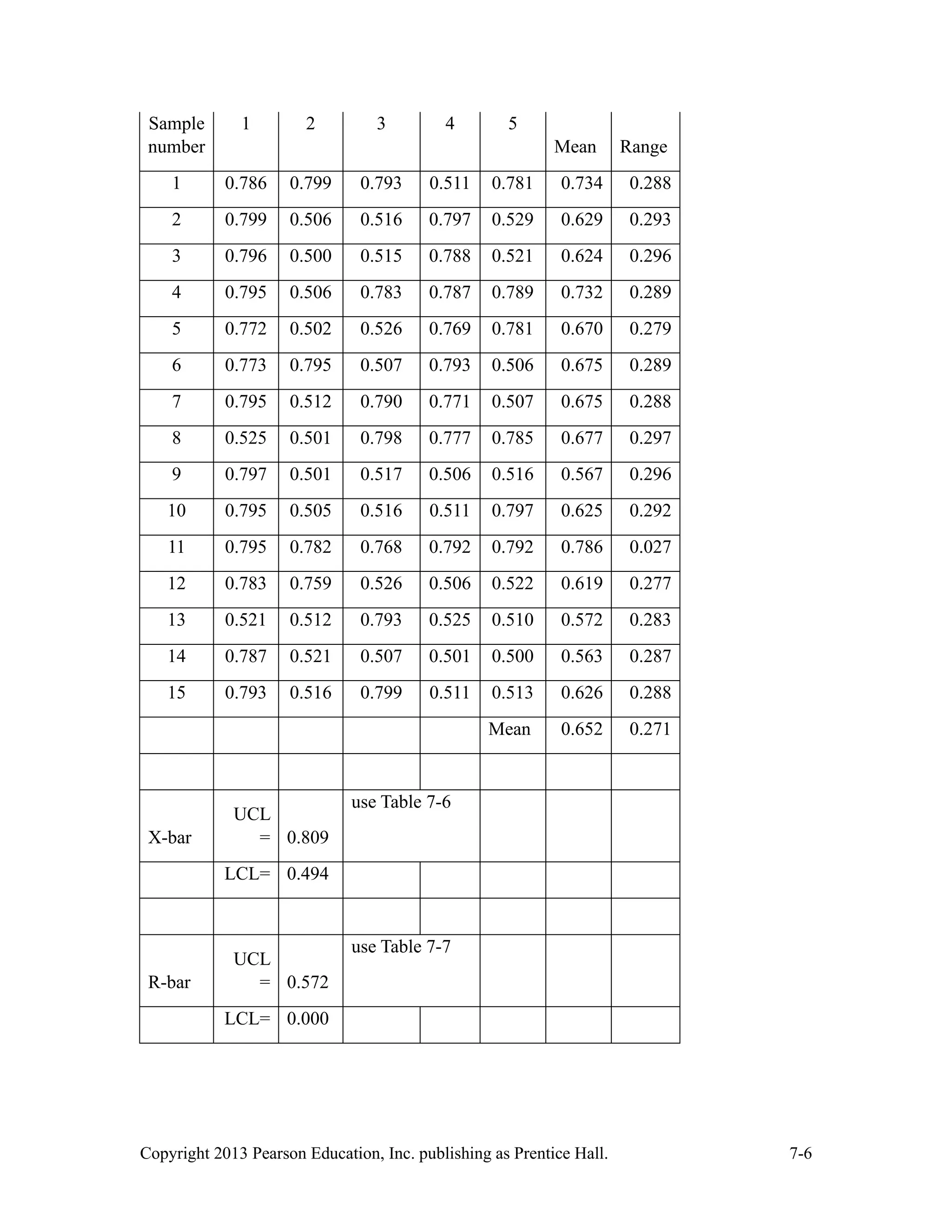
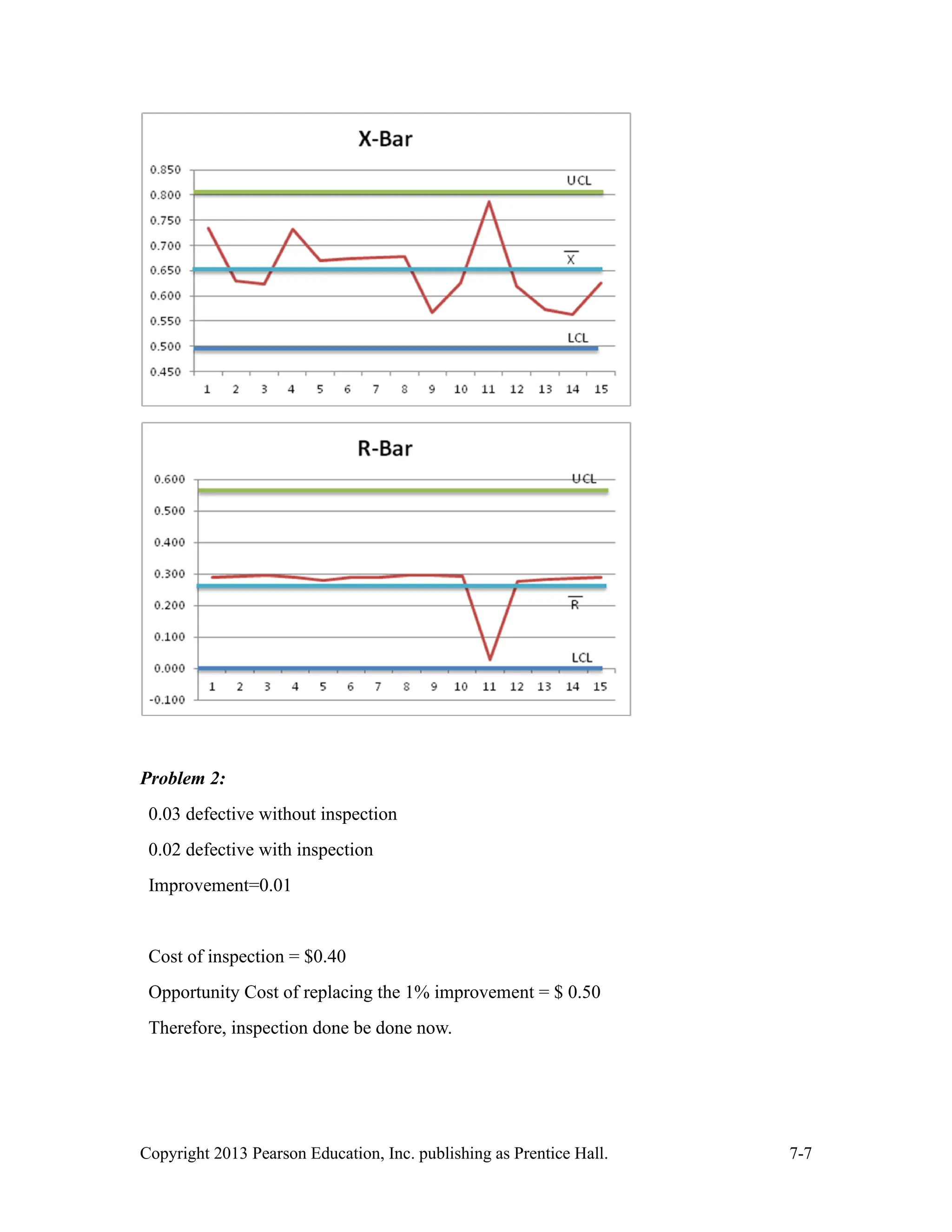
Problem 1:
Observations
Copyright 2013 Pearson Education, Inc. publishing as Prentice Hall. 7-6
Sample
number
1 2 3 4 5
Mean Range
1 0.786 0.799 0.793 0.511 0.781 0.734 0.288
2 0.799 0.506 0.516 0.797 0.529 0.629 0.293
3 0.796 0.500 0.515 0.788 0.521 0.624 0.296
4 0.795 0.506 0.783 0.787 0.789 0.732 0.289
5 0.772 0.502 0.526 0.769 0.781 0.670 0.279
6 0.773 0.795 0.507 0.793 0.506 0.675 0.289
7 0.795 0.512 0.790 0.771 0.507 0.675 0.288
8 0.525 0.501 0.798 0.777 0.785 0.677 0.297
9 0.797 0.501 0.517 0.506 0.516 0.567 0.296
10 0.795 0.505 0.516 0.511 0.797 0.625 0.292
11 0.795 0.782 0.768 0.792 0.792 0.786 0.027
12 0.783 0.759 0.526 0.506 0.522 0.619 0.277
13 0.521 0.512 0.793 0.525 0.510 0.572 0.283
14 0.787 0.521 0.507 0.501 0.500 0.563 0.287
15 0.793 0.516 0.799 0.511 0.513 0.626 0.288
Mean 0.652 0.271
X-bar
UCL
= 0.809
use Table 7-6
LCL= 0.494
R-bar
UCL
= 0.572
use Table 7-7
LCL= 0.000
Copyright 2013 Pearson Education, Inc. publishing as Prentice Hall. 7-7
Problem 2:
0.03 defective without inspection
0.02 defective with inspection
Improvement=0.01
Cost of inspection = $0.40
Opportunity Cost of replacing the 1% improvement = $ 0.50
Therefore, inspection done be done now.
Copyright 2013 Pearson Education, Inc. publishing as Prentice Hall. 7-8
Cost of inspection = $0.80
Inspection should not be done now.
Problem 3
Cost of quality is:
CoQ = Cp + Ca + Cf
This is described as the cost of prevention plus the cost of detection plus the cost
of failures. This is not the cost of achieving quality in product and services, but
rather not achieving quality and the cost associated with failures due to the lack of
quality in the production process.
The cost of quality for Superior Buy, who is the buyer in this scenario, would
most likely be replacing or upgrading inferior computers that do not perform as
expected. If the computers were to fail due to manufacturing defects, this would
be covered under the manufacturer warranty. But if Superior Buy purchased
computers with lower performance specifications to try and save money, then the
cost of bringing them up to par if they are under performing would be the cost of
quality. The cost includes installing additional RAM, changing the processor,
installing different or new software, or may even be replacing the whole computer
with one that will perform. Superior Buy must take into account these costs for
possible upgrades or replacements when defining the specifications for their
order.
The cost of quality for Dell, who is the supplier in this scenario, would most
likely be warranty repair or replacement costs. These costs would be incurred if
defective computers were to leave the factory and end up in the hands of the
customer. These costs would start the minute the customer calls the service
number for help, and are not finished until the customer is completely satisfied
with the end result. One customer may even call multiple times with multiple
problems. Dell must integrate quality within the manufacturing process which
will increase quality, decrease defects, and ultimately reduce the cost of quality.
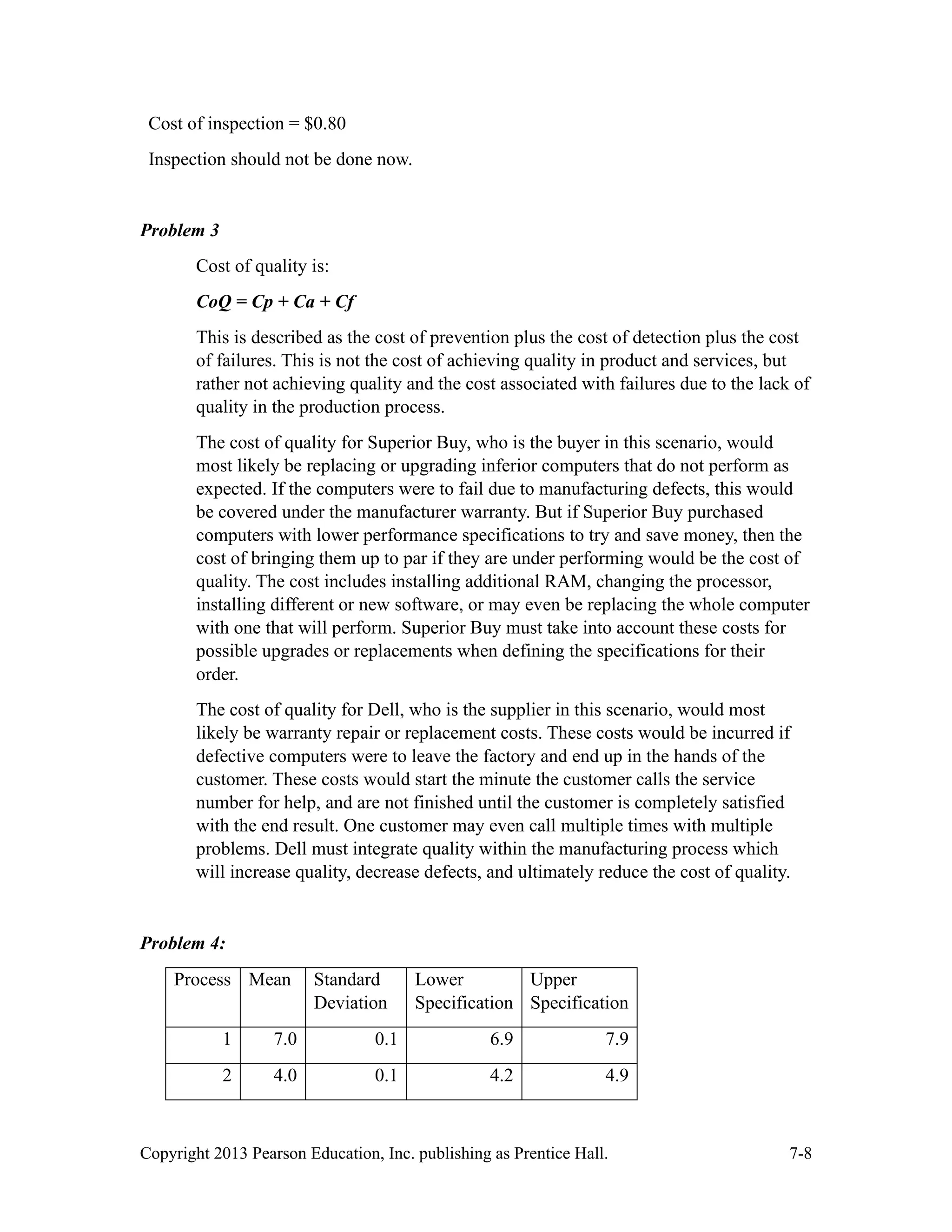
Problem 4:
Process Mean Standard
Deviation
Lower
Specification
Upper
Specification
1 7.0 0.1 6.9 7.9
2 4.0 0.1 4.2 4.9
Copyright 2013 Pearson Education, Inc. publishing as Prentice Hall. 7-9
3 6.6 0.1 5.4 6.5
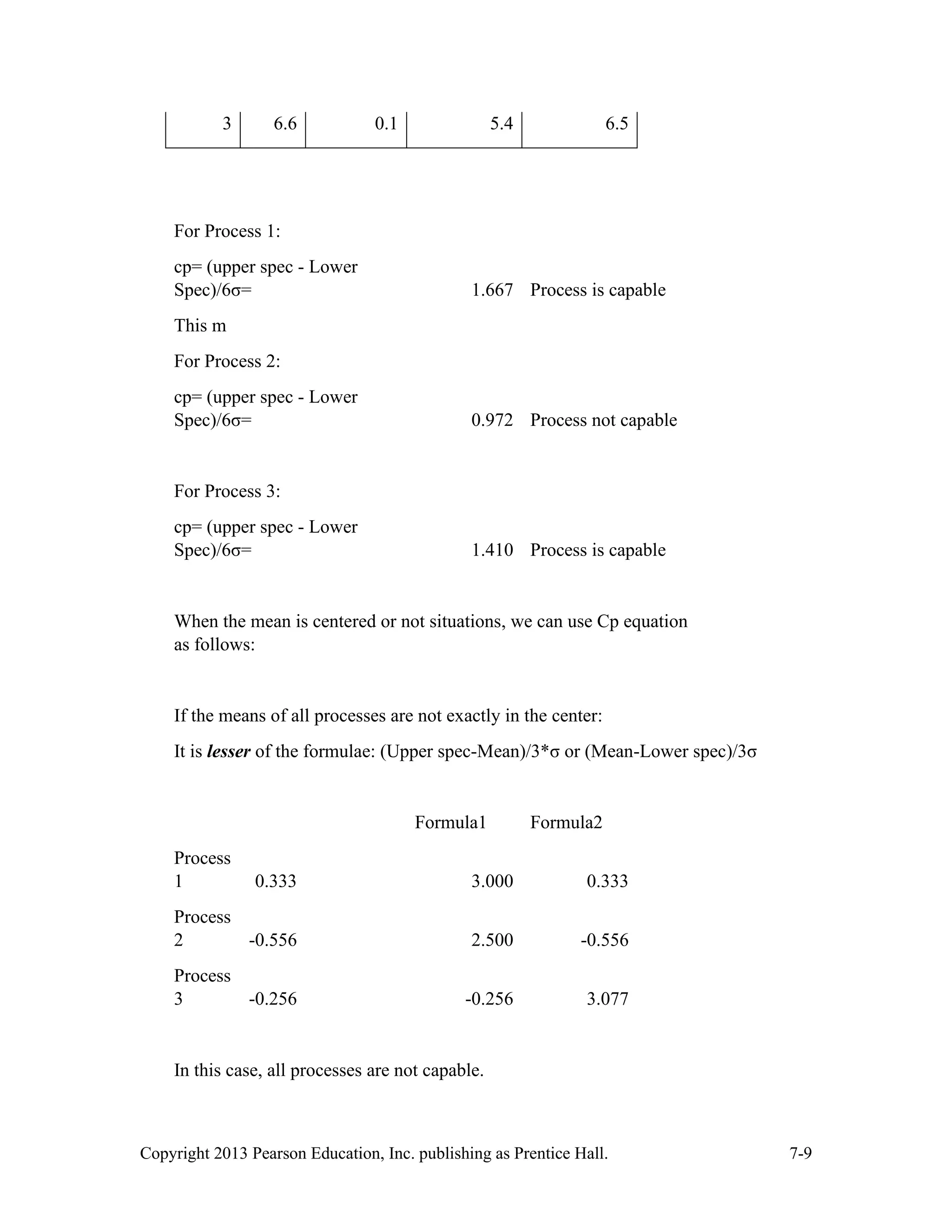
For Process 1:
cp= (upper spec - Lower
Spec)/6σ= 1.667 Process is capable
This m
For Process 2:
cp= (upper spec - Lower
Spec)/6σ= 0.972 Process not capable
For Process 3:
cp= (upper spec - Lower
Spec)/6σ= 1.410 Process is capable
When the mean is centered or not situations, we can use Cp equation
as follows:
If the means of all processes are not exactly in the center:
It is lesser of the formulae: (Upper spec-Mean)/3*σ or (Mean-Lower spec)/3σ
Formula1 Formula2
Process
1 0.333 3.000 0.333
Process
2 -0.556 2.500 -0.556
Process
3 -0.256 -0.256 3.077
In this case, all processes are not capable.
Copyright 2013 Pearson Education, Inc. publishing as Prentice Hall. 7-10
The Cp should be at least equal to 1.33
Problem 5:
a. The metrics to show control over a project are scope variance hours, scope cost
increase, productivity, project cost deviation, and project progress deviation. The
variance and deviation metrics for scope, cost and progress indicates that these factors
are well defined and restrained within acceptable limitation. Meanwhile, productivity
reflects how well the individual processes are executed.
b. The metrics to show progress would be actual scope hours, productivity, and product
progress deviation. Actual scope hours provide evidence for completed tasks which
are related to the defined scope. Productivity and product progress deviation manifest
the consistency of project progress.
c. The metrics to charge a customer for changes are Scope Variance Hours, Scope Cost
Increase, Number of baseline Changes, Project Effort and Project Cost Deviation.
Number of baseline changes elicits additional requirements which have to be paid by
the customers. The project effort, project cost deviation, and scope cost increases are
used for calculating the amount of additional payment. Rescheduling of the project
should take into account the scope variance hours metric.
d. The metrics are Project Feature Enhancement Increase. This indicator measures the
efficiency of effort scheduling which should be governed to complete important
features.
e. The metrics to use to manage customer expectations are Project Merit and Project
Risk. The project merit communicates that expectations are consistently maintained
and transparent during project duration. Meanwhile, project risk conveys the plans for
securing and preserving expectations.
f. The metrics to understand how fast a team is performing tasks are Project Efficiency
and Project Effort. These metrics quantify the pace of task execution.
g. The metrics for how well a team is performing are Project Effectiveness, Productivity
and Project Effort. The three metrics are numerical presentations of quality of project
execution.
h. The metrics are removed are Removed Defects Efficiency. Removed Defects
Efficiency numerically measures defect detecting and removing capability.
i. The metrics are the Project Customer Commitment which completely evaluates
factors of customer involvement, communication, and availability.
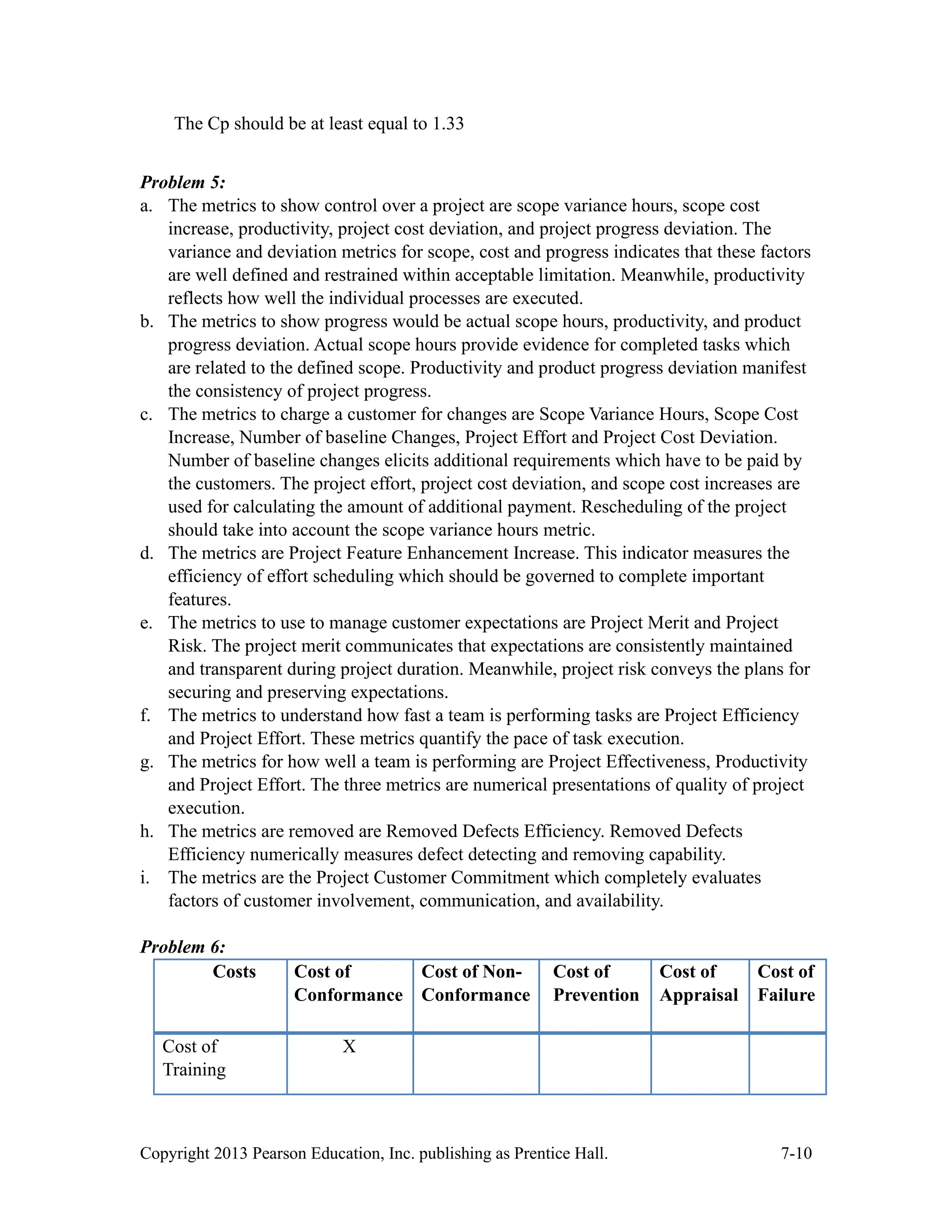
Problem 6:
Costs Cost of
Conformance
Cost of Non-
Conformance
Cost of
Prevention
Cost of
Appraisal
Cost of
Failure
Cost of
Training
X
Visit https://testbankdead.com
now to explore a rich
collection of testbank,
solution manual and enjoy
exciting offers!
Copyright 2013 Pearson Education, Inc. publishing as Prentice Hall. 7-11
Business
Opportunity
Cost
X
Cost of Testing
Material
X
Cost of Quality
Planning
X
Cost of
Rework
X
Cost of
handling
Complaints
X
Cost of
explaining
Project
Deviations
X
Cost of Testing
Tools
X
Cost of
Stationary and
Printing for
Quality
X
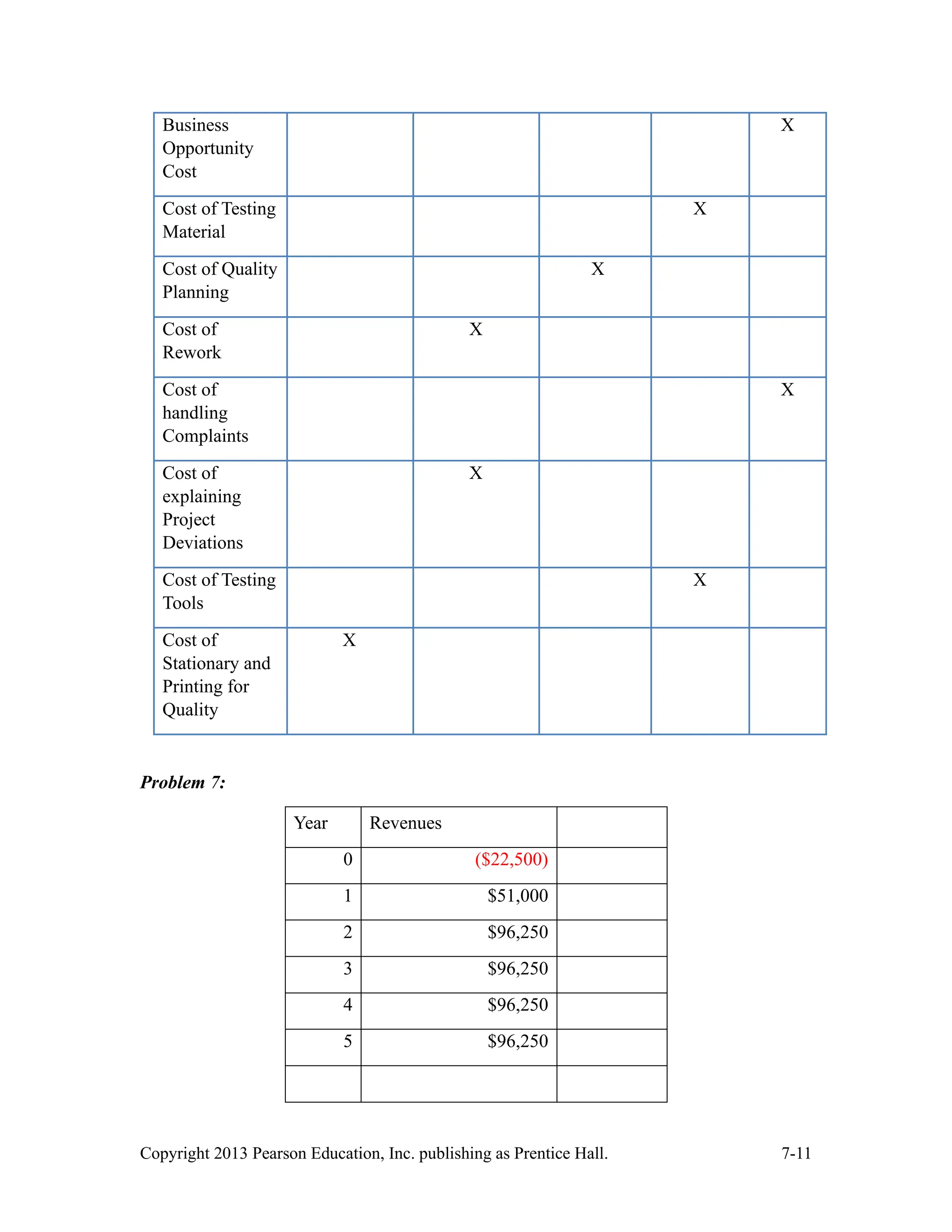
Problem 7:
Year Revenues
0 ($22,500)
1 $51,000
2 $96,250
3 $96,250
4 $96,250
5 $96,250
Copyright 2013 Pearson Education, Inc. publishing as Prentice Hall. 7-12
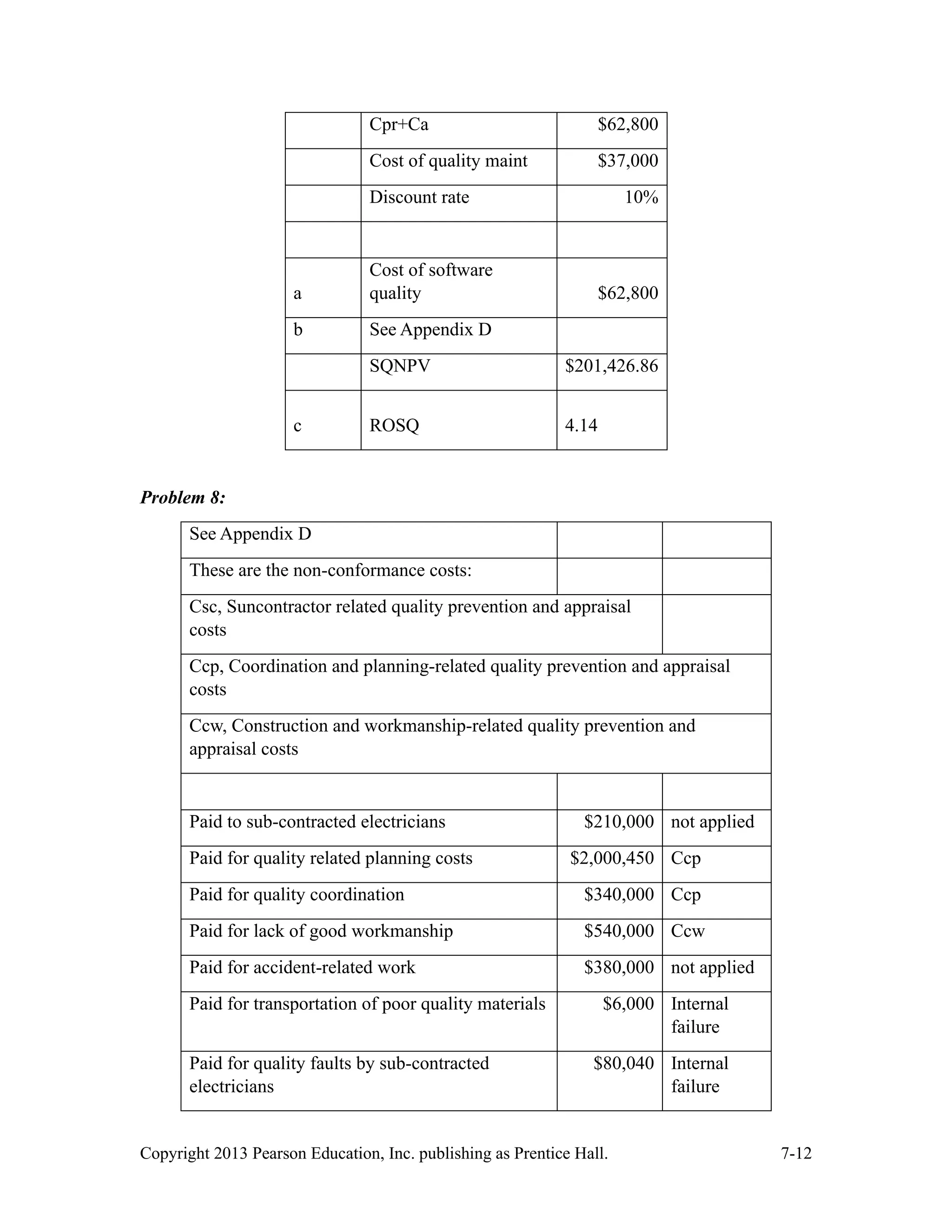
Cpr+Ca $62,800
Cost of quality maint $37,000
Discount rate 10%
a
Cost of software
quality $62,800
b See Appendix D
SQNPV $201,426.86
c ROSQ 4.14
Problem 8:
See Appendix D
These are the non-conformance costs:
Csc, Suncontractor related quality prevention and appraisal
costs
Ccp, Coordination and planning-related quality prevention and appraisal
costs
Ccw, Construction and workmanship-related quality prevention and
appraisal costs
Paid to sub-contracted electricians $210,000 not applied
Paid for quality related planning costs $2,000,450 Ccp
Paid for quality coordination $340,000 Ccp
Paid for lack of good workmanship $540,000 Ccw
Paid for accident-related work $380,000 not applied
Paid for transportation of poor quality materials $6,000 Internal
failure
Paid for quality faults by sub-contracted
electricians
$80,040 Internal
failure
Copyright 2013 Pearson Education, Inc. publishing as Prentice Hall. 7-13
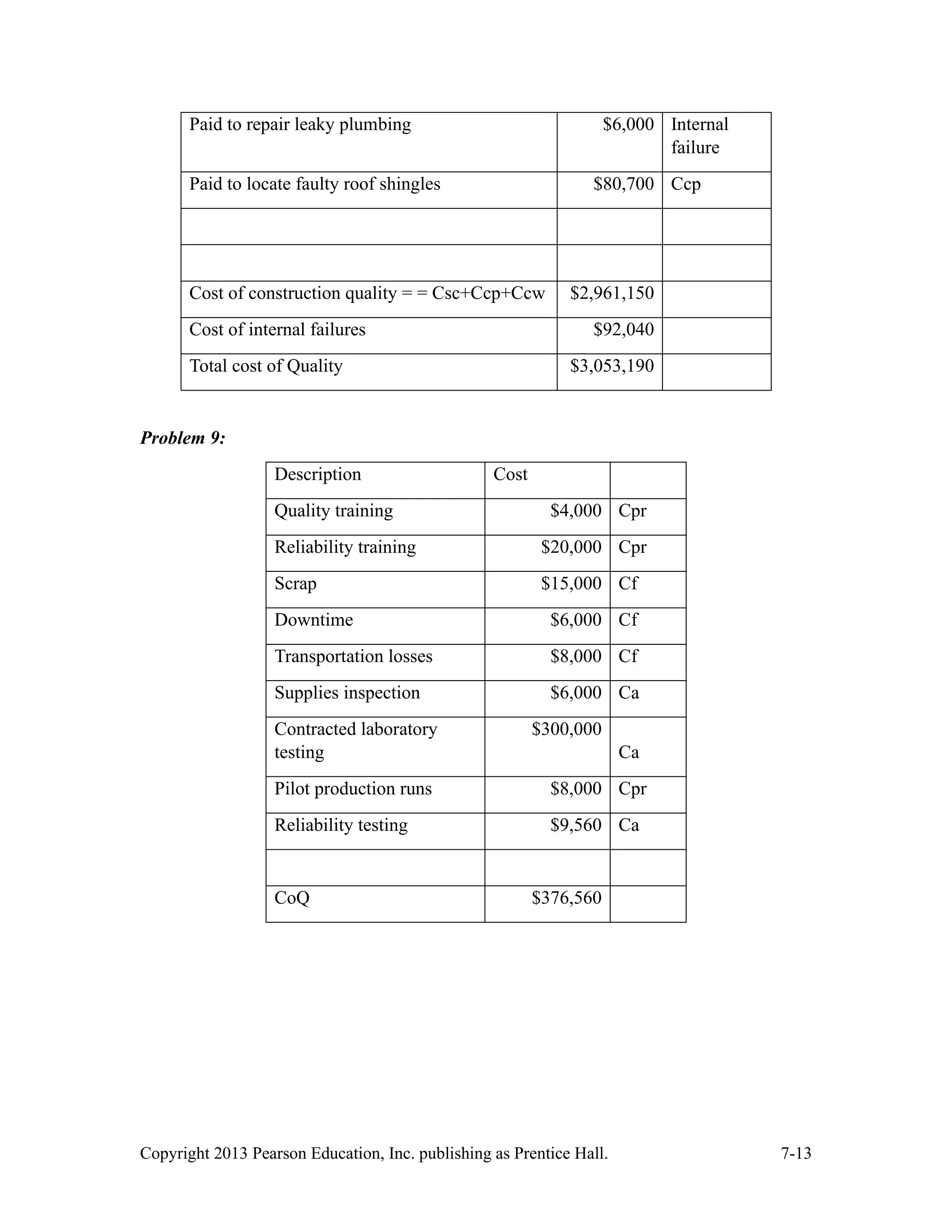
Paid to repair leaky plumbing $6,000 Internal
failure
Paid to locate faulty roof shingles $80,700 Ccp
Cost of construction quality = = Csc+Ccp+Ccw $2,961,150
Cost of internal failures $92,040
Total cost of Quality $3,053,190
Problem 9:
Description Cost
Quality training $4,000 Cpr
Reliability training $20,000 Cpr
Scrap $15,000 Cf
Downtime $6,000 Cf
Transportation losses $8,000 Cf
Supplies inspection $6,000 Ca
Contracted laboratory
testing
$300,000
Ca
Pilot production runs $8,000 Cpr
Reliability testing $9,560 Ca
CoQ $376,560
Copyright 2013 Pearson Education, Inc. publishing as Prentice Hall. 7-14
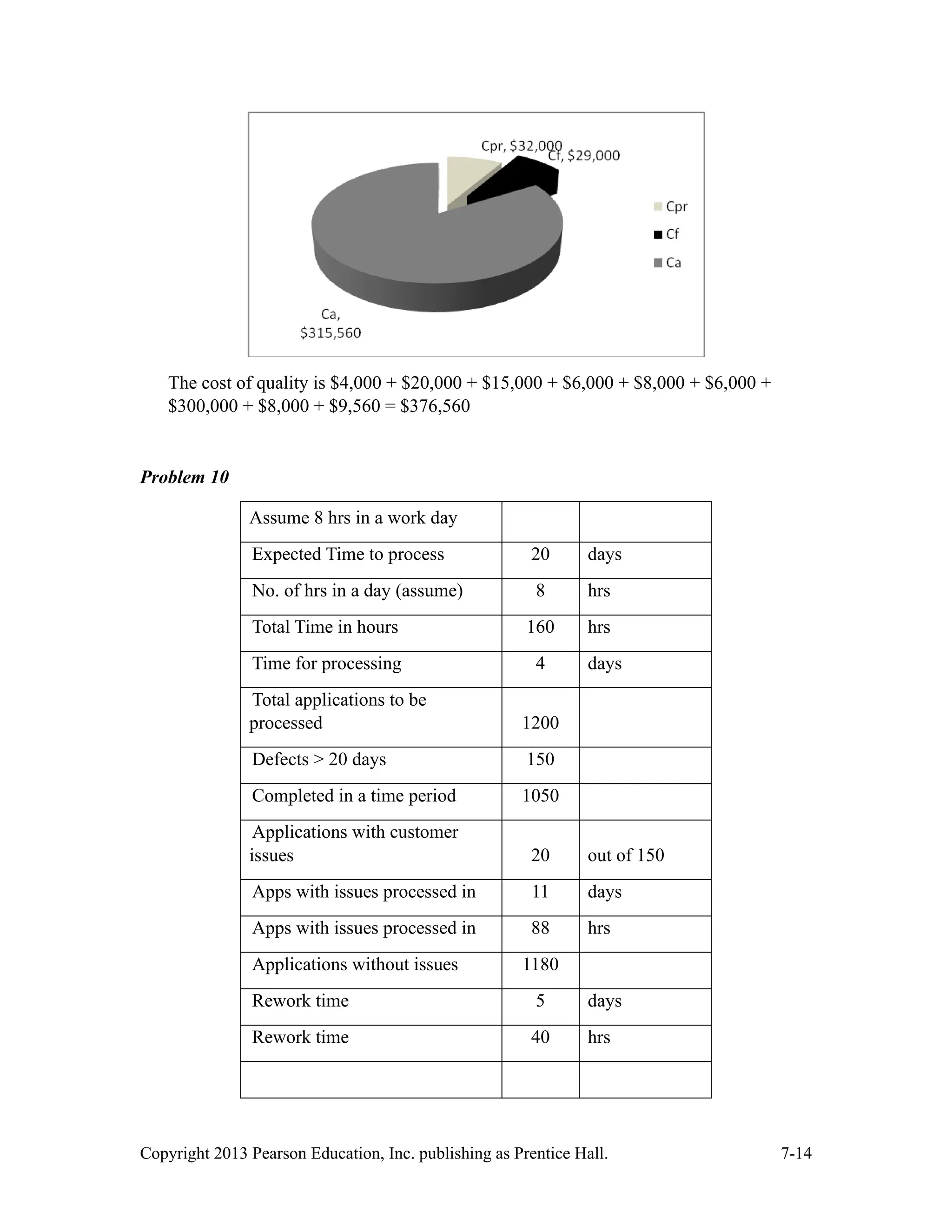
The cost of quality is $4,000 + $20,000 + $15,000 + $6,000 + $8,000 + $6,000 +
$300,000 + $8,000 + $9,560 = $376,560
Problem 10
Assume 8 hrs in a work day
Expected Time to process 20 days
No. of hrs in a day (assume) 8 hrs
Total Time in hours 160 hrs
Time for processing 4 days
Total applications to be
processed 1200
Defects > 20 days 150
Completed in a time period 1050
Applications with customer
issues 20 out of 150
Apps with issues processed in 11 days
Apps with issues processed in 88 hrs
Applications without issues 1180
Rework time 5 days
Rework time 40 hrs
Copyright 2013 Pearson Education, Inc. publishing as Prentice Hall. 7-15
Project Efficiency 88%
Project Effectiveness 98%
Productivity 4.84 in March
Expected Productivity 7.5 in March
Defective loans 13%
Correct loans 88%
See Appendix D
Project Quality Time 0.55
Time spent on defects 40 hrs
Defect by Time 0.16129
defect/project
time
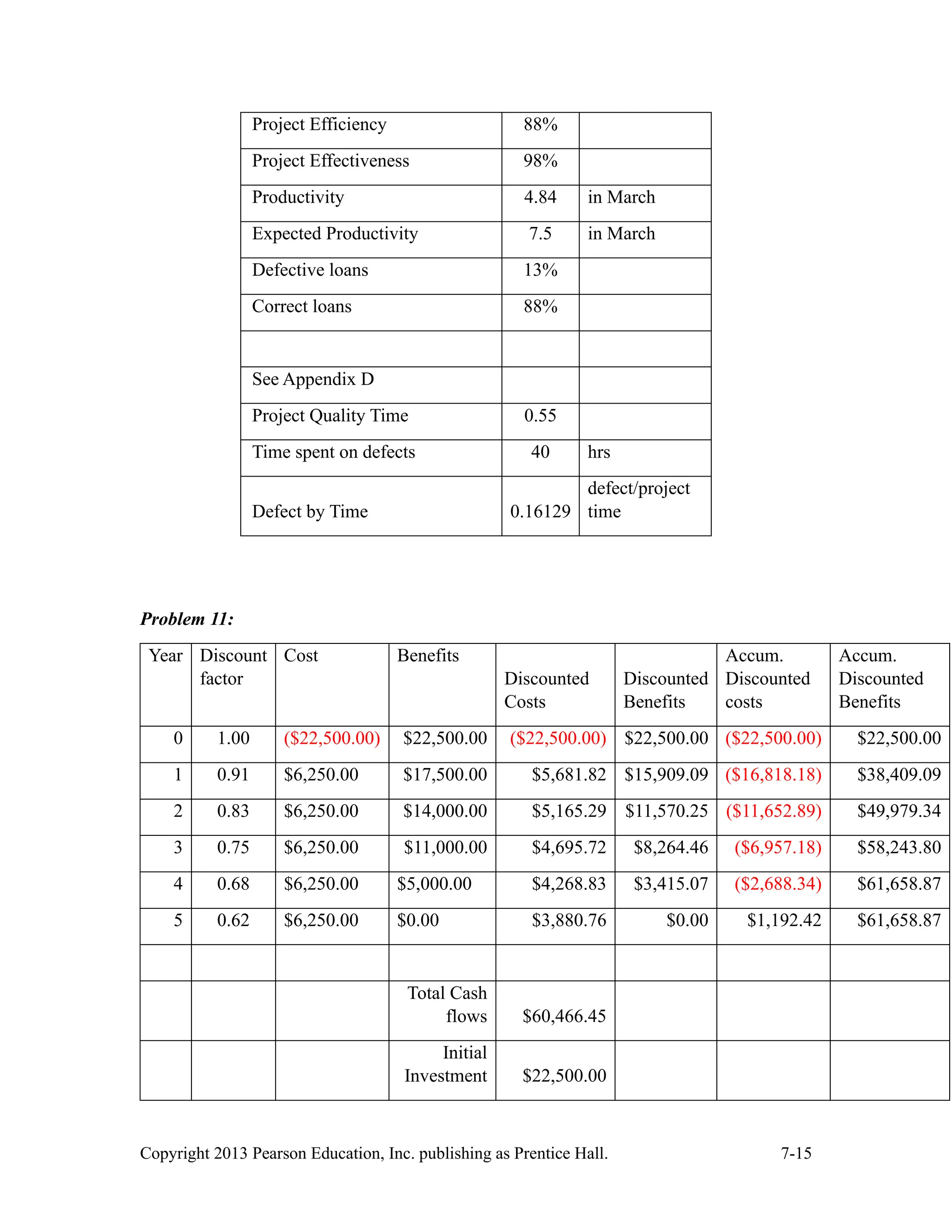
Problem 11:
Year Discount
factor
Cost Benefits
Discounted
Costs
Discounted
Benefits
Accum.
Discounted
costs
Accum.
Discounted
Benefits
0 1.00 ($22,500.00) $22,500.00 ($22,500.00) $22,500.00 ($22,500.00) $22,500.00
1 0.91 $6,250.00 $17,500.00 $5,681.82 $15,909.09 ($16,818.18) $38,409.09
2 0.83 $6,250.00 $14,000.00 $5,165.29 $11,570.25 ($11,652.89) $49,979.34
3 0.75 $6,250.00 $11,000.00 $4,695.72 $8,264.46 ($6,957.18) $58,243.80
4 0.68 $6,250.00 $5,000.00 $4,268.83 $3,415.07 ($2,688.34) $61,658.87
5 0.62 $6,250.00 $0.00 $3,880.76 $0.00 $1,192.42 $61,658.87
Total Cash
flows $60,466.45
Initial
Investment $22,500.00
Other documents randomly have
different content
limbs on the banks of the Rhine; and whenever the soldiers saw him
hobbling-past, they would say, loud enough for him to hear,—“That
fellow does not care what happens; he is certain, at all events, to
have one foot in France.”
The men of science who accompanied the expedition also came in
for their share of the jests. Asses were very numerous in Egypt;
almost all the soldiers possessed one or two, and they used always
to call them their demi-savans.
The General-in-chief, on his departure from France, had issued a
proclamation, in which he informed the troops that he was about to
take them to a country where he would make them all rich; where
they should each have seven acres of land at their disposal. The
soldiers, when they found themselves in the midst of the Desert,
surrounded by the boundless ocean of sand, began to question the
generosity of their General: they thought he had observed singular
moderation in having promised only seven acres. “The rogue,” said
they, “might with safety give us as much as he pleases; we should
not abuse his good nature.”
While the army was passing through Syria, there was not a soldier
but was heard to repeat these lines from Zaire:—
Les Français sont lassés de chercher désormais
Des climats que pour eux le destin n’a point faits,
Ils n’abandonnent point leur fertile patrie,
Pour languir aux déserts de l’aride Arabie.
On one occasion, the General-in-chief, having a few moments’
leisure to look about the country, took advantage of the ebb-tide,
and crossed on foot to the opposite coast of the Red Sea. Night
surprised him on his return, and he lost his way in the midst of the
rising tide. He was in the greatest danger, and very narrowly
escaped perishing precisely in the same manner as Pharaoh. “This,”
said Napoleon, “would have furnished all the preachers of
Christianity with a splendid text against me.” On reaching the
Arabian coast of the Red Sea, he received a deputation of the
Cenobites of Mount Sinai, who came to implore his protection, and
to request him to inscribe his name on the ancient register of their
charters. Napoleon inscribed his name in the same list with those of
Ali, Saladin, Ibrahim, and others! In allusion to this circumstance, or
something of a similar kind, the Emperor observed that he had in
the course of one year received letters from Rome and Mecca; the
Pope addressing him as his dearest son, and the Sherif styling him
the Protector of the holy Kaaba.
This singular coincidence, however, is scarcely surprising, with
reference to him who has led armies both through the burning sands
of the Tropic, and over the frozen Steppes of the North; who, when
he narrowly escaped being swallowed up in the waves of the Red
Sea, or might have perished in the flames of Moscow, was
threatening the Indies from those two extreme points.
The General-in-chief shared the fatigues of the soldiers. The
privations endured by every individual in the army were sometimes
so great that they were compelled to dispute with each other for the
smallest enjoyments, without the least distinction of rank. To such
extremities were they reduced that, in the Desert, the soldiers would
hardly relinquish their places to allow the General to dip his hands in
a muddy stream. On one occasion, as they were passing by the ruins
of Pelusium, and were almost suffocated with the heat, some one
resigned to him a fragment of a door, beneath which he contrived to
shade his head for a few minutes: “And this,” said Napoleon, “was
no trifling concession.” It was on this very spot, while removing
some stones at his feet, that chance rendered him the possessor of
a superb antique, well known in the learned world.[21]
In proceeding to Asia, the French army had to cross the Desert
which separates that continent from Africa. Kleber, who commanded
the advanced guard, mistook his road, and lost his way in the
Desert. Napoleon, who was following at the distance of half a day’s
march, attended by a slender escort, found himself at night-fall in
the midst of the Turkish camp: he was closely pursued, and escaped
only because, it being night, the Turks suspected that an ambush
was intended. The next source of uneasiness was the doubtful fate
of Kleber and his detachment, and the greater part of the night was
passed in the most cruel anxiety. At length they obtained information
respecting them from some Arabs of the Desert, and the General-in-
chief hastened, on his dromedary, in quest of his troops. He found
them overwhelmed with despair, and ready to perish from thirst and
fatigue; some of the young soldiers had, in a moment of frenzy,
even broken their muskets. The sight of their General seemed to
give them new life, by reviving their hopes. Napoleon informed them
that a supply of provisions and water was coming up behind him.
“But,” said he, to the troops, “if relief had been longer delayed,
would that have excused your murmuring and loss of courage? No,
soldiers; learn to die with honour.”
Napoleon travelled the greater part of the way through the Desert
on a dromedary. The physical hardihood of this animal renders it
unnecessary to pay the least attention to his sustenance; he scarcely
eats or drinks; but his moral sensibility is extreme, harsh treatment
provokes his resentment, and renders him furious. The Emperor
observed that the roughness of his trot created nausea, like the
motion of a ship. The animal will travel twenty leagues a day. The
Emperor formed some dromedary regiments, and the use he made
of them in the army soon proved the destruction of the Arabs. The
rider squats himself on the back of the animal, through whose
nostrils a ring is passed, which serves to guide him: he is very
obedient, and on a certain signal, made by the voice of the rider, the
animal kneels down to allow him to alight. The dromedary will carry
very heavy burdens, and he is never unloaded during the whole of
the journey. On his arrival at evening stations, his load is propped
up, and the animal lies down and goes to sleep: at day-break he
rises,—his burden is on his back, and he is ready to continue his
journey. The dromedary is only a beast of burden, and not at all fit
for draught. In Syria, however, they succeeded in yoking them to
field-pieces, thus rendering them essentially serviceable.
Napoleon became very popular among the Egyptians, who gave
him the name of Sultan Kebir (Father of Fire). He inspired particular
respect: wherever he appeared the people rose in his presence; and
this deference was paid to him alone. The uniform consideration
with which he treated the Sheiks, and the adroitness by which he
gained their confidence, rendered him truly the sovereign of Egypt,
and more than once saved his life. But for their disclosures, he
would have fallen a victim to fanaticism, like Kleber, who, on the
contrary, rendered himself odious to the Sheiks, and perished in
consequence of subjecting one of them to the punishment of the
bastinado. Bertrand was one of the judges who condemned the
assassin, and, on his telling us this fact one day at dinner, the
Emperor observed:—“If the slanderers, who accuse me of having
caused the death of Kleber, were acquainted with the fact you have
mentioned, they would not hesitate to call you the assassin, or the
accomplice, and would take it for granted that your title of Grand
Marshal, and your residence at Saint Helena, are the reward and the
punishment of the crime.”
Napoleon willingly conversed with the people of the country, and
always displayed sentiments of justice which struck them with
wonder. On his way back to Syria, an Arab tribe came to meet him,
for the double purpose of shewing him respect and of selling their
services as guides. “The chief of the tribe was unwell, and his place
was filled by his son, a youth of the age and size of your boy here,”
said the Emperor to me: “he was mounted on his dromedary, riding
close beside me, and chatting to me with great familiarity. ’Sultan
Kebir, said he, ‘I could give you good advice, now that you are
returning to Cairo,’ ‘Well, speak, my friend, and if your advice is
good, I will follow it.’—‘I’ll tell you what I would do, if I were in your
place. As soon as I got to Cairo, I would order the richest slave-
merchant into the market, and I would choose twenty of the
prettiest women for myself; I would next send for the richest
jewellers, and would make them give me up a good share of their
stock; I would then do the same with all the other merchants; for
what is the use of reigning, or being powerful, if not to acquire
riches?’—‘But, my friend, suppose it were more noble to preserve
them for others?’ This sentiment seemed to make him reflect a little,
without convincing him. The young man was evidently very
promising, for an Arab: he was lively and courageous, and led his
troop with dignity and order. He is, perhaps, destined, one day or
other, to carry his advice into execution for his own benefit in the
market-place of Cairo.”
On another occasion, some Arabs who were on friendly terms with
the army, penetrated into a village on the frontier, and an
unfortunate Fellah (peasant) was killed. The Sultan Kebir flew into a
great passion; and, vowing that he would have vengeance, gave
orders that the tribe should be pursued into the Desert to extinction.
This order was given in the presence of the principal Sheiks, one of
whom could not refrain from laughing at his anger and his
determination. “Sultan Kebir,” said he, “you are playing a bad game
just now: do not quarrel with these people; they can do you ten
times more harm than you can do them. And besides, what is it all
about. Because they have killed a miserable peasant? Was he your
cousin (a proverbial expression among them)?” “He was more than
my cousin,” replied Napoleon; “all those whom I govern are my
children: power is given to me only that I may ensure their safety.”
On hearing these words all the Sheiks bowed their heads, and said,
“O! that is very fine;—you have spoken like the Prophet.”
The decision of the Grand Mosque of Cairo in favour of the French
army was a masterpiece of skill on the part of the General-in-chief,
who induced the synod of the chief Sheiks to declare, by a public
act, that the Mussulmans should obey, and pay tribute to, the French
general. It is the first and only example of the sort, since the
establishment of the Koran, which forbids submission to Infidels. The
details of this transaction are invaluable: they will be found in the
Campaigns of Egypt.
Saint-Jean d’Acre, doubtless, presented a singular spectacle, when
two European armies met with hostile intentions in a little town of
Asia, with the mutual purpose of securing the possession of a
portion of Africa; but it is still more extraordinary that the persons
who directed the efforts of each party were both of the same nation,
of the same age, of the same rank, of the same corps, and of the
same school.
Philippeaux, to whose talents the English and Turks owed the
preservation of Saint Jean d’Acre, had been the companion of
Napoleon at the military school of Paris: they had been there
examined together, previous to their being sent to their respective
corps. “His figure resembled yours,” said the Emperor to me, after
having dictated his eulogium in the Memoirs, and mentioned all the
mischief he had done him. “Sire,” I answered, “there were many
other points of affinity between us; we had been intimate and
inseparable companions at the Military School. When he passed
through London with Sir Sydney Smith, who, by his assistance, had
been enabled to escape from the Temple, he sought for me in every
direction. I called at his lodgings only half an hour after his
departure; had it not been for this accident, I should probably have
accompanied him. I was at the time without occupation; the
prospect of adventure might have tempted me; and how strangely
might the course of my destinies have been turned in a new
direction!”
“I am well aware,” said Napoleon, “of the influence which chance
usurps over our political determinations; and it is the knowledge of
that circumstance which has always kept me free from prejudice,
and rendered me very indulgent with regard to the party adopted by
individuals in our political convulsions. To be a good Frenchman, or
to wish to become one, was all that I looked for in any one.”—The
Emperor then went on to compare the confusion of our troubles to
battles in the night-time, where each man attacks his neighbour, and
friends are often confounded with foes; but when daylight returns,
and order is restored, every one forgives the injury which he has
sustained through mistake. “Even for myself,” said he, “how could I
undertake to say that there might not have existed circumstances
sufficiently powerful, notwithstanding my natural sentiments, to
induce me to emigrate? The vicinity of the frontier, for instance, a
friendly attachment, or the influence of a chief. In revolutions, we
can only speak with certainty to what we have done: it is silly to
affirm that we could not have acted otherwise.” The Emperor then
related a singular example of the influence of chance over the
destinies of men. Serrurier and the younger Hedouville, while
travelling together on foot to emigrate into Spain, were met by a
military patrol. Hedouville, being the younger and more active of the
two, cleared the frontier, thought himself very lucky, and went to
spend a life of mere vegetation in Spain. Serrurier, on the contrary,
being obliged to return into the interior, bewailed his unhappy fate,
and became a marshal: such is the uncertainty of human foresight
and calculations!
At Saint-Jean d’Acre, the General-in-chief lost Caffarelli, of whom
he was extremely fond. Caffarelli entertained a sort of reverential
respect for the General-in-chief. The influence of this sentiment was
so great that, though he was delirious for several days previous to
his death, when Napoleon went to see him, the announcement of his
name seemed to recal him to life: he became more collected, his
spirits revived, and he conversed coherently; but he relapsed into his
former state immediately after Napoleon’s departure. This singular
phenomenon was renewed every time the General-in-chief paid him
a visit.
Napoleon received, during the siege of Saint-Jean d’Acre, an
affecting proof of heroic devotedness. While he was in the trenches,
a shell fell at his feet; two grenadiers who observed it immediately
rushed towards him, placed him between them, and raising their
arms above his head, completely covered every part of his body.
Happily the shell respected the whole group; nobody was injured.
One of these brave grenadiers afterwards became General
Dumesnil, who lost a leg in the campaign of Moscow, and
commanded the fortress of Vincennes at the time of the invasion in
1814. The capital had been for some weeks occupied by the Allies,
and Dumesnil still held out. Nothing was then talked of in Paris but
his obstinate defence, and his humorous reply when summoned by
the Russians to surrender;—“Give me back my leg, and I will give up
my fortress.”
The French soldiers acquired extraordinary reputation in Egypt,
and not without cause; they had dispersed and dismayed the
celebrated Mamelucks, the most formidable militia of the East. After
the retreat from Syria, a Turkish army landed at Aboukir: Murat-Bey,
the most powerful and brave of the Mamelucks, left Upper Egypt,
whither he had fled for safety, and reached the Turkish camp by a
circuitous route. On the landing of the Turks, the French
detachments had fallen back in order to concentrate their forces.
The Pacha who commanded the Turks was delighted at this
movement, which he mistook for the effect of fear; and, on
perceiving Murat-Bey, he exultingly exclaimed:—“So! these are the
terrible French whom you could not face; see, the moment I make
my appearance, how they fly before me.“ The indignant Murat-Bey
furiously replied:—“Pacha, render thanks to the Prophet that it has
pleased these Frenchmen to retire; if they should return, you will
disappear before them like dust before the wind.”
His words were prophetical:—some days after, the French poured
down upon the Turkish army and put it to flight. Murat-Bey, who had
interviews with several of our generals, was extremely surprised at
their diminutive stature and pitiful condition. The Oriental nations
attach high importance to the bodily stature, and they were unable
to conceive how so much genius could exist within such small
dimensions. The appearance of Kleber alone came up to their ideas;
he was an uncommonly fine-looking man, but his manners were
rude. The discrimination of the Egyptians induced them to think that
he was not a Frenchman; in fact, though a native of Alsace, he had
spent the early part of his life in the Prussian army, and might very
well have passed for a German. Some one said that Kleber had been
a Janissary in his youth; the Emperor burst into a fit of laughter, and
said somebody had been imposing on him.
The Grand-Marshal told the Emperor that at the battle of Aboukir
he was for the first time placed in his army, and near his person. He
was then so little accustomed to the boldness of his manœuvres,
that he scarcely understood any of the orders he heard him give.
“Particularly, Sire,” added he, “when I heard you call out to an
officer, ‘Hercule, my dear fellow, take twenty-five men and charge
that rabble:’ I really thought I had lost my senses; your Majesty
pointed to a detachment of a thousand Turkish horse.”
After all, the losses sustained by the army in Egypt were far from
being so considerable as might have been expected in a country to
which the troops were unaccustomed; particularly when the
insalubrity of the climate, the remoteness of the resources of the
country, the ravages of the plague, and the numerous actions which
have immortalized that army, are taken into account. The French
force, at its landing in Egypt, amounted to 30,000 men; it was
augmented by the wrecks of the battle of Aboukir, and probably also
by some partial arrivals from France; and yet the total loss sustained
by the army, from the commencement of the campaign to two
months after the departure of the General-in-chief for Europe,
(during the space of seven or eight-and-twenty months,) amounted
only to 8,915, as is proved by the official report of the Muster-
master-general.[22]
The life of a man must indeed be replete with prodigies, when one
of his acts, which is without parallel in history scarcely arrests our
attention. When Cæsar passed the Rubicon, he possessed an army,
and was advancing in his own defence. When Alexander, urged by
the ardour of youth and the fire of genius, landed in Asia, to make
war on the great King, he, Alexander, was the son of a king, a king
himself, and courted the chances of ambition and glory at the head
of the forces of his kingdom. But that a private individual, whose
name three years before was unknown to the world, who at that
moment had nothing to aid him but the reputation of a few victories,
his name, and the consciousness of his genius, should have dared to
conceive the project of taking into his own hands the destinies of
thirty millions of men, of protecting them from external defeats and
internal dissensions;—that, roused by the recital of the troubles
which were described to him, and by the idea of the disasters which
he foresaw, he should have exclaimed, “France will be lost through
these fine talkers, these babblers: now is the time to save her!”—
that he should have abandoned his army, and crossed the seas, at
the risk of his liberty and reputation, have reached the French soil
and flown to the capital; that he should there have seized the helm,
and stopped short a nation intoxicated with every excess; that he
should have suddenly brought her back to the true course of reason
and justice;—that he should from that moment have prepared for
her a career of power and glory till then unknown;—and that all this
should have been accomplished without the shedding of a single
tear or a drop of blood;—such an undertaking may be regarded as
one of the most gigantic and sublime that ever was heard of; it will
fill calm and dispassionate posterity with astonishment and
admiration; though at the time it was branded by some with the
name of a desperate flight, and an infamous desertion. The army,
however, which Napoleon left behind him, continued to occupy Egypt
for the space of two years longer. It was the opinion of the Emperor
that it ought never to have been forced to surrender; and the Grand
Marshal, who accompanied the army to the last moment, concurred
in that opinion.
After the departure of the General-in-chief, Kleber, who succeeded
him, deceived and misled by intrigues, treated for the evacuation of
Egypt; but when the enemy’s refusal compelled him to seek for new
glory, and to form a more just estimate of his own force, he totally
altered his opinions, and declared himself favourable to the
occupation of Egypt; and this had even become the general
sentiment of the army. He now thought only of maintaining himself
in the country; he dismissed those who had influenced him in
forming his first design, and collected around him only those who
favoured the contrary measure. Had he lived, Egypt would have
been secure; to his death her loss must be attributed. The command
of the army was afterwards divided between Menou and Regnier. It
then became a mere field of intrigue: the energy and courage of the
French troops continued unabated; but they were no longer
employed and directed as they had been by Kleber. Menou was
totally inefficient; the English advanced to attack him with twenty
thousand men; his force was much more considerable, and the
general spirit of the two armies was not to be compared. By an
inconceivable infatuation, Menou hastily dispersed his troops, as
soon as he learned that the English were about to appear, the latter
advanced in a mass, and were attacked only in detail. “How blind is
fortune,” said the Emperor; “by the adoption of contrary measures,
the English would infallibly have been destroyed; and how many new
chances might not that event have brought about!”
Their landing was admirable, said the Grand Marshal: in less than
five or six minutes five thousand five hundred men appeared in
order of battle: it was a truly theatrical movement; and it was thrice
repeated. Their landing was opposed by only twelve hundred men,
who did them considerable damage. Shortly after, this mass,
amounting to between thirteen and fourteen thousand, was
intrepidly attacked by General Lanusse. The General had only three
thousand troops; but fired with ambition, and not doubting that his
force was adequate to fulfil the object he had in view, he would not
wait for reinforcements; at first he overthrew every thing in his way,
and, after causing immense slaughter to the enemy, he was at
length defeated. Had his force been two or three thousand stronger,
he would have attained his object.
The English were greatly astonished when they had an
opportunity of judging for themselves of our real situation in Egypt;
and they considered themselves extremely fortunate in the turn
which affairs had taken.
General Hutchinson, who reaped the glory of the conquest, said,
on his return to Europe, that had the English known the real state of
things, they would certainly never have attempted to land; but in
England it was believed that there were not six thousand French
troops in Egypt. This mistake arose out of the intercepted letters, as
well as the intelligence that was collected in Egypt. “So natural is it
to Frenchmen,” said Napoleon, “to exaggerate, murmur, and
misrepresent, whenever they are dissatisfied. These reports,
however, were created merely by ill-humour or diseased
imaginations: it was said that there was a famine in Egypt; that the
French had all been destroyed, at every new battle; that the plague
had swept away the whole army; that there was not a man left,” &c.
Through the repetition of these reports, Pitt was at length
persuaded of their reality; and how could it be otherwise? The First
Consul saw the despatches from his successor addressed to the
Directory; and also letters from various persons in the French army.
Who can explain the contradictions they contained? Who will
henceforth trust to individual authority for the support of his
opinion? Kleber, the General-in-chief, informed the Directory, that he
had only six thousand men, while in the same packet the accounts
of the inspector of reviews exhibited upwards of twenty thousand.
Kleber declared that he was without money, and the treasury
accounts display vast sums. The General-in-chief alleged that the
artillery was merely an intrenched park, destitute of ammunition;
while the estimates of that department made mention of stores for
several campaigns. “Thus, if Kleber, by virtue of the treaty he
commenced, had evacuated Egypt,” said the Emperor, “I should
undoubtedly have brought him to trial on his return to France. All
these contradictory documents had been submitted to the
examination and opinion of the Council of State.”
From the letters of Kleber, the General-in-chief, an idea may be
formed of the tone of those written by persons of inferior rank, and
by the common soldiers. Such, however, were the communications
daily intercepted by the English; which they printed and which
guided them in their operations—a circumstance that must have cost
them dear. The Emperor observed that in all his campaigns he had
seen the same effect produced by intercepted letters, which
sometimes had proved of great advantage to him.
Among the letters which at this period fell into his hands, he found
odious attacks upon himself, which he felt the more sensibly because
several of them were written by persons whom he had loaded with
benefits, in whom he had reposed full confidence, and whom he
believed to be strongly attached to him. One of these individuals,
whose fortune he had made, and in whom he trusted with the
utmost sincerity, alleged that the General-in-chief had decamped,
after robbing the treasury of two millions. Fortunately, in these same
despatches the accounts of the Paymaster proved that the General
had not even received the whole amount of the pay due to him. “On
reading this statement,” said the Emperor, “I felt really disgusted at
mankind. This was the first moral disappointment I had ever
experienced; and if it has not been the only one, it has, perhaps, at
least, been the most severe. Many individuals in the army thought
me ruined, and they were already eagerly seeking to pay their court
in the proper quarter at my expense.” The author of the assertion
above alluded to subsequently endeavoured to restore himself to
favour. The Emperor signified that he should have no objection to his
being employed in a subordinate situation; but that he would never
see him again. To every application he constantly replied that he did
not know him: this was the only vengeance he took.
The Emperor never ceased to repeat that Egypt ought to have
remained in the possession of the French, which would infallibly
have been the case had the country been defended by Kleber or
Desaix. “These were my two most distinguished lieutenants,” said
he; “both possessed great and rare merits, though their characters
and dispositions were very different.”
Kleber’s was the talent of nature; Desaix’s was entirely the result
of education and assiduity. The genius of Kleber only burst forth at
particular moments, when roused by the importance of the occasion;
and then it immediately slumbered again in the bosom of indolence
and pleasure. The talent of Desaix was always in full activity; he
lived only for noble ambition and true glory: his character was
formed on the true ancient model. The Emperor said that his death
was the greatest loss he could possibly have sustained. Their
conformity of education and principles would always have preserved
a good understanding between them. Desaix would have been
satisfied with secondary rank, and would have remained ever
devoted and faithful. Had he not been killed at the battle of
Marengo, the First Consul would have given him the command of the
army of Germany, instead of continuing it to Moreau. A very
extraordinary circumstance in the destiny of these two lieutenants of
Napoleon was that on the very day and at the very hour when
Kleber was assassinated at Cairo, Desaix was killed by a cannon-ball
at Marengo.
THE EMPEROR’S METHOD OF DICTATING.
October 1st—3rd. The wind, the sea, and the temperature still
continued without variation. The westerly wind, which had at first
been so much in our favour, now began to be adverse. We had taken
an easterly direction, in the hope of falling in with the trade-winds;
but we now found ourselves to the leeward of the place of our
destination, through the continuance of the westerly winds—a
circumstance which surprised every body, and excited dissatisfaction
among the crew.
The Emperor every morning regularly continued his dictation, in
which he daily took a deeper interest; consequently his hours
henceforth seemed less tedious.
The vessel had been sent out of port in such a hurry that many
repairs remained to be completed after we had put to sea, and the
painting of the ship had only recently been finished. The Emperor’s
sense of smelling is extremely delicate; and he found the paint so
very offensive that he was forced to confine himself to his cabin for
two days.
Every evening, when taking his walk on deck, he loved to revert to
the occupation of the morning. At first, he was assisted by no other
document than a wretched work entitled Guerres des Français en
Italie, written without end or object, and devoid of any connected
chronological plan. The Emperor glanced through it, and his memory
supplied all deficiences: this faculty indeed appeared to me the more
extraordinary since it always seemed to be in readiness when
needed, and as if at command.
When the Emperor commenced his daily dictations, he always
complained that the circumstances to which he wished to recur were
no longer familiar to him. He seemed to want confidence in himself,
saying he should never get through the task. After considering for a
few moments he would rise and walk about, and then begin to
dictate. From that moment he was quite another man: every thing
flowed smoothly; he spoke as if by inspiration; places, dates,
phrases—he stopped at nothing.
On the following day I read to him what he had dictated. After
making the first correction he continued to go on with the same
subject, as though he had said nothing about it the day before. The
difference between the first and the second version was very great:
the latter was more positive and diffuse, and better arranged;
indeed it sometimes materially differed from the first.
On the day succeeding the first correction, the same operation
was repeated, and the Emperor commenced his third dictation for
the purpose of setting the two former ones right. But after that, had
he dictated a fourth, a seventh, or a tenth time, as he in some
instances did, it would have been a repetition of precisely the same
ideas, the same construction of phrases, and almost the same
words. It was needless to take the trouble to write, though before
his eyes: he paid no attention to what was doing, and continued to
the end of his subject. It would have been vain to ask him to repeat
any thing that might not have been distinctly heard: he still went on;
and as he dictated with great rapidity, I never ventured to interrupt
him, lest I should lose still more, and find myself unable to recover
the thread of the subject.
A SINGULAR ACCIDENT.
4th—7th. The continuance of the south-west wind was truly
unfortunate. We were now going back instead of forward and we
had completely entered the Gulf of Guinea. There we perceived a
ship, with which we spoke. She proved to be a French ship, driven
out of her course like ourselves. She had sailed from a port in
Britany, and was bound for the Isle of Bourbon. The Emperor had
been much distressed for want of books; and I jokingly said that
perhaps I might have a box-full on board that ship, as I had
despatched one to the Isle of Bourbon, a few months since. I spoke
truly. Such is the caprice of chance! Had I been in quest of this ship,
I might have traversed the ocean in vain. This was the identical
vessel: I learned her name next day from the officer who had visited
her. This officer strangely surprised the French captain, by telling
him that the Emperor Napoleon was on board the ship which he
then saw making for St. Helena. The poor fellow shook his head
sorrowfully, and said, “You have robbed us of our treasure: you have
taken away him who knew how to govern us according to our tastes
and manners.”
COMPLAINTS OF THE CREW AGAINST THE ADMIRAL.—EXAMINATION
OF ANOTHER WORK.—REFUTATIONS.—REFLECTIONS.
8th—11th. The weather continued obstinately settled. We every
evening consoled ourselves, for the unfavourable state of the day,
with the hope of a change during the night; but we arose in the
morning with the same disappointment. We had been almost within
sight of the Congo, and we stood off. Every one manifested
discontent and ennui. The crew complained of the Admiral; had he
taken the usual course, said they, we should have reached our
destination long before; his caprice, they observed, had led him, in
spite of reason, to try an experiment, of which they knew not what
might be the consequence. Their murmurs were not, however, so
vehement as those raised against Christopher Columbus; we should
not have been ill pleased had he been reduced to the necessity of
finding another Saint Salvador, in order to evade the crisis. Being for
my own part fully occupied, this circumstance engrossed but little of
my attention; and after all, one prison was as good as another. As to
the Emperor, he was still more unconcerned at this delay; he merely
looked upon it as so many days spent.
Les Mémoires de Napoléon Bonaparte, par quelqu’un qui ne l’a
jamais quitté pendant 15 ans, (The Memoirs of Napoleon Bonaparte,
by one who was constantly near him, during fifteen years,) was the
title of a work which I began to examine after the writings of Sir
Robert Wilson. It is a volume of three hundred pages, by an
anonymous author—a circumstance in itself sufficient to inspire
distrust at the first outset. But the composition and style of the work
soon created more positive doubts in the mind of the reflecting
reader, who is accustomed to judge of books. Finally, he who has
seen and known but little of the Emperor will not hesitate to affirm,
on reading the very first pages, that this work is a mere romance,
written at pleasure; that the author has never approached the
Emperor; and that he is a hundred leagues distant from his
language, habits, and every thing concerning him. The Emperor
never said to a minister: “Count, do this,”—“Count, execute that.”
Ambassadors never attended his levee. Napoleon could not, at
fourteen years of age, have made to a lady in company, the reply
attributed to him, relative to the Viscomte de Turenne; because from
the age of ten to eighteen he was attending the Military School,
where he could not possibly have been introduced to the company
of ladies. It was not Perignon, who did not know him, but
Dugommier, who had been his General, who recommended him in so
marked a way to the Directory. It was a letter for restoring the
Democracy, and not the Bourbons, which an officer addressed to the
First Consul, &c.
The Emperor, who in Europe was universally acknowledged to
have preserved the most impenetrable secrecy with regard to his
plans and views, never indulged in gestures, and still less in
soliloquies, which would have been likely to betray him: nor did his
anger ever throw him into fits of insanity or epilepsy—an absurd
fabrication which was long circulated in the saloons of Paris, but
which was relinquished when it was found that those accidents
never occurred on important occasions. These Memoirs have
unquestionably been an ordered work, the speculation of some
bookseller who has furnished the title. Be this as it may, it might
have been supposed that, in adverting to a career so public as that
of the Emperor and of those who surrounded him, the author might
have evinced more accuracy and knowledge of his subject. He is
aware of his insufficiency on this head, and seeks to defend himself
by saying that he was under the necessity of altering names, and
that he did not wish to render certain portraits too striking; but he
also observes this circumspection with regard to facts, so that they
cannot be recognised. They are for the most part entirely the
creations of his own fancy. Thus, the paper whose loss cost the
General-in-chief so much anxiety in Egypt; the recommendation of
the young Englishman, who transported Bonaparte with joy by
opening to him so brilliant a perspective of fortune at
Constantinople; the melodrama of Malmaison, where the heroism of
Madame Bonaparte (who is described as an absolute amazon) so
promptly secures the safety of her husband, may perhaps excite the
interest of the reader; but they are only so many fables; and the
story relative to Malmaison shews that the author knew no more of
the character and disposition of the Empress Josephine than of
those of the Emperor. The writer, however, by extolling certain traits,
praising certain actions, and refuting certain falsehoods, assumes an
air of impartiality, which, joined to his pretended situation near the
Emperor during fifteen years, produces a wonderful effect in the
eyes of common readers. Most of the Englishmen on board the
vessel looked upon this work as a kind of oracle. Their opinion was
not changed on finding the Emperor’s character so different from
that attributed to him in this romance. They were inclined to believe
that adversity and constraint had wrought an alteration in the
Emperor, rather than to suppose that these printed statements were
false. To my observations, they constantly replied:—“But the author
was an impartial man, and one who was about the Emperor for
fifteen years:”—“But,” said I, “what is this man’s name? If he had
personally injured you in his book, how could you bring him to
justice? Any body here might have written it!” These arguments
were of course unanswerable; but the English found great difficulty
in overcoming their first impressions: such are the common mass of
readers, and such is the effect inevitably produced by printed
falsehoods!
But I shall no longer continue my examination of a work which is
not deserving of farther notice; I therefore dispense with the
remainder. On revising my manuscript in Europe, I found that public
opinion had made such progress that I should be ashamed to waste
time in refuting allegations and facts which judgment and common
sense have long since rejected, and which are now repeated only by
fools.
In endeavouring to subvert the erroneous notions which this
author thought proper to create respecting the character of
Napoleon, it will perhaps be thought that I should substitute my own
opinions in their stead; but this I shall carefully avoid. I shall content
myself with noting down all that I saw and heard; I will report his
conversations, and nothing more must be expected.
12th—13th. By dint of patience, and with the help of a few trifling
variations, we gradually approached the termination of our voyage;
and, though deprived of the natural monsoon, we had now
advanced within a short distance of our place of destination. As we
continued our course, the weather gradually improved, and at length
the wind became perfectly favourable; but this change did not take
place until twenty-four hours before our arrival.
14th.—The Admiral had previously informed us that he expected
to come within sight of St. Helena this day. We had scarcely risen
from table when our ears were saluted with the cry of Land! This
was just within a quarter of an hour of the moment that had been
fixed on. Nothing can better prove the advancement of navigation,
than this sort of miracle, by which seamen are enabled to foretel the
hour at which they shall arrive at a particular point in the vast
expanse. The Emperor went on the forecastle to see the island: he
thought he perceived it, but I could see nothing. We lay-to all night.
ARRIVAL OFF SAINT-HELENA.
15th.—At day light I had a tolerably near view of the island. At
first I thought it rather extensive; but it seemed to diminish
considerably as we approached. At length, about seventy days after
our departure from England, and a hundred and ten after our
departure from Paris, we cast anchor about noon. This was the first
link of the chain that was to bind the modern Prometheus to his
rock.
We found at anchor several of the vessels of our squadron, which
had separated from us, or which we had left behind. They had,
however, arrived several days before us: another proof of the
extreme uncertainty attending nautical calculations.
The Emperor, contrary to custom, dressed early and went upon
deck; he went forward on the gangway to view the island. We
beheld a kind of village surrounded by numerous barren and naked
hills towering to the clouds. Every platform, every aperture, the
brow of every hill, was planted with cannon. The Emperor viewed
the prospect through his glass. I stood behind him. My eyes were
constantly fixed on his countenance, in which I could perceive no
change; and yet he saw before him, perhaps his perpetual prison!—
perhaps his grave!... What, then, remained for me to feel or to
express!
The Emperor soon left the deck. He desired me to come to him,
and we proceeded with our usual occupation.
The admiral, who had gone ashore very early, returned about six
o’clock, much fatigued. He had been walking about various parts of
the island, and at length thought he had found a habitation that
would suit us. The place, however, stood in need of repairs which
might occupy two months. We had now been confined to our
wooden dungeon for nearly three months; and the precise
instructions of the Ministers were that we should be detained there
until our prison on shore was ready for our reception. The Admiral,
to do him justice, was incapable of such barbarity; he informed us,
at the same time betraying a sort of inward satisfaction, that he
would take upon himself the responsibility of putting us ashore next
day.
RESIDENCE AT BRIARS.
FROM THE 16th OF OCTOBER 1815,
THE DAY OF OUR LANDING AT SAINT-HELENA,
TO THE 9th OF DECEMBER, THE DAY PRECEDING THAT
OF OUR REMOVAL TO LONGWOOD.
An interval of a Month and Twenty-four Days.
LANDING OF THE EMPEROR AT SAINT-HELENA.
Oct. 16th.—After dinner, the Emperor, accompanied by the Grand
Marshal, got into a boat to go ashore. By a remarkable and
irresistible impulse, the officers all assembled on the quarter-deck,
and the greater part of the crew on the gangways. This was not the
effect of curiosity, which an acquaintance of three months’ duration
could not fail to have removed, and which was now succeeded by
the liveliest interest. The Emperor, before he stepped into the boat,
sent for the captain of the vessel, and took leave of him, desiring
him at the same time to convey his thanks to the officers and crew.
These words appeared to produce a great sensation on all by whom
they were understood, or to whom they were interpreted. The
remainder of the Emperor’s suite landed about eight o’clock. We
were accompanied by several of the officers, and every one on
board seemed to be sincerely affected at our departure.
We found the Emperor in the apartment which had been assigned
to him; a few minutes after our arrival he went up stairs to his
chamber, where we were called to attend him. His situation here was
no better than it had been on board the vessel; we found ourselves
lodged in a sort of inn or hotel.
The town of St. Helena consists only of one very short street, or
row of houses, built along a very narrow valley, formed between two
mountains, quite perpendicular, composed of barren rock.
THE EMPEROR FIXES HIS ABODE AT BRIARS—DESCRIPTION
OF THE PLACE.—MISERABLE SITUATION.
17th.—At six o’clock in the morning the Emperor, the Grand
Marshal, and the Admiral, rode out on horse-back to visit Longwood,
a house which had been chosen for the Emperor’s residence, and
was more than two leagues from the town. On their return they saw
a small villa situated in the valley about two miles from the town.
The Emperor was extremely reluctant to return to the place where
he had passed the preceding night, and where he felt himself more
completely secluded from the world than he had been when on
board the vessel. What with the sentinels who guarded his doors,
and the crowds of persons whom curiosity had attracted beneath his
windows, he had been obliged to confine himself to his chamber. A
small pavilion, attached to the villa above-mentioned, pleased him,
and the Admiral was of opinion that he would be more agreeably
situated there than in the town. In this place, therefore, the Emperor
fixed his residence, and immediately sent for me. He had become so
much interested in his work, on the Campaigns of Italy, that he
could not suspend it:—I immediately proceeded to join him.
The little valley in which the village of St. Helena [James Town] is
situated, extends to a considerable distance up the island, winding
along between two chains of barren hills which enclose it on either
side. A good carriage-road runs through this valley to the distance of
about two miles; after which it is traced along the brow of the hill
which rises on the left, while nothing but precipices and gulfs are
discoverable on the right. The rugged aspect of the country here
gradually diminishes, and the road opens on a small level height, on
which are several houses interspersed with trees and different kinds
Welcome to our website – the perfect destination for book lovers and
knowledge seekers. We believe that every book holds a new world,
offering opportunities for learning, discovery, and personal growth.
That’s why we are dedicated to bringing you a diverse collection of
books, ranging from classic literature and specialized publications to
self-development guides and children's books.
More than just a book-buying platform, we strive to be a bridge
connecting you with timeless cultural and intellectual values. With an
elegant, user-friendly interface and a smart search system, you can
quickly find the books that best suit your interests. Additionally,
our special promotions and home delivery services help you save time
and fully enjoy the joy of reading.
Join us on a journey of knowledge exploration, passion nurturing, and
personal growth every day!
testbankdeal.com

Project Management Process Technology and Practice 1st Edition Vaidyanathan Solutions Manual

  • 1.
    Project Management ProcessTechnology and Practice 1st Edition Vaidyanathan Solutions Manual download https://testbankdeal.com/product/project-management-process- technology-and-practice-1st-edition-vaidyanathan-solutions- manual/ Explore and download more test bank or solution manual at testbankdeal.com

  • 2.
    Here are somerecommended products for you. Click the link to download, or explore more at testbankdeal.com Project Management Process Technology and Practice 1st Edition Vaidyanathan Test Bank https://testbankdeal.com/product/project-management-process- technology-and-practice-1st-edition-vaidyanathan-test-bank/ Information Technology Project Management 9th Edition Schwalbe Solutions Manual https://testbankdeal.com/product/information-technology-project- management-9th-edition-schwalbe-solutions-manual/ Information Technology Project Management 4th Edition Marchewka Solutions Manual https://testbankdeal.com/product/information-technology-project- management-4th-edition-marchewka-solutions-manual/ American Government Brief 14th Edition Ansolabehere Test Bank https://testbankdeal.com/product/american-government-brief-14th- edition-ansolabehere-test-bank/
  • 3.
    Economics Canada inthe Global Environment Canadian 8th Edition Parkin Test Bank https://testbankdeal.com/product/economics-canada-in-the-global- environment-canadian-8th-edition-parkin-test-bank/ Oracle 11G PL SQL Programming 2nd Edition Casteel Solutions Manual https://testbankdeal.com/product/oracle-11g-pl-sql-programming-2nd- edition-casteel-solutions-manual/ Payroll Accounting 2017 27th Edition Bieg Test Bank https://testbankdeal.com/product/payroll-accounting-2017-27th-edition- bieg-test-bank/ Organizational Communication Approaches and Processes 7th Edition Miller Test Bank https://testbankdeal.com/product/organizational-communication- approaches-and-processes-7th-edition-miller-test-bank/ Essentials of Psychiatric Mental Health Nursing 1st Edition Varcarolis Test Bank https://testbankdeal.com/product/essentials-of-psychiatric-mental- health-nursing-1st-edition-varcarolis-test-bank/
  • 4.
    Essentials of Entrepreneurshipand Small Business Management 7th Edition Scarborough Solutions Manual https://testbankdeal.com/product/essentials-of-entrepreneurship-and- small-business-management-7th-edition-scarborough-solutions-manual/
  • 5.
    Copyright 2013 PearsonEducation, Inc. publishing as Prentice Hall. 7-1 Chapter 7 Quality and Performance NOTES for the Instructor: The study projects and the cases are posed as challenging assignments to students. This study guide elaborates all the material needed to teach those study guides and cases. The study projects can be assigned in two different ways: a. If you want to evaluate the ability of the students to form assumptions, research for materials, and understand the study projects, you can ask the students to work on the study project without any additional information. In this case, the students should be encouraged to obtain necessary information using the Internet. b. If you want to provide all the information, you can provide that information shown in the following pages to solve the study projects. Objectives • Manage project quality as seen by quality gurus • Determine how performance in projects are measured • Define cost of quality • Implement quality planning, assurance, and control in projects • Measure project value, project performance, and project scope Cases • Information technology Case: SAP Project at NIBCO, Inc. • Healthcare IT Case: Memorial Hospital of South Bend: Computerized Physician Order Entry Project • Financial Services IT Case: Syndicated Community Bank: Core Banking Systems Replacement Project • General Construction Case: Craig Constructions, Inc.: A Home Improvement Project Review Questions 1. Performance of a project can be defined as the execution or accomplishment of a project to fulfill customer requirements in accordance with the project scope.
  • 6.
    Copyright 2013 PearsonEducation, Inc. publishing as Prentice Hall. 7-2 2. Project value is a relative worth or importance that is monetary in nature. 3. Quality is defined as conformance to requirements. Deming defined quality as a predictable degree of uniformity and dependability at low cost suitable to the market. Juran defined quality as something that satisfies customer needs. Project quality is the degree to which a set of inherent characteristics of a project fulfill project scope. 4. Some of the main differences are in the areas of responsibility of senior management, SPC, and teamwork. 5. The major goal of quality management is to prevent defects. Quality management eliminates the source of defects so that defect detection and rework do not happen often during projects. Quality management complements project management, which means that components of quality management including customer satisfaction, defect prevention, continuous improvement, and management responsibility to provide essential resources are important in project management. Quality management is composed of quality planning, quality assurance, and quality control. Quality management is more about process and is based on problems related to processes. 6. The eight quality management principles include customer focus, leadership, involvement of projects, process approach, systems approach, continual improvement, decision making approach, and supplier relationships. 7. The quality model described in ISO/IEC 9126-1 addresses a framework for software evaluation using the general characteristics of software. These are further refined into sub-characteristics, which in turn are decomposed into attributes, yielding a multilevel hierarchy. The characteristics in a quality model are non- measurable quality factors and are used only to classify the sub-characteristics of the model, which may be subjectively measured. The ISO/IEC 9126 standard makes a distinction between internal quality and external quality and introduces the quality in use.
  • 7.
    Copyright 2013 PearsonEducation, Inc. publishing as Prentice Hall. 7-3 8. Quality management is composed of quality planning, quality assurance, and quality control. 9. Quality planning: The inputs for the quality planning are the scope document, the requirements from stakeholders, the risk register, and the project schedule. By using this input information, a project manager in cooperation with the quality team can develop a quality plan for a project as the output. Quality assurance: The inputs for quality assurance are quality planning, work performance information, quality control measurements, and quality metrics. The outputs of the process are asset updates, change requests, project management plan updates, and project document updates. Quality control: The inputs are quality metrics, approved change requests, and organizational process assets. The outputs are quality control measurements, validated changes, and updates to project management plans and other project documents. 10. Benchmarking is a process to measure the performance of an organization and compare that measure with other organizations in the same industry to understand industry best practices. 11. A quality audit is a review of the quality plan to determine whether the project activities comply with organizational and project policies, processes, and procedures. 12. There are many tools and techniques used in quality control including: • Cause-and-effect diagrams • Run charts • Scatter diagrams • Histograms • Pareto charts • Six Sigma • Process maps or flowcharts • Control charts • Statistical sampling • Reviews, and • Testing and inspection.
  • 8.
    Copyright 2013 PearsonEducation, Inc. publishing as Prentice Hall. 7-4 13. Testing is a procedure in which the system, product, or service is observed during operation in order to determine whether it functions properly. Inspection is the activity of examining the product, sub-components, or systems to determine if they meet the design standards. 14. Process capability is a critical aspect of quality control and evaluates the ability of a project process to meet or exceed the expectations or preset specifications. 15. Statistical sampling deals with the selection of a subset of a population in order to gain knowledge about the whole population and to predict quality outcomes of the population using statistics. 16. The three criteria are: 1. The level of precision 2. The level of confidence or risk, and 3. The level of variability in the attributes being measured. 17. There are a number of methods of quality reviews including: • Expert reviews • Peer reviews • Team reviews • Walk-through reviews • Formal reviews • Management reviews, and • Process reviews. 18. Metrics are required in order to answer the following questions: • Is the project is on track? • Is the project manager sure about the progress of the project? • Does the project manager understand the current status of the project, schedule wise or cost wise? • Can the project manager be sure of the performance of the project? Teaching Points - Discussion Questions
  • 9.
    Copyright 2013 PearsonEducation, Inc. publishing as Prentice Hall. 7-5 1. What else may be considered for performance other than quality? Performance measurement should consider many metrics that are listed in the chapter. It should also consider measuring time and cost constraints and make sure that the project is performing according to plan. 2. Do the three quality gurus preach the same message on quality? Even though they preach the same message, there are variations to their quality messages; See Table 7-1. 3. Quality audits have to be performed on each project. Quality audits typically should be deployed in all projects large and small. However, in reality it is not possible to do this because of added costs and time. Many industrial projects, especially small projects, are not usually audited. 4. Is there one tool that may be used in all projects for quality control? Analyzing using process maps is a very easy method that can be used in all projects for quality control. The “as-is” process and the “to-be” process bring out the essence of quality control in a very easy method especially in small projects. 5. Can we do without metrics when managing projects? No; every project has to be measured against the measurements of selected metrics. Proper metrics have to be identified and used. If metrics are not used in a project, there is no way to know how a project is progressing and may not ensure the success of the project. 6. There are differences between testing and inspection. Yes; Testing helps to execute the software in order to test the functionality and requirements while inspection analyzes the code based on a set of predefined rules. 7. Who decides which metrics are the best for a project: the project manager or management? Project manager should decide the metrics while management should help the project manager by removing any obstacles in order to measure those metrics. 8. Should management be involved in quality management? Yes; the management should provide leadership to encourage project managers to manage the project quality. Answers to Chapter Problems Problem 1: Observations
  • 10.
    Copyright 2013 PearsonEducation, Inc. publishing as Prentice Hall. 7-6 Sample number 1 2 3 4 5 Mean Range 1 0.786 0.799 0.793 0.511 0.781 0.734 0.288 2 0.799 0.506 0.516 0.797 0.529 0.629 0.293 3 0.796 0.500 0.515 0.788 0.521 0.624 0.296 4 0.795 0.506 0.783 0.787 0.789 0.732 0.289 5 0.772 0.502 0.526 0.769 0.781 0.670 0.279 6 0.773 0.795 0.507 0.793 0.506 0.675 0.289 7 0.795 0.512 0.790 0.771 0.507 0.675 0.288 8 0.525 0.501 0.798 0.777 0.785 0.677 0.297 9 0.797 0.501 0.517 0.506 0.516 0.567 0.296 10 0.795 0.505 0.516 0.511 0.797 0.625 0.292 11 0.795 0.782 0.768 0.792 0.792 0.786 0.027 12 0.783 0.759 0.526 0.506 0.522 0.619 0.277 13 0.521 0.512 0.793 0.525 0.510 0.572 0.283 14 0.787 0.521 0.507 0.501 0.500 0.563 0.287 15 0.793 0.516 0.799 0.511 0.513 0.626 0.288 Mean 0.652 0.271 X-bar UCL = 0.809 use Table 7-6 LCL= 0.494 R-bar UCL = 0.572 use Table 7-7 LCL= 0.000
  • 11.
    Copyright 2013 PearsonEducation, Inc. publishing as Prentice Hall. 7-7 Problem 2: 0.03 defective without inspection 0.02 defective with inspection Improvement=0.01 Cost of inspection = $0.40 Opportunity Cost of replacing the 1% improvement = $ 0.50 Therefore, inspection done be done now.
  • 12.
    Copyright 2013 PearsonEducation, Inc. publishing as Prentice Hall. 7-8 Cost of inspection = $0.80 Inspection should not be done now. Problem 3 Cost of quality is: CoQ = Cp + Ca + Cf This is described as the cost of prevention plus the cost of detection plus the cost of failures. This is not the cost of achieving quality in product and services, but rather not achieving quality and the cost associated with failures due to the lack of quality in the production process. The cost of quality for Superior Buy, who is the buyer in this scenario, would most likely be replacing or upgrading inferior computers that do not perform as expected. If the computers were to fail due to manufacturing defects, this would be covered under the manufacturer warranty. But if Superior Buy purchased computers with lower performance specifications to try and save money, then the cost of bringing them up to par if they are under performing would be the cost of quality. The cost includes installing additional RAM, changing the processor, installing different or new software, or may even be replacing the whole computer with one that will perform. Superior Buy must take into account these costs for possible upgrades or replacements when defining the specifications for their order. The cost of quality for Dell, who is the supplier in this scenario, would most likely be warranty repair or replacement costs. These costs would be incurred if defective computers were to leave the factory and end up in the hands of the customer. These costs would start the minute the customer calls the service number for help, and are not finished until the customer is completely satisfied with the end result. One customer may even call multiple times with multiple problems. Dell must integrate quality within the manufacturing process which will increase quality, decrease defects, and ultimately reduce the cost of quality. Problem 4: Process Mean Standard Deviation Lower Specification Upper Specification 1 7.0 0.1 6.9 7.9 2 4.0 0.1 4.2 4.9
  • 13.
    Copyright 2013 PearsonEducation, Inc. publishing as Prentice Hall. 7-9 3 6.6 0.1 5.4 6.5 For Process 1: cp= (upper spec - Lower Spec)/6σ= 1.667 Process is capable This m For Process 2: cp= (upper spec - Lower Spec)/6σ= 0.972 Process not capable For Process 3: cp= (upper spec - Lower Spec)/6σ= 1.410 Process is capable When the mean is centered or not situations, we can use Cp equation as follows: If the means of all processes are not exactly in the center: It is lesser of the formulae: (Upper spec-Mean)/3*σ or (Mean-Lower spec)/3σ Formula1 Formula2 Process 1 0.333 3.000 0.333 Process 2 -0.556 2.500 -0.556 Process 3 -0.256 -0.256 3.077 In this case, all processes are not capable.
  • 14.
    Copyright 2013 PearsonEducation, Inc. publishing as Prentice Hall. 7-10 The Cp should be at least equal to 1.33 Problem 5: a. The metrics to show control over a project are scope variance hours, scope cost increase, productivity, project cost deviation, and project progress deviation. The variance and deviation metrics for scope, cost and progress indicates that these factors are well defined and restrained within acceptable limitation. Meanwhile, productivity reflects how well the individual processes are executed. b. The metrics to show progress would be actual scope hours, productivity, and product progress deviation. Actual scope hours provide evidence for completed tasks which are related to the defined scope. Productivity and product progress deviation manifest the consistency of project progress. c. The metrics to charge a customer for changes are Scope Variance Hours, Scope Cost Increase, Number of baseline Changes, Project Effort and Project Cost Deviation. Number of baseline changes elicits additional requirements which have to be paid by the customers. The project effort, project cost deviation, and scope cost increases are used for calculating the amount of additional payment. Rescheduling of the project should take into account the scope variance hours metric. d. The metrics are Project Feature Enhancement Increase. This indicator measures the efficiency of effort scheduling which should be governed to complete important features. e. The metrics to use to manage customer expectations are Project Merit and Project Risk. The project merit communicates that expectations are consistently maintained and transparent during project duration. Meanwhile, project risk conveys the plans for securing and preserving expectations. f. The metrics to understand how fast a team is performing tasks are Project Efficiency and Project Effort. These metrics quantify the pace of task execution. g. The metrics for how well a team is performing are Project Effectiveness, Productivity and Project Effort. The three metrics are numerical presentations of quality of project execution. h. The metrics are removed are Removed Defects Efficiency. Removed Defects Efficiency numerically measures defect detecting and removing capability. i. The metrics are the Project Customer Commitment which completely evaluates factors of customer involvement, communication, and availability. Problem 6: Costs Cost of Conformance Cost of Non- Conformance Cost of Prevention Cost of Appraisal Cost of Failure Cost of Training X
  • 15.
    Visit https://testbankdead.com now toexplore a rich collection of testbank, solution manual and enjoy exciting offers!
  • 16.
    Copyright 2013 PearsonEducation, Inc. publishing as Prentice Hall. 7-11 Business Opportunity Cost X Cost of Testing Material X Cost of Quality Planning X Cost of Rework X Cost of handling Complaints X Cost of explaining Project Deviations X Cost of Testing Tools X Cost of Stationary and Printing for Quality X Problem 7: Year Revenues 0 ($22,500) 1 $51,000 2 $96,250 3 $96,250 4 $96,250 5 $96,250
  • 17.
    Copyright 2013 PearsonEducation, Inc. publishing as Prentice Hall. 7-12 Cpr+Ca $62,800 Cost of quality maint $37,000 Discount rate 10% a Cost of software quality $62,800 b See Appendix D SQNPV $201,426.86 c ROSQ 4.14 Problem 8: See Appendix D These are the non-conformance costs: Csc, Suncontractor related quality prevention and appraisal costs Ccp, Coordination and planning-related quality prevention and appraisal costs Ccw, Construction and workmanship-related quality prevention and appraisal costs Paid to sub-contracted electricians $210,000 not applied Paid for quality related planning costs $2,000,450 Ccp Paid for quality coordination $340,000 Ccp Paid for lack of good workmanship $540,000 Ccw Paid for accident-related work $380,000 not applied Paid for transportation of poor quality materials $6,000 Internal failure Paid for quality faults by sub-contracted electricians $80,040 Internal failure
  • 18.
    Copyright 2013 PearsonEducation, Inc. publishing as Prentice Hall. 7-13 Paid to repair leaky plumbing $6,000 Internal failure Paid to locate faulty roof shingles $80,700 Ccp Cost of construction quality = = Csc+Ccp+Ccw $2,961,150 Cost of internal failures $92,040 Total cost of Quality $3,053,190 Problem 9: Description Cost Quality training $4,000 Cpr Reliability training $20,000 Cpr Scrap $15,000 Cf Downtime $6,000 Cf Transportation losses $8,000 Cf Supplies inspection $6,000 Ca Contracted laboratory testing $300,000 Ca Pilot production runs $8,000 Cpr Reliability testing $9,560 Ca CoQ $376,560
  • 19.
    Copyright 2013 PearsonEducation, Inc. publishing as Prentice Hall. 7-14 The cost of quality is $4,000 + $20,000 + $15,000 + $6,000 + $8,000 + $6,000 + $300,000 + $8,000 + $9,560 = $376,560 Problem 10 Assume 8 hrs in a work day Expected Time to process 20 days No. of hrs in a day (assume) 8 hrs Total Time in hours 160 hrs Time for processing 4 days Total applications to be processed 1200 Defects > 20 days 150 Completed in a time period 1050 Applications with customer issues 20 out of 150 Apps with issues processed in 11 days Apps with issues processed in 88 hrs Applications without issues 1180 Rework time 5 days Rework time 40 hrs
  • 20.
    Copyright 2013 PearsonEducation, Inc. publishing as Prentice Hall. 7-15 Project Efficiency 88% Project Effectiveness 98% Productivity 4.84 in March Expected Productivity 7.5 in March Defective loans 13% Correct loans 88% See Appendix D Project Quality Time 0.55 Time spent on defects 40 hrs Defect by Time 0.16129 defect/project time Problem 11: Year Discount factor Cost Benefits Discounted Costs Discounted Benefits Accum. Discounted costs Accum. Discounted Benefits 0 1.00 ($22,500.00) $22,500.00 ($22,500.00) $22,500.00 ($22,500.00) $22,500.00 1 0.91 $6,250.00 $17,500.00 $5,681.82 $15,909.09 ($16,818.18) $38,409.09 2 0.83 $6,250.00 $14,000.00 $5,165.29 $11,570.25 ($11,652.89) $49,979.34 3 0.75 $6,250.00 $11,000.00 $4,695.72 $8,264.46 ($6,957.18) $58,243.80 4 0.68 $6,250.00 $5,000.00 $4,268.83 $3,415.07 ($2,688.34) $61,658.87 5 0.62 $6,250.00 $0.00 $3,880.76 $0.00 $1,192.42 $61,658.87 Total Cash flows $60,466.45 Initial Investment $22,500.00
  • 21.
    Other documents randomlyhave different content
  • 22.
    limbs on thebanks of the Rhine; and whenever the soldiers saw him hobbling-past, they would say, loud enough for him to hear,—“That fellow does not care what happens; he is certain, at all events, to have one foot in France.” The men of science who accompanied the expedition also came in for their share of the jests. Asses were very numerous in Egypt; almost all the soldiers possessed one or two, and they used always to call them their demi-savans. The General-in-chief, on his departure from France, had issued a proclamation, in which he informed the troops that he was about to take them to a country where he would make them all rich; where they should each have seven acres of land at their disposal. The soldiers, when they found themselves in the midst of the Desert, surrounded by the boundless ocean of sand, began to question the generosity of their General: they thought he had observed singular moderation in having promised only seven acres. “The rogue,” said they, “might with safety give us as much as he pleases; we should not abuse his good nature.” While the army was passing through Syria, there was not a soldier but was heard to repeat these lines from Zaire:— Les Français sont lassés de chercher désormais Des climats que pour eux le destin n’a point faits, Ils n’abandonnent point leur fertile patrie, Pour languir aux déserts de l’aride Arabie. On one occasion, the General-in-chief, having a few moments’ leisure to look about the country, took advantage of the ebb-tide, and crossed on foot to the opposite coast of the Red Sea. Night surprised him on his return, and he lost his way in the midst of the rising tide. He was in the greatest danger, and very narrowly escaped perishing precisely in the same manner as Pharaoh. “This,” said Napoleon, “would have furnished all the preachers of Christianity with a splendid text against me.” On reaching the Arabian coast of the Red Sea, he received a deputation of the
  • 23.
    Cenobites of MountSinai, who came to implore his protection, and to request him to inscribe his name on the ancient register of their charters. Napoleon inscribed his name in the same list with those of Ali, Saladin, Ibrahim, and others! In allusion to this circumstance, or something of a similar kind, the Emperor observed that he had in the course of one year received letters from Rome and Mecca; the Pope addressing him as his dearest son, and the Sherif styling him the Protector of the holy Kaaba. This singular coincidence, however, is scarcely surprising, with reference to him who has led armies both through the burning sands of the Tropic, and over the frozen Steppes of the North; who, when he narrowly escaped being swallowed up in the waves of the Red Sea, or might have perished in the flames of Moscow, was threatening the Indies from those two extreme points. The General-in-chief shared the fatigues of the soldiers. The privations endured by every individual in the army were sometimes so great that they were compelled to dispute with each other for the smallest enjoyments, without the least distinction of rank. To such extremities were they reduced that, in the Desert, the soldiers would hardly relinquish their places to allow the General to dip his hands in a muddy stream. On one occasion, as they were passing by the ruins of Pelusium, and were almost suffocated with the heat, some one resigned to him a fragment of a door, beneath which he contrived to shade his head for a few minutes: “And this,” said Napoleon, “was no trifling concession.” It was on this very spot, while removing some stones at his feet, that chance rendered him the possessor of a superb antique, well known in the learned world.[21] In proceeding to Asia, the French army had to cross the Desert which separates that continent from Africa. Kleber, who commanded the advanced guard, mistook his road, and lost his way in the Desert. Napoleon, who was following at the distance of half a day’s march, attended by a slender escort, found himself at night-fall in the midst of the Turkish camp: he was closely pursued, and escaped only because, it being night, the Turks suspected that an ambush was intended. The next source of uneasiness was the doubtful fate of Kleber and his detachment, and the greater part of the night was
  • 24.
    passed in themost cruel anxiety. At length they obtained information respecting them from some Arabs of the Desert, and the General-in- chief hastened, on his dromedary, in quest of his troops. He found them overwhelmed with despair, and ready to perish from thirst and fatigue; some of the young soldiers had, in a moment of frenzy, even broken their muskets. The sight of their General seemed to give them new life, by reviving their hopes. Napoleon informed them that a supply of provisions and water was coming up behind him. “But,” said he, to the troops, “if relief had been longer delayed, would that have excused your murmuring and loss of courage? No, soldiers; learn to die with honour.” Napoleon travelled the greater part of the way through the Desert on a dromedary. The physical hardihood of this animal renders it unnecessary to pay the least attention to his sustenance; he scarcely eats or drinks; but his moral sensibility is extreme, harsh treatment provokes his resentment, and renders him furious. The Emperor observed that the roughness of his trot created nausea, like the motion of a ship. The animal will travel twenty leagues a day. The Emperor formed some dromedary regiments, and the use he made of them in the army soon proved the destruction of the Arabs. The rider squats himself on the back of the animal, through whose nostrils a ring is passed, which serves to guide him: he is very obedient, and on a certain signal, made by the voice of the rider, the animal kneels down to allow him to alight. The dromedary will carry very heavy burdens, and he is never unloaded during the whole of the journey. On his arrival at evening stations, his load is propped up, and the animal lies down and goes to sleep: at day-break he rises,—his burden is on his back, and he is ready to continue his journey. The dromedary is only a beast of burden, and not at all fit for draught. In Syria, however, they succeeded in yoking them to field-pieces, thus rendering them essentially serviceable. Napoleon became very popular among the Egyptians, who gave him the name of Sultan Kebir (Father of Fire). He inspired particular respect: wherever he appeared the people rose in his presence; and this deference was paid to him alone. The uniform consideration with which he treated the Sheiks, and the adroitness by which he
  • 25.
    gained their confidence,rendered him truly the sovereign of Egypt, and more than once saved his life. But for their disclosures, he would have fallen a victim to fanaticism, like Kleber, who, on the contrary, rendered himself odious to the Sheiks, and perished in consequence of subjecting one of them to the punishment of the bastinado. Bertrand was one of the judges who condemned the assassin, and, on his telling us this fact one day at dinner, the Emperor observed:—“If the slanderers, who accuse me of having caused the death of Kleber, were acquainted with the fact you have mentioned, they would not hesitate to call you the assassin, or the accomplice, and would take it for granted that your title of Grand Marshal, and your residence at Saint Helena, are the reward and the punishment of the crime.” Napoleon willingly conversed with the people of the country, and always displayed sentiments of justice which struck them with wonder. On his way back to Syria, an Arab tribe came to meet him, for the double purpose of shewing him respect and of selling their services as guides. “The chief of the tribe was unwell, and his place was filled by his son, a youth of the age and size of your boy here,” said the Emperor to me: “he was mounted on his dromedary, riding close beside me, and chatting to me with great familiarity. ’Sultan Kebir, said he, ‘I could give you good advice, now that you are returning to Cairo,’ ‘Well, speak, my friend, and if your advice is good, I will follow it.’—‘I’ll tell you what I would do, if I were in your place. As soon as I got to Cairo, I would order the richest slave- merchant into the market, and I would choose twenty of the prettiest women for myself; I would next send for the richest jewellers, and would make them give me up a good share of their stock; I would then do the same with all the other merchants; for what is the use of reigning, or being powerful, if not to acquire riches?’—‘But, my friend, suppose it were more noble to preserve them for others?’ This sentiment seemed to make him reflect a little, without convincing him. The young man was evidently very promising, for an Arab: he was lively and courageous, and led his troop with dignity and order. He is, perhaps, destined, one day or
  • 26.
    other, to carryhis advice into execution for his own benefit in the market-place of Cairo.” On another occasion, some Arabs who were on friendly terms with the army, penetrated into a village on the frontier, and an unfortunate Fellah (peasant) was killed. The Sultan Kebir flew into a great passion; and, vowing that he would have vengeance, gave orders that the tribe should be pursued into the Desert to extinction. This order was given in the presence of the principal Sheiks, one of whom could not refrain from laughing at his anger and his determination. “Sultan Kebir,” said he, “you are playing a bad game just now: do not quarrel with these people; they can do you ten times more harm than you can do them. And besides, what is it all about. Because they have killed a miserable peasant? Was he your cousin (a proverbial expression among them)?” “He was more than my cousin,” replied Napoleon; “all those whom I govern are my children: power is given to me only that I may ensure their safety.” On hearing these words all the Sheiks bowed their heads, and said, “O! that is very fine;—you have spoken like the Prophet.” The decision of the Grand Mosque of Cairo in favour of the French army was a masterpiece of skill on the part of the General-in-chief, who induced the synod of the chief Sheiks to declare, by a public act, that the Mussulmans should obey, and pay tribute to, the French general. It is the first and only example of the sort, since the establishment of the Koran, which forbids submission to Infidels. The details of this transaction are invaluable: they will be found in the Campaigns of Egypt. Saint-Jean d’Acre, doubtless, presented a singular spectacle, when two European armies met with hostile intentions in a little town of Asia, with the mutual purpose of securing the possession of a portion of Africa; but it is still more extraordinary that the persons who directed the efforts of each party were both of the same nation, of the same age, of the same rank, of the same corps, and of the same school. Philippeaux, to whose talents the English and Turks owed the preservation of Saint Jean d’Acre, had been the companion of Napoleon at the military school of Paris: they had been there
  • 27.
    examined together, previousto their being sent to their respective corps. “His figure resembled yours,” said the Emperor to me, after having dictated his eulogium in the Memoirs, and mentioned all the mischief he had done him. “Sire,” I answered, “there were many other points of affinity between us; we had been intimate and inseparable companions at the Military School. When he passed through London with Sir Sydney Smith, who, by his assistance, had been enabled to escape from the Temple, he sought for me in every direction. I called at his lodgings only half an hour after his departure; had it not been for this accident, I should probably have accompanied him. I was at the time without occupation; the prospect of adventure might have tempted me; and how strangely might the course of my destinies have been turned in a new direction!” “I am well aware,” said Napoleon, “of the influence which chance usurps over our political determinations; and it is the knowledge of that circumstance which has always kept me free from prejudice, and rendered me very indulgent with regard to the party adopted by individuals in our political convulsions. To be a good Frenchman, or to wish to become one, was all that I looked for in any one.”—The Emperor then went on to compare the confusion of our troubles to battles in the night-time, where each man attacks his neighbour, and friends are often confounded with foes; but when daylight returns, and order is restored, every one forgives the injury which he has sustained through mistake. “Even for myself,” said he, “how could I undertake to say that there might not have existed circumstances sufficiently powerful, notwithstanding my natural sentiments, to induce me to emigrate? The vicinity of the frontier, for instance, a friendly attachment, or the influence of a chief. In revolutions, we can only speak with certainty to what we have done: it is silly to affirm that we could not have acted otherwise.” The Emperor then related a singular example of the influence of chance over the destinies of men. Serrurier and the younger Hedouville, while travelling together on foot to emigrate into Spain, were met by a military patrol. Hedouville, being the younger and more active of the two, cleared the frontier, thought himself very lucky, and went to
  • 28.
    spend a lifeof mere vegetation in Spain. Serrurier, on the contrary, being obliged to return into the interior, bewailed his unhappy fate, and became a marshal: such is the uncertainty of human foresight and calculations! At Saint-Jean d’Acre, the General-in-chief lost Caffarelli, of whom he was extremely fond. Caffarelli entertained a sort of reverential respect for the General-in-chief. The influence of this sentiment was so great that, though he was delirious for several days previous to his death, when Napoleon went to see him, the announcement of his name seemed to recal him to life: he became more collected, his spirits revived, and he conversed coherently; but he relapsed into his former state immediately after Napoleon’s departure. This singular phenomenon was renewed every time the General-in-chief paid him a visit. Napoleon received, during the siege of Saint-Jean d’Acre, an affecting proof of heroic devotedness. While he was in the trenches, a shell fell at his feet; two grenadiers who observed it immediately rushed towards him, placed him between them, and raising their arms above his head, completely covered every part of his body. Happily the shell respected the whole group; nobody was injured. One of these brave grenadiers afterwards became General Dumesnil, who lost a leg in the campaign of Moscow, and commanded the fortress of Vincennes at the time of the invasion in 1814. The capital had been for some weeks occupied by the Allies, and Dumesnil still held out. Nothing was then talked of in Paris but his obstinate defence, and his humorous reply when summoned by the Russians to surrender;—“Give me back my leg, and I will give up my fortress.” The French soldiers acquired extraordinary reputation in Egypt, and not without cause; they had dispersed and dismayed the celebrated Mamelucks, the most formidable militia of the East. After the retreat from Syria, a Turkish army landed at Aboukir: Murat-Bey, the most powerful and brave of the Mamelucks, left Upper Egypt, whither he had fled for safety, and reached the Turkish camp by a circuitous route. On the landing of the Turks, the French detachments had fallen back in order to concentrate their forces.
  • 29.
    The Pacha whocommanded the Turks was delighted at this movement, which he mistook for the effect of fear; and, on perceiving Murat-Bey, he exultingly exclaimed:—“So! these are the terrible French whom you could not face; see, the moment I make my appearance, how they fly before me.“ The indignant Murat-Bey furiously replied:—“Pacha, render thanks to the Prophet that it has pleased these Frenchmen to retire; if they should return, you will disappear before them like dust before the wind.” His words were prophetical:—some days after, the French poured down upon the Turkish army and put it to flight. Murat-Bey, who had interviews with several of our generals, was extremely surprised at their diminutive stature and pitiful condition. The Oriental nations attach high importance to the bodily stature, and they were unable to conceive how so much genius could exist within such small dimensions. The appearance of Kleber alone came up to their ideas; he was an uncommonly fine-looking man, but his manners were rude. The discrimination of the Egyptians induced them to think that he was not a Frenchman; in fact, though a native of Alsace, he had spent the early part of his life in the Prussian army, and might very well have passed for a German. Some one said that Kleber had been a Janissary in his youth; the Emperor burst into a fit of laughter, and said somebody had been imposing on him. The Grand-Marshal told the Emperor that at the battle of Aboukir he was for the first time placed in his army, and near his person. He was then so little accustomed to the boldness of his manœuvres, that he scarcely understood any of the orders he heard him give. “Particularly, Sire,” added he, “when I heard you call out to an officer, ‘Hercule, my dear fellow, take twenty-five men and charge that rabble:’ I really thought I had lost my senses; your Majesty pointed to a detachment of a thousand Turkish horse.” After all, the losses sustained by the army in Egypt were far from being so considerable as might have been expected in a country to which the troops were unaccustomed; particularly when the insalubrity of the climate, the remoteness of the resources of the country, the ravages of the plague, and the numerous actions which have immortalized that army, are taken into account. The French
  • 30.
    force, at itslanding in Egypt, amounted to 30,000 men; it was augmented by the wrecks of the battle of Aboukir, and probably also by some partial arrivals from France; and yet the total loss sustained by the army, from the commencement of the campaign to two months after the departure of the General-in-chief for Europe, (during the space of seven or eight-and-twenty months,) amounted only to 8,915, as is proved by the official report of the Muster- master-general.[22] The life of a man must indeed be replete with prodigies, when one of his acts, which is without parallel in history scarcely arrests our attention. When Cæsar passed the Rubicon, he possessed an army, and was advancing in his own defence. When Alexander, urged by the ardour of youth and the fire of genius, landed in Asia, to make war on the great King, he, Alexander, was the son of a king, a king himself, and courted the chances of ambition and glory at the head of the forces of his kingdom. But that a private individual, whose name three years before was unknown to the world, who at that moment had nothing to aid him but the reputation of a few victories, his name, and the consciousness of his genius, should have dared to conceive the project of taking into his own hands the destinies of thirty millions of men, of protecting them from external defeats and internal dissensions;—that, roused by the recital of the troubles which were described to him, and by the idea of the disasters which he foresaw, he should have exclaimed, “France will be lost through these fine talkers, these babblers: now is the time to save her!”— that he should have abandoned his army, and crossed the seas, at the risk of his liberty and reputation, have reached the French soil and flown to the capital; that he should there have seized the helm, and stopped short a nation intoxicated with every excess; that he should have suddenly brought her back to the true course of reason and justice;—that he should from that moment have prepared for her a career of power and glory till then unknown;—and that all this should have been accomplished without the shedding of a single tear or a drop of blood;—such an undertaking may be regarded as one of the most gigantic and sublime that ever was heard of; it will fill calm and dispassionate posterity with astonishment and
  • 31.
    admiration; though atthe time it was branded by some with the name of a desperate flight, and an infamous desertion. The army, however, which Napoleon left behind him, continued to occupy Egypt for the space of two years longer. It was the opinion of the Emperor that it ought never to have been forced to surrender; and the Grand Marshal, who accompanied the army to the last moment, concurred in that opinion. After the departure of the General-in-chief, Kleber, who succeeded him, deceived and misled by intrigues, treated for the evacuation of Egypt; but when the enemy’s refusal compelled him to seek for new glory, and to form a more just estimate of his own force, he totally altered his opinions, and declared himself favourable to the occupation of Egypt; and this had even become the general sentiment of the army. He now thought only of maintaining himself in the country; he dismissed those who had influenced him in forming his first design, and collected around him only those who favoured the contrary measure. Had he lived, Egypt would have been secure; to his death her loss must be attributed. The command of the army was afterwards divided between Menou and Regnier. It then became a mere field of intrigue: the energy and courage of the French troops continued unabated; but they were no longer employed and directed as they had been by Kleber. Menou was totally inefficient; the English advanced to attack him with twenty thousand men; his force was much more considerable, and the general spirit of the two armies was not to be compared. By an inconceivable infatuation, Menou hastily dispersed his troops, as soon as he learned that the English were about to appear, the latter advanced in a mass, and were attacked only in detail. “How blind is fortune,” said the Emperor; “by the adoption of contrary measures, the English would infallibly have been destroyed; and how many new chances might not that event have brought about!” Their landing was admirable, said the Grand Marshal: in less than five or six minutes five thousand five hundred men appeared in order of battle: it was a truly theatrical movement; and it was thrice repeated. Their landing was opposed by only twelve hundred men, who did them considerable damage. Shortly after, this mass,
  • 32.
    amounting to betweenthirteen and fourteen thousand, was intrepidly attacked by General Lanusse. The General had only three thousand troops; but fired with ambition, and not doubting that his force was adequate to fulfil the object he had in view, he would not wait for reinforcements; at first he overthrew every thing in his way, and, after causing immense slaughter to the enemy, he was at length defeated. Had his force been two or three thousand stronger, he would have attained his object. The English were greatly astonished when they had an opportunity of judging for themselves of our real situation in Egypt; and they considered themselves extremely fortunate in the turn which affairs had taken. General Hutchinson, who reaped the glory of the conquest, said, on his return to Europe, that had the English known the real state of things, they would certainly never have attempted to land; but in England it was believed that there were not six thousand French troops in Egypt. This mistake arose out of the intercepted letters, as well as the intelligence that was collected in Egypt. “So natural is it to Frenchmen,” said Napoleon, “to exaggerate, murmur, and misrepresent, whenever they are dissatisfied. These reports, however, were created merely by ill-humour or diseased imaginations: it was said that there was a famine in Egypt; that the French had all been destroyed, at every new battle; that the plague had swept away the whole army; that there was not a man left,” &c. Through the repetition of these reports, Pitt was at length persuaded of their reality; and how could it be otherwise? The First Consul saw the despatches from his successor addressed to the Directory; and also letters from various persons in the French army. Who can explain the contradictions they contained? Who will henceforth trust to individual authority for the support of his opinion? Kleber, the General-in-chief, informed the Directory, that he had only six thousand men, while in the same packet the accounts of the inspector of reviews exhibited upwards of twenty thousand. Kleber declared that he was without money, and the treasury accounts display vast sums. The General-in-chief alleged that the artillery was merely an intrenched park, destitute of ammunition;
  • 33.
    while the estimatesof that department made mention of stores for several campaigns. “Thus, if Kleber, by virtue of the treaty he commenced, had evacuated Egypt,” said the Emperor, “I should undoubtedly have brought him to trial on his return to France. All these contradictory documents had been submitted to the examination and opinion of the Council of State.” From the letters of Kleber, the General-in-chief, an idea may be formed of the tone of those written by persons of inferior rank, and by the common soldiers. Such, however, were the communications daily intercepted by the English; which they printed and which guided them in their operations—a circumstance that must have cost them dear. The Emperor observed that in all his campaigns he had seen the same effect produced by intercepted letters, which sometimes had proved of great advantage to him. Among the letters which at this period fell into his hands, he found odious attacks upon himself, which he felt the more sensibly because several of them were written by persons whom he had loaded with benefits, in whom he had reposed full confidence, and whom he believed to be strongly attached to him. One of these individuals, whose fortune he had made, and in whom he trusted with the utmost sincerity, alleged that the General-in-chief had decamped, after robbing the treasury of two millions. Fortunately, in these same despatches the accounts of the Paymaster proved that the General had not even received the whole amount of the pay due to him. “On reading this statement,” said the Emperor, “I felt really disgusted at mankind. This was the first moral disappointment I had ever experienced; and if it has not been the only one, it has, perhaps, at least, been the most severe. Many individuals in the army thought me ruined, and they were already eagerly seeking to pay their court in the proper quarter at my expense.” The author of the assertion above alluded to subsequently endeavoured to restore himself to favour. The Emperor signified that he should have no objection to his being employed in a subordinate situation; but that he would never see him again. To every application he constantly replied that he did not know him: this was the only vengeance he took.
  • 34.
    The Emperor neverceased to repeat that Egypt ought to have remained in the possession of the French, which would infallibly have been the case had the country been defended by Kleber or Desaix. “These were my two most distinguished lieutenants,” said he; “both possessed great and rare merits, though their characters and dispositions were very different.” Kleber’s was the talent of nature; Desaix’s was entirely the result of education and assiduity. The genius of Kleber only burst forth at particular moments, when roused by the importance of the occasion; and then it immediately slumbered again in the bosom of indolence and pleasure. The talent of Desaix was always in full activity; he lived only for noble ambition and true glory: his character was formed on the true ancient model. The Emperor said that his death was the greatest loss he could possibly have sustained. Their conformity of education and principles would always have preserved a good understanding between them. Desaix would have been satisfied with secondary rank, and would have remained ever devoted and faithful. Had he not been killed at the battle of Marengo, the First Consul would have given him the command of the army of Germany, instead of continuing it to Moreau. A very extraordinary circumstance in the destiny of these two lieutenants of Napoleon was that on the very day and at the very hour when Kleber was assassinated at Cairo, Desaix was killed by a cannon-ball at Marengo. THE EMPEROR’S METHOD OF DICTATING. October 1st—3rd. The wind, the sea, and the temperature still continued without variation. The westerly wind, which had at first been so much in our favour, now began to be adverse. We had taken an easterly direction, in the hope of falling in with the trade-winds; but we now found ourselves to the leeward of the place of our destination, through the continuance of the westerly winds—a circumstance which surprised every body, and excited dissatisfaction among the crew.
  • 35.
    The Emperor everymorning regularly continued his dictation, in which he daily took a deeper interest; consequently his hours henceforth seemed less tedious. The vessel had been sent out of port in such a hurry that many repairs remained to be completed after we had put to sea, and the painting of the ship had only recently been finished. The Emperor’s sense of smelling is extremely delicate; and he found the paint so very offensive that he was forced to confine himself to his cabin for two days. Every evening, when taking his walk on deck, he loved to revert to the occupation of the morning. At first, he was assisted by no other document than a wretched work entitled Guerres des Français en Italie, written without end or object, and devoid of any connected chronological plan. The Emperor glanced through it, and his memory supplied all deficiences: this faculty indeed appeared to me the more extraordinary since it always seemed to be in readiness when needed, and as if at command. When the Emperor commenced his daily dictations, he always complained that the circumstances to which he wished to recur were no longer familiar to him. He seemed to want confidence in himself, saying he should never get through the task. After considering for a few moments he would rise and walk about, and then begin to dictate. From that moment he was quite another man: every thing flowed smoothly; he spoke as if by inspiration; places, dates, phrases—he stopped at nothing. On the following day I read to him what he had dictated. After making the first correction he continued to go on with the same subject, as though he had said nothing about it the day before. The difference between the first and the second version was very great: the latter was more positive and diffuse, and better arranged; indeed it sometimes materially differed from the first. On the day succeeding the first correction, the same operation was repeated, and the Emperor commenced his third dictation for the purpose of setting the two former ones right. But after that, had he dictated a fourth, a seventh, or a tenth time, as he in some instances did, it would have been a repetition of precisely the same
  • 36.
    ideas, the sameconstruction of phrases, and almost the same words. It was needless to take the trouble to write, though before his eyes: he paid no attention to what was doing, and continued to the end of his subject. It would have been vain to ask him to repeat any thing that might not have been distinctly heard: he still went on; and as he dictated with great rapidity, I never ventured to interrupt him, lest I should lose still more, and find myself unable to recover the thread of the subject. A SINGULAR ACCIDENT. 4th—7th. The continuance of the south-west wind was truly unfortunate. We were now going back instead of forward and we had completely entered the Gulf of Guinea. There we perceived a ship, with which we spoke. She proved to be a French ship, driven out of her course like ourselves. She had sailed from a port in Britany, and was bound for the Isle of Bourbon. The Emperor had been much distressed for want of books; and I jokingly said that perhaps I might have a box-full on board that ship, as I had despatched one to the Isle of Bourbon, a few months since. I spoke truly. Such is the caprice of chance! Had I been in quest of this ship, I might have traversed the ocean in vain. This was the identical vessel: I learned her name next day from the officer who had visited her. This officer strangely surprised the French captain, by telling him that the Emperor Napoleon was on board the ship which he then saw making for St. Helena. The poor fellow shook his head sorrowfully, and said, “You have robbed us of our treasure: you have taken away him who knew how to govern us according to our tastes and manners.” COMPLAINTS OF THE CREW AGAINST THE ADMIRAL.—EXAMINATION OF ANOTHER WORK.—REFUTATIONS.—REFLECTIONS. 8th—11th. The weather continued obstinately settled. We every evening consoled ourselves, for the unfavourable state of the day, with the hope of a change during the night; but we arose in the
  • 37.
    morning with thesame disappointment. We had been almost within sight of the Congo, and we stood off. Every one manifested discontent and ennui. The crew complained of the Admiral; had he taken the usual course, said they, we should have reached our destination long before; his caprice, they observed, had led him, in spite of reason, to try an experiment, of which they knew not what might be the consequence. Their murmurs were not, however, so vehement as those raised against Christopher Columbus; we should not have been ill pleased had he been reduced to the necessity of finding another Saint Salvador, in order to evade the crisis. Being for my own part fully occupied, this circumstance engrossed but little of my attention; and after all, one prison was as good as another. As to the Emperor, he was still more unconcerned at this delay; he merely looked upon it as so many days spent. Les Mémoires de Napoléon Bonaparte, par quelqu’un qui ne l’a jamais quitté pendant 15 ans, (The Memoirs of Napoleon Bonaparte, by one who was constantly near him, during fifteen years,) was the title of a work which I began to examine after the writings of Sir Robert Wilson. It is a volume of three hundred pages, by an anonymous author—a circumstance in itself sufficient to inspire distrust at the first outset. But the composition and style of the work soon created more positive doubts in the mind of the reflecting reader, who is accustomed to judge of books. Finally, he who has seen and known but little of the Emperor will not hesitate to affirm, on reading the very first pages, that this work is a mere romance, written at pleasure; that the author has never approached the Emperor; and that he is a hundred leagues distant from his language, habits, and every thing concerning him. The Emperor never said to a minister: “Count, do this,”—“Count, execute that.” Ambassadors never attended his levee. Napoleon could not, at fourteen years of age, have made to a lady in company, the reply attributed to him, relative to the Viscomte de Turenne; because from the age of ten to eighteen he was attending the Military School, where he could not possibly have been introduced to the company of ladies. It was not Perignon, who did not know him, but Dugommier, who had been his General, who recommended him in so
  • 38.
    marked a wayto the Directory. It was a letter for restoring the Democracy, and not the Bourbons, which an officer addressed to the First Consul, &c. The Emperor, who in Europe was universally acknowledged to have preserved the most impenetrable secrecy with regard to his plans and views, never indulged in gestures, and still less in soliloquies, which would have been likely to betray him: nor did his anger ever throw him into fits of insanity or epilepsy—an absurd fabrication which was long circulated in the saloons of Paris, but which was relinquished when it was found that those accidents never occurred on important occasions. These Memoirs have unquestionably been an ordered work, the speculation of some bookseller who has furnished the title. Be this as it may, it might have been supposed that, in adverting to a career so public as that of the Emperor and of those who surrounded him, the author might have evinced more accuracy and knowledge of his subject. He is aware of his insufficiency on this head, and seeks to defend himself by saying that he was under the necessity of altering names, and that he did not wish to render certain portraits too striking; but he also observes this circumspection with regard to facts, so that they cannot be recognised. They are for the most part entirely the creations of his own fancy. Thus, the paper whose loss cost the General-in-chief so much anxiety in Egypt; the recommendation of the young Englishman, who transported Bonaparte with joy by opening to him so brilliant a perspective of fortune at Constantinople; the melodrama of Malmaison, where the heroism of Madame Bonaparte (who is described as an absolute amazon) so promptly secures the safety of her husband, may perhaps excite the interest of the reader; but they are only so many fables; and the story relative to Malmaison shews that the author knew no more of the character and disposition of the Empress Josephine than of those of the Emperor. The writer, however, by extolling certain traits, praising certain actions, and refuting certain falsehoods, assumes an air of impartiality, which, joined to his pretended situation near the Emperor during fifteen years, produces a wonderful effect in the eyes of common readers. Most of the Englishmen on board the
  • 39.
    vessel looked uponthis work as a kind of oracle. Their opinion was not changed on finding the Emperor’s character so different from that attributed to him in this romance. They were inclined to believe that adversity and constraint had wrought an alteration in the Emperor, rather than to suppose that these printed statements were false. To my observations, they constantly replied:—“But the author was an impartial man, and one who was about the Emperor for fifteen years:”—“But,” said I, “what is this man’s name? If he had personally injured you in his book, how could you bring him to justice? Any body here might have written it!” These arguments were of course unanswerable; but the English found great difficulty in overcoming their first impressions: such are the common mass of readers, and such is the effect inevitably produced by printed falsehoods! But I shall no longer continue my examination of a work which is not deserving of farther notice; I therefore dispense with the remainder. On revising my manuscript in Europe, I found that public opinion had made such progress that I should be ashamed to waste time in refuting allegations and facts which judgment and common sense have long since rejected, and which are now repeated only by fools. In endeavouring to subvert the erroneous notions which this author thought proper to create respecting the character of Napoleon, it will perhaps be thought that I should substitute my own opinions in their stead; but this I shall carefully avoid. I shall content myself with noting down all that I saw and heard; I will report his conversations, and nothing more must be expected. 12th—13th. By dint of patience, and with the help of a few trifling variations, we gradually approached the termination of our voyage; and, though deprived of the natural monsoon, we had now advanced within a short distance of our place of destination. As we continued our course, the weather gradually improved, and at length the wind became perfectly favourable; but this change did not take place until twenty-four hours before our arrival. 14th.—The Admiral had previously informed us that he expected to come within sight of St. Helena this day. We had scarcely risen
  • 40.
    from table whenour ears were saluted with the cry of Land! This was just within a quarter of an hour of the moment that had been fixed on. Nothing can better prove the advancement of navigation, than this sort of miracle, by which seamen are enabled to foretel the hour at which they shall arrive at a particular point in the vast expanse. The Emperor went on the forecastle to see the island: he thought he perceived it, but I could see nothing. We lay-to all night. ARRIVAL OFF SAINT-HELENA. 15th.—At day light I had a tolerably near view of the island. At first I thought it rather extensive; but it seemed to diminish considerably as we approached. At length, about seventy days after our departure from England, and a hundred and ten after our departure from Paris, we cast anchor about noon. This was the first link of the chain that was to bind the modern Prometheus to his rock. We found at anchor several of the vessels of our squadron, which had separated from us, or which we had left behind. They had, however, arrived several days before us: another proof of the extreme uncertainty attending nautical calculations. The Emperor, contrary to custom, dressed early and went upon deck; he went forward on the gangway to view the island. We beheld a kind of village surrounded by numerous barren and naked hills towering to the clouds. Every platform, every aperture, the brow of every hill, was planted with cannon. The Emperor viewed the prospect through his glass. I stood behind him. My eyes were constantly fixed on his countenance, in which I could perceive no change; and yet he saw before him, perhaps his perpetual prison!— perhaps his grave!... What, then, remained for me to feel or to express! The Emperor soon left the deck. He desired me to come to him, and we proceeded with our usual occupation. The admiral, who had gone ashore very early, returned about six o’clock, much fatigued. He had been walking about various parts of
  • 41.
    the island, andat length thought he had found a habitation that would suit us. The place, however, stood in need of repairs which might occupy two months. We had now been confined to our wooden dungeon for nearly three months; and the precise instructions of the Ministers were that we should be detained there until our prison on shore was ready for our reception. The Admiral, to do him justice, was incapable of such barbarity; he informed us, at the same time betraying a sort of inward satisfaction, that he would take upon himself the responsibility of putting us ashore next day.
  • 42.
    RESIDENCE AT BRIARS. FROMTHE 16th OF OCTOBER 1815, THE DAY OF OUR LANDING AT SAINT-HELENA, TO THE 9th OF DECEMBER, THE DAY PRECEDING THAT OF OUR REMOVAL TO LONGWOOD. An interval of a Month and Twenty-four Days. LANDING OF THE EMPEROR AT SAINT-HELENA. Oct. 16th.—After dinner, the Emperor, accompanied by the Grand Marshal, got into a boat to go ashore. By a remarkable and irresistible impulse, the officers all assembled on the quarter-deck, and the greater part of the crew on the gangways. This was not the effect of curiosity, which an acquaintance of three months’ duration could not fail to have removed, and which was now succeeded by the liveliest interest. The Emperor, before he stepped into the boat, sent for the captain of the vessel, and took leave of him, desiring him at the same time to convey his thanks to the officers and crew. These words appeared to produce a great sensation on all by whom they were understood, or to whom they were interpreted. The remainder of the Emperor’s suite landed about eight o’clock. We were accompanied by several of the officers, and every one on board seemed to be sincerely affected at our departure. We found the Emperor in the apartment which had been assigned to him; a few minutes after our arrival he went up stairs to his
  • 43.
    chamber, where wewere called to attend him. His situation here was no better than it had been on board the vessel; we found ourselves lodged in a sort of inn or hotel. The town of St. Helena consists only of one very short street, or row of houses, built along a very narrow valley, formed between two mountains, quite perpendicular, composed of barren rock. THE EMPEROR FIXES HIS ABODE AT BRIARS—DESCRIPTION OF THE PLACE.—MISERABLE SITUATION. 17th.—At six o’clock in the morning the Emperor, the Grand Marshal, and the Admiral, rode out on horse-back to visit Longwood, a house which had been chosen for the Emperor’s residence, and was more than two leagues from the town. On their return they saw a small villa situated in the valley about two miles from the town. The Emperor was extremely reluctant to return to the place where he had passed the preceding night, and where he felt himself more completely secluded from the world than he had been when on board the vessel. What with the sentinels who guarded his doors, and the crowds of persons whom curiosity had attracted beneath his windows, he had been obliged to confine himself to his chamber. A small pavilion, attached to the villa above-mentioned, pleased him, and the Admiral was of opinion that he would be more agreeably situated there than in the town. In this place, therefore, the Emperor fixed his residence, and immediately sent for me. He had become so much interested in his work, on the Campaigns of Italy, that he could not suspend it:—I immediately proceeded to join him. The little valley in which the village of St. Helena [James Town] is situated, extends to a considerable distance up the island, winding along between two chains of barren hills which enclose it on either side. A good carriage-road runs through this valley to the distance of about two miles; after which it is traced along the brow of the hill which rises on the left, while nothing but precipices and gulfs are discoverable on the right. The rugged aspect of the country here gradually diminishes, and the road opens on a small level height, on which are several houses interspersed with trees and different kinds
  • 44.
    Welcome to ourwebsite – the perfect destination for book lovers and knowledge seekers. We believe that every book holds a new world, offering opportunities for learning, discovery, and personal growth. That’s why we are dedicated to bringing you a diverse collection of books, ranging from classic literature and specialized publications to self-development guides and children's books. More than just a book-buying platform, we strive to be a bridge connecting you with timeless cultural and intellectual values. With an elegant, user-friendly interface and a smart search system, you can quickly find the books that best suit your interests. Additionally, our special promotions and home delivery services help you save time and fully enjoy the joy of reading. Join us on a journey of knowledge exploration, passion nurturing, and personal growth every day! testbankdeal.com