Project
Management Process
& Its Phases
GAURAV SUKHIJA
HPGD/AP16/3870
SPECIALIZATION: IT PROJECT MANAGEMENT
WELINGKAR INSTITUTE OF MANAGEMENT DEVELOPMENT & RESEARCH
Year of Submission: March, 2018
Content
 What is a Project ?
 Project Success
 Project Failure
 Project Management
 Project Management vs General Management
 Key Areas of Project Management
 Project Management Tools
 Role of a Project Manager
 Project Life Cycle
 Phases of Project Life Cycle
 Conclusion
 References
What is a Project?
The word project comes from the Latin word projectum which means "something
that comes before anything else happens".
A project is “a unique endeavor to produce a set of deliverables within clearly
specified time, cost and quality constraints”.
-Jason Westland, CEO MPMM
“A group of milestones or phases, activities or tasks that support an effort to
accomplish something is a project.”
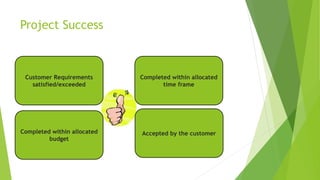
Project Success
Customer Requirements
satisfied/exceeded
Completed within allocated
time frame
Completed within allocated
budget
Accepted by the customer
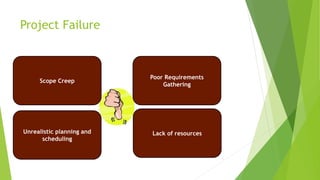
Project Failure
Scope Creep
Poor Requirements
Gathering
Unrealistic planning and
scheduling
Lack of resources
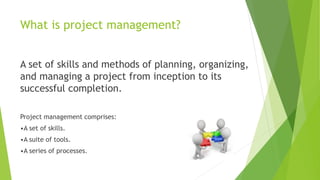
What is project management?
A set of skills and methods of planning, organizing,
and managing a project from inception to its
successful completion.
Project management comprises:
•A set of skills.
•A suite of tools.
•A series of processes.
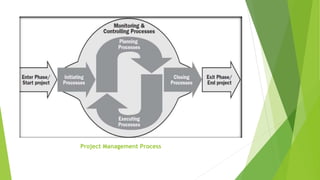
Project Management Process
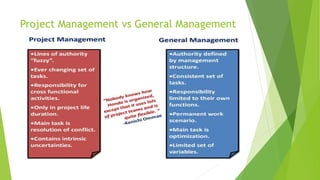
Project Management vs General Management
Key Areas of Project Management
 Scope Management
 Issue Management
 Cost Management
 Quality Management
 Communications Management
 Risk Management
 Change Control Management
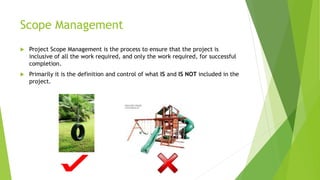
Scope Management
 Project Scope Management is the process to ensure that the project is
inclusive of all the work required, and only the work required, for successful
completion.
 Primarily it is the definition and control of what IS and IS NOT included in the
project.
Issue Management
 Issues are restraints to accomplishing the deliverables of the project.
 Issues are typically identified throughout the project and logged and tracked
through resolution.
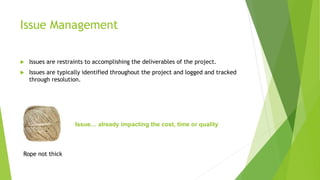
Issue… already impacting the cost, time or quality
Rope not thick
Cost Management
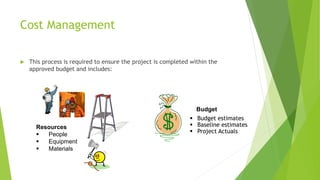
 This process is required to ensure the project is completed within the
approved budget and includes:
Resources
 People
 Equipment
 Materials
Budget
 Budget estimates
 Baseline estimates
 Project Actuals
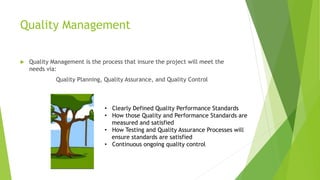
Quality Management
 Quality Management is the process that insure the project will meet the
needs via:
Quality Planning, Quality Assurance, and Quality Control
• Clearly Defined Quality Performance Standards
• How those Quality and Performance Standards are
measured and satisfied
• How Testing and Quality Assurance Processes will
ensure standards are satisfied
• Continuous ongoing quality control
Communications Management
 This process is necessary to ensure timely and appropriate generation,
collection, dissemination, and storage of project information
 Communications planning
 Information Distribution
 Performance Reporting
Risk Management
 Risk identification and mitigation strategy
 Whenif new risks arise
 Risk update and tracking
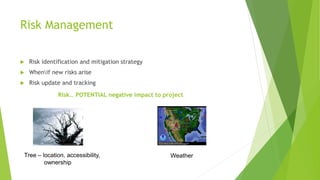
Risk… POTENTIAL negative impact to project
Tree – location, accessibility,
ownership
Weather
Change Control Management
 Define how changes to the project scope will be executed
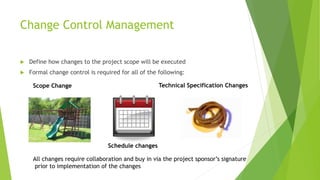
 Formal change control is required for all of the following:
Scope Change
Schedule changes
Technical Specification Changes
All changes require collaboration and buy in via the project sponsor’s signature
prior to implementation of the changes
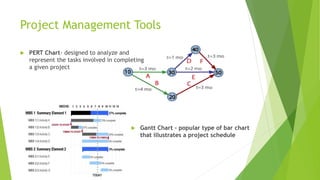
Project Management Tools
 PERT Chart- designed to analyze and
represent the tasks involved in completing
a given project
 Gantt Chart - popular type of bar chart
that illustrates a project schedule
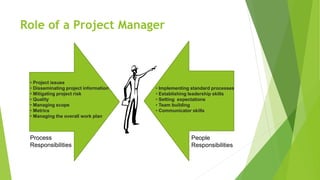
Role of a Project Manager
Process
Responsibilities
People
Responsibilities
• Project issues
• Disseminating project information
• Mitigating project risk
• Quality
• Managing scope
• Metrics
• Managing the overall work plan
• Implementing standard processes
• Establishing leadership skills
• Setting expectations
• Team building
• Communicator skills
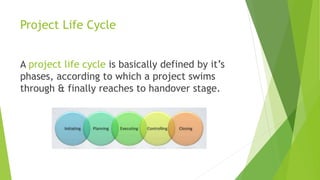
Project Life Cycle
A project life cycle is basically defined by it’s
phases, according to which a project swims
through & finally reaches to handover stage.
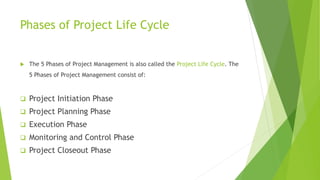
Phases of Project Life Cycle
 The 5 Phases of Project Management is also called the Project Life Cycle. The
5 Phases of Project Management consist of:
 Project Initiation Phase
 Project Planning Phase
 Execution Phase
 Monitoring and Control Phase
 Project Closeout Phase
Project Initiation Phase
 The beginning phase of every project where a project manager is selected.
 The project manager will meet with the project sponsor and key stakeholders to
determine the business or technical objectives of the project.
 Determine any historical information regarding the project. Begin to identify who
is needed on a project team.
Key Outputs of this phase are:
 Develop Project Charter
 Develop Preliminary Scope Statement
 Identification of all stakeholders
 Divide the project into Phases
Project Planning Phase
 One of the largest and most important phases of every project. The project
manager will determine the team, identify roles and responsibilities and solidify
a scope statement.
 At this phase the project manager will begin to develop different project plans.
Key Outputs of this phase are:
 Create WBS and WBS Dictionary
 Develop Schedule
 Determine roles and Responsibilities
 Develop Communication & Risk Plan
 Create Performance measurement baselines
 Test Plan
 Determine the Critical Path
 Prepare procurement documents
 Create Process Improvement Plan
 Gain Formal Approval of all plans and key deliverables
Execution Phase
 This phase is where you do the “work” or execute the plan. This phase typically
requires the most amount of time since the majority of the work is done in this
timeframe.
 You will solidify the team; conduct teambuilding exercises. Hold progress and
status meetings.
 Follow the processes in your project plans.
 Recommend changes and corrective actions.
 Continuous Improvement
Key outputs of this phase are:
 Signoff that key milestones are complete.
 Documented performance reports
Monitoring and Control Phase
 The phase where results derived from your new process or product are
compared to the metrics you outlined in your performance plan.
 Implement your change control process
 Determine variances and identify if they warrant corrective action or change.
 Facilitate conflict Resolution
 Use Issue Logs
Key outputs of this phase are:
 Receive all signoffs that work is completed as per requirements.
 Archive all project assets
 Create and document lessons learned
Project Closeout Phase
This is the final phase of the project life cycle.
 Develop closure procedures
 Document final performance reporting
 Handoff completed product, process or code
 Release resources
 Complete contract closures
Key outputs of this phase are:
 Receive all signoffs that work is completed as per requirements.
 Index and archive all project assets
 Create and document lessons learned
Celebrate project success!
Conclusion
Work Smart Not Hard !!!
“Trying to manage a project without project management is like trying to play a
football game without a game plan.” - K .Tate
References
 Project Management Institute, USA via internet.
 Practical tools, techniques & MS project scheduling -- Dick Billows
 Best project management practices -- Dick Billows
 The AMA handbook of Project Management.
 Project Management – Harvey Maylor
 www.google.com
Project Management Process and Its Phases

Project Management Process and Its Phases

  • 1.
    Project Management Process & ItsPhases GAURAV SUKHIJA HPGD/AP16/3870 SPECIALIZATION: IT PROJECT MANAGEMENT WELINGKAR INSTITUTE OF MANAGEMENT DEVELOPMENT & RESEARCH Year of Submission: March, 2018
  • 2.
    Content  What isa Project ?  Project Success  Project Failure  Project Management  Project Management vs General Management  Key Areas of Project Management  Project Management Tools  Role of a Project Manager  Project Life Cycle  Phases of Project Life Cycle  Conclusion  References
  • 3.
    What is aProject? The word project comes from the Latin word projectum which means "something that comes before anything else happens". A project is “a unique endeavor to produce a set of deliverables within clearly specified time, cost and quality constraints”. -Jason Westland, CEO MPMM “A group of milestones or phases, activities or tasks that support an effort to accomplish something is a project.”
  • 4.
    Project Success Customer Requirements satisfied/exceeded Completedwithin allocated time frame Completed within allocated budget Accepted by the customer
  • 5.
    Project Failure Scope Creep PoorRequirements Gathering Unrealistic planning and scheduling Lack of resources
  • 6.
    What is projectmanagement? A set of skills and methods of planning, organizing, and managing a project from inception to its successful completion. Project management comprises: •A set of skills. •A suite of tools. •A series of processes.
  • 7.
  • 8.
    Project Management vsGeneral Management
  • 9.
    Key Areas ofProject Management  Scope Management  Issue Management  Cost Management  Quality Management  Communications Management  Risk Management  Change Control Management
  • 10.
    Scope Management  ProjectScope Management is the process to ensure that the project is inclusive of all the work required, and only the work required, for successful completion.  Primarily it is the definition and control of what IS and IS NOT included in the project.
  • 11.
    Issue Management  Issuesare restraints to accomplishing the deliverables of the project.  Issues are typically identified throughout the project and logged and tracked through resolution. Issue… already impacting the cost, time or quality Rope not thick
  • 12.
    Cost Management  Thisprocess is required to ensure the project is completed within the approved budget and includes: Resources  People  Equipment  Materials Budget  Budget estimates  Baseline estimates  Project Actuals
  • 13.
    Quality Management  QualityManagement is the process that insure the project will meet the needs via: Quality Planning, Quality Assurance, and Quality Control • Clearly Defined Quality Performance Standards • How those Quality and Performance Standards are measured and satisfied • How Testing and Quality Assurance Processes will ensure standards are satisfied • Continuous ongoing quality control
  • 14.
    Communications Management  Thisprocess is necessary to ensure timely and appropriate generation, collection, dissemination, and storage of project information  Communications planning  Information Distribution  Performance Reporting
  • 15.
    Risk Management  Riskidentification and mitigation strategy  Whenif new risks arise  Risk update and tracking Risk… POTENTIAL negative impact to project Tree – location, accessibility, ownership Weather
  • 16.
    Change Control Management Define how changes to the project scope will be executed  Formal change control is required for all of the following: Scope Change Schedule changes Technical Specification Changes All changes require collaboration and buy in via the project sponsor’s signature prior to implementation of the changes
  • 17.
    Project Management Tools PERT Chart- designed to analyze and represent the tasks involved in completing a given project  Gantt Chart - popular type of bar chart that illustrates a project schedule
  • 18.
    Role of aProject Manager Process Responsibilities People Responsibilities • Project issues • Disseminating project information • Mitigating project risk • Quality • Managing scope • Metrics • Managing the overall work plan • Implementing standard processes • Establishing leadership skills • Setting expectations • Team building • Communicator skills
  • 19.
    Project Life Cycle Aproject life cycle is basically defined by it’s phases, according to which a project swims through & finally reaches to handover stage.
  • 20.
    Phases of ProjectLife Cycle  The 5 Phases of Project Management is also called the Project Life Cycle. The 5 Phases of Project Management consist of:  Project Initiation Phase  Project Planning Phase  Execution Phase  Monitoring and Control Phase  Project Closeout Phase
  • 21.
    Project Initiation Phase The beginning phase of every project where a project manager is selected.  The project manager will meet with the project sponsor and key stakeholders to determine the business or technical objectives of the project.  Determine any historical information regarding the project. Begin to identify who is needed on a project team. Key Outputs of this phase are:  Develop Project Charter  Develop Preliminary Scope Statement  Identification of all stakeholders  Divide the project into Phases
  • 22.
    Project Planning Phase One of the largest and most important phases of every project. The project manager will determine the team, identify roles and responsibilities and solidify a scope statement.  At this phase the project manager will begin to develop different project plans. Key Outputs of this phase are:  Create WBS and WBS Dictionary  Develop Schedule  Determine roles and Responsibilities  Develop Communication & Risk Plan  Create Performance measurement baselines  Test Plan  Determine the Critical Path  Prepare procurement documents  Create Process Improvement Plan  Gain Formal Approval of all plans and key deliverables
  • 23.
    Execution Phase  Thisphase is where you do the “work” or execute the plan. This phase typically requires the most amount of time since the majority of the work is done in this timeframe.  You will solidify the team; conduct teambuilding exercises. Hold progress and status meetings.  Follow the processes in your project plans.  Recommend changes and corrective actions.  Continuous Improvement Key outputs of this phase are:  Signoff that key milestones are complete.  Documented performance reports
  • 24.
    Monitoring and ControlPhase  The phase where results derived from your new process or product are compared to the metrics you outlined in your performance plan.  Implement your change control process  Determine variances and identify if they warrant corrective action or change.  Facilitate conflict Resolution  Use Issue Logs Key outputs of this phase are:  Receive all signoffs that work is completed as per requirements.  Archive all project assets  Create and document lessons learned
  • 25.
    Project Closeout Phase Thisis the final phase of the project life cycle.  Develop closure procedures  Document final performance reporting  Handoff completed product, process or code  Release resources  Complete contract closures Key outputs of this phase are:  Receive all signoffs that work is completed as per requirements.  Index and archive all project assets  Create and document lessons learned
  • 26.
  • 27.
    Conclusion Work Smart NotHard !!! “Trying to manage a project without project management is like trying to play a football game without a game plan.” - K .Tate
  • 28.
    References  Project ManagementInstitute, USA via internet.  Practical tools, techniques & MS project scheduling -- Dick Billows  Best project management practices -- Dick Billows  The AMA handbook of Project Management.  Project Management – Harvey Maylor  www.google.com