Resume Writing/Updating Camille  S. Britton October 25 th , 2007
The point of a resume is to effectively sell yourself. Highlight  your strengths and  dim  your weaknesses.
Resumes must be  tailored  to the position that you are seeking, so you must  RESEARCH  the perspective company, it’s imperative.
There are 2 types of resumes: The Strong one and The Bad one
 
Format and Presentation: The average resume is scanned for 8 – 15 seconds.  If it does not impress the reader within that time frame your resume is set aside.
 
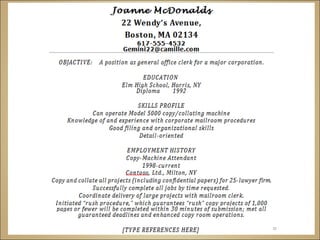
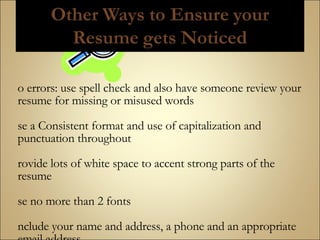
No errors: use spell check and also have someone review your resume for missing or misused words Use a Consistent format and use of capitalization and punctuation throughout Provide lots of white space to accent strong parts of the resume Use no more than 2 fonts Include your name and address, a phone and an appropriate email address Laser print your work on quality white or cream resume paper
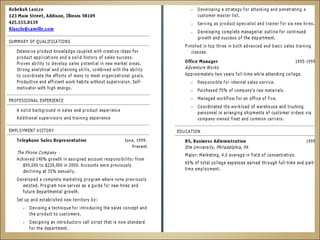
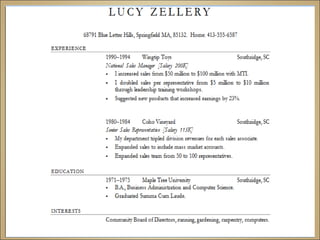
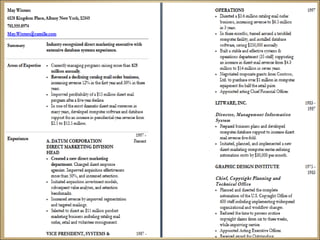
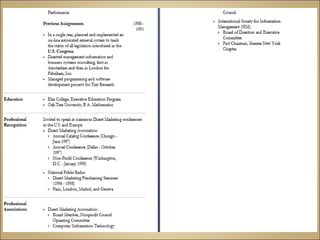
Accomplishments,  Not Duties: Your routine activities can be quantified and written as accomplishments that demonstrate your experience and knowledge, and how you’ve HELPED the company!
 
Did you: save the company money? How much and how? help improve sales? By how much? improve productivity and efficiency? implement any new systems or processes? help launch any new products or services? achieve more with (same or fewer) resources? resolve a major problem with little investment? participate in any technical/operational improvements? exceed accepted standards for quality or quantity? identify the need for a program or service? resolve customer problems? get rated as outstanding in performance reviews?
Avoid Common Errors in Resume Writing Many job seekers either don't know or don't understand the many items that do not belong in a resume.
 
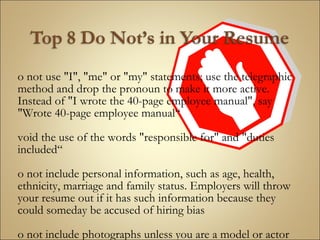
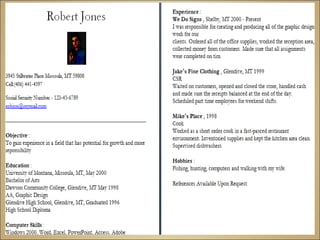
Do not use "I", "me" or "my" statements; use the telegraphic method and drop the pronoun to make it more active. Instead of "I wrote the 40-page employee manual", say "Wrote 40-page employee manual“ Avoid the use of the words "responsible for" and "duties included“ Do not include personal information, such as age, health, ethnicity, marriage and family status. Employers will throw your resume out if it has such information because they could someday be accused of hiring bias Do not include photographs unless you are a model or actor  
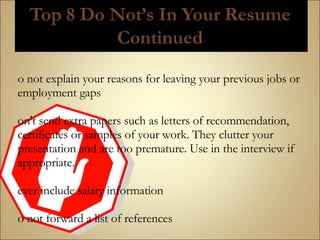
Do not explain your reasons for leaving your previous jobs or employment gaps Don't send extra papers such as letters of recommendation, certificates or samples of your work. They clutter your presentation and are too premature. Use in the interview if appropriate. Never include salary information Do not forward a list of references


Resume Writers' Tool Kit Three Steps to Writing Your Own Resume by Linda Matias

Professional Development - Resume Update Writing

  • 1.
    Resume Writing/Updating Camille S. Britton October 25 th , 2007
  • 2.
    The point ofa resume is to effectively sell yourself. Highlight your strengths and dim your weaknesses.
  • 3.
    Resumes must be tailored to the position that you are seeking, so you must RESEARCH the perspective company, it’s imperative.
  • 4.
    There are 2types of resumes: The Strong one and The Bad one
  • 5.
  • 6.
    Format and Presentation:The average resume is scanned for 8 – 15 seconds. If it does not impress the reader within that time frame your resume is set aside.
  • 7.
  • 8.
    No errors: usespell check and also have someone review your resume for missing or misused words Use a Consistent format and use of capitalization and punctuation throughout Provide lots of white space to accent strong parts of the resume Use no more than 2 fonts Include your name and address, a phone and an appropriate email address Laser print your work on quality white or cream resume paper
  • 9.
    Accomplishments, NotDuties: Your routine activities can be quantified and written as accomplishments that demonstrate your experience and knowledge, and how you’ve HELPED the company!
  • 10.
  • 11.
    Did you: savethe company money? How much and how? help improve sales? By how much? improve productivity and efficiency? implement any new systems or processes? help launch any new products or services? achieve more with (same or fewer) resources? resolve a major problem with little investment? participate in any technical/operational improvements? exceed accepted standards for quality or quantity? identify the need for a program or service? resolve customer problems? get rated as outstanding in performance reviews?
  • 12.
    Avoid Common Errorsin Resume Writing Many job seekers either don't know or don't understand the many items that do not belong in a resume.
  • 13.
  • 14.
    Do not use"I", "me" or "my" statements; use the telegraphic method and drop the pronoun to make it more active. Instead of "I wrote the 40-page employee manual", say "Wrote 40-page employee manual“ Avoid the use of the words "responsible for" and "duties included“ Do not include personal information, such as age, health, ethnicity, marriage and family status. Employers will throw your resume out if it has such information because they could someday be accused of hiring bias Do not include photographs unless you are a model or actor  
  • 15.
    Do not explainyour reasons for leaving your previous jobs or employment gaps Don't send extra papers such as letters of recommendation, certificates or samples of your work. They clutter your presentation and are too premature. Use in the interview if appropriate. Never include salary information Do not forward a list of references
  • 16.
  • 17.
  • 18.
  • 19.
    Resume Writers' ToolKit Three Steps to Writing Your Own Resume by Linda Matias