Page
Root Cause &
Corrective Action (RCCA)
Overview
1
Page
Objective
 To provide guidance to carry out proper Root Cause Analysis
(RCA) with suitable quality tools
 To ensure responded SCAR able to meet Keysight expectation
Keysight Restricted 2
Page
Introduction
Supplier Corrective Action Request (SCAR) is a systematic
approach to request investigation of a problem that already
happened and request root cause analysis and resolution from
supplier to prevent recurrence.
Keysight Restricted 3
Page
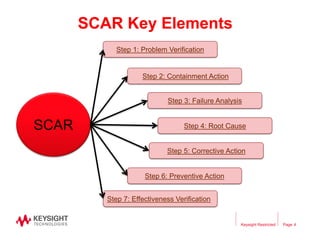
SCAR Key Elements
SCAR
Step 1: Problem Verification
Step 2: Containment Action
Step 3: Failure Analysis
Step 4: Root Cause
Step 5: Corrective Action
Step 7: Effectiveness Verification
Step 6: Preventive Action
Keysight Restricted 4
Page
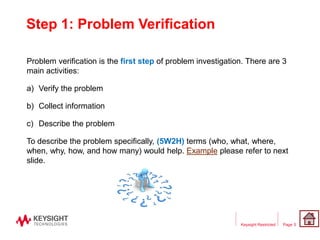
Step 1: Problem Verification
Problem verification is the first step of problem investigation. There are 3
main activities:
a) Verify the problem
b) Collect information
c) Describe the problem
To describe the problem specifically, (5W2H) terms (who, what, where,
when, why, how, and how many) would help. Example please refer to next
slide.
Keysight Restricted 5
Page
Step 1: Problem Verification
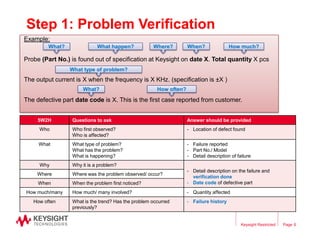
Example:
Probe (Part No.) is found out of specification at Keysight on date X. Total quantity X pcs
The output current is X when the frequency is X KHz. (specification is ±X )
The defective part date code is X. This is the first case reported from customer.
Keysight Restricted 6
5W2H Questions to ask Answer should be provided
Who Who first observed?
Who is affected?
- Location of defect found
What What type of problem?
What has the problem?
What is happening?
- Failure reported
- Part No./ Model
- Detail description of failure
Why Why it is a problem?
- Detail description on the failure and
verification done
- Date code of defective part
Where Where was the problem observed/ occur?
When When the problem first noticed?
How much/many How much/ many involved? - Quantity affected
How often What is the trend? Has the problem occurred
previously?
- Failure history
What? What happen? When?
What type of problem?
Where?
What? How often?
How much?
Page
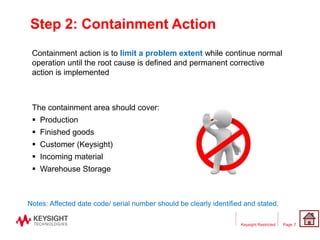
Step 2: Containment Action
Containment action is to limit a problem extent while continue normal
operation until the root cause is defined and permanent corrective
action is implemented
The containment area should cover:
 Production
 Finished goods
 Customer (Keysight)
 Incoming material
 Warehouse Storage
Keysight Restricted 7
Notes: Affected date code/ serial number should be clearly identified and stated.
Page
Step 2: Containment Action
Activities:
 Stoppage of production or shipment
 Segregation goods on pass or fail
 Additional visual control
 Informing customer about the problem
 Informing operators about the problem
 Check on similar product or processes if there is similar risk
Keysight Restricted 8
Example:
100% screening is done for below area:
Supplier’s production (xx pcs), warehouse inventory (xx pcs)
Keysight inventory including production (xx pcs), warehouse (xx pcs),
Results: xx pcs out of total xx pcs is found with similar reject. The reject rate is xx%.
Confirmed the affected date code is x. Rejected part is sent back for further FA.
Page
Step 3: Failure Analysis
Failure analysis (FA) is the process of collecting and analyzing data
to determine the cause of a failure.
Failure Analysis can be carry out by various methods including visual
inspection, electrical testing and physical testing.
Keysight Restricted 9
Page
Step 3: Failure Analysis
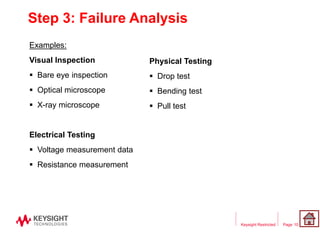
Examples:
Visual Inspection
 Bare eye inspection
 Optical microscope
 X-ray microscope
Electrical Testing
 Voltage measurement data
 Resistance measurement
Keysight Restricted 10
Physical Testing
 Drop test
 Bending test
 Pull test
Page
Step 4: Root Cause
Root cause identification is the most important step. The problem will be
solved only if the corrective action implemented is addressing the real root
cause accurately.
Root Cause Analysis (RCA) is a systematic approach to identify the actual
root causes of a problem. Below are the tools frequently used in RCA.
 5 Whys Analysis
 Fishbone Diagram (Cause and Effect Diagram)
Notes:
The RCA should identify root cause for both
 Occurrence (Why it occur?)
 Detection (Why it can’t be detect?)
Keysight Restricted 11
Page
Step 4: Root Cause
This is a continuous question-asking technique used to explore the cause-and-
effect relationships underlying a particular problem.
General Flow
i. Define the problem.
ii. Ask Why the problem happen and write down the answer
iii. Validate the answer is it the real root cause
iv. If no, Repeat step 3 until problem’s root cause is identified.
Keysight Restricted 12
5 Whys Analysis Tools
Page
Step 4: Root Cause
.
Keysight Restricted 13
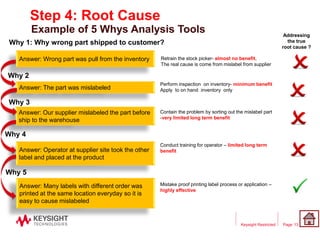
Example of 5 Whys Analysis Tools
Answer: Wrong part was pull from the inventory
Answer: The part was mislabeled
Answer: Our supplier mislabeled the part before
ship to the warehouse
Answer: Operator at supplier site took the other
label and placed at the product
Answer: Many labels with different order was
printed at the same location everyday so it is
easy to cause mislabeled
Retrain the stock picker- almost no benefit.
The real cause is come from mislabel from supplier
Perform inspection on inventory- minimum benefit
Apply to on hand inventory only
Contain the problem by sorting out the mislabel part
-very limited long term benefit
Conduct training for operator – limited long term
benefit
Mistake proof printing label process or application –
highly effective
Why 1: Why wrong part shipped to customer?
Why 2
Why 3
Why 4
Why 5
Addressing
the true
root cause ?
Page
Step 4: Root Cause
A fishbone diagram is a visualization tool for categorizing the potential causes of a
problem in order to identify its root causes.
General Flow:
i. Define the problem
ii. Identify the key causes
iii. Brainstorm the causes
iv. Validate the identified root cause causes.
Keysight Restricted 14
Fishbone Diagram (Cause and Effect Diagram)
PageKeysight Restricted 15
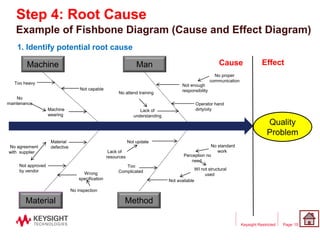
Example of Fishbone Diagram (Cause and Effect Diagram)
Machine
Material Method
Man
Not update
Not available
Lack of
understanding
Not enough
responsibility
Machine
wearing
Material
defective
Not capable
Not approved
by vendor
Wrong
specification
No
maintenance
No proper
communication
Too
Complicated
Too heavy
Lack of
resources
WI not structural
used
Perception no
need
No standard
work
No agreement
with supplier
No inspection
Operator hand
dirty/oily
No attend training
Quality
Problem
EffectCause
Step 4: Root Cause
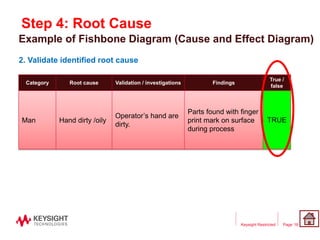
1. Identify potential root cause
Page
Step 4: Root Cause
Keysight Restricted 16
Example of Fishbone Diagram (Cause and Effect Diagram)
Category Root cause Validation / investigations Findings
True /
false
Man Hand dirty /oily
Operator’s hand are
dirty.
Parts found with finger
print mark on surface
during process
TRUE
2. Validate identified root cause
Page
Step 5: Corrective Action
Corrective action (CA) is to remove the root cause and prevent a
problem from ever happening again.
The corrective action should correspond to the root cause identified
earlier in order to eliminate the real root cause and prevent recurrence
of the problem.
Method such as brainstorming is recommended as it can help to select
appropriate corrective action for identified root cause.
Keysight Restricted 17
Page
Step 5: Corrective Action
Examples:
For root cause of “Why problem occur?”
 Introduce additional process control
 Introduce new process
For root cause of “Why not detected?”
 Introduce new testing gate
 Enhance previous testing coverage
Keysight Restricted 18
Page
Step 6: Preventive Action
Preventive Action are proactive and focused on a potential problem
in the future.
Corrective actions is only a temporary solution that keeps the system
running, but a permanent solution is needed to avoid similar problems
from occurring into the system again.
Keysight Restricted 19
Page
Step 6: Preventive Action
Examples:
 Changing the process parameter
 Changing procedure
 Changing documentation or specification
 Changing of process or tools
 Modified or make proper jig
Keysight Restricted 20
Page
Step 7: Effectiveness Verification
After the corrective and preventive actions are implemented, the
effectiveness should be validate.
The key to verification is evidence. This evidence usually takes the
form of data, records or first-hand observations.
It is recommended the verification made by monitoring the quality of
next deliveries.
Keysight Restricted 21
Page
Step 7: Effectiveness Verification
Examples:
 Product acceptance rate
 Test or control results showing improvement
 Engineering measurement (Dimension and appearance) according
to specification and tolerance
 Suppliers deliver goods of better quality
Keysight Restricted 22
Page
Summary
In conclusion, proper RCA should be conducted in a systematic approach in
order to obtain the real root cause. Besides, effective containment, corrective
and preventive actions correspond to identified root cause should be
provided. Below shows the difference between containment, corrective and
preventive actions.
Containment Action
A “first aid” that limit a problem’s extent and establish normal operations until
the root cause is defined and permanent corrective actions is implemented
Corrective Action
Actions to remove the root cause and prevent a problem from ever happening
again. The actions are directed to an event that happened in the past.
Preventive Action
Preventive Action are proactive and oriented towards a potential problem in the
future. They improve a process or a product to remove causes for a potential
problem and prevent it and related problems from ever happening.
Keysight Restricted 23
Page
Appendix:
SCAR
Response Guideline and Expectation
Keysight Restricted 24
PageKeysight Restricted 25
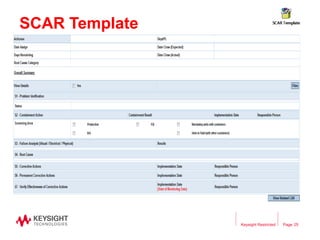
SCAR Template
Page
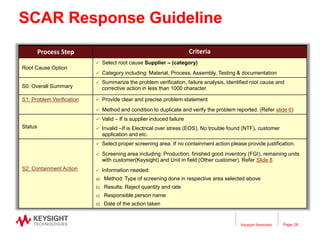
SCAR Response Guideline
Keysight Restricted 26
Process Step Criteria
Root Cause Option
 Select root cause Supplier – (category)
 Category including: Material, Process, Assembly, Testing & documentation
S0: Overall Summary
 Summarize the problem verification, failure analysis, identified root cause and
corrective action in less than 1000 character.
S1: Problem Verification  Provide clear and precise problem statement
 Method and condition to duplicate and verify the problem reported. (Refer slide 6)
Status
 Valid – If is supplier induced failure
 Invalid –If is Electrical over stress (EOS), No trouble found (NTF), customer
application and etc.
S2: Containment Action
 Select proper screening area. If no containment action please provide justification.
 Screening area including: Production, finished good inventory (FGI), remaining units
with customer(Keysight) and Unit in field (Other customer). Refer Slide 8
 Information needed:
a) Method: Type of screening done in respective area selected above
b) Results: Reject quantity and rate
c) Responsible person name
d) Date of the action taken
Page 26
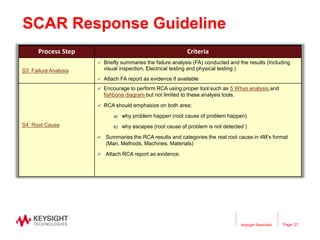
PageKeysight Restricted 27
Process Step Criteria
S3: Failure Analysis
 Briefly summaries the failure analysis (FA) conducted and the results (Including
visual inspection, Electrical testing and physical testing )
 Attach FA report as evidence if available
S4: Root Cause
 Encourage to perform RCA using proper tool such as 5 Whys analysis and
fishbone diagram but not limited to these analysis tools.
 RCA should emphasize on both area:
a) why problem happen (root cause of problem happen)
b) why escapee (root cause of problem is not detected )
 Summaries the RCA results and categories the real root cause in 4M’s format
(Man, Methods, Machines, Materials)
 Attach RCA report as evidence.
Page 27
SCAR Response Guideline
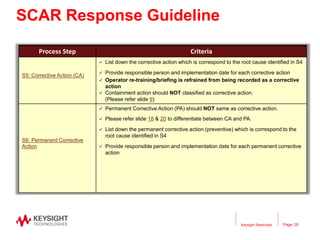
PageKeysight Restricted 28
Process Step Criteria
S5: Corrective Action (CA)
 List down the corrective action which is correspond to the root cause identified in S4
 Provide responsible person and implementation date for each corrective action
 Operator re-training/briefing is refrained from being recorded as a corrective
action
 Containment action should NOT classified as corrective action.
(Please refer slide 9)
S6: Permanent Corrective
Action
 Permanent Corrective Action (PA) should NOT same as corrective action.
 Please refer slide 18 & 20 to differentiate between CA and PA.
 List down the permanent corrective action (preventive) which is correspond to the
root cause identified in S4
 Provide responsible person and implementation date for each permanent corrective
action
Page 28
SCAR Response Guideline
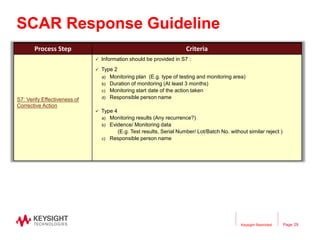
PageKeysight Restricted 29
Process Step Criteria
S7: Verify Effectiveness of
Corrective Action
 Information should be provided in S7 :
 Type 2
a) Monitoring plan (E.g. type of testing and monitoring area)
b) Duration of monitoring (At least 3 months)
c) Monitoring start date of the action taken
d) Responsible person name
 Type 4
a) Monitoring results (Any recurrence?)
b) Evidence/ Monitoring data
(E.g. Test results, Serial Number/ Lot/Batch No. without similar reject )
c) Responsible person name
Page 29
SCAR Response Guideline
Page
Thank you!
Keysight Restricted 30

Problem solving terminology

  • 1.
    Page Root Cause & CorrectiveAction (RCCA) Overview 1
  • 2.
    Page Objective  To provideguidance to carry out proper Root Cause Analysis (RCA) with suitable quality tools  To ensure responded SCAR able to meet Keysight expectation Keysight Restricted 2
  • 3.
    Page Introduction Supplier Corrective ActionRequest (SCAR) is a systematic approach to request investigation of a problem that already happened and request root cause analysis and resolution from supplier to prevent recurrence. Keysight Restricted 3
  • 4.
    Page SCAR Key Elements SCAR Step1: Problem Verification Step 2: Containment Action Step 3: Failure Analysis Step 4: Root Cause Step 5: Corrective Action Step 7: Effectiveness Verification Step 6: Preventive Action Keysight Restricted 4
  • 5.
    Page Step 1: ProblemVerification Problem verification is the first step of problem investigation. There are 3 main activities: a) Verify the problem b) Collect information c) Describe the problem To describe the problem specifically, (5W2H) terms (who, what, where, when, why, how, and how many) would help. Example please refer to next slide. Keysight Restricted 5
  • 6.
    Page Step 1: ProblemVerification Example: Probe (Part No.) is found out of specification at Keysight on date X. Total quantity X pcs The output current is X when the frequency is X KHz. (specification is ±X ) The defective part date code is X. This is the first case reported from customer. Keysight Restricted 6 5W2H Questions to ask Answer should be provided Who Who first observed? Who is affected? - Location of defect found What What type of problem? What has the problem? What is happening? - Failure reported - Part No./ Model - Detail description of failure Why Why it is a problem? - Detail description on the failure and verification done - Date code of defective part Where Where was the problem observed/ occur? When When the problem first noticed? How much/many How much/ many involved? - Quantity affected How often What is the trend? Has the problem occurred previously? - Failure history What? What happen? When? What type of problem? Where? What? How often? How much?
  • 7.
    Page Step 2: ContainmentAction Containment action is to limit a problem extent while continue normal operation until the root cause is defined and permanent corrective action is implemented The containment area should cover:  Production  Finished goods  Customer (Keysight)  Incoming material  Warehouse Storage Keysight Restricted 7 Notes: Affected date code/ serial number should be clearly identified and stated.
  • 8.
    Page Step 2: ContainmentAction Activities:  Stoppage of production or shipment  Segregation goods on pass or fail  Additional visual control  Informing customer about the problem  Informing operators about the problem  Check on similar product or processes if there is similar risk Keysight Restricted 8 Example: 100% screening is done for below area: Supplier’s production (xx pcs), warehouse inventory (xx pcs) Keysight inventory including production (xx pcs), warehouse (xx pcs), Results: xx pcs out of total xx pcs is found with similar reject. The reject rate is xx%. Confirmed the affected date code is x. Rejected part is sent back for further FA.
  • 9.
    Page Step 3: FailureAnalysis Failure analysis (FA) is the process of collecting and analyzing data to determine the cause of a failure. Failure Analysis can be carry out by various methods including visual inspection, electrical testing and physical testing. Keysight Restricted 9
  • 10.
    Page Step 3: FailureAnalysis Examples: Visual Inspection  Bare eye inspection  Optical microscope  X-ray microscope Electrical Testing  Voltage measurement data  Resistance measurement Keysight Restricted 10 Physical Testing  Drop test  Bending test  Pull test
  • 11.
    Page Step 4: RootCause Root cause identification is the most important step. The problem will be solved only if the corrective action implemented is addressing the real root cause accurately. Root Cause Analysis (RCA) is a systematic approach to identify the actual root causes of a problem. Below are the tools frequently used in RCA.  5 Whys Analysis  Fishbone Diagram (Cause and Effect Diagram) Notes: The RCA should identify root cause for both  Occurrence (Why it occur?)  Detection (Why it can’t be detect?) Keysight Restricted 11
  • 12.
    Page Step 4: RootCause This is a continuous question-asking technique used to explore the cause-and- effect relationships underlying a particular problem. General Flow i. Define the problem. ii. Ask Why the problem happen and write down the answer iii. Validate the answer is it the real root cause iv. If no, Repeat step 3 until problem’s root cause is identified. Keysight Restricted 12 5 Whys Analysis Tools
  • 13.
    Page Step 4: RootCause . Keysight Restricted 13 Example of 5 Whys Analysis Tools Answer: Wrong part was pull from the inventory Answer: The part was mislabeled Answer: Our supplier mislabeled the part before ship to the warehouse Answer: Operator at supplier site took the other label and placed at the product Answer: Many labels with different order was printed at the same location everyday so it is easy to cause mislabeled Retrain the stock picker- almost no benefit. The real cause is come from mislabel from supplier Perform inspection on inventory- minimum benefit Apply to on hand inventory only Contain the problem by sorting out the mislabel part -very limited long term benefit Conduct training for operator – limited long term benefit Mistake proof printing label process or application – highly effective Why 1: Why wrong part shipped to customer? Why 2 Why 3 Why 4 Why 5 Addressing the true root cause ?
  • 14.
    Page Step 4: RootCause A fishbone diagram is a visualization tool for categorizing the potential causes of a problem in order to identify its root causes. General Flow: i. Define the problem ii. Identify the key causes iii. Brainstorm the causes iv. Validate the identified root cause causes. Keysight Restricted 14 Fishbone Diagram (Cause and Effect Diagram)
  • 15.
    PageKeysight Restricted 15 Exampleof Fishbone Diagram (Cause and Effect Diagram) Machine Material Method Man Not update Not available Lack of understanding Not enough responsibility Machine wearing Material defective Not capable Not approved by vendor Wrong specification No maintenance No proper communication Too Complicated Too heavy Lack of resources WI not structural used Perception no need No standard work No agreement with supplier No inspection Operator hand dirty/oily No attend training Quality Problem EffectCause Step 4: Root Cause 1. Identify potential root cause
  • 16.
    Page Step 4: RootCause Keysight Restricted 16 Example of Fishbone Diagram (Cause and Effect Diagram) Category Root cause Validation / investigations Findings True / false Man Hand dirty /oily Operator’s hand are dirty. Parts found with finger print mark on surface during process TRUE 2. Validate identified root cause
  • 17.
    Page Step 5: CorrectiveAction Corrective action (CA) is to remove the root cause and prevent a problem from ever happening again. The corrective action should correspond to the root cause identified earlier in order to eliminate the real root cause and prevent recurrence of the problem. Method such as brainstorming is recommended as it can help to select appropriate corrective action for identified root cause. Keysight Restricted 17
  • 18.
    Page Step 5: CorrectiveAction Examples: For root cause of “Why problem occur?”  Introduce additional process control  Introduce new process For root cause of “Why not detected?”  Introduce new testing gate  Enhance previous testing coverage Keysight Restricted 18
  • 19.
    Page Step 6: PreventiveAction Preventive Action are proactive and focused on a potential problem in the future. Corrective actions is only a temporary solution that keeps the system running, but a permanent solution is needed to avoid similar problems from occurring into the system again. Keysight Restricted 19
  • 20.
    Page Step 6: PreventiveAction Examples:  Changing the process parameter  Changing procedure  Changing documentation or specification  Changing of process or tools  Modified or make proper jig Keysight Restricted 20
  • 21.
    Page Step 7: EffectivenessVerification After the corrective and preventive actions are implemented, the effectiveness should be validate. The key to verification is evidence. This evidence usually takes the form of data, records or first-hand observations. It is recommended the verification made by monitoring the quality of next deliveries. Keysight Restricted 21
  • 22.
    Page Step 7: EffectivenessVerification Examples:  Product acceptance rate  Test or control results showing improvement  Engineering measurement (Dimension and appearance) according to specification and tolerance  Suppliers deliver goods of better quality Keysight Restricted 22
  • 23.
    Page Summary In conclusion, properRCA should be conducted in a systematic approach in order to obtain the real root cause. Besides, effective containment, corrective and preventive actions correspond to identified root cause should be provided. Below shows the difference between containment, corrective and preventive actions. Containment Action A “first aid” that limit a problem’s extent and establish normal operations until the root cause is defined and permanent corrective actions is implemented Corrective Action Actions to remove the root cause and prevent a problem from ever happening again. The actions are directed to an event that happened in the past. Preventive Action Preventive Action are proactive and oriented towards a potential problem in the future. They improve a process or a product to remove causes for a potential problem and prevent it and related problems from ever happening. Keysight Restricted 23
  • 24.
    Page Appendix: SCAR Response Guideline andExpectation Keysight Restricted 24
  • 25.
  • 26.
    Page SCAR Response Guideline KeysightRestricted 26 Process Step Criteria Root Cause Option  Select root cause Supplier – (category)  Category including: Material, Process, Assembly, Testing & documentation S0: Overall Summary  Summarize the problem verification, failure analysis, identified root cause and corrective action in less than 1000 character. S1: Problem Verification  Provide clear and precise problem statement  Method and condition to duplicate and verify the problem reported. (Refer slide 6) Status  Valid – If is supplier induced failure  Invalid –If is Electrical over stress (EOS), No trouble found (NTF), customer application and etc. S2: Containment Action  Select proper screening area. If no containment action please provide justification.  Screening area including: Production, finished good inventory (FGI), remaining units with customer(Keysight) and Unit in field (Other customer). Refer Slide 8  Information needed: a) Method: Type of screening done in respective area selected above b) Results: Reject quantity and rate c) Responsible person name d) Date of the action taken Page 26
  • 27.
    PageKeysight Restricted 27 ProcessStep Criteria S3: Failure Analysis  Briefly summaries the failure analysis (FA) conducted and the results (Including visual inspection, Electrical testing and physical testing )  Attach FA report as evidence if available S4: Root Cause  Encourage to perform RCA using proper tool such as 5 Whys analysis and fishbone diagram but not limited to these analysis tools.  RCA should emphasize on both area: a) why problem happen (root cause of problem happen) b) why escapee (root cause of problem is not detected )  Summaries the RCA results and categories the real root cause in 4M’s format (Man, Methods, Machines, Materials)  Attach RCA report as evidence. Page 27 SCAR Response Guideline
  • 28.
    PageKeysight Restricted 28 ProcessStep Criteria S5: Corrective Action (CA)  List down the corrective action which is correspond to the root cause identified in S4  Provide responsible person and implementation date for each corrective action  Operator re-training/briefing is refrained from being recorded as a corrective action  Containment action should NOT classified as corrective action. (Please refer slide 9) S6: Permanent Corrective Action  Permanent Corrective Action (PA) should NOT same as corrective action.  Please refer slide 18 & 20 to differentiate between CA and PA.  List down the permanent corrective action (preventive) which is correspond to the root cause identified in S4  Provide responsible person and implementation date for each permanent corrective action Page 28 SCAR Response Guideline
  • 29.
    PageKeysight Restricted 29 ProcessStep Criteria S7: Verify Effectiveness of Corrective Action  Information should be provided in S7 :  Type 2 a) Monitoring plan (E.g. type of testing and monitoring area) b) Duration of monitoring (At least 3 months) c) Monitoring start date of the action taken d) Responsible person name  Type 4 a) Monitoring results (Any recurrence?) b) Evidence/ Monitoring data (E.g. Test results, Serial Number/ Lot/Batch No. without similar reject ) c) Responsible person name Page 29 SCAR Response Guideline
  • 30.