SUNY Potsdam College Libraries
Panelists:
Nancy Alzo, Elizabeth Andrews, Carol
Franck, Marianne Hebert, Jenica
Rogers, Abby Smith

SUNY Potsdam Academic Festival 2013
“Making the Future”
http://pluto.potsdam.edu/academicfestwiki/
AUDIENCE ASSIGNMENT 1

Write 3 SEPARATE WORDS on
 the catalog card that you think
 describe a ―Library of the
 Future‖
AUDIENCE ASSIGNMENT 2

Write 1 WORD on the scrap
 paper:
• What did you do last time you
  visited the library?
S. R. RANGANATHAN … THEN (1931)

 1.Books are for use.
 2. Every reader his [or her] book.
 3. Every book its reader.
 4. Save the time of the reader.
 5. The library is a growing organism.
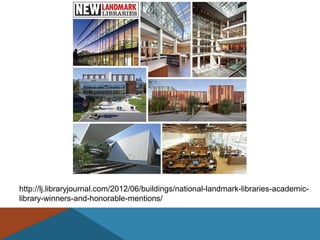
http://lj.libraryjournal.com/2012/06/buildings/national-landmark-libraries-academic-
library-winners-and-honorable-mentions/
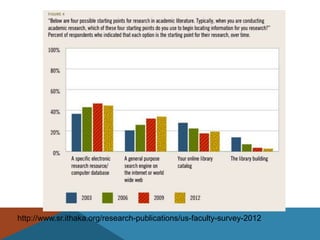
http://www.sr.ithaka.org/research-publications/us-faculty-survey-2012
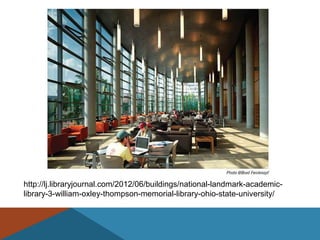
http://lj.libraryjournal.com/2012/06/buildings/national-landmark-academic-
library-3-william-oxley-thompson-memorial-library-ohio-state-university/
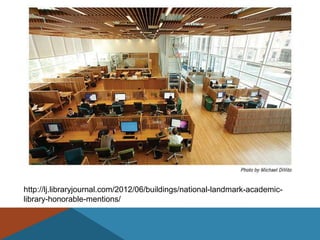
http://lj.libraryjournal.com/2012/06/buildings/national-landmark-academic-
library-honorable-mentions/
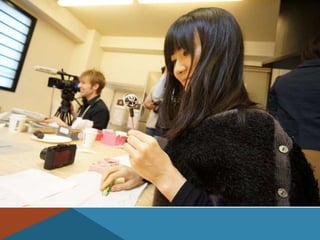
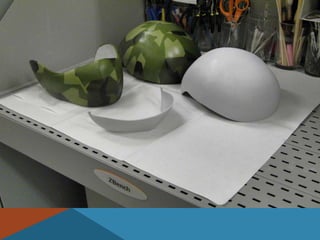
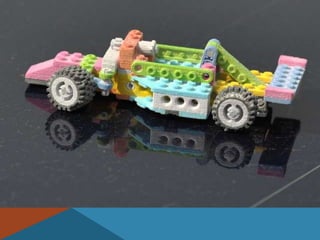
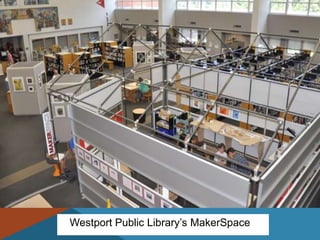
Westport Public Library’s MakerSpace
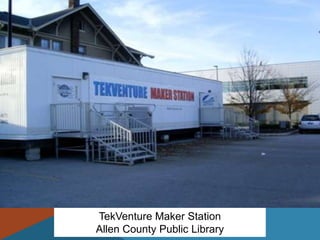
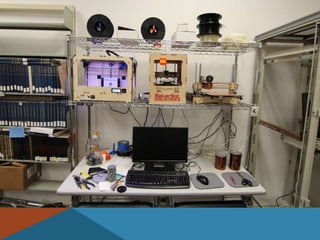
TekVenture Maker Station
Allen County Public Library
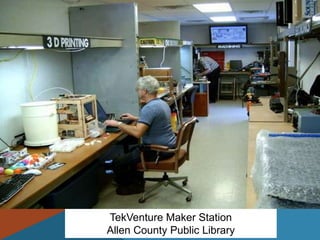
TekVenture Maker Station
Allen County Public Library
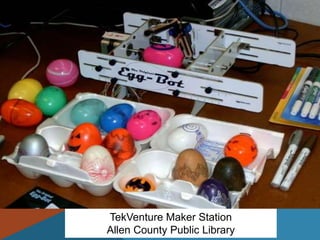
TekVenture Maker Station
Allen County Public Library
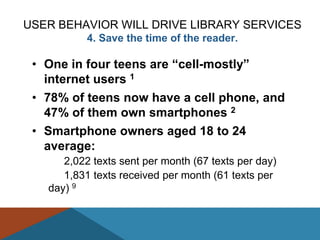
USER BEHAVIOR WILL DRIVE LIBRARY SERVICES
           4. Save the time of the reader.

 • One in four teens are ―cell-mostly‖
   internet users 1
 • 78% of teens now have a cell phone, and
   47% of them own smartphones 2
 • Smartphone owners aged 18 to 24
   average:
      2,022 texts sent per month (67 texts per day)
      1,831 texts received per month (61 texts per
   day) 9
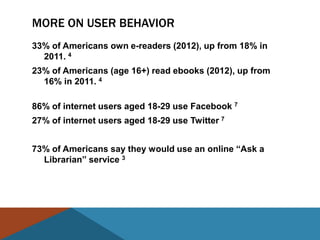
MORE ON USER BEHAVIOR
33% of Americans own e-readers (2012), up from 18% in
  2011. 4
23% of Americans (age 16+) read ebooks (2012), up from
  16% in 2011. 4

86% of internet users aged 18-29 use Facebook 7
27% of internet users aged 18-29 use Twitter 7


73% of Americans say they would use an online ―Ask a
  Librarian‖ service 3
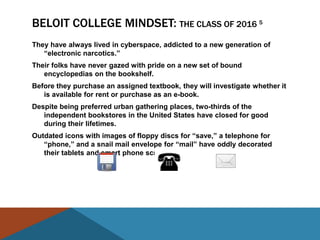
BELOIT COLLEGE MINDSET: THE CLASS OF 2016 5
They have always lived in cyberspace, addicted to a new generation of
   ―electronic narcotics.‖
Their folks have never gazed with pride on a new set of bound
   encyclopedias on the bookshelf.
Before they purchase an assigned textbook, they will investigate whether it
   is available for rent or purchase as an e-book.
Despite being preferred urban gathering places, two-thirds of the
   independent bookstores in the United States have closed for good
   during their lifetimes.
Outdated icons with images of floppy discs for ―save,‖ a telephone for
   ―phone,‖ and a snail mail envelope for ―mail‖ have oddly decorated
   their tablets and smart phone screens.
EDUCATIONAL TECHNOLOGY TRENDS WILL
DRIVE USER EXPECTATIONS 6

Students are being assessed on collaboration and
team dynamics (not just outcomes).
Wikis, Skype, Google Docs, and online tools that
preserve the process and the multiple perspectives
will become more prevalent.

1. Cloud based technologies
  Where we store our work doesn’t matter.
  Access to our work, any time, anywhere DOES matter.

2. Online Learning will required new digital
   skills
  Fewer face-to-face classes / more hybrid learning
  Ability to use digital media and navigate networked environments
  Ability to collaborate and communicate in a variety of online systems
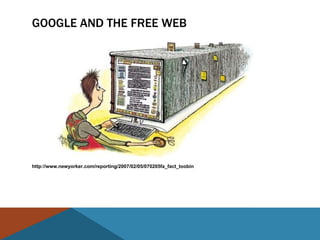
GOOGLE AND THE FREE WEB


http://www.newyorker.com/reporting/2007/02/05/070205fa_fact_toobin
Ranganathan’s Law #4:


Save the time of the
 reader
   Library Classification Systems
   (complicated)
               vs.
   Free Web Keyword searching (easy)
―The trend for accessing information is
  moving toward an expectation of being
  able to use one start point for all
  research.‖
     Timpson, H., &Sansom, G. (2011). A Student Perspective on e-Resource Discovery: Has the Google Factor
     Changed Publisher Platform Searching Forever?. Serials Librarian, 61(2), 253-266.
     doi:10.1080/0361526X.2011.592115


― 89 percent of college student information
  searches begin with a search engine‖
     OCLC. (2006). College Students’ Perceptions of Libraries and Information Resources. Dublin, Ohio: OCLC.
―The a-literate expect:

• instant results
• convenience (which is seen as superior to quality)
• images are at least as important as text
• if it’s not on the web, it doesn’t exist
• cut and paste is a legitimate alternative to original
  thought
• just enough material for the task in hand, not
  everything‖
     Law, D. (2011). “As for the future, your task is not to foresee it, but to enable it”: (Antoine de Saint Exupéry). IFLA
     Journal, 37(4), 269-275. doi:10.1177/0340035211430308
SO WHAT’S THE PROBLEM?
The clash: students’ ―good enough‖ vs. faculty
  requirements

Background issues:

•   Students don’t know what they don’t know
               (and who is responsible for teaching that?)
•   Few people think about what is NOT in Google
•   The package no longer defines the information contained in it, which
    means…
•   Evaluation of quality is hard to do
•   Searching almost anything else isn’t as easy and familiar as Google
USING THE FREE WEB
Students might:

   • Find a reasonable source and/or answer
   • satisfice with inadequate materials
   • waste gobs of time trying for find something that
     isn’t there
   • Decide it doesn’t exist and give up
   • Ultimately move to non-free web resources
THE GOOD GOOGLE:
     PLAYS WELL WITH LIBRARIES
Google Scholar
    Links to library databases from on-campus (IP based)
    Beginning select off-campus proxy authentication

Google Books
    Provides snippits for evaluation
    Links to libraries (and bookstores) for full access

―Ready Reference‖ a la Google (and Wikipedia)
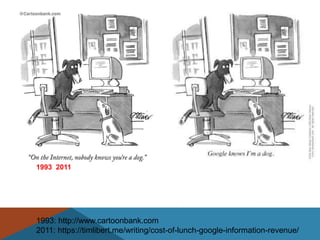
1993 2011


1993: http://www.cartoonbank.com
2011: https://timlibert.me/writing/cost-of-lunch-google-information-revenue/
THE BAD GOOGLE:
      WANTS …MONEY, POWER, CONTROL
          (BWAH HAH HAH HAH!!!)

The Evolution of Google
Google as business
Advertising
Information Provider (Google Books)
Information Consumer (Personal Data)

      Google as a player in the library of the
  future…
FUTURE OF LIBRARY COLLECTIONS
1. Print collections will continue to decline in value
2. Electronic collections will continue to grow and increase
   in popularity
3. Remember Newsweek?
4. Academic library spaces are prime real estate:
   Increased demand for collaborative and other spaces
   It costs $4.26 per book, per year to store a book on the shelf 11
   ~50% of print books have never been used 7
      3. Every book its reader
   Circulation is down 26% in academic libraries since 1991 (ACRL) 12

5. Digital repositories are making pre-1922 books readily
   available (HathiTrust, etc.)
E-BOOKS ARE GAINING POPULARITY SLOWLY
1. E-books can have enhanced features: full text
   searching, annotations, pages can be bookmarked, text-
   to-audio, embedded video, links to websites, interactive
   lessons and changeable plots.
2. E-books for consumers ≠ E-books for libraries
3. Libraries can purchase a Kindle, pay for and download
   100 books, but only one patron can borrow the Kindle
   (with 100 books)
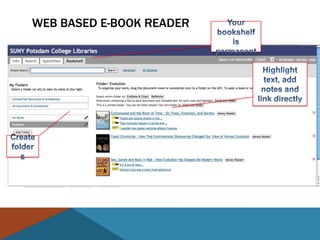
4. Academic e-book readers tend to be web-based
5. Downloading to hand-held readers = short term and
   technically challenging
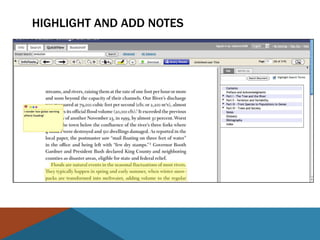
  • Ability to highlight and add notes, is limited and temporary
WEB BASED E-BOOK READER
HIGHLIGHT AND ADD NOTES
E-BOOKS WILL BECOME MORE LIBRARY FRIENDLY
             AND PATRON FRIENDLY

Libraries usually cannot lend e-books to other libraries
   (Interlibrary Loan)
Some e-book vendors have ―loan‖ periods. If you check out
  an e-book, no one else can use it until your loan period
  expires.
Some publishers limit the number of times an e-book can be
  loaned, at which point the library needs to purchase
  another copy
Publishers are restricting e-book content for libraries
Technological obstacles need to be resolved, especially for
  hand held devices
Tower of eBabel = Too many formats
PURCHASE-ON-DEMAND

Who should develop the library
 collections?

Can we trust patrons to know what they
 want?

Just-in-case VS Just-in-time

Interlibrary Loan is not ―free‖
PURCHASE-ON-DEMAND MODELS
Several models being implemented in
libraries:
1. Records for print books are loaded into the catalog.
   Patron requests are sent to Acquisitions Department
   and materials are ordered RUSH.
2. Interlibrary Loan requests are submitted into ILLiad.
   Library staff monitor ILL requests, and if purchase is
   warranted (affordable, available and appropriate) the
   request is sent to Acquisition department to be ordered
   RUSH.
3. Records for e-books are loaded into the catalog.
   Patrons click on the link and have immediate access to
   browse or borrow or trigger a purchase. Library costs
   for loans and purchases are unpredictable.
NY 3RS DEMAND DRIVEN EBL E-BOOK PILOT
Consortial pilot project to test collaborative e-book collection building
18 members (16 Academics, 2 Public Library Systems)
18 Publishers
Members contribute funds to common account at WNYLRC to be drawn against as
  consortium patrons use books
7971 records loaded into catalog (published Oct. 2011- )
Purchased e-books are owned “into perpetuity” (65 so far)


Current costs:
Browsing is free
After 5 minutes browsing – loan Is triggered (24 hrs or 7 days) ($.20-$44 each
    loan)
    Purchase is triggered on 8 loan (list price x 5).
Price cap is $250 for any title (X5).
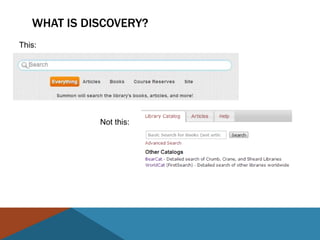
WHAT IS DISCOVERY?
This:


             Not this:
THE FUTURE OF DISCOVERY

• Better user interfaces

• Better results

• Innovative search and display methods

• Incorporates best of paid resources AND the

  free web!
BUT IT’S NOT PERFECT

• Great for novices, not as great for experts

• Can’t find everything

• Doesn’t yet understand natural language
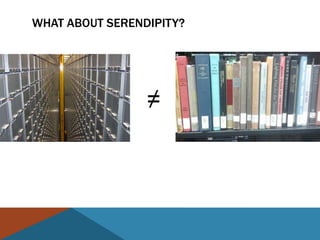
WHAT ABOUT SERENDIPITY?


                 ≠
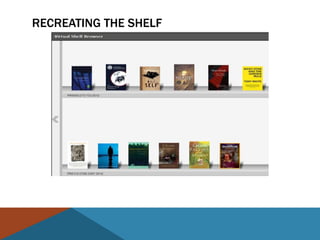
RECREATING THE SHELF
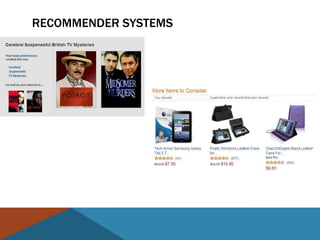
RECOMMENDER SYSTEMS
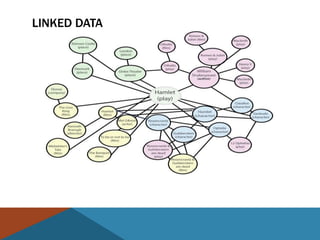
LINKED DATA
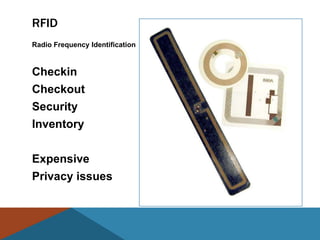
RFID
Radio Frequency Identification


Checkin
Checkout
Security
Inventory


Expensive
Privacy issues
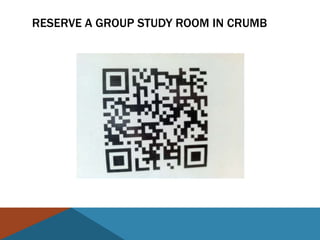
RESERVE A GROUP STUDY ROOM IN CRUMB
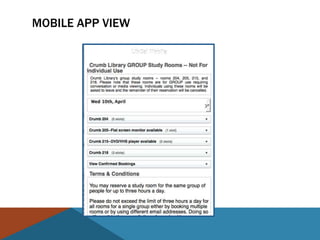
MOBILE APP VIEW
ACCESS IN A DIGITAL CULTURE

•   Intellectual Property
•   Copyright
•   Licenses
•   Alternate Publishing Models
•   Scholarly Communication
•   Open Access
•   Peer Review
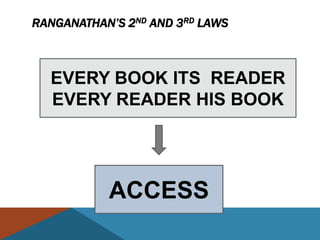
RANGANATHAN’S 2ND AND 3RD LAWS


  EVERY BOOK ITS READER
  EVERY READER HIS BOOK


           ACCESS
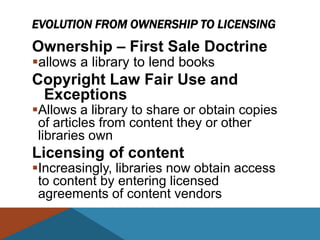
EVOLUTION FROM OWNERSHIP TO LICENSING
Ownership – First Sale Doctrine
allows a library to lend books
Copyright Law Fair Use and
 Exceptions
Allows a library to share or obtain copies
 of articles from content they or other
 libraries own
Licensing of content
Increasingly, libraries now obtain access
 to content by entering licensed
 agreements of content vendors
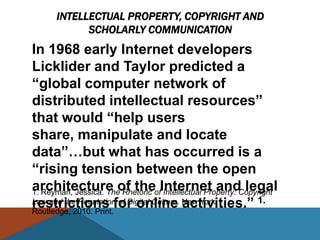
INTELLECTUAL PROPERTY, COPYRIGHT AND
            SCHOLARLY COMMUNICATION
In 1968 early Internet developers
Licklider and Taylor predicted a
―global computer network of
distributed intellectual resources‖
that would ―help users
share, manipulate and locate
data‖…but what has occurred is a
―rising tension between the open
architecture of theofInternet and legal
1. Reyman, Jessica. The Rhetoric Intellectual Property: Copyright
restrictions for online activities.‖ 1.
Law and the Regulation of Digital Culture. New York:
Routledge, 2010. Print.
ALTERNATIVE PUBLISHING MODELS, OPEN ACCESS
AND PEER REVIEW
•   What constitutes ―publishing‖?
•   Access and dollars
•   Digital Scholarship
•   Open Access
•   Peer Review
AUDIENCE PARTICIPATION - WORDLE RESULT
S. R RANGANATHAN THEN (1931) & NOW AND …

1. Books are for use.
2. Every reader his [or her] book.
3. Every book its reader.
4. Save the time of the reader.
5. The library is a growing organism.
SOURCES FOR USER TRENDS AND COLLECTIONS
1. Teens and Technology 2013 by Mary Madden, Amanda Lenhart, Maeve Duggan, Sandra Cortesi, UrsGasser. Mar 13, 2013.
      http://www.pewinternet.org/Reports/2013/Teens-and-Tech.aspx
2. Teens and Technology 2013 by Mary Madden, Amanda Lenhart, Maeve Duggan, Sandra Cortesi, Urs Gasser. Mar 13, 2013.
      http://www.pewinternet.org/Reports/2013/Teens-and-Tech.aspx
3. Library Services in the Digital Age. by Kathryn Zickuhr, Lee Rainie and Kristen Purcell. January 22, 2013.
       http://libraries.pewinternet.org/2013/01/22/library-services/
4. E-book Reading Jumps; Print Book Reading Declines by Lee Rainie and Maeve Duggan. December 27, 2012.
      http://libraries.pewinternet.org/2012/12/27/e-book-reading-jumps-print-book-reading-declines/
5. Beloit College Mindset List. http://www.beloit.edu/mindset/2016/
6. 2012 top ten trends in academic libraries A review of the trends and issues affecting academic libraries in higher education ACRL
      Research Planning and Review Committee. http://crln.acrl.org/content/73/6/311.full
7. AttisD, Koproske C. Thirty trends shaping the future of academic libraries. Learned Publishing [serial online]. January 2013;26(1):18-
       23.
8. The Demographics of Social Media Users — 2012 (Feb 14, 2013) by Maeve Duggan, Joanna Brenner
      http://pewinternet.org/Reports/2013/Social-media-users/The-State-of-Social-Media-Users.aspx
9. CHART OF THE DAY: Kids Send A Mind Boggling Number Of Texts Every Month,byAlex Cocotas (March 22, 2013) Business
      Insider, http://www.businessinsider.com/chart-of-the-day-number-of-texts-sent-2013-3#ixzz2ON3Xb9rg
10. Trend Data (Teens) http://www.pewinternet.org/Static-Pages/Trend-Data-%28Teens%29.aspx
11. "On the Cost of Keeping a Book‖byPaul N. Courant and Matthew Nielsen
      (2009): http://www.clir.org/pubs/reports/pub147/pub147.pdf
12. Anderson R. PRINT ON THE MARGINS. Library Journal [serial online]. June 15, 2011;136(11):38-39.
      http://webproxy.potsdam.edu:2048/login?url=http://search.ebscohost.com/login.aspx?direct=true&db=lih&AN=61428301&site=e
      host-live&scope=site
IMAGE SOURCES – MAKER SPACES
•   http://www.flickr.com/photos/kakissel/6165114664/
•   http://www.flickr.com/photos/creative_tools/8080035591/
•   http://www.flickr.com/photos/fabcafe/8459306528/in/photostream/
•   http://www.flickr.com/photos/creative_tools/4619199174/
•   http://www.flickr.com/photos/creative_tools/5924881693/
•   http://www.flickr.com/photos/sethoscope/3985762567/
•   http://www.flickr.com/photos/kans1985/2019768277/
•   http://www.flickr.com/photos/steevithak/5015721515/
•   http://www.flickr.com/photos/lbmixpro/3605314938/
•   http://www.flickr.com/photos/philliecasablanca/4338175245/
IMAGE SOURCES – MAKER SPACES
•   http://blog.thehenryford.org/wp-content/uploads/2013/02/hypecenter-700x525.jpg
•   http://www.ilovefc.com/E-FE-MakerSpace.JPG
•   http://tekventure.org/maker-station/
•   http://www.flickr.com/photos/wbaiv/5764557986/
•   http://www.makerlibrarian.com/page/4/
•   http://www.dc.umich.edu/dl1/
•   http://cnr.ncsu.edu/prtm/research/visualization_lab.php
•   http://www.lib.ncsu.edu/cdm/videoediting
•   http://www.lib.ncsu.edu/cdm/audioproduction
•   http://communication.utexas.edu/technology/dml/
•   http://www.fastcodesign.com
•   http://chronicle.com/blogs/percolator/lab-equipment-made-with-3-d-printers-could-cut-
    costs-by-97/32447
IMAGE SOURCES
•   http://sustainability.ncsu.edu/uncategorized/the-sustainable-side-of-hunt-
    library
•   http://library.buffalostate.edu/
•   http://uscp.ent.sirsi.net/client/default
•   http://www.amazon.com
•   http://www.netflix.com

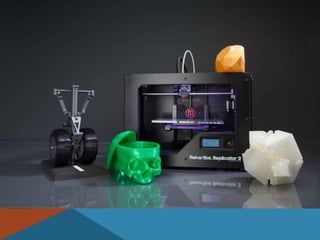
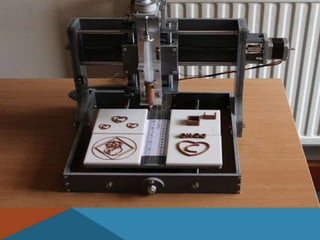
Printing chocolate bars

  • 1.
    SUNY Potsdam CollegeLibraries Panelists: Nancy Alzo, Elizabeth Andrews, Carol Franck, Marianne Hebert, Jenica Rogers, Abby Smith SUNY Potsdam Academic Festival 2013 “Making the Future” http://pluto.potsdam.edu/academicfestwiki/
  • 2.
    AUDIENCE ASSIGNMENT 1 Write3 SEPARATE WORDS on the catalog card that you think describe a ―Library of the Future‖
  • 3.
    AUDIENCE ASSIGNMENT 2 Write1 WORD on the scrap paper: • What did you do last time you visited the library?
  • 4.
    S. R. RANGANATHAN… THEN (1931) 1.Books are for use. 2. Every reader his [or her] book. 3. Every book its reader. 4. Save the time of the reader. 5. The library is a growing organism.
  • 5.
  • 6.
  • 7.
  • 8.
  • 16.
  • 17.
    TekVenture Maker Station AllenCounty Public Library
  • 18.
    TekVenture Maker Station AllenCounty Public Library
  • 19.
    TekVenture Maker Station AllenCounty Public Library
  • 30.
    USER BEHAVIOR WILLDRIVE LIBRARY SERVICES 4. Save the time of the reader. • One in four teens are ―cell-mostly‖ internet users 1 • 78% of teens now have a cell phone, and 47% of them own smartphones 2 • Smartphone owners aged 18 to 24 average: 2,022 texts sent per month (67 texts per day) 1,831 texts received per month (61 texts per day) 9
  • 32.
    MORE ON USERBEHAVIOR 33% of Americans own e-readers (2012), up from 18% in 2011. 4 23% of Americans (age 16+) read ebooks (2012), up from 16% in 2011. 4 86% of internet users aged 18-29 use Facebook 7 27% of internet users aged 18-29 use Twitter 7 73% of Americans say they would use an online ―Ask a Librarian‖ service 3
  • 33.
    BELOIT COLLEGE MINDSET:THE CLASS OF 2016 5 They have always lived in cyberspace, addicted to a new generation of ―electronic narcotics.‖ Their folks have never gazed with pride on a new set of bound encyclopedias on the bookshelf. Before they purchase an assigned textbook, they will investigate whether it is available for rent or purchase as an e-book. Despite being preferred urban gathering places, two-thirds of the independent bookstores in the United States have closed for good during their lifetimes. Outdated icons with images of floppy discs for ―save,‖ a telephone for ―phone,‖ and a snail mail envelope for ―mail‖ have oddly decorated their tablets and smart phone screens.
  • 34.
    EDUCATIONAL TECHNOLOGY TRENDSWILL DRIVE USER EXPECTATIONS 6 Students are being assessed on collaboration and team dynamics (not just outcomes). Wikis, Skype, Google Docs, and online tools that preserve the process and the multiple perspectives will become more prevalent. 1. Cloud based technologies  Where we store our work doesn’t matter.  Access to our work, any time, anywhere DOES matter. 2. Online Learning will required new digital skills  Fewer face-to-face classes / more hybrid learning  Ability to use digital media and navigate networked environments  Ability to collaborate and communicate in a variety of online systems
  • 35.
    GOOGLE AND THEFREE WEB http://www.newyorker.com/reporting/2007/02/05/070205fa_fact_toobin
  • 36.
    Ranganathan’s Law #4: Savethe time of the reader Library Classification Systems (complicated) vs. Free Web Keyword searching (easy)
  • 37.
    ―The trend foraccessing information is moving toward an expectation of being able to use one start point for all research.‖ Timpson, H., &Sansom, G. (2011). A Student Perspective on e-Resource Discovery: Has the Google Factor Changed Publisher Platform Searching Forever?. Serials Librarian, 61(2), 253-266. doi:10.1080/0361526X.2011.592115 ― 89 percent of college student information searches begin with a search engine‖ OCLC. (2006). College Students’ Perceptions of Libraries and Information Resources. Dublin, Ohio: OCLC.
  • 38.
    ―The a-literate expect: •instant results • convenience (which is seen as superior to quality) • images are at least as important as text • if it’s not on the web, it doesn’t exist • cut and paste is a legitimate alternative to original thought • just enough material for the task in hand, not everything‖ Law, D. (2011). “As for the future, your task is not to foresee it, but to enable it”: (Antoine de Saint Exupéry). IFLA Journal, 37(4), 269-275. doi:10.1177/0340035211430308
  • 39.
    SO WHAT’S THEPROBLEM? The clash: students’ ―good enough‖ vs. faculty requirements Background issues: • Students don’t know what they don’t know (and who is responsible for teaching that?) • Few people think about what is NOT in Google • The package no longer defines the information contained in it, which means… • Evaluation of quality is hard to do • Searching almost anything else isn’t as easy and familiar as Google
  • 40.
    USING THE FREEWEB Students might: • Find a reasonable source and/or answer • satisfice with inadequate materials • waste gobs of time trying for find something that isn’t there • Decide it doesn’t exist and give up • Ultimately move to non-free web resources
  • 41.
    THE GOOD GOOGLE: PLAYS WELL WITH LIBRARIES Google Scholar  Links to library databases from on-campus (IP based)  Beginning select off-campus proxy authentication Google Books  Provides snippits for evaluation  Links to libraries (and bookstores) for full access ―Ready Reference‖ a la Google (and Wikipedia)
  • 42.
    1993 2011 1993: http://www.cartoonbank.com 2011:https://timlibert.me/writing/cost-of-lunch-google-information-revenue/
  • 43.
    THE BAD GOOGLE: WANTS …MONEY, POWER, CONTROL (BWAH HAH HAH HAH!!!) The Evolution of Google Google as business Advertising Information Provider (Google Books) Information Consumer (Personal Data) Google as a player in the library of the future…
  • 44.
    FUTURE OF LIBRARYCOLLECTIONS 1. Print collections will continue to decline in value 2. Electronic collections will continue to grow and increase in popularity 3. Remember Newsweek? 4. Academic library spaces are prime real estate:  Increased demand for collaborative and other spaces  It costs $4.26 per book, per year to store a book on the shelf 11  ~50% of print books have never been used 7  3. Every book its reader  Circulation is down 26% in academic libraries since 1991 (ACRL) 12 5. Digital repositories are making pre-1922 books readily available (HathiTrust, etc.)
  • 45.
    E-BOOKS ARE GAININGPOPULARITY SLOWLY 1. E-books can have enhanced features: full text searching, annotations, pages can be bookmarked, text- to-audio, embedded video, links to websites, interactive lessons and changeable plots. 2. E-books for consumers ≠ E-books for libraries 3. Libraries can purchase a Kindle, pay for and download 100 books, but only one patron can borrow the Kindle (with 100 books) 4. Academic e-book readers tend to be web-based 5. Downloading to hand-held readers = short term and technically challenging • Ability to highlight and add notes, is limited and temporary
  • 46.
  • 47.
  • 48.
    E-BOOKS WILL BECOMEMORE LIBRARY FRIENDLY AND PATRON FRIENDLY Libraries usually cannot lend e-books to other libraries (Interlibrary Loan) Some e-book vendors have ―loan‖ periods. If you check out an e-book, no one else can use it until your loan period expires. Some publishers limit the number of times an e-book can be loaned, at which point the library needs to purchase another copy Publishers are restricting e-book content for libraries Technological obstacles need to be resolved, especially for hand held devices Tower of eBabel = Too many formats
  • 49.
    PURCHASE-ON-DEMAND Who should developthe library collections? Can we trust patrons to know what they want? Just-in-case VS Just-in-time Interlibrary Loan is not ―free‖
  • 50.
    PURCHASE-ON-DEMAND MODELS Several modelsbeing implemented in libraries: 1. Records for print books are loaded into the catalog. Patron requests are sent to Acquisitions Department and materials are ordered RUSH. 2. Interlibrary Loan requests are submitted into ILLiad. Library staff monitor ILL requests, and if purchase is warranted (affordable, available and appropriate) the request is sent to Acquisition department to be ordered RUSH. 3. Records for e-books are loaded into the catalog. Patrons click on the link and have immediate access to browse or borrow or trigger a purchase. Library costs for loans and purchases are unpredictable.
  • 51.
    NY 3RS DEMANDDRIVEN EBL E-BOOK PILOT Consortial pilot project to test collaborative e-book collection building 18 members (16 Academics, 2 Public Library Systems) 18 Publishers Members contribute funds to common account at WNYLRC to be drawn against as consortium patrons use books 7971 records loaded into catalog (published Oct. 2011- ) Purchased e-books are owned “into perpetuity” (65 so far) Current costs: Browsing is free After 5 minutes browsing – loan Is triggered (24 hrs or 7 days) ($.20-$44 each loan) Purchase is triggered on 8 loan (list price x 5). Price cap is $250 for any title (X5).
  • 52.
  • 53.
    THE FUTURE OFDISCOVERY • Better user interfaces • Better results • Innovative search and display methods • Incorporates best of paid resources AND the free web!
  • 54.
    BUT IT’S NOTPERFECT • Great for novices, not as great for experts • Can’t find everything • Doesn’t yet understand natural language
  • 55.
  • 56.
  • 57.
  • 58.
  • 59.
  • 60.
    RESERVE A GROUPSTUDY ROOM IN CRUMB
  • 61.
  • 62.
    ACCESS IN ADIGITAL CULTURE • Intellectual Property • Copyright • Licenses • Alternate Publishing Models • Scholarly Communication • Open Access • Peer Review
  • 63.
    RANGANATHAN’S 2ND AND3RD LAWS EVERY BOOK ITS READER EVERY READER HIS BOOK ACCESS
  • 64.
    EVOLUTION FROM OWNERSHIPTO LICENSING Ownership – First Sale Doctrine allows a library to lend books Copyright Law Fair Use and Exceptions Allows a library to share or obtain copies of articles from content they or other libraries own Licensing of content Increasingly, libraries now obtain access to content by entering licensed agreements of content vendors
  • 65.
    INTELLECTUAL PROPERTY, COPYRIGHTAND SCHOLARLY COMMUNICATION In 1968 early Internet developers Licklider and Taylor predicted a ―global computer network of distributed intellectual resources‖ that would ―help users share, manipulate and locate data‖…but what has occurred is a ―rising tension between the open architecture of theofInternet and legal 1. Reyman, Jessica. The Rhetoric Intellectual Property: Copyright restrictions for online activities.‖ 1. Law and the Regulation of Digital Culture. New York: Routledge, 2010. Print.
  • 66.
    ALTERNATIVE PUBLISHING MODELS,OPEN ACCESS AND PEER REVIEW • What constitutes ―publishing‖? • Access and dollars • Digital Scholarship • Open Access • Peer Review
  • 67.
  • 68.
    S. R RANGANATHANTHEN (1931) & NOW AND … 1. Books are for use. 2. Every reader his [or her] book. 3. Every book its reader. 4. Save the time of the reader. 5. The library is a growing organism.
  • 69.
    SOURCES FOR USERTRENDS AND COLLECTIONS 1. Teens and Technology 2013 by Mary Madden, Amanda Lenhart, Maeve Duggan, Sandra Cortesi, UrsGasser. Mar 13, 2013. http://www.pewinternet.org/Reports/2013/Teens-and-Tech.aspx 2. Teens and Technology 2013 by Mary Madden, Amanda Lenhart, Maeve Duggan, Sandra Cortesi, Urs Gasser. Mar 13, 2013. http://www.pewinternet.org/Reports/2013/Teens-and-Tech.aspx 3. Library Services in the Digital Age. by Kathryn Zickuhr, Lee Rainie and Kristen Purcell. January 22, 2013. http://libraries.pewinternet.org/2013/01/22/library-services/ 4. E-book Reading Jumps; Print Book Reading Declines by Lee Rainie and Maeve Duggan. December 27, 2012. http://libraries.pewinternet.org/2012/12/27/e-book-reading-jumps-print-book-reading-declines/ 5. Beloit College Mindset List. http://www.beloit.edu/mindset/2016/ 6. 2012 top ten trends in academic libraries A review of the trends and issues affecting academic libraries in higher education ACRL Research Planning and Review Committee. http://crln.acrl.org/content/73/6/311.full 7. AttisD, Koproske C. Thirty trends shaping the future of academic libraries. Learned Publishing [serial online]. January 2013;26(1):18- 23. 8. The Demographics of Social Media Users — 2012 (Feb 14, 2013) by Maeve Duggan, Joanna Brenner http://pewinternet.org/Reports/2013/Social-media-users/The-State-of-Social-Media-Users.aspx 9. CHART OF THE DAY: Kids Send A Mind Boggling Number Of Texts Every Month,byAlex Cocotas (March 22, 2013) Business Insider, http://www.businessinsider.com/chart-of-the-day-number-of-texts-sent-2013-3#ixzz2ON3Xb9rg 10. Trend Data (Teens) http://www.pewinternet.org/Static-Pages/Trend-Data-%28Teens%29.aspx 11. "On the Cost of Keeping a Book‖byPaul N. Courant and Matthew Nielsen (2009): http://www.clir.org/pubs/reports/pub147/pub147.pdf 12. Anderson R. PRINT ON THE MARGINS. Library Journal [serial online]. June 15, 2011;136(11):38-39. http://webproxy.potsdam.edu:2048/login?url=http://search.ebscohost.com/login.aspx?direct=true&db=lih&AN=61428301&site=e host-live&scope=site
  • 70.
    IMAGE SOURCES –MAKER SPACES • http://www.flickr.com/photos/kakissel/6165114664/ • http://www.flickr.com/photos/creative_tools/8080035591/ • http://www.flickr.com/photos/fabcafe/8459306528/in/photostream/ • http://www.flickr.com/photos/creative_tools/4619199174/ • http://www.flickr.com/photos/creative_tools/5924881693/ • http://www.flickr.com/photos/sethoscope/3985762567/ • http://www.flickr.com/photos/kans1985/2019768277/ • http://www.flickr.com/photos/steevithak/5015721515/ • http://www.flickr.com/photos/lbmixpro/3605314938/ • http://www.flickr.com/photos/philliecasablanca/4338175245/
  • 71.
    IMAGE SOURCES –MAKER SPACES • http://blog.thehenryford.org/wp-content/uploads/2013/02/hypecenter-700x525.jpg • http://www.ilovefc.com/E-FE-MakerSpace.JPG • http://tekventure.org/maker-station/ • http://www.flickr.com/photos/wbaiv/5764557986/ • http://www.makerlibrarian.com/page/4/ • http://www.dc.umich.edu/dl1/ • http://cnr.ncsu.edu/prtm/research/visualization_lab.php • http://www.lib.ncsu.edu/cdm/videoediting • http://www.lib.ncsu.edu/cdm/audioproduction • http://communication.utexas.edu/technology/dml/ • http://www.fastcodesign.com • http://chronicle.com/blogs/percolator/lab-equipment-made-with-3-d-printers-could-cut- costs-by-97/32447
  • 72.
    IMAGE SOURCES • http://sustainability.ncsu.edu/uncategorized/the-sustainable-side-of-hunt- library • http://library.buffalostate.edu/ • http://uscp.ent.sirsi.net/client/default • http://www.amazon.com • http://www.netflix.com

Editor's Notes

  • #29 .
  • #31 Teens are preferring to use their phones for internet browsing even when they have a computer at homeSmart phones require more expensive service plans (digital divide)Designing and maintaining phone apps is challenging for vendors
  • #32 Younger internet users, are less aware of copyright and digital ownership, and feel free to reuse, remix, repackage digital information. They are more collaborative, and expect interactive interfaces (tagging, commenting, sharing)
  • #35 Online students will needvitual libraries
  • #45 Many student continue to want print books, but we think that may changeOlder books don’t get used as the older publication dates sink to the bottom of search resultsUse of print periodicals is VERY low. E-journals are the preferred medium.More and more periodicals and newspapers are moving to online onlyLibrarians’ mindset is changing away from preserving everything to keeping just what is needed and used4. Trends are driving weeding projects in academic libraries nationwide
  • #46 We own 136,598+ ebooksUse of ebooks is slowly rising – tied to device ownershipEnhanced ebooks are still maybes. Reality is ebooks can lack images and other content.Use in academic libraries slowly increasingThe market place for popular vs academic ebooks is very differentMany publishers are reluctant to sell ebooks to librariesEbook are often more expensive than print counterpartsWhen you buy an ebook, you don’t own it
  • #47 You can search full text, and
  • #48 You can search full text and click to navigate to search terms
  • #49 Smartphone are a popular device for reading ebooksStandardization: too many ebook formats and how to get them, not all formats work with all readers
  • #50 IIL:There are staff and system costs, and many lending libraries charge us (College Libraries) to borrow books for our users.Historically libraries have not been great about predicting which books students will want or need.Many of the books purchased for library shelves never get used, or are only used once.We are shifting away from buying “good” books, to buying books to fulfill research assignment needsMoving away from just-in-case model to just-in-time.
  • #63 When thinking about the library of the future, I am certain that I could safely bet that these are not words that appeared on the cards you originally filled out but while these are terms – some of which have been part of the discussion for decades --in 2013 as we anticipate the library in the future they still significantly impact how scholarship is produced, shared and accessed.
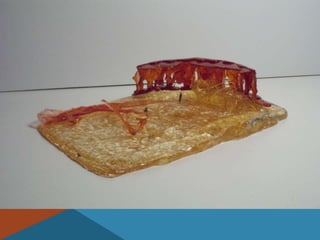
  • #64 These two of Ranganathan’s laws describe what most people consider a library’s critical role and this does not change in the future – simply put -- access to material in whatever format it exists – be it a book, an article or even a three dimensional chocolate bar printed on demand.
  • #65 We are familiar with the ways libraries have provided access to books and articles that are based on the library’s ownership of content.Increasingly in the library of the future, libraries will pay for licenses to gain access to content rather than paying for outright ownership. When the library owns the content, we can make it available over time to many users. When we license content we are limited by the terms of the agreement. In most cases we believe that we will be able to provide access to users over time but there is less certainty and terms can vary from vendor to vendor. How many times have you accessed something electronically by clicking the “I agree” box – have you read the agreement? What will it be like in the library of future if content requires us to purchase access that is limited to a single use? How will the library of the future leverage the cost of access to best serve our entire population of users?
  • #66 Intellectual Property – Ideas - and copyright – the tangible expression of ideas – have been part of the landscape for centuries but the digital environment for the sharing of ideas challenges our understanding of what constitutes a “tangible expression” and therefore what is “copyrighted”. Originally the intent of copyright was to encourage the sharing of ideas easily by expressing the idea in a format that could be shared and giving the originator appropriate compensation for sharing their “intellectual property”. Over time, the economics of copyright have become paramount but in the digital world, the response to new technologies has often been new laws and restrictions. While it is far easier to share information in the library of the future, will legalities stifle the sharing? DMCA – copyright laws “digital” response is now 15 years old. Court cases related to peer-to-peer sharing are still being resolved. Universities are carefully following the ramifications of the as-yet-incomplete Georgia copyright decision. And in the meantime…we use the Internet to access information – within the bounds of copyright law and at times in an uncertain environment where the law has not yet caught up to the potential of the technology.
  • #67 This is a period of significant change in the areas of publishing and access to scholarly content. Where we go and how quickly we change will have much to say about the library of the future. Right now we have more questions than answers about the library of the future as we seek to meet Ranganathan’s laws relating to access. We increasingly see material published in a traditional “print” format that is now also made available on line – where the online content is just a copy of the print. Access is easier but only minimal use of technology is made. Journals, in particular, are abandoning their print format and are available “online” only. Consider the end of the print publication of Newsweek magazine to its new “all digital” content. Why should a publisher wait to publish content in a traditional collection or “volume”? And many are not, so that a web search will find a scholarly article destined for distribution in the current model (i.e a journal volume) but available now (for a mere payment of $37.00). But leave the traditional behind – how will the “power of digital” impact scholarship? Will scholarship exist in distinct blocks in time or will scholarship evolve through processes of editing and commenting and analysis? Should scholarship always cost to access? When it is so easy to share, shouldn’t we just do it? Open Access is appealing because it is just that but what value will we place on freely accessible scholarship over scholarship from sources that we pay for? How will we measure “peer review”? Will it matter?
  • #70 “One in four teens are “cell-mostly” internet users, who say they mostly go online using their phone and not using some other device such as a desktop or laptop computer” 78% of teens now have a cell phone, and almost half (47%) of them own smartphones. That translates into 37% of all teens who have smartphones, up from just 23% in 2011.3. 80% of Americans say borrowing books is a “very important” service libraries provide.3. 80% say reference librarians are a “very important” service of libraries.3. 77% say free access to computers and the internet is a “very important” service of libraries.4.