GENERAL DETAILS
Pupil teacher’s name :
Pooja bindal
Shalu verma
GENERAL DETAILS
Subject : Mathematics
Class : 6th
Topic : Basic geometrical ideas
Duration : 35 minutes
GENERAL OBJECTIVES
Pupil will be able to :-
Understand the properties of
quadrilaterals.
Distinguish between different types
of quadrilaterals.
Grasp the concept of symmetry in
different types of quadrilaterals
What is geometry ?
Geometry is the branch of
mathematics which deals with
properties and relations with the lines
, angles ,surfaces and solids. Just as
Maths deals with numbers , geometry
deals with figures , points and
lines…….
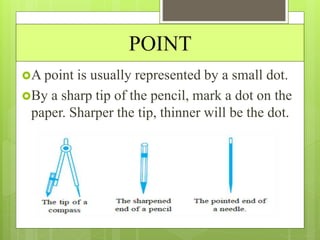
POINT
A point is usually represented by a small dot.
By a sharp tip of the pencil, mark a dot on the
paper. Sharper the tip, thinner will be the dot.
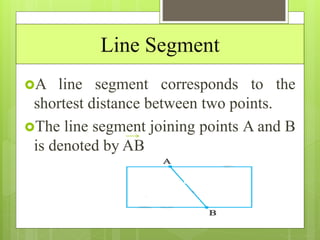
Line Segment
A line segment corresponds to the
shortest distance between two points.
The line segment joining points A and B
is denoted by AB
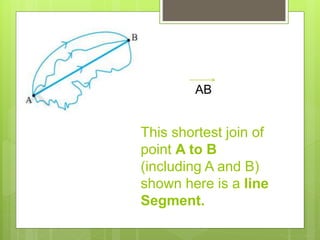
This shortest join of
point A to B
(including A and B)
shown here is a line
Segment.
AB
Line
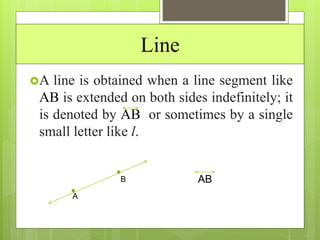
A line is obtained when a line segment like
AB is extended on both sides indefinitely; it
is denoted by AB or sometimes by a single
small letter like l.
A
B AB
Intersecting Lines
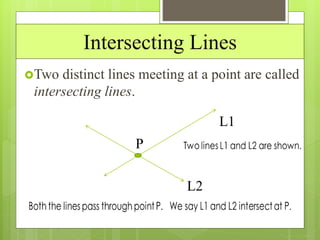
Two distinct lines meeting at a point are called
intersecting lines.
L1
L2
P
Parallel Lines
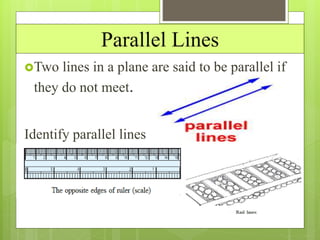
Two lines in a plane are said to be parallel if
they do not meet.
Identify parallel lines
Ray
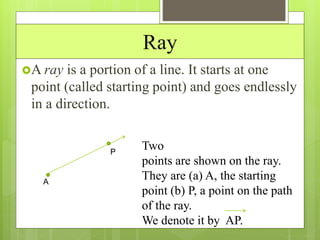
A ray is a portion of a line. It starts at one
point (called starting point) and goes endlessly
in a direction.
A
P
Two
points are shown on the ray.
They are (a) A, the starting
point (b) P, a point on the path
of the ray.
We denote it by AP.
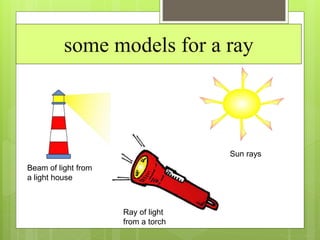
some models for a ray
Beam of light from
a light house
Ray of light
from a torch
Sun rays
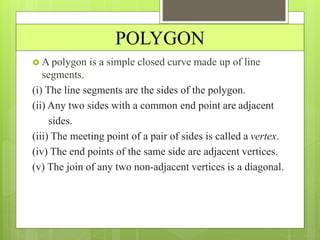
POLYGON
 A polygon is a simple closed curve made up of line
segments.
(i) The line segments are the sides of the polygon.
(ii) Any two sides with a common end point are adjacent
sides.
(iii) The meeting point of a pair of sides is called a vertex.
(iv) The end points of the same side are adjacent vertices.
(v) The join of any two non-adjacent vertices is a diagonal.
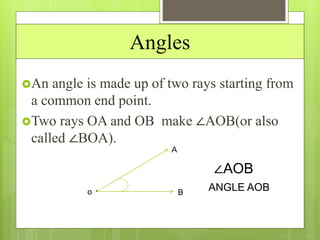
Angles
An angle is made up of two rays starting from
a common end point.
Two rays OA and OB make ∠AOB(or also
called ∠BOA).
o
A
B
∠AOB
ANGLE AOB
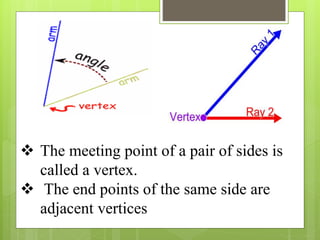
 The meeting point of a pair of sides is
called a vertex.
 The end points of the same side are
adjacent vertices
Triangles
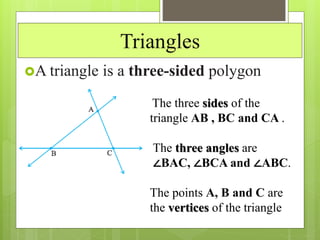
A triangle is a three-sided polygon
The three sides of the
triangle AB , BC and CA .
The three angles are
∠BAC, ∠BCA and ∠ABC.
The points A, B and C are
the vertices of the triangle
Quadrilaterals
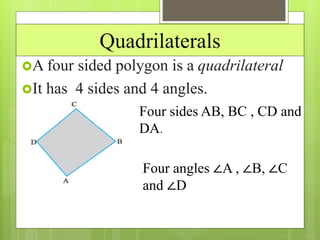
A four sided polygon is a quadrilateral
It has 4 sides and 4 angles.
Four sides AB, BC , CD and
DA.
Four angles ∠A , ∠B, ∠C
and ∠D
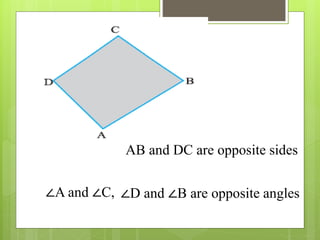
AB and DC are opposite sides
∠A and ∠C, ∠D and ∠B are opposite angles
Circles
A circle is a simple closed curve which is not a
polygon.
Parts of circle
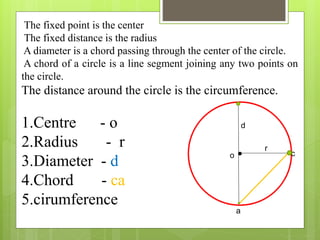
1.Centre - The fixed point
2.Radius- fixed distance
3.Diameter -A diameter is a chord passing through the
center
4.Chord-line segment joining any two points on the
circle.
5.Circumference – distance around the circle.
The fixed point is the center
The fixed distance is the radius
A diameter is a chord passing through the center of the circle.
A chord of a circle is a line segment joining any two points on
the circle.
The distance around the circle is the circumference.
1.Centre - o
2.Radius - r
3.Diameter - d
4.Chord - ca
5.cirumference
o
r
d
c
a
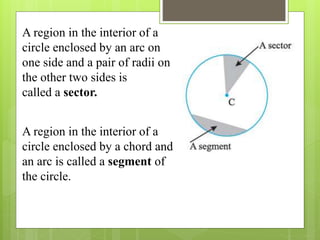
A region in the interior of a
circle enclosed by an arc on
one side and a pair of radii on
the other two sides is
called a sector.
A region in the interior of a
circle enclosed by a chord and
an arc is called a segment of
the circle.
Learning outcome
Students will be able to
 Understand the concept of point ,
line , line segment , ray ,angle ,
triangle , quadrilateral and circle.
 Apply the knowledge in different
situations.
Thank
you

presentationofmaths-160226144340.pdf

  • 2.
    GENERAL DETAILS Pupil teacher’sname : Pooja bindal Shalu verma
  • 3.
    GENERAL DETAILS Subject :Mathematics Class : 6th Topic : Basic geometrical ideas Duration : 35 minutes
  • 4.
    GENERAL OBJECTIVES Pupil willbe able to :- Understand the properties of quadrilaterals. Distinguish between different types of quadrilaterals. Grasp the concept of symmetry in different types of quadrilaterals
  • 5.
    What is geometry? Geometry is the branch of mathematics which deals with properties and relations with the lines , angles ,surfaces and solids. Just as Maths deals with numbers , geometry deals with figures , points and lines…….
  • 6.
    POINT A point isusually represented by a small dot. By a sharp tip of the pencil, mark a dot on the paper. Sharper the tip, thinner will be the dot.
  • 7.
    Line Segment A linesegment corresponds to the shortest distance between two points. The line segment joining points A and B is denoted by AB
  • 8.
    This shortest joinof point A to B (including A and B) shown here is a line Segment. AB
  • 9.
    Line A line isobtained when a line segment like AB is extended on both sides indefinitely; it is denoted by AB or sometimes by a single small letter like l. A B AB
  • 10.
    Intersecting Lines Two distinctlines meeting at a point are called intersecting lines. L1 L2 P
  • 11.
    Parallel Lines Two linesin a plane are said to be parallel if they do not meet. Identify parallel lines
  • 12.
    Ray A ray isa portion of a line. It starts at one point (called starting point) and goes endlessly in a direction. A P Two points are shown on the ray. They are (a) A, the starting point (b) P, a point on the path of the ray. We denote it by AP.
  • 13.
    some models fora ray Beam of light from a light house Ray of light from a torch Sun rays
  • 14.
    POLYGON  A polygonis a simple closed curve made up of line segments. (i) The line segments are the sides of the polygon. (ii) Any two sides with a common end point are adjacent sides. (iii) The meeting point of a pair of sides is called a vertex. (iv) The end points of the same side are adjacent vertices. (v) The join of any two non-adjacent vertices is a diagonal.
  • 15.
    Angles An angle ismade up of two rays starting from a common end point. Two rays OA and OB make ∠AOB(or also called ∠BOA). o A B ∠AOB ANGLE AOB
  • 16.
     The meetingpoint of a pair of sides is called a vertex.  The end points of the same side are adjacent vertices
  • 17.
    Triangles A triangle isa three-sided polygon The three sides of the triangle AB , BC and CA . The three angles are ∠BAC, ∠BCA and ∠ABC. The points A, B and C are the vertices of the triangle
  • 18.
    Quadrilaterals A four sidedpolygon is a quadrilateral It has 4 sides and 4 angles. Four sides AB, BC , CD and DA. Four angles ∠A , ∠B, ∠C and ∠D
  • 19.
    AB and DCare opposite sides ∠A and ∠C, ∠D and ∠B are opposite angles
  • 20.
    Circles A circle isa simple closed curve which is not a polygon. Parts of circle 1.Centre - The fixed point 2.Radius- fixed distance 3.Diameter -A diameter is a chord passing through the center 4.Chord-line segment joining any two points on the circle. 5.Circumference – distance around the circle.
  • 21.
    The fixed pointis the center The fixed distance is the radius A diameter is a chord passing through the center of the circle. A chord of a circle is a line segment joining any two points on the circle. The distance around the circle is the circumference. 1.Centre - o 2.Radius - r 3.Diameter - d 4.Chord - ca 5.cirumference o r d c a
  • 22.
    A region inthe interior of a circle enclosed by an arc on one side and a pair of radii on the other two sides is called a sector. A region in the interior of a circle enclosed by a chord and an arc is called a segment of the circle.
  • 23.
    Learning outcome Students willbe able to  Understand the concept of point , line , line segment , ray ,angle , triangle , quadrilateral and circle.  Apply the knowledge in different situations.
  • 24.