PARTIAL DIFFERENTIAL
EQUATIONS

Dosen: Retnari Dian Mudiastuti, ST., M.Si
BASIC CONCEPTS & IDEAS
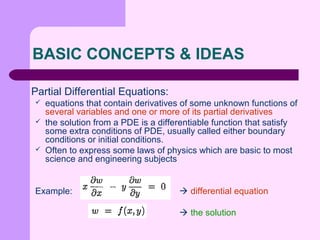
Partial Differential Equations:





equations that contain derivatives of some unknown functions of
several variables and one or more of its partial derivatives
the solution from a PDE is a differentiable function that satisfy
some extra conditions of PDE, usually called either boundary
conditions or initial conditions.
Often to express some laws of physics which are basic to most
science and engineering subjects

Example:

 differential equation
 the solution
Example of PDE: Laplace Equation

 Imagine a solid object made of some uniform heat-conducting
material (say a solid metal ball), and imagine a steady
temperature distribution on its surface is maintained somehow
(say with some arrangement of wires and thermostats). Then
after a while the temperature at each point inside the ball will
come to equilibrium (steady state), and the resulting
temperature function inside the ball will then satisfy Laplace’s
equation.
Solution: any steady-state temperature distribution in three space
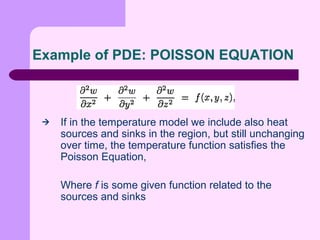
Example of PDE: POISSON EQUATION



If in the temperature model we include also heat
sources and sinks in the region, but still unchanging
over time, the temperature function satisfies the
Poisson Equation,
Where f is some given function related to the
sources and sinks
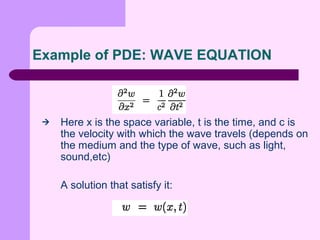
Example of PDE: WAVE EQUATION



Here x is the space variable, t is the time, and c is
the velocity with which the wave travels (depends on
the medium and the type of wave, such as light,
sound,etc)
A solution that satisfy it:
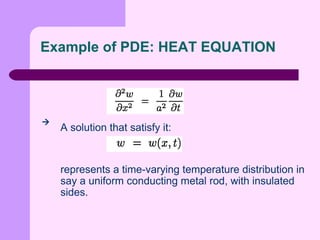
Example of PDE: HEAT EQUATION



A solution that satisfy it:

represents a time-varying temperature distribution in
say a uniform conducting metal rod, with insulated
sides.
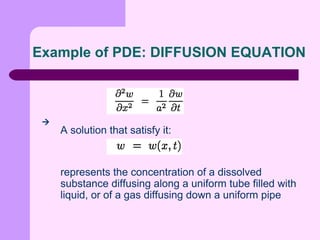
Example of PDE: DIFFUSION EQUATION



A solution that satisfy it:

represents the concentration of a dissolved
substance diffusing along a uniform tube filled with
liquid, or of a gas diffusing down a uniform pipe
Exercises on Partial Derivatives..
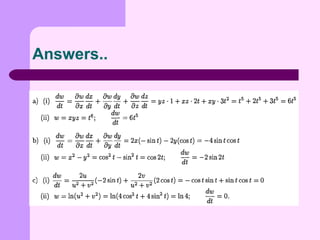
Answers..
Exercises on Chain Rule
Answers..
More exercises on PDE…
Answer..

Presentation3 partial differentials equation

  • 1.
  • 2.
    BASIC CONCEPTS &IDEAS Partial Differential Equations:    equations that contain derivatives of some unknown functions of several variables and one or more of its partial derivatives the solution from a PDE is a differentiable function that satisfy some extra conditions of PDE, usually called either boundary conditions or initial conditions. Often to express some laws of physics which are basic to most science and engineering subjects Example:  differential equation  the solution
  • 3.
    Example of PDE:Laplace Equation  Imagine a solid object made of some uniform heat-conducting material (say a solid metal ball), and imagine a steady temperature distribution on its surface is maintained somehow (say with some arrangement of wires and thermostats). Then after a while the temperature at each point inside the ball will come to equilibrium (steady state), and the resulting temperature function inside the ball will then satisfy Laplace’s equation. Solution: any steady-state temperature distribution in three space
  • 4.
    Example of PDE:POISSON EQUATION  If in the temperature model we include also heat sources and sinks in the region, but still unchanging over time, the temperature function satisfies the Poisson Equation, Where f is some given function related to the sources and sinks
  • 5.
    Example of PDE:WAVE EQUATION  Here x is the space variable, t is the time, and c is the velocity with which the wave travels (depends on the medium and the type of wave, such as light, sound,etc) A solution that satisfy it:
  • 6.
    Example of PDE:HEAT EQUATION  A solution that satisfy it: represents a time-varying temperature distribution in say a uniform conducting metal rod, with insulated sides.
  • 7.
    Example of PDE:DIFFUSION EQUATION  A solution that satisfy it: represents the concentration of a dissolved substance diffusing along a uniform tube filled with liquid, or of a gas diffusing down a uniform pipe
  • 8.
    Exercises on PartialDerivatives..
  • 9.
  • 10.
  • 11.
  • 12.
  • 13.