BY
SROTA DAWN.
M.PHARM [PHARMACOLOGY]
SUBJECT - PHARMACOLOGY -∏
VELS SCHOOL OF PHARMACEUTICAL SCIENCES
BRONCHITIS
[PATHOLOGY & TREATMENT]
9/25/2013
1
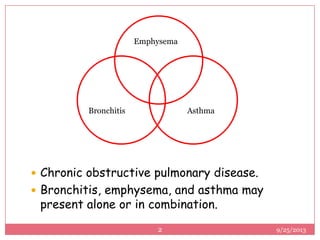
 Chronic obstructive pulmonary disease.
 Bronchitis, emphysema, and asthma may
present alone or in combination.
AsthmaBronchitis
Emphysema
9/25/20132
Description
 Characterized by presence of airflow
obstruction
 Caused by emphysema or chronic bronchitis
 Generally progressive
 May be accompanied by airway hyperreactivity
 May be partially reversible
9/25/2013
3
Emphysema
 Abnormal permanent enlargement of the air
space distal to the terminal bronchioles
 Accompanied by destruction of bronchioles
9/25/2013
4
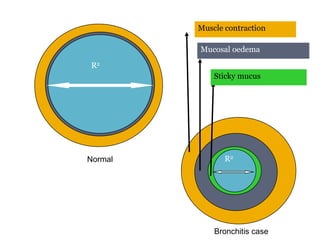
Muscle contraction
Mucosal oedema
Sticky mucus
R2
R2
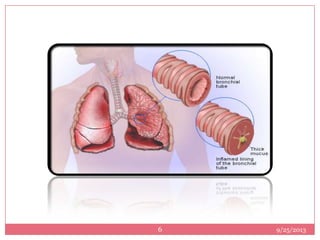
Bronchitis case
Normal
9/25/20135
9/25/20136
COPD Causes
 Infection
 Major contributing factor to the
aggravation and progression of COPD
 Heredity
 -Antitrypsin (AAT) deficiency (produced
by liver and found in lungs); accounts for
< 1% of COPD cases
 Emphysema results from lysis of lung tissues by
proteolytic enzymes from neutrophils and macrophages
9/25/2013
7
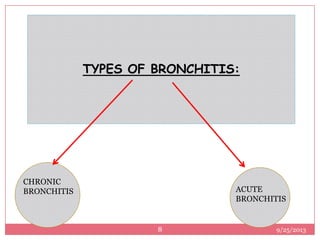
TYPES OF BRONCHITIS:
CHRONIC
BRONCHITIS ACUTE
BRONCHITIS
9/25/20138
Chronic bronchitis
•Chronic bronchitis is
a chronic inflammation
of the bronchi (medium-size airways) in
the lungs.
• It is generally considered one of the two
forms of chronic obstructive pulmonary
disease (COPD), the other being emphysema.
•Chronic bronchitis It is defined clinically as a
persistent cough that produces sputum and
mucus, for at least three months per year in
two consecutive years.
9/25/20139
Signs and symptoms
Bronchitis may be indicated by –
 Cough (also known as a productive
cough, i.E. One that produces sputum),
 Shortness of breath and
 Wheezing.
Occasionally ,
chest pains, fever, and fatigue or malaise may also occur.
Mucus is often green or yellowish green and also may be
orange or pink, depending on the pathogen causing the
inflammation.
9/25/201310
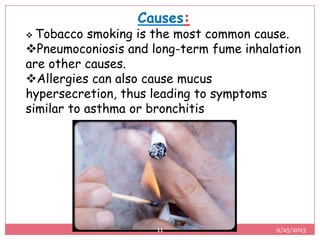
Causes:
 Tobacco smoking is the most common cause.
Pneumoconiosis and long-term fume inhalation
are other causes.
Allergies can also cause mucus
hypersecretion, thus leading to symptoms
similar to asthma or bronchitis
9/25/201311
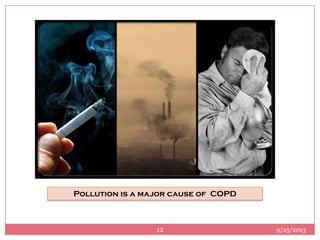
Pollution is a major cause of COPD
9/25/201312
Chronic Bronchitis Pathophysiology
Pathologic lung changes are:
 Hyperplasia of mucus-secreting glands
in trachea and bronchi
 Increase in goblet cells
 Disappearance of cilia
 Chronic inflammatory changes and narrowing
of small airways
 Altered function of alveolar macrophages
infections
9/25/2013
13
Chronic Bronchitis Pathophysiology
Chronic inflammation
Primary pathologic mechanism causing
changes
Narrow airway lumen and reduced
airflow
hyperplasia of mucus glands
Inflammatory swelling
Excess, thick mucus
9/25/2013
14
Chronic Bronchitis Pathophysiology
 Greater resistance to airflow increases
work of breathing
 Hypoxemia and hypercapnia develop more
frequently in chronic bronchitis than
emphysema
9/25/2013
15
Chronic Bronchitis Pathophysiology
 Bronchioles are clogged with mucus and
pose a physical barrier to ventilation
 Hypoxemia and hypercapnia , lack of
ventilation and O2 diffusion
 Tendency to hypoventilate and retain CO2
 Frequently patients require O2 both at rest
and during exercise
9/25/2013
16
Chronic Bronchitis Pathophysiology
 Cough is often ineffective to remove secretions
because the person cannot breathe deeply enough to
cause air flow distal to the secretions
 Bronchospasm frequently develops
More common with history of
smoking or asthma
9/25/2013
17
Chronic Bronchitis
Clinical Manifestations
 Earliest symptoms:
Frequent, productive cough during
winter
Frequent respiratory infections
9/25/2013
18
Chronic Bronchitis
Clinical Manifestations
 Bronchospasm at end of paroxysms of
coughing
 Cough
 History of smoking
 Normal weight or heavyset
 Ruddy (bluish-red) appearance d/t
 polycythemia (increased Hgb d/t chronic hypoxemia))
 cyanosis
9/25/2013
19
Chronic Bronchitis Clinical Manifestations
 Hypoxemia and hypercapnia
Results from hypoventilation and 
airway resistance + problems with
alveolar gas exchange
9/25/2013
20
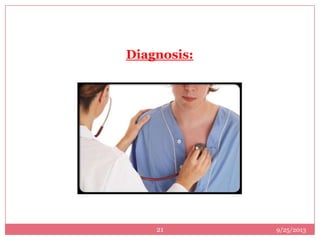
Diagnosis:
9/25/201321
Diagnosis:
A variety of tests may be performed in patients
presenting with cough and shortness of breath:
•Pulmonary Function Tests (PFT)
(or spirometry)
•A chest X-ray
• chest radiography.
•A sputum sample showing neutrophil
granulocytes (inflammatory white blood cells)
and Check for pathogenic microorganisms such
as Streptococcus spp.
•A blood test would indicate inflammation
•High Resolution Computed Tomography (HRCT)
9/25/201322
COPD Complications
 Pulmonary hypertension (pulmonary vessel
constriction alveolar hypoxia & acidosis)
 Pneumonia
 Acute Respiratory Failure
9/25/2013
23
Acute bronchitis
Acute bronchitis is an inflammation of the large bronchi (medium-
size airways) in the lungs that is
Usually caused by viruses or bacteria and may last
several days or weeks.
Characteristic symptoms :
• cough,
• sputum (phlegm) production,
• shortness of breath
• wheezing related to the obstruction of the inflamed airways.
Diagnosis is by clinical examination and
sometimes microbiological examination of the phlegm.
Treatment
For acute bronchitis is typically symptomatic. As viruses cause
most cases of acute bronchitis, antibiotics should not be used unless
microscopic examination of gram-stained sputum reveals large numbers of
bacteria.
9/25/201324
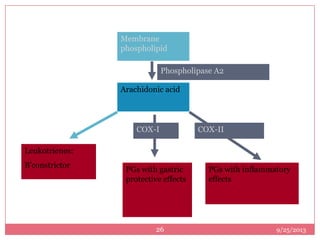
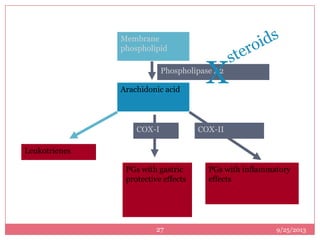
Anti-inflammatory drugs: steroids
9/25/201325
Membrane
phospholipid
Arachidonic acid
Phospholipase A2
Leukotrienes:
B’constrictor
COX-I
PGs with gastric
protective effects
COX-II
PGs with inflammatory
effects
9/25/201326
Membrane
phospholipid
Arachidonic acid
Phospholipase A2
Leukotrienes
COX-I
PGs with gastric
protective effects
COX-II
PGs with inflammatory
effects
X
9/25/201327
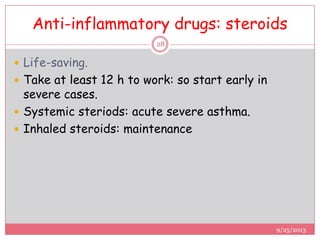
Anti-inflammatory drugs: steroids
 Life-saving.
 Take at least 12 h to work: so start early in
severe cases.
 Systemic steriods: acute severe asthma.
 Inhaled steroids: maintenance
9/25/2013
28
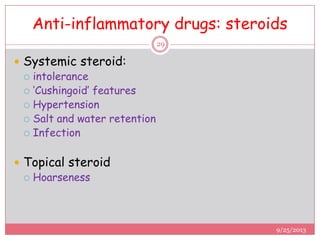
Anti-inflammatory drugs: steroids
 Systemic steroid:
 intolerance
 ‘Cushingoid’ features
 Hypertension
 Salt and water retention
 Infection
 Topical steroid
 Hoarseness
9/25/2013
29
Anti-inflammatory drugs:
cromoglycate{mast cell stabilizer}
 Prevent release of histamine from mast cells
 By inhaler only.
 Useful maintenance therapy.
 No role in severe episodes.
 Few, if any, adverse effects.
9/25/2013
30
Anti-inflammatory drugs:
leukotriene receptor antagonists
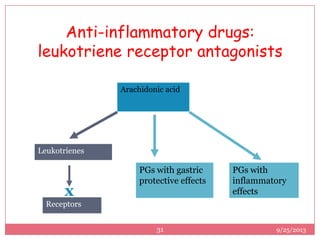
Arachidonic acid
Leukotrienes
PGs with gastric
protective effects
PGs with
inflammatory
effectsx
Receptors
9/25/201331
• Leukotrienes cause capillary leakiness
and bronchoconstriction
• Used orally for maintenance therapy
(e.g. montelukast).
• Additive with inhaled steroids.
Anti-inflammatory drugs:
leukotriene receptor antagonists
9/25/201332
Bronchodilators
9/25/2013
33
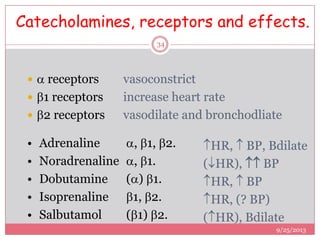
Catecholamines, receptors and effects.
  receptors vasoconstrict
 1 receptors increase heart rate
 2 receptors vasodilate and bronchodliate
• Adrenaline , 1, 2.
• Noradrenaline , 1.
• Dobutamine () 1.
• Isoprenaline 1, 2.
• Salbutamol (1) 2.
HR,  BP, Bdilate
(HR),  BP
HR,  BP
HR, (? BP)
(HR), Bdilate
9/25/2013
34
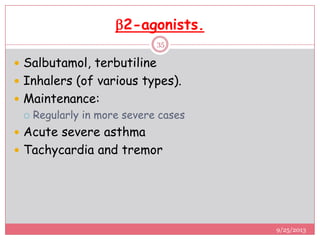
2-agonists.
 Salbutamol, terbutiline
 Inhalers (of various types).
 Maintenance:
 Regularly in more severe cases
 Acute severe asthma
 Tachycardia and tremor
9/25/2013
35
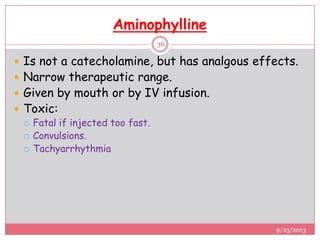
Aminophylline
 Is not a catecholamine, but has analgous effects.
 Narrow therapeutic range.
 Given by mouth or by IV infusion.
 Toxic:
 Fatal if injected too fast.
 Convulsions.
 Tachyarrhythmia
9/25/2013
36
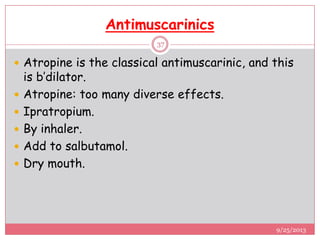
Antimuscarinics
 Atropine is the classical antimuscarinic, and this
is b’dilator.
 Atropine: too many diverse effects.
 Ipratropium.
 By inhaler.
 Add to salbutamol.
 Dry mouth.
9/25/2013
37
9/25/201338

bronchitis (pathology and treatment)by srota dawn

  • 1.
    BY SROTA DAWN. M.PHARM [PHARMACOLOGY] SUBJECT- PHARMACOLOGY -∏ VELS SCHOOL OF PHARMACEUTICAL SCIENCES BRONCHITIS [PATHOLOGY & TREATMENT] 9/25/2013 1
  • 2.
     Chronic obstructivepulmonary disease.  Bronchitis, emphysema, and asthma may present alone or in combination. AsthmaBronchitis Emphysema 9/25/20132
  • 3.
    Description  Characterized bypresence of airflow obstruction  Caused by emphysema or chronic bronchitis  Generally progressive  May be accompanied by airway hyperreactivity  May be partially reversible 9/25/2013 3
  • 4.
    Emphysema  Abnormal permanentenlargement of the air space distal to the terminal bronchioles  Accompanied by destruction of bronchioles 9/25/2013 4
  • 5.
    Muscle contraction Mucosal oedema Stickymucus R2 R2 Bronchitis case Normal 9/25/20135
  • 6.
  • 7.
    COPD Causes  Infection Major contributing factor to the aggravation and progression of COPD  Heredity  -Antitrypsin (AAT) deficiency (produced by liver and found in lungs); accounts for < 1% of COPD cases  Emphysema results from lysis of lung tissues by proteolytic enzymes from neutrophils and macrophages 9/25/2013 7
  • 8.
    TYPES OF BRONCHITIS: CHRONIC BRONCHITISACUTE BRONCHITIS 9/25/20138
  • 9.
    Chronic bronchitis •Chronic bronchitisis a chronic inflammation of the bronchi (medium-size airways) in the lungs. • It is generally considered one of the two forms of chronic obstructive pulmonary disease (COPD), the other being emphysema. •Chronic bronchitis It is defined clinically as a persistent cough that produces sputum and mucus, for at least three months per year in two consecutive years. 9/25/20139
  • 10.
    Signs and symptoms Bronchitismay be indicated by –  Cough (also known as a productive cough, i.E. One that produces sputum),  Shortness of breath and  Wheezing. Occasionally , chest pains, fever, and fatigue or malaise may also occur. Mucus is often green or yellowish green and also may be orange or pink, depending on the pathogen causing the inflammation. 9/25/201310
  • 11.
    Causes:  Tobacco smokingis the most common cause. Pneumoconiosis and long-term fume inhalation are other causes. Allergies can also cause mucus hypersecretion, thus leading to symptoms similar to asthma or bronchitis 9/25/201311
  • 12.
    Pollution is amajor cause of COPD 9/25/201312
  • 13.
    Chronic Bronchitis Pathophysiology Pathologiclung changes are:  Hyperplasia of mucus-secreting glands in trachea and bronchi  Increase in goblet cells  Disappearance of cilia  Chronic inflammatory changes and narrowing of small airways  Altered function of alveolar macrophages infections 9/25/2013 13
  • 14.
    Chronic Bronchitis Pathophysiology Chronicinflammation Primary pathologic mechanism causing changes Narrow airway lumen and reduced airflow hyperplasia of mucus glands Inflammatory swelling Excess, thick mucus 9/25/2013 14
  • 15.
    Chronic Bronchitis Pathophysiology Greater resistance to airflow increases work of breathing  Hypoxemia and hypercapnia develop more frequently in chronic bronchitis than emphysema 9/25/2013 15
  • 16.
    Chronic Bronchitis Pathophysiology Bronchioles are clogged with mucus and pose a physical barrier to ventilation  Hypoxemia and hypercapnia , lack of ventilation and O2 diffusion  Tendency to hypoventilate and retain CO2  Frequently patients require O2 both at rest and during exercise 9/25/2013 16
  • 17.
    Chronic Bronchitis Pathophysiology Cough is often ineffective to remove secretions because the person cannot breathe deeply enough to cause air flow distal to the secretions  Bronchospasm frequently develops More common with history of smoking or asthma 9/25/2013 17
  • 18.
    Chronic Bronchitis Clinical Manifestations Earliest symptoms: Frequent, productive cough during winter Frequent respiratory infections 9/25/2013 18
  • 19.
    Chronic Bronchitis Clinical Manifestations Bronchospasm at end of paroxysms of coughing  Cough  History of smoking  Normal weight or heavyset  Ruddy (bluish-red) appearance d/t  polycythemia (increased Hgb d/t chronic hypoxemia))  cyanosis 9/25/2013 19
  • 20.
    Chronic Bronchitis ClinicalManifestations  Hypoxemia and hypercapnia Results from hypoventilation and  airway resistance + problems with alveolar gas exchange 9/25/2013 20
  • 21.
  • 22.
    Diagnosis: A variety oftests may be performed in patients presenting with cough and shortness of breath: •Pulmonary Function Tests (PFT) (or spirometry) •A chest X-ray • chest radiography. •A sputum sample showing neutrophil granulocytes (inflammatory white blood cells) and Check for pathogenic microorganisms such as Streptococcus spp. •A blood test would indicate inflammation •High Resolution Computed Tomography (HRCT) 9/25/201322
  • 23.
    COPD Complications  Pulmonaryhypertension (pulmonary vessel constriction alveolar hypoxia & acidosis)  Pneumonia  Acute Respiratory Failure 9/25/2013 23
  • 24.
    Acute bronchitis Acute bronchitisis an inflammation of the large bronchi (medium- size airways) in the lungs that is Usually caused by viruses or bacteria and may last several days or weeks. Characteristic symptoms : • cough, • sputum (phlegm) production, • shortness of breath • wheezing related to the obstruction of the inflamed airways. Diagnosis is by clinical examination and sometimes microbiological examination of the phlegm. Treatment For acute bronchitis is typically symptomatic. As viruses cause most cases of acute bronchitis, antibiotics should not be used unless microscopic examination of gram-stained sputum reveals large numbers of bacteria. 9/25/201324
  • 25.
  • 26.
    Membrane phospholipid Arachidonic acid Phospholipase A2 Leukotrienes: B’constrictor COX-I PGswith gastric protective effects COX-II PGs with inflammatory effects 9/25/201326
  • 27.
    Membrane phospholipid Arachidonic acid Phospholipase A2 Leukotrienes COX-I PGswith gastric protective effects COX-II PGs with inflammatory effects X 9/25/201327
  • 28.
    Anti-inflammatory drugs: steroids Life-saving.  Take at least 12 h to work: so start early in severe cases.  Systemic steriods: acute severe asthma.  Inhaled steroids: maintenance 9/25/2013 28
  • 29.
    Anti-inflammatory drugs: steroids Systemic steroid:  intolerance  ‘Cushingoid’ features  Hypertension  Salt and water retention  Infection  Topical steroid  Hoarseness 9/25/2013 29
  • 30.
    Anti-inflammatory drugs: cromoglycate{mast cellstabilizer}  Prevent release of histamine from mast cells  By inhaler only.  Useful maintenance therapy.  No role in severe episodes.  Few, if any, adverse effects. 9/25/2013 30
  • 31.
    Anti-inflammatory drugs: leukotriene receptorantagonists Arachidonic acid Leukotrienes PGs with gastric protective effects PGs with inflammatory effectsx Receptors 9/25/201331
  • 32.
    • Leukotrienes causecapillary leakiness and bronchoconstriction • Used orally for maintenance therapy (e.g. montelukast). • Additive with inhaled steroids. Anti-inflammatory drugs: leukotriene receptor antagonists 9/25/201332
  • 33.
  • 34.
    Catecholamines, receptors andeffects.   receptors vasoconstrict  1 receptors increase heart rate  2 receptors vasodilate and bronchodliate • Adrenaline , 1, 2. • Noradrenaline , 1. • Dobutamine () 1. • Isoprenaline 1, 2. • Salbutamol (1) 2. HR,  BP, Bdilate (HR),  BP HR,  BP HR, (? BP) (HR), Bdilate 9/25/2013 34
  • 35.
    2-agonists.  Salbutamol, terbutiline Inhalers (of various types).  Maintenance:  Regularly in more severe cases  Acute severe asthma  Tachycardia and tremor 9/25/2013 35
  • 36.
    Aminophylline  Is nota catecholamine, but has analgous effects.  Narrow therapeutic range.  Given by mouth or by IV infusion.  Toxic:  Fatal if injected too fast.  Convulsions.  Tachyarrhythmia 9/25/2013 36
  • 37.
    Antimuscarinics  Atropine isthe classical antimuscarinic, and this is b’dilator.  Atropine: too many diverse effects.  Ipratropium.  By inhaler.  Add to salbutamol.  Dry mouth. 9/25/2013 37
  • 38.