WOLLO UNIVERSITY
COLLEGE OF MEDICINE AND HEALTH SCIENCES
SCHOOL OF PUBLIC HEALTH
DEPARTEMENT OF HEALTH INFORMATICS
GROUP ASSAGNMENT OF HEALTH DATA ANAYTICS
SUBMITED TO: MULUGETA HAYLOM
SUBMITION DATE:JULY 7 2022 G.C
ETHIOPIAN ,DESSISE 2022
1
GROUP MEMBER
1,ALEMU MEHARIW ……………………………………3473/11
2,TADESE ALEMU……………………………………….3680/11
3,TESFAHUN ASMARE…………………………………3689/11
4,KALKIDAN WASE ……………………………………..
5,KIDANEMARYAM ABRHAM ………………………3595/11
6,TIGIST AYALNEH ……………………………………………3693/11
2
Objectives
• Define Probabilistic models
• Define Bayesian Networks
• Discus the feature of Bayesian Networks?
• What are the important of Bayesian Networks?
• How to build a Bayesian network?
• How are Bayesian networks implemented?
• Advantage and disadvantage of Bayesian Networks?
• Example
3
INTRODUCTION
• Probabilistic modeling is a statistical technique used to take
into account the impact of random events or actions in
predicting the potential occurrence of future outcomes.
• In statistics, Probabilistic models are used to define a
relationship between variables.
• can be used to calculate the probabilities of each variable.
• The only way is to develop a model that can preserve the
conditional dependencies between random variables and
conditional independence in other cases.
• This leads us to the concept of Bayesian Networks.
4
Bayesian Networks
• is a probabilistic graphical model for representing knowledge
about an uncertain domain.
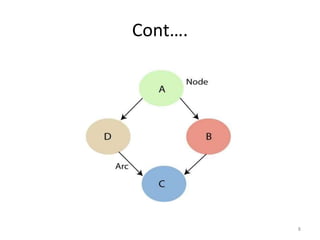
• The network consists node and edge.
• Nodes: Random variables in a graphical model.
• Edges: Relationships between random variables in a graphical
model.
5
Cont…
• each node corresponds to a random variable
and each edge represents the conditional
probability for the corresponding random
variables.
• It capture both conditionally dependent and
conditionally independent relationships
between random variables.
6
Cont…
• Bayesian Networks help us to effectively visualize the
probabilistic model for each domain and to study the
relationship between random variables in the form of a user-
friendly graph.
• It represents a set of variables and its conditional probabilities
with a Directed Acyclic Graph (DAG).
7
Cont….
8
Features of BN
• BN techniques have several features that make them useful in
many real-life data analysis and management questions.
 They provide a natural way to handle missing data
 they allow combination of data with domain knowledge
 they facilitate learning about causal relationships between
variables.
9
Cont…
 they provide a method for avoiding overfitting of data
 they can show good prediction accuracy even with rather
small sample sizes
 they can be easily combined with decision analytic tools to aid
management
10
Uses
• Bayesian network is an important part of machine learning
and statistics.
• It is used in data mining and scientific discovery.
• tool for analyzing the past, predicting the future and
improving the quality of decisions.
11
Cont….
Bayesian networks can readily handle incomplete
data sets.
 When one of the inputs is not observed, many models will
produce an inaccurate prediction, because they do not
encode the correlation between the input variables. Bayesian
networks offer a natural way to encode such dependencies.
12
cont…
Bayesian networks allow one to learn about
causal relationships
• For example, a marketing analyst may want to know whether
or not it is worthwhile to increase exposure of a particular
advertisement in order to increase the sales of a product.
13
Cont..
• Visualization. The model provides a direct way to visualize the
structure of the model and motivate the design of new
models.
• Relationships. Provides insights into the presence and
absence of the relationships between random variables.
• Computations. Provides a way to structure complex
probability calculations.
14
How to build a Bayesian network?
• There are two ways to build a Bayesian network.
 a manual construction
 Automatic(computer) construction (so called "learning") from
databases
15
Manual construction
• Manual construction of a Bayesian network assumes prior
expert knowledge of the underlying domain.
• The first step is to build a directed acyclic graph
• The second step to assess the conditional probability
distribution in each node.
16
Directed acyclic graph
• Building the directed acyclic graph starts with
identification of relevant nodes (random
variables) and structural dependence among
them.
17
Conditional probability distribution
• The constructed directed acyclic graph has to
include conditional probability distributions
for every node in the graph.
18
Automatic learning
• Unlike manual construction, automatic learning does not
require expert knowledge of the underlying domain.
• Bayesian networks may be learnt automatically straight from
databases using experience-based algorithms often built-in in
appropriate software
19
How are Bayesian networks implemented?
• A Bayesian network is a graphical model where each of the
nodes represent random variables.
• Each node is connected to other nodes by directed arcs.
• Each arc represents a conditional probability distribution of
the parents given the children.
• The directed edges represent the influence of a parent on its
children.
20
Cont..
• The nodes usually represent some real-world objects and the
arcs represent some physical or logical relationship between
them.
• Bayesian networks are used in many applications like
automatic speech recognition, document/image classification,
medical diagnosis, and robotics.
21
Advantage
• It is readable to both computers and humans; both can
interpret the information.
• unlike some networks like neural networks, which humans
can’t read.
• it is an excellent network for adding a new piece of data to an
existing probabilistic model.
• Computations calculate complex probability problems
efficiently.
22
Disadvantage
• The Bayesian network fails to define cyclic relationships.
• The network is expensive to build.
• The design of Bayesian Networks is hard to make compared to
other networks. It needs a lot of effort.
• It performs poorly on high dimensional data.
23
Example
24
]
 For example, with a given symptom we can predict the
probability of a disease occurring with several other factors
contributing to the disease.
 In the below diagram A, B, C and are 3 random variables
represented by nodes given in the network of the graph. To
node B is its parent node and C and A is its child node
Cont…
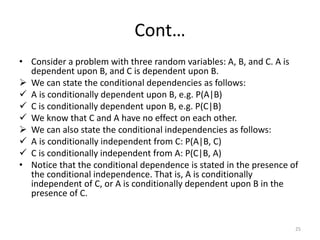
• Consider a problem with three random variables: A, B, and C. A is
dependent upon B, and C is dependent upon B.
 We can state the conditional dependencies as follows:
 A is conditionally dependent upon B, e.g. P(A|B)
 C is conditionally dependent upon B, e.g. P(C|B)
 We know that C and A have no effect on each other.
 We can also state the conditional independencies as follows:
 A is conditionally independent from C: P(A|B, C)
 C is conditionally independent from A: P(C|B, A)
• Notice that the conditional dependence is stated in the presence of
the conditional independence. That is, A is conditionally
independent of C, or A is conditionally dependent upon B in the
presence of C.
25
Presentation1.pptx

Presentation1.pptx

  • 1.
    WOLLO UNIVERSITY COLLEGE OFMEDICINE AND HEALTH SCIENCES SCHOOL OF PUBLIC HEALTH DEPARTEMENT OF HEALTH INFORMATICS GROUP ASSAGNMENT OF HEALTH DATA ANAYTICS SUBMITED TO: MULUGETA HAYLOM SUBMITION DATE:JULY 7 2022 G.C ETHIOPIAN ,DESSISE 2022 1
  • 2.
    GROUP MEMBER 1,ALEMU MEHARIW……………………………………3473/11 2,TADESE ALEMU……………………………………….3680/11 3,TESFAHUN ASMARE…………………………………3689/11 4,KALKIDAN WASE …………………………………….. 5,KIDANEMARYAM ABRHAM ………………………3595/11 6,TIGIST AYALNEH ……………………………………………3693/11 2
  • 3.
    Objectives • Define Probabilisticmodels • Define Bayesian Networks • Discus the feature of Bayesian Networks? • What are the important of Bayesian Networks? • How to build a Bayesian network? • How are Bayesian networks implemented? • Advantage and disadvantage of Bayesian Networks? • Example 3
  • 4.
    INTRODUCTION • Probabilistic modelingis a statistical technique used to take into account the impact of random events or actions in predicting the potential occurrence of future outcomes. • In statistics, Probabilistic models are used to define a relationship between variables. • can be used to calculate the probabilities of each variable. • The only way is to develop a model that can preserve the conditional dependencies between random variables and conditional independence in other cases. • This leads us to the concept of Bayesian Networks. 4
  • 5.
    Bayesian Networks • isa probabilistic graphical model for representing knowledge about an uncertain domain. • The network consists node and edge. • Nodes: Random variables in a graphical model. • Edges: Relationships between random variables in a graphical model. 5
  • 6.
    Cont… • each nodecorresponds to a random variable and each edge represents the conditional probability for the corresponding random variables. • It capture both conditionally dependent and conditionally independent relationships between random variables. 6
  • 7.
    Cont… • Bayesian Networkshelp us to effectively visualize the probabilistic model for each domain and to study the relationship between random variables in the form of a user- friendly graph. • It represents a set of variables and its conditional probabilities with a Directed Acyclic Graph (DAG). 7
  • 8.
  • 9.
    Features of BN •BN techniques have several features that make them useful in many real-life data analysis and management questions.  They provide a natural way to handle missing data  they allow combination of data with domain knowledge  they facilitate learning about causal relationships between variables. 9
  • 10.
    Cont…  they providea method for avoiding overfitting of data  they can show good prediction accuracy even with rather small sample sizes  they can be easily combined with decision analytic tools to aid management 10
  • 11.
    Uses • Bayesian networkis an important part of machine learning and statistics. • It is used in data mining and scientific discovery. • tool for analyzing the past, predicting the future and improving the quality of decisions. 11
  • 12.
    Cont…. Bayesian networks canreadily handle incomplete data sets.  When one of the inputs is not observed, many models will produce an inaccurate prediction, because they do not encode the correlation between the input variables. Bayesian networks offer a natural way to encode such dependencies. 12
  • 13.
    cont… Bayesian networks allowone to learn about causal relationships • For example, a marketing analyst may want to know whether or not it is worthwhile to increase exposure of a particular advertisement in order to increase the sales of a product. 13
  • 14.
    Cont.. • Visualization. Themodel provides a direct way to visualize the structure of the model and motivate the design of new models. • Relationships. Provides insights into the presence and absence of the relationships between random variables. • Computations. Provides a way to structure complex probability calculations. 14
  • 15.
    How to builda Bayesian network? • There are two ways to build a Bayesian network.  a manual construction  Automatic(computer) construction (so called "learning") from databases 15
  • 16.
    Manual construction • Manualconstruction of a Bayesian network assumes prior expert knowledge of the underlying domain. • The first step is to build a directed acyclic graph • The second step to assess the conditional probability distribution in each node. 16
  • 17.
    Directed acyclic graph •Building the directed acyclic graph starts with identification of relevant nodes (random variables) and structural dependence among them. 17
  • 18.
    Conditional probability distribution •The constructed directed acyclic graph has to include conditional probability distributions for every node in the graph. 18
  • 19.
    Automatic learning • Unlikemanual construction, automatic learning does not require expert knowledge of the underlying domain. • Bayesian networks may be learnt automatically straight from databases using experience-based algorithms often built-in in appropriate software 19
  • 20.
    How are Bayesiannetworks implemented? • A Bayesian network is a graphical model where each of the nodes represent random variables. • Each node is connected to other nodes by directed arcs. • Each arc represents a conditional probability distribution of the parents given the children. • The directed edges represent the influence of a parent on its children. 20
  • 21.
    Cont.. • The nodesusually represent some real-world objects and the arcs represent some physical or logical relationship between them. • Bayesian networks are used in many applications like automatic speech recognition, document/image classification, medical diagnosis, and robotics. 21
  • 22.
    Advantage • It isreadable to both computers and humans; both can interpret the information. • unlike some networks like neural networks, which humans can’t read. • it is an excellent network for adding a new piece of data to an existing probabilistic model. • Computations calculate complex probability problems efficiently. 22
  • 23.
    Disadvantage • The Bayesiannetwork fails to define cyclic relationships. • The network is expensive to build. • The design of Bayesian Networks is hard to make compared to other networks. It needs a lot of effort. • It performs poorly on high dimensional data. 23
  • 24.
    Example 24 ]  For example,with a given symptom we can predict the probability of a disease occurring with several other factors contributing to the disease.  In the below diagram A, B, C and are 3 random variables represented by nodes given in the network of the graph. To node B is its parent node and C and A is its child node
  • 25.
    Cont… • Consider aproblem with three random variables: A, B, and C. A is dependent upon B, and C is dependent upon B.  We can state the conditional dependencies as follows:  A is conditionally dependent upon B, e.g. P(A|B)  C is conditionally dependent upon B, e.g. P(C|B)  We know that C and A have no effect on each other.  We can also state the conditional independencies as follows:  A is conditionally independent from C: P(A|B, C)  C is conditionally independent from A: P(C|B, A) • Notice that the conditional dependence is stated in the presence of the conditional independence. That is, A is conditionally independent of C, or A is conditionally dependent upon B in the presence of C. 25