

Presented by
Rajat Soni
M.tech. WCT
Enrl.No.-140291
Secure Routing Protocol in Wireless Sensor
Networks
Supervisor
Prof. P.P. Bhattacharya
Co supervisor
Mr Deepak Sethi
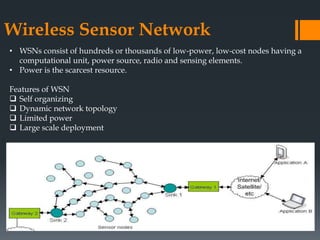
Wireless Sensor Network
• WSNs consist of hundreds or thousands of low-power, low-cost nodes having a
computational unit, power source, radio and sensing elements.
• Power is the scarcest resource.
Features of WSN
 Self organizing
 Dynamic network topology
 Limited power
 Large scale deployment
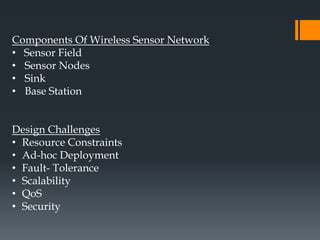
Components Of Wireless Sensor Network
• Sensor Field
• Sensor Nodes
• Sink
• Base Station
Design Challenges
• Resource Constraints
• Ad-hoc Deployment
• Fault- Tolerance
• Scalability
• QoS
• Security
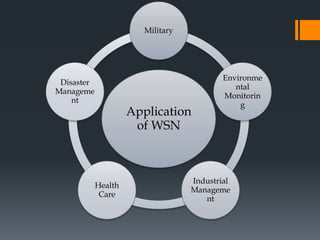
Application
of WSN
Military
Environme
ntal
Monitorin
g
Industrial
Manageme
nt
Health
Care
Disaster
Manageme
nt
Routing in Wireless Sensor
Network
• Many routing and data dissemination protocols have been specifically
designed for WSNs where energy awareness is an essential design
issue.
• Routing protocols might differ depending on the application and
network architecture
• The design of routing protocols is influenced by many challenging
factors caused by the nature of the WSNs.
some of these factors are
• Data delivery model
• Security
• Data aggregation
• Fault tolerance
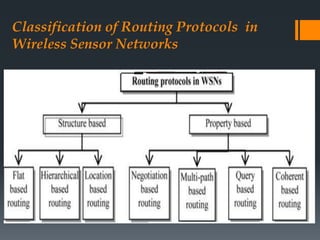
Classification of Routing Protocols in
Wireless Sensor Networks
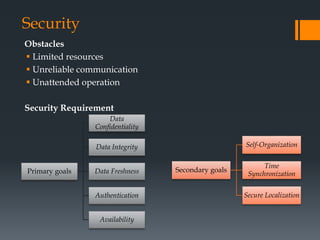
Security
Obstacles
 Limited resources
 Unreliable communication
 Unattended operation
Security Requirement
Primary goals
Data
Confidentiality
Data Integrity
Data Freshness
Authentication
Availability
Secondary goals
Self-Organization
Time
Synchronization
Secure Localization
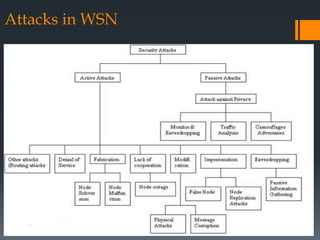
Attacks in WSN
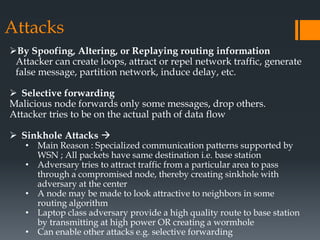
Attacks
By Spoofing, Altering, or Replaying routing information
Attacker can create loops, attract or repel network traffic, generate
false message, partition network, induce delay, etc.
 Selective forwarding
Malicious node forwards only some messages, drop others.
Attacker tries to be on the actual path of data flow
 Sinkhole Attacks 
• Main Reason : Specialized communication patterns supported by
WSN ; All packets have same destination i.e. base station
• Adversary tries to attract traffic from a particular area to pass
through a compromised node, thereby creating sinkhole with
adversary at the center
• A node may be made to look attractive to neighbors in some
routing algorithm
• Laptop class adversary provide a high quality route to base station
by transmitting at high power OR creating a wormhole
• Can enable other attacks e.g. selective forwarding
Sybil Attack
• Single node presents multiple identities to other nodes
• Significantly affect fault-tolerance schemes like distributed storage,
multi-path routing, topology maintenance
• Threat to geographical routing protocols
Wormholes
• tunnelling of messages over alternative low-latency links, e.g.
confuse the routing protocol, create sinkholes. etc.
• Exploit routing race condition
HELLO flood attack
• Some protocols require that nodes broadcast ‘hello’ packets to
advertise themselves
Acknowledgement spoofing
• Adversary can spoof ACKs for control packets and try to
convince the sender that a weak link is strong or a dead link is
alive; causing packet losses
Various Secure Routing Protocols
Distributed Security Framework (DSF)
Multipath Data Transfer protocol (MDTP)
Secure and Energy Efficient Disjoint Route (SEDR)
Data Centric Braided Multipath (DCBM)
Energy Efficient Secure Routing Protocol (EESRP)
Bio-inspired Self-Organized Secure Autonomous Routing
Protocol (BIOSARP)
Sink Toroidal Region Routing (STAR)
Distributed Security Framework
 Uses Hierarchical routing protocols
 Prevents network from Sybil, selective forwarding& worm hole
attacks
 Works for both mobile and static attackers
Limitations
 Consume high energy
 End to end delay is very high
Scope
 Improvement in success rate
 No defence mechanism for attack on gateway node
Energy Efficient Secure Routing
Protocol
 This protocol makes uses the sink-oriented grid structure for providing
better delivery ratio.
 It employs the farthest-highest energy dissemination node search to
find an efficient path from the source to the sink.
 use three different key for security.
 prevents from Sybil, black hole& worm hole attacks,
 Latency is high.
 Packet drop ratio is high.
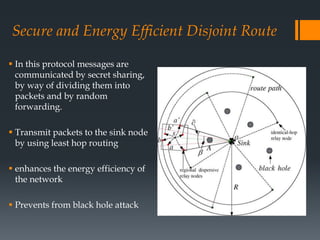
Secure and Energy Efficient Disjoint Route
 In this protocol messages are
communicated by secret sharing,
by way of dividing them into
packets and by random
forwarding.
 Transmit packets to the sink node
by using least hop routing
 enhances the energy efficiency of
the network
 Prevents from black hole attack
Data Centric Braided Multipath
 Concentrate on the non-hierarchical approach
 Works on Reverse-path-based forwarding
 Normally using previous information, but detecting loops and
dismantling them soon after their formation
 Monitoring data delivery and limiting refreshes to the
neighbourhood of paths to sources with poor delivery quality
 Maintaining braided multiple paths from sources to the sink
 Highly energy efficient
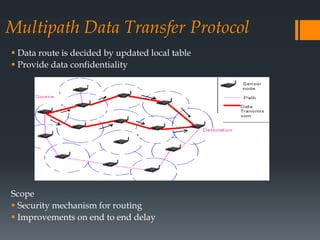
Multipath Data Transfer Protocol
 Data route is decided by updated local table
 Provide data confidentiality
Scope
 Security mechanism for routing
 Improvements on end to end delay
Bio-inspired Self-Organized Secure
Autonomous Routing Protocol
 Based on ant colony optimization
 On demand routing protocol
 can be practically implemented for environmental monitoring or
battlefield surveillance.
 suitable for a large-scale self-organizing system
Scope
Can be designed by involving the mobility factor and
Autonomous security mechanism based on an artificial immune system
(AIS).
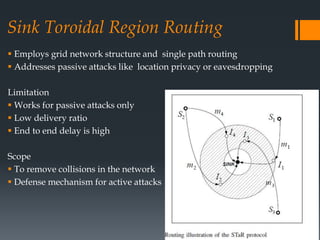
Sink Toroidal Region Routing
 Employs grid network structure and single path routing
 Addresses passive attacks like location privacy or eavesdropping
Limitation
 Works for passive attacks only
 Low delivery ratio
 End to end delay is high
Scope
 To remove collisions in the network
 Defense mechanism for active attacks
Conclusion and Future Scope
Routing is of pivotal importance in getting information from one node to
another. usually from the data collecting nodes or source to the base station
or sink is the primary objective. However, in military and medical
applications just getting the data across the network is not the only desired
focus. In these applications security is of utmost importance due to the
sensitive nature of the data that is transported. Hence, information security
measures must be placed in these types of WSNs.
In near future we are approaching to develop a new routing approach
based on multiple routes and provide security for possible threats using
MATLAB simulator which will have low energy consumption and high
delivery ratio with strong security mechanism.
REFRENCES
 Himali Saxena, Chunyu Ai, Marco Valero, Yingshu Li, and Raheem Beyah “DSF - A Distributed Security
Framework for Heterogeneous Wireless Sensor Networks” Military Communications Conference Cyber
Security and Network Management 2010.
 Shobha Poojary, Manohara “Multipath Data Transfer in Wireless Multimedia Sensor Network” Pai
Information and Communication Technology, Manipal Institute of Technology.2010.
 Anfeng Liu, Zhongming Zheng, Chao Zhang, Zhigang Chen, Member, IEEE, and Xuemin (Sherman)
Shen, “Secure and Energy-Efficient Disjoint Multipath Routing for WSNs”, IEEE ,2012.
 Alexander Aronsky and Adrian Segall “A Multipath Routing Algorithm for Mobile Wireless Sensor
Networks” Department of Electrical Engineering, Technion IIT, Haifa, Israel.
 Huei-Wen Ferng and Dian Rachmarini “A Secure Routing Protocol for Wireless Sensor Networks with
Consideration of Energy Efficiency” IEEE 2012.
 Kashif Saleem Norsheila Fisal, M. Ariff Baharudin “A Real-Time Empirical Study of BIOSARP based
Wireless Sensor Network Test bed” IEEE 2012.
 Leron Lightfoot, Yun Li, Jian Ren “Preserving Source-Location Privacy in Wireless Sensor Network using
STaR Routing” IEEE Globecom 2010.
Thank you

Presentation1

  • 1.
    Presented by Rajat Soni M.tech.WCT Enrl.No.-140291 Secure Routing Protocol in Wireless Sensor Networks Supervisor Prof. P.P. Bhattacharya Co supervisor Mr Deepak Sethi
  • 2.
    Wireless Sensor Network •WSNs consist of hundreds or thousands of low-power, low-cost nodes having a computational unit, power source, radio and sensing elements. • Power is the scarcest resource. Features of WSN  Self organizing  Dynamic network topology  Limited power  Large scale deployment
  • 3.
    Components Of WirelessSensor Network • Sensor Field • Sensor Nodes • Sink • Base Station Design Challenges • Resource Constraints • Ad-hoc Deployment • Fault- Tolerance • Scalability • QoS • Security
  • 4.
  • 5.
    Routing in WirelessSensor Network • Many routing and data dissemination protocols have been specifically designed for WSNs where energy awareness is an essential design issue. • Routing protocols might differ depending on the application and network architecture • The design of routing protocols is influenced by many challenging factors caused by the nature of the WSNs. some of these factors are • Data delivery model • Security • Data aggregation • Fault tolerance
  • 6.
    Classification of RoutingProtocols in Wireless Sensor Networks
  • 7.
    Security Obstacles  Limited resources Unreliable communication  Unattended operation Security Requirement Primary goals Data Confidentiality Data Integrity Data Freshness Authentication Availability Secondary goals Self-Organization Time Synchronization Secure Localization
  • 8.
  • 9.
    Attacks By Spoofing, Altering,or Replaying routing information Attacker can create loops, attract or repel network traffic, generate false message, partition network, induce delay, etc.  Selective forwarding Malicious node forwards only some messages, drop others. Attacker tries to be on the actual path of data flow  Sinkhole Attacks  • Main Reason : Specialized communication patterns supported by WSN ; All packets have same destination i.e. base station • Adversary tries to attract traffic from a particular area to pass through a compromised node, thereby creating sinkhole with adversary at the center • A node may be made to look attractive to neighbors in some routing algorithm • Laptop class adversary provide a high quality route to base station by transmitting at high power OR creating a wormhole • Can enable other attacks e.g. selective forwarding
  • 10.
    Sybil Attack • Singlenode presents multiple identities to other nodes • Significantly affect fault-tolerance schemes like distributed storage, multi-path routing, topology maintenance • Threat to geographical routing protocols Wormholes • tunnelling of messages over alternative low-latency links, e.g. confuse the routing protocol, create sinkholes. etc. • Exploit routing race condition HELLO flood attack • Some protocols require that nodes broadcast ‘hello’ packets to advertise themselves Acknowledgement spoofing • Adversary can spoof ACKs for control packets and try to convince the sender that a weak link is strong or a dead link is alive; causing packet losses
  • 11.
    Various Secure RoutingProtocols Distributed Security Framework (DSF) Multipath Data Transfer protocol (MDTP) Secure and Energy Efficient Disjoint Route (SEDR) Data Centric Braided Multipath (DCBM) Energy Efficient Secure Routing Protocol (EESRP) Bio-inspired Self-Organized Secure Autonomous Routing Protocol (BIOSARP) Sink Toroidal Region Routing (STAR)
  • 12.
    Distributed Security Framework Uses Hierarchical routing protocols  Prevents network from Sybil, selective forwarding& worm hole attacks  Works for both mobile and static attackers Limitations  Consume high energy  End to end delay is very high Scope  Improvement in success rate  No defence mechanism for attack on gateway node
  • 13.
    Energy Efficient SecureRouting Protocol  This protocol makes uses the sink-oriented grid structure for providing better delivery ratio.  It employs the farthest-highest energy dissemination node search to find an efficient path from the source to the sink.  use three different key for security.  prevents from Sybil, black hole& worm hole attacks,  Latency is high.  Packet drop ratio is high.
  • 14.
    Secure and EnergyEfficient Disjoint Route  In this protocol messages are communicated by secret sharing, by way of dividing them into packets and by random forwarding.  Transmit packets to the sink node by using least hop routing  enhances the energy efficiency of the network  Prevents from black hole attack
  • 15.
    Data Centric BraidedMultipath  Concentrate on the non-hierarchical approach  Works on Reverse-path-based forwarding  Normally using previous information, but detecting loops and dismantling them soon after their formation  Monitoring data delivery and limiting refreshes to the neighbourhood of paths to sources with poor delivery quality  Maintaining braided multiple paths from sources to the sink  Highly energy efficient
  • 16.
    Multipath Data TransferProtocol  Data route is decided by updated local table  Provide data confidentiality Scope  Security mechanism for routing  Improvements on end to end delay
  • 17.
    Bio-inspired Self-Organized Secure AutonomousRouting Protocol  Based on ant colony optimization  On demand routing protocol  can be practically implemented for environmental monitoring or battlefield surveillance.  suitable for a large-scale self-organizing system Scope Can be designed by involving the mobility factor and Autonomous security mechanism based on an artificial immune system (AIS).
  • 18.
    Sink Toroidal RegionRouting  Employs grid network structure and single path routing  Addresses passive attacks like location privacy or eavesdropping Limitation  Works for passive attacks only  Low delivery ratio  End to end delay is high Scope  To remove collisions in the network  Defense mechanism for active attacks
  • 19.
    Conclusion and FutureScope Routing is of pivotal importance in getting information from one node to another. usually from the data collecting nodes or source to the base station or sink is the primary objective. However, in military and medical applications just getting the data across the network is not the only desired focus. In these applications security is of utmost importance due to the sensitive nature of the data that is transported. Hence, information security measures must be placed in these types of WSNs. In near future we are approaching to develop a new routing approach based on multiple routes and provide security for possible threats using MATLAB simulator which will have low energy consumption and high delivery ratio with strong security mechanism.
  • 20.
    REFRENCES  Himali Saxena,Chunyu Ai, Marco Valero, Yingshu Li, and Raheem Beyah “DSF - A Distributed Security Framework for Heterogeneous Wireless Sensor Networks” Military Communications Conference Cyber Security and Network Management 2010.  Shobha Poojary, Manohara “Multipath Data Transfer in Wireless Multimedia Sensor Network” Pai Information and Communication Technology, Manipal Institute of Technology.2010.  Anfeng Liu, Zhongming Zheng, Chao Zhang, Zhigang Chen, Member, IEEE, and Xuemin (Sherman) Shen, “Secure and Energy-Efficient Disjoint Multipath Routing for WSNs”, IEEE ,2012.  Alexander Aronsky and Adrian Segall “A Multipath Routing Algorithm for Mobile Wireless Sensor Networks” Department of Electrical Engineering, Technion IIT, Haifa, Israel.  Huei-Wen Ferng and Dian Rachmarini “A Secure Routing Protocol for Wireless Sensor Networks with Consideration of Energy Efficiency” IEEE 2012.  Kashif Saleem Norsheila Fisal, M. Ariff Baharudin “A Real-Time Empirical Study of BIOSARP based Wireless Sensor Network Test bed” IEEE 2012.  Leron Lightfoot, Yun Li, Jian Ren “Preserving Source-Location Privacy in Wireless Sensor Network using STaR Routing” IEEE Globecom 2010.
  • 21.