ARTIFICIAL
INTELLIGENCE
AND IoT
From concept to applications
Dr. Muhammad Al-Qurishi
Data Scientist, Research Chair of Pervasive
and Mobile Computing (CPMC)
What is
AI?
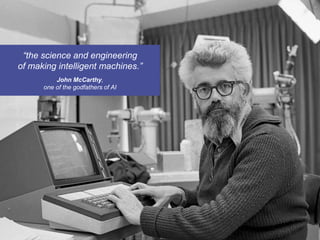
“the science and engineering
of making intelligent machines.”
John McCarthy,
one of the godfathers of AI
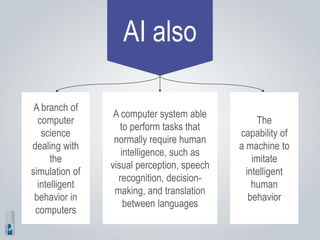
AI also
A branch of
computer
science
dealing with
the
simulation of
intelligent
behavior in
computers
The
capability of
a machine to
imitate
intelligent
human
behavior
A computer system able
to perform tasks that
normally require human
intelligence, such as
visual perception, speech
recognition, decision-
making, and translation
between languages
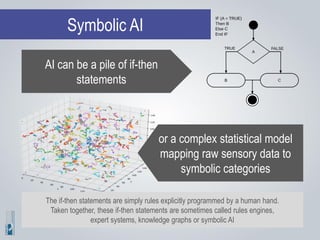
AI can be a pile of if-then
statements
or a complex statistical model
mapping raw sensory data to
symbolic categories
The if-then statements are simply rules explicitly programmed by a human hand.
Taken together, these if-then statements are sometimes called rules engines,
expert systems, knowledge graphs or symbolic AI
Symbolic AI
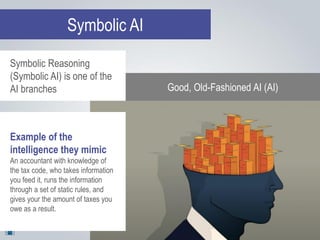
Symbolic AI
Good, Old-Fashioned AI (AI)
Symbolic Reasoning
(Symbolic AI) is one of the
AI branches
Example of the
intelligence they mimic
An accountant with knowledge of
the tax code, who takes information
you feed it, runs the information
through a set of static rules, and
gives your the amount of taxes you
owe as a result.
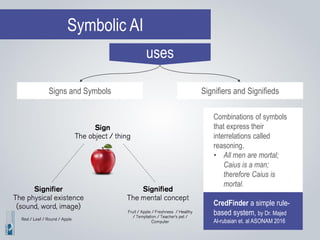
uses
Signs and Symbols Signifiers and Signifieds
Symbolic AI
Combinations of symbols
that express their
interrelations called
reasoning.
• All men are mortal;
Caius is a man;
therefore Caius is
mortal.
CredFinder a simple rule-
based system, by Dr. Majed
Al-rubaian et. al ASONAM 2016
Is it really
true?
A wag would say that true AI is whatever
computers can’t do yet
“the science and engineering
of making intelligent machines.”
John McCarthy,
one of the godfathers of AI
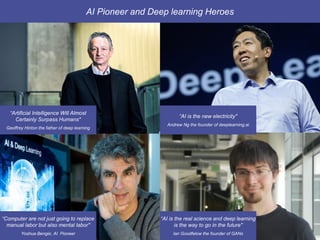
AI Pioneer and Deep learning Heroes
“Artificial Intelligence Will Almost
Certainly Surpass Humans"
Geoffrey Hinton the father of deep learning
“Computer are not just going to replace
manual labor but also mental labor"
Yoshua Bengio, AI Pioneer
“AI is the new electricity"
Andrew Ng the founder of deeplearning.ai
“AI is the real science and deep learning
is the way to go in the future"
Ian Goodfelow the founder of GANs
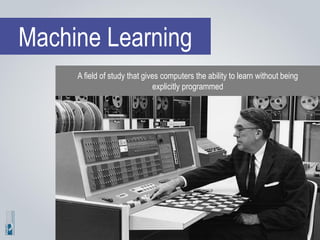
Machine Learning
A field of study that gives computers the ability to learn without being
explicitly programmed
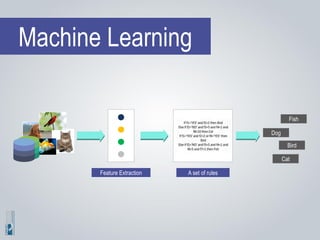
Machine Learning
Feature Extraction A set of rules
Dog
Bird
Cat
Fish
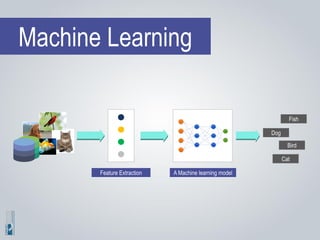
Machine Learning
Feature Extraction A Machine learning model
Dog
Bird
Cat
Fish
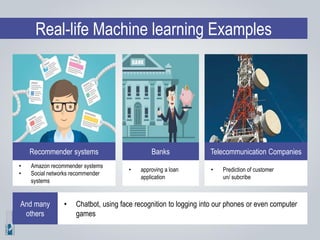
Real-life Machine learning Examples
Recommender systems
• Amazon recommender systems
• Social networks recommender
systems
Banks
• approving a loan
application
Telecommunication Companies
• Prediction of customer
un/ subcribe
• Chatbot, using face recognition to logging into our phones or even computer
games
And many
others
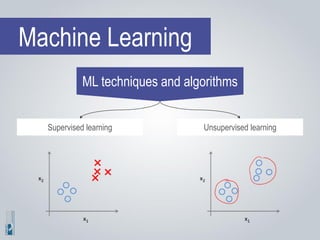
ML techniques and algorithms
Supervised learning Unsupervised learning
Machine Learning
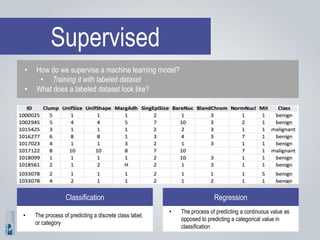
• How do we supervise a machine learning model?
• Training it with labeled dataset
• What does a labeled dataset look like?
Supervised
Classification
• The process of predicting a discrete class label,
or category
Regression
• The process of predicting a continuous value as
opposed to predicting a categorical value in
classification
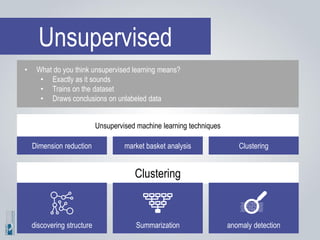
• What do you think unsupervised learning means?
• Exactly as it sounds
• Trains on the dataset
• Draws conclusions on unlabeled data
Unsupervised
Unsupervised machine learning techniques
Dimension reduction market basket analysis Clustering
Clustering
discovering structure Summarization anomaly detection
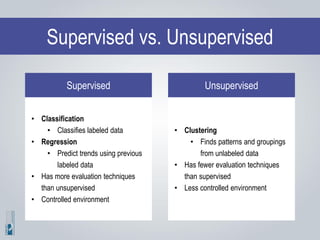
Supervised vs. Unsupervised
• Classification
• Classifies labeled data
• Regression
• Predict trends using previous
labeled data
• Has more evaluation techniques
than unsupervised
• Controlled environment
Supervised
• Clustering
• Finds patterns and groupings
from unlabeled data
• Has fewer evaluation techniques
than supervised
• Less controlled environment
Unsupervised
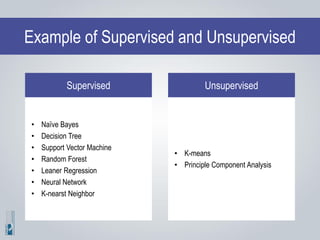
Example of Supervised and Unsupervised
• Naïve Bayes
• Decision Tree
• Support Vector Machine
• Random Forest
• Leaner Regression
• Neural Network
• K-nearst Neighbor
Supervised
• K-means
• Principle Component Analysis
Unsupervised
Building a basic ML
Model using python
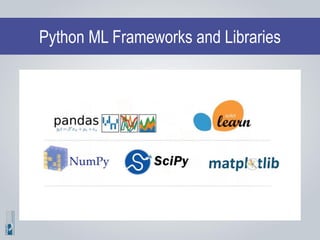
Python ML Frameworks and Libraries
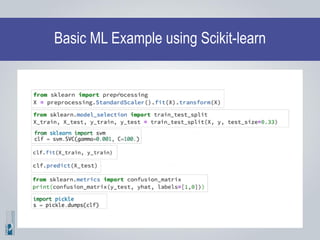
Basic ML Example using Scikit-learn
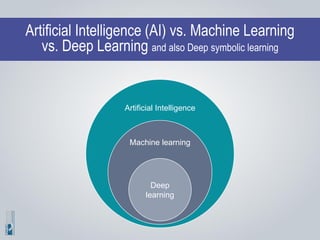
Artificial Intelligence (AI) vs. Machine Learning
vs. Deep Learning and also Deep symbolic learning
Artificial Intelligence
Machine learning
Deep
learning
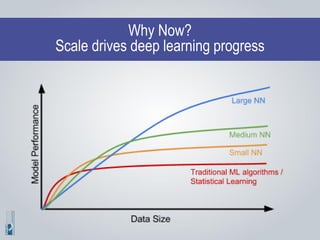
Why Now?
Scale drives deep learning progress
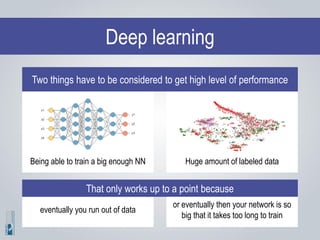
Deep learning
Being able to train a big enough NN
Two things have to be considered to get high level of performance
Huge amount of labeled data
eventually you run out of data
That only works up to a point because
or eventually then your network is so
big that it takes too long to train
Deep learning
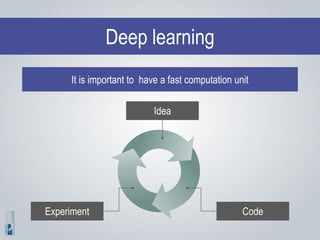
It is important to have a fast computation unit
Idea
CodeExperiment
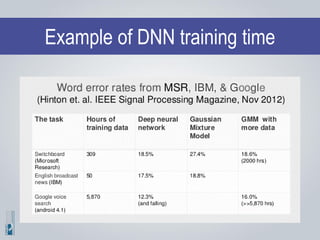
Example of DNN training time
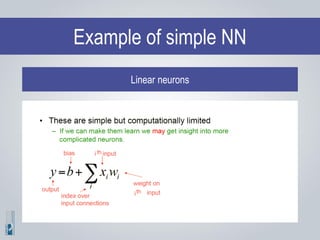
Example of simple NN
Linear neurons
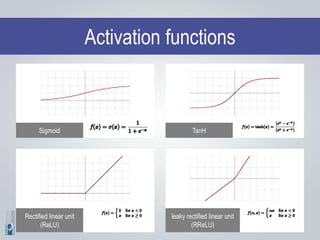
Activation functions
Sigmoid TanH
Rectified linear unit
(ReLU)
leaky rectified linear unit
(RReLU)
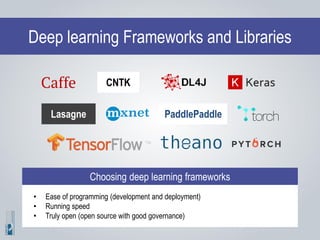
Deep learning Frameworks and Libraries
CNTK
Lasagne PaddlePaddle
• Ease of programming (development and deployment)
• Running speed
• Truly open (open source with good governance)
Choosing deep learning frameworks
Building a basic DL Model using python
import numpy as np
import tensorflow as tf
coefficients = np.array([[1], [-20], [25]])
w = tf.Variable([0],dtype=tf.float32)
x = tf.placeholder(tf.float32, [3,1])
cost = x[0][0]*w**2 + x[1][0]*w + x[2][0] # (w-5)**2
train = tf.train.GradientDescentOptimizer(0.01).minimize(cost)
init = tf.global_variables_initializer()
with tf.Session() as session:
session.run(init)
print(session.run(w))
for i in range(1000):
session.run(train, feed_dict={x:coefficients})
print(session.run(w))
Deep learning resources
• Book : Deep learning by Ian
Goodfelow et. al
• Deeplearning.ai
• FastAI
• OpenAI
• DeepMind
• FacebookAI
• Google Brain
Symbolic AI vs. Deep learning
• The main drawback is the difficulty of revising beliefs once they were
encoded in a rules engine
• Expert systems are monotonic;
• The more rules you add, the more knowledge is encoded in the system, but
additional rules can’t undo old knowledge
• Open research line:
• Can we fuse the ability of deep neural nets to learn probabilistic correlations from
scratch alongside abstract and higher-order concepts, which are useful in compressing
data and combining it in new ways?
• Deep symbolic learning
• Enabling deep neural networks to manipulate, generate and otherwise
cohabitate with concepts expressed in strings of characters, could help solve
explainability, because, after all, humans communicate with signs and symbols,
and that is what we desire from machines
Symbolic AI vs. Deep learning
• Deep learning biggest weaknesses are
• Model Explanation
• Data hungry
• Geoff Hinton himself has expressed skepticism about whether
backpropagation, the workhorse of deep neural nets, will be the
way forward for AI.
• Open research:
• Hyper-parameters
• Work on unsupervised learning (learning from unlabeled data) will
lead to our next breakthroughs.
• GANs and CycleGANs
Internet of Things
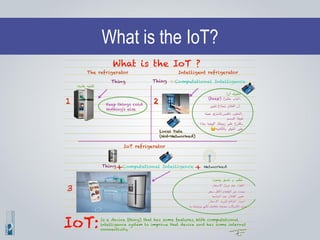
What is the IoT?
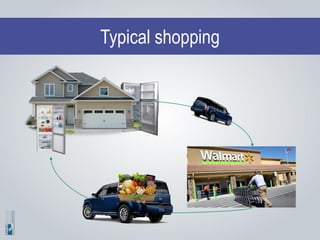
Typical shopping
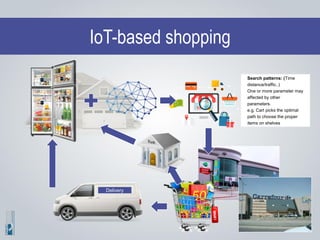
IoT-based shopping
Search patterns: (Time
distance/traffic..)
One or more parameter may
affected by other
parameters.
e.g. Cart picks the optimal
path to choose the proper
items on shelves
Delivery
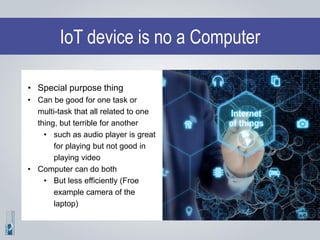
IoT device is no a Computer
• Special purpose thing
• Can be good for one task or
multi-task that all related to one
thing, but terrible for another
• such as audio player is great
for playing but not good in
playing video
• Computer can do both
• But less efficiently (Froe
example camera of the
laptop)
What Support IoT
• Cost of Hardware and software are cheaper than before
• You can get a laptop 1500SAR
• IoT will be cheaper, the computational ability of it is a lot less than
laptops
• You can add IoT to old machines with low cost (example, car)
• Hardware size
• IoT is small and light
• Computational technology has also adaptable to that
• Speed of the computational technology
• Speech-to-Text, audio processing and network communication
What Support IoT
• Internet Access
• Internet access has improved
• Internet is reachable from a lot of places
• Wi-Fi
• Cheaper than wired
• Makes IoT technology much more usable and much more possible
• Data usage it not that expensive
• High bandwidth
• Transmit lots of data fast (YouTube videos)
Pervasive and Cloud computing
• Pervasive nature of IoT
• IoT is not only everywhere, but also networked
• Can be an interface to the cloud (example refrigerator search)
• A window to massive database and some massive computational
resource
• The actual computation is the one send to the cloud
• The cloud process it and give the result back
• You can think of many examples
• IoT can work as an access points for something much bigger
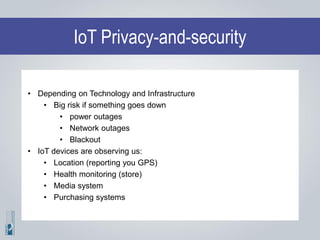
IoT Privacy-and-security
• Depending on Technology and Infrastructure
• Big risk if something goes down
• power outages
• Network outages
• Blackout
• IoT devices are observing us:
• Location (reporting you GPS)
• Health monitoring (store)
• Media system
• Purchasing systems
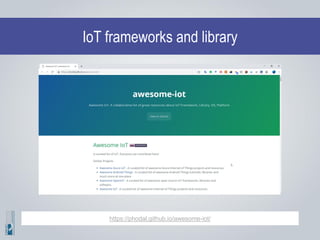
IoT frameworks and library
https://phodal.github.io/awesome-iot/
Thank You

Presentation v3

  • 1.
    ARTIFICIAL INTELLIGENCE AND IoT From conceptto applications Dr. Muhammad Al-Qurishi Data Scientist, Research Chair of Pervasive and Mobile Computing (CPMC)
  • 2.
  • 3.
    “the science andengineering of making intelligent machines.” John McCarthy, one of the godfathers of AI
  • 4.
    AI also A branchof computer science dealing with the simulation of intelligent behavior in computers The capability of a machine to imitate intelligent human behavior A computer system able to perform tasks that normally require human intelligence, such as visual perception, speech recognition, decision- making, and translation between languages
  • 5.
    AI can bea pile of if-then statements or a complex statistical model mapping raw sensory data to symbolic categories The if-then statements are simply rules explicitly programmed by a human hand. Taken together, these if-then statements are sometimes called rules engines, expert systems, knowledge graphs or symbolic AI Symbolic AI
  • 6.
    Symbolic AI Good, Old-FashionedAI (AI) Symbolic Reasoning (Symbolic AI) is one of the AI branches Example of the intelligence they mimic An accountant with knowledge of the tax code, who takes information you feed it, runs the information through a set of static rules, and gives your the amount of taxes you owe as a result.
  • 7.
    uses Signs and SymbolsSignifiers and Signifieds Symbolic AI Combinations of symbols that express their interrelations called reasoning. • All men are mortal; Caius is a man; therefore Caius is mortal. CredFinder a simple rule- based system, by Dr. Majed Al-rubaian et. al ASONAM 2016
  • 8.
    Is it really true? Awag would say that true AI is whatever computers can’t do yet
  • 9.
    “the science andengineering of making intelligent machines.” John McCarthy, one of the godfathers of AI AI Pioneer and Deep learning Heroes “Artificial Intelligence Will Almost Certainly Surpass Humans" Geoffrey Hinton the father of deep learning “Computer are not just going to replace manual labor but also mental labor" Yoshua Bengio, AI Pioneer “AI is the new electricity" Andrew Ng the founder of deeplearning.ai “AI is the real science and deep learning is the way to go in the future" Ian Goodfelow the founder of GANs
  • 10.
    Machine Learning A fieldof study that gives computers the ability to learn without being explicitly programmed
  • 11.
    Machine Learning Feature ExtractionA set of rules Dog Bird Cat Fish
  • 12.
    Machine Learning Feature ExtractionA Machine learning model Dog Bird Cat Fish
  • 13.
    Real-life Machine learningExamples Recommender systems • Amazon recommender systems • Social networks recommender systems Banks • approving a loan application Telecommunication Companies • Prediction of customer un/ subcribe • Chatbot, using face recognition to logging into our phones or even computer games And many others
  • 14.
    ML techniques andalgorithms Supervised learning Unsupervised learning Machine Learning
  • 15.
    • How dowe supervise a machine learning model? • Training it with labeled dataset • What does a labeled dataset look like? Supervised Classification • The process of predicting a discrete class label, or category Regression • The process of predicting a continuous value as opposed to predicting a categorical value in classification
  • 16.
    • What doyou think unsupervised learning means? • Exactly as it sounds • Trains on the dataset • Draws conclusions on unlabeled data Unsupervised Unsupervised machine learning techniques Dimension reduction market basket analysis Clustering Clustering discovering structure Summarization anomaly detection
  • 17.
    Supervised vs. Unsupervised •Classification • Classifies labeled data • Regression • Predict trends using previous labeled data • Has more evaluation techniques than unsupervised • Controlled environment Supervised • Clustering • Finds patterns and groupings from unlabeled data • Has fewer evaluation techniques than supervised • Less controlled environment Unsupervised
  • 18.
    Example of Supervisedand Unsupervised • Naïve Bayes • Decision Tree • Support Vector Machine • Random Forest • Leaner Regression • Neural Network • K-nearst Neighbor Supervised • K-means • Principle Component Analysis Unsupervised
  • 19.
    Building a basicML Model using python
  • 20.
    Python ML Frameworksand Libraries
  • 21.
    Basic ML Exampleusing Scikit-learn
  • 22.
    Artificial Intelligence (AI)vs. Machine Learning vs. Deep Learning and also Deep symbolic learning Artificial Intelligence Machine learning Deep learning
  • 23.
    Why Now? Scale drivesdeep learning progress
  • 24.
    Deep learning Being ableto train a big enough NN Two things have to be considered to get high level of performance Huge amount of labeled data eventually you run out of data That only works up to a point because or eventually then your network is so big that it takes too long to train
  • 25.
    Deep learning It isimportant to have a fast computation unit Idea CodeExperiment
  • 26.
    Example of DNNtraining time
  • 27.
    Example of simpleNN Linear neurons
  • 28.
    Activation functions Sigmoid TanH Rectifiedlinear unit (ReLU) leaky rectified linear unit (RReLU)
  • 29.
    Deep learning Frameworksand Libraries CNTK Lasagne PaddlePaddle • Ease of programming (development and deployment) • Running speed • Truly open (open source with good governance) Choosing deep learning frameworks
  • 30.
    Building a basicDL Model using python import numpy as np import tensorflow as tf coefficients = np.array([[1], [-20], [25]]) w = tf.Variable([0],dtype=tf.float32) x = tf.placeholder(tf.float32, [3,1]) cost = x[0][0]*w**2 + x[1][0]*w + x[2][0] # (w-5)**2 train = tf.train.GradientDescentOptimizer(0.01).minimize(cost) init = tf.global_variables_initializer() with tf.Session() as session: session.run(init) print(session.run(w)) for i in range(1000): session.run(train, feed_dict={x:coefficients}) print(session.run(w))
  • 31.
    Deep learning resources •Book : Deep learning by Ian Goodfelow et. al • Deeplearning.ai • FastAI • OpenAI • DeepMind • FacebookAI • Google Brain
  • 32.
    Symbolic AI vs.Deep learning • The main drawback is the difficulty of revising beliefs once they were encoded in a rules engine • Expert systems are monotonic; • The more rules you add, the more knowledge is encoded in the system, but additional rules can’t undo old knowledge • Open research line: • Can we fuse the ability of deep neural nets to learn probabilistic correlations from scratch alongside abstract and higher-order concepts, which are useful in compressing data and combining it in new ways? • Deep symbolic learning • Enabling deep neural networks to manipulate, generate and otherwise cohabitate with concepts expressed in strings of characters, could help solve explainability, because, after all, humans communicate with signs and symbols, and that is what we desire from machines
  • 33.
    Symbolic AI vs.Deep learning • Deep learning biggest weaknesses are • Model Explanation • Data hungry • Geoff Hinton himself has expressed skepticism about whether backpropagation, the workhorse of deep neural nets, will be the way forward for AI. • Open research: • Hyper-parameters • Work on unsupervised learning (learning from unlabeled data) will lead to our next breakthroughs. • GANs and CycleGANs
  • 34.
  • 35.
  • 36.
  • 37.
    IoT-based shopping Search patterns:(Time distance/traffic..) One or more parameter may affected by other parameters. e.g. Cart picks the optimal path to choose the proper items on shelves Delivery
  • 38.
    IoT device isno a Computer • Special purpose thing • Can be good for one task or multi-task that all related to one thing, but terrible for another • such as audio player is great for playing but not good in playing video • Computer can do both • But less efficiently (Froe example camera of the laptop)
  • 39.
    What Support IoT •Cost of Hardware and software are cheaper than before • You can get a laptop 1500SAR • IoT will be cheaper, the computational ability of it is a lot less than laptops • You can add IoT to old machines with low cost (example, car) • Hardware size • IoT is small and light • Computational technology has also adaptable to that • Speed of the computational technology • Speech-to-Text, audio processing and network communication
  • 40.
    What Support IoT •Internet Access • Internet access has improved • Internet is reachable from a lot of places • Wi-Fi • Cheaper than wired • Makes IoT technology much more usable and much more possible • Data usage it not that expensive • High bandwidth • Transmit lots of data fast (YouTube videos)
  • 41.
    Pervasive and Cloudcomputing • Pervasive nature of IoT • IoT is not only everywhere, but also networked • Can be an interface to the cloud (example refrigerator search) • A window to massive database and some massive computational resource • The actual computation is the one send to the cloud • The cloud process it and give the result back • You can think of many examples • IoT can work as an access points for something much bigger
  • 42.
    IoT Privacy-and-security • Dependingon Technology and Infrastructure • Big risk if something goes down • power outages • Network outages • Blackout • IoT devices are observing us: • Location (reporting you GPS) • Health monitoring (store) • Media system • Purchasing systems
  • 43.
    IoT frameworks andlibrary https://phodal.github.io/awesome-iot/
  • 44.