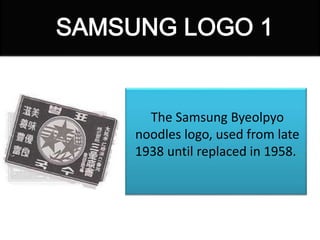
The Samsung Byeolpyo
noodles logo, used from late
1938 until replaced in 1958.
The Samsung Group logo, used from
late 1969 until replaced in 1979
The Samsung Group logo
(“three stars”), used from
late 1980 until replaced in
1992
The Samsung Electronics logo, used
from late 1980 until replaced in 1992
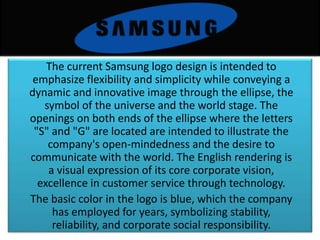
Samsung's current logo, in use since 1993.
According to the founder of Samsung Group,
the meaning of the Korean hanja word
Samsung (三星) is "tristar" or "three stars". The
word "three" represents something "big,
numerous and powerful"; the "stars" mean
eternity.
The current Samsung logo design is intended to
emphasize flexibility and simplicity while conveying a
dynamic and innovative image through the ellipse, the
symbol of the universe and the world stage. The
openings on both ends of the ellipse where the letters
"S" and "G" are located are intended to illustrate the
company's open-mindedness and the desire to
communicate with the world. The English rendering is
a visual expression of its core corporate vision,
excellence in customer service through technology.
The basic color in the logo is blue, which the company
has employed for years, symbolizing stability,
reliability, and corporate social responsibility.
Samsung was founded by Lee Byung Chul
in 1938 as a trading company.
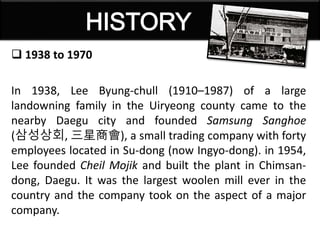
 1938 to 1970
In 1938, Lee Byung-chull (1910–1987) of a large
landowning family in the Uiryeong county came to the
nearby Daegu city and founded Samsung Sanghoe
(삼성상회, 三星商會), a small trading company with forty
employees located in Su-dong (now Ingyo-dong). in 1954,
Lee founded Cheil Mojik and built the plant in Chimsan-
dong, Daegu. It was the largest woolen mill ever in the
country and the company took on the aspect of a major
company.
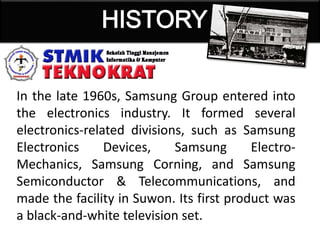
In the late 1960s, Samsung Group entered into
the electronics industry. It formed several
electronics-related divisions, such as Samsung
Electronics Devices, Samsung Electro-
Mechanics, Samsung Corning, and Samsung
Semiconductor & Telecommunications, and
made the facility in Suwon. Its first product was
a black-and-white television set.
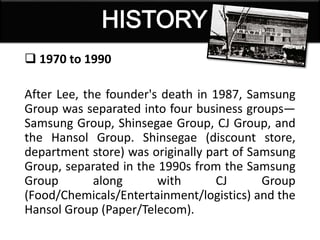
 1970 to 1990
After Lee, the founder's death in 1987, Samsung
Group was separated into four business groups—
Samsung Group, Shinsegae Group, CJ Group, and
the Hansol Group. Shinsegae (discount store,
department store) was originally part of Samsung
Group, separated in the 1990s from the Samsung
Group along with CJ Group
(Food/Chemicals/Entertainment/logistics) and the
Hansol Group (Paper/Telecom).
 1970 to 1990
In the 1980s, Samsung Electronics began to invest heavily
in research and development, investments that were
pivotal in pushing the company to the forefront of the
global electronics industry. In 1982, it built a television
assembly plant in Portugal; in 1984, a plant in New York;
in 1985, a plant in Tokyo; in 1987, a facility in England and
another facility in Austin, Texas, in 1996. As of 2012,
Samsung has invested more than US$13 billion in the
Austin facility, which operates under the name Samsung
Austin Semiconductor. This makes the Austin location the
largest foreign investment in Texas and one of the largest
single foreign investments in the United States.
 1990 to 2000
Samsung started to rise as an international corporation in
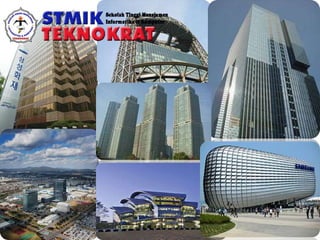
the 1990s. Samsung's construction branch was awarded a
contract to build one of the two Petronas Towers in
Malaysia, Taipei 101 in Taiwan and the Burj Khalifa in
United Arab Emirates. In 1993, Lee Kun-hee sold off ten of
Samsung Group's subsidiaries, downsized the company,
and merged other operations to concentrate on three
industries: electronics, engineering, and chemicals. In
1996, the Samsung Group reacquired the Sungkyunkwan
University foundation.
 2000 to 2013
In 2000, Samsung opened a computer
programming laboratory in Warsaw, Poland. Its
work began with set-top-box technology before
moving into digital TV and smartphones. As of
2011, the Warsaw base is Samsung's most
important R&D center in Europe, forecast to be
recruiting 400 new-hires per year by the end of
2013.
 2000 to 2013
In 2010, Samsung announced a ten-year growth
strategy centered around five businesses. One of
these businesses was to be focused on
biopharmaceuticals, to which the company has
committed ₩2.1 trillion.
In December 2011, Samsung Electronics sold its
hard disk drive (HDD) business to Seagate.
 2000 to 2013
In the first quarter of 2012, Samsung Electronics
became the world's largest mobile phone maker
by unit sales, overtaking Nokia, which had been
the market leader since 1998.`In the August 21
edition of the Austin American-Statesman,
Samsung confirmed plans to spend 3 to 4 billion
dollars converting half of its Austin chip
manufacturing plant to a more profitable chip.
 2000 to 2013
On 24 August 2012, nine American jurors ruled
that Samsung had to pay Apple $1.05 billion in
damages for violating six of its patents on
smartphone technology. The award was still less
than the $2.5 billion requested by Apple.
As stated in its new motto, Samsung Electronics' vision for
the new decade is, "Inspire the World, Create the Future.“
This new vision reflects Samsung Electronics’ commitment
to inspiring its communities by leveraging Samsung's
three key strengths: “New Technology,” “Innovative
Products,” and “Creative Solutions.” -- and to promoting
new value for Samsung's core networks -- Industry,
Partners, and Employees. Through these efforts, Samsung
hopes to contribute to a better world and a richer
experience for all.
 Apparel
 Chemicals
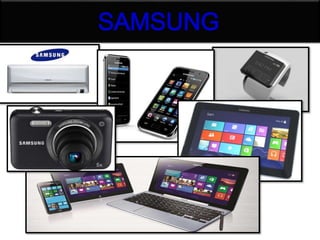
 Consumer electronics
 Electronic components
 Medical equipment
 Precision instruments
 Semiconductors
 Ships
Telecommunications equipment
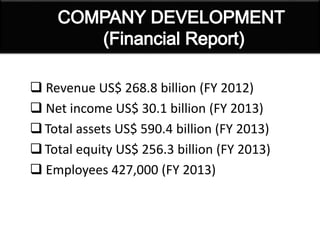
 Revenue US$ 268.8 billion (FY 2012)
 Net income US$ 30.1 billion (FY 2013)
 Total assets US$ 590.4 billion (FY 2013)
 Total equity US$ 256.3 billion (FY 2013)
 Employees 427,000 (FY 2013)
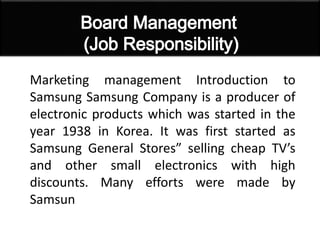
Marketing management Introduction to
Samsung Samsung Company is a producer of
electronic products which was started in the
year 1938 in Korea. It was first started as
Samsung General Stores” selling cheap TV’s
and other small electronics with high
discounts. Many efforts were made by
Samsun
samsung targets all adults ages 20 to 50
younger people are to young to buy a TV
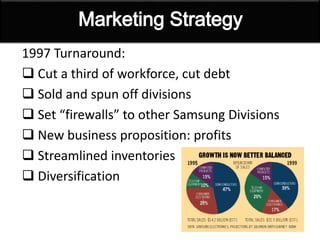
1997 Turnaround:
 Cut a third of workforce, cut debt
 Sold and spun off divisions
 Set “firewalls” to other Samsung Divisions
 New business proposition: profits
 Streamlined inventories
 Diversification
New Economy:
Exodus of engineers and managers to startups
Top 4 conglomerates: $1.2B in startups
(Samsung: $520M)
Stakes of up to 29.9% in 80+ startups
Startups benefit from links to global networks
and financial expertise
“You simply can’t survive without adapting to the
fast-changing Internet era, and one solution is
linking up with startups”
Digital Vision: “A Company that leads the digital
convergence revolution”
Brand power, logistics, IP:
High-margin products
Create value chain that integrates competencies of
all areas
Customer and market oriented
Global network by function
Performance evaluation and compensation
system
Digital Vision:
Innovation, meeting challenges and creativity
Target debt-to-equity ratio: 50%
R&D: 7% of total revenues
Overseas partners:
Joint R&D projects
Technology transfer arrangements
Joint investments
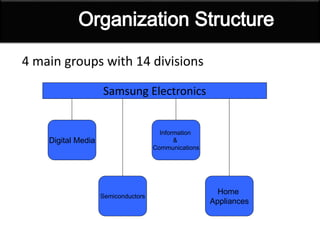
4 main groups with 14 divisions
Digital Media
Semiconductors
Information
&
Communications
Home
Appliances
Samsung Electronics
Presentation samsung

Presentation samsung

  • 5.
    The Samsung Byeolpyo noodleslogo, used from late 1938 until replaced in 1958.
  • 6.
    The Samsung Grouplogo, used from late 1969 until replaced in 1979
  • 7.
    The Samsung Grouplogo (“three stars”), used from late 1980 until replaced in 1992
  • 8.
    The Samsung Electronicslogo, used from late 1980 until replaced in 1992
  • 9.
    Samsung's current logo,in use since 1993. According to the founder of Samsung Group, the meaning of the Korean hanja word Samsung (三星) is "tristar" or "three stars". The word "three" represents something "big, numerous and powerful"; the "stars" mean eternity.
  • 10.
    The current Samsunglogo design is intended to emphasize flexibility and simplicity while conveying a dynamic and innovative image through the ellipse, the symbol of the universe and the world stage. The openings on both ends of the ellipse where the letters "S" and "G" are located are intended to illustrate the company's open-mindedness and the desire to communicate with the world. The English rendering is a visual expression of its core corporate vision, excellence in customer service through technology. The basic color in the logo is blue, which the company has employed for years, symbolizing stability, reliability, and corporate social responsibility.
  • 11.
    Samsung was foundedby Lee Byung Chul in 1938 as a trading company.
  • 12.
     1938 to1970 In 1938, Lee Byung-chull (1910–1987) of a large landowning family in the Uiryeong county came to the nearby Daegu city and founded Samsung Sanghoe (삼성상회, 三星商會), a small trading company with forty employees located in Su-dong (now Ingyo-dong). in 1954, Lee founded Cheil Mojik and built the plant in Chimsan- dong, Daegu. It was the largest woolen mill ever in the country and the company took on the aspect of a major company.
  • 13.
    In the late1960s, Samsung Group entered into the electronics industry. It formed several electronics-related divisions, such as Samsung Electronics Devices, Samsung Electro- Mechanics, Samsung Corning, and Samsung Semiconductor & Telecommunications, and made the facility in Suwon. Its first product was a black-and-white television set.
  • 14.
     1970 to1990 After Lee, the founder's death in 1987, Samsung Group was separated into four business groups— Samsung Group, Shinsegae Group, CJ Group, and the Hansol Group. Shinsegae (discount store, department store) was originally part of Samsung Group, separated in the 1990s from the Samsung Group along with CJ Group (Food/Chemicals/Entertainment/logistics) and the Hansol Group (Paper/Telecom).
  • 15.
     1970 to1990 In the 1980s, Samsung Electronics began to invest heavily in research and development, investments that were pivotal in pushing the company to the forefront of the global electronics industry. In 1982, it built a television assembly plant in Portugal; in 1984, a plant in New York; in 1985, a plant in Tokyo; in 1987, a facility in England and another facility in Austin, Texas, in 1996. As of 2012, Samsung has invested more than US$13 billion in the Austin facility, which operates under the name Samsung Austin Semiconductor. This makes the Austin location the largest foreign investment in Texas and one of the largest single foreign investments in the United States.
  • 16.
     1990 to2000 Samsung started to rise as an international corporation in the 1990s. Samsung's construction branch was awarded a contract to build one of the two Petronas Towers in Malaysia, Taipei 101 in Taiwan and the Burj Khalifa in United Arab Emirates. In 1993, Lee Kun-hee sold off ten of Samsung Group's subsidiaries, downsized the company, and merged other operations to concentrate on three industries: electronics, engineering, and chemicals. In 1996, the Samsung Group reacquired the Sungkyunkwan University foundation.
  • 17.
     2000 to2013 In 2000, Samsung opened a computer programming laboratory in Warsaw, Poland. Its work began with set-top-box technology before moving into digital TV and smartphones. As of 2011, the Warsaw base is Samsung's most important R&D center in Europe, forecast to be recruiting 400 new-hires per year by the end of 2013.
  • 18.
     2000 to2013 In 2010, Samsung announced a ten-year growth strategy centered around five businesses. One of these businesses was to be focused on biopharmaceuticals, to which the company has committed ₩2.1 trillion. In December 2011, Samsung Electronics sold its hard disk drive (HDD) business to Seagate.
  • 19.
     2000 to2013 In the first quarter of 2012, Samsung Electronics became the world's largest mobile phone maker by unit sales, overtaking Nokia, which had been the market leader since 1998.`In the August 21 edition of the Austin American-Statesman, Samsung confirmed plans to spend 3 to 4 billion dollars converting half of its Austin chip manufacturing plant to a more profitable chip.
  • 20.
     2000 to2013 On 24 August 2012, nine American jurors ruled that Samsung had to pay Apple $1.05 billion in damages for violating six of its patents on smartphone technology. The award was still less than the $2.5 billion requested by Apple.
  • 21.
    As stated inits new motto, Samsung Electronics' vision for the new decade is, "Inspire the World, Create the Future.“ This new vision reflects Samsung Electronics’ commitment to inspiring its communities by leveraging Samsung's three key strengths: “New Technology,” “Innovative Products,” and “Creative Solutions.” -- and to promoting new value for Samsung's core networks -- Industry, Partners, and Employees. Through these efforts, Samsung hopes to contribute to a better world and a richer experience for all.
  • 22.
     Apparel  Chemicals Consumer electronics  Electronic components  Medical equipment  Precision instruments  Semiconductors  Ships Telecommunications equipment
  • 25.
     Revenue US$268.8 billion (FY 2012)  Net income US$ 30.1 billion (FY 2013)  Total assets US$ 590.4 billion (FY 2013)  Total equity US$ 256.3 billion (FY 2013)  Employees 427,000 (FY 2013)
  • 26.
    Marketing management Introductionto Samsung Samsung Company is a producer of electronic products which was started in the year 1938 in Korea. It was first started as Samsung General Stores” selling cheap TV’s and other small electronics with high discounts. Many efforts were made by Samsun
  • 27.
    samsung targets alladults ages 20 to 50 younger people are to young to buy a TV
  • 28.
    1997 Turnaround:  Cuta third of workforce, cut debt  Sold and spun off divisions  Set “firewalls” to other Samsung Divisions  New business proposition: profits  Streamlined inventories  Diversification
  • 29.
    New Economy: Exodus ofengineers and managers to startups Top 4 conglomerates: $1.2B in startups (Samsung: $520M) Stakes of up to 29.9% in 80+ startups Startups benefit from links to global networks and financial expertise “You simply can’t survive without adapting to the fast-changing Internet era, and one solution is linking up with startups”
  • 30.
    Digital Vision: “ACompany that leads the digital convergence revolution” Brand power, logistics, IP: High-margin products Create value chain that integrates competencies of all areas Customer and market oriented Global network by function Performance evaluation and compensation system
  • 31.
    Digital Vision: Innovation, meetingchallenges and creativity Target debt-to-equity ratio: 50% R&D: 7% of total revenues Overseas partners: Joint R&D projects Technology transfer arrangements Joint investments
  • 32.
    4 main groupswith 14 divisions Digital Media Semiconductors Information & Communications Home Appliances Samsung Electronics