Direct and Inverse
        Proportion
    Chapter 2
     (Book 2)


                     1
Direct

Proportion

             2
Direct Proportion

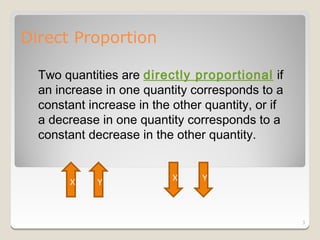
  Two quantities are directly proportional if
  an increase in one quantity corresponds to a
  constant increase in the other quantity, or if
  a decrease in one quantity corresponds to a
  constant decrease in the other quantity.


                           X    Y
       X     Y


                                                   3
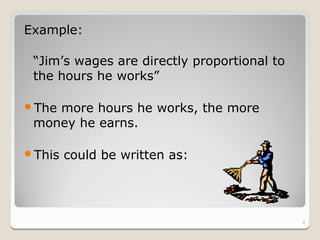
Example:

 “Jim’s wages are directly proportional to
 the hours he works”

Themore hours he works, the more
 money he earns.

This   could be written as:


                                             4
Wages α           Hours
Or...
            Wages = k x Hours

    k is the “constant of proportionality”


                                             5
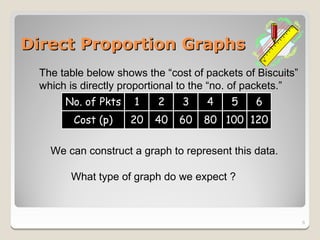
Direct Proportion Graphs
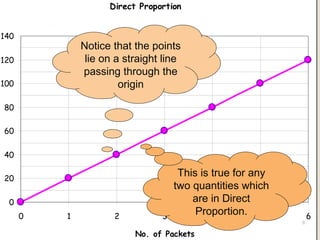
 The table below shows the “cost of packets of Biscuits”
 which is directly proportional to the “no. of packets.”
      No. of Pkts    1    2    3    4    5     6
        Cost (p)    20   40   60   80 100 120

   We can construct a graph to represent this data.

       What type of graph do we expect ?


                                                           6
Points to remember for graph:

     For the data given in the previous slide
     C
        ∝   N

 1. For the above relation N is the independent variable and C is the
    dependent variable.

 2. On the graph we always take the independent variable on the X axis
    and the dependant variable on the Y axis.


                                                                         7
Direct Proportion


140
              Notice that the points
120            lie on a straight line Graphs
                   Direct Proportion
              passing through the
100                    origin

80

60

40

20
                                     This is true for any
                                    two quantities which
 0                                      are in Direct
      0   1          2          3
                                         Proportion. 5
                                             4                  6
                                                            8

                          No. of Packets
Direct Proportion Graph
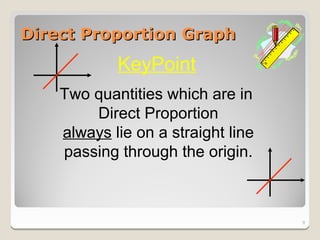
            KeyPoint
    Two quantities which are in
        Direct Proportion
    always lie on a straight line
    passing through the origin.


                                    9
Direct Proportion Graphs
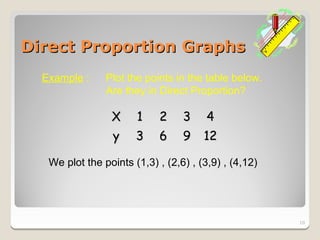
  Example :     Plot the points in the table below.
                Are they in Direct Proportion?

                 X     1     2    3     4
                 y     3     6    9    12

   We plot the points (1,3) , (2,6) , (3,9) , (4,12)


                                                       10
Direct Proportion Graphs

                                  y 12
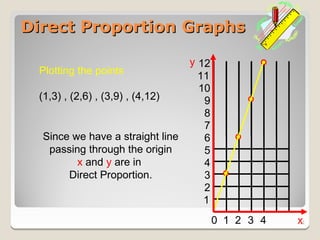
 Plotting the points                11
                                    10
 (1,3) , (2,6) , (3,9) , (4,12)      9
                                     8
                                     7
  Since we have a straight line      6
   passing through the origin        5
         x and y are in              4
       Direct Proportion.            3
                                     2
                                     1
                                         0 1 2 3 4   x
                                                     11
Inverse Proportion


                 12
Inverse Proportion

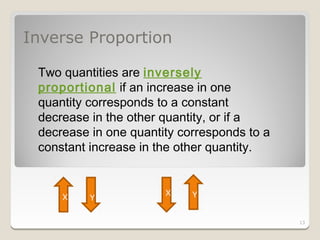
 Two quantities are inversely
 proportional if an increase in one
 quantity corresponds to a constant
 decrease in the other quantity, or if a
 decrease in one quantity corresponds to a
 constant increase in the other quantity.


                       X    Y
     X    Y

                                             13
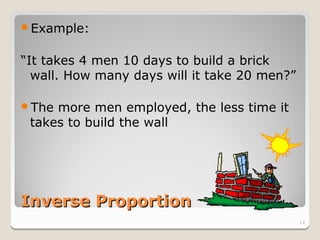
Example:


“It takes 4 men 10 days to build a brick
  wall. How many days will it take 20 men?”

The more men employed, the less time it
 takes to build the wall


Inverse Proportion
                                              14
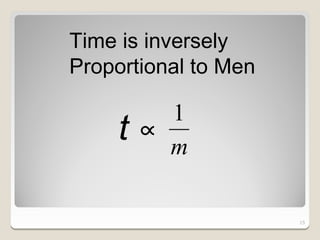
Time is inversely
Proportional to Men

          1
     t∝   m

                      15
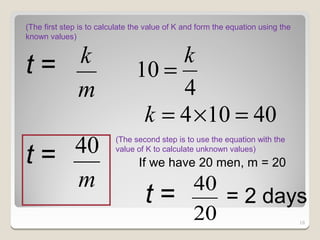
(The first step is to calculate the value of K and form the equation using the
known values)


t= k                                 k
                                10 =
   m                                 4
                                 k = 4 ×10 = 40
t= 40                     (The second step is to use the equation with the
                          value of K to calculate unknown values)
                                 If we have 20 men, m = 20
   m                                             40
                                   t=               = 2 days
                                                 20                              16
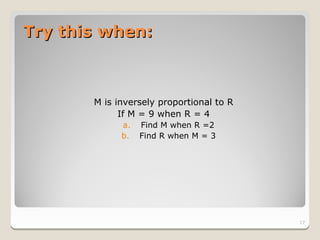
Try this when:


       M is inversely proportional to R
             If M = 9 when R = 4
             a.   Find M when R =2
             b.   Find R when M = 3


                                          17
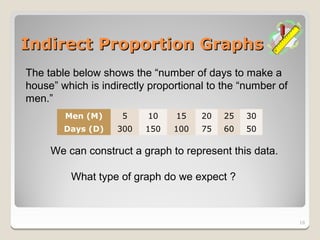
Indirect Proportion Graphs
The table below shows the “number of days to make a
house” which is indirectly proportional to the “number of
men.”
        Men (M)      5    10    15    20   25   30
        Days (D)   300    150   100   75   60   50

     We can construct a graph to represent this data.

         What type of graph do we expect ?


                                                            18
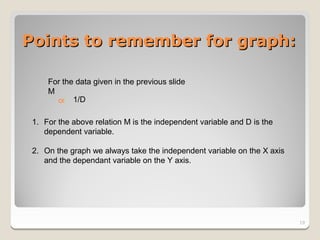
Points to remember for graph:

     For the data given in the previous slide
     M
        ∝   1/D

 1. For the above relation M is the independent variable and D is the
    dependent variable.

 2. On the graph we always take the independent variable on the X axis
    and the dependant variable on the Y axis.


                                                                         19
Indirect Proportion Graphs


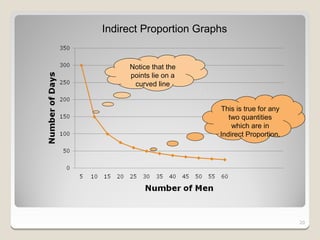
     Notice that the
     points lie on a
      curved line


                        This is true for any
                           two quantities
                            which are in
                        Indirect Proportion.


                                               20
Indirect Proportion Graph
           KeyPoint
      Two quantities which are
        Indirectly Proportion
    always make a curved graph.


                                  21
If you have any further queries regarding the topic

   or have any problems don’t hesitate to ask.


           Best of Luck!


                                                      22

Presentation on inverse proportion

  • 1.
    Direct and Inverse Proportion Chapter 2 (Book 2) 1
  • 2.
  • 3.
    Direct Proportion Two quantities are directly proportional if an increase in one quantity corresponds to a constant increase in the other quantity, or if a decrease in one quantity corresponds to a constant decrease in the other quantity. X Y X Y 3
  • 4.
    Example: “Jim’s wagesare directly proportional to the hours he works” Themore hours he works, the more money he earns. This could be written as: 4
  • 5.
    Wages α Hours Or... Wages = k x Hours k is the “constant of proportionality” 5
  • 6.
    Direct Proportion Graphs The table below shows the “cost of packets of Biscuits” which is directly proportional to the “no. of packets.” No. of Pkts 1 2 3 4 5 6 Cost (p) 20 40 60 80 100 120 We can construct a graph to represent this data. What type of graph do we expect ? 6
  • 7.
    Points to rememberfor graph: For the data given in the previous slide C ∝ N 1. For the above relation N is the independent variable and C is the dependent variable. 2. On the graph we always take the independent variable on the X axis and the dependant variable on the Y axis. 7
  • 8.
    Direct Proportion 140 Notice that the points 120 lie on a straight line Graphs Direct Proportion passing through the 100 origin 80 60 40 20 This is true for any two quantities which 0 are in Direct 0 1 2 3 Proportion. 5 4 6 8 No. of Packets
  • 9.
    Direct Proportion Graph KeyPoint Two quantities which are in Direct Proportion always lie on a straight line passing through the origin. 9
  • 10.
    Direct Proportion Graphs Example : Plot the points in the table below. Are they in Direct Proportion? X 1 2 3 4 y 3 6 9 12 We plot the points (1,3) , (2,6) , (3,9) , (4,12) 10
  • 11.
    Direct Proportion Graphs y 12 Plotting the points 11 10 (1,3) , (2,6) , (3,9) , (4,12) 9 8 7 Since we have a straight line 6 passing through the origin 5 x and y are in 4 Direct Proportion. 3 2 1 0 1 2 3 4 x 11
  • 12.
  • 13.
    Inverse Proportion Twoquantities are inversely proportional if an increase in one quantity corresponds to a constant decrease in the other quantity, or if a decrease in one quantity corresponds to a constant increase in the other quantity. X Y X Y 13
  • 14.
    Example: “It takes 4men 10 days to build a brick wall. How many days will it take 20 men?” The more men employed, the less time it takes to build the wall Inverse Proportion 14
  • 15.
  • 16.
    (The first stepis to calculate the value of K and form the equation using the known values) t= k k 10 = m 4 k = 4 ×10 = 40 t= 40 (The second step is to use the equation with the value of K to calculate unknown values) If we have 20 men, m = 20 m 40 t= = 2 days 20 16
  • 17.
    Try this when: M is inversely proportional to R If M = 9 when R = 4 a. Find M when R =2 b. Find R when M = 3 17
  • 18.
    Indirect Proportion Graphs Thetable below shows the “number of days to make a house” which is indirectly proportional to the “number of men.” Men (M) 5 10 15 20 25 30 Days (D) 300 150 100 75 60 50 We can construct a graph to represent this data. What type of graph do we expect ? 18
  • 19.
    Points to rememberfor graph: For the data given in the previous slide M ∝ 1/D 1. For the above relation M is the independent variable and D is the dependent variable. 2. On the graph we always take the independent variable on the X axis and the dependant variable on the Y axis. 19
  • 20.
    Indirect Proportion Graphs Notice that the points lie on a curved line This is true for any two quantities which are in Indirect Proportion. 20
  • 21.
    Indirect Proportion Graph KeyPoint Two quantities which are Indirectly Proportion always make a curved graph. 21
  • 22.
    If you haveany further queries regarding the topic or have any problems don’t hesitate to ask. Best of Luck! 22