Presentation
on
Submitted by
ALPANA MEHTA
Registration Number
2020PGEEPS07
Under the Supervision of :
Dr. Jitendra Kumar
(Assistant Professor)
Electrical Engineering Department
NATIONAL INSTITUTE OF TECHNOLOGY,
JAMSHEDPUR
FAULT CLASSIFICATION AND LOCATION IN SERIES
COMPENSATED LINE DURING POWER SWING
Contents
Literature Survey
Introduction
Objectives
Need of Fault Classification & Location
Methodology & Software Used
References
Introduction
• In electrical utilities, transmission lines form the backbone of power systems. With regard
to reliability and maintenance costs of power delivery, type and accurate fault location for
transmission lines is of vital importance in restoring power services, and reducing outage
time as much as possible.
• Transmission lines usually experience a variety of faults resulting in disconnecting the
power feeding to the loads. Hence, its restoration process can be expedited if the location
and type of the fault is known or can be estimated with a reasonable accuracy.
• Different benefits are gained by utilizing fault locators and fault classifiers in power
networks including reducing maintenance time, increasing the power availability,
improving the power quality and avoiding future accidents
• In a series compensated line due to sub synchronous oscillations, current and voltage
inversion fault detection becomes a difficult task and it becomes even more difficult if
fault occurs during power swing.
• Protection mechanism should be capable of blocking the operation of relay during power
swing but if a fault occurs during power swing it must be detected and cleared.
4
Need for Fault Classification and Location
 Fault detection plays an important role in high-cost and safety-critical processes. Early
detection of process faults can help avoid abnormal event progression. And with the timely
classification and location of fault the appropriate measures can be carried out to clear the
fault.
 The classical approaches, involving positive, negative, and zero-sequence components, fault
inception angle, etc., suffer from tedious and slow processing times and
are prone to more errors.
 Wavelet transforms in conjunction with AI/fuzzy/expert system-based techniques are
inherently faster and more accurate compared to conventional techniques. The Wavelet fuzzy
combined approach suffers from the fact that as the number of fault zones increases, the
associated rules for developing the fuzzy model also increases, and the optimization of rules
becomes a cumbersome task.
 Most of the algorithms that have been developed recently for the detection and
classification of faults is based on wavelet multi-resolution analysis to overcome the
difficulties associated with conventional voltage- and current-based measurements.
 Most of the available methods either detects fault, classifies fault or locates the distance of
fault. Also not all methods are applicable for all conditions. Most of the methods fails to
operate during power swing or for a series compensated line.
5
Title Authors Publications year Remark
[1] Transmission Line Fault
Classification and Location Using
Wavelet Entropy and Neural
Network
Aritra Dasgupta, Sudipta Nath
and Arabinda Das
Electric Power Components and
Systems, 2012, 40:15,1676-1689
An expert system based on an artificial
neural network for fault classification and
distance estimation.
[2] Travelling Wave Based Fault
Location Analysis
for Transmission Lines
L. de Andrade, and T. Ponce de
Leão
EPJ Web of Conferences 2012 Review of Fault location methods in
transmission line using travelling wave.
[3] Transmission line fault
classification using discrete
wavelet transform
M. Choudhury and A. Ganguly 2015 International Conference on
Energy, Power and Environment:
Towards Sustainable Growth (ICEPE),
Discrete wavelet transform has been applied
on the fault current and the mean of
approximate coefficients of the phase signals
is calculated.
[4] The Application of Discrete
Wavelet Transform to
Classification of Power
Transmission System Faults
J. Matarweh, R. Mustaklem, A.
Saleem and O. Mohamed
2019 IEEE
Jordan International Joint Conference
on Electrical Engineering and
Information Technology
(JEEIT)
Discrete wavelet transform is adopted to
transform the fault signals in such a way it
can be translated to indicate the fault type.
.
[5] A Comparative Fault Analysis
in Series
Compensated Line during Power
Swing
D. Datta, S. Mohapatra and S. K.
Mohanty
2019 Innovations in Power and
Advanced
Computing Technologies (i-PACT),
Negative sequence component of current is
used for the classification and location of
symmetrical and unsymmetrical fault in a
series compensated line during power swing.
Literature survey
6
Title Authors Publications year Remark
[6] Detection of Fault in Fixed Series
Compensated Transmission Line
during Power Swing Using Wavelet Transform
Rohan Kumar Gupta International Journal of Scientific and
Research Publications, Volume 4,
Issue 5, May 2014 1 ISSN 2250-3153
www.ijsrp.org
A support vector machine (SVM) classifier is
employed to distinguish faults from other normal
capacitor and switching transients
.
[7] ANN Based Directional Fault
Detector/Classifier for
Protection of Transmission Lines
Anamika Yadav and A.S. Thoke (IJCSIT) International Journal of
Computer Science and
Information Technologies, Vol. 2 (5),
2011, 2426-2433.
Fault distance and direction estimation based on
application of artificial neural networks for
protection of doubly fed transmission lines
[8] Fast fault detection scheme for series-
compensated lines during
power swing
M. Daryalal, M. Sarlak International Journal of Electrical
Power & Energy Systems, Volume
92,2017.
Likelihood ratio [LR] test is utilized to detect a jump
in the statistical mean of the calculated
forward travelling wave. Finally, a support vector
machine (SVM) classifier is employed to
distinguish faults from other normal capacitor and
switching transients.
[9] A Fault-Location Algorithm for Series-
Compensated
Double-Circuit Transmission Lines Using the
Distributed Parameter Line Model
N. Kang, J. Chen and Y. Liao IEEE
Transactions on Power Delivery, vol.
30, no. 1, pp. 360-367, Feb. 2015, doi:
10.1109/TPWRD.2014.2337306
Fault-location algorithm for series-compensated
double-circuit transmission lines utilizing two-
terminal unsynchronized voltage and current
measurements
[10] Power swing protection of series
compensated transmission
line with novel fault detection technique
Saptarshi Roy P. Suresh Babu Green Computing Communication
and
Electrical Engineering (ICGCCEE),
2014
A negative-sequence current–based technique for
detecting presence of fault, classification of fault
occurred, estimating zone and location of the fault
occurred and the fault inception time.
Objectives
The main objectives of this project are:
To design and simulate transmission line in PSCAD.
To classify faults using wavelet transform in a series
compensated line during power swing using MATLAB
program.
To determine fault location by using travelling waves using
MATLAB.
8
Methodology and Software Used
 Methodology used
Fault Classification: The voltage waveforms will be recorded for each phase and Daub4 discrete wavelet
transform is applied to each phase at scale 1. The mean of the approximate coefficients of each phase is
calculated. Based upon the mean of approximate coefficients the faults will be classified.
Fault Location: Traveling Waves both single and double ended will be used and the transient instances will
be calculated using wavelet transform at level 5. Based upon the transient instances the fault location will be
determined whether it’s a front end or back end fault
 Software used
MATLAB/Simulink and PSCAD
9
Methodology
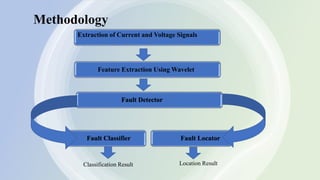
Extraction of Current and Voltage Signals
Feature Extraction Using Wavelet
Fault Detector
Fault Locator
Fault Classifier
Classification Result Location Result
10
References
[1] Aritra Dasgupta, Sudipta Nath and Arabinda Das. Transmission Line Fault Classification and Location Using
Wavelet Entropy and Neural Network, Electric Power Components and Systems,40:15,1676-1689.
[2] L. de Andrade, and T. Ponce de Leão Travelling Wave Based Fault Location Analysis for Transmission Lines,
EPJ Web of Conferences 2012.
[3] Chengzong Pang and Mladen Kezunovic
http://smartgridcenter.tamu.edu/resume/pdf/cnf/MedPower08_Pnag.pdf
[4] M. Choudhury and A. Ganguly, "Transmission line fault classification using discrete wavelet transform," 2015
International Conference on Energy, Power and Environment: Towards Sustainable Growth (ICEPE), 2015, pp. 1-
5, doi: 10.1109/EPETSG.2015.7510112.
[5] J. Matarweh, R. Mustaklem, A. Saleem and O. Mohamed, "The Application of Discrete Wavelet Transform to
Classification of Power Transmission System Faults," 2019 IEEE Jordan International Joint Conference on
Electrical Engineering and Information Technology (JEEIT), 2019, pp. 699-704, doi:
10.1109/JEEIT.2019.8717394.
[6] D. Datta, S. Mohapatra and S. K. Mohanty, "A Comparative Fault Analysis in Series Compensated Line during
Power Swing," 2019 Innovations in Power and Advanced Computing Technologies (i-PACT), 2019, pp. 1-6,
doi:10.1109/iPACT44901.2019.8960247.
[7] Saptarshi Roy P. Suresh Babu Power swing protection of series compensated transmission line with novel fault
detection technique Conference: Green Computing Communication and Electrical Engineering (ICGCCEE), 2014.
11
[8]Rohan Kumar Gupta, Detection of Fault in Fixed Series Compensated Transmission Line during
Power Swing Using Wavelet Transform International Journal of Scientific and Research Publications,
Volume 4, Issue 5, May 2014 1 ISSN 2250-3153 www.ijsrp.org
František Janıcek, Martin Mucha, and Marian Ostrozlık. A new protection relay based on fault
transient analysis using wavelet transform. Journal of Electrical Engineering, 58(5):271–278,2007.
[9] S. Lotfifard, J. Faiz, and M. Kezunivic, “Detection of symmetrical faults by distance relays
amidst power swings,” IEEE Trans. Power Delivery, vol. 25, no. 1, pp. 81–87, Jan. 2010.
[10] Power System Relaying Committee et al. EMTP reference models for transmission line
relay testing report. IEEE Power System Relaying Committee,2004.
[11] Aleena Swetapadma, Anamika Yadav A novel single-ended fault location scheme for parallel
transmission lines using k-nearest neighbor algorithm Computers & Electrical Engineering, Volume
69, 2018, pp. 41-53.
[12] Avagaddi Prasad, J. Belwin Edward, K. Ravi, A review on fault classification methodologies in
power transmission systems: Part-II, Journal of Electrical Systems and Information Technology,
Volume 5, Issue 1, 2018,
12
12
Publications
Alpana Mehta, Gyanu Gautam, Piyush Kumar and Jitendra Kumar, “A COMBINED SEQUENCE
APPROACH BASED ON CUMULATIVE SUM FOR DETECTION OF FAULT AMIDST POWER
SWING FOR LINE WITH SERIES COMPENSATION “ 1st International Conference on Smart
Energy and Advancement in Power Technologies (ICSEAPT, 2021)
13

Presentation on FAULT CLASSIFICATION.pptx

  • 1.
    Presentation on Submitted by ALPANA MEHTA RegistrationNumber 2020PGEEPS07 Under the Supervision of : Dr. Jitendra Kumar (Assistant Professor) Electrical Engineering Department NATIONAL INSTITUTE OF TECHNOLOGY, JAMSHEDPUR FAULT CLASSIFICATION AND LOCATION IN SERIES COMPENSATED LINE DURING POWER SWING
  • 2.
    Contents Literature Survey Introduction Objectives Need ofFault Classification & Location Methodology & Software Used References
  • 3.
    Introduction • In electricalutilities, transmission lines form the backbone of power systems. With regard to reliability and maintenance costs of power delivery, type and accurate fault location for transmission lines is of vital importance in restoring power services, and reducing outage time as much as possible. • Transmission lines usually experience a variety of faults resulting in disconnecting the power feeding to the loads. Hence, its restoration process can be expedited if the location and type of the fault is known or can be estimated with a reasonable accuracy. • Different benefits are gained by utilizing fault locators and fault classifiers in power networks including reducing maintenance time, increasing the power availability, improving the power quality and avoiding future accidents • In a series compensated line due to sub synchronous oscillations, current and voltage inversion fault detection becomes a difficult task and it becomes even more difficult if fault occurs during power swing. • Protection mechanism should be capable of blocking the operation of relay during power swing but if a fault occurs during power swing it must be detected and cleared.
  • 4.
    4 Need for FaultClassification and Location  Fault detection plays an important role in high-cost and safety-critical processes. Early detection of process faults can help avoid abnormal event progression. And with the timely classification and location of fault the appropriate measures can be carried out to clear the fault.  The classical approaches, involving positive, negative, and zero-sequence components, fault inception angle, etc., suffer from tedious and slow processing times and are prone to more errors.  Wavelet transforms in conjunction with AI/fuzzy/expert system-based techniques are inherently faster and more accurate compared to conventional techniques. The Wavelet fuzzy combined approach suffers from the fact that as the number of fault zones increases, the associated rules for developing the fuzzy model also increases, and the optimization of rules becomes a cumbersome task.  Most of the algorithms that have been developed recently for the detection and classification of faults is based on wavelet multi-resolution analysis to overcome the difficulties associated with conventional voltage- and current-based measurements.  Most of the available methods either detects fault, classifies fault or locates the distance of fault. Also not all methods are applicable for all conditions. Most of the methods fails to operate during power swing or for a series compensated line.
  • 5.
    5 Title Authors Publicationsyear Remark [1] Transmission Line Fault Classification and Location Using Wavelet Entropy and Neural Network Aritra Dasgupta, Sudipta Nath and Arabinda Das Electric Power Components and Systems, 2012, 40:15,1676-1689 An expert system based on an artificial neural network for fault classification and distance estimation. [2] Travelling Wave Based Fault Location Analysis for Transmission Lines L. de Andrade, and T. Ponce de Leão EPJ Web of Conferences 2012 Review of Fault location methods in transmission line using travelling wave. [3] Transmission line fault classification using discrete wavelet transform M. Choudhury and A. Ganguly 2015 International Conference on Energy, Power and Environment: Towards Sustainable Growth (ICEPE), Discrete wavelet transform has been applied on the fault current and the mean of approximate coefficients of the phase signals is calculated. [4] The Application of Discrete Wavelet Transform to Classification of Power Transmission System Faults J. Matarweh, R. Mustaklem, A. Saleem and O. Mohamed 2019 IEEE Jordan International Joint Conference on Electrical Engineering and Information Technology (JEEIT) Discrete wavelet transform is adopted to transform the fault signals in such a way it can be translated to indicate the fault type. . [5] A Comparative Fault Analysis in Series Compensated Line during Power Swing D. Datta, S. Mohapatra and S. K. Mohanty 2019 Innovations in Power and Advanced Computing Technologies (i-PACT), Negative sequence component of current is used for the classification and location of symmetrical and unsymmetrical fault in a series compensated line during power swing. Literature survey
  • 6.
    6 Title Authors Publicationsyear Remark [6] Detection of Fault in Fixed Series Compensated Transmission Line during Power Swing Using Wavelet Transform Rohan Kumar Gupta International Journal of Scientific and Research Publications, Volume 4, Issue 5, May 2014 1 ISSN 2250-3153 www.ijsrp.org A support vector machine (SVM) classifier is employed to distinguish faults from other normal capacitor and switching transients . [7] ANN Based Directional Fault Detector/Classifier for Protection of Transmission Lines Anamika Yadav and A.S. Thoke (IJCSIT) International Journal of Computer Science and Information Technologies, Vol. 2 (5), 2011, 2426-2433. Fault distance and direction estimation based on application of artificial neural networks for protection of doubly fed transmission lines [8] Fast fault detection scheme for series- compensated lines during power swing M. Daryalal, M. Sarlak International Journal of Electrical Power & Energy Systems, Volume 92,2017. Likelihood ratio [LR] test is utilized to detect a jump in the statistical mean of the calculated forward travelling wave. Finally, a support vector machine (SVM) classifier is employed to distinguish faults from other normal capacitor and switching transients. [9] A Fault-Location Algorithm for Series- Compensated Double-Circuit Transmission Lines Using the Distributed Parameter Line Model N. Kang, J. Chen and Y. Liao IEEE Transactions on Power Delivery, vol. 30, no. 1, pp. 360-367, Feb. 2015, doi: 10.1109/TPWRD.2014.2337306 Fault-location algorithm for series-compensated double-circuit transmission lines utilizing two- terminal unsynchronized voltage and current measurements [10] Power swing protection of series compensated transmission line with novel fault detection technique Saptarshi Roy P. Suresh Babu Green Computing Communication and Electrical Engineering (ICGCCEE), 2014 A negative-sequence current–based technique for detecting presence of fault, classification of fault occurred, estimating zone and location of the fault occurred and the fault inception time.
  • 7.
    Objectives The main objectivesof this project are: To design and simulate transmission line in PSCAD. To classify faults using wavelet transform in a series compensated line during power swing using MATLAB program. To determine fault location by using travelling waves using MATLAB.
  • 8.
    8 Methodology and SoftwareUsed  Methodology used Fault Classification: The voltage waveforms will be recorded for each phase and Daub4 discrete wavelet transform is applied to each phase at scale 1. The mean of the approximate coefficients of each phase is calculated. Based upon the mean of approximate coefficients the faults will be classified. Fault Location: Traveling Waves both single and double ended will be used and the transient instances will be calculated using wavelet transform at level 5. Based upon the transient instances the fault location will be determined whether it’s a front end or back end fault  Software used MATLAB/Simulink and PSCAD
  • 9.
    9 Methodology Extraction of Currentand Voltage Signals Feature Extraction Using Wavelet Fault Detector Fault Locator Fault Classifier Classification Result Location Result
  • 10.
    10 References [1] Aritra Dasgupta,Sudipta Nath and Arabinda Das. Transmission Line Fault Classification and Location Using Wavelet Entropy and Neural Network, Electric Power Components and Systems,40:15,1676-1689. [2] L. de Andrade, and T. Ponce de Leão Travelling Wave Based Fault Location Analysis for Transmission Lines, EPJ Web of Conferences 2012. [3] Chengzong Pang and Mladen Kezunovic http://smartgridcenter.tamu.edu/resume/pdf/cnf/MedPower08_Pnag.pdf [4] M. Choudhury and A. Ganguly, "Transmission line fault classification using discrete wavelet transform," 2015 International Conference on Energy, Power and Environment: Towards Sustainable Growth (ICEPE), 2015, pp. 1- 5, doi: 10.1109/EPETSG.2015.7510112. [5] J. Matarweh, R. Mustaklem, A. Saleem and O. Mohamed, "The Application of Discrete Wavelet Transform to Classification of Power Transmission System Faults," 2019 IEEE Jordan International Joint Conference on Electrical Engineering and Information Technology (JEEIT), 2019, pp. 699-704, doi: 10.1109/JEEIT.2019.8717394. [6] D. Datta, S. Mohapatra and S. K. Mohanty, "A Comparative Fault Analysis in Series Compensated Line during Power Swing," 2019 Innovations in Power and Advanced Computing Technologies (i-PACT), 2019, pp. 1-6, doi:10.1109/iPACT44901.2019.8960247. [7] Saptarshi Roy P. Suresh Babu Power swing protection of series compensated transmission line with novel fault detection technique Conference: Green Computing Communication and Electrical Engineering (ICGCCEE), 2014.
  • 11.
    11 [8]Rohan Kumar Gupta,Detection of Fault in Fixed Series Compensated Transmission Line during Power Swing Using Wavelet Transform International Journal of Scientific and Research Publications, Volume 4, Issue 5, May 2014 1 ISSN 2250-3153 www.ijsrp.org František Janıcek, Martin Mucha, and Marian Ostrozlık. A new protection relay based on fault transient analysis using wavelet transform. Journal of Electrical Engineering, 58(5):271–278,2007. [9] S. Lotfifard, J. Faiz, and M. Kezunivic, “Detection of symmetrical faults by distance relays amidst power swings,” IEEE Trans. Power Delivery, vol. 25, no. 1, pp. 81–87, Jan. 2010. [10] Power System Relaying Committee et al. EMTP reference models for transmission line relay testing report. IEEE Power System Relaying Committee,2004. [11] Aleena Swetapadma, Anamika Yadav A novel single-ended fault location scheme for parallel transmission lines using k-nearest neighbor algorithm Computers & Electrical Engineering, Volume 69, 2018, pp. 41-53. [12] Avagaddi Prasad, J. Belwin Edward, K. Ravi, A review on fault classification methodologies in power transmission systems: Part-II, Journal of Electrical Systems and Information Technology, Volume 5, Issue 1, 2018,
  • 12.
    12 12 Publications Alpana Mehta, GyanuGautam, Piyush Kumar and Jitendra Kumar, “A COMBINED SEQUENCE APPROACH BASED ON CUMULATIVE SUM FOR DETECTION OF FAULT AMIDST POWER SWING FOR LINE WITH SERIES COMPENSATION “ 1st International Conference on Smart Energy and Advancement in Power Technologies (ICSEAPT, 2021)
  • 13.