Presentation on chickpea
Presented by : Sunil Kumar
Dept. of Agronomy
UAS Bengaluru
Content
• Introduction
• Importance
• Area production and productivity
• classification
• Botany
• Climatic condition
• Soil and field preparation
• Others cultivation practices
Introduction
• Pulses are an important source of stable protein food for
the poor and the vegetarians which constitute a major
population of the country
• India’s outstanding contribution towards total global
acreage and production of pulses at 35% & 27 %
respectively
• India is the world’s largest producer and consumer of
pulses accounting about 27 % of the total production and
about 30 % of the total consumption in the world.
• The Recommended Dietary Allowances (RDA) for
adult male and female is 60 g and 55 g per day
respectively. The per capita availability of pulses
is @ 42 g per day
• Worldwide area under pulse production was 79
mha area with the average production of 72 mt
having
• The world average yield was 910 kg/ha (2013-
14).
Chickpea
• Botanical Name – Cicer arietinum
• Synonym – Chickpea, Bengalgram, Chana and
Gram
• Origin – South West Asia – probably
Afganisthan and/or Persia.
• Chromosome no. – 2n = 16
• Family - Leguminoseae. ( paplionacious)
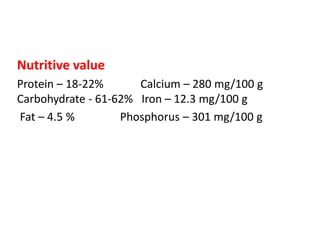
Nutritive value
Protein – 18-22% Calcium – 280 mg/100 g
Carbohydrate - 61-62% Iron – 12.3 mg/100 g
Fat – 4.5 % Phosphorus – 301 mg/100 g
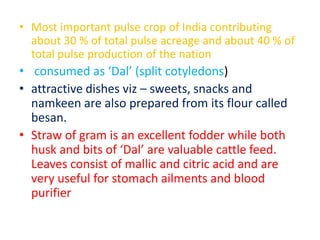
• Most important pulse crop of India contributing
about 30 % of total pulse acreage and about 40 % of
total pulse production of the nation
• consumed as ‘Dal’ (split cotyledons)
• attractive dishes viz – sweets, snacks and
namkeen are also prepared from its flour called
besan.
• Straw of gram is an excellent fodder while both
husk and bits of ‘Dal’ are valuable cattle feed.
Leaves consist of mallic and citric acid and are
very useful for stomach ailments and blood
purifier
Area & Production
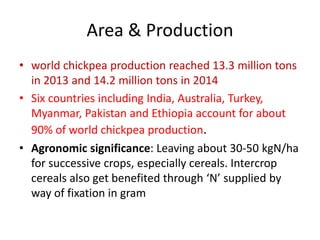
• world chickpea production reached 13.3 million tons
in 2013 and 14.2 million tons in 2014
• Six countries including India, Australia, Turkey,
Myanmar, Pakistan and Ethiopia account for about
90% of world chickpea production.
• Agronomic significance: Leaving about 30-50 kgN/ha
for successive crops, especially cereals. Intercrop
cereals also get benefited through ‘N’ supplied by
way of fixation in gram
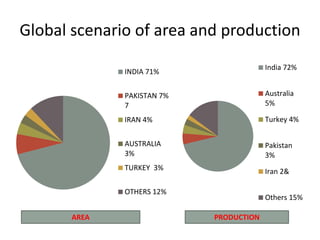
Global scenario of area and production
INDIA 71%
PAKISTAN 7%
7
IRAN 4%
AUSTRALIA
3%
TURKEY 3%
OTHERS 12%
India 72%
Australia
5%
Turkey 4%
Pakistan
3%
Iran 2&
Others 15%
AREA PRODUCTION
Area production and productivity
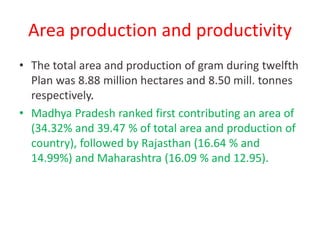
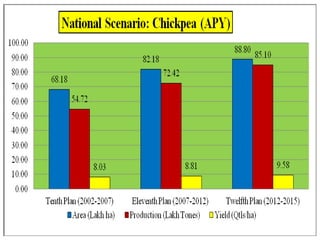
• The total area and production of gram during twelfth
Plan was 8.88 million hectares and 8.50 mill. tonnes
respectively.
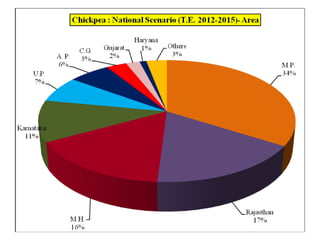
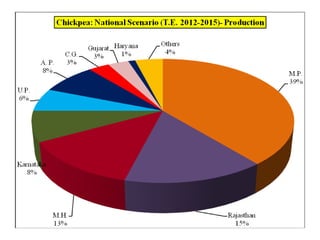
• Madhya Pradesh ranked first contributing an area of
(34.32% and 39.47 % of total area and production of
country), followed by Rajasthan (16.64 % and
14.99%) and Maharashtra (16.09 % and 12.95).
Classification
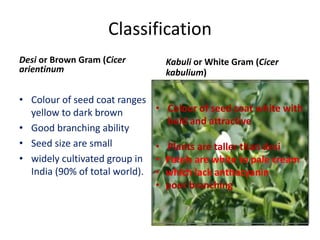
Desi or Brown Gram (Cicer
arientinum
• Colour of seed coat ranges
yellow to dark brown
• Good branching ability
• Seed size are small
• widely cultivated group in
India (90% of total world).
Kabuli or White Gram (Cicer
kabulium)
• Colour of seed coat white with
bold and attractive
• Plants are taller than desi
• Patels are white to pale cream
• which lack anthocyanin
• poor branching
Botany of chickpea
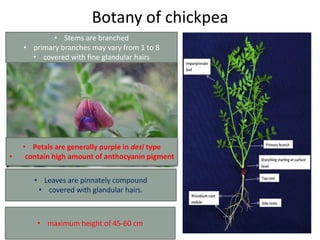
• Petals are generally purple in desi type
• contain high amount of anthocyanin pigment
• Stems are branched
• primary branches may vary from 1 to 8
• covered with fine glandular hairs
• Leaves are pinnately compound
• covered with glandular hairs.
• maximum height of 45-60 cm
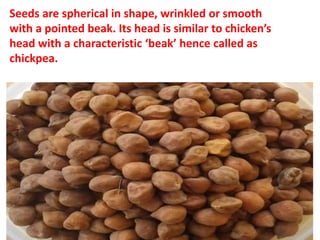
Seeds are spherical in shape, wrinkled or smooth
with a pointed beak. Its head is similar to chicken’s
head with a characteristic ‘beak’ hence called as
chickpea.
• Flowers are typical Papilionaceous consisting of five
sepals, five petals (consists of one standard, two
wings and two keels), ten stamens (nine fused to
form one staminal column and one free
• Inflorescence -axillary, racemes
• Anthesis takes place between 9 am to 3 pm.
• Self- fertilization
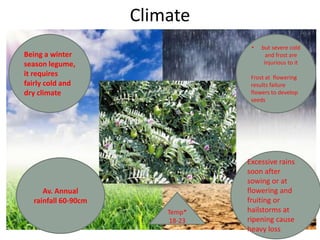
Climate
Being a winter
season legume,
it requires
fairly cold and
dry climate
• but severe cold
and frost are
injurious to it
Frost at flowering
results failure
flowers to develop
seeds
Av. Annual
rainfall 60-90cm
Excessive rains
soon after
sowing or at
flowering and
fruiting or
hailstorms at
ripening cause
heavy loss
Temp*
18-23
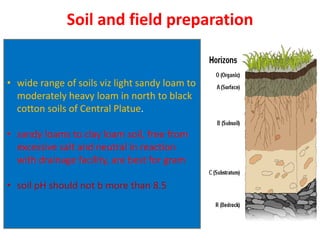
Soil and field preparation
• wide range of soils viz light sandy loam to
moderately heavy loam in north to black
cotton soils of Central Platue.
• sandy loams to clay loam soil, free from
excessive salt and neutral in reaction
with drainage facility, are best for gram
• soil pH should not b more than 8.5
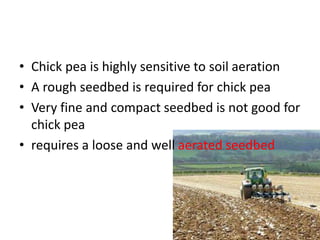
• Chick pea is highly sensitive to soil aeration
• A rough seedbed is required for chick pea
• Very fine and compact seedbed is not good for
chick pea
• requires a loose and well aerated seedbed
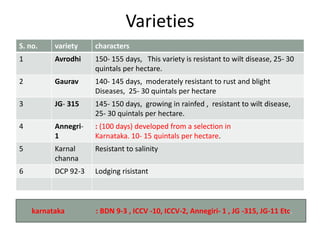
Varieties
S. no. variety characters
1 Avrodhi 150‐ 155 days, This variety is resistant to wilt disease, 25‐ 30
quintals per hectare.
2 Gaurav 140‐ 145 days, moderately resistant to rust and blight
Diseases, 25‐ 30 quintals per hectare
3 JG‐ 315 145‐ 150 days, growing in rainfed , resistant to wilt disease,
25‐ 30 quintals per hectare.
4 Annegri‐
1
: (100 days) developed from a selection in
Karnataka. 10‐ 15 quintals per hectare.
5 Karnal
channa
Resistant to salinity
6 DCP 92-3 Lodging risistant
karnataka : BDN 9-3 , ICCV -10, ICCV-2, Annegiri- 1 , JG -315, JG-11 Etc.
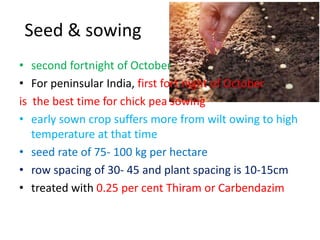
Seed & sowing
• second fortnight of October
• For peninsular India, first fort night of October
is the best time for chick pea sowing
• early sown crop suffers more from wilt owing to high
temperature at that time
• seed rate of 75‐ 100 kg per hectare
• row spacing of 30‐ 45 and plant spacing is 10-15cm
• treated with 0.25 per cent Thiram or Carbendazim
Manure and fertilizer
• Chick pea being a leguminous crop fulfils the
major part of its nitrogen requirement.
• fertilizer dose is 15-20 kg N as starter dose,
40kg phosporous.
• About 5 tonnes FYM or compost.
• fertilizers are drilled in furrows at a depth of 7‐
10 centimeters
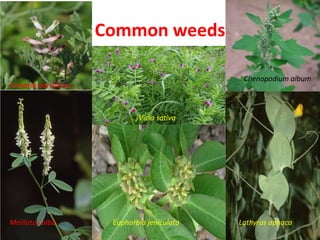
Common weeds
Chenopodium album
Fumaria parviflora
Vicia sativa
Melilotus alba Lathyrus aphacaEuphorbia jeniculata
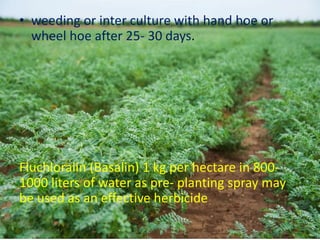
• weeding or inter culture with hand hoe or
wheel hoe after 25‐ 30 days.
Fluchloralin (Basalin) 1 kg per hectare in 800‐
1000 liters of water as pre‐ planting spray may
be used as an effective herbicide
Water Management
• Chick pea is mostly sown as a rainfed crop
• pre‐ sowing irrigation ensure proper
germination and smooth growth
• Irrigation required at pre‐ flowering stage and
one at pod development stage.
Pest and disease
management
• Chickpea wilt
• Rust
• Ascochyta blight
Seed treatment with thiram
@2.5g/kg seed
Spray the crop with 0.2%
Mancozeb 72wp
wilt
Rust
Ascochyta blight
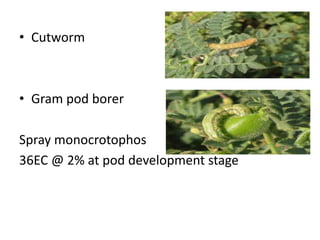
• Cutworm
• Gram pod borer
Spray monocrotophos
36EC @ 2% at pod development stage
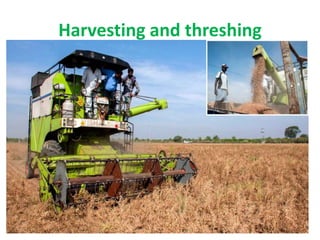
Harvesting and threshing
Yield
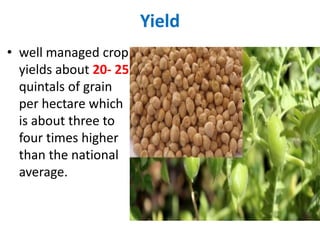
• well managed crop
yields about 20‐ 25
quintals of grain
per hectare which
is about three to
four times higher
than the national
average.

presentation on chickpea

  • 1.
    Presentation on chickpea Presentedby : Sunil Kumar Dept. of Agronomy UAS Bengaluru
  • 2.
    Content • Introduction • Importance •Area production and productivity • classification • Botany • Climatic condition • Soil and field preparation • Others cultivation practices
  • 3.
    Introduction • Pulses arean important source of stable protein food for the poor and the vegetarians which constitute a major population of the country • India’s outstanding contribution towards total global acreage and production of pulses at 35% & 27 % respectively • India is the world’s largest producer and consumer of pulses accounting about 27 % of the total production and about 30 % of the total consumption in the world.
  • 4.
    • The RecommendedDietary Allowances (RDA) for adult male and female is 60 g and 55 g per day respectively. The per capita availability of pulses is @ 42 g per day • Worldwide area under pulse production was 79 mha area with the average production of 72 mt having • The world average yield was 910 kg/ha (2013- 14).
  • 5.
    Chickpea • Botanical Name– Cicer arietinum • Synonym – Chickpea, Bengalgram, Chana and Gram • Origin – South West Asia – probably Afganisthan and/or Persia. • Chromosome no. – 2n = 16 • Family - Leguminoseae. ( paplionacious)
  • 6.
    Nutritive value Protein –18-22% Calcium – 280 mg/100 g Carbohydrate - 61-62% Iron – 12.3 mg/100 g Fat – 4.5 % Phosphorus – 301 mg/100 g
  • 7.
    • Most importantpulse crop of India contributing about 30 % of total pulse acreage and about 40 % of total pulse production of the nation • consumed as ‘Dal’ (split cotyledons) • attractive dishes viz – sweets, snacks and namkeen are also prepared from its flour called besan. • Straw of gram is an excellent fodder while both husk and bits of ‘Dal’ are valuable cattle feed. Leaves consist of mallic and citric acid and are very useful for stomach ailments and blood purifier
  • 8.
    Area & Production •world chickpea production reached 13.3 million tons in 2013 and 14.2 million tons in 2014 • Six countries including India, Australia, Turkey, Myanmar, Pakistan and Ethiopia account for about 90% of world chickpea production. • Agronomic significance: Leaving about 30-50 kgN/ha for successive crops, especially cereals. Intercrop cereals also get benefited through ‘N’ supplied by way of fixation in gram
  • 9.
    Global scenario ofarea and production INDIA 71% PAKISTAN 7% 7 IRAN 4% AUSTRALIA 3% TURKEY 3% OTHERS 12% India 72% Australia 5% Turkey 4% Pakistan 3% Iran 2& Others 15% AREA PRODUCTION
  • 10.
    Area production andproductivity • The total area and production of gram during twelfth Plan was 8.88 million hectares and 8.50 mill. tonnes respectively. • Madhya Pradesh ranked first contributing an area of (34.32% and 39.47 % of total area and production of country), followed by Rajasthan (16.64 % and 14.99%) and Maharashtra (16.09 % and 12.95).
  • 14.
    Classification Desi or BrownGram (Cicer arientinum • Colour of seed coat ranges yellow to dark brown • Good branching ability • Seed size are small • widely cultivated group in India (90% of total world). Kabuli or White Gram (Cicer kabulium) • Colour of seed coat white with bold and attractive • Plants are taller than desi • Patels are white to pale cream • which lack anthocyanin • poor branching
  • 15.
    Botany of chickpea •Petals are generally purple in desi type • contain high amount of anthocyanin pigment • Stems are branched • primary branches may vary from 1 to 8 • covered with fine glandular hairs • Leaves are pinnately compound • covered with glandular hairs. • maximum height of 45-60 cm
  • 16.
    Seeds are sphericalin shape, wrinkled or smooth with a pointed beak. Its head is similar to chicken’s head with a characteristic ‘beak’ hence called as chickpea.
  • 17.
    • Flowers aretypical Papilionaceous consisting of five sepals, five petals (consists of one standard, two wings and two keels), ten stamens (nine fused to form one staminal column and one free • Inflorescence -axillary, racemes • Anthesis takes place between 9 am to 3 pm. • Self- fertilization
  • 18.
    Climate Being a winter seasonlegume, it requires fairly cold and dry climate • but severe cold and frost are injurious to it Frost at flowering results failure flowers to develop seeds Av. Annual rainfall 60-90cm Excessive rains soon after sowing or at flowering and fruiting or hailstorms at ripening cause heavy loss Temp* 18-23
  • 19.
    Soil and fieldpreparation • wide range of soils viz light sandy loam to moderately heavy loam in north to black cotton soils of Central Platue. • sandy loams to clay loam soil, free from excessive salt and neutral in reaction with drainage facility, are best for gram • soil pH should not b more than 8.5
  • 20.
    • Chick peais highly sensitive to soil aeration • A rough seedbed is required for chick pea • Very fine and compact seedbed is not good for chick pea • requires a loose and well aerated seedbed
  • 21.
    Varieties S. no. varietycharacters 1 Avrodhi 150‐ 155 days, This variety is resistant to wilt disease, 25‐ 30 quintals per hectare. 2 Gaurav 140‐ 145 days, moderately resistant to rust and blight Diseases, 25‐ 30 quintals per hectare 3 JG‐ 315 145‐ 150 days, growing in rainfed , resistant to wilt disease, 25‐ 30 quintals per hectare. 4 Annegri‐ 1 : (100 days) developed from a selection in Karnataka. 10‐ 15 quintals per hectare. 5 Karnal channa Resistant to salinity 6 DCP 92-3 Lodging risistant karnataka : BDN 9-3 , ICCV -10, ICCV-2, Annegiri- 1 , JG -315, JG-11 Etc.
  • 22.
    Seed & sowing •second fortnight of October • For peninsular India, first fort night of October is the best time for chick pea sowing • early sown crop suffers more from wilt owing to high temperature at that time • seed rate of 75‐ 100 kg per hectare • row spacing of 30‐ 45 and plant spacing is 10-15cm • treated with 0.25 per cent Thiram or Carbendazim
  • 23.
    Manure and fertilizer •Chick pea being a leguminous crop fulfils the major part of its nitrogen requirement. • fertilizer dose is 15-20 kg N as starter dose, 40kg phosporous. • About 5 tonnes FYM or compost. • fertilizers are drilled in furrows at a depth of 7‐ 10 centimeters
  • 24.
    Common weeds Chenopodium album Fumariaparviflora Vicia sativa Melilotus alba Lathyrus aphacaEuphorbia jeniculata
  • 25.
    • weeding orinter culture with hand hoe or wheel hoe after 25‐ 30 days. Fluchloralin (Basalin) 1 kg per hectare in 800‐ 1000 liters of water as pre‐ planting spray may be used as an effective herbicide
  • 26.
    Water Management • Chickpea is mostly sown as a rainfed crop • pre‐ sowing irrigation ensure proper germination and smooth growth • Irrigation required at pre‐ flowering stage and one at pod development stage.
  • 27.
    Pest and disease management •Chickpea wilt • Rust • Ascochyta blight Seed treatment with thiram @2.5g/kg seed Spray the crop with 0.2% Mancozeb 72wp wilt Rust Ascochyta blight
  • 28.
    • Cutworm • Grampod borer Spray monocrotophos 36EC @ 2% at pod development stage
  • 29.
  • 30.
    Yield • well managedcrop yields about 20‐ 25 quintals of grain per hectare which is about three to four times higher than the national average.