ICH GCP Guidelines 
Overview 
Vidhyapriya.R
Agenda 
• What is ICH & GCP 
• Principles of ICH & GCP 
• IRB & IEC 
• Investigator 
• Sponsor 
• Clinical trial Protocol 
• Investigator brochures & Essential documents
What is ICH & GCP 
“The International Conference on Harmonization - 
Technical Requirements for Registration of 
Pharmaceuticals for human use.” 
 Unifying regulatory authorities & pharmaceutical 
industry 
 Geographies - Europe, Japan and the US 
 Discuss scientific and technical aspects of drug 
registration.
GCP – Good Clinical Practices 
“International quality standard that is provided by ICH” 
 Ethical and Scientific quality standard 
 For designing , conducting, recording and 
reporting trials 
 Provides public assurance that the rights, safety, 
confidentiality and wellbeing of trial subjects are protected 
 Consistent with the principles of the Declaration of 
Helsinki (developed by World medical Association) 
 It’s a statement of ethical principles for medical research 
involving human subjects, including research on 
identifiable human material and data
Principles of ICH-GCP 
Ethical Principles-Applicable regulatory 
requirements 
Foreseeable risks Vs. Anticipated benefits 
Adequate clinical & non clinical information of 
an investigational product 
Trial should be in compliance with the protocol 
that received prior approval from IRB & IEC
Principles of ICH-GCP contd. 
Medical decisions – Qualified physician 
Personnel Conducting trials – Qualified by education, training & 
experience 
Freely given ICF from every subject prior to trial participation 
Investigational product –GMP practice – quality assurance 
All information- recorded, handled, and stored that allows 
accurate reporting, interpretation & verification
IRB & IEC 
 IRB- Institutional Review Board is an independent 
body constituted of medical, scientific & non scientific 
members 
 IEC-Independent Ethics Committee (A review 
board/committee/regional/national) an independent 
body constituted medical/non medical members 
 Responsible to ensure protection of rights, safety & 
wellbeing of human subjects involved in a trial 
 IRB/IEC should obtain following documents-trial 
protocol(s) amendments, Written ICF, Advertisements, 
Investigator brochure, payment info & CV of 
investigator.
IRB & IEC 
 Composition & Functions 
 At least 5 members(1 member-non scientific area & 1 member 
independent of the institution/trial site) 
 Perform its function according to written operating procedures. 
 Review a proposed trial in a reasonable time and document its 
view. 
 Approval/Modification/disapproval/termination 
 Should comply with GCP & applicable regulatory requirements 
 Notification in writing trial related decisions, reasons, procedures, 
for appeal 
 Retain trial records for 3 years
Investigator 
 Responsible for the conduct of the clinical trial qualified by 
education, training, & experience. 
 Thoroughly familiar with correct use of investigational products 
described in protocol 
 Aware of & comply with GCP & applicable regulatory requirements 
 Adequate resources 
 Medical care of the trial subjects 
 Communication with IRB/IEC 
 Compliance with protocol 
 Investigational product(s) 
 Randomization procedures/ unblinding
Informed consent -process 
In obtaining & documenting informed consent, investigator 
should comply with applicable regulatory requirement(s), 
adhere to GCP 
Prior approval from IRB/IEC 
Neither investigator nor trial staff coerce or unduly 
influence the subject to participate in the trial. 
Language used in written ICF should be non technical, 
practical & understandable in their own language. 
If both the subject and their legally accepted 
representative are unable to read, an impartial witness 
should be present during discussion.
Informed consent discussion 
Purpose of trial 
Trial treatments & procedures 
Subject’s responsibilities, Foreseeable risks/in 
conveniences 
Alternative procedure/treatment, Compensation/treatment 
in event of trial related injury 
Voluntary participation 
Prior to participation in trial, subject should receive a copy 
of signed and dated written IC form
Records & reports 
Accuracy, completeness, legibility & timeliness of data 
Data reported on CRF that are derived from source documents 
should be consistent 
Any correction to a CRF should be dated, initiated and explained 
Essential documents should be retained until at least 2 years 
Submission of trial status, All SAE,s should be reported immediately 
to IRB/IEC 
Premature termination promptly informed to sponsor, IRB/IEC 
Final reports- A summary of trial outcome
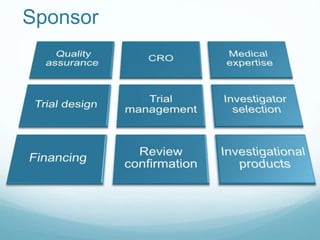
Sponsor
Monitoring 
The act of overseeing the progress of a clinical trial, and of ensuring that it is: 
 Conducted 
 Recorded 
 And reported 
In accordance with 
 The protocol 
 Standard operating procedures (SOP’S) 
 Good clinical practice (GCP) and 
 Applicable regulatory requirements 
Trial monitoring is an integral component of trial quality assurance process, and critical for 
GCP fulfillment.
Monitor’s Responsibilities 
Ensure that the trial is conducted and documented properly 
Acting as the main line of communication between sponsor and 
investigator 
Verifying 
 The investigator’s qualification 
 Investigational products 
 Following the approved protocol 
 ICF, Investigator’s brochure, 
 Source documents, trial records are accurate, complete, timely, 
legible, dated, accuracy & completeness of the CRF
Audit 
“A Systematic and independent examination of trial 
related activities and document to determine” 
 Whether the evaluated trial related activities were 
conducted 
 The data were recorded, analyzed, & accurately 
reported according to the protocol, sponsor SOP’S, 
GCP, applicable regulatory requirements 
 Purpose of a sponsor’s audit is to evaluate the trial 
conduct & compliance with quality systems & SOPs 
,protocol, and GCP.
What to Audit? 
 Organization and personnel 
 Qualification, training, & adequacy of staff 
 List of monitors 
 Quality management systems 
 Investigational drug 
 IRB/IEC 
 Investigators & sub investigators 
 Essential documents
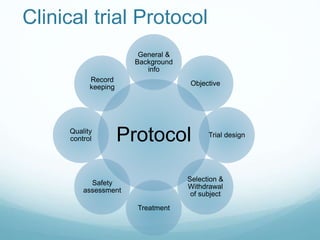
Clinical trial Protocol 
General & 
Background 
info 
Objective 
Protocol 
Trial design 
Selection & 
Withdrawal 
of subject 
Treatment 
Record 
keeping 
Safety 
Quality 
control 
assessment
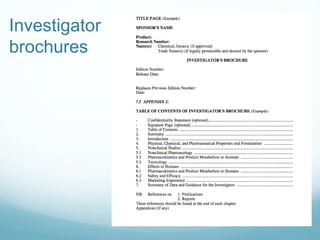
Investigator 
brochures
Essential documents 
 Documents which individually and collectively permit 
evaluation of the conduct of a study and the quality of 
the data produced. 
 Documents are grouped in to three sections 
1. Before the clinical phase of the trial commences 
2. During the clinical conduct of the trial 
3. After the completion or termination of the trial
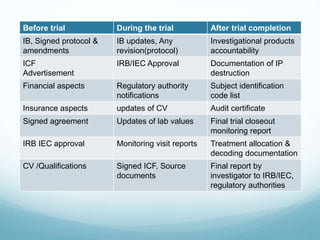
Before trial During the trial After trial completion 
IB, Signed protocol & 
IB updates, Any 
amendments 
revision(protocol) 
Investigational products 
accountability 
ICF 
Advertisement 
IRB/IEC Approval Documentation of IP 
destruction 
Financial aspects Regulatory authority 
notifications 
Subject identification 
code list 
Insurance aspects updates of CV Audit certificate 
Signed agreement Updates of lab values Final trial closeout 
monitoring report 
IRB IEC approval Monitoring visit reports Treatment allocation & 
decoding documentation 
CV /Qualifications Signed ICF, Source 
documents 
Final report by 
investigator to IRB/IEC, 
regulatory authorities
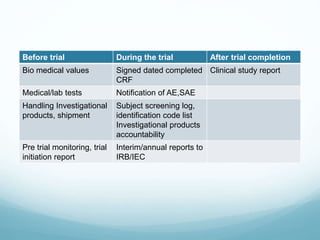
Before trial During the trial After trial completion 
Bio medical values Signed dated completed 
CRF 
Clinical study report 
Medical/lab tests Notification of AE,SAE 
Handling Investigational 
products, shipment 
Subject screening log, 
identification code list 
Investigational products 
accountability 
Pre trial monitoring, trial 
initiation report 
Interim/annual reports to 
IRB/IEC
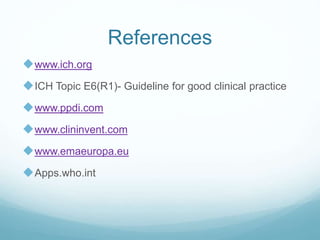
References 
www.ich.org 
ICH Topic E6(R1)- Guideline for good clinical practice 
www.ppdi.com 
www.clininvent.com 
www.emaeuropa.eu 
Apps.who.int
Q & A
Thank you!

ICHGCP Guidelines overview

  • 1.
    ICH GCP Guidelines Overview Vidhyapriya.R
  • 2.
    Agenda • Whatis ICH & GCP • Principles of ICH & GCP • IRB & IEC • Investigator • Sponsor • Clinical trial Protocol • Investigator brochures & Essential documents
  • 3.
    What is ICH& GCP “The International Conference on Harmonization - Technical Requirements for Registration of Pharmaceuticals for human use.”  Unifying regulatory authorities & pharmaceutical industry  Geographies - Europe, Japan and the US  Discuss scientific and technical aspects of drug registration.
  • 4.
    GCP – GoodClinical Practices “International quality standard that is provided by ICH”  Ethical and Scientific quality standard  For designing , conducting, recording and reporting trials  Provides public assurance that the rights, safety, confidentiality and wellbeing of trial subjects are protected  Consistent with the principles of the Declaration of Helsinki (developed by World medical Association)  It’s a statement of ethical principles for medical research involving human subjects, including research on identifiable human material and data
  • 5.
    Principles of ICH-GCP Ethical Principles-Applicable regulatory requirements Foreseeable risks Vs. Anticipated benefits Adequate clinical & non clinical information of an investigational product Trial should be in compliance with the protocol that received prior approval from IRB & IEC
  • 6.
    Principles of ICH-GCPcontd. Medical decisions – Qualified physician Personnel Conducting trials – Qualified by education, training & experience Freely given ICF from every subject prior to trial participation Investigational product –GMP practice – quality assurance All information- recorded, handled, and stored that allows accurate reporting, interpretation & verification
  • 7.
    IRB & IEC  IRB- Institutional Review Board is an independent body constituted of medical, scientific & non scientific members  IEC-Independent Ethics Committee (A review board/committee/regional/national) an independent body constituted medical/non medical members  Responsible to ensure protection of rights, safety & wellbeing of human subjects involved in a trial  IRB/IEC should obtain following documents-trial protocol(s) amendments, Written ICF, Advertisements, Investigator brochure, payment info & CV of investigator.
  • 8.
    IRB & IEC  Composition & Functions  At least 5 members(1 member-non scientific area & 1 member independent of the institution/trial site)  Perform its function according to written operating procedures.  Review a proposed trial in a reasonable time and document its view.  Approval/Modification/disapproval/termination  Should comply with GCP & applicable regulatory requirements  Notification in writing trial related decisions, reasons, procedures, for appeal  Retain trial records for 3 years
  • 9.
    Investigator  Responsiblefor the conduct of the clinical trial qualified by education, training, & experience.  Thoroughly familiar with correct use of investigational products described in protocol  Aware of & comply with GCP & applicable regulatory requirements  Adequate resources  Medical care of the trial subjects  Communication with IRB/IEC  Compliance with protocol  Investigational product(s)  Randomization procedures/ unblinding
  • 10.
    Informed consent -process In obtaining & documenting informed consent, investigator should comply with applicable regulatory requirement(s), adhere to GCP Prior approval from IRB/IEC Neither investigator nor trial staff coerce or unduly influence the subject to participate in the trial. Language used in written ICF should be non technical, practical & understandable in their own language. If both the subject and their legally accepted representative are unable to read, an impartial witness should be present during discussion.
  • 11.
    Informed consent discussion Purpose of trial Trial treatments & procedures Subject’s responsibilities, Foreseeable risks/in conveniences Alternative procedure/treatment, Compensation/treatment in event of trial related injury Voluntary participation Prior to participation in trial, subject should receive a copy of signed and dated written IC form
  • 12.
    Records & reports Accuracy, completeness, legibility & timeliness of data Data reported on CRF that are derived from source documents should be consistent Any correction to a CRF should be dated, initiated and explained Essential documents should be retained until at least 2 years Submission of trial status, All SAE,s should be reported immediately to IRB/IEC Premature termination promptly informed to sponsor, IRB/IEC Final reports- A summary of trial outcome
  • 13.
  • 14.
    Monitoring The actof overseeing the progress of a clinical trial, and of ensuring that it is:  Conducted  Recorded  And reported In accordance with  The protocol  Standard operating procedures (SOP’S)  Good clinical practice (GCP) and  Applicable regulatory requirements Trial monitoring is an integral component of trial quality assurance process, and critical for GCP fulfillment.
  • 15.
    Monitor’s Responsibilities Ensurethat the trial is conducted and documented properly Acting as the main line of communication between sponsor and investigator Verifying  The investigator’s qualification  Investigational products  Following the approved protocol  ICF, Investigator’s brochure,  Source documents, trial records are accurate, complete, timely, legible, dated, accuracy & completeness of the CRF
  • 16.
    Audit “A Systematicand independent examination of trial related activities and document to determine”  Whether the evaluated trial related activities were conducted  The data were recorded, analyzed, & accurately reported according to the protocol, sponsor SOP’S, GCP, applicable regulatory requirements  Purpose of a sponsor’s audit is to evaluate the trial conduct & compliance with quality systems & SOPs ,protocol, and GCP.
  • 17.
    What to Audit?  Organization and personnel  Qualification, training, & adequacy of staff  List of monitors  Quality management systems  Investigational drug  IRB/IEC  Investigators & sub investigators  Essential documents
  • 18.
    Clinical trial Protocol General & Background info Objective Protocol Trial design Selection & Withdrawal of subject Treatment Record keeping Safety Quality control assessment
  • 19.
  • 20.
    Essential documents Documents which individually and collectively permit evaluation of the conduct of a study and the quality of the data produced.  Documents are grouped in to three sections 1. Before the clinical phase of the trial commences 2. During the clinical conduct of the trial 3. After the completion or termination of the trial
  • 21.
    Before trial Duringthe trial After trial completion IB, Signed protocol & IB updates, Any amendments revision(protocol) Investigational products accountability ICF Advertisement IRB/IEC Approval Documentation of IP destruction Financial aspects Regulatory authority notifications Subject identification code list Insurance aspects updates of CV Audit certificate Signed agreement Updates of lab values Final trial closeout monitoring report IRB IEC approval Monitoring visit reports Treatment allocation & decoding documentation CV /Qualifications Signed ICF, Source documents Final report by investigator to IRB/IEC, regulatory authorities
  • 22.
    Before trial Duringthe trial After trial completion Bio medical values Signed dated completed CRF Clinical study report Medical/lab tests Notification of AE,SAE Handling Investigational products, shipment Subject screening log, identification code list Investigational products accountability Pre trial monitoring, trial initiation report Interim/annual reports to IRB/IEC
  • 23.
    References www.ich.org ICHTopic E6(R1)- Guideline for good clinical practice www.ppdi.com www.clininvent.com www.emaeuropa.eu Apps.who.int
  • 24.
  • 25.