AFFILIATE MARKETING 101
How to successfully sell peoples product
Presentation
15 slides
In this presentation we be looking at the
following
1. What is Affiliate Marketing? - Learn the basics of affiliate marketing
and how it works.
2. Finding Affiliate Programs - Discover how to find and choose the
right affiliate programs for your niche.
3. Creating Content that Converts - Tips on how to create high-quality
content that drives affiliate sales.
4. Promoting Your Affiliate Links - Learn different methods of
promoting your affiliate links to reach your target audience.
5. Tracking and Analyzing Results - Understand the importance of
tracking your results and how to analyze your affiliate marketing
performance.
What is Affiliate Marketing? - Learn the basics of
affiliate marketing and how it works.
Affiliate marketing is a type of online
marketing where businesses pay
affiliates a commission for
promoting their products or services
and driving sales.
Finding Affiliate Programs
Finding affiliate programs involves researching and selecting
programs that align with your niche and audience, evaluating
commission rates and payment models, and reviewing
program terms and conditions to ensure they meet your
needs. Some ways to find affiliate programs include searching
on affiliate networks, reaching out to companies directly, and
leveraging affiliate program directories.
Creating Content that Converts
To create high-quality content that drives affiliate sales, consider the
following tips:
1. Know your audience and what they are interested in.
2. Research the product or service you are promoting to create
accurate and helpful content.
3. Use engaging and compelling headlines and visuals to grab
attention.
4. Incorporate personal experiences and opinions to build trust and
credibility.
Creating Content that Converts continued
5. Include a clear call-to-action and affiliate link in your content.
6. Test and optimize your content to improve its performance over
time.
Promoting Your Affiliate Links - Learn different
methods of promoting your affiliate links to reach
your target audience
Promoting your affiliate links is a critical step in affiliate marketing and
can greatly impact the success of your campaigns. Here are some
different methods to consider when promoting your affiliate links:
• Content marketing: This involves creating high-quality content, such
as blog posts, videos, and social media posts, that incorporates your
affiliate links. Make sure your content is informative and helpful to
your audience, and includes a clear call-to-action and affiliate link.
• Email marketing: Email marketing is a great way to reach a targeted
audience and promote your affiliate links. Build an email list of
interested subscribers and send regular emails that include relevant
and valuable content and affiliate links.
Promoting Your Affiliate Links continued
• Social media marketing: Leverage social media platforms like
Facebook, Instagram, and Twitter to promote your affiliate links.
Share posts, create sponsored ads, and engage with your followers to
increase visibility and drive sales.
• Paid advertising: Paid advertising, such as Google AdWords, social
media advertising, and display ads, can help you reach a broader
audience and drive traffic to your affiliate links. However, it can be
costly, so make sure to set a budget and track your ROI carefully.
Promoting Your Affiliate Links continued
• Influencer marketing: Partner with influencers in your niche who have
a large following to promote your affiliate links. You can offer them a
commission or flat fee for their promotion.
• Product reviews: Write in-depth product reviews that incorporate
your affiliate links and highlight the features and benefits of the
product or service. Make sure to include both the positives and
negatives to build credibility with your audience.
Promoting Your Affiliate Links continued
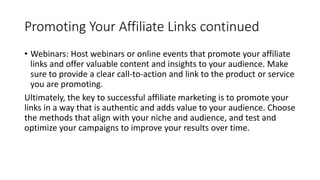
• Webinars: Host webinars or online events that promote your affiliate
links and offer valuable content and insights to your audience. Make
sure to provide a clear call-to-action and link to the product or service
you are promoting.
Ultimately, the key to successful affiliate marketing is to promote your
links in a way that is authentic and adds value to your audience. Choose
the methods that align with your niche and audience, and test and
optimize your campaigns to improve your results over time.
Tracking and Analyzing Results - Understand the
importance of tracking your results and how to
analyze your affiliate marketing performance.
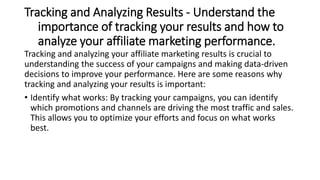
Tracking and analyzing your affiliate marketing results is crucial to
understanding the success of your campaigns and making data-driven
decisions to improve your performance. Here are some reasons why
tracking and analyzing your results is important:
• Identify what works: By tracking your campaigns, you can identify
which promotions and channels are driving the most traffic and sales.
This allows you to optimize your efforts and focus on what works
best.
Tracking and Analyzing Results continued
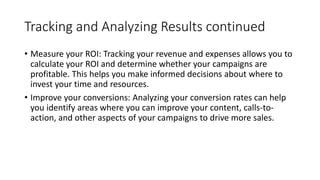
• Measure your ROI: Tracking your revenue and expenses allows you to
calculate your ROI and determine whether your campaigns are
profitable. This helps you make informed decisions about where to
invest your time and resources.
• Improve your conversions: Analyzing your conversion rates can help
you identify areas where you can improve your content, calls-to-
action, and other aspects of your campaigns to drive more sales.
Tracking and Analyzing Results continued
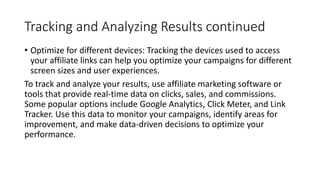
• Optimize for different devices: Tracking the devices used to access
your affiliate links can help you optimize your campaigns for different
screen sizes and user experiences.
To track and analyze your results, use affiliate marketing software or
tools that provide real-time data on clicks, sales, and commissions.
Some popular options include Google Analytics, Click Meter, and Link
Tracker. Use this data to monitor your campaigns, identify areas for
improvement, and make data-driven decisions to optimize your
performance.
Tracking and Analyzing Results continued
In addition to tracking your results, it's important to regularly review
your affiliate program terms and conditions to ensure you are
complying with the rules and regulations. This helps you maintain a
positive relationship with your partners and avoid any potential
penalties or issues down the road.
Please visit:
https://aff.stakecut.com/501/815200
for more info

Presentation. Beginner guide to Affiliate marketing.pptx

  • 1.
    AFFILIATE MARKETING 101 Howto successfully sell peoples product Presentation 15 slides
  • 2.
    In this presentationwe be looking at the following 1. What is Affiliate Marketing? - Learn the basics of affiliate marketing and how it works. 2. Finding Affiliate Programs - Discover how to find and choose the right affiliate programs for your niche. 3. Creating Content that Converts - Tips on how to create high-quality content that drives affiliate sales. 4. Promoting Your Affiliate Links - Learn different methods of promoting your affiliate links to reach your target audience. 5. Tracking and Analyzing Results - Understand the importance of tracking your results and how to analyze your affiliate marketing performance.
  • 3.
    What is AffiliateMarketing? - Learn the basics of affiliate marketing and how it works. Affiliate marketing is a type of online marketing where businesses pay affiliates a commission for promoting their products or services and driving sales.
  • 4.
    Finding Affiliate Programs Findingaffiliate programs involves researching and selecting programs that align with your niche and audience, evaluating commission rates and payment models, and reviewing program terms and conditions to ensure they meet your needs. Some ways to find affiliate programs include searching on affiliate networks, reaching out to companies directly, and leveraging affiliate program directories.
  • 5.
    Creating Content thatConverts To create high-quality content that drives affiliate sales, consider the following tips: 1. Know your audience and what they are interested in. 2. Research the product or service you are promoting to create accurate and helpful content. 3. Use engaging and compelling headlines and visuals to grab attention. 4. Incorporate personal experiences and opinions to build trust and credibility.
  • 6.
    Creating Content thatConverts continued 5. Include a clear call-to-action and affiliate link in your content. 6. Test and optimize your content to improve its performance over time.
  • 7.
    Promoting Your AffiliateLinks - Learn different methods of promoting your affiliate links to reach your target audience Promoting your affiliate links is a critical step in affiliate marketing and can greatly impact the success of your campaigns. Here are some different methods to consider when promoting your affiliate links: • Content marketing: This involves creating high-quality content, such as blog posts, videos, and social media posts, that incorporates your affiliate links. Make sure your content is informative and helpful to your audience, and includes a clear call-to-action and affiliate link. • Email marketing: Email marketing is a great way to reach a targeted audience and promote your affiliate links. Build an email list of interested subscribers and send regular emails that include relevant and valuable content and affiliate links.
  • 8.
    Promoting Your AffiliateLinks continued • Social media marketing: Leverage social media platforms like Facebook, Instagram, and Twitter to promote your affiliate links. Share posts, create sponsored ads, and engage with your followers to increase visibility and drive sales. • Paid advertising: Paid advertising, such as Google AdWords, social media advertising, and display ads, can help you reach a broader audience and drive traffic to your affiliate links. However, it can be costly, so make sure to set a budget and track your ROI carefully.
  • 9.
    Promoting Your AffiliateLinks continued • Influencer marketing: Partner with influencers in your niche who have a large following to promote your affiliate links. You can offer them a commission or flat fee for their promotion. • Product reviews: Write in-depth product reviews that incorporate your affiliate links and highlight the features and benefits of the product or service. Make sure to include both the positives and negatives to build credibility with your audience.
  • 10.
    Promoting Your AffiliateLinks continued • Webinars: Host webinars or online events that promote your affiliate links and offer valuable content and insights to your audience. Make sure to provide a clear call-to-action and link to the product or service you are promoting. Ultimately, the key to successful affiliate marketing is to promote your links in a way that is authentic and adds value to your audience. Choose the methods that align with your niche and audience, and test and optimize your campaigns to improve your results over time.
  • 11.
    Tracking and AnalyzingResults - Understand the importance of tracking your results and how to analyze your affiliate marketing performance. Tracking and analyzing your affiliate marketing results is crucial to understanding the success of your campaigns and making data-driven decisions to improve your performance. Here are some reasons why tracking and analyzing your results is important: • Identify what works: By tracking your campaigns, you can identify which promotions and channels are driving the most traffic and sales. This allows you to optimize your efforts and focus on what works best.
  • 12.
    Tracking and AnalyzingResults continued • Measure your ROI: Tracking your revenue and expenses allows you to calculate your ROI and determine whether your campaigns are profitable. This helps you make informed decisions about where to invest your time and resources. • Improve your conversions: Analyzing your conversion rates can help you identify areas where you can improve your content, calls-to- action, and other aspects of your campaigns to drive more sales.
  • 13.
    Tracking and AnalyzingResults continued • Optimize for different devices: Tracking the devices used to access your affiliate links can help you optimize your campaigns for different screen sizes and user experiences. To track and analyze your results, use affiliate marketing software or tools that provide real-time data on clicks, sales, and commissions. Some popular options include Google Analytics, Click Meter, and Link Tracker. Use this data to monitor your campaigns, identify areas for improvement, and make data-driven decisions to optimize your performance.
  • 14.
    Tracking and AnalyzingResults continued In addition to tracking your results, it's important to regularly review your affiliate program terms and conditions to ensure you are complying with the rules and regulations. This helps you maintain a positive relationship with your partners and avoid any potential penalties or issues down the road.
  • 15.