Legislation And Legislative
Process In Malaysia
Master of Enforcement Law (LW707)
BY:
MOHD TARMIZI BIN SAID (2021351147)
MUHAMMAD ASRAF BIN HASHIM (2021772909)
MUHAMMAD TAUFIK BIN SAHADOM (2021790845)
TENGKU IRENE SYAMEIRA BINTI TENGKU AHMAD NOOR (2021932263)
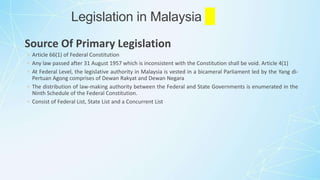
Legislation in Malaysia
Source Of Primary Legislation
◦ Article 66(1) of Federal Constitution
◦ Any law passed after 31 August 1957 which is inconsistent with the Constitution shall be void. Article 4(1)
◦ At Federal Level, the legislative authority in Malaysia is vested in a bicameral Parliament led by the Yang di-
Pertuan Agong comprises of Dewan Rakyat and Dewan Negara
◦ The distribution of law-making authority between the Federal and State Governments is enumerated in the
Ninth Schedule of the Federal Constitution.
◦ Consist of Federal List, State List and a Concurrent List
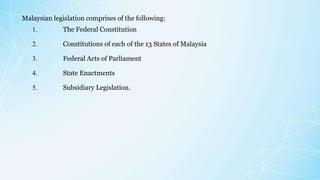
Malaysian legislation comprises of the following:
1. The Federal Constitution
2. Constitutions of each of the 13 States of Malaysia
3. Federal Acts of Parliament
4. State Enactments
5. Subsidiary Legislation.
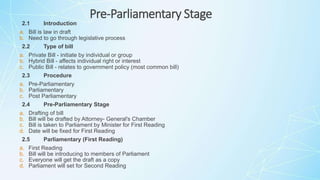
Pre-Parliamentary Stage
2.1 Introduction
a. Bill is law in draft
b. Need to go through legislative process
2.2 Type of bill
a. Private Bill - initiate by individual or group
b. Hybrid Bill - affects individual right or interest
c. Public Bill - relates to government policy (most common bill)
2.3 Procedure
a. Pre-Parliamentary
b. Parliamentary
c. Post Parliamentary
2.4 Pre-Parliamentary Stage
a. Drafting of bill
b. Bill will be drafted by Attorney- General's Chamber
c. Bill is taken to Parliament by Minister for First Reading
d. Date will be fixed for First Reading
2.5 Parliamentary (First Reading)
a. First Reading
b. Bill will be introducing to members of Parliament
c. Everyone will get the draft as a copy
d. Parliament will set for Second Reading
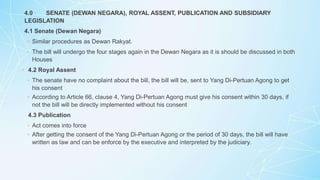
4.0 SENATE (DEWAN NEGARA), ROYAL ASSENT, PUBLICATION AND SUBSIDIARY
LEGISLATION
4.1 Senate (Dewan Negara)
◦ Similar procedures as Dewan Rakyat.
◦ The bill will undergo the four stages again in the Dewan Negara as it is should be discussed in both
Houses
◦ 4.2 Royal Assent
◦ The senate have no complaint about the bill, the bill will be, sent to Yang Di-Pertuan Agong to get
his consent
◦ According to Article 66, clause 4, Yang Di-Pertuan Agong must give his consent within 30 days, if
not the bill will be directly implemented without his consent
4.3 Publication
◦ Act comes into force
◦ After getting the consent of the Yang Di-Pertuan Agong or the period of 30 days, the bill will have
written as law and can be enforce by the executive and interpreted by the judiciary.
PRE PARLIAMENTARY
STAGE
LAW MAKING PROCESS
WHAT IS BILL?
A Bill actually just a draft of legislative proposal
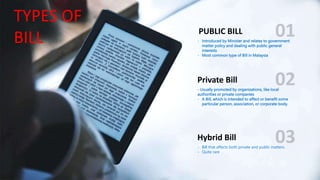
TYPES OF
BILL - Introduced by Minister and relates to government
matter policy and dealing with public general
interests
- Most common type of Bill in Malaysia
PUBLIC BILL
- Usually promoted by organizations, like local
authorities or private companies
- A Bill, which is intended to affect or benefit some
particular person, association, or corporate body.
Private Bill
- Bill that affects both private and public matters.
- Quite rare
Hybrid Bill
LAW MAKING PROCESS
PROPOSED BILL
DRAFTING OF
BILL
FINAL
BILL
- Discussion
- The idea can come from anybody in making a draft
01
- The proposal is sent to the Parliamentary Draftsperson in the Attorney
General’s Chambers
- To put legal language and correct form
02
- Proposal is complete converted, the proposal is now known as a bill
- Return back to review and make sure that the provision they desire are in
the bill in the correct form.
03
The procedure is set out in Chapter 5, Part IV of the Federal
Constitution and Standing Orders of Dewan Rakyat (Parliament) and
Dewan Negara (Senate) .
The Standing Orders regulate the actual procedure in the passage of
a Bill in Parliament.
These rules have been drawn up under powers conferred by Article
62 of Constitution which House of Parliament shall regulate its own
procedure.
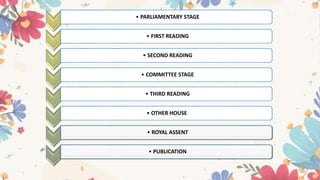
• PARLIAMENTARY STAGE
• FIRST READING
• SECOND READING
• COMMITTEE STAGE
• THIRD READING
• OTHER HOUSE
• ROYAL ASSENT
• PUBLICATION
1st READING
The first reading principally consists of the act of submission, i.e. the introduction of the Bill to
Parliament.
Minister will give notice to inform the Secretary of the House of Parliament & the Senate.
The bill will be listed in the Aturan Urusan Mesyuarat (AUM) for the First Reading.
The Minister/ Deputy Minister will read the tittle of the bill.
There is no debate or amendment at this stage of the proceedings.
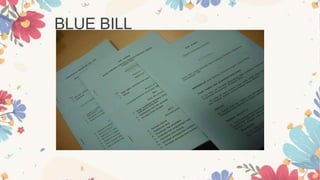
Before the First Reading the Blue Bill will be distribute to all the members of the Parliament.
BLUE BILL
The bill will be listed in the Aturan Urusan Mesyuarat (AUM) according as determined by the
Government.
The Minister/Deputy Minister will motion “Iaitu Rang Undang-Undang ini dibacakan kali yang
kedua sekarang” and supported by a member of the administration. - PM 53 (3)
The minister outlines the main principles of the bill.
A debate on principles ensues.
If the bill receives the requisite number of votes, it proceeds to Committee Stage. But, If the
House disagrees, then the bill is defeated.
2nd READING
COMMITTEE STAGE
The bill will be submitted to a member Committee of the Council
– PM 54 (2)
◦ Sometimes a Bill is not considered by the Committee of the whole
House but by a Special Select Committee.
Meeting Council convenes as a Committee and the Yang di-Pertua
will Chairing the meeting.
In Committee Stage, only the clauses of the Bill will be discussed
and policy matters not discussed further. – PM 55 (2)
The secretary will read out the clause numbers in the Bill (clause
by clause) – PM 57 (1)
COMMITTEE STAGE
If there is an amendment to the Bill – it need to be
proposed and informed the Parliament at least one
day in advance. – PM 57 (2)
If all the proposed amendments are completed, the
The Chairman shall submit the matter as Committee's
decision. – 57 (1)
When discussion is completed in Committee, the
minister moves a motion to report the Bill under
consideration to the Parliament – PM 57 (13)
When the Parliament resumes sitting, the Minister reports that the
Bills has been considered and accepted by the Committee with or
without amendments – PM 57 (14)
Debate can be carried out but limited to the content of the bill only –
PM 61
The Minister then moves a motion that the Bill be read a third time
and passed. If the motion is accepted, the Bill is considered passed.
3rd READING
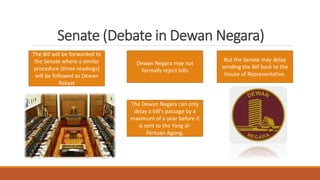
Senate (Debate in Dewan Negara)
The Bill will be forwarded to
the Senate where a similar
procedure (three readings)
will be followed as Dewan
Rakyat
Dewan Negara may not
formally reject bills
But the Senate may delay
sending the Bill back to the
House of Representative.
The Dewan Negara can only
delay a bill's passage by a
maximum of a year before it
is sent to the Yang di-
Pertuan Agong.
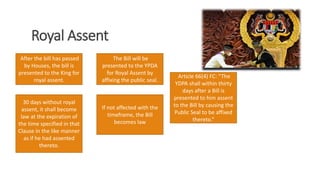
Royal Assent
After the bill has passed
by Houses, the bill is
presented to the King for
royal assent.
The Bill will be
presented to the YPDA
for Royal Assent by
affixing the public seal.
Article 66(4) FC: “The
YDPA shall within thirty
days after a Bill is
presented to him assent
to the Bill by causing the
Public Seal to be affixed
thereto.”
30 days without royal
assent, it shall become
law at the expiration of
the time specified in that
Clause in the like manner
as if he had assented
thereto.
If not affected with the
timeframe, the Bill
becomes law
Publication
Article 66 (5): “A Bill shall become law
on being assented to by the YDPA or as
provided in Clause (4A), but no law
shall come into force until it has been
published, without prejudice, however,
to the power of parliament to
postpone the operation of any law or
to make laws with retrospective
effect.”
Power of Parliament to postpone the
operation of the law or to make laws
with retrospective effect. Parliament
can specify that the law is to take
effect at a later date even though it is
published today
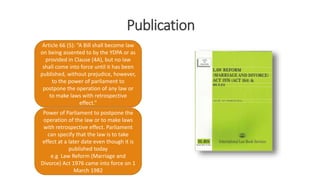
e.g Law Reform (Marriage and
Divorce) Act 1976 came into force on 1
March 1982

PRESENTATION 1.pptx

  • 1.
    Legislation And Legislative ProcessIn Malaysia Master of Enforcement Law (LW707) BY: MOHD TARMIZI BIN SAID (2021351147) MUHAMMAD ASRAF BIN HASHIM (2021772909) MUHAMMAD TAUFIK BIN SAHADOM (2021790845) TENGKU IRENE SYAMEIRA BINTI TENGKU AHMAD NOOR (2021932263)
  • 2.
    Legislation in Malaysia SourceOf Primary Legislation ◦ Article 66(1) of Federal Constitution ◦ Any law passed after 31 August 1957 which is inconsistent with the Constitution shall be void. Article 4(1) ◦ At Federal Level, the legislative authority in Malaysia is vested in a bicameral Parliament led by the Yang di- Pertuan Agong comprises of Dewan Rakyat and Dewan Negara ◦ The distribution of law-making authority between the Federal and State Governments is enumerated in the Ninth Schedule of the Federal Constitution. ◦ Consist of Federal List, State List and a Concurrent List
  • 3.
    Malaysian legislation comprisesof the following: 1. The Federal Constitution 2. Constitutions of each of the 13 States of Malaysia 3. Federal Acts of Parliament 4. State Enactments 5. Subsidiary Legislation.
  • 4.
    Pre-Parliamentary Stage 2.1 Introduction a.Bill is law in draft b. Need to go through legislative process 2.2 Type of bill a. Private Bill - initiate by individual or group b. Hybrid Bill - affects individual right or interest c. Public Bill - relates to government policy (most common bill) 2.3 Procedure a. Pre-Parliamentary b. Parliamentary c. Post Parliamentary 2.4 Pre-Parliamentary Stage a. Drafting of bill b. Bill will be drafted by Attorney- General's Chamber c. Bill is taken to Parliament by Minister for First Reading d. Date will be fixed for First Reading 2.5 Parliamentary (First Reading) a. First Reading b. Bill will be introducing to members of Parliament c. Everyone will get the draft as a copy d. Parliament will set for Second Reading
  • 5.
    4.0 SENATE (DEWANNEGARA), ROYAL ASSENT, PUBLICATION AND SUBSIDIARY LEGISLATION 4.1 Senate (Dewan Negara) ◦ Similar procedures as Dewan Rakyat. ◦ The bill will undergo the four stages again in the Dewan Negara as it is should be discussed in both Houses ◦ 4.2 Royal Assent ◦ The senate have no complaint about the bill, the bill will be, sent to Yang Di-Pertuan Agong to get his consent ◦ According to Article 66, clause 4, Yang Di-Pertuan Agong must give his consent within 30 days, if not the bill will be directly implemented without his consent 4.3 Publication ◦ Act comes into force ◦ After getting the consent of the Yang Di-Pertuan Agong or the period of 30 days, the bill will have written as law and can be enforce by the executive and interpreted by the judiciary.
  • 6.
  • 7.
    WHAT IS BILL? ABill actually just a draft of legislative proposal
  • 8.
    TYPES OF BILL -Introduced by Minister and relates to government matter policy and dealing with public general interests - Most common type of Bill in Malaysia PUBLIC BILL - Usually promoted by organizations, like local authorities or private companies - A Bill, which is intended to affect or benefit some particular person, association, or corporate body. Private Bill - Bill that affects both private and public matters. - Quite rare Hybrid Bill
  • 9.
    LAW MAKING PROCESS PROPOSEDBILL DRAFTING OF BILL FINAL BILL - Discussion - The idea can come from anybody in making a draft 01 - The proposal is sent to the Parliamentary Draftsperson in the Attorney General’s Chambers - To put legal language and correct form 02 - Proposal is complete converted, the proposal is now known as a bill - Return back to review and make sure that the provision they desire are in the bill in the correct form. 03
  • 11.
    The procedure isset out in Chapter 5, Part IV of the Federal Constitution and Standing Orders of Dewan Rakyat (Parliament) and Dewan Negara (Senate) . The Standing Orders regulate the actual procedure in the passage of a Bill in Parliament. These rules have been drawn up under powers conferred by Article 62 of Constitution which House of Parliament shall regulate its own procedure.
  • 12.
    • PARLIAMENTARY STAGE •FIRST READING • SECOND READING • COMMITTEE STAGE • THIRD READING • OTHER HOUSE • ROYAL ASSENT • PUBLICATION
  • 13.
    1st READING The firstreading principally consists of the act of submission, i.e. the introduction of the Bill to Parliament. Minister will give notice to inform the Secretary of the House of Parliament & the Senate. The bill will be listed in the Aturan Urusan Mesyuarat (AUM) for the First Reading. The Minister/ Deputy Minister will read the tittle of the bill. There is no debate or amendment at this stage of the proceedings. Before the First Reading the Blue Bill will be distribute to all the members of the Parliament.
  • 14.
  • 15.
    The bill willbe listed in the Aturan Urusan Mesyuarat (AUM) according as determined by the Government. The Minister/Deputy Minister will motion “Iaitu Rang Undang-Undang ini dibacakan kali yang kedua sekarang” and supported by a member of the administration. - PM 53 (3) The minister outlines the main principles of the bill. A debate on principles ensues. If the bill receives the requisite number of votes, it proceeds to Committee Stage. But, If the House disagrees, then the bill is defeated. 2nd READING
  • 16.
    COMMITTEE STAGE The billwill be submitted to a member Committee of the Council – PM 54 (2) ◦ Sometimes a Bill is not considered by the Committee of the whole House but by a Special Select Committee. Meeting Council convenes as a Committee and the Yang di-Pertua will Chairing the meeting. In Committee Stage, only the clauses of the Bill will be discussed and policy matters not discussed further. – PM 55 (2) The secretary will read out the clause numbers in the Bill (clause by clause) – PM 57 (1)
  • 17.
    COMMITTEE STAGE If thereis an amendment to the Bill – it need to be proposed and informed the Parliament at least one day in advance. – PM 57 (2) If all the proposed amendments are completed, the The Chairman shall submit the matter as Committee's decision. – 57 (1) When discussion is completed in Committee, the minister moves a motion to report the Bill under consideration to the Parliament – PM 57 (13)
  • 18.
    When the Parliamentresumes sitting, the Minister reports that the Bills has been considered and accepted by the Committee with or without amendments – PM 57 (14) Debate can be carried out but limited to the content of the bill only – PM 61 The Minister then moves a motion that the Bill be read a third time and passed. If the motion is accepted, the Bill is considered passed. 3rd READING
  • 19.
    Senate (Debate inDewan Negara) The Bill will be forwarded to the Senate where a similar procedure (three readings) will be followed as Dewan Rakyat Dewan Negara may not formally reject bills But the Senate may delay sending the Bill back to the House of Representative. The Dewan Negara can only delay a bill's passage by a maximum of a year before it is sent to the Yang di- Pertuan Agong.
  • 20.
    Royal Assent After thebill has passed by Houses, the bill is presented to the King for royal assent. The Bill will be presented to the YPDA for Royal Assent by affixing the public seal. Article 66(4) FC: “The YDPA shall within thirty days after a Bill is presented to him assent to the Bill by causing the Public Seal to be affixed thereto.” 30 days without royal assent, it shall become law at the expiration of the time specified in that Clause in the like manner as if he had assented thereto. If not affected with the timeframe, the Bill becomes law
  • 21.
    Publication Article 66 (5):“A Bill shall become law on being assented to by the YDPA or as provided in Clause (4A), but no law shall come into force until it has been published, without prejudice, however, to the power of parliament to postpone the operation of any law or to make laws with retrospective effect.” Power of Parliament to postpone the operation of the law or to make laws with retrospective effect. Parliament can specify that the law is to take effect at a later date even though it is published today e.g Law Reform (Marriage and Divorce) Act 1976 came into force on 1 March 1982