Present Perfect
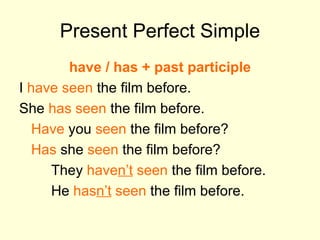
Present Perfect Simple have / has + past participle I  have seen  the film before. She  has seen  the film before. Have  you  seen  the film before? Has  she  seen  the film before? They  have n’t  seen  the film before. He  has n’t  seen  the film before.
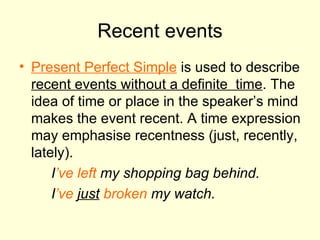
Recent events Present Perfect Simple   is used to describe  recent events without a definite  time . The idea of time or place in the speaker’s mind makes the event recent. A time expression may emphasise recentness ( just, recently, lately ). I ’ve left  my shopping bag behind. I ’ve   just   broken  my watch.
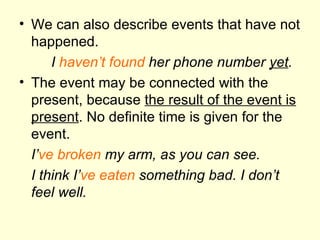
We can also describe events that have not happened. I  haven’t found  her phone number  yet . The event may be connected with the present, because  the result of the event is present . No definite time is given for the event. I’ ve   broken  my arm, as you can see. I think I’ ve   eaten  something bad. I don’t feel well.
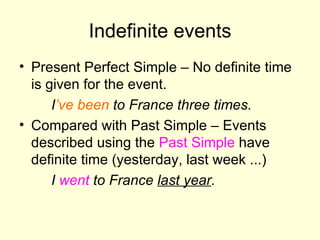
Indefinite events Present Perfect Simple – No definite time is given for the event. I ’ve   been  to France three times. Compared with Past Simple – Events described using the  Past Simple  have definite time (yesterday, last week ...) I  went  to France  last year .
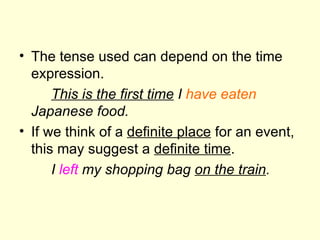
The tense used can depend on the time expression. This is the first time  I  have eaten  Japanese food. If we think of a  definite place  for an event, this may suggest a  definite time . I  left  my shopping bag  on the train .
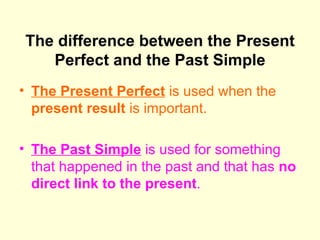
The difference between the Present Perfect and the Past Simple The Present Perfect  is used when the  present result  is important.  The Past Simple  is used for something that happened in the past and that has  no direct link to the present .
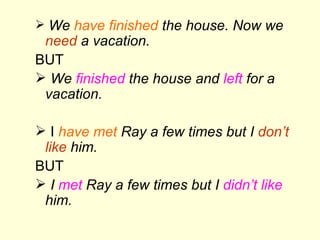
We  have finished  the house. Now we  need  a vacation. BUT We  finished  the house and  left  for a vacation. I  have met  Ray a few times but I  don’t like  him. BUT I  met  Ray a few times but I  didn’t like  him.
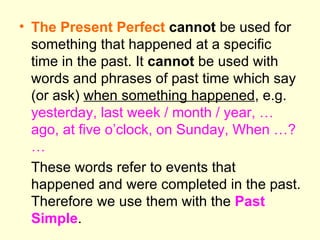
The Present Perfect   cannot  be used for something that happened at a specific time in the past. It  cannot  be used with words and phrases of past time which say (or ask)  when something happened , e.g.  yesterday, last week / month / year, …ago, at five o’clock, on Sunday, When …? … These words refer to events that happened and were completed in the past. Therefore we use them with the  Past Simple .
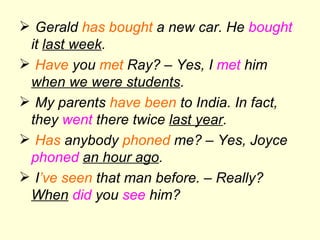
Gerald  has bought  a new car. He  bought  it  last week . Have  you  met  Ray? – Yes, I  met  him  when we were students . My parents  have been  to India. In fact, they  went  there twice  last year . Has  anybody  phoned  me? – Yes, Joyce  phoned   an hour ago . I ’ve   seen  that man before. – Really?  When   did  you  see  him?
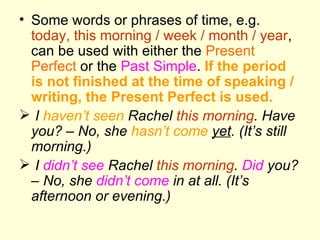
Some words or phrases of time, e.g.  today, this morning / week / month / year , can be used with either the  Present Perfect  or the  Past Simple .  If the period is not finished at the time of speaking / writing, the Present Perfect is used. I  haven’t seen  Rachel  this morning . Have you? – No, she  hasn’t come   yet . (It’s still morning.) I  didn’t see  Rachel  this morning .  Did  you? – No, she  didn’t come  in at all. (It’s afternoon or evening.)
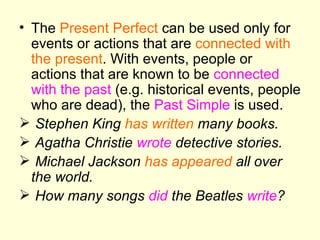
The  Present Perfect  can be used only for events or actions that are  connected with the present . With events, people or actions that are known to be  connected with the past  (e.g. historical events, people who are dead), the  Past Simple  is used. Stephen King  has written  many books. Agatha Christie  wrote  detective stories. Michael Jackson  has appeared  all over the world. How many songs  did  the Beatles  write ?
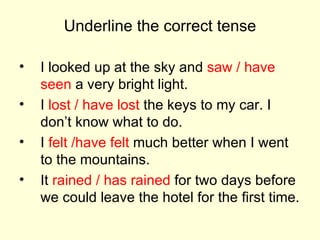
Underline the correct tense I looked up at the sky and  saw / have   seen  a very bright light. I  lost / have lost  the keys to my car. I don’t know what to do. I  felt /have felt  much better when I went to the mountains. It  rained / has rained  for two days before we could leave the hotel for the first time.
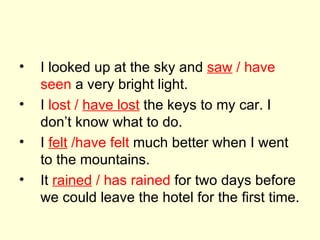
I looked up at the sky and  saw  / have   seen  a very bright light. I  lost /  have lost  the keys to my car. I don’t know what to do. I  felt  /have felt  much better when I went to the mountains. It  rained  / has rained  for two days before we could leave the hotel for the first time.
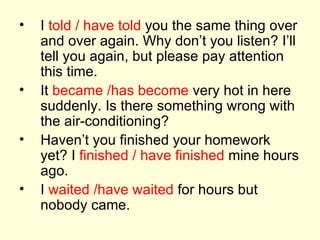
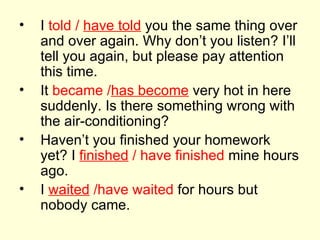
I  told / have told  you the same thing over and over again. Why don’t you listen? I’ll tell you again, but please pay attention this time. It  became /has become  very hot in here suddenly. Is there something wrong with the air-conditioning? Haven’t you finished your homework yet? I  finished / have finished  mine hours ago. I  waited /have waited  for hours but nobody came.
I  told /  have told  you the same thing over and over again. Why don’t you listen? I’ll tell you again, but please pay attention this time. It  became / has become  very hot in here suddenly. Is there something wrong with the air-conditioning? Haven’t you finished your homework yet? I  finished  / have finished  mine hours ago. I  waited  /have waited  for hours but nobody came.
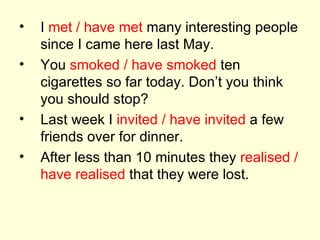
I  met / have met  many interesting people since I came here last May. You  smoked / have smoked  ten cigarettes so far today. Don’t you think you should stop? Last week I  invited / have invited  a few friends over for dinner. After less than 10 minutes they  realised / have realised  that they were lost.
I  met /  have met  many interesting people since I came here last May. You  smoked /  have smoked  ten cigarettes so far today. Don’t you think you should stop? Last week I  invited  / have invited  a few friends over for dinner. After less than 10 minutes they  realised  / have realised  that they were lost.
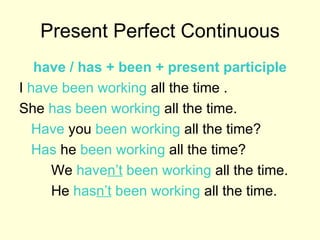
Present Perfect Continuous have / has + been + present participle I  have been working  all the time . She  has been working  all the time. Have  you  been working  all the time? Has  he  been working  all the time? We  have n’t  been working  all the time. He  has n’t  been working  all the time.
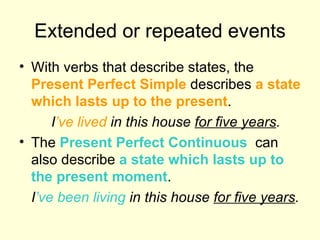
Extended or repeated events With verbs that describe states, the  Present Perfect Simple  describes  a state which lasts up to the present . I ’ve   lived  in this house  for five years . The  Present Perfect Continuous   can also describe  a state which lasts up to the present moment . I ’ve been living  in this house  for five years .
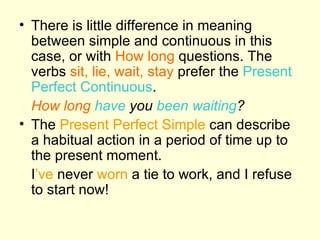
There is little difference in meaning between simple and continuous in this case, or with  How long  questions. The verbs  sit, lie, wait, stay  prefer the  Present Perfect Continuous . How long   have  you  been waiting ? The   Present Perfect Simple  can describe a habitual action in a period of time up to the present moment. I ’ve  never  worn  a tie to work, and I refuse to start now!
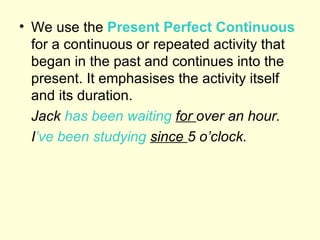
We use the  Present Perfect Continuous  for a continuous or repeated activity that began in the past and continues into the present. It emphasises the activity itself and its duration. Jack  has been waiting   for  over an hour. I ’ve   been studying   since  5 o’clock.
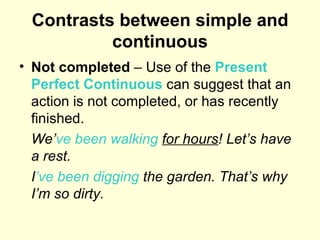
Contrasts between simple and continuous Not completed  – Use of the  Present Perfect Continuous  can suggest that an action is not completed, or has recently finished. We’ ve   been walking   for hours ! Let’s have a rest. I ’ve   been digging  the garden. That’s why I’m so dirty.
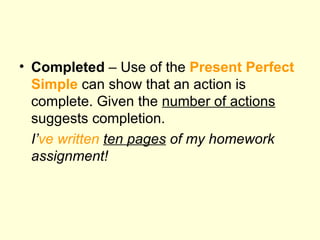
Completed  – Use of the  Present Perfect Simple  can show that an action is complete. Given the  number of actions  suggests completion. I’ ve written   ten pages  of my homework assignment!
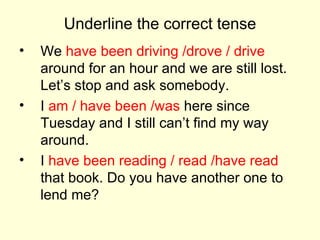
Underline the correct tense We  have been driving /drove / drive  around for an hour and we are still lost. Let’s stop and ask somebody. I  am / have been /was  here since Tuesday and I still can’t find my way around. I  have been reading / read /have read  that book. Do you have another one to lend me?
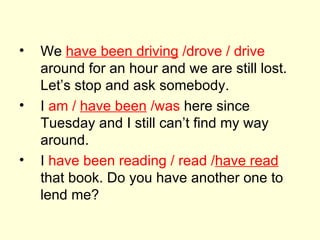
We  have been driving  /drove / drive  around for an hour and we are still lost. Let’s stop and ask somebody. I  am /  have been  /was  here since Tuesday and I still can’t find my way around. I  have been reading / read / have read  that book. Do you have another one to lend me?
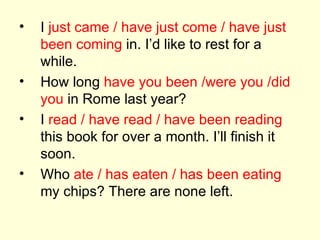
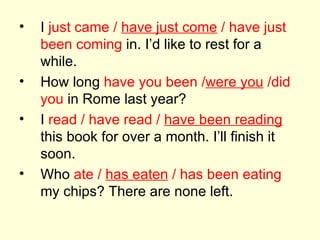
I  just came / have just come / have just been coming  in. I’d like to rest for a while. How long  have you been /were you /did you  in Rome last year? I  read / have read / have been reading  this book for over a month. I’ll finish it soon. Who  ate / has eaten / has been eating  my chips? There are none left.
I  just came /  have just come  / have just been coming  in. I’d like to rest for a while. How long  have you been / were you  /did you  in Rome last year? I  read / have read /  have been reading  this book for over a month. I’ll finish it soon. Who  ate /  has eaten  / has been eating  my chips? There are none left.
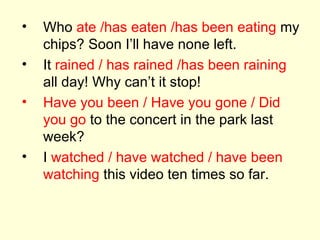
Who  ate /has eaten /has been eating  my chips? Soon I’ll have none left. It  rained / has rained /has been raining  all day! Why can’t it stop! Have you been / Have you gone / Did you go  to the concert in the park last week? I  watched / have watched / have been watching  this video ten times so far.
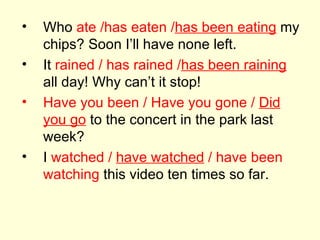
Who  ate /has eaten / has been eating  my chips? Soon I’ll have none left. It  rained / has rained / has been raining  all day! Why can’t it stop! Have you been / Have you gone /  Did you go  to the concert in the park last week? I  watched /  have watched  / have been watching  this video ten times so far.
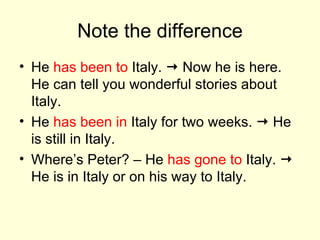
Note the difference He  has been to  Italy.    Now he is here. He can tell you wonderful stories about Italy. He  has been in  Italy for two weeks.    He is still in Italy. Where’s Peter? – He  has gone to  Italy.    He is in Italy or on his way to Italy.

Present Perfect

  • 1.
  • 2.
    Present Perfect Simplehave / has + past participle I have seen the film before. She has seen the film before. Have you seen the film before? Has she seen the film before? They have n’t seen the film before. He has n’t seen the film before.
  • 3.
    Recent events PresentPerfect Simple is used to describe recent events without a definite time . The idea of time or place in the speaker’s mind makes the event recent. A time expression may emphasise recentness ( just, recently, lately ). I ’ve left my shopping bag behind. I ’ve just broken my watch.
  • 4.
    We can alsodescribe events that have not happened. I haven’t found her phone number yet . The event may be connected with the present, because the result of the event is present . No definite time is given for the event. I’ ve broken my arm, as you can see. I think I’ ve eaten something bad. I don’t feel well.
  • 5.
    Indefinite events PresentPerfect Simple – No definite time is given for the event. I ’ve been to France three times. Compared with Past Simple – Events described using the Past Simple have definite time (yesterday, last week ...) I went to France last year .
  • 6.
    The tense usedcan depend on the time expression. This is the first time I have eaten Japanese food. If we think of a definite place for an event, this may suggest a definite time . I left my shopping bag on the train .
  • 7.
    The difference betweenthe Present Perfect and the Past Simple The Present Perfect is used when the present result is important. The Past Simple is used for something that happened in the past and that has no direct link to the present .
  • 8.
    We havefinished the house. Now we need a vacation. BUT We finished the house and left for a vacation. I have met Ray a few times but I don’t like him. BUT I met Ray a few times but I didn’t like him.
  • 9.
    The Present Perfect cannot be used for something that happened at a specific time in the past. It cannot be used with words and phrases of past time which say (or ask) when something happened , e.g. yesterday, last week / month / year, …ago, at five o’clock, on Sunday, When …? … These words refer to events that happened and were completed in the past. Therefore we use them with the Past Simple .
  • 10.
    Gerald hasbought a new car. He bought it last week . Have you met Ray? – Yes, I met him when we were students . My parents have been to India. In fact, they went there twice last year . Has anybody phoned me? – Yes, Joyce phoned an hour ago . I ’ve seen that man before. – Really? When did you see him?
  • 11.
    Some words orphrases of time, e.g. today, this morning / week / month / year , can be used with either the Present Perfect or the Past Simple . If the period is not finished at the time of speaking / writing, the Present Perfect is used. I haven’t seen Rachel this morning . Have you? – No, she hasn’t come yet . (It’s still morning.) I didn’t see Rachel this morning . Did you? – No, she didn’t come in at all. (It’s afternoon or evening.)
  • 12.
    The PresentPerfect can be used only for events or actions that are connected with the present . With events, people or actions that are known to be connected with the past (e.g. historical events, people who are dead), the Past Simple is used. Stephen King has written many books. Agatha Christie wrote detective stories. Michael Jackson has appeared all over the world. How many songs did the Beatles write ?
  • 13.
    Underline the correcttense I looked up at the sky and saw / have seen a very bright light. I lost / have lost the keys to my car. I don’t know what to do. I felt /have felt much better when I went to the mountains. It rained / has rained for two days before we could leave the hotel for the first time.
  • 14.
    I looked upat the sky and saw / have seen a very bright light. I lost / have lost the keys to my car. I don’t know what to do. I felt /have felt much better when I went to the mountains. It rained / has rained for two days before we could leave the hotel for the first time.
  • 15.
    I told/ have told you the same thing over and over again. Why don’t you listen? I’ll tell you again, but please pay attention this time. It became /has become very hot in here suddenly. Is there something wrong with the air-conditioning? Haven’t you finished your homework yet? I finished / have finished mine hours ago. I waited /have waited for hours but nobody came.
  • 16.
    I told/ have told you the same thing over and over again. Why don’t you listen? I’ll tell you again, but please pay attention this time. It became / has become very hot in here suddenly. Is there something wrong with the air-conditioning? Haven’t you finished your homework yet? I finished / have finished mine hours ago. I waited /have waited for hours but nobody came.
  • 17.
    I met/ have met many interesting people since I came here last May. You smoked / have smoked ten cigarettes so far today. Don’t you think you should stop? Last week I invited / have invited a few friends over for dinner. After less than 10 minutes they realised / have realised that they were lost.
  • 18.
    I met/ have met many interesting people since I came here last May. You smoked / have smoked ten cigarettes so far today. Don’t you think you should stop? Last week I invited / have invited a few friends over for dinner. After less than 10 minutes they realised / have realised that they were lost.
  • 19.
    Present Perfect Continuoushave / has + been + present participle I have been working all the time . She has been working all the time. Have you been working all the time? Has he been working all the time? We have n’t been working all the time. He has n’t been working all the time.
  • 20.
    Extended or repeatedevents With verbs that describe states, the Present Perfect Simple describes a state which lasts up to the present . I ’ve lived in this house for five years . The Present Perfect Continuous can also describe a state which lasts up to the present moment . I ’ve been living in this house for five years .
  • 21.
    There is littledifference in meaning between simple and continuous in this case, or with How long questions. The verbs sit, lie, wait, stay prefer the Present Perfect Continuous . How long have you been waiting ? The Present Perfect Simple can describe a habitual action in a period of time up to the present moment. I ’ve never worn a tie to work, and I refuse to start now!
  • 22.
    We use the Present Perfect Continuous for a continuous or repeated activity that began in the past and continues into the present. It emphasises the activity itself and its duration. Jack has been waiting for over an hour. I ’ve been studying since 5 o’clock.
  • 23.
    Contrasts between simpleand continuous Not completed – Use of the Present Perfect Continuous can suggest that an action is not completed, or has recently finished. We’ ve been walking for hours ! Let’s have a rest. I ’ve been digging the garden. That’s why I’m so dirty.
  • 24.
    Completed –Use of the Present Perfect Simple can show that an action is complete. Given the number of actions suggests completion. I’ ve written ten pages of my homework assignment!
  • 25.
    Underline the correcttense We have been driving /drove / drive around for an hour and we are still lost. Let’s stop and ask somebody. I am / have been /was here since Tuesday and I still can’t find my way around. I have been reading / read /have read that book. Do you have another one to lend me?
  • 26.
    We havebeen driving /drove / drive around for an hour and we are still lost. Let’s stop and ask somebody. I am / have been /was here since Tuesday and I still can’t find my way around. I have been reading / read / have read that book. Do you have another one to lend me?
  • 27.
    I justcame / have just come / have just been coming in. I’d like to rest for a while. How long have you been /were you /did you in Rome last year? I read / have read / have been reading this book for over a month. I’ll finish it soon. Who ate / has eaten / has been eating my chips? There are none left.
  • 28.
    I justcame / have just come / have just been coming in. I’d like to rest for a while. How long have you been / were you /did you in Rome last year? I read / have read / have been reading this book for over a month. I’ll finish it soon. Who ate / has eaten / has been eating my chips? There are none left.
  • 29.
    Who ate/has eaten /has been eating my chips? Soon I’ll have none left. It rained / has rained /has been raining all day! Why can’t it stop! Have you been / Have you gone / Did you go to the concert in the park last week? I watched / have watched / have been watching this video ten times so far.
  • 30.
    Who ate/has eaten / has been eating my chips? Soon I’ll have none left. It rained / has rained / has been raining all day! Why can’t it stop! Have you been / Have you gone / Did you go to the concert in the park last week? I watched / have watched / have been watching this video ten times so far.
  • 31.
    Note the differenceHe has been to Italy.  Now he is here. He can tell you wonderful stories about Italy. He has been in Italy for two weeks.  He is still in Italy. Where’s Peter? – He has gone to Italy.  He is in Italy or on his way to Italy.