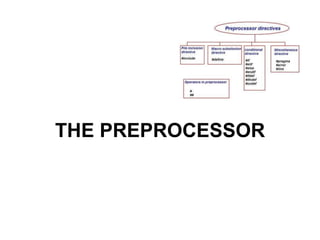
THE PREPROCESSOR
Contents
• The preprocessor introduction
• #include
• #define (Symbolic Constants)
• #define (Macro)
• Conditional compilation
• #error and #pragma
• # and ## Operators
• Line Numbers
• Predefined Symbolic Constants
• Assertions
2
Introduction
– Occurs before program compiled
• Inclusion of external files (#include <stdio.h>)
• Definition of symbolic constants (#define max 100)
• Macros
• Conditional compilation (#ifdef #elif #endif …)
• Conditional execution
– All directives begin with #
– Directives not C++ statements
• Do not end with ;
– Preprocessor is the text replacement
3
#include
– Puts copy of file in place of directive
• Seen many times in example code
– Two forms
• #include <filename>
– For standard library header files in SDK
– Searches predestinated directories
• #include "filename"
– Searches in current directory
– Normally used for programmer-defined files
4
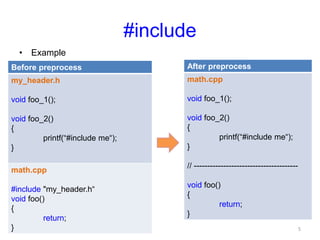
#include
• Example
– Before preprocess
– After preprocess
After preprocess
math.cpp
void foo_1();
void foo_2()
{
printf(“#include me“);
}
// ---------------------------------------
void foo()
{
return;
}
Before preprocess
my_header.h
void foo_1();
void foo_2()
{
printf(“#include me“);
}
math.cpp
#include "my_header.h“
void foo()
{
return;
} 5
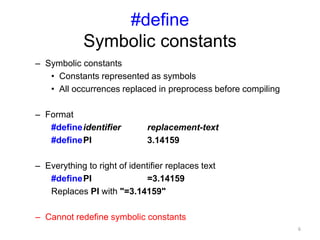
#define
Symbolic constants
– Symbolic constants
• Constants represented as symbols
• All occurrences replaced in preprocess before compiling
– Format
#defineidentifier replacement-text
#definePI 3.14159
– Everything to right of identifier replaces text
#definePI =3.14159
Replaces PI with "=3.14159"
– Cannot redefine symbolic constants
6
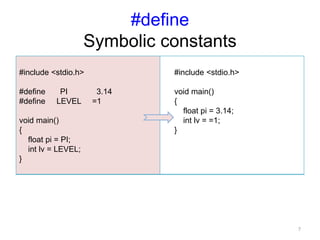
#define
Symbolic constants
#include <stdio.h>
#define PI 3.14
#define LEVEL =1
void main()
{
float pi = PI;
int lv = LEVEL;
}
#include <stdio.h>
void main()
{
float pi = 3.14;
int lv = =1;
}
7
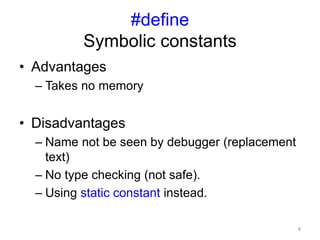
#define
Symbolic constants
• Advantages
– Takes no memory
• Disadvantages
– Name not be seen by debugger (replacement
text)
– No type checking (not safe).
– Using static constant instead.
8
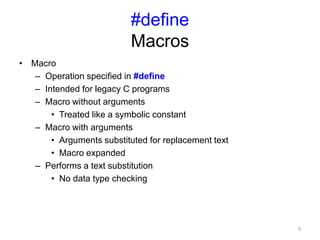
#define
Macros
• Macro
– Operation specified in #define
– Intended for legacy C programs
– Macro without arguments
• Treated like a symbolic constant
– Macro with arguments
• Arguments substituted for replacement text
• Macro expanded
– Performs a text substitution
• No data type checking
9
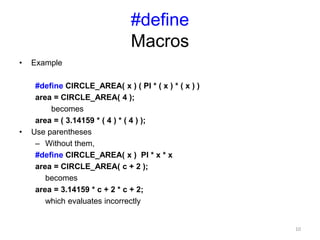
#define
Macros
• Example
#define CIRCLE_AREA( x ) ( PI * ( x ) * ( x ) )
area = CIRCLE_AREA( 4 );
becomes
area = ( 3.14159 * ( 4 ) * ( 4 ) );
• Use parentheses
– Without them,
#define CIRCLE_AREA( x ) PI * x * x
area = CIRCLE_AREA( c + 2 );
becomes
area = 3.14159 * c + 2 * c + 2;
which evaluates incorrectly
10
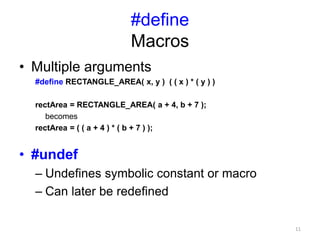
#define
Macros
• Multiple arguments
#define RECTANGLE_AREA( x, y ) ( ( x ) * ( y ) )
rectArea = RECTANGLE_AREA( a + 4, b + 7 );
becomes
rectArea = ( ( a + 4 ) * ( b + 7 ) );
• #undef
– Undefines symbolic constant or macro
– Can later be redefined
11
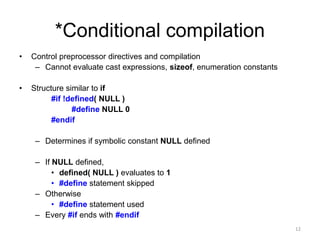
*Conditional compilation
• Control preprocessor directives and compilation
– Cannot evaluate cast expressions, sizeof, enumeration constants
• Structure similar to if
#if !defined( NULL )
#define NULL 0
#endif
– Determines if symbolic constant NULL defined
– If NULL defined,
• defined( NULL ) evaluates to 1
• #define statement skipped
– Otherwise
• #define statement used
– Every #if ends with #endif
12
*Conditional compilation
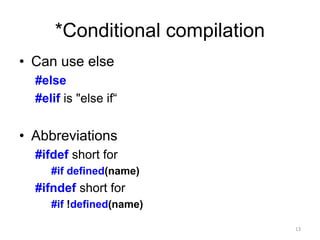
• Can use else
#else
#elif is "else if“
• Abbreviations
#ifdef short for
#if defined(name)
#ifndef short for
#if !defined(name)
13
*Conditional compilation
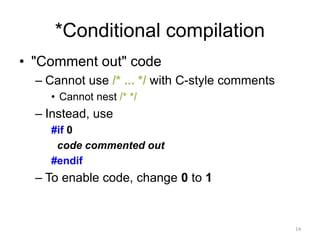
• "Comment out" code
– Cannot use /* ... */ with C-style comments
• Cannot nest /* */
– Instead, use
#if 0
code commented out
#endif
– To enable code, change 0 to 1
14
*Conditional compilation
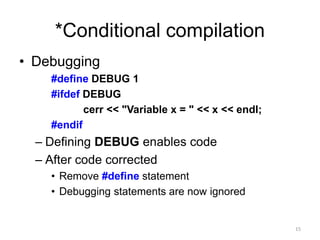
• Debugging
#define DEBUG 1
#ifdef DEBUG
cerr << "Variable x = " << x << endl;
#endif
– Defining DEBUG enables code
– After code corrected
• Remove #define statement
• Debugging statements are now ignored
15
#error and #pragma
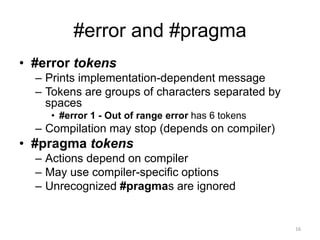
• #error tokens
– Prints implementation-dependent message
– Tokens are groups of characters separated by
spaces
• #error 1 - Out of range error has 6 tokens
– Compilation may stop (depends on compiler)
• #pragma tokens
– Actions depend on compiler
– May use compiler-specific options
– Unrecognized #pragmas are ignored
16
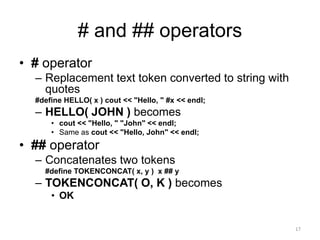
# and ## operators
• # operator
– Replacement text token converted to string with
quotes
#define HELLO( x ) cout << "Hello, " #x << endl;
– HELLO( JOHN ) becomes
• cout << "Hello, " "John" << endl;
• Same as cout << "Hello, John" << endl;
• ## operator
– Concatenates two tokens
#define TOKENCONCAT( x, y ) x ## y
– TOKENCONCAT( O, K ) becomes
• OK
17
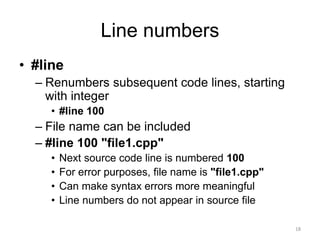
Line numbers
• #line
– Renumbers subsequent code lines, starting
with integer
• #line 100
– File name can be included
– #line 100 "file1.cpp"
• Next source code line is numbered 100
• For error purposes, file name is "file1.cpp"
• Can make syntax errors more meaningful
• Line numbers do not appear in source file
18
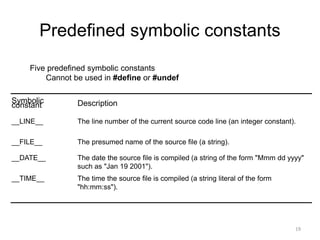
Predefined symbolic constants
Symbolic
constant Description
__LINE__ The line number of the current source code line (an integer constant).
__FILE__ The presumed name of the source file (a string).
__DATE__ The date the source file is compiled (a string of the form "Mmm dd yyyy"
such as "Jan 19 2001").
__TIME__ The time the source file is compiled (a string literal of the form
"hh:mm:ss").
Five predefined symbolic constants
Cannot be used in #define or #undef
19
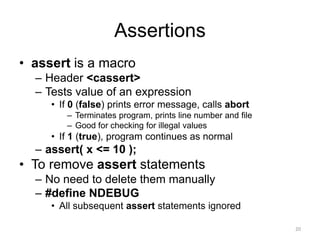
Assertions
• assert is a macro
– Header <cassert>
– Tests value of an expression
• If 0 (false) prints error message, calls abort
– Terminates program, prints line number and file
– Good for checking for illegal values
• If 1 (true), program continues as normal
– assert( x <= 10 );
• To remove assert statements
– No need to delete them manually
– #define NDEBUG
• All subsequent assert statements ignored
20

Preprocessor

  • 1.
  • 2.
    Contents • The preprocessorintroduction • #include • #define (Symbolic Constants) • #define (Macro) • Conditional compilation • #error and #pragma • # and ## Operators • Line Numbers • Predefined Symbolic Constants • Assertions 2
  • 3.
    Introduction – Occurs beforeprogram compiled • Inclusion of external files (#include <stdio.h>) • Definition of symbolic constants (#define max 100) • Macros • Conditional compilation (#ifdef #elif #endif …) • Conditional execution – All directives begin with # – Directives not C++ statements • Do not end with ; – Preprocessor is the text replacement 3
  • 4.
    #include – Puts copyof file in place of directive • Seen many times in example code – Two forms • #include <filename> – For standard library header files in SDK – Searches predestinated directories • #include "filename" – Searches in current directory – Normally used for programmer-defined files 4
  • 5.
    #include • Example – Beforepreprocess – After preprocess After preprocess math.cpp void foo_1(); void foo_2() { printf(“#include me“); } // --------------------------------------- void foo() { return; } Before preprocess my_header.h void foo_1(); void foo_2() { printf(“#include me“); } math.cpp #include "my_header.h“ void foo() { return; } 5
  • 6.
    #define Symbolic constants – Symbolicconstants • Constants represented as symbols • All occurrences replaced in preprocess before compiling – Format #defineidentifier replacement-text #definePI 3.14159 – Everything to right of identifier replaces text #definePI =3.14159 Replaces PI with "=3.14159" – Cannot redefine symbolic constants 6
  • 7.
    #define Symbolic constants #include <stdio.h> #definePI 3.14 #define LEVEL =1 void main() { float pi = PI; int lv = LEVEL; } #include <stdio.h> void main() { float pi = 3.14; int lv = =1; } 7
  • 8.
    #define Symbolic constants • Advantages –Takes no memory • Disadvantages – Name not be seen by debugger (replacement text) – No type checking (not safe). – Using static constant instead. 8
  • 9.
    #define Macros • Macro – Operationspecified in #define – Intended for legacy C programs – Macro without arguments • Treated like a symbolic constant – Macro with arguments • Arguments substituted for replacement text • Macro expanded – Performs a text substitution • No data type checking 9
  • 10.
    #define Macros • Example #define CIRCLE_AREA(x ) ( PI * ( x ) * ( x ) ) area = CIRCLE_AREA( 4 ); becomes area = ( 3.14159 * ( 4 ) * ( 4 ) ); • Use parentheses – Without them, #define CIRCLE_AREA( x ) PI * x * x area = CIRCLE_AREA( c + 2 ); becomes area = 3.14159 * c + 2 * c + 2; which evaluates incorrectly 10
  • 11.
    #define Macros • Multiple arguments #defineRECTANGLE_AREA( x, y ) ( ( x ) * ( y ) ) rectArea = RECTANGLE_AREA( a + 4, b + 7 ); becomes rectArea = ( ( a + 4 ) * ( b + 7 ) ); • #undef – Undefines symbolic constant or macro – Can later be redefined 11
  • 12.
    *Conditional compilation • Controlpreprocessor directives and compilation – Cannot evaluate cast expressions, sizeof, enumeration constants • Structure similar to if #if !defined( NULL ) #define NULL 0 #endif – Determines if symbolic constant NULL defined – If NULL defined, • defined( NULL ) evaluates to 1 • #define statement skipped – Otherwise • #define statement used – Every #if ends with #endif 12
  • 13.
    *Conditional compilation • Canuse else #else #elif is "else if“ • Abbreviations #ifdef short for #if defined(name) #ifndef short for #if !defined(name) 13
  • 14.
    *Conditional compilation • "Commentout" code – Cannot use /* ... */ with C-style comments • Cannot nest /* */ – Instead, use #if 0 code commented out #endif – To enable code, change 0 to 1 14
  • 15.
    *Conditional compilation • Debugging #defineDEBUG 1 #ifdef DEBUG cerr << "Variable x = " << x << endl; #endif – Defining DEBUG enables code – After code corrected • Remove #define statement • Debugging statements are now ignored 15
  • 16.
    #error and #pragma •#error tokens – Prints implementation-dependent message – Tokens are groups of characters separated by spaces • #error 1 - Out of range error has 6 tokens – Compilation may stop (depends on compiler) • #pragma tokens – Actions depend on compiler – May use compiler-specific options – Unrecognized #pragmas are ignored 16
  • 17.
    # and ##operators • # operator – Replacement text token converted to string with quotes #define HELLO( x ) cout << "Hello, " #x << endl; – HELLO( JOHN ) becomes • cout << "Hello, " "John" << endl; • Same as cout << "Hello, John" << endl; • ## operator – Concatenates two tokens #define TOKENCONCAT( x, y ) x ## y – TOKENCONCAT( O, K ) becomes • OK 17
  • 18.
    Line numbers • #line –Renumbers subsequent code lines, starting with integer • #line 100 – File name can be included – #line 100 "file1.cpp" • Next source code line is numbered 100 • For error purposes, file name is "file1.cpp" • Can make syntax errors more meaningful • Line numbers do not appear in source file 18
  • 19.
    Predefined symbolic constants Symbolic constantDescription __LINE__ The line number of the current source code line (an integer constant). __FILE__ The presumed name of the source file (a string). __DATE__ The date the source file is compiled (a string of the form "Mmm dd yyyy" such as "Jan 19 2001"). __TIME__ The time the source file is compiled (a string literal of the form "hh:mm:ss"). Five predefined symbolic constants Cannot be used in #define or #undef 19
  • 20.
    Assertions • assert isa macro – Header <cassert> – Tests value of an expression • If 0 (false) prints error message, calls abort – Terminates program, prints line number and file – Good for checking for illegal values • If 1 (true), program continues as normal – assert( x <= 10 ); • To remove assert statements – No need to delete them manually – #define NDEBUG • All subsequent assert statements ignored 20