OHIO UNIVERSITY
HONG KONG PROGRAMME
PHIL 120: PRINCIPLES OF REASONING
Instructor: Dr. Giuseppe Mario Saccone
LECTURE 1: Introduction to the basic concepts of logic
We are talking about philosophy
Philosophy literally means love of wisdom, the Greek words philia meaning love or
friendship, and Sophia meaning wisdom. Philosophy is concerned basically with three areas:
epistemology (the study of knowledge), metaphysics (the study of the nature of reality), and
ethics (the study of morality).
Epistemology deals with the following questions: what is knowledge? What are truth and
falsity, and to what do they apply? What is required for someone to actually know
something? What is the nature of perception, and how reliable is it? What are logic and
logical reasoning, and how can human beings attain them? What is the difference
between knowledge and belief? Is there anything as “certain knowledge”?
Metaphysics is the study of the nature of reality, asking the questions: What exists in reality
and what is the nature of what exists? Specifically, such questions as the following are asked:
Is there really cause and effect in reality, and if so, how does it work? What is the nature of
the physical world, and is there anything other than the physical such as the mental or
spiritual? What is the nature of human beings? Is there freedom in reality or is everything
predetermined?
Ethics deals with what is right or wrong in human behaviour and conduct. It asks such
questions as what constitutes any person or action being good, bad, right, or wrong, and how
do we know (epistemology)? What part does self-interest or the interest of others play in the
making of moral decisions and judgements? What theories of conduct are valid or invalid,
and why? Should we use principles or rules or laws, or should we let each situation decide
our morality? Are killing, lying, cheating, stealing, and sexual acts right or wrong, and why
or why not?
Logic
Logic is the study of the methods and principles used to distinguish correct reasoning from
incorrect reasoning and is a tool for figuring out everything that can truthfully be said, based
on what is already known to be true. For this reason, it is related to epistemology, i.e., the
theory of knowledge, but its range of application cover the evaluations of arguments in every
field of knowledge including metaphysics and ethics. There are objective criteria with which
correct reasoning may be defined. If these criteria are not known, they cannot be used. The
aim of logic is to discover and make available those criteria that that can be used to test
arguments, and to sort good arguments from bad ones.
The logician is concerned with reasoning on every subject: science and medicine,
metaphysics, ethics and law, politics and commerce, sports and games, and even the simple
affairs of everyday life. Very different kinds of reasoning may be used, and all are of interest
1
to the logician, but his concern throughout will be not with the subject matter of those
arguments, but with their form and quality. His aim is how to test arguments and evaluate
them.
It is not the thought processes called reasoning that are the logician’s concern, but the
outcomes of these processes, the arguments that are the products of reasoning, and that can
be formulated in writing, examined, and analyzed. Each argument confronted raises this
question for the logician: Does the conclusion reached follow from the premises used or
assumed? Do the premises provide good reasons for accepting the conclusion drawn?
The origins of logic
In Western intellectual history there have been three great periods of development in logic,
with somewhat barren periods sandwiched between them. The first great period was ancient
Greece between about 400 BC and 200 CE. The most influential figure here is Aristotle
(384-322) who developed a systematic theory of inferences called “syllogisms”.
It should also be mentioned that at around the same time as all this was happening in Greece,
theories of logic were being developed in India, principally by Buddhist logicians.
The second growth period in Western logic was the in the medieval European universities,
such as Paris and Oxford, from the 12th
to the 14th
centuries.
After this period, logic largely stagnated till the second half of the 19th
century.
The development of abstract algebra in the 19th
century triggered the start of third and
possibly the greatest of the three periods. The logical theories developed in the third period
are normally referred as modern logic, as opposed to the traditional logic that preceded it.
Developments in logic continued apace throughout the 20th century and show no sign of
slowing down yet.
“Arguments” in logic
As we have seen, it is with arguments that logic is chiefly concerned. An argument is a
cluster of propositions in which one is the conclusion and the other(s) are premises offered in
its support. This means that in understanding and constructing arguments, it is particularly
important to distinguish the conclusion from the premises. Indicator words can help us to do
this: words like therefore, thus, so, consequently tell us which claims are to be justified by
evidence and reasons, and since, because, for, as, as indicated by, in view of the fact that
which other claims are put forward as premises to support them. However, indicator words
are not infallible signs of argument because some arguments do not contain indicator words,
and some indicator words may appear outside the context of arguments.
Arguments may be analyzed and illustrated either by paraphrasing, in which the
propositions are reformulated and arranged in logical order; or by diagramming, in which
the propositions are numbered and the numbers are laid out on a page and connected in
ways that exhibit the logical relations among the propositions. To diagram we number each
proposition in the order in which it appears, circling the numbers. This avoids the need to
restate the premises.
Nonarguments
Arguing and arguments are important as rational ways of approaching disputes and as careful
critical methods of trying to arrive at the truth. Speeches and texts that do not contain
arguments can be regarded as nonarguments. There are many different types of
nonarguments – including description, exclamation, question, joke, and explanation.
Explanation are sometimes easily confused with arguments because they have a somewhat
similar structure and some of the major indicator words for arguments are also used in
explanations. Explanations should be distinguished from arguments, however, because they
do not attempt to justify a claim, or prove it to be true.
2
Recognizing arguments: deduction and induction
The difference between inductive and deductive arguments is deep, Because an inductive
argument can yield no more than some degree of probability for its conclusion it is always
possible that additional information will strengthen or weaken it. Newly discovered facts
may cause us to change our estimate of probabilities, and thus may lead us to judge the
argument to be better or worse than we thought it was. In the world of inductive argument –
even when the conclusion is thought to be very highly probable – all the evidence is never in.
It is this possibility of new data, perhaps conflicting with what was believed earlier, that
keeps us from asserting that any inductive conclusion is absolutely certain.
Deductive arguments, on the other hand, cannot gradually become better or worse. They
either succeed or do not succeed in exhibiting a compelling relation between premises and
conclusion. The fundamental difference between deduction and induction is revealed by this
contrast. If a deductive argument is valid, no additional premises could possibly add to the
strength of that argument. For example, if all humans are mortal, and is Socrates is human,
we may conclude without reservation that Socrates is mortal – and that conclusion will
follow from that premises no matter what else may be true in the world, and no matter what
other information may be discovered or added.
3
Assignment 1 Due at the end of the fourth week of the course.
As briefly as possible: (1) Try to formulate some general principles or criteria that you use in
deciding whether the truth of a statement is more or less certain; (2) Define philosophy and
explain the role of logic within it specifying how it differs from or relate to epistemology,
metaphysics and ethics.
Identify the premises and the conclusions in the following arguments:
(3) Since pain is a state of consciousness, a “mental event”, it can never be directly observed.
(Peter Singer, “Animal Liberation,” 1973);
(4) He who acts unjustly acts unjustly to himself, because he makes himself bad. (Marcus
Aurelius, Meditations, c. A.D. 180);
(5) The invention or discovery of symbols is doubtless by far the single greatest event in the
history of man. Without them, no intellectual advance is possible; with them, there is no limit
set to intellectual development except inherent stupidity. (John Dewey, The Quest for
Certainty, 1929);
(6) Democracy has at least one merit, namely, that a member of Parliament cannot be
stupider than his constituents, for the more stupid he is, the more stupid they were to elect
him. (Bertrand Russell, Autobiography, 1967);
(7) When the universe has crushed him man will still be nobler than that which kills him,
because he knows that he is dying, and of its victory the universe knows nothing. (Blaise
Pascal, Pensées, 1670);
Try to determine which of the following passages contain arguments and which do not:
(8) I ate because I was hungry;
(9) If Christmas is on a Friday, then the day after Christmas must be a Saturday;
(10) Capital punishment should be abolished because there is no convincing evidence that it
deters any more effectively than a sentence of life imprisonment;
(11) Neptune is blue because its atmosphere contains methane;
(12) All segregation statutes are unjust because segregation distorts the soul and damages the
personality. (Martin Luther King, Jr., Letter from Birmingham Jail, 1963.)
Determine whether the following arguments are best regarded as deductive or inductive:
(13) If x=3 and y=5, then x + y=8;
(14) The sign says it is eleven miles to Lake Lily. Therefore, it is approximately eleven miles
to Lake Lily;
(15) I would not swim in that water if I were you. It might be polluted;
(16) Every argument is either deductive or inductive. Since this argument isn’t deductive, it
must be inductive;
(17) Dogs are put to sleep when they become too old or too sick to enjoy life further.
Similarly, human beings should be mercifully put to death when they become too old or too
sick to enjoy life further;
Determine whether the following deductive arguments are valid or invalid;
(18) If Flipper is a dolphin, then Flipper is a mammal. Flipper is a dolphin. So, Flipper is a
mammal;
(19) If Bigfoot is human, then Bigfoot has a heart. Bigfoot is not human. So Bigfoot doesn’t
have a heart.
Determine whether the following deductive arguments are sound or unsound:
(20) All mosquitoes are insects. All insects are animals. So, all mosquitoes are animals;
4
(21) If Bill Gates is a billionaire, then he is rich. Bill Gates is rich. So, he is a billionaire;
(22) If the pope is a Southern Baptist, then he is Protestant. The pope is not a Southern
Baptist. So, the pope is not Protestant;
(23) Halloween is always on a Friday. Therefore, the day after Halloween is always a
Saturday.
Determine whether the following inductive arguments are cogent or uncogent:
(24) It tends to be cold in Minneapolis in January. So, probably it will be cold in
Minneapolis next January;
(25) Harvard University has been a leading American university for many years. Therefore,
probably Harvard University will be a leading American university ten years from now;
(26) John F. Kennedy was a democratic president, and he cheated on his wife. Bill Clinton
was a Democratic president, and he cheated on his wife. I suppose all Democratic presidents
have cheated on their wives.
Determine whether the following arguments are deductive and valid or invalid, or inductive
and strong or weak:
(27) Exercise is good for the vast majority of people. Therefore, it would be good for my
ninety-five-year old grandfather to run in next year’s Boston Marathon;
(28) According to the Cambridge Dictionary of Philosophy, philosopher William James was
born in New York City in 1842. So, William James was born in New York city in 1842;
(29) Wally weights 200 pounds. Hence, Joyce weighs 150 pounds, since she weighs exactly
25 percent less than Wally does;
(30) If Sturdley fails all his classes, then he won’t graduate. Hence, Sturdley will graduate,
since he won’t fail all his classes.
Use the counterexample method to determine whether the following arguments are valid or
invalid:
(31) All Anglicans are believers. Therefore, since all Calvinists are believers, all Anglicans
are Calvinists;
(32) If Ophelia is an Australian, then she is a beach-lover. Hence, since Ophelia is not a
beach-lover, she is not an Australian;
(33) No Argentinians are Bolivians. Therefore, some Cubans are not Bolivians, since some
Argentinians are not Cubans;
(34) All aphids are bugs. Some aphids are cranky. So some cranky things are not bugs.
Diagram the following arguments assigning numerals to the various statements and using
arrows to represent the inferential links:
(35) All humans are mortal. Socrates is a human. Therefore, Socrates is mortal;
(36) Several states have abolished the insanity defence as a defence against criminal
responsibility. This may be popular with voters, but it is morally indefensible. Insanity
removes moral responsibility, and it is wrong to punish someone who is not morally
responsible for his crime. Moreover, it is pointless to punish the insane, because punishment
has no deterrent effect on a person who cannot appreciate the wrongfulness or criminality of
his or her actions.
(37) If today is Saturday, then tomorrow is Sunday. If tomorrow is Sunday, then we will be
having pasta for dinner, then I should pick up some red wine today, since in this state wine
can be purchased only at liquor stores, and the liquor stores are closed on Sundays. Today is
Saturday. Therefore, I should pick up some red wine today;
(38) Brute beasts, not having understanding and therefore not being persons, cannot have
rights.
5
LECTURE 2
Deductive arguments: Validity and truth
A successful deductive argument is valid. This means that the conclusion follows with
logical necessity from the premises.
Remember that truth and falsity are attributes of individual propositions or statements;
validity and invalidity are attributes of arguments.
Just as the concept of validity does not apply to single propositions, the concept of truth does
not apply to arguments.
There are many possible combinations of true and false premises a conclusions in both valid
and invalid arguments. Consider the following illustrative deductive arguments, each of
which is prefaced by the statement of the combination it represents.
I Some valid arguments contain only true propositions – true premises and a true conclusion:
All mammals have lungs.
All whales are mammals.
Therefore all whales have lungs.
II Some valid arguments contain only false propositions:
All four-legged creatures have wings.
All spiders have four legs.
Therefore all spiders have wings.
This argument is valid because, if its premises were true, its conclusion would have to be
true also – even though we know that in fact both the premises and the conclusion of this
argument are false.
III Some invalid arguments contain only true propositions – all their premises are true, and
their conclusion are true as well:
If I owned all the gold in Fort Knox, then I would be wealthy.
I do not own all the gold in Fort Knox.
Therefore I am not wealthy.
IV Some invalid arguments contain only true premises and have a false conclusion. This can
be illustrated with an argument exactly like the previous one (III) in form, changed only
enough to make the conclusion false:
If Bill Gates owned all the gold in Fort Knox, then Bill Gates would be wealthy.
Bill Gates does not own all the gold in Fort Knox.
Therefore Bill Gates is not wealthy.
The premises of this argument are true, but its conclusion is false.
Such an argument cannot be valid because it is impossible for the premises of a valid
argument to be true and its conclusion to be false.
V Some valid arguments have false premises and a true conclusion:
6
All fishes are mammals.
All whales are fishes.
Therefore all whales are mammals.
The conclusion of this argument is true, as we know; moreover it may be validly inferred
from the two premises, both of which are wildly false.
VI Some invalid arguments also have false premises and a true conclusion:
All mammals have wings.
All whales have wings.
Therefore all whales are mammals.
From examples V and VI taken together, it is clear that we cannot tell from the fact that an
argument has false premises and a true conclusion whether it is valid or invalid.
VII Some invalid arguments, of course, contain all false propositions – false premises and a
false conclusion:
All mammals have wings.
All whales have wings.
Therefore all mammals are whales.
Deductive arguments: Soundness
When an argument is valid, and all of its premises are true, we call it sound.
All whales are mammals.
All mammals are animals.
Hence, all whales are animals.
If the president does live in the White House, then he lives in Washington, D.C.
The president does live in the White House.
So, the president lives in Washington, D.C.
The conclusion of a sound argument obviously must be true – and only a sound argument
can establish the truth of its conclusion. If a deductive argument is not sound – that is, if the
argument is not valid, or if not all of its premises are true – it fails to establish the truth of its
conclusion even if in fact the conclusion is true.
To test the truth or falsehood of premises is the task of science in general, since premises
may deal with any subject matter at all. The logician is not interested in the truth or
falsehood of propositions so much as in the logical relations between them. By “logical”
relations between propositions we mean those relations that determine the correctness or
incorrectness of the arguments in which they occur. The task of determining the correctness
or incorrectness of arguments falls squarely within the province of logic. The logician is
interested in the correctness even of arguments whose premises may be false.
Why not confine ourselves to arguments with true premises, ignoring all others? Because the
correctness of arguments whose premises are not known to be true may be of great
importance. In science, for example, we verify theories by deducing testable consequences –
but we cannot beforehand which theories are true. In everyday life as well, we must often
choose between alternative courses of action, deducing the consequences of each. To avoid
7
deceiving ourselves we must reason correctly about the consequences of the alternatives,
taking each as a premise. If we were interested only in arguments with true premises, we
would not know which set of consequences to trace out until we knew which of the
alternative premises was true. But if we knew which of the alternative premises was true, we
would not need to reason about it at all, since our purpose in reasoning was to help us decide
which alternative premise to make true. To confine our attention to arguments with premises
known to be true would therefore be self-defeating.
Inductive arguments: Strength and cogency
However, there is a major drawback to all deductive arguments. You cannot get any more
out of the conclusion than is present in the premises. But when we want to enlarge our
knowledge of the world – especially when we engage in empirical investigation, as natural
scientists do – deductive arguments are not sufficient, because we want to go beyond the
premises we begin with. In the vast majority of arguments one finds in the natural sciences
and in such social sciences as psychology, geography, history, linguistics, and anthropology,
the reasons lend weight to the conclusion without demonstrating conclusively the truth of
those conclusions. These arguments are called inductive arguments.
If the argument is such that true premises would make the conclusion highly probable, then
we say that the argument is a strong argument.
For example, in a murder trial the mere fact that the suspect own a gun of the same calibre as
that which killed the victim adds very little weight to the conclusion that the suspect is the
murderer. The prosecutor’s case would be greatly strengthened if it could be shown that the
bullet which killed the victim was fired from the suspect’s own gun. This, too, would hardly
be convincing without additional evidence, as for example, that the suspect had a motive for
killing the deceased, had threatened the victim, was seen by eyewitnesses in the vicinity of
the murder immediately before and after the fatal shots were fired, and so forth. In spite of
the accumulation of evidence, the argument against the suspect still is not conclusive, since it
is possible for all this to be true even though the victim was shot by someone else who was
trying to frame the suspect.
A strong argument that actually have true premises is a cogent argument. A cogent
argument does not absolutely guarantee the conclusion (as does a sound argument), but it
does give us good reasons for believing the conclusion. The author does not claim that the
conclusion necessarily follows from the premises but claims merely that the premises make
the conclusion highly probable.
For instance, if we say that every horse that has ever been observed has had a heart, we reach
the cogent conclusion that every horse has a heart.
Deductive arguments: Proving invalidity
1 See whether the premises are actually true and the conclusion is actually false. If they are,
then the argument is invalid. If they are not, or if you can’t determine whether the premises
and the conclusion are actually true or false, then go on to step 2.
2 See if you can conceive a possible scenario in which the premises would be true and the
conclusion false. If you can, then the argument is invalid. If you can’t, and it is not obvious
to you that the argument is valid, then go on to step 3.
3 Try to construct a counterexample to the argument – that is, a second argument that has
exactly the same form as the first argument, but whose premises are obviously true and
whose conclusion is obviously false. If you can construct such a counterexample, then the
argument is invalid. If you can’t, then it is usually safe to assume that the argument is valid.
8
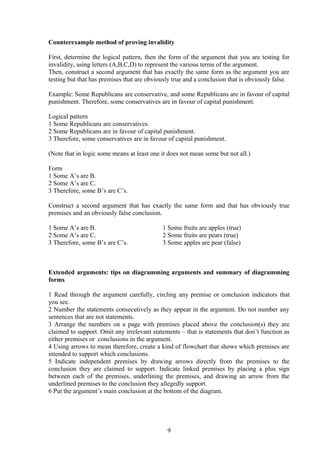
Counterexample method of proving invalidity
First, determine the logical pattern, then the form of the argument that you are testing for
invalidity, using letters (A,B,C,D) to represent the various terms of the argument.
Then, construct a second argument that has exactly the same form as the argument you are
testing but that has premises that are obviously true and a conclusion that is obviously false.
Example: Some Republicans are conservative, and some Republicans are in favour of capital
punishment. Therefore, some conservatives are in favour of capital punishment.
Logical pattern
1 Some Republicans are conservatives.
2 Some Republicans are in favour of capital punishment.
3 Therefore, some conservatives are in favour of capital punishment.
(Note that in logic some means at least one it does not mean some but not all.)
Form
1 Some A’s are B.
2 Some A’s are C.
3 Therefore, some B’s are C’s.
Construct a second argument that has exactly the same form and that has obviously true
premises and an obviously false conclusion.
1 Some A’s are B. 1 Some fruits are apples (true)
2 Some A’s are C. 2 Some fruits are pears (true)
3 Therefore, some B’s are C’s. 3 Some apples are pear (false)
Extended arguments: tips on diagramming arguments and summary of diagramming
forms
1 Read through the argument carefully, circling any premise or conclusion indicators that
you see.
2 Number the statements consecutively as they appear in the argument. Do not number any
sentences that are not statements.
3 Arrange the numbers on a page with premises placed above the conclusion(s) they are
claimed to support. Omit any irrelevant statements – that is statements that don’t function as
either premises or conclusions in the argument.
4 Using arrows to mean therefore, create a kind of flowchart that shows which premises are
intended to support which conclusions.
5 Indicate independent premises by drawing arrows directly from the premises to the
conclusion they are claimed to support. Indicate linked premises by placing a plus sign
between each of the premises, underlining the premises, and drawing an arrow from the
underlined premises to the conclusion they allegedly support.
6 Put the argument’s main conclusion at the bottom of the diagram.
9
Arguments diagrammed according to a vertical pattern: consist of a series of arguments in
which a conclusion of a logically prior argument becomes a premise of a subsequent
argument.
Arguments diagrammed according to a horizontal pattern: the horizontal pattern consists of a
single argument in which two or more premises provide independent support for a single
conclusion.
Conjoint premises: It is a variation on the horizontal and vertical pattern that occurs when the
premises depend on one another in such a way that if one were omitted, the support that the
others provide would be diminished or destroyed.
Multiple conclusion: It is a variation on the horizontal and vertical pattern that occurs when
one or more premises support multiple conclusions.
Example
Democratic laws generally tend to promote the welfare of the greatest number; for they
emanate from the majority of the citizens, who are subject to error, but who cannot have an
interest opposed to their own advantage. The laws of an aristocracy tend, on the contrary, to
concentrate wealth and power in the hands of a minority; because an aristocracy by its very
nature, constitutes a minority. It may therefore be asserted, as a general proposition, that the
purpose of a democracy in its legislation is more useful to humanity than that of an
aristocracy.
Alexis de Tocqueville, Democracy in America, 1835
1 [Democratic laws generally tend to promote the welfare of the greatest possible number]
for 2 [they emanate from the majority of the citizens, who are subject to error, but who
cannot have an interest opposed to their own advantage.] 3 [The laws of an aristocracy tend,
on the contrary, to concentrate wealth and power in the hands of the minority;] because 4 [an
aristocracy, by its very nature, constitutes a minority.] It may therefore be asserted as a
general proposition, that 5 [the purpose of a democracy in its legislation is more useful to
humanity than that of an aristocracy.]
2 4
1 3
5
10
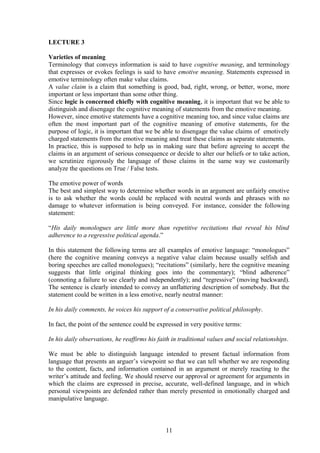
LECTURE 3
Varieties of meaning
Terminology that conveys information is said to have cognitive meaning, and terminology
that expresses or evokes feelings is said to have emotive meaning. Statements expressed in
emotive terminology often make value claims.
A value claim is a claim that something is good, bad, right, wrong, or better, worse, more
important or less important than some other thing.
Since logic is concerned chiefly with cognitive meaning, it is important that we be able to
distinguish and disengage the cognitive meaning of statements from the emotive meaning.
However, since emotive statements have a cognitive meaning too, and since value claims are
often the most important part of the cognitive meaning of emotive statements, for the
purpose of logic, it is important that we be able to disengage the value claims of emotively
charged statements from the emotive meaning and treat these claims as separate statements.
In practice, this is supposed to help us in making sure that before agreeing to accept the
claims in an argument of serious consequence or decide to alter our beliefs or to take action,
we scrutinize rigorously the language of those claims in the same way we customarily
analyze the questions on True / False tests.
The emotive power of words
The best and simplest way to determine whether words in an argument are unfairly emotive
is to ask whether the words could be replaced with neutral words and phrases with no
damage to whatever information is being conveyed. For instance, consider the following
statement:
“His daily monologues are little more than repetitive recitations that reveal his blind
adherence to a regressive political agenda.”
In this statement the following terms are all examples of emotive language: “monologues”
(here the cognitive meaning conveys a negative value claim because usually selfish and
boring speeches are called monologues); “recitations” (similarly, here the cognitive meaning
suggests that little original thinking goes into the commentary); “blind adherence”
(connoting a failure to see clearly and independently); and “regressive” (moving backward).
The sentence is clearly intended to convey an unflattering description of somebody. But the
statement could be written in a less emotive, nearly neutral manner:
In his daily comments, he voices his support of a conservative political philosophy.
In fact, the point of the sentence could be expressed in very positive terms:
In his daily observations, he reaffirms his faith in traditional values and social relationships.
We must be able to distinguish language intended to present factual information from
language that presents an arguer’s viewpoint so that we can tell whether we are responding
to the content, facts, and information contained in an argument or merely reacting to the
writer’s attitude and feeling. We should reserve our approval or agreement for arguments in
which the claims are expressed in precise, accurate, well-defined language, and in which
personal viewpoints are defended rather than merely presented in emotionally charged and
manipulative language.
11
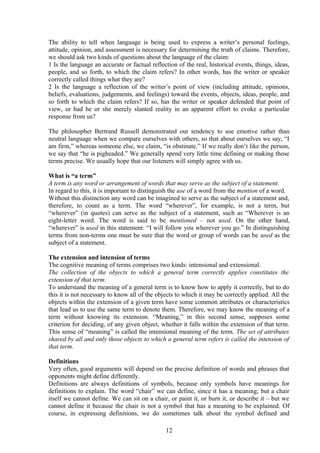
The ability to tell when language is being used to express a writer’s personal feelings,
attitude, opinion, and assessment is necessary for determining the truth of claims. Therefore,
we should ask two kinds of questions about the language of the claim:
1 Is the language an accurate or factual reflection of the real, historical events, things, ideas,
people, and so forth, to which the claim refers? In other words, has the writer or speaker
correctly called things what they are?
2 Is the language a reflection of the writer’s point of view (including attitude, opinions,
beliefs, evaluations, judgements, and feelings) toward the events, objects, ideas, people, and
so forth to which the claim refers? If so, has the writer or speaker defended that point of
view, or had he or she merely slanted reality in an apparent effort to evoke a particular
response from us?
The philosopher Bertrand Russell demonstrated our tendency to use emotive rather than
neutral language when we compare ourselves with others, so that about ourselves we say, “I
am firm,” whereas someone else, we claim, “is obstinate.” If we really don’t like the person,
we say that “he is pigheaded.” We generally spend very little time defining or making those
terms precise. We usually hope that our listeners will simply agree with us.
What is “a term”
A term is any word or arrangement of words that may serve as the subject of a statement.
In regard to this, it is important to distinguish the use of a word from the mention of a word.
Without this distinction any word can be imagined to serve as the subject of a statement and,
therefore, to count as a term. The word “wherever”, for example, is not a term, but
“wherever” (in quotes) can serve as the subject of a statement, such as “Wherever is an
eight-letter word. The word is said to be mentioned – not used. On the other hand,
“wherever” is used in this statement: “I will follow you wherever you go.” In distinguishing
terms from non-terms one must be sure that the word or group of words can be used as the
subject of a statement.
The extension and intension of terms
The cognitive meaning of terms comprises two kinds: intensional and extensional.
The collection of the objects to which a general term correctly applies constitutes the
extension of that term.
To understand the meaning of a general term is to know how to apply it correctly, but to do
this it is not necessary to know all of the objects to which it may be correctly applied. All the
objects within the extension of a given term have some common attributes or characteristics
that lead us to use the same term to denote them. Therefore, we may know the meaning of a
term without knowing its extension. “Meaning,” in this second sense, supposes some
criterion for deciding, of any given object, whether it falls within the extension of that term.
This sense of “meaning” is called the intensional meaning of the term. The set of attributes
shared by all and only those objects to which a general term refers is called the intension of
that term.
Definitions
Very often, good arguments will depend on the precise definition of words and phrases that
opponents might define differently.
Definitions are always definitions of symbols, because only symbols have meanings for
definitions to explain. The word “chair” we can define, since it has a meaning; but a chair
itself we cannot define. We can sit on a chair, or paint it, or burn it, or describe it – but we
cannot define it because the chair is not a symbol that has a meaning to be explained. Of
course, in expressing definitions, we do sometimes talk about the symbol defined and
12
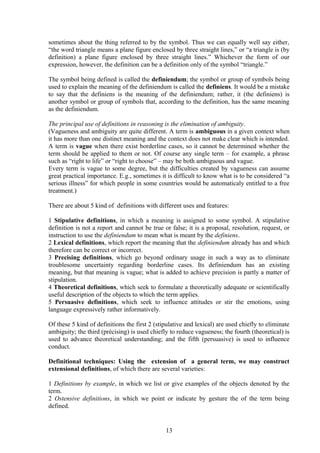
sometimes about the thing referred to by the symbol. Thus we can equally well say either,
“the word triangle means a plane figure enclosed by three straight lines,” or “a triangle is (by
definition) a plane figure enclosed by three straight lines.” Whichever the form of our
expression, however, the definition can be a definition only of the symbol “triangle.”
The symbol being defined is called the definiendum; the symbol or group of symbols being
used to explain the meaning of the definiendum is called the definiens. It would be a mistake
to say that the definiens is the meaning of the definiendum; rather, it (the definiens) is
another symbol or group of symbols that, according to the definition, has the same meaning
as the definiendum.
The principal use of definitions in reasoning is the elimination of ambiguity.
(Vagueness and ambiguity are quite different. A term is ambiguous in a given context when
it has more than one distinct meaning and the context does not make clear which is intended.
A term is vague when there exist borderline cases, so it cannot be determined whether the
term should be applied to them or not. Of course any single term – for example, a phrase
such as “right to life” or “right to choose” – may be both ambiguous and vague.
Every term is vague to some degree, but the difficulties created by vagueness can assume
great practical importance. E.g., sometimes it is difficult to know what is to be considered “a
serious illness” for which people in some countries would be automaticaly entitled to a free
treatment.)
There are about 5 kind of definitions with different uses and features:
1 Stipulative definitions, in which a meaning is assigned to some symbol. A stipulative
definition is not a report and cannot be true or false; it is a proposal, resolution, request, or
instruction to use the definiendum to mean what is meant by the definiens.
2 Lexical definitions, which report the meaning that the definiendum already has and which
therefore can be correct or incorrect.
3 Precising definitions, which go beyond ordinary usage in such a way as to eliminate
troublesome uncertainty regarding borderline cases. Its definiendum has an existing
meaning, but that meaning is vague; what is added to achieve precision is partly a matter of
stipulation.
4 Theoretical definitions, which seek to formulate a theoretically adequate or scientifically
useful description of the objects to which the term applies.
5 Persuasive definitions, which seek to influence attitudes or stir the emotions, using
language expressively rather informatively.
Of these 5 kind of definitions the first 2 (stipulative and lexical) are used chiefly to eliminate
ambiguity; the third (précising) is used chiefly to reduce vagueness; the fourth (theoretical) is
used to advance theoretical understanding; and the fifth (persuasive) is used to influence
conduct.
Definitional techniques: Using the extension of a general term, we may construct
extensional definitions, of which there are several varieties:
1 Definitions by example, in which we list or give examples of the objects denoted by the
term.
2 Ostensive definitions, in which we point or indicate by gesture the of the term being
defined.
13
3 Quasi-ostensive definitions, in which the gesture or pointing is accompanied by some
descriptive phrase whose meaning is taken as being known.
Definitional techniques: Using the intension of a general term, we can construct
intensional definitions, of which there are also several varieties:
1 Synonymous definitions, in which we provide another word, whose meaning is already
understood, that has the same meaning as the word being defined.
2 Operational definitions, which state the that the term is correctly applied to a given case if
and only if the performance of specified operations in that case yields a specified result.
3 Definitions by genus and difference, in which we first name the genus of which the species
designated by the definiendum is a subclass, and then name the attribute (or specific
difference) that distinguishes the members of that species from members of all other species
in that genus.
The techniques of intensional definition may be used in constructing definitions of any one
among stipulative, lexical, precising, theoretical, or persuasive definitions.
There are five rules traditionally laid down for definitions by genus and difference most
often employed in constructing lexical definitions:
1 A definition should state the essential attributes of the species.
2 A definition must not be circular.
3 A definition must be neither too broad nor too narrow.
4 A definition must not be expressed in ambiguous, obscure, or figurative language.
5 A definition should not be negative where it can be affirmative.
14
LECTURE 4
Logical fallacies: Fallacies of relevance
A logical fallacy is an argument that contains a mistake in reasoning. Fallacies can be
divided in two broad groups: fallacies of relevance and fallacies of insufficient evidence.
Fallacies of relevance are argument in which the premises are logically irrelevant to the
conclusion. Fallacies of insufficient evidence are arguments in which the premises, though
logically relevant to the conclusion, fail to provide sufficient evidence for the conclusion.
During this lecture we will discuss fallacies of relevance. We will discuss fallacies of
insufficient evidence in the next lecture.
The concept of relevance
A statement is relevant to another if it provides at least some evidence or reason for thinking
that the second statement is true or false. There are three ways in which a statement can be
relevant or irrelevant to another. A statement can be positively relevant, negatively relevant,
or logically irrelevant to another statement. A statement is positively relevant to another
statement if it provides at least some reason for thinking that the second statement is true.
A statement is positively relevant to another statement if it counts in favour of that statement.
Here are several examples:
First argument: Dogs are cats. Cats are feline. So dogs are felines.
Second argument: All dogs have five legs. Rick is a dog. So Rick has five legs.
Third argument: Most Penn State Univ. students are resident of Pennsylvania. Marc is a Penn
State Univ. student. So, Mark is probably a resident of Pennsylvania.
Fourth argument: Carole is a woman. Therefore, Carole enjoys knitting.
Each of these premises is positively relevant to its conclusion. That is, each provides at least
some evidence or reason for thinking that the conclusion is true. In the first and second
argument, the premises provide logically conclusive reasons for accepting the conclusion. In
the fourth argument, the premise - Carole is a woman - provides neither probable nor
conclusive reasons for accepting the conclusion – Carole enjoys knitting. However, the
premise does make the conclusion slightly more probable than it would be if the conclusion
were considered independently of that premise. Thus, premise does provide some evidence
for the conclusion, and hence is positively relevant to it.
These examples highlight two important lessons about the concept of relevance. First, a
statement can be relevant to another statement even if the first statement is completely false.
Thus, in the first example, the statement “Dogs are cats” is clearly false. Nevertheless, it is
relevant to the statement “Dogs are felines” because if it were true, then the latter statement
would have to be true as well.
Second whether a statement is relevant to another usually depends on the context in which
the statements are made. Thus, in the second example, the statement “All dogs have five
legs” is positively relevant to the statement “Rick has five legs” only because it is conjoined
with the statement “Rick is a dog.”
Statements that count against other statements are said to be negatively relevant to those
statements.
Here are some examples:
15
Joe is an uncle. Therefore, Joe is a female.
Althea is two years old. Thus, Althea probably goes to college.
Mark is a staunch Republican. Therefore, Mark probably favours higher taxes.
In each of these examples, the premises are negatively relevant to the conclusion. Each
premise, if true, makes the conclusion at least somewhat less likely.
Statements can be logically irrelevant to other statements. A statement is logically irrelevant
to another statement if it counts neither for nor against that statement.
Here are some examples:
Last night I dreamed that Germany will win the next World Cup. Therefore, Germany will
win the next World Cup.
The earth revolves around the sun. Therefore, marijuana should be legalized.
Julie is ugly. Therefore, Julie should not be allowed to board the train.
None of these premises provides even the slightest reason for thinking that their conclusions
are either true or false. Thus, they are logically irrelevant to those conclusions.
Fallacies of relevance
A fallacy of relevance occurs when an arguer offers reasons that are logically irrelevant to
his or her conclusion. Like most popular fallacies, fallacies of relevance often seem to be
good arguments but are not.
There are some 11 common fallacies of relevance:
1 Personal attack (ad hominem): The rejection of a person’s argument or claim by means of
an attack on the person’s character rather than the person’s argument or claim.
Professor Platter has argued against the theory of evolution. But Platter is a heavy drinker
and an egoist who has never given a single penny to charity in all his life. I absolutely refuse
to listen to him.
2 Attacking the motive: Criticizing a person’s motivation for offering a particular argument
or claim, rather than examining the worth of the argument or claim itself.
Mr. Platter has argued that we need to build a new middle school. But Mr. Platter is the
owner of Platter’s Construction Company. He will make a fortune if his company is picked
to build the new school. Obviously, Platter’s argument is a lot of self-serving baloney.
3 Look who is talking (tu quoque): The rejection of another person’s argument or claim
because that person is a hypocrite.
My opponent has accused me of running a negative political campaign. But my opponent has
run a much more negative campaign than I have. Just last week he has accused me of graft,
perjury and all sort of other wrong doings.
4 Two wrongs make a right: Attempting to justify a wrongful act by claiming that some other
act is just as bad or worse.
16
I admit we plied Olympic officials with booze, free ski vacations, and millions of dollars in
outright bribes in order to be selected as the site of the next winter Olympics. But everybody
does it. That’s the way the process works. Therefore, paying those bribes was not really
wrong.
5 Appeal to force: Threatening to harm a reader or listener, when the threat is irrelevant to
the truth of the arguer’s conclusion.
I am telling you the truth and if you do not believe I will call my big brother who will teach
you a lesson.
6 Appeal to pity: Attempting to evoke feelings of pity or compassion, when such feelings,
however understandable, are not relevant to the truth of the arguer’s conclusion.
Officer, I know I was going too fast. But I do not deserve a speeding ticket. I have had a
really bad day. My mother is sick in hospital and my father had a heart attack at hearing the
news. Today, I have also been fired from my job, and I have no money left in the bank to pay
the bills.
7 Bandwagon argument: An appeal to a person’s desire to be popular, accepted, or valued
rather than to logically relevant reasons or evidence.
All the popular, cool kids wear Mohawk haircuts. Therefore, you should, too.
8 Straw man: The misrepresentation of another person’s position in order to make that
position easier to attack.
Professor Platter has argued that the Bible should not be read literally. Obviously, Platter
believes that any reading of the Bible is as good as any other. But this would mean that there
is no difference between a true interpretation of Scripture and a false interpretation. Such a
view is absurd.
9 Red herring: An attempt to sidetrack an audience by raising an irrelevant issue and then
claiming that the original issues has been effectively settled by the irrelevant diversion.
Frank has argued that Volvos are safer cars than Ford Mustang convertibles. But they are
clunky, boxlike cars, whereas Mustang convertibles are sleek, powerful, and sexy. Clearly,
Frank does not know what he is talking about.
10 Equivocation: The use of a key word in an argument in two or (or more) different senses.
In the summer 1940, Londoners were bombed almost every night. To be bombed is to be
intoxicated. Therefore, in the summer 1940, Londoners were intoxicated almost every night.
11 Begging the question: Stating or assuming as a premise the very thing one is seeking to
prove as a conclusion.
I am entitled to say whatever I choose, because I have a right to say whatever I please.
17
LECTURE 5
Logical fallacies: Fallacies of insufficient evidence
In the last lecture we looked at fallacies of relevance, fallacies that occur when the premises
are logically irrelevant to the truth of the conclusion. Fallacies of insufficient evidence are
fallacies in which the premises, though relevant to the conclusion, fail to provide sufficient
evidence for the conclusion.
There are some nine common fallacies of insufficient evidence:
1 Inappropriate appeal to authority: Citing a witness or an authority that is untrustworthy.
My hairdresser told me that the extraterrestrials built the lost city of Atlantis. So, it is
reasonable to believe that extraterrestrial did build the lost city of Atlantis.
2 Appeal to ignorance: Claiming that something is true because no one has proven it false, or
vice versa.
Bigfoot must exist. No one has proved that it does not.
3 False alternatives: Posing a false either/or choice.
The choice in this election is clear. Either we elect a staunch conservative as our next
president, or we watch our country slides into anarchy and economic depression. Clearly, we
don’t want our country to slide into anarchy and economic depression. Therefore, we should
elect a staunch conservative as our next president.
4 Loaded question: Posing a question that contains an unfair or unwarranted presupposition.
Are you still dating that total loser Phil?
Yes.
Well, at least you admit he is a total loser.
5 Questionable cause: Claiming, without sufficient evidence, that one thing is the cause of
something else.
Two days after I drank lemon tea, my head cold cleared up completely. Try it. It works.
6 Hasty generalization: Drawing a general conclusion from a sample that is biased or too
small.
BMWs are a pile of junk. I have two friends who drive BMWs, and both of them have had
nothing but trouble from those cars.
7 Slippery slope: Claiming, without sufficient evidence, that a seemingly harmless action, if
taken, will lead to a disastrous outcome.
Immediate steps should be taken to reduce violence in children’s television programming. If
this violent programming is allowed to continue, this will almost certainly lead to fights and
acts of bulling in school playgrounds. This in turn will lead to an increase in juvenile
18
delinquency and gang violence. Eventually, our entire society will become engulfed in an
orgy of lawlessness and brutality.
8 Weak analogy: Comparing things that are not really comparable.
Nobody would buy a car without first taking it for a test drive. Why then should you not taste
what is inside a box before buying a product?
9 Inconsistency: Asserting inconsistent premises, asserting a premise that is inconsistent with
the conclusion, or arguing for inconsistent conclusions.
Note found in a Forest Service suggestion box: Park visitors need to know how important it
is to keep this wilderness area completely pristine and undisturbed. So why not put a few
signs to remind people of this fact?
19
SECOND ASSIGNMENT
For each of the following statements (a) determine whether it can be known a priori to be
true and (b) explain the basis for your answer.
39 Either a person is grateful for a favour done him or he is not.
40 No man is an island.
41 May the force be with you.
Arrange in order of increasing intension.
42 Animal, feline, lynx, mammal, vertebrate, wildcat.
Give a synonymous definition
43 Egotism
44 Jeopardy
Match the definiendum with an appropriate genus and difference.
45 Banquet
46 Girl
47 Stallion
48 Tell whether you could define “wisdom” by ostensive definition. Give reasons for your
answer.
Assume that the following statements are put forward as lexical definition. Explain why they
are adequate or not.
49 Money is a medium of exchange.
50 To study is to concentrate very hard with the goal of remembering what you are
concentrating on.
51 A radical is nothing but a person with an extreme, implausible, and ruthless plan for
reforming society.
Identify the fallacies committed by the following arguments. There may be more than one. If
no fallacy is committed, write no fallacy.
52 The new Volkswagen Beetle is the coolest car around. It’s selling like hot-cakes. You
should ask your parents to buy one.
53 Paper is combustible, because it burns.
54 Only man has an immortal soul. No woman is a man. Therefore, no woman has an
immortal soul.
55 Flag-burning is unconstitutional. Just ask anybody.
56 Beef industry slogan: “Beef: Real food for real people.”
57 Since an atheist by definition is a person who has no beliefs, he cannot be persecuted for
his beliefs.
58 I am prejudiced only if I hold irrational biases. But I do not hold any irrational biases. I
just think this country is being overrun by a bunch of jerks.
59 If we do not dramatically increase defence spending, the Chinese will soon surpass us as a
military power. If the Chinese surpass us as a military power, it is only a matter of time
before we will all be speaking Chinese and eating Chinese food.
60 The universe is spherical in form because all its constituent parts, that is the sun, moon,
and the planets, appear in this form.
61 Which is more useful, the Sun or the Moon? The Moon is more useful since it gives us
light during the night, when it is dark, whereas the Sun shines only in the day time, when it is
light anyway.
62 Little Town State University is a better university than Harvard University. I have been
assured of this by The Dean of Admissions of Little Town State University.
63 It says in the Encyclopaedia Britannica that the Bermejo River is a western tributary of
the Paraguay River, in south-central South America. This is probably true, because the
Encyclopaedia Britannica is a highly reliable reference source.
20
64 I heard that a person in California used his car to run into a fence and kill two children.
Now, I hope those who would like to ban unauthorized possession of guns because all too
often they have been used in murders and robberies, they will now take up a cry to ban
automobiles too.
21
LECTURE 6
Introduction to categorical Logic: Some Philosophical background
The theory of deduction is intended to explain the relationship between premises and
conclusion in a valid argument, and to provide techniques for the appraisal of deductive
arguments, that is, for discriminating between valid and invalid deductions. To accomplish
this, two great bodies of theory have been developed. The first of these is called “classical”
or “Aristotelian” logic, after the great Greek philosopher who initiated this study. The
second is called “modern” or “modern symbolic” logic. Classical logic will be the topic of
this and the following two lectures, modern logic will be the topic of the subsequent lectures.
Aristotle was one of the towering intellects of the ancient world. After studying for 20 years
in Plato’s Academy, he became tutor to Alexander the Great; later he founded his own
school, the Lyceum, where he contributed substantially to every field of human knowledge.
After Aristotle’s death, his treatises on reasoning were gathered together and came to be
called the Organon. The word logic did not acquire its modern meaning of study of the
methods and principles used to distinguish correct from incorrect reasoning (and make
available those criteria that can be used to test arguments), until the second century A.D., but
the subject matter of logic was long determined by the content of the Organon.
So categorical logic was first discovered by Aristotle more than three centuries before the
birth of Christ. The Aristotelian study of deduction focused on arguments containing
propositions of a special kind, called “categorical propositions” because they are about
categories or classes. Seeing the formal relationships between the Greek equivalents of all
are, none are, some are, and some are not, Aristotle formulated rules of inference for simple
arguments in which the premises and conclusions were all in categorical form.
[In the loose sense of the term, inference is used interchangeably with argument. However,
an inference, in the technical sense of the term, is the reasoning process expressed by an
argument. Inferences may be expressed not only through arguments but through conditional
statements as well. Inference is a process by which one proposition is arrived at and affirmed
on the basis of some other proposition or propositions; the rules of inference in deductive
logic are the rules that may be used in constructing formal proofs of validity comprising
three groups: a set of elementary valid arguments forms, a set of logically equivalent pairs of
expressions whose members may be replaced by one another, and a set of rules for
quantification.]
So impressive was Aristotle’s achievement that for nearly two thousand years most logicians
believed that categorical logic was the whole of logic. An important aspect of Aristotelian
theory was the belief that all statements – whatever their surface grammatical features – were
of the subject/predicate form and that all deductively valid relationships depended on aspects
of the logical form that statements containing “all are”, “none are”, “some are” and “some
are not” express.
At the end of the eighteenth century, the eminent German philosopher Immanuel Kant still
believed that Aristotelian logic was the whole of formal logic. In fact, this belief persisted in
many circles until nearly the end of the nineteenth century. However, most modern logicians
do not subscribe to this theory: they see categorical relations as some of the important logical
relations, not all of them.
22
Such statements as, “if inflation continues, strikes will increase” and “Either is will be
cloudy or it will rain” are not basically subject/predicate statements. They cannot naturally
be expressed in categorical form. (It would be necessary a lot fiddling, and the result would
not be very close to the original in meaning.) There are more useful logical symbolisms to
represent these statements. These form part of modern system of propositional logic. For
instance, as we will see later statements about particular individual can be put in categorical
form only in a rather unnatural way. In modern systems of logic, statements about
individuals can be symbolized using letters that represent one individual – not a group.
Modern logicians do not regard categorical form as the last word insofar as formally
representing statements is concerned. Categorical form is a useful representation for some
statements, but not for all.
Another interesting difference between ancient and modern theorists of logic concerns the
matter of making statements about things that do not exist. Like other Greek philosophers of
his time, Aristotle regarded the notion of speaking and reasoning about nonexistent things as
irrational and paradoxical. He developed categorical logic on the assumption that its subjects
are always things that exist. Aristotle believed that we make assertions only about those
things that are real. This view of categorical logic is called the existential view.
Most modern logicians do not share this existential view. They point out that we often make
statements about things that might or might not exist, and we want our rules of logic to apply
to these statements, just as they apply to others. Scientist reasoned about genes and electrons
before they knew such things exist. A scientist who says, “Black holes are invisible,” before
he or she knows that there is such a thing as a black hole, is saying in effect “If anything is a
black hole, then that thing is invisible.” The world if makes the statement hypothetical; the
scientist did not commit himself or herself to the claim that there are black holes.
Whereas ancient logicians always interpreted statements containing “all are”, and “none are”
as entailing the existence of things in the subject and predicate categories (or else it was not
possible to derive valid inferences from them), modern logicians prefer a hypothetical
interpretation in which the non-existence of things in those categories is left open as a
possibility. For the ancient logicians, “All human beings are mortal” carried with it a firm
commitment to the claim that human beings exist. This is the existential interpretation.
According to the interpretation of modern logicians, “All human beings are mortal” should
be interpreted in a hypothetical way. It says only that if anyone is a human, that person is
mortal.
In modern logic, statements containing “all are” and “none are” can be true, even when there
are no members of the subject category. A statement such as, “All student who cheat are
liable to penalties imposed by the dean” can be true even if there are no students who cheat.
We can make statements about electrons, black holes, mermaids, or unicorns without
committing ourselves to the assumptions that these things exist. That is, we can do this
provided that the statements are universal. Modern and ancient logic share the view that the
particular statements assert existence. To say that some students cheat is to say that there is
at least one student who cheats. This statement commits you to the existence of at least one
student.
Who is right in this dispute between ancient and modern logicians? Can we speak and reason
about what does not exist? Do we need to? These are large metaphysical questions that
cannot be answered simplistically. By and large, the modern view seems to have prevailed in
courses on mathematics and formal logic. In some practical contexts, however, the modern
view yields strange results. For example, it prevents us form deductively inferring that some
(that is, at least one) lawyers are rich from the claim that lawyers are rich. Surely, you would
think, if all lawyers are rich, then some are. But on the hypothetical interpretation of the
statement “all lawyers are rich”, we cannot validly infer the existence of some lawyers
23
because the statement “all lawyers are rich” is interpreted as hypothetical and the statement
that “some lawyers are rich” says that there is at least one lawyer. We cannot validly deduce
the actual from the hypothetical, so in the modern view there will be no valid immediate
inference that some lawyers exist from the statement “all lawyers are rich”. The result may
seem strange. You may want to ask, “Are not some lawyers rich if all are?” The reason the
results seem strange is that most of the time, we restrict ourselves in the way Aristotle did.
We talk about things that exist.
One solution to this problem is to step back and ask yourself whether the existence of the
subject class should be assumed in the context you are dealing with. If it should, you read
that assumption into the universal statement. In the case of the lawyers, you would then
understand “All lawyers are rich” as presuming that there are lawyers and saying all those
lawyers are rich. On this understanding of the statement “All lawyers are rich”, you can
validly infer from it the statement that “Some lawyers are rich”. In context like these, where
is a matter of common knowledge that the subject category is a category of existing things, it
is recommendable reading in it an existence assumption and reverting in a sense, to the
ancient view of things. But in other context, it is recommendable to work with the
hypothetical interpretation, since it is standard in modern logic.
24
LECTURE 7: Categorical logic
Categorical (or Aristotelian or Classical) logic uses all, some, are, and not as its basic logical
terms. These terms are used to tell, in a general way, how many members of one category are
included in, or excluded from, another category.
Categorical statements or propositions
A categorical proposition is a proposition that relates two or more classes or categories of
things.
Some preliminary explanations
A sentence is a unit of language that expresses a complete thought; a sentence may express a
proposition, but is distinct from the proposition it may be used to express.
A statement is a sentence that is either true or false.
A proposition, in the technical sense, is the information content of a statement (i.e., of a
sentence that is true or false). For our purposes, however, proposition and statement (but
not sentence) are used interchangeably.
Propositions are the building blocks of every argument. A proposition is something that
may be asserted or denied. Every proposition is either true or false, although we may
not know the truth or falsity of some given proposition.
It is customary to distinguish between propositions and the sentences by means of which
they are asserted. Two sentences that consist of different words differently arranged may in
the same context have the same meaning and be used to assert the same proposition.
For example, “A fish is not a mammal”, and “No fish are mammals” are plainly two
different sentences, for the first contains 6 words and the second 4, and they begin
differently, and so on. Yet these two declarative sentences have exactly the same meaning
and assert the same proposition.
A sentence, moreover, is always a sentence in a particular language, the language in which it
is used. But propositions are not peculiar to any language; a given proposition may be
asserted in many languages, and different sentences in different languages may be uttered to
assert the same proposition.
Moreover, the same sentence can be used, in different contexts, to make very different
statements. For example, the sentence: “The largest state in the United States was once an
independent republic” would have been a true statement about Texas during the first half of
the twentieth century, but is now a false statement about Alaska. A change in the temporal
context, plainly, may result in very different propositions, or statements, being asserted by
the very same words. (The terms “proposition” and “statement” are not exact synonyms, but
in the context of logical investigation they are used in much the same sense. Some writers on
logic prefer “statement” to “proposition”, although the latter has been more common in the
history of logic. I will use both terms.)
Standard-form categorical statements
It was traditionally held that all deductive arguments were analyzable in terms of classes,
categories, and their relations. Thus the four standard form categorical statements that have
one of the following four forms:
All S are P, universal affirmative propositions (called A propositions)
No S are P, universal negative propositions (called E propositions)
Some S are P, particular affirmative propositions (called I propositions)
Some S are not P, particular negative propositions (called O propositions),
25
were thought to be the building blocks of all deductive arguments. A great deal of logical
theory as been built up concerning these four kinds of propositions.
Standard-form categorical statements have four basic parts:
1 They all begin with the word all, no, or some. These words are called quantifiers, because
they are used to express a quantity or a number.
2 They all have a subject term. The subject term is a word or phrase that names a class and
that serves as the grammatical subject of the sentence. In the four statements forms listed
above, the subject term is represented by S.
3 They all have a predicate term. The predicate term is a word or phrase that names a class
and that serves as the subject complement of the sentence. In the statement forms listed
above, the predicate term is represented by P.
4 They all have a copula, or linking verb, which is some form of the verb to be. The copula
serves to link, or join, the subject term with the predicate term.
Quality
Every standard-form categorical proposition is said to have a quality, either affirmative or
negative. If the proposition affirms some class inclusion, whether complete or partial, its
quality is affirmative. Thus both universal affirmative propositions and particular affirmative
propositions are affirmative in quality, and their letter names, A and I respectively are
thought to come from the Latin word, AffIrmo, meaning I affirm. If the proposition denies
class inclusion, whether complete or partial, its quality is negative. Thus both universal
negative propositions and particular negative propositions are negative in quality and their
letter names, E and O, respectively, are thought to come from the Latin word nEgO,
meaning I deny.
Quantity
Every standard-form categorical proposition is said to have a quantity also, universal or
particular. If the proposition refers to all members of the class designated by its subject term,
its quantity is universal. Thus the A and E propositions are universal in quantity. If the
proposition refers only to some members of the class designated by its subject term, its
quantity is particular. Thus the I and O propositions are particular in quantity.
Distribution
On the class interpretation, the subject and predicate terms of a standard-form categorical
proposition designate classes of objects, and the proposition is regarded as being about these
classes. The technical distribution is introduced to characterize the ways in which terns can
occur in categorical propositions. A proposition distributes a term if it refers to all
members of the class designated by the term.
Universal propositions, both affirmative and negative, distribute their subject terms,
whereas particular propositions, whether affirmative or negative, do not distribute their
subject terms. Thus the quantity of any standard-form categorical proposition determines
whether its subject term is distributed or undistributed. Affirmative propositions, whether
universal or particular, do not distribute their predicate terms, whereas negative
propositions, both universal and particular, do distribute their predicate terms. Thus the
quality of any stand-form categorical proposition determines whether its predicate term is
distributed or undistributed.
Square of opposition
A diagram in the form of a square in which the four types of categorical propositions (A, E,
I, and O) are situated at the corners, exhibiting the logical relations (called “oppositions”)
among these propositions. The traditional square of opposition, which represents the
Aristotelian interpretation of these propositions and their relations, differs importantly from
26
the square of opposition as it is used in Boolean, or modern symbolic, logic, according to
which some traditional oppositions do not hold.
Complementary predicate
Predicate formed by placing non in front of an existing predicate. Example: the
complementary predicate of musician is non-musician. For any predicate, we can construct a
complementary predicate such that these two predicate are the basis of contradictory
statements. Two statements are contradictory if and only if the truth of one entails the
falsity of the other and one of them must be true. For example of the predicate beautiful
we can construct the complementary predicate non-beautiful. For every entity it will be true
that it is either beautiful or non-beautiful. (But it is crucially important to note that non-
beautiful does not mean the same as ugly. It is not true that every item in the universe is
either beautiful or ugly. The terms beautiful and ugly are opposites, but they are not
complementary predicates in the logical sense that anything that fails to be one is the other.
The predicates beautiful and non-beautiful are complementary predicates, beautiful and ugly
are contrary predicates. If we confuse logical complementary with contrary or opposite, the
result will be false dichotomy or polarized thinking in which we will think that everything or
everyone is either good or evil, happy or unhappy, intelligent or stupid, friend or enemy,
white or black, etc.)
With a little ingenuity, many ordinary English sentences can be translated into
standard-form categorical statements. When translating into standard categorical form,
keep in mind the following tips:
Rephrase all non-standard subject and predicate terms so that they refer to classes.
Rephrase all non-standard so that the statement includes the linking verb are or are not.
Fill in any unexpressed quantifiers.
Translate singular statements as all or no statements.
Translate stylistic variants into the appropriate categorical form.
In order to translate an ordinary sentence into standard categorical form you can make use of
the rules of immediate inference.
Rules of immediate inference [Any inference is the drawing of a conclusion from one or
more premises. Where a conclusion is drawn from only one premise, i.e. there is no
mediation by other premises, the inference is said to be immediate.]
1 Conversion. To create the converse of a statement (convert a statement) transpose its
subject and predicate. All E and I statements are logically equivalent to their converse. No A
or O statements are logically equivalent to their converse.
2 Contraposition. To create the contra-positive of a statement, transpose its subject and
predicate and negate both. All A and O statements are logically equivalent to their contra-
positive. No E or I statement are logically equivalent to their contra-positive.
3 Obversion. To create the obverse of a statement, change its quality from positive to
negative or from negative to positive and form the complement of its predicate. All
statements in categorical form are logically equivalent to their obverse.
3 Contradiction. I A is true, then O is false, and vice versa. If E is true, then I is false, and
vice versa.
The immediate inferences based on the traditional Square of Opposition may be listed
as follows:
A being given as true: E is false, I is true, O is false.
E being given as true: A is false, I is false, O is true.
I being given as true: E is false, while A and O are undetermined.
O being given as true: A is false, while E and I are undetermined.
A being given as false: O is true, while E and I are undetermined.
27
E being given as false: I is true, while A and O are undetermined.
I being given as false: A is false, E is true, O is true.
O being given as false: A is true, E is false, I is true.
Venn Diagrams
The meanings of the A, E, I, and O statements can be shown on diagrams in which circles
represent the categories of things. These diagrams are called Venn diagrams, after the
nineteenth-century English philosopher and logician John Venn. Venn diagrams are helpful
because they enables us to visually show the meanings of the A, E, I, and O statements and
to understand the logical relationships using simple pictures.
Venn diagrams offer a system for representing whether there is something or nothing in an
area of logical space. Logical space is represented in circles and parts of circles. To indicate
that there is nothing in an area of logical space, we shade in the are. To indicate that there is
something, we put an x in the space.
28
LECTURE 8: Categorical syllogisms
A syllogism is a deductive argument in which a conclusion is inferred from two premises. A
categorical syllogism (in standard form) is a syllogism whose every claim is a standard-form
categorical claim and in which three terms each occur exactly twice in exactly two of the
claims. For in instance, in the following example:
All Hong Kongers are consumers.
Some consumers are not Chinese.
Therefore, some Hong Kongers are not Chinese.
Notice how each of the three terms Hong Kongers, consumers and Chinese occurs exactly
twice in exactly two different claims. The terms of a syllogism are given the following
labels:
Major term, the term that occurs as a predicate term of the syllogism’s conclusion.
Minor term, the term that occurs as the subject term of the syllogism’s conclusion.
Middle term, the term that occurs in both of the premises but not at all in the conclusion.
The most frequently used symbols for these three terms are P for major term, S for minor
term, and M for middle term.
The premise containing the major term is called the major premise, and the premise
containing the minor term is called the minor premise.
In a standard-form syllogism, the major premise is stated first, the minor premise
second, and the conclusion last.
In a categorical syllogism, each of the premises states a relationship between the middle term
and one of the others. If both premises do their jobs correctly that is, if the proper
connections between S and P are established via the middle term M – then the relationship
between S and P stated by the conclusion will have to follow – that is, the argument is valid.
(An argument is valid if, and only if, it is not possible for its premises to be true while its
conclusion is false. This is just another way of saying that were the premises of a valid
argument true (whether they are in fact true or false), then the truth of the conclusion would
be guaranteed.)
The three rules of the syllogism
A syllogism is valid if and only if all of these conditions are met:
1 The number of negative claims in the premises must be the same as the number of negative
claims in the conclusion. (Because the conclusion is always one claim, this implies that no
valid syllogism has two negative premises.)
2 At least one premise must distribute the middle term.
3 Any term that is distributed in the conclusion of the syllogism must be distributed in its
premises.
[A term is distributed in a claim if, and only if, on the assumption that the claim is true, the
class named by the term can be replaced by any subset of that class without producing a false
claim. Example: the claim “All senators are politicians,” the term “senators” is distributed
29
because, assuming the claim is true, you can substitute any subset of senators (Democratic
ones, Republican ones, tall ones, short ones…) and the result must also be true. “Politicians”
is not distributed: The original claim could be true while “All senators are honest politicians”
was false.]
The mood of a syllogism is determined by the three letters identifying the types of its three
propositions, A, E, I, or O. There are 64 possible different moods.
The figure of a syllogism is determined by the position of the middle term in its premises.
There are four possible figures.
First figure, the middle term is the subject term of the major premise and the predicate term
of the minor premise.
M P
S M
Therefore S P
Second figure, the middle term is the predicate of both premises.
P M
S M
Therefore S P
Third figure, the middle term is the subject term of both premises.
M P
M S
Therefore S P
Fourth figure, the middle term is the predicate term of the major premise and the subject
term of the minor premise.
P M
M S
Therefore S P
The mood ad figure of a standard-form categorical syllogism jointly determine its logical
form. Since each of the 64 moods may appear in all four figures, there are exactly 256
standard-form categorical syllogisms, of which only a few are valid.
The 15 unconditionally valid forms of the categorical syllogisms according to their
traditional Latin names are:
AAA-1 (Barbara); EAE-1 (Celarent); AII-1 (Darii); EIO-1 (Ferio); AEE-2 (Camestres);
EAE-2 (Cesare); AOO-2 (Baroko); EIO-2 (Festino); AII-3 (Datisi); IAI-3 (Disamis); EIO-3
(Ferison); OAO-3 (Bokardo); AEE-4 (Camenes); IAI-4 (Dimaris); EIO-4 (Fresison).
A simple way to test the formal validity of categorical syllogism is to use Venn diagrams in
which overlapping circles are used to represent relationships between classes. The Venn
diagram technique for checking the validity of categorical syllogism involves 6 basic steps:
1 Translate all statements in the argument (if necessary) into standard-form categorical
statements.
30
2 Draw and label three overlapping circles, one for each term (class name) in the argument,
with the two circles for the conclusion placed on the bottom.
3 Use shading to represent the information in “all” or “no” statements. To diagram
statements of the form “All S are P”, shade that portion of the S circle that does not overlap
with the P circle. To diagram statements of the form “No S are P”, shade that portion of the S
circle that overlaps with the P circle.
Use Xs to represent the information in some statements. To diagram statements of the form
“Some are P”, place an X in that portion of the S circle that overlaps with the P circle. To
diagram statements of the form “Some S are not P”, place an X in that portion of the S circle
that does not overlap with the P circle.
4 Diagram the two premises. (No marks should be entered for the conclusion.) If the
argument contains one “all” or “no” premise and one “some” premise, diagram the “all” or
“no” premise first. If the argument contains two “some” or two “all” or “no” premises,
diagram either premise first.
5 When placing an X in a two-part area, if one part of the area has been shaded, place the X
in the un-shaded part. If neither part of the area has been shaded, place the X squarely on the
line separating the two parts.
6 Look to see if the completed diagram contains all the information presented in the
conclusion. If it does, the argument is formally valid. If it does not, the argument is formally
invalid.
A syllogistic argument in ordinary language may deviate from a standard-form
categorical syllogism mainly in three ways:
1 The order in which the premises and conclusion happen to be stated may not be that of the
standard-form syllogism. This is a minor problem, easily remedied, since the order of the
statements is the only deviation, the three propositions may readily be reordered.
2 The component propositions of the argument in ordinary language may appear to involve
more than three terms, although that appearance may prove deceptive.
3 The component propositions of the syllogism in ordinary language may not all be standard-
form propositions.
In the second and third of these deviant patterns, a proper translation of the syllogism into
standard form often is possible.
Syllogisms in ordinary language appearing to have more than three terms may
sometimes have the number of terms in them appropriately reduced to three by
elimination of synonyms, and by elimination of complementary classes.
Enthymemes are syllogistic arguments in which one of the constituent propositions has
been suppressed.
Sorites are syllogistic arguments in which a chain of syllogisms may be compressed into
a cluster of linked propositions.
31
LECTURE 9: Review of the previous topics
LECTURE 10: Propositional logic
Although categorical logic is the oldest developed in the Western philosophical tradition, it is
not now believed to be the most basic part of logic. This role is reserved for propositional
logic. Propositional logic studies arguments whose validity depends on “if then”, “and,”
“or,” “not”, and similar notions. We will cover the very basics of it.
The earliest development of propositional logic (known also as truth-functional logic or
sentential logic) took place among the Stoics, who flourished from about the third century
B.C.E. until the second century C.E. But it was in the late nineteenth and twentieth centuries
that the real power of truth-functional logic became apparent.
Modern symbolic logic is not encumbered (as Aristotelian logic was) by the need to
transform deductive arguments into syllogistic form. That task can be laborious. Freed from
the need to make such transformations, we can pursue the aims of deductive analysis more
directly.
In modern logic it is not syllogisms (as in the Aristotelian tradition) that are central, but
logical connectives, the relations between elements that every deductive argument, syllogism
or not, must employ. The internal structure of propositions and arguments is the focus of
modern logic.
The “logic of sentences” is one of the bases on which modern symbolic logic rests, and as
such it is important in such intellectual areas as set theory and the foundations of
mathematics. It is also the model for electrical circuits of the sort that are the basis of digital
computing. But truth-functional logic is also a useful tool in the analysis of arguments.
Therefore, the study of truth-functional logic can be beneficial in several ways. For one
thing, it allows us to learn something about the structure of language that we would not learn
any other way. For another, we get a sense of what it is like to work with a very precise, non-
mathematical system of symbols that is nevertheless very accessible to nearly any student
willing to invest a modest amount of effort. The model of precision and clarity that such
systems provide can serve us well when we communicate with others in ordinary language.
However, in order to understand the internal structure of propositions and argument we must
master the special symbols that are used in modern logical analysis. It is with them that we
can more fully achieve the central aim of deductive logic: to discriminate valid arguments
from invalid arguments.
In sum, the symbolic notation of modern logic is an exceedingly powerful tool for the
analysis of arguments.
Symbols and translation
1 In propositional logic, the world conjunction refers to a compound statement. A compound
statement, such as “This lesson was stimulating, and I learned a lot, is symbolized by two
variables joined by a dot (for example p ∙ q ).
[If in any case we are unsure whether a statement is simple or compound, we must ask,
“What does the statement mean?” Does the statement consists of two simple statements? If it
does, then it is compound. If it doesn’t, then it is simple.]
32
For the purposes of propositional logic, the following words are all equivalent and can be
symbolized by the dot: and, but, yet, while, whereas, although, though, however.
2 Negation is the use of the word “not” (or an equivalent word or phrase) to deny a
statement. The conventional symbol for negation is the tilde, ∼.
3 A disjunction is an “or” statement – that is, a statement that consists of two (or more)
statements set apart, usually by the word “or”. The symbol for disjunction is the lower case
v, also called the wedge. The word “or” has two possible senses. The exclusive sense
eliminates one of the possibilities. For example, a flight attendant may tell you, “For dinner
you may have chicken or fish.” The nonexclusive sense does not exclude either possibility.
For example, a doctor may advise you that “when you are feeling dehydrated, you should
drink water or natural fruit juice.” It is true when either of the two statement is true, and it is
also true when both statements are true. For the purposes of propositional logic, it is
conventional to take the word “or” in its nonexclusive sense.
4 A conditional statement is an if-then statement consisting of two parts. The first part of the
statement, which follows “if” and precedes “then,” is called the antecedent. The symbol for
the implication involved in an if then statement is the horseshoe, ⊃. The only time a
conditional is false is when the antecedent is true and the conclusion is false. It may be
helpful to think of the truth table for conditional statements in terms of the guiding legal
principle that a person is presumed innocent until proven guilty. In a similar way, a
conditional is presumed true until proven false. The only thing that can definitively show that
a conditional is false is a true antecedent followed by a false consequent.
5 Any two true statements materially imply one another and any two false statements also
materially imply one another, since they are either both true, or both false. The symbol for
material equivalence is the triple bar sign ≡. We can read the triple bar sign to say “if and
only if”. Two statements are logically equivalent when the statement of their material
equivalence is a tautology. A tautology is a statement that it is true in every possible case.
Statements that are logically equivalent may be substituted for one another, while statements
that are merely materially equivalent cannot replace one another.
We now have a propositional language, with precise rules for constructing arguments and
testing validity. Our language can help to test arguments.
∼ P = Not P
(P ∙ Q) = Both P and Q
(P v Q) = Either P or Q
(P ⊃ Q) = If P then Q
(P ≡ Q) = P if and only if Q
A grammatically correct formula of this language is called a wff, or well formed formula
(pronounce woof – as in wood).
The truth value of any truth functional connective depends upon (is a function of) the truth
or falsity of the statements it connects.
Truth values for a variable (which stands for a statement) are indicated as true, T, or false, F.
Truth tables
A truth table is a listing of all possible truth values for the variables in an argument form.
33
In a valid argument it is impossible for all of the premises to be true and the conclusion false.
So in examining the truth table, we look for instances in which all the premises are true. If
there is any instance of all true premises followed by a false conclusion, an F under the
conclusion column, the argument is invalid. It does not matter if there are other instances in
the truth table where all the premises are true and the conclusion is true, too.
Any two arguments that share the same argument form are either both valid or both invalid.
When we know that an argument form is valid, we know that any argument that fits that
form is valid.
The truth tables for the five basic truth functional symbols
Negation: "not" or "it is not the case that"
P ∼P
T F
F T
Conjunction : and, but, while.
P Q (P ∙ Q)
T T T
T F F
F T F
F F F
Disjunction: or, unless
P Q (P v Q)
T T T
T F T
F T T
F F F
Conditional: if….then
P Q (P ⊃ Q)
T T T
T F F
F T T
F F T
Material equivalence: if and only if
P Q (P ≡ Q)
T T T
T F F
F T F
F F T
34
The 3 Laws of Thought
Some early thinkers, after having defined logic as the science of the laws of thought, went on
to assert that there are exactly three basic laws of thought, laws so fundamental that
obedience to them is both the necessary and the sufficient condition of correct thinking.
These three laws have traditionally been called:
1 The principle of identity.
This principle asserts that if any statement is true, then it is true. Using our notation we may
rephrase it by saying that the principle of identity asserts that every statement of the form
p ⊃ p must be true, that every such statement is a tautology (a tautology is a statement which
uses different words to same the same thing). From this follows that
1 Prem.
a=a [This is an axiom – a basic assertion that is not proved but can be used to prove other
things. The rule of self-identity says that that we may assert a self-identity as a derived step
anywhere in a proof, no matter what the earlier lines are.]
and that
2 a=b :: b=a
and that
3 Fa
a = b
Fb [This is the equals may substitute for equals rule which is based on the idea that
identicals are interchangeable. If a=b, then whatever is true of a is also true of b, and vice
versa. This rule holds regardless of what constants replace a and b and what well formed
formulas replace Fa and Fb provided that the two well formed formulas are alike except that
the constants are interchanged in one or more occurrences.]
2 The principle of non contradiction.
This principle assets that no statement can be both true and false. Using our notation we may
rephrase it by saying that the principle of non contradiction asserts that every statement of
the form p ∙ ∼p must be false, that every such statement is self contradictory.
3 The principle of excluded middle.
This principle asserts that every statement is either true or false.
Using our notation we may rephrase it by saying that the principle of excluded middle asserts
that every statement of the form p ∨ ∼p must be true, that every such statement is a
tautology.
It is obvious that these 3 principles are indeed true, logically true – but the claim that they
deserve a privileged status as the most fundamental laws of thought is doubtful. The first
(identity) and the third (excluded middle) are tautologies, but there are many other
tautologous forms whose truth is equally certain. And the second (non contradiction) is by no
means the only self-contradictory form of statement.
We do use these principles in completing truth tables. In the initial columns of each row of a
table we place either a T or an F, being guided by the principle of excluded middle. Nowhere
do we put both T and F together, being guided by the principle of non-contradiction. And
once having put a T under a symbol in a given row, then (being guided by the principle of
identity) when we encounter that symbol in other columns of that row we regard it as still
being assigned a T. So we could regard the three laws of thought as principles governing the
construction of truth tables.
35
Nevertheless, some thinkers, believing themselves to have devised a new and different logic,
have claimed that these 3 principles are in fact not true, and that obedience to them has been
needlessly confining.
The principle of identity has been attacked on the ground that things change, and are always
changing. Thus for example, statements that were true of the United States when it consisted
of the 13 original states are no longer true of the United States today with 50 states. But this
does not undermine the principle of identity. The sentence “There are only thirteen states in
the United States” is incomplete, an elliptical formulation of the statement that “There were
only 13 states in the United States in 1790” and that statement is as true today as it was in
1790. When we confine our attention to complete, non-elliptical formulation of propositions,
we see that their truth (or falsity) does not change over time. The principle of identity is true,
and does not interfere with our recognition of continuing change.
The principle of non-contradiction has been attacked by Hegelian and Marxists on the
ground that genuine contradiction is everywhere pervasive, that the world is replete with the
inevitable conflict of contradictory forces. That there are conflicting forces in the real world
is true, of course - but to call these conflicting forces contradictory is a loose and misleading
use of that term. Labour unions and the private owners of industrial plants may indeed find
themselves in conflict – but neither the owner nor the union is the negation or the denial or
the contradictory of the other. The principle of contradiction, understood in the
straightforward sense in which it is intended by logicians, is unobjectionable and perfectly
true.
The principle of excluded middle has been the object of much criticism, on the grounds that
it leads to a two-valued orientation which implies that things in the world must be either
white or black, and which therefore hinders the realization of compromise and less than
absolute gradations. This objection also arises from misunderstanding. Of course the
statement “This is black” cannot be jointly true with the statement “This is white” – where
“this” refers to exactly the same thing. But although these two statements cannot both be
true, they can both be false. “This” may be neither black nor white; the two statements are
contraries, not contradictories. The contradictory of the statement “This is white” is the
statement “It is not the case that this is white” and (if “white” is used in precisely the same
sense in both of these statements) one of them must be true and the other false. The principle
of excluded middle is inescapable.
36
LECTURE 11: Natural deduction and propositional logic
Formal proof
When we use the method of deduction, we actually deduce (or derive) the conclusion from
the premises by means of a series of basic truth-functionally valid argument patterns. This is
a lot like thinking through the argument, taking one step at a time to see how, once we have
assumed the truth of the premises, we eventually arrive at the conclusion. The first few basic
argument patterns are referred to as truth-functional rules because they govern what steps
we are allowed to take in getting from the premise to the conclusion.
We define a formal proof that a given argument is valid as a sequence of statements each of
which is either a premise of that argument or follows from preceding statements of the
sequence by an elementary valid argument, such that the last statement in the sequence is the
conclusion of the argument whose validity is being proved.
We define an elementary valid argument as any argument that is a substitution instance of an
elementary valid argument form. One matter to be emphasized is that any substitution
instance of an elementary valid argument form is an elementary valid argument. Thus the
argument
(A ∙ B) ⊃ [C ≡ (D ∨ E)]
(A ∙ B)
∴ C ≡ (D ∨ E)
is an elementary valid argument because it is a substitution instance of the elementary valid
form modus ponens (M.P.). It results from
p ⊃ q
p
∴ q
by substituting A ∙ B for p and C ≡ (D ∨ E) for q, and is therefore of that form even though
modus ponens is not the specific form of the given argument.
1 Modus ponens, also known as affirming the antecedent, is the most elementary among the
rules of inference, but the same process can be applied to all the others. It can be applied also
to:
2 Modus tollens, also known as denying the consequent. If you have a conditional claim as
one premise and if one of your other premises is the negation of the consequent of that
conditional, you can write down the negation of the conditional’s antecedent as a new line in
your deduction.
3 The pure hypothetical syllogism also known as chain argument rule allows you to derive a
conditional from two you already have, provided the antecedent of one of your conditionals
is the same as the consequent of the other.
4 Disjunctive argument, from a disjunction and the negation of one disjunct, the other
disjunct may be derived.
37
5 Constructive dilemma, the disjunction of the antecedents of any two conditionals allows
the derivation of the disjunction of their consequents.
(p ⊃ q) ∙ (r ⊃ s)
p v r
∴ q v s
5b Destructive dilemma, the disjunction of the negations of the consequents of two
conditionals allows the derivation of the disjunction of the negations of their antecedents.
(p ⊃ q) ∙ (r ⊃ s)
∼q v ∼s
∴ ∼p v ∼r
God and Evil
An age old argument that God is either not all powerful or not all good goes like this:
If God is all powerful, then he would be able to abolish evil.
If God is all good, then he would not allow evil to be.
Either God is not able to abolish evil, or God allows evil to be.
Therefore, either God is not all powerful, or God is not all good.
(p ⊃ a) ∙ (g ⊃ ∼e)
∼a v e
∴ ∼p v ∼g
This argument is an instance of the destructive dilemma.
6 Simplification, if the conjunction is true, then of course the conjunct must all be true. You
can pull out one conjunct from any conjunction and make it the new line in your deduction.
7 Conjunction, this rules allows you to put any two lines of a deduction together in the form
of a conjunction.
p
q
∴ p ∙ q
8 Addition, clearly no matter what claims p and q might be, if p is true then either p or q
must be true. The truth one disjunt is all it takes to make the whole disjunction true.
p
∴ p v q
Truth-Functional Equivalences
First, these rules allow us to go two ways instead of one – from either claim to its equivalent.
Second, these rules allow us to replace part of a claim with an equivalent part, rather than
having to deal with entire lines of deduction all at once. A claim or part of a claim may be
replaced by any claim or part of a claim to which it is equivalent.
Example:
Exportation (EXP)
P ⊃ (Q ⊃ R) ≡ [(P ∙ Q) ⊃ R]
38
Square brackets are used exactly as parentheses are. In English, the exportation rule says that
“If P, then if Q, then R” is equivalent to “If both P and Q, then R” (The commas are optional
in both claims.)
Example of application of the rules of inference to derive the conclusion of a
symbolized argument
Sometimes we find deductively valid arguments that proceed by making several valid moves
is sequence. We can see that they are valid by seeing that, for example, if we first do modus
ponens and then disjunctive syllogism, using the premises, we will arrive at the conclusion.
This shows us that the conclusion can be validly derived from the premises by a series of
steps, each of which is individually valid. This strategy is the basis of proof techniques in
more advanced formal logic.
1 P ⊃ (Q ⊃ R)
2 (T ⊃ P) ∙ (S ⊃ Q)
3 T ∙ S /∴R
4 T ⊃ P 2, SIM (Simplification)
5 S ⊃ Q 2, SIM
6 T 3, SIM
7 S 3, SIM
8 P 4, 6, MP
9 Q 5,7, MP
10 P ∙ Q 8,9, Conjunction
11 (P ∙ Q) ⊃ R 1, Exportation
12 R 10, 11, MP
Conditional proof
Conditional proof (CP) is both a rule and a strategy for constructing a deduction. It is based
on the following idea: Let’s say we to produce a deduction for a conditional claim, P ⊃ Q. If
we produce such a deduction, what have we proved? We have proved the equivalent of “If P
were true, then Q would be true.” One way to do this is simply to assume that P is true (that
is, to add it as an additional premise) and then to prove that, on that assumption, Q has to be
true. If we can do that – prove Q after assuming P – then we will have proved that if P then
Q, P ⊃ Q. So, we can simply write down the antecedent of whatever conditional we want to
prove, drawing a circle around the number of that step in the deduction; in the annotation
write “CP Premise” for that step. Then, after we have proved what we want – the consequent
of the conditional – in the next step, we write the full conditional down. Then we draw a line
in the margin to the left of the deduction from the premise with the circled number to the
number of the line we deducted from it. In the annotation for the last line in the process, list
all the steps from the circled number to the one with the conditional’s consequent, and give
CP as the rule. Drawing the line that connects our earlier CP premise with the step we
derived from it indicates we have stopped making the assumption that the premise, which is
now the antecedent of our conditional in our last step, is true. This is known as discharging
the premise. Here is how the whole thing looks:
1 P v (Q ⊃ R) Premise
2 Q Premise
 ⊕3 ∼P CP Premise
 4 (Q ⊃ R) 1,3, DA
 5 R 2,4, MP
6 ∼P ⊃ R 3-5, CP
39
Some important restrictions on the Conditional Premise rule are:
1 CP can be used only to produce a conditional claim: After we discharge a CP premise, the
very next step must be a conditional with the preceding step as consequent and the CP
premise as antecedent. [Remember that lots of claims are equivalent to conditional claims.
For example, to get (∼P v Q), just prove (P ⊃ Q), and the use IMPL. (implication).
2 If more than one use is made of CP at a time – that is, if more than one CP premise is
brought in – they must be discharged in exactly the reverse order from that in which they
were assumed. This means that the lines that run from different CP premises must not cross
each other.
3 Once a CP premise has been discharged, no steps derived from it – those steps
encompassed by the line drawn in the left margin – may be used in the deduction. (They
depend on the conditional premises, and that has been discharged.)
4 All conditional premises must be discharged.
Reductio ad Absurdum Arguments
The label of the reduction ad absurdum argument, a valid argument form, means reducing to
an absurdity. To use this technique, you begin by assuming that your opponent’s position is
true and then you show that it logically implies either an absurd conclusion or one that
contradicts itself or that it contradicts other conclusions held by your opponent. Deducing a
clearly false statement from a proposition is definitive proof that the original assumption was
false and is a way of exposing an inconsistency that is lurking in an opponent’s position.
When the reduction ad absurdum argument is done well, it is an effective way to refute a
position.
1 Suppose the truth of A (the position that you wish to refute).
2 If A, then B.
3 If B, then C.
4 If C, then not-A.
5 Therefore, both A and not-A
6 But 5 is a contradiction, so the original assumption must be false and not-A must be true.
Philosophical example of a Reductio ad Absurdum
Socrates’ philosophical opponents, the Sophists, believed that all truth was subjective and
relative. Protagoras, one the most famous Sophists, argued that one opinion is just as true as
another opinion. The following is a summary of the argument that Socrates used to refute
this position as Plato tell us (Theaetetus, 171a,b):
1 One opinion is just as true as another opinion. Socrates assumes the truth of Protagoras’s
position.)
2 Protagoras’s critics have the following opinion: Protagoras’s opinion is false and that of his
critics is true.
3 Since Protagoras believe premise 1, he believes that the opinion of his critics in premise 2
is true.
4 Hence, Protagoras also believes it is true that: Protagoras’s opinion is false and that of his
critics is true.
5 Since individual opinion determines what is true and everyone (both Protagoras and his
critics) believe the statement “Protagoras’s opinion is false”, it follows that
6 Protagoras’s opinion is false.
40
Inconsistency
Consistency and inconsistency are important because, among other things, they can be used
to evaluate the overall rationality of a person’s stated position on something.
If truth values can be assigned to make all the premises of an argument true and its
conclusion false, than that shows the argument to be invalid. If a deductive argument is not
invalid it must be valid. So, if no truth-value assignment can be given to the component
simple statements of an argument that makes its premises true and its conclusion false, then
the argument must be valid. Although this follows from the definition of validity, it has a
curious consequence. The essence of the matter is simply shown in the case of the following
argument, whose openly inconsistent premises allow us validly to infer an irrelevant and
fantastic conclusion:
Today is Sunday
Today is not Sunday
Therefore, the moon is made of green cheese.
In symbols, we have
1 S
2 ∼S
3 ∴ M
The formal proof of its validity is almost immediately obvious:
3 S v M 1, Add.
4 M 3,2, D.S.
What is wrong here? How can such a meagre and even inconsistent premises make any
argument in which they occur valid? Note first that if an argument is valid because of an
inconsistency in its premises, it cannot be possibly a sound argument. If premises are
inconsistent with each other, they cannot possibly all be true. No conclusion can be
established to be true by an argument with inconsistent premises, because its premises cannot
possibly all be true themselves.
The present situation is closely related to the so-called paradox of material implication. As
far as the latter goes, the statement form ∼p ⊃ (p ⊃ q) is a tautology, having all its
substitutions instances true. Its formulation in English asserts that If a statement is false then
it materially implies any statement whatever, which is easily proved by means of truth tables.
What has been established in the present discussion is that the argument form
p
∼p
∴ q
is valid. We have proved that any argument with inconsistent premises is valid, regardless of
what its conclusion may be. Its validity may be established either by a truth table or by the
kind of formal proof given above.
The premises of a valid argument imply its conclusion not merely in the sense of material
implication, but logically or strictly. In a valid argument, it is logically impossible for the
premises to be true when the conclusion is false. And this situation obtains whenever it is
logically impossible for the premises to be true, even when the question of the truth or
falsehood of the conclusion is ignored. Its analogy with the corresponding property of
material implication has led some writers on logic to call this a paradox of strict implication.
In view of the logician technical definition of validity, it does not seem to be especially
41
paradoxical. The alleged paradox arises primarily from treating a technical term as if it were
a term of ordinary, everyday language.
The foregoing discussion helps to explain why consistency is so highly prized. One reason,
of course, is that inconsistent statements cannot both be true. This fact underlies the strategy
of cross-examination, in which an attorney may seek to manoeuvre a hostile witness into
contradicting himself. If testimony affirms incompatible or inconsistent assertions, it cannot
all be true, and the witness’s credibility is destroyed or at least shaken. A witness giving
contradictory testimony testifies to some proposition that is false. When it has been once
established that a witness has lied under oath (or is perhaps thoroughly confused) no sworn
testimony of that witness can be fully trusted. Lawyers quote the Latin saying: Falsus in
unum, falsus in omnibus; untrustworthy in one thing, untrustworthy in all.
But another reason why inconsistency is so repugnant is that any and every conclusion
follows logically from inconsistent statements taken as premises. Inconsistent statements are
not meaningless; their trouble is just the opposite. They mean too much. They mean
everything, in the sense of implying everything. And if everything is asserted, half of what is
asserted is surely false, because every statement has a denial.
The preceding discussion incidentally provides us with an answer to the old riddle: What
happens when an irresistible force meets an immovable object? The description involves a
contradiction. For an irresistible force to meet an immovable object, both must exist. There
must be an irresistible force and there must also be an immovable object. But if there is an
irresistible force there can be no immovable object. Here is the contradiction made explicit:
There is an immovable object, and there is no immovable object. Given these inconsistent
premises, any conclusion may validly be inferred. So the correct answer to the question
“What happens when an irresistible force an immovable object?” is Everything!
Although devastating when uncovered within an argument, inconsistency can be highly
amusing, as in the very common saying: That restaurant is so crowded, that nobody goes
there any more. And speaking of the partner in a long and happy marriage: We have a great
time together, even when we are not together.
Such utterances are funny because the contradictions they harbour (and therefore the
nonsense of the remarks when taken literally) appear not to be recognized by their authors.
So we chuckle when we read of the schoolboy who said that the climate of the Australian
interior is so bad that the inhabitants don’t live there any more. Such inadvertent and
unrecognized inconsistencies are sometimes called Irish Bulls.
Sets of propositions that are internally inconsistent cannot all be true, as matter of logic. But
human beings are not always logical and do utter, and sometimes may even believe, two
propositions that contradict one another. This may seem difficult to do, but we are told Lewis
Caroll, a very reliable authority in such matters, that the White Queen in Alice in
Wonderland made a regular practice of believing six impossible things before breakfast!
42
LECTURE 12: Induction and Mill’s method
In the preceding lectures we have dealt with deductive arguments, which are valid if their
premises establish their conclusions demonstratively, but invalid otherwise. There are very
many good and important arguments, however, whose conclusions cannot be proved with
certainty. Many causal connections in which we rightly place confidence can be established
only with probability – though the degree of probability may be very high. Thus we can say
without reservation that smoking is a cause of cancer, but we cannot ascribe to that
knowledge the kind of certainty that we ascribe to our knowledge that the conclusion of a
valid deductive argument is entailed by its premises. Deductive certainty is, indeed, too high
a standard to impose when evaluating our knowledge of facts about the world.
Of all inductive arguments there is one type that is most commonly used: argument by
analogy.
An analogy is a likeness or comparison; we draw an analogy when we indicate one or more
respects in which two or more entities are similar. An argument by analogy is an argument
in which the similarity of two or more entities in one or more respects is used as the
premis(es); its conclusion is that those entities are similar in some further respect. Not
all analogies are used for the purposes of argument; they also may serve some literary effect,
or for purposes of explanation. Because analogical arguments are inductive, not deductive,
the terms validity and invalidity do not apply to them. The conclusion of an analogical
argument, like the conclusion of every inductive argument, has some degree of probability,
but it is not claimed to be certain.
There are some 6 criteria used in determining whether the premises of an analogical
argument render its conclusion more or less probable. These are:
1 The number of entities between which the analogy is said to hold.
2 The variety, or degree of dissimilarity, among those entities or instances mentioned only in
the premises.
3 The number of respects in which the entities involved are said to be analogous.
4 The relevance of the respects mentioned in the premises to the further respect mentioned in
the conclusion.
5 The number and importance of non-analogies between the instances mentioned only in the
premises and the instance mentioned in the conclusion.
6 The modesty (or boldness) of the conclusion relative to the premises.
Refutation by logical analogy is an effective method of refuting both inductive and deductive
arguments. To show that a given argument is mistaken, one may present another obviously
mistaken argument that is very similar in form to the argument under attack.
Causal connections
To exercise any measure of control over our environment, we must have some knowledge of
causal connections. To cure some disease, for example, physicians must know its cause, and
they should understand the effects (including the side effects) of the drugs they administer.
The relation of cause and effect is of the deepest importance – understanding it, however, is
complicated by the fact that there are several different meanings of the word cause.
By cause we sometimes mean a necessary condition; sometimes a sufficient condition;
sometimes a condition that is both necessary and sufficient; and sometimes something that is
a contributory factor. Compare, for instance, the following claims:
43
1 C is a necessary condition, or necessary cause, for E. Without C, E will not happen; E ⊃ C.
2 C is a sufficient condition, or sufficient cause, for E. Given C, E is bound to happen; C ⊃
E.
3 C is a necessary and sufficient condition, or sufficient cause, for E. Without C, E will not
happen and given C, E is bound to happen. Bi-conditional: (E ⊃ C) ∙ (C ⊃ E).
4 C is a contributory cause of E. (C is one of several factors that, together, produce E.)
These claims are different from each other in important ways. Claims (a), (b), and (c) make
the clearest assertion from a logical point of view. Often, however, it is causal factors (d) that
we are trying to discover. Both in ordinary speech and in scientific research, we often speak
of a contributory factor, as in (d) as the cause. If we were using language strictly, such a
claim would be an oversimplification. Consider, for instance, the much discussed claim that
high cholesterol in the blood causes heart disease. High cholesterol may be one contributory
factor to the development of heart disease but there are many other contributory factors,
including genetic inheritance, fitness level, and diet.
When we read reports in the media and elsewhere of the results of scientific studies, it is
important to check to see whether a causal claim is made. Causal claims are not always
stated using the words cause and effect. Many other words and expressions are used in
stating causal claims, Here are some of them:
A produced B
A was responsible for B
A brought about B
A led to B
A was the factor behind B
A created B
A affected B
A influenced B
B was the result of (or resulted from) A
As a result of A, B occurred
B was determined by A
A was a determinant of B
B was induced by A
B was the effect of A
B was an effect of A
When we evaluate inductive arguments, it is crucially important to see whether a causal
claim is made. Causal claims require a different justification from inductive generalizations;
in addition they have different implications for action.
Mill’s Methods
The nineteenth-century philosopher John Stuart Mill proposed methods for discovering
causal relationships. Of Mill’s methods, I will briefly describe three: the Method of
Agreement, the Method of Difference, and the Joint Method of Agreement and Difference.
As we shall see, Mill’s methods have some limitations. However, they are still useful in
some circumstances.
The method of Agreement
To see how this works, suppose that a group of ten friends visit a restaurant and have a nice
diner. Afterward five of them develop acute stomach pains. They were all in the restaurant
together; investigating to find the cause, they begin by operating from the assumption that
44
the stomach pain resulted from what they ate in the restaurant. They ate in the same
restaurant, but they did not all eat the same thing. To use Mill’s method of agreement to
explore this topic, they would list what each person ate and then check to see whether there
was one food eaten by all the people who suffered from stomach pains. If there were, they
would tentatively infer a causal hypothesis: that item was the cause of the stomach pains. In
this case, the cause would be a sufficient condition (given the background circumstances) of
having the stomach pains.
Suppose that Paul, John, Mary, Sue, and David were the ones who became ill, that they ate
different main dishes and different desserts, but they all had Caesar salad with a sharp cheese
dressing. Given this evidence, there is reason to suspect that the salad or the sharp cheese
dressing caused their illness.
It is worth noting that the exploration need not stop at this point. The method of agreement
can be used to explore the matter further. For example, did other patrons who consumed this
dressing suffer stomach pains? If the group were to discover that thirty-five others ate the
sharp cheese dressing, and of these only ten experienced ill effects, that would be evidence
against their causal hypothesis that the dressing caused the stomach pains. (Perhaps sharp
cheese dressing, in conjunction with some other factor or factors, caused the discomfort.
Such hypotheses could also be explored using Mill’s methods.) The investigating patrons
could use the method of agreement again with the broader group of fifteen people to try to
discover the cause by finding out what, if anything, all these people had in common relative
to their illness.
The method of difference
As we might expect from its name, in the method of difference we are looking for the factor
that makes the difference. Suppose that 100 people are exposed to Disease D and of them,
only three catch it. Following the method of difference, we would seek what feature
differentiates these three people from the others. If we could find a property that they shared,
and that none of the other people possessed, we would have ground for the causal hypothesis
that the shared characteristic made the difference in catching Disease D. If, for instance,
these three people, and only they, had scarlet fever as children, we would tentatively form
the hypothesis that having had scarlet fever made them more vulnerable, and that this was a
cause (in the sense of necessary condition) of getting Disease D.
The joint method of agreement and difference
This method consists of using the method of agreement and the method of difference
together. If an aspect, x, is common in all examined cases in which y does not occur, then we
have some reason to suspect that x is the cause of y. The application of the Joint method
supports the conclusion that x is a necessary and sufficient condition of y. That is to say,
(y ⊃ x) ∙ (x ⊃ y).
Mill’s methods presuppose that there is a cause to be found, and that we have enough
knowledge to know what sorts of factors to look for. Using these methods, we arrive at
causal hypotheses. There are some pitfalls in the method. An obvious one is that we may
have made a faulty assumption when we identified the factors to examine, (Our list of
possible factors may have been too short.) In the case of the sharp cheese dressing, for
example, it is not hard to imagine various ways in which the causal inference might have
gone wrong. The overall assumption that the cause must have been something in the food
might be mistaken. Paul, John, Mary, Sue, and David might have all been exposed on a
previous day to a certain flu bug, and the stomach pain might have been part of that flu. By
concentrating their attention on what was eaten at the restaurant, the friends would miss this
factor and reach a faulty causal conclusion. This is not to say that Mill’s methods are useless
45
– only that they have to be applied with care. We must remember that our results are only as
good as the assumptions used in formulating the problem, and second, that the conclusion is
a causal hypothesis.
The inductive method
The inductive approach to knowledge is based on the impartial gathering of evidence or the
setting up of appropriate experiments, such that the resulting information can be examined
and conclusions drawn from it. It assumes that the person examining it will come with an
open mind and that theories framed as a result of that examination will then be checked
against new evidence.
In practice, the method works like this:
1 Evidence is gathered, and irrelevant factors are eliminated as far as possible;
2 Conclusions are drawn from that evidence, which lead to the framing of a hypothesis;
3 Experiments are devised to test out the hypothesis, by seeing if it can correctly predict the
results of those experiments;
4 If necessary, the hypothesis is modified to take into account the results of those later
experiments;
5 A general theory is framed from the hypothesis and related experimental data;
6 That theory is then used to make predictions, on the basis of which it can be either
confirmed or disproved.
It is clear that this process can yield no more than a very high degree of probability. There is
always going to be the chance that some new evidence will show that the original hypothesis,
upon which a theory is based, was wrong. Most likely, it is shown that the theory only
applies within a limited field and that in some unusual sets of circumstances it breaks down.
Even if it is never disproved, or shown to be limited in this way, a scientific theory that has
been developed using this inductive method is always going to be open to the possibility of
being proved wrong. Without that possibility, it is not scientific.
Example
The final step in this process (i.e., the theory used to make predictions confirming or
disproving its validity) is well illustrated by the key prediction that confirmed Einstein’s
general theory of general relativity. Einstein argued that light would bend within a strong
gravitational field and therefore that stars would appear to shift their relative positions when
the light from them passed close to the Sun. This was a remarkably bold prediction to make.
It could only be tested by observing the stars very close to the edge of the Sun as it passed
across the sky and comparing this with their position relative to other stars once the light
coming from them was no longer affected by the Sun’s gravitational pull. But the only time
they could be observed so close to the Sun was during an eclipse. Teams of observers went
to Africa and South America to observe an eclipse in 1919. The stars did indeed appear to
shift their positions to a degree very close to Einstein’s predictions, thus confirming the
theory of general relativity.
Scientific laws
With the development of modern science, the experimental method led to the framing of
laws of nature. It is important to recognize exactly what is meant by law in this case. A law
of nature (in the scientific sense) does not have to be obeyed. A scientific law cannot dictate
how things should be, it simply describes them. The law of gravity does not require that,
having tripped up, I should adopt a prone position on the pavement – it simply describes the
phenomenon that, having tripped, I fall.
46
Hence, if I trip and float upward, I am not disobeying a law, it simply means that I am in an
environment (e.g. in orbit) in which the phenomenon described by the law of gravity does
not apply. The law cannot be broken in these circumstances, only be found to be inadequate
to describe what is happening.
47
THIRD ASSIGNMENT
65 As briefly as possible, explain the difference between Modern logic and Aristotelian
logic.
Are these valid syllogisms? If not, explain why they are invalid.
66 All pianists are keyboard players.
Some keyboard players are not percussionists.
Therefore, some pianists are not percussionists.
67 No dogs up for adoption at the animal shelter are pedigreed dogs.
Some pedigreed dogs are expensive dogs.
Therefore, some dogs up for adoption at the animal shelter are expensive dogs.
68 No mercantilists are large landowners.
All mercantilists are creditors.
Therefore, no creditors are large landowners.
69 All tigers are ferocious creatures.
Some ferocious creatures are zoo animals.
Therefore, some zoo animals are tigers.
70 All human acts are determined.
No free acts are determined.
Therefore, no human acts are free.
71 As briefly as possible, make a comment on this sentence:
“The claim I am making is false.”
Rewrite in standard form and derive a conclusion that follows validly from and uses all the
premises. Specify the mood and the figure. Write no conclusion if no such conclusion validly
follows.
72 All philosophers love wisdom.
John loves wisdom.
73 All human acts are determined (caused by prior events beyond our control).
No determined acts are free.
74 All acts where you do what you want are free.
Some acts where you do what you want are determined.
Identify the un-stated premise of these enthymemes, abbreviate each category with a letter,
put the argument in standard form, evaluate the validity.
75 Ladybugs eat aphids; therefore, they are good to have in your garden.
76 Self-tapping screws are a boon to the construction industry. They make it possible to
screw things without drilling pilot holes.
Evaluate the validity of the following syllogisms using Venn diagrams:
77 Every spider is a robot. No Martian is a robot. So no spider is a Martian.
78 Some insects are papallones. Some papallones are yellow. So some yellow things are
insects.
48
79 No man is an island. All islands are surrounded by water. So no man is surrounded by
water.
80 Some tasty things are plants because some plants are edible and every edible thing is
tasty.
Consider the following argument:
81 Linda says she has just seen a Martian in the car-park. So probably the Martian is still in
the car-park.
Now consider each of the following information, and decide whether it would increase or
decrease the probability of the conclusion being true.
a Linda has a reputation of being an honest person.
b Linda has just drunk a bottle of whisky.
Now give your own example of an additional premise which 1 increase the probability of the
conclusion, and one which 2 decreases the probability of the conclusion, and one which 3
neither increases nor decreases the probability of the conclusion.
49

P.reason

  • 1.
    OHIO UNIVERSITY HONG KONGPROGRAMME PHIL 120: PRINCIPLES OF REASONING Instructor: Dr. Giuseppe Mario Saccone LECTURE 1: Introduction to the basic concepts of logic We are talking about philosophy Philosophy literally means love of wisdom, the Greek words philia meaning love or friendship, and Sophia meaning wisdom. Philosophy is concerned basically with three areas: epistemology (the study of knowledge), metaphysics (the study of the nature of reality), and ethics (the study of morality). Epistemology deals with the following questions: what is knowledge? What are truth and falsity, and to what do they apply? What is required for someone to actually know something? What is the nature of perception, and how reliable is it? What are logic and logical reasoning, and how can human beings attain them? What is the difference between knowledge and belief? Is there anything as “certain knowledge”? Metaphysics is the study of the nature of reality, asking the questions: What exists in reality and what is the nature of what exists? Specifically, such questions as the following are asked: Is there really cause and effect in reality, and if so, how does it work? What is the nature of the physical world, and is there anything other than the physical such as the mental or spiritual? What is the nature of human beings? Is there freedom in reality or is everything predetermined? Ethics deals with what is right or wrong in human behaviour and conduct. It asks such questions as what constitutes any person or action being good, bad, right, or wrong, and how do we know (epistemology)? What part does self-interest or the interest of others play in the making of moral decisions and judgements? What theories of conduct are valid or invalid, and why? Should we use principles or rules or laws, or should we let each situation decide our morality? Are killing, lying, cheating, stealing, and sexual acts right or wrong, and why or why not? Logic Logic is the study of the methods and principles used to distinguish correct reasoning from incorrect reasoning and is a tool for figuring out everything that can truthfully be said, based on what is already known to be true. For this reason, it is related to epistemology, i.e., the theory of knowledge, but its range of application cover the evaluations of arguments in every field of knowledge including metaphysics and ethics. There are objective criteria with which correct reasoning may be defined. If these criteria are not known, they cannot be used. The aim of logic is to discover and make available those criteria that that can be used to test arguments, and to sort good arguments from bad ones. The logician is concerned with reasoning on every subject: science and medicine, metaphysics, ethics and law, politics and commerce, sports and games, and even the simple affairs of everyday life. Very different kinds of reasoning may be used, and all are of interest 1
  • 2.
    to the logician,but his concern throughout will be not with the subject matter of those arguments, but with their form and quality. His aim is how to test arguments and evaluate them. It is not the thought processes called reasoning that are the logician’s concern, but the outcomes of these processes, the arguments that are the products of reasoning, and that can be formulated in writing, examined, and analyzed. Each argument confronted raises this question for the logician: Does the conclusion reached follow from the premises used or assumed? Do the premises provide good reasons for accepting the conclusion drawn? The origins of logic In Western intellectual history there have been three great periods of development in logic, with somewhat barren periods sandwiched between them. The first great period was ancient Greece between about 400 BC and 200 CE. The most influential figure here is Aristotle (384-322) who developed a systematic theory of inferences called “syllogisms”. It should also be mentioned that at around the same time as all this was happening in Greece, theories of logic were being developed in India, principally by Buddhist logicians. The second growth period in Western logic was the in the medieval European universities, such as Paris and Oxford, from the 12th to the 14th centuries. After this period, logic largely stagnated till the second half of the 19th century. The development of abstract algebra in the 19th century triggered the start of third and possibly the greatest of the three periods. The logical theories developed in the third period are normally referred as modern logic, as opposed to the traditional logic that preceded it. Developments in logic continued apace throughout the 20th century and show no sign of slowing down yet. “Arguments” in logic As we have seen, it is with arguments that logic is chiefly concerned. An argument is a cluster of propositions in which one is the conclusion and the other(s) are premises offered in its support. This means that in understanding and constructing arguments, it is particularly important to distinguish the conclusion from the premises. Indicator words can help us to do this: words like therefore, thus, so, consequently tell us which claims are to be justified by evidence and reasons, and since, because, for, as, as indicated by, in view of the fact that which other claims are put forward as premises to support them. However, indicator words are not infallible signs of argument because some arguments do not contain indicator words, and some indicator words may appear outside the context of arguments. Arguments may be analyzed and illustrated either by paraphrasing, in which the propositions are reformulated and arranged in logical order; or by diagramming, in which the propositions are numbered and the numbers are laid out on a page and connected in ways that exhibit the logical relations among the propositions. To diagram we number each proposition in the order in which it appears, circling the numbers. This avoids the need to restate the premises. Nonarguments Arguing and arguments are important as rational ways of approaching disputes and as careful critical methods of trying to arrive at the truth. Speeches and texts that do not contain arguments can be regarded as nonarguments. There are many different types of nonarguments – including description, exclamation, question, joke, and explanation. Explanation are sometimes easily confused with arguments because they have a somewhat similar structure and some of the major indicator words for arguments are also used in explanations. Explanations should be distinguished from arguments, however, because they do not attempt to justify a claim, or prove it to be true. 2
  • 3.
    Recognizing arguments: deductionand induction The difference between inductive and deductive arguments is deep, Because an inductive argument can yield no more than some degree of probability for its conclusion it is always possible that additional information will strengthen or weaken it. Newly discovered facts may cause us to change our estimate of probabilities, and thus may lead us to judge the argument to be better or worse than we thought it was. In the world of inductive argument – even when the conclusion is thought to be very highly probable – all the evidence is never in. It is this possibility of new data, perhaps conflicting with what was believed earlier, that keeps us from asserting that any inductive conclusion is absolutely certain. Deductive arguments, on the other hand, cannot gradually become better or worse. They either succeed or do not succeed in exhibiting a compelling relation between premises and conclusion. The fundamental difference between deduction and induction is revealed by this contrast. If a deductive argument is valid, no additional premises could possibly add to the strength of that argument. For example, if all humans are mortal, and is Socrates is human, we may conclude without reservation that Socrates is mortal – and that conclusion will follow from that premises no matter what else may be true in the world, and no matter what other information may be discovered or added. 3
  • 4.
    Assignment 1 Dueat the end of the fourth week of the course. As briefly as possible: (1) Try to formulate some general principles or criteria that you use in deciding whether the truth of a statement is more or less certain; (2) Define philosophy and explain the role of logic within it specifying how it differs from or relate to epistemology, metaphysics and ethics. Identify the premises and the conclusions in the following arguments: (3) Since pain is a state of consciousness, a “mental event”, it can never be directly observed. (Peter Singer, “Animal Liberation,” 1973); (4) He who acts unjustly acts unjustly to himself, because he makes himself bad. (Marcus Aurelius, Meditations, c. A.D. 180); (5) The invention or discovery of symbols is doubtless by far the single greatest event in the history of man. Without them, no intellectual advance is possible; with them, there is no limit set to intellectual development except inherent stupidity. (John Dewey, The Quest for Certainty, 1929); (6) Democracy has at least one merit, namely, that a member of Parliament cannot be stupider than his constituents, for the more stupid he is, the more stupid they were to elect him. (Bertrand Russell, Autobiography, 1967); (7) When the universe has crushed him man will still be nobler than that which kills him, because he knows that he is dying, and of its victory the universe knows nothing. (Blaise Pascal, Pensées, 1670); Try to determine which of the following passages contain arguments and which do not: (8) I ate because I was hungry; (9) If Christmas is on a Friday, then the day after Christmas must be a Saturday; (10) Capital punishment should be abolished because there is no convincing evidence that it deters any more effectively than a sentence of life imprisonment; (11) Neptune is blue because its atmosphere contains methane; (12) All segregation statutes are unjust because segregation distorts the soul and damages the personality. (Martin Luther King, Jr., Letter from Birmingham Jail, 1963.) Determine whether the following arguments are best regarded as deductive or inductive: (13) If x=3 and y=5, then x + y=8; (14) The sign says it is eleven miles to Lake Lily. Therefore, it is approximately eleven miles to Lake Lily; (15) I would not swim in that water if I were you. It might be polluted; (16) Every argument is either deductive or inductive. Since this argument isn’t deductive, it must be inductive; (17) Dogs are put to sleep when they become too old or too sick to enjoy life further. Similarly, human beings should be mercifully put to death when they become too old or too sick to enjoy life further; Determine whether the following deductive arguments are valid or invalid; (18) If Flipper is a dolphin, then Flipper is a mammal. Flipper is a dolphin. So, Flipper is a mammal; (19) If Bigfoot is human, then Bigfoot has a heart. Bigfoot is not human. So Bigfoot doesn’t have a heart. Determine whether the following deductive arguments are sound or unsound: (20) All mosquitoes are insects. All insects are animals. So, all mosquitoes are animals; 4
  • 5.
    (21) If BillGates is a billionaire, then he is rich. Bill Gates is rich. So, he is a billionaire; (22) If the pope is a Southern Baptist, then he is Protestant. The pope is not a Southern Baptist. So, the pope is not Protestant; (23) Halloween is always on a Friday. Therefore, the day after Halloween is always a Saturday. Determine whether the following inductive arguments are cogent or uncogent: (24) It tends to be cold in Minneapolis in January. So, probably it will be cold in Minneapolis next January; (25) Harvard University has been a leading American university for many years. Therefore, probably Harvard University will be a leading American university ten years from now; (26) John F. Kennedy was a democratic president, and he cheated on his wife. Bill Clinton was a Democratic president, and he cheated on his wife. I suppose all Democratic presidents have cheated on their wives. Determine whether the following arguments are deductive and valid or invalid, or inductive and strong or weak: (27) Exercise is good for the vast majority of people. Therefore, it would be good for my ninety-five-year old grandfather to run in next year’s Boston Marathon; (28) According to the Cambridge Dictionary of Philosophy, philosopher William James was born in New York City in 1842. So, William James was born in New York city in 1842; (29) Wally weights 200 pounds. Hence, Joyce weighs 150 pounds, since she weighs exactly 25 percent less than Wally does; (30) If Sturdley fails all his classes, then he won’t graduate. Hence, Sturdley will graduate, since he won’t fail all his classes. Use the counterexample method to determine whether the following arguments are valid or invalid: (31) All Anglicans are believers. Therefore, since all Calvinists are believers, all Anglicans are Calvinists; (32) If Ophelia is an Australian, then she is a beach-lover. Hence, since Ophelia is not a beach-lover, she is not an Australian; (33) No Argentinians are Bolivians. Therefore, some Cubans are not Bolivians, since some Argentinians are not Cubans; (34) All aphids are bugs. Some aphids are cranky. So some cranky things are not bugs. Diagram the following arguments assigning numerals to the various statements and using arrows to represent the inferential links: (35) All humans are mortal. Socrates is a human. Therefore, Socrates is mortal; (36) Several states have abolished the insanity defence as a defence against criminal responsibility. This may be popular with voters, but it is morally indefensible. Insanity removes moral responsibility, and it is wrong to punish someone who is not morally responsible for his crime. Moreover, it is pointless to punish the insane, because punishment has no deterrent effect on a person who cannot appreciate the wrongfulness or criminality of his or her actions. (37) If today is Saturday, then tomorrow is Sunday. If tomorrow is Sunday, then we will be having pasta for dinner, then I should pick up some red wine today, since in this state wine can be purchased only at liquor stores, and the liquor stores are closed on Sundays. Today is Saturday. Therefore, I should pick up some red wine today; (38) Brute beasts, not having understanding and therefore not being persons, cannot have rights. 5
  • 6.
    LECTURE 2 Deductive arguments:Validity and truth A successful deductive argument is valid. This means that the conclusion follows with logical necessity from the premises. Remember that truth and falsity are attributes of individual propositions or statements; validity and invalidity are attributes of arguments. Just as the concept of validity does not apply to single propositions, the concept of truth does not apply to arguments. There are many possible combinations of true and false premises a conclusions in both valid and invalid arguments. Consider the following illustrative deductive arguments, each of which is prefaced by the statement of the combination it represents. I Some valid arguments contain only true propositions – true premises and a true conclusion: All mammals have lungs. All whales are mammals. Therefore all whales have lungs. II Some valid arguments contain only false propositions: All four-legged creatures have wings. All spiders have four legs. Therefore all spiders have wings. This argument is valid because, if its premises were true, its conclusion would have to be true also – even though we know that in fact both the premises and the conclusion of this argument are false. III Some invalid arguments contain only true propositions – all their premises are true, and their conclusion are true as well: If I owned all the gold in Fort Knox, then I would be wealthy. I do not own all the gold in Fort Knox. Therefore I am not wealthy. IV Some invalid arguments contain only true premises and have a false conclusion. This can be illustrated with an argument exactly like the previous one (III) in form, changed only enough to make the conclusion false: If Bill Gates owned all the gold in Fort Knox, then Bill Gates would be wealthy. Bill Gates does not own all the gold in Fort Knox. Therefore Bill Gates is not wealthy. The premises of this argument are true, but its conclusion is false. Such an argument cannot be valid because it is impossible for the premises of a valid argument to be true and its conclusion to be false. V Some valid arguments have false premises and a true conclusion: 6
  • 7.
    All fishes aremammals. All whales are fishes. Therefore all whales are mammals. The conclusion of this argument is true, as we know; moreover it may be validly inferred from the two premises, both of which are wildly false. VI Some invalid arguments also have false premises and a true conclusion: All mammals have wings. All whales have wings. Therefore all whales are mammals. From examples V and VI taken together, it is clear that we cannot tell from the fact that an argument has false premises and a true conclusion whether it is valid or invalid. VII Some invalid arguments, of course, contain all false propositions – false premises and a false conclusion: All mammals have wings. All whales have wings. Therefore all mammals are whales. Deductive arguments: Soundness When an argument is valid, and all of its premises are true, we call it sound. All whales are mammals. All mammals are animals. Hence, all whales are animals. If the president does live in the White House, then he lives in Washington, D.C. The president does live in the White House. So, the president lives in Washington, D.C. The conclusion of a sound argument obviously must be true – and only a sound argument can establish the truth of its conclusion. If a deductive argument is not sound – that is, if the argument is not valid, or if not all of its premises are true – it fails to establish the truth of its conclusion even if in fact the conclusion is true. To test the truth or falsehood of premises is the task of science in general, since premises may deal with any subject matter at all. The logician is not interested in the truth or falsehood of propositions so much as in the logical relations between them. By “logical” relations between propositions we mean those relations that determine the correctness or incorrectness of the arguments in which they occur. The task of determining the correctness or incorrectness of arguments falls squarely within the province of logic. The logician is interested in the correctness even of arguments whose premises may be false. Why not confine ourselves to arguments with true premises, ignoring all others? Because the correctness of arguments whose premises are not known to be true may be of great importance. In science, for example, we verify theories by deducing testable consequences – but we cannot beforehand which theories are true. In everyday life as well, we must often choose between alternative courses of action, deducing the consequences of each. To avoid 7
  • 8.
    deceiving ourselves wemust reason correctly about the consequences of the alternatives, taking each as a premise. If we were interested only in arguments with true premises, we would not know which set of consequences to trace out until we knew which of the alternative premises was true. But if we knew which of the alternative premises was true, we would not need to reason about it at all, since our purpose in reasoning was to help us decide which alternative premise to make true. To confine our attention to arguments with premises known to be true would therefore be self-defeating. Inductive arguments: Strength and cogency However, there is a major drawback to all deductive arguments. You cannot get any more out of the conclusion than is present in the premises. But when we want to enlarge our knowledge of the world – especially when we engage in empirical investigation, as natural scientists do – deductive arguments are not sufficient, because we want to go beyond the premises we begin with. In the vast majority of arguments one finds in the natural sciences and in such social sciences as psychology, geography, history, linguistics, and anthropology, the reasons lend weight to the conclusion without demonstrating conclusively the truth of those conclusions. These arguments are called inductive arguments. If the argument is such that true premises would make the conclusion highly probable, then we say that the argument is a strong argument. For example, in a murder trial the mere fact that the suspect own a gun of the same calibre as that which killed the victim adds very little weight to the conclusion that the suspect is the murderer. The prosecutor’s case would be greatly strengthened if it could be shown that the bullet which killed the victim was fired from the suspect’s own gun. This, too, would hardly be convincing without additional evidence, as for example, that the suspect had a motive for killing the deceased, had threatened the victim, was seen by eyewitnesses in the vicinity of the murder immediately before and after the fatal shots were fired, and so forth. In spite of the accumulation of evidence, the argument against the suspect still is not conclusive, since it is possible for all this to be true even though the victim was shot by someone else who was trying to frame the suspect. A strong argument that actually have true premises is a cogent argument. A cogent argument does not absolutely guarantee the conclusion (as does a sound argument), but it does give us good reasons for believing the conclusion. The author does not claim that the conclusion necessarily follows from the premises but claims merely that the premises make the conclusion highly probable. For instance, if we say that every horse that has ever been observed has had a heart, we reach the cogent conclusion that every horse has a heart. Deductive arguments: Proving invalidity 1 See whether the premises are actually true and the conclusion is actually false. If they are, then the argument is invalid. If they are not, or if you can’t determine whether the premises and the conclusion are actually true or false, then go on to step 2. 2 See if you can conceive a possible scenario in which the premises would be true and the conclusion false. If you can, then the argument is invalid. If you can’t, and it is not obvious to you that the argument is valid, then go on to step 3. 3 Try to construct a counterexample to the argument – that is, a second argument that has exactly the same form as the first argument, but whose premises are obviously true and whose conclusion is obviously false. If you can construct such a counterexample, then the argument is invalid. If you can’t, then it is usually safe to assume that the argument is valid. 8
  • 9.
    Counterexample method ofproving invalidity First, determine the logical pattern, then the form of the argument that you are testing for invalidity, using letters (A,B,C,D) to represent the various terms of the argument. Then, construct a second argument that has exactly the same form as the argument you are testing but that has premises that are obviously true and a conclusion that is obviously false. Example: Some Republicans are conservative, and some Republicans are in favour of capital punishment. Therefore, some conservatives are in favour of capital punishment. Logical pattern 1 Some Republicans are conservatives. 2 Some Republicans are in favour of capital punishment. 3 Therefore, some conservatives are in favour of capital punishment. (Note that in logic some means at least one it does not mean some but not all.) Form 1 Some A’s are B. 2 Some A’s are C. 3 Therefore, some B’s are C’s. Construct a second argument that has exactly the same form and that has obviously true premises and an obviously false conclusion. 1 Some A’s are B. 1 Some fruits are apples (true) 2 Some A’s are C. 2 Some fruits are pears (true) 3 Therefore, some B’s are C’s. 3 Some apples are pear (false) Extended arguments: tips on diagramming arguments and summary of diagramming forms 1 Read through the argument carefully, circling any premise or conclusion indicators that you see. 2 Number the statements consecutively as they appear in the argument. Do not number any sentences that are not statements. 3 Arrange the numbers on a page with premises placed above the conclusion(s) they are claimed to support. Omit any irrelevant statements – that is statements that don’t function as either premises or conclusions in the argument. 4 Using arrows to mean therefore, create a kind of flowchart that shows which premises are intended to support which conclusions. 5 Indicate independent premises by drawing arrows directly from the premises to the conclusion they are claimed to support. Indicate linked premises by placing a plus sign between each of the premises, underlining the premises, and drawing an arrow from the underlined premises to the conclusion they allegedly support. 6 Put the argument’s main conclusion at the bottom of the diagram. 9
  • 10.
    Arguments diagrammed accordingto a vertical pattern: consist of a series of arguments in which a conclusion of a logically prior argument becomes a premise of a subsequent argument. Arguments diagrammed according to a horizontal pattern: the horizontal pattern consists of a single argument in which two or more premises provide independent support for a single conclusion. Conjoint premises: It is a variation on the horizontal and vertical pattern that occurs when the premises depend on one another in such a way that if one were omitted, the support that the others provide would be diminished or destroyed. Multiple conclusion: It is a variation on the horizontal and vertical pattern that occurs when one or more premises support multiple conclusions. Example Democratic laws generally tend to promote the welfare of the greatest number; for they emanate from the majority of the citizens, who are subject to error, but who cannot have an interest opposed to their own advantage. The laws of an aristocracy tend, on the contrary, to concentrate wealth and power in the hands of a minority; because an aristocracy by its very nature, constitutes a minority. It may therefore be asserted, as a general proposition, that the purpose of a democracy in its legislation is more useful to humanity than that of an aristocracy. Alexis de Tocqueville, Democracy in America, 1835 1 [Democratic laws generally tend to promote the welfare of the greatest possible number] for 2 [they emanate from the majority of the citizens, who are subject to error, but who cannot have an interest opposed to their own advantage.] 3 [The laws of an aristocracy tend, on the contrary, to concentrate wealth and power in the hands of the minority;] because 4 [an aristocracy, by its very nature, constitutes a minority.] It may therefore be asserted as a general proposition, that 5 [the purpose of a democracy in its legislation is more useful to humanity than that of an aristocracy.] 2 4 1 3 5 10
  • 11.
    LECTURE 3 Varieties ofmeaning Terminology that conveys information is said to have cognitive meaning, and terminology that expresses or evokes feelings is said to have emotive meaning. Statements expressed in emotive terminology often make value claims. A value claim is a claim that something is good, bad, right, wrong, or better, worse, more important or less important than some other thing. Since logic is concerned chiefly with cognitive meaning, it is important that we be able to distinguish and disengage the cognitive meaning of statements from the emotive meaning. However, since emotive statements have a cognitive meaning too, and since value claims are often the most important part of the cognitive meaning of emotive statements, for the purpose of logic, it is important that we be able to disengage the value claims of emotively charged statements from the emotive meaning and treat these claims as separate statements. In practice, this is supposed to help us in making sure that before agreeing to accept the claims in an argument of serious consequence or decide to alter our beliefs or to take action, we scrutinize rigorously the language of those claims in the same way we customarily analyze the questions on True / False tests. The emotive power of words The best and simplest way to determine whether words in an argument are unfairly emotive is to ask whether the words could be replaced with neutral words and phrases with no damage to whatever information is being conveyed. For instance, consider the following statement: “His daily monologues are little more than repetitive recitations that reveal his blind adherence to a regressive political agenda.” In this statement the following terms are all examples of emotive language: “monologues” (here the cognitive meaning conveys a negative value claim because usually selfish and boring speeches are called monologues); “recitations” (similarly, here the cognitive meaning suggests that little original thinking goes into the commentary); “blind adherence” (connoting a failure to see clearly and independently); and “regressive” (moving backward). The sentence is clearly intended to convey an unflattering description of somebody. But the statement could be written in a less emotive, nearly neutral manner: In his daily comments, he voices his support of a conservative political philosophy. In fact, the point of the sentence could be expressed in very positive terms: In his daily observations, he reaffirms his faith in traditional values and social relationships. We must be able to distinguish language intended to present factual information from language that presents an arguer’s viewpoint so that we can tell whether we are responding to the content, facts, and information contained in an argument or merely reacting to the writer’s attitude and feeling. We should reserve our approval or agreement for arguments in which the claims are expressed in precise, accurate, well-defined language, and in which personal viewpoints are defended rather than merely presented in emotionally charged and manipulative language. 11
  • 12.
    The ability totell when language is being used to express a writer’s personal feelings, attitude, opinion, and assessment is necessary for determining the truth of claims. Therefore, we should ask two kinds of questions about the language of the claim: 1 Is the language an accurate or factual reflection of the real, historical events, things, ideas, people, and so forth, to which the claim refers? In other words, has the writer or speaker correctly called things what they are? 2 Is the language a reflection of the writer’s point of view (including attitude, opinions, beliefs, evaluations, judgements, and feelings) toward the events, objects, ideas, people, and so forth to which the claim refers? If so, has the writer or speaker defended that point of view, or had he or she merely slanted reality in an apparent effort to evoke a particular response from us? The philosopher Bertrand Russell demonstrated our tendency to use emotive rather than neutral language when we compare ourselves with others, so that about ourselves we say, “I am firm,” whereas someone else, we claim, “is obstinate.” If we really don’t like the person, we say that “he is pigheaded.” We generally spend very little time defining or making those terms precise. We usually hope that our listeners will simply agree with us. What is “a term” A term is any word or arrangement of words that may serve as the subject of a statement. In regard to this, it is important to distinguish the use of a word from the mention of a word. Without this distinction any word can be imagined to serve as the subject of a statement and, therefore, to count as a term. The word “wherever”, for example, is not a term, but “wherever” (in quotes) can serve as the subject of a statement, such as “Wherever is an eight-letter word. The word is said to be mentioned – not used. On the other hand, “wherever” is used in this statement: “I will follow you wherever you go.” In distinguishing terms from non-terms one must be sure that the word or group of words can be used as the subject of a statement. The extension and intension of terms The cognitive meaning of terms comprises two kinds: intensional and extensional. The collection of the objects to which a general term correctly applies constitutes the extension of that term. To understand the meaning of a general term is to know how to apply it correctly, but to do this it is not necessary to know all of the objects to which it may be correctly applied. All the objects within the extension of a given term have some common attributes or characteristics that lead us to use the same term to denote them. Therefore, we may know the meaning of a term without knowing its extension. “Meaning,” in this second sense, supposes some criterion for deciding, of any given object, whether it falls within the extension of that term. This sense of “meaning” is called the intensional meaning of the term. The set of attributes shared by all and only those objects to which a general term refers is called the intension of that term. Definitions Very often, good arguments will depend on the precise definition of words and phrases that opponents might define differently. Definitions are always definitions of symbols, because only symbols have meanings for definitions to explain. The word “chair” we can define, since it has a meaning; but a chair itself we cannot define. We can sit on a chair, or paint it, or burn it, or describe it – but we cannot define it because the chair is not a symbol that has a meaning to be explained. Of course, in expressing definitions, we do sometimes talk about the symbol defined and 12
  • 13.
    sometimes about thething referred to by the symbol. Thus we can equally well say either, “the word triangle means a plane figure enclosed by three straight lines,” or “a triangle is (by definition) a plane figure enclosed by three straight lines.” Whichever the form of our expression, however, the definition can be a definition only of the symbol “triangle.” The symbol being defined is called the definiendum; the symbol or group of symbols being used to explain the meaning of the definiendum is called the definiens. It would be a mistake to say that the definiens is the meaning of the definiendum; rather, it (the definiens) is another symbol or group of symbols that, according to the definition, has the same meaning as the definiendum. The principal use of definitions in reasoning is the elimination of ambiguity. (Vagueness and ambiguity are quite different. A term is ambiguous in a given context when it has more than one distinct meaning and the context does not make clear which is intended. A term is vague when there exist borderline cases, so it cannot be determined whether the term should be applied to them or not. Of course any single term – for example, a phrase such as “right to life” or “right to choose” – may be both ambiguous and vague. Every term is vague to some degree, but the difficulties created by vagueness can assume great practical importance. E.g., sometimes it is difficult to know what is to be considered “a serious illness” for which people in some countries would be automaticaly entitled to a free treatment.) There are about 5 kind of definitions with different uses and features: 1 Stipulative definitions, in which a meaning is assigned to some symbol. A stipulative definition is not a report and cannot be true or false; it is a proposal, resolution, request, or instruction to use the definiendum to mean what is meant by the definiens. 2 Lexical definitions, which report the meaning that the definiendum already has and which therefore can be correct or incorrect. 3 Precising definitions, which go beyond ordinary usage in such a way as to eliminate troublesome uncertainty regarding borderline cases. Its definiendum has an existing meaning, but that meaning is vague; what is added to achieve precision is partly a matter of stipulation. 4 Theoretical definitions, which seek to formulate a theoretically adequate or scientifically useful description of the objects to which the term applies. 5 Persuasive definitions, which seek to influence attitudes or stir the emotions, using language expressively rather informatively. Of these 5 kind of definitions the first 2 (stipulative and lexical) are used chiefly to eliminate ambiguity; the third (précising) is used chiefly to reduce vagueness; the fourth (theoretical) is used to advance theoretical understanding; and the fifth (persuasive) is used to influence conduct. Definitional techniques: Using the extension of a general term, we may construct extensional definitions, of which there are several varieties: 1 Definitions by example, in which we list or give examples of the objects denoted by the term. 2 Ostensive definitions, in which we point or indicate by gesture the of the term being defined. 13
  • 14.
    3 Quasi-ostensive definitions,in which the gesture or pointing is accompanied by some descriptive phrase whose meaning is taken as being known. Definitional techniques: Using the intension of a general term, we can construct intensional definitions, of which there are also several varieties: 1 Synonymous definitions, in which we provide another word, whose meaning is already understood, that has the same meaning as the word being defined. 2 Operational definitions, which state the that the term is correctly applied to a given case if and only if the performance of specified operations in that case yields a specified result. 3 Definitions by genus and difference, in which we first name the genus of which the species designated by the definiendum is a subclass, and then name the attribute (or specific difference) that distinguishes the members of that species from members of all other species in that genus. The techniques of intensional definition may be used in constructing definitions of any one among stipulative, lexical, precising, theoretical, or persuasive definitions. There are five rules traditionally laid down for definitions by genus and difference most often employed in constructing lexical definitions: 1 A definition should state the essential attributes of the species. 2 A definition must not be circular. 3 A definition must be neither too broad nor too narrow. 4 A definition must not be expressed in ambiguous, obscure, or figurative language. 5 A definition should not be negative where it can be affirmative. 14
  • 15.
    LECTURE 4 Logical fallacies:Fallacies of relevance A logical fallacy is an argument that contains a mistake in reasoning. Fallacies can be divided in two broad groups: fallacies of relevance and fallacies of insufficient evidence. Fallacies of relevance are argument in which the premises are logically irrelevant to the conclusion. Fallacies of insufficient evidence are arguments in which the premises, though logically relevant to the conclusion, fail to provide sufficient evidence for the conclusion. During this lecture we will discuss fallacies of relevance. We will discuss fallacies of insufficient evidence in the next lecture. The concept of relevance A statement is relevant to another if it provides at least some evidence or reason for thinking that the second statement is true or false. There are three ways in which a statement can be relevant or irrelevant to another. A statement can be positively relevant, negatively relevant, or logically irrelevant to another statement. A statement is positively relevant to another statement if it provides at least some reason for thinking that the second statement is true. A statement is positively relevant to another statement if it counts in favour of that statement. Here are several examples: First argument: Dogs are cats. Cats are feline. So dogs are felines. Second argument: All dogs have five legs. Rick is a dog. So Rick has five legs. Third argument: Most Penn State Univ. students are resident of Pennsylvania. Marc is a Penn State Univ. student. So, Mark is probably a resident of Pennsylvania. Fourth argument: Carole is a woman. Therefore, Carole enjoys knitting. Each of these premises is positively relevant to its conclusion. That is, each provides at least some evidence or reason for thinking that the conclusion is true. In the first and second argument, the premises provide logically conclusive reasons for accepting the conclusion. In the fourth argument, the premise - Carole is a woman - provides neither probable nor conclusive reasons for accepting the conclusion – Carole enjoys knitting. However, the premise does make the conclusion slightly more probable than it would be if the conclusion were considered independently of that premise. Thus, premise does provide some evidence for the conclusion, and hence is positively relevant to it. These examples highlight two important lessons about the concept of relevance. First, a statement can be relevant to another statement even if the first statement is completely false. Thus, in the first example, the statement “Dogs are cats” is clearly false. Nevertheless, it is relevant to the statement “Dogs are felines” because if it were true, then the latter statement would have to be true as well. Second whether a statement is relevant to another usually depends on the context in which the statements are made. Thus, in the second example, the statement “All dogs have five legs” is positively relevant to the statement “Rick has five legs” only because it is conjoined with the statement “Rick is a dog.” Statements that count against other statements are said to be negatively relevant to those statements. Here are some examples: 15
  • 16.
    Joe is anuncle. Therefore, Joe is a female. Althea is two years old. Thus, Althea probably goes to college. Mark is a staunch Republican. Therefore, Mark probably favours higher taxes. In each of these examples, the premises are negatively relevant to the conclusion. Each premise, if true, makes the conclusion at least somewhat less likely. Statements can be logically irrelevant to other statements. A statement is logically irrelevant to another statement if it counts neither for nor against that statement. Here are some examples: Last night I dreamed that Germany will win the next World Cup. Therefore, Germany will win the next World Cup. The earth revolves around the sun. Therefore, marijuana should be legalized. Julie is ugly. Therefore, Julie should not be allowed to board the train. None of these premises provides even the slightest reason for thinking that their conclusions are either true or false. Thus, they are logically irrelevant to those conclusions. Fallacies of relevance A fallacy of relevance occurs when an arguer offers reasons that are logically irrelevant to his or her conclusion. Like most popular fallacies, fallacies of relevance often seem to be good arguments but are not. There are some 11 common fallacies of relevance: 1 Personal attack (ad hominem): The rejection of a person’s argument or claim by means of an attack on the person’s character rather than the person’s argument or claim. Professor Platter has argued against the theory of evolution. But Platter is a heavy drinker and an egoist who has never given a single penny to charity in all his life. I absolutely refuse to listen to him. 2 Attacking the motive: Criticizing a person’s motivation for offering a particular argument or claim, rather than examining the worth of the argument or claim itself. Mr. Platter has argued that we need to build a new middle school. But Mr. Platter is the owner of Platter’s Construction Company. He will make a fortune if his company is picked to build the new school. Obviously, Platter’s argument is a lot of self-serving baloney. 3 Look who is talking (tu quoque): The rejection of another person’s argument or claim because that person is a hypocrite. My opponent has accused me of running a negative political campaign. But my opponent has run a much more negative campaign than I have. Just last week he has accused me of graft, perjury and all sort of other wrong doings. 4 Two wrongs make a right: Attempting to justify a wrongful act by claiming that some other act is just as bad or worse. 16
  • 17.
    I admit weplied Olympic officials with booze, free ski vacations, and millions of dollars in outright bribes in order to be selected as the site of the next winter Olympics. But everybody does it. That’s the way the process works. Therefore, paying those bribes was not really wrong. 5 Appeal to force: Threatening to harm a reader or listener, when the threat is irrelevant to the truth of the arguer’s conclusion. I am telling you the truth and if you do not believe I will call my big brother who will teach you a lesson. 6 Appeal to pity: Attempting to evoke feelings of pity or compassion, when such feelings, however understandable, are not relevant to the truth of the arguer’s conclusion. Officer, I know I was going too fast. But I do not deserve a speeding ticket. I have had a really bad day. My mother is sick in hospital and my father had a heart attack at hearing the news. Today, I have also been fired from my job, and I have no money left in the bank to pay the bills. 7 Bandwagon argument: An appeal to a person’s desire to be popular, accepted, or valued rather than to logically relevant reasons or evidence. All the popular, cool kids wear Mohawk haircuts. Therefore, you should, too. 8 Straw man: The misrepresentation of another person’s position in order to make that position easier to attack. Professor Platter has argued that the Bible should not be read literally. Obviously, Platter believes that any reading of the Bible is as good as any other. But this would mean that there is no difference between a true interpretation of Scripture and a false interpretation. Such a view is absurd. 9 Red herring: An attempt to sidetrack an audience by raising an irrelevant issue and then claiming that the original issues has been effectively settled by the irrelevant diversion. Frank has argued that Volvos are safer cars than Ford Mustang convertibles. But they are clunky, boxlike cars, whereas Mustang convertibles are sleek, powerful, and sexy. Clearly, Frank does not know what he is talking about. 10 Equivocation: The use of a key word in an argument in two or (or more) different senses. In the summer 1940, Londoners were bombed almost every night. To be bombed is to be intoxicated. Therefore, in the summer 1940, Londoners were intoxicated almost every night. 11 Begging the question: Stating or assuming as a premise the very thing one is seeking to prove as a conclusion. I am entitled to say whatever I choose, because I have a right to say whatever I please. 17
  • 18.
    LECTURE 5 Logical fallacies:Fallacies of insufficient evidence In the last lecture we looked at fallacies of relevance, fallacies that occur when the premises are logically irrelevant to the truth of the conclusion. Fallacies of insufficient evidence are fallacies in which the premises, though relevant to the conclusion, fail to provide sufficient evidence for the conclusion. There are some nine common fallacies of insufficient evidence: 1 Inappropriate appeal to authority: Citing a witness or an authority that is untrustworthy. My hairdresser told me that the extraterrestrials built the lost city of Atlantis. So, it is reasonable to believe that extraterrestrial did build the lost city of Atlantis. 2 Appeal to ignorance: Claiming that something is true because no one has proven it false, or vice versa. Bigfoot must exist. No one has proved that it does not. 3 False alternatives: Posing a false either/or choice. The choice in this election is clear. Either we elect a staunch conservative as our next president, or we watch our country slides into anarchy and economic depression. Clearly, we don’t want our country to slide into anarchy and economic depression. Therefore, we should elect a staunch conservative as our next president. 4 Loaded question: Posing a question that contains an unfair or unwarranted presupposition. Are you still dating that total loser Phil? Yes. Well, at least you admit he is a total loser. 5 Questionable cause: Claiming, without sufficient evidence, that one thing is the cause of something else. Two days after I drank lemon tea, my head cold cleared up completely. Try it. It works. 6 Hasty generalization: Drawing a general conclusion from a sample that is biased or too small. BMWs are a pile of junk. I have two friends who drive BMWs, and both of them have had nothing but trouble from those cars. 7 Slippery slope: Claiming, without sufficient evidence, that a seemingly harmless action, if taken, will lead to a disastrous outcome. Immediate steps should be taken to reduce violence in children’s television programming. If this violent programming is allowed to continue, this will almost certainly lead to fights and acts of bulling in school playgrounds. This in turn will lead to an increase in juvenile 18
  • 19.
    delinquency and gangviolence. Eventually, our entire society will become engulfed in an orgy of lawlessness and brutality. 8 Weak analogy: Comparing things that are not really comparable. Nobody would buy a car without first taking it for a test drive. Why then should you not taste what is inside a box before buying a product? 9 Inconsistency: Asserting inconsistent premises, asserting a premise that is inconsistent with the conclusion, or arguing for inconsistent conclusions. Note found in a Forest Service suggestion box: Park visitors need to know how important it is to keep this wilderness area completely pristine and undisturbed. So why not put a few signs to remind people of this fact? 19
  • 20.
    SECOND ASSIGNMENT For eachof the following statements (a) determine whether it can be known a priori to be true and (b) explain the basis for your answer. 39 Either a person is grateful for a favour done him or he is not. 40 No man is an island. 41 May the force be with you. Arrange in order of increasing intension. 42 Animal, feline, lynx, mammal, vertebrate, wildcat. Give a synonymous definition 43 Egotism 44 Jeopardy Match the definiendum with an appropriate genus and difference. 45 Banquet 46 Girl 47 Stallion 48 Tell whether you could define “wisdom” by ostensive definition. Give reasons for your answer. Assume that the following statements are put forward as lexical definition. Explain why they are adequate or not. 49 Money is a medium of exchange. 50 To study is to concentrate very hard with the goal of remembering what you are concentrating on. 51 A radical is nothing but a person with an extreme, implausible, and ruthless plan for reforming society. Identify the fallacies committed by the following arguments. There may be more than one. If no fallacy is committed, write no fallacy. 52 The new Volkswagen Beetle is the coolest car around. It’s selling like hot-cakes. You should ask your parents to buy one. 53 Paper is combustible, because it burns. 54 Only man has an immortal soul. No woman is a man. Therefore, no woman has an immortal soul. 55 Flag-burning is unconstitutional. Just ask anybody. 56 Beef industry slogan: “Beef: Real food for real people.” 57 Since an atheist by definition is a person who has no beliefs, he cannot be persecuted for his beliefs. 58 I am prejudiced only if I hold irrational biases. But I do not hold any irrational biases. I just think this country is being overrun by a bunch of jerks. 59 If we do not dramatically increase defence spending, the Chinese will soon surpass us as a military power. If the Chinese surpass us as a military power, it is only a matter of time before we will all be speaking Chinese and eating Chinese food. 60 The universe is spherical in form because all its constituent parts, that is the sun, moon, and the planets, appear in this form. 61 Which is more useful, the Sun or the Moon? The Moon is more useful since it gives us light during the night, when it is dark, whereas the Sun shines only in the day time, when it is light anyway. 62 Little Town State University is a better university than Harvard University. I have been assured of this by The Dean of Admissions of Little Town State University. 63 It says in the Encyclopaedia Britannica that the Bermejo River is a western tributary of the Paraguay River, in south-central South America. This is probably true, because the Encyclopaedia Britannica is a highly reliable reference source. 20
  • 21.
    64 I heardthat a person in California used his car to run into a fence and kill two children. Now, I hope those who would like to ban unauthorized possession of guns because all too often they have been used in murders and robberies, they will now take up a cry to ban automobiles too. 21
  • 22.
    LECTURE 6 Introduction tocategorical Logic: Some Philosophical background The theory of deduction is intended to explain the relationship between premises and conclusion in a valid argument, and to provide techniques for the appraisal of deductive arguments, that is, for discriminating between valid and invalid deductions. To accomplish this, two great bodies of theory have been developed. The first of these is called “classical” or “Aristotelian” logic, after the great Greek philosopher who initiated this study. The second is called “modern” or “modern symbolic” logic. Classical logic will be the topic of this and the following two lectures, modern logic will be the topic of the subsequent lectures. Aristotle was one of the towering intellects of the ancient world. After studying for 20 years in Plato’s Academy, he became tutor to Alexander the Great; later he founded his own school, the Lyceum, where he contributed substantially to every field of human knowledge. After Aristotle’s death, his treatises on reasoning were gathered together and came to be called the Organon. The word logic did not acquire its modern meaning of study of the methods and principles used to distinguish correct from incorrect reasoning (and make available those criteria that can be used to test arguments), until the second century A.D., but the subject matter of logic was long determined by the content of the Organon. So categorical logic was first discovered by Aristotle more than three centuries before the birth of Christ. The Aristotelian study of deduction focused on arguments containing propositions of a special kind, called “categorical propositions” because they are about categories or classes. Seeing the formal relationships between the Greek equivalents of all are, none are, some are, and some are not, Aristotle formulated rules of inference for simple arguments in which the premises and conclusions were all in categorical form. [In the loose sense of the term, inference is used interchangeably with argument. However, an inference, in the technical sense of the term, is the reasoning process expressed by an argument. Inferences may be expressed not only through arguments but through conditional statements as well. Inference is a process by which one proposition is arrived at and affirmed on the basis of some other proposition or propositions; the rules of inference in deductive logic are the rules that may be used in constructing formal proofs of validity comprising three groups: a set of elementary valid arguments forms, a set of logically equivalent pairs of expressions whose members may be replaced by one another, and a set of rules for quantification.] So impressive was Aristotle’s achievement that for nearly two thousand years most logicians believed that categorical logic was the whole of logic. An important aspect of Aristotelian theory was the belief that all statements – whatever their surface grammatical features – were of the subject/predicate form and that all deductively valid relationships depended on aspects of the logical form that statements containing “all are”, “none are”, “some are” and “some are not” express. At the end of the eighteenth century, the eminent German philosopher Immanuel Kant still believed that Aristotelian logic was the whole of formal logic. In fact, this belief persisted in many circles until nearly the end of the nineteenth century. However, most modern logicians do not subscribe to this theory: they see categorical relations as some of the important logical relations, not all of them. 22
  • 23.
    Such statements as,“if inflation continues, strikes will increase” and “Either is will be cloudy or it will rain” are not basically subject/predicate statements. They cannot naturally be expressed in categorical form. (It would be necessary a lot fiddling, and the result would not be very close to the original in meaning.) There are more useful logical symbolisms to represent these statements. These form part of modern system of propositional logic. For instance, as we will see later statements about particular individual can be put in categorical form only in a rather unnatural way. In modern systems of logic, statements about individuals can be symbolized using letters that represent one individual – not a group. Modern logicians do not regard categorical form as the last word insofar as formally representing statements is concerned. Categorical form is a useful representation for some statements, but not for all. Another interesting difference between ancient and modern theorists of logic concerns the matter of making statements about things that do not exist. Like other Greek philosophers of his time, Aristotle regarded the notion of speaking and reasoning about nonexistent things as irrational and paradoxical. He developed categorical logic on the assumption that its subjects are always things that exist. Aristotle believed that we make assertions only about those things that are real. This view of categorical logic is called the existential view. Most modern logicians do not share this existential view. They point out that we often make statements about things that might or might not exist, and we want our rules of logic to apply to these statements, just as they apply to others. Scientist reasoned about genes and electrons before they knew such things exist. A scientist who says, “Black holes are invisible,” before he or she knows that there is such a thing as a black hole, is saying in effect “If anything is a black hole, then that thing is invisible.” The world if makes the statement hypothetical; the scientist did not commit himself or herself to the claim that there are black holes. Whereas ancient logicians always interpreted statements containing “all are”, and “none are” as entailing the existence of things in the subject and predicate categories (or else it was not possible to derive valid inferences from them), modern logicians prefer a hypothetical interpretation in which the non-existence of things in those categories is left open as a possibility. For the ancient logicians, “All human beings are mortal” carried with it a firm commitment to the claim that human beings exist. This is the existential interpretation. According to the interpretation of modern logicians, “All human beings are mortal” should be interpreted in a hypothetical way. It says only that if anyone is a human, that person is mortal. In modern logic, statements containing “all are” and “none are” can be true, even when there are no members of the subject category. A statement such as, “All student who cheat are liable to penalties imposed by the dean” can be true even if there are no students who cheat. We can make statements about electrons, black holes, mermaids, or unicorns without committing ourselves to the assumptions that these things exist. That is, we can do this provided that the statements are universal. Modern and ancient logic share the view that the particular statements assert existence. To say that some students cheat is to say that there is at least one student who cheats. This statement commits you to the existence of at least one student. Who is right in this dispute between ancient and modern logicians? Can we speak and reason about what does not exist? Do we need to? These are large metaphysical questions that cannot be answered simplistically. By and large, the modern view seems to have prevailed in courses on mathematics and formal logic. In some practical contexts, however, the modern view yields strange results. For example, it prevents us form deductively inferring that some (that is, at least one) lawyers are rich from the claim that lawyers are rich. Surely, you would think, if all lawyers are rich, then some are. But on the hypothetical interpretation of the statement “all lawyers are rich”, we cannot validly infer the existence of some lawyers 23
  • 24.
    because the statement“all lawyers are rich” is interpreted as hypothetical and the statement that “some lawyers are rich” says that there is at least one lawyer. We cannot validly deduce the actual from the hypothetical, so in the modern view there will be no valid immediate inference that some lawyers exist from the statement “all lawyers are rich”. The result may seem strange. You may want to ask, “Are not some lawyers rich if all are?” The reason the results seem strange is that most of the time, we restrict ourselves in the way Aristotle did. We talk about things that exist. One solution to this problem is to step back and ask yourself whether the existence of the subject class should be assumed in the context you are dealing with. If it should, you read that assumption into the universal statement. In the case of the lawyers, you would then understand “All lawyers are rich” as presuming that there are lawyers and saying all those lawyers are rich. On this understanding of the statement “All lawyers are rich”, you can validly infer from it the statement that “Some lawyers are rich”. In context like these, where is a matter of common knowledge that the subject category is a category of existing things, it is recommendable reading in it an existence assumption and reverting in a sense, to the ancient view of things. But in other context, it is recommendable to work with the hypothetical interpretation, since it is standard in modern logic. 24
  • 25.
    LECTURE 7: Categoricallogic Categorical (or Aristotelian or Classical) logic uses all, some, are, and not as its basic logical terms. These terms are used to tell, in a general way, how many members of one category are included in, or excluded from, another category. Categorical statements or propositions A categorical proposition is a proposition that relates two or more classes or categories of things. Some preliminary explanations A sentence is a unit of language that expresses a complete thought; a sentence may express a proposition, but is distinct from the proposition it may be used to express. A statement is a sentence that is either true or false. A proposition, in the technical sense, is the information content of a statement (i.e., of a sentence that is true or false). For our purposes, however, proposition and statement (but not sentence) are used interchangeably. Propositions are the building blocks of every argument. A proposition is something that may be asserted or denied. Every proposition is either true or false, although we may not know the truth or falsity of some given proposition. It is customary to distinguish between propositions and the sentences by means of which they are asserted. Two sentences that consist of different words differently arranged may in the same context have the same meaning and be used to assert the same proposition. For example, “A fish is not a mammal”, and “No fish are mammals” are plainly two different sentences, for the first contains 6 words and the second 4, and they begin differently, and so on. Yet these two declarative sentences have exactly the same meaning and assert the same proposition. A sentence, moreover, is always a sentence in a particular language, the language in which it is used. But propositions are not peculiar to any language; a given proposition may be asserted in many languages, and different sentences in different languages may be uttered to assert the same proposition. Moreover, the same sentence can be used, in different contexts, to make very different statements. For example, the sentence: “The largest state in the United States was once an independent republic” would have been a true statement about Texas during the first half of the twentieth century, but is now a false statement about Alaska. A change in the temporal context, plainly, may result in very different propositions, or statements, being asserted by the very same words. (The terms “proposition” and “statement” are not exact synonyms, but in the context of logical investigation they are used in much the same sense. Some writers on logic prefer “statement” to “proposition”, although the latter has been more common in the history of logic. I will use both terms.) Standard-form categorical statements It was traditionally held that all deductive arguments were analyzable in terms of classes, categories, and their relations. Thus the four standard form categorical statements that have one of the following four forms: All S are P, universal affirmative propositions (called A propositions) No S are P, universal negative propositions (called E propositions) Some S are P, particular affirmative propositions (called I propositions) Some S are not P, particular negative propositions (called O propositions), 25
  • 26.
    were thought tobe the building blocks of all deductive arguments. A great deal of logical theory as been built up concerning these four kinds of propositions. Standard-form categorical statements have four basic parts: 1 They all begin with the word all, no, or some. These words are called quantifiers, because they are used to express a quantity or a number. 2 They all have a subject term. The subject term is a word or phrase that names a class and that serves as the grammatical subject of the sentence. In the four statements forms listed above, the subject term is represented by S. 3 They all have a predicate term. The predicate term is a word or phrase that names a class and that serves as the subject complement of the sentence. In the statement forms listed above, the predicate term is represented by P. 4 They all have a copula, or linking verb, which is some form of the verb to be. The copula serves to link, or join, the subject term with the predicate term. Quality Every standard-form categorical proposition is said to have a quality, either affirmative or negative. If the proposition affirms some class inclusion, whether complete or partial, its quality is affirmative. Thus both universal affirmative propositions and particular affirmative propositions are affirmative in quality, and their letter names, A and I respectively are thought to come from the Latin word, AffIrmo, meaning I affirm. If the proposition denies class inclusion, whether complete or partial, its quality is negative. Thus both universal negative propositions and particular negative propositions are negative in quality and their letter names, E and O, respectively, are thought to come from the Latin word nEgO, meaning I deny. Quantity Every standard-form categorical proposition is said to have a quantity also, universal or particular. If the proposition refers to all members of the class designated by its subject term, its quantity is universal. Thus the A and E propositions are universal in quantity. If the proposition refers only to some members of the class designated by its subject term, its quantity is particular. Thus the I and O propositions are particular in quantity. Distribution On the class interpretation, the subject and predicate terms of a standard-form categorical proposition designate classes of objects, and the proposition is regarded as being about these classes. The technical distribution is introduced to characterize the ways in which terns can occur in categorical propositions. A proposition distributes a term if it refers to all members of the class designated by the term. Universal propositions, both affirmative and negative, distribute their subject terms, whereas particular propositions, whether affirmative or negative, do not distribute their subject terms. Thus the quantity of any standard-form categorical proposition determines whether its subject term is distributed or undistributed. Affirmative propositions, whether universal or particular, do not distribute their predicate terms, whereas negative propositions, both universal and particular, do distribute their predicate terms. Thus the quality of any stand-form categorical proposition determines whether its predicate term is distributed or undistributed. Square of opposition A diagram in the form of a square in which the four types of categorical propositions (A, E, I, and O) are situated at the corners, exhibiting the logical relations (called “oppositions”) among these propositions. The traditional square of opposition, which represents the Aristotelian interpretation of these propositions and their relations, differs importantly from 26
  • 27.
    the square ofopposition as it is used in Boolean, or modern symbolic, logic, according to which some traditional oppositions do not hold. Complementary predicate Predicate formed by placing non in front of an existing predicate. Example: the complementary predicate of musician is non-musician. For any predicate, we can construct a complementary predicate such that these two predicate are the basis of contradictory statements. Two statements are contradictory if and only if the truth of one entails the falsity of the other and one of them must be true. For example of the predicate beautiful we can construct the complementary predicate non-beautiful. For every entity it will be true that it is either beautiful or non-beautiful. (But it is crucially important to note that non- beautiful does not mean the same as ugly. It is not true that every item in the universe is either beautiful or ugly. The terms beautiful and ugly are opposites, but they are not complementary predicates in the logical sense that anything that fails to be one is the other. The predicates beautiful and non-beautiful are complementary predicates, beautiful and ugly are contrary predicates. If we confuse logical complementary with contrary or opposite, the result will be false dichotomy or polarized thinking in which we will think that everything or everyone is either good or evil, happy or unhappy, intelligent or stupid, friend or enemy, white or black, etc.) With a little ingenuity, many ordinary English sentences can be translated into standard-form categorical statements. When translating into standard categorical form, keep in mind the following tips: Rephrase all non-standard subject and predicate terms so that they refer to classes. Rephrase all non-standard so that the statement includes the linking verb are or are not. Fill in any unexpressed quantifiers. Translate singular statements as all or no statements. Translate stylistic variants into the appropriate categorical form. In order to translate an ordinary sentence into standard categorical form you can make use of the rules of immediate inference. Rules of immediate inference [Any inference is the drawing of a conclusion from one or more premises. Where a conclusion is drawn from only one premise, i.e. there is no mediation by other premises, the inference is said to be immediate.] 1 Conversion. To create the converse of a statement (convert a statement) transpose its subject and predicate. All E and I statements are logically equivalent to their converse. No A or O statements are logically equivalent to their converse. 2 Contraposition. To create the contra-positive of a statement, transpose its subject and predicate and negate both. All A and O statements are logically equivalent to their contra- positive. No E or I statement are logically equivalent to their contra-positive. 3 Obversion. To create the obverse of a statement, change its quality from positive to negative or from negative to positive and form the complement of its predicate. All statements in categorical form are logically equivalent to their obverse. 3 Contradiction. I A is true, then O is false, and vice versa. If E is true, then I is false, and vice versa. The immediate inferences based on the traditional Square of Opposition may be listed as follows: A being given as true: E is false, I is true, O is false. E being given as true: A is false, I is false, O is true. I being given as true: E is false, while A and O are undetermined. O being given as true: A is false, while E and I are undetermined. A being given as false: O is true, while E and I are undetermined. 27
  • 28.
    E being givenas false: I is true, while A and O are undetermined. I being given as false: A is false, E is true, O is true. O being given as false: A is true, E is false, I is true. Venn Diagrams The meanings of the A, E, I, and O statements can be shown on diagrams in which circles represent the categories of things. These diagrams are called Venn diagrams, after the nineteenth-century English philosopher and logician John Venn. Venn diagrams are helpful because they enables us to visually show the meanings of the A, E, I, and O statements and to understand the logical relationships using simple pictures. Venn diagrams offer a system for representing whether there is something or nothing in an area of logical space. Logical space is represented in circles and parts of circles. To indicate that there is nothing in an area of logical space, we shade in the are. To indicate that there is something, we put an x in the space. 28
  • 29.
    LECTURE 8: Categoricalsyllogisms A syllogism is a deductive argument in which a conclusion is inferred from two premises. A categorical syllogism (in standard form) is a syllogism whose every claim is a standard-form categorical claim and in which three terms each occur exactly twice in exactly two of the claims. For in instance, in the following example: All Hong Kongers are consumers. Some consumers are not Chinese. Therefore, some Hong Kongers are not Chinese. Notice how each of the three terms Hong Kongers, consumers and Chinese occurs exactly twice in exactly two different claims. The terms of a syllogism are given the following labels: Major term, the term that occurs as a predicate term of the syllogism’s conclusion. Minor term, the term that occurs as the subject term of the syllogism’s conclusion. Middle term, the term that occurs in both of the premises but not at all in the conclusion. The most frequently used symbols for these three terms are P for major term, S for minor term, and M for middle term. The premise containing the major term is called the major premise, and the premise containing the minor term is called the minor premise. In a standard-form syllogism, the major premise is stated first, the minor premise second, and the conclusion last. In a categorical syllogism, each of the premises states a relationship between the middle term and one of the others. If both premises do their jobs correctly that is, if the proper connections between S and P are established via the middle term M – then the relationship between S and P stated by the conclusion will have to follow – that is, the argument is valid. (An argument is valid if, and only if, it is not possible for its premises to be true while its conclusion is false. This is just another way of saying that were the premises of a valid argument true (whether they are in fact true or false), then the truth of the conclusion would be guaranteed.) The three rules of the syllogism A syllogism is valid if and only if all of these conditions are met: 1 The number of negative claims in the premises must be the same as the number of negative claims in the conclusion. (Because the conclusion is always one claim, this implies that no valid syllogism has two negative premises.) 2 At least one premise must distribute the middle term. 3 Any term that is distributed in the conclusion of the syllogism must be distributed in its premises. [A term is distributed in a claim if, and only if, on the assumption that the claim is true, the class named by the term can be replaced by any subset of that class without producing a false claim. Example: the claim “All senators are politicians,” the term “senators” is distributed 29
  • 30.
    because, assuming theclaim is true, you can substitute any subset of senators (Democratic ones, Republican ones, tall ones, short ones…) and the result must also be true. “Politicians” is not distributed: The original claim could be true while “All senators are honest politicians” was false.] The mood of a syllogism is determined by the three letters identifying the types of its three propositions, A, E, I, or O. There are 64 possible different moods. The figure of a syllogism is determined by the position of the middle term in its premises. There are four possible figures. First figure, the middle term is the subject term of the major premise and the predicate term of the minor premise. M P S M Therefore S P Second figure, the middle term is the predicate of both premises. P M S M Therefore S P Third figure, the middle term is the subject term of both premises. M P M S Therefore S P Fourth figure, the middle term is the predicate term of the major premise and the subject term of the minor premise. P M M S Therefore S P The mood ad figure of a standard-form categorical syllogism jointly determine its logical form. Since each of the 64 moods may appear in all four figures, there are exactly 256 standard-form categorical syllogisms, of which only a few are valid. The 15 unconditionally valid forms of the categorical syllogisms according to their traditional Latin names are: AAA-1 (Barbara); EAE-1 (Celarent); AII-1 (Darii); EIO-1 (Ferio); AEE-2 (Camestres); EAE-2 (Cesare); AOO-2 (Baroko); EIO-2 (Festino); AII-3 (Datisi); IAI-3 (Disamis); EIO-3 (Ferison); OAO-3 (Bokardo); AEE-4 (Camenes); IAI-4 (Dimaris); EIO-4 (Fresison). A simple way to test the formal validity of categorical syllogism is to use Venn diagrams in which overlapping circles are used to represent relationships between classes. The Venn diagram technique for checking the validity of categorical syllogism involves 6 basic steps: 1 Translate all statements in the argument (if necessary) into standard-form categorical statements. 30
  • 31.
    2 Draw andlabel three overlapping circles, one for each term (class name) in the argument, with the two circles for the conclusion placed on the bottom. 3 Use shading to represent the information in “all” or “no” statements. To diagram statements of the form “All S are P”, shade that portion of the S circle that does not overlap with the P circle. To diagram statements of the form “No S are P”, shade that portion of the S circle that overlaps with the P circle. Use Xs to represent the information in some statements. To diagram statements of the form “Some are P”, place an X in that portion of the S circle that overlaps with the P circle. To diagram statements of the form “Some S are not P”, place an X in that portion of the S circle that does not overlap with the P circle. 4 Diagram the two premises. (No marks should be entered for the conclusion.) If the argument contains one “all” or “no” premise and one “some” premise, diagram the “all” or “no” premise first. If the argument contains two “some” or two “all” or “no” premises, diagram either premise first. 5 When placing an X in a two-part area, if one part of the area has been shaded, place the X in the un-shaded part. If neither part of the area has been shaded, place the X squarely on the line separating the two parts. 6 Look to see if the completed diagram contains all the information presented in the conclusion. If it does, the argument is formally valid. If it does not, the argument is formally invalid. A syllogistic argument in ordinary language may deviate from a standard-form categorical syllogism mainly in three ways: 1 The order in which the premises and conclusion happen to be stated may not be that of the standard-form syllogism. This is a minor problem, easily remedied, since the order of the statements is the only deviation, the three propositions may readily be reordered. 2 The component propositions of the argument in ordinary language may appear to involve more than three terms, although that appearance may prove deceptive. 3 The component propositions of the syllogism in ordinary language may not all be standard- form propositions. In the second and third of these deviant patterns, a proper translation of the syllogism into standard form often is possible. Syllogisms in ordinary language appearing to have more than three terms may sometimes have the number of terms in them appropriately reduced to three by elimination of synonyms, and by elimination of complementary classes. Enthymemes are syllogistic arguments in which one of the constituent propositions has been suppressed. Sorites are syllogistic arguments in which a chain of syllogisms may be compressed into a cluster of linked propositions. 31
  • 32.
    LECTURE 9: Reviewof the previous topics LECTURE 10: Propositional logic Although categorical logic is the oldest developed in the Western philosophical tradition, it is not now believed to be the most basic part of logic. This role is reserved for propositional logic. Propositional logic studies arguments whose validity depends on “if then”, “and,” “or,” “not”, and similar notions. We will cover the very basics of it. The earliest development of propositional logic (known also as truth-functional logic or sentential logic) took place among the Stoics, who flourished from about the third century B.C.E. until the second century C.E. But it was in the late nineteenth and twentieth centuries that the real power of truth-functional logic became apparent. Modern symbolic logic is not encumbered (as Aristotelian logic was) by the need to transform deductive arguments into syllogistic form. That task can be laborious. Freed from the need to make such transformations, we can pursue the aims of deductive analysis more directly. In modern logic it is not syllogisms (as in the Aristotelian tradition) that are central, but logical connectives, the relations between elements that every deductive argument, syllogism or not, must employ. The internal structure of propositions and arguments is the focus of modern logic. The “logic of sentences” is one of the bases on which modern symbolic logic rests, and as such it is important in such intellectual areas as set theory and the foundations of mathematics. It is also the model for electrical circuits of the sort that are the basis of digital computing. But truth-functional logic is also a useful tool in the analysis of arguments. Therefore, the study of truth-functional logic can be beneficial in several ways. For one thing, it allows us to learn something about the structure of language that we would not learn any other way. For another, we get a sense of what it is like to work with a very precise, non- mathematical system of symbols that is nevertheless very accessible to nearly any student willing to invest a modest amount of effort. The model of precision and clarity that such systems provide can serve us well when we communicate with others in ordinary language. However, in order to understand the internal structure of propositions and argument we must master the special symbols that are used in modern logical analysis. It is with them that we can more fully achieve the central aim of deductive logic: to discriminate valid arguments from invalid arguments. In sum, the symbolic notation of modern logic is an exceedingly powerful tool for the analysis of arguments. Symbols and translation 1 In propositional logic, the world conjunction refers to a compound statement. A compound statement, such as “This lesson was stimulating, and I learned a lot, is symbolized by two variables joined by a dot (for example p ∙ q ). [If in any case we are unsure whether a statement is simple or compound, we must ask, “What does the statement mean?” Does the statement consists of two simple statements? If it does, then it is compound. If it doesn’t, then it is simple.] 32
  • 33.
    For the purposesof propositional logic, the following words are all equivalent and can be symbolized by the dot: and, but, yet, while, whereas, although, though, however. 2 Negation is the use of the word “not” (or an equivalent word or phrase) to deny a statement. The conventional symbol for negation is the tilde, ∼. 3 A disjunction is an “or” statement – that is, a statement that consists of two (or more) statements set apart, usually by the word “or”. The symbol for disjunction is the lower case v, also called the wedge. The word “or” has two possible senses. The exclusive sense eliminates one of the possibilities. For example, a flight attendant may tell you, “For dinner you may have chicken or fish.” The nonexclusive sense does not exclude either possibility. For example, a doctor may advise you that “when you are feeling dehydrated, you should drink water or natural fruit juice.” It is true when either of the two statement is true, and it is also true when both statements are true. For the purposes of propositional logic, it is conventional to take the word “or” in its nonexclusive sense. 4 A conditional statement is an if-then statement consisting of two parts. The first part of the statement, which follows “if” and precedes “then,” is called the antecedent. The symbol for the implication involved in an if then statement is the horseshoe, ⊃. The only time a conditional is false is when the antecedent is true and the conclusion is false. It may be helpful to think of the truth table for conditional statements in terms of the guiding legal principle that a person is presumed innocent until proven guilty. In a similar way, a conditional is presumed true until proven false. The only thing that can definitively show that a conditional is false is a true antecedent followed by a false consequent. 5 Any two true statements materially imply one another and any two false statements also materially imply one another, since they are either both true, or both false. The symbol for material equivalence is the triple bar sign ≡. We can read the triple bar sign to say “if and only if”. Two statements are logically equivalent when the statement of their material equivalence is a tautology. A tautology is a statement that it is true in every possible case. Statements that are logically equivalent may be substituted for one another, while statements that are merely materially equivalent cannot replace one another. We now have a propositional language, with precise rules for constructing arguments and testing validity. Our language can help to test arguments. ∼ P = Not P (P ∙ Q) = Both P and Q (P v Q) = Either P or Q (P ⊃ Q) = If P then Q (P ≡ Q) = P if and only if Q A grammatically correct formula of this language is called a wff, or well formed formula (pronounce woof – as in wood). The truth value of any truth functional connective depends upon (is a function of) the truth or falsity of the statements it connects. Truth values for a variable (which stands for a statement) are indicated as true, T, or false, F. Truth tables A truth table is a listing of all possible truth values for the variables in an argument form. 33
  • 34.
    In a validargument it is impossible for all of the premises to be true and the conclusion false. So in examining the truth table, we look for instances in which all the premises are true. If there is any instance of all true premises followed by a false conclusion, an F under the conclusion column, the argument is invalid. It does not matter if there are other instances in the truth table where all the premises are true and the conclusion is true, too. Any two arguments that share the same argument form are either both valid or both invalid. When we know that an argument form is valid, we know that any argument that fits that form is valid. The truth tables for the five basic truth functional symbols Negation: "not" or "it is not the case that" P ∼P T F F T Conjunction : and, but, while. P Q (P ∙ Q) T T T T F F F T F F F F Disjunction: or, unless P Q (P v Q) T T T T F T F T T F F F Conditional: if….then P Q (P ⊃ Q) T T T T F F F T T F F T Material equivalence: if and only if P Q (P ≡ Q) T T T T F F F T F F F T 34
  • 35.
    The 3 Lawsof Thought Some early thinkers, after having defined logic as the science of the laws of thought, went on to assert that there are exactly three basic laws of thought, laws so fundamental that obedience to them is both the necessary and the sufficient condition of correct thinking. These three laws have traditionally been called: 1 The principle of identity. This principle asserts that if any statement is true, then it is true. Using our notation we may rephrase it by saying that the principle of identity asserts that every statement of the form p ⊃ p must be true, that every such statement is a tautology (a tautology is a statement which uses different words to same the same thing). From this follows that 1 Prem. a=a [This is an axiom – a basic assertion that is not proved but can be used to prove other things. The rule of self-identity says that that we may assert a self-identity as a derived step anywhere in a proof, no matter what the earlier lines are.] and that 2 a=b :: b=a and that 3 Fa a = b Fb [This is the equals may substitute for equals rule which is based on the idea that identicals are interchangeable. If a=b, then whatever is true of a is also true of b, and vice versa. This rule holds regardless of what constants replace a and b and what well formed formulas replace Fa and Fb provided that the two well formed formulas are alike except that the constants are interchanged in one or more occurrences.] 2 The principle of non contradiction. This principle assets that no statement can be both true and false. Using our notation we may rephrase it by saying that the principle of non contradiction asserts that every statement of the form p ∙ ∼p must be false, that every such statement is self contradictory. 3 The principle of excluded middle. This principle asserts that every statement is either true or false. Using our notation we may rephrase it by saying that the principle of excluded middle asserts that every statement of the form p ∨ ∼p must be true, that every such statement is a tautology. It is obvious that these 3 principles are indeed true, logically true – but the claim that they deserve a privileged status as the most fundamental laws of thought is doubtful. The first (identity) and the third (excluded middle) are tautologies, but there are many other tautologous forms whose truth is equally certain. And the second (non contradiction) is by no means the only self-contradictory form of statement. We do use these principles in completing truth tables. In the initial columns of each row of a table we place either a T or an F, being guided by the principle of excluded middle. Nowhere do we put both T and F together, being guided by the principle of non-contradiction. And once having put a T under a symbol in a given row, then (being guided by the principle of identity) when we encounter that symbol in other columns of that row we regard it as still being assigned a T. So we could regard the three laws of thought as principles governing the construction of truth tables. 35
  • 36.
    Nevertheless, some thinkers,believing themselves to have devised a new and different logic, have claimed that these 3 principles are in fact not true, and that obedience to them has been needlessly confining. The principle of identity has been attacked on the ground that things change, and are always changing. Thus for example, statements that were true of the United States when it consisted of the 13 original states are no longer true of the United States today with 50 states. But this does not undermine the principle of identity. The sentence “There are only thirteen states in the United States” is incomplete, an elliptical formulation of the statement that “There were only 13 states in the United States in 1790” and that statement is as true today as it was in 1790. When we confine our attention to complete, non-elliptical formulation of propositions, we see that their truth (or falsity) does not change over time. The principle of identity is true, and does not interfere with our recognition of continuing change. The principle of non-contradiction has been attacked by Hegelian and Marxists on the ground that genuine contradiction is everywhere pervasive, that the world is replete with the inevitable conflict of contradictory forces. That there are conflicting forces in the real world is true, of course - but to call these conflicting forces contradictory is a loose and misleading use of that term. Labour unions and the private owners of industrial plants may indeed find themselves in conflict – but neither the owner nor the union is the negation or the denial or the contradictory of the other. The principle of contradiction, understood in the straightforward sense in which it is intended by logicians, is unobjectionable and perfectly true. The principle of excluded middle has been the object of much criticism, on the grounds that it leads to a two-valued orientation which implies that things in the world must be either white or black, and which therefore hinders the realization of compromise and less than absolute gradations. This objection also arises from misunderstanding. Of course the statement “This is black” cannot be jointly true with the statement “This is white” – where “this” refers to exactly the same thing. But although these two statements cannot both be true, they can both be false. “This” may be neither black nor white; the two statements are contraries, not contradictories. The contradictory of the statement “This is white” is the statement “It is not the case that this is white” and (if “white” is used in precisely the same sense in both of these statements) one of them must be true and the other false. The principle of excluded middle is inescapable. 36
  • 37.
    LECTURE 11: Naturaldeduction and propositional logic Formal proof When we use the method of deduction, we actually deduce (or derive) the conclusion from the premises by means of a series of basic truth-functionally valid argument patterns. This is a lot like thinking through the argument, taking one step at a time to see how, once we have assumed the truth of the premises, we eventually arrive at the conclusion. The first few basic argument patterns are referred to as truth-functional rules because they govern what steps we are allowed to take in getting from the premise to the conclusion. We define a formal proof that a given argument is valid as a sequence of statements each of which is either a premise of that argument or follows from preceding statements of the sequence by an elementary valid argument, such that the last statement in the sequence is the conclusion of the argument whose validity is being proved. We define an elementary valid argument as any argument that is a substitution instance of an elementary valid argument form. One matter to be emphasized is that any substitution instance of an elementary valid argument form is an elementary valid argument. Thus the argument (A ∙ B) ⊃ [C ≡ (D ∨ E)] (A ∙ B) ∴ C ≡ (D ∨ E) is an elementary valid argument because it is a substitution instance of the elementary valid form modus ponens (M.P.). It results from p ⊃ q p ∴ q by substituting A ∙ B for p and C ≡ (D ∨ E) for q, and is therefore of that form even though modus ponens is not the specific form of the given argument. 1 Modus ponens, also known as affirming the antecedent, is the most elementary among the rules of inference, but the same process can be applied to all the others. It can be applied also to: 2 Modus tollens, also known as denying the consequent. If you have a conditional claim as one premise and if one of your other premises is the negation of the consequent of that conditional, you can write down the negation of the conditional’s antecedent as a new line in your deduction. 3 The pure hypothetical syllogism also known as chain argument rule allows you to derive a conditional from two you already have, provided the antecedent of one of your conditionals is the same as the consequent of the other. 4 Disjunctive argument, from a disjunction and the negation of one disjunct, the other disjunct may be derived. 37
  • 38.
    5 Constructive dilemma,the disjunction of the antecedents of any two conditionals allows the derivation of the disjunction of their consequents. (p ⊃ q) ∙ (r ⊃ s) p v r ∴ q v s 5b Destructive dilemma, the disjunction of the negations of the consequents of two conditionals allows the derivation of the disjunction of the negations of their antecedents. (p ⊃ q) ∙ (r ⊃ s) ∼q v ∼s ∴ ∼p v ∼r God and Evil An age old argument that God is either not all powerful or not all good goes like this: If God is all powerful, then he would be able to abolish evil. If God is all good, then he would not allow evil to be. Either God is not able to abolish evil, or God allows evil to be. Therefore, either God is not all powerful, or God is not all good. (p ⊃ a) ∙ (g ⊃ ∼e) ∼a v e ∴ ∼p v ∼g This argument is an instance of the destructive dilemma. 6 Simplification, if the conjunction is true, then of course the conjunct must all be true. You can pull out one conjunct from any conjunction and make it the new line in your deduction. 7 Conjunction, this rules allows you to put any two lines of a deduction together in the form of a conjunction. p q ∴ p ∙ q 8 Addition, clearly no matter what claims p and q might be, if p is true then either p or q must be true. The truth one disjunt is all it takes to make the whole disjunction true. p ∴ p v q Truth-Functional Equivalences First, these rules allow us to go two ways instead of one – from either claim to its equivalent. Second, these rules allow us to replace part of a claim with an equivalent part, rather than having to deal with entire lines of deduction all at once. A claim or part of a claim may be replaced by any claim or part of a claim to which it is equivalent. Example: Exportation (EXP) P ⊃ (Q ⊃ R) ≡ [(P ∙ Q) ⊃ R] 38
  • 39.
    Square brackets areused exactly as parentheses are. In English, the exportation rule says that “If P, then if Q, then R” is equivalent to “If both P and Q, then R” (The commas are optional in both claims.) Example of application of the rules of inference to derive the conclusion of a symbolized argument Sometimes we find deductively valid arguments that proceed by making several valid moves is sequence. We can see that they are valid by seeing that, for example, if we first do modus ponens and then disjunctive syllogism, using the premises, we will arrive at the conclusion. This shows us that the conclusion can be validly derived from the premises by a series of steps, each of which is individually valid. This strategy is the basis of proof techniques in more advanced formal logic. 1 P ⊃ (Q ⊃ R) 2 (T ⊃ P) ∙ (S ⊃ Q) 3 T ∙ S /∴R 4 T ⊃ P 2, SIM (Simplification) 5 S ⊃ Q 2, SIM 6 T 3, SIM 7 S 3, SIM 8 P 4, 6, MP 9 Q 5,7, MP 10 P ∙ Q 8,9, Conjunction 11 (P ∙ Q) ⊃ R 1, Exportation 12 R 10, 11, MP Conditional proof Conditional proof (CP) is both a rule and a strategy for constructing a deduction. It is based on the following idea: Let’s say we to produce a deduction for a conditional claim, P ⊃ Q. If we produce such a deduction, what have we proved? We have proved the equivalent of “If P were true, then Q would be true.” One way to do this is simply to assume that P is true (that is, to add it as an additional premise) and then to prove that, on that assumption, Q has to be true. If we can do that – prove Q after assuming P – then we will have proved that if P then Q, P ⊃ Q. So, we can simply write down the antecedent of whatever conditional we want to prove, drawing a circle around the number of that step in the deduction; in the annotation write “CP Premise” for that step. Then, after we have proved what we want – the consequent of the conditional – in the next step, we write the full conditional down. Then we draw a line in the margin to the left of the deduction from the premise with the circled number to the number of the line we deducted from it. In the annotation for the last line in the process, list all the steps from the circled number to the one with the conditional’s consequent, and give CP as the rule. Drawing the line that connects our earlier CP premise with the step we derived from it indicates we have stopped making the assumption that the premise, which is now the antecedent of our conditional in our last step, is true. This is known as discharging the premise. Here is how the whole thing looks: 1 P v (Q ⊃ R) Premise 2 Q Premise  ⊕3 ∼P CP Premise  4 (Q ⊃ R) 1,3, DA  5 R 2,4, MP 6 ∼P ⊃ R 3-5, CP 39
  • 40.
    Some important restrictionson the Conditional Premise rule are: 1 CP can be used only to produce a conditional claim: After we discharge a CP premise, the very next step must be a conditional with the preceding step as consequent and the CP premise as antecedent. [Remember that lots of claims are equivalent to conditional claims. For example, to get (∼P v Q), just prove (P ⊃ Q), and the use IMPL. (implication). 2 If more than one use is made of CP at a time – that is, if more than one CP premise is brought in – they must be discharged in exactly the reverse order from that in which they were assumed. This means that the lines that run from different CP premises must not cross each other. 3 Once a CP premise has been discharged, no steps derived from it – those steps encompassed by the line drawn in the left margin – may be used in the deduction. (They depend on the conditional premises, and that has been discharged.) 4 All conditional premises must be discharged. Reductio ad Absurdum Arguments The label of the reduction ad absurdum argument, a valid argument form, means reducing to an absurdity. To use this technique, you begin by assuming that your opponent’s position is true and then you show that it logically implies either an absurd conclusion or one that contradicts itself or that it contradicts other conclusions held by your opponent. Deducing a clearly false statement from a proposition is definitive proof that the original assumption was false and is a way of exposing an inconsistency that is lurking in an opponent’s position. When the reduction ad absurdum argument is done well, it is an effective way to refute a position. 1 Suppose the truth of A (the position that you wish to refute). 2 If A, then B. 3 If B, then C. 4 If C, then not-A. 5 Therefore, both A and not-A 6 But 5 is a contradiction, so the original assumption must be false and not-A must be true. Philosophical example of a Reductio ad Absurdum Socrates’ philosophical opponents, the Sophists, believed that all truth was subjective and relative. Protagoras, one the most famous Sophists, argued that one opinion is just as true as another opinion. The following is a summary of the argument that Socrates used to refute this position as Plato tell us (Theaetetus, 171a,b): 1 One opinion is just as true as another opinion. Socrates assumes the truth of Protagoras’s position.) 2 Protagoras’s critics have the following opinion: Protagoras’s opinion is false and that of his critics is true. 3 Since Protagoras believe premise 1, he believes that the opinion of his critics in premise 2 is true. 4 Hence, Protagoras also believes it is true that: Protagoras’s opinion is false and that of his critics is true. 5 Since individual opinion determines what is true and everyone (both Protagoras and his critics) believe the statement “Protagoras’s opinion is false”, it follows that 6 Protagoras’s opinion is false. 40
  • 41.
    Inconsistency Consistency and inconsistencyare important because, among other things, they can be used to evaluate the overall rationality of a person’s stated position on something. If truth values can be assigned to make all the premises of an argument true and its conclusion false, than that shows the argument to be invalid. If a deductive argument is not invalid it must be valid. So, if no truth-value assignment can be given to the component simple statements of an argument that makes its premises true and its conclusion false, then the argument must be valid. Although this follows from the definition of validity, it has a curious consequence. The essence of the matter is simply shown in the case of the following argument, whose openly inconsistent premises allow us validly to infer an irrelevant and fantastic conclusion: Today is Sunday Today is not Sunday Therefore, the moon is made of green cheese. In symbols, we have 1 S 2 ∼S 3 ∴ M The formal proof of its validity is almost immediately obvious: 3 S v M 1, Add. 4 M 3,2, D.S. What is wrong here? How can such a meagre and even inconsistent premises make any argument in which they occur valid? Note first that if an argument is valid because of an inconsistency in its premises, it cannot be possibly a sound argument. If premises are inconsistent with each other, they cannot possibly all be true. No conclusion can be established to be true by an argument with inconsistent premises, because its premises cannot possibly all be true themselves. The present situation is closely related to the so-called paradox of material implication. As far as the latter goes, the statement form ∼p ⊃ (p ⊃ q) is a tautology, having all its substitutions instances true. Its formulation in English asserts that If a statement is false then it materially implies any statement whatever, which is easily proved by means of truth tables. What has been established in the present discussion is that the argument form p ∼p ∴ q is valid. We have proved that any argument with inconsistent premises is valid, regardless of what its conclusion may be. Its validity may be established either by a truth table or by the kind of formal proof given above. The premises of a valid argument imply its conclusion not merely in the sense of material implication, but logically or strictly. In a valid argument, it is logically impossible for the premises to be true when the conclusion is false. And this situation obtains whenever it is logically impossible for the premises to be true, even when the question of the truth or falsehood of the conclusion is ignored. Its analogy with the corresponding property of material implication has led some writers on logic to call this a paradox of strict implication. In view of the logician technical definition of validity, it does not seem to be especially 41
  • 42.
    paradoxical. The allegedparadox arises primarily from treating a technical term as if it were a term of ordinary, everyday language. The foregoing discussion helps to explain why consistency is so highly prized. One reason, of course, is that inconsistent statements cannot both be true. This fact underlies the strategy of cross-examination, in which an attorney may seek to manoeuvre a hostile witness into contradicting himself. If testimony affirms incompatible or inconsistent assertions, it cannot all be true, and the witness’s credibility is destroyed or at least shaken. A witness giving contradictory testimony testifies to some proposition that is false. When it has been once established that a witness has lied under oath (or is perhaps thoroughly confused) no sworn testimony of that witness can be fully trusted. Lawyers quote the Latin saying: Falsus in unum, falsus in omnibus; untrustworthy in one thing, untrustworthy in all. But another reason why inconsistency is so repugnant is that any and every conclusion follows logically from inconsistent statements taken as premises. Inconsistent statements are not meaningless; their trouble is just the opposite. They mean too much. They mean everything, in the sense of implying everything. And if everything is asserted, half of what is asserted is surely false, because every statement has a denial. The preceding discussion incidentally provides us with an answer to the old riddle: What happens when an irresistible force meets an immovable object? The description involves a contradiction. For an irresistible force to meet an immovable object, both must exist. There must be an irresistible force and there must also be an immovable object. But if there is an irresistible force there can be no immovable object. Here is the contradiction made explicit: There is an immovable object, and there is no immovable object. Given these inconsistent premises, any conclusion may validly be inferred. So the correct answer to the question “What happens when an irresistible force an immovable object?” is Everything! Although devastating when uncovered within an argument, inconsistency can be highly amusing, as in the very common saying: That restaurant is so crowded, that nobody goes there any more. And speaking of the partner in a long and happy marriage: We have a great time together, even when we are not together. Such utterances are funny because the contradictions they harbour (and therefore the nonsense of the remarks when taken literally) appear not to be recognized by their authors. So we chuckle when we read of the schoolboy who said that the climate of the Australian interior is so bad that the inhabitants don’t live there any more. Such inadvertent and unrecognized inconsistencies are sometimes called Irish Bulls. Sets of propositions that are internally inconsistent cannot all be true, as matter of logic. But human beings are not always logical and do utter, and sometimes may even believe, two propositions that contradict one another. This may seem difficult to do, but we are told Lewis Caroll, a very reliable authority in such matters, that the White Queen in Alice in Wonderland made a regular practice of believing six impossible things before breakfast! 42
  • 43.
    LECTURE 12: Inductionand Mill’s method In the preceding lectures we have dealt with deductive arguments, which are valid if their premises establish their conclusions demonstratively, but invalid otherwise. There are very many good and important arguments, however, whose conclusions cannot be proved with certainty. Many causal connections in which we rightly place confidence can be established only with probability – though the degree of probability may be very high. Thus we can say without reservation that smoking is a cause of cancer, but we cannot ascribe to that knowledge the kind of certainty that we ascribe to our knowledge that the conclusion of a valid deductive argument is entailed by its premises. Deductive certainty is, indeed, too high a standard to impose when evaluating our knowledge of facts about the world. Of all inductive arguments there is one type that is most commonly used: argument by analogy. An analogy is a likeness or comparison; we draw an analogy when we indicate one or more respects in which two or more entities are similar. An argument by analogy is an argument in which the similarity of two or more entities in one or more respects is used as the premis(es); its conclusion is that those entities are similar in some further respect. Not all analogies are used for the purposes of argument; they also may serve some literary effect, or for purposes of explanation. Because analogical arguments are inductive, not deductive, the terms validity and invalidity do not apply to them. The conclusion of an analogical argument, like the conclusion of every inductive argument, has some degree of probability, but it is not claimed to be certain. There are some 6 criteria used in determining whether the premises of an analogical argument render its conclusion more or less probable. These are: 1 The number of entities between which the analogy is said to hold. 2 The variety, or degree of dissimilarity, among those entities or instances mentioned only in the premises. 3 The number of respects in which the entities involved are said to be analogous. 4 The relevance of the respects mentioned in the premises to the further respect mentioned in the conclusion. 5 The number and importance of non-analogies between the instances mentioned only in the premises and the instance mentioned in the conclusion. 6 The modesty (or boldness) of the conclusion relative to the premises. Refutation by logical analogy is an effective method of refuting both inductive and deductive arguments. To show that a given argument is mistaken, one may present another obviously mistaken argument that is very similar in form to the argument under attack. Causal connections To exercise any measure of control over our environment, we must have some knowledge of causal connections. To cure some disease, for example, physicians must know its cause, and they should understand the effects (including the side effects) of the drugs they administer. The relation of cause and effect is of the deepest importance – understanding it, however, is complicated by the fact that there are several different meanings of the word cause. By cause we sometimes mean a necessary condition; sometimes a sufficient condition; sometimes a condition that is both necessary and sufficient; and sometimes something that is a contributory factor. Compare, for instance, the following claims: 43
  • 44.
    1 C isa necessary condition, or necessary cause, for E. Without C, E will not happen; E ⊃ C. 2 C is a sufficient condition, or sufficient cause, for E. Given C, E is bound to happen; C ⊃ E. 3 C is a necessary and sufficient condition, or sufficient cause, for E. Without C, E will not happen and given C, E is bound to happen. Bi-conditional: (E ⊃ C) ∙ (C ⊃ E). 4 C is a contributory cause of E. (C is one of several factors that, together, produce E.) These claims are different from each other in important ways. Claims (a), (b), and (c) make the clearest assertion from a logical point of view. Often, however, it is causal factors (d) that we are trying to discover. Both in ordinary speech and in scientific research, we often speak of a contributory factor, as in (d) as the cause. If we were using language strictly, such a claim would be an oversimplification. Consider, for instance, the much discussed claim that high cholesterol in the blood causes heart disease. High cholesterol may be one contributory factor to the development of heart disease but there are many other contributory factors, including genetic inheritance, fitness level, and diet. When we read reports in the media and elsewhere of the results of scientific studies, it is important to check to see whether a causal claim is made. Causal claims are not always stated using the words cause and effect. Many other words and expressions are used in stating causal claims, Here are some of them: A produced B A was responsible for B A brought about B A led to B A was the factor behind B A created B A affected B A influenced B B was the result of (or resulted from) A As a result of A, B occurred B was determined by A A was a determinant of B B was induced by A B was the effect of A B was an effect of A When we evaluate inductive arguments, it is crucially important to see whether a causal claim is made. Causal claims require a different justification from inductive generalizations; in addition they have different implications for action. Mill’s Methods The nineteenth-century philosopher John Stuart Mill proposed methods for discovering causal relationships. Of Mill’s methods, I will briefly describe three: the Method of Agreement, the Method of Difference, and the Joint Method of Agreement and Difference. As we shall see, Mill’s methods have some limitations. However, they are still useful in some circumstances. The method of Agreement To see how this works, suppose that a group of ten friends visit a restaurant and have a nice diner. Afterward five of them develop acute stomach pains. They were all in the restaurant together; investigating to find the cause, they begin by operating from the assumption that 44
  • 45.
    the stomach painresulted from what they ate in the restaurant. They ate in the same restaurant, but they did not all eat the same thing. To use Mill’s method of agreement to explore this topic, they would list what each person ate and then check to see whether there was one food eaten by all the people who suffered from stomach pains. If there were, they would tentatively infer a causal hypothesis: that item was the cause of the stomach pains. In this case, the cause would be a sufficient condition (given the background circumstances) of having the stomach pains. Suppose that Paul, John, Mary, Sue, and David were the ones who became ill, that they ate different main dishes and different desserts, but they all had Caesar salad with a sharp cheese dressing. Given this evidence, there is reason to suspect that the salad or the sharp cheese dressing caused their illness. It is worth noting that the exploration need not stop at this point. The method of agreement can be used to explore the matter further. For example, did other patrons who consumed this dressing suffer stomach pains? If the group were to discover that thirty-five others ate the sharp cheese dressing, and of these only ten experienced ill effects, that would be evidence against their causal hypothesis that the dressing caused the stomach pains. (Perhaps sharp cheese dressing, in conjunction with some other factor or factors, caused the discomfort. Such hypotheses could also be explored using Mill’s methods.) The investigating patrons could use the method of agreement again with the broader group of fifteen people to try to discover the cause by finding out what, if anything, all these people had in common relative to their illness. The method of difference As we might expect from its name, in the method of difference we are looking for the factor that makes the difference. Suppose that 100 people are exposed to Disease D and of them, only three catch it. Following the method of difference, we would seek what feature differentiates these three people from the others. If we could find a property that they shared, and that none of the other people possessed, we would have ground for the causal hypothesis that the shared characteristic made the difference in catching Disease D. If, for instance, these three people, and only they, had scarlet fever as children, we would tentatively form the hypothesis that having had scarlet fever made them more vulnerable, and that this was a cause (in the sense of necessary condition) of getting Disease D. The joint method of agreement and difference This method consists of using the method of agreement and the method of difference together. If an aspect, x, is common in all examined cases in which y does not occur, then we have some reason to suspect that x is the cause of y. The application of the Joint method supports the conclusion that x is a necessary and sufficient condition of y. That is to say, (y ⊃ x) ∙ (x ⊃ y). Mill’s methods presuppose that there is a cause to be found, and that we have enough knowledge to know what sorts of factors to look for. Using these methods, we arrive at causal hypotheses. There are some pitfalls in the method. An obvious one is that we may have made a faulty assumption when we identified the factors to examine, (Our list of possible factors may have been too short.) In the case of the sharp cheese dressing, for example, it is not hard to imagine various ways in which the causal inference might have gone wrong. The overall assumption that the cause must have been something in the food might be mistaken. Paul, John, Mary, Sue, and David might have all been exposed on a previous day to a certain flu bug, and the stomach pain might have been part of that flu. By concentrating their attention on what was eaten at the restaurant, the friends would miss this factor and reach a faulty causal conclusion. This is not to say that Mill’s methods are useless 45
  • 46.
    – only thatthey have to be applied with care. We must remember that our results are only as good as the assumptions used in formulating the problem, and second, that the conclusion is a causal hypothesis. The inductive method The inductive approach to knowledge is based on the impartial gathering of evidence or the setting up of appropriate experiments, such that the resulting information can be examined and conclusions drawn from it. It assumes that the person examining it will come with an open mind and that theories framed as a result of that examination will then be checked against new evidence. In practice, the method works like this: 1 Evidence is gathered, and irrelevant factors are eliminated as far as possible; 2 Conclusions are drawn from that evidence, which lead to the framing of a hypothesis; 3 Experiments are devised to test out the hypothesis, by seeing if it can correctly predict the results of those experiments; 4 If necessary, the hypothesis is modified to take into account the results of those later experiments; 5 A general theory is framed from the hypothesis and related experimental data; 6 That theory is then used to make predictions, on the basis of which it can be either confirmed or disproved. It is clear that this process can yield no more than a very high degree of probability. There is always going to be the chance that some new evidence will show that the original hypothesis, upon which a theory is based, was wrong. Most likely, it is shown that the theory only applies within a limited field and that in some unusual sets of circumstances it breaks down. Even if it is never disproved, or shown to be limited in this way, a scientific theory that has been developed using this inductive method is always going to be open to the possibility of being proved wrong. Without that possibility, it is not scientific. Example The final step in this process (i.e., the theory used to make predictions confirming or disproving its validity) is well illustrated by the key prediction that confirmed Einstein’s general theory of general relativity. Einstein argued that light would bend within a strong gravitational field and therefore that stars would appear to shift their relative positions when the light from them passed close to the Sun. This was a remarkably bold prediction to make. It could only be tested by observing the stars very close to the edge of the Sun as it passed across the sky and comparing this with their position relative to other stars once the light coming from them was no longer affected by the Sun’s gravitational pull. But the only time they could be observed so close to the Sun was during an eclipse. Teams of observers went to Africa and South America to observe an eclipse in 1919. The stars did indeed appear to shift their positions to a degree very close to Einstein’s predictions, thus confirming the theory of general relativity. Scientific laws With the development of modern science, the experimental method led to the framing of laws of nature. It is important to recognize exactly what is meant by law in this case. A law of nature (in the scientific sense) does not have to be obeyed. A scientific law cannot dictate how things should be, it simply describes them. The law of gravity does not require that, having tripped up, I should adopt a prone position on the pavement – it simply describes the phenomenon that, having tripped, I fall. 46
  • 47.
    Hence, if Itrip and float upward, I am not disobeying a law, it simply means that I am in an environment (e.g. in orbit) in which the phenomenon described by the law of gravity does not apply. The law cannot be broken in these circumstances, only be found to be inadequate to describe what is happening. 47
  • 48.
    THIRD ASSIGNMENT 65 Asbriefly as possible, explain the difference between Modern logic and Aristotelian logic. Are these valid syllogisms? If not, explain why they are invalid. 66 All pianists are keyboard players. Some keyboard players are not percussionists. Therefore, some pianists are not percussionists. 67 No dogs up for adoption at the animal shelter are pedigreed dogs. Some pedigreed dogs are expensive dogs. Therefore, some dogs up for adoption at the animal shelter are expensive dogs. 68 No mercantilists are large landowners. All mercantilists are creditors. Therefore, no creditors are large landowners. 69 All tigers are ferocious creatures. Some ferocious creatures are zoo animals. Therefore, some zoo animals are tigers. 70 All human acts are determined. No free acts are determined. Therefore, no human acts are free. 71 As briefly as possible, make a comment on this sentence: “The claim I am making is false.” Rewrite in standard form and derive a conclusion that follows validly from and uses all the premises. Specify the mood and the figure. Write no conclusion if no such conclusion validly follows. 72 All philosophers love wisdom. John loves wisdom. 73 All human acts are determined (caused by prior events beyond our control). No determined acts are free. 74 All acts where you do what you want are free. Some acts where you do what you want are determined. Identify the un-stated premise of these enthymemes, abbreviate each category with a letter, put the argument in standard form, evaluate the validity. 75 Ladybugs eat aphids; therefore, they are good to have in your garden. 76 Self-tapping screws are a boon to the construction industry. They make it possible to screw things without drilling pilot holes. Evaluate the validity of the following syllogisms using Venn diagrams: 77 Every spider is a robot. No Martian is a robot. So no spider is a Martian. 78 Some insects are papallones. Some papallones are yellow. So some yellow things are insects. 48
  • 49.
    79 No manis an island. All islands are surrounded by water. So no man is surrounded by water. 80 Some tasty things are plants because some plants are edible and every edible thing is tasty. Consider the following argument: 81 Linda says she has just seen a Martian in the car-park. So probably the Martian is still in the car-park. Now consider each of the following information, and decide whether it would increase or decrease the probability of the conclusion being true. a Linda has a reputation of being an honest person. b Linda has just drunk a bottle of whisky. Now give your own example of an additional premise which 1 increase the probability of the conclusion, and one which 2 decreases the probability of the conclusion, and one which 3 neither increases nor decreases the probability of the conclusion. 49