Professor Merium Leverett
Beulah Heights University
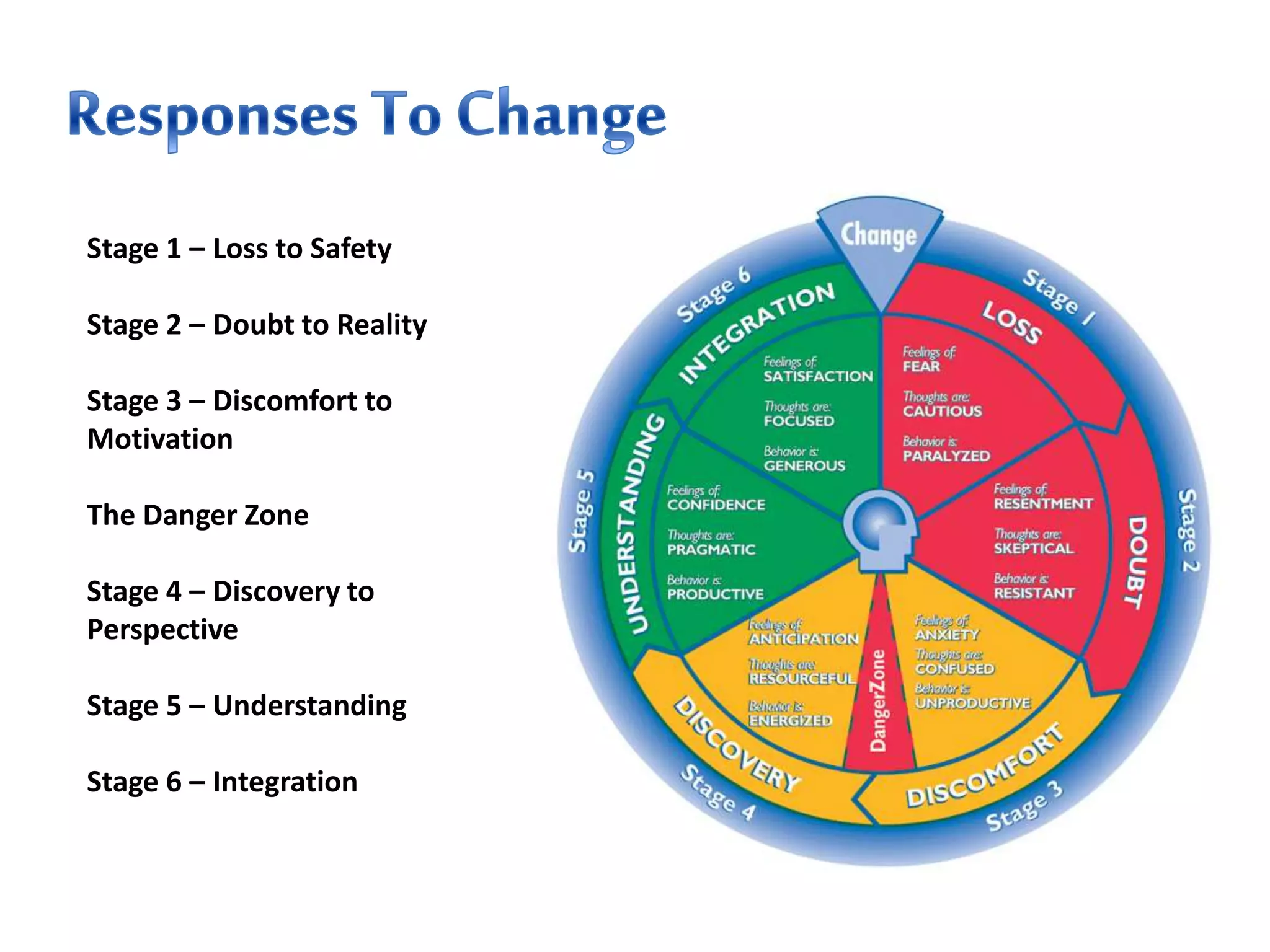
People react, respond and adjust to
change in a sequence of six
predictable stages. The Change
Cycle model identifies the thoughts,
feelings and behaviors associated
with each stage of change.
Stage 1 – Loss to Safety
Stage 2 – Doubt to Reality
Stage 3 – Discomfort to
Motivation
The Danger Zone
Stage 4 – Discovery to
Perspective
Stage 5 – Understanding
Stage 6 – Integration
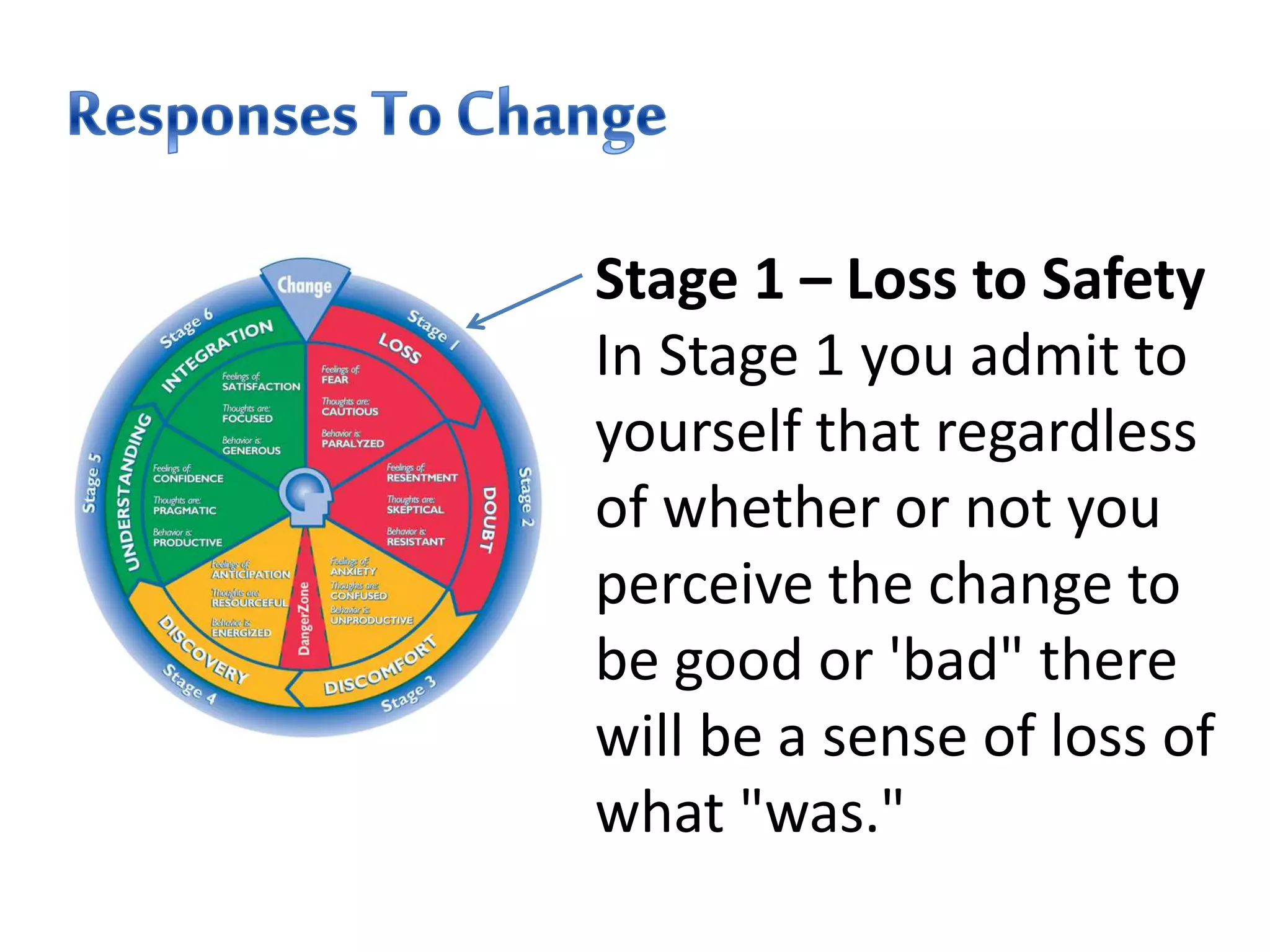
Stage 1 – Loss to Safety
In Stage 1 you admit to
yourself that regardless
of whether or not you
perceive the change to
be good or 'bad" there
will be a sense of loss of
what "was."
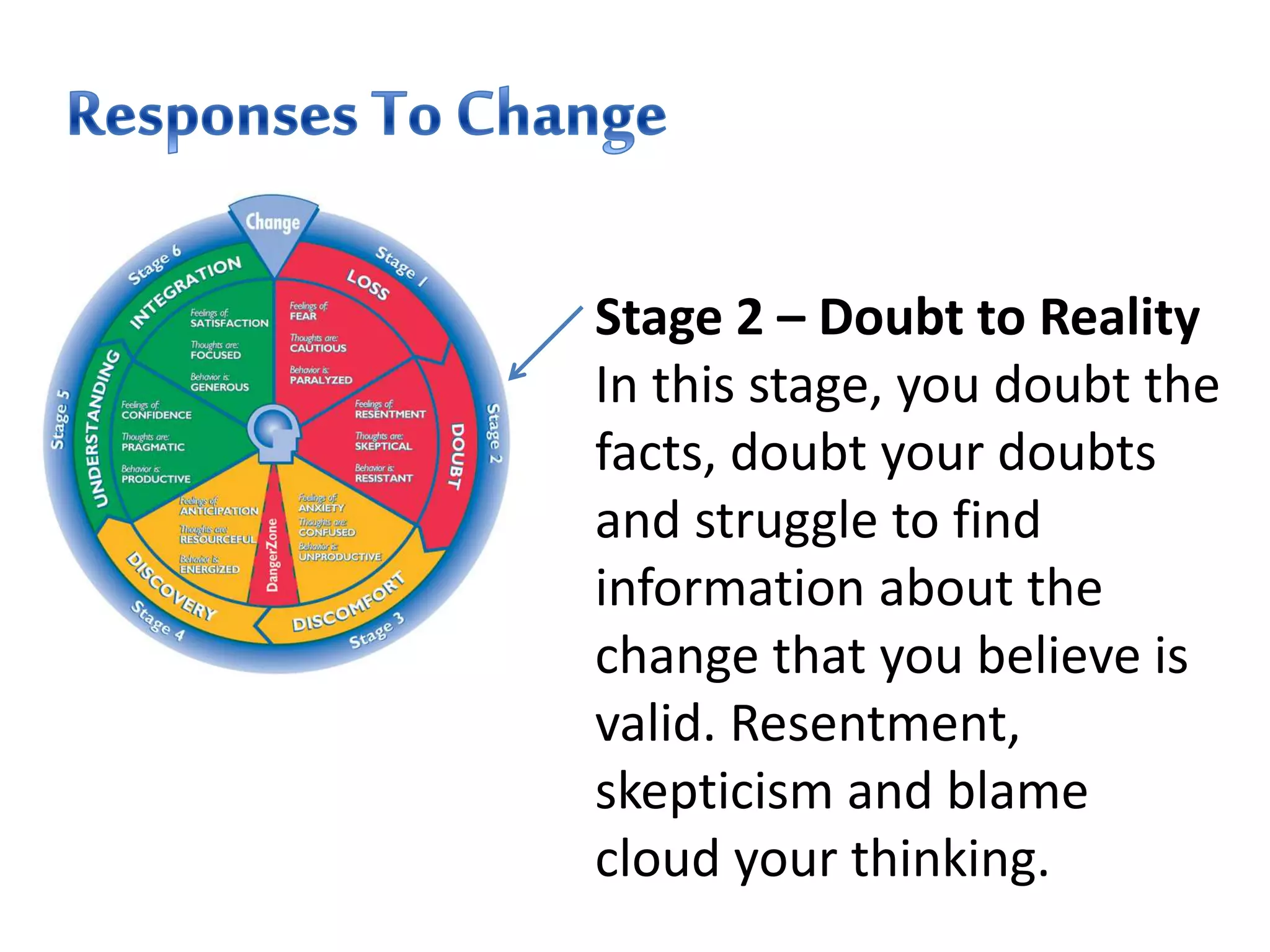
Stage 2 – Doubt to Reality
In this stage, you doubt the
facts, doubt your doubts
and struggle to find
information about the
change that you believe is
valid. Resentment,
skepticism and blame
cloud your thinking.
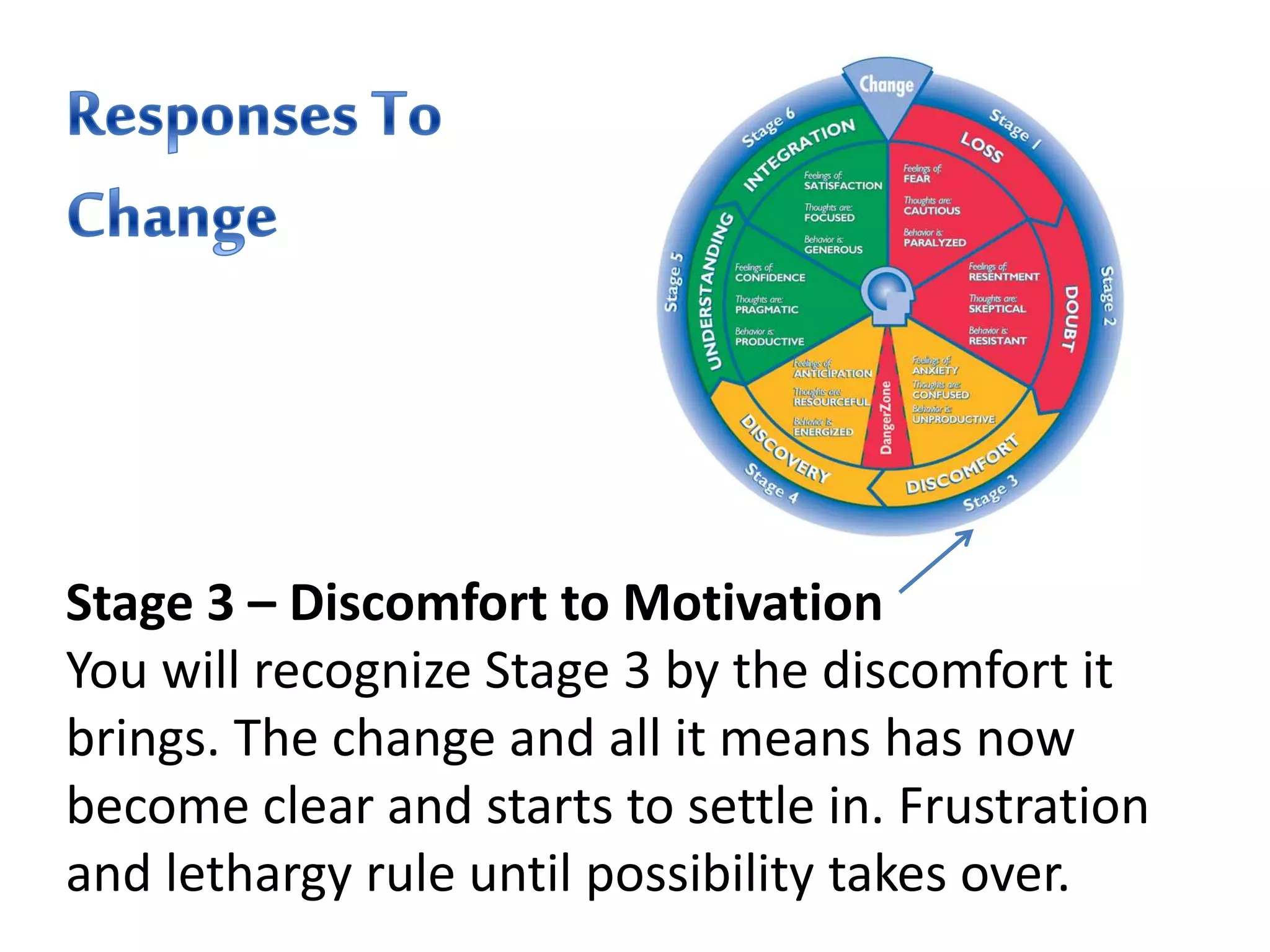
Stage 3 – Discomfort to Motivation
You will recognize Stage 3 by the discomfort it
brings. The change and all it means has now
become clear and starts to settle in. Frustration
and lethargy rule until possibility takes over.
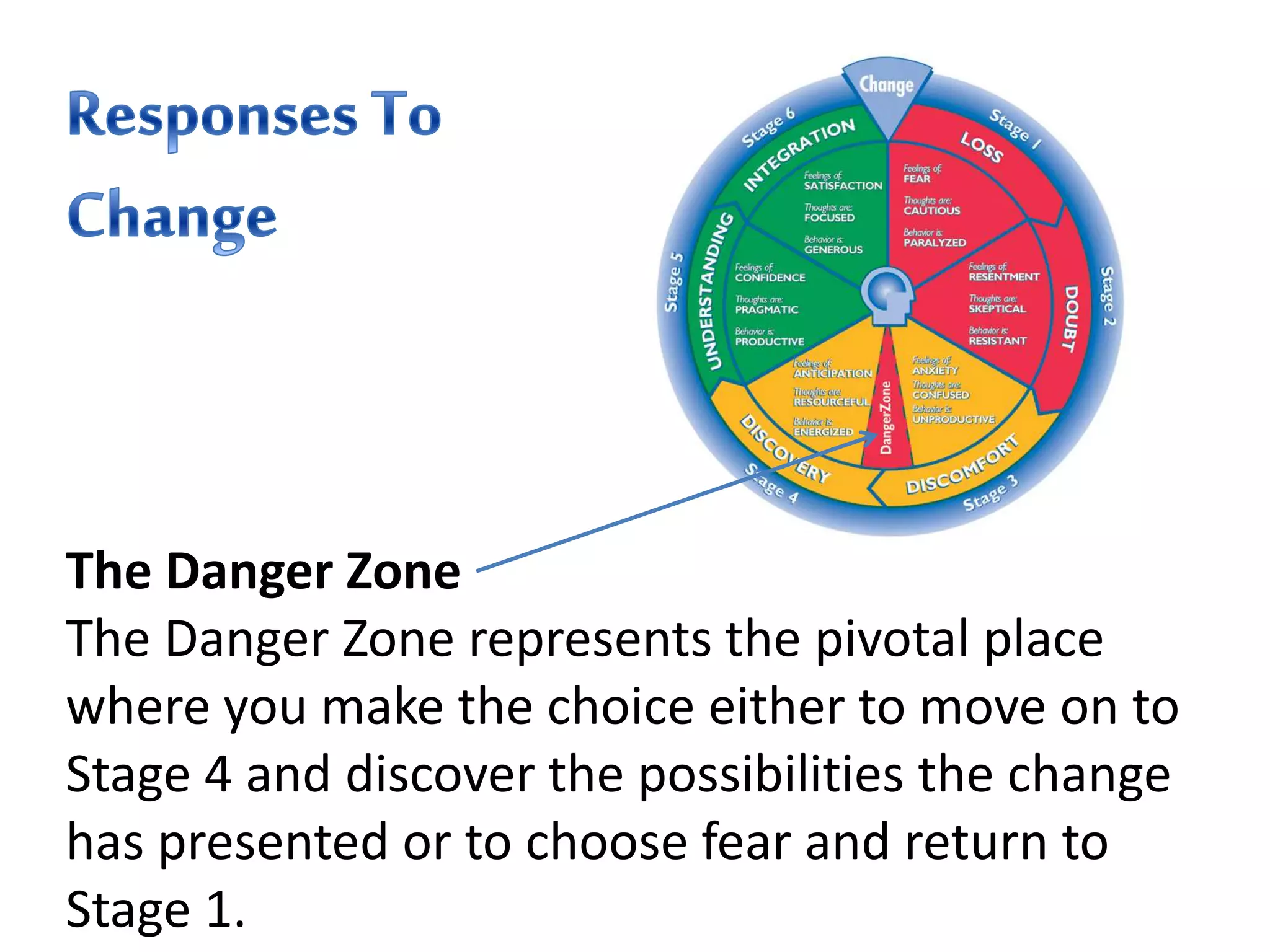
The Danger Zone
The Danger Zone represents the pivotal place
where you make the choice either to move on to
Stage 4 and discover the possibilities the change
has presented or to choose fear and return to
Stage 1.
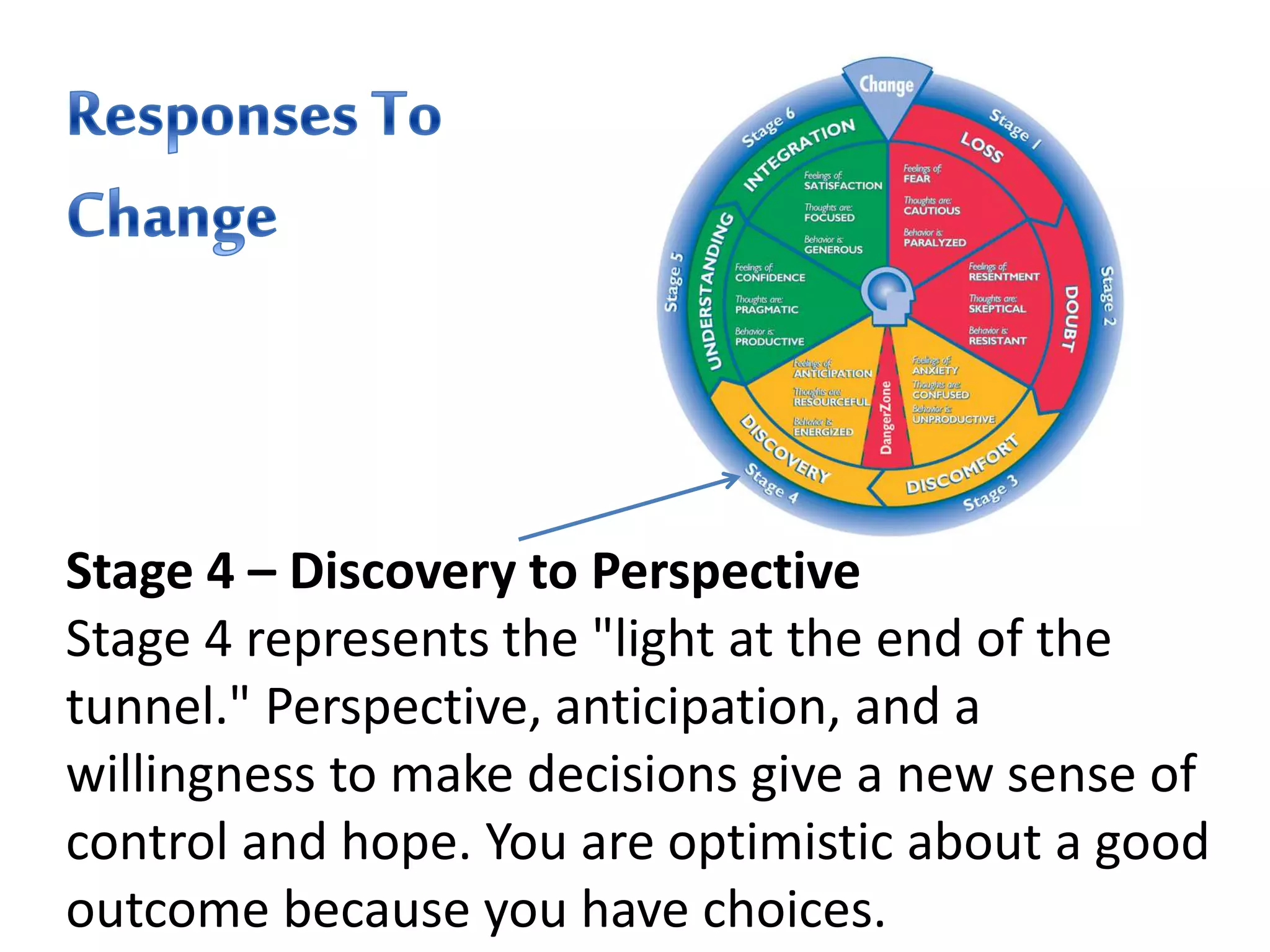
Stage 4 – Discovery to Perspective
Stage 4 represents the "light at the end of the
tunnel." Perspective, anticipation, and a
willingness to make decisions give a new sense of
control and hope. You are optimistic about a good
outcome because you have choices.
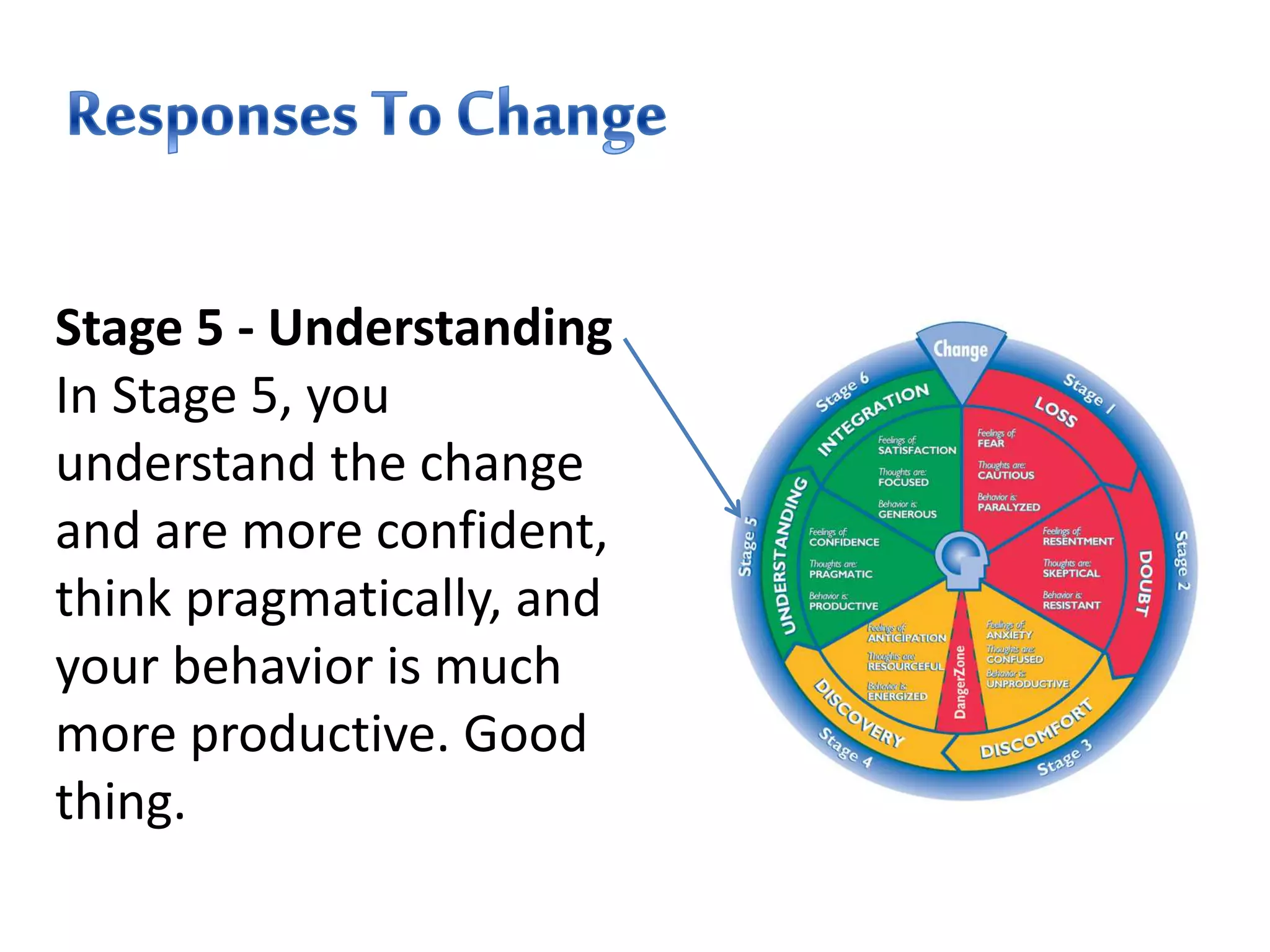
Stage 5 - Understanding
In Stage 5, you
understand the change
and are more confident,
think pragmatically, and
your behavior is much
more productive. Good
thing.
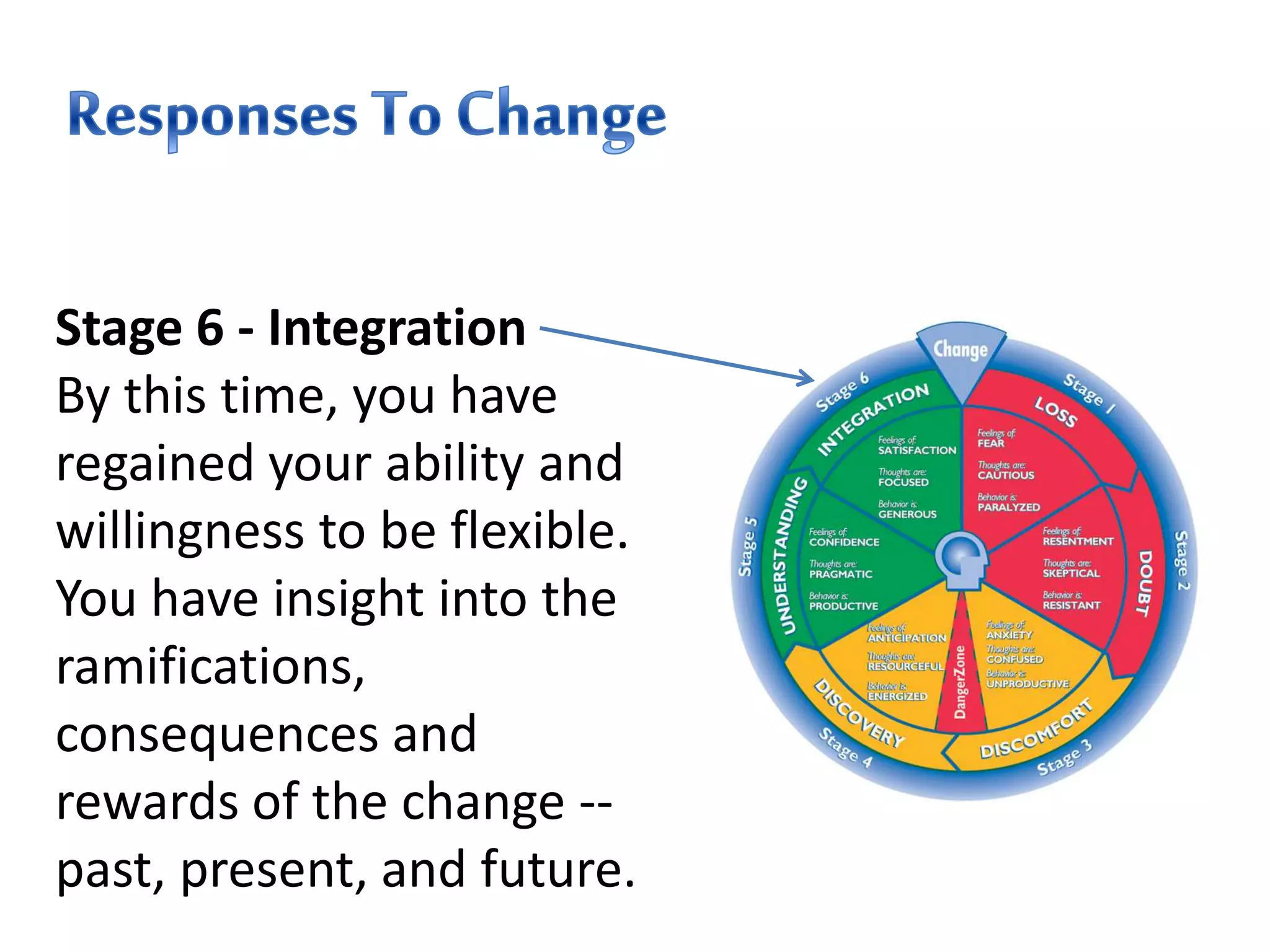
Stage 6 - Integration
By this time, you have
regained your ability and
willingness to be flexible.
You have insight into the
ramifications,
consequences and
rewards of the change --
past, present, and future.
•The fact that people are different in how they
handle change
•The fact that there are particular ways in which
leaders themselves handle and lead change
•Leaders who develop followers add one at a
time – Leaders who develop leaders multiply
their growth
•There is direct correlation between
communication effectiveness and leading change
• The work of coaching is to help define how to link the
inner world of our purpose with the outer world where we
express our various roles – careerist, parent, partner,
friend, team-member and community citizen
• Michelangelo was being observed one day as he was
creating a sculpture. People were amazed with what they
saw as this blank piece of marble started to become an
angel. When asked, how do you do that? He said, I saw the
angel in the marble and released it.
• This is an apt metaphor for life coaching. Without
attempting to change who the clients are, coaches make
powerful impacts on their clients’ lives.
Source: Frederic, Hudson, The Hudson Institute
• Coaching is partnering with clients in a thought-provoking
and creative process that inspires them to maximize their
personal and professional potential.
• Coaching is an ongoing relationship which focuses on
clients taking action toward the realization of their visions,
goals or desires. Coaching uses a process of inquiry and
personal discovery to build the client’s level of awareness
and responsibility and provides the client with structure,
support and feedback. The coaching process helps clients
both define and achieve professional and personal goals
faster and with more ease than would be possible
otherwise.
• COACHING transforms human interaction, encouraging leaders
to continually become more effective in shaping the world’s
future.
• COACHING accelerates the development of human potential by
combining applications from psychology, business
management, systems theory, management consulting, and
philosophy. Designed to promote your personal and
professional achievement, coaching facilitates self-awareness,
the development of success-producing actions, and proactive
living.
• COACHING is a customized, strategic, action and results-
oriented partnership, providing the context and methodology
to define what success means to you. In collaboration, you will
identify your goals, clarify your purpose, and create a vision for
an integrated and fulfilling life.
• COACHING is a human development specialist. Your
coach will “hold” your vision and motivation the
development and implementation of a strategic
action plan through which to achieve your goals.
• COACHING is about learning. Learning to expand the
way you observe, relate to, and engage the world by
challenging the underlying beliefs and assumptions
that are responsible for your actions and behaviors.
Understanding the principles upon which you form
your identity leads to expanded possibilities for
relationships, contributions and achievements.
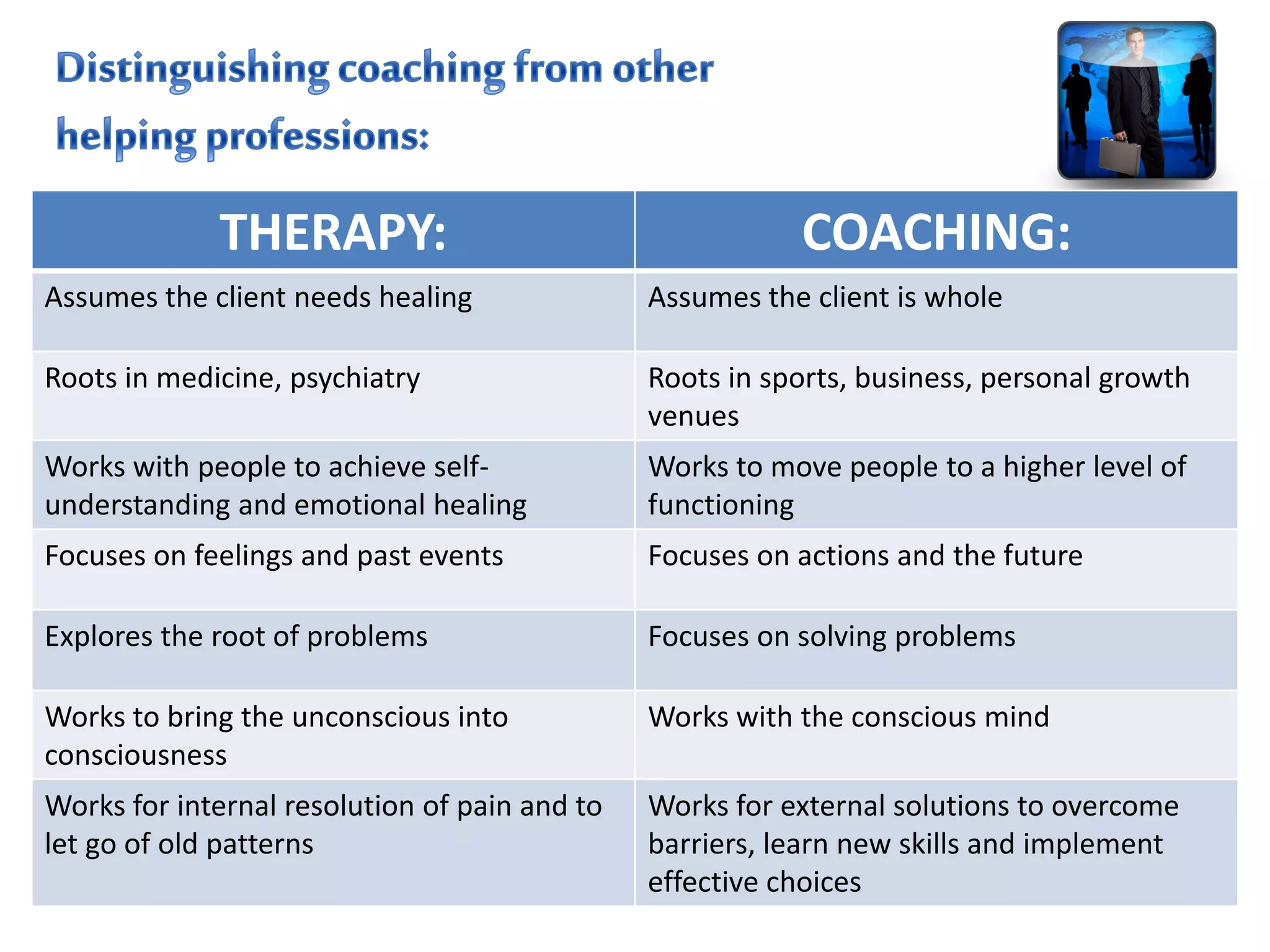
THERAPY: COACHING:
Assumes the client needs healing Assumes the client is whole
Roots in medicine, psychiatry Roots in sports, business, personal growth
venues
Works with people to achieve self-
understanding and emotional healing
Works to move people to a higher level of
functioning
Focuses on feelings and past events Focuses on actions and the future
Explores the root of problems Focuses on solving problems
Works to bring the unconscious into
consciousness
Works with the conscious mind
Works for internal resolution of pain and to
let go of old patterns
Works for external solutions to overcome
barriers, learn new skills and implement
effective choices
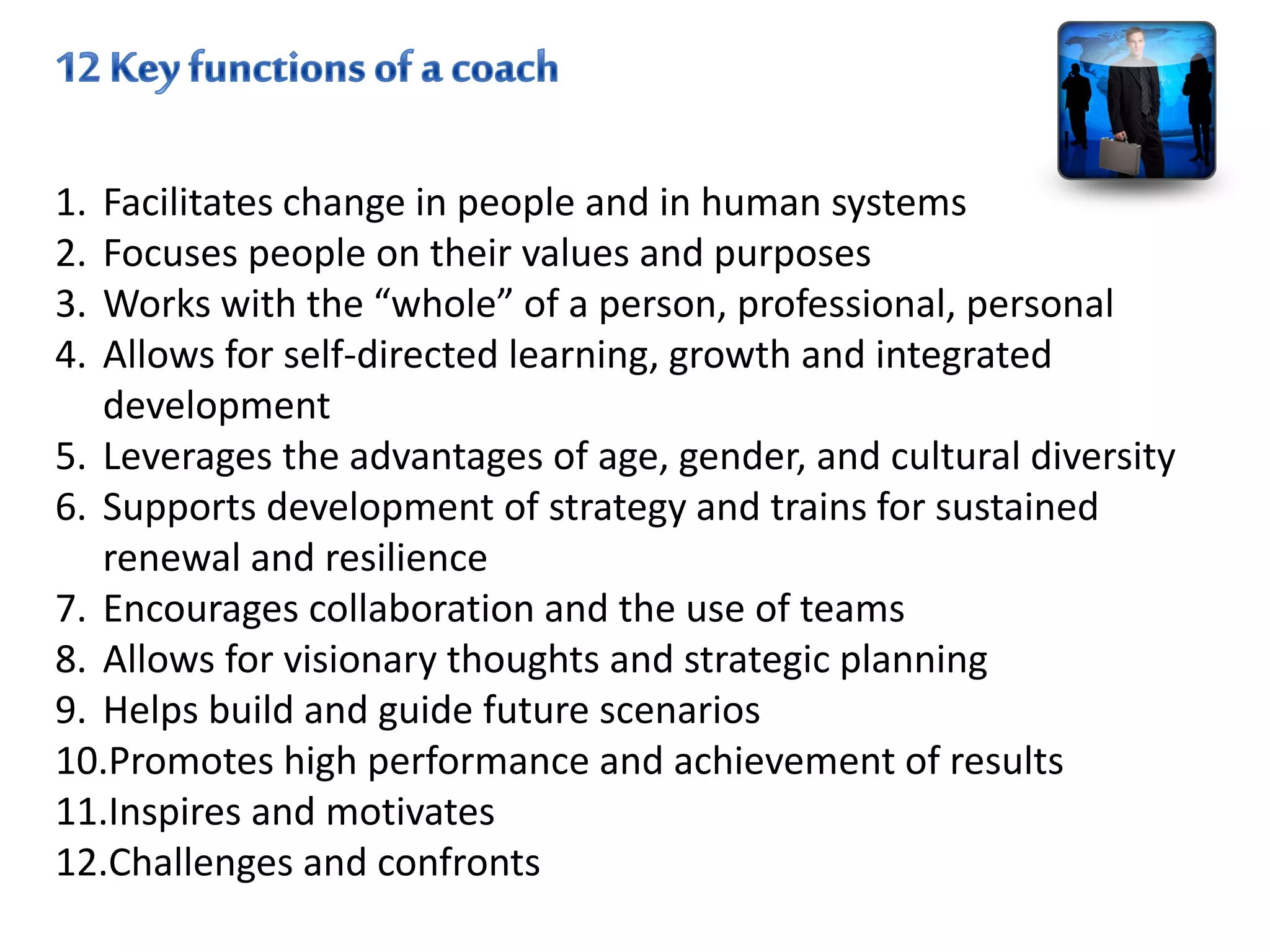
1. Facilitates change in people and in human systems
2. Focuses people on their values and purposes
3. Works with the “whole” of a person, professional, personal
4. Allows for self-directed learning, growth and integrated
development
5. Leverages the advantages of age, gender, and cultural diversity
6. Supports development of strategy and trains for sustained
renewal and resilience
7. Encourages collaboration and the use of teams
8. Allows for visionary thoughts and strategic planning
9. Helps build and guide future scenarios
10.Promotes high performance and achievement of results
11.Inspires and motivates
12.Challenges and confronts
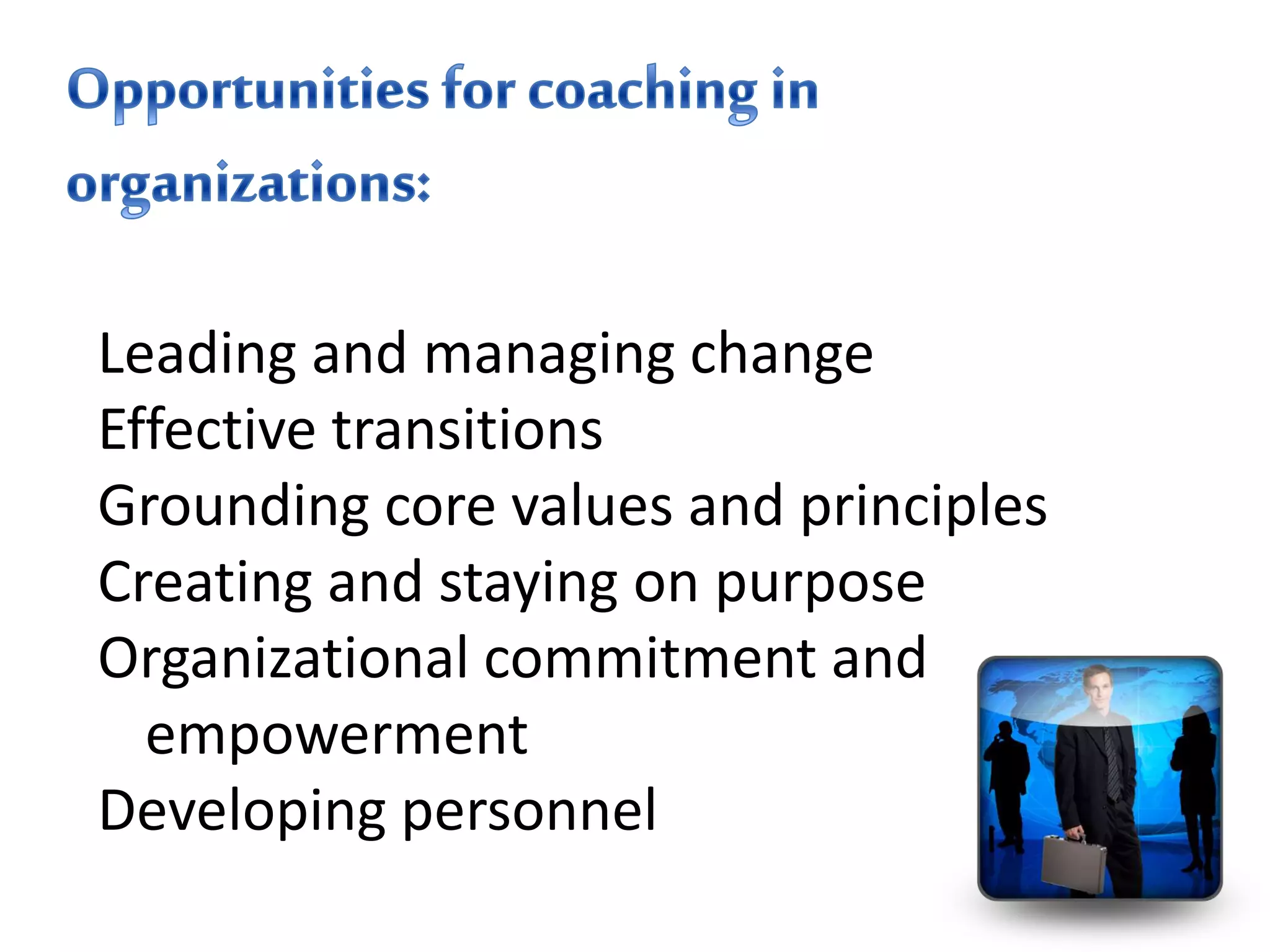
Leading and managing change
Effective transitions
Grounding core values and principles
Creating and staying on purpose
Organizational commitment and
empowerment
Developing personnel

Practice of coaching change

  • 1.
  • 3.
    People react, respondand adjust to change in a sequence of six predictable stages. The Change Cycle model identifies the thoughts, feelings and behaviors associated with each stage of change.
  • 4.
    Stage 1 –Loss to Safety Stage 2 – Doubt to Reality Stage 3 – Discomfort to Motivation The Danger Zone Stage 4 – Discovery to Perspective Stage 5 – Understanding Stage 6 – Integration
  • 5.
    Stage 1 –Loss to Safety In Stage 1 you admit to yourself that regardless of whether or not you perceive the change to be good or 'bad" there will be a sense of loss of what "was."
  • 6.
    Stage 2 –Doubt to Reality In this stage, you doubt the facts, doubt your doubts and struggle to find information about the change that you believe is valid. Resentment, skepticism and blame cloud your thinking.
  • 7.
    Stage 3 –Discomfort to Motivation You will recognize Stage 3 by the discomfort it brings. The change and all it means has now become clear and starts to settle in. Frustration and lethargy rule until possibility takes over.
  • 8.
    The Danger Zone TheDanger Zone represents the pivotal place where you make the choice either to move on to Stage 4 and discover the possibilities the change has presented or to choose fear and return to Stage 1.
  • 9.
    Stage 4 –Discovery to Perspective Stage 4 represents the "light at the end of the tunnel." Perspective, anticipation, and a willingness to make decisions give a new sense of control and hope. You are optimistic about a good outcome because you have choices.
  • 10.
    Stage 5 -Understanding In Stage 5, you understand the change and are more confident, think pragmatically, and your behavior is much more productive. Good thing.
  • 11.
    Stage 6 -Integration By this time, you have regained your ability and willingness to be flexible. You have insight into the ramifications, consequences and rewards of the change -- past, present, and future.
  • 12.
    •The fact thatpeople are different in how they handle change •The fact that there are particular ways in which leaders themselves handle and lead change •Leaders who develop followers add one at a time – Leaders who develop leaders multiply their growth •There is direct correlation between communication effectiveness and leading change
  • 13.
    • The workof coaching is to help define how to link the inner world of our purpose with the outer world where we express our various roles – careerist, parent, partner, friend, team-member and community citizen • Michelangelo was being observed one day as he was creating a sculpture. People were amazed with what they saw as this blank piece of marble started to become an angel. When asked, how do you do that? He said, I saw the angel in the marble and released it. • This is an apt metaphor for life coaching. Without attempting to change who the clients are, coaches make powerful impacts on their clients’ lives. Source: Frederic, Hudson, The Hudson Institute
  • 14.
    • Coaching ispartnering with clients in a thought-provoking and creative process that inspires them to maximize their personal and professional potential. • Coaching is an ongoing relationship which focuses on clients taking action toward the realization of their visions, goals or desires. Coaching uses a process of inquiry and personal discovery to build the client’s level of awareness and responsibility and provides the client with structure, support and feedback. The coaching process helps clients both define and achieve professional and personal goals faster and with more ease than would be possible otherwise.
  • 15.
    • COACHING transformshuman interaction, encouraging leaders to continually become more effective in shaping the world’s future. • COACHING accelerates the development of human potential by combining applications from psychology, business management, systems theory, management consulting, and philosophy. Designed to promote your personal and professional achievement, coaching facilitates self-awareness, the development of success-producing actions, and proactive living. • COACHING is a customized, strategic, action and results- oriented partnership, providing the context and methodology to define what success means to you. In collaboration, you will identify your goals, clarify your purpose, and create a vision for an integrated and fulfilling life.
  • 16.
    • COACHING isa human development specialist. Your coach will “hold” your vision and motivation the development and implementation of a strategic action plan through which to achieve your goals. • COACHING is about learning. Learning to expand the way you observe, relate to, and engage the world by challenging the underlying beliefs and assumptions that are responsible for your actions and behaviors. Understanding the principles upon which you form your identity leads to expanded possibilities for relationships, contributions and achievements.
  • 17.
    THERAPY: COACHING: Assumes theclient needs healing Assumes the client is whole Roots in medicine, psychiatry Roots in sports, business, personal growth venues Works with people to achieve self- understanding and emotional healing Works to move people to a higher level of functioning Focuses on feelings and past events Focuses on actions and the future Explores the root of problems Focuses on solving problems Works to bring the unconscious into consciousness Works with the conscious mind Works for internal resolution of pain and to let go of old patterns Works for external solutions to overcome barriers, learn new skills and implement effective choices
  • 18.
    1. Facilitates changein people and in human systems 2. Focuses people on their values and purposes 3. Works with the “whole” of a person, professional, personal 4. Allows for self-directed learning, growth and integrated development 5. Leverages the advantages of age, gender, and cultural diversity 6. Supports development of strategy and trains for sustained renewal and resilience 7. Encourages collaboration and the use of teams 8. Allows for visionary thoughts and strategic planning 9. Helps build and guide future scenarios 10.Promotes high performance and achievement of results 11.Inspires and motivates 12.Challenges and confronts
  • 19.
    Leading and managingchange Effective transitions Grounding core values and principles Creating and staying on purpose Organizational commitment and empowerment Developing personnel