INTRODUCTION to pra
WHAT IS PARTICIPATORY RURAL APPRAISAL?
• Appraisal –The finding out of information about problems,
needs, and potential in a village. It is the first stage in any
project.
• Participatory – Means that people are involved in the process
in deciding how something is done.
• Rural – The techniques can be used in any situation, urban or
rural, with both literate and illiterate people.
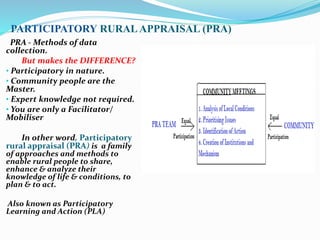
PARTICIPATORY RURAL APPRAISAL (PRA)
PRA - Methods of data
collection.
But makes the DIFFERENCE?
• Participatory in nature.
• Community people are the
Master.
• Expert knowledge not required.
• You are only a Facilitator/
Mobiliser
In other word, Participatory
rural appraisal (PRA) is a family
of approaches and methods to
enable rural people to share,
enhance & analyze their
knowledge of life & conditions, to
plan & to act.
Also known as Participatory
Learning and Action (PLA)
CHALLENGES
 Expect the unexpected (rodents, mosquitoes, street
hawking, open markets)
 Expect poor road conditions
 No electricity or power failures (your computer loses
power…)
 Lots of people may follow you around (no
confidentiality!)
 Time feels different
So how are you going to get your work done?
KEY PRINCIPLES
 Participation – local people serve as partners in data collection
and analysis
 Flexibility- not a standardized methodology
 Teamwork – everyone is involved
 Diversity – attempts made to identify and analyse contradictions
and exceptions
 Optimal Ignorance – leave out unessential details
 Systematic – to get correct details and conclusions, it is best to
cross check
 Reversal of Learning – Learning from rural people directly
on the site and face to face.
pra techniques
 Physical mapping
 Do-it-yourself
 Venn-Diagram
 Time trend
 Matrix ranking
 Impact diagrams
 Semi – structured interviews
 Mapping-community members depicting the physical or social characteristics of their
community.
 Social Mapping
 Wealth Ranking
social mapping
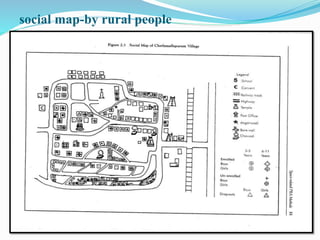
 Social mapping is a PRA method that involves the
sketching/drawing of houses and other social facilities
and infrastructure (i.e. temple, stores, rice mills,
school, pharmacy, trails and roads, water pumps,
irrigation and recreation facilities) in a village.
 It helps to visualize and situate the location of
households and other social facilities/infrastructure in
a village.
 It serves as a baseline for planning, implementation,
monitoring, and evaluation of village development
activities (including selection of village organizing
strategy).
social map-by rural people
objectives
 To learn about the social structures in the village and
the differences among the households by ethnicity,
religion and wealth.
 To learn about who is living where.
 To learn about the social institutions and the different
views local people might have regarding those
institutions.
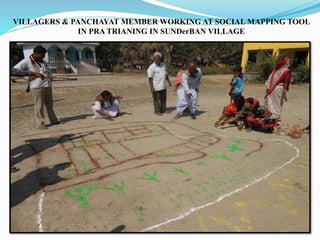
VILLAGERS & PANCHAYAT MEMBER WORKING AT SOCIAL MAPPING TOOL
IN PRA TRIANING IN SUNDerBAN VILLAGE
wealth ranking
This tool is a method for collecting and
analyzing data on perceptions of wealth
differences and inequalities in a community
and for identifying and understanding local
indicators and criteria of wealth, well-being,
and poverty.
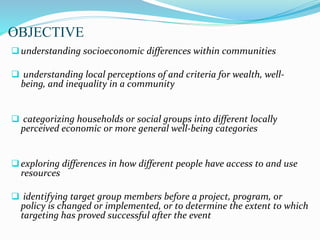
OBJECTIVE
understanding socioeconomic differences within communities
 understanding local perceptions of and criteria for wealth, well-
being, and inequality in a community
 categorizing households or social groups into different locally
perceived economic or more general well-being categories
exploring differences in how different people have access to and use
resources
 identifying target group members before a project, program, or
policy is changed or implemented, or to determine the extent to which
targeting has proved successful after the event
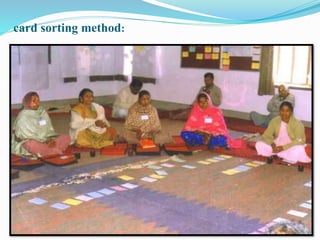
card sorting method:
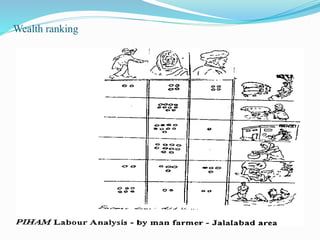
Wealth ranking
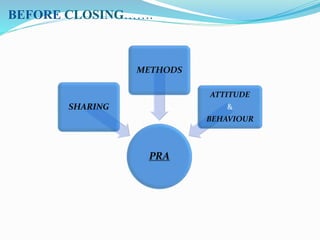
BEFORE CLOSING…….
PRA
SHARING
METHODS
ATTITUDE
&
BEHAVIOUR
references
 En.m.wikipedia.org/……/participatory_rural……..
 www.fao.org/docrep/003/....../x5996eo
 Web.worldbank.org/…../o,,contentmdk:…..
 Siteresources.worldbank.org/…./3_so…..
 www.ifmrlead.org/..../2.-pra-technique-.....
 Cec.vcn.bc.ca/cmp/modules/par-tech
 www.slideshare.net/iccnn/paticipatory-rural-appraisal-
kala-rai?related=1
Pra tools

Pra tools

  • 2.
    INTRODUCTION to pra WHATIS PARTICIPATORY RURAL APPRAISAL? • Appraisal –The finding out of information about problems, needs, and potential in a village. It is the first stage in any project. • Participatory – Means that people are involved in the process in deciding how something is done. • Rural – The techniques can be used in any situation, urban or rural, with both literate and illiterate people.
  • 3.
    PARTICIPATORY RURAL APPRAISAL(PRA) PRA - Methods of data collection. But makes the DIFFERENCE? • Participatory in nature. • Community people are the Master. • Expert knowledge not required. • You are only a Facilitator/ Mobiliser In other word, Participatory rural appraisal (PRA) is a family of approaches and methods to enable rural people to share, enhance & analyze their knowledge of life & conditions, to plan & to act. Also known as Participatory Learning and Action (PLA)
  • 4.
    CHALLENGES  Expect theunexpected (rodents, mosquitoes, street hawking, open markets)  Expect poor road conditions  No electricity or power failures (your computer loses power…)  Lots of people may follow you around (no confidentiality!)  Time feels different So how are you going to get your work done?
  • 5.
    KEY PRINCIPLES  Participation– local people serve as partners in data collection and analysis  Flexibility- not a standardized methodology  Teamwork – everyone is involved  Diversity – attempts made to identify and analyse contradictions and exceptions  Optimal Ignorance – leave out unessential details  Systematic – to get correct details and conclusions, it is best to cross check  Reversal of Learning – Learning from rural people directly on the site and face to face.
  • 6.
    pra techniques  Physicalmapping  Do-it-yourself  Venn-Diagram  Time trend  Matrix ranking  Impact diagrams  Semi – structured interviews  Mapping-community members depicting the physical or social characteristics of their community.  Social Mapping  Wealth Ranking
  • 7.
    social mapping  Socialmapping is a PRA method that involves the sketching/drawing of houses and other social facilities and infrastructure (i.e. temple, stores, rice mills, school, pharmacy, trails and roads, water pumps, irrigation and recreation facilities) in a village.  It helps to visualize and situate the location of households and other social facilities/infrastructure in a village.  It serves as a baseline for planning, implementation, monitoring, and evaluation of village development activities (including selection of village organizing strategy).
  • 8.
  • 9.
    objectives  To learnabout the social structures in the village and the differences among the households by ethnicity, religion and wealth.  To learn about who is living where.  To learn about the social institutions and the different views local people might have regarding those institutions.
  • 10.
    VILLAGERS & PANCHAYATMEMBER WORKING AT SOCIAL MAPPING TOOL IN PRA TRIANING IN SUNDerBAN VILLAGE
  • 11.
    wealth ranking This toolis a method for collecting and analyzing data on perceptions of wealth differences and inequalities in a community and for identifying and understanding local indicators and criteria of wealth, well-being, and poverty.
  • 12.
    OBJECTIVE understanding socioeconomic differenceswithin communities  understanding local perceptions of and criteria for wealth, well- being, and inequality in a community  categorizing households or social groups into different locally perceived economic or more general well-being categories exploring differences in how different people have access to and use resources  identifying target group members before a project, program, or policy is changed or implemented, or to determine the extent to which targeting has proved successful after the event
  • 13.
  • 14.
  • 15.
  • 16.
    references  En.m.wikipedia.org/……/participatory_rural……..  www.fao.org/docrep/003/....../x5996eo Web.worldbank.org/…../o,,contentmdk:…..  Siteresources.worldbank.org/…./3_so…..  www.ifmrlead.org/..../2.-pra-technique-.....  Cec.vcn.bc.ca/cmp/modules/par-tech  www.slideshare.net/iccnn/paticipatory-rural-appraisal- kala-rai?related=1