THESIS PROTOCOL
• SERUM URIC ACID LEVEL AND MICRO
& MACRO VASCULAR COMPLICATION
IN DIABETES MELLITUS
Presented By :
Dr Sachinkumar Pandey
DNB Family Medicine
THESIS PROTOCOL
• NAME OF CANDIDATE : DR. SACHINKUMAR PANDEY
• COURSE : DNB FAMILY MEDICINE
• NAME OF INSTITUTE : ADITYA BIRLA MEMORIAL HOSPITAL, PUNE
• DATE OF JOINING : 6th SEPTEMBER, 2017
• GUIDE : Dr. SANDEEP BHAVSAR
MD ( INTERNAL MEDICINE)
SENIOR CONSULTANT
• CO-GUIDE :DR. SURESH SINHA
MD, DM (ENDOCRINOLOGIST)
SENIOR CONSULTANT
Why should we do this study ?
• Specifically, in patients with type 2 diabetes mellitus (T2DM),
high SUA levels have been linked with macrovascular disease,
namely, stroke and PAD while the association between SUA and
microvascular disease has received little attention. More
recently, however, some data on its relationship with
microangiopathy have become available.
INTRODUCTION
• Diabetes mellitus (DM) is a metabolic disease that affects many people
across the world but more so in India. India is known as the "diabetes
capital of the world". From 51 million people in 2010, the number of
persons with type 2 diabetes mellitus in India is estimated to register a
58% increase to reach an alarming level of 87 million by the year 2030. In
a recent study from India, the prevalence of microvascular complications
in newly diagnosed type 2 diabetics was reported 1,2,3as 32.55% (one in
three patients) .[1]
• Diabetes mellitus (DM) refers to a group of common metabolic disorders
that share the phenotype of hyperglycemia. The two broad categories of
DM designated as type 1 and type 2. Type 1 diabetes is the result of
complete or near total insulin deficiency. Type 2 diabetes is a
heterogenous group of disorders characterized by variable degrees of
insulin resistance, impaired insulin secretion, and increased glucose
production. In accordance with the criteria of the American Diabetes
Association and World Health Organization, DM is diagnosed when 1)
fasting blood glucose ≥126 mg/dl or 2)two hour post glucose >200 mg/dl.
The diabetic duration is defined as the duration from the first diagnosis of
type 2 DM to the time of blood sampling.[25]
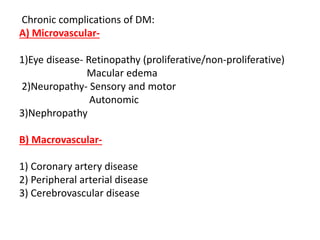
Chronic complications of DM:
A) Microvascular-
1)Eye disease- Retinopathy (proliferative/non-proliferative)
Macular edema
2)Neuropathy- Sensory and motor
Autonomic
3)Nephropathy
B) Macrovascular-
1) Coronary artery disease
2) Peripheral arterial disease
3) Cerebrovascular disease
AIMS
1) To study clinical, haematological and biochemical profile of Diabetes
Mellitus Type 2
2) To establish a correlation between diabetes (micro and macrovascular)
complications and serum uric acid level.
OBJECTIVES
1. To know whether increased serum uric acid levels are independently
associated with chronic complications in type 2 diabetes. ( To assess the
predictive role of serum uric acid levels on development of diabetic
retinopathy, nephropathy, neuropathy and dyslipidemia in a large group of
type 2 diabetic individuals.)
2. To evaluate relationship between hyperuricemia and the risk of incident
micro and macrovascular complications in type 2 diabetic patients
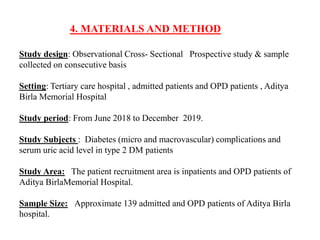
4. MATERIALS AND METHOD
Study design: Observational Cross- Sectional Prospective study & sample
collected on consecutive basis
Setting: Tertiary care hospital , admitted patients and OPD patients , Aditya
Birla Memorial Hospital
Study period: From June 2018 to December 2019.
Study Subjects : Diabetes (micro and macrovascular) complications and
serum uric acid level in type 2 DM patients
Study Area: The patient recruitment area is inpatients and OPD patients of
Aditya BirlaMemorial Hospital.
Sample Size: Approximate 139 admitted and OPD patients of Aditya Birla
hospital.
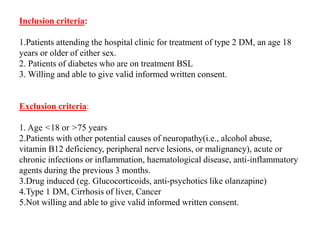
Inclusion criteria:
1.Patients attending the hospital clinic for treatment of type 2 DM, an age 18
years or older of either sex.
2. Patients of diabetes who are on treatment BSL
3. Willing and able to give valid informed written consent.
Exclusion criteria:
1. Age <18 or >75 years
2.Patients with other potential causes of neuropathy(i.e., alcohol abuse,
vitamin B12 deficiency, peripheral nerve lesions, or malignancy), acute or
chronic infections or inflammation, haematological disease, anti-inflammatory
agents during the previous 3 months.
3.Drug induced (eg. Glucocorticoids, anti-psychotics like olanzapine)
4.Type 1 DM, Cirrhosis of liver, Cancer
5.Not willing and able to give valid informed written consent.
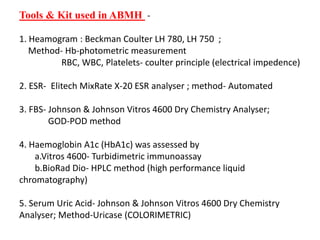
Tools & Kit used in ABMH -
1. Heamogram : Beckman Coulter LH 780, LH 750 ;
Method- Hb-photometric measurement
RBC, WBC, Platelets- coulter principle (electrical impedence)
2. ESR- Elitech MixRate X-20 ESR analyser ; method- Automated
3. FBS- Johnson & Johnson Vitros 4600 Dry Chemistry Analyser;
GOD-POD method
4. Haemoglobin A1c (HbA1c) was assessed by
a.Vitros 4600- Turbidimetric immunoassay
b.BioRad Dio- HPLC method (high performance liquid
chromatography)
5. Serum Uric Acid- Johnson & Johnson Vitros 4600 Dry Chemistry
Analyser; Method-Uricase (COLORIMETRIC)
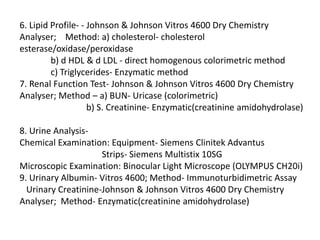
6. Lipid Profile- - Johnson & Johnson Vitros 4600 Dry Chemistry
Analyser; Method: a) cholesterol- cholesterol
esterase/oxidase/peroxidase
b) d HDL & d LDL - direct homogenous colorimetric method
c) Triglycerides- Enzymatic method
7. Renal Function Test- Johnson & Johnson Vitros 4600 Dry Chemistry
Analyser; Method – a) BUN- Uricase (colorimetric)
b) S. Creatinine- Enzymatic(creatinine amidohydrolase)
8. Urine Analysis-
Chemical Examination: Equipment- Siemens Clinitek Advantus
Strips- Siemens Multistix 10SG
Microscopic Examination: Binocular Light Microscope (OLYMPUS CH20i)
9. Urinary Albumin- Vitros 4600; Method- Immunoturbidimetric Assay
Urinary Creatinine-Johnson & Johnson Vitros 4600 Dry Chemistry
Analyser; Method- Enzymatic(creatinine amidohydrolase)
10. Slit Lamp Biomicroscope (CARLZEISS)
11. Indirect Ophthalmoscope with 20D Lense
12. Zeiss Cirrus HD-OCT- Spectrum Domain Technology
13. 10 gram Monofilament
14. Sphegmomenometer for blood pressure measurement
15. Electrocardiogram: MAC 1200ST
5. Sample size and statistical method:
Sample size:
P= 10 %. (diabetes mellitus type II)(21)
Confidence level = 95%
Absolute Precision = E = 5%
N = Z2 PQ / E2
= ( 1.96)2 ( 10 ) X( 90 ) / ( 5 )2
= 138.2~139 Aprroximatly
So I have taken 139 cases in my study
(The sample size calculation that we use internally can be found in Cochran,
W. G. (1977). Sampling Techniques, 3rd edition. Wiley, New York.) 20
Methodology
In study total 139 patients of known case of type 2 DM will be included. We will take
full medical history of all individuals and detailed clinical examinations with laboratory
investigations will be undertaken to exclude any other systemic and/or local diseases
that may affect the parameters examined in this study.
For this study, microvascular complications were defined as follows:
Nephropathy: Measurement of a spot urine sample for albumin alone (whether by
immunoassay or by using a sensitive dipstick test specific for albuminuria) was done.
Values ≥ 30μg/mg creatinine is taken as increased urinary albumin excretion as given
by ADA 6guidelines .[1,13]
Neuropathy: Patients are screened using tests such as pinprick sensation, vibration
perception (using a 128-Hz tuning fork), and 10 g monofilament pressure sensation at
the distal plantar aspect of both great toes and metatarsal joints, and assessment of
ankle reflexes. The presence of neuropathy is confirmed by physician if diagnosed with
one or more abnormal finding of 10 gram monofilament, pinprick sensations and
ankle reflexes.[1,9]
Methodology
Retinopathy: All patients will be evaluated by an ophthalmologist and classified as
diabetic retinopathy as per Early Treatment Diabetic Retinopathy Study.
In this study, we describe and compare macular thickness using Stratus OCT in persons
with diabetes, and identified factors that affected macular thickness measurements.
OCT scanning is performed by trained technicians using OCT (Zeiss Cirrus HD-OCT-
Spectrum Domain Technology).
Body mass index was computed as weight in kilograms divided by the square of height
in meters. , BMI cut-off of 25 kg/m was used for making a diagnosis of obesity as
recommended by various studies with Indians (Asian Indian Phenotype).
Blood pressure will be measured with a random-zero mercury sphygmomanometer
for each and every patient. Hypertension was defined as a SBP value ≥140 mm of Hg
and/ or DBP ≥ 90mm of Hg according to JNC 7 values or when taking anti-hypertensive
therapy .
Dyslipidemia: Values of total triglycerides ≥ 150 mg/dl and /or HDL <40mg/dl for men
and <50 mg/dl for women is considered abnormal.
Smoking is defined as daily consumption of ≥1 cigarette for at least 2 years during the
preceding 5 years.(12)
Methodology
Coronary artery disease (CAD) will be diagnosed on the basis of
electrocardiographic findings.
Peripheral Arterial Disease will be diagnosed by on the basis of Arterial
Doppler study.
Cerebrovascular disease will be diagnosed on the basis of previous history of
stroke, cerebral small vessel disease and acute cerebral vascular disease.
Haemoglobin A1c (HbA1c) by high performance liquid chromatography and
serum uric acid level will be assessed for each and every patient of our study.
Hyperuricemia is diagnosed when the serum uric acid concentration is > 416
micro mol/L (>7.0 mg/dl) in men or >386 micro mol/L(>6.5 mg/dl) in women,
or when patients were taking allopurinol. [7]
Methodology
Arbitrary Criteria for Education :
1] Able to read or write any single language is taken as ‘educated’.
2] Not able to read or write even a single language is taken as ‘uneducated’.
Arbitrary Criteria for Awareness : It is based on following two questions :
1] Do you know about DM ?
2] Whether good DM control is essential or not ?
On the basis of knowledge of the subjects of these two questions, they are
classified as Aware ,Partial aware and Not aware.
REVIEW OF LITERATURE
1.In 2017 ,Nikhitha Chandrashekar, et al studied the
Profile of Microvascular Complications in Newly Diagnosed Type
2 Diabetics and its Association with Correlates of Metabolic
Syndrome in a Tertiary Hospital. The prevalence of peripheral
neuropathy, nephropathy and retinopathy was 15.9%, 2.3% and
2.3% respectively. The study showed that out of 44 patients, 18
had hypertension (40.91%). Four out of the 18 hypertensive
patients had microvascular complications (22.2 %). There was a
significant association between obesity and peripheral
neuropathy (P< 0.05).
REVIEW OF LITERATURE
2. In 2014, Lee, J.J.; Yang, I.H.; Kuo, H.K.; Chung, M.S.; Chen,
Y.J.; Chen, C.H.; Liu, R.T; et al studied the Serum uric acid concentration
is associated with worsening in severity of diabetic retinopathy among type 2
diabetic patients in taiwan—A 3-year prospective study. Fundus examination
showed that 184 patients (24.6%) had non-proliferative retinopathy and 565
(75.4%) without DR at baseline. After 3 years, increase in the severity of DR
was recognized in 103 patients (13.8%), including 81 patients with newly
developed DR. Patients with increase in severity of DR positively associated
with duration of DM (11.9 vs. 9.4 years, p = 0.001), HbA1c (7.6 vs. 7.2%, p =
0.001), albuminuria (45.5 vs. 31.0%, p = 0.006), and SUA (6.47 vs. 5.87 mg/dl,
p<0.001) than did those without change in DR stage. Cox regression showed
that patients with SUA in the 3rd (5.9-6.9 mg/dl) and 4th (≥ 7.0mg/dl)
quartiles had hazard ratios for DR worsening of 2.57 and 3.66 (95% C.I. 1.30-
5.08 and 1.92-7.00) when compared with patients with SUA in the 1st quartile
(<4.9 mg/dl).
REVIEW OF LITERATURE
3.In 2013, Alberico Catapano, University of Milan, Italy ,et al.
conducted a search which yielded 9 eligible articles including
20,891 T2DM patients. Pooled estimates for the relationship
suggested that each 0.1 mmol/l increase in SUA resulted in a
28% increase in the risk of diabetic vascular complications and a
9% increase in the risk of diabetic mortality. In stratification-
analysis, the positive relationship between SUA and vascular
complications remained significant irrespective of mean age,
adjustment for metabolic variables and medications. However, it
was inconsistent in different populations (significantly positive in
the Asian but not in Australian and Italian population) and
sample sizes (significantly positive in the relatively large sample
size [≥1000] but non-significant in the small sample size [<1000]).
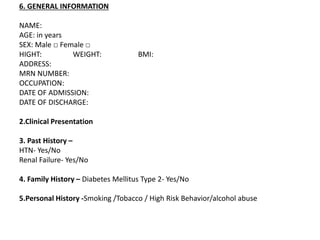
6. GENERAL INFORMATION
NAME:
AGE: in years
SEX: Male □ Female □
HIGHT: WEIGHT: BMI:
ADDRESS:
MRN NUMBER:
OCCUPATION:
DATE OF ADMISSION:
DATE OF DISCHARGE:
2.Clinical Presentation
3. Past History –
HTN- Yes/No
Renal Failure- Yes/No
4. Family History – Diabetes Mellitus Type 2- Yes/No
5.Personal History -Smoking /Tobacco / High Risk Behavior/alcohol abuse
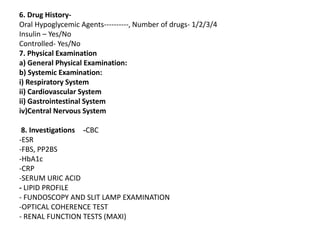
6. Drug History-
Oral Hypoglycemic Agents----------, Number of drugs- 1/2/3/4
Insulin – Yes/No
Controlled- Yes/No
7. Physical Examination
a) General Physical Examination:
b) Systemic Examination:
i) Respiratory System
ii) Cardiovascular System
ii) Gastrointestinal System
iv)Central Nervous System
8. Investigations -CBC
-ESR
-FBS, PP2BS
-HbA1c
-CRP
-SERUM URIC ACID
- LIPID PROFILE
- FUNDOSCOPY AND SLIT LAMP EXAMINATION
-OPTICAL COHERENCE TEST
- RENAL FUNCTION TESTS (MAXI)
THANK YOU !!

PPT.THESIS_PROTOCOL.pptx

  • 1.
    THESIS PROTOCOL • SERUMURIC ACID LEVEL AND MICRO & MACRO VASCULAR COMPLICATION IN DIABETES MELLITUS Presented By : Dr Sachinkumar Pandey DNB Family Medicine
  • 2.
    THESIS PROTOCOL • NAMEOF CANDIDATE : DR. SACHINKUMAR PANDEY • COURSE : DNB FAMILY MEDICINE • NAME OF INSTITUTE : ADITYA BIRLA MEMORIAL HOSPITAL, PUNE • DATE OF JOINING : 6th SEPTEMBER, 2017 • GUIDE : Dr. SANDEEP BHAVSAR MD ( INTERNAL MEDICINE) SENIOR CONSULTANT • CO-GUIDE :DR. SURESH SINHA MD, DM (ENDOCRINOLOGIST) SENIOR CONSULTANT
  • 3.
    Why should wedo this study ? • Specifically, in patients with type 2 diabetes mellitus (T2DM), high SUA levels have been linked with macrovascular disease, namely, stroke and PAD while the association between SUA and microvascular disease has received little attention. More recently, however, some data on its relationship with microangiopathy have become available.
  • 5.
    INTRODUCTION • Diabetes mellitus(DM) is a metabolic disease that affects many people across the world but more so in India. India is known as the "diabetes capital of the world". From 51 million people in 2010, the number of persons with type 2 diabetes mellitus in India is estimated to register a 58% increase to reach an alarming level of 87 million by the year 2030. In a recent study from India, the prevalence of microvascular complications in newly diagnosed type 2 diabetics was reported 1,2,3as 32.55% (one in three patients) .[1] • Diabetes mellitus (DM) refers to a group of common metabolic disorders that share the phenotype of hyperglycemia. The two broad categories of DM designated as type 1 and type 2. Type 1 diabetes is the result of complete or near total insulin deficiency. Type 2 diabetes is a heterogenous group of disorders characterized by variable degrees of insulin resistance, impaired insulin secretion, and increased glucose production. In accordance with the criteria of the American Diabetes Association and World Health Organization, DM is diagnosed when 1) fasting blood glucose ≥126 mg/dl or 2)two hour post glucose >200 mg/dl. The diabetic duration is defined as the duration from the first diagnosis of type 2 DM to the time of blood sampling.[25]
  • 6.
    Chronic complications ofDM: A) Microvascular- 1)Eye disease- Retinopathy (proliferative/non-proliferative) Macular edema 2)Neuropathy- Sensory and motor Autonomic 3)Nephropathy B) Macrovascular- 1) Coronary artery disease 2) Peripheral arterial disease 3) Cerebrovascular disease
  • 7.
    AIMS 1) To studyclinical, haematological and biochemical profile of Diabetes Mellitus Type 2 2) To establish a correlation between diabetes (micro and macrovascular) complications and serum uric acid level. OBJECTIVES 1. To know whether increased serum uric acid levels are independently associated with chronic complications in type 2 diabetes. ( To assess the predictive role of serum uric acid levels on development of diabetic retinopathy, nephropathy, neuropathy and dyslipidemia in a large group of type 2 diabetic individuals.) 2. To evaluate relationship between hyperuricemia and the risk of incident micro and macrovascular complications in type 2 diabetic patients
  • 8.
    4. MATERIALS ANDMETHOD Study design: Observational Cross- Sectional Prospective study & sample collected on consecutive basis Setting: Tertiary care hospital , admitted patients and OPD patients , Aditya Birla Memorial Hospital Study period: From June 2018 to December 2019. Study Subjects : Diabetes (micro and macrovascular) complications and serum uric acid level in type 2 DM patients Study Area: The patient recruitment area is inpatients and OPD patients of Aditya BirlaMemorial Hospital. Sample Size: Approximate 139 admitted and OPD patients of Aditya Birla hospital.
  • 9.
    Inclusion criteria: 1.Patients attendingthe hospital clinic for treatment of type 2 DM, an age 18 years or older of either sex. 2. Patients of diabetes who are on treatment BSL 3. Willing and able to give valid informed written consent. Exclusion criteria: 1. Age <18 or >75 years 2.Patients with other potential causes of neuropathy(i.e., alcohol abuse, vitamin B12 deficiency, peripheral nerve lesions, or malignancy), acute or chronic infections or inflammation, haematological disease, anti-inflammatory agents during the previous 3 months. 3.Drug induced (eg. Glucocorticoids, anti-psychotics like olanzapine) 4.Type 1 DM, Cirrhosis of liver, Cancer 5.Not willing and able to give valid informed written consent.
  • 10.
    Tools & Kitused in ABMH - 1. Heamogram : Beckman Coulter LH 780, LH 750 ; Method- Hb-photometric measurement RBC, WBC, Platelets- coulter principle (electrical impedence) 2. ESR- Elitech MixRate X-20 ESR analyser ; method- Automated 3. FBS- Johnson & Johnson Vitros 4600 Dry Chemistry Analyser; GOD-POD method 4. Haemoglobin A1c (HbA1c) was assessed by a.Vitros 4600- Turbidimetric immunoassay b.BioRad Dio- HPLC method (high performance liquid chromatography) 5. Serum Uric Acid- Johnson & Johnson Vitros 4600 Dry Chemistry Analyser; Method-Uricase (COLORIMETRIC)
  • 11.
    6. Lipid Profile-- Johnson & Johnson Vitros 4600 Dry Chemistry Analyser; Method: a) cholesterol- cholesterol esterase/oxidase/peroxidase b) d HDL & d LDL - direct homogenous colorimetric method c) Triglycerides- Enzymatic method 7. Renal Function Test- Johnson & Johnson Vitros 4600 Dry Chemistry Analyser; Method – a) BUN- Uricase (colorimetric) b) S. Creatinine- Enzymatic(creatinine amidohydrolase) 8. Urine Analysis- Chemical Examination: Equipment- Siemens Clinitek Advantus Strips- Siemens Multistix 10SG Microscopic Examination: Binocular Light Microscope (OLYMPUS CH20i) 9. Urinary Albumin- Vitros 4600; Method- Immunoturbidimetric Assay Urinary Creatinine-Johnson & Johnson Vitros 4600 Dry Chemistry Analyser; Method- Enzymatic(creatinine amidohydrolase)
  • 12.
    10. Slit LampBiomicroscope (CARLZEISS) 11. Indirect Ophthalmoscope with 20D Lense 12. Zeiss Cirrus HD-OCT- Spectrum Domain Technology 13. 10 gram Monofilament 14. Sphegmomenometer for blood pressure measurement 15. Electrocardiogram: MAC 1200ST
  • 13.
    5. Sample sizeand statistical method: Sample size: P= 10 %. (diabetes mellitus type II)(21) Confidence level = 95% Absolute Precision = E = 5% N = Z2 PQ / E2 = ( 1.96)2 ( 10 ) X( 90 ) / ( 5 )2 = 138.2~139 Aprroximatly So I have taken 139 cases in my study (The sample size calculation that we use internally can be found in Cochran, W. G. (1977). Sampling Techniques, 3rd edition. Wiley, New York.) 20
  • 14.
    Methodology In study total139 patients of known case of type 2 DM will be included. We will take full medical history of all individuals and detailed clinical examinations with laboratory investigations will be undertaken to exclude any other systemic and/or local diseases that may affect the parameters examined in this study. For this study, microvascular complications were defined as follows: Nephropathy: Measurement of a spot urine sample for albumin alone (whether by immunoassay or by using a sensitive dipstick test specific for albuminuria) was done. Values ≥ 30μg/mg creatinine is taken as increased urinary albumin excretion as given by ADA 6guidelines .[1,13] Neuropathy: Patients are screened using tests such as pinprick sensation, vibration perception (using a 128-Hz tuning fork), and 10 g monofilament pressure sensation at the distal plantar aspect of both great toes and metatarsal joints, and assessment of ankle reflexes. The presence of neuropathy is confirmed by physician if diagnosed with one or more abnormal finding of 10 gram monofilament, pinprick sensations and ankle reflexes.[1,9]
  • 15.
    Methodology Retinopathy: All patientswill be evaluated by an ophthalmologist and classified as diabetic retinopathy as per Early Treatment Diabetic Retinopathy Study. In this study, we describe and compare macular thickness using Stratus OCT in persons with diabetes, and identified factors that affected macular thickness measurements. OCT scanning is performed by trained technicians using OCT (Zeiss Cirrus HD-OCT- Spectrum Domain Technology). Body mass index was computed as weight in kilograms divided by the square of height in meters. , BMI cut-off of 25 kg/m was used for making a diagnosis of obesity as recommended by various studies with Indians (Asian Indian Phenotype). Blood pressure will be measured with a random-zero mercury sphygmomanometer for each and every patient. Hypertension was defined as a SBP value ≥140 mm of Hg and/ or DBP ≥ 90mm of Hg according to JNC 7 values or when taking anti-hypertensive therapy . Dyslipidemia: Values of total triglycerides ≥ 150 mg/dl and /or HDL <40mg/dl for men and <50 mg/dl for women is considered abnormal. Smoking is defined as daily consumption of ≥1 cigarette for at least 2 years during the preceding 5 years.(12)
  • 16.
    Methodology Coronary artery disease(CAD) will be diagnosed on the basis of electrocardiographic findings. Peripheral Arterial Disease will be diagnosed by on the basis of Arterial Doppler study. Cerebrovascular disease will be diagnosed on the basis of previous history of stroke, cerebral small vessel disease and acute cerebral vascular disease. Haemoglobin A1c (HbA1c) by high performance liquid chromatography and serum uric acid level will be assessed for each and every patient of our study. Hyperuricemia is diagnosed when the serum uric acid concentration is > 416 micro mol/L (>7.0 mg/dl) in men or >386 micro mol/L(>6.5 mg/dl) in women, or when patients were taking allopurinol. [7]
  • 17.
    Methodology Arbitrary Criteria forEducation : 1] Able to read or write any single language is taken as ‘educated’. 2] Not able to read or write even a single language is taken as ‘uneducated’. Arbitrary Criteria for Awareness : It is based on following two questions : 1] Do you know about DM ? 2] Whether good DM control is essential or not ? On the basis of knowledge of the subjects of these two questions, they are classified as Aware ,Partial aware and Not aware.
  • 18.
    REVIEW OF LITERATURE 1.In2017 ,Nikhitha Chandrashekar, et al studied the Profile of Microvascular Complications in Newly Diagnosed Type 2 Diabetics and its Association with Correlates of Metabolic Syndrome in a Tertiary Hospital. The prevalence of peripheral neuropathy, nephropathy and retinopathy was 15.9%, 2.3% and 2.3% respectively. The study showed that out of 44 patients, 18 had hypertension (40.91%). Four out of the 18 hypertensive patients had microvascular complications (22.2 %). There was a significant association between obesity and peripheral neuropathy (P< 0.05).
  • 19.
    REVIEW OF LITERATURE 2.In 2014, Lee, J.J.; Yang, I.H.; Kuo, H.K.; Chung, M.S.; Chen, Y.J.; Chen, C.H.; Liu, R.T; et al studied the Serum uric acid concentration is associated with worsening in severity of diabetic retinopathy among type 2 diabetic patients in taiwan—A 3-year prospective study. Fundus examination showed that 184 patients (24.6%) had non-proliferative retinopathy and 565 (75.4%) without DR at baseline. After 3 years, increase in the severity of DR was recognized in 103 patients (13.8%), including 81 patients with newly developed DR. Patients with increase in severity of DR positively associated with duration of DM (11.9 vs. 9.4 years, p = 0.001), HbA1c (7.6 vs. 7.2%, p = 0.001), albuminuria (45.5 vs. 31.0%, p = 0.006), and SUA (6.47 vs. 5.87 mg/dl, p<0.001) than did those without change in DR stage. Cox regression showed that patients with SUA in the 3rd (5.9-6.9 mg/dl) and 4th (≥ 7.0mg/dl) quartiles had hazard ratios for DR worsening of 2.57 and 3.66 (95% C.I. 1.30- 5.08 and 1.92-7.00) when compared with patients with SUA in the 1st quartile (<4.9 mg/dl).
  • 20.
    REVIEW OF LITERATURE 3.In2013, Alberico Catapano, University of Milan, Italy ,et al. conducted a search which yielded 9 eligible articles including 20,891 T2DM patients. Pooled estimates for the relationship suggested that each 0.1 mmol/l increase in SUA resulted in a 28% increase in the risk of diabetic vascular complications and a 9% increase in the risk of diabetic mortality. In stratification- analysis, the positive relationship between SUA and vascular complications remained significant irrespective of mean age, adjustment for metabolic variables and medications. However, it was inconsistent in different populations (significantly positive in the Asian but not in Australian and Italian population) and sample sizes (significantly positive in the relatively large sample size [≥1000] but non-significant in the small sample size [<1000]).
  • 21.
    6. GENERAL INFORMATION NAME: AGE:in years SEX: Male □ Female □ HIGHT: WEIGHT: BMI: ADDRESS: MRN NUMBER: OCCUPATION: DATE OF ADMISSION: DATE OF DISCHARGE: 2.Clinical Presentation 3. Past History – HTN- Yes/No Renal Failure- Yes/No 4. Family History – Diabetes Mellitus Type 2- Yes/No 5.Personal History -Smoking /Tobacco / High Risk Behavior/alcohol abuse
  • 22.
    6. Drug History- OralHypoglycemic Agents----------, Number of drugs- 1/2/3/4 Insulin – Yes/No Controlled- Yes/No 7. Physical Examination a) General Physical Examination: b) Systemic Examination: i) Respiratory System ii) Cardiovascular System ii) Gastrointestinal System iv)Central Nervous System 8. Investigations -CBC -ESR -FBS, PP2BS -HbA1c -CRP -SERUM URIC ACID - LIPID PROFILE - FUNDOSCOPY AND SLIT LAMP EXAMINATION -OPTICAL COHERENCE TEST - RENAL FUNCTION TESTS (MAXI)
  • 23.