SAFE SPACES ACT
REPUBLIC ACT NO. 11313
• Safe Spaces Act or the “Bawal Bastos Act” was
signed into law last April 17, 2019
• Implementing Rules and Regulations (IRR) was
approved on October 28, 2019
Objective:
• To address existing gaps and issues on equality,
security and safety of both men and women in private
and public spaces.
• To address Gender-Based Sexual Harassment (GBSH)
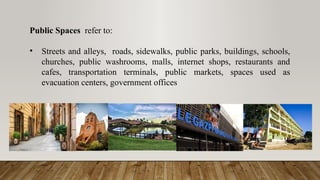
Public Spaces refer to:
• Streets and alleys, roads, sidewalks, public parks, buildings, schools,
churches, public washrooms, malls, internet shops, restaurants and
cafes, transportation terminals, public markets, spaces used as
evacuation centers, government offices
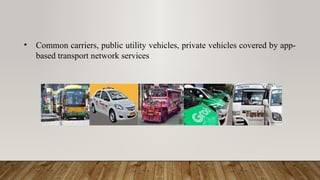
• Common carriers, public utility vehicles, private vehicles covered by app-
based transport network services
• Other recreational spaces such cinema halls, theaters and spas, bars
and clubs, resorts and water parks, hotels and casinos
• All other areas, regardless of ownership, openly accessible or offered
to be accessed by the public
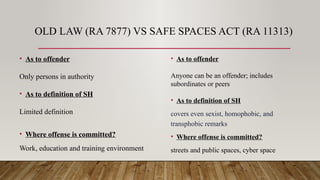
OLD LAW (RA 7877) VS SAFE SPACES ACT (RA 11313)
• As to offender
Only persons in authority
• As to definition of SH
Limited definition
• Where offense is committed?
Work, education and training environment
• As to offender
Anyone can be an offender; includes
subordinates or peers
• As to definition of SH
covers even sexist, homophobic, and
transphobic remarks
• Where offense is committed?
streets and public spaces, cyber space
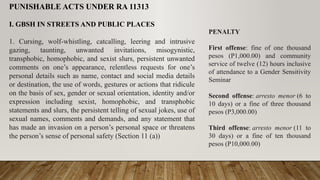
PUNISHABLE ACTS UNDER RA 11313
I. GBSH IN STREETS AND PUBLIC PLACES
1. Cursing, wolf-whistling, catcalling, leering and intrusive
gazing, taunting, unwanted invitations, misogynistic,
transphobic, homophobic, and sexist slurs, persistent unwanted
comments on one’s appearance, relentless requests for one’s
personal details such as name, contact and social media details
or destination, the use of words, gestures or actions that ridicule
on the basis of sex, gender or sexual orientation, identity and/or
expression including sexist, homophobic, and transphobic
statements and slurs, the persistent telling of sexual jokes, use of
sexual names, comments and demands, and any statement that
has made an invasion on a person’s personal space or threatens
the person’s sense of personal safety (Section 11 (a))
PENALTY
First offense: fine of one thousand
pesos (P1,000.00) and community
service of twelve (12) hours inclusive
of attendance to a Gender Sensitivity
Seminar
Second offense: arresto menor (6 to
10 days) or a fine of three thousand
pesos (P3,000.00)
Third offense: arresto menor (11 to
30 days) or a fine of ten thousand
pesos (P10,000.00)
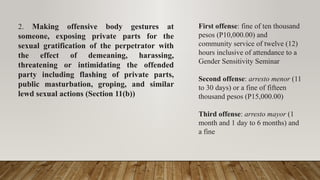
2. Making offensive body gestures at
someone, exposing private parts for the
sexual gratification of the perpetrator with
the effect of demeaning, harassing,
threatening or intimidating the offended
party including flashing of private parts,
public masturbation, groping, and similar
lewd sexual actions (Section 11(b))
First offense: fine of ten thousand
pesos (P10,000.00) and
community service of twelve (12)
hours inclusive of attendance to a
Gender Sensitivity Seminar
Second offense: arresto menor (11
to 30 days) or a fine of fifteen
thousand pesos (P15,000.00)
Third offense: arresto mayor (1
month and 1 day to 6 months) and
a fine
3. Stalking, any of the acts mentioned in
11(a) or 11(b) when accompanied by
touching, pinching or brushing against
the body of the offended person; any
touching, pinching, or brushing against
the genitalia, face, arms, anus, groin,
breasts, inner thighs, buttocks or any
part of the victim’s body even when not
accompanied by acts mentioned in 11(a)
and 11(b)
First offense: arresto menor (11 to 30
days) or a fine of thirty thousand pesos
(P30,000.00), provided that it includes
attendance in a Gender Sensitivity Seminar
Second offense: arresto mayor (1 month
and 1 day) or a fine of fifty thousand pesos
(P50,000.00)
Third offense: arresto mayor in its
maximum period or a fine of one hundred
thousand pesos (P100,000.00)
4. Gender-based online sexual harassment
includes acts that use information and
communications technology in terrorizing
and intimidating victims
PENALTY
Prision correccional in its medium
period or a fine of not less than
one hundred thousand pesos
(P100,000.00) but not more than
five hundred thousand pesos
(P500,000.00), or both at the
discretion of the court
• If the perpetrator is a juridical person, its license or franchise shall
be automatically deemed revoked, and the persons liable shall be
the officers thereof, including the editor or reporter in the case of
print media, and the station manager, editor and broadcaster in the
case of broadcast media.
• An alien who commits gender-based online sexual harassment
shall be subject to deportation proceedings after serving sentence
and payment of fines.
GENDER-BASED ONLINE SEXUAL HARASSMENT includes acts that use
information and communications technology in terrorizing and intimidating
victims through:
1. Physical, psychological, and emotional threats, unwanted sexual
misogynistic, transphobic, homophobic, and sexist remarks and
comments online whether publicly or through direct and private
messages.
2. Invasion of the victim’s privacy through cyberstalking and incessant
messaging;
3. Uploading and sharing without the consent of the victim of any form of
media that contains photos, voice, or video with sexual content;
4. Any unauthorized recording and sharing of any of the victim’s photos,
videos, or any information online;
5. Impersonating identities of victims online or posting lies about victims
to harm their reputation;
6. Filing false abuse reports to online platforms to silence victims.
5. Qualified gender-based sexual
harassment
PENALTY
Penalty next higher in degree
5. Gender-based sexual harassment in the
workplace and educational or training
environment
PENALTY
Administrative penalties as
provided for by the employer’s
Committee on Decorum and
Investigation, and without
prejudice to other applicable
criminal violations and
penalties
WHO ARE THE
OFFENDERS OF
GBSH
IN THE
WORKPLACE?
May be committed
between peers
By a subordinate to
a superior officer
WHAT
CONSTITUTE
GBSH
IN THE
WORKPLACE?
• An act or series of acts involving any
unwelcome sexual advances, requests or
demand for sexual favors or any act of sexual
nature, whether done verbally, physically or
through the use of technology such as text
messages or electronic mail or though any
other forms of information and
communication systems, that has or could
have a detrimental effect on the conditions of
an individual’s employment or education, job
performance or opportunities.
WHAT
CONSTITUTE
GBSH
IN THE
WORKPLACE?
• Any conduct of sexual nature and other
conduct-based on sex affecting the
dignity of a person, which is
unwelcome, unreasonable, and offensive
to the recipient, whether done verbally,
physically or though the use of
technology such as text messaging or
email or through any other forms of
information and communication systems.
WHAT
CONSTITUTE
GBSH
IN THE
WORKPLACE?
• A conduct that is unwelcome and
pervasive and creates an intimidating,
hostile or humiliating environment for
the recipient.
OFFENDERS OF
GBSH IN
EDUCATION
AND TRAINING
ENVIRONMENT
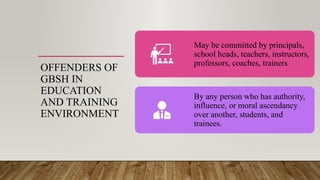
May be committed by principals,
school heads, teachers, instructors,
professors, coaches, trainers
By any person who has authority,
influence, or moral ascendancy
over another, students, and
trainees.
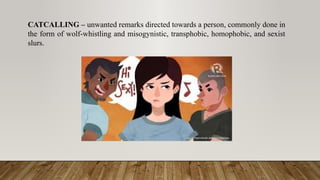
CATCALLING – unwanted remarks directed towards a person, commonly done in
the form of wolf-whistling and misogynistic, transphobic, homophobic, and sexist
slurs.
HOMOPHOBIC REMARKS OR SLURS – are any statements in whatever
form or however delivered, which are indicative of fear, hatred, or aversion
towards persons who are perceived to be or actually identify as lesbian, gay,
bisexual, queer, pansexual, and such other persons of diverse sexual orientation,
gender identity or expression, or towards any person perceived to or actually
have experienced same sex-attraction.
MISOGYNISTIC REMARKS OR SLURS – are any statements in whatever
form or however delivered, that are indicative of the feeling of hating of women
or the belief that men are inherently better than women.
TRANSPHOBIC REMARKS OR SLURS – are any statements in whatever form
or however delivered that are indicative of fear, hatred, aversion towards persons
whose gender identity and/or expression do not conform with their sex assigned at
birth.
SEXIST REMARKS OR SLURS – are statements in whatever form or however
delivered, that are indicative of prejudice, stereotyping, or discrimination on the
basis of sex, typically against women.
STALKING – refers to conduct directed at a person involving the repeated visual or
physical proximity, non-consensual communication, or a combination thereof that
cause or will likely cause a person to fear for once’s own safety or the safety of
others, or to suffer emotional distress.
Violations of the Safe Spaces Act:
I. Gender-based Streets and Public Spaces Sexual Harassment
- crimes committed through unwanted and uninvited sexual actions or remarks against
any person regardless of the motive for committing such action or remarks.
II. Gender-based Online Sexual Harassment
- any online conduct targeted at a particular person that causes or likely to cause
another mental, emotional or psychological distress, and fear of personal safety, sexual
harassment acts including unwanted sexual remarks and comments, threats, uploading or
sharing of one’s photos without consent, video and audio recordings, cyberstalking and
online identity theft.

PPT-of-safe-spaces-act-ra-11313_compress.pdf

  • 1.
  • 2.
    • Safe SpacesAct or the “Bawal Bastos Act” was signed into law last April 17, 2019 • Implementing Rules and Regulations (IRR) was approved on October 28, 2019
  • 3.
    Objective: • To addressexisting gaps and issues on equality, security and safety of both men and women in private and public spaces. • To address Gender-Based Sexual Harassment (GBSH)
  • 4.
    Public Spaces referto: • Streets and alleys, roads, sidewalks, public parks, buildings, schools, churches, public washrooms, malls, internet shops, restaurants and cafes, transportation terminals, public markets, spaces used as evacuation centers, government offices
  • 5.
    • Common carriers,public utility vehicles, private vehicles covered by app- based transport network services
  • 6.
    • Other recreationalspaces such cinema halls, theaters and spas, bars and clubs, resorts and water parks, hotels and casinos • All other areas, regardless of ownership, openly accessible or offered to be accessed by the public
  • 7.
    OLD LAW (RA7877) VS SAFE SPACES ACT (RA 11313) • As to offender Only persons in authority • As to definition of SH Limited definition • Where offense is committed? Work, education and training environment • As to offender Anyone can be an offender; includes subordinates or peers • As to definition of SH covers even sexist, homophobic, and transphobic remarks • Where offense is committed? streets and public spaces, cyber space
  • 8.
    PUNISHABLE ACTS UNDERRA 11313 I. GBSH IN STREETS AND PUBLIC PLACES 1. Cursing, wolf-whistling, catcalling, leering and intrusive gazing, taunting, unwanted invitations, misogynistic, transphobic, homophobic, and sexist slurs, persistent unwanted comments on one’s appearance, relentless requests for one’s personal details such as name, contact and social media details or destination, the use of words, gestures or actions that ridicule on the basis of sex, gender or sexual orientation, identity and/or expression including sexist, homophobic, and transphobic statements and slurs, the persistent telling of sexual jokes, use of sexual names, comments and demands, and any statement that has made an invasion on a person’s personal space or threatens the person’s sense of personal safety (Section 11 (a)) PENALTY First offense: fine of one thousand pesos (P1,000.00) and community service of twelve (12) hours inclusive of attendance to a Gender Sensitivity Seminar Second offense: arresto menor (6 to 10 days) or a fine of three thousand pesos (P3,000.00) Third offense: arresto menor (11 to 30 days) or a fine of ten thousand pesos (P10,000.00)
  • 9.
    2. Making offensivebody gestures at someone, exposing private parts for the sexual gratification of the perpetrator with the effect of demeaning, harassing, threatening or intimidating the offended party including flashing of private parts, public masturbation, groping, and similar lewd sexual actions (Section 11(b)) First offense: fine of ten thousand pesos (P10,000.00) and community service of twelve (12) hours inclusive of attendance to a Gender Sensitivity Seminar Second offense: arresto menor (11 to 30 days) or a fine of fifteen thousand pesos (P15,000.00) Third offense: arresto mayor (1 month and 1 day to 6 months) and a fine
  • 10.
    3. Stalking, anyof the acts mentioned in 11(a) or 11(b) when accompanied by touching, pinching or brushing against the body of the offended person; any touching, pinching, or brushing against the genitalia, face, arms, anus, groin, breasts, inner thighs, buttocks or any part of the victim’s body even when not accompanied by acts mentioned in 11(a) and 11(b) First offense: arresto menor (11 to 30 days) or a fine of thirty thousand pesos (P30,000.00), provided that it includes attendance in a Gender Sensitivity Seminar Second offense: arresto mayor (1 month and 1 day) or a fine of fifty thousand pesos (P50,000.00) Third offense: arresto mayor in its maximum period or a fine of one hundred thousand pesos (P100,000.00)
  • 11.
    4. Gender-based onlinesexual harassment includes acts that use information and communications technology in terrorizing and intimidating victims PENALTY Prision correccional in its medium period or a fine of not less than one hundred thousand pesos (P100,000.00) but not more than five hundred thousand pesos (P500,000.00), or both at the discretion of the court
  • 12.
    • If theperpetrator is a juridical person, its license or franchise shall be automatically deemed revoked, and the persons liable shall be the officers thereof, including the editor or reporter in the case of print media, and the station manager, editor and broadcaster in the case of broadcast media. • An alien who commits gender-based online sexual harassment shall be subject to deportation proceedings after serving sentence and payment of fines.
  • 13.
    GENDER-BASED ONLINE SEXUALHARASSMENT includes acts that use information and communications technology in terrorizing and intimidating victims through: 1. Physical, psychological, and emotional threats, unwanted sexual misogynistic, transphobic, homophobic, and sexist remarks and comments online whether publicly or through direct and private messages. 2. Invasion of the victim’s privacy through cyberstalking and incessant messaging; 3. Uploading and sharing without the consent of the victim of any form of media that contains photos, voice, or video with sexual content;
  • 14.
    4. Any unauthorizedrecording and sharing of any of the victim’s photos, videos, or any information online; 5. Impersonating identities of victims online or posting lies about victims to harm their reputation; 6. Filing false abuse reports to online platforms to silence victims.
  • 15.
    5. Qualified gender-basedsexual harassment PENALTY Penalty next higher in degree
  • 16.
    5. Gender-based sexualharassment in the workplace and educational or training environment PENALTY Administrative penalties as provided for by the employer’s Committee on Decorum and Investigation, and without prejudice to other applicable criminal violations and penalties
  • 17.
    WHO ARE THE OFFENDERSOF GBSH IN THE WORKPLACE? May be committed between peers By a subordinate to a superior officer
  • 18.
    WHAT CONSTITUTE GBSH IN THE WORKPLACE? • Anact or series of acts involving any unwelcome sexual advances, requests or demand for sexual favors or any act of sexual nature, whether done verbally, physically or through the use of technology such as text messages or electronic mail or though any other forms of information and communication systems, that has or could have a detrimental effect on the conditions of an individual’s employment or education, job performance or opportunities.
  • 19.
    WHAT CONSTITUTE GBSH IN THE WORKPLACE? • Anyconduct of sexual nature and other conduct-based on sex affecting the dignity of a person, which is unwelcome, unreasonable, and offensive to the recipient, whether done verbally, physically or though the use of technology such as text messaging or email or through any other forms of information and communication systems.
  • 20.
    WHAT CONSTITUTE GBSH IN THE WORKPLACE? • Aconduct that is unwelcome and pervasive and creates an intimidating, hostile or humiliating environment for the recipient.
  • 21.
    OFFENDERS OF GBSH IN EDUCATION ANDTRAINING ENVIRONMENT May be committed by principals, school heads, teachers, instructors, professors, coaches, trainers By any person who has authority, influence, or moral ascendancy over another, students, and trainees.
  • 22.
    CATCALLING – unwantedremarks directed towards a person, commonly done in the form of wolf-whistling and misogynistic, transphobic, homophobic, and sexist slurs.
  • 23.
    HOMOPHOBIC REMARKS ORSLURS – are any statements in whatever form or however delivered, which are indicative of fear, hatred, or aversion towards persons who are perceived to be or actually identify as lesbian, gay, bisexual, queer, pansexual, and such other persons of diverse sexual orientation, gender identity or expression, or towards any person perceived to or actually have experienced same sex-attraction. MISOGYNISTIC REMARKS OR SLURS – are any statements in whatever form or however delivered, that are indicative of the feeling of hating of women or the belief that men are inherently better than women.
  • 24.
    TRANSPHOBIC REMARKS ORSLURS – are any statements in whatever form or however delivered that are indicative of fear, hatred, aversion towards persons whose gender identity and/or expression do not conform with their sex assigned at birth. SEXIST REMARKS OR SLURS – are statements in whatever form or however delivered, that are indicative of prejudice, stereotyping, or discrimination on the basis of sex, typically against women. STALKING – refers to conduct directed at a person involving the repeated visual or physical proximity, non-consensual communication, or a combination thereof that cause or will likely cause a person to fear for once’s own safety or the safety of others, or to suffer emotional distress.
  • 25.
    Violations of theSafe Spaces Act: I. Gender-based Streets and Public Spaces Sexual Harassment - crimes committed through unwanted and uninvited sexual actions or remarks against any person regardless of the motive for committing such action or remarks. II. Gender-based Online Sexual Harassment - any online conduct targeted at a particular person that causes or likely to cause another mental, emotional or psychological distress, and fear of personal safety, sexual harassment acts including unwanted sexual remarks and comments, threats, uploading or sharing of one’s photos without consent, video and audio recordings, cyberstalking and online identity theft.