Presented by:
1.AHMAD SAJJAD
2.WASIQ NADEEM
3.SAIRA HAMEED
4.MOBEEN ALI
5.EMAN
 Introduction
 Water scarcity and its types
 Why need of women empowerment
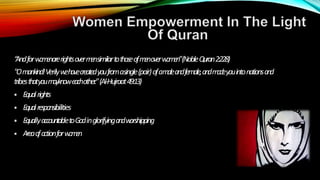
 Women empowerment in light of Quran
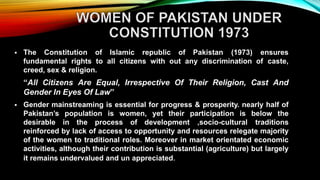
 Women empowerment under constitution of
1973
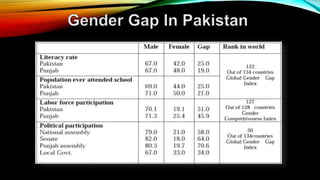
 Ranking of Pakistan in women
empowerment
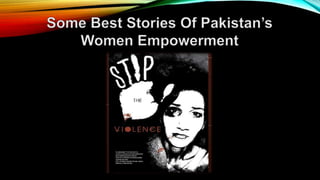
 Some best stories of women empowerment
 Vision
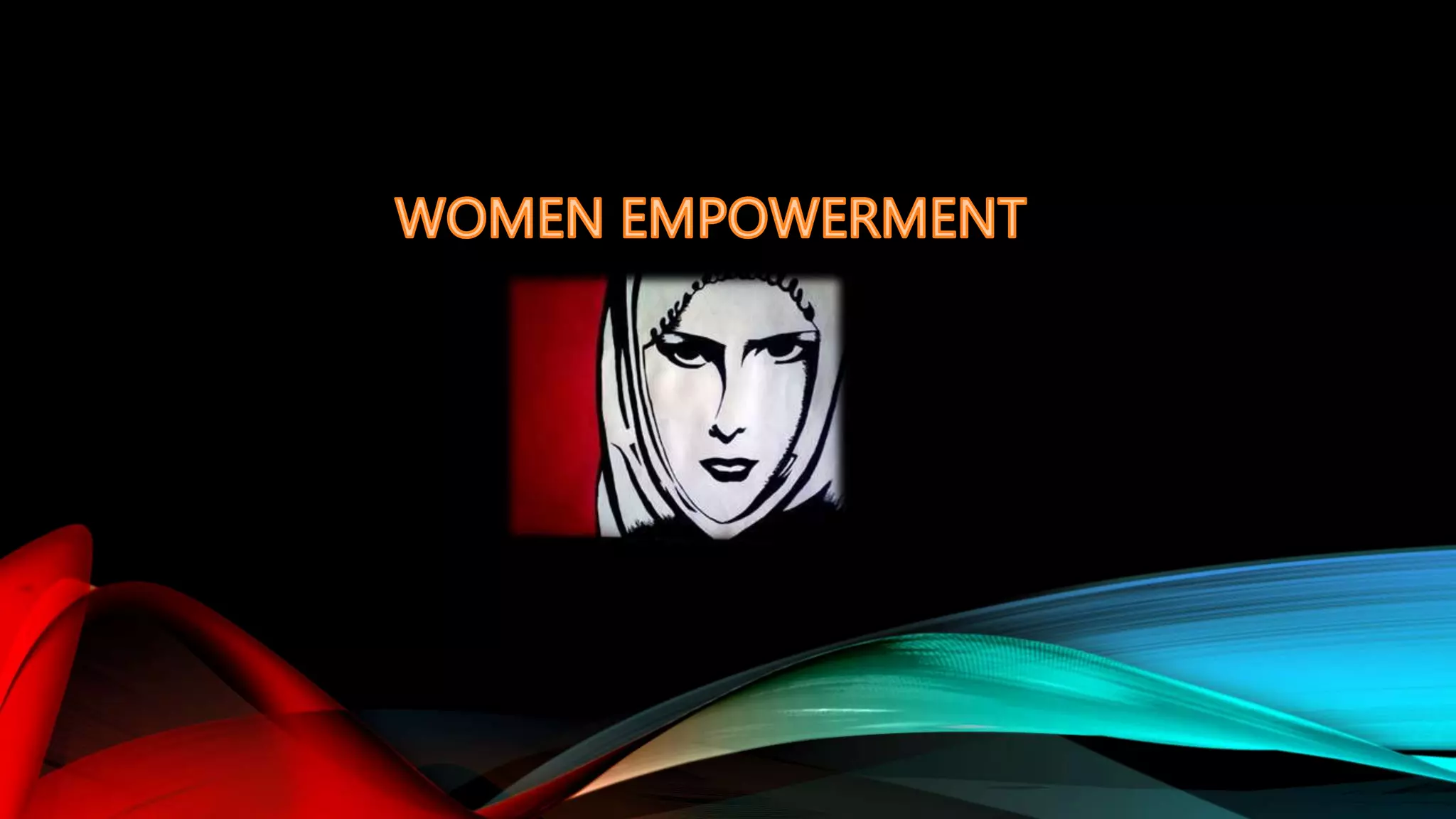
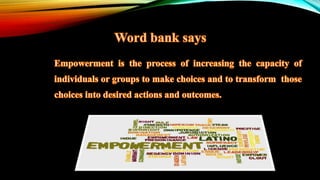
Women empowerment refers to increasing
the spiritual, political, social, educational,
gender, or economic strength of individuals
and communities of women.
Women Empowerment
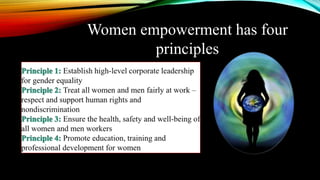
Women empowerment has four
principles
The main problems that were faced by women in past days
(and still today up to some extent):
 Gender discrimination
 Woman education
 Female infanticide
 Dowry
 Marriage in same caste and child marriage(still existing)
 Atrocities on Women: Raped, kicked, killed, subdued &
humiliated almost daily.
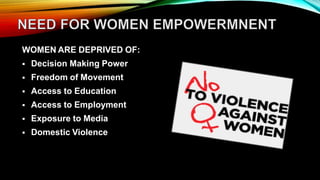
WOMEN ARE DEPRIVED OF:
 Decision Making Power
 Freedom of Movement
 Access to Education
 Access to Employment
 Exposure to Media
 Domestic Violence
“
Andforw
o
m
e
narerightsoverm
e
nsimilartothoseofm
e
noverwomen”(NobleQuran2:228)
"Omankind!Verilyw
ehavecreatedyoufromasingle(pair)ofamaleandfemale,andm
a
d
eyouintonationsand
tribesthatyouma
yknoweachother
."(Al-Hujraat49:13)
 Equalrights
 Equalresponsibilities
 EquallyaccountabletoGodinglorifyingandw
orshipping
 Areaofa
ctionforw
o
m
e
n
 The Constitution of Islamic republic of Pakistan (1973) ensures
fundamental rights to all citizens with out any discrimination of caste,
creed, sex & religion.
“All Citizens Are Equal, Irrespective Of Their Religion, Cast And
Gender In Eyes Of Law”
 Gender mainstreaming is essential for progress & prosperity. nearly half of
Pakistan’s population is women, yet their participation is below the
desirable in the process of development ,socio-cultural traditions
reinforced by lack of access to opportunity and resources relegate majority
of the women to traditional roles. Moreover in market orientated economic
activities, although their contribution is substantial (agriculture) but largely
it remains undervalued and un appreciated.
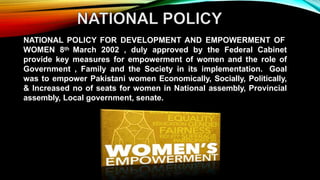
NATIONAL POLICY FOR DEVELOPMENT AND EMPOWERMENT OF
WOMEN 8th March 2002 , duly approved by the Federal Cabinet
provide key measures for empowerment of women and the role of
Government , Family and the Society in its implementation. Goal
was to empower Pakistani women Economically, Socially, Politically,
& Increased no of seats for women in National assembly, Provincial
assembly, Local government, senate.
 Gender Empowerment Measure (GEM)
 Political
 Economic activity
 Decision making capability
Pakistan is 82 ranked out of 93 countries
 Gender Development Index (GDI)
 Health
 Income
 Education
Pakistan is ranked 125th out of 157 countries
 Lack of education and employment
 Limited opportunities to acquire land/property
 Dispossessed of their inheritance
 Lost individual identity
 Heavy house load
 No involvement in decision making
 Inhuman social customs
 Low wedges in paid work
 Diet deficiency
 Sexual harassment
 Changes in women's mobility and social
interaction;
 Changes in women's labor patterns;
 Changes in women's access to and control
over resources; and
 Changes in women's control over decision-
making.
 Providing education
 Self employment and Self help groups
 Providing minimum needs like nutrition, health, sanitation,
housing
 Other than this, society should change the mentality
towards the word “women”.
 Encouraging women to develop in their fields they are good
at and make a career.
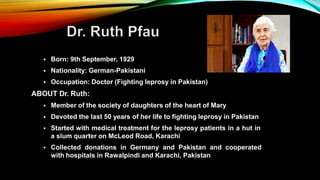
 Born: 9th September, 1929
 Nationality: German-Pakistani
 Occupation: Doctor (Fighting leprosy in Pakistan)
ABOUT Dr. Ruth:
 Member of the society of daughters of the heart of Mary
 Devoted the last 50 years of her life to fighting leprosy in Pakistan
 Started with medical treatment for the leprosy patients in a hut in
a slum quarter on McLeod Road, Karachi
 Collected donations in Germany and Pakistan and cooperated
with hospitals in Rawalpindi and Karachi, Pakistan
 Awarded Pakistani citizenship in 1988 due to her outstanding
contributions
AWARDS
 Civilian award at President’s House on 23rd March, 1989
 Hilal-e-Pakistan
 Nishan-e-Quaid-e-Azam
 Order of Merit, Germany
 Ramon Magsaysay Award
 Doctor of Science, Honoris causa, Aga Khan University, Karachi,
Pakistan
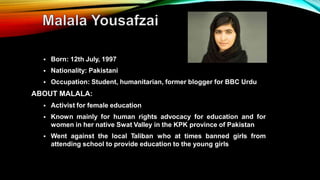
 Born: 12th July, 1997
 Nationality: Pakistani
 Occupation: Student, humanitarian, former blogger for BBC Urdu
ABOUT MALALA:
 Activist for female education
 Known mainly for human rights advocacy for education and for
women in her native Swat Valley in the KPK province of Pakistan
 Went against the local Taliban who at times banned girls from
attending school to provide education to the young girls
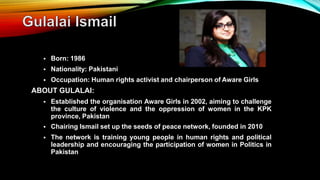
 Born: 1986
 Nationality: Pakistani
 Occupation: Human rights activist and chairperson of Aware Girls
ABOUT GULALAI:
 Established the organisation Aware Girls in 2002, aiming to challenge
the culture of violence and the oppression of women in the KPK
province, Pakistan
 Chairing Ismail set up the seeds of peace network, founded in 2010
 The network is training young people in human rights and political
leadership and encouraging the participation of women in Politics in
Pakistan
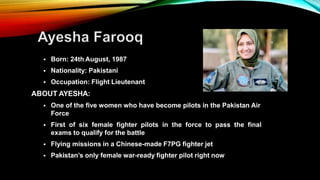
 Born: 24th August, 1987
 Nationality: Pakistani
 Occupation: Flight Lieutenant
ABOUT AYESHA:
 One of the five women who have become pilots in the Pakistan Air
Force
 First of six female fighter pilots in the force to pass the final
exams to qualify for the battle
 Flying missions in a Chinese-made F7PG fighter jet
 Pakistan’s only female war-ready fighter pilot right now
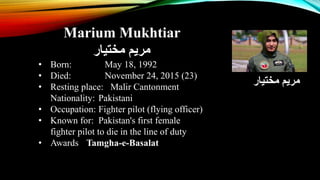
Marium Mukhtiar
‫مختیار‬ ‫مریم‬
• Born: May 18, 1992
• Died: November 24, 2015 (23)
• Resting place: Malir Cantonment
Nationality: Pakistani
• Occupation: Fighter pilot (flying officer)
• Known for: Pakistan's first female
fighter pilot to die in the line of duty
• Awards Tamgha-e-Basalat
‫مختیار‬ ‫مریم‬
 To Make Pakistan a country where women enjoy equal
rights & respect, the same level of decision making
authority and equal mobility and protection under law as
their male counter parts.
“EMPOWERMENT OF WOMEN NOT JUST A GOAL IN ITSELF,
BUT KEY TO ALL GLOBAL DEVELOPMENT GOALS”
 To promote women’s access to the to the economical,
political and social empowerment at National, Provincial
and district levels.
 Government of Pakistan is fully sensitive to safeguard
women’s rights and is engaged in taking steps to bring a
positive change in the lives of ABOUT 80 MILLION
Pakistani women and girls in order to accord them a status
they deserve, in conformity with the teaching of Islam &
the constitution of Islamic republic of PAKISTAN.
PPT SLIDE FINAL.pptx

PPT SLIDE FINAL.pptx

  • 2.
    Presented by: 1.AHMAD SAJJAD 2.WASIQNADEEM 3.SAIRA HAMEED 4.MOBEEN ALI 5.EMAN
  • 3.
     Introduction  Waterscarcity and its types  Why need of women empowerment  Women empowerment in light of Quran  Women empowerment under constitution of 1973  Ranking of Pakistan in women empowerment  Some best stories of women empowerment  Vision
  • 5.
    Women empowerment refersto increasing the spiritual, political, social, educational, gender, or economic strength of individuals and communities of women. Women Empowerment
  • 6.
    Women empowerment hasfour principles
  • 7.
    The main problemsthat were faced by women in past days (and still today up to some extent):  Gender discrimination  Woman education  Female infanticide  Dowry  Marriage in same caste and child marriage(still existing)  Atrocities on Women: Raped, kicked, killed, subdued & humiliated almost daily.
  • 8.
    WOMEN ARE DEPRIVEDOF:  Decision Making Power  Freedom of Movement  Access to Education  Access to Employment  Exposure to Media  Domestic Violence
  • 9.
  • 10.
     The Constitutionof Islamic republic of Pakistan (1973) ensures fundamental rights to all citizens with out any discrimination of caste, creed, sex & religion. “All Citizens Are Equal, Irrespective Of Their Religion, Cast And Gender In Eyes Of Law”  Gender mainstreaming is essential for progress & prosperity. nearly half of Pakistan’s population is women, yet their participation is below the desirable in the process of development ,socio-cultural traditions reinforced by lack of access to opportunity and resources relegate majority of the women to traditional roles. Moreover in market orientated economic activities, although their contribution is substantial (agriculture) but largely it remains undervalued and un appreciated.
  • 11.
    NATIONAL POLICY FORDEVELOPMENT AND EMPOWERMENT OF WOMEN 8th March 2002 , duly approved by the Federal Cabinet provide key measures for empowerment of women and the role of Government , Family and the Society in its implementation. Goal was to empower Pakistani women Economically, Socially, Politically, & Increased no of seats for women in National assembly, Provincial assembly, Local government, senate.
  • 13.
     Gender EmpowermentMeasure (GEM)  Political  Economic activity  Decision making capability Pakistan is 82 ranked out of 93 countries  Gender Development Index (GDI)  Health  Income  Education Pakistan is ranked 125th out of 157 countries
  • 14.
     Lack ofeducation and employment  Limited opportunities to acquire land/property  Dispossessed of their inheritance  Lost individual identity  Heavy house load  No involvement in decision making  Inhuman social customs  Low wedges in paid work  Diet deficiency  Sexual harassment
  • 15.
     Changes inwomen's mobility and social interaction;  Changes in women's labor patterns;  Changes in women's access to and control over resources; and  Changes in women's control over decision- making.
  • 16.
     Providing education Self employment and Self help groups  Providing minimum needs like nutrition, health, sanitation, housing  Other than this, society should change the mentality towards the word “women”.  Encouraging women to develop in their fields they are good at and make a career.
  • 18.
     Born: 9thSeptember, 1929  Nationality: German-Pakistani  Occupation: Doctor (Fighting leprosy in Pakistan) ABOUT Dr. Ruth:  Member of the society of daughters of the heart of Mary  Devoted the last 50 years of her life to fighting leprosy in Pakistan  Started with medical treatment for the leprosy patients in a hut in a slum quarter on McLeod Road, Karachi  Collected donations in Germany and Pakistan and cooperated with hospitals in Rawalpindi and Karachi, Pakistan
  • 19.
     Awarded Pakistanicitizenship in 1988 due to her outstanding contributions AWARDS  Civilian award at President’s House on 23rd March, 1989  Hilal-e-Pakistan  Nishan-e-Quaid-e-Azam  Order of Merit, Germany  Ramon Magsaysay Award  Doctor of Science, Honoris causa, Aga Khan University, Karachi, Pakistan
  • 20.
     Born: 12thJuly, 1997  Nationality: Pakistani  Occupation: Student, humanitarian, former blogger for BBC Urdu ABOUT MALALA:  Activist for female education  Known mainly for human rights advocacy for education and for women in her native Swat Valley in the KPK province of Pakistan  Went against the local Taliban who at times banned girls from attending school to provide education to the young girls
  • 21.
     Born: 1986 Nationality: Pakistani  Occupation: Human rights activist and chairperson of Aware Girls ABOUT GULALAI:  Established the organisation Aware Girls in 2002, aiming to challenge the culture of violence and the oppression of women in the KPK province, Pakistan  Chairing Ismail set up the seeds of peace network, founded in 2010  The network is training young people in human rights and political leadership and encouraging the participation of women in Politics in Pakistan
  • 22.
     Born: 24thAugust, 1987  Nationality: Pakistani  Occupation: Flight Lieutenant ABOUT AYESHA:  One of the five women who have become pilots in the Pakistan Air Force  First of six female fighter pilots in the force to pass the final exams to qualify for the battle  Flying missions in a Chinese-made F7PG fighter jet  Pakistan’s only female war-ready fighter pilot right now
  • 23.
    Marium Mukhtiar ‫مختیار‬ ‫مریم‬ •Born: May 18, 1992 • Died: November 24, 2015 (23) • Resting place: Malir Cantonment Nationality: Pakistani • Occupation: Fighter pilot (flying officer) • Known for: Pakistan's first female fighter pilot to die in the line of duty • Awards Tamgha-e-Basalat ‫مختیار‬ ‫مریم‬
  • 24.
     To MakePakistan a country where women enjoy equal rights & respect, the same level of decision making authority and equal mobility and protection under law as their male counter parts. “EMPOWERMENT OF WOMEN NOT JUST A GOAL IN ITSELF, BUT KEY TO ALL GLOBAL DEVELOPMENT GOALS”
  • 25.
     To promotewomen’s access to the to the economical, political and social empowerment at National, Provincial and district levels.  Government of Pakistan is fully sensitive to safeguard women’s rights and is engaged in taking steps to bring a positive change in the lives of ABOUT 80 MILLION Pakistani women and girls in order to accord them a status they deserve, in conformity with the teaching of Islam & the constitution of Islamic republic of PAKISTAN.