Use of GFRP Rebars as
Reinforcement in
Concrete
PresentedBy
Naveen kumar singh
1302800037
Introduction FRP Materials
FRP Bars
Standards &
Specifications
Applications Summary
First developed in the mid 1930s, Glass Fiber Reinforced
Polymer (GFRP) has become a staple in the building industry
 GFRP were inadvertently discovered in 1967 with the
attempted destruction of Disneyland’s “House of the Future”.
Built between 1956 and 1957, the futuristic house was
constructed entirely of fiberglass
 By 1994, nearly 600 million pounds of composite materials had
been used by the building industry
• The Problem - Corrosion
•
– Corrosion and deterioration of steel reinforce
•
– Mitigation techniques - High costs to rehabilita remediate
structures
•
– Safety - Construction zones and detours
•
• The Solution – FRP Rebars
•
– Non corrosive concrete reinforcement
•
– Increase service life (durability)
•
– Hundreds of applications in service in North AMERICA
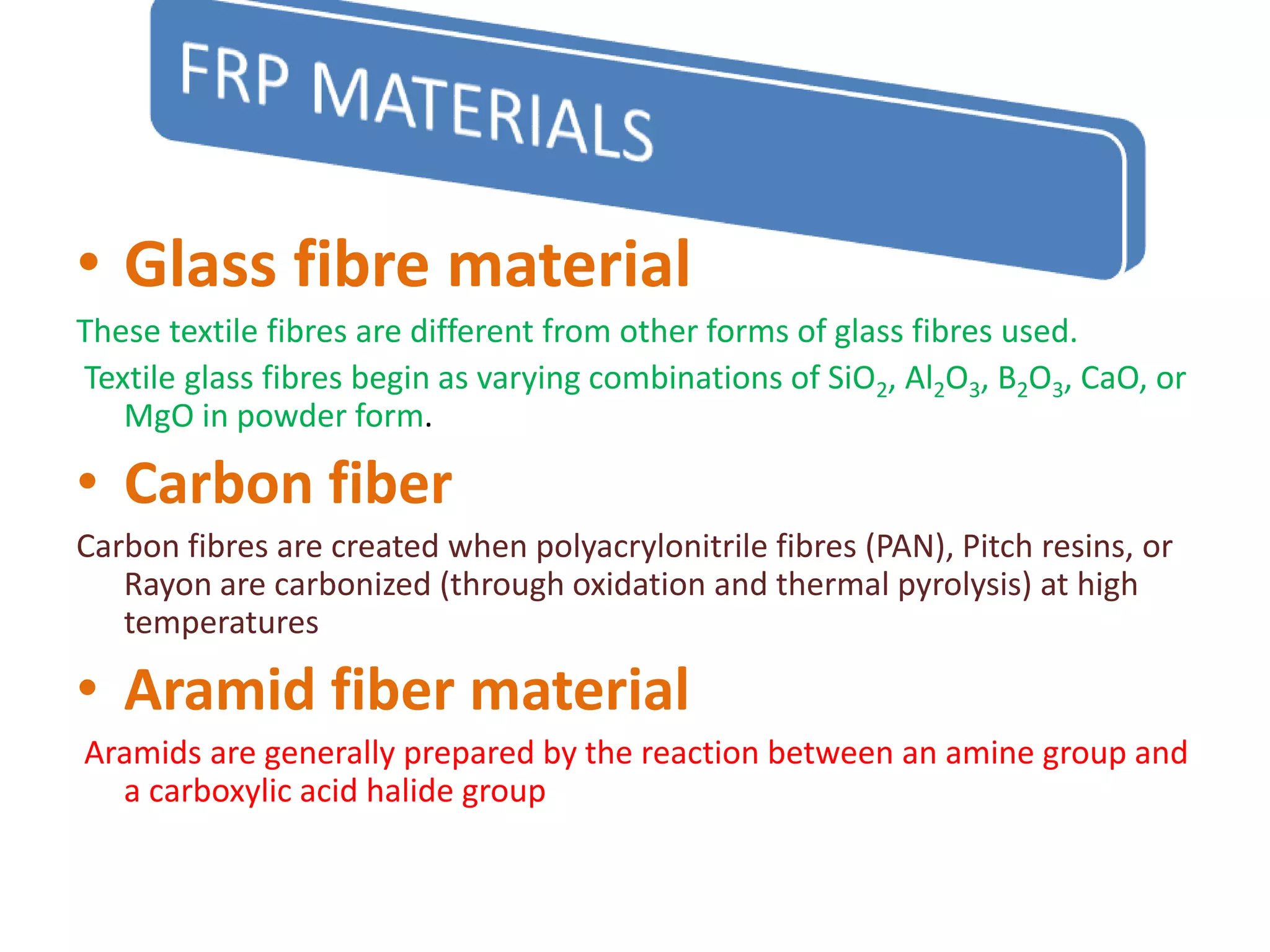
• Glass fibre material
These textile fibres are different from other forms of glass fibres used.
Textile glass fibres begin as varying combinations of SiO2, Al2O3, B2O3, CaO, or
MgO in powder form.
• Carbon fiber
Carbon fibres are created when polyacrylonitrile fibres (PAN), Pitch resins, or
Rayon are carbonized (through oxidation and thermal pyrolysis) at high
temperatures
• Aramid fiber material
Aramids are generally prepared by the reaction between an amine group and
a carboxylic acid halide group
• Type of fiber
• Fiber volume
• Quality control procedures during
manufacturingg
• Rate of curing
• Void content
Impervious to chloride ion and chemical atks
Tensile strength is greater that steel
¼ the weight of steel
Transparent to magnetic fields
Electrically non-conductive
Thermally non-conductive
• High strength in the direction of the fibers
• the material elastic until failure
• High impact strength: in contrast to most
metals, fibreglass does not change shape even
when it is ruptured.
Corrosion resistance: unlike metal, fibreglass
does not rust away and it can be used to make
long-lasting structures.
• Anti-magnetic, no sparks: making it super
safe for the power industry, fibreglass has no
magnetic field and resists electrical sparks
• Formability: fibreglass can be moulded to
almost any desired shape.
• Steel
483-690
• GFRP
483-1600
• CFRP
600-3690
• St eel 6.5
• GFRP 3.5-5.6
• CFRP -4-0
•FRP can be applied to strengthen
the beams, columns, and slabs of buildings
and bridges. It is possible to increase the
strength of structural members even after
they have been severely damaged due
to loading conditions.
• Applications: Interior and Exterior
• Domes
• Fountains
• Columns
• Panels
• Roofs
• Cast in Place
• Precast
• Top mat
• Top and bottom mat
• Decks, parapets, sidewalks
• Other applications: tunneling (soft eye, sea MRI
rooms, light rail foundations, railway g culverts, and
many more.
• Morristown Bridge Vermont 2002
•Emma Park Bridge, Pleasant Grov
Utah DOT, 2009
•Floodway Bridge, Manitoba, Canad
(2005)
• O’Reilly Bridge – Canada and many more
ppt on FRP bars

ppt on FRP bars

  • 1.
    Use of GFRPRebars as Reinforcement in Concrete PresentedBy Naveen kumar singh 1302800037
  • 2.
    Introduction FRP Materials FRPBars Standards & Specifications Applications Summary
  • 3.
    First developed inthe mid 1930s, Glass Fiber Reinforced Polymer (GFRP) has become a staple in the building industry  GFRP were inadvertently discovered in 1967 with the attempted destruction of Disneyland’s “House of the Future”. Built between 1956 and 1957, the futuristic house was constructed entirely of fiberglass  By 1994, nearly 600 million pounds of composite materials had been used by the building industry
  • 4.
    • The Problem- Corrosion • – Corrosion and deterioration of steel reinforce • – Mitigation techniques - High costs to rehabilita remediate structures • – Safety - Construction zones and detours • • The Solution – FRP Rebars • – Non corrosive concrete reinforcement • – Increase service life (durability) • – Hundreds of applications in service in North AMERICA
  • 5.
    • Glass fibrematerial These textile fibres are different from other forms of glass fibres used. Textile glass fibres begin as varying combinations of SiO2, Al2O3, B2O3, CaO, or MgO in powder form. • Carbon fiber Carbon fibres are created when polyacrylonitrile fibres (PAN), Pitch resins, or Rayon are carbonized (through oxidation and thermal pyrolysis) at high temperatures • Aramid fiber material Aramids are generally prepared by the reaction between an amine group and a carboxylic acid halide group
  • 6.
    • Type offiber • Fiber volume • Quality control procedures during manufacturingg • Rate of curing • Void content
  • 7.
    Impervious to chlorideion and chemical atks Tensile strength is greater that steel ¼ the weight of steel Transparent to magnetic fields Electrically non-conductive Thermally non-conductive
  • 8.
    • High strengthin the direction of the fibers • the material elastic until failure • High impact strength: in contrast to most metals, fibreglass does not change shape even when it is ruptured. Corrosion resistance: unlike metal, fibreglass does not rust away and it can be used to make long-lasting structures. • Anti-magnetic, no sparks: making it super safe for the power industry, fibreglass has no magnetic field and resists electrical sparks • Formability: fibreglass can be moulded to almost any desired shape.
  • 9.
  • 10.
    • St eel6.5 • GFRP 3.5-5.6 • CFRP -4-0
  • 11.
    •FRP can beapplied to strengthen the beams, columns, and slabs of buildings and bridges. It is possible to increase the strength of structural members even after they have been severely damaged due to loading conditions.
  • 12.
    • Applications: Interiorand Exterior • Domes • Fountains • Columns • Panels • Roofs • Cast in Place • Precast • Top mat • Top and bottom mat • Decks, parapets, sidewalks • Other applications: tunneling (soft eye, sea MRI rooms, light rail foundations, railway g culverts, and many more.
  • 13.
    • Morristown BridgeVermont 2002 •Emma Park Bridge, Pleasant Grov Utah DOT, 2009 •Floodway Bridge, Manitoba, Canad (2005) • O’Reilly Bridge – Canada and many more