What are GM‟s?
 Organism one that has been altered
through recombinant DNA technology
 Involves either the combining of DNA
from different genomes or the insertion
of foreign DNA into a genome
 The most common genetically modified
(GM) organisms are crop plants
 Microbes are the first organisms to be
genetically modified
Other terms that mean the same
thing:
 Genetically engineered
 Transgenic
 Recombinant DNA (rDNA) technology
What is not a GMO?
 Does not include
◦ Mutants.
◦ Fusion of animal cells unless the product
can form an animal.
◦ Plants formed x protoplast fusion.
◦ Plants formed by embryo rescue or invitro
fertilisation or zygote implantation.
◦ Organisms formed by natural DNA transfer.
How does this differ from Mendel
and his peas?
GM vs. Selective breading
Selective breading
 Slow
 Imprecise
 Modification of genes that naturally occur in the organism
 Occur between plant/animal of same species(dog  dog)
GM
 Very fast
 Precise
 Can introduce genes into an organism that would not
occur naturally
 It can occur between different types of species
(Human  bacteria)
How transgenic organisms work…
Three Main Methods…
 DNA Microinjection
◦ A foreign gene is directly injected into a fertilized egg that is put
into a female animal that acts as a surrogate mother for the egg.
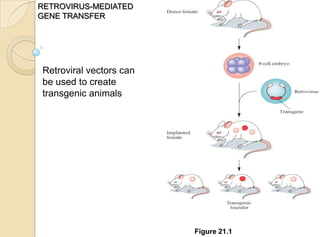
 Retrovirus-Mediated Gene Transfer
◦ A retrovirus is a virus that attaches to an organism‟s DNA and
changes it to include a new characteristic. Scientists expose
ordinary cells to a retrovirus when they are trying to create
transgenic animals.
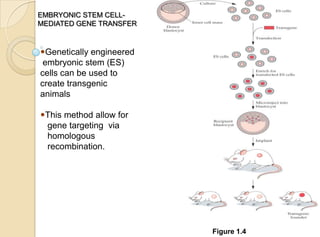
 Embryonic Stem Cell-Mediated Gene Transfer
◦ Stem cells are blank cells that can turn into any type of cell.
Scientists modify these cells, and then add them to an
embryo, which is a fertilized egg that develops and grows until it
hatches or is born.
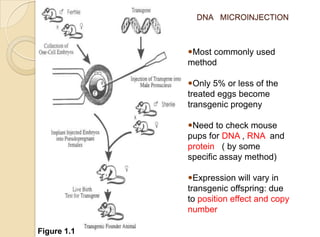
DNA MICROINJECTION
Most commonly used
method
Only 5% or less of the
treated eggs become
transgenic progeny
Need to check mouse
pups for DNA , RNA and
protein ( by some
specific assay method)
Expression will vary in
transgenic offspring: due
to position effect and copy
number
Figure 1.1
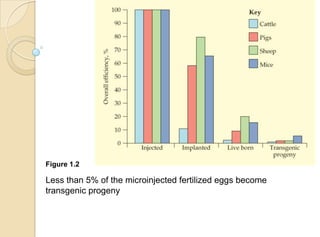
Figure 1.2
Less than 5% of the microinjected fertilized eggs become
transgenic progeny
Figure 21.1
Retroviral vectors can
be used to create
transgenic animals
RETROVIRUS-MEDIATED
GENE TRANSFER
Figure 1.4
Genetically engineered
embryonic stem (ES)
cells can be used to
create transgenic
animals
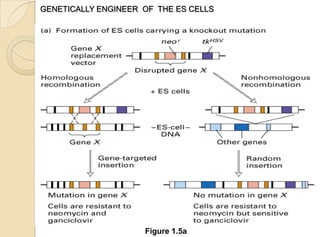
This method allow for
gene targeting via
homologous
recombination.
EMBRYONIC STEM CELL-
MEDIATED GENE TRANSFER
GENETICALLY ENGINEER OF THE ES CELLS
Figure 1.5a
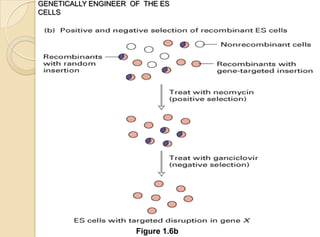
GENETICALLY ENGINEER OF THE ES
CELLS
Figure 1.6b
THE TWO MOST COMMON TYPES OF
GMO‟S
I. FOODS
Crops are modified to develop resistance to
herbicides and increase their nutrient
content, for example corn and soybeans .
Fruits are modified to make them ripen later.
This help them available fresh in marketplace
during a longer time or for fruits that ripen
after being picked, make it easier to transport
them.
THE TWO MOST COMMON TYPES OF
GMO‟S
II. MEDICINES
These can be produced cheaper and easier
some are: insulin, thyroid hormones and the
Hepatitis B vaccine
GM Bacteria‟s have been particularly important
in
producing large amounts of pure human
proteins
for use in medicine like clotting factors for
hemophilia and human growth hormones to
treat
dwarfism
OTHER TYPES OF GMO‟S ARE
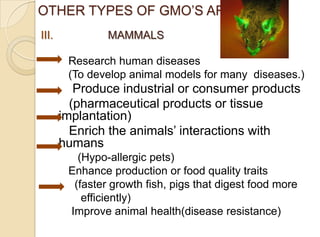
III. MAMMALS
Research human diseases
(To develop animal models for many diseases.)
Produce industrial or consumer products
(pharmaceutical products or tissue
implantation)
Enrich the animals‟ interactions with
humans
(Hypo-allergic pets)
Enhance production or food quality traits
(faster growth fish, pigs that digest food more
efficiently)
Improve animal health(disease resistance)
OTHER TYPES OF GMO‟S ARE
IV. INSECTS
The effects of genetic changes on development
(malaria resistant mosquitoes)
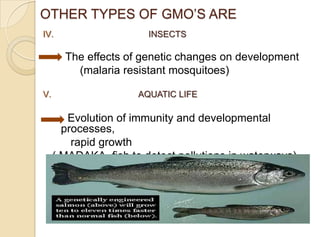
V. AQUATIC LIFE
Evolution of immunity and developmental
processes,
rapid growth
( MADAKA -fish to detect pollutions in waterways)
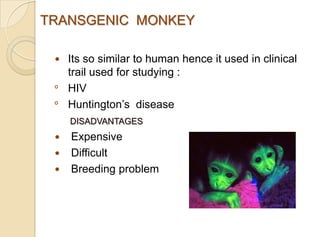
TRANSGENIC MONKEY
 Its so similar to human hence it used in clinical
trail used for studying :
º HIV
º Huntington‟s disease
DISADVANTAGES
 Expensive
 Difficult
 Breeding problem
TOPICAL MICROBICIDES FOR
BLOCKING HIV-1 TRANSMISSION
 Lactobacilli or E. Coli altered to secrete or express
proteins with anti–hiv-1 activity
 Colonization of the vagina or rectum with
recombinant bacteria
 Secret fusion inhibitory peptides or proteins
 Lactobacilli that maintains a low vaginal ph
 Lowers the risk of hiv-1 infection
GENETICALLY MODIFIED PIGS
 MEDICINE
º Production of pharmaceuticals (human hemoglobin
in blood of pigs for treating Trauma patients)
º Organs for Xenotransplantation into humans
º development of models for human diseases
 AGRICULTURE
º resistance to disease
º Altering the carcass composition
º Improving pig‟s resistance to heat stress
º Protecting environment
PIGS GIVEN SPINACH GENES
 World's first to genetically engineered mammals to
contain DNA from plants
 Produce pork that is healthier normal pigs
 Produces less fat than normal ,less fat intake
 “It is confirmed for the first time in the world that a
plant
gene is functioning properly in a living mammal, not
in a
cultured cell,” said professor by akira
PIGS GIVEN SPINACH GENES-
EXPERIMENT
 Inserting the spinach gene into a fertilised
pig egg
 Implanted in a female pig's womb
 FAD2 gene converted about a fifth saturated
fatty acids into linoleic acids
ADVANTAGES OF PIG„S
 Physiology and size
 Raised in pathogen free condition
 Less chance to transmit infectious disease to
humans
 Have fewer ethical issues as donor
 Short generation interval(114 days)
 Genome is quite similar to humans (3x times than
mouse)
GOAT THAT PRODUCE SPIDER SILK
 Two key genes that allow a spider to weave their silk
inserted into their genetic code.
 That produce milk that contain spider silk proteins
 Proteins are then harvested through the goat's milk
 Goats are separated into two groups, each contains
one of the two proteins
 Proteins must be extracted and combined
GOAT THAT PRODUCE SPIDER SILK
 Stronger than steel and more
flexible
 Used to replace damaged
tendons and ligaments ,
suture damaged eyes, or
even nerves
 Make stronger and safer
parachutes for soldiers ,
bulletproof vests
SILK FROM MILK
 Goats are milked
 Milk is frozen and the cream is separated
 Thawed milk is pushed into a micro filter that blocks
the larger fat molecules and lets the smaller
proteins through
 A smaller filter then further isolates the silk proteins
 When dried looks like a white powder
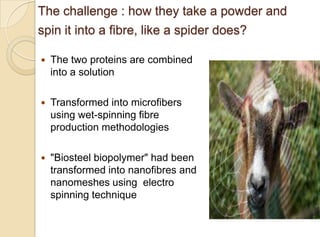
The challenge : how they take a powder and
spin it into a fibre, like a spider does?
 The two proteins are combined
into a solution
 Transformed into microfibers
using wet-spinning fibre
production methodologies
 "Biosteel biopolymer" had been
transformed into nanofibres and
nanomeshes using electro
spinning technique
WAYS GMO TOXICITY AFFECTS ANIMALS,
PLANTS AND SOIL
 Cancer
 Damage native species
 Pollute the environment
 Deplete soil minerals, destroy beneficial bacteria
 'Super weeds,' 'superbugs.'
 Cause infertility, stillbirths, miscarriages
LAB ANIMALS TESTED WITH GM
FOODS
 Stunted growth
 Impaired immune systems
 Bleeding stomachs
 Impaired blood cell
development
 Misshapen cell structures in
the liver, pancreas, and
testicles
 Altered gene expression and
cell metabolism
 Their offspring have a lower
chance of survival
 Higher blood sugar
 Enlarged livers,
pancreases
 Inflamed kidneys
 Less developed brains
and testicles
 Intestines reduced
digestive enzymes
 The animal‟s life spans
are shortened
 Inflamed lung tissue
ADVERSE EFFECTS OF GMO‟S
 Already 37 people have died from side effects
 1,500 partially paralyzed
 5,000 were temporarily handicapped by chemicals
used in harvesting
 Glyophosate "caused malformations in frog and
chicken embryos "
 Malformations of the head
 Increased death rates and higher offspring mortality
CURRENT RESEARCH
 Mosquito-borne diseases remain one of the greatest
global threats to human health
 With recombinant and novel combinations of DNA
passing into the environment
 Effects of gm plants on soil processes such as
decomposition
 Lactococcus lactis secreting interleukin 10 provides
a therapeutic approach for inflammatory bowel
disease
CONCLUSION
 Transgenic animals are now-a-days used for
screening of many drugs
 Using of transgenic animals reduce number of
experimental animals during testing
 We will need them in the future
genetically modified organisms

genetically modified organisms

  • 2.
    What are GM‟s? Organism one that has been altered through recombinant DNA technology  Involves either the combining of DNA from different genomes or the insertion of foreign DNA into a genome  The most common genetically modified (GM) organisms are crop plants  Microbes are the first organisms to be genetically modified
  • 3.
    Other terms thatmean the same thing:  Genetically engineered  Transgenic  Recombinant DNA (rDNA) technology
  • 4.
    What is nota GMO?  Does not include ◦ Mutants. ◦ Fusion of animal cells unless the product can form an animal. ◦ Plants formed x protoplast fusion. ◦ Plants formed by embryo rescue or invitro fertilisation or zygote implantation. ◦ Organisms formed by natural DNA transfer.
  • 5.
    How does thisdiffer from Mendel and his peas? GM vs. Selective breading Selective breading  Slow  Imprecise  Modification of genes that naturally occur in the organism  Occur between plant/animal of same species(dog  dog) GM  Very fast  Precise  Can introduce genes into an organism that would not occur naturally  It can occur between different types of species (Human  bacteria)
  • 6.
    How transgenic organismswork… Three Main Methods…  DNA Microinjection ◦ A foreign gene is directly injected into a fertilized egg that is put into a female animal that acts as a surrogate mother for the egg.  Retrovirus-Mediated Gene Transfer ◦ A retrovirus is a virus that attaches to an organism‟s DNA and changes it to include a new characteristic. Scientists expose ordinary cells to a retrovirus when they are trying to create transgenic animals.  Embryonic Stem Cell-Mediated Gene Transfer ◦ Stem cells are blank cells that can turn into any type of cell. Scientists modify these cells, and then add them to an embryo, which is a fertilized egg that develops and grows until it hatches or is born.
  • 7.
    DNA MICROINJECTION Most commonlyused method Only 5% or less of the treated eggs become transgenic progeny Need to check mouse pups for DNA , RNA and protein ( by some specific assay method) Expression will vary in transgenic offspring: due to position effect and copy number Figure 1.1
  • 8.
    Figure 1.2 Less than5% of the microinjected fertilized eggs become transgenic progeny
  • 9.
    Figure 21.1 Retroviral vectorscan be used to create transgenic animals RETROVIRUS-MEDIATED GENE TRANSFER
  • 10.
    Figure 1.4 Genetically engineered embryonicstem (ES) cells can be used to create transgenic animals This method allow for gene targeting via homologous recombination. EMBRYONIC STEM CELL- MEDIATED GENE TRANSFER
  • 11.
    GENETICALLY ENGINEER OFTHE ES CELLS Figure 1.5a
  • 12.
    GENETICALLY ENGINEER OFTHE ES CELLS Figure 1.6b
  • 13.
    THE TWO MOSTCOMMON TYPES OF GMO‟S I. FOODS Crops are modified to develop resistance to herbicides and increase their nutrient content, for example corn and soybeans . Fruits are modified to make them ripen later. This help them available fresh in marketplace during a longer time or for fruits that ripen after being picked, make it easier to transport them.
  • 14.
    THE TWO MOSTCOMMON TYPES OF GMO‟S II. MEDICINES These can be produced cheaper and easier some are: insulin, thyroid hormones and the Hepatitis B vaccine GM Bacteria‟s have been particularly important in producing large amounts of pure human proteins for use in medicine like clotting factors for hemophilia and human growth hormones to treat dwarfism
  • 15.
    OTHER TYPES OFGMO‟S ARE III. MAMMALS Research human diseases (To develop animal models for many diseases.) Produce industrial or consumer products (pharmaceutical products or tissue implantation) Enrich the animals‟ interactions with humans (Hypo-allergic pets) Enhance production or food quality traits (faster growth fish, pigs that digest food more efficiently) Improve animal health(disease resistance)
  • 16.
    OTHER TYPES OFGMO‟S ARE IV. INSECTS The effects of genetic changes on development (malaria resistant mosquitoes) V. AQUATIC LIFE Evolution of immunity and developmental processes, rapid growth ( MADAKA -fish to detect pollutions in waterways)
  • 17.
    TRANSGENIC MONKEY  Itsso similar to human hence it used in clinical trail used for studying : º HIV º Huntington‟s disease DISADVANTAGES  Expensive  Difficult  Breeding problem
  • 18.
    TOPICAL MICROBICIDES FOR BLOCKINGHIV-1 TRANSMISSION  Lactobacilli or E. Coli altered to secrete or express proteins with anti–hiv-1 activity  Colonization of the vagina or rectum with recombinant bacteria  Secret fusion inhibitory peptides or proteins  Lactobacilli that maintains a low vaginal ph  Lowers the risk of hiv-1 infection
  • 19.
    GENETICALLY MODIFIED PIGS MEDICINE º Production of pharmaceuticals (human hemoglobin in blood of pigs for treating Trauma patients) º Organs for Xenotransplantation into humans º development of models for human diseases  AGRICULTURE º resistance to disease º Altering the carcass composition º Improving pig‟s resistance to heat stress º Protecting environment
  • 20.
    PIGS GIVEN SPINACHGENES  World's first to genetically engineered mammals to contain DNA from plants  Produce pork that is healthier normal pigs  Produces less fat than normal ,less fat intake  “It is confirmed for the first time in the world that a plant gene is functioning properly in a living mammal, not in a cultured cell,” said professor by akira
  • 21.
    PIGS GIVEN SPINACHGENES- EXPERIMENT  Inserting the spinach gene into a fertilised pig egg  Implanted in a female pig's womb  FAD2 gene converted about a fifth saturated fatty acids into linoleic acids
  • 22.
    ADVANTAGES OF PIG„S Physiology and size  Raised in pathogen free condition  Less chance to transmit infectious disease to humans  Have fewer ethical issues as donor  Short generation interval(114 days)  Genome is quite similar to humans (3x times than mouse)
  • 23.
    GOAT THAT PRODUCESPIDER SILK  Two key genes that allow a spider to weave their silk inserted into their genetic code.  That produce milk that contain spider silk proteins  Proteins are then harvested through the goat's milk  Goats are separated into two groups, each contains one of the two proteins  Proteins must be extracted and combined
  • 24.
    GOAT THAT PRODUCESPIDER SILK  Stronger than steel and more flexible  Used to replace damaged tendons and ligaments , suture damaged eyes, or even nerves  Make stronger and safer parachutes for soldiers , bulletproof vests
  • 25.
    SILK FROM MILK Goats are milked  Milk is frozen and the cream is separated  Thawed milk is pushed into a micro filter that blocks the larger fat molecules and lets the smaller proteins through  A smaller filter then further isolates the silk proteins  When dried looks like a white powder
  • 26.
    The challenge :how they take a powder and spin it into a fibre, like a spider does?  The two proteins are combined into a solution  Transformed into microfibers using wet-spinning fibre production methodologies  "Biosteel biopolymer" had been transformed into nanofibres and nanomeshes using electro spinning technique
  • 27.
    WAYS GMO TOXICITYAFFECTS ANIMALS, PLANTS AND SOIL  Cancer  Damage native species  Pollute the environment  Deplete soil minerals, destroy beneficial bacteria  'Super weeds,' 'superbugs.'  Cause infertility, stillbirths, miscarriages
  • 28.
    LAB ANIMALS TESTEDWITH GM FOODS  Stunted growth  Impaired immune systems  Bleeding stomachs  Impaired blood cell development  Misshapen cell structures in the liver, pancreas, and testicles  Altered gene expression and cell metabolism  Their offspring have a lower chance of survival  Higher blood sugar  Enlarged livers, pancreases  Inflamed kidneys  Less developed brains and testicles  Intestines reduced digestive enzymes  The animal‟s life spans are shortened  Inflamed lung tissue
  • 29.
    ADVERSE EFFECTS OFGMO‟S  Already 37 people have died from side effects  1,500 partially paralyzed  5,000 were temporarily handicapped by chemicals used in harvesting  Glyophosate "caused malformations in frog and chicken embryos "  Malformations of the head  Increased death rates and higher offspring mortality
  • 30.
    CURRENT RESEARCH  Mosquito-bornediseases remain one of the greatest global threats to human health  With recombinant and novel combinations of DNA passing into the environment  Effects of gm plants on soil processes such as decomposition  Lactococcus lactis secreting interleukin 10 provides a therapeutic approach for inflammatory bowel disease
  • 31.
    CONCLUSION  Transgenic animalsare now-a-days used for screening of many drugs  Using of transgenic animals reduce number of experimental animals during testing  We will need them in the future