1
NETOPEER
Session by
C.UDHAYAKUMAR, AP/ECE
U19EC604 INTRODUCTION TO IOT
2
Agenda of the session
2
• Previous class content
• NETCONF / YANG
• NETOPEER
NETOPEER
Outline
NETOPEER
Set of open source NETCONF Tools built on
libnetconf library.
Home Automation
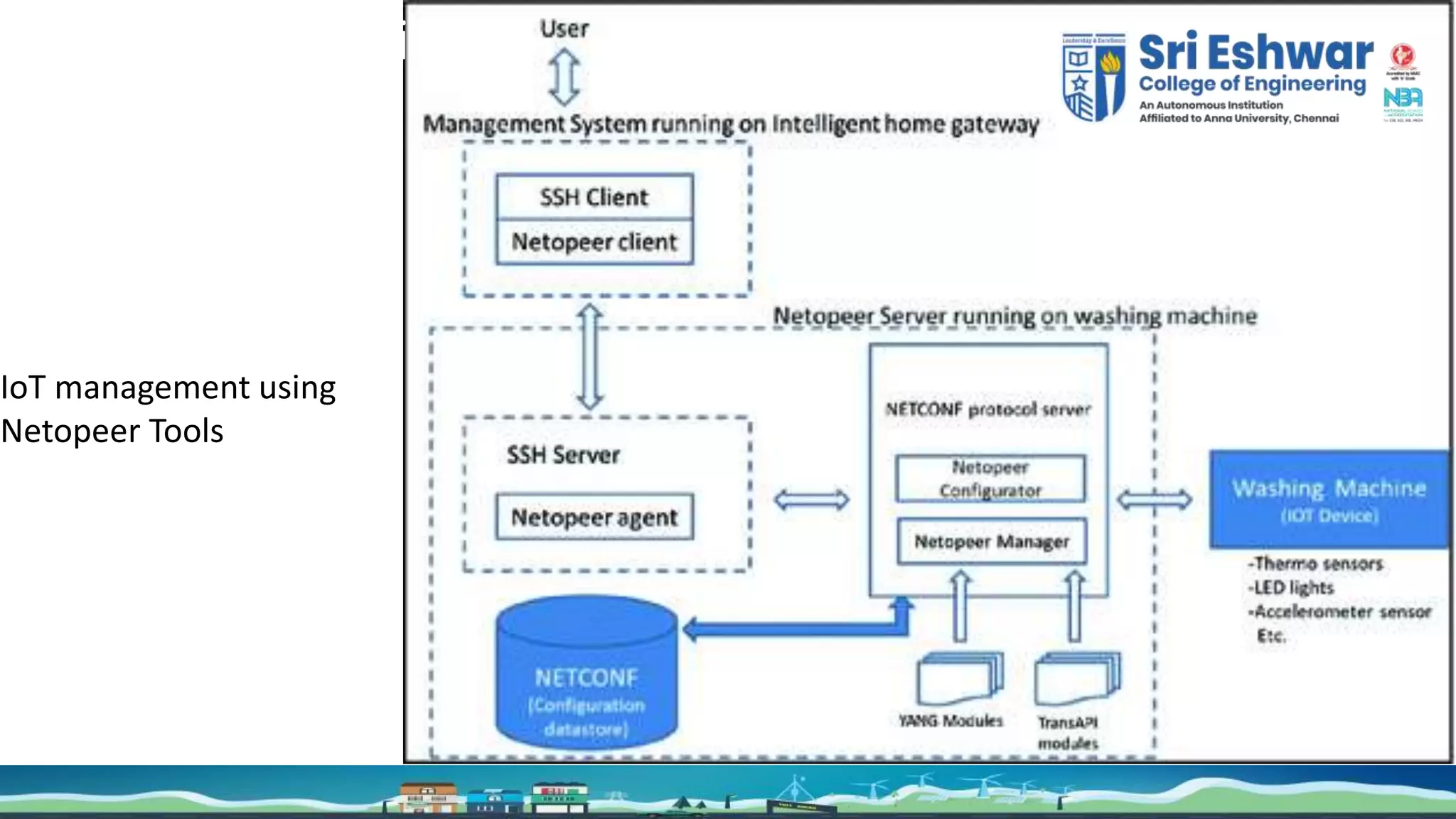
IoT management using
Netopeer Tools
Cities
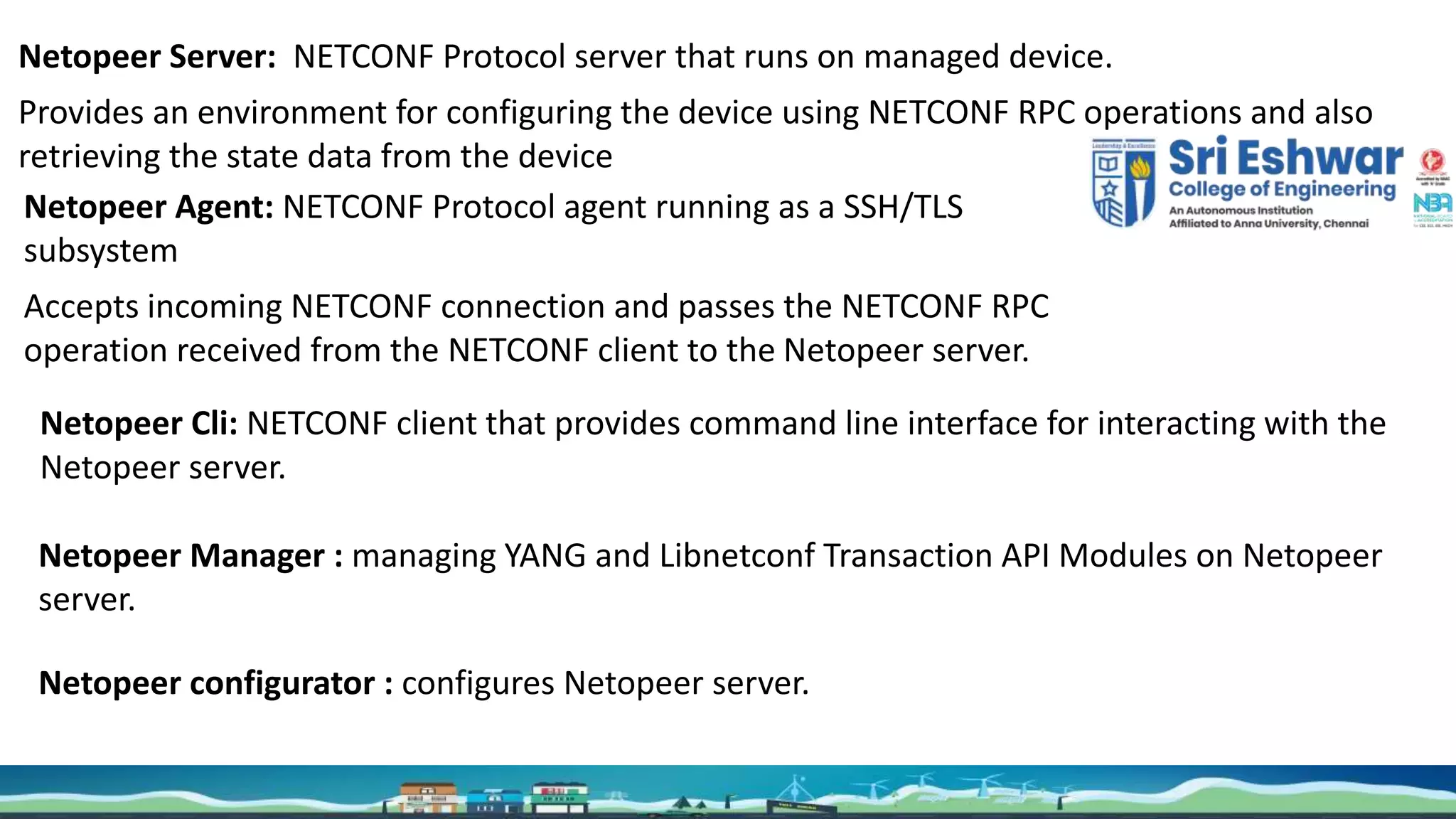
Netopeer Server: NETCONF Protocol server that runs on managed device.
Provides an environment for configuring the device using NETCONF RPC operations and also
retrieving the state data from the device
Netopeer Agent: NETCONF Protocol agent running as a SSH/TLS
subsystem
Accepts incoming NETCONF connection and passes the NETCONF RPC
operation received from the NETCONF client to the Netopeer server.
Netopeer Cli: NETCONF client that provides command line interface for interacting with the
Netopeer server.
Netopeer Manager : managing YANG and Libnetconf Transaction API Modules on Netopeer
server.
Netopeer configurator : configures Netopeer server.
7
8
9
10
11
12
Syllabus
12
MODULE I INTERNET OF THINGS AN OVERVIEW
Definition and Characteristics of IoT - Physical Design of IoT - Logical design of IoT - IoT
enabled Technologies: Wireless Sensor Networks, Cloud Computing, Big data
analytics, Communication protocols and Embedded Systems - IoT Levels &
Deployment Templates - Domain Specific IoTs : Home, City, Environment, Energy,
Retail, Logistics, Agriculture, Industry, health and Lifestyle.
13
13
MODULE II IOT ARCHITECTURE
Communication Protocols - IoT and M2M : Software Defined Networking, Network
function virtualization- IoT System Management with NETCONF-YANG, SNMP,
NETOPEER.
MODULE III PYTHON PROGRAMMING
Language features of Python - Data types - Data structures - Control of flow - Functions
– Modules – Packages - File handling - Data/time operation - Classes - Exception
handling - Python packages: JSON, XML, HTTPLib, URLLib, SMTPLib.
14
14
MODULE IV IOT PHYSICAL DEVICES AND
SERVERS
Building blocks of an IoT device - Programming Inputs and outputs, Serial, SPI and I2C -
Sensors and sensor Node and interfacing using any Embedded target boards :
Raspberry Pi / Intel Galileo/ARM Cortex/ Arduino) Cloud Support : Cloud Storage
models and communication APIs Webserver - Web server for IoT - Cloud for IoT -
Amazon Web services for IoT
MODULE V CASE STUDY AND IOT APPLICATION DEVELOPMENT
Home Automation – Smart cities - Environment - Agriculture - Productivity Applications
– Healthcare - Automotive/Vehicular IoT- Smart grid
15
15
TEXTBOOKS:
1.ArshdeepBahga and Vijay Madisetti, "Internet of Things: A Hands-on Approach",
Universities Press, 2014.
2 .Vlasios Tsiatsis, Stamatis Karnouskos, Jan Holler, David Boyle, Catherine Mulligan,
“Internet of Things: Technologies and Applications for a New Age of Intelligence”,
Academic Press, 2019.
REFERENCES:
1.Cuno Pfister, " Getting Started with the Internet of Things", O'Reilly Media Press, 2011
2.Jamil Y. Khan, Mehmet R. Yuce, “Internet of Things (IoT): Systems and Applications”,
Jenny Stanford Publishing, 2019
16
Session Handler Details
C.Udhayakumar,
AP/ECE
9698489931
udhayakumar.c@sece.ac.in

Ppt 11 - netopeer

  • 1.
  • 2.
    2 Agenda of thesession 2 • Previous class content • NETCONF / YANG • NETOPEER
  • 3.
  • 4.
    Outline NETOPEER Set of opensource NETCONF Tools built on libnetconf library.
  • 5.
    Home Automation IoT managementusing Netopeer Tools
  • 6.
    Cities Netopeer Server: NETCONFProtocol server that runs on managed device. Provides an environment for configuring the device using NETCONF RPC operations and also retrieving the state data from the device Netopeer Agent: NETCONF Protocol agent running as a SSH/TLS subsystem Accepts incoming NETCONF connection and passes the NETCONF RPC operation received from the NETCONF client to the Netopeer server. Netopeer Cli: NETCONF client that provides command line interface for interacting with the Netopeer server. Netopeer Manager : managing YANG and Libnetconf Transaction API Modules on Netopeer server. Netopeer configurator : configures Netopeer server.
  • 7.
  • 8.
  • 9.
  • 10.
  • 11.
  • 12.
    12 Syllabus 12 MODULE I INTERNETOF THINGS AN OVERVIEW Definition and Characteristics of IoT - Physical Design of IoT - Logical design of IoT - IoT enabled Technologies: Wireless Sensor Networks, Cloud Computing, Big data analytics, Communication protocols and Embedded Systems - IoT Levels & Deployment Templates - Domain Specific IoTs : Home, City, Environment, Energy, Retail, Logistics, Agriculture, Industry, health and Lifestyle.
  • 13.
    13 13 MODULE II IOTARCHITECTURE Communication Protocols - IoT and M2M : Software Defined Networking, Network function virtualization- IoT System Management with NETCONF-YANG, SNMP, NETOPEER. MODULE III PYTHON PROGRAMMING Language features of Python - Data types - Data structures - Control of flow - Functions – Modules – Packages - File handling - Data/time operation - Classes - Exception handling - Python packages: JSON, XML, HTTPLib, URLLib, SMTPLib.
  • 14.
    14 14 MODULE IV IOTPHYSICAL DEVICES AND SERVERS Building blocks of an IoT device - Programming Inputs and outputs, Serial, SPI and I2C - Sensors and sensor Node and interfacing using any Embedded target boards : Raspberry Pi / Intel Galileo/ARM Cortex/ Arduino) Cloud Support : Cloud Storage models and communication APIs Webserver - Web server for IoT - Cloud for IoT - Amazon Web services for IoT MODULE V CASE STUDY AND IOT APPLICATION DEVELOPMENT Home Automation – Smart cities - Environment - Agriculture - Productivity Applications – Healthcare - Automotive/Vehicular IoT- Smart grid
  • 15.
    15 15 TEXTBOOKS: 1.ArshdeepBahga and VijayMadisetti, "Internet of Things: A Hands-on Approach", Universities Press, 2014. 2 .Vlasios Tsiatsis, Stamatis Karnouskos, Jan Holler, David Boyle, Catherine Mulligan, “Internet of Things: Technologies and Applications for a New Age of Intelligence”, Academic Press, 2019. REFERENCES: 1.Cuno Pfister, " Getting Started with the Internet of Things", O'Reilly Media Press, 2011 2.Jamil Y. Khan, Mehmet R. Yuce, “Internet of Things (IoT): Systems and Applications”, Jenny Stanford Publishing, 2019
  • 16.