1
BACHELOR OF QUANTITY SURVEYING (HONOURS)
PROFESSIONAL PRACTICE I (QSB60604)
Lecturer: Mr. Wong Chong Wei
Group Members:
Ng Wai Khong (0317980)
Leong Karr Khei (0324362)
Loh Pey Mun (0318572)
Sherlyn Ang (0317977)
Michael Chang (0319198)
2
Table of Content
No. Description Page
Number
1. Introduction 2
2. Traditional Procurement Method 4
3. Management Contracting Procurement
Method
5 - 6
4. Comparison 7
5. Suitability 8
6. Type of Contract 9 - 10
7. Viability and Comparison with Design and
Build
11 - 12
8. Conclusion 13
9. Reference 14
10. Appendix
3
Introduction
Proposed project: 20 stories condominium
Type of project: Residential
Location of the project: Kuala Lumpur
The Malaysian economic downturn has affected developers in delivering and meeting key
property development and sales targets due to inventory fluctuation, unstable market condition
and tighter lending requirements. Thus, the concept of condominium is the most suitable project
which has sustainable features that create values to the environment and end users as it intensify
affordability by fractionalizing the cost of land and building among consumers.
There are various construction procurement methods currently practiced in the construction
industry. Construction procurement is the process whereby client chooses a specialized method
to implement a project. It involves setting up a contractual network of designers, contractors,
financiers and other agents to design, construct and manage a project. Furthermore, there are
many factors to consider when selecting procurement methods, for instance, time, capital cost,
operating cost, environment, market value of the project, flexibility and prestige. The common
procurement methods are traditional procurement method, management contracting, construction
management as well as Design and Build.
4
Traditional Procurement Method
The traditional procurement method is known as the ‘least risk’ approach because there is a level
of certainty on design, cost and time inherent in the strategy. It can be relatively slow prior to the
commencement of construction due to its sequential nature of the strategy, which is necessary to
assure low risk. The client will select and appoints the consultant team comprising of architect,
engineer, quantity surveyor, etc to design the building and prepare tender documents. Under the
traditional procurement method, design will be completed before the contractual relationship are
made. Contractors are then selected through open tender, selective tender or negotiation. Tender
documents for the selection of the contractor includes drawings and a specification of
workmanship and materials which the contractor should use in the preparation of a price.
One of the advantages of traditional procurement method is that it is competitive fairness
because all tenderers are bidding on the same basis through open tender. Moreover, it has a
relatively low tender preparation costs. It also serves as a satisfactory strategy in terms of public
accountability, as it is transparent and based upon competition. Traditional procurement method
ensures the confidence for those who involved throughout the supply chain as it carries a well-
known procedures. Through design stage, the client is able to have a direct influence which can
facilitate a high level of performance and improve the quality of the overall design. Changes and
variations to the contract are reasonably easy to arrange and value where the design needs vary
due to changes in client demands. It assures price certainty at the award of the contract.
The disadvantage of traditional procurement method is that it takes a long process from design
and tendering stage to construction stage, thus the construction will take place after design is
complete. It opens to abuse when the design is incomplete, resulting in less certainty in time and
cost which may lead to disputes. Furthermore, it is potential for adversarial relationships because
the strategy is based upon price competition. Not only that, it may encounter poor buildability as
contractor is not involved in design or planning of the project at the design stage. Last but not
least, the design risk rests with the client.
5
Management Contracting Procurement Method
Management Contracting(MC) is a procurement route which is fairly similar to Construction
Manager(CM) where the client will be appointed in the early stage (design stage) where it can
shorten the time used to complete the entire project. It is essential where appointing a MC in an
early stage can enhance the buildability development in terms of figure. But there are a few
specific differences among MC and CM, where MC are responsible and works direct with
different works contractors which act as a dominant. Furthermore, the client has an only direct
contract with the Management Contractor.
During the pre-construction and construction process, collateral warranties may be required by
the work contractor(purchasers or funders). A collateral warranties is basically an agreement and
contractual relationship between parties that would exist. This warranty maybe an insurance to
designers or sub-contractors where the client may provide coverage to them when difficulties or
dispute arises.
Most client preferred MC where it contains essential condition such as quality and cost.
Therefore, a management contractor provides services for an example, advising and planning on
the development schedule, cost planning and cost control, monitoring the site and key
performance.
However, there is still some pros and cons by choosing management contracting method. The
main advantage is that the MC can participate in the early stage where the design process and
construction process can over-lapped where it generally helps to reduce the development time.
Moreover, the contract sum will be the total of each separate work trades that are tendered
differently because all the works trade will be break down into various work packages. Thus, the
procurement method uses cost-plus contract where the MC will pay for every works cost and
determine whether to select fixed fee, incentive fee or pay by a percentage of the cost.
Hence, the disadvantages of MC will not be able to be precise and certain of the final cost unless
the final works and contract have been sign with confirmation. Variation may occur during the
construction period where the cost of variations and re-measurement can lead to a higher cost
than the original traditional method. There will be a high opportunity(percentage) of changes
during the whole period.
6
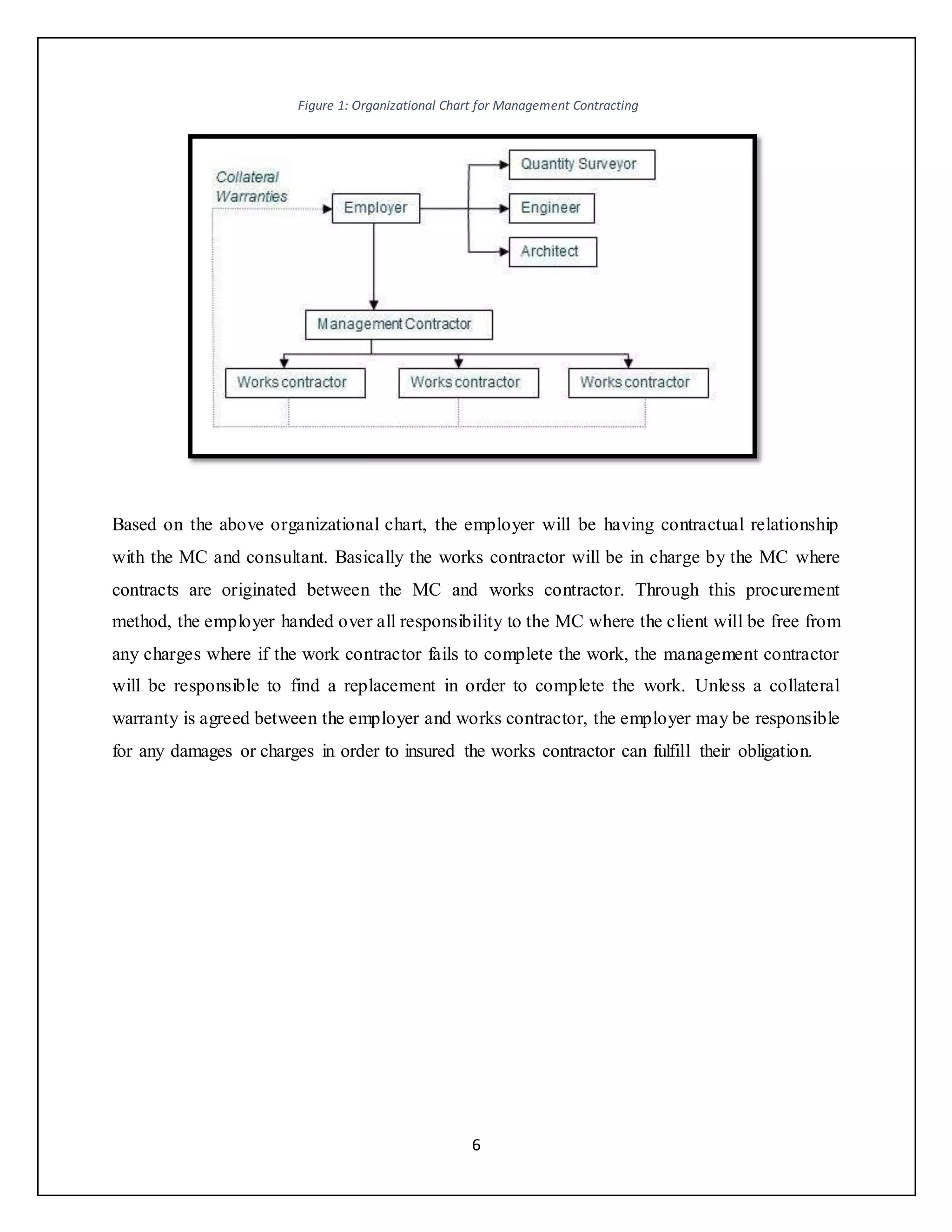
Based on the above organizational chart, the employer will be having contractual relationship
with the MC and consultant. Basically the works contractor will be in charge by the MC where
contracts are originated between the MC and works contractor. Through this procurement
method, the employer handed over all responsibility to the MC where the client will be free from
any charges where if the work contractor fails to complete the work, the management contractor
will be responsible to find a replacement in order to complete the work. Unless a collateral
warranty is agreed between the employer and works contractor, the employer may be responsible
for any damages or charges in order to insured the works contractor can fulfill their obligation.
Figure 1: Organizational Chart for Management Contracting
7
Comparison
Selection of procurement method aligned to the client’s requirement is extremely important to
successful of any construction projects. A number of fundamental key requirements for instance
time, cost and quality are highlighted especially selecting a suitable procurement method. At the
same time, major factors such as the size, value and nature of the project likewise the experience
and expertise of the project team has to be underlined too.
Comparison and recommendation between traditional and management contracting will be made.
‘’Time is gold’’, this clearly define how important is time. Traditional method requires longer
period of time for completion as the overall complete design prior to contract award. Whereas
Management Contracting method allow the shortest total project time since design and
construction phase are overlapping. Under Management Contracting method, client can attain
early revenue as the completion time is shorter.
In terms of flexibility, Management Contracting method has greater control over the change of
design of the project without sacrificing cost control. It is crucial as the project required
additional sustainable features which the design is prone to changes furthermore it is still not so
familiar to the construction industry. Traditional method, conversely is less flexible for the
employer to declare any design variations since the contract sum is fixed before commencing the
project. Implementation of design variations is more difficult and time consuming since the
overall design has been finalized in the event before the project commencing.
Another fundamental requirement is the quality of works whereby Management Contracting
method is more outstanding than the Traditional method. By using Management Contracting
method, the contractor has the freedom to choose and evaluate specialist subcontractors and
suppliers to collaborate with them. Subcontractors with their expertise and experience in their
particular scope ensure the quality of the project is retained. Under traditional method, the
contractor may lack of incentives to point out any potential mistakes and missing parts in the
design due to the fixed contract sum. They have more tendency to complete the project in the
sake to barely meet the contractual requirement in which quality of the project is not warranted.
8
Suitability
In conclusion, I would like to recommend Management Contracting method as our project
procurement method. It fulfilled most of my client’s requirement which is completed or high-end
projects to be built in a short time frame, design variations can be controlled over, quality of
works retained and lastly there is good coordination between contractor and designer that reduce
disputes.
Although cost of the projects might be hardly under control by the client due to the amount of
money required for this project is being known after completing unlike the traditional method
which using lump sum contract. Therefore, no ‘one size fits all’’ approach and priority of the
needs come from the client.
9
Type of Contract
In this project, we are using cost reimbursement contract. Means that the management
contractor(MC) is reimbursed for completed work and plus a management fees as his profit.
Before the project starts, the client and the MC will agree on a fee that the MC will preserve as
profit and overhead. In this type of contract, the MC is not supposed to earn any extra profit on
any stage of the construction. The contract is also an open book process. This contract’s idea is
for the clients to pay the cost of the actual work without markup rate, but then plus a
management fee for the MC as his profit. To avoid any argument, the 2 parties should specify
how much is the reimbursable fees to the MC before the project start.
Cost Reimbursable Contracts can be allocated into 4 categories:
 Cost Plus Fixed Fee Contract (CPFF)
 Cost Plus Incentive Fee Contract (CPIF)
 Cost Plus Award Fee (CPAF)
 Cost Plus Percentage of Cost (CPPC)
Why Cost Plus Fixed Fee Contract (CPFF)?
In this 20 stories condominium project, we choose to use Cost Plus-Fixed Fee Contract (CPFF).
In this kind of contract, the MC is paying for all gained costs and then plus a fixed amount,
which is agree in both parties before enter into the project, and it will not be change, regardless
of his performance. The client has the benefit in financial from a cost-plus fixed fee contract as
the MC has no need to overprice a job to cover profit for any unknown work, the client only pay
for works that are carry out by the MC. So, the MC profit margin can be less, and making it
cheaper for the clients. Besides, this agreement can allow the client to have more flexibility to
change designs and material during the projects proceeds because in this project is pressing to
allow additional green and sustainable features to create more value to environment and social.
Furthermore, CPFF requires the MC to acquire numerous competitive bids for each trade, for
allowing the client to evaluate all the bids and secure the lowest construction cost. There is a
greater potential for the client to have the control in the decision of making process and with the
controlling of money spent and documentation to support the progress payment claims. Client
has the right to know all the details about the project, for example the cost of materials and
10
labour at every stage of the construction process. Final cost may be less compare with the fixed
price contract because MC can’t to increase the price to cover their risk. This is so called “open
book process”. It is a monitoring system to ensure that the MC is keeping good records. Above
all are the benefits for the client.
Now, discuss about the disadvantages for the client. In this agreement, client bears the
unbelievable risk that the construction works will not spiral out of control, although even
legitimately and there is very little incentive for the builder to have the job done quickly and
inexpensively. Client requires a high level of trust, good relationship, and good communication
between the parties. Besides that, client can’t know exactly how much is the cost for the project,
and making it difficult to budget. But this is not the problem for our client, because our client has
enough capital, and they are more focusing on the work quality. To overcome the problem and to
limit the risk of the client, client can hire a specialist construction lawyer to draft a special
conditions and request to be included in the CPFF contract and client should be cautious after
obtaining the required legal advice before enter into the contract.
11
Viability and Comparison with Design and Build
Design and build(D&B) is one of the most popular and modern procurement route. What is
Design and Build? The term itself is describing the method, in which the main contractor is
responsible to design and construct the building. The main difference between D&B and other
contract is that, the client usually appoints consultants to design the building, and then contractor
is only appointed to construct the building according to the drawing produced by consultants.
The main focus of D&B is to have a single point of responsibility which cannot achieved by
other contract. Since the design and the construction will both produced out by Contractor, the
responsibility will all be on the Contractor.
The process of D&B basically is that the Client will normally appoint design consultants to draft
a layout design(incomplete). When it is partially complete, the rest will be done by the appointed
D&B Contractor. After the layout design is submitted and approved, tender document will be
prepared according to Approximate Bills of Quantity.
After the Approximate BOQ is prepared, it will then be given to few selected D&B Contractors
to participate the tender process. The D&B contractors will compete with each other with their
based on their rates. When a D&B contractor is assigned, the D&B Contractor will continue to
finish the design including detail design and all, by appointing a team of design consultant. The
design will be completed according to the Employer’s Requirement.
Lastly, when all of the construction drawings are completed, Client’s QS will then prepare a final
BQ based on the unit rates in Approximate BQ. Once the BQ has gotten consent from Client, it
will then be converted into Lump Sum Contract.
Instantly, D&B may have some advantages in compare to basic procurement method, where
D&B contractor are appointed based on standards, capabilities and experience, as based on
single point of responsibility, D&B contractor work individually as they include both
12
construction and design which are able to reduce the owner’s risk. But on the other hand, through
basic procurement method, the contractor is not responsible for design where they utterly follow
and construct based on the instruction of the design consultant where appointed by the client
itself.
Hence, the design and construction team work in closer relationship where excellence
communication is achieved, less dispute will arise while, basic procurement method may mislead
and often miscommunicate when variation occurs between contractor and consultant team. A
longer time is required in order to resolve the problem especially when it involve more than 2
parties.
Less competition may be the main concern for using D&B contractor where an efficient and
effective design and build team is still in a minority state where only a few success D&B
company are found in the market, but through basic procurement method, we are able to form a
competitive market where we can easily access the cost data of current market and further decide
which procurement method to use.
13
Conclusion
In a nutshell, Management Contractor(MC) is the best procurement method that I will suggest
and implement to the client because the client doesn’t need to take responsibility whereas the
MC will manage each work contractor in order for the project to complete within the time frame.
In contract wise, CPFF manage to reduce the risk of the client where MC will not spend more
than the cost of fixed fee.
Hence, MC has a strong buildability towards quality, where home buyers are often attracted by
the quality of a building rather than over look on the cost. Hence, the quality can be control by
the client and MC where discussion will often stick on track with the project and variation can be
further discuss to resolve dispute from arising.
Resources and workmanship wise is all beyond the control of the MC where they contractually
work with different work contractors where each seek for difference resources and each provide
well-train skilled workers in each aspect can save time yet maintain the quality.
In comparison to D&B, MC is much for suitable because there is more typical floor design in a
condominium where huge variation doesn’t take place unlike D&B where design varies until the
construction process end. Hence, D&B are usually suitable for fast track and large project where
specialized work is strongly required. MC would be the method I will recommend. (2855 words)
14
References
1. https://pmstudycircle.com/2013/12/types-of-procurement-contracts-used-in-project-management/
2. Davis, P. ,Love, P. and Baccarini, D. (2008) Deliver and Management of Built Assets:Building
Procurement Methods, Brisbane: Icon. Net Pty Ltd.
3. Royal Institution of Chartered Surveyors (RICS), (2013) RICS Professional Guidance, UK:
Developing a construction procurement strategy and selecting an appropriate route, London: The
Royal Institution of Chartered Surveyors (RICS).
4. http://www.construction-innovation.info/images/pdfs/Research_library/ResearchLibraryC/2006-
034-C/reports/Report_-_Building_Procurement_Methods.pdf
5. http://tipsdiscover.com/home/difference-management-contracting-construction-management/
6. http://eprints.qut.edu.au/27114/1/Furneaux_-_BEIIC_Procurement_Report.pdf
7. https://www.basiccivilengineering.com/2016/10/procurement-methods-construction-
industry.html

Pp1 final

  • 1.
    1 BACHELOR OF QUANTITYSURVEYING (HONOURS) PROFESSIONAL PRACTICE I (QSB60604) Lecturer: Mr. Wong Chong Wei Group Members: Ng Wai Khong (0317980) Leong Karr Khei (0324362) Loh Pey Mun (0318572) Sherlyn Ang (0317977) Michael Chang (0319198)
  • 2.
    2 Table of Content No.Description Page Number 1. Introduction 2 2. Traditional Procurement Method 4 3. Management Contracting Procurement Method 5 - 6 4. Comparison 7 5. Suitability 8 6. Type of Contract 9 - 10 7. Viability and Comparison with Design and Build 11 - 12 8. Conclusion 13 9. Reference 14 10. Appendix
  • 3.
    3 Introduction Proposed project: 20stories condominium Type of project: Residential Location of the project: Kuala Lumpur The Malaysian economic downturn has affected developers in delivering and meeting key property development and sales targets due to inventory fluctuation, unstable market condition and tighter lending requirements. Thus, the concept of condominium is the most suitable project which has sustainable features that create values to the environment and end users as it intensify affordability by fractionalizing the cost of land and building among consumers. There are various construction procurement methods currently practiced in the construction industry. Construction procurement is the process whereby client chooses a specialized method to implement a project. It involves setting up a contractual network of designers, contractors, financiers and other agents to design, construct and manage a project. Furthermore, there are many factors to consider when selecting procurement methods, for instance, time, capital cost, operating cost, environment, market value of the project, flexibility and prestige. The common procurement methods are traditional procurement method, management contracting, construction management as well as Design and Build.
  • 4.
    4 Traditional Procurement Method Thetraditional procurement method is known as the ‘least risk’ approach because there is a level of certainty on design, cost and time inherent in the strategy. It can be relatively slow prior to the commencement of construction due to its sequential nature of the strategy, which is necessary to assure low risk. The client will select and appoints the consultant team comprising of architect, engineer, quantity surveyor, etc to design the building and prepare tender documents. Under the traditional procurement method, design will be completed before the contractual relationship are made. Contractors are then selected through open tender, selective tender or negotiation. Tender documents for the selection of the contractor includes drawings and a specification of workmanship and materials which the contractor should use in the preparation of a price. One of the advantages of traditional procurement method is that it is competitive fairness because all tenderers are bidding on the same basis through open tender. Moreover, it has a relatively low tender preparation costs. It also serves as a satisfactory strategy in terms of public accountability, as it is transparent and based upon competition. Traditional procurement method ensures the confidence for those who involved throughout the supply chain as it carries a well- known procedures. Through design stage, the client is able to have a direct influence which can facilitate a high level of performance and improve the quality of the overall design. Changes and variations to the contract are reasonably easy to arrange and value where the design needs vary due to changes in client demands. It assures price certainty at the award of the contract. The disadvantage of traditional procurement method is that it takes a long process from design and tendering stage to construction stage, thus the construction will take place after design is complete. It opens to abuse when the design is incomplete, resulting in less certainty in time and cost which may lead to disputes. Furthermore, it is potential for adversarial relationships because the strategy is based upon price competition. Not only that, it may encounter poor buildability as contractor is not involved in design or planning of the project at the design stage. Last but not least, the design risk rests with the client.
  • 5.
    5 Management Contracting ProcurementMethod Management Contracting(MC) is a procurement route which is fairly similar to Construction Manager(CM) where the client will be appointed in the early stage (design stage) where it can shorten the time used to complete the entire project. It is essential where appointing a MC in an early stage can enhance the buildability development in terms of figure. But there are a few specific differences among MC and CM, where MC are responsible and works direct with different works contractors which act as a dominant. Furthermore, the client has an only direct contract with the Management Contractor. During the pre-construction and construction process, collateral warranties may be required by the work contractor(purchasers or funders). A collateral warranties is basically an agreement and contractual relationship between parties that would exist. This warranty maybe an insurance to designers or sub-contractors where the client may provide coverage to them when difficulties or dispute arises. Most client preferred MC where it contains essential condition such as quality and cost. Therefore, a management contractor provides services for an example, advising and planning on the development schedule, cost planning and cost control, monitoring the site and key performance. However, there is still some pros and cons by choosing management contracting method. The main advantage is that the MC can participate in the early stage where the design process and construction process can over-lapped where it generally helps to reduce the development time. Moreover, the contract sum will be the total of each separate work trades that are tendered differently because all the works trade will be break down into various work packages. Thus, the procurement method uses cost-plus contract where the MC will pay for every works cost and determine whether to select fixed fee, incentive fee or pay by a percentage of the cost. Hence, the disadvantages of MC will not be able to be precise and certain of the final cost unless the final works and contract have been sign with confirmation. Variation may occur during the construction period where the cost of variations and re-measurement can lead to a higher cost than the original traditional method. There will be a high opportunity(percentage) of changes during the whole period.
  • 6.
    6 Based on theabove organizational chart, the employer will be having contractual relationship with the MC and consultant. Basically the works contractor will be in charge by the MC where contracts are originated between the MC and works contractor. Through this procurement method, the employer handed over all responsibility to the MC where the client will be free from any charges where if the work contractor fails to complete the work, the management contractor will be responsible to find a replacement in order to complete the work. Unless a collateral warranty is agreed between the employer and works contractor, the employer may be responsible for any damages or charges in order to insured the works contractor can fulfill their obligation. Figure 1: Organizational Chart for Management Contracting
  • 7.
    7 Comparison Selection of procurementmethod aligned to the client’s requirement is extremely important to successful of any construction projects. A number of fundamental key requirements for instance time, cost and quality are highlighted especially selecting a suitable procurement method. At the same time, major factors such as the size, value and nature of the project likewise the experience and expertise of the project team has to be underlined too. Comparison and recommendation between traditional and management contracting will be made. ‘’Time is gold’’, this clearly define how important is time. Traditional method requires longer period of time for completion as the overall complete design prior to contract award. Whereas Management Contracting method allow the shortest total project time since design and construction phase are overlapping. Under Management Contracting method, client can attain early revenue as the completion time is shorter. In terms of flexibility, Management Contracting method has greater control over the change of design of the project without sacrificing cost control. It is crucial as the project required additional sustainable features which the design is prone to changes furthermore it is still not so familiar to the construction industry. Traditional method, conversely is less flexible for the employer to declare any design variations since the contract sum is fixed before commencing the project. Implementation of design variations is more difficult and time consuming since the overall design has been finalized in the event before the project commencing. Another fundamental requirement is the quality of works whereby Management Contracting method is more outstanding than the Traditional method. By using Management Contracting method, the contractor has the freedom to choose and evaluate specialist subcontractors and suppliers to collaborate with them. Subcontractors with their expertise and experience in their particular scope ensure the quality of the project is retained. Under traditional method, the contractor may lack of incentives to point out any potential mistakes and missing parts in the design due to the fixed contract sum. They have more tendency to complete the project in the sake to barely meet the contractual requirement in which quality of the project is not warranted.
  • 8.
    8 Suitability In conclusion, Iwould like to recommend Management Contracting method as our project procurement method. It fulfilled most of my client’s requirement which is completed or high-end projects to be built in a short time frame, design variations can be controlled over, quality of works retained and lastly there is good coordination between contractor and designer that reduce disputes. Although cost of the projects might be hardly under control by the client due to the amount of money required for this project is being known after completing unlike the traditional method which using lump sum contract. Therefore, no ‘one size fits all’’ approach and priority of the needs come from the client.
  • 9.
    9 Type of Contract Inthis project, we are using cost reimbursement contract. Means that the management contractor(MC) is reimbursed for completed work and plus a management fees as his profit. Before the project starts, the client and the MC will agree on a fee that the MC will preserve as profit and overhead. In this type of contract, the MC is not supposed to earn any extra profit on any stage of the construction. The contract is also an open book process. This contract’s idea is for the clients to pay the cost of the actual work without markup rate, but then plus a management fee for the MC as his profit. To avoid any argument, the 2 parties should specify how much is the reimbursable fees to the MC before the project start. Cost Reimbursable Contracts can be allocated into 4 categories:  Cost Plus Fixed Fee Contract (CPFF)  Cost Plus Incentive Fee Contract (CPIF)  Cost Plus Award Fee (CPAF)  Cost Plus Percentage of Cost (CPPC) Why Cost Plus Fixed Fee Contract (CPFF)? In this 20 stories condominium project, we choose to use Cost Plus-Fixed Fee Contract (CPFF). In this kind of contract, the MC is paying for all gained costs and then plus a fixed amount, which is agree in both parties before enter into the project, and it will not be change, regardless of his performance. The client has the benefit in financial from a cost-plus fixed fee contract as the MC has no need to overprice a job to cover profit for any unknown work, the client only pay for works that are carry out by the MC. So, the MC profit margin can be less, and making it cheaper for the clients. Besides, this agreement can allow the client to have more flexibility to change designs and material during the projects proceeds because in this project is pressing to allow additional green and sustainable features to create more value to environment and social. Furthermore, CPFF requires the MC to acquire numerous competitive bids for each trade, for allowing the client to evaluate all the bids and secure the lowest construction cost. There is a greater potential for the client to have the control in the decision of making process and with the controlling of money spent and documentation to support the progress payment claims. Client has the right to know all the details about the project, for example the cost of materials and
  • 10.
    10 labour at everystage of the construction process. Final cost may be less compare with the fixed price contract because MC can’t to increase the price to cover their risk. This is so called “open book process”. It is a monitoring system to ensure that the MC is keeping good records. Above all are the benefits for the client. Now, discuss about the disadvantages for the client. In this agreement, client bears the unbelievable risk that the construction works will not spiral out of control, although even legitimately and there is very little incentive for the builder to have the job done quickly and inexpensively. Client requires a high level of trust, good relationship, and good communication between the parties. Besides that, client can’t know exactly how much is the cost for the project, and making it difficult to budget. But this is not the problem for our client, because our client has enough capital, and they are more focusing on the work quality. To overcome the problem and to limit the risk of the client, client can hire a specialist construction lawyer to draft a special conditions and request to be included in the CPFF contract and client should be cautious after obtaining the required legal advice before enter into the contract.
  • 11.
    11 Viability and Comparisonwith Design and Build Design and build(D&B) is one of the most popular and modern procurement route. What is Design and Build? The term itself is describing the method, in which the main contractor is responsible to design and construct the building. The main difference between D&B and other contract is that, the client usually appoints consultants to design the building, and then contractor is only appointed to construct the building according to the drawing produced by consultants. The main focus of D&B is to have a single point of responsibility which cannot achieved by other contract. Since the design and the construction will both produced out by Contractor, the responsibility will all be on the Contractor. The process of D&B basically is that the Client will normally appoint design consultants to draft a layout design(incomplete). When it is partially complete, the rest will be done by the appointed D&B Contractor. After the layout design is submitted and approved, tender document will be prepared according to Approximate Bills of Quantity. After the Approximate BOQ is prepared, it will then be given to few selected D&B Contractors to participate the tender process. The D&B contractors will compete with each other with their based on their rates. When a D&B contractor is assigned, the D&B Contractor will continue to finish the design including detail design and all, by appointing a team of design consultant. The design will be completed according to the Employer’s Requirement. Lastly, when all of the construction drawings are completed, Client’s QS will then prepare a final BQ based on the unit rates in Approximate BQ. Once the BQ has gotten consent from Client, it will then be converted into Lump Sum Contract. Instantly, D&B may have some advantages in compare to basic procurement method, where D&B contractor are appointed based on standards, capabilities and experience, as based on single point of responsibility, D&B contractor work individually as they include both
  • 12.
    12 construction and designwhich are able to reduce the owner’s risk. But on the other hand, through basic procurement method, the contractor is not responsible for design where they utterly follow and construct based on the instruction of the design consultant where appointed by the client itself. Hence, the design and construction team work in closer relationship where excellence communication is achieved, less dispute will arise while, basic procurement method may mislead and often miscommunicate when variation occurs between contractor and consultant team. A longer time is required in order to resolve the problem especially when it involve more than 2 parties. Less competition may be the main concern for using D&B contractor where an efficient and effective design and build team is still in a minority state where only a few success D&B company are found in the market, but through basic procurement method, we are able to form a competitive market where we can easily access the cost data of current market and further decide which procurement method to use.
  • 13.
    13 Conclusion In a nutshell,Management Contractor(MC) is the best procurement method that I will suggest and implement to the client because the client doesn’t need to take responsibility whereas the MC will manage each work contractor in order for the project to complete within the time frame. In contract wise, CPFF manage to reduce the risk of the client where MC will not spend more than the cost of fixed fee. Hence, MC has a strong buildability towards quality, where home buyers are often attracted by the quality of a building rather than over look on the cost. Hence, the quality can be control by the client and MC where discussion will often stick on track with the project and variation can be further discuss to resolve dispute from arising. Resources and workmanship wise is all beyond the control of the MC where they contractually work with different work contractors where each seek for difference resources and each provide well-train skilled workers in each aspect can save time yet maintain the quality. In comparison to D&B, MC is much for suitable because there is more typical floor design in a condominium where huge variation doesn’t take place unlike D&B where design varies until the construction process end. Hence, D&B are usually suitable for fast track and large project where specialized work is strongly required. MC would be the method I will recommend. (2855 words)
  • 14.
    14 References 1. https://pmstudycircle.com/2013/12/types-of-procurement-contracts-used-in-project-management/ 2. Davis,P. ,Love, P. and Baccarini, D. (2008) Deliver and Management of Built Assets:Building Procurement Methods, Brisbane: Icon. Net Pty Ltd. 3. Royal Institution of Chartered Surveyors (RICS), (2013) RICS Professional Guidance, UK: Developing a construction procurement strategy and selecting an appropriate route, London: The Royal Institution of Chartered Surveyors (RICS). 4. http://www.construction-innovation.info/images/pdfs/Research_library/ResearchLibraryC/2006- 034-C/reports/Report_-_Building_Procurement_Methods.pdf 5. http://tipsdiscover.com/home/difference-management-contracting-construction-management/ 6. http://eprints.qut.edu.au/27114/1/Furneaux_-_BEIIC_Procurement_Report.pdf 7. https://www.basiccivilengineering.com/2016/10/procurement-methods-construction- industry.html