Acceleration of XML
Parsing through Prefetching
IEEE TRANSACTIONS ON COMPUTERS, VOL. 62, NO. 8, AUGUST
2013
Authors: Jie Tang, Student Member, IEEE, Shaoshan Liu, Chen Liu,
Member, IEEE, Zhimin Gu, and Jean-Luc Gaudiot, Fellow, IEEE
Presented By :
Rohit Deshpande
Mtech CSE 2nd sem
130913016
3/24/2014 1
Department Of Computer Science and
Engg.
Contents
• Introduction
• Motivation
• The XML Parsing Process
• Prefetching Techniques
• Methodology
• Performance Analysis of XML Parsing
• Memory-Side Acceleration
• Implementation Feasibility
• A Exemplary Hardware Implementation
• Conclusion
• Future Work
3/24/2014 2
Department Of Computer Science and
Engg.
Introduction
• Extensible Markup Language (XML) has become a
widely adopted standard for data representation
and exchange.
• Neutrality, Application independency and
Flexibility.
• Morgan Stanley’s Financial Services system,
spends 40% execution time on processing XML
documents.
• This paper proposes to accelerate XML parsing
from the memory side.
3/24/2014 3
Department Of Computer Science and
Engg.
Motivation
• XML is widely adopted standard for data
representation and exchange.
• Parsing of XML data introduce significant
overhead.
3/24/2014 4
Department Of Computer Science and
Engg.
The XML Parsing Process
3/24/2014 5
Department Of Computer Science and
Engg.
• XML data parsing consists of three steps:
• Character conversion
• Lexical analysis
• Syntactic analysis.
3/24/2014 6
Department Of Computer Science and
Engg.
XML Parsing Modeling
3/24/2014 7
Department Of Computer Science and
Engg.
• Event Driven Parser
• Tree-Based Parser
3/24/2014 8
Department Of Computer Science and
Engg.
Prefetching Techniques
• Data prefetching has been proposed as a
speculative technique to bridge the speed gap
between CPU and memory subsystem.
• Classic Prefetching Techniques:-
• Sequential Prefetching
• Stride Prefetching
• Strem Prefetching
• Correlating Prefetching
3/24/2014 9
Department Of Computer Science and
Engg.
Overview of Hardware Prefetching
• System Integration of Hardware Prefetcher
3/24/2014 10
Department Of Computer Science and
Engg.
Architecture of Hardware Prefetcher
3/24/2014 11
Department Of Computer Science and
Engg.
Methodology
• XML Parsers and Benchmarks
3/24/2014 12
Department Of Computer Science and
Engg.
• Performance and memory Modeling
3/24/2014 13
Department Of Computer Science and
Engg.
Native versus Managed Execution
3/24/2014 14
Department Of Computer Science and
Engg.
Performance Analysis Of XML Parsing
• Data Flow of XML Parsing
3/24/2014 15
Department Of Computer Science and
Engg.
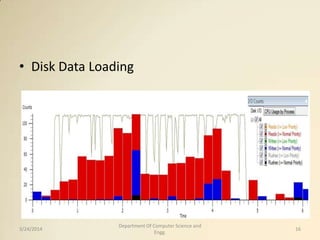
• Disk Data Loading
3/24/2014 16
Department Of Computer Science and
Engg.
Data Loading from Memory Side
• Data flow starting from main memory, going
through each cache layer and finally fetched in
to CPU.
• The CPI of speed test is 0.80.
• Using the SAX parser, the CPI of standard is
1.27, which introduces 58.75 % of overhead.
• Using the DOM parser, the CPI of standard
becomes 1.42, which introduces 77.5% of
overhead.
3/24/2014
Department Of Computer Science and
Engg.
17
Memory-Side Acceleration
• Prefetchers
3/24/2014 18
Department Of Computer Science and
Engg.
• Performance Analysis
3/24/2014 19
Department Of Computer Science and
Engg.
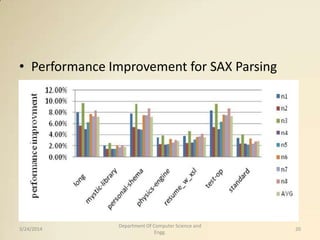
• Performance Improvement for SAX Parsing
3/24/2014 20
Department Of Computer Science and
Engg.
• Performance Improvement for DOM Parsing
3/24/2014 21
Department Of Computer Science and
Engg.
Implementation Feasibility
• Bandwidth Utilization
3/24/2014 22
Department Of Computer Science and
Engg.
• Hardware Cost and Energy Consumption
3/24/2014 23
Department Of Computer Science and
Engg.
3/24/2014 24
Department Of Computer Science and
Engg.
• Energy Consumption of SAX Parsing
3/24/2014 25
Department Of Computer Science and
Engg.
• Energy Consumption of DOM Parsing
3/24/2014 26
Department Of Computer Science and
Engg.
A Exemplary Hardware
Implementation
• Power consumption of the prefetcher on FPGA
3/24/2014 27
Department Of Computer Science and
Engg.
• Hardware Cost and Power Consumption
Comparison between eMIPS and Prefetcher
3/24/2014 28
Department Of Computer Science and
Engg.
Performance comparison of L2-only versus
two-level prefetcher
3/24/2014 29
Department Of Computer Science and
Engg.
consumption comparison of L2-only
versus two-level prefetcher
3/24/2014 30
Department Of Computer Science and
Engg.
Conclusion
• Authors Proposed to make acceleration for
XML parsing from memory side by improving
its data loading performance.
• Reduce cache misses by up to 80 percent,
which translates into up to 20 percent of
performance improvement.
• 12.77 percent of energy saving.
3/24/2014 31
Department Of Computer Science and
Engg.
Future Work
• The ultimate goal is to built a many core chip
in which one core perform conventional
general computing workloads and the other
cores do XML parsing and Garbage Collection.
3/24/2014 32
Department Of Computer Science and
Engg.
References
• K. Chiu, M. Govindaraju, and R. Bramley, “Investigating the Limits of Soap Performance for Scientific
Computing,” Proc. IEEE 11th Int’l Symp. High Performance Distributed Computing (HPDC-11), 2002.
• M.R. Head, M. Govindaraju, R. van Engelen, and W. Zhang, “Grid Scheduling and Protocols-
Benchmarking xml Processors for Applications in Grid Web Services,” Proc. ACM/IEEE Conf.
Supercomputing (SC ’06), p. 121, 2006.
• P. Apparao et al., “Architectural Characterization of an XML-Centric Commercial Server Workload,”
Proc. 33rd Int’l Conf. Parallel Processing, 2004.
• P. Apparao and M. Bhat, “A Detailed Look at the Characteristics of xml Parsing,” Proc. First
Workshop Building Block Engine Architectures for Computers and Networks (BEACON ’04), 2004.
• M. Nicola and J. John, “XML Parsing: A Threat to Database Performance,” Proc. 12th Int’l Conf.
Information and Knowledge Management, 2003.
• Int’l HapMap Project: http://hapmap.ncbi.nlm.nih.gov/, 2013.
SAX Parsing Model: http://sax.sourceforge.net, 2013.
3/24/2014 33
Department Of Computer Science and
Engg.
• W3C, “Document Object Model (DOM) Level 2 Core Specifica-tion,” http://www.w3.org/TR/DOM-Level-2-Core,
2013.
• K. Chiu, T. Devadithya, W. Lu, and A. Slominski, “A Binary XML for Scientific Applications,” Proc. First Int’l Conf. e-
Science and Grid Computing, 2005.
• XimpleWare, “VTD-XML: The Future of XML Processing,” http://vtdxml. sourceforge.net, Accessed 10, Mar. 2007.
W. Lu, K. Chiu, and Y. Pan, “A Parallel Approach to XML Parsing,” Proc. IEEE/ACM Seventh Int’l Conf. Grid
Computing, Sept. 2006.
• M.R. Head and M. Govindaraju, “Approaching a Parallelized XML Parser Optimized for Multi-Core Processor,” Proc.
Workshop Service-Oriented Computing Performance: Aspects, Issues, and Ap-proaches (SOCP ’07), June 2007.
• R.D. Cameron, K.S. Herdy, and D. Lin, “High Performance XML Parsing Using Parallel Bit Stream Technology,” Proc.
Conf. Center for Advanced Studies on Collaborative Research, Oct. 2008.
• L. Zhao and L. Bhuyan, “Performance Evaluation and Accelera-tion for XML Data Parsing,” Proc. Ninth Workshop
Computer Architecture Evaluation Using Commercial Workloads, 2006.
• J. Moscola and J.W. Lockwood, “Reconfigurable Content-Based Router Using Hardware-Accelerated Language
Parser,” ACM Trans. Design Automation of Electronic Systems, vol. 13, article 28, 2008.
3/24/2014 34
Department Of Computer Science and
Engg.
THANK YOU
3/24/2014
Department Of Computer Science and
Engg.
35

Acceleration of XML Parsing through Prefetching

  • 1.
    Acceleration of XML Parsingthrough Prefetching IEEE TRANSACTIONS ON COMPUTERS, VOL. 62, NO. 8, AUGUST 2013 Authors: Jie Tang, Student Member, IEEE, Shaoshan Liu, Chen Liu, Member, IEEE, Zhimin Gu, and Jean-Luc Gaudiot, Fellow, IEEE Presented By : Rohit Deshpande Mtech CSE 2nd sem 130913016 3/24/2014 1 Department Of Computer Science and Engg.
  • 2.
    Contents • Introduction • Motivation •The XML Parsing Process • Prefetching Techniques • Methodology • Performance Analysis of XML Parsing • Memory-Side Acceleration • Implementation Feasibility • A Exemplary Hardware Implementation • Conclusion • Future Work 3/24/2014 2 Department Of Computer Science and Engg.
  • 3.
    Introduction • Extensible MarkupLanguage (XML) has become a widely adopted standard for data representation and exchange. • Neutrality, Application independency and Flexibility. • Morgan Stanley’s Financial Services system, spends 40% execution time on processing XML documents. • This paper proposes to accelerate XML parsing from the memory side. 3/24/2014 3 Department Of Computer Science and Engg.
  • 4.
    Motivation • XML iswidely adopted standard for data representation and exchange. • Parsing of XML data introduce significant overhead. 3/24/2014 4 Department Of Computer Science and Engg.
  • 5.
    The XML ParsingProcess 3/24/2014 5 Department Of Computer Science and Engg.
  • 6.
    • XML dataparsing consists of three steps: • Character conversion • Lexical analysis • Syntactic analysis. 3/24/2014 6 Department Of Computer Science and Engg.
  • 7.
    XML Parsing Modeling 3/24/20147 Department Of Computer Science and Engg.
  • 8.
    • Event DrivenParser • Tree-Based Parser 3/24/2014 8 Department Of Computer Science and Engg.
  • 9.
    Prefetching Techniques • Dataprefetching has been proposed as a speculative technique to bridge the speed gap between CPU and memory subsystem. • Classic Prefetching Techniques:- • Sequential Prefetching • Stride Prefetching • Strem Prefetching • Correlating Prefetching 3/24/2014 9 Department Of Computer Science and Engg.
  • 10.
    Overview of HardwarePrefetching • System Integration of Hardware Prefetcher 3/24/2014 10 Department Of Computer Science and Engg.
  • 11.
    Architecture of HardwarePrefetcher 3/24/2014 11 Department Of Computer Science and Engg.
  • 12.
    Methodology • XML Parsersand Benchmarks 3/24/2014 12 Department Of Computer Science and Engg.
  • 13.
    • Performance andmemory Modeling 3/24/2014 13 Department Of Computer Science and Engg.
  • 14.
    Native versus ManagedExecution 3/24/2014 14 Department Of Computer Science and Engg.
  • 15.
    Performance Analysis OfXML Parsing • Data Flow of XML Parsing 3/24/2014 15 Department Of Computer Science and Engg.
  • 16.
    • Disk DataLoading 3/24/2014 16 Department Of Computer Science and Engg.
  • 17.
    Data Loading fromMemory Side • Data flow starting from main memory, going through each cache layer and finally fetched in to CPU. • The CPI of speed test is 0.80. • Using the SAX parser, the CPI of standard is 1.27, which introduces 58.75 % of overhead. • Using the DOM parser, the CPI of standard becomes 1.42, which introduces 77.5% of overhead. 3/24/2014 Department Of Computer Science and Engg. 17
  • 18.
    Memory-Side Acceleration • Prefetchers 3/24/201418 Department Of Computer Science and Engg.
  • 19.
    • Performance Analysis 3/24/201419 Department Of Computer Science and Engg.
  • 20.
    • Performance Improvementfor SAX Parsing 3/24/2014 20 Department Of Computer Science and Engg.
  • 21.
    • Performance Improvementfor DOM Parsing 3/24/2014 21 Department Of Computer Science and Engg.
  • 22.
    Implementation Feasibility • BandwidthUtilization 3/24/2014 22 Department Of Computer Science and Engg.
  • 23.
    • Hardware Costand Energy Consumption 3/24/2014 23 Department Of Computer Science and Engg.
  • 24.
    3/24/2014 24 Department OfComputer Science and Engg.
  • 25.
    • Energy Consumptionof SAX Parsing 3/24/2014 25 Department Of Computer Science and Engg.
  • 26.
    • Energy Consumptionof DOM Parsing 3/24/2014 26 Department Of Computer Science and Engg.
  • 27.
    A Exemplary Hardware Implementation •Power consumption of the prefetcher on FPGA 3/24/2014 27 Department Of Computer Science and Engg.
  • 28.
    • Hardware Costand Power Consumption Comparison between eMIPS and Prefetcher 3/24/2014 28 Department Of Computer Science and Engg.
  • 29.
    Performance comparison ofL2-only versus two-level prefetcher 3/24/2014 29 Department Of Computer Science and Engg.
  • 30.
    consumption comparison ofL2-only versus two-level prefetcher 3/24/2014 30 Department Of Computer Science and Engg.
  • 31.
    Conclusion • Authors Proposedto make acceleration for XML parsing from memory side by improving its data loading performance. • Reduce cache misses by up to 80 percent, which translates into up to 20 percent of performance improvement. • 12.77 percent of energy saving. 3/24/2014 31 Department Of Computer Science and Engg.
  • 32.
    Future Work • Theultimate goal is to built a many core chip in which one core perform conventional general computing workloads and the other cores do XML parsing and Garbage Collection. 3/24/2014 32 Department Of Computer Science and Engg.
  • 33.
    References • K. Chiu,M. Govindaraju, and R. Bramley, “Investigating the Limits of Soap Performance for Scientific Computing,” Proc. IEEE 11th Int’l Symp. High Performance Distributed Computing (HPDC-11), 2002. • M.R. Head, M. Govindaraju, R. van Engelen, and W. Zhang, “Grid Scheduling and Protocols- Benchmarking xml Processors for Applications in Grid Web Services,” Proc. ACM/IEEE Conf. Supercomputing (SC ’06), p. 121, 2006. • P. Apparao et al., “Architectural Characterization of an XML-Centric Commercial Server Workload,” Proc. 33rd Int’l Conf. Parallel Processing, 2004. • P. Apparao and M. Bhat, “A Detailed Look at the Characteristics of xml Parsing,” Proc. First Workshop Building Block Engine Architectures for Computers and Networks (BEACON ’04), 2004. • M. Nicola and J. John, “XML Parsing: A Threat to Database Performance,” Proc. 12th Int’l Conf. Information and Knowledge Management, 2003. • Int’l HapMap Project: http://hapmap.ncbi.nlm.nih.gov/, 2013. SAX Parsing Model: http://sax.sourceforge.net, 2013. 3/24/2014 33 Department Of Computer Science and Engg.
  • 34.
    • W3C, “DocumentObject Model (DOM) Level 2 Core Specifica-tion,” http://www.w3.org/TR/DOM-Level-2-Core, 2013. • K. Chiu, T. Devadithya, W. Lu, and A. Slominski, “A Binary XML for Scientific Applications,” Proc. First Int’l Conf. e- Science and Grid Computing, 2005. • XimpleWare, “VTD-XML: The Future of XML Processing,” http://vtdxml. sourceforge.net, Accessed 10, Mar. 2007. W. Lu, K. Chiu, and Y. Pan, “A Parallel Approach to XML Parsing,” Proc. IEEE/ACM Seventh Int’l Conf. Grid Computing, Sept. 2006. • M.R. Head and M. Govindaraju, “Approaching a Parallelized XML Parser Optimized for Multi-Core Processor,” Proc. Workshop Service-Oriented Computing Performance: Aspects, Issues, and Ap-proaches (SOCP ’07), June 2007. • R.D. Cameron, K.S. Herdy, and D. Lin, “High Performance XML Parsing Using Parallel Bit Stream Technology,” Proc. Conf. Center for Advanced Studies on Collaborative Research, Oct. 2008. • L. Zhao and L. Bhuyan, “Performance Evaluation and Accelera-tion for XML Data Parsing,” Proc. Ninth Workshop Computer Architecture Evaluation Using Commercial Workloads, 2006. • J. Moscola and J.W. Lockwood, “Reconfigurable Content-Based Router Using Hardware-Accelerated Language Parser,” ACM Trans. Design Automation of Electronic Systems, vol. 13, article 28, 2008. 3/24/2014 34 Department Of Computer Science and Engg.
  • 35.
    THANK YOU 3/24/2014 Department OfComputer Science and Engg. 35