On becoming a
journalist
aka
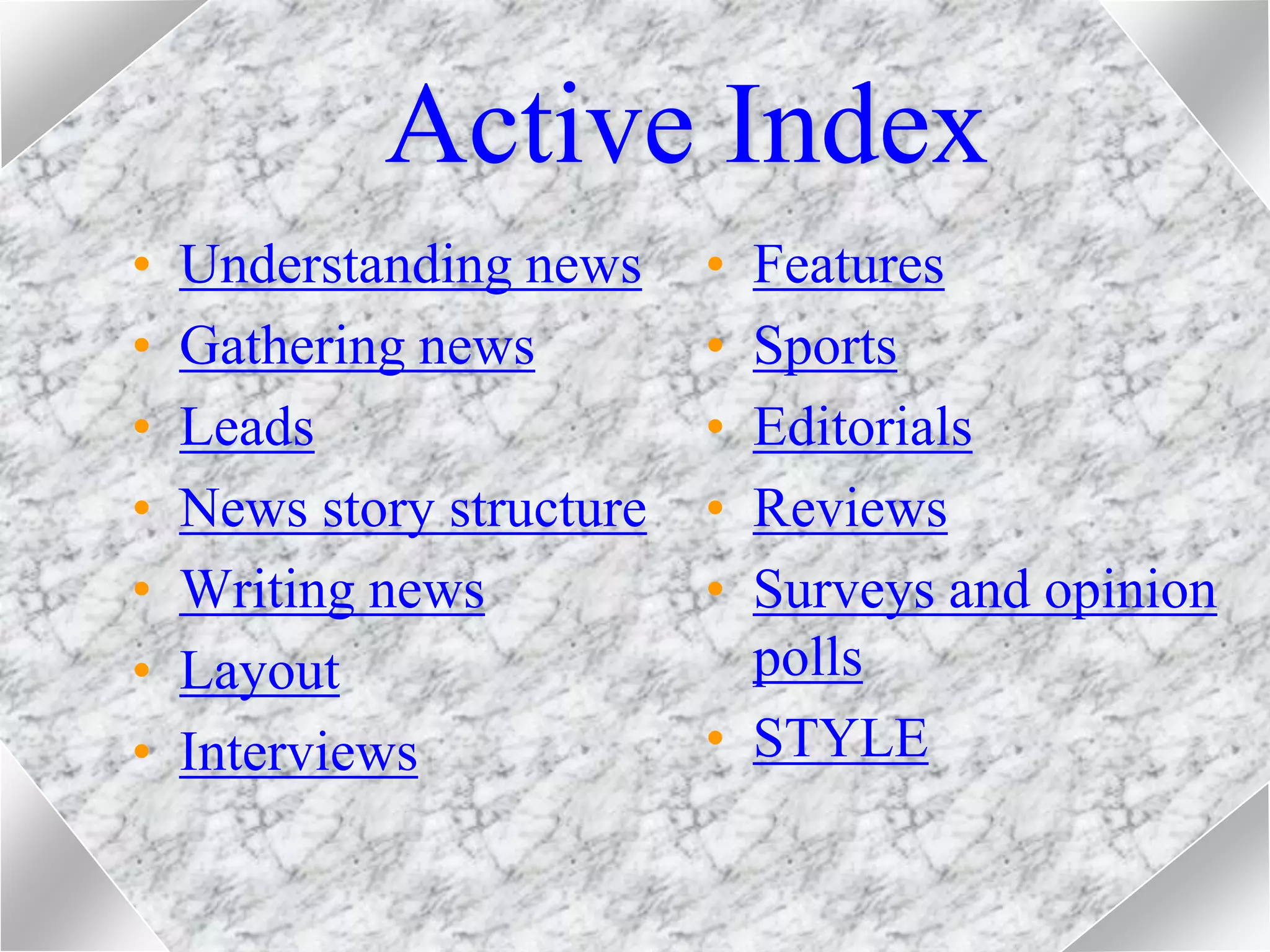
Active Index
• Understanding news
• Gathering news
• Leads
• News story structure
• Writing news
• Layout
• Interviews
• Features
• Sports
• Editorials
• Reviews
• Surveys and opinion
polls
• STYLE
Understanding
news
Understanding
News
• Hard News = significant
events
• Soft News = less significant
but larger audience
Three factors to all
news:
•facts
•interest
•audience
Six qualities to all
news. It must be:
•Accurate
•Balanced
•Objective
•Concise
•Clear
•Timely
News Values
• Timeliness
• Proximity
• Consequence
• Prominence
• Drama
• Oddity
• Conflict
• Progress
• Emotions
• Sex
Gathering
news
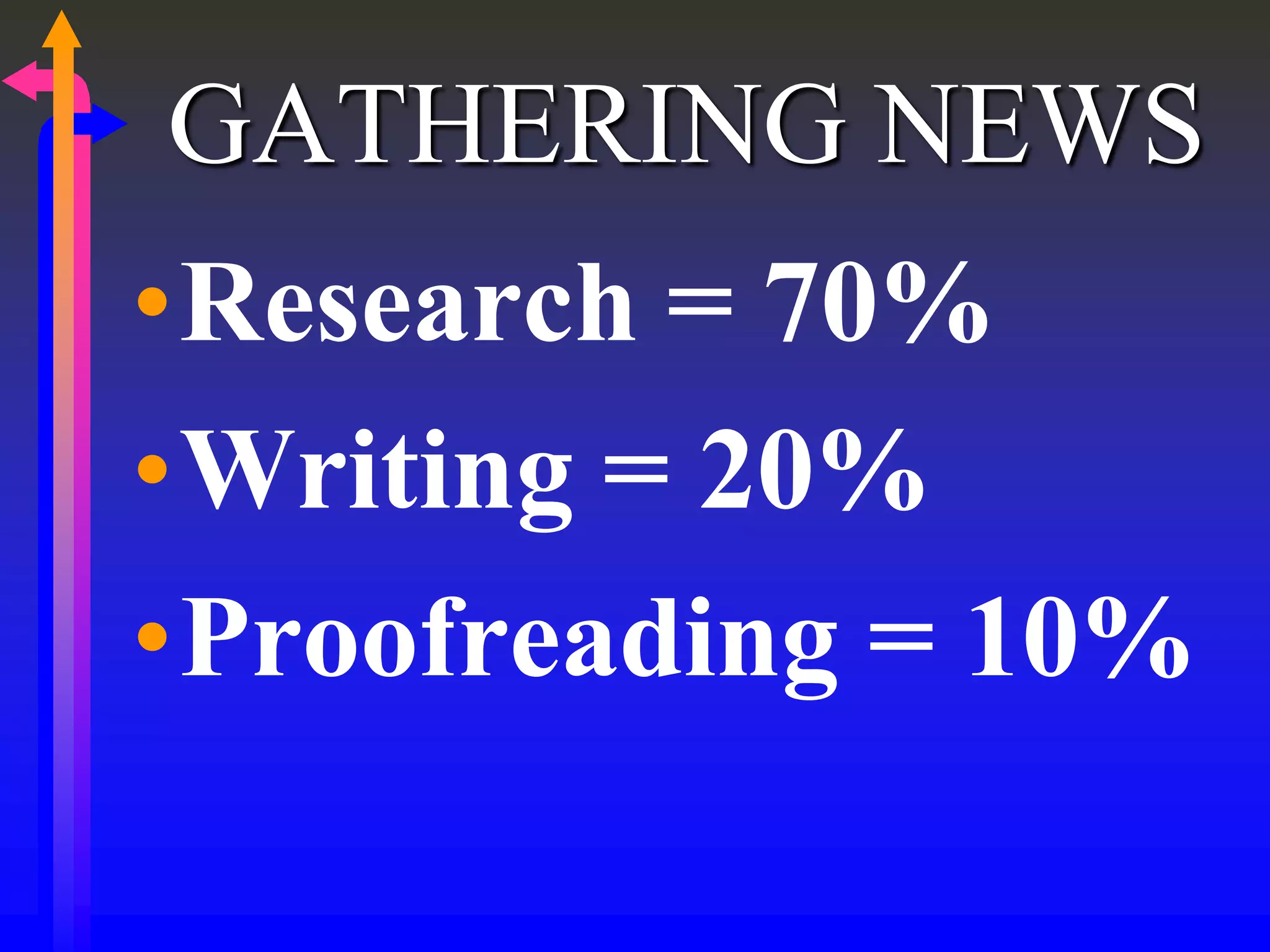
GATHERING NEWS
•Research = 70%
•Writing = 20%
•Proofreading = 10%
Sources of news:
• Beats
• Handbook
• Press Releases
• City newspaper
• Magazines
• Tips
• Snack, lunch
• Club activities
• Extra-curricular
activities
• Twitter
• RSS Feeds
• Class Site Portal
• Personal Site Portal
• City hall
• Chamber of Commerce
• City Bulletin Boards
To succeed...
•You must have a
Nose for
News
Characteristics of a
good reporter
• curiosity
• sincere concern and sense of
justice
• Objectivity
Characteristics of a
good reporter
• Ability to interview strangers
• Ability to inspire confidence
and make people feel at ease
• Wide educational background
Characteristics of a good
reporter
• Resourcefulness and persistence
• Ability to write and speak
standard English
• Keen observation
• Extensive vocabulary
5 Ws and H are basic
requirements but not
enough to make someone
remark, "Wow! Great
story."
• Dig deep • Make facts
interesting
Leads
All About Leads
• Feature the feature
• Clothesline WWWWHW
• Colored Clothesline -- quote,
eye-catcher, comment;
• Include as many wwwwwh as
possible as soon as possible
• Hold one back as a tease
Begin by
determining which
of the 5Ws&H is the
feature to feature
Leads
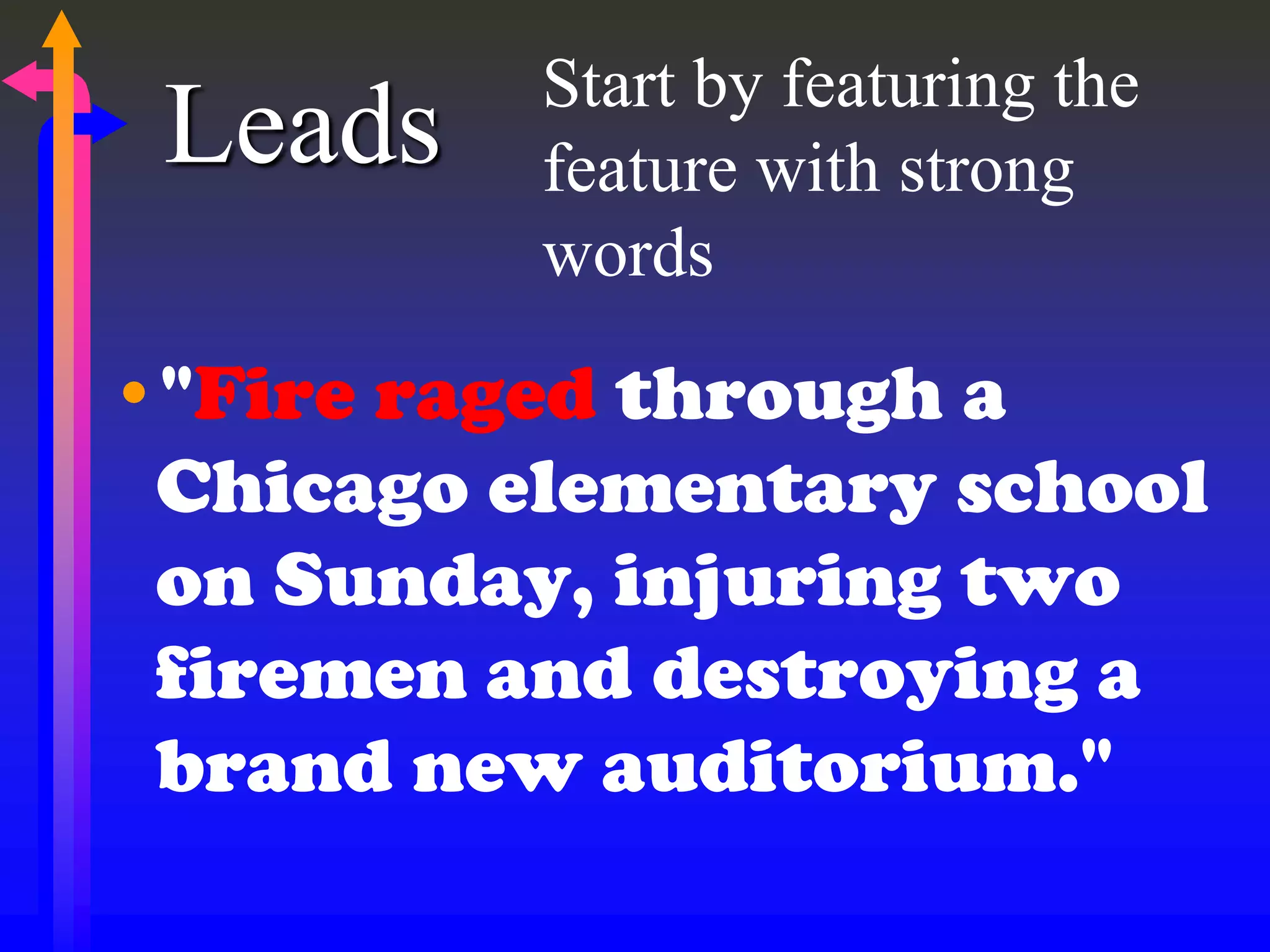
•"Fire raged through a
Chicago elementary school
on Sunday, injuring two
firemen and destroying a
brand new auditorium."
Start by featuring the
feature with strong
words
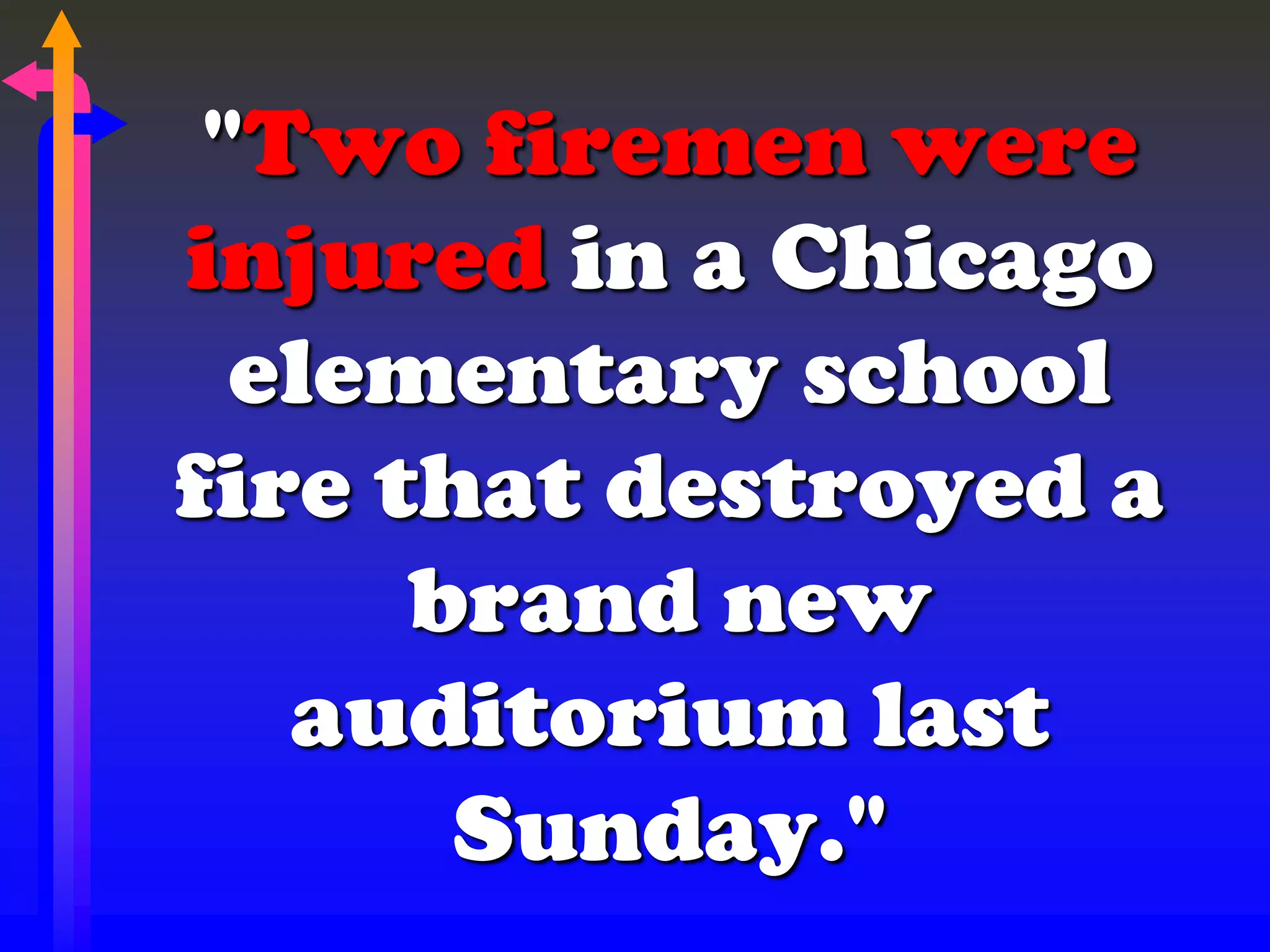
"Two firemen were
injured in a Chicago
elementary school
fire that destroyed a
brand new
auditorium last
Sunday."
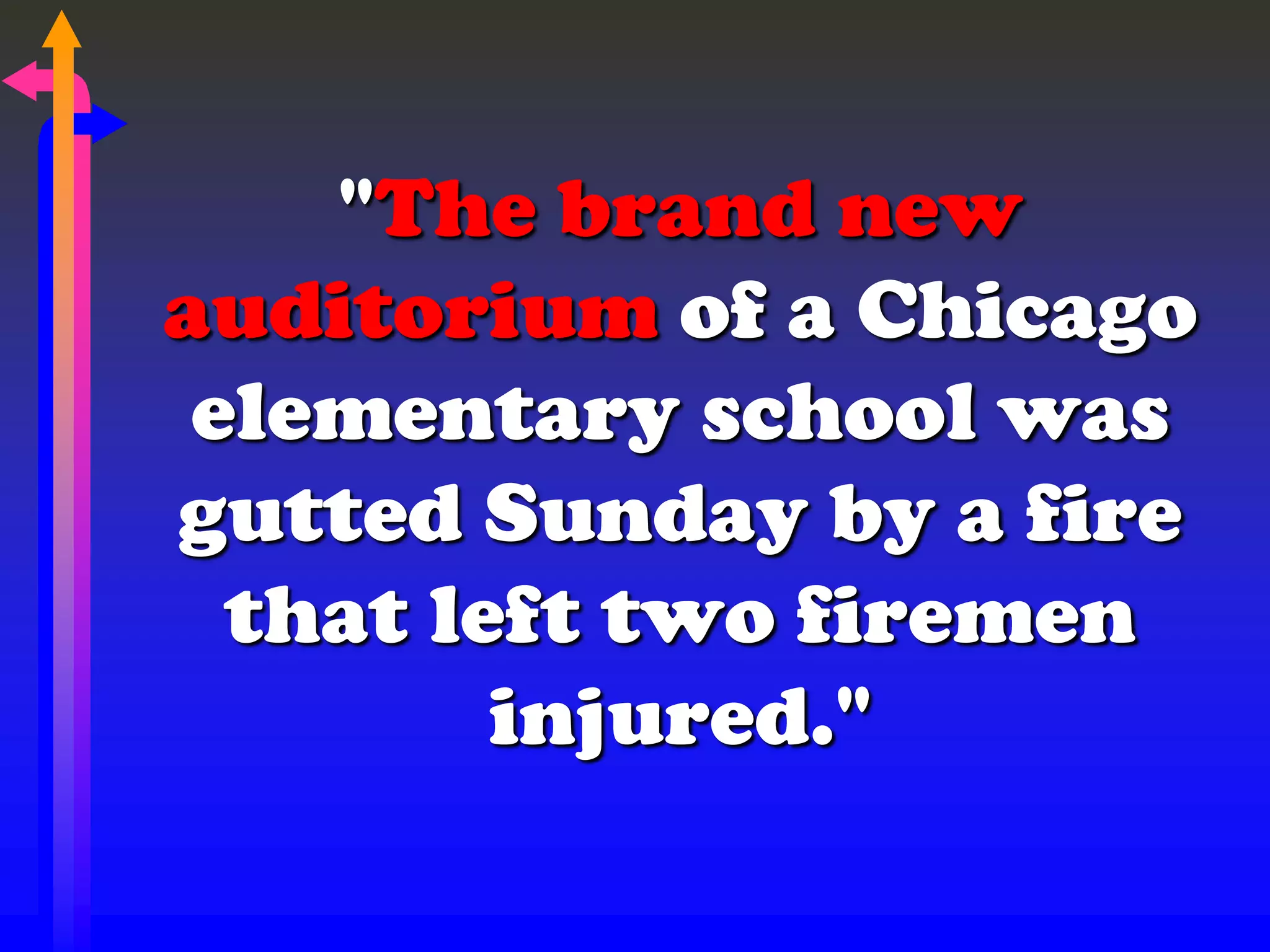
"The brand new
auditorium of a Chicago
elementary school was
gutted Sunday by a fire
that left two firemen
injured."
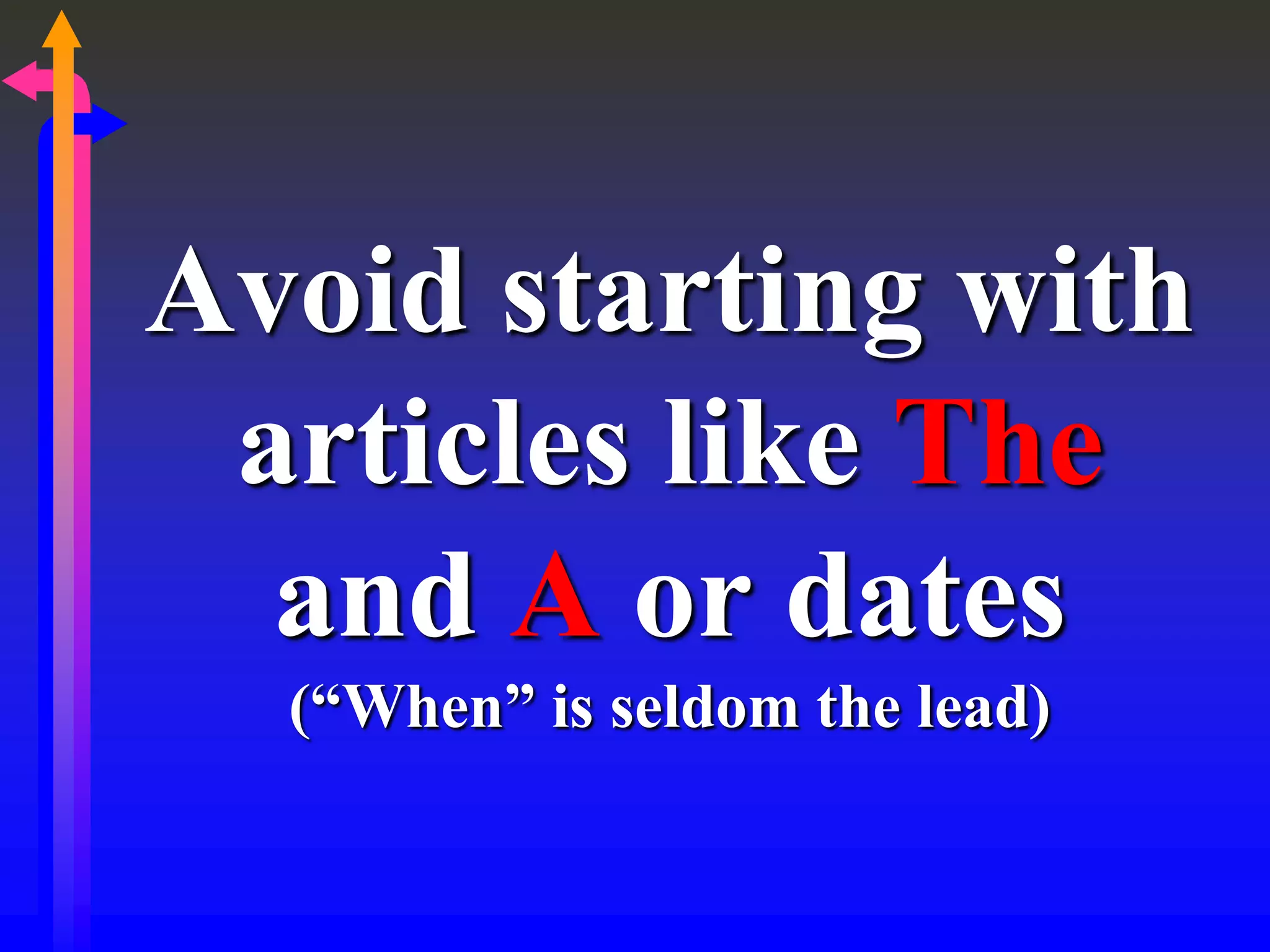
Avoid starting with
articles like The
and A or dates
(“When” is seldom the lead)
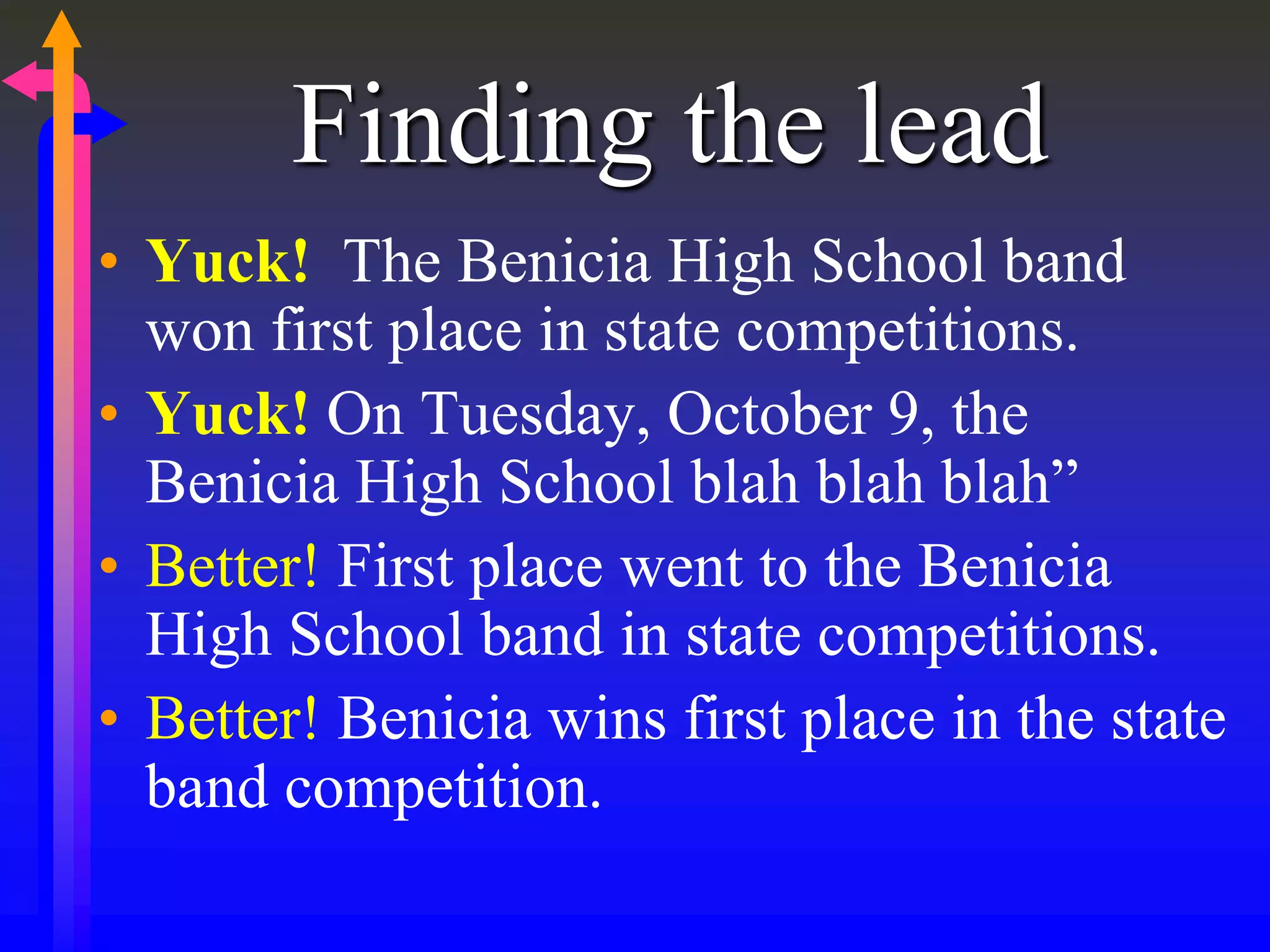
Finding the lead
• Yuck! The Benicia High School band
won first place in state competitions.
• Yuck! On Tuesday, October 9, the
Benicia High School blah blah blah”
• Better! First place went to the Benicia
High School band in state competitions.
• Better! Benicia wins first place in the state
band competition.
News structure
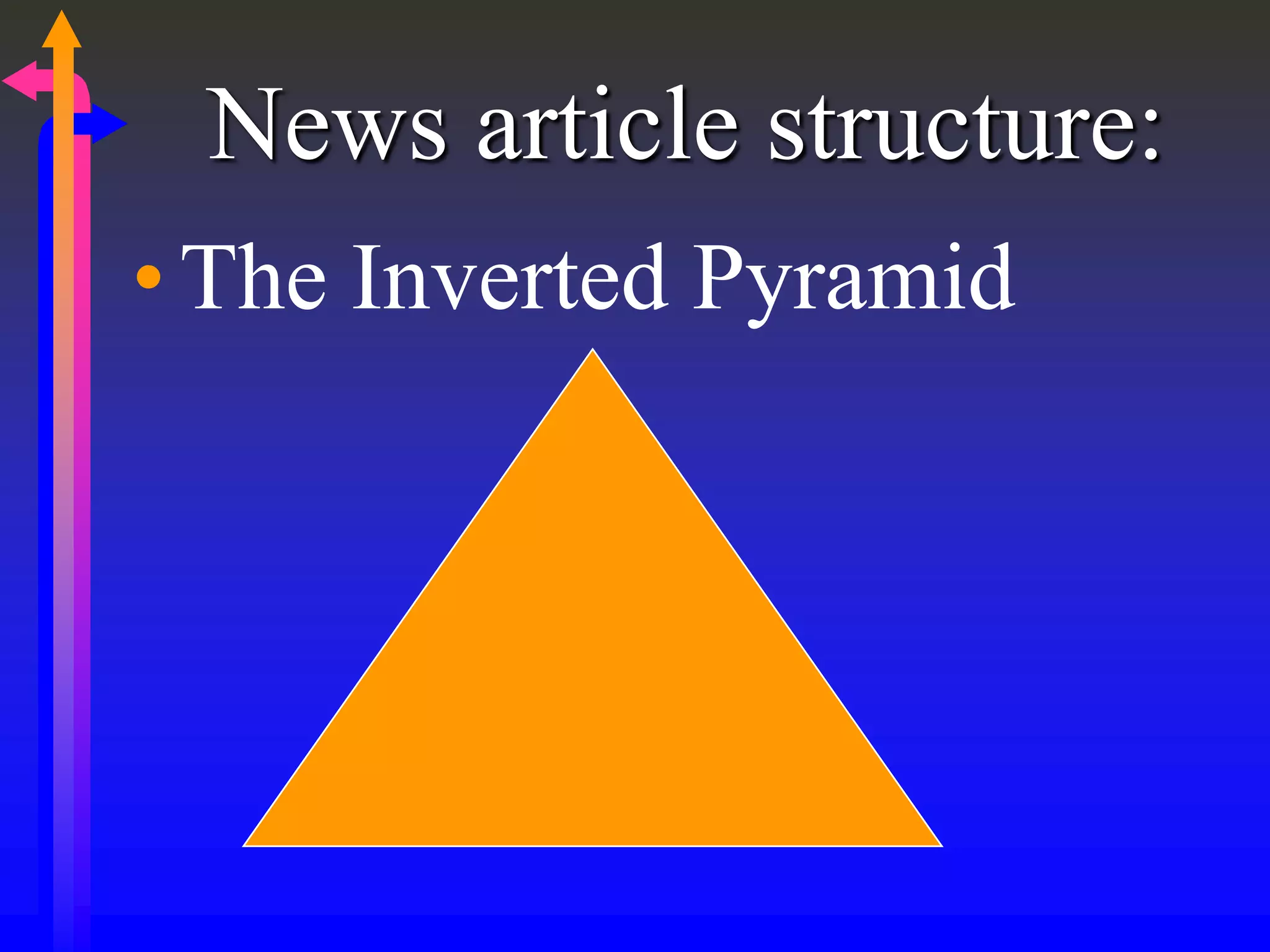
News article structure:
•The Inverted Pyramid
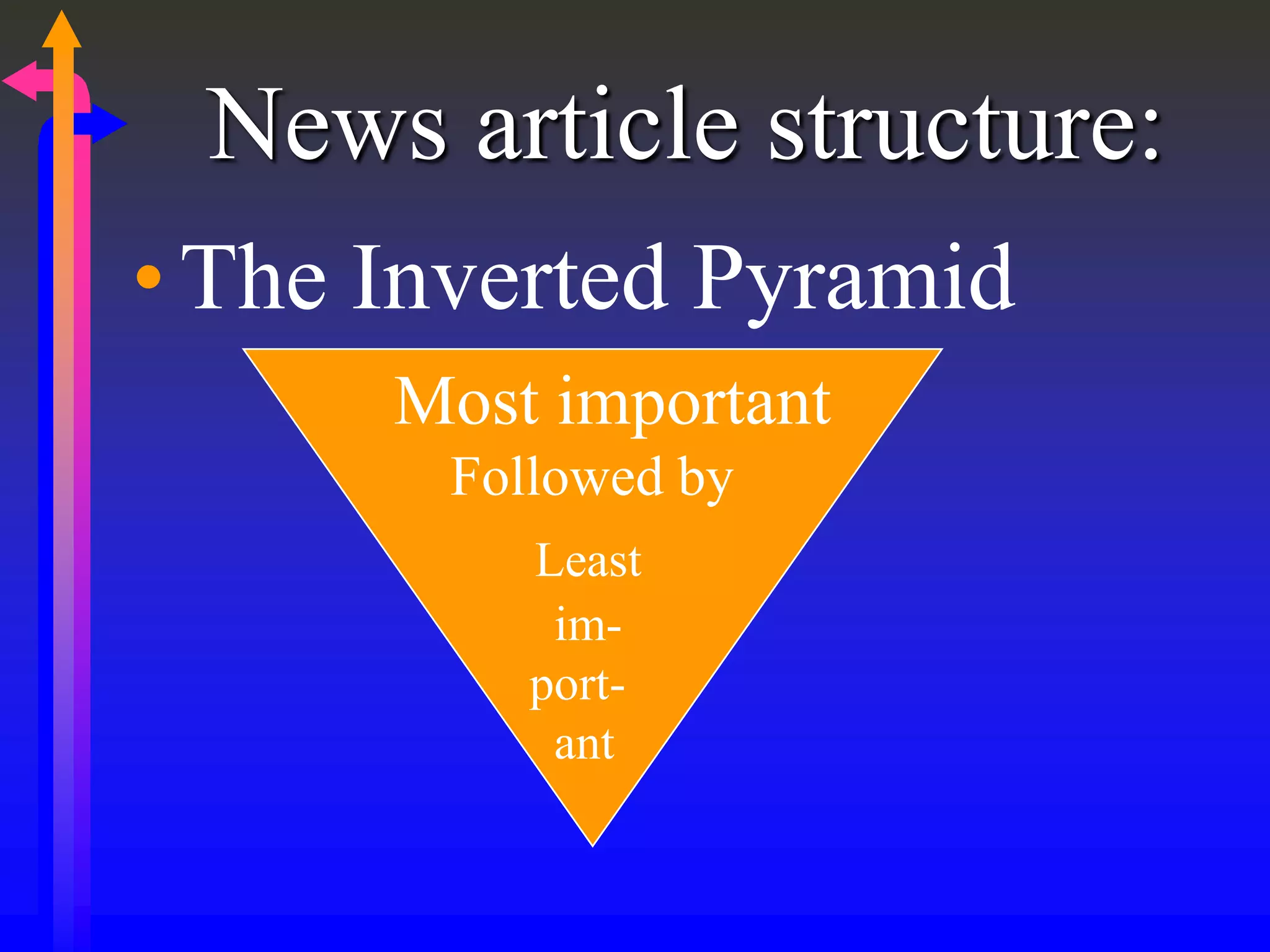
News article structure:
•The Inverted Pyramid
Most important
Followed by
Least
im-
port-
ant
First things first:
Push the facts to the
front and cut the crap
Be precise
Make every word
count
Brevity doesn't
excuse reporters
from being accurate
and thorough
To complete the pyramid
• End the story in the last two
paragraphs
• This way the last paragraph
can be cut without affecting
the conclusion
Writing news
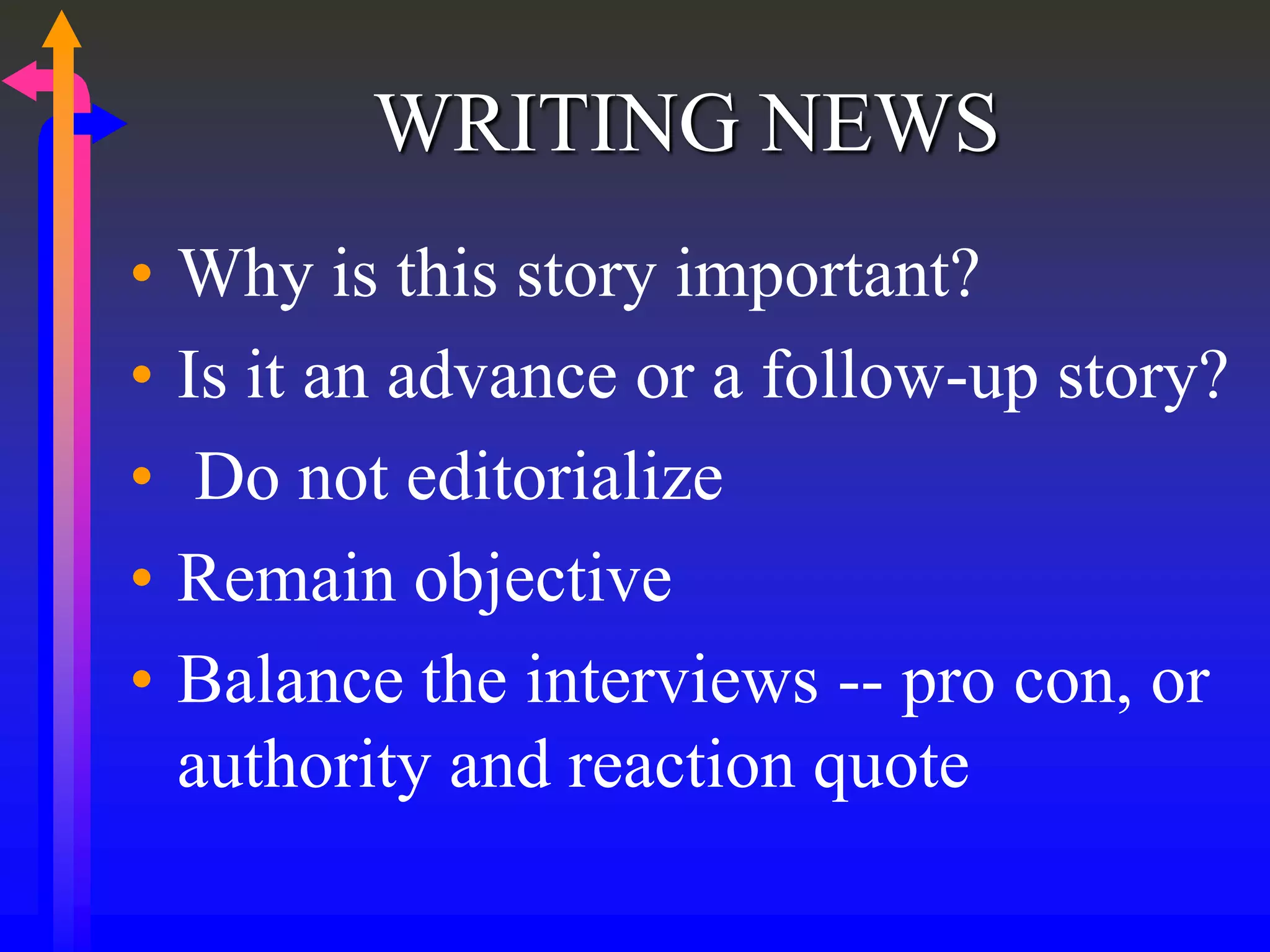
WRITING NEWS
• Why is this story important?
• Is it an advance or a follow-up story?
• Do not editorialize
• Remain objective
• Balance the interviews -- pro con, or
authority and reaction quote
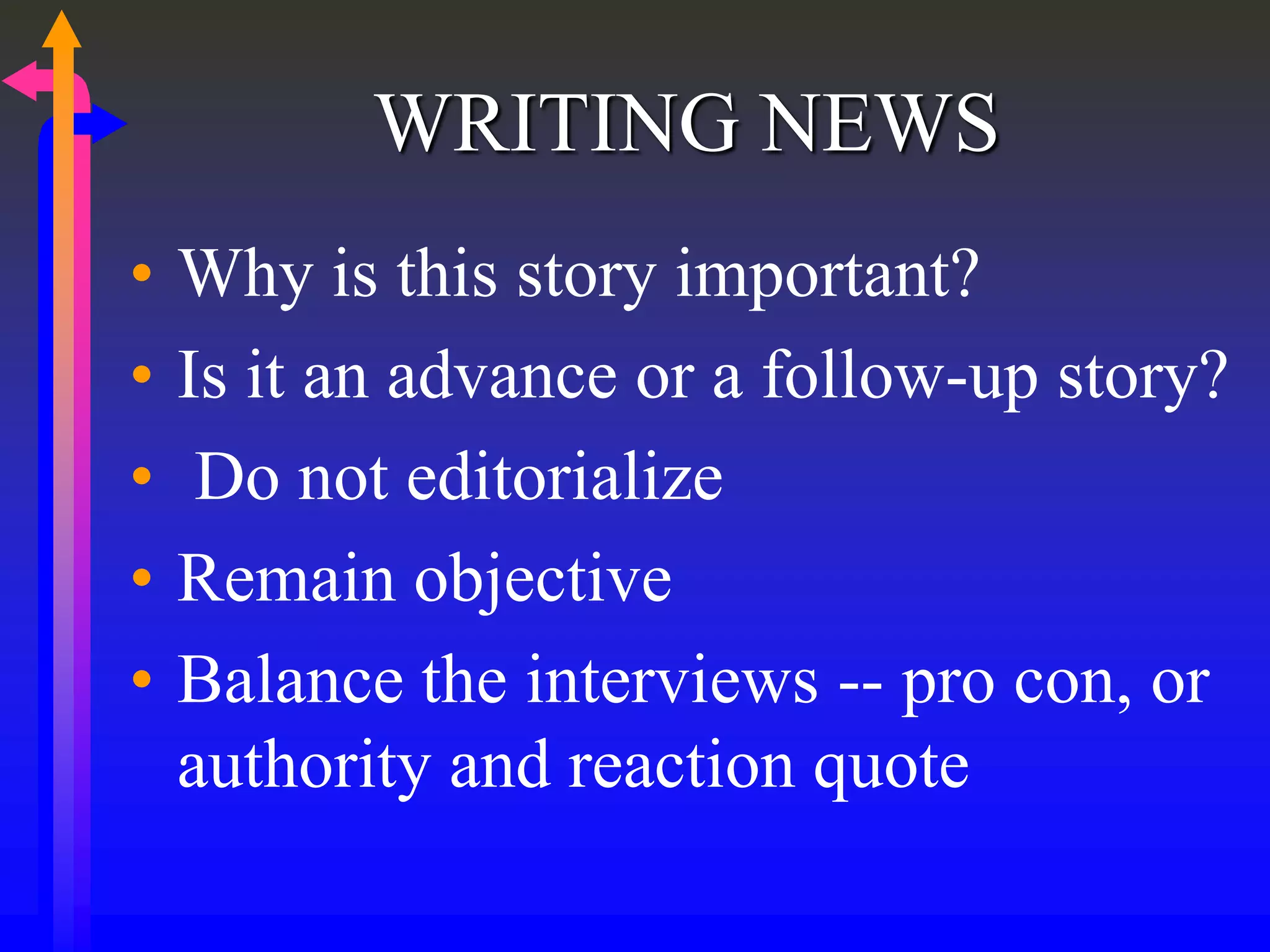
WRITING NEWS
• Why is this story important?
• Is it an advance or a follow-up story?
• Do not editorialize
• Remain objective
• Balance the interviews -- pro con, or
authority and reaction quote
WRITING NEWS
No Mr., No Mrs., No Ms.
• Introduce every person with a
title or description. Then use
only the last name
• Never use Ms. Miss. Mrs. Or
Mr.
Layout
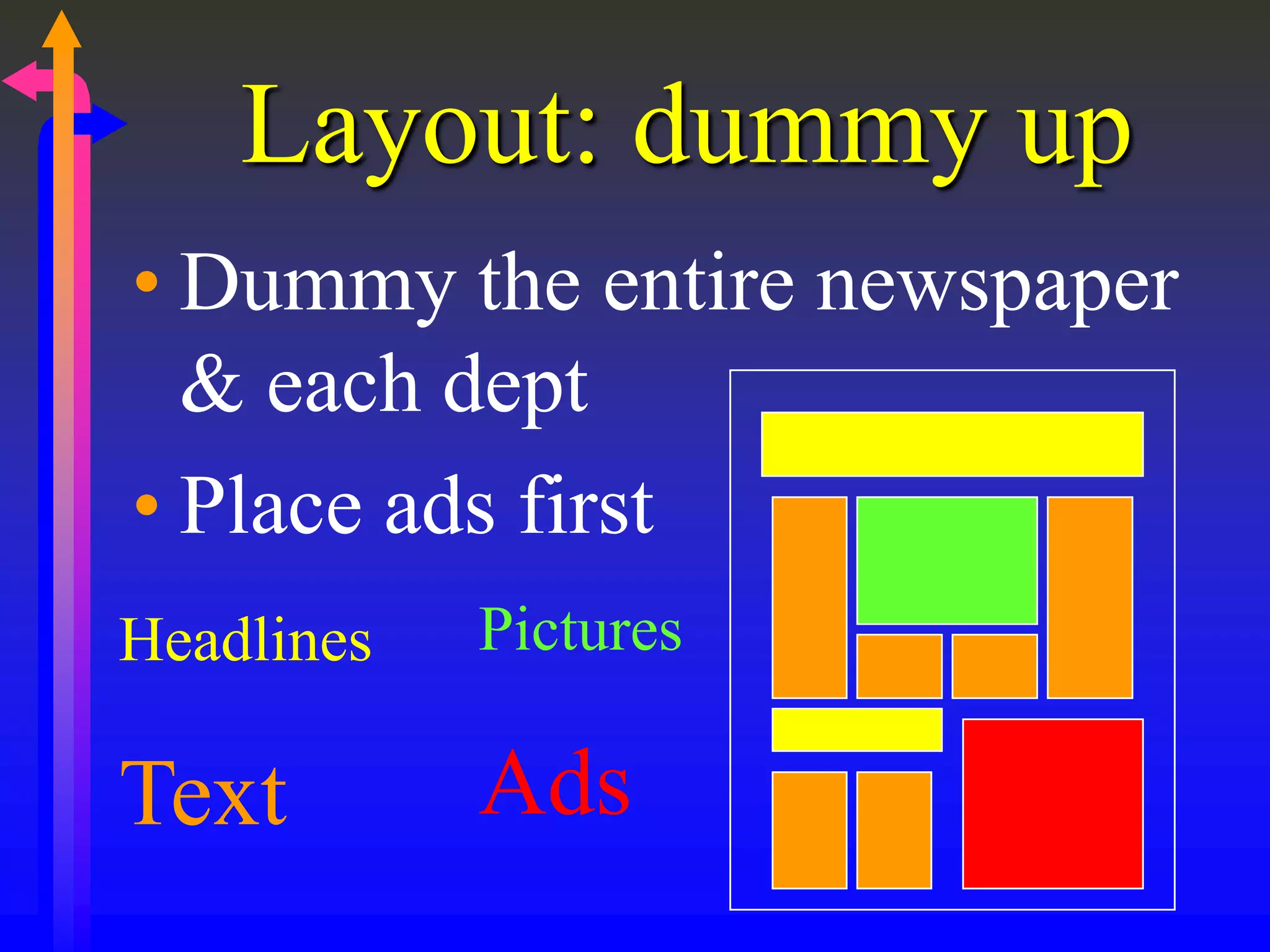
Layout: dummy up
• Dummy the entire newspaper
& each dept
• Place ads first
Headlines
Text
Pictures
Ads
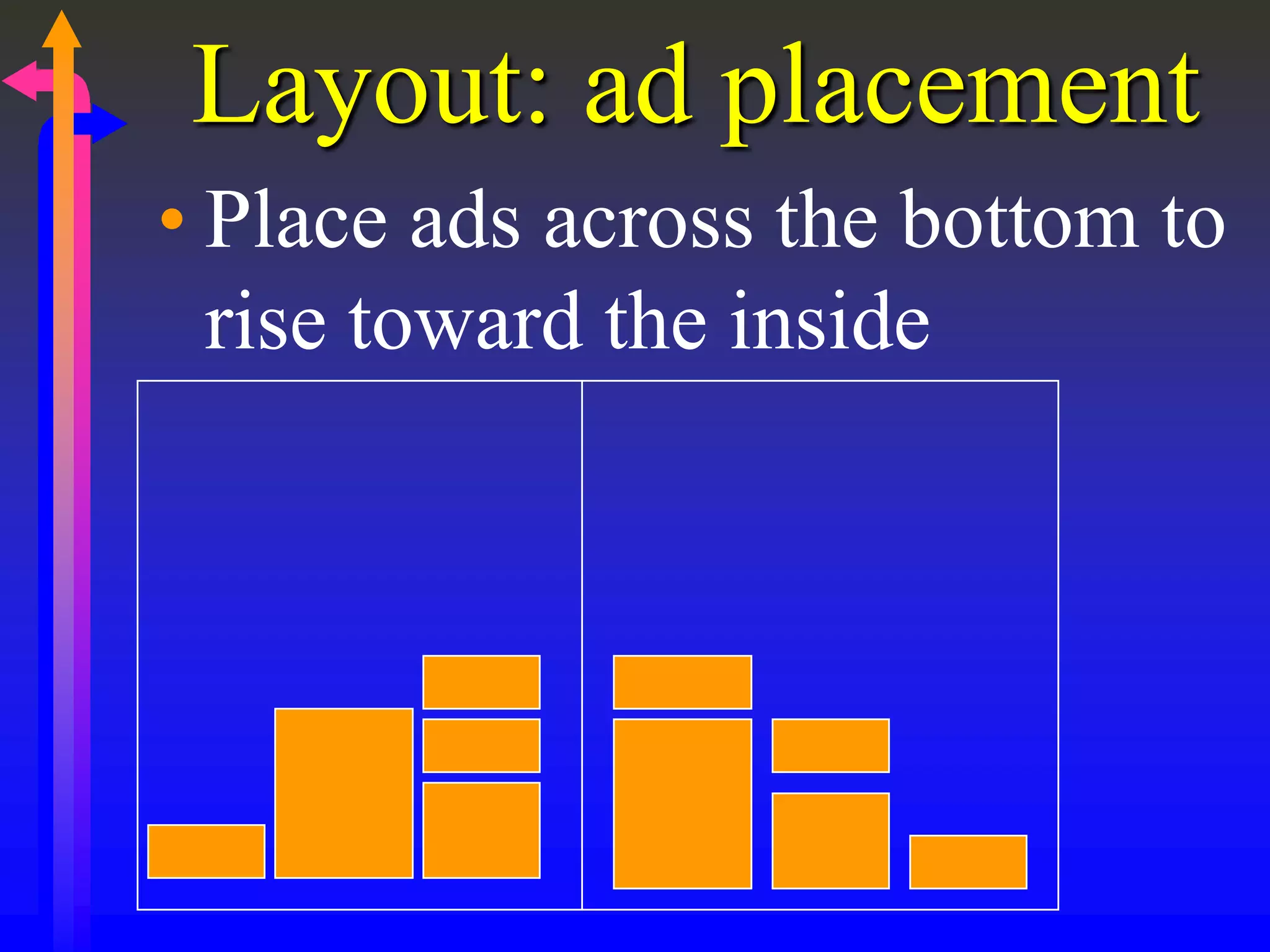
Layout: ad placement
• Place ads across the bottom to
rise toward the inside
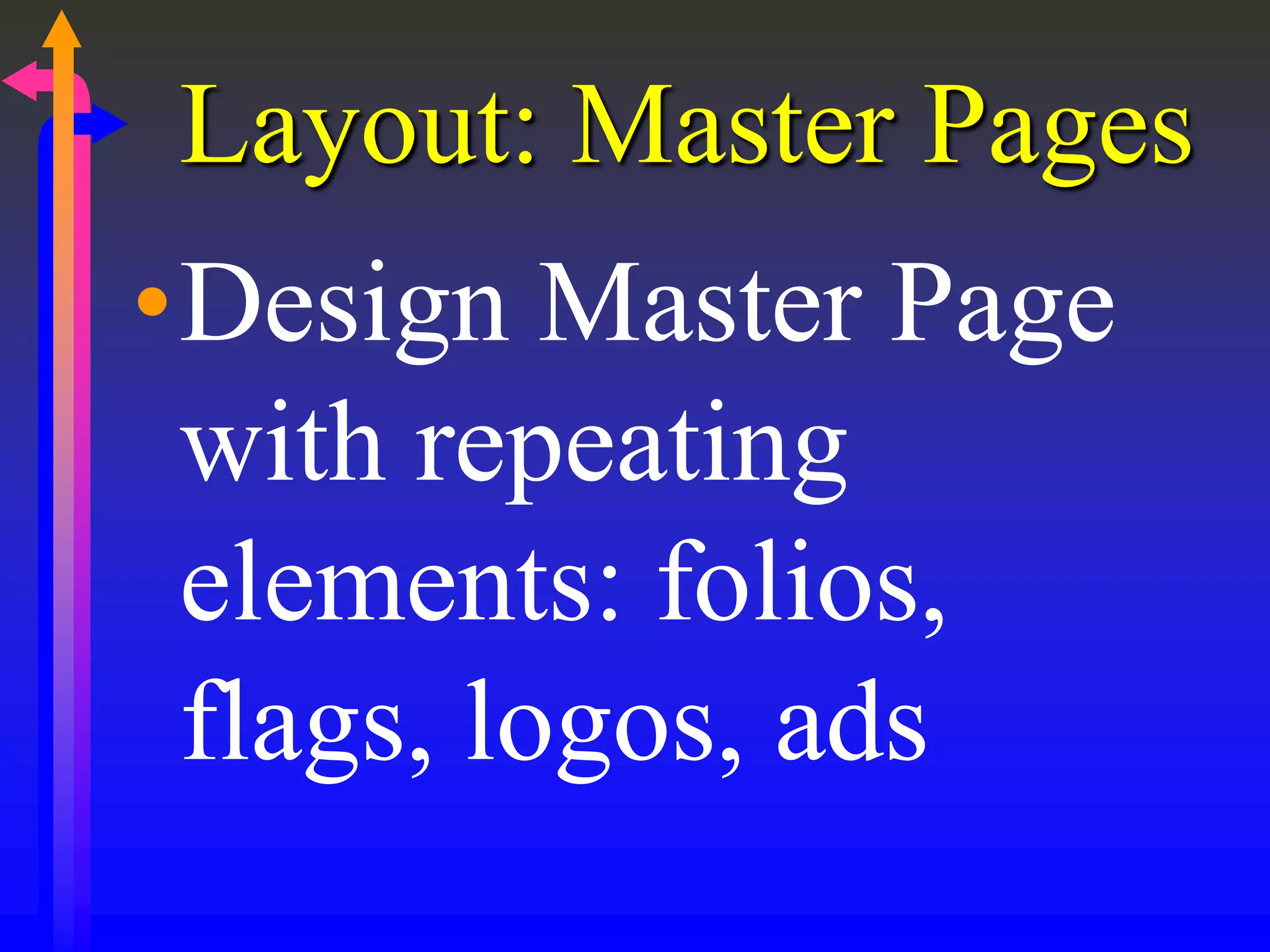
Layout: Master Pages
•Design Master Page
with repeating
elements: folios,
flags, logos, ads
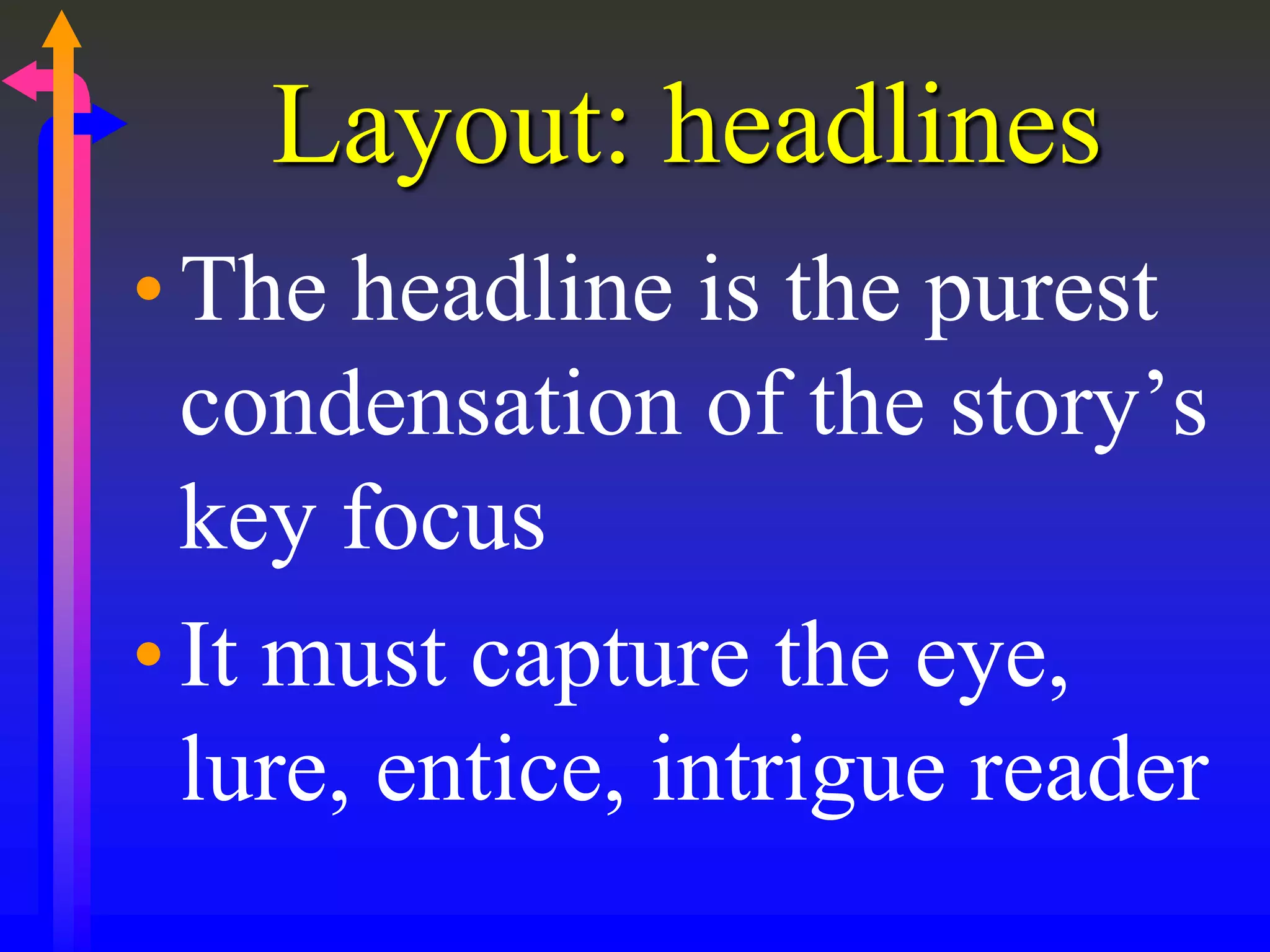
Layout: headlines
•The headline is the purest
condensation of the story’s
key focus
•It must capture the eye,
lure, entice, intrigue reader
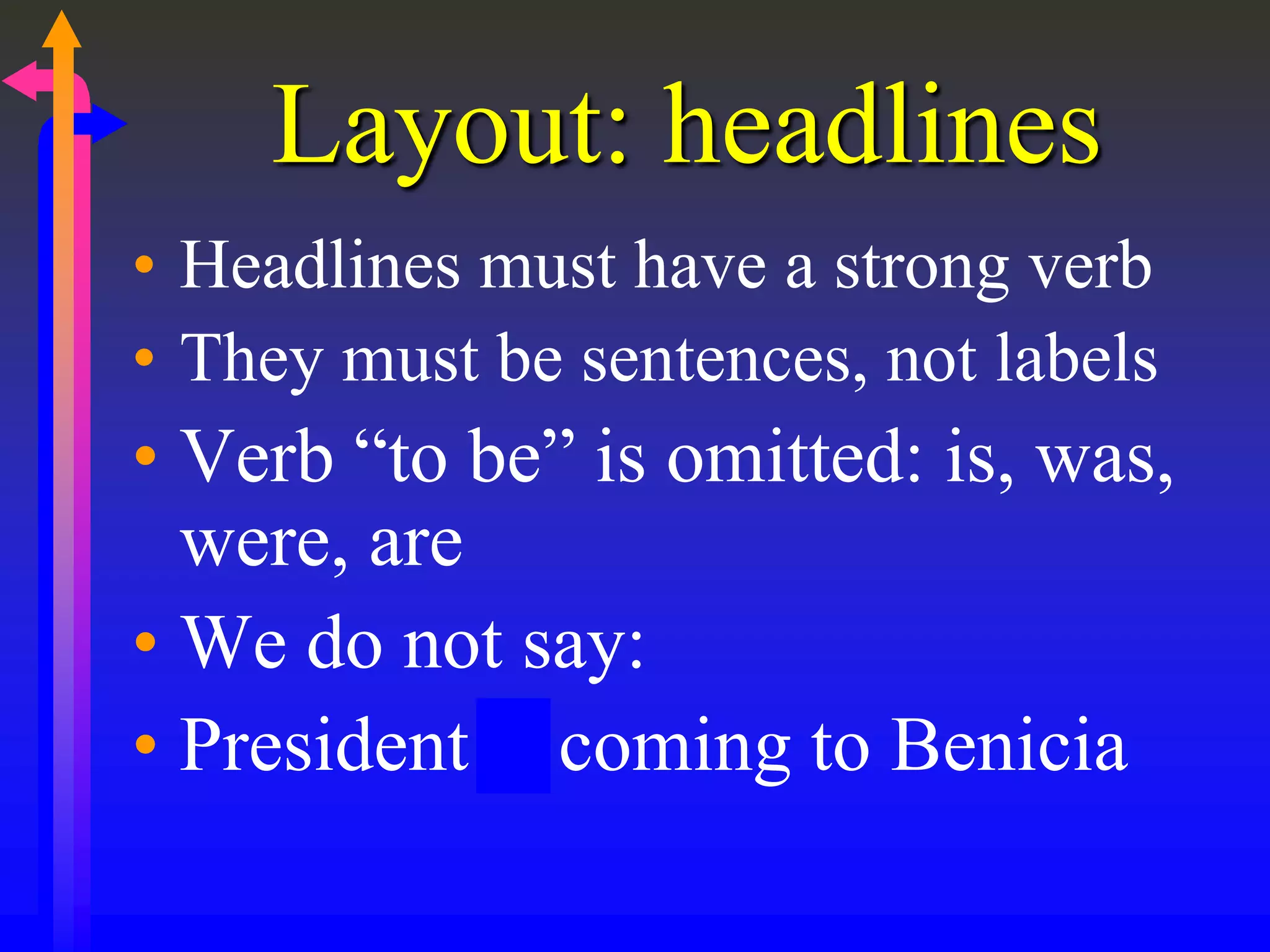
Layout: headlines
• Headlines must have a strong verb
• They must be sentences, not labels
• Verb “to be” is omitted: is, was,
were, are
• We do not say:
• President is coming to Benicia
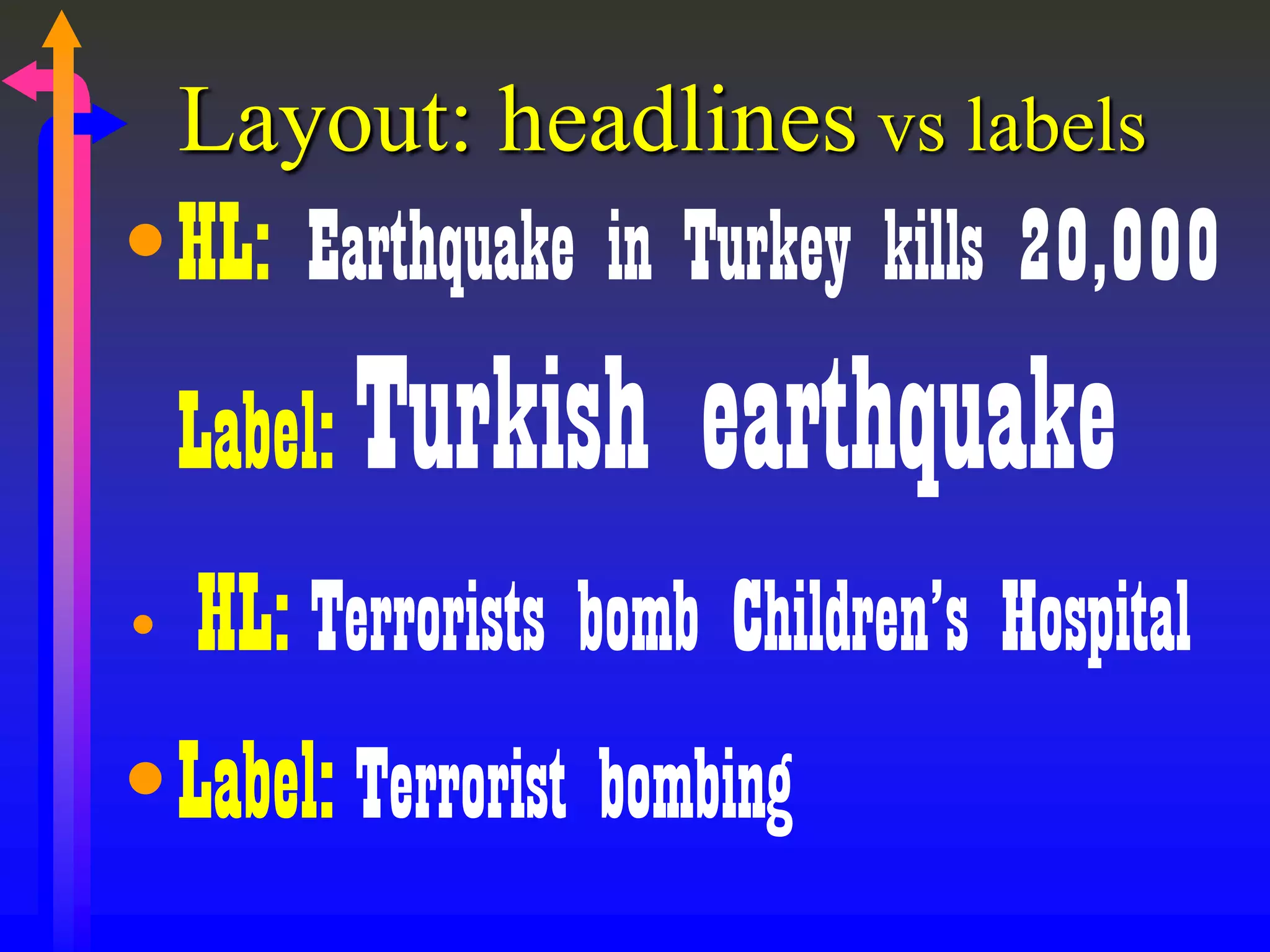
Layout: headlines vs labels
•HL: Earthquake in Turkey kills 20,000
Label: Turkish earthquake
• HL: Terrorists bomb Children’s Hospital
•Label: Terrorist bombing
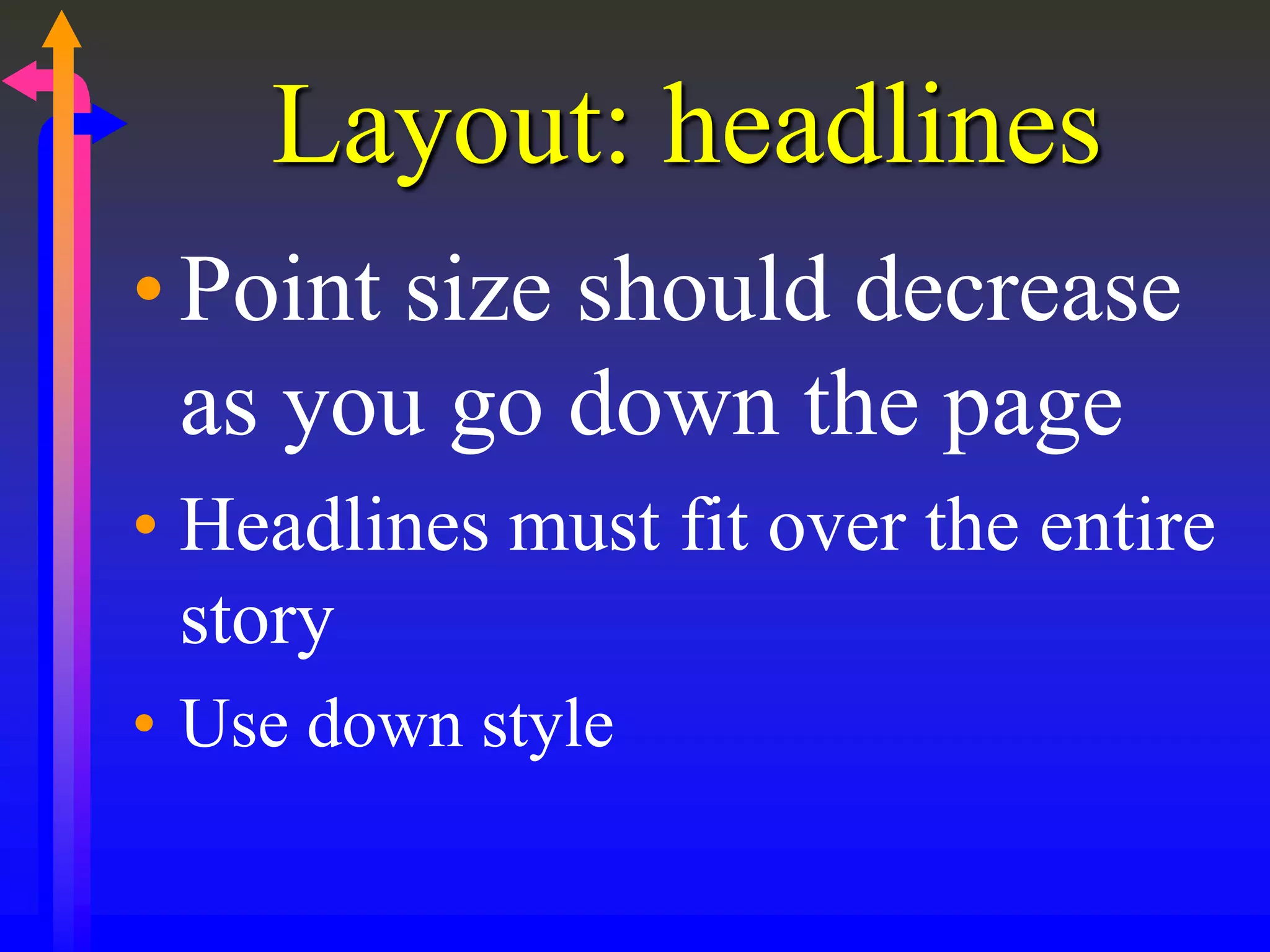
Layout: headlines
•Point size should decrease
as you go down the page
• Headlines must fit over the entire
story
• Use down style
Layout: standards
• Folio contains “Page” #, month
& year, dept name IN CAPS
• Save fancy fonts for ads
• Don’t jump more than once
• Jumps should NOT continue at
the top of the page (if possible)
Layout: photos
•Pictures must have
borders and captions
•Pictures must be light
and well defined
Layout: consider breaking up large
blocks of text with something…
Subtitles
Sidebars
Pull quotes
Bold facing
Interviews
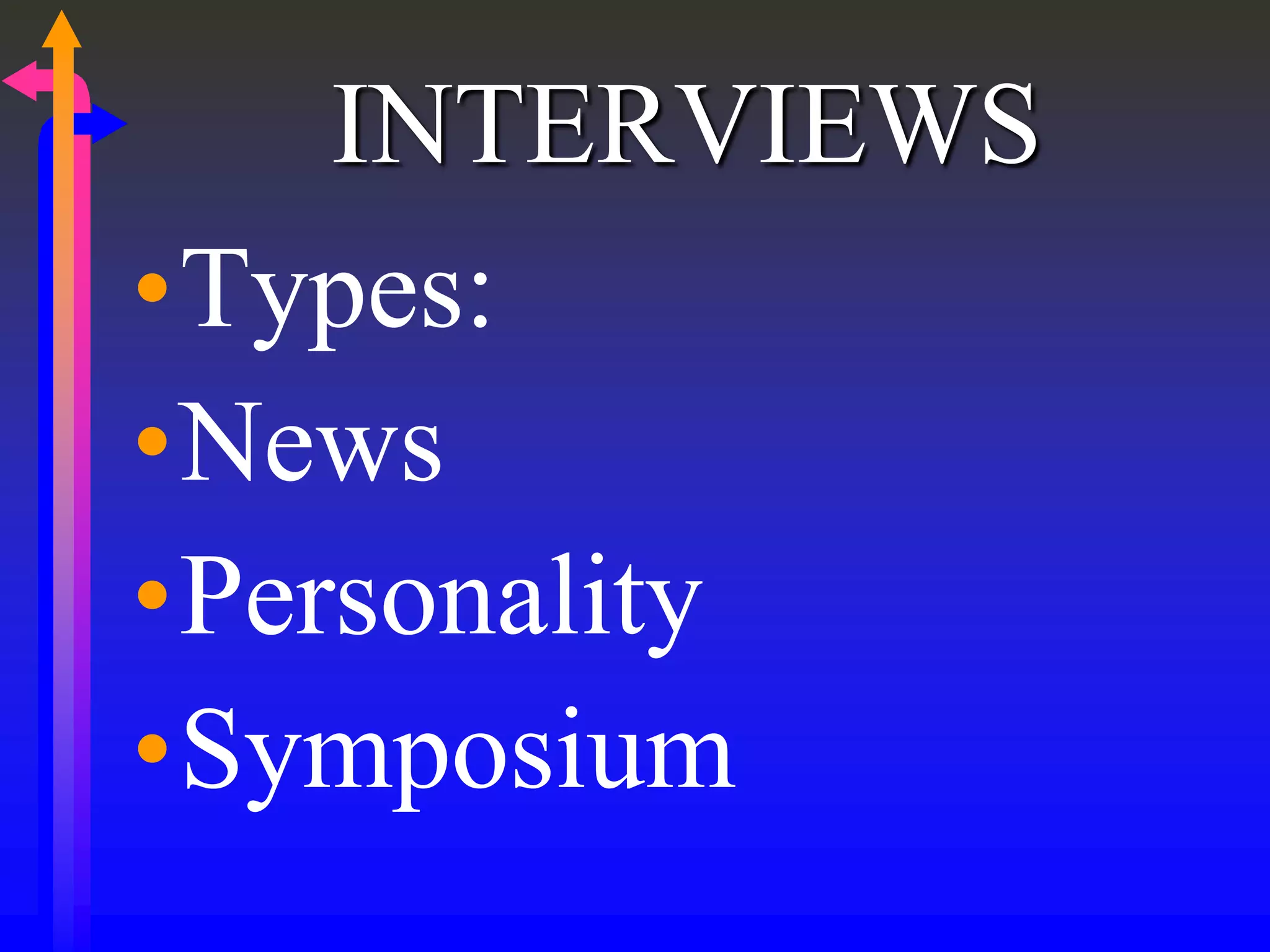
INTERVIEWS
•Types:
•News
•Personality
•Symposium
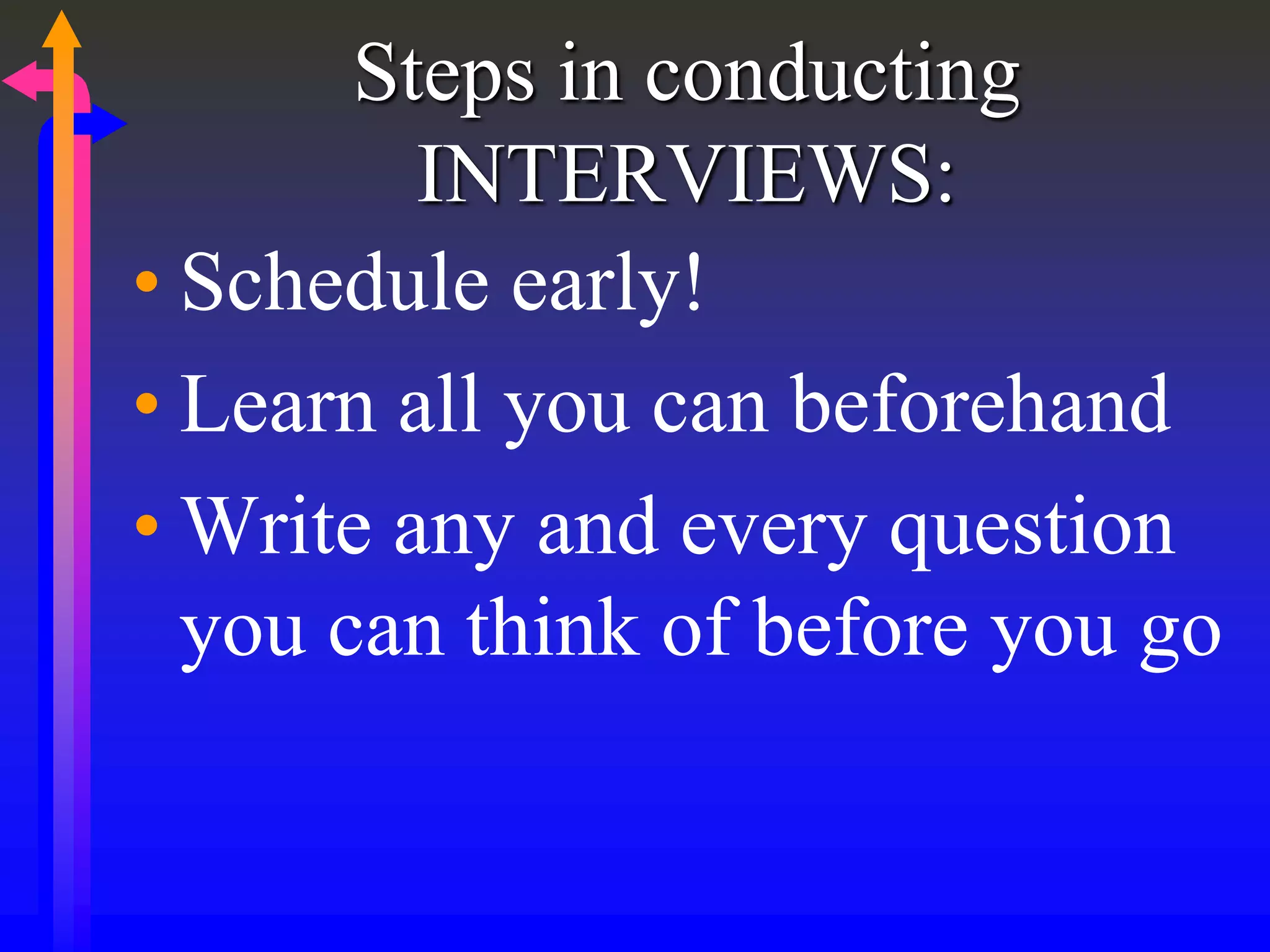
Steps in conducting
INTERVIEWS:
• Schedule early!
• Learn all you can beforehand
• Write any and every question
you can think of before you go
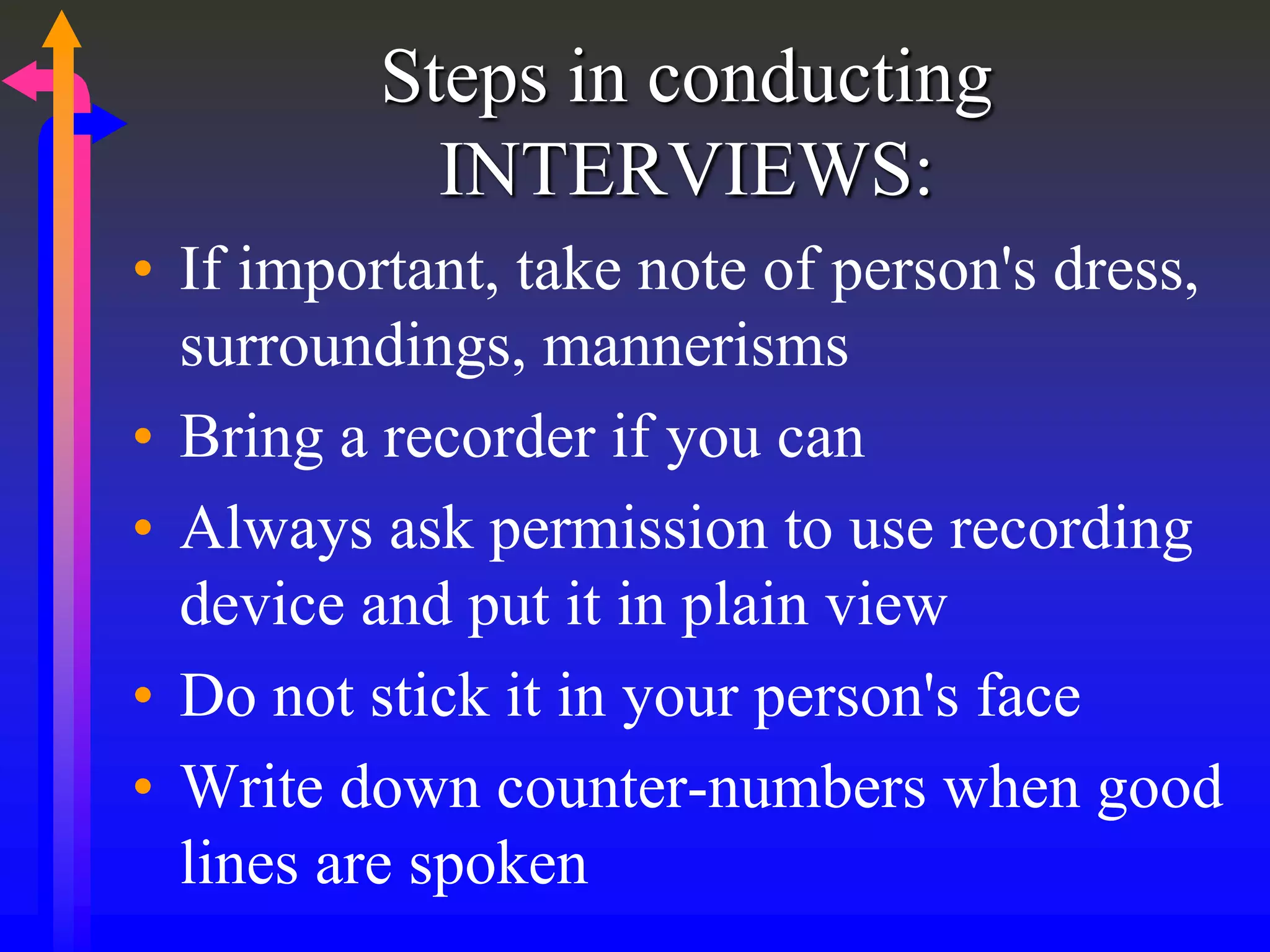
Steps in conducting
INTERVIEWS:
• If important, take note of person's dress,
surroundings, mannerisms
• Bring a recorder if you can
• Always ask permission to use recording
device and put it in plain view
• Do not stick it in your person's face
• Write down counter-numbers when good
lines are spoken
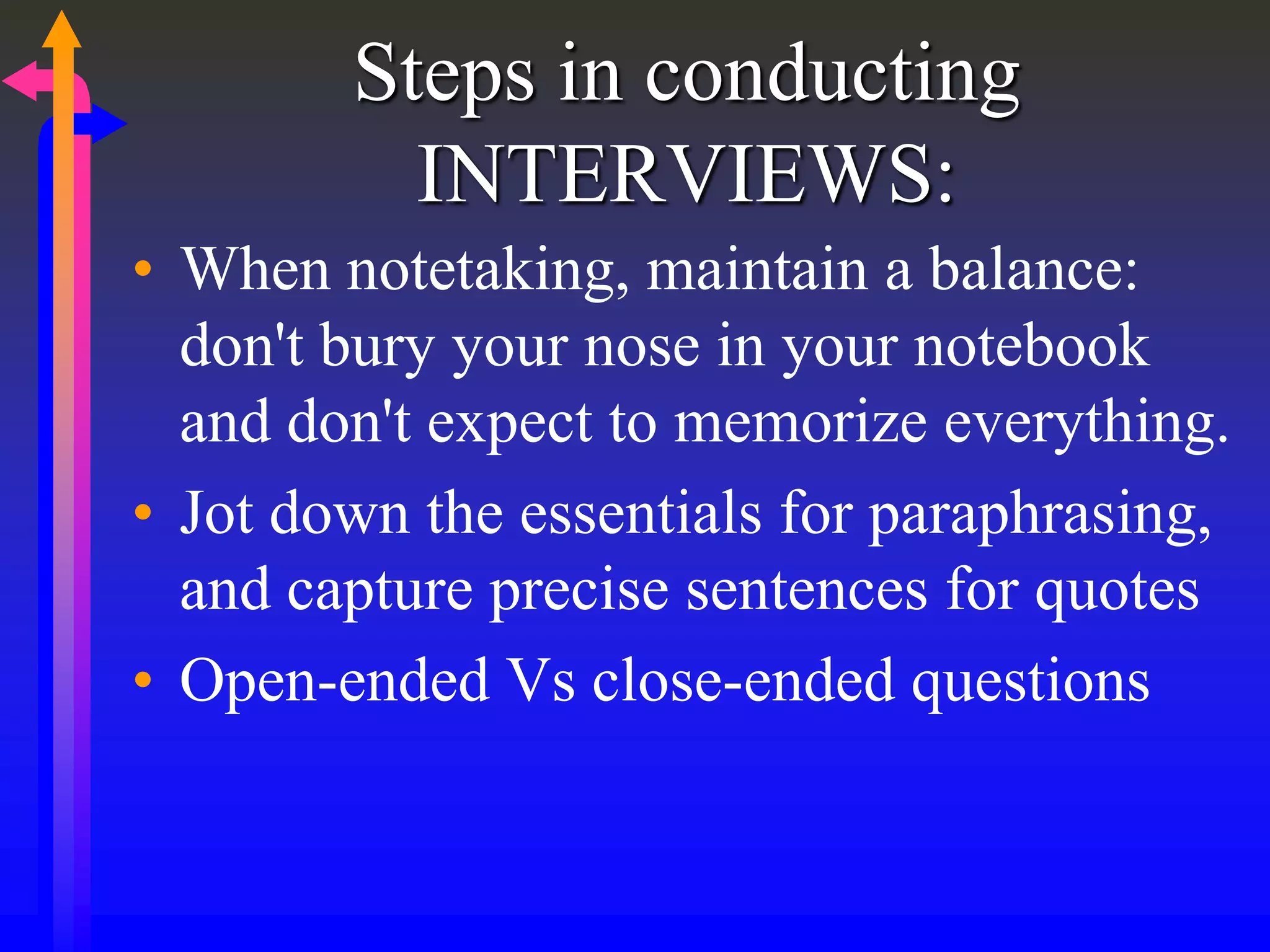
Steps in conducting
INTERVIEWS:
• When notetaking, maintain a balance:
don't bury your nose in your notebook
and don't expect to memorize everything.
• Jot down the essentials for paraphrasing,
and capture precise sentences for quotes
• Open-ended Vs close-ended questions
Steps in conducting
INTERVIEWS:
• End by asking if the person
has anything to say that you
haven't asked
• Advise that you may condense
quotes for clarity, but that you
will not change meaning
Steps in conducting
INTERVIEWS:
• Get permission to follow-up
with a phone call or a drop by
if you need any more info
• Offer to give them a proof of
the story if it's warranted
Writing the Interview:
•Avoid Q & A
•Stay out of the picture
Writing the Interview:
•Use "said" synonyms
sparingly
•Use a quote early
•Use plenty of quotes
Writing the Interview:
•Alternate between
quotes and paraphrases
•Use quotes from other
people
Features
FEATURES
• They may inform, instruct, advise, but
their primary purpose is to entertain
• They are factual, and can relate to
current news/news story
• They allow for creativity and individual
curiosity
• Written in a casual style
Types of Features:
• News feature
• Human interest
• Character sketch
• Writing the Feature:
• All the other rules of news writing apply
except the feature writer is permitted
more creativity in expression and layout
Sports
Writing Sports Stories:
• Don't editorialize, but you have more
freedom than regular news reporters.
• Support opinions with facts and
quotes
• Coach quote
• Opposing coach quote -- before/after
the game. Ask who to watch.
Sports Layout:
• Sports can have hard, soft news,
interviews, surveys, all the
elements of the entire paper
• Special Note: Triple check name
spellings and grade level
Editorials &
Personal
Opinion
Editorials & Personal Opinion
•Editorial = staff
opinion
•Personal = author’s
opinion
Editorials & Personal Opinion
•Opinions based on
fact and reason
•Opinions with some
mass appeal
Editorials & Personal Opinion
•Avoid over
generalization
•Use examples and
specific, concrete details
•Quote sources
Reviews
REVIEWS
• Goal is to introduce people to good
entertainment and protect them from
crap
• Reviews are critical analysis
• They are sort of like book essays in
English class, except the primary
question is Did you Like the Book or
Not? Why?
Steps in reviewing:
•Take notebook
•Take notes
•Get all names: actors,
characters, performers,
hosts
Film review: Analysis
• plot,
• conflict,
• setting,
• tone,
• character,
• actor,
• editing,
• cinematography,
• sound track,
• popularity,
• director,
• background
information,
• similarities to
other films,
• cost,
• genre
Steps in reviewing:
•Write review immediately
after the performance
•Support all critical analysis
with example
Steps in reviewing:
•Don't write a PLOT
SUMMARY!
•Write a CRITICAL
ANALYSIS
Steps in reviewing:
• Summarizing a story is O.K., but
it shouldn't be more than 20% of
the story…
• …and don’t give away the
ending or any other surprises
Surveys
SURVEYS
•Two kinds:
•Opinion Polls
•Questionnaire Survey
Opinion Polls:
• Ask one open-ended, controversial
or entertaining question to a
balanced variety of individuals
• Get equal males, females, 9, 10, 11,
12, from different walks of life
• toss in an occasional teacher,
administrator, janitor or parent
Opinion Polls:
• Gather twice as many responses
as you intend to publish
• Extract the best quotes and
organize them
• Check name spelling and grade
level
Questionnaire Surveys:
• Devise a topic
• Create a list of
opinion and value
questions on a
related topic
• Agree/disagree,
for/against,
most/least
important
• Format the
questionnaire so
two fit on one 8x11
paper
• Distribute across
campus in an
organized fashion
Questionnaire Surveys:
•Statistical Significance
begins at 10-percent
•Distribute enough
questionnaires to gather
15-percent
Questionnaire Surveys:
•Survey of just freshmen
would require 20-percent
of freshmen only
•Survey of teachers would
require 30-percent
Questionnaire Surveys:
• Finish early because you must
• Tabulate the results and
determine percentages
• Submit your survey results to
me
Questionnaire Surveys:
•Edit in the questions that
elicited the best
responses
•Layout the page
yourself
Questionnaire Surveys:
• Write an intro paragraph that
explains the nature and purpose
of the survey and how many
votes you tabulated. Interpret the
results. What was the overall
outcome of your findings, and
were there any surprises
Style
Every newspaper sets a style
for consistency of design
and word use
• In many ways it simply
follows traditional
grammatical, mechanical rules
Titles of apposition
• Short titles go before a name
in caps: Principal Bob Jones
• Long titles go after a name, in
low case: Mike Bowers,
director of personnel relations
Capitalize
the
following:
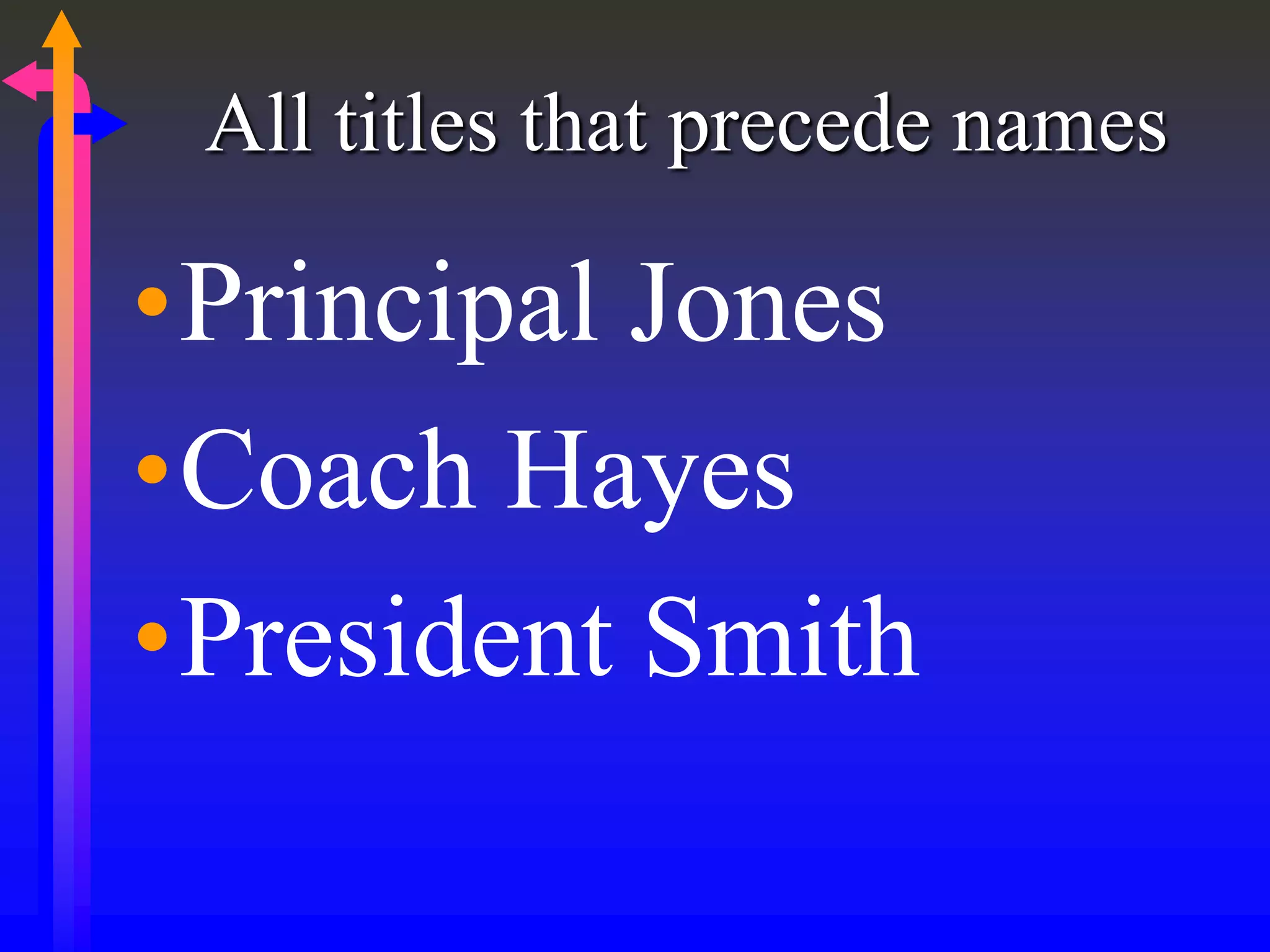
All titles that precede names
•Principal Jones
•Coach Hayes
•President Smith
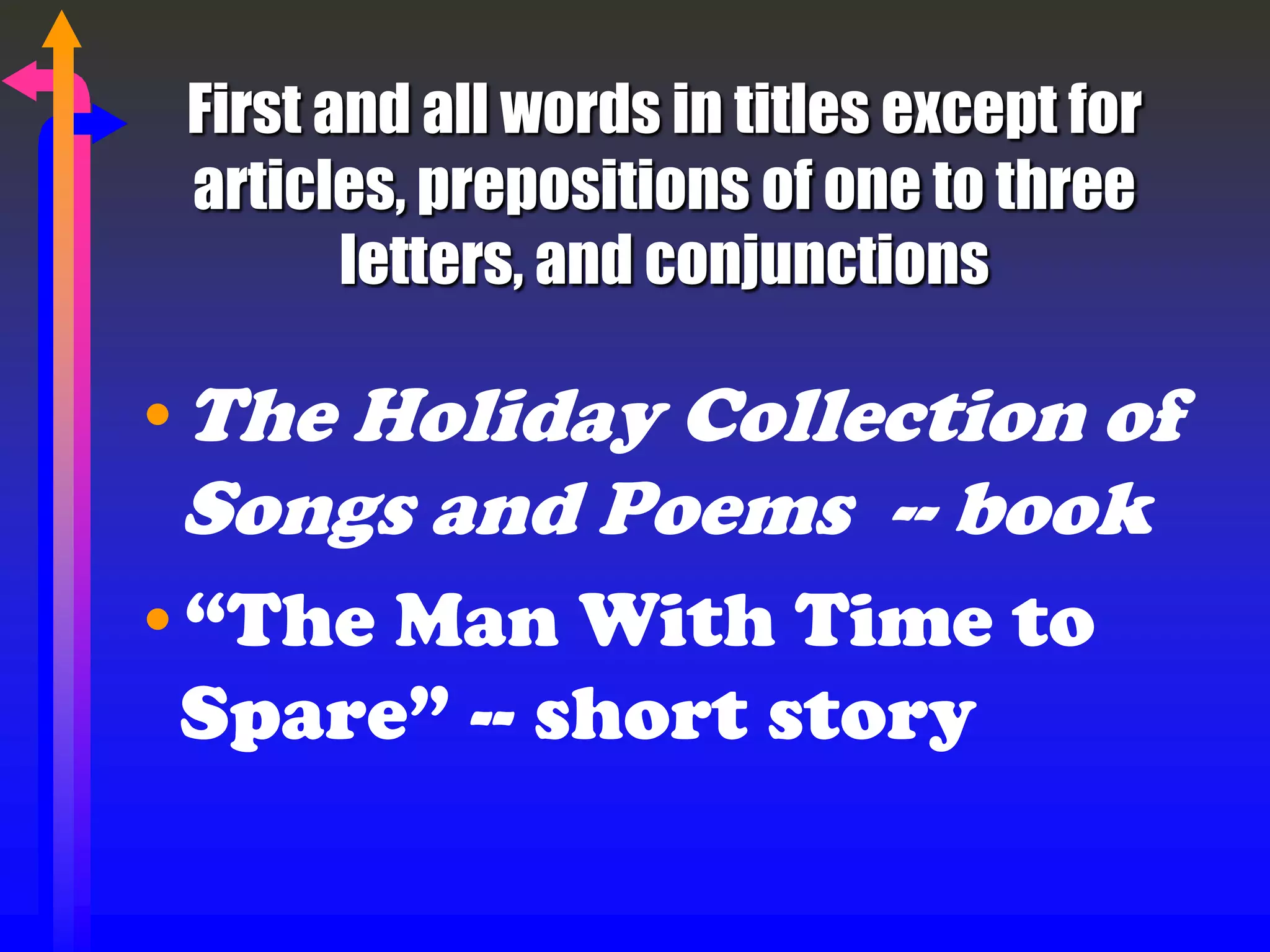
First and all words in titles except for
articles, prepositions of one to three
letters, and conjunctions
•The Holiday Collection of
Songs and Poems -- book
•“The Man With Time to
Spare” -- short story
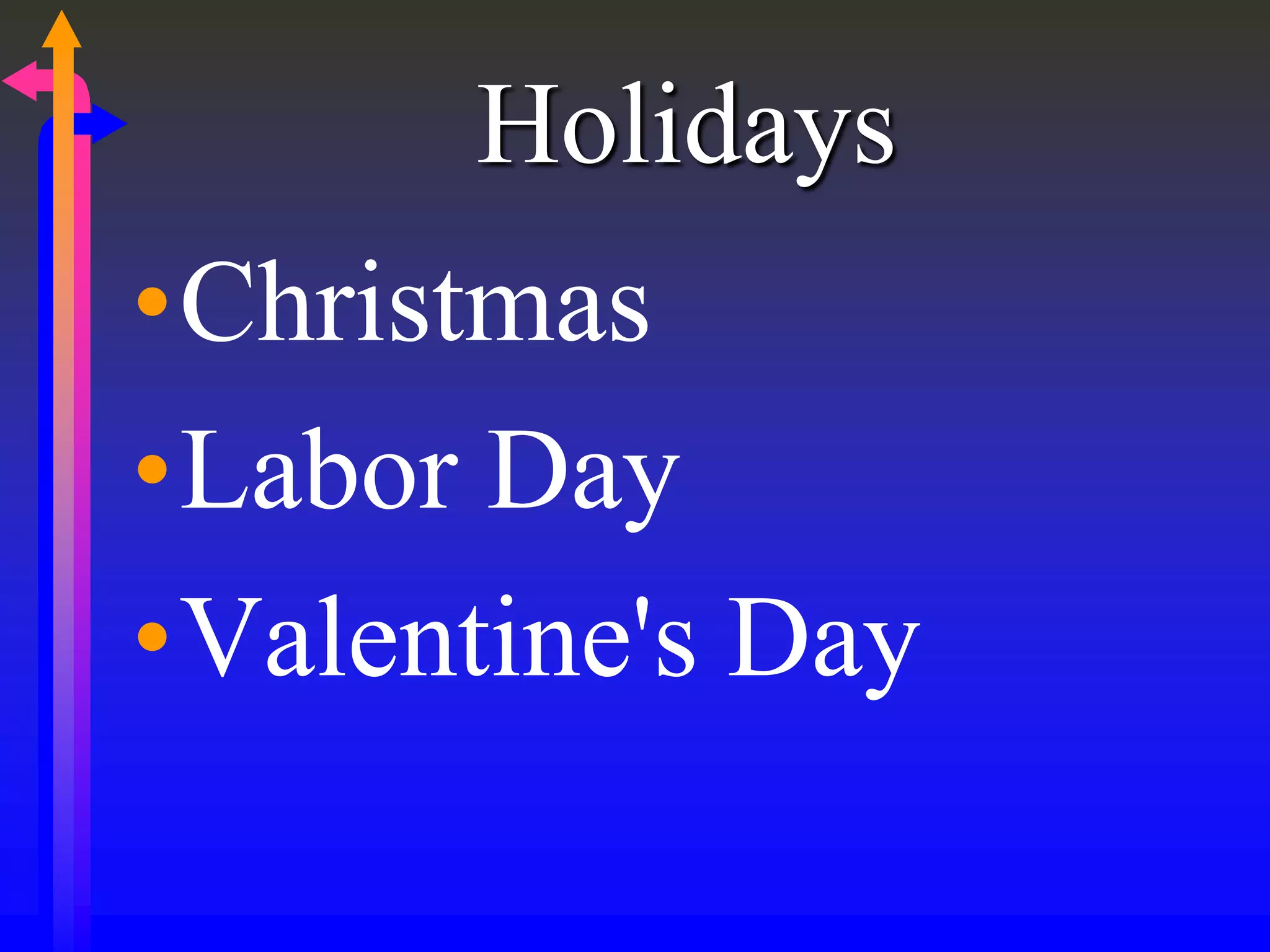
Holidays
•Christmas
•Labor Day
•Valentine's Day
Special Events
•Homecoming
•Homecoming Game
•Prom
Sections of the Country but
not directions
•She lived in the South
•She moved south for the
winter
College Degrees
when abbreviated
•M.A.
•Ph.D.
•B.S.
Clubs
•Backpacking Club
•Chess Club
•Computer Club
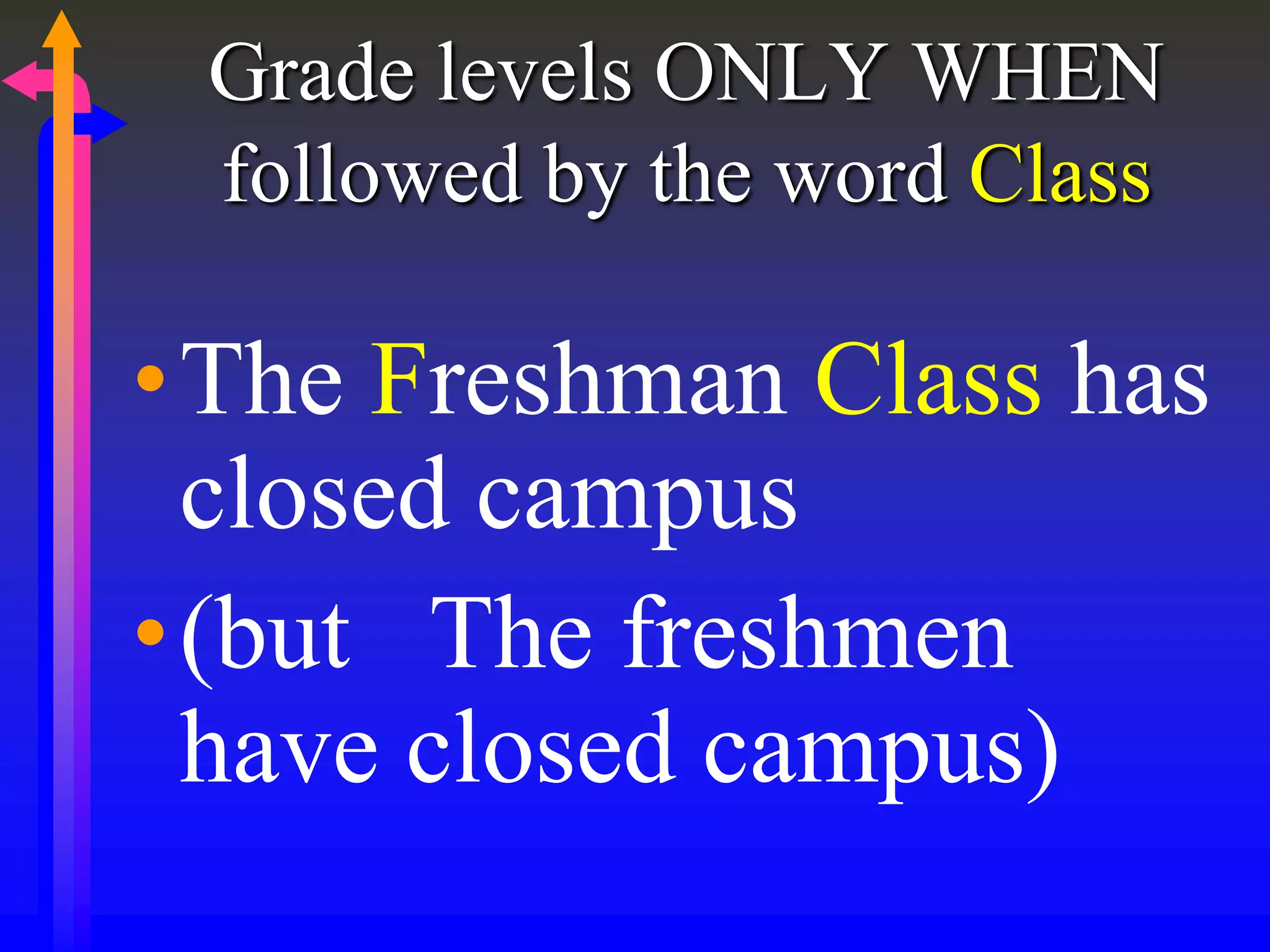
Grade levels ONLY WHEN
followed by the word Class
•The Freshman Class has
closed campus
•(but The freshmen
have closed campus)
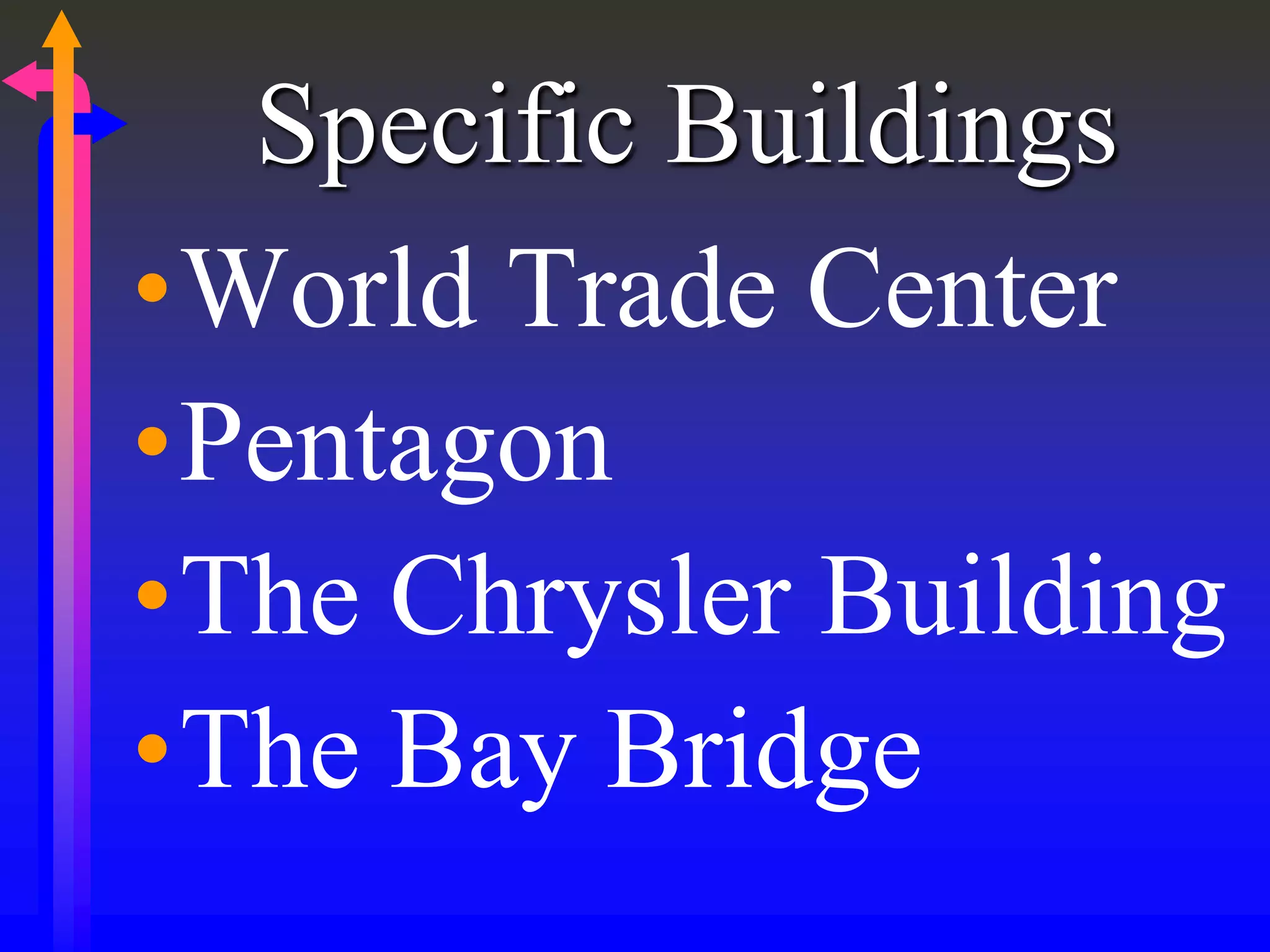
Specific Buildings
•World Trade Center
•Pentagon
•The Chrysler Building
•The Bay Bridge
Departments
•English Department
•Math Department
•Science Department
Schools
(not simply middle school or high school)
• Benicia High School competed in
the games against Benicia Middle
School
• The high school competed in the
games against the middle school.
• Mary Farmar Robert Semple
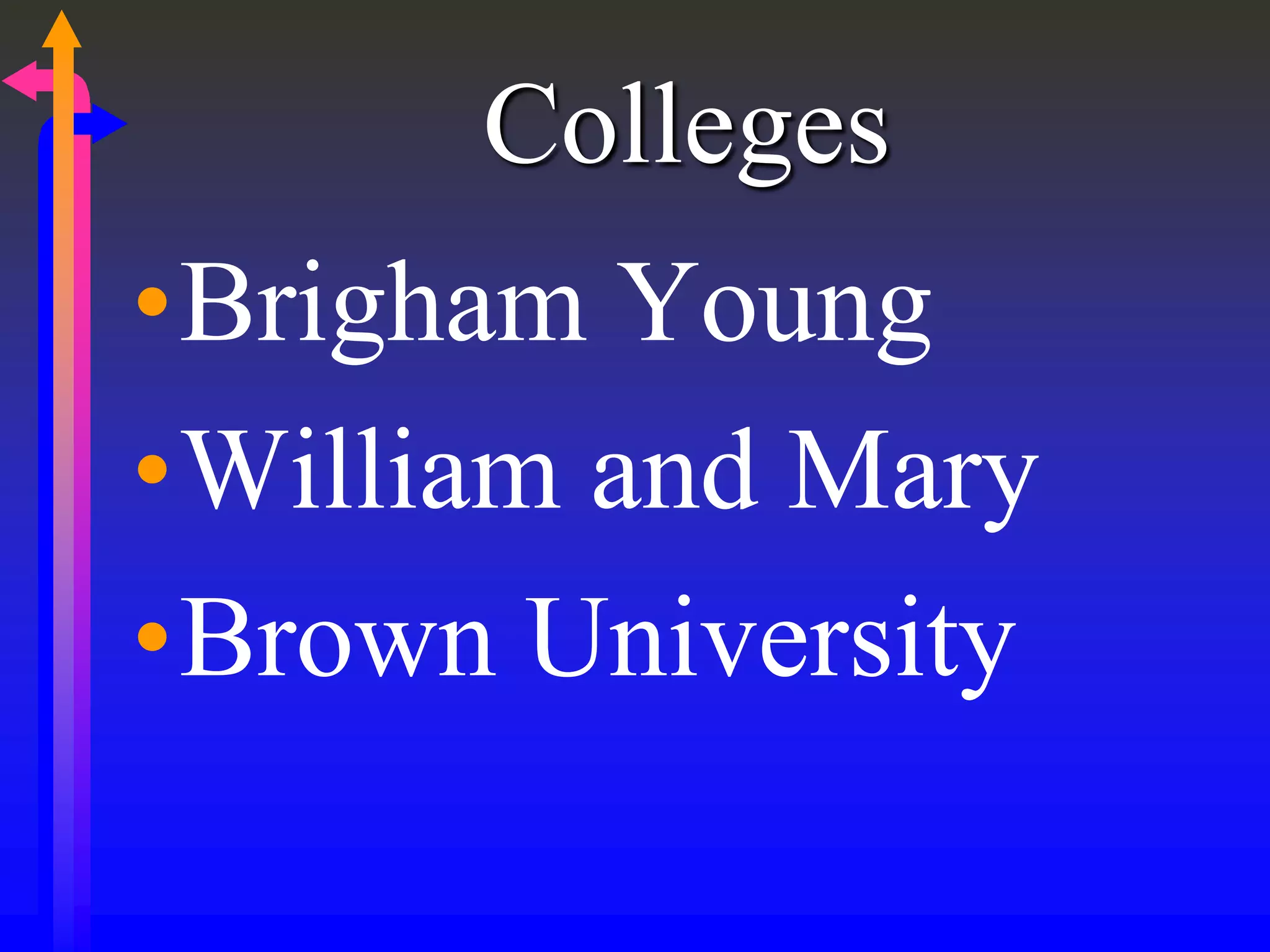
Colleges
•Brigham Young
•William and Mary
•Brown University
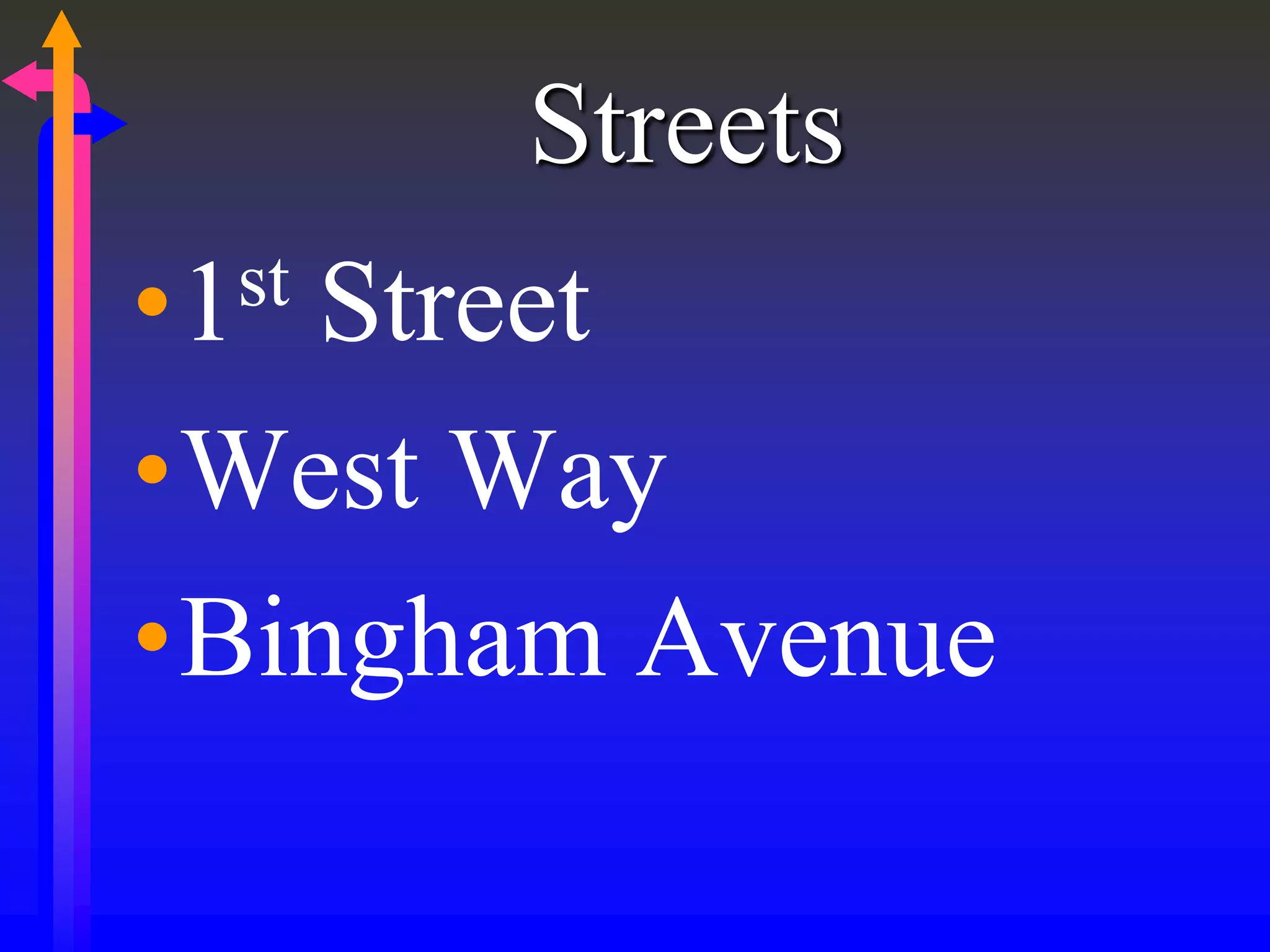
Streets
•1st Street
•West Way
•Bingham Avenue
Geographical names
•Hudson River
•Mt. Shasta
•The Osarks
Names of specific courses
(usually followed by number or letter)
•American History I (but
American history)
•History 101 (but history)
•Math B ( but math)
Languages
•French
•Spanish
•English
Words or abrev. Like
• No. Fig. Chart Chapter when
followed by a number
• No. 7
• Chart 16
• Chapter 1
• Fig. 32
DO NOT
CAPITALIZE:
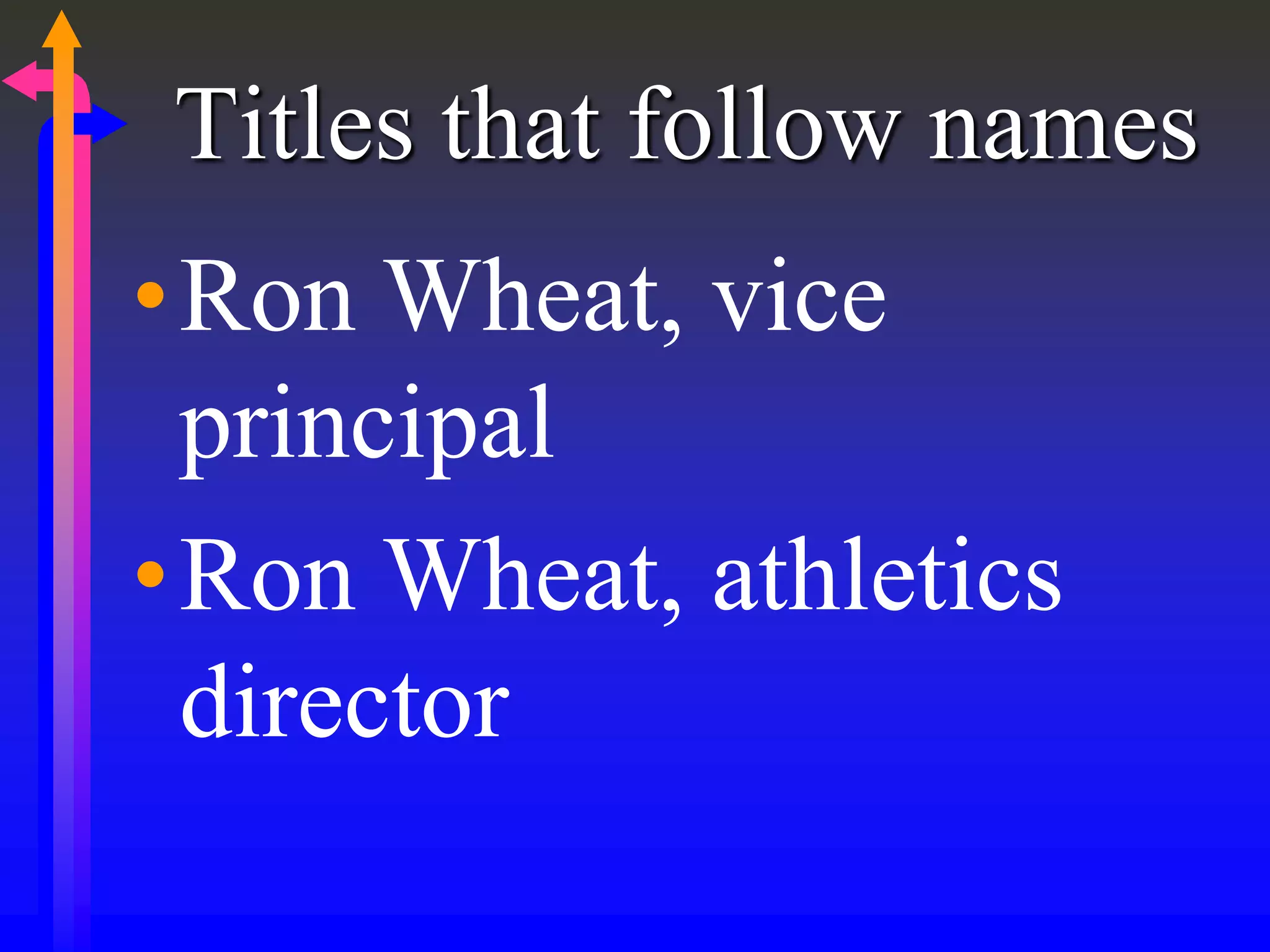
Titles that follow names
•Ron Wheat, vice
principal
•Ron Wheat, athletics
director
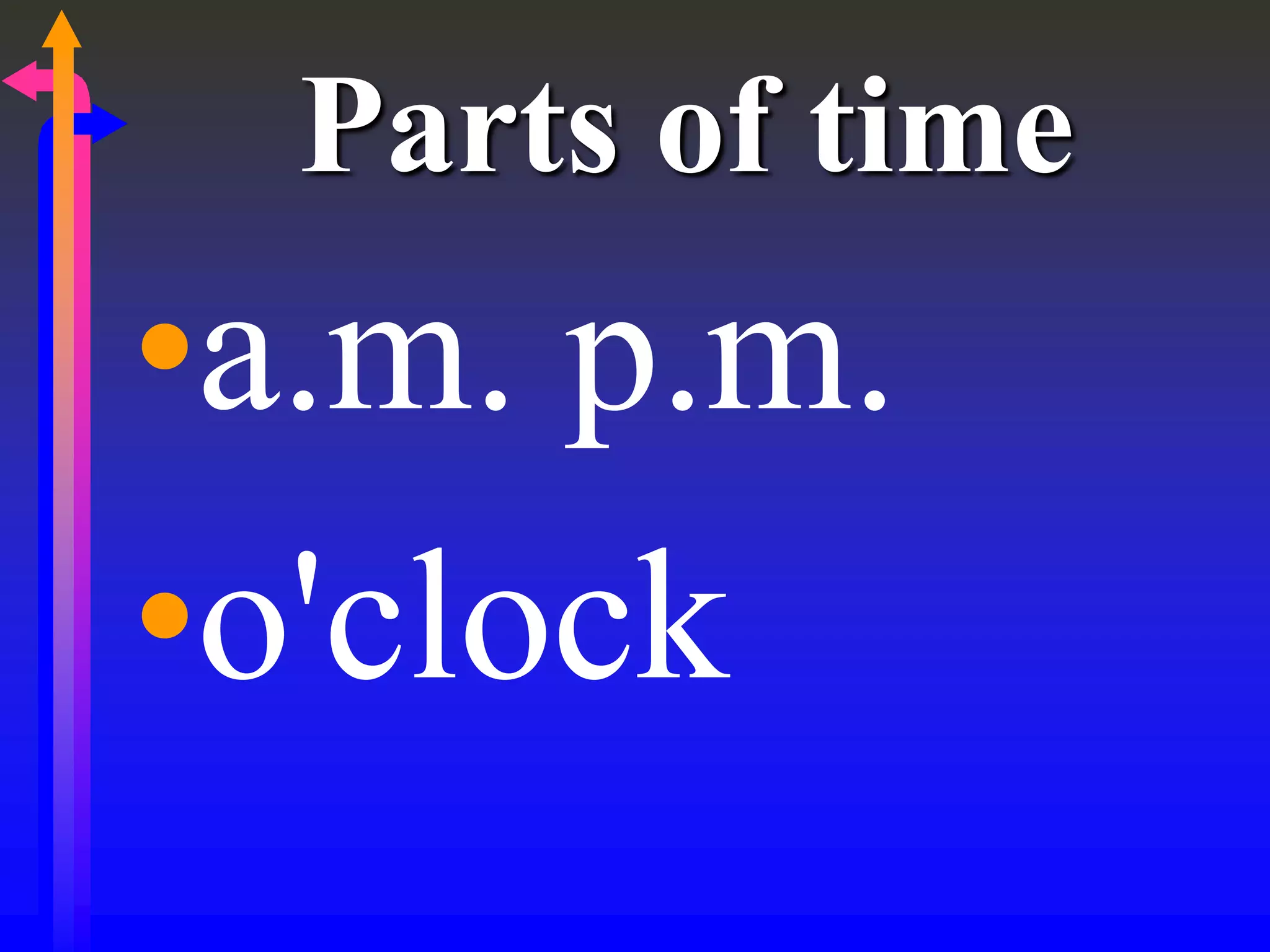
Parts of time
•a.m. p.m.
•o'clock
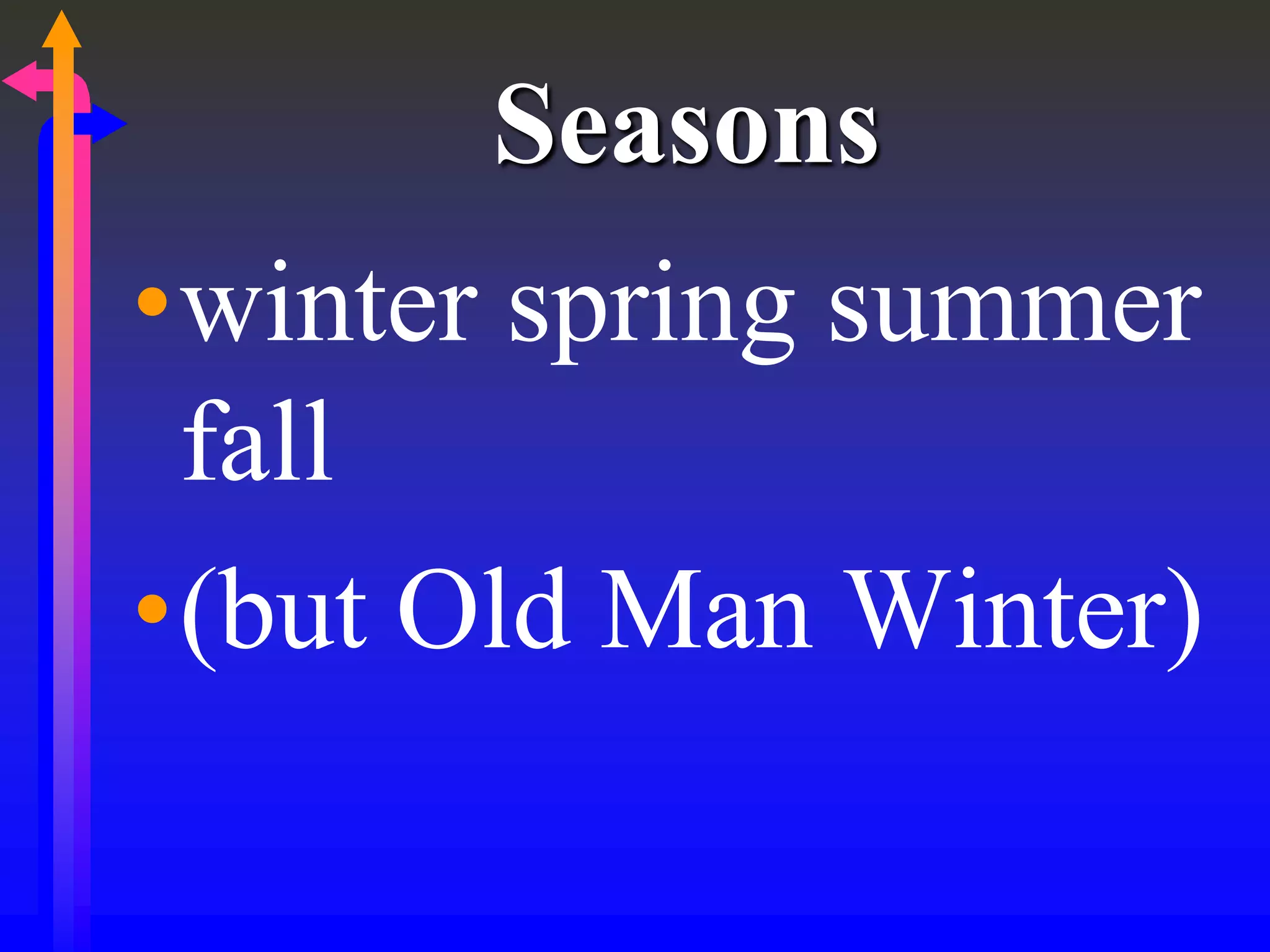
Seasons
•winter spring summer
fall
•(but Old Man Winter)
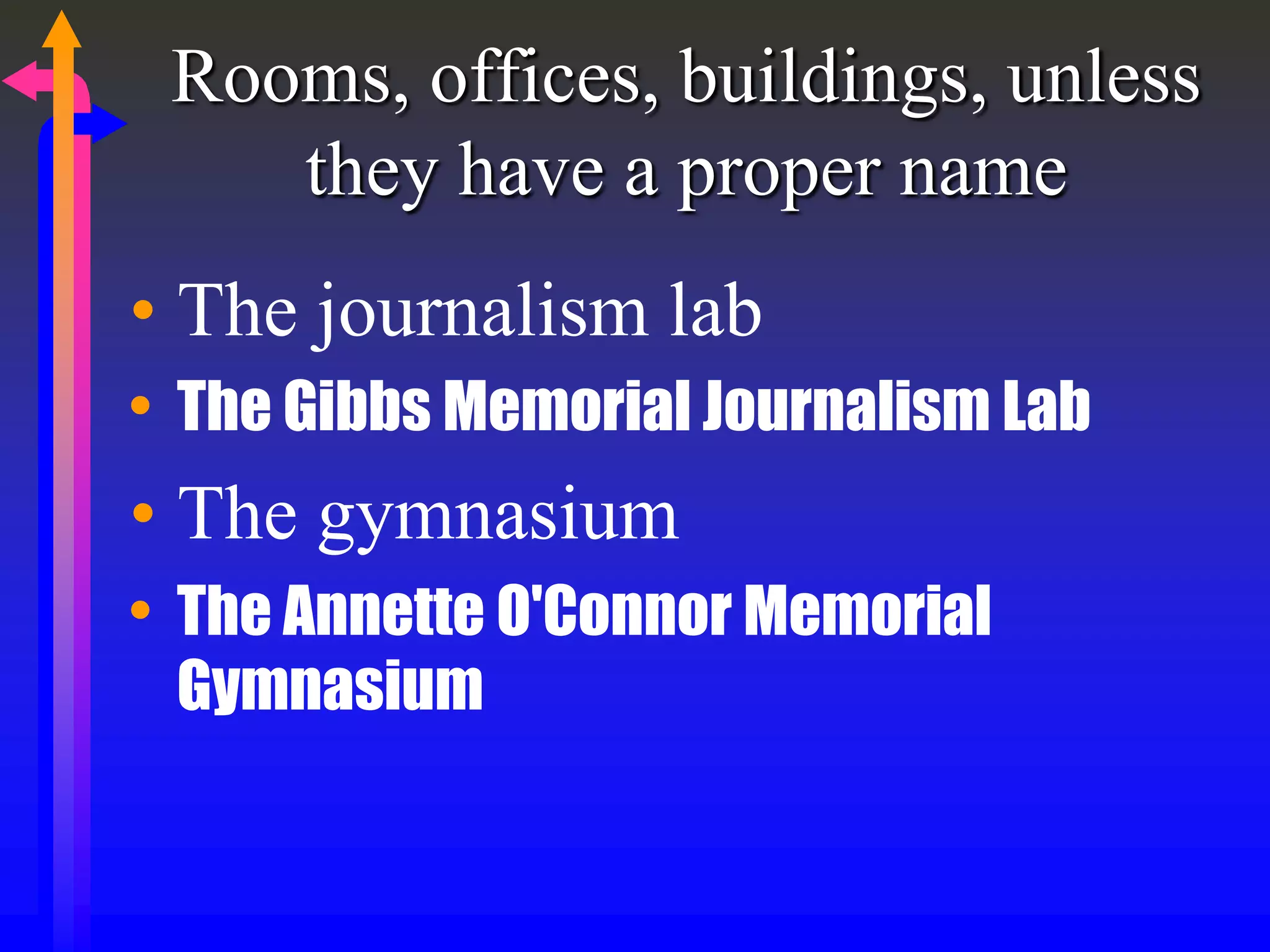
Rooms, offices, buildings, unless
they have a proper name
• The journalism lab
• The Gibbs Memorial Journalism Lab
• The gymnasium
• The Annette O'Connor Memorial
Gymnasium
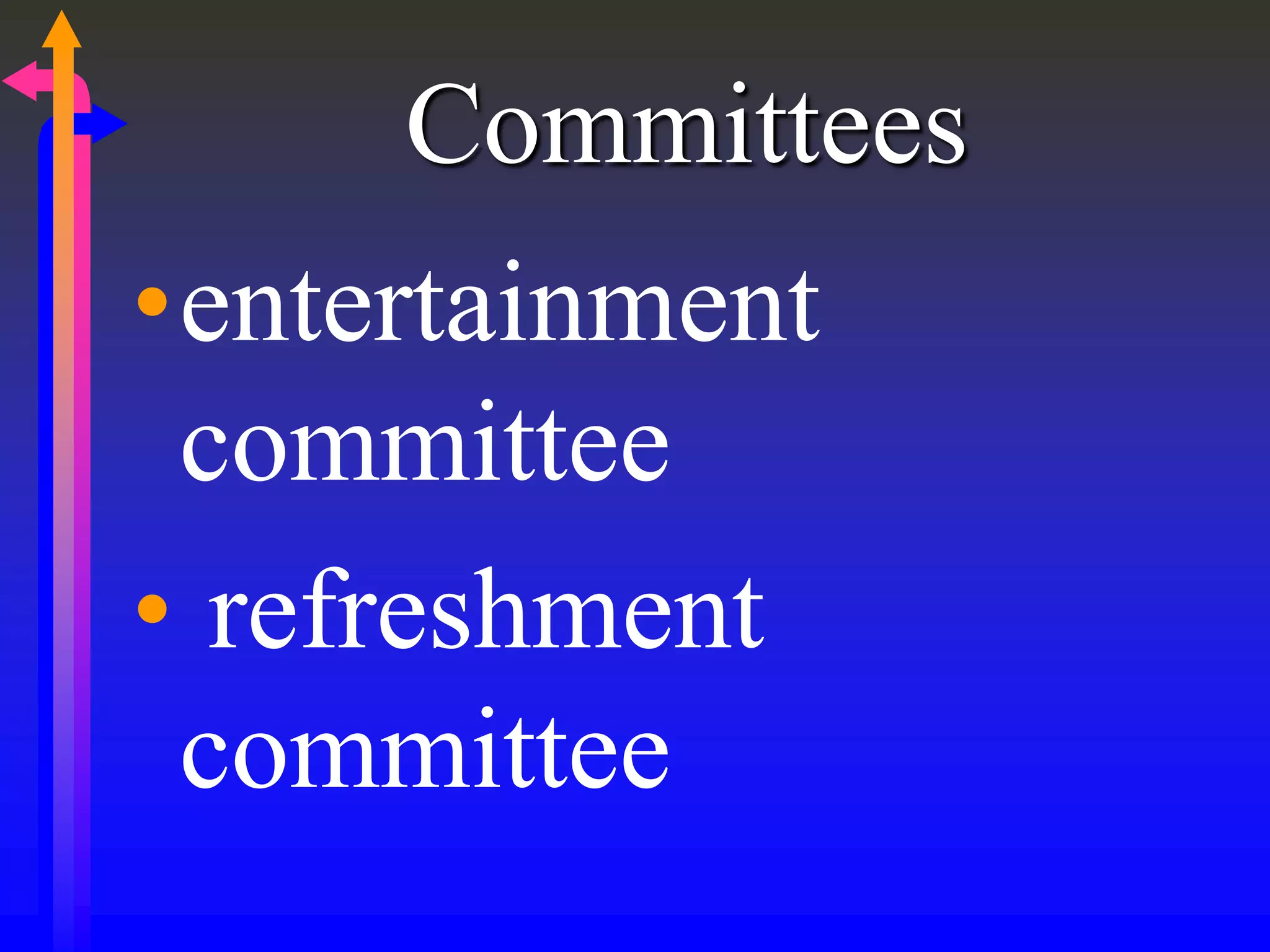
Committees
•entertainment
committee
• refreshment
committee
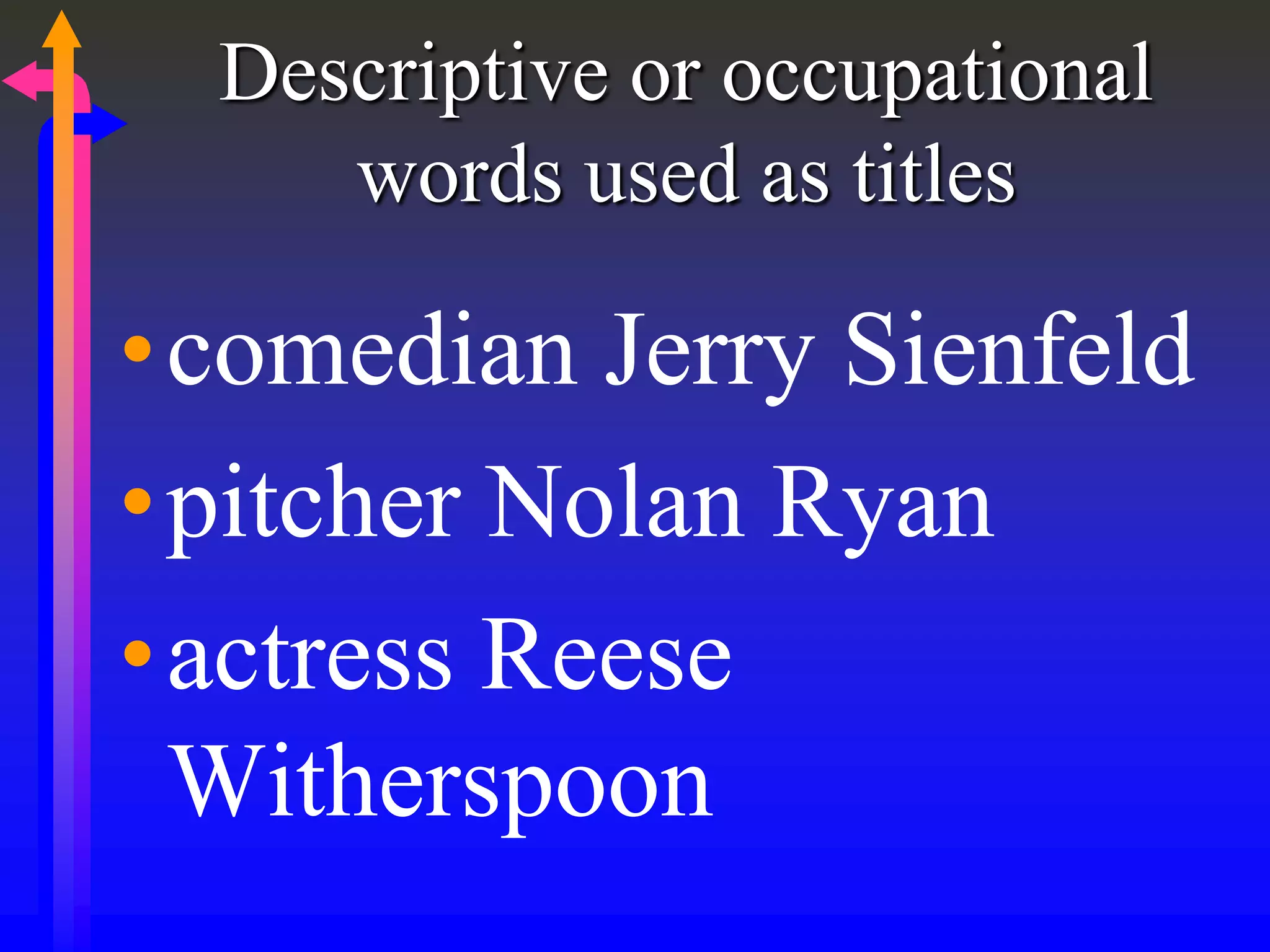
Descriptive or occupational
words used as titles
•comedian Jerry Sienfeld
•pitcher Nolan Ryan
•actress Reese
Witherspoon
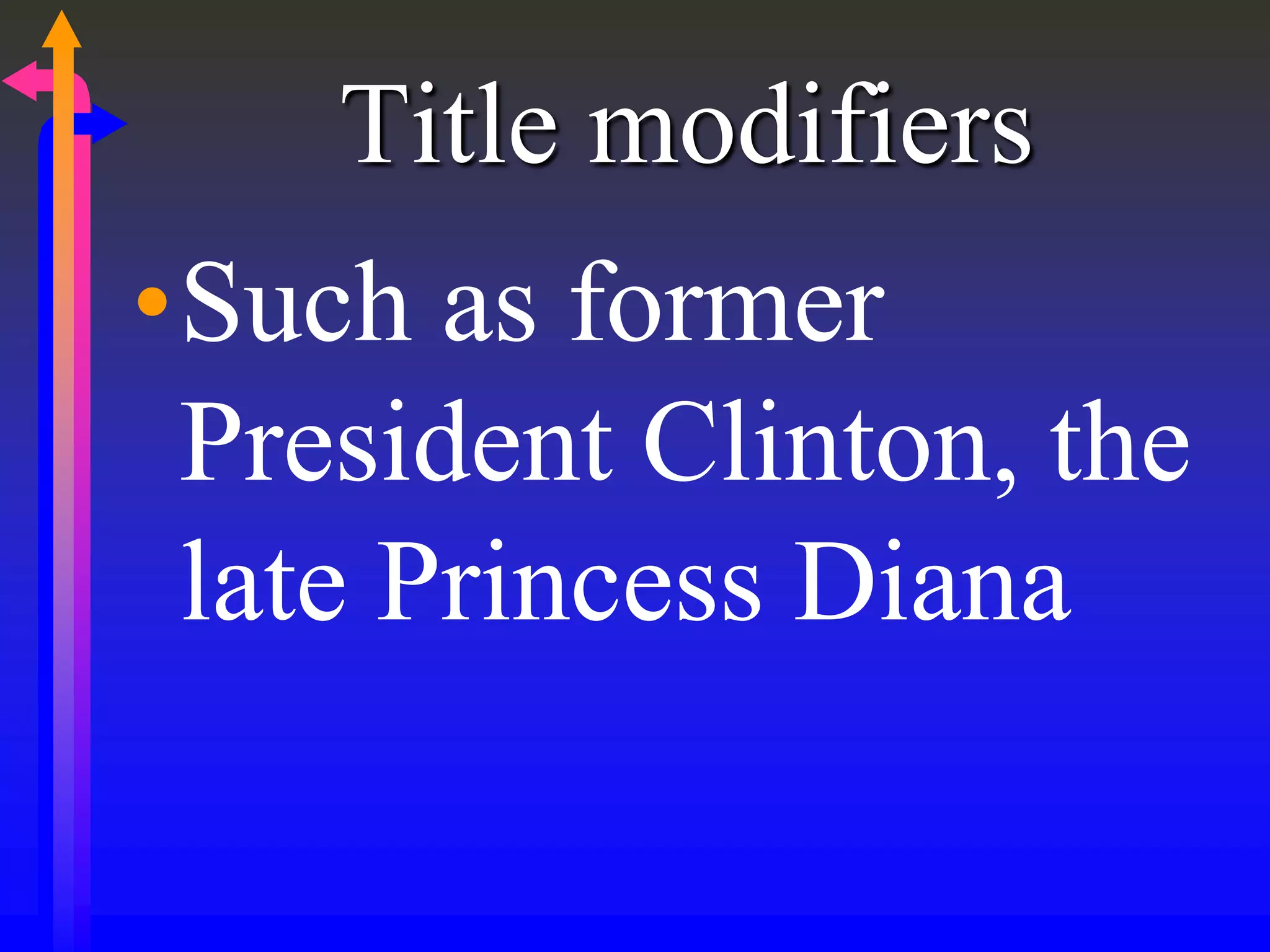
Title modifiers
•Such as former
President Clinton, the
late Princess Diana
College degrees when
spelled out
•master of arts degree
•bachelor of science
ABBREVATIONS
•Avoid all but standard
abbreviations
Abbreviate
the
Following:
Names that are well known as
abbreviations
• YMCA, PTA, FBI, BHS, NASA
•(remove the periods and
write it as a word)
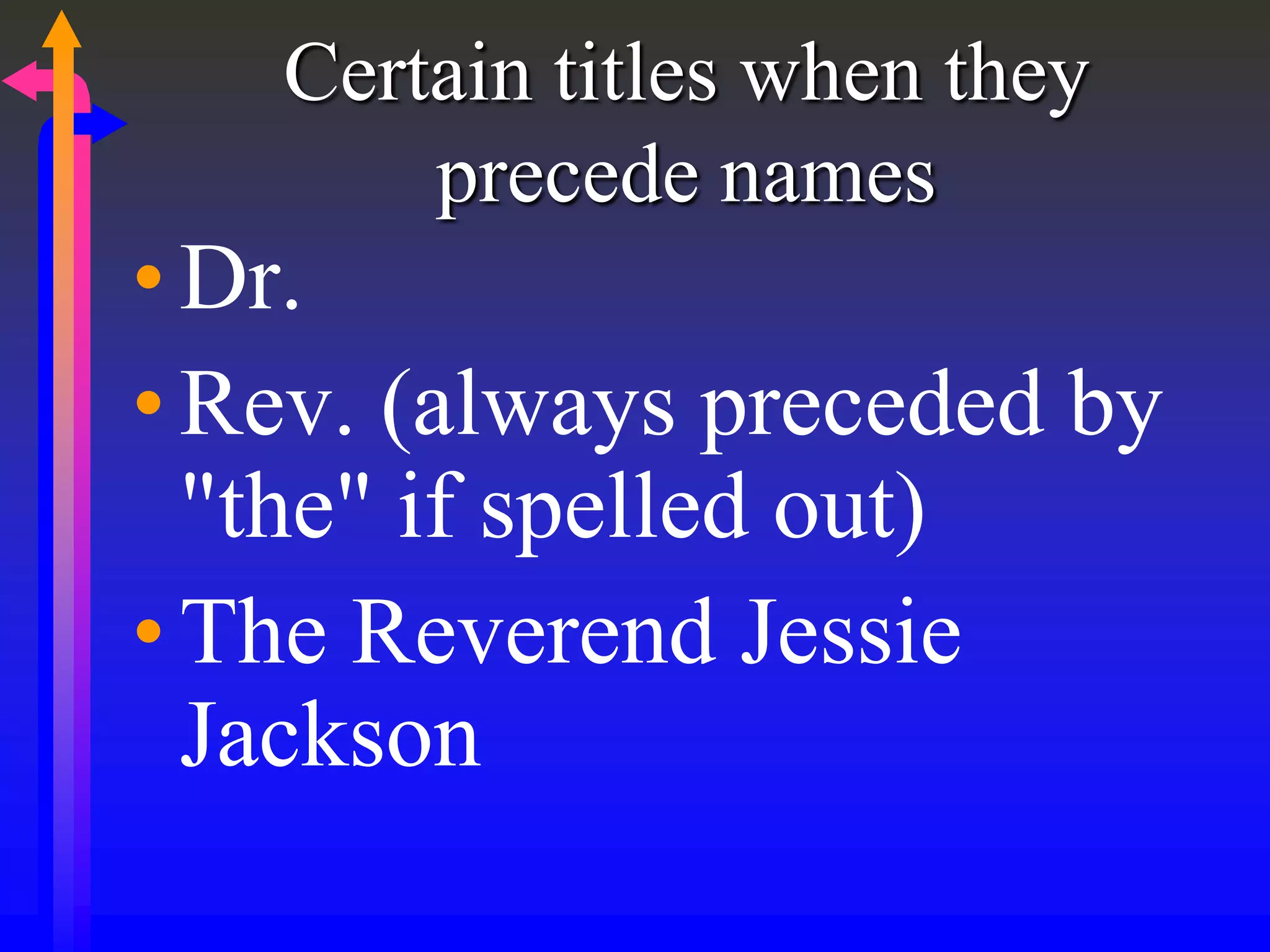
Certain titles when they
precede names
•Dr.
•Rev. (always preceded by
"the" if spelled out)
•The Reverend Jessie
Jackson
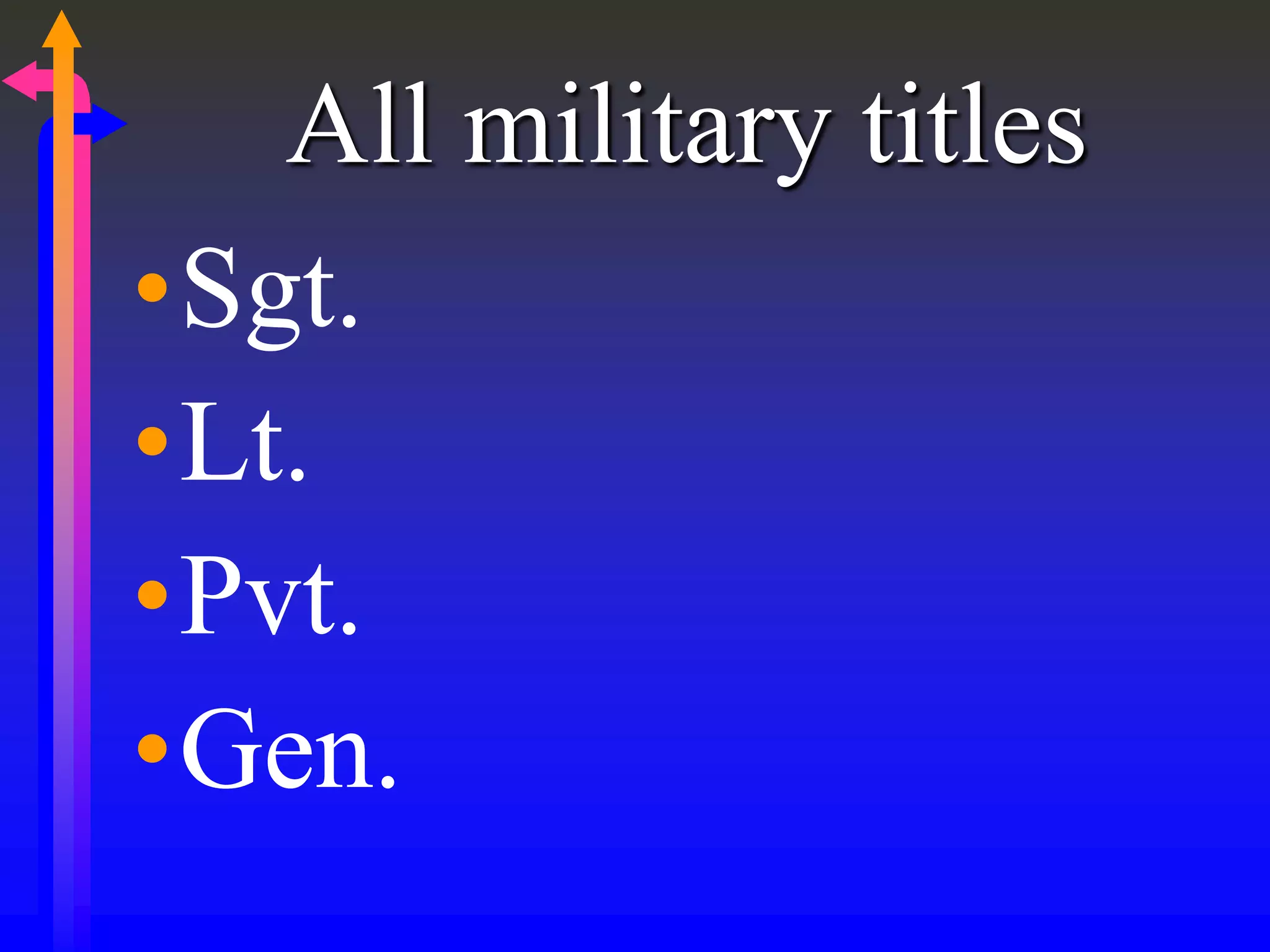
All military titles
•Sgt.
•Lt.
•Pvt.
•Gen.
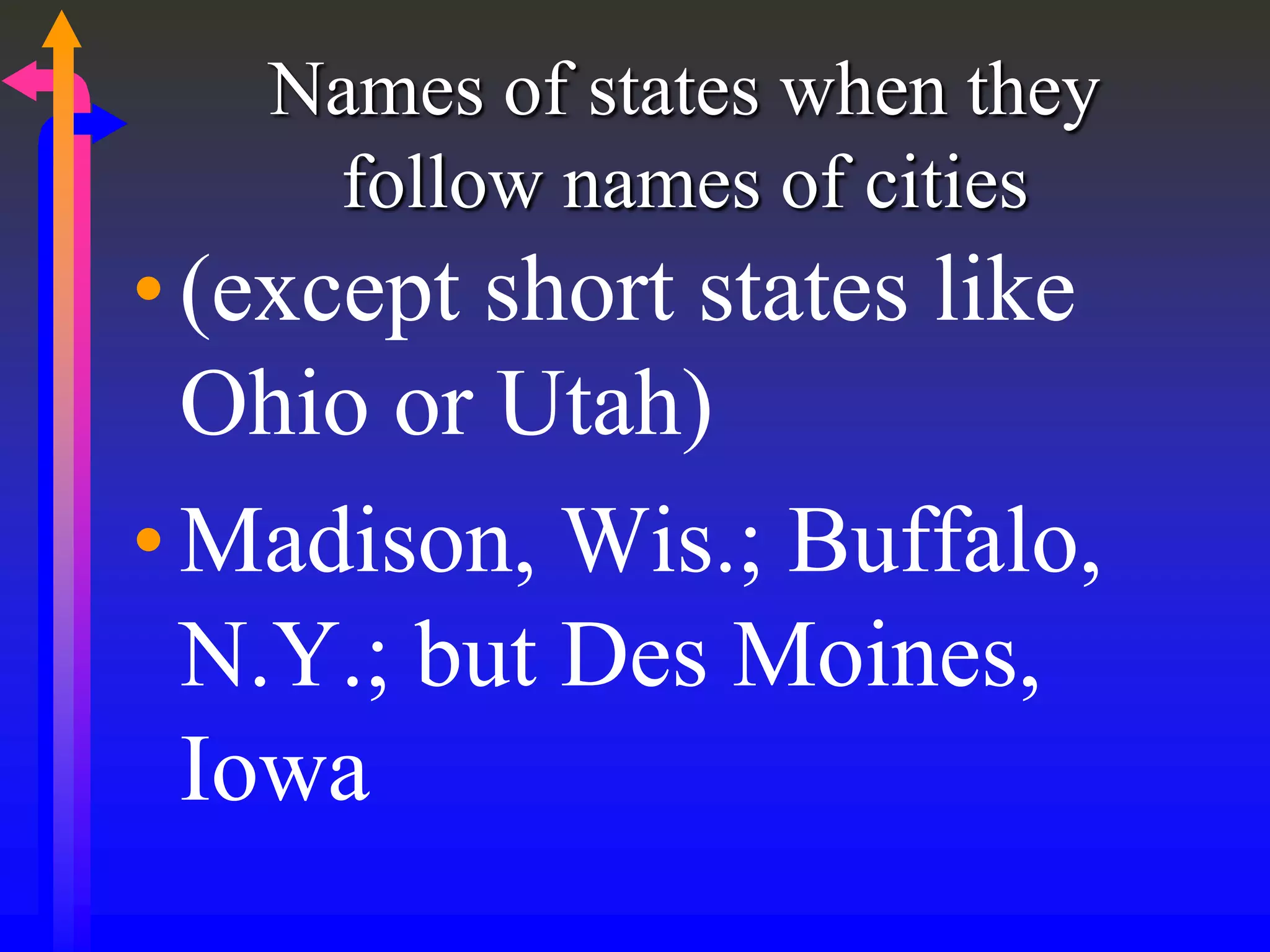
Names of states when they
follow names of cities
•(except short states like
Ohio or Utah)
•Madison, Wis.; Buffalo,
N.Y.; but Des Moines,
Iowa
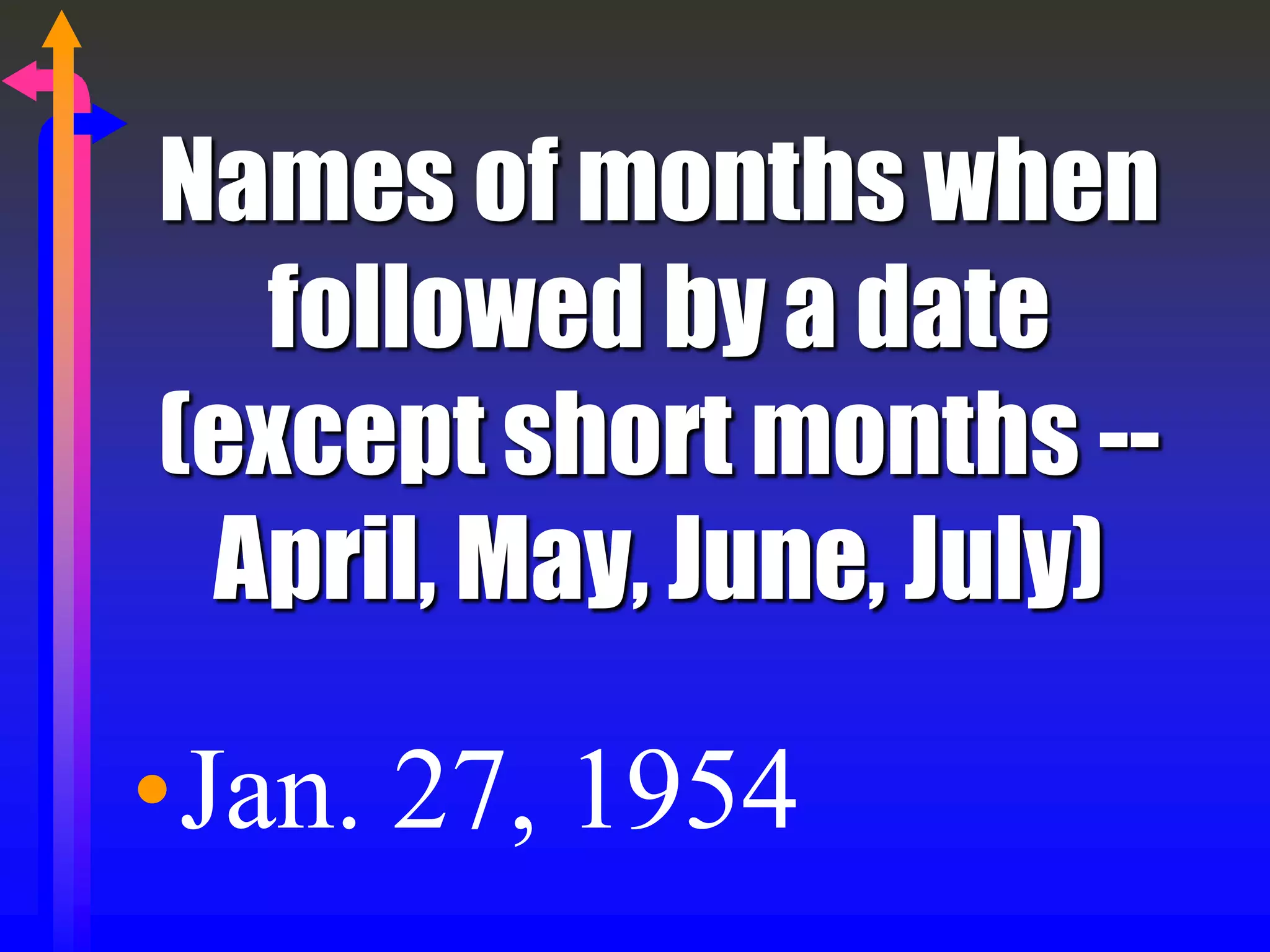
Names of months when
followed by a date
(except short months --
April, May, June, July)
•Jan. 27, 1954
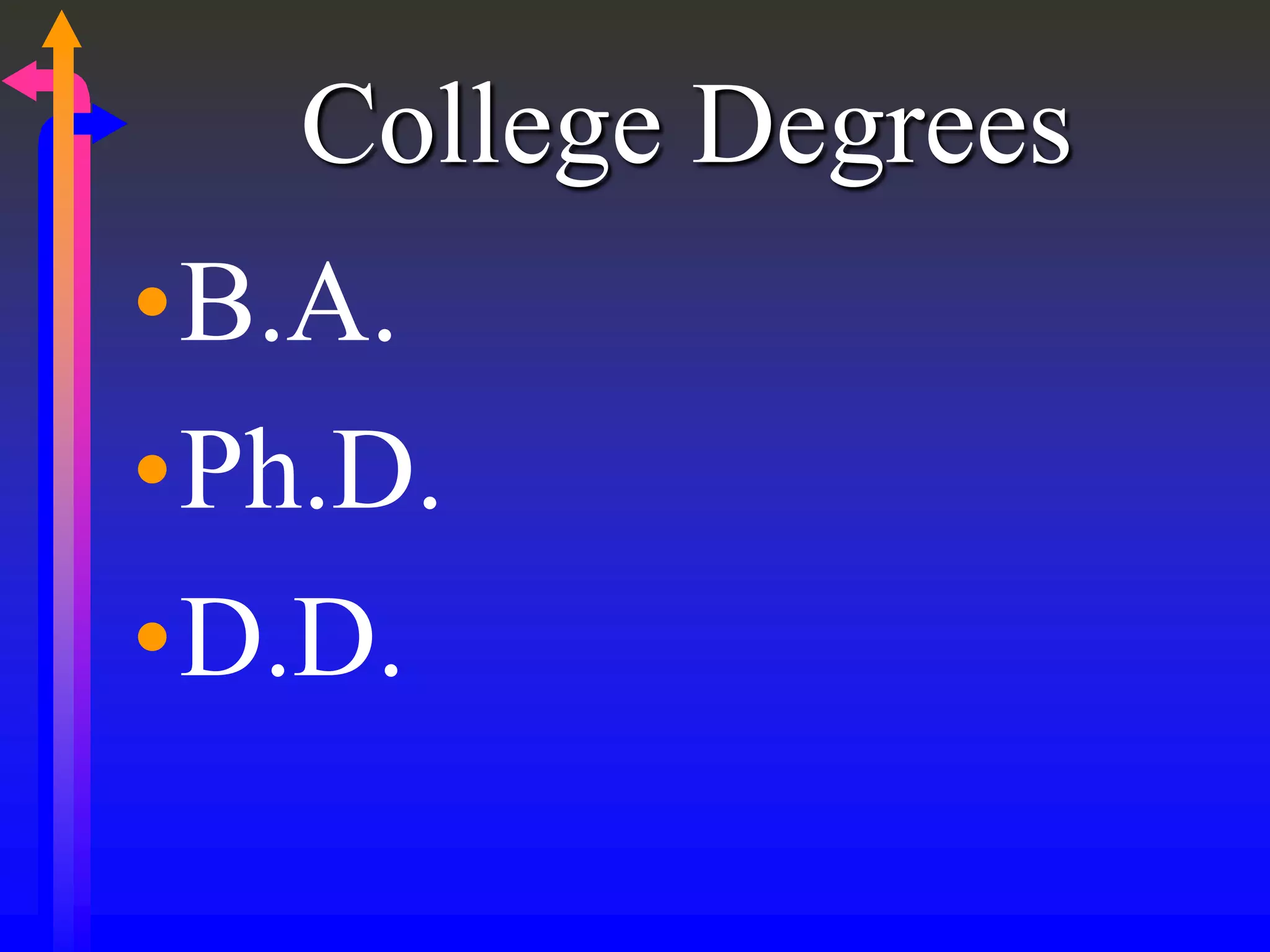
College Degrees
•B.A.
•Ph.D.
•D.D.
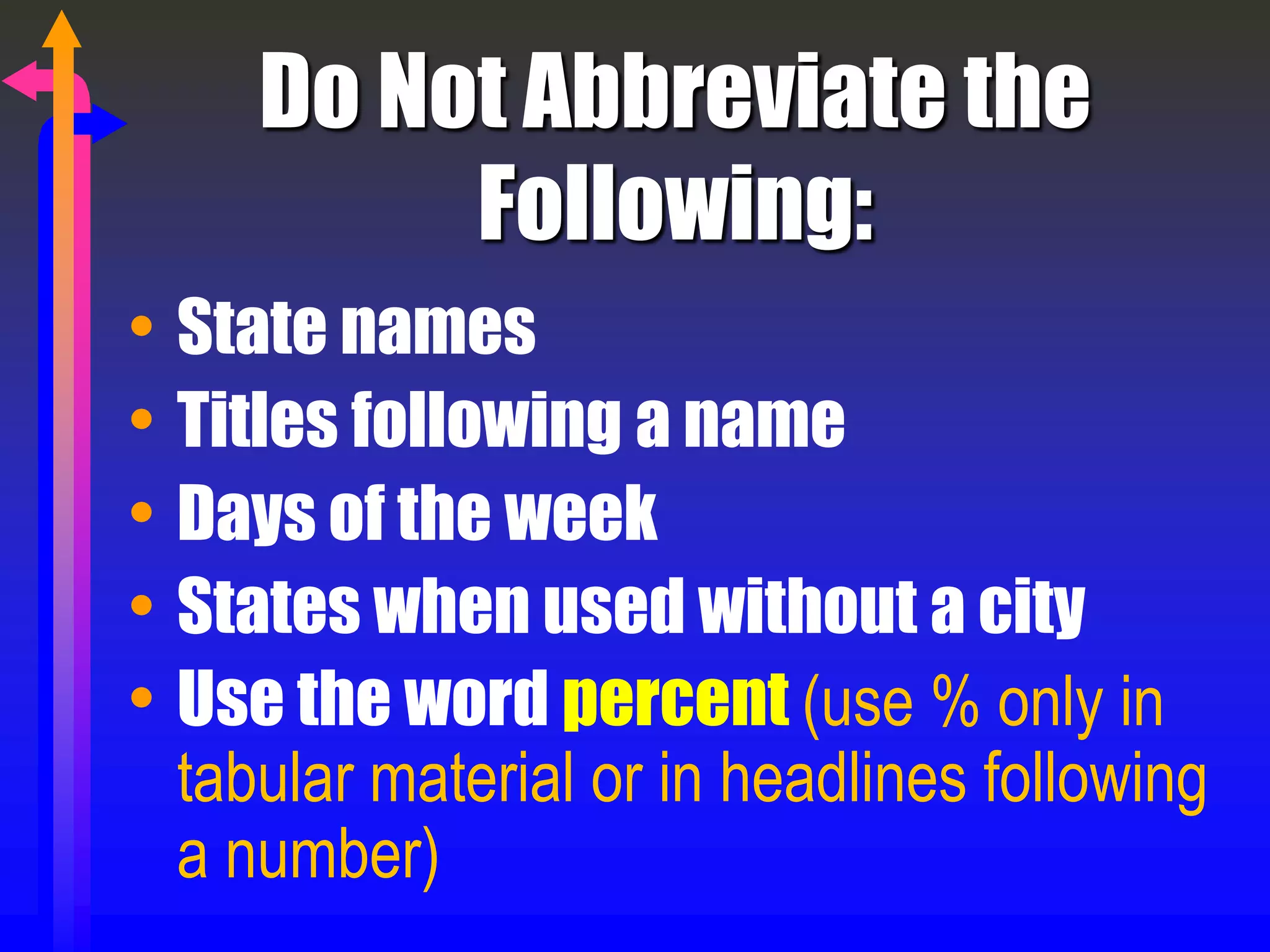
Do Not Abbreviate the
Following:
• State names
• Titles following a name
• Days of the week
• States when used without a city
• Use the word percent (use % only in
tabular material or in headlines following
a number)
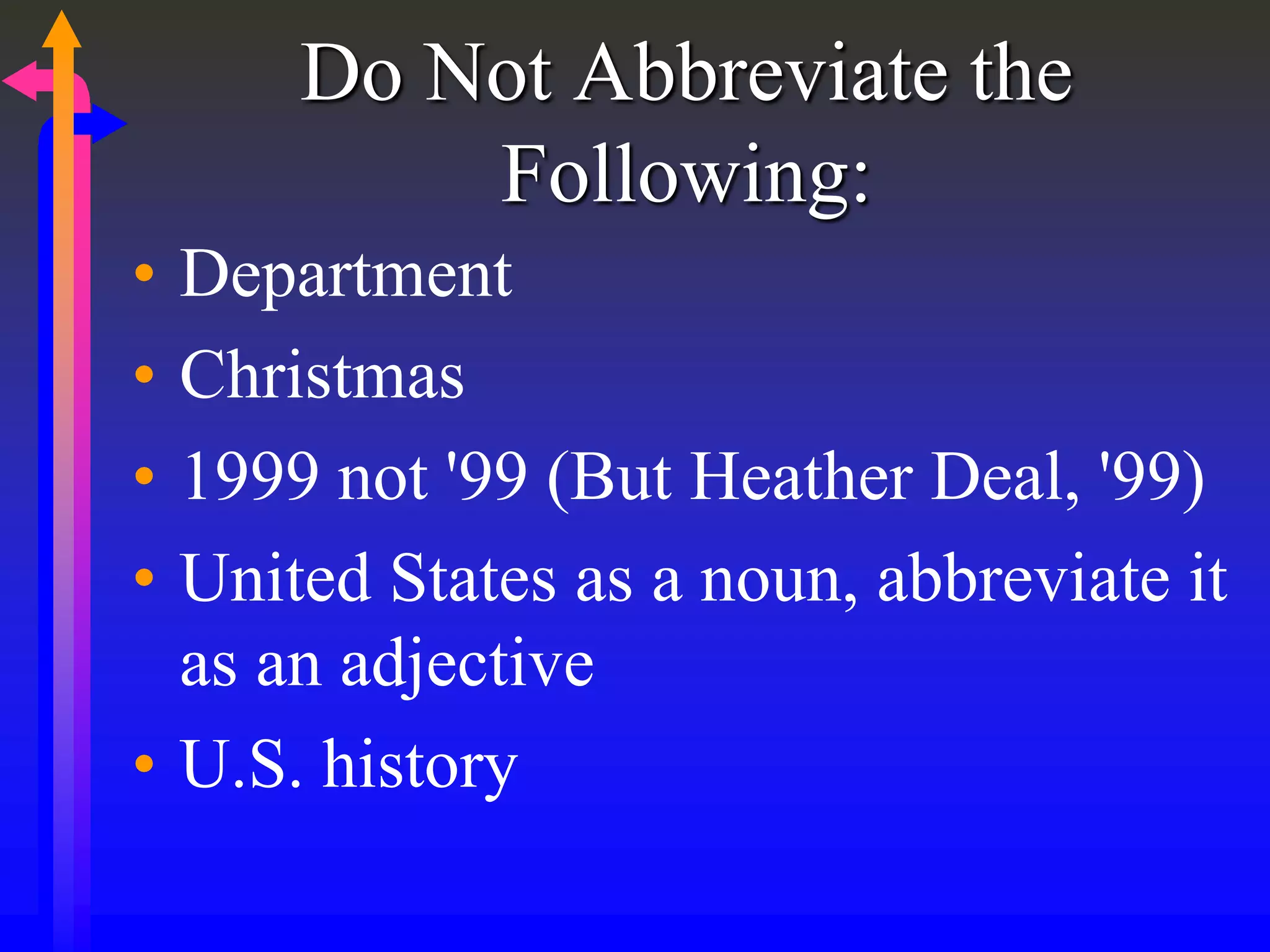
Do Not Abbreviate the
Following:
• Department
• Christmas
• 1999 not '99 (But Heather Deal, '99)
• United States as a noun, abbreviate it
as an adjective
• U.S. history
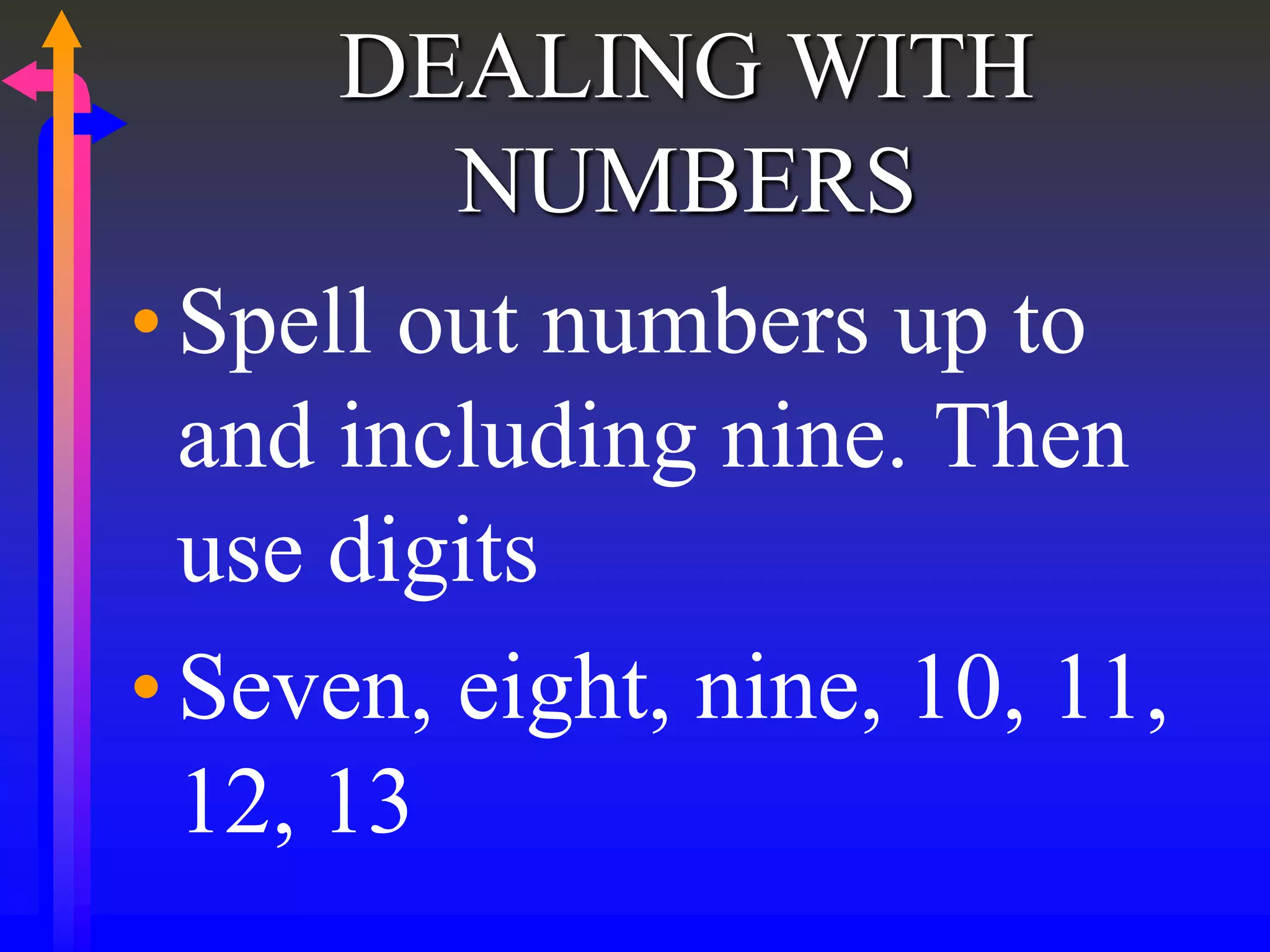
DEALING WITH
NUMBERS
•Spell out numbers up to
and including nine. Then
use digits
•Seven, eight, nine, 10, 11,
12, 13
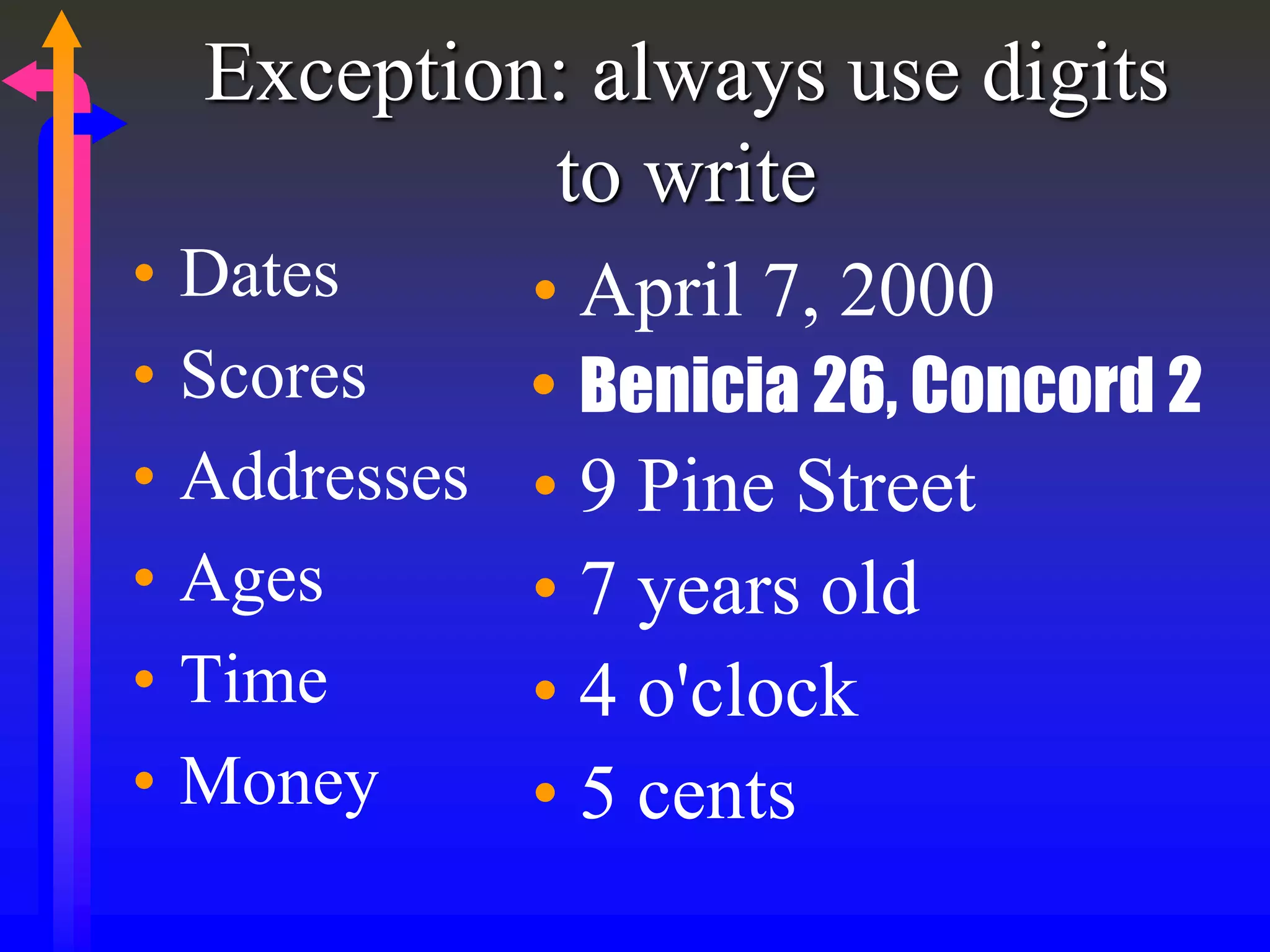
Exception: always use digits
to write
• Dates
• Scores
• Addresses
• Ages
• Time
• Money
• April 7, 2000
• Benicia 26, Concord 2
• 9 Pine Street
• 7 years old
• 4 o'clock
• 5 cents
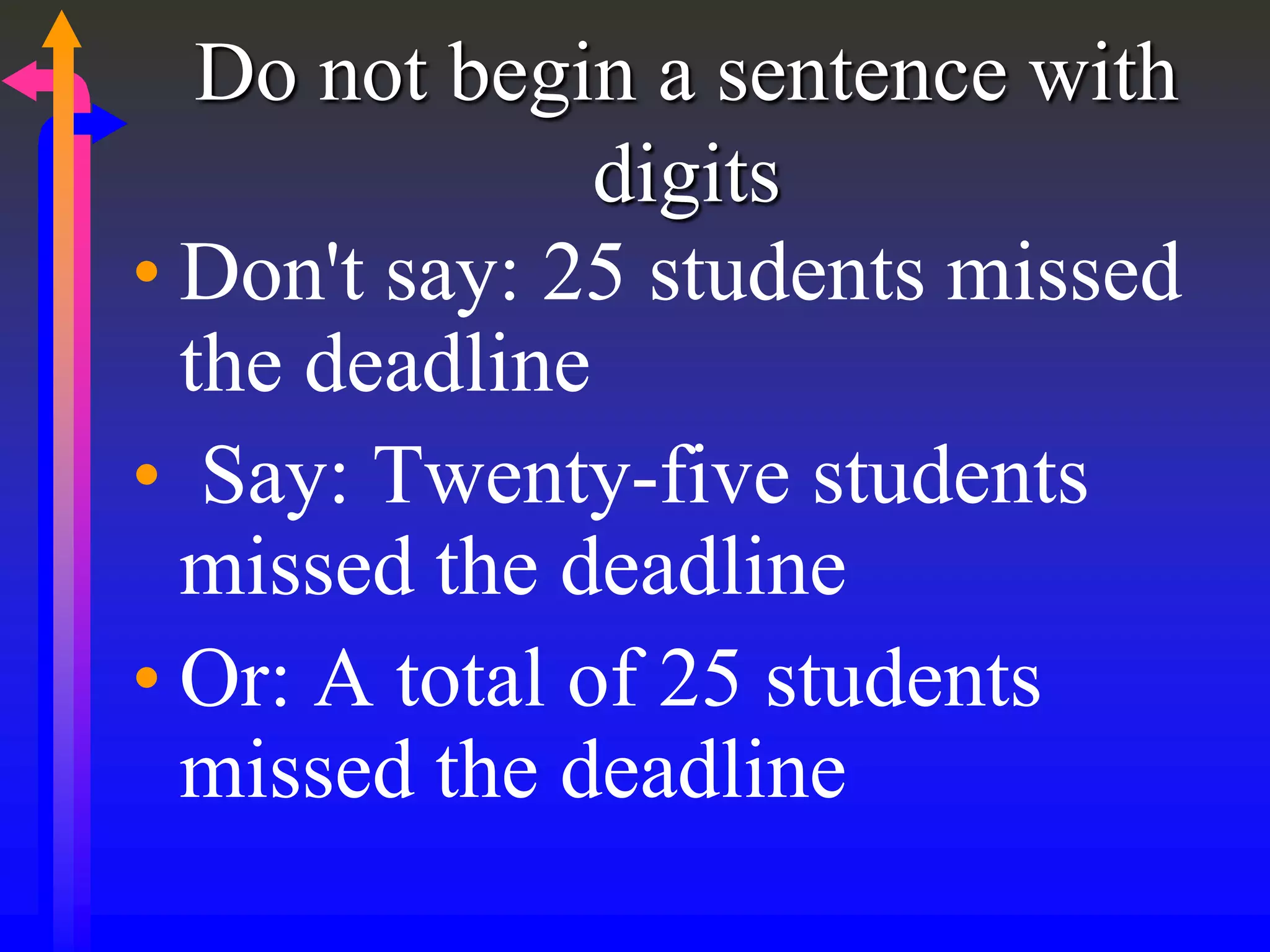
Do not begin a sentence with
digits
• Don't say: 25 students missed
the deadline
• Say: Twenty-five students
missed the deadline
• Or: A total of 25 students
missed the deadline
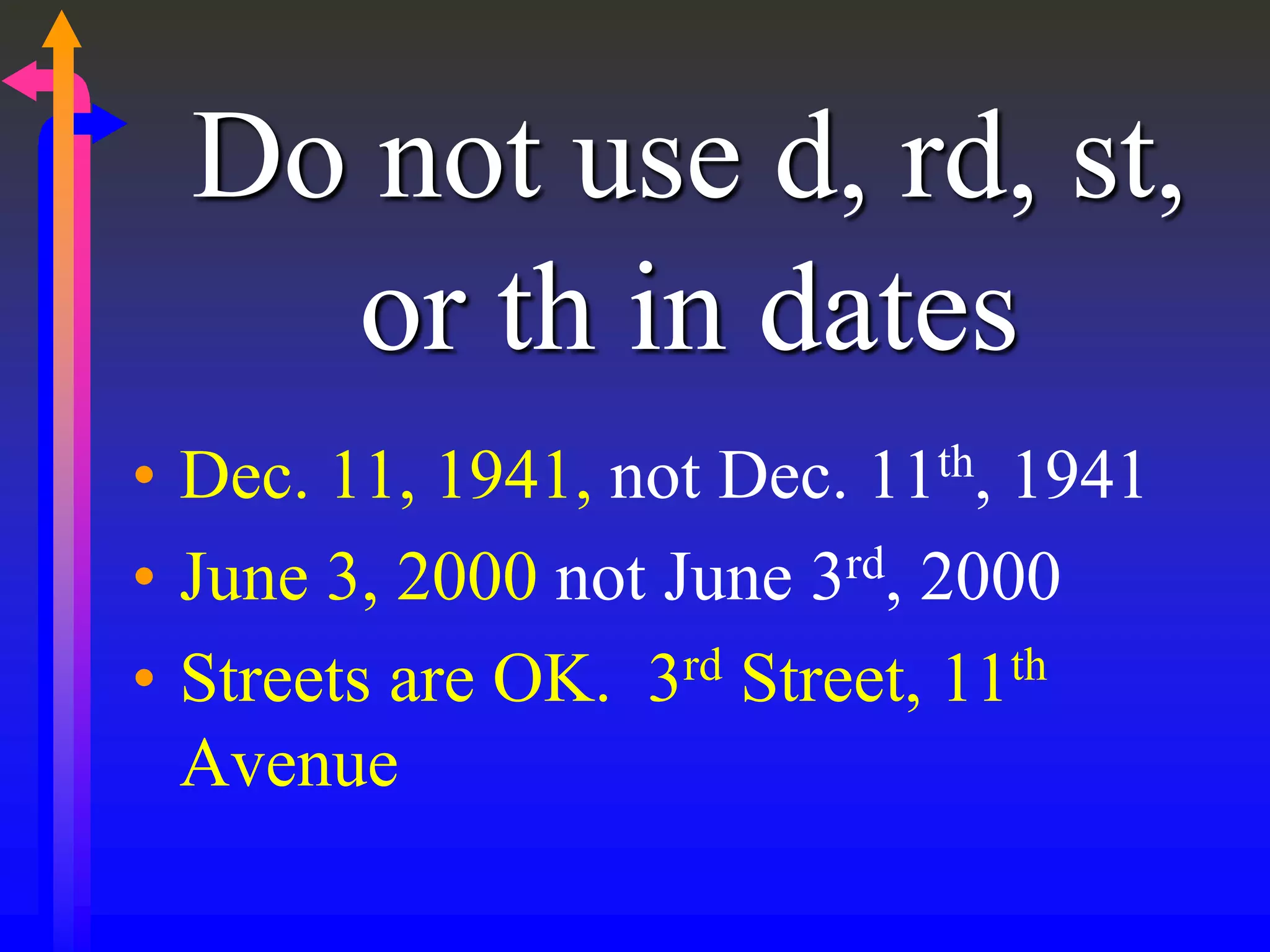
Do not use d, rd, st,
or th in dates
• Dec. 11, 1941, not Dec. 11th, 1941
• June 3, 2000 not June 3rd, 2000
• Streets are OK. 3rd Street, 11th
Avenue
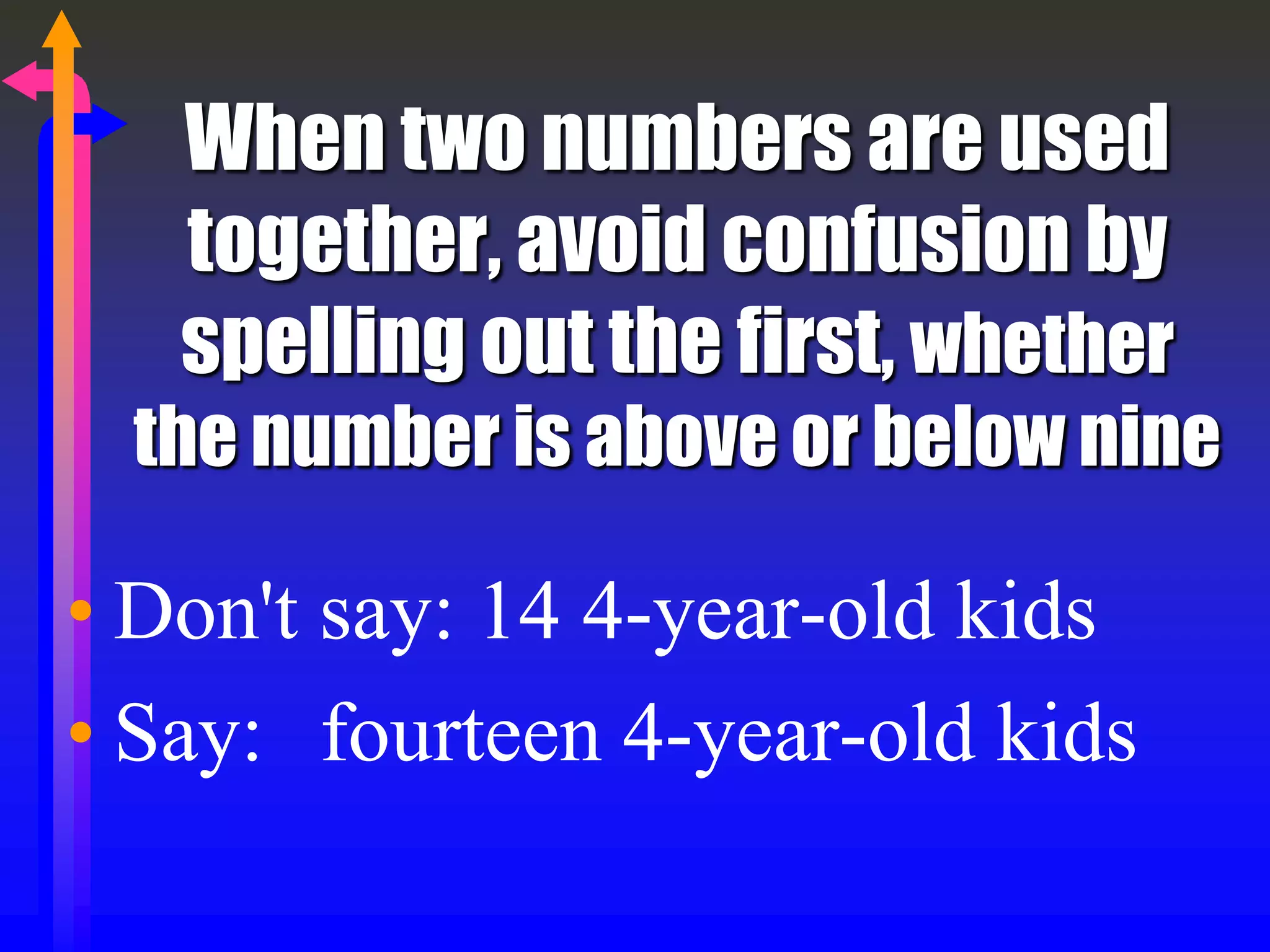
When two numbers are used
together, avoid confusion by
spelling out the first, whether
the number is above or below nine
• Don't say: 14 4-year-old kids
• Say: fourteen 4-year-old kids
In a list using numbers below
and above nine, use digits for all:
• Attending were 2 from the
elementary school, 13 from
the middle school, and 9
from the high school
For sums of money below
one dollar, use digits and
the word "cents"
•10 cents, not $.10
Do not use zeros when
giving the exact hour or an
even number of dollars
•4 o'clock, not 4:00
o'clock
•$6 not $6.00
For numbers of four
or more digits, use a
comma
•1,000 64,500
PUNCTUATION
Comma
•Do not use a comma before
the word and in a series
•Red, white and blue.
Members included Lewis,
Clark and Upton
Do not use a comma
before Jr. in a name
•William Strunk Jr.
Use the semicolon in lists where the
individual items contain commas.
• The committee included Mary Ladd,
chairperson; Oliver Greenwood,
treasurer; and Nellie Kim, secretary.
• They brought with them from New
Orleans a box of gumbo; a large, green
suitcase; and a change of clothes.
Quotation Marks
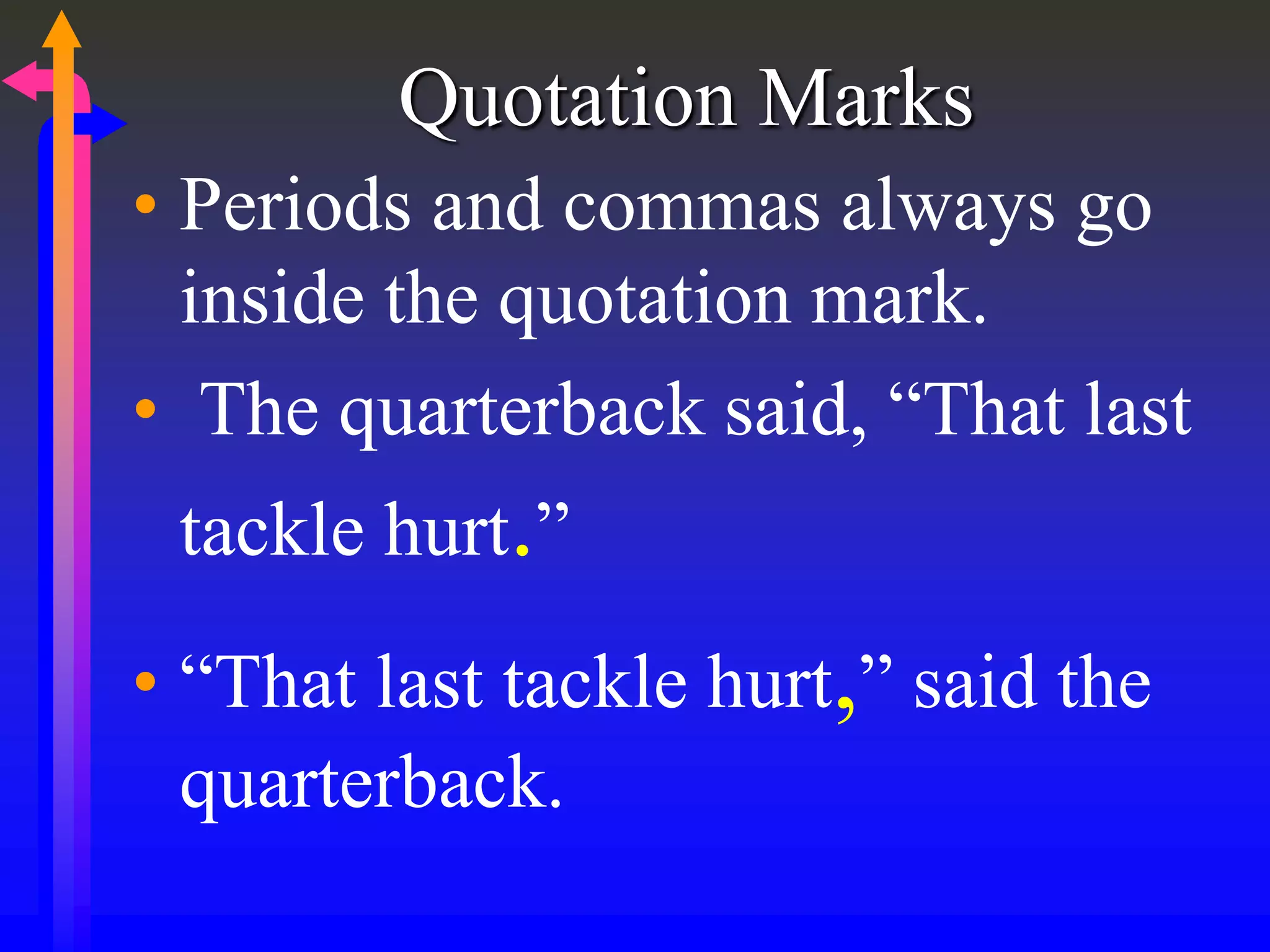
• Periods and commas always go
inside the quotation mark.
• The quarterback said, “That last
tackle hurt.”
• “That last tackle hurt,” said the
quarterback.
Quotation Marks
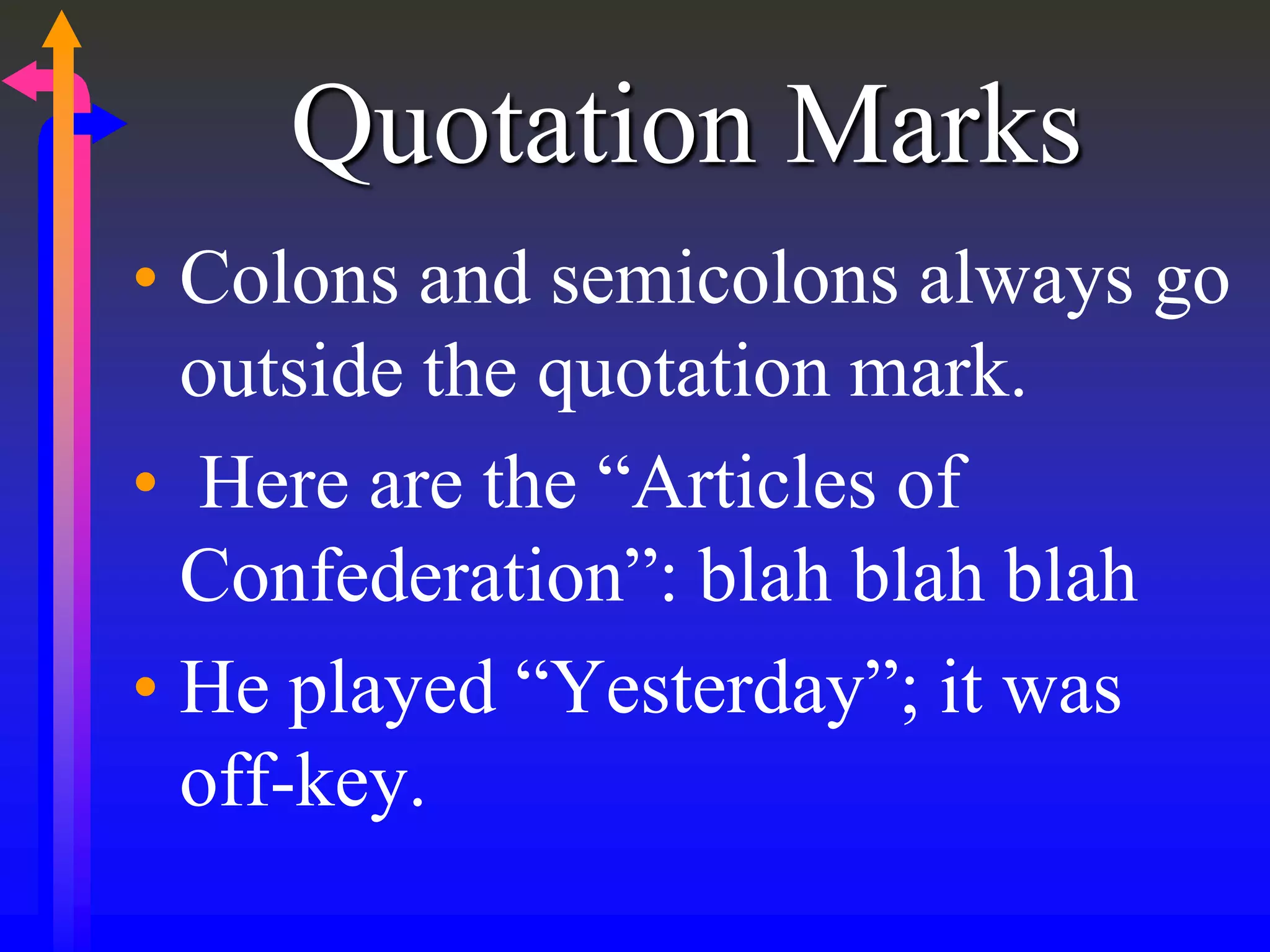
• Colons and semicolons always go
outside the quotation mark.
• Here are the “Articles of
Confederation”: blah blah blah
• He played “Yesterday”; it was
off-key.
Quotation Marks
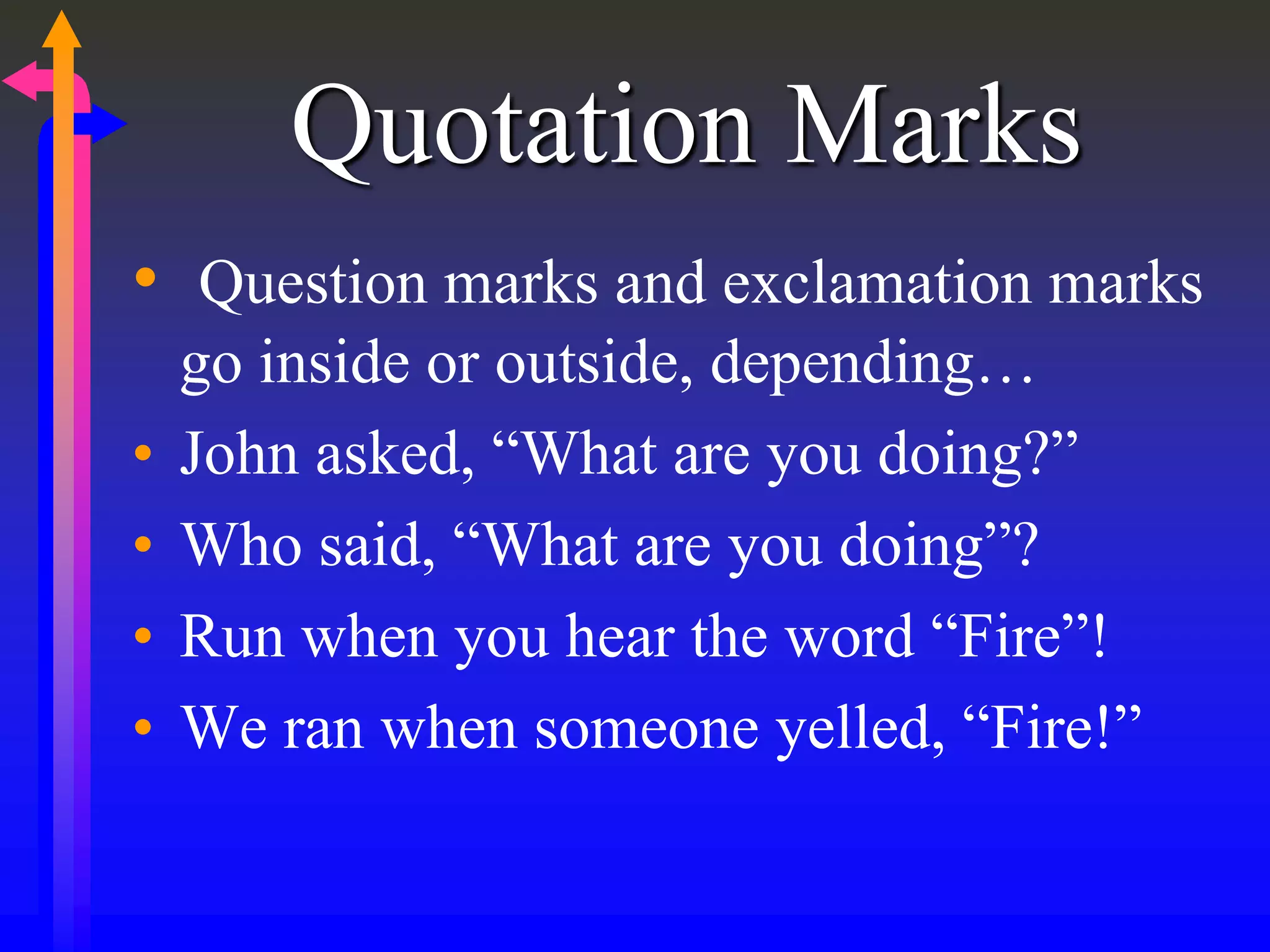
• Question marks and exclamation marks
go inside or outside, depending…
• John asked, “What are you doing?”
• Who said, “What are you doing”?
• Run when you hear the word “Fire”!
• We ran when someone yelled, “Fire!”
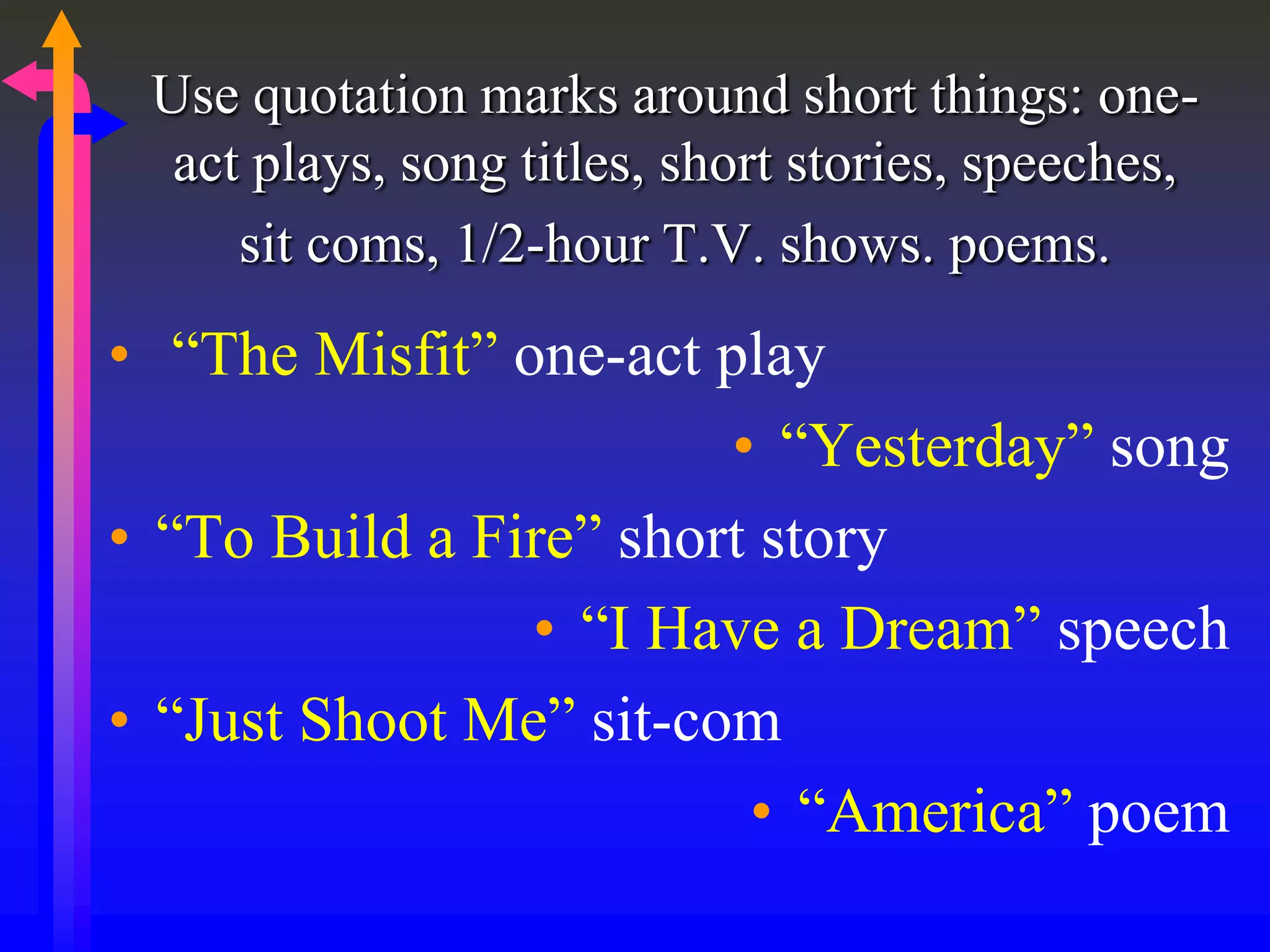
Use quotation marks around short things: one-
act plays, song titles, short stories, speeches,
sit coms, 1/2-hour T.V. shows. poems.
• “The Misfit” one-act play
• “Yesterday” song
• “To Build a Fire” short story
• “I Have a Dream” speech
• “Just Shoot Me” sit-com
• “America” poem
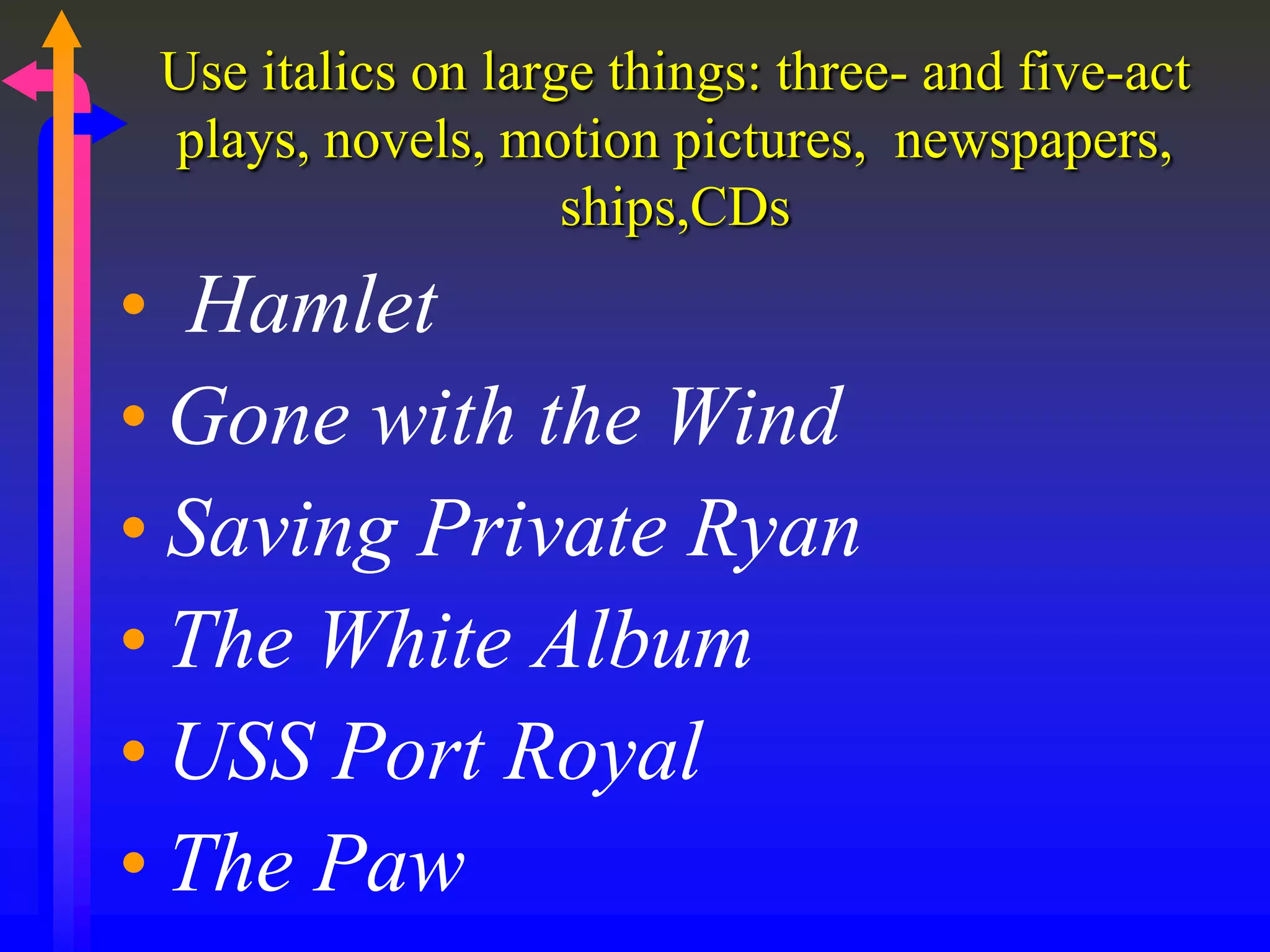
Use italics on large things: three- and five-act
plays, novels, motion pictures, newspapers,
ships,CDs
• Hamlet
• Gone with the Wind
• Saving Private Ryan
• The White Album
• USS Port Royal
• The Paw
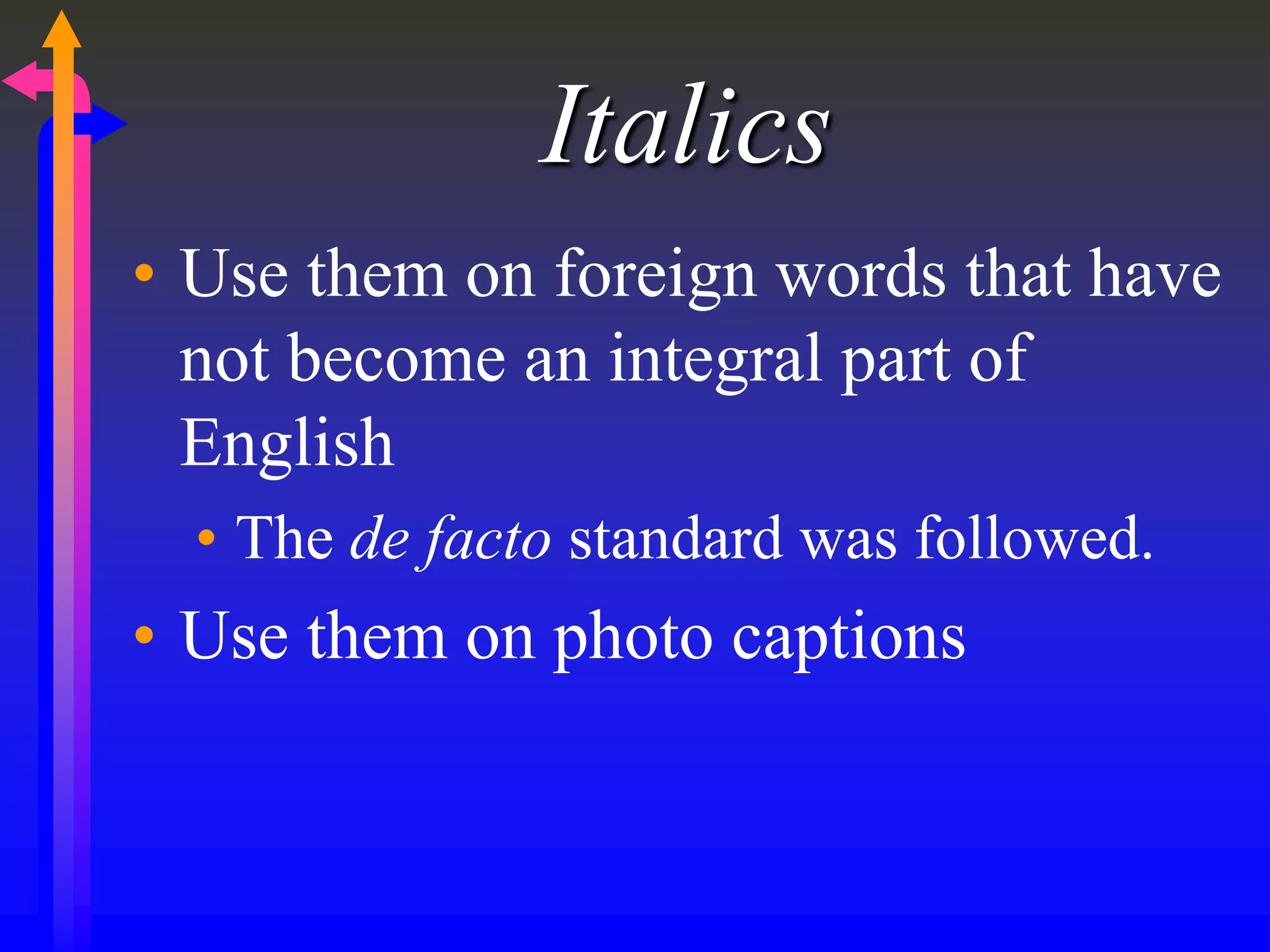
Italics
• Use them on foreign words that have
not become an integral part of
English
• The de facto standard was followed.
• Use them on photo captions
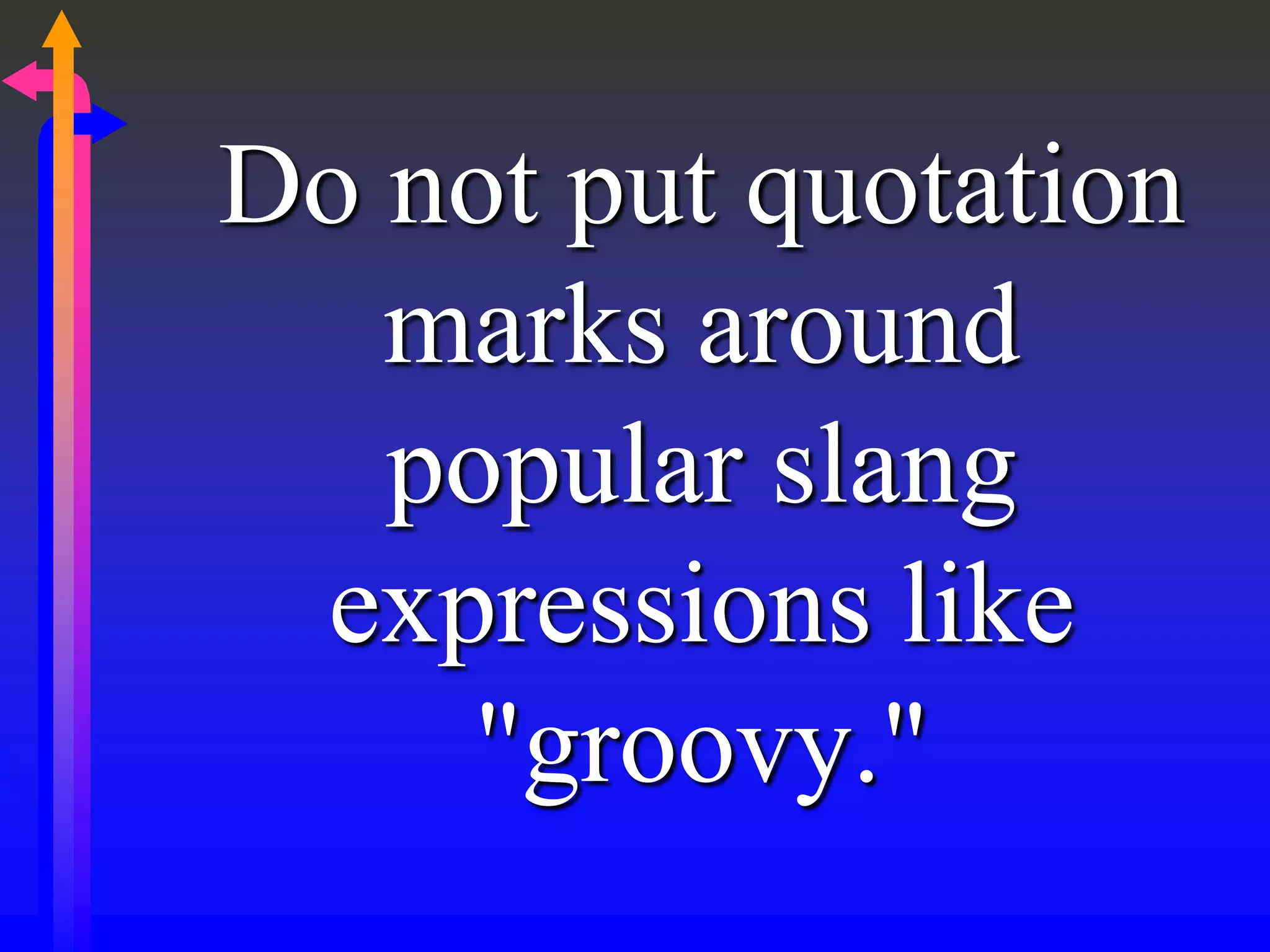
Do not put quotation
marks around
popular slang
expressions like
"groovy."
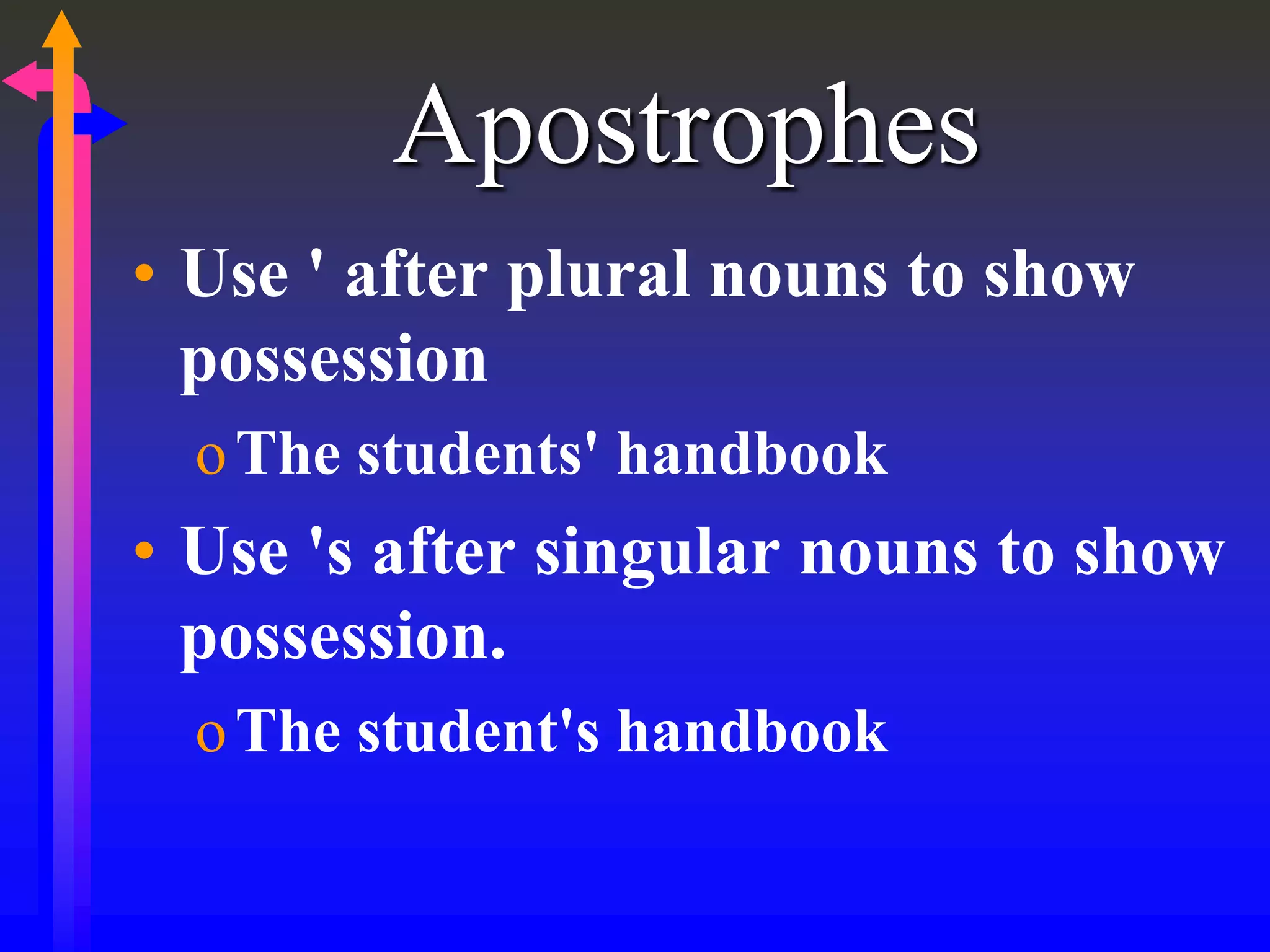
Apostrophes
• Use ' after plural nouns to show
possession
oThe students' handbook
• Use 's after singular nouns to show
possession.
oThe student's handbook
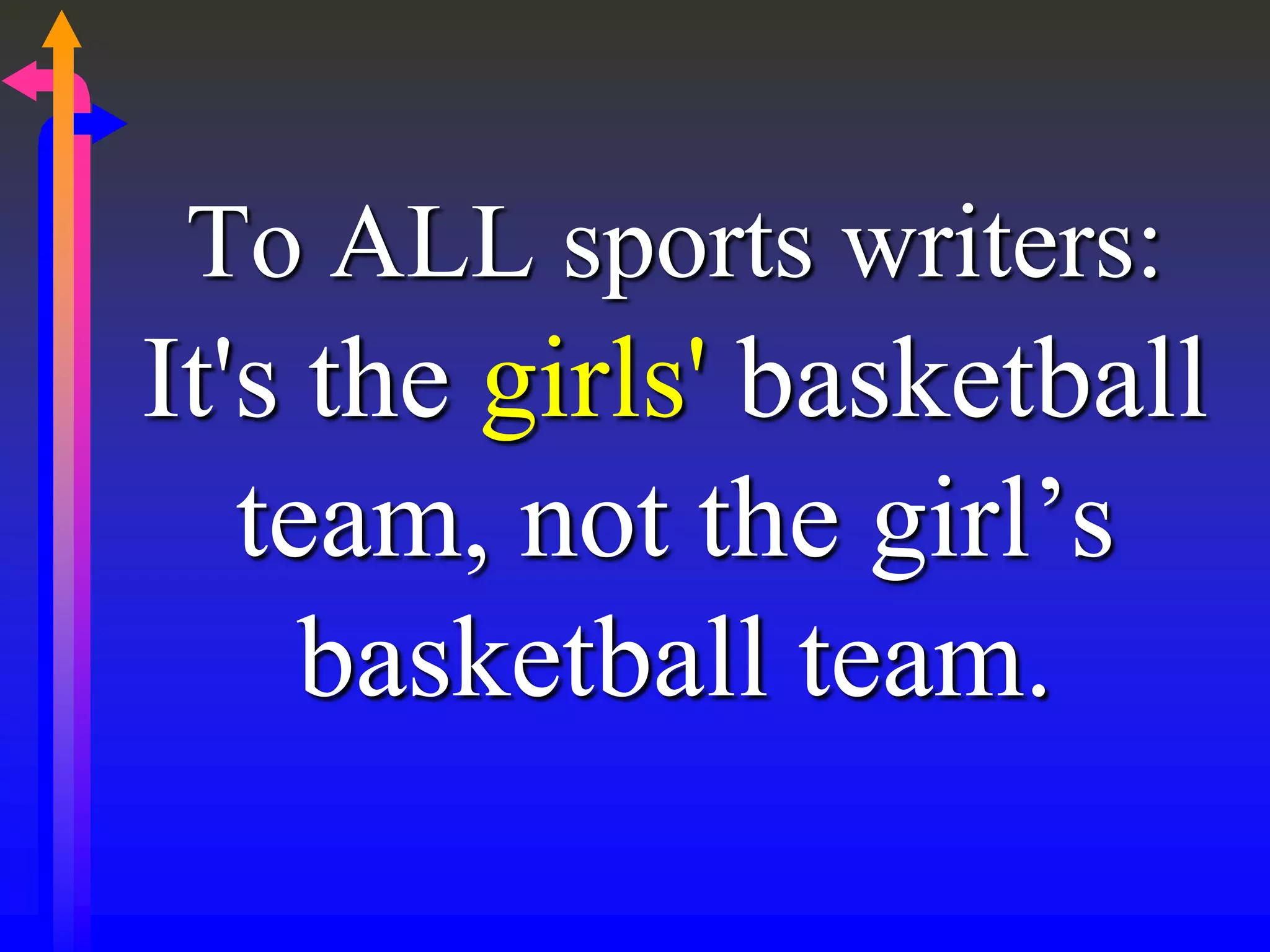
To ALL sports writers:
It's the girls' basketball
team, not the girl’s
basketball team.
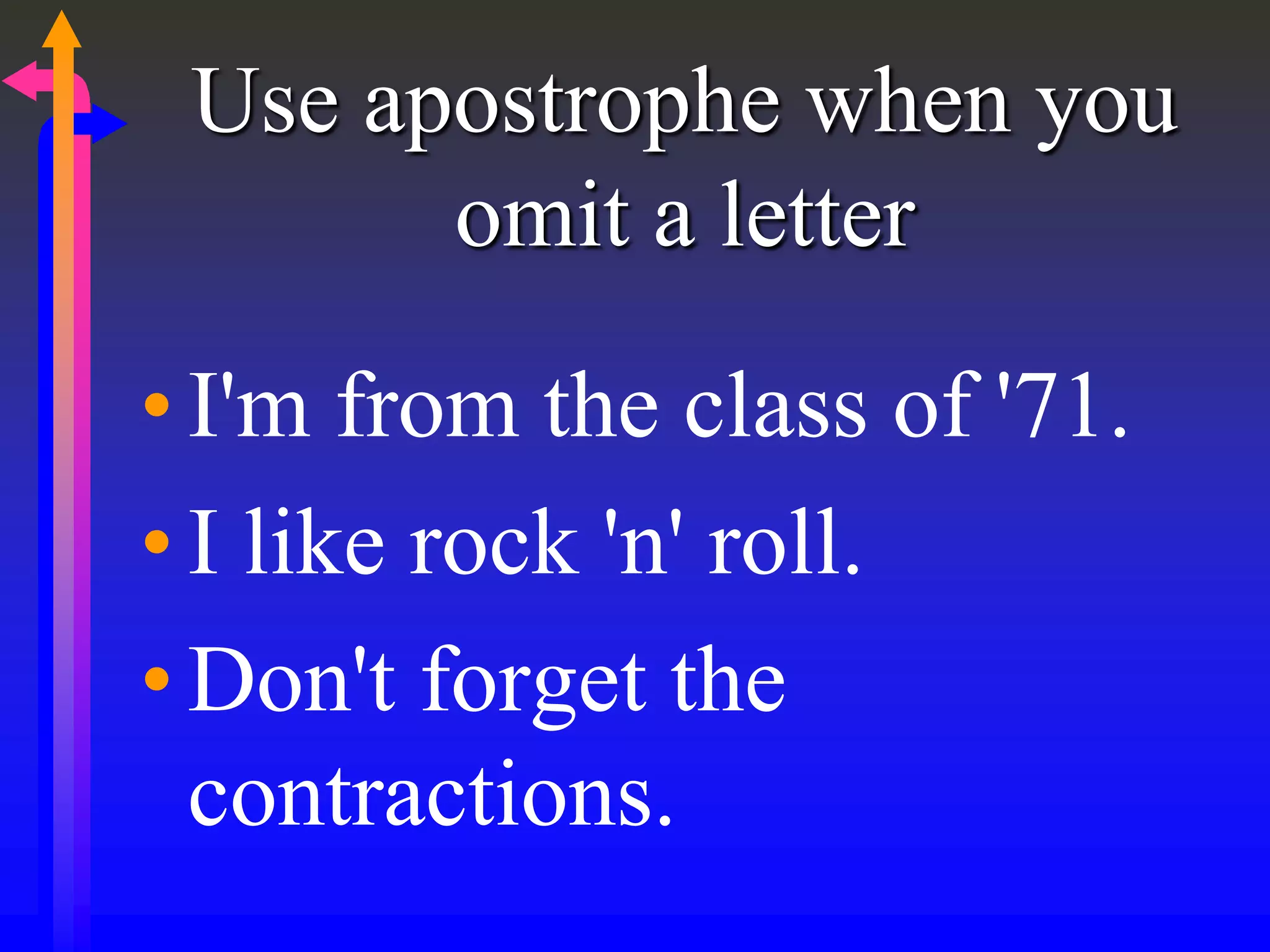
Use apostrophe when you
omit a letter
•I'm from the class of '71.
•I like rock 'n' roll.
•Don't forget the
contractions.
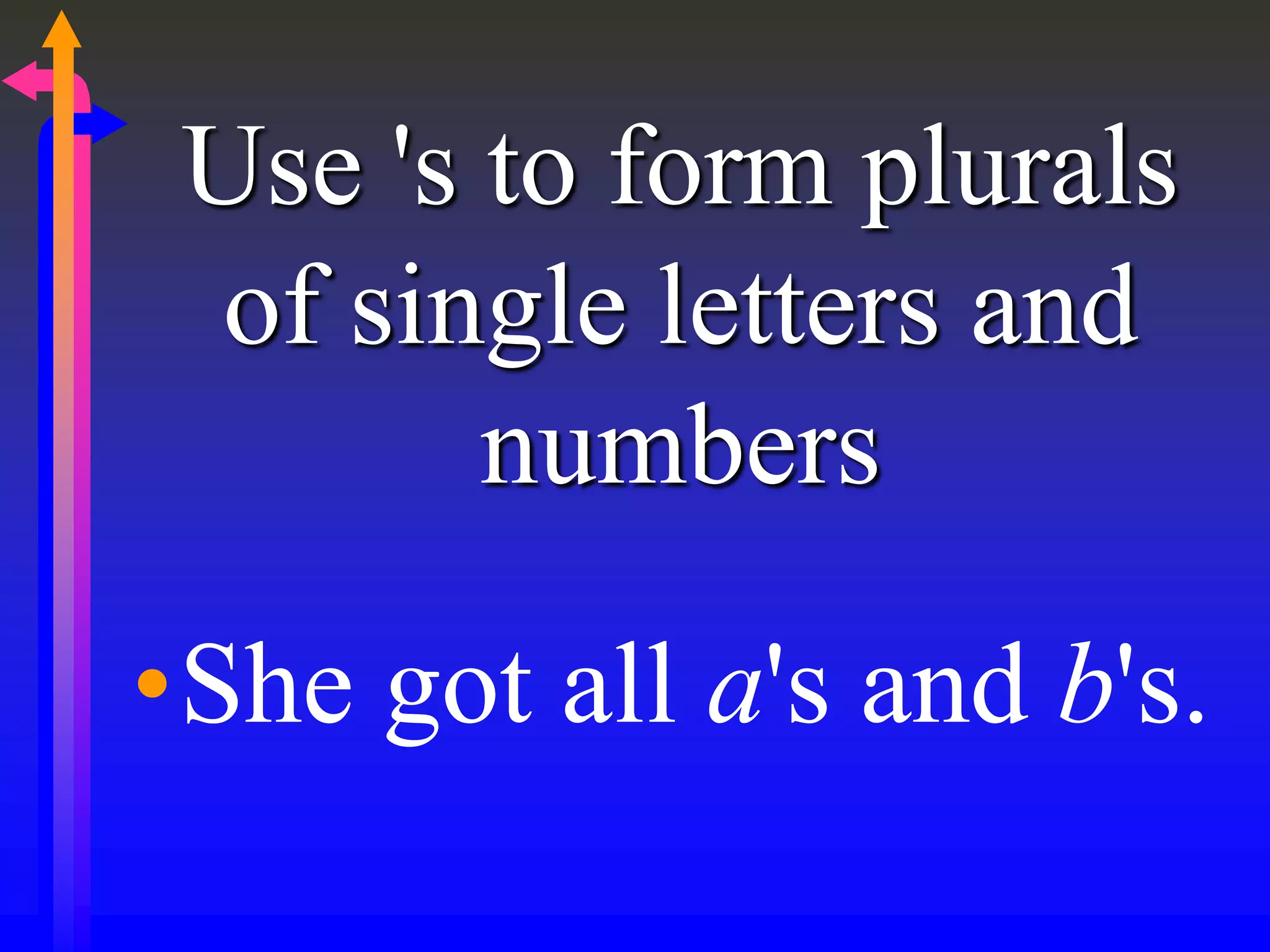
Use 's to form plurals
of single letters and
numbers
•She got all a's and b's.
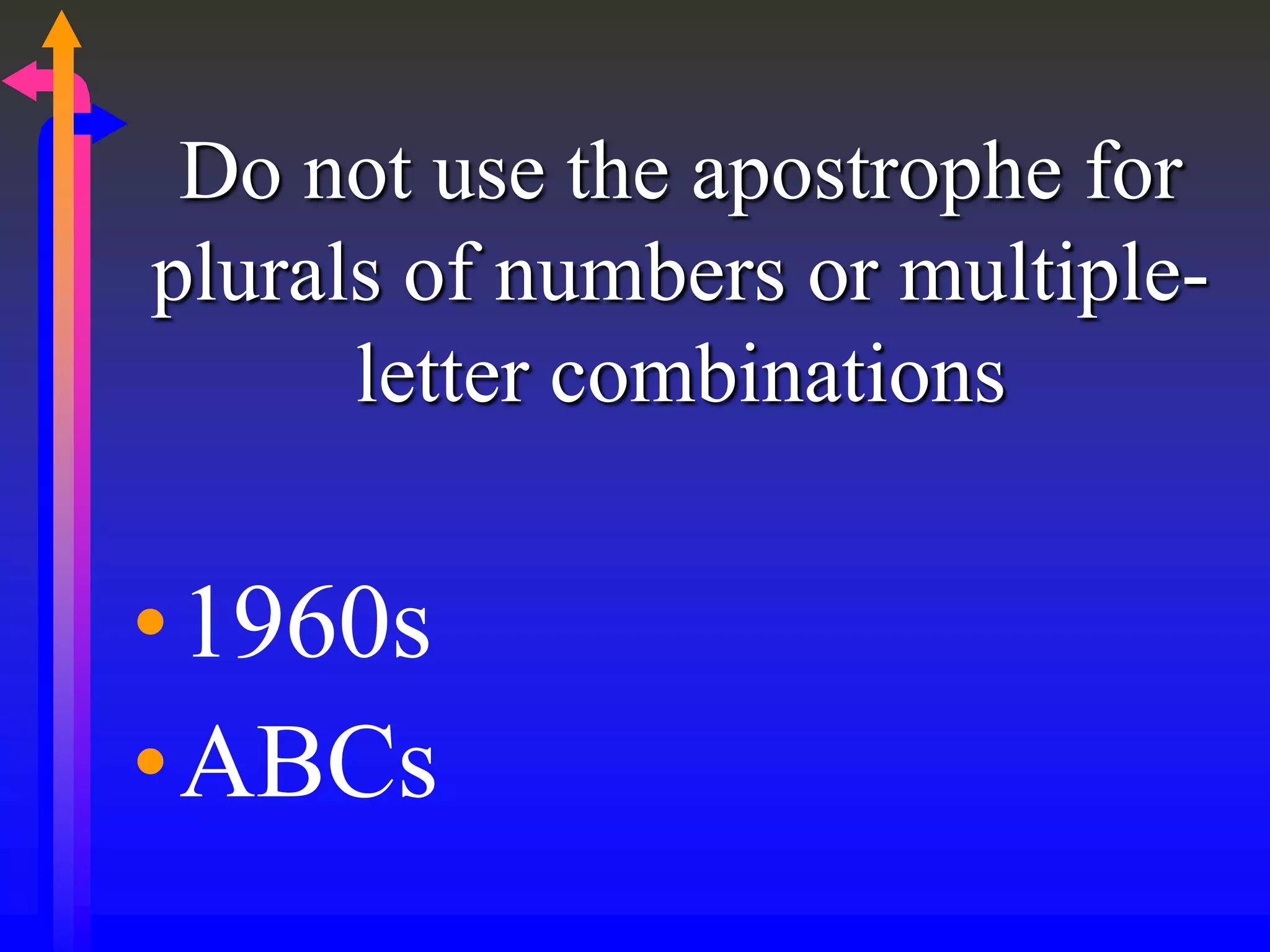
Do not use the apostrophe for
plurals of numbers or multiple-
letter combinations
•1960s
•ABCs
Omit the apostrophe in names of
organizations when the possessive
case is implied and in certain
geographic designations
•Citizens League
•Actors Guild
•Pikes Peak
HYPHEN
•Use hyphens in compound
numbers and fractions
•Forty-five, three-fourths
Use hyphens in such
words as
•Vice-principal
•vice-president
Use a hyphen on compound
adjectives used to modify a noun
• The two-sided issue; the double-edged
sword; the 8-year-old boy
• (not for multiple adjectives. The old, tired
argument. The late, exhausted student)
• (not for adverb ending in ly
• The smartly dressed man
Use two hyphens with spaces at
each end -- to represent a dash.
• Use a dash to show long
apposition.
• The quarterback -- a man short
on energy but long on
determination -- finished the
game with a touchdown pass.
POLICY
Big no no:
Slander, Liable,
Profanity, Incite to
Riot
extra school-news
precautions: no flippant,
positive or enticing
references can be made to
the use of drugs, alcohol,
tobacco, or illicit sex
Say all the positive you
want about a person.
Negative comments
require you to show the
story to the person and
give them an opportunity
to respond
The End

Power point from hell - Journalism Textbook Digitized

  • 1.
  • 2.
  • 3.
    Active Index • Understandingnews • Gathering news • Leads • News story structure • Writing news • Layout • Interviews • Features • Sports • Editorials • Reviews • Surveys and opinion polls • STYLE
  • 4.
  • 5.
    Understanding News • Hard News= significant events • Soft News = less significant but larger audience
  • 6.
    Three factors toall news: •facts •interest •audience
  • 7.
    Six qualities toall news. It must be: •Accurate •Balanced •Objective •Concise •Clear •Timely
  • 8.
    News Values • Timeliness •Proximity • Consequence • Prominence • Drama • Oddity • Conflict • Progress • Emotions • Sex
  • 9.
  • 10.
    GATHERING NEWS •Research =70% •Writing = 20% •Proofreading = 10%
  • 11.
    Sources of news: •Beats • Handbook • Press Releases • City newspaper • Magazines • Tips • Snack, lunch • Club activities • Extra-curricular activities • Twitter • RSS Feeds • Class Site Portal • Personal Site Portal • City hall • Chamber of Commerce • City Bulletin Boards
  • 12.
    To succeed... •You musthave a Nose for News
  • 13.
    Characteristics of a goodreporter • curiosity • sincere concern and sense of justice • Objectivity
  • 14.
    Characteristics of a goodreporter • Ability to interview strangers • Ability to inspire confidence and make people feel at ease • Wide educational background
  • 15.
    Characteristics of agood reporter • Resourcefulness and persistence • Ability to write and speak standard English • Keen observation • Extensive vocabulary
  • 16.
    5 Ws andH are basic requirements but not enough to make someone remark, "Wow! Great story." • Dig deep • Make facts interesting
  • 17.
  • 18.
    All About Leads •Feature the feature • Clothesline WWWWHW • Colored Clothesline -- quote, eye-catcher, comment; • Include as many wwwwwh as possible as soon as possible • Hold one back as a tease
  • 19.
    Begin by determining which ofthe 5Ws&H is the feature to feature
  • 20.
    Leads •"Fire raged througha Chicago elementary school on Sunday, injuring two firemen and destroying a brand new auditorium." Start by featuring the feature with strong words
  • 21.
    "Two firemen were injuredin a Chicago elementary school fire that destroyed a brand new auditorium last Sunday."
  • 22.
    "The brand new auditoriumof a Chicago elementary school was gutted Sunday by a fire that left two firemen injured."
  • 23.
    Avoid starting with articleslike The and A or dates (“When” is seldom the lead)
  • 24.
    Finding the lead •Yuck! The Benicia High School band won first place in state competitions. • Yuck! On Tuesday, October 9, the Benicia High School blah blah blah” • Better! First place went to the Benicia High School band in state competitions. • Better! Benicia wins first place in the state band competition.
  • 25.
  • 26.
  • 27.
    News article structure: •TheInverted Pyramid Most important Followed by Least im- port- ant
  • 28.
    First things first: Pushthe facts to the front and cut the crap
  • 29.
  • 30.
  • 31.
    Brevity doesn't excuse reporters frombeing accurate and thorough
  • 32.
    To complete thepyramid • End the story in the last two paragraphs • This way the last paragraph can be cut without affecting the conclusion
  • 33.
  • 34.
    WRITING NEWS • Whyis this story important? • Is it an advance or a follow-up story? • Do not editorialize • Remain objective • Balance the interviews -- pro con, or authority and reaction quote
  • 35.
    WRITING NEWS • Whyis this story important? • Is it an advance or a follow-up story? • Do not editorialize • Remain objective • Balance the interviews -- pro con, or authority and reaction quote
  • 36.
    WRITING NEWS No Mr.,No Mrs., No Ms. • Introduce every person with a title or description. Then use only the last name • Never use Ms. Miss. Mrs. Or Mr.
  • 37.
  • 38.
    Layout: dummy up •Dummy the entire newspaper & each dept • Place ads first Headlines Text Pictures Ads
  • 39.
    Layout: ad placement •Place ads across the bottom to rise toward the inside
  • 40.
    Layout: Master Pages •DesignMaster Page with repeating elements: folios, flags, logos, ads
  • 41.
    Layout: headlines •The headlineis the purest condensation of the story’s key focus •It must capture the eye, lure, entice, intrigue reader
  • 42.
    Layout: headlines • Headlinesmust have a strong verb • They must be sentences, not labels • Verb “to be” is omitted: is, was, were, are • We do not say: • President is coming to Benicia
  • 43.
    Layout: headlines vslabels •HL: Earthquake in Turkey kills 20,000 Label: Turkish earthquake • HL: Terrorists bomb Children’s Hospital •Label: Terrorist bombing
  • 44.
    Layout: headlines •Point sizeshould decrease as you go down the page • Headlines must fit over the entire story • Use down style
  • 45.
    Layout: standards • Foliocontains “Page” #, month & year, dept name IN CAPS • Save fancy fonts for ads • Don’t jump more than once • Jumps should NOT continue at the top of the page (if possible)
  • 46.
    Layout: photos •Pictures musthave borders and captions •Pictures must be light and well defined
  • 47.
    Layout: consider breakingup large blocks of text with something… Subtitles Sidebars Pull quotes Bold facing
  • 48.
  • 49.
  • 50.
    Steps in conducting INTERVIEWS: •Schedule early! • Learn all you can beforehand • Write any and every question you can think of before you go
  • 51.
    Steps in conducting INTERVIEWS: •If important, take note of person's dress, surroundings, mannerisms • Bring a recorder if you can • Always ask permission to use recording device and put it in plain view • Do not stick it in your person's face • Write down counter-numbers when good lines are spoken
  • 52.
    Steps in conducting INTERVIEWS: •When notetaking, maintain a balance: don't bury your nose in your notebook and don't expect to memorize everything. • Jot down the essentials for paraphrasing, and capture precise sentences for quotes • Open-ended Vs close-ended questions
  • 53.
    Steps in conducting INTERVIEWS: •End by asking if the person has anything to say that you haven't asked • Advise that you may condense quotes for clarity, but that you will not change meaning
  • 54.
    Steps in conducting INTERVIEWS: •Get permission to follow-up with a phone call or a drop by if you need any more info • Offer to give them a proof of the story if it's warranted
  • 55.
    Writing the Interview: •AvoidQ & A •Stay out of the picture
  • 56.
    Writing the Interview: •Use"said" synonyms sparingly •Use a quote early •Use plenty of quotes
  • 57.
    Writing the Interview: •Alternatebetween quotes and paraphrases •Use quotes from other people
  • 58.
  • 59.
    FEATURES • They mayinform, instruct, advise, but their primary purpose is to entertain • They are factual, and can relate to current news/news story • They allow for creativity and individual curiosity • Written in a casual style
  • 60.
    Types of Features: •News feature • Human interest • Character sketch • Writing the Feature: • All the other rules of news writing apply except the feature writer is permitted more creativity in expression and layout
  • 61.
  • 62.
    Writing Sports Stories: •Don't editorialize, but you have more freedom than regular news reporters. • Support opinions with facts and quotes • Coach quote • Opposing coach quote -- before/after the game. Ask who to watch.
  • 63.
    Sports Layout: • Sportscan have hard, soft news, interviews, surveys, all the elements of the entire paper • Special Note: Triple check name spellings and grade level
  • 64.
  • 65.
    Editorials & PersonalOpinion •Editorial = staff opinion •Personal = author’s opinion
  • 66.
    Editorials & PersonalOpinion •Opinions based on fact and reason •Opinions with some mass appeal
  • 67.
    Editorials & PersonalOpinion •Avoid over generalization •Use examples and specific, concrete details •Quote sources
  • 68.
  • 69.
    REVIEWS • Goal isto introduce people to good entertainment and protect them from crap • Reviews are critical analysis • They are sort of like book essays in English class, except the primary question is Did you Like the Book or Not? Why?
  • 70.
    Steps in reviewing: •Takenotebook •Take notes •Get all names: actors, characters, performers, hosts
  • 71.
    Film review: Analysis •plot, • conflict, • setting, • tone, • character, • actor, • editing, • cinematography, • sound track, • popularity, • director, • background information, • similarities to other films, • cost, • genre
  • 72.
    Steps in reviewing: •Writereview immediately after the performance •Support all critical analysis with example
  • 73.
    Steps in reviewing: •Don'twrite a PLOT SUMMARY! •Write a CRITICAL ANALYSIS
  • 74.
    Steps in reviewing: •Summarizing a story is O.K., but it shouldn't be more than 20% of the story… • …and don’t give away the ending or any other surprises
  • 75.
  • 76.
  • 77.
    Opinion Polls: • Askone open-ended, controversial or entertaining question to a balanced variety of individuals • Get equal males, females, 9, 10, 11, 12, from different walks of life • toss in an occasional teacher, administrator, janitor or parent
  • 78.
    Opinion Polls: • Gathertwice as many responses as you intend to publish • Extract the best quotes and organize them • Check name spelling and grade level
  • 79.
    Questionnaire Surveys: • Devisea topic • Create a list of opinion and value questions on a related topic • Agree/disagree, for/against, most/least important • Format the questionnaire so two fit on one 8x11 paper • Distribute across campus in an organized fashion
  • 80.
    Questionnaire Surveys: •Statistical Significance beginsat 10-percent •Distribute enough questionnaires to gather 15-percent
  • 81.
    Questionnaire Surveys: •Survey ofjust freshmen would require 20-percent of freshmen only •Survey of teachers would require 30-percent
  • 82.
    Questionnaire Surveys: • Finishearly because you must • Tabulate the results and determine percentages • Submit your survey results to me
  • 83.
    Questionnaire Surveys: •Edit inthe questions that elicited the best responses •Layout the page yourself
  • 84.
    Questionnaire Surveys: • Writean intro paragraph that explains the nature and purpose of the survey and how many votes you tabulated. Interpret the results. What was the overall outcome of your findings, and were there any surprises
  • 85.
  • 86.
    Every newspaper setsa style for consistency of design and word use • In many ways it simply follows traditional grammatical, mechanical rules
  • 87.
    Titles of apposition •Short titles go before a name in caps: Principal Bob Jones • Long titles go after a name, in low case: Mike Bowers, director of personnel relations
  • 88.
  • 89.
    All titles thatprecede names •Principal Jones •Coach Hayes •President Smith
  • 90.
    First and allwords in titles except for articles, prepositions of one to three letters, and conjunctions •The Holiday Collection of Songs and Poems -- book •“The Man With Time to Spare” -- short story
  • 91.
  • 92.
  • 93.
    Sections of theCountry but not directions •She lived in the South •She moved south for the winter
  • 94.
  • 95.
  • 96.
    Grade levels ONLYWHEN followed by the word Class •The Freshman Class has closed campus •(but The freshmen have closed campus)
  • 97.
    Specific Buildings •World TradeCenter •Pentagon •The Chrysler Building •The Bay Bridge
  • 98.
  • 99.
    Schools (not simply middleschool or high school) • Benicia High School competed in the games against Benicia Middle School • The high school competed in the games against the middle school. • Mary Farmar Robert Semple
  • 100.
  • 101.
  • 102.
  • 103.
    Names of specificcourses (usually followed by number or letter) •American History I (but American history) •History 101 (but history) •Math B ( but math)
  • 104.
  • 105.
    Words or abrev.Like • No. Fig. Chart Chapter when followed by a number • No. 7 • Chart 16 • Chapter 1 • Fig. 32
  • 106.
  • 107.
    Titles that follownames •Ron Wheat, vice principal •Ron Wheat, athletics director
  • 108.
    Parts of time •a.m.p.m. •o'clock
  • 109.
  • 110.
    Rooms, offices, buildings,unless they have a proper name • The journalism lab • The Gibbs Memorial Journalism Lab • The gymnasium • The Annette O'Connor Memorial Gymnasium
  • 111.
  • 112.
    Descriptive or occupational wordsused as titles •comedian Jerry Sienfeld •pitcher Nolan Ryan •actress Reese Witherspoon
  • 113.
    Title modifiers •Such asformer President Clinton, the late Princess Diana
  • 114.
    College degrees when spelledout •master of arts degree •bachelor of science
  • 115.
    ABBREVATIONS •Avoid all butstandard abbreviations
  • 116.
  • 117.
    Names that arewell known as abbreviations • YMCA, PTA, FBI, BHS, NASA •(remove the periods and write it as a word)
  • 118.
    Certain titles whenthey precede names •Dr. •Rev. (always preceded by "the" if spelled out) •The Reverend Jessie Jackson
  • 119.
  • 120.
    Names of stateswhen they follow names of cities •(except short states like Ohio or Utah) •Madison, Wis.; Buffalo, N.Y.; but Des Moines, Iowa
  • 121.
    Names of monthswhen followed by a date (except short months -- April, May, June, July) •Jan. 27, 1954
  • 122.
  • 123.
    Do Not Abbreviatethe Following: • State names • Titles following a name • Days of the week • States when used without a city • Use the word percent (use % only in tabular material or in headlines following a number)
  • 124.
    Do Not Abbreviatethe Following: • Department • Christmas • 1999 not '99 (But Heather Deal, '99) • United States as a noun, abbreviate it as an adjective • U.S. history
  • 125.
    DEALING WITH NUMBERS •Spell outnumbers up to and including nine. Then use digits •Seven, eight, nine, 10, 11, 12, 13
  • 126.
    Exception: always usedigits to write • Dates • Scores • Addresses • Ages • Time • Money • April 7, 2000 • Benicia 26, Concord 2 • 9 Pine Street • 7 years old • 4 o'clock • 5 cents
  • 127.
    Do not begina sentence with digits • Don't say: 25 students missed the deadline • Say: Twenty-five students missed the deadline • Or: A total of 25 students missed the deadline
  • 128.
    Do not used, rd, st, or th in dates • Dec. 11, 1941, not Dec. 11th, 1941 • June 3, 2000 not June 3rd, 2000 • Streets are OK. 3rd Street, 11th Avenue
  • 129.
    When two numbersare used together, avoid confusion by spelling out the first, whether the number is above or below nine • Don't say: 14 4-year-old kids • Say: fourteen 4-year-old kids
  • 130.
    In a listusing numbers below and above nine, use digits for all: • Attending were 2 from the elementary school, 13 from the middle school, and 9 from the high school
  • 131.
    For sums ofmoney below one dollar, use digits and the word "cents" •10 cents, not $.10
  • 132.
    Do not usezeros when giving the exact hour or an even number of dollars •4 o'clock, not 4:00 o'clock •$6 not $6.00
  • 133.
    For numbers offour or more digits, use a comma •1,000 64,500
  • 134.
  • 135.
    Comma •Do not usea comma before the word and in a series •Red, white and blue. Members included Lewis, Clark and Upton
  • 136.
    Do not usea comma before Jr. in a name •William Strunk Jr.
  • 137.
    Use the semicolonin lists where the individual items contain commas. • The committee included Mary Ladd, chairperson; Oliver Greenwood, treasurer; and Nellie Kim, secretary. • They brought with them from New Orleans a box of gumbo; a large, green suitcase; and a change of clothes.
  • 138.
    Quotation Marks • Periodsand commas always go inside the quotation mark. • The quarterback said, “That last tackle hurt.” • “That last tackle hurt,” said the quarterback.
  • 139.
    Quotation Marks • Colonsand semicolons always go outside the quotation mark. • Here are the “Articles of Confederation”: blah blah blah • He played “Yesterday”; it was off-key.
  • 140.
    Quotation Marks • Questionmarks and exclamation marks go inside or outside, depending… • John asked, “What are you doing?” • Who said, “What are you doing”? • Run when you hear the word “Fire”! • We ran when someone yelled, “Fire!”
  • 141.
    Use quotation marksaround short things: one- act plays, song titles, short stories, speeches, sit coms, 1/2-hour T.V. shows. poems. • “The Misfit” one-act play • “Yesterday” song • “To Build a Fire” short story • “I Have a Dream” speech • “Just Shoot Me” sit-com • “America” poem
  • 142.
    Use italics onlarge things: three- and five-act plays, novels, motion pictures, newspapers, ships,CDs • Hamlet • Gone with the Wind • Saving Private Ryan • The White Album • USS Port Royal • The Paw
  • 143.
    Italics • Use themon foreign words that have not become an integral part of English • The de facto standard was followed. • Use them on photo captions
  • 144.
    Do not putquotation marks around popular slang expressions like "groovy."
  • 145.
    Apostrophes • Use 'after plural nouns to show possession oThe students' handbook • Use 's after singular nouns to show possession. oThe student's handbook
  • 146.
    To ALL sportswriters: It's the girls' basketball team, not the girl’s basketball team.
  • 147.
    Use apostrophe whenyou omit a letter •I'm from the class of '71. •I like rock 'n' roll. •Don't forget the contractions.
  • 148.
    Use 's toform plurals of single letters and numbers •She got all a's and b's.
  • 149.
    Do not usethe apostrophe for plurals of numbers or multiple- letter combinations •1960s •ABCs
  • 150.
    Omit the apostrophein names of organizations when the possessive case is implied and in certain geographic designations •Citizens League •Actors Guild •Pikes Peak
  • 151.
    HYPHEN •Use hyphens incompound numbers and fractions •Forty-five, three-fourths
  • 152.
    Use hyphens insuch words as •Vice-principal •vice-president
  • 153.
    Use a hyphenon compound adjectives used to modify a noun • The two-sided issue; the double-edged sword; the 8-year-old boy • (not for multiple adjectives. The old, tired argument. The late, exhausted student) • (not for adverb ending in ly • The smartly dressed man
  • 154.
    Use two hyphenswith spaces at each end -- to represent a dash. • Use a dash to show long apposition. • The quarterback -- a man short on energy but long on determination -- finished the game with a touchdown pass.
  • 155.
  • 156.
    Big no no: Slander,Liable, Profanity, Incite to Riot
  • 157.
    extra school-news precautions: noflippant, positive or enticing references can be made to the use of drugs, alcohol, tobacco, or illicit sex
  • 158.
    Say all thepositive you want about a person. Negative comments require you to show the story to the person and give them an opportunity to respond
  • 159.