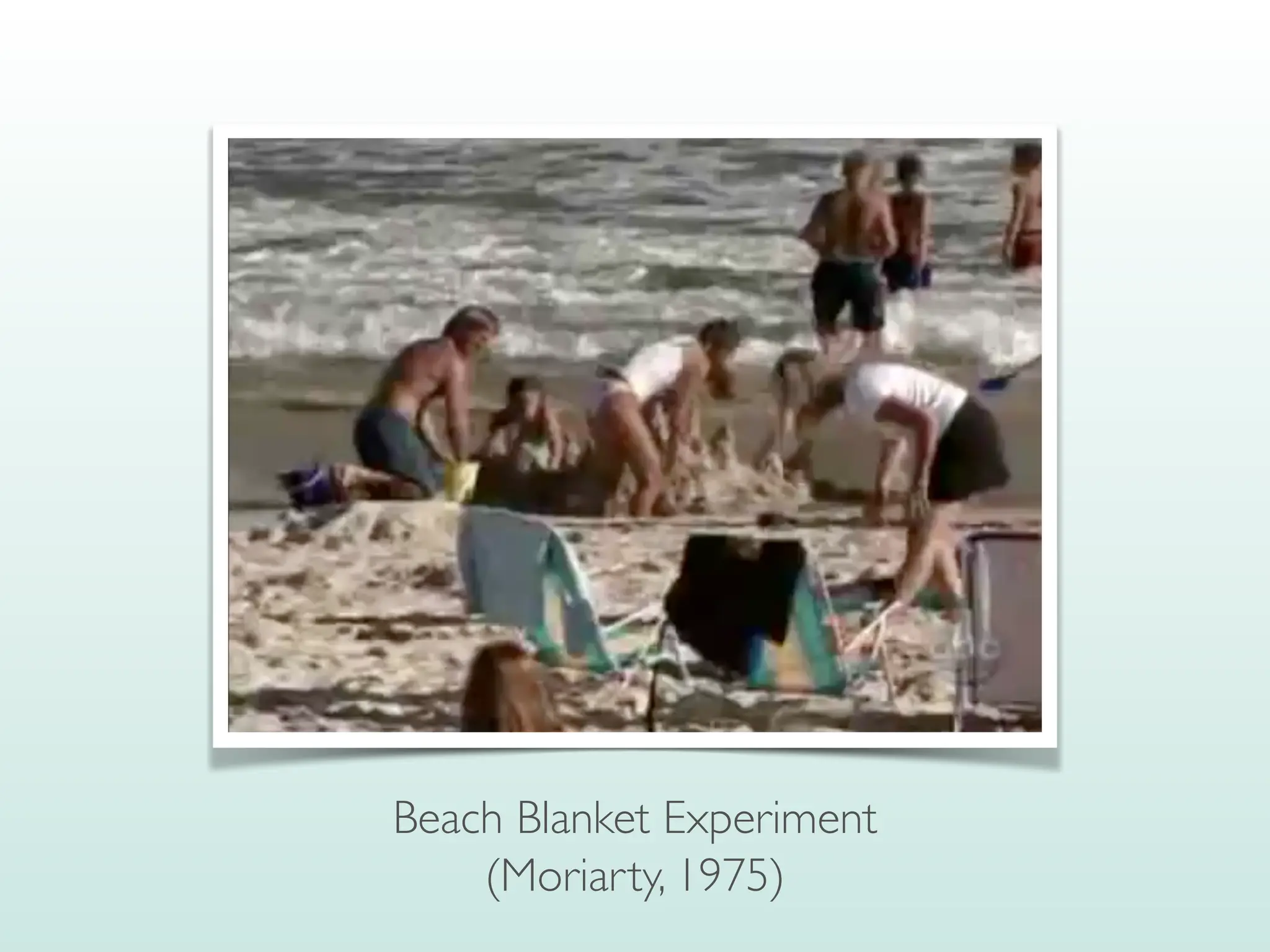
Beach Blanket Experiment:
(Moriarty,1975)
• Put blanket down 5 feet away from
stranger, then left
• Pretend thief steals radio
• 4 out of 20 apprehended thief
• “Please watch my things” request
• 19 out of 20 apprehended thief
COMMITMENT
Once we make a choice, we feel pressured
to act consistently with that commitment
1. Heavy pre-holidayadvertising
2. Kids request toy
3. Parents commit to buying toy
4. Companies undersupply toy stores
5. Toy is sold out everywhere
6. Parent buys a substitute toy
7. Heavy post-holiday advertising
8. Kids remind parents of their promise
9. Parents give in to avoid breaking promise
TOY COMPANIES &
The Commitment Exploitation
Desire to be & look consistent in words, deeds, beliefs, attitudes
9.
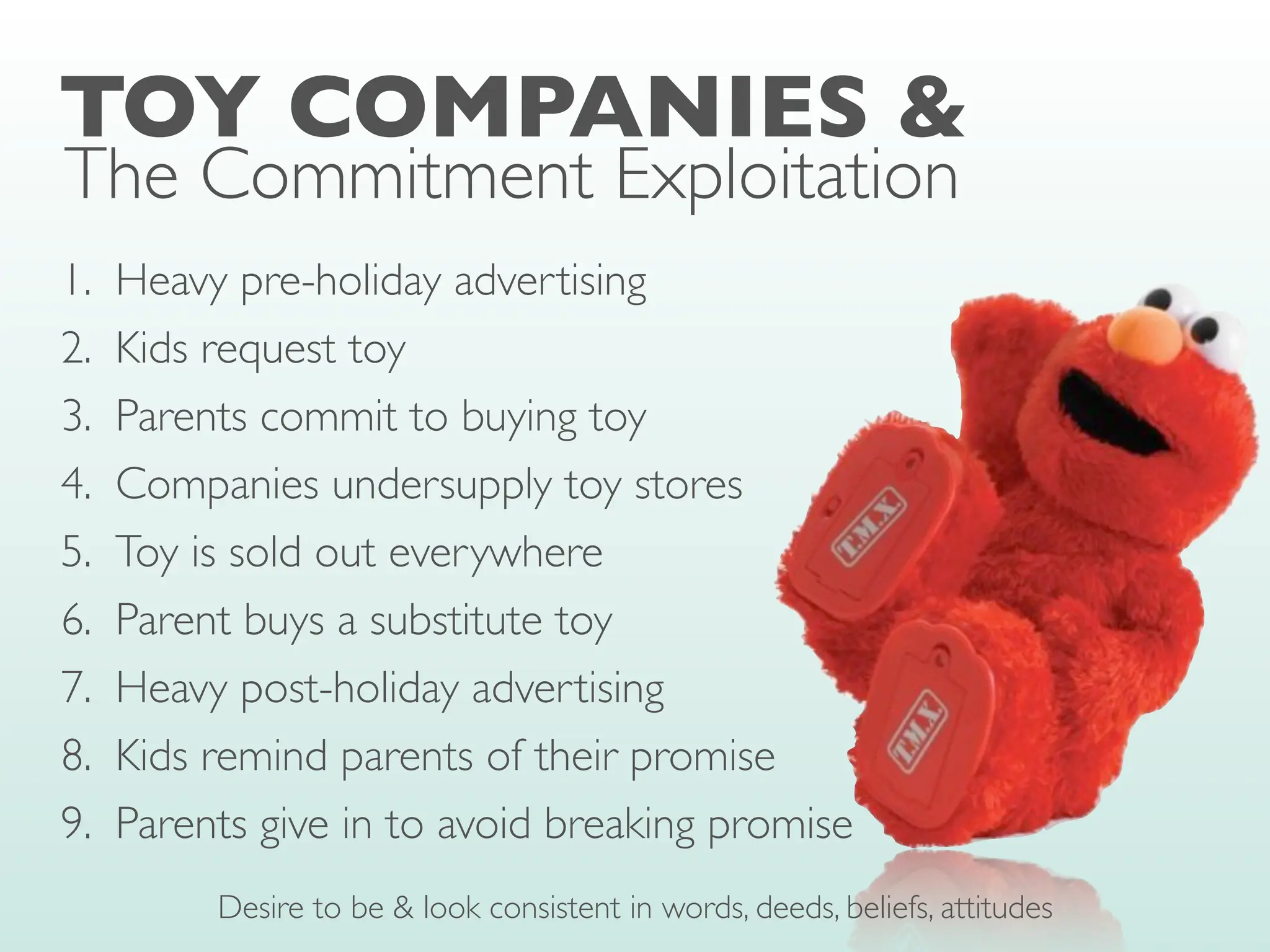
Social Proof/Validation: Thegreater the number of people who
fi
nd
idea correct, the more an individual will perceive idea to be correct
10.
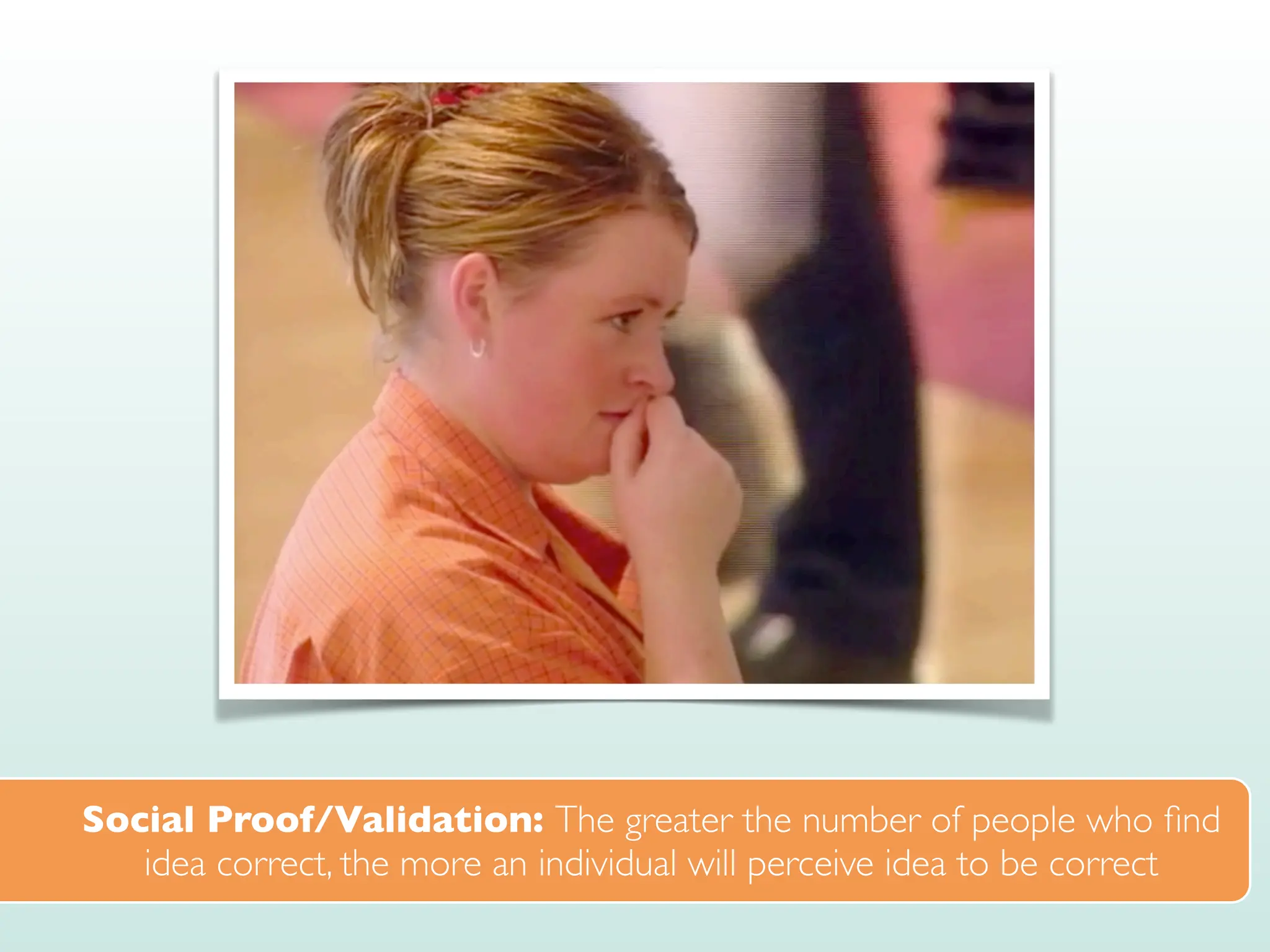
Social Proof/Validation: Thegreater the number of people who
fi
nd
idea correct, the more an individual will perceive idea to be correct
11.
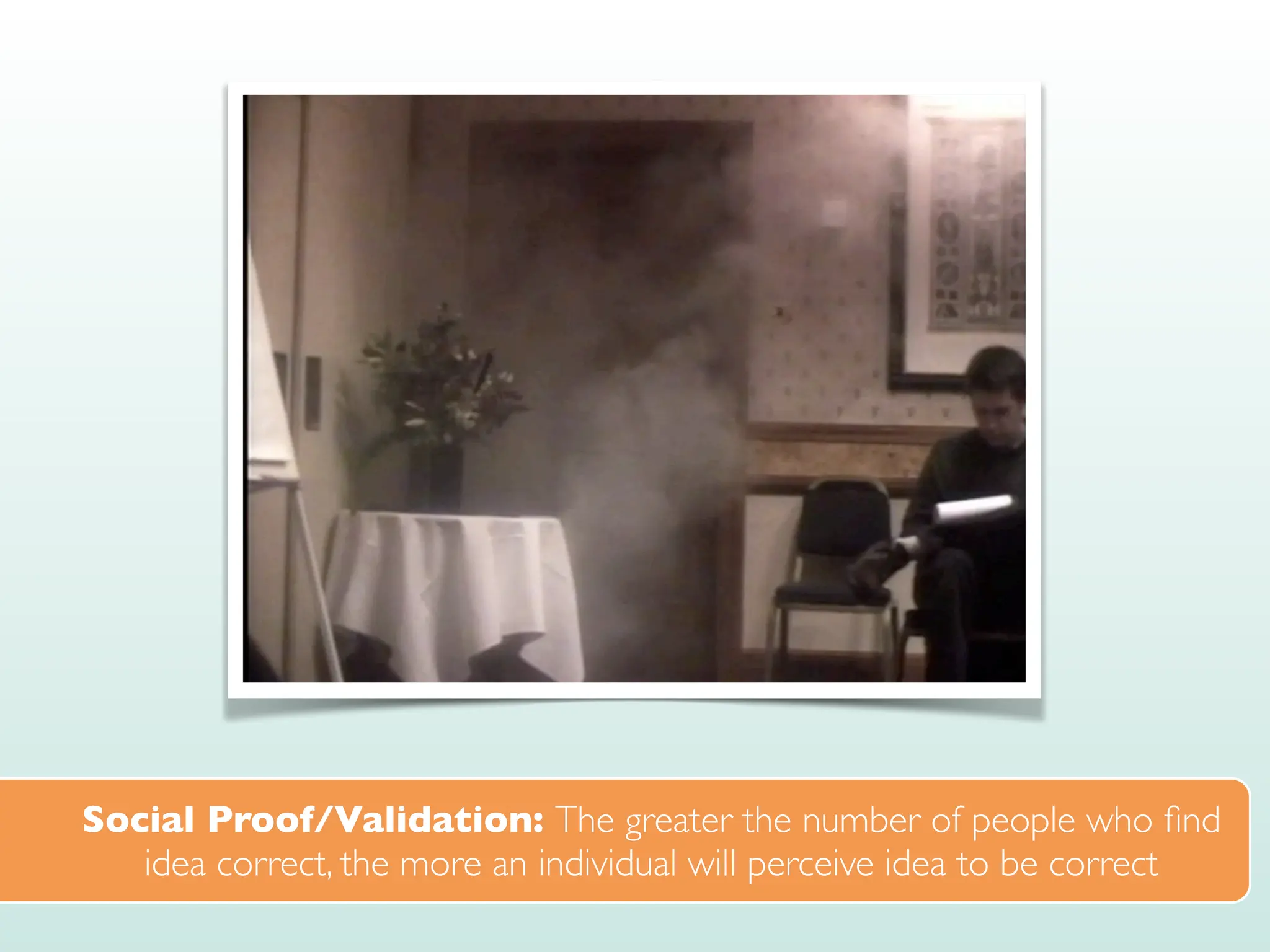
Social Proof/Validation: Thegreater the number of people who
fi
nd
idea correct, the more an individual will perceive idea to be correct
12.
AUTHORITY
We comply torequests from authority
fi
gures
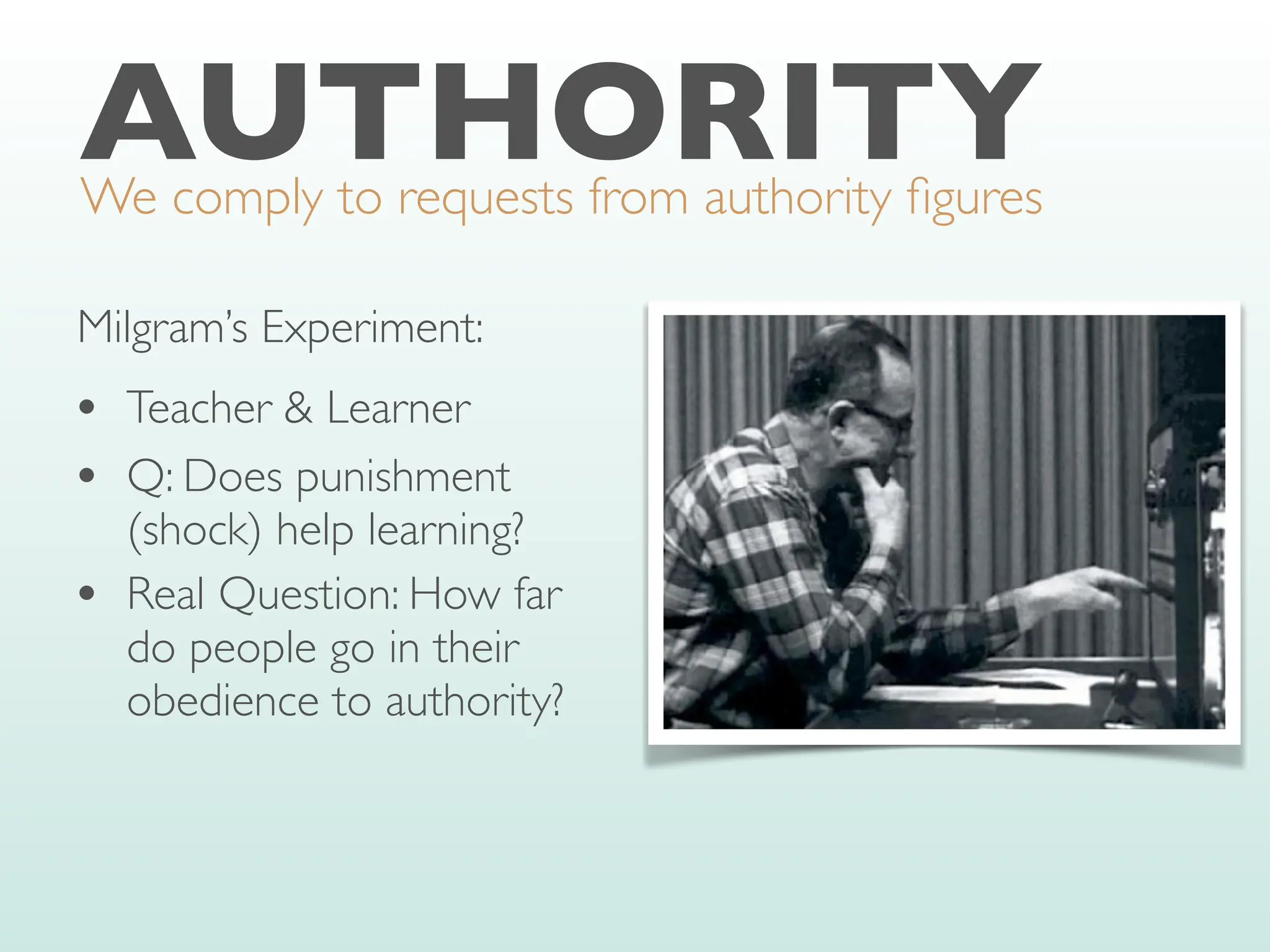
Milgram’s Experiment:
• Teacher & Learner
• Q: Does punishment
(shock) help learning?
• Real Question: How far
do people go in their
obedience to authority?
If the subjectindicated desire to halt the experiment, he was
given a succession of verbal prods by the experimenter:
1. Please continue.
2. The experiment requires that you continue.
3. Whether the learner likes it or not, we must continue
4. It is absolutely essential that you continue.
5. You have no other choice, you must go on.
If the subject still wished to stop after all successive verbal
prods, the experiment was halted.
• 65% administered the
fi
nal 450-volt shock
SCARCITY
We want somethingmore when it’s limited
• Duct tape during terror scare
of 2003
• Water, batteries, gas during an
impending hurricane
18.
LIKING
We comply withrequests of people we like
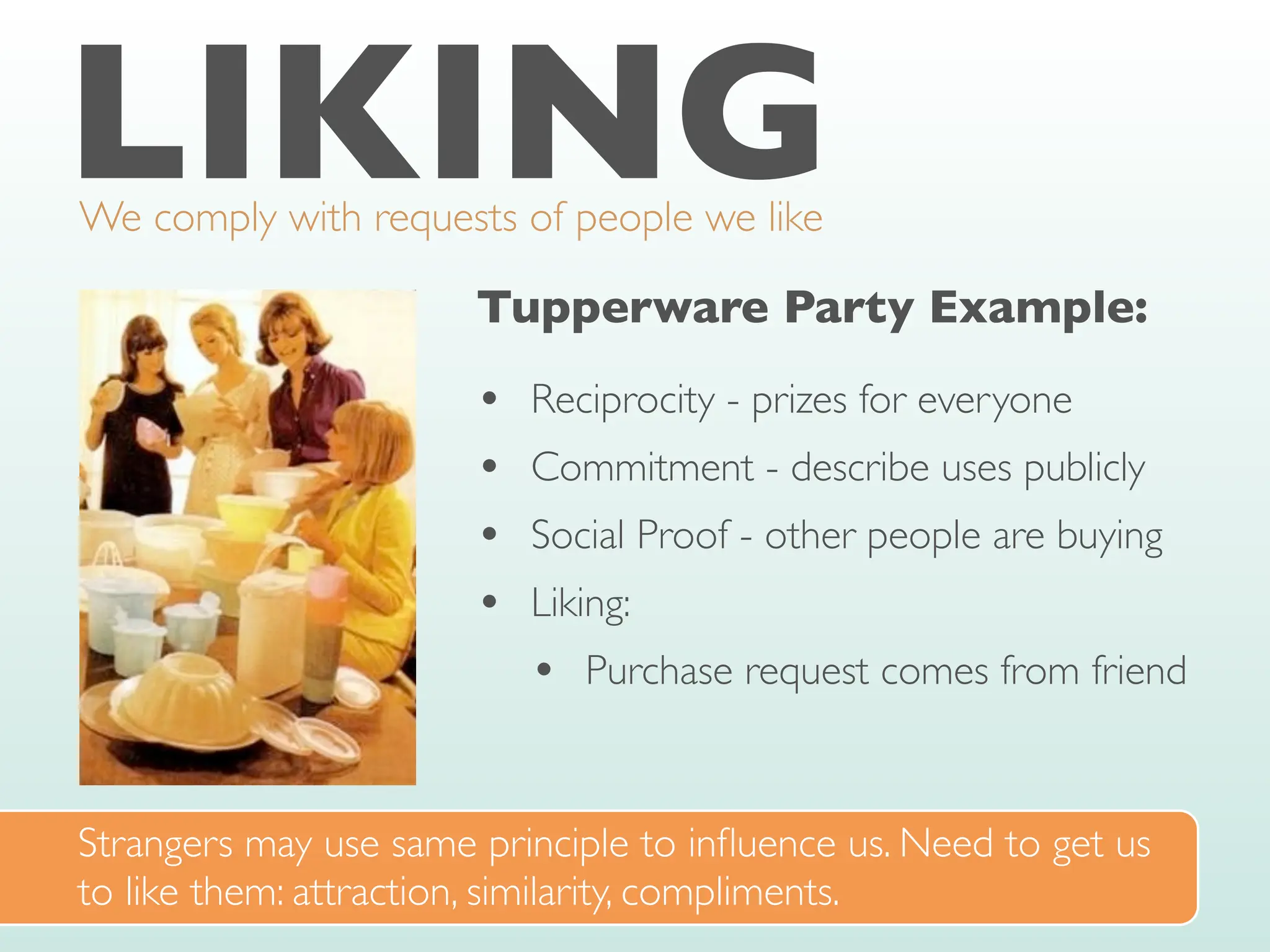
Tupperware Party Example:
• Reciprocity - prizes for everyone
• Commitment - describe uses publicly
• Social Proof - other people are buying
• Liking:
• Purchase request comes from friend
Strangers may use same principle to in
fl
uence us. Need to get us
to like them: attraction, similarity, compliments.
19.
RECIPROCATION
We try torepay, in kind, what another has provided us
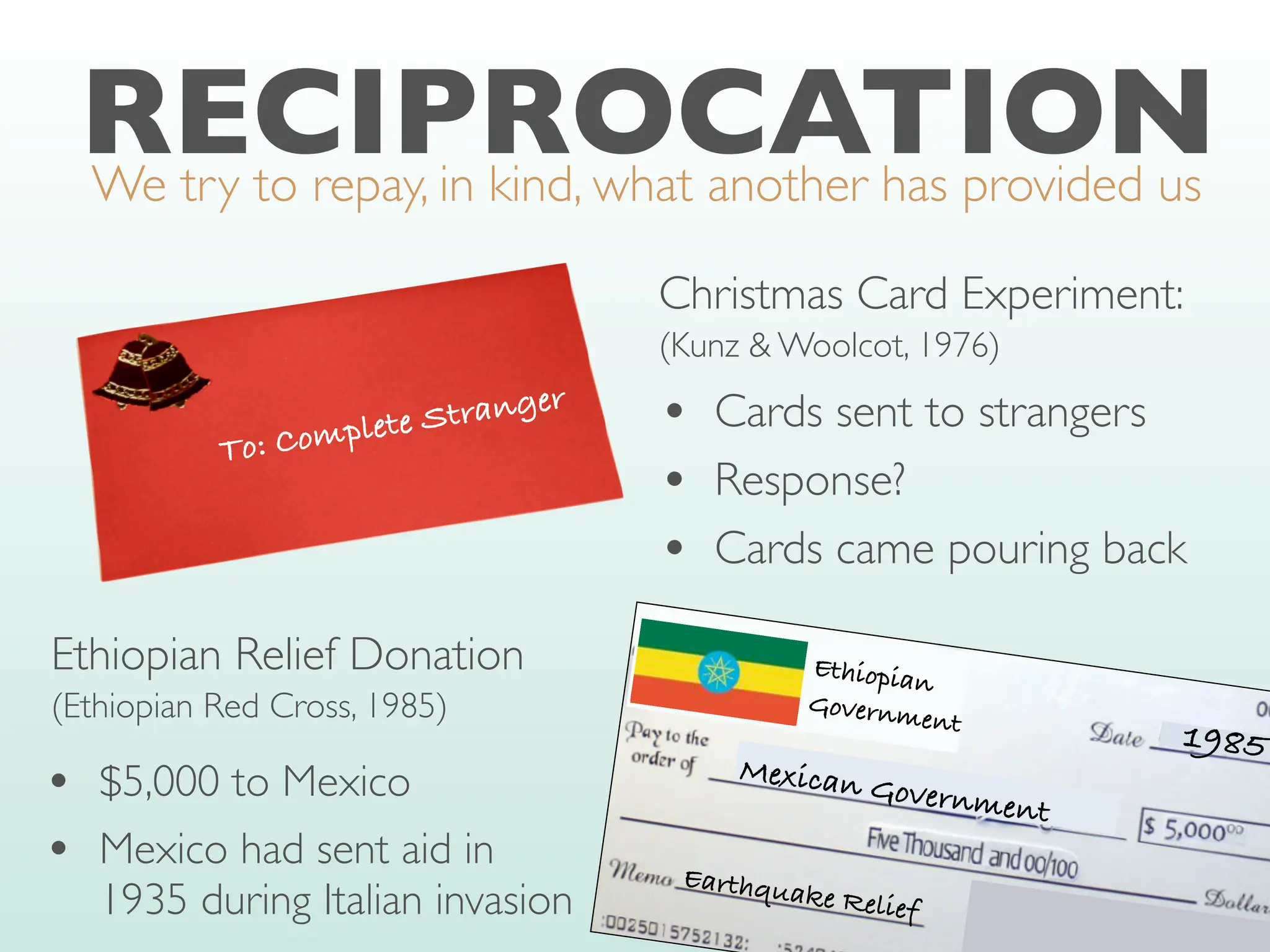
To: Complete Stranger
Christmas Card Experiment:
(Kunz & Woolcot, 1976)
• Cards sent to strangers
• Response?
• Cards came pouring back
Ethiopian
Government
1985
Mexican Government
Earthquake Relief
Ethiopian Relief Donation
(Ethiopian Red Cross, 1985)
• $5,000 to Mexico
• Mexico had sent aid in
1935 during Italian invasion
20.
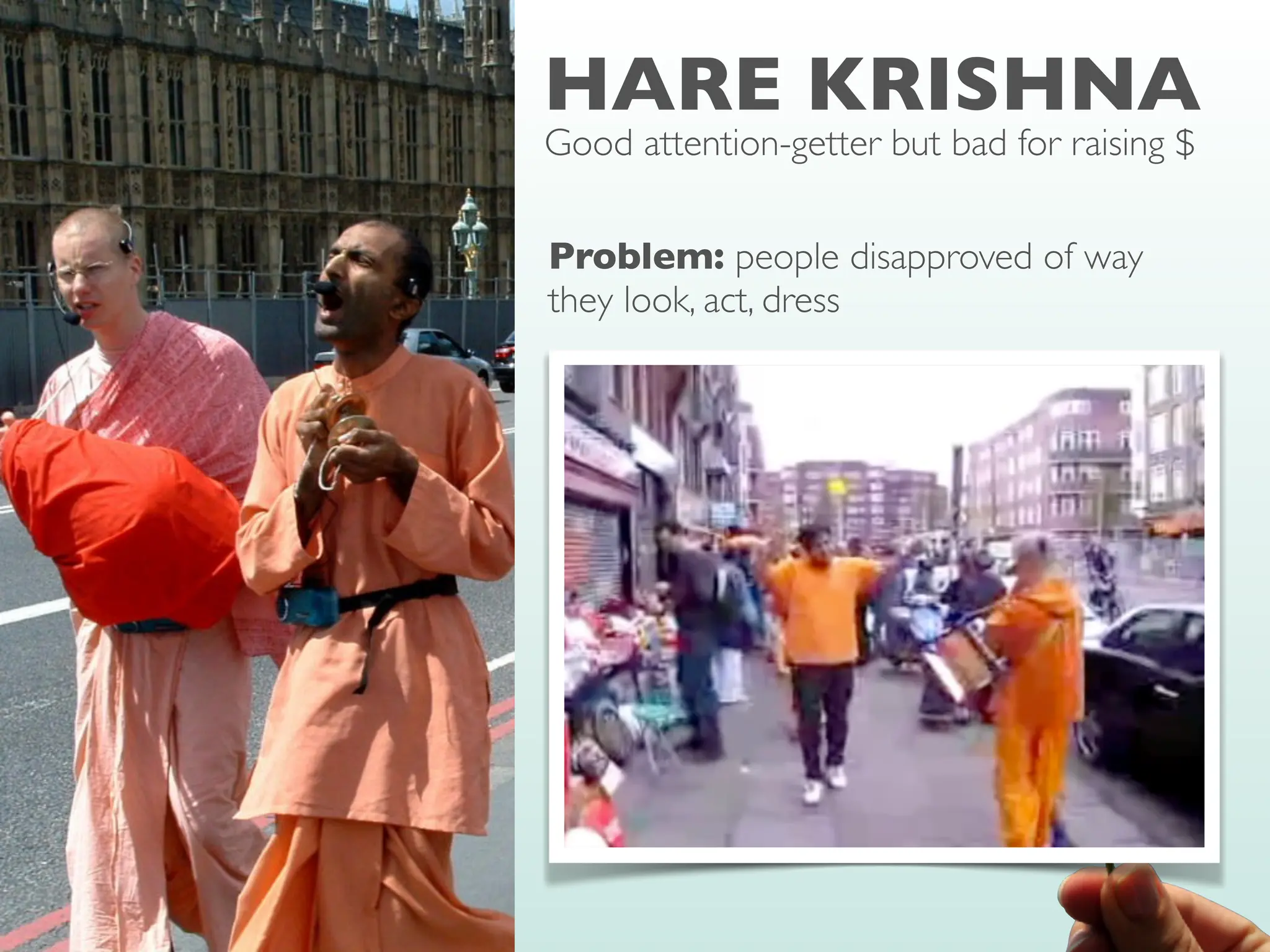
HARE KRISHNA
Good attention-getterbut bad for raising $
Problem: people disapproved of way
they look, act, dress
Solution: Rule of reciprocity is strong
enough to overcome dislike for requester
• Give gift (book,
fl
ower) before making the
request for money
• Don’t allow passersby to return gift
• Benefactor-before-beggar
strategy very successful
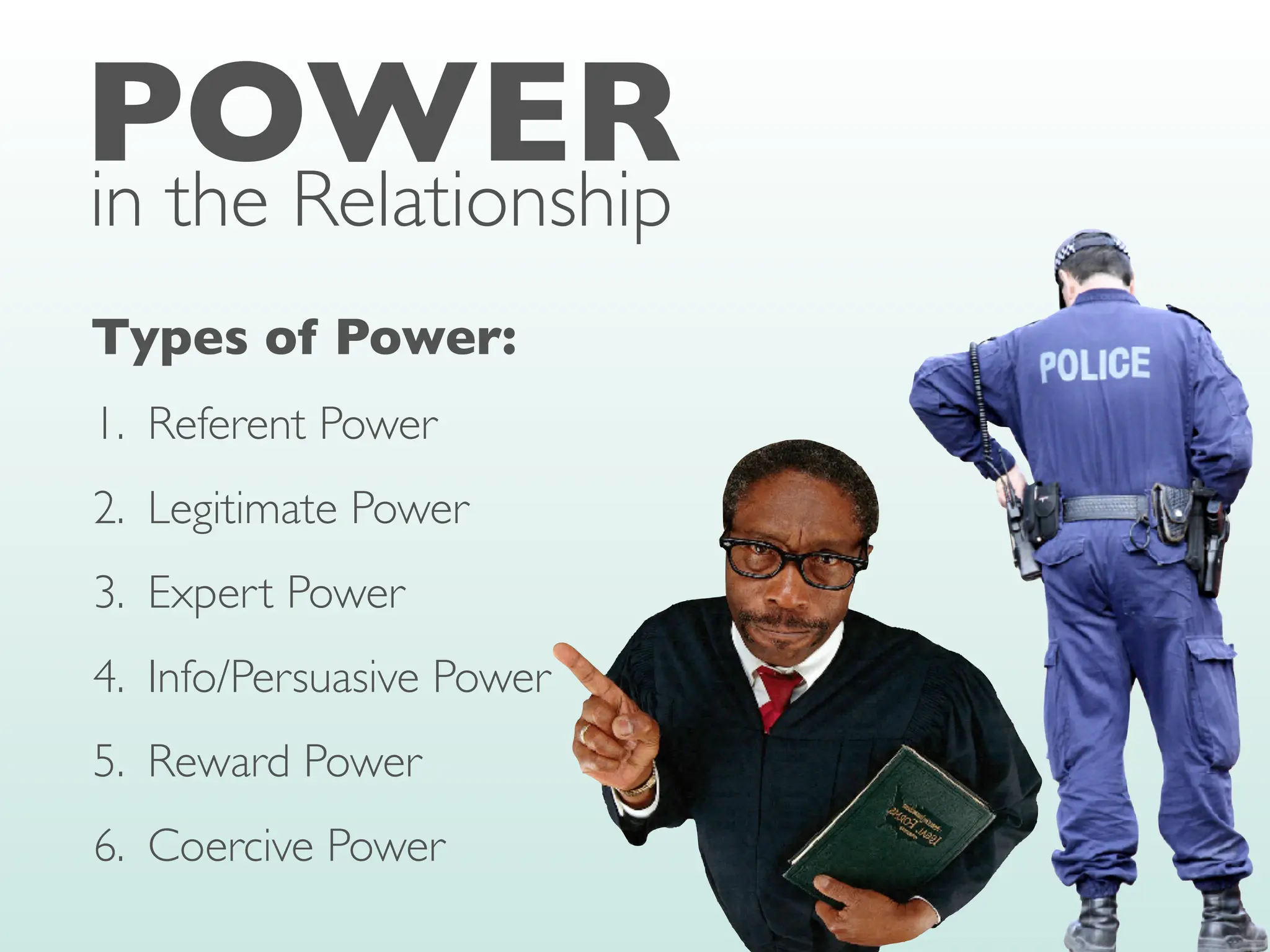
POWER
1. Referent Power
2.Legitimate Power
3. Expert Power
4. Info/Persuasive Power
5. Reward Power
6. Coercive Power
in the Relationship
Types of Power:
23.
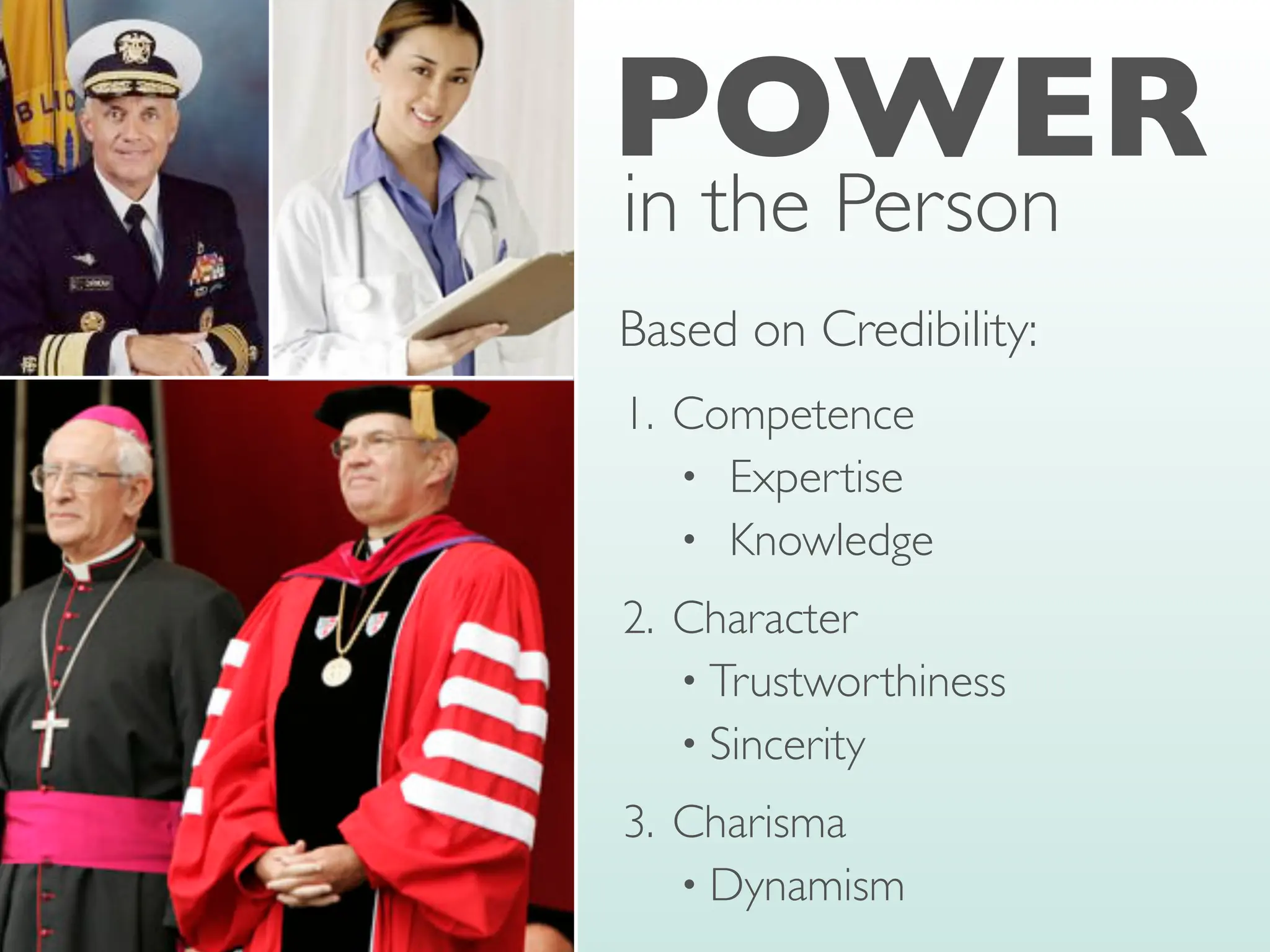
1. Competence
• Expertise
•Knowledge
2. Character
• Trustworthiness
• Sincerity
3. Charisma
• Dynamism
POWER
in the Person
Based on Credibility:
24.
• Hesitations
• Toomany Intensi
fi
ers
• Disquali
fi
ers
• Tag Questions
• Self-Critical statements
• Slang andVulgarity
POWER
in the Message
Language:
25.
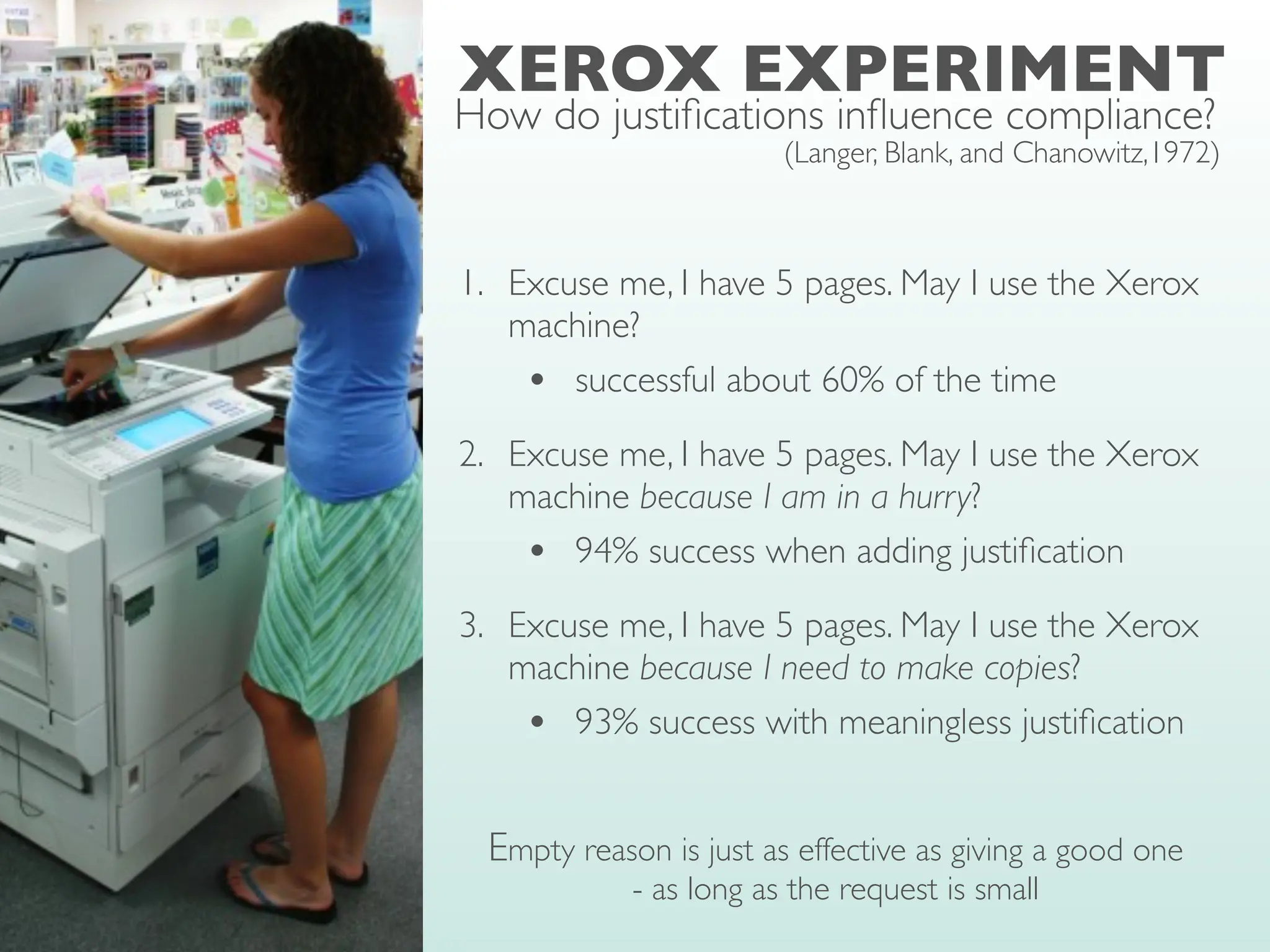
XEROX EXPERIMENT
(Langer, Blank,and Chanowitz,1972)
1. Excuse me, I have 5 pages. May I use the Xerox
machine?
• successful about 60% of the time
2. Excuse me, I have 5 pages. May I use the Xerox
machine because I am in a hurry?
• 94% success when adding justi
fi
cation
3. Excuse me, I have 5 pages. May I use the Xerox
machine because I need to make copies?
• 93% success with meaningless justi
fi
cation
Empty reason is just as effective as giving a good one
- as long as the request is small
How do justi
fi
cations in
fl
uence compliance?
26.
• Speaking Power
•Direct Requests
• Bargaining
• Ingratiation
• Manipulation
• Threatening
POWER
in the Message
27.
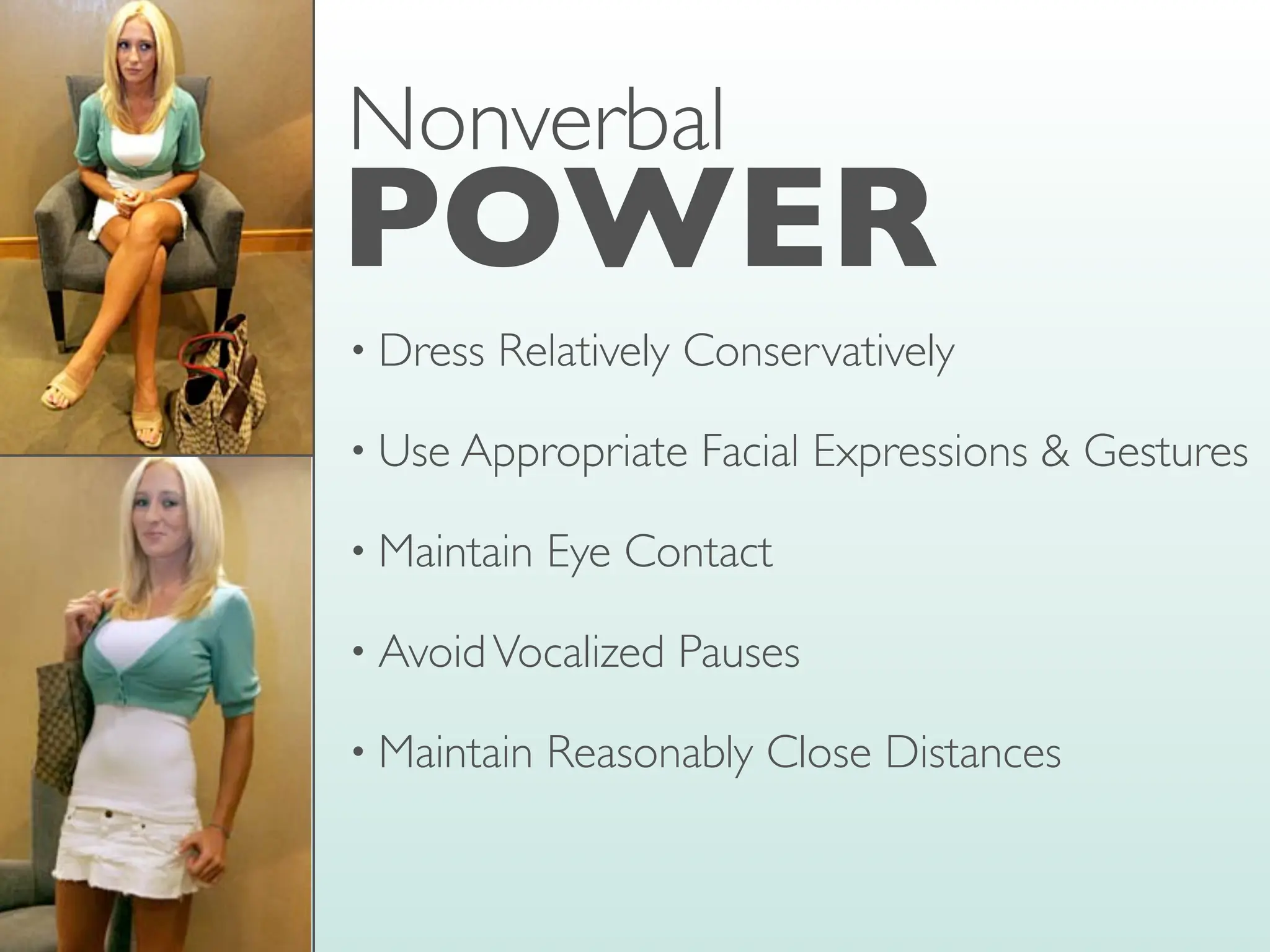
• Dress RelativelyConservatively
• Use Appropriate Facial Expressions & Gestures
• Maintain Eye Contact
• AvoidVocalized Pauses
• Maintain Reasonably Close Distances
POWER
Nonverbal
28.
• Respond inKind to Eye Flashes
• Avoid Adaptors
• Use Consistent Packaging
• Select Easily Accessible Chair
• Exert Firmer than Usual Handshake
• Walk Slowly and Deliberately
POWER
Nonverbal
29.
• Listen Actively
•RespondVisibly but in Moderation
• Maintain Focused Eye Contact
• Resist Adaptors
• Maintain Open Posture
• Avoid Interrupting
• Engage inVisual Dominance Behavior
POWER
Listening
31.
SOCIAL VALIDATION
We determinewhat is correct by
fi
nding out what other
people think is correct
Chicago Doomsday Cult:
(When Prophecy Fails, Festinger, Riecken, Scharter, 1956)
• Researchers in
fi
ltrated cult
• Flood to destroy planet on Dec. 21, 1954
• Believers to be picked up by spaceship
• Preparations:
• removing metal from clothes
• rehearsing passwords:“I left my hat at home”,
“I am my own porter”
• What happens when spaceship doesn’t appear?
32.
DOOMSDAY CULT
• Rationale:Group had spread so much light that
God had saved the world from destruction
• Decision to publicize the explanation
• Before: no press, no recruiting
• After: active recruiting
• No physical proof (spacecraft/
fl
ood) for validity
of beliefs => need for social proof
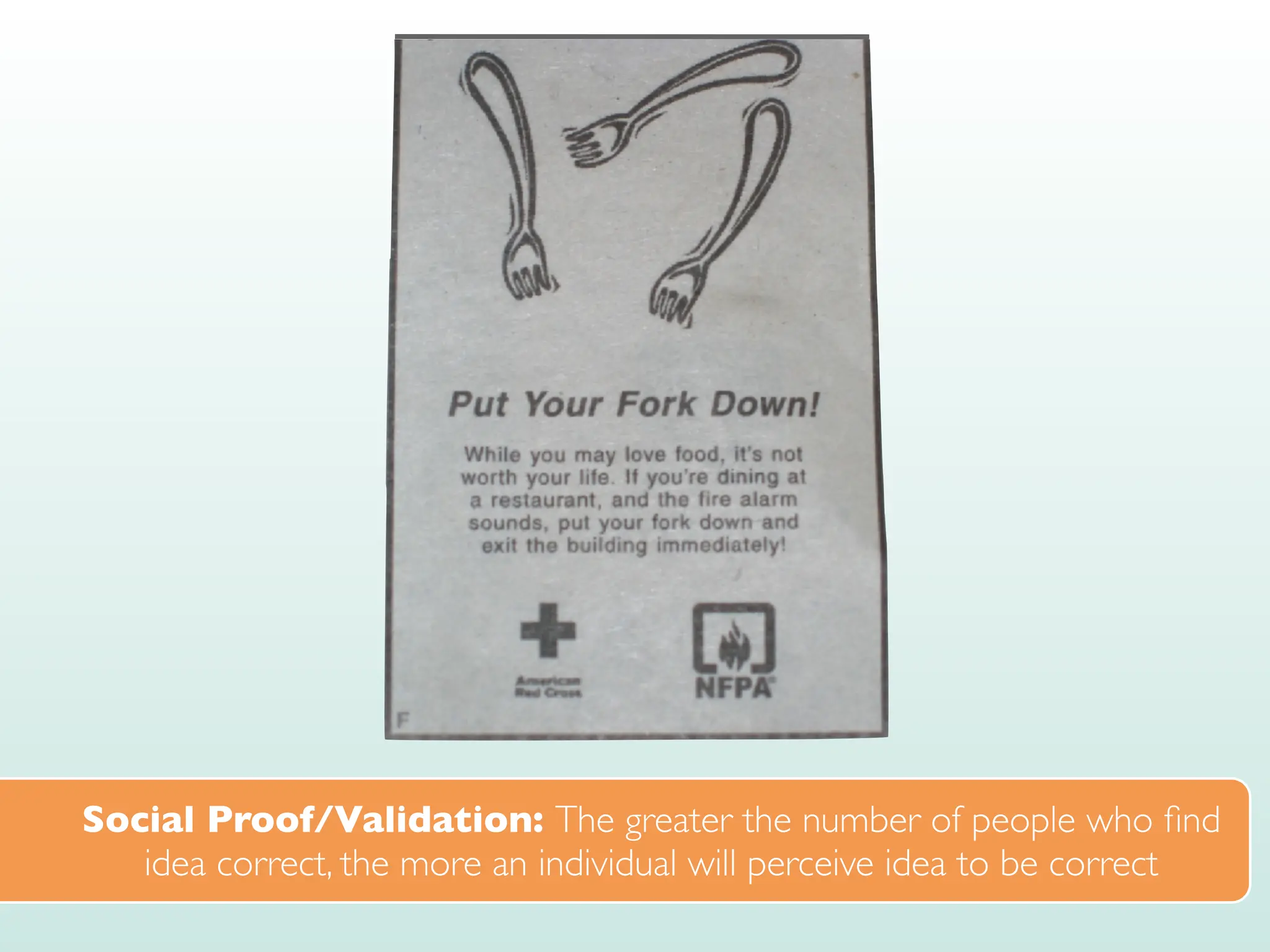
Social Proof/Validation: The greater the number of people who
fi
nd
idea correct, the more an individual will perceive idea to be correct
33.
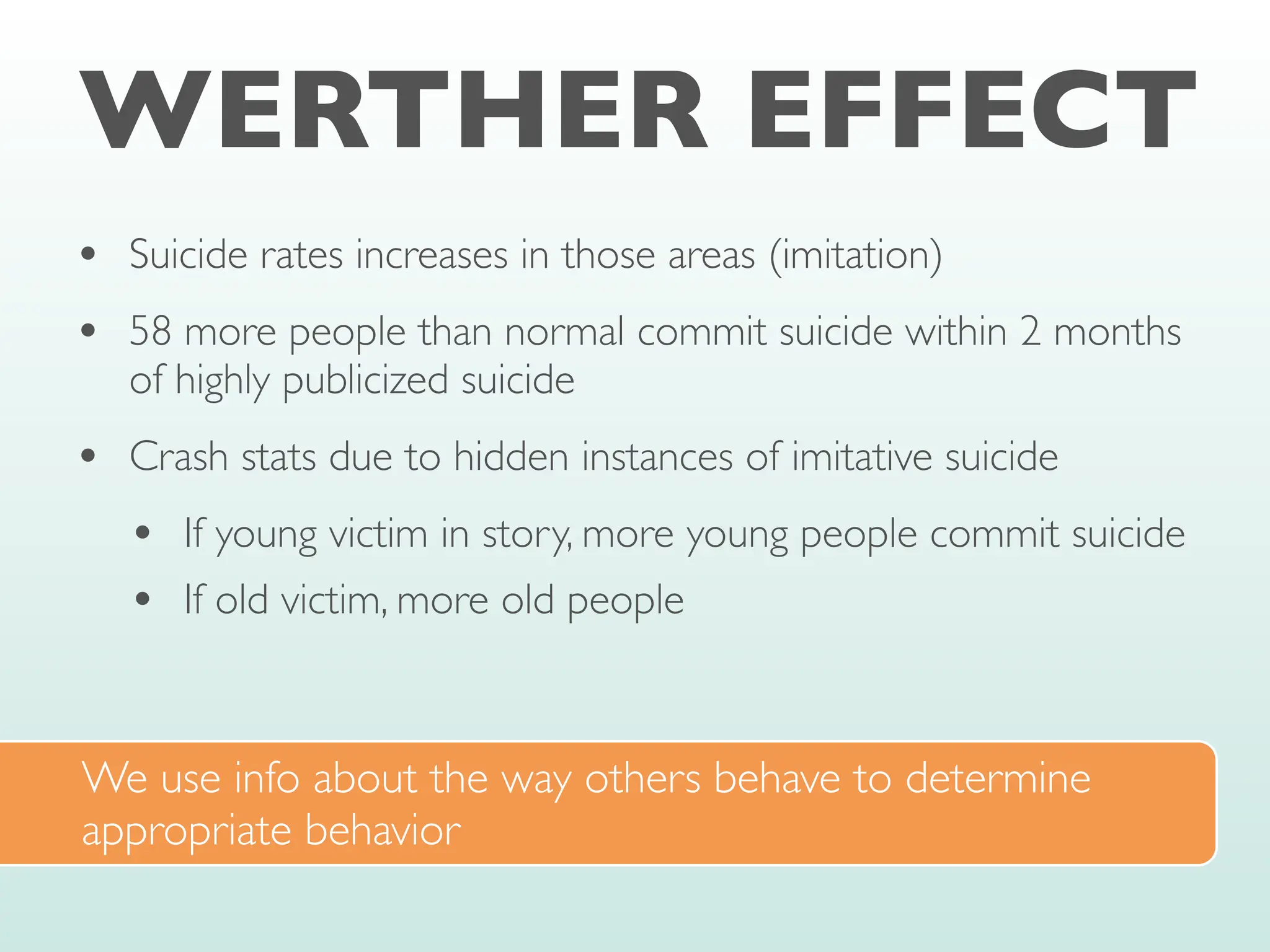
WERTHER EFFECT
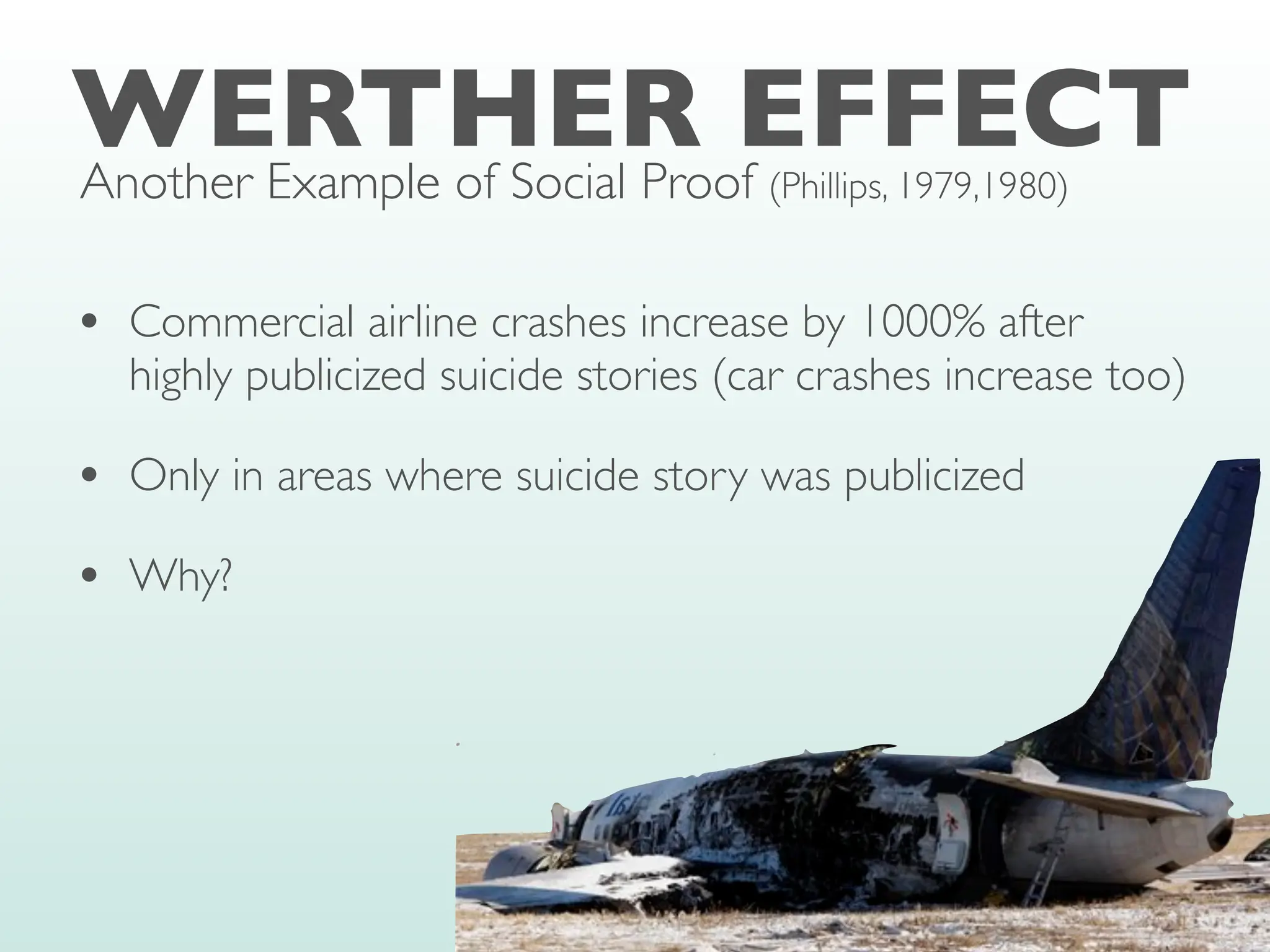
• Commercialairline crashes increase by 1000% after
highly publicized suicide stories (car crashes increase too)
• Only in areas where suicide story was publicized
• Why?
Another Example of Social Proof (Phillips, 1979,1980)
34.
WERTHER EFFECT
• Suiciderates increases in those areas (imitation)
• 58 more people than normal commit suicide within 2 months
of highly publicized suicide
• Crash stats due to hidden instances of imitative suicide
• If young victim in story, more young people commit suicide
• If old victim, more old people
We use info about the way others behave to determine
appropriate behavior