Presenter
Hem Raj Pant
frenndlyhem01234@gmail.com
Msc. Ag
Department of Plant pathology
AFU- Agriculture and Forestry University
Rampur, chitwan
www.afu.edu.np
A Presentation on
CURRENT STATUS AND POTENTIAL OF BIOLOGICAL
CONTROL OF COTTON INSECT AND DISEASE PESTS
What isbiologicalcontrol
Biological control is "the action of
parasites, predators, or pathogens in
maintaining another organism's population
density at a lower average than would
occur in their absence".
This management technology has
received much attention in recent times.
Why biologicalcontrol
 Highly economical in a long run
 Selective with no side effects
 Self propagating and self-perpetuating
 Pest resistance to BCAs is virtually unknown
 No harmful effects on humans, livestock's and
other organisms
 Efficiency, greater ability to search their prey
 Improved quality of produce
 Compatible with most of the IPM components
WHY not common in use in Nepal
 Very few researches have been conducted in this field in our
country
 Expensive at startup
 Insufficient technical Manpower knowledge
 Doesn't completely destroy a pest
 Does not have a broad-spectrum as insecticides & fungicides
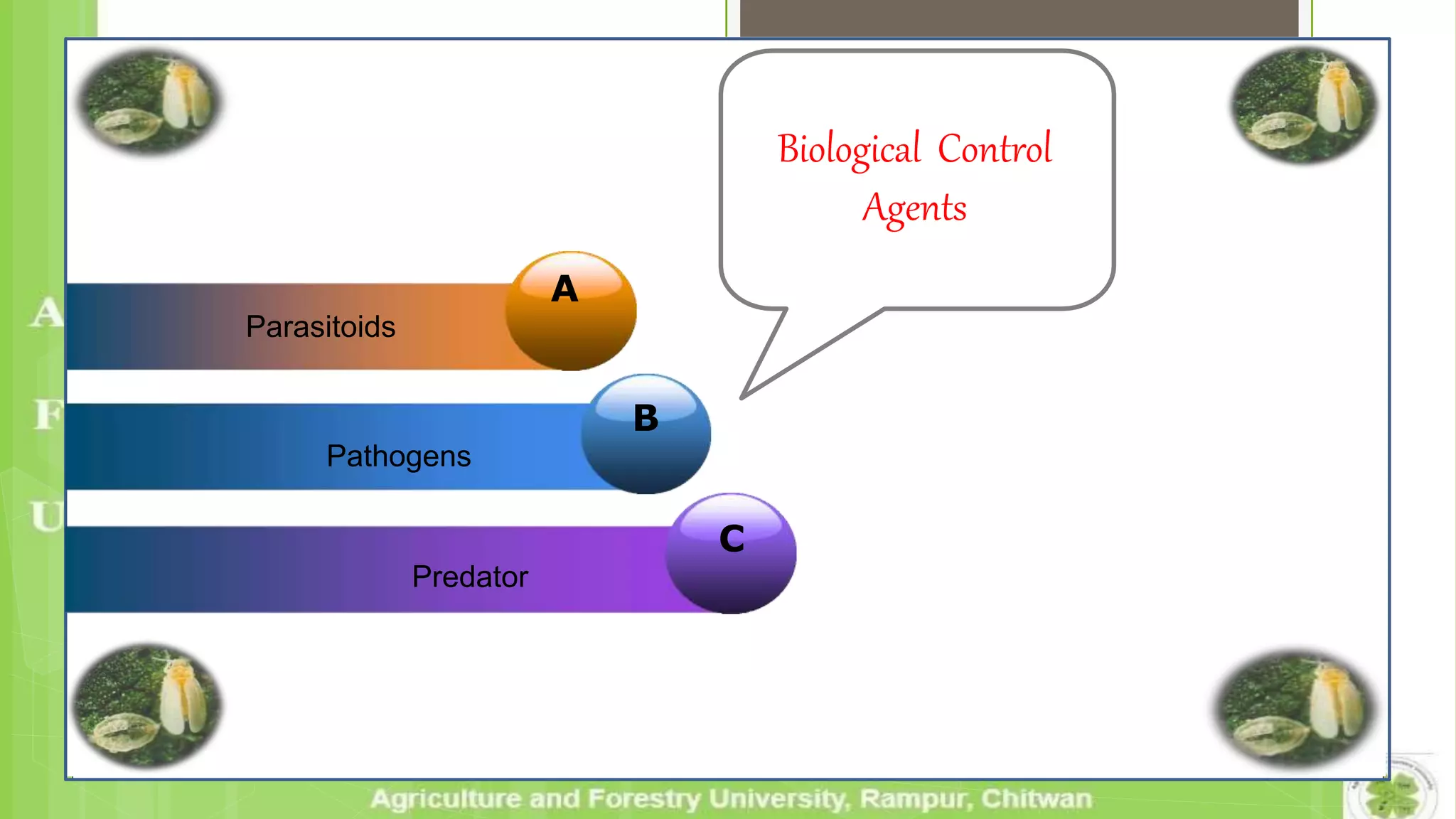
Biological Control
Agents
A
Parasitoids
B
Pathogens
C
Predator
Parasitoid
 Each parasitoids requires only one host, which it kills for its
development into a free living adult.
 Parasitoids are of the same size as the hosts , or sometimes even
smaller.
Mechanism
Examples
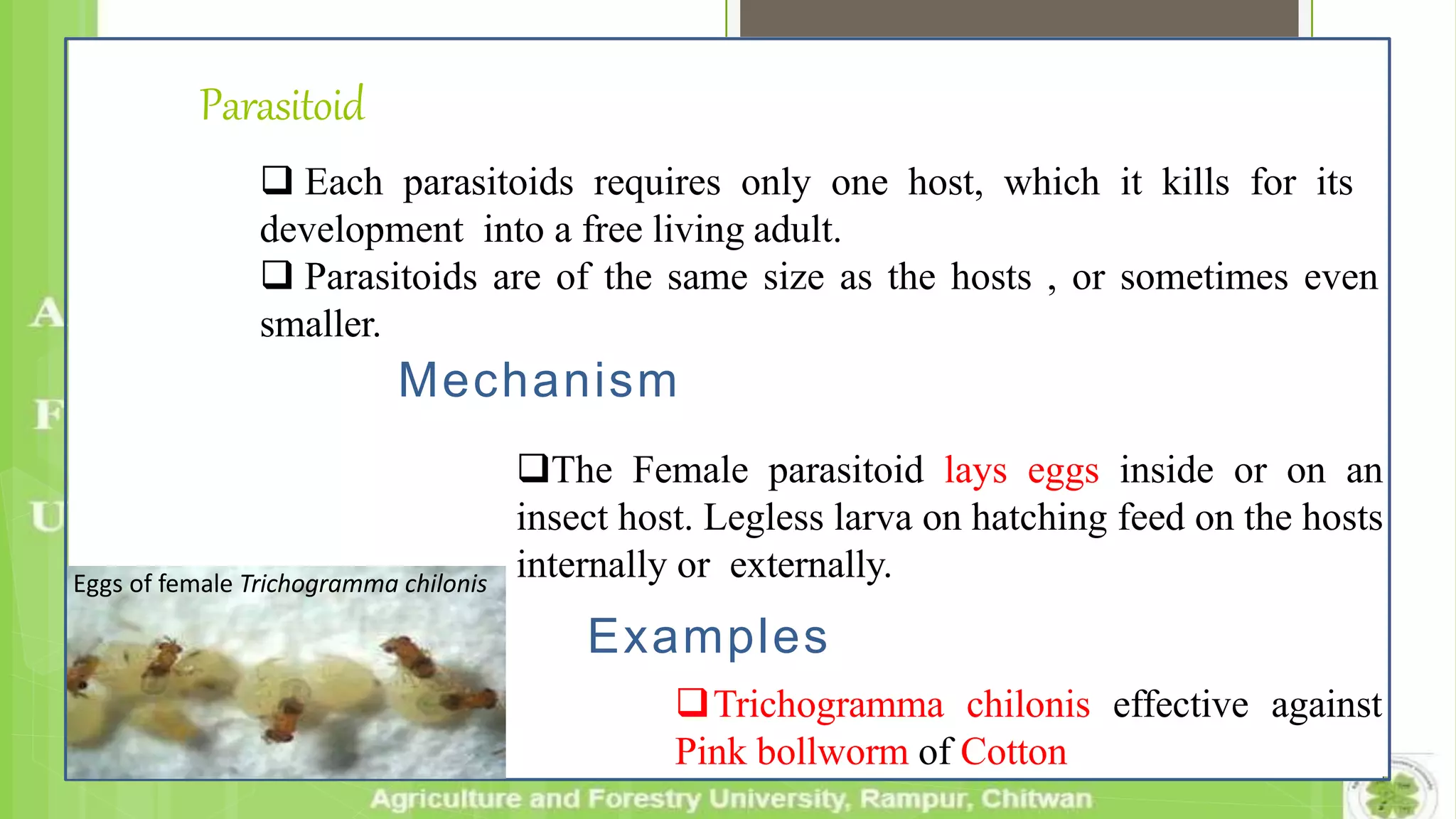
Trichogramma chilonis effective against
Pink bollworm of Cotton
Eggs of female Trichogramma chilonis
The Female parasitoid lays eggs inside or on an
insect host. Legless larva on hatching feed on the hosts
internally or externally.
Pathogen
Pathogens are disease causing organisms e.g. Bacteria, Fungi, Viruses,
Protozoa and Nematodes in insect and disease pests which kill their
host or debilitate the future generation.
Mechanism
Examples
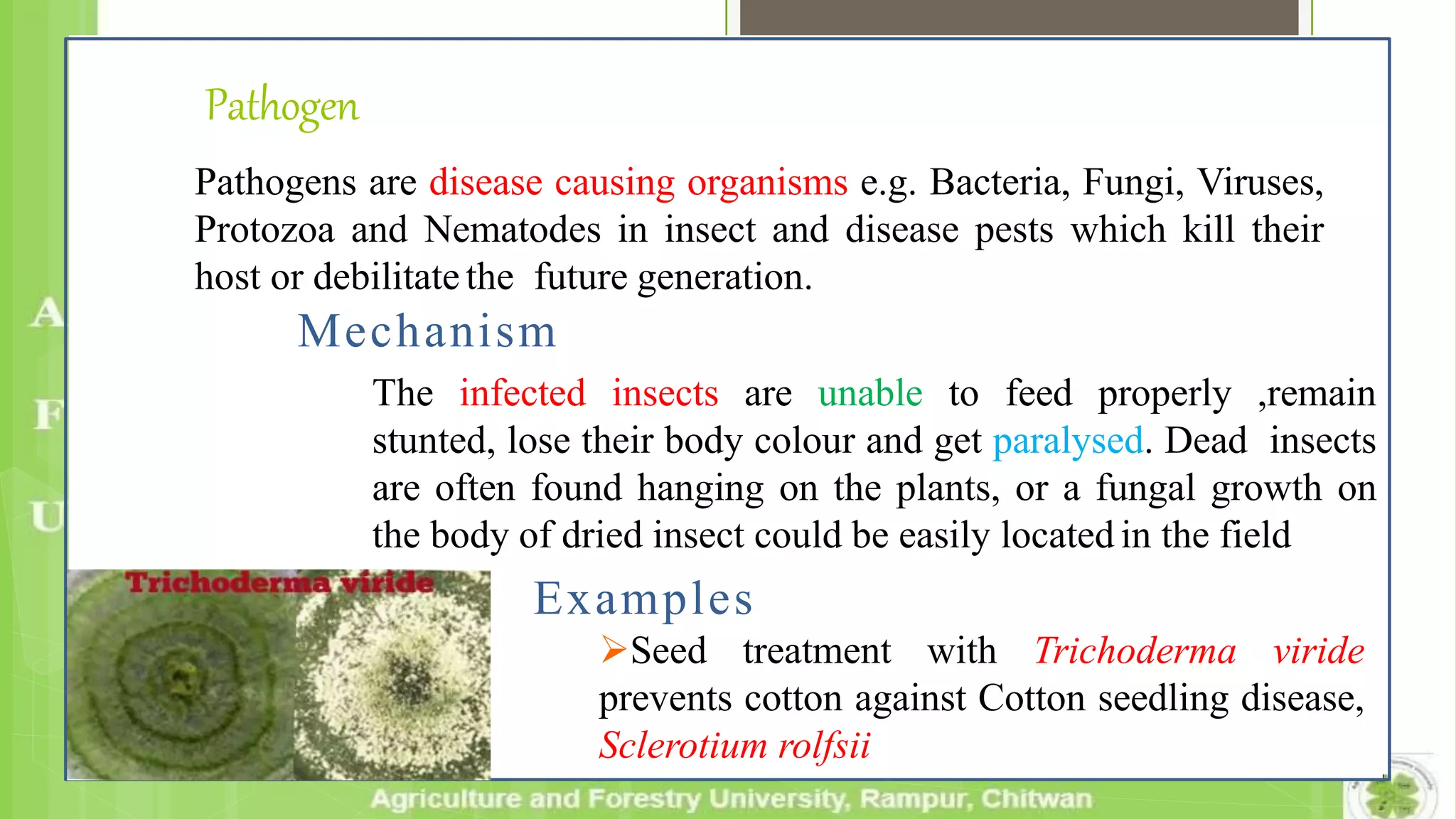
Seed treatment with Trichoderma viride
prevents cotton against Cotton seedling disease,
Sclerotium rolfsii
The infected insects are unable to feed properly ,remain
stunted, lose their body colour and get paralysed. Dead insects
are often found hanging on the plants, or a fungal growth on
the body of dried insect could be easily located in the field
Predator
These are free living and larger in size than their prey, requiring several
preys to complete their life cycle. Some smaller predators release a
powerful poison, use a trap or hunt in groups to be more effective.
Mechanism
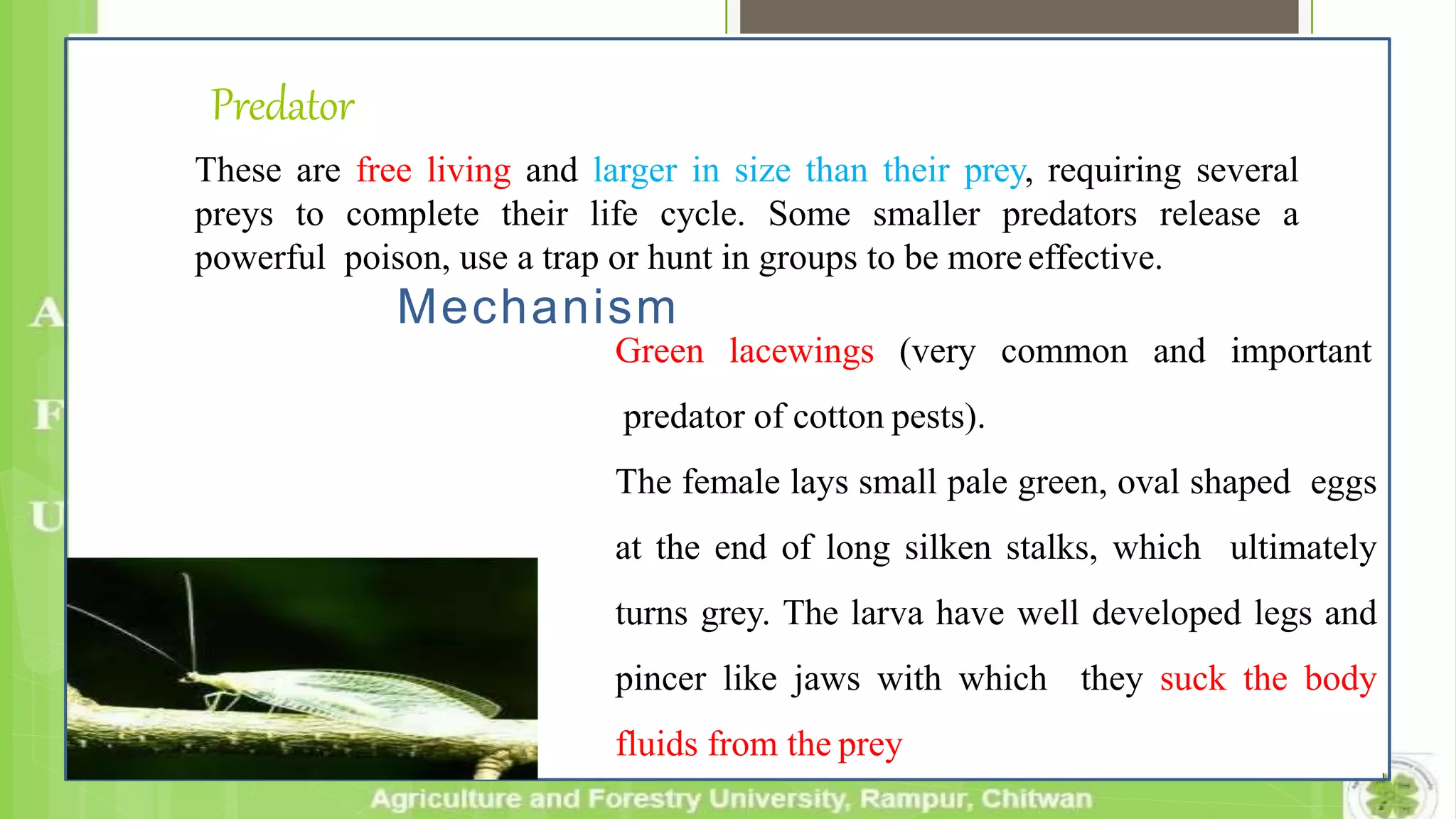
Green lacewings (very common and important
predator of cotton pests).
The female lays small pale green, oval shaped eggs
at the end of long silken stalks, which ultimately
turns grey. The larva have well developed legs and
pincer like jaws with which they suck the body
fluids from the prey
TYPES OF BIOLOGICAL PEST CONTROL
1. Importation or classical biological control: The control of a pest species by
introduced natural enemies
2. Augmentation: Propagation (mass culturing) and release of NE to increase its
population. Two types,
(i) Inoculative release: Control expected from the progeny and subsequent
generations only.
(ii) Inundative release: NE mass cultured and released to suppress pest
directly e.g. Trichogramma spp. (egg parasitoid), Chrysoperla carnia
(Predator)
3. Conservation: Actions that preserve and increase NE by environmental
manipulation e.g. Use of selective insecticides, Provide alternate host for NE.
(Gossypium hirsutum)
INTRODUCTION
Cotton is referred to as “King of Fibres” and also known as “White
Gold”.
It is also backbone of textile industry.
China is the world’s largest producer of cotton
45% world’s fiber need is met from cotton.
10% of world’s edible oil is met from cotton.
Cotton in Nepal
143 ha and total production of 127 Mt with productivity of 0.89
ton/ha (MoAD, 2016/17)
IMPORTANCE OFCOTTON
It is cultivated primarily for lint.
Raw cotton is also used for medical and surgical purpose.
Linters are used cushions, pillows etc.
Linters Also used for high grade paper, rayon, films,
explosives.
Seed crushed for edible oil.
Cakes and meals are excellent cattle feed.
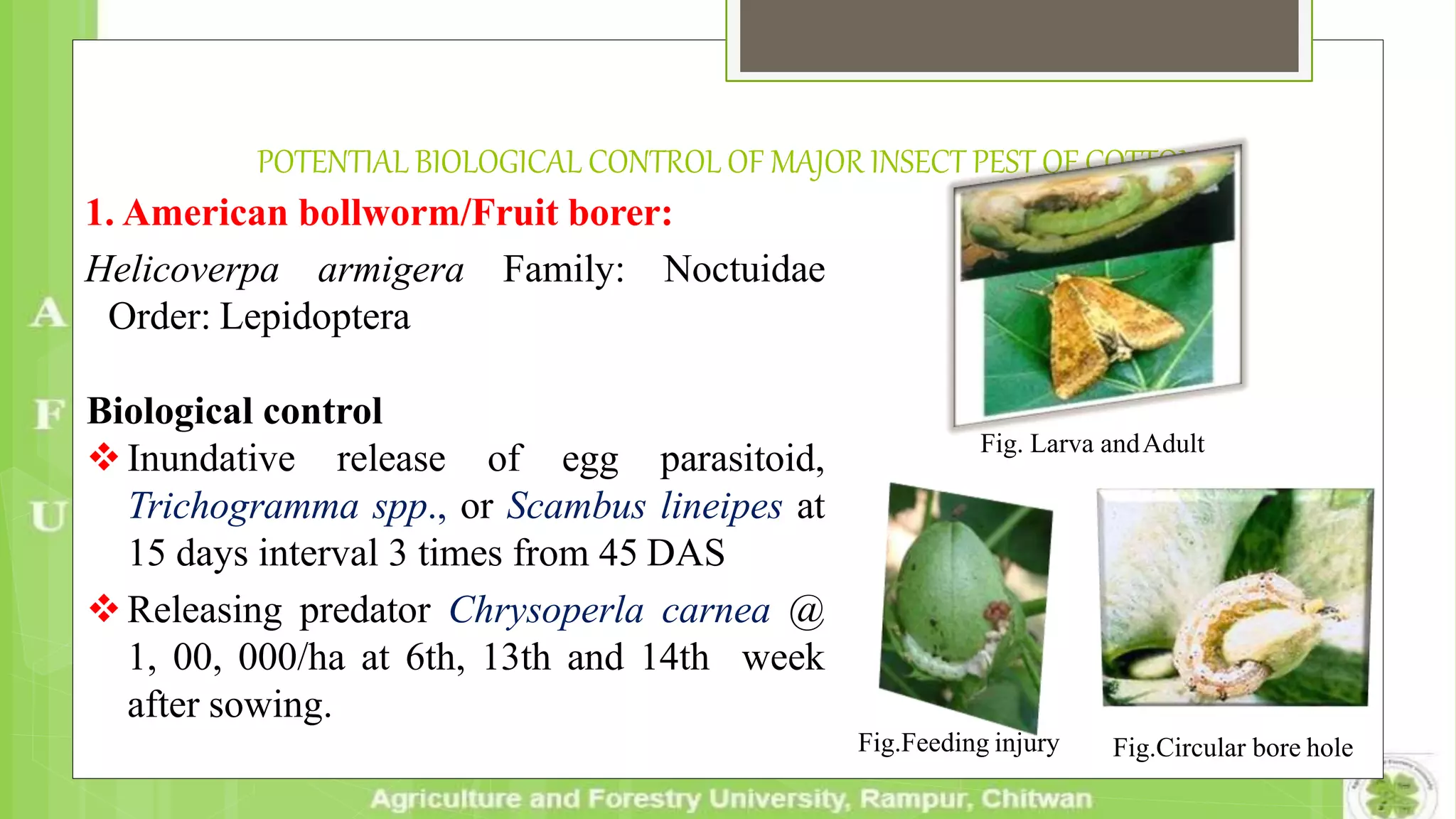
POTENTIAL BIOLOGICAL CONTROL OF MAJOR INSECT PEST OF COTTON
1. American bollworm/Fruit borer:
Helicoverpa armigera Family: Noctuidae
Order: Lepidoptera
Biological control
Inundative release of egg parasitoid,
Trichogramma spp., or Scambus lineipes at
15 days interval 3 times from 45 DAS
Releasing predator Chrysoperla carnea @
1, 00, 000/ha at 6th, 13th and 14th week
after sowing.
Fig.Feeding injury Fig.Circular bore hole
Fig. Larva andAdult
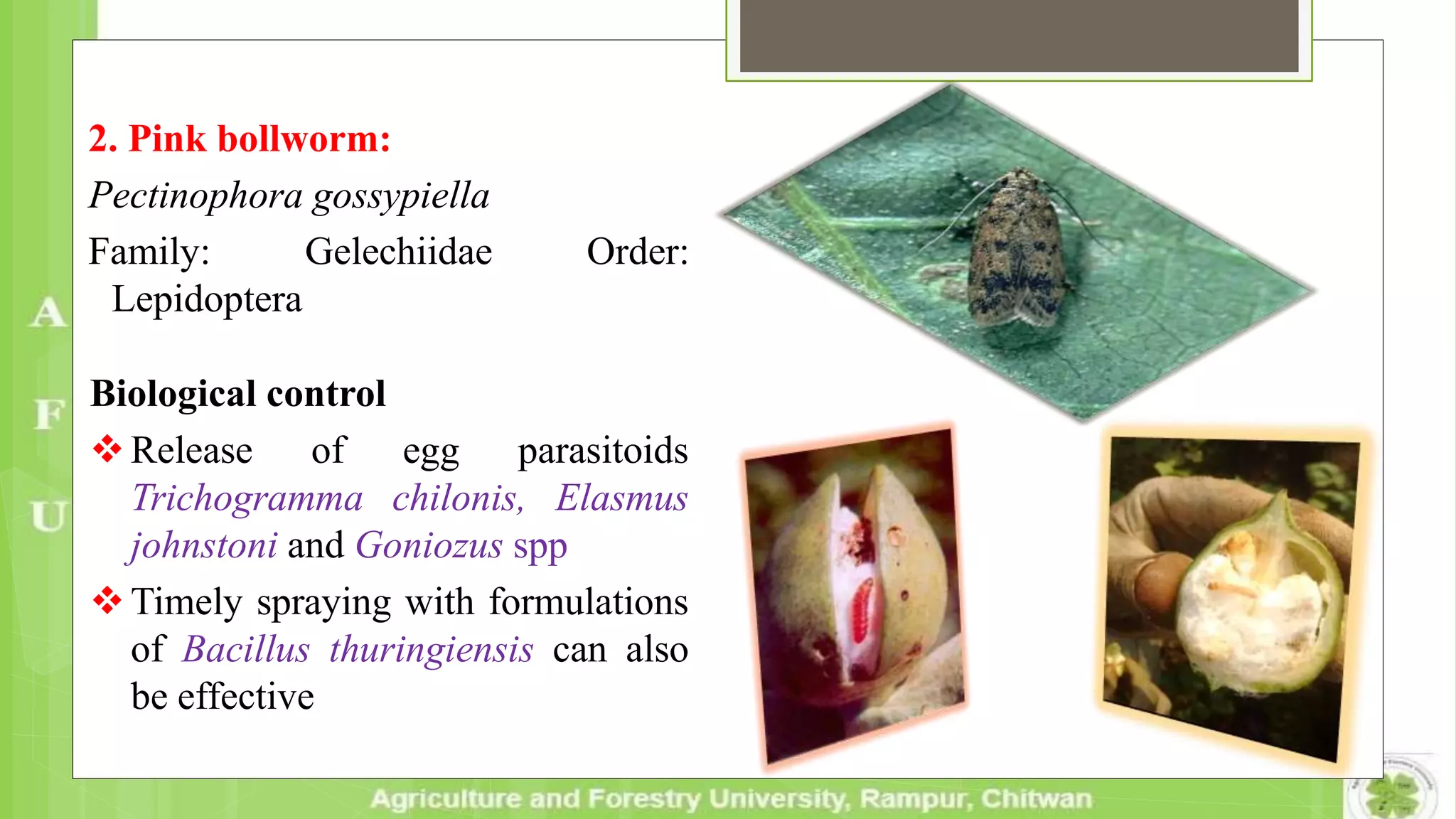
2. Pink bollworm:
Pectinophora gossypiella
Family: Gelechiidae Order:
Lepidoptera
Biological control
Release of egg parasitoids
Trichogramma chilonis, Elasmus
johnstoni and Goniozus spp
Timely spraying with formulations
of Bacillus thuringiensis can also
be effective
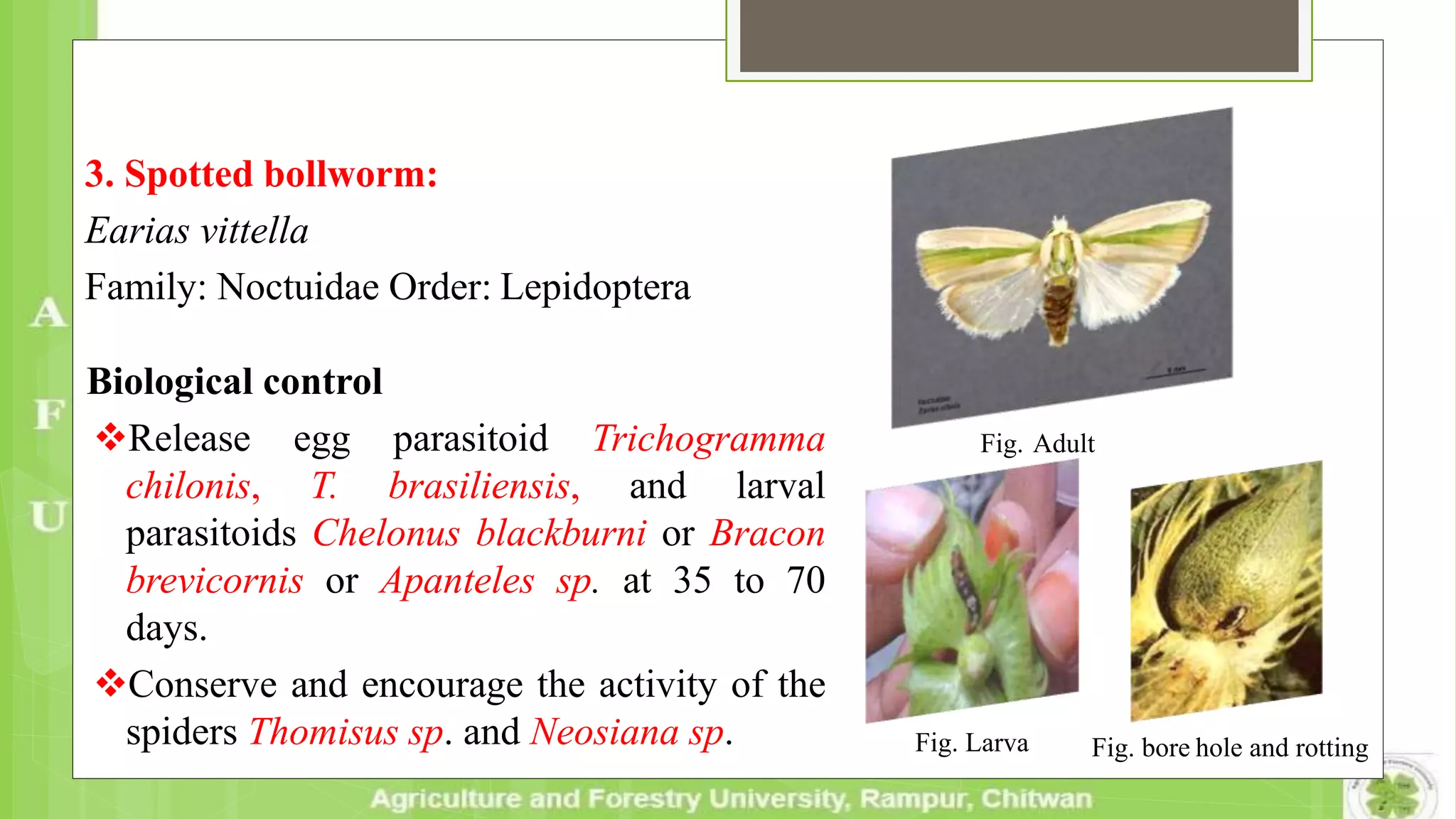
3. Spotted bollworm:
Earias vittella
Family: Noctuidae Order: Lepidoptera
Biological control
Release egg parasitoid Trichogramma
chilonis, T. brasiliensis, and larval
parasitoids Chelonus blackburni or Bracon
brevicornis or Apanteles sp. at 35 to 70
days.
Conserve and encourage the activity of the
spiders Thomisus sp. and Neosiana sp. Fig. Larva Fig. bore hole and rotting
Fig. Adult
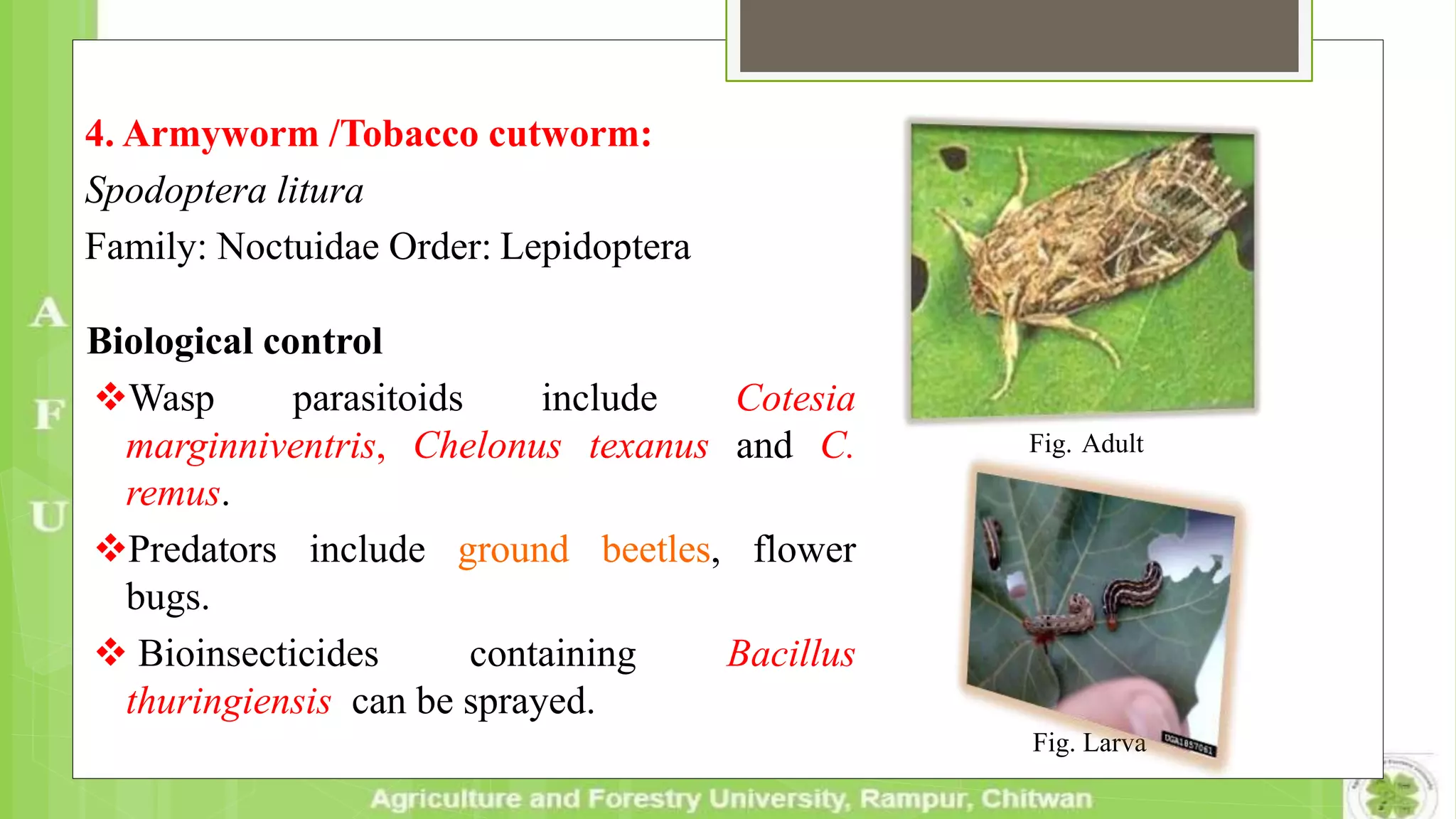
4. Armyworm /Tobacco cutworm:
Spodoptera litura
Family: Noctuidae Order: Lepidoptera
Biological control
Wasp parasitoids include Cotesia
marginniventris, Chelonus texanus and C.
remus.
Predators include ground beetles, flower
bugs.
 Bioinsecticides containing Bacillus
thuringiensis can be sprayed.
Fig. Larva
Fig. Adult
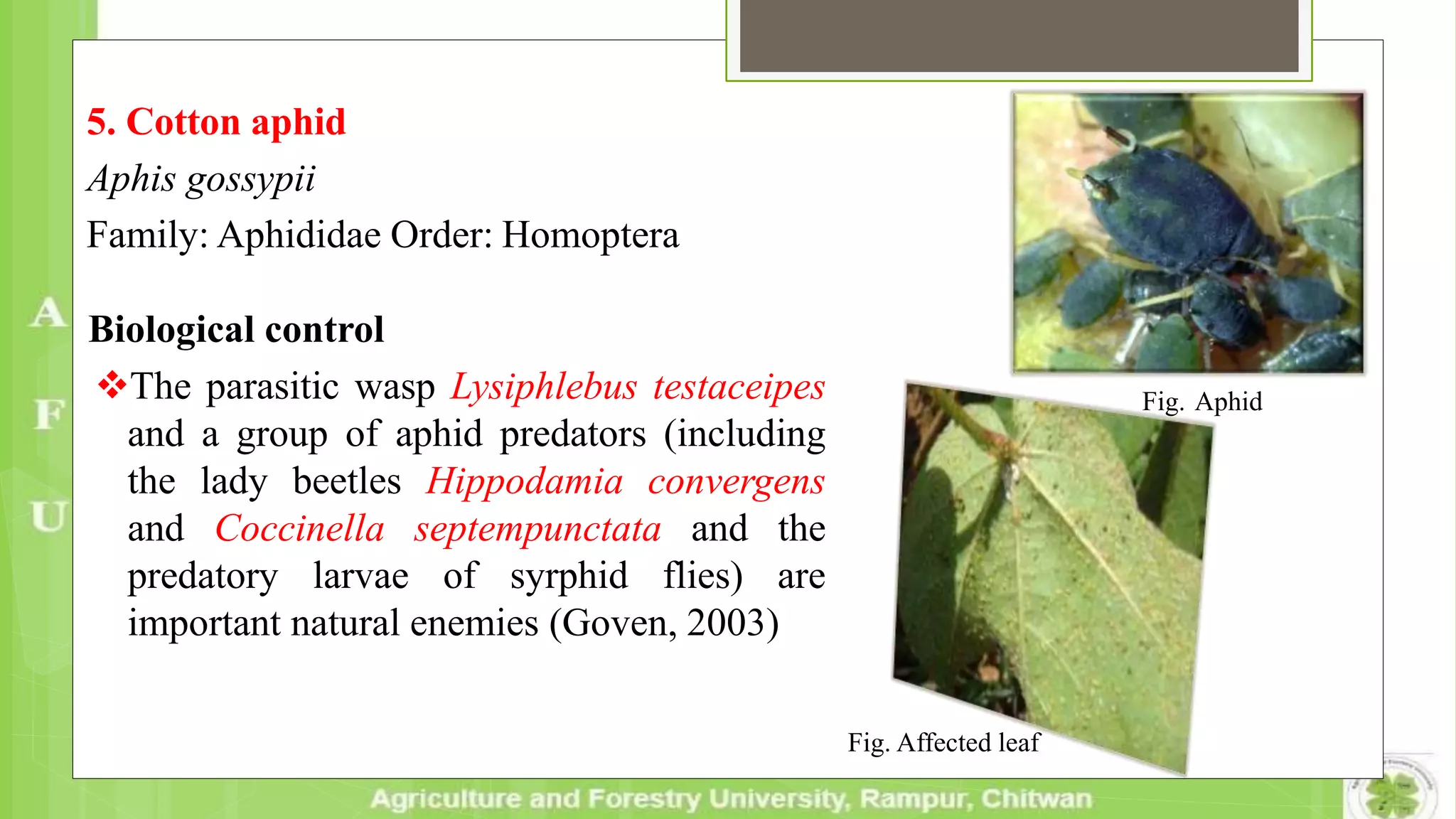
5. Cotton aphid
Aphis gossypii
Family: Aphididae Order: Homoptera
Biological control
The parasitic wasp Lysiphlebus testaceipes
and a group of aphid predators (including
the lady beetles Hippodamia convergens
and Coccinella septempunctata and the
predatory larvae of syrphid flies) are
important natural enemies (Goven, 2003)
Fig. Affected leaf
Fig. Aphid
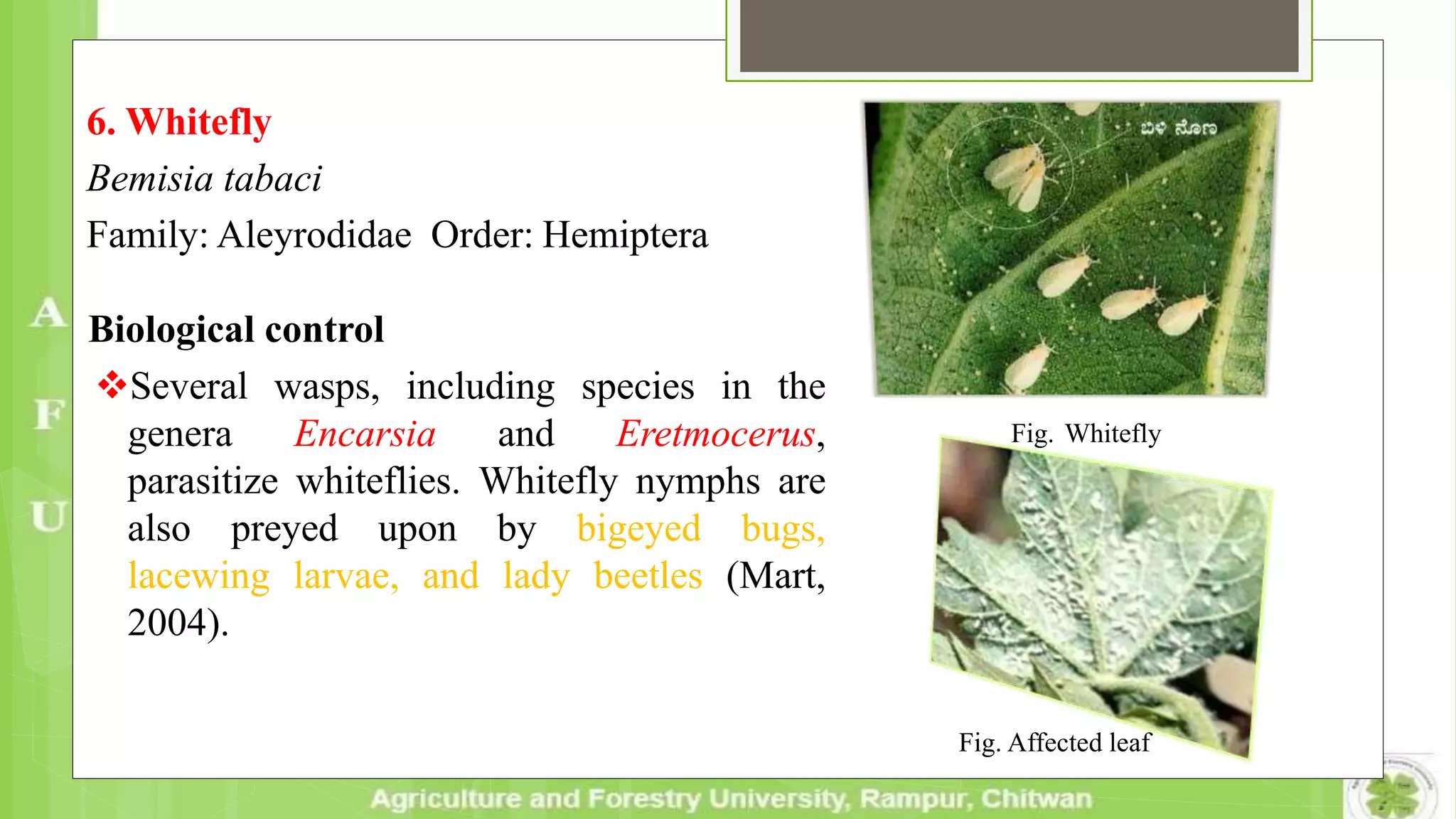
6. Whitefly
Bemisia tabaci
Family: Aleyrodidae Order: Hemiptera
Biological control
Several wasps, including species in the
genera Encarsia and Eretmocerus,
parasitize whiteflies. Whitefly nymphs are
also preyed upon by bigeyed bugs,
lacewing larvae, and lady beetles (Mart,
2004).
Fig. Affected leaf
Fig. Whitefly
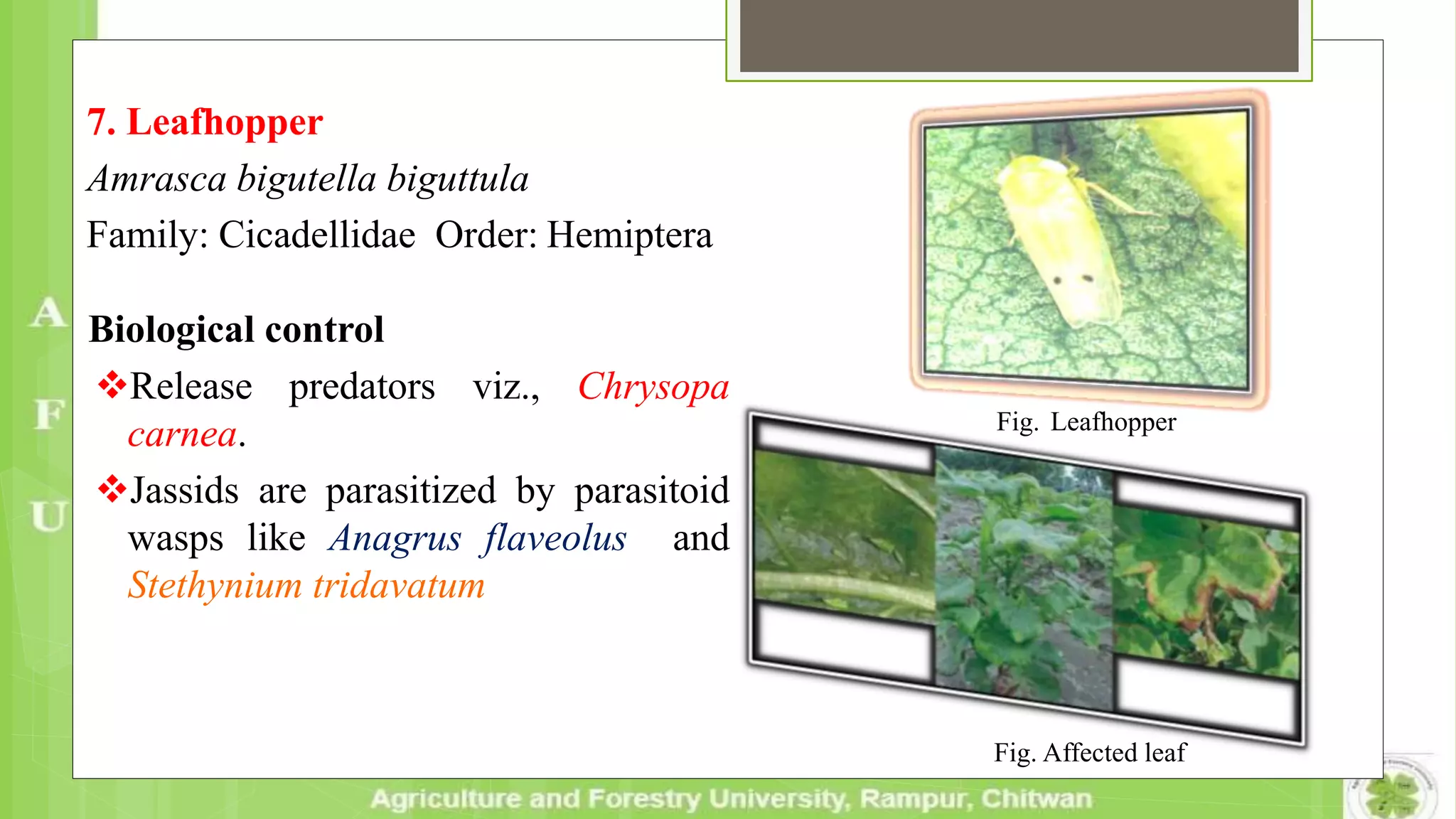
7. Leafhopper
Amrasca bigutella biguttula
Family: Cicadellidae Order: Hemiptera
Biological control
Release predators viz., Chrysopa
carnea.
Jassids are parasitized by parasitoid
wasps like Anagrus flaveolus and
Stethynium tridavatum
Fig. Affected leaf
Fig. Leafhopper
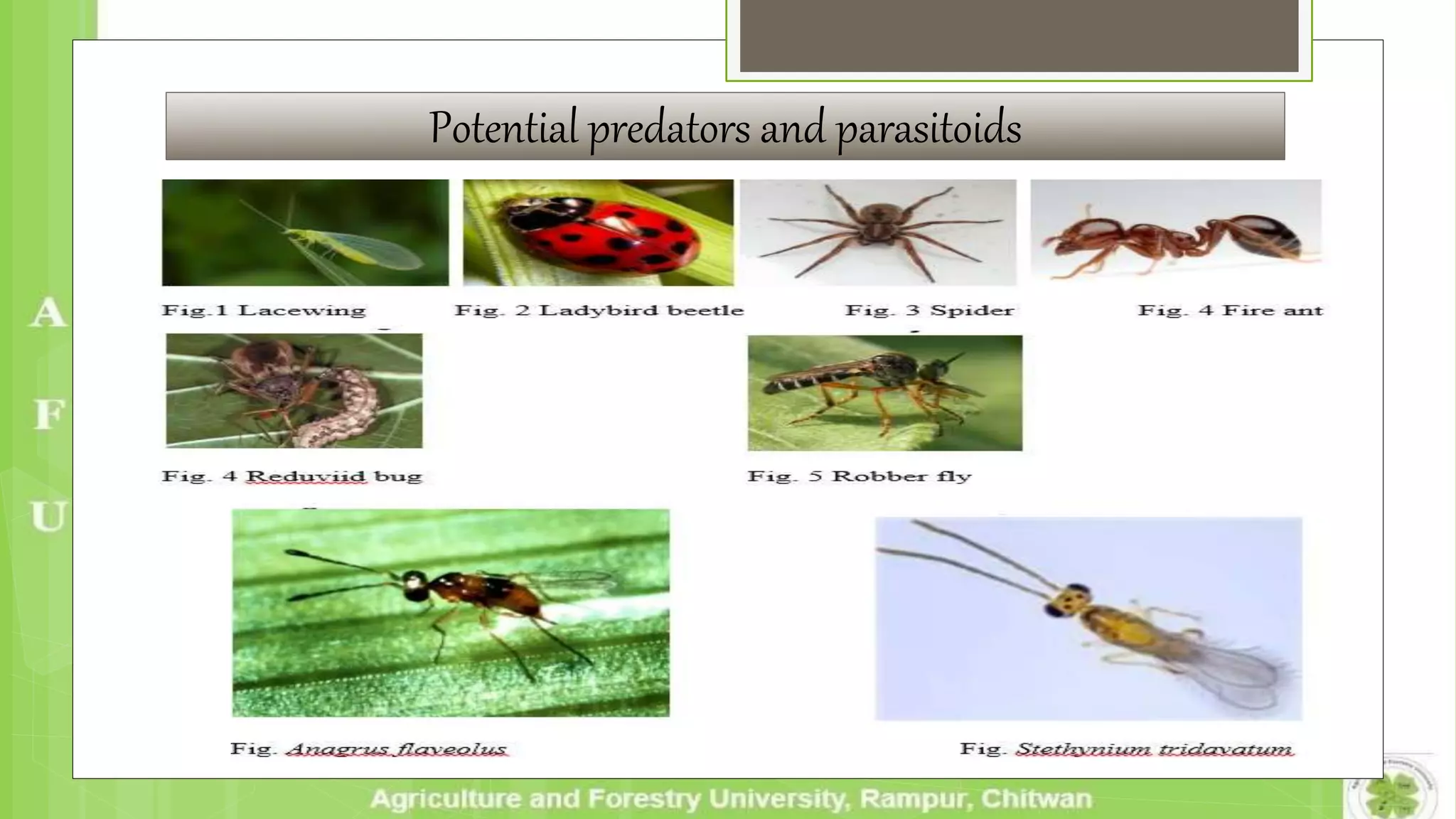
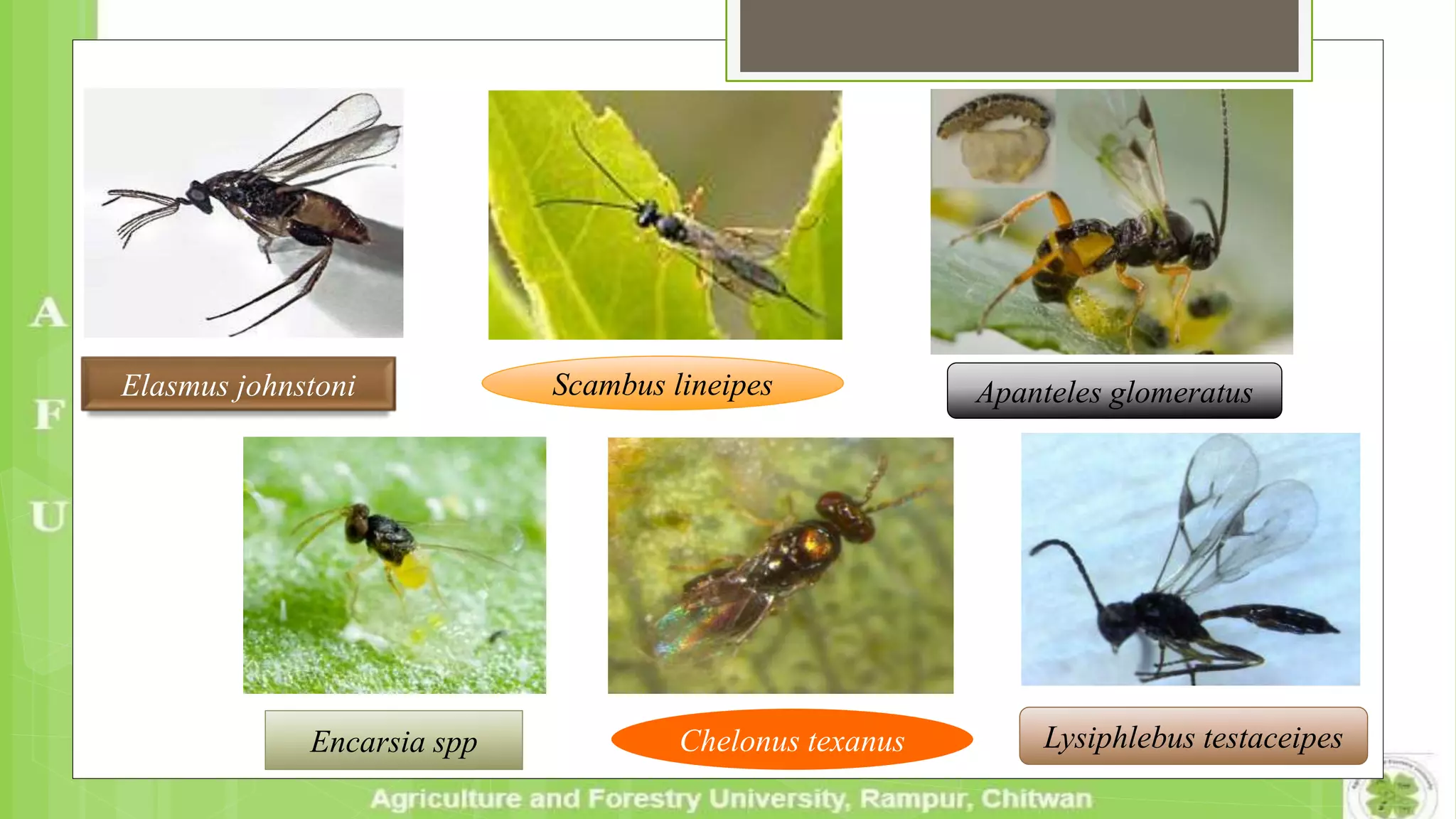
Potential predators and parasitoids
Encarsia spp Chelonus texanus Lysiphlebus testaceipes
Elasmus johnstoni Scambus lineipes Apanteles glomeratus
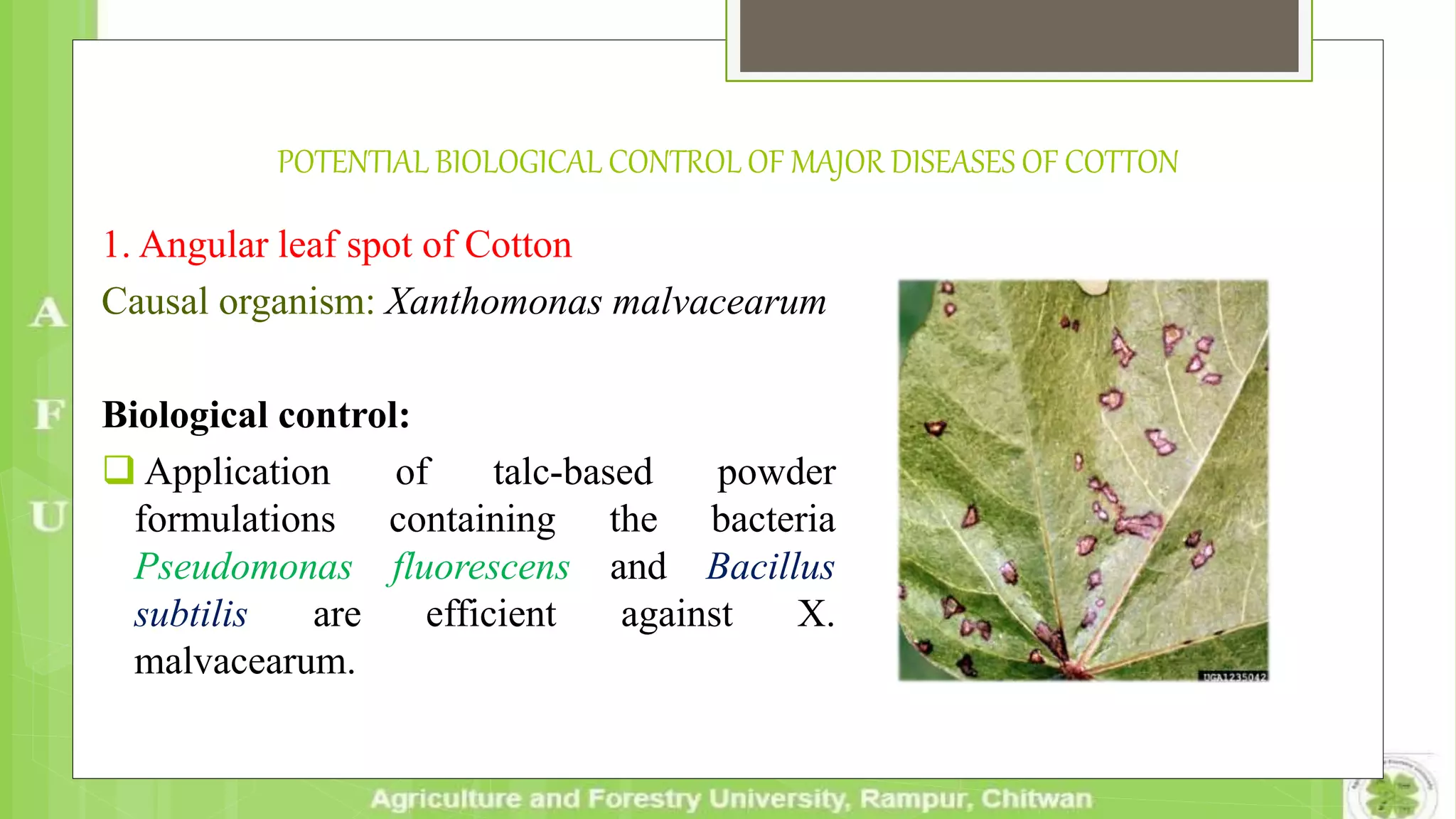
1. Angular leaf spot of Cotton
Causal organism: Xanthomonas malvacearum
Biological control:
 Application of talc-based powder
formulations containing the bacteria
Pseudomonas fluorescens and Bacillus
subtilis are efficient against X.
malvacearum.
POTENTIAL BIOLOGICAL CONTROL OF MAJOR DISEASES OF COTTON
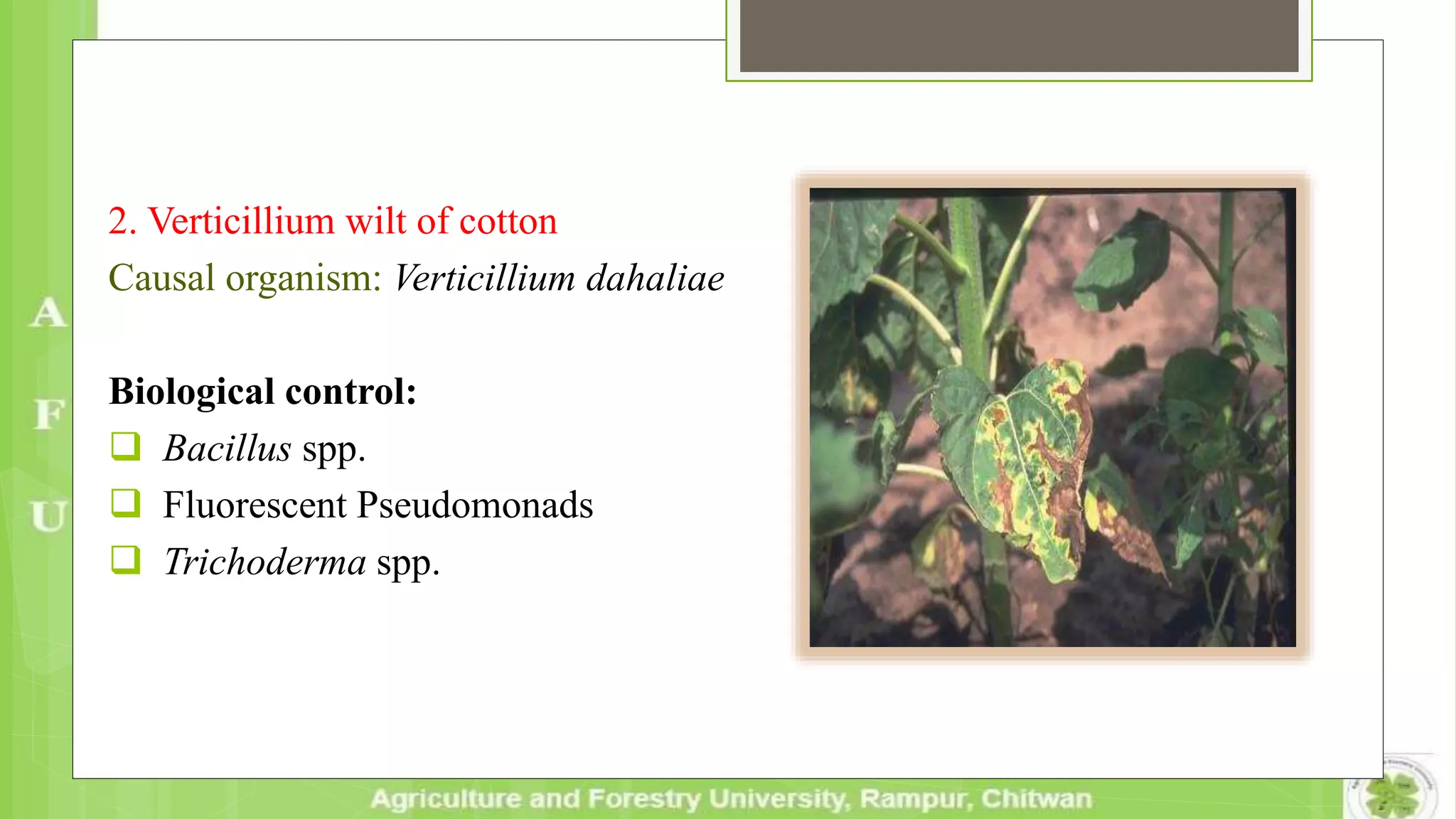
2. Verticillium wilt of cotton
Causal organism: Verticillium dahaliae
Biological control:
 Bacillus spp.
 Fluorescent Pseudomonads
 Trichoderma spp.
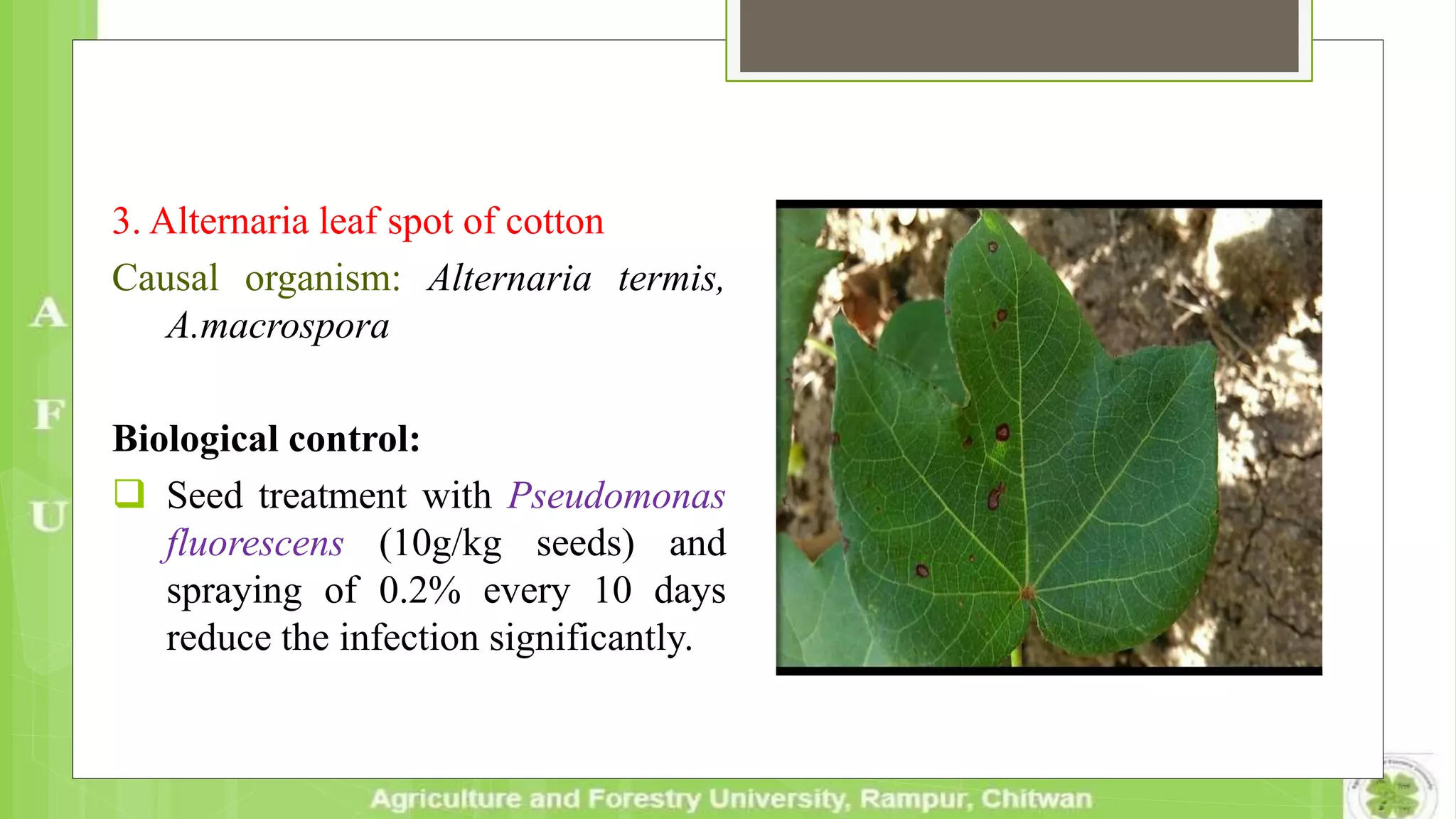
3. Alternaria leaf spot of cotton
Causal organism: Alternaria termis,
A.macrospora
Biological control:
 Seed treatment with Pseudomonas
fluorescens (10g/kg seeds) and
spraying of 0.2% every 10 days
reduce the infection significantly.
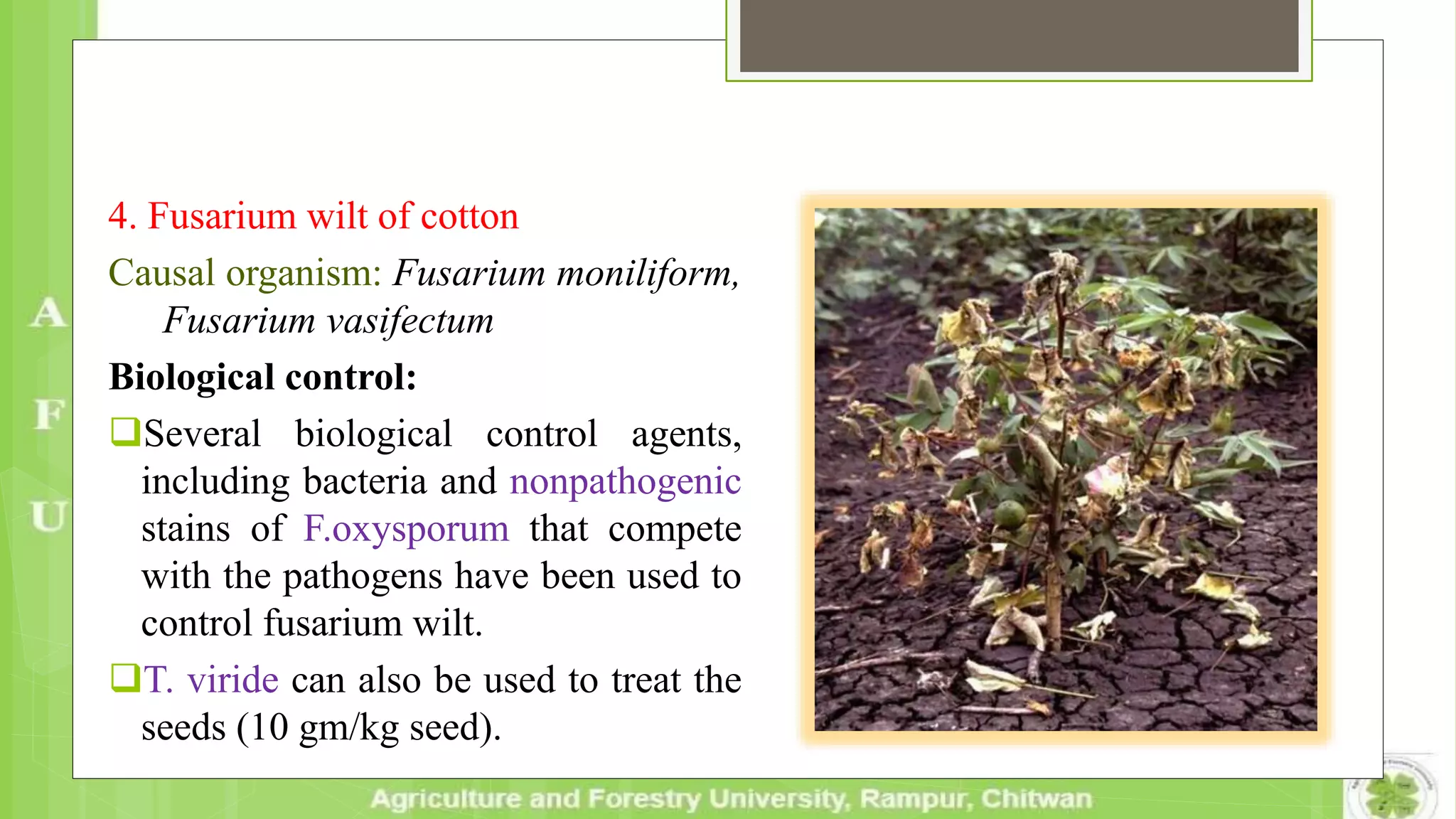
4. Fusarium wilt of cotton
Causal organism: Fusarium moniliform,
Fusarium vasifectum
Biological control:
Several biological control agents,
including bacteria and nonpathogenic
stains of F.oxysporum that compete
with the pathogens have been used to
control fusarium wilt.
T. viride can also be used to treat the
seeds (10 gm/kg seed).
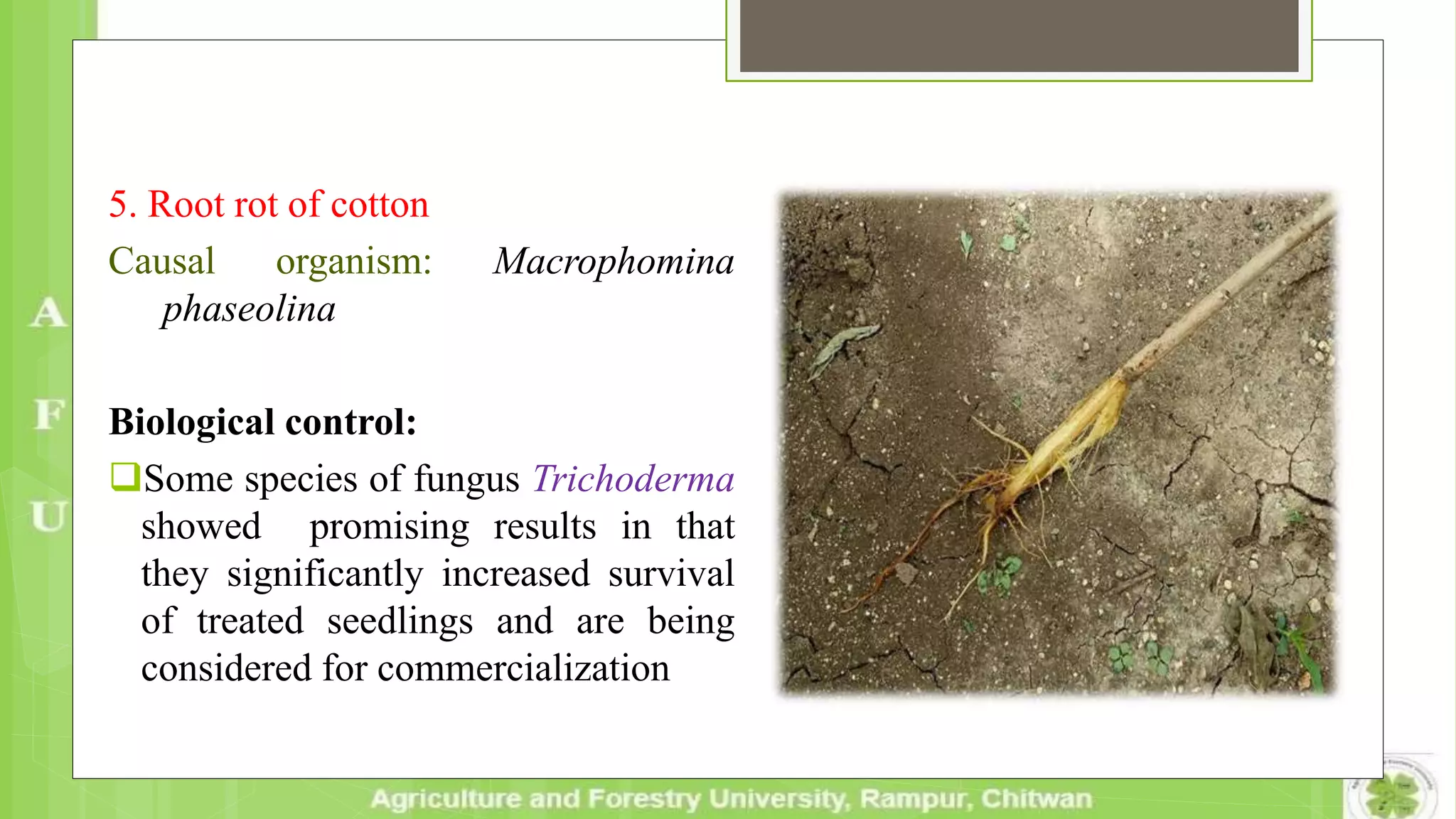
5. Root rot of cotton
Causal organism: Macrophomina
phaseolina
Biological control:
Some species of fungus Trichoderma
showed promising results in that
they significantly increased survival
of treated seedlings and are being
considered for commercialization
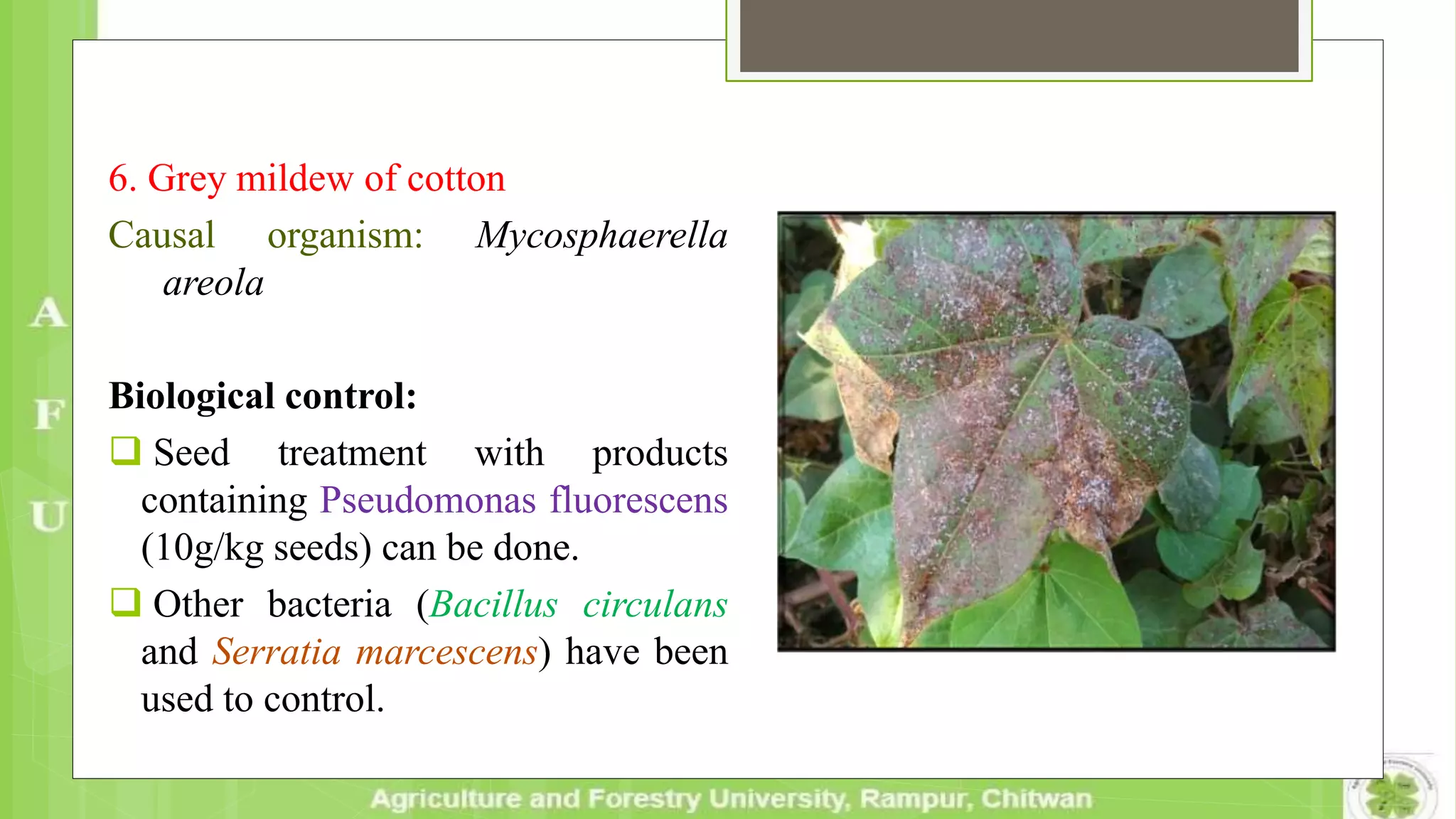
6. Grey mildew of cotton
Causal organism: Mycosphaerella
areola
Biological control:
 Seed treatment with products
containing Pseudomonas fluorescens
(10g/kg seeds) can be done.
 Other bacteria (Bacillus circulans
and Serratia marcescens) have been
used to control.
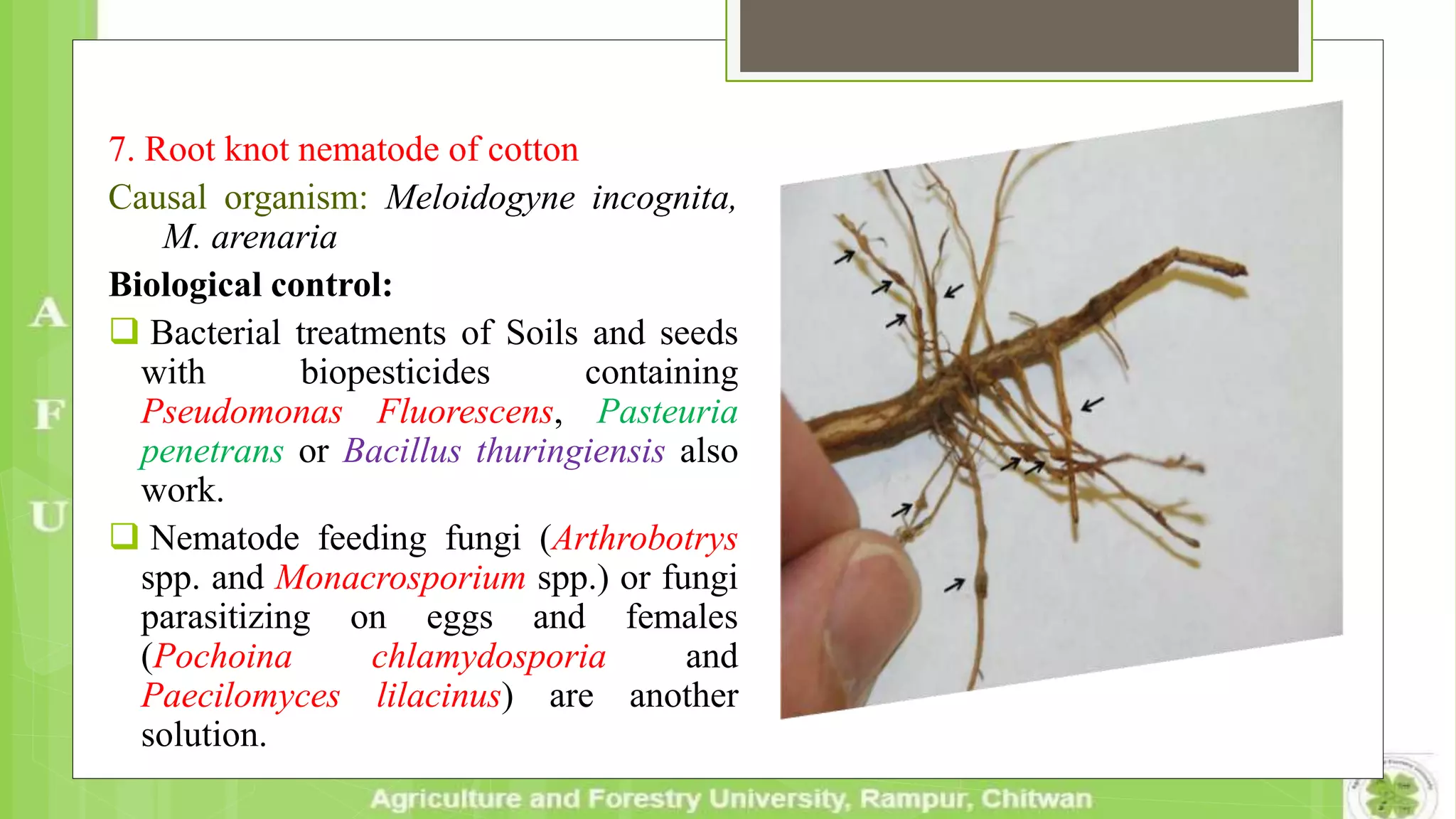
7. Root knot nematode of cotton
Causal organism: Meloidogyne incognita,
M. arenaria
Biological control:
 Bacterial treatments of Soils and seeds
with biopesticides containing
Pseudomonas Fluorescens, Pasteuria
penetrans or Bacillus thuringiensis also
work.
 Nematode feeding fungi (Arthrobotrys
spp. and Monacrosporium spp.) or fungi
parasitizing on eggs and females
(Pochoina chlamydosporia and
Paecilomyces lilacinus) are another
solution.
Potential of biocontrol of cotton insect and diseases

Potential of biocontrol of cotton insect and diseases

  • 2.
    Presenter Hem Raj Pant frenndlyhem01234@gmail.com Msc.Ag Department of Plant pathology AFU- Agriculture and Forestry University Rampur, chitwan www.afu.edu.np A Presentation on CURRENT STATUS AND POTENTIAL OF BIOLOGICAL CONTROL OF COTTON INSECT AND DISEASE PESTS
  • 3.
    What isbiologicalcontrol Biological controlis "the action of parasites, predators, or pathogens in maintaining another organism's population density at a lower average than would occur in their absence". This management technology has received much attention in recent times.
  • 4.
    Why biologicalcontrol  Highlyeconomical in a long run  Selective with no side effects  Self propagating and self-perpetuating  Pest resistance to BCAs is virtually unknown  No harmful effects on humans, livestock's and other organisms  Efficiency, greater ability to search their prey  Improved quality of produce  Compatible with most of the IPM components
  • 5.
    WHY not commonin use in Nepal  Very few researches have been conducted in this field in our country  Expensive at startup  Insufficient technical Manpower knowledge  Doesn't completely destroy a pest  Does not have a broad-spectrum as insecticides & fungicides
  • 6.
  • 7.
    Parasitoid  Each parasitoidsrequires only one host, which it kills for its development into a free living adult.  Parasitoids are of the same size as the hosts , or sometimes even smaller. Mechanism Examples Trichogramma chilonis effective against Pink bollworm of Cotton Eggs of female Trichogramma chilonis The Female parasitoid lays eggs inside or on an insect host. Legless larva on hatching feed on the hosts internally or externally.
  • 8.
    Pathogen Pathogens are diseasecausing organisms e.g. Bacteria, Fungi, Viruses, Protozoa and Nematodes in insect and disease pests which kill their host or debilitate the future generation. Mechanism Examples Seed treatment with Trichoderma viride prevents cotton against Cotton seedling disease, Sclerotium rolfsii The infected insects are unable to feed properly ,remain stunted, lose their body colour and get paralysed. Dead insects are often found hanging on the plants, or a fungal growth on the body of dried insect could be easily located in the field
  • 9.
    Predator These are freeliving and larger in size than their prey, requiring several preys to complete their life cycle. Some smaller predators release a powerful poison, use a trap or hunt in groups to be more effective. Mechanism Green lacewings (very common and important predator of cotton pests). The female lays small pale green, oval shaped eggs at the end of long silken stalks, which ultimately turns grey. The larva have well developed legs and pincer like jaws with which they suck the body fluids from the prey
  • 10.
    TYPES OF BIOLOGICALPEST CONTROL 1. Importation or classical biological control: The control of a pest species by introduced natural enemies 2. Augmentation: Propagation (mass culturing) and release of NE to increase its population. Two types, (i) Inoculative release: Control expected from the progeny and subsequent generations only. (ii) Inundative release: NE mass cultured and released to suppress pest directly e.g. Trichogramma spp. (egg parasitoid), Chrysoperla carnia (Predator) 3. Conservation: Actions that preserve and increase NE by environmental manipulation e.g. Use of selective insecticides, Provide alternate host for NE.
  • 11.
    (Gossypium hirsutum) INTRODUCTION Cotton isreferred to as “King of Fibres” and also known as “White Gold”. It is also backbone of textile industry. China is the world’s largest producer of cotton 45% world’s fiber need is met from cotton. 10% of world’s edible oil is met from cotton. Cotton in Nepal 143 ha and total production of 127 Mt with productivity of 0.89 ton/ha (MoAD, 2016/17)
  • 12.
    IMPORTANCE OFCOTTON It iscultivated primarily for lint. Raw cotton is also used for medical and surgical purpose. Linters are used cushions, pillows etc. Linters Also used for high grade paper, rayon, films, explosives. Seed crushed for edible oil. Cakes and meals are excellent cattle feed.
  • 13.
    POTENTIAL BIOLOGICAL CONTROLOF MAJOR INSECT PEST OF COTTON 1. American bollworm/Fruit borer: Helicoverpa armigera Family: Noctuidae Order: Lepidoptera Biological control Inundative release of egg parasitoid, Trichogramma spp., or Scambus lineipes at 15 days interval 3 times from 45 DAS Releasing predator Chrysoperla carnea @ 1, 00, 000/ha at 6th, 13th and 14th week after sowing. Fig.Feeding injury Fig.Circular bore hole Fig. Larva andAdult
  • 14.
    2. Pink bollworm: Pectinophoragossypiella Family: Gelechiidae Order: Lepidoptera Biological control Release of egg parasitoids Trichogramma chilonis, Elasmus johnstoni and Goniozus spp Timely spraying with formulations of Bacillus thuringiensis can also be effective
  • 15.
    3. Spotted bollworm: Eariasvittella Family: Noctuidae Order: Lepidoptera Biological control Release egg parasitoid Trichogramma chilonis, T. brasiliensis, and larval parasitoids Chelonus blackburni or Bracon brevicornis or Apanteles sp. at 35 to 70 days. Conserve and encourage the activity of the spiders Thomisus sp. and Neosiana sp. Fig. Larva Fig. bore hole and rotting Fig. Adult
  • 16.
    4. Armyworm /Tobaccocutworm: Spodoptera litura Family: Noctuidae Order: Lepidoptera Biological control Wasp parasitoids include Cotesia marginniventris, Chelonus texanus and C. remus. Predators include ground beetles, flower bugs.  Bioinsecticides containing Bacillus thuringiensis can be sprayed. Fig. Larva Fig. Adult
  • 17.
    5. Cotton aphid Aphisgossypii Family: Aphididae Order: Homoptera Biological control The parasitic wasp Lysiphlebus testaceipes and a group of aphid predators (including the lady beetles Hippodamia convergens and Coccinella septempunctata and the predatory larvae of syrphid flies) are important natural enemies (Goven, 2003) Fig. Affected leaf Fig. Aphid
  • 18.
    6. Whitefly Bemisia tabaci Family:Aleyrodidae Order: Hemiptera Biological control Several wasps, including species in the genera Encarsia and Eretmocerus, parasitize whiteflies. Whitefly nymphs are also preyed upon by bigeyed bugs, lacewing larvae, and lady beetles (Mart, 2004). Fig. Affected leaf Fig. Whitefly
  • 19.
    7. Leafhopper Amrasca bigutellabiguttula Family: Cicadellidae Order: Hemiptera Biological control Release predators viz., Chrysopa carnea. Jassids are parasitized by parasitoid wasps like Anagrus flaveolus and Stethynium tridavatum Fig. Affected leaf Fig. Leafhopper
  • 20.
  • 21.
    Encarsia spp Chelonustexanus Lysiphlebus testaceipes Elasmus johnstoni Scambus lineipes Apanteles glomeratus
  • 22.
    1. Angular leafspot of Cotton Causal organism: Xanthomonas malvacearum Biological control:  Application of talc-based powder formulations containing the bacteria Pseudomonas fluorescens and Bacillus subtilis are efficient against X. malvacearum. POTENTIAL BIOLOGICAL CONTROL OF MAJOR DISEASES OF COTTON
  • 23.
    2. Verticillium wiltof cotton Causal organism: Verticillium dahaliae Biological control:  Bacillus spp.  Fluorescent Pseudomonads  Trichoderma spp.
  • 24.
    3. Alternaria leafspot of cotton Causal organism: Alternaria termis, A.macrospora Biological control:  Seed treatment with Pseudomonas fluorescens (10g/kg seeds) and spraying of 0.2% every 10 days reduce the infection significantly.
  • 25.
    4. Fusarium wiltof cotton Causal organism: Fusarium moniliform, Fusarium vasifectum Biological control: Several biological control agents, including bacteria and nonpathogenic stains of F.oxysporum that compete with the pathogens have been used to control fusarium wilt. T. viride can also be used to treat the seeds (10 gm/kg seed).
  • 26.
    5. Root rotof cotton Causal organism: Macrophomina phaseolina Biological control: Some species of fungus Trichoderma showed promising results in that they significantly increased survival of treated seedlings and are being considered for commercialization
  • 27.
    6. Grey mildewof cotton Causal organism: Mycosphaerella areola Biological control:  Seed treatment with products containing Pseudomonas fluorescens (10g/kg seeds) can be done.  Other bacteria (Bacillus circulans and Serratia marcescens) have been used to control.
  • 28.
    7. Root knotnematode of cotton Causal organism: Meloidogyne incognita, M. arenaria Biological control:  Bacterial treatments of Soils and seeds with biopesticides containing Pseudomonas Fluorescens, Pasteuria penetrans or Bacillus thuringiensis also work.  Nematode feeding fungi (Arthrobotrys spp. and Monacrosporium spp.) or fungi parasitizing on eggs and females (Pochoina chlamydosporia and Paecilomyces lilacinus) are another solution.