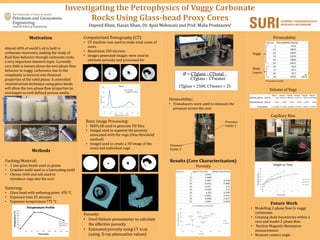
Investigating the Petrophysics of Vuggy Carbonate
Rocks Using Glass-bead Proxy Cores
Dayeed Khan, Hasan Khan, Dr. Ayaz Mehmani and Prof. Maša Prodanović
Motivation
Almost 60% of world’s oil is held in
carbonate reservoirs, making the study of
fluid flow behavior through carbonate rocks
a very important research topic. Currently
very little is known about the two-phase flow
behavior in vuggy carbonates due to the
complexity in textural and chemical
properties of the solid phase. A controlled
reconstruction technique using glass beads
will allow the two-phase flow properties be
investigate in well-defined porous media.
Methods
Packing/Material:
• 1 mm glass beads used as grains
• Graphite mold used as a lubricating mold
• Cheese cloth and salt used to
introduce vugs into the core
Sintering:
• Glass bead with softening point 650 °C
• Exposure time 25 minutes
• Exposure temperature 775 °C
Computerized Tomography (CT):
• CT machine was used to make axial scans of
cores
• Resolution 250 microns
• Images generated images were used to
estimate porosity and processed for
segmentation
Basic Image Processing:
• MATLAB used to generate TIF files
• ImageJ used to segment the porosity
associated with the vugs (Otsu threshold
method)
• ImageJ used to create a 3D image of the
cores and individual vugs
Porosity:
• Used Helium porosimeter to calculate
the effective porosity
• Estimated porosity using CT scan
(using X-ray attenuation values)
Permeability:
• Transducers were used to measure the
pressure across the core
Results (Core Characterization)
Porosity
Permeability
Volume of Vugs
Future Work
• Modelling 2-phase flow in vuggy
carbonates
• Creating shale boundaries within a
core and model 2-phase flow
• Nuclear Magnetic Resonance
measurements
• Measure contact angle
Capillary Rise
48.2mm
61.5mm
Pressure
Outlet 1
Pressure
Outlet 2
Ø = CTglass - CTtotal
CTglass - CTwater
CTglass = 2500, CTwater = 25
Vuggy
Shale
Layers
*
*4 pressure points

Poster_Suri

  • 1.
    Investigating the Petrophysicsof Vuggy Carbonate Rocks Using Glass-bead Proxy Cores Dayeed Khan, Hasan Khan, Dr. Ayaz Mehmani and Prof. Maša Prodanović Motivation Almost 60% of world’s oil is held in carbonate reservoirs, making the study of fluid flow behavior through carbonate rocks a very important research topic. Currently very little is known about the two-phase flow behavior in vuggy carbonates due to the complexity in textural and chemical properties of the solid phase. A controlled reconstruction technique using glass beads will allow the two-phase flow properties be investigate in well-defined porous media. Methods Packing/Material: • 1 mm glass beads used as grains • Graphite mold used as a lubricating mold • Cheese cloth and salt used to introduce vugs into the core Sintering: • Glass bead with softening point 650 °C • Exposure time 25 minutes • Exposure temperature 775 °C Computerized Tomography (CT): • CT machine was used to make axial scans of cores • Resolution 250 microns • Images generated images were used to estimate porosity and processed for segmentation Basic Image Processing: • MATLAB used to generate TIF files • ImageJ used to segment the porosity associated with the vugs (Otsu threshold method) • ImageJ used to create a 3D image of the cores and individual vugs Porosity: • Used Helium porosimeter to calculate the effective porosity • Estimated porosity using CT scan (using X-ray attenuation values) Permeability: • Transducers were used to measure the pressure across the core Results (Core Characterization) Porosity Permeability Volume of Vugs Future Work • Modelling 2-phase flow in vuggy carbonates • Creating shale boundaries within a core and model 2-phase flow • Nuclear Magnetic Resonance measurements • Measure contact angle Capillary Rise 48.2mm 61.5mm Pressure Outlet 1 Pressure Outlet 2 Ø = CTglass - CTtotal CTglass - CTwater CTglass = 2500, CTwater = 25 Vuggy Shale Layers * *4 pressure points