
Uploaded byTaylor Hartman
Poster copy
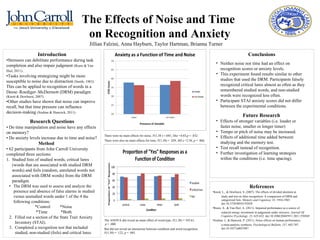
The experiment tested the effects of noise and time pressure on recognition and anxiety. It found that neither noise nor time limits had an effect on recognition scores or anxiety levels. The results were similar to other studies using the Deese-Roediger-McDermott paradigm, where participants falsely recognized critical lures as often as studied words, but less for non-studied words. The study suggests that stronger variables like louder noise, smaller time limits, or additional testing delays could be explored in future research.


Poster copy
- 1. The Effects ofNoise and Time on Recognition and Anxiety Conclusions References •Knott, L., & Dewhurst, S. (2007). The effects of divided attention at study and test on false recognition: A comparison of DRM and categorized lists. Memory and Cognition, 35, 1954-1965. doi:10.3758/BF03192928 •Roets, A., & Van Hiel, A. (2011). Impaired performance as a source of reduced energy investment in judgement under stressors. Journal Of Cognitive Psychology, 23, 625-632. doi:10.1080/20445911.2011.550569 •Szalma, J., & Hancock, P. (2011). Noise effects on human performance: a meta-analytic synthesis. Psychological Bulletin, 137, 682-707. doi:10.1037/a0023987 Jillian Falzini, Anna Hayburn, Taylor Hartman, Brianna Turner • Neither noise nor time had an effect on recognition scores or anxiety levels. • This experiment found results similar to other studies that used the DRM. Participants falsely recognized critical lures almost as often as they remembered studied words, and non-studied words were recognized less often. • Participant STAI anxiety scores did not differ between the experimental conditions. Future Research • Effects of stronger variables (i.e. louder or faster noise, smaller or longer timer) • Tempo or pitch of noise may be increased. • Effects of additional time added between studying and the memory test. • Test recall instead of recognition. • Further investigation of learning strategies within the conditions (i.e. time spacing). There were no main effects for noise, F(1,58 ) =.045, Mse =4.03,p = .832. There were also no main effects for time, F(1,58) = .029, MS e =2.56, p = .866. The ANOVA did reveal an main effect of word type, F(1,58) = 345.61, p = .000. But did not reveal an interaction between condition and word recognition, F(1,58) = .122, p = .885.