Post Insertion Problems In
Complete Dentures
Dr .Rohan Bhoil
Hyperlinks present in this like .
Contents
• Introduction
• Review of Literature
• Causes
• Complaints
• Conclusion
• References
Introduction
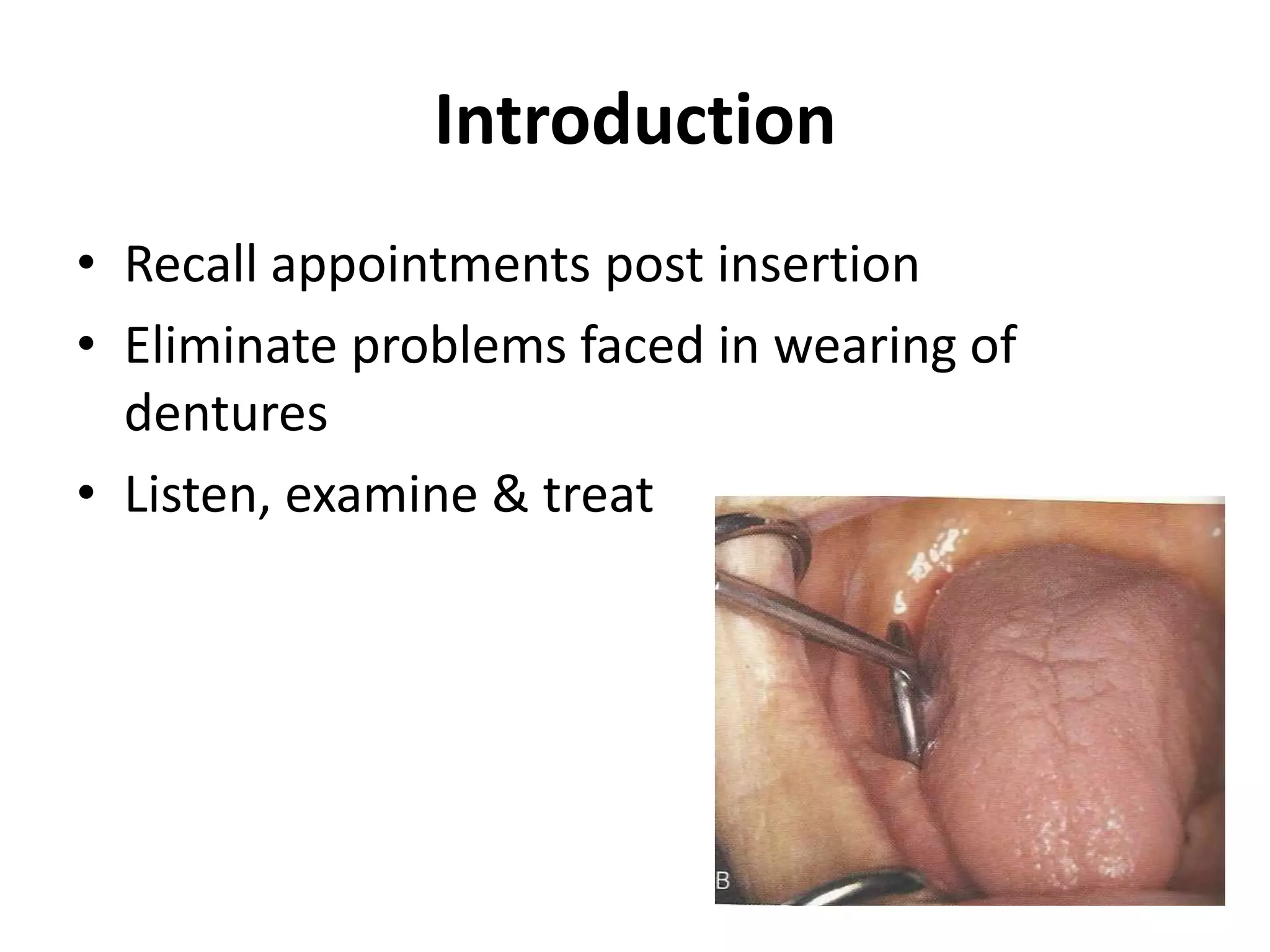
• Recall appointments post insertion
• Eliminate problems faced in wearing of
dentures
• Listen, examine & treat
Examination
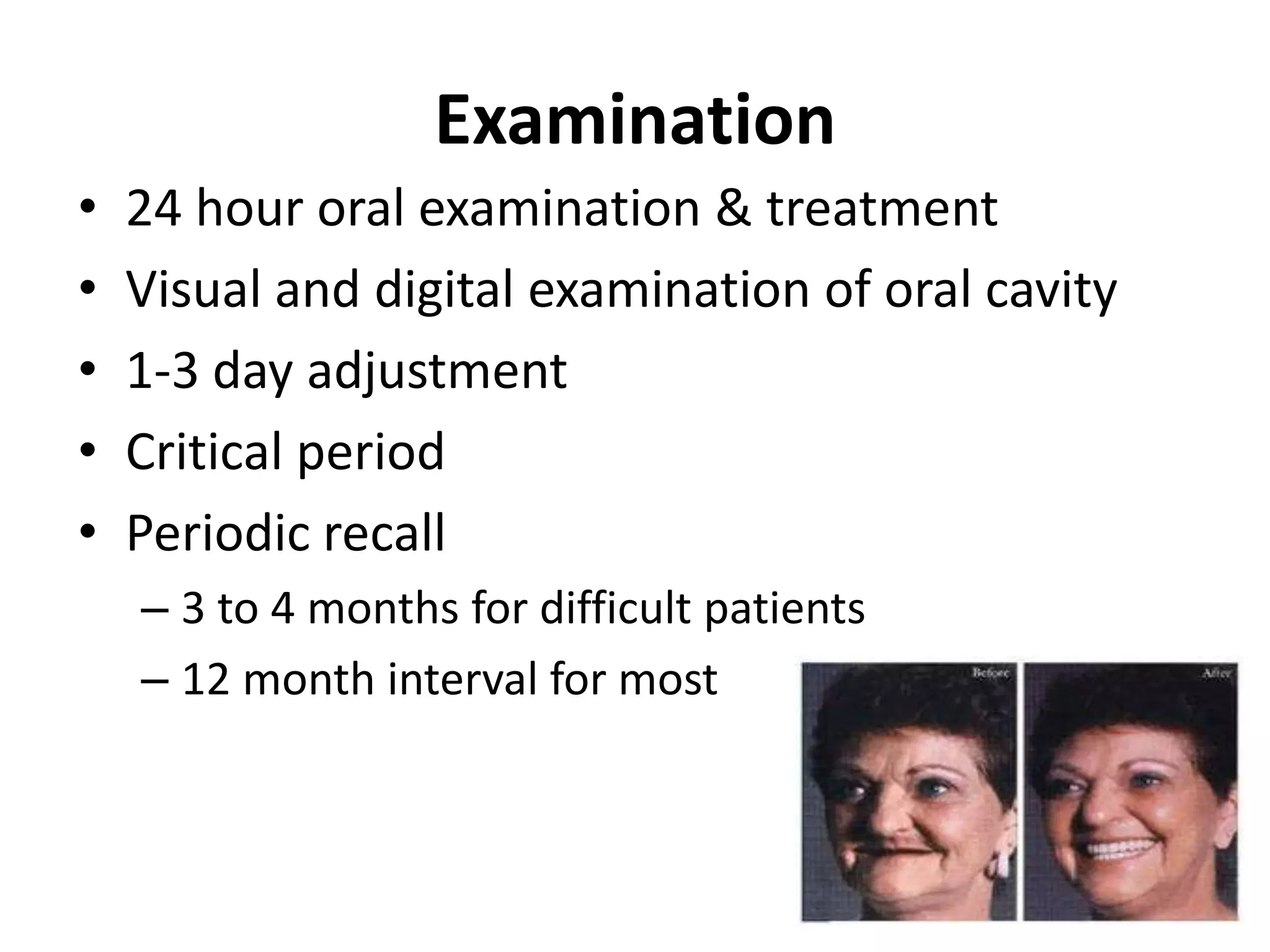
• 24 hour oral examination & treatment
• Visual and digital examination of oral cavity
• 1-3 day adjustment
• Critical period
• Periodic recall
– 3 to 4 months for difficult patients
– 12 month interval for most
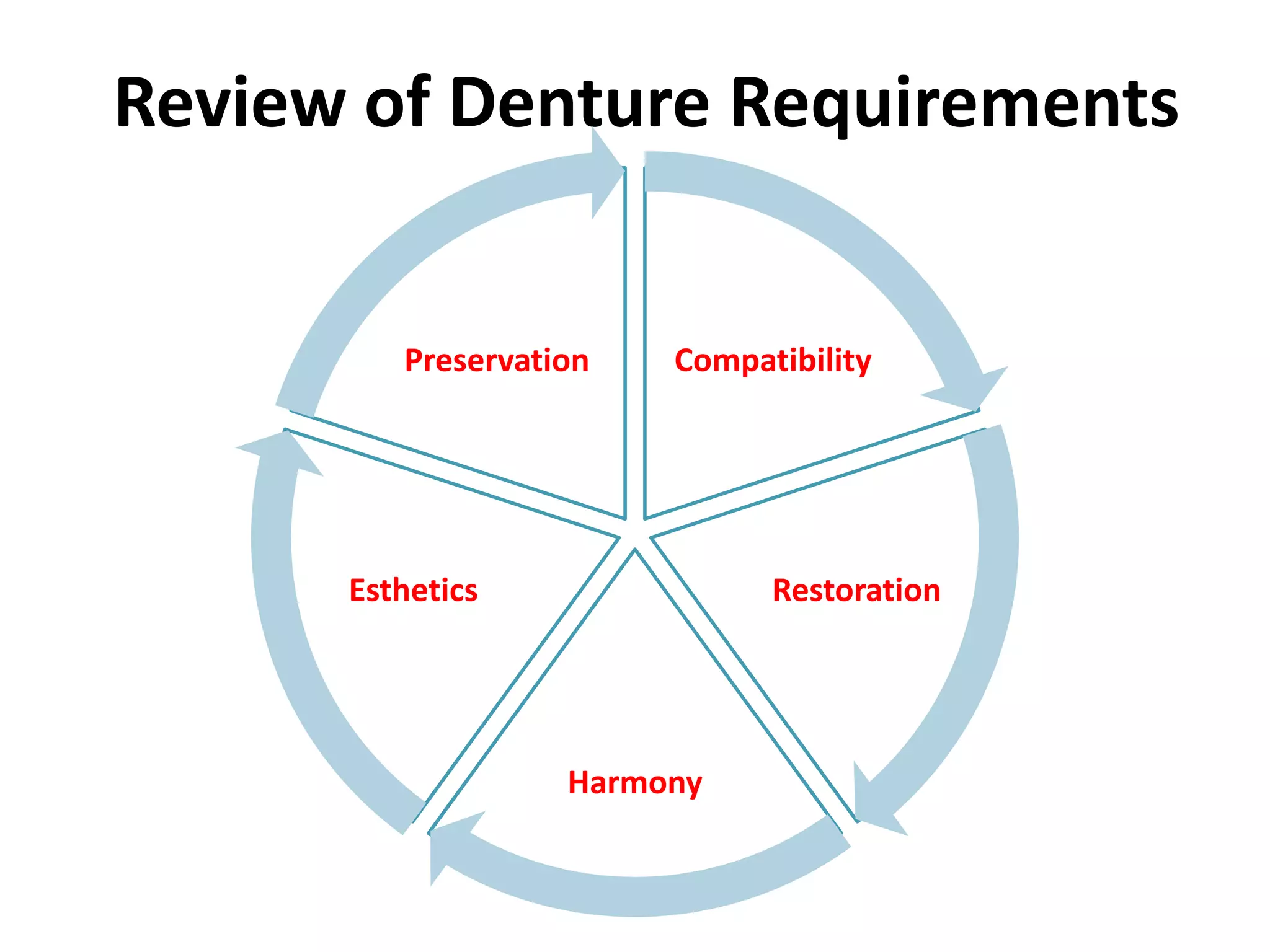
Review of Denture Requirements
Compatibility
Restoration
Harmony
Esthetics
Preservation
Review of Literature
• Basker RM, Beck CB, et al 1993 did a survey
of the dissatisfied denture patient. In the
majority of cases technical errors in denture
construction accounted for the presenting
complaint.
• Champion H et al in 1995 investigated into the
problems experienced by 114 referred
patients with complete. The commonest
problems were those of pain and lack of
retention, mainly due to occlusal
discrepancies and excessive VDO.
• Muller F et al, 1995 did a study on adaptation
to complete dentures. They concluded that
good denture retention facilitates the
adaptation process.
• Yoshida M, Sato Y, Akagawa Y. 2001 did a
study on the correlation between the quality
of life, and denture satisfaction in elderly
complete denture wearers and concluded that
people who are well satisfied with their daily
lives are also satisfied with their complete
dentures.
• Dervis E. et al 2002 did a study to investigate
relationships between patient complaints with
complete dentures and several factors such as
age, gender, medical status and denture
faults.
• No significant relationship was found when
age, gender, and medical status were
compared but, statistically significant
relationships were observed between denture
construction faults or the condition of the
patient's denture bearing mucosa and patient
complaints.
• Roessler DM et al. 2003 Before treatment
even begins, the patient's motivation for
denture treatment and emotional attitude
towards dentures must be evaluated.
–Patients will thereby gain realistic
expectations of what can and cannot
be achieved, and dentists will
understand what the patient really
wants.
– Finally, patients must be informed
that continued success depends on
regular denture maintenance at home,
combined with periodic consultation
with the dentist .
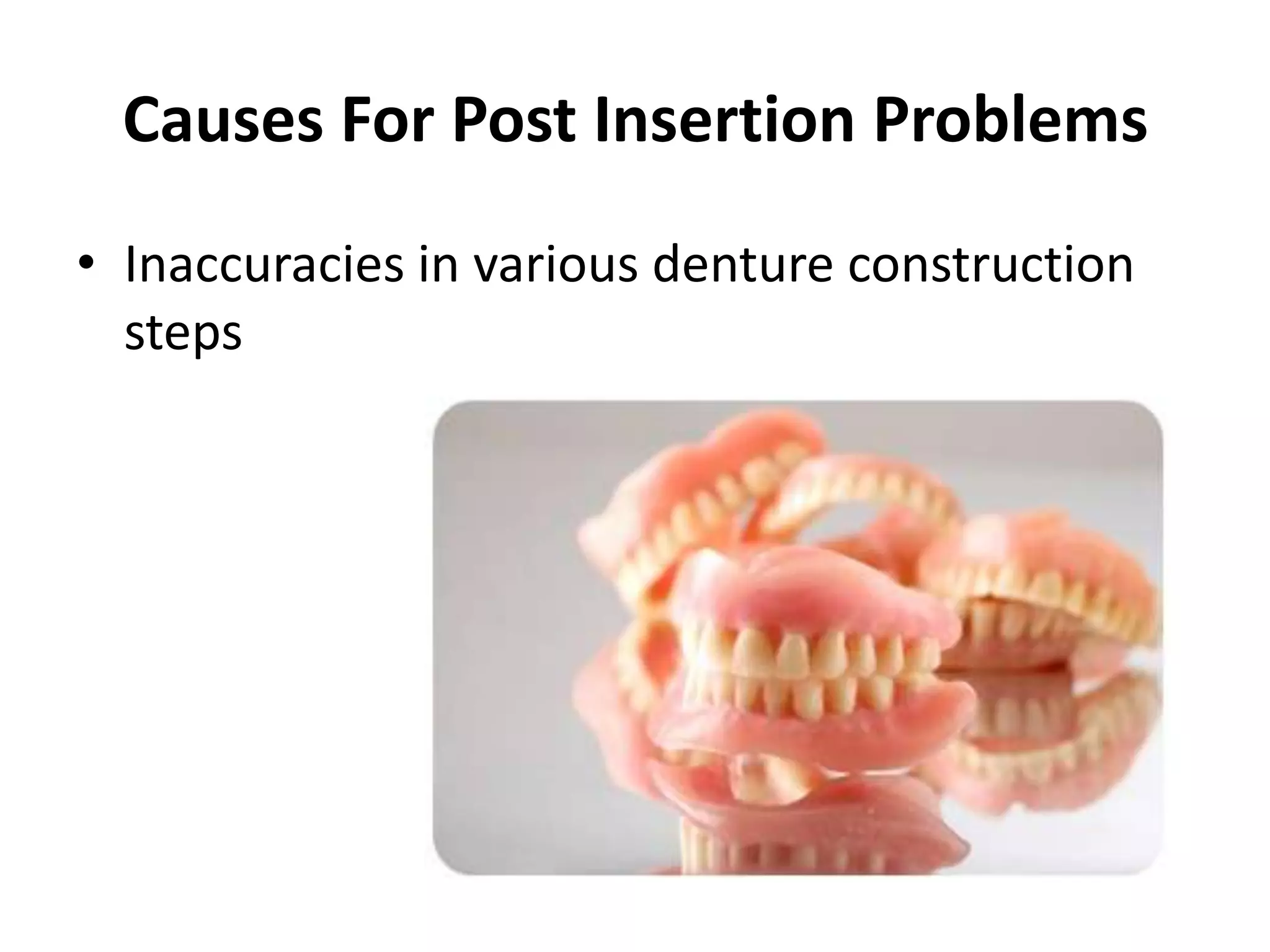
Causes For Post Insertion Problems
• Inaccuracies in various denture construction
steps
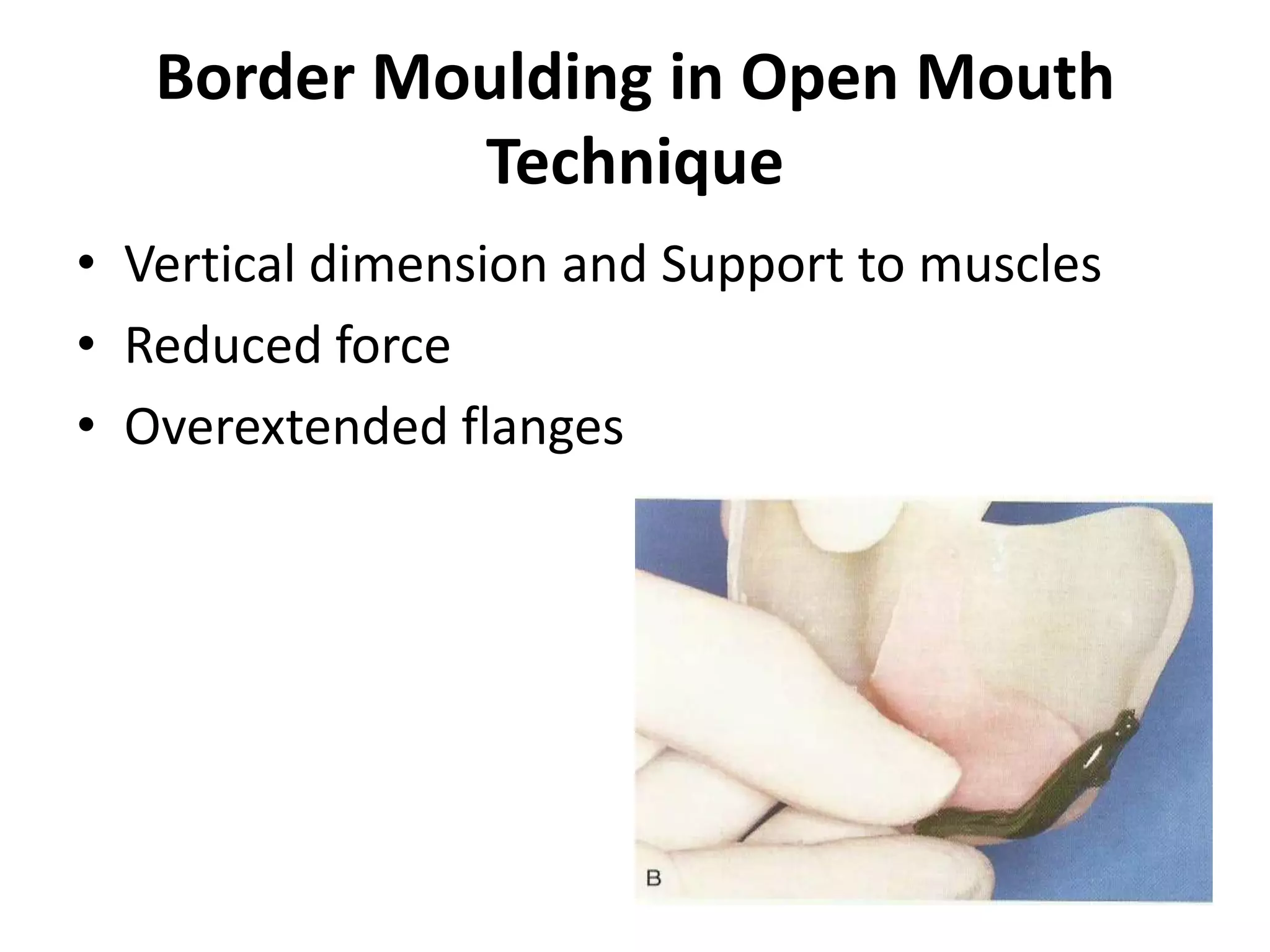
Border Moulding in Open Mouth
Technique
• Vertical dimension and Support to muscles
• Reduced force
• Overextended flanges
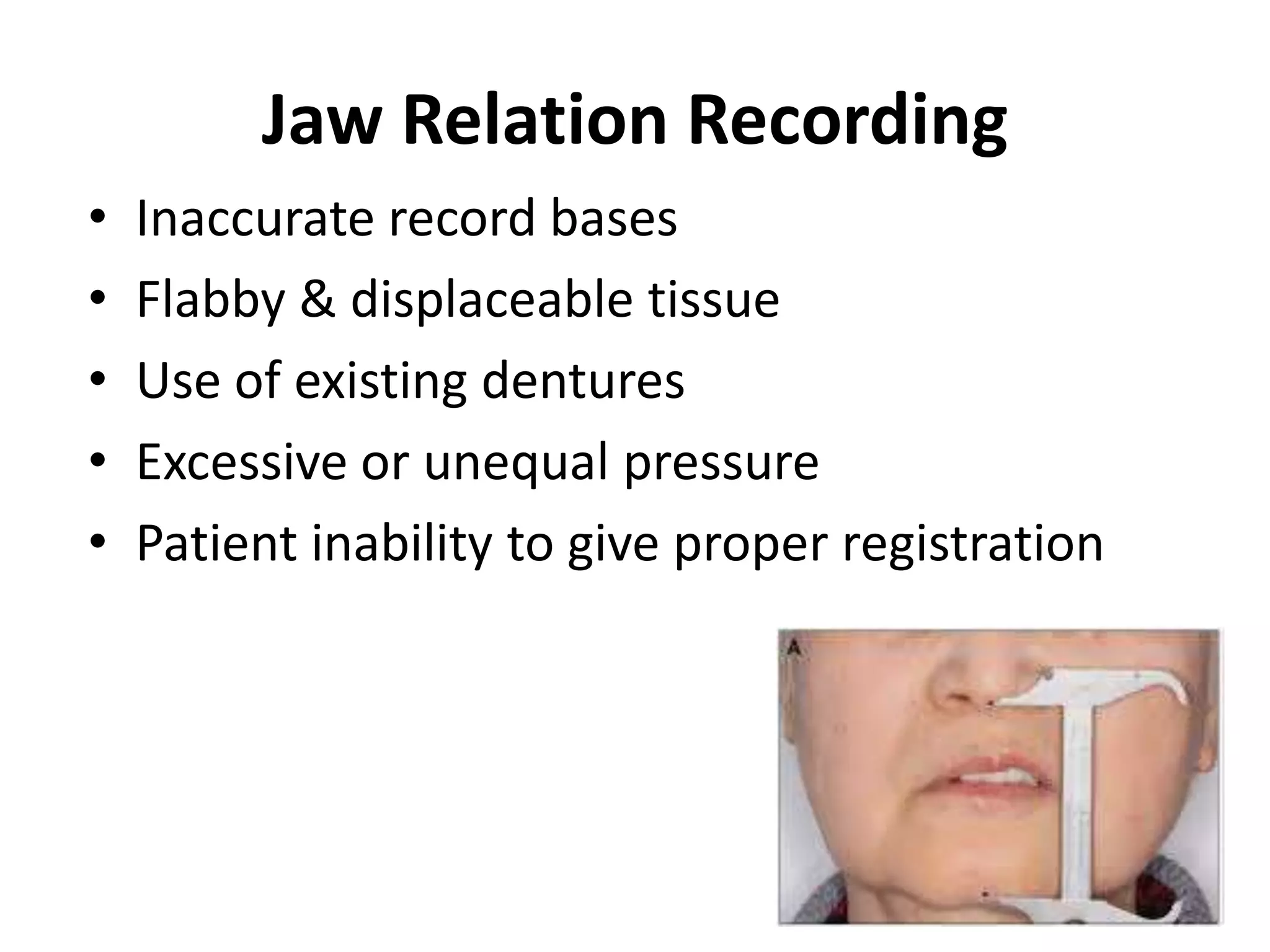
Jaw Relation Recording
• Inaccurate record bases
• Flabby & displaceable tissue
• Use of existing dentures
• Excessive or unequal pressure
• Patient inability to give proper registration
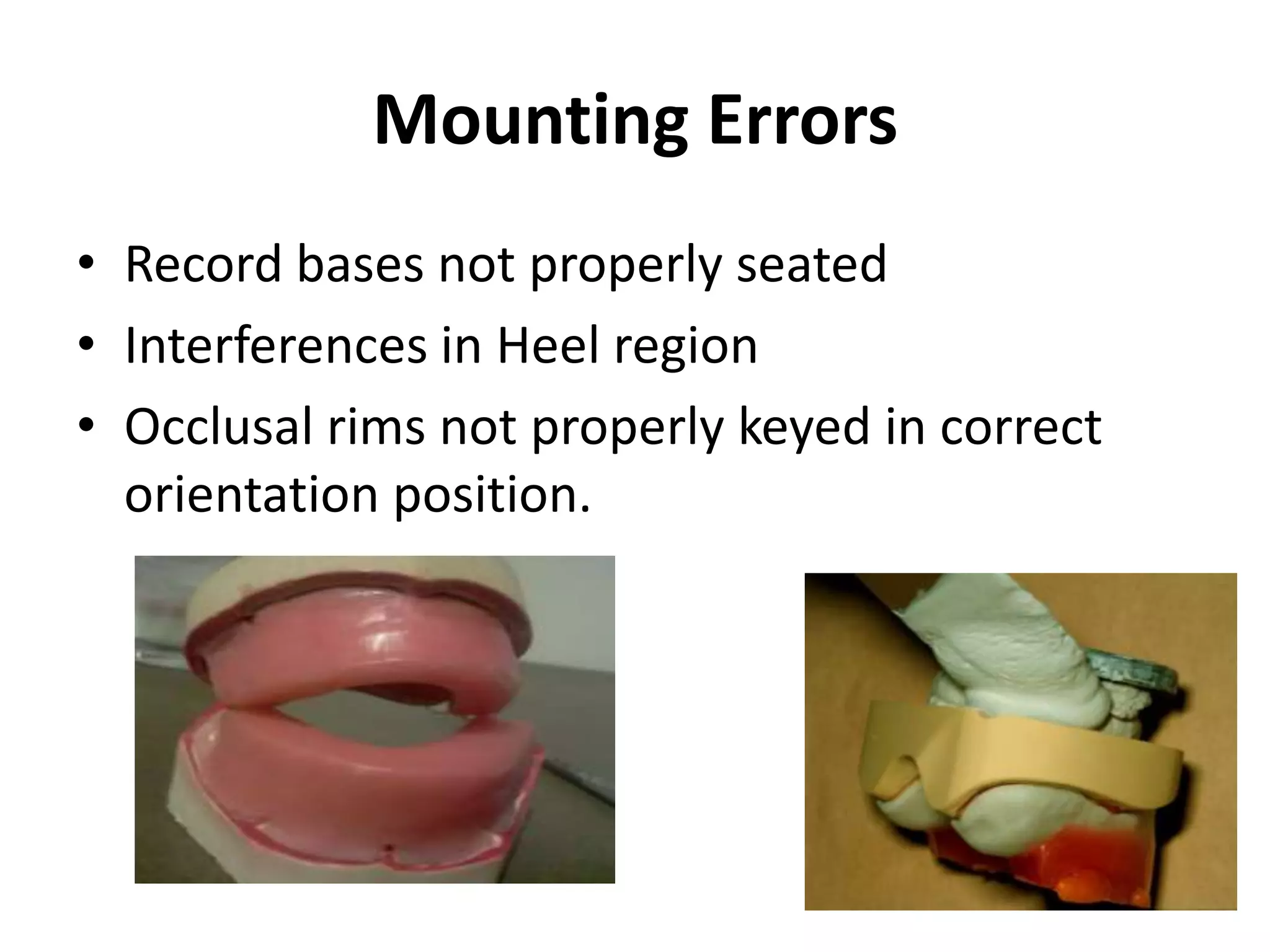
Mounting Errors
• Record bases not properly seated
• Interferences in Heel region
• Occlusal rims not properly keyed in correct
orientation position.
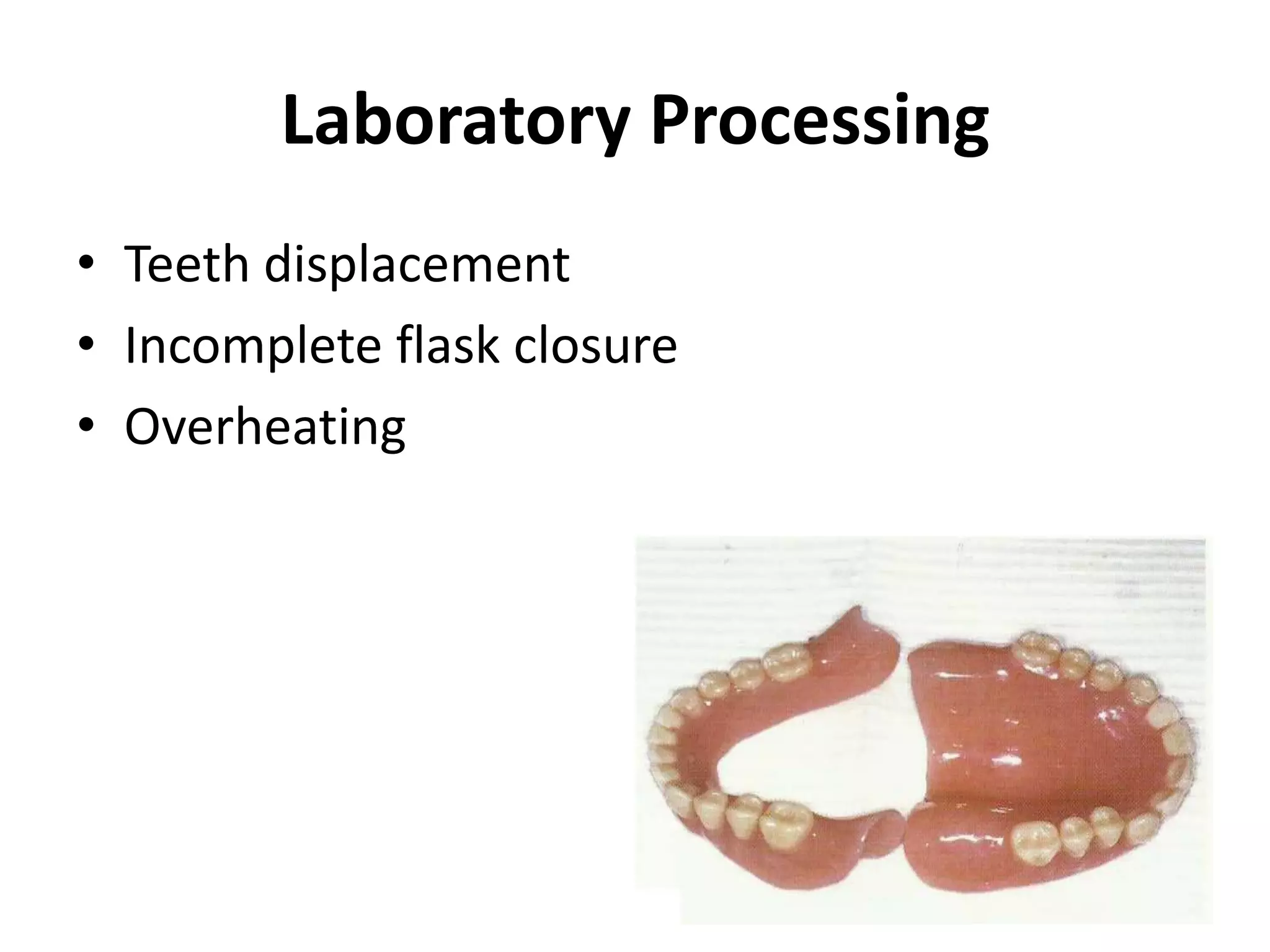
Laboratory Processing
• Teeth displacement
• Incomplete flask closure
• Overheating
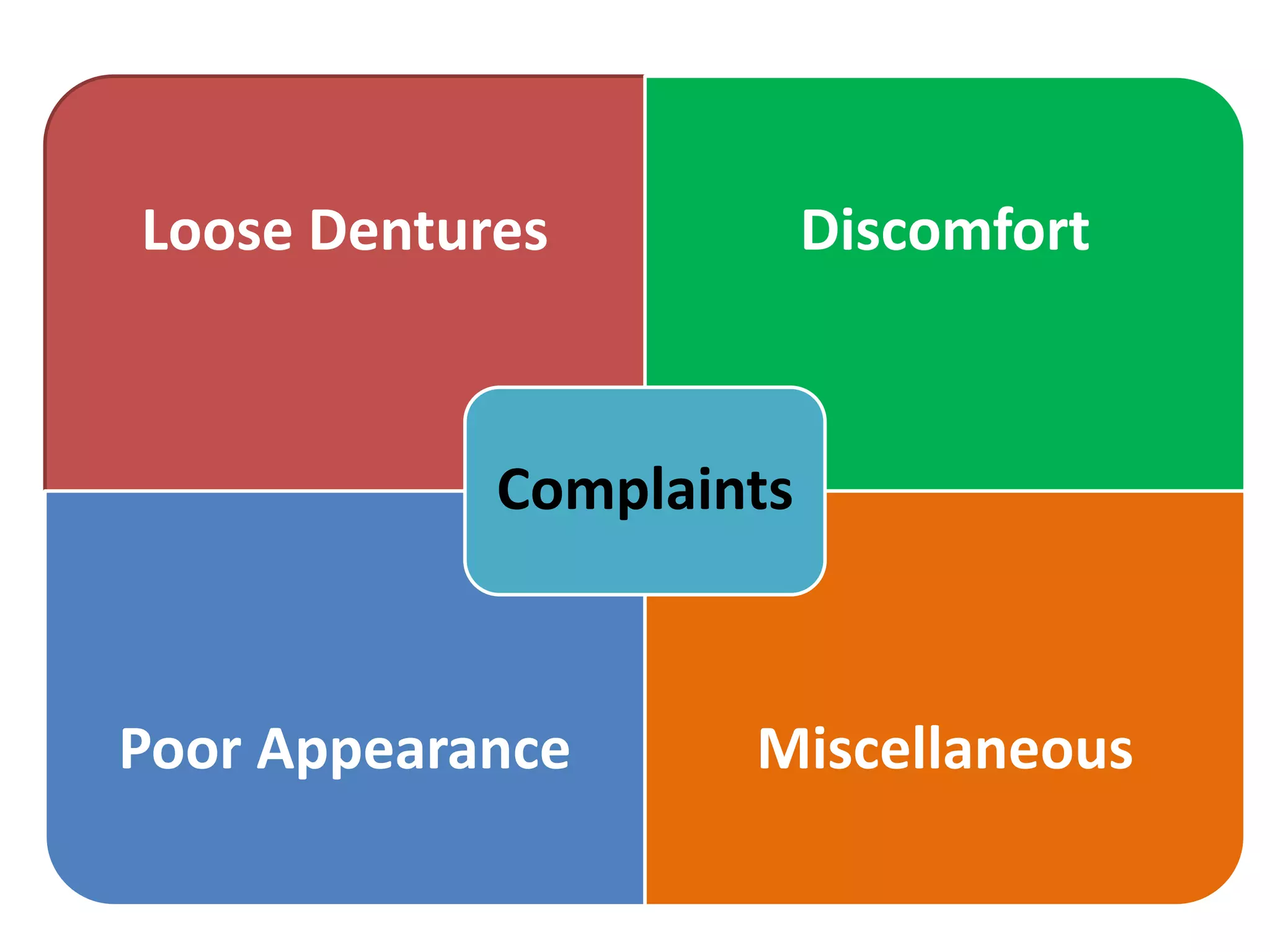
Loose Dentures Discomfort
Poor Appearance Miscellaneous
Complaints
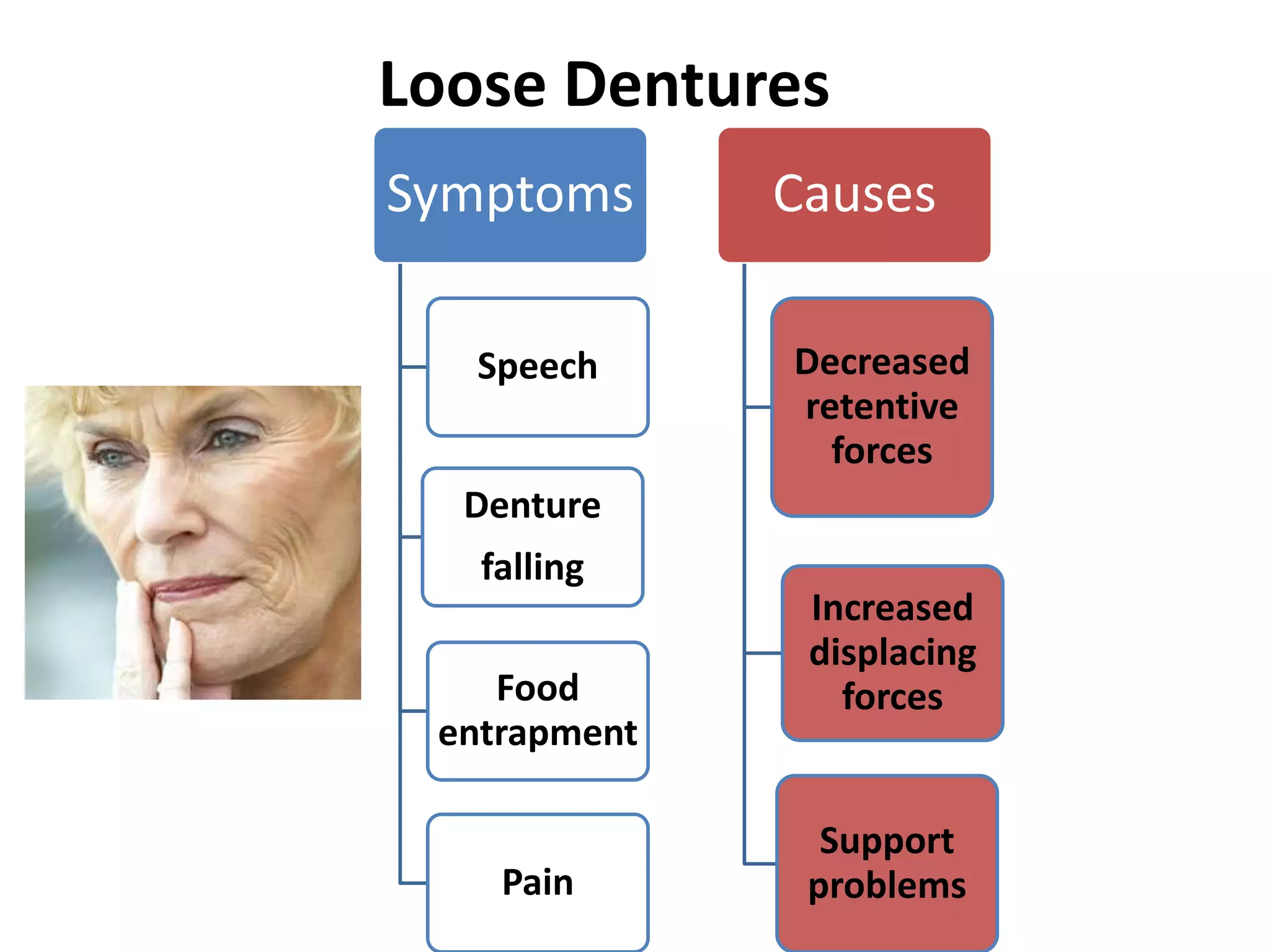
Loose Dentures
Symptoms
Speech
Denture
falling
Food
entrapment
Pain
Causes
Decreased
retentive
forces
Increased
displacing
forces
Support
problems
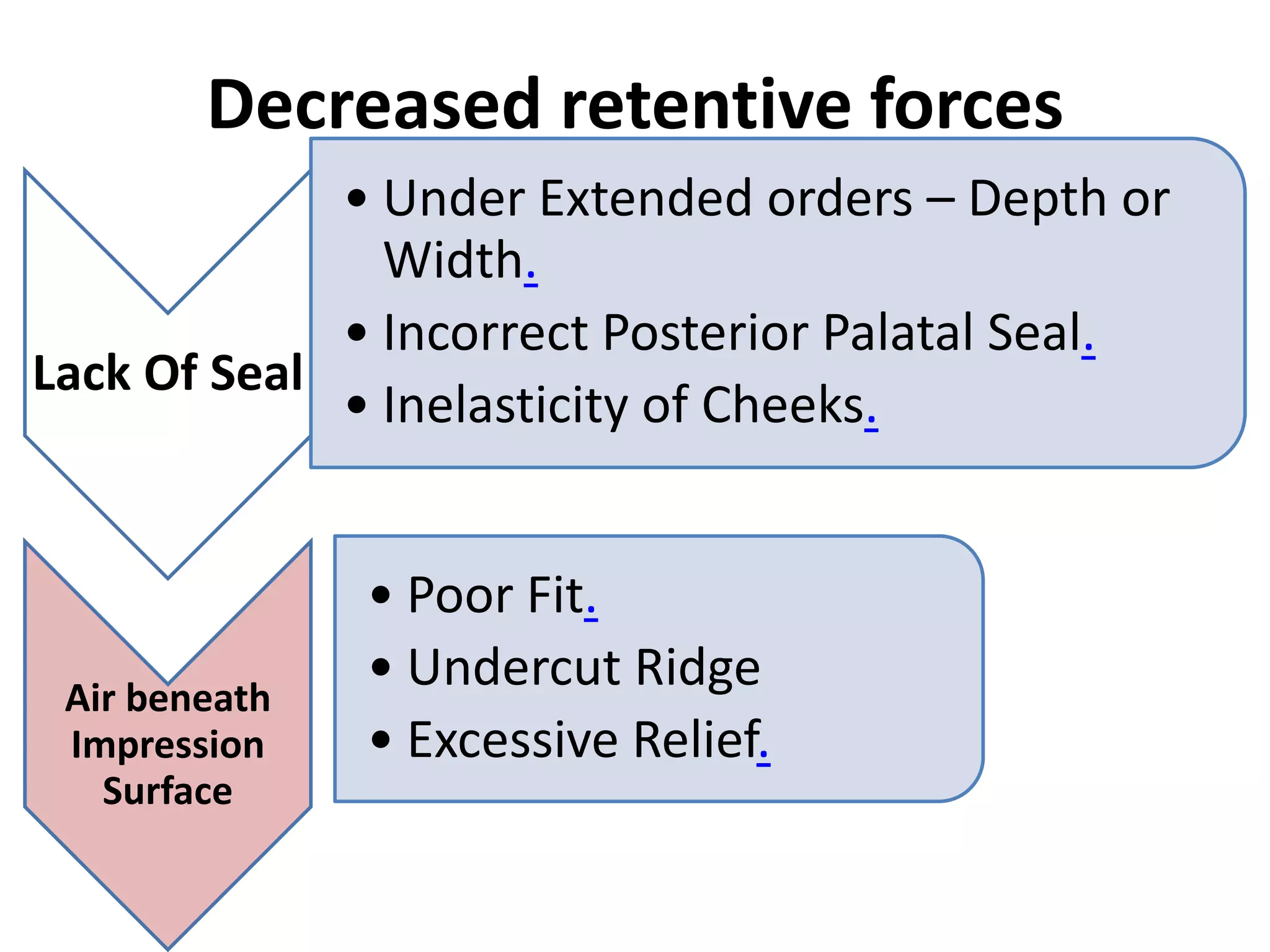
Decreased retentive forces
Lack Of Seal
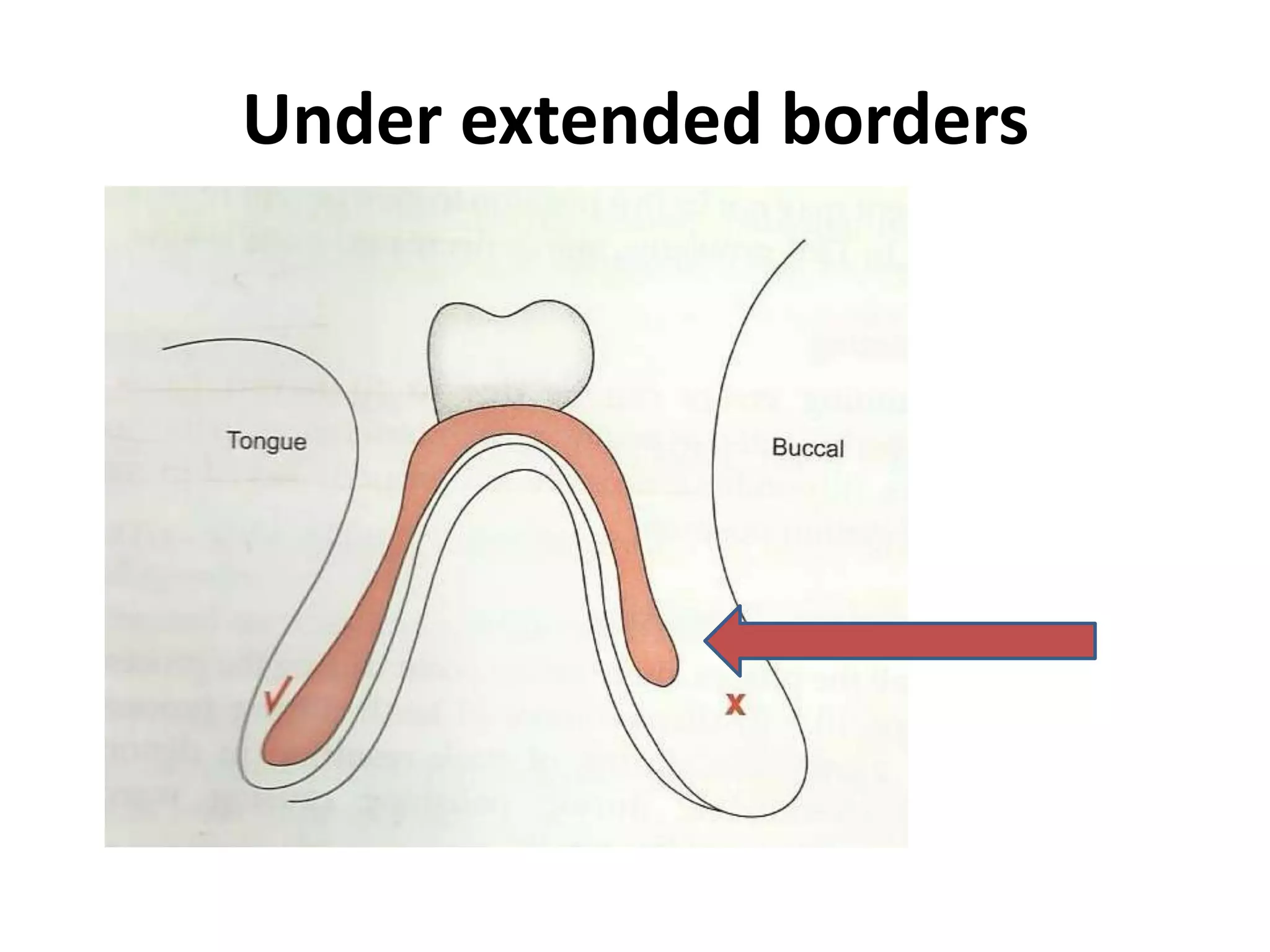
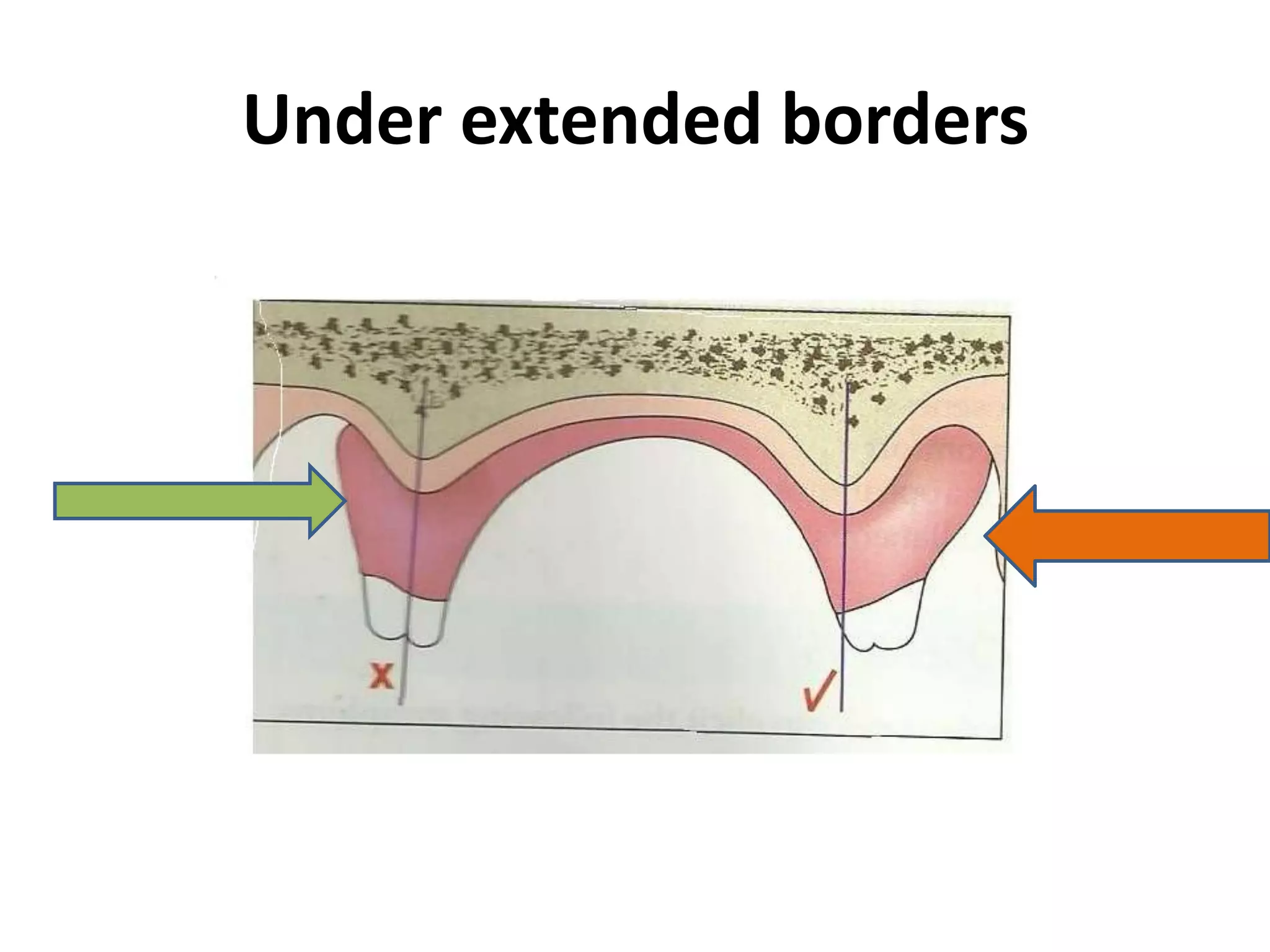
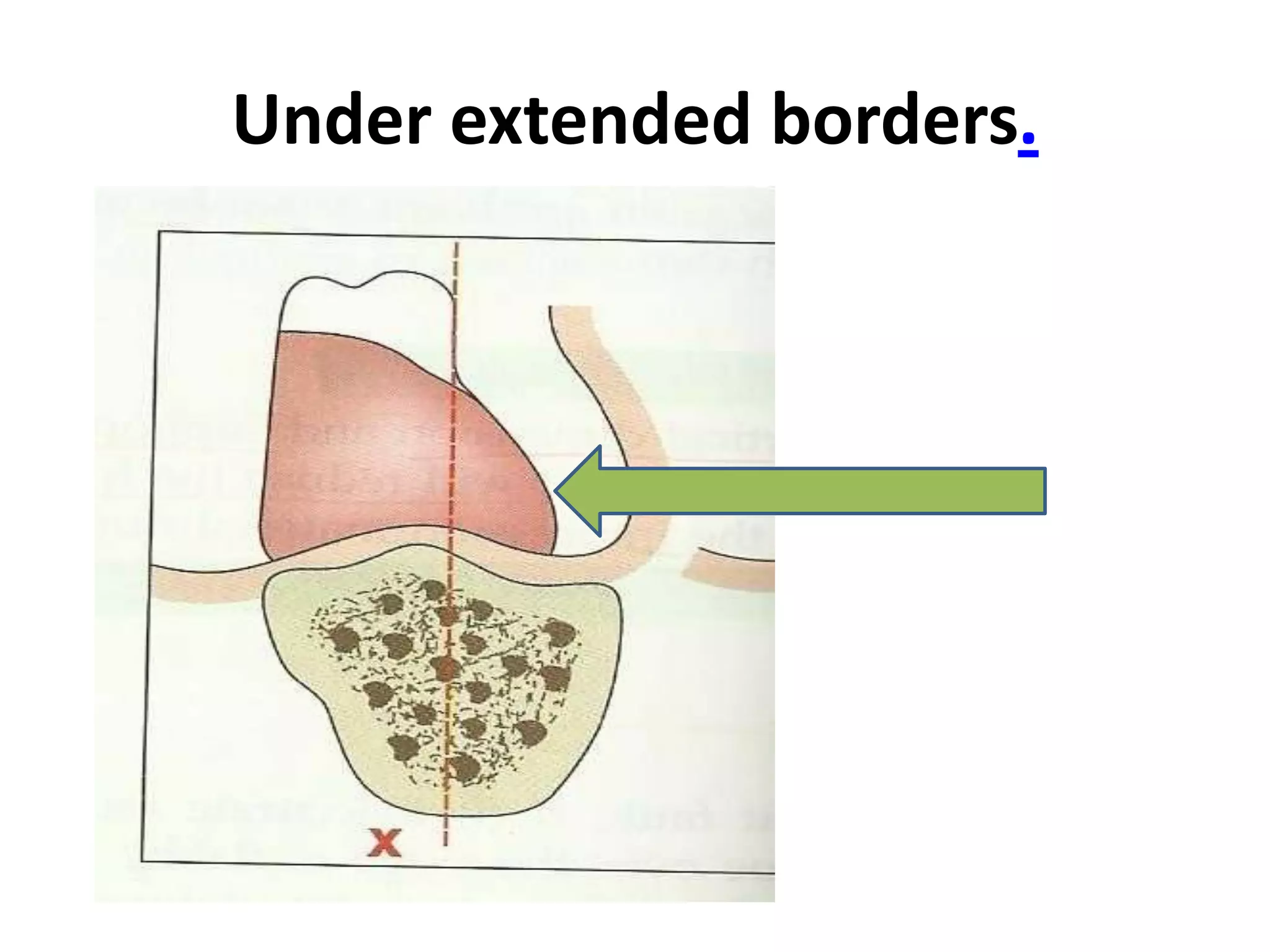
• Under Extended orders – Depth or
Width.
• Incorrect Posterior Palatal Seal.
• Inelasticity of Cheeks.
Air beneath
Impression
Surface
• Poor Fit.
• Undercut Ridge
• Excessive Relief.
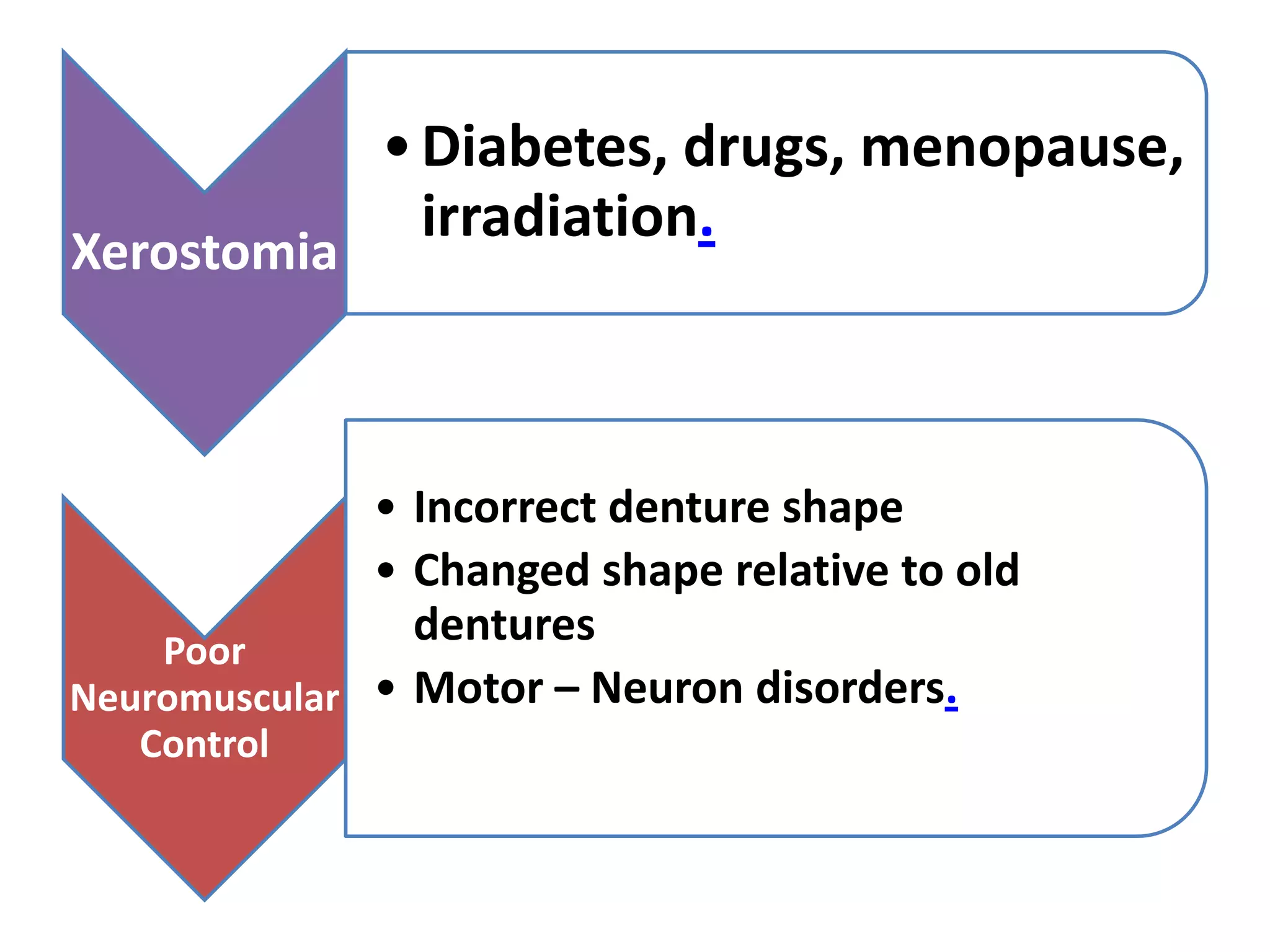
Xerostomia
•Diabetes, drugs, menopause,
irradiation.
Poor
Neuromuscular
Control
• Incorrect denture shape
• Changed shape relative to old
dentures
• Motor – Neuron disorders.
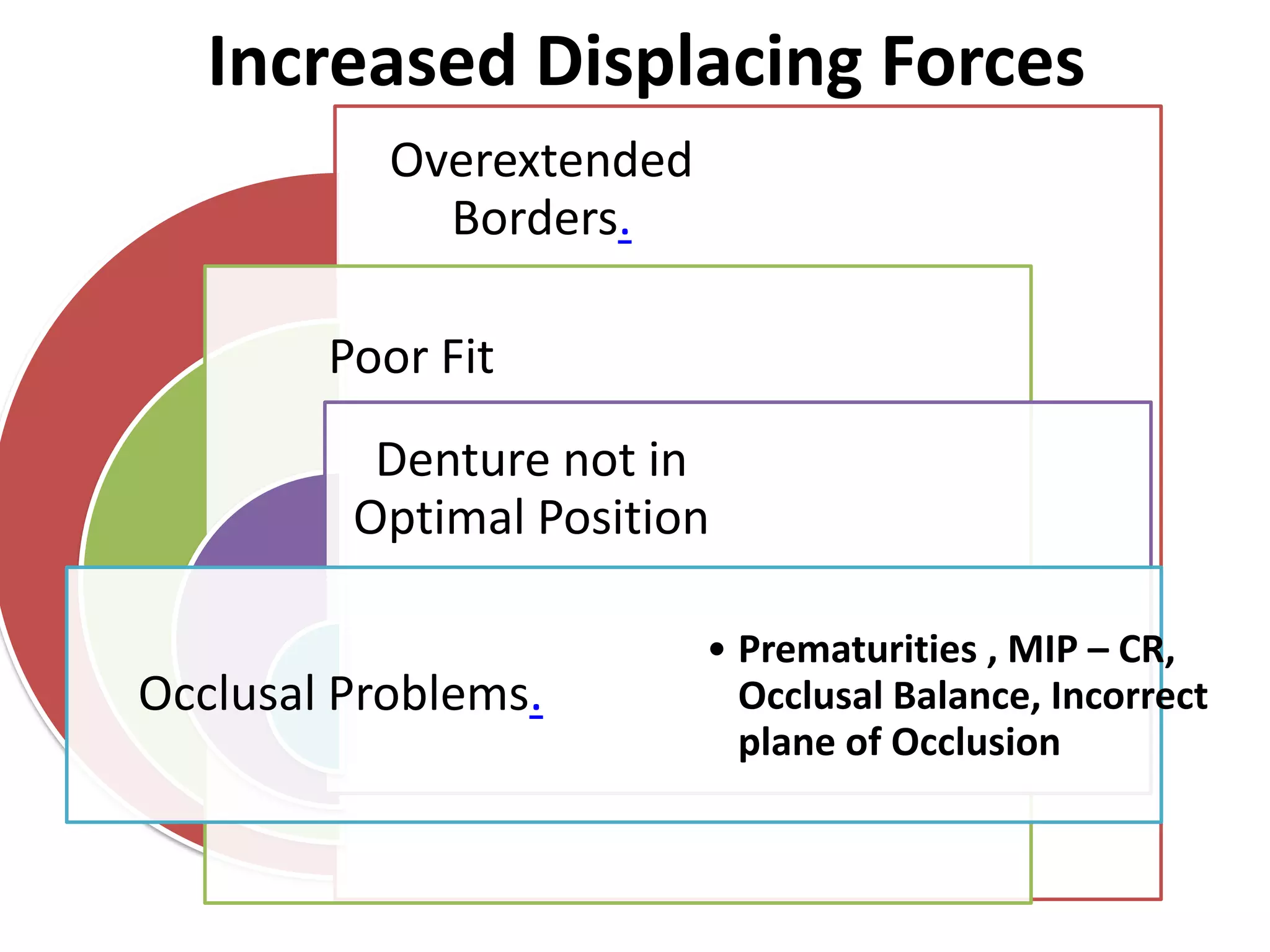
Increased Displacing Forces
Overextended
Borders.
Poor Fit
Denture not in
Optimal Position
Occlusal Problems.
• Prematurities , MIP – CR,
Occlusal Balance, Incorrect
plane of Occlusion
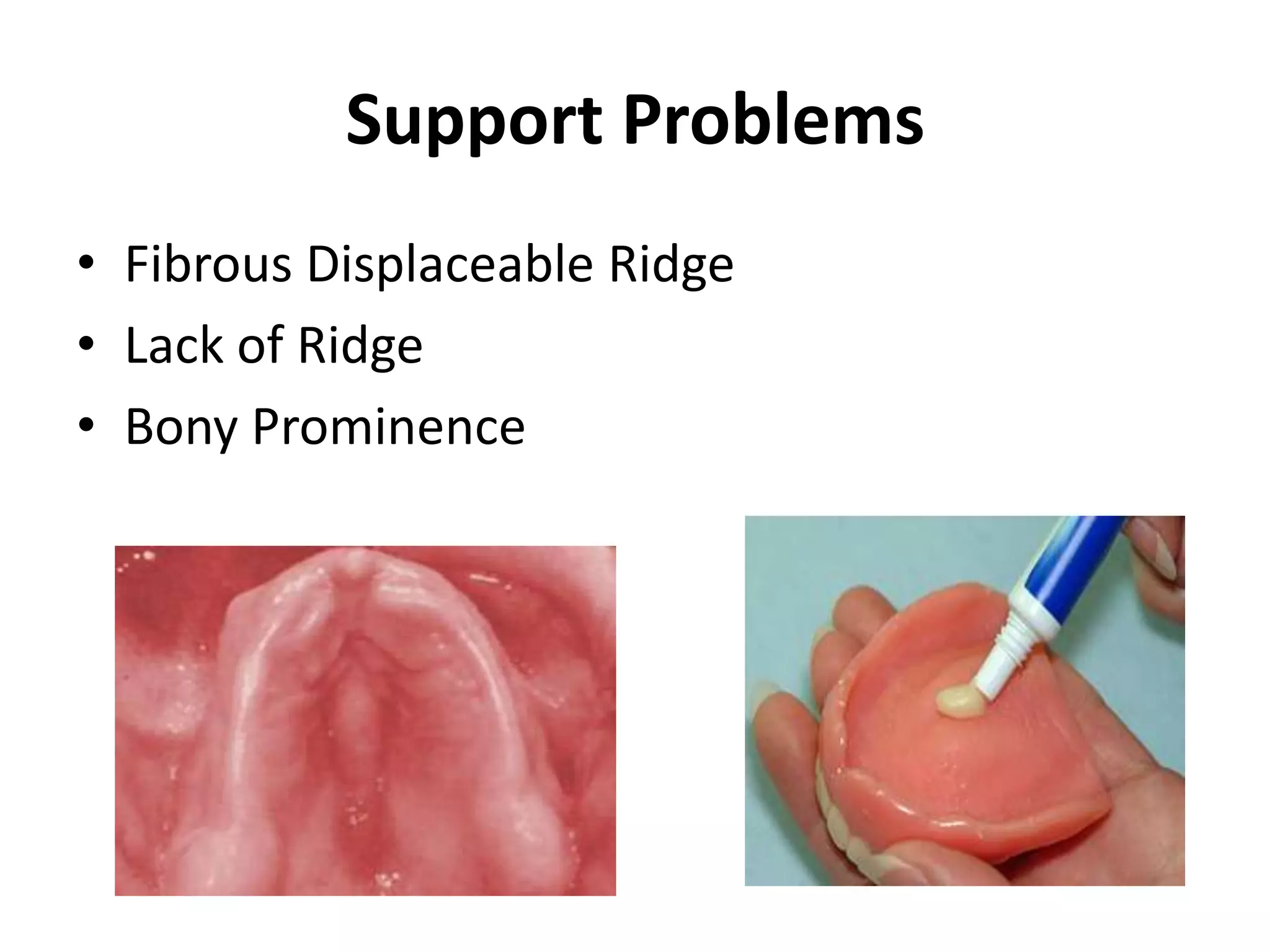
Support Problems
• Fibrous Displaceable Ridge
• Lack of Ridge
• Bony Prominence
Discomfort.
Impression
Surface
Polished
Surface
Occlusal
Surface
Related to Impression Surface
• Sharp Acrylic Nodules
• Un-relieved undercut areas
• Overextension
• Lower knife-edged ridge.
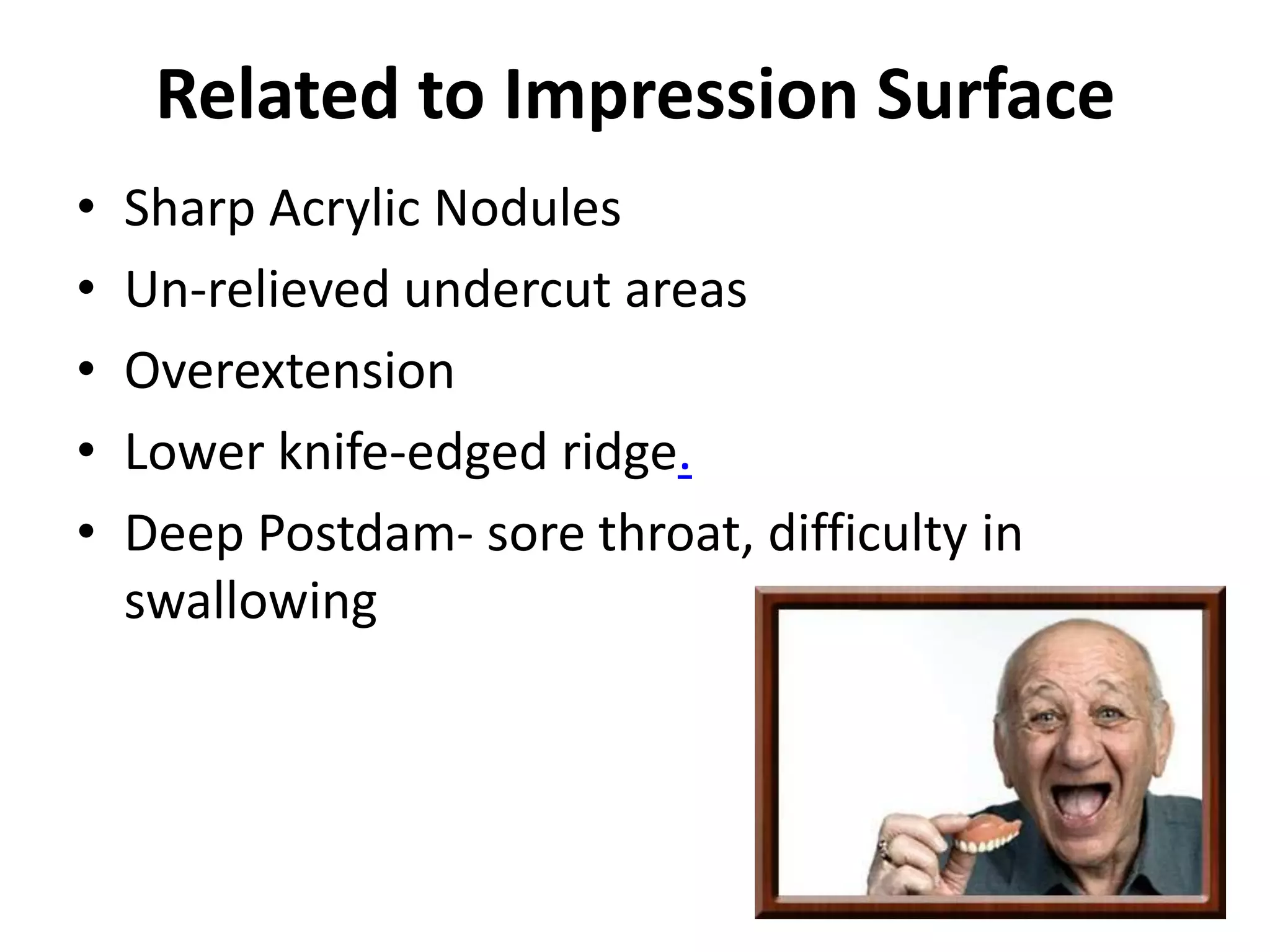
• Deep Postdam- sore throat, difficulty in
swallowing
Related to Polished Surface
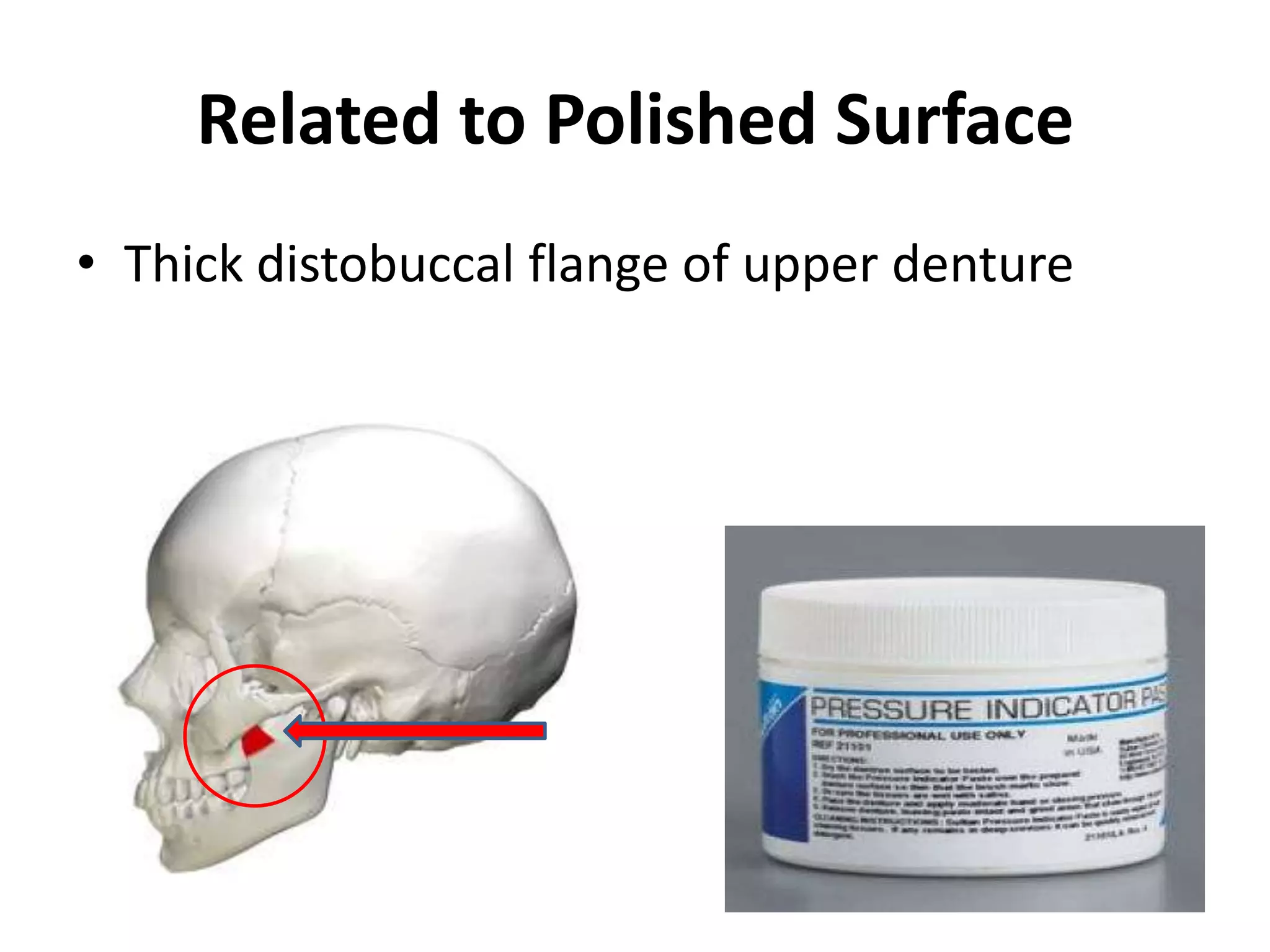
• Thick distobuccal flange of upper denture
Related to Occlusal Surface
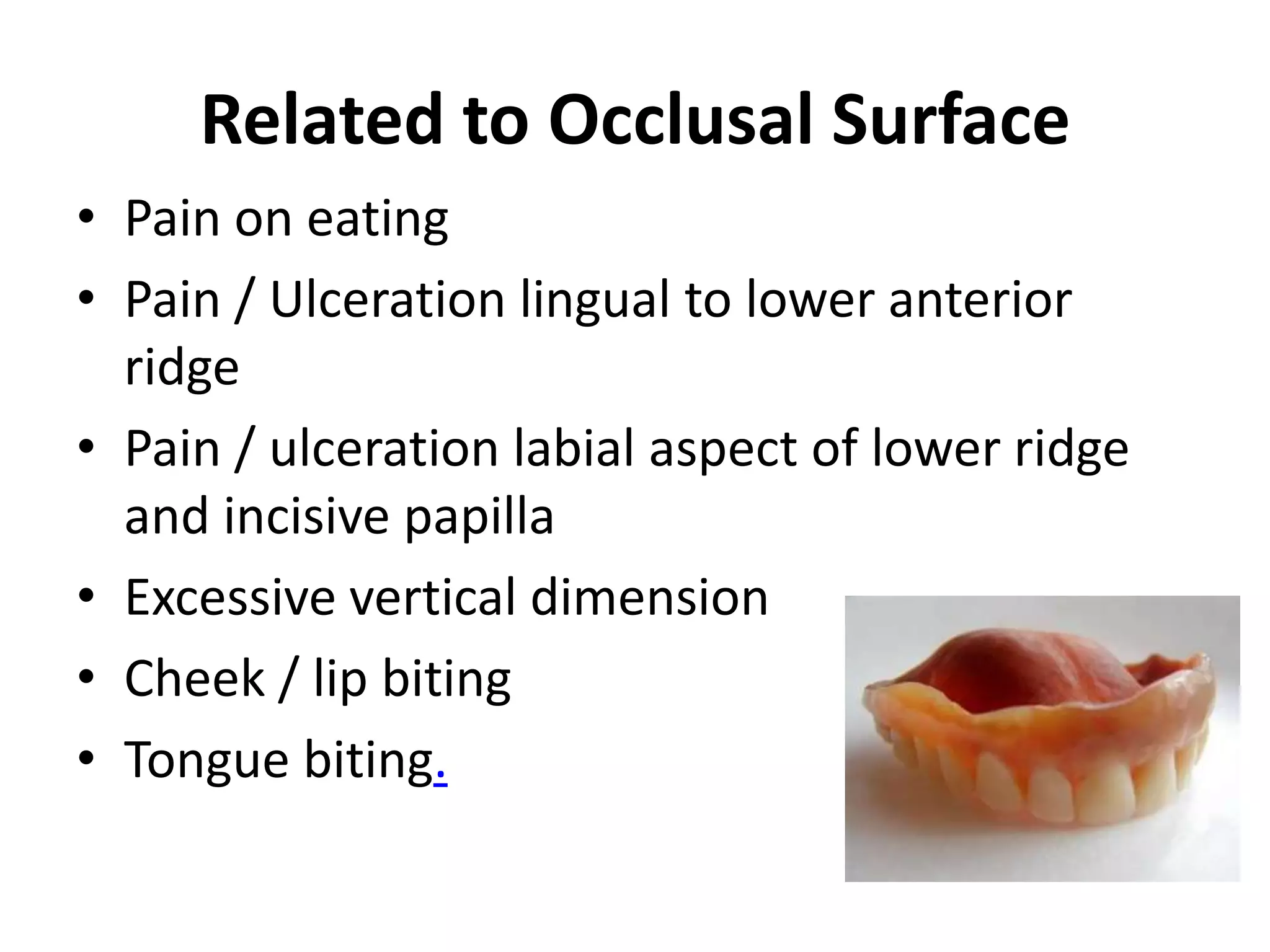
• Pain on eating
• Pain / Ulceration lingual to lower anterior
ridge
• Pain / ulceration labial aspect of lower ridge
and incisive papilla
• Excessive vertical dimension
• Cheek / lip biting
• Tongue biting.
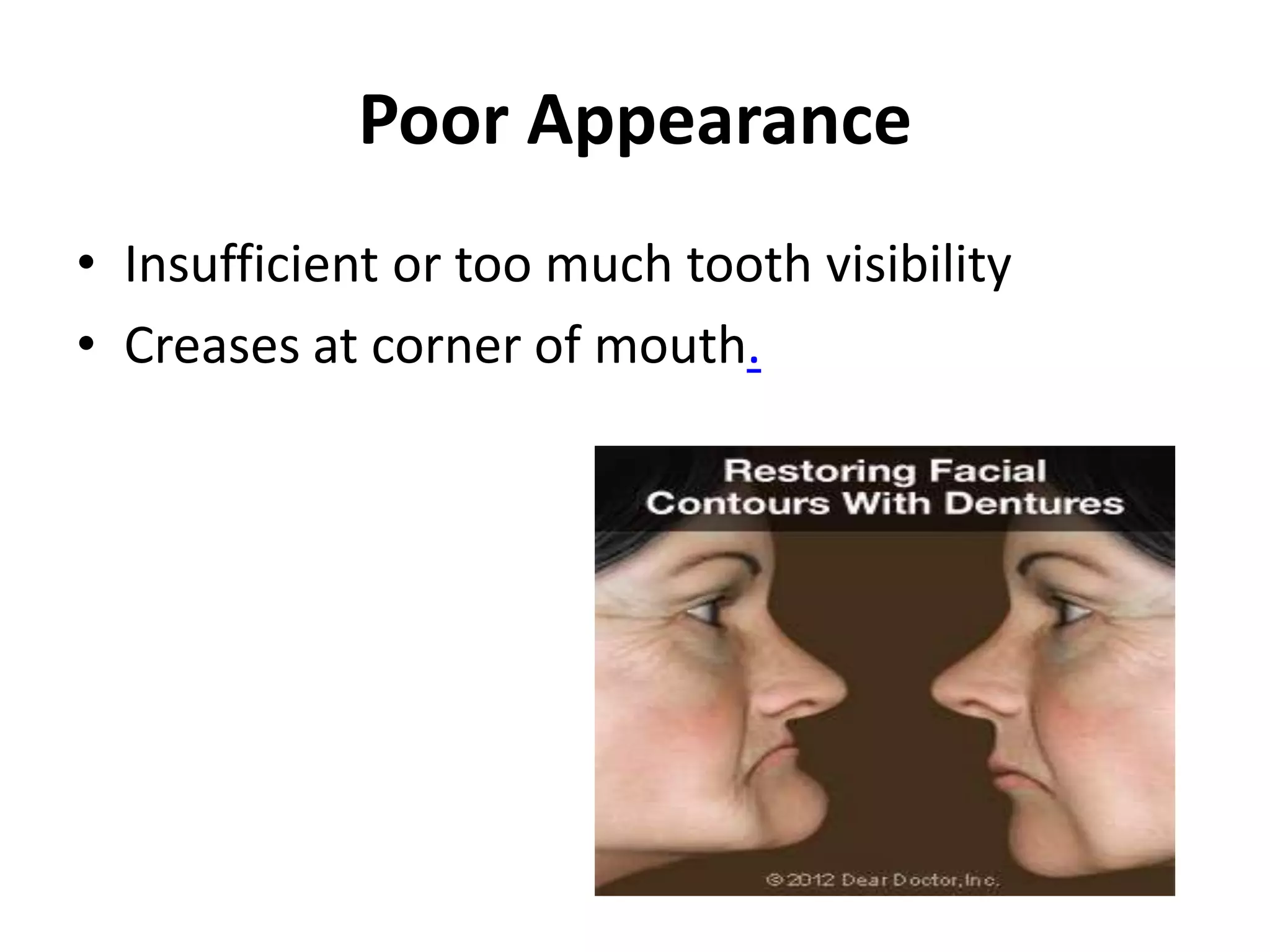
Poor Appearance
• Insufficient or too much tooth visibility
• Creases at corner of mouth.
Miscellaneous
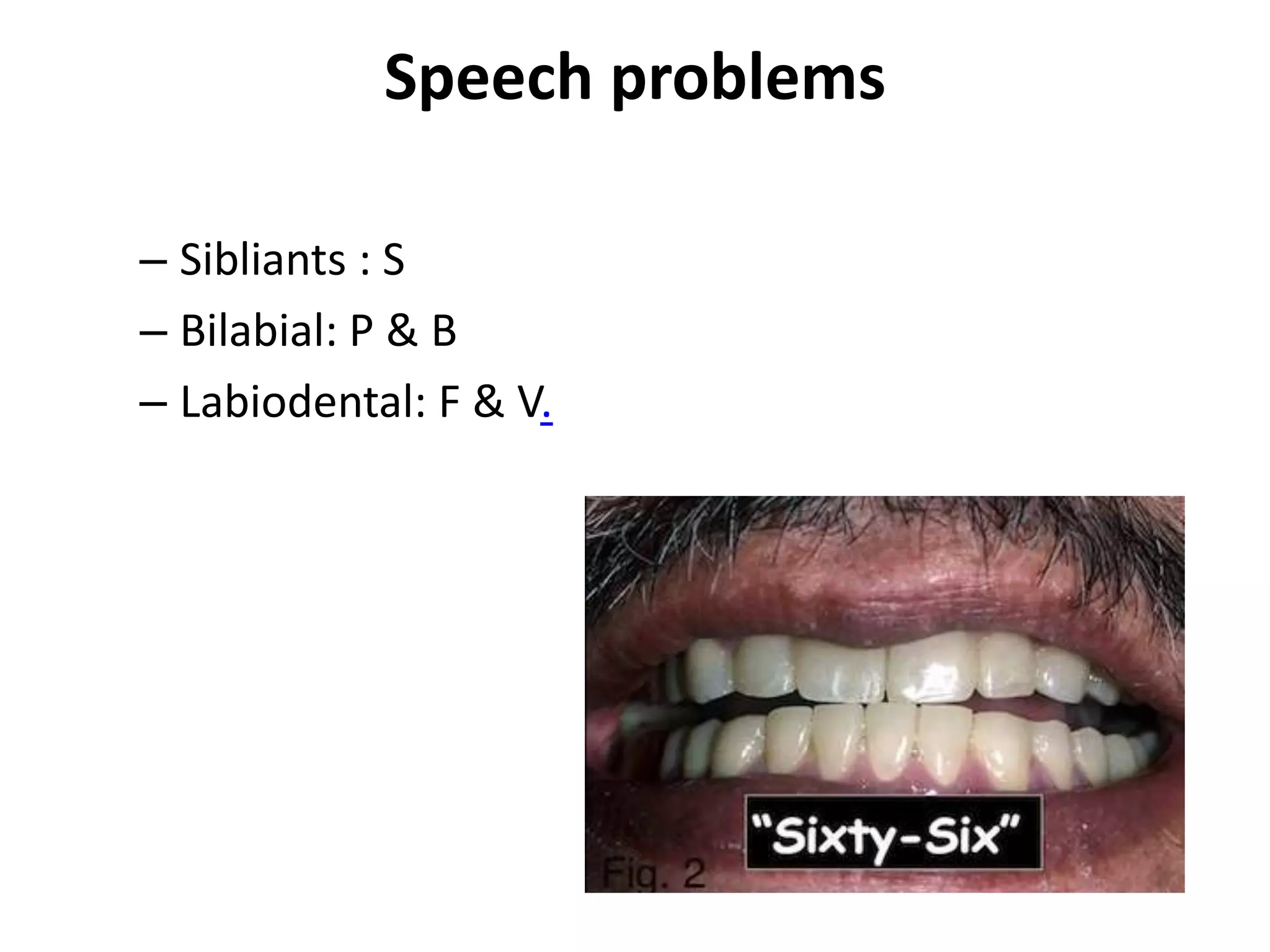
Speech problems
– Sibliants : S
– Bilabial: P & B
– Labiodental: F & V.
Difficulty in Eating
• Instability
• Too narrow occlusal table
• Increased or decreased vertical dimension
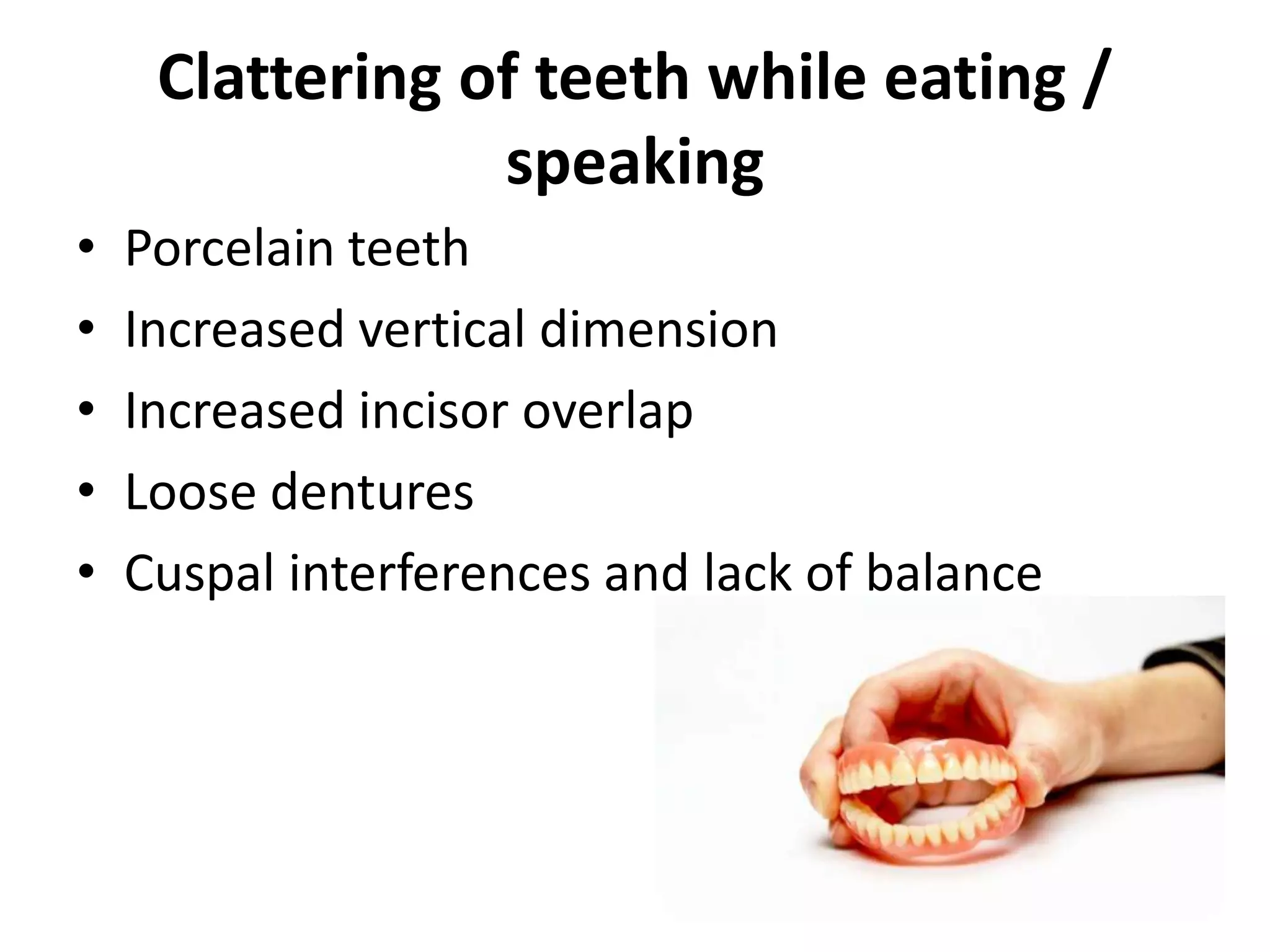
Clattering of teeth while eating /
speaking
• Porcelain teeth
• Increased vertical dimension
• Increased incisor overlap
• Loose dentures
• Cuspal interferences and lack of balance
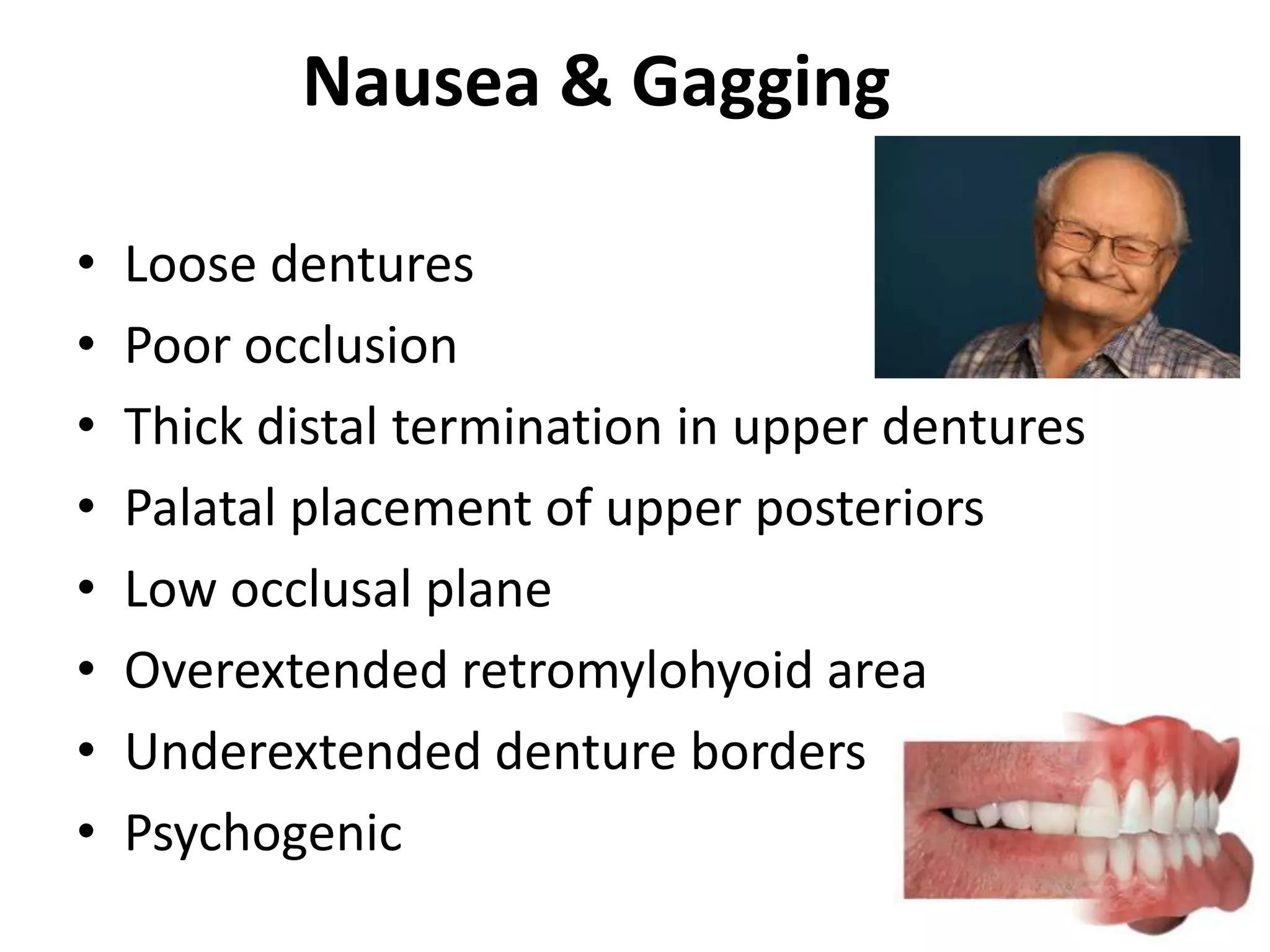
Nausea & Gagging
• Loose dentures
• Poor occlusion
• Thick distal termination in upper dentures
• Palatal placement of upper posteriors
• Low occlusal plane
• Overextended retromylohyoid area
• Underextended denture borders
• Psychogenic
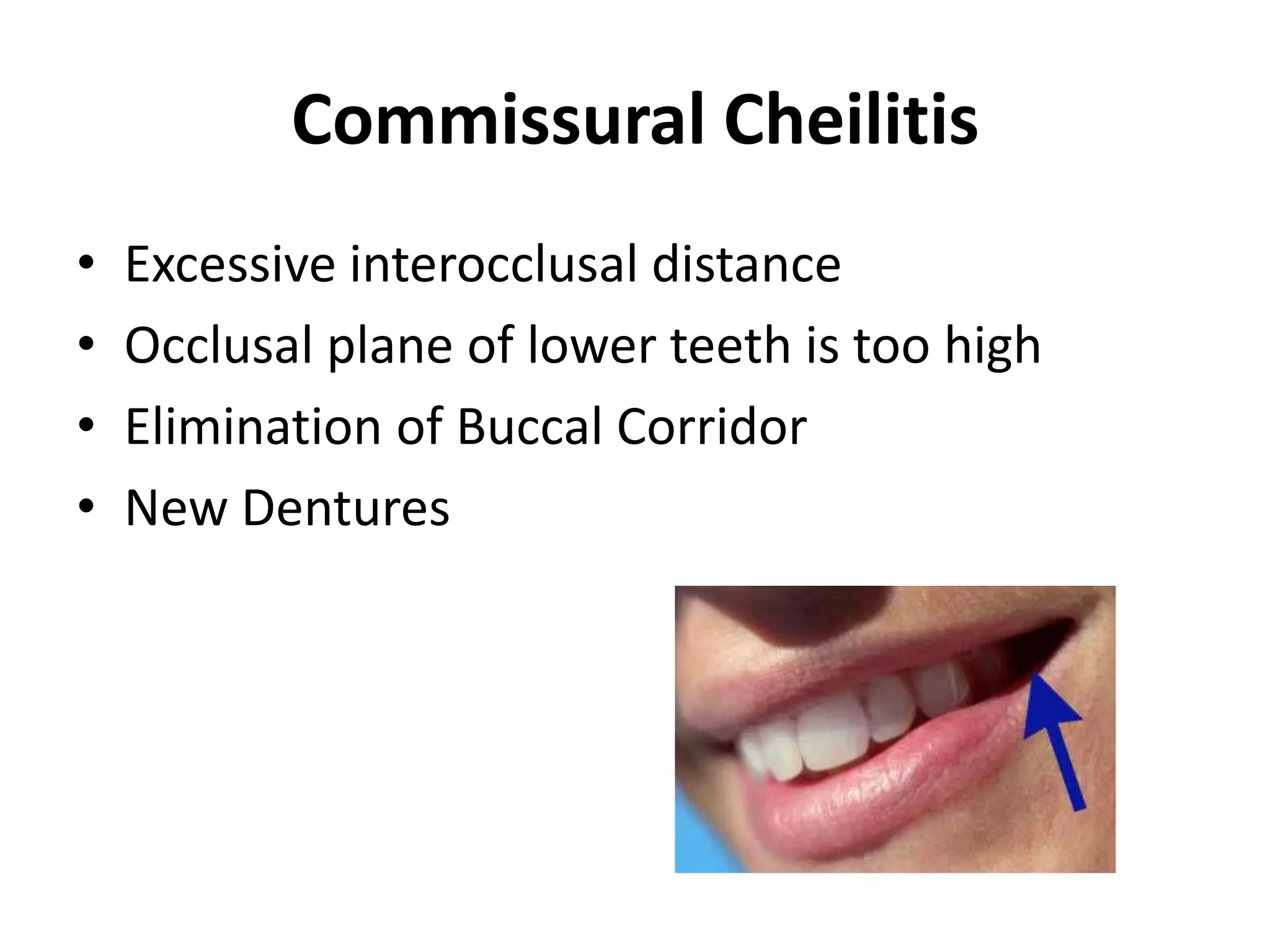
Commissural Cheilitis
• Excessive interocclusal distance
• Occlusal plane of lower teeth is too high
• Elimination of Buccal Corridor
• New Dentures
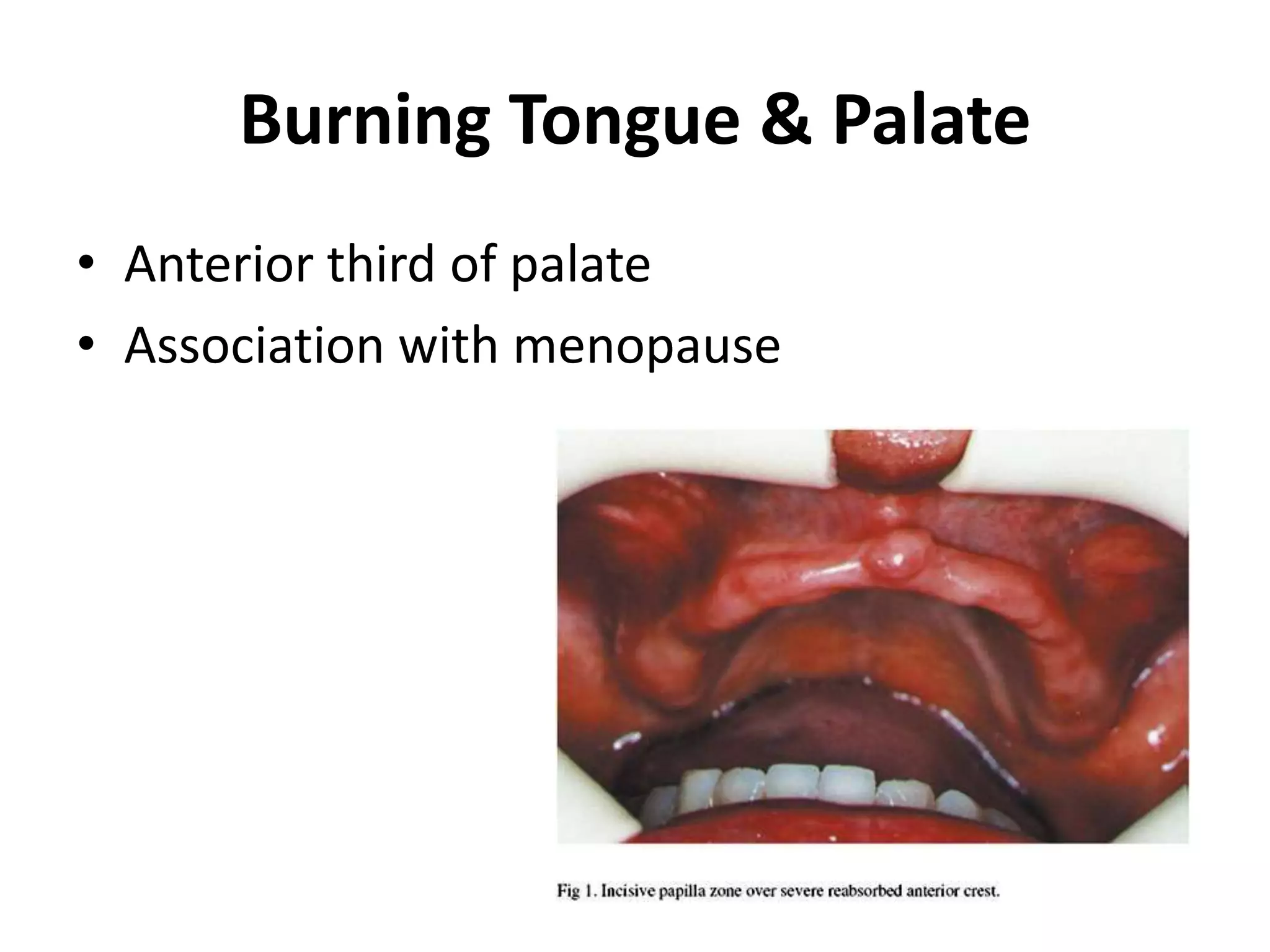
Burning Tongue & Palate
• Anterior third of palate
• Association with menopause
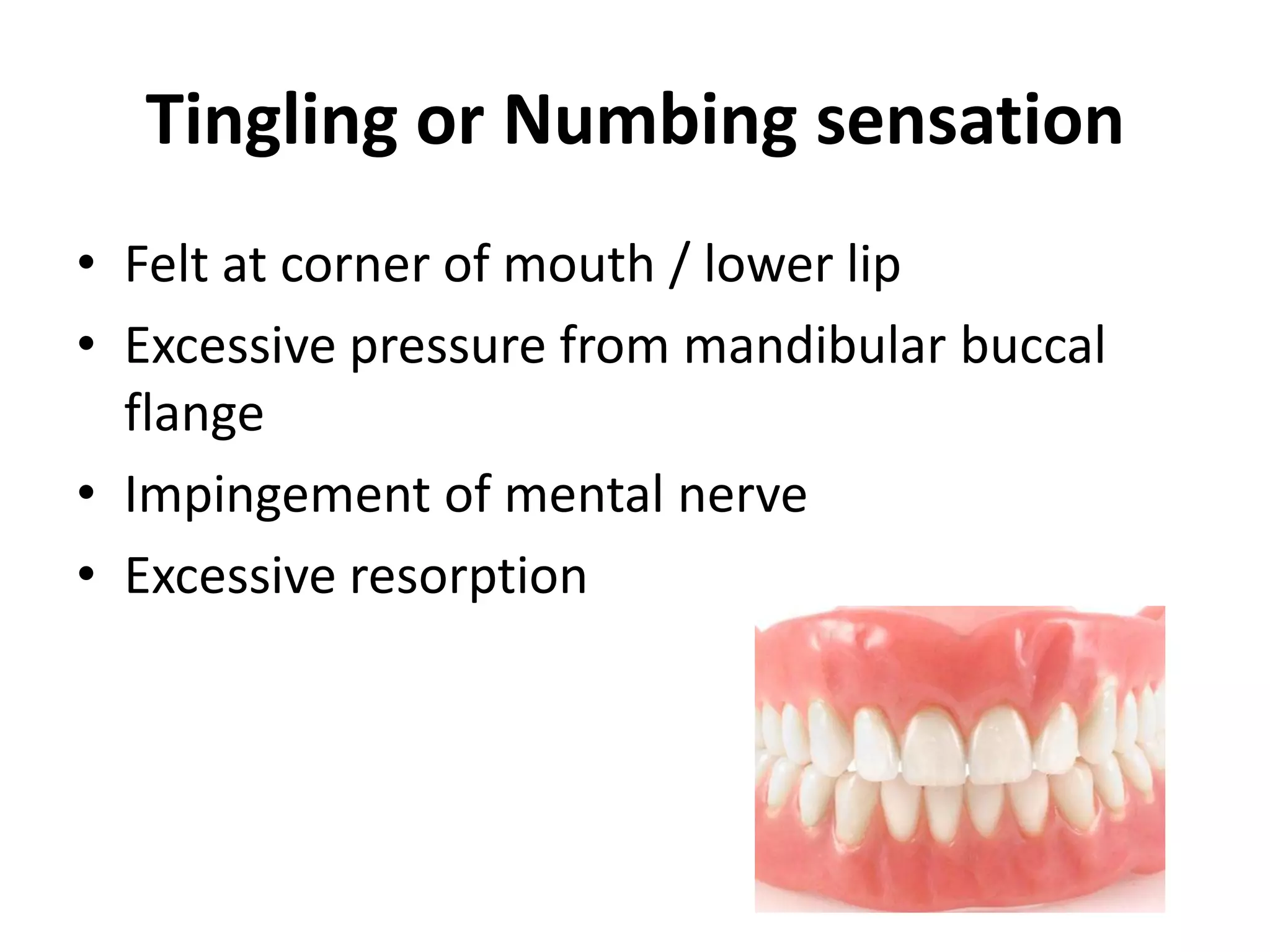
Tingling or Numbing sensation
• Felt at corner of mouth / lower lip
• Excessive pressure from mandibular buccal
flange
• Impingement of mental nerve
• Excessive resorption
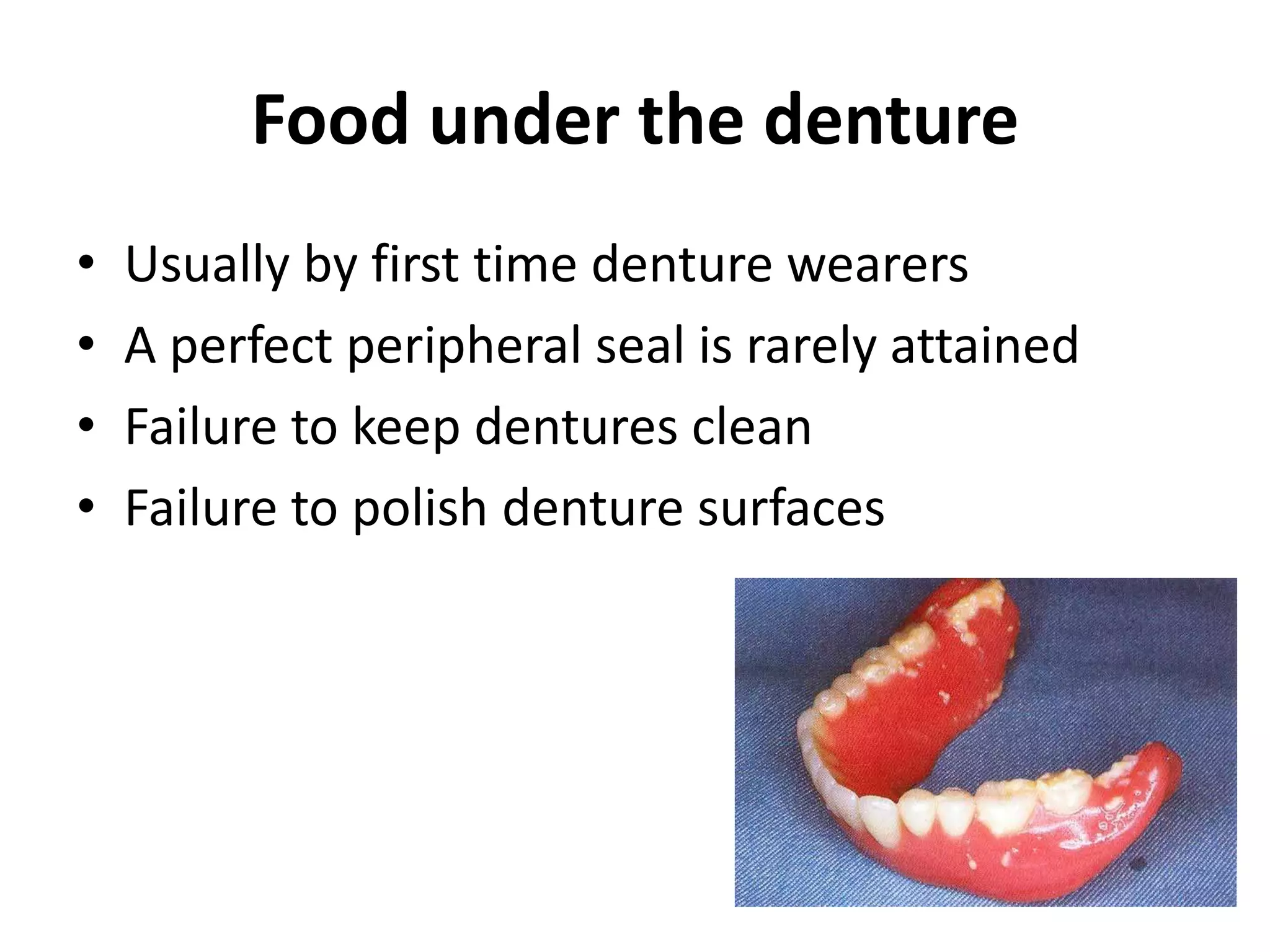
Food under the denture
• Usually by first time denture wearers
• A perfect peripheral seal is rarely attained
• Failure to keep dentures clean
• Failure to polish denture surfaces
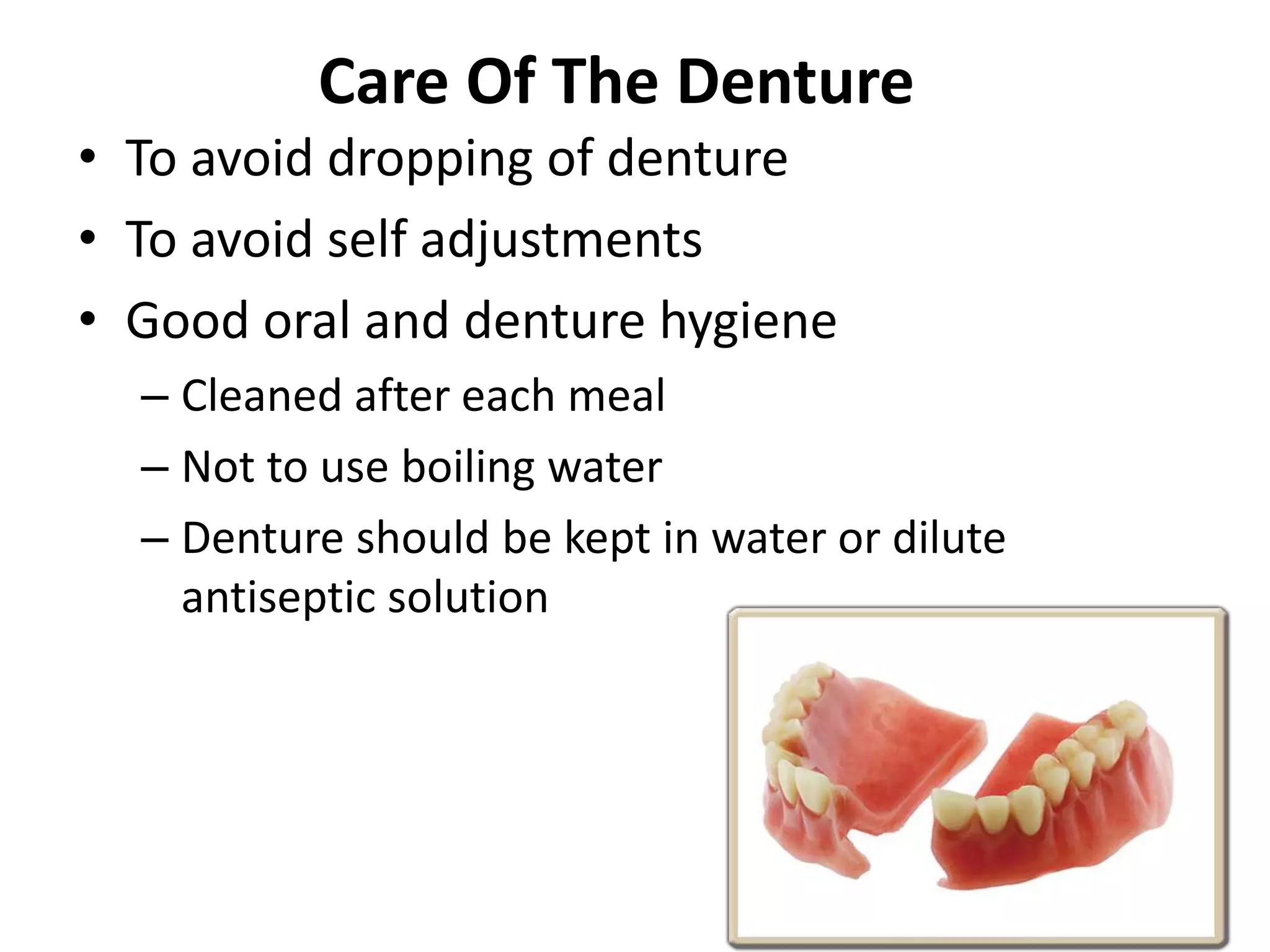
Care Of The Denture
• To avoid dropping of denture
• To avoid self adjustments
• Good oral and denture hygiene
– Cleaned after each meal
– Not to use boiling water
– Denture should be kept in water or dilute
antiseptic solution
Conclusion
• Patient education
• Forewarning
• Explanations
References
• Arthur O Rahn, Charles M. Heartwell: Textbook of
complete Dentures, ed 5, London, 1993.
• George A. Zarb, Charles L.Bolender, Judson C. Hickey,
Gunnar E. Carlsson: Boucher’s prosthodontic
treatment for edentulous patients, ed 10, B.I
Publications Pvt Ltd.
• John J. Sharry: Complete Denture Prosthodontics,
McGrawhill Book Company, Inc. 1962.
• Sheldon Winkler: Essentials of complete Denture
Prosthodontics, ed 2, Ishiyaku Euro America Inc.
Thank You ...
Under extended borders
Under extended borders.
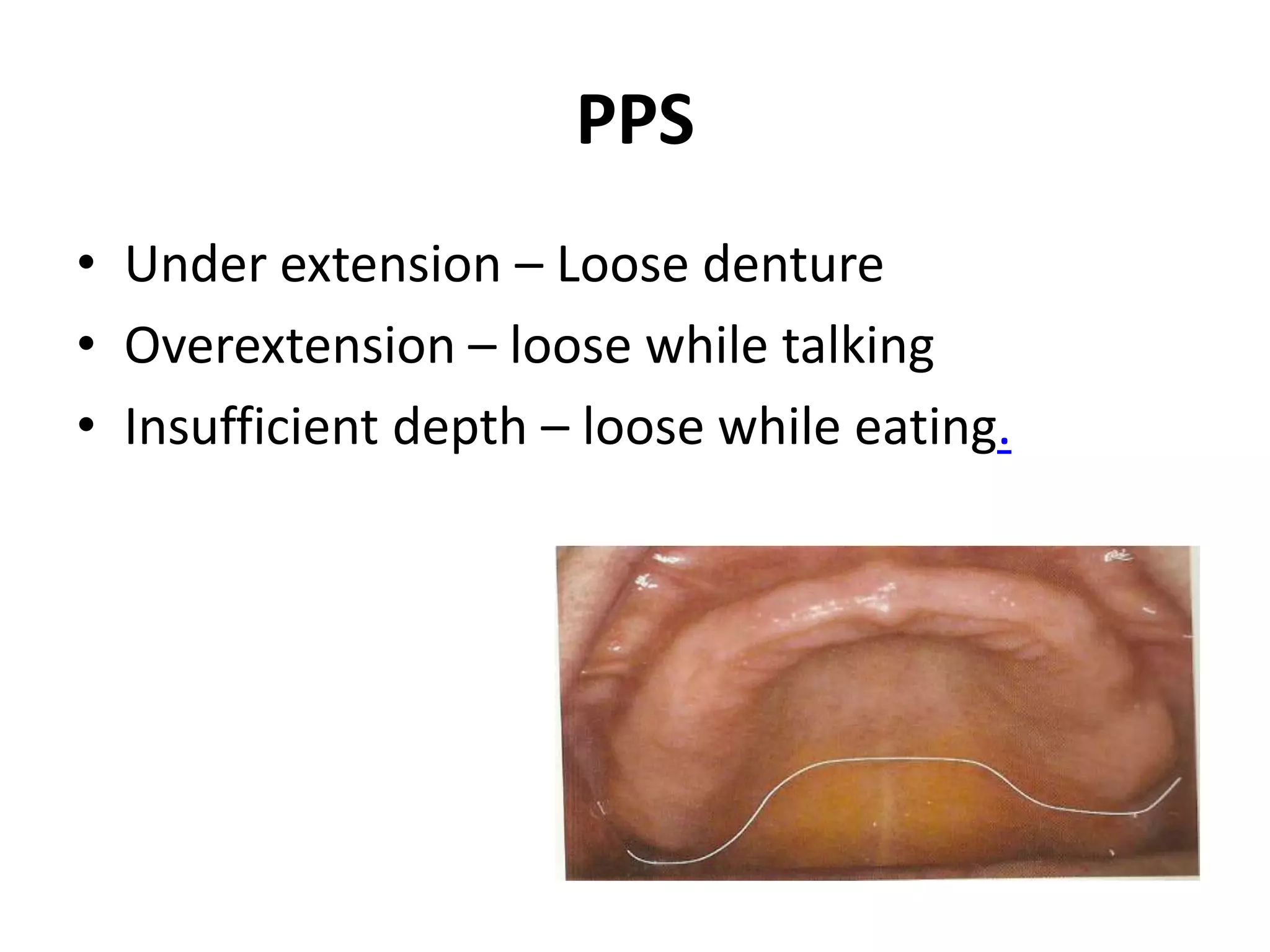
PPS
• Under extension – Loose denture
• Overextension – loose while talking
• Insufficient depth – loose while eating.
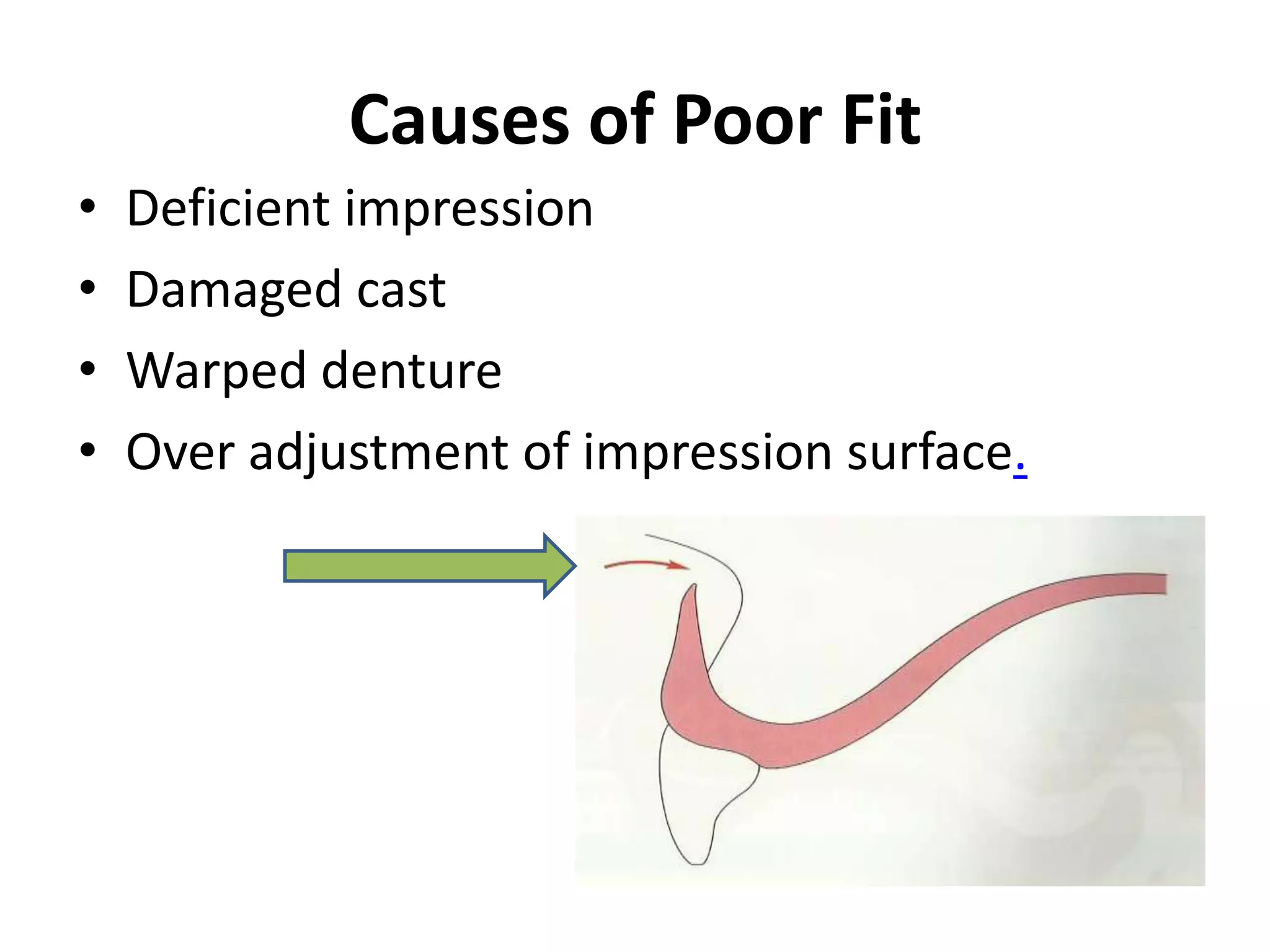
Causes of Poor Fit
• Deficient impression
• Damaged cast
• Warped denture
• Over adjustment of impression surface.
Treatment: Lack of Seal
• Under extended borders – soft tracing
compound
• Incorrect posterior palatal seal – correct
placement of border
• Inelasticity of Cheeks – incremental border
moulding and functional movements.
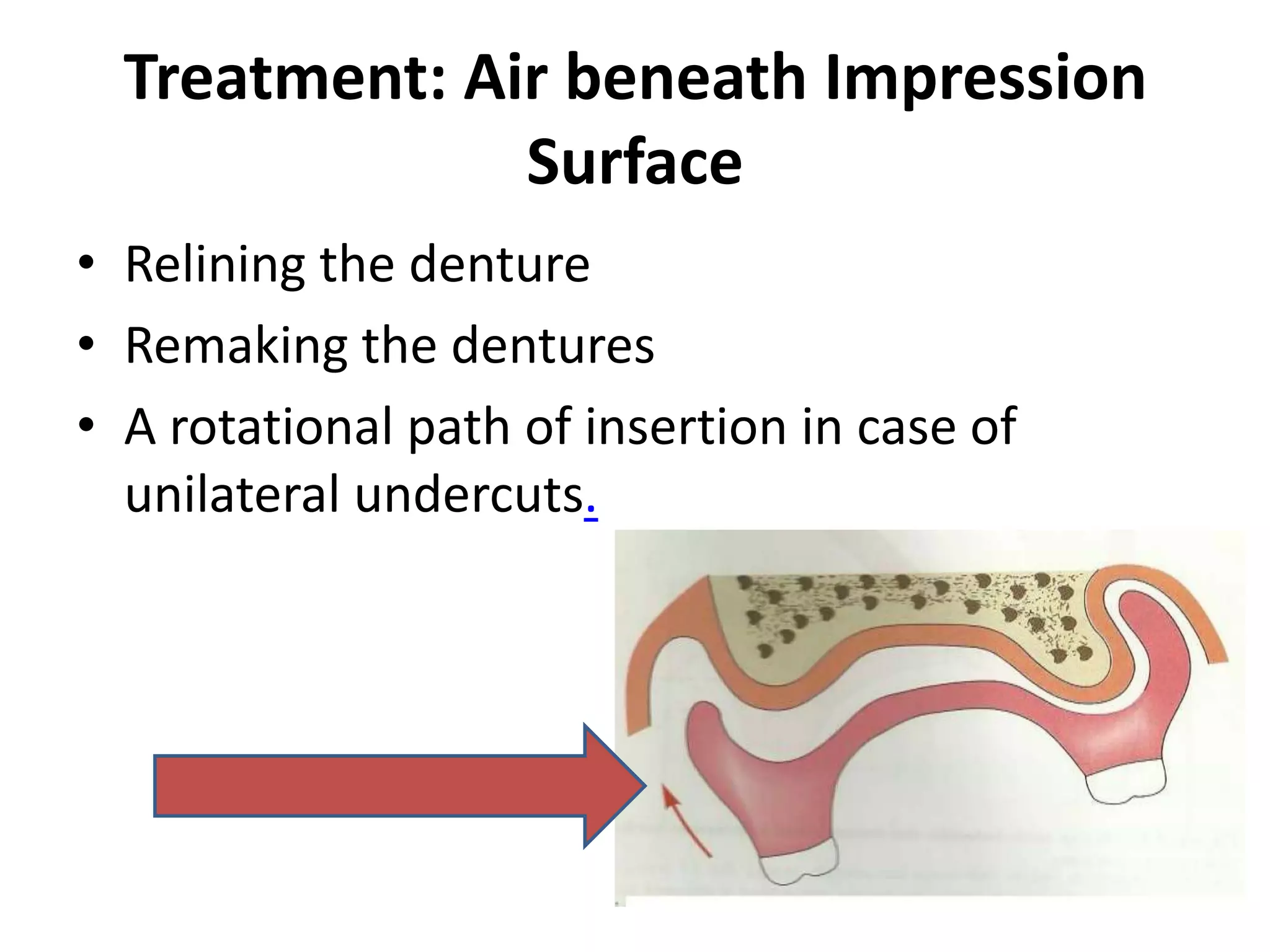
Treatment: Air beneath Impression
Surface
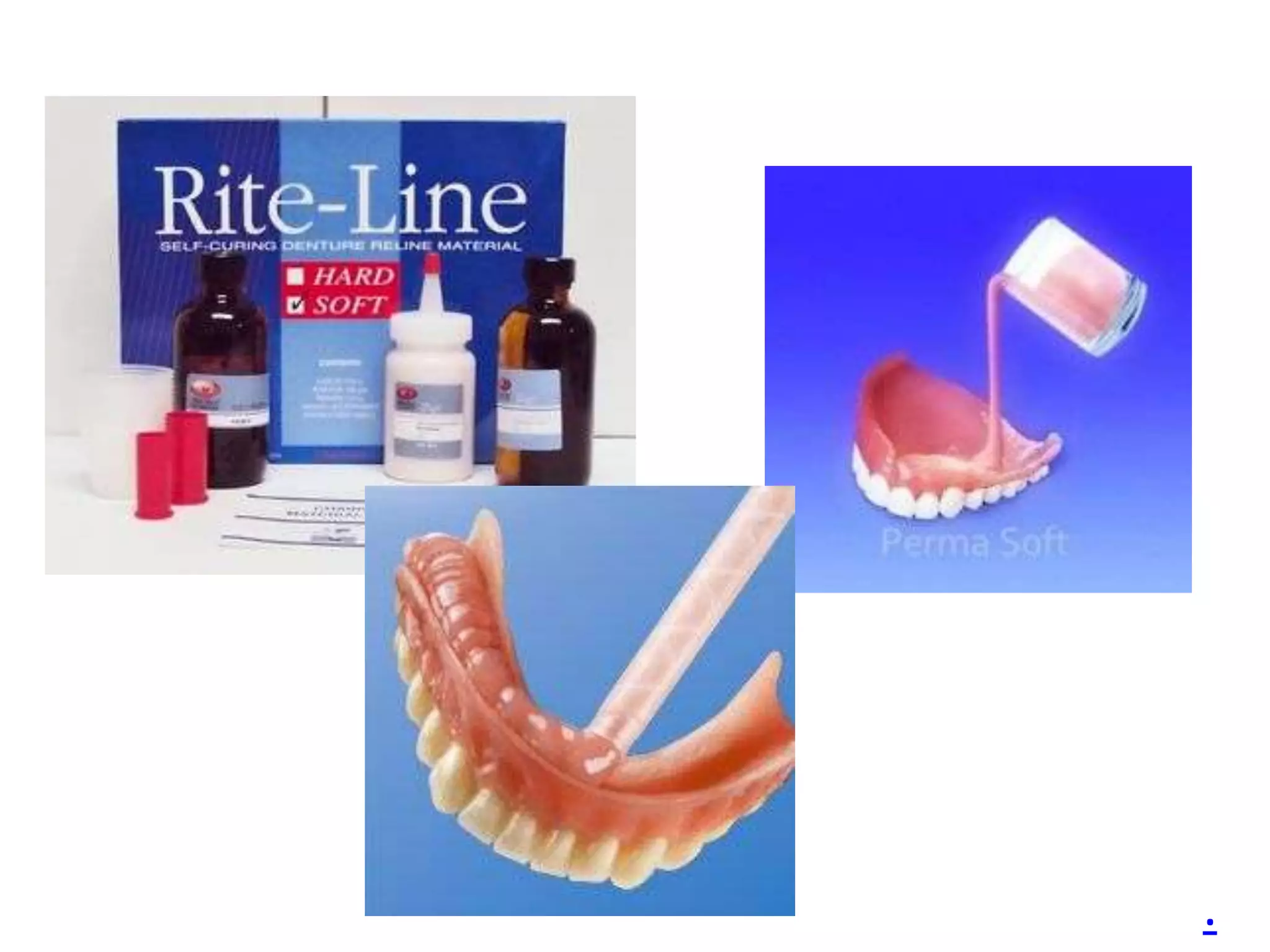
• Relining the denture
• Remaking the dentures
• A rotational path of insertion in case of
unilateral undercuts.
Treatment: Xerostomia
• Presence / Absence of glandular function
• Artificial saliva substitutes
• Sucking on sour candy
• Intermittent sips of water
• Pilocarpine hydrochloride.
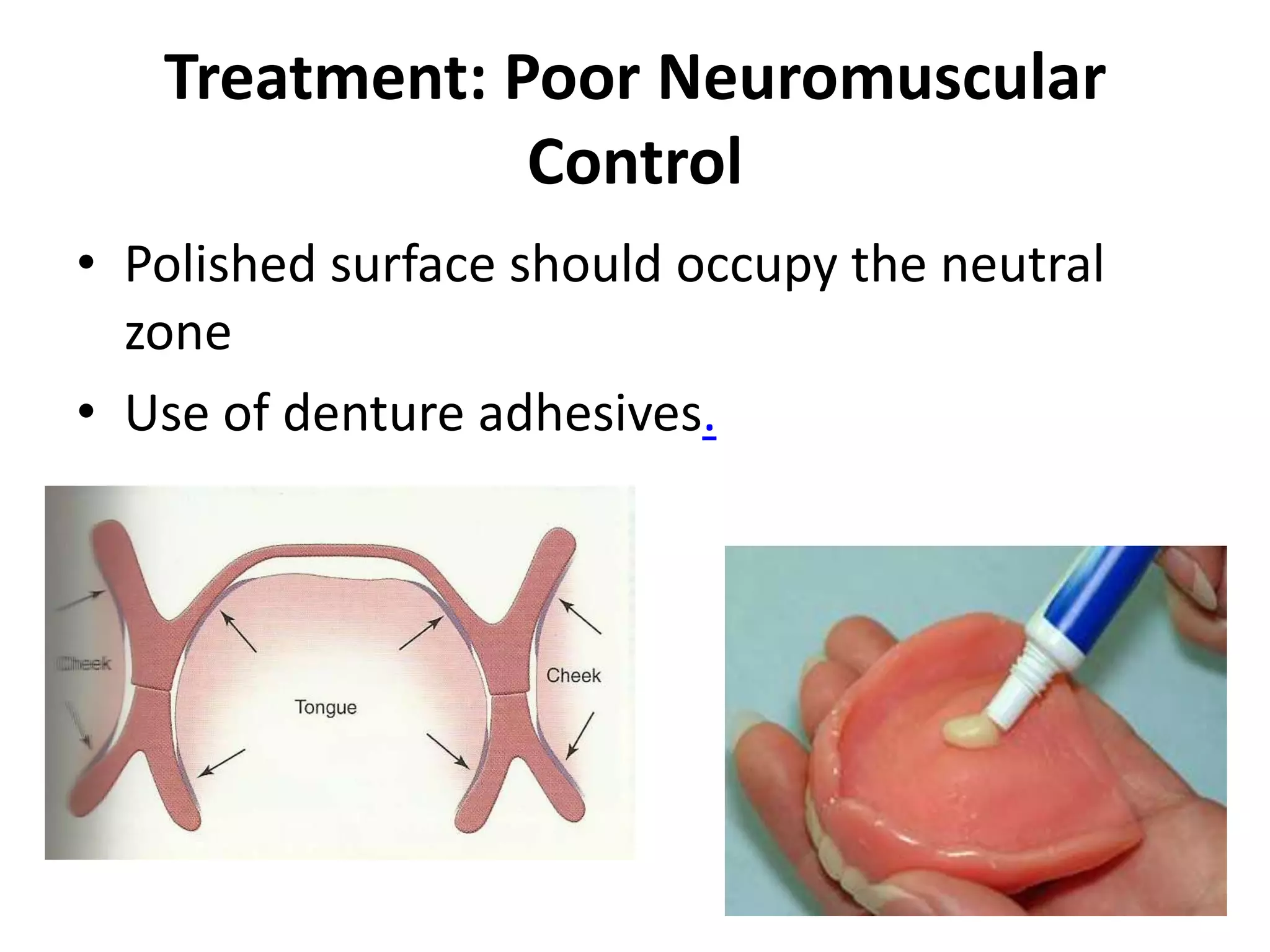
Treatment: Poor Neuromuscular
Control
• Polished surface should occupy the neutral
zone
• Use of denture adhesives.
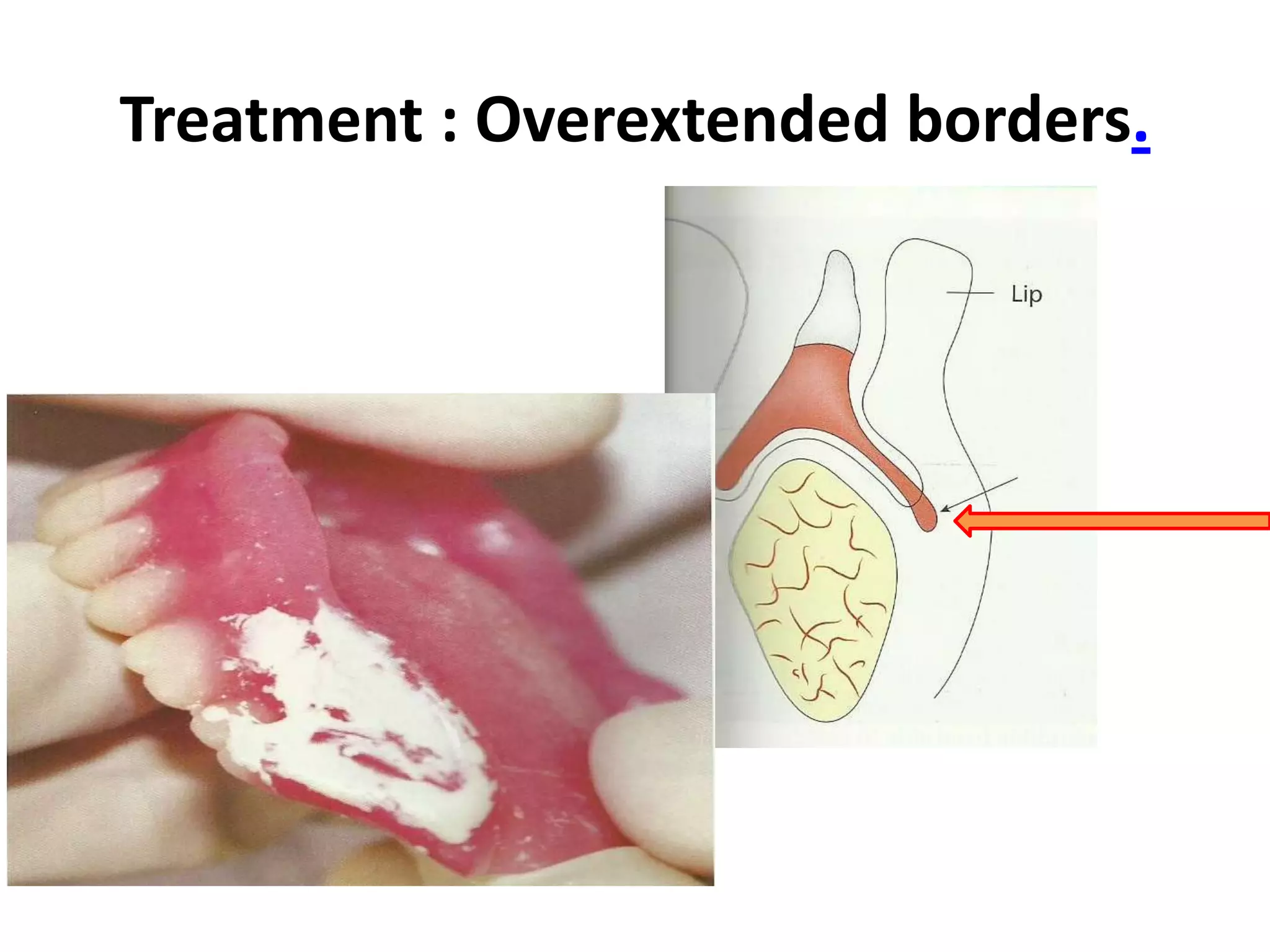
Treatment : Overextended borders.
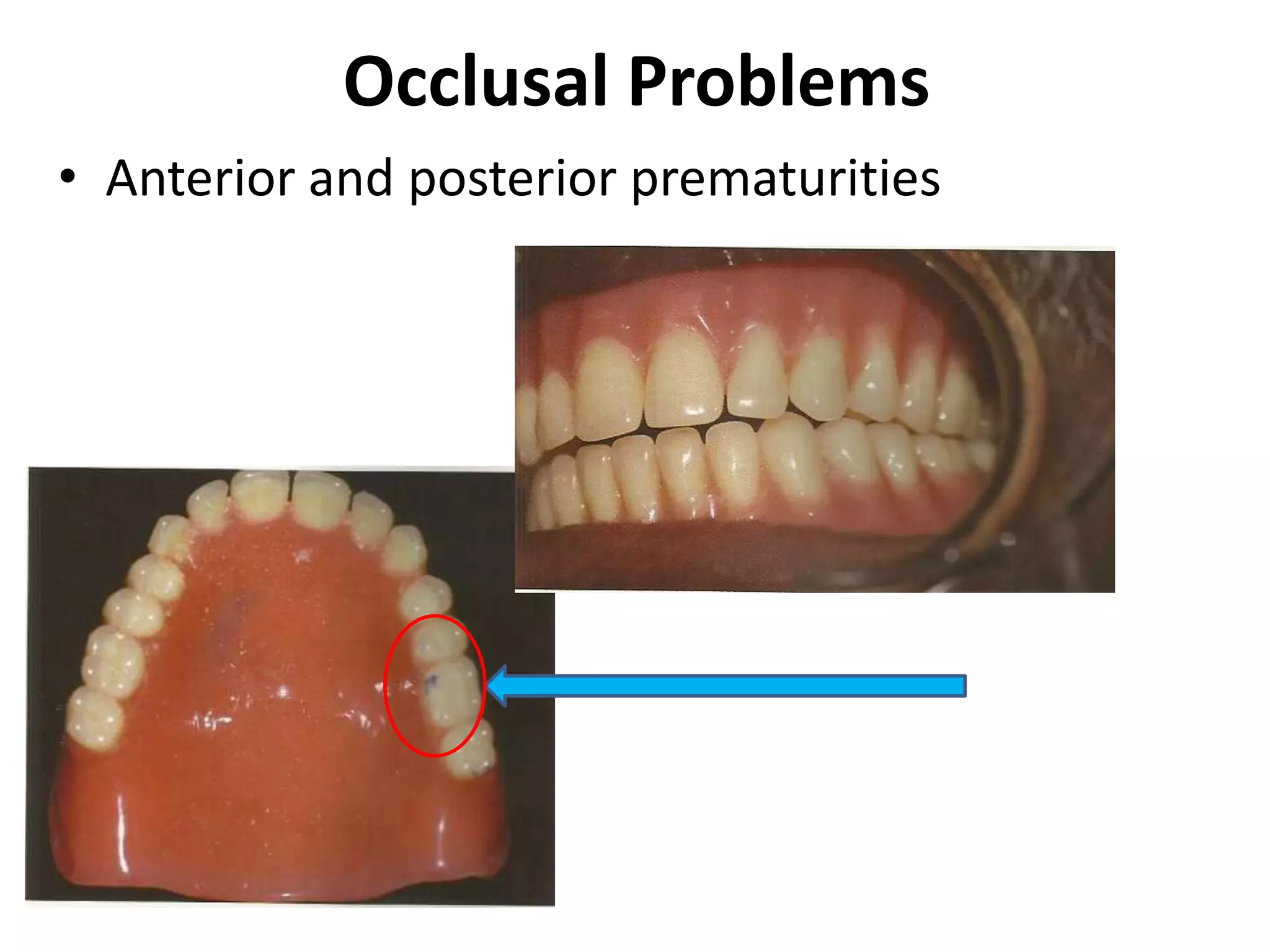
Occlusal Problems
• Anterior and posterior prematurities
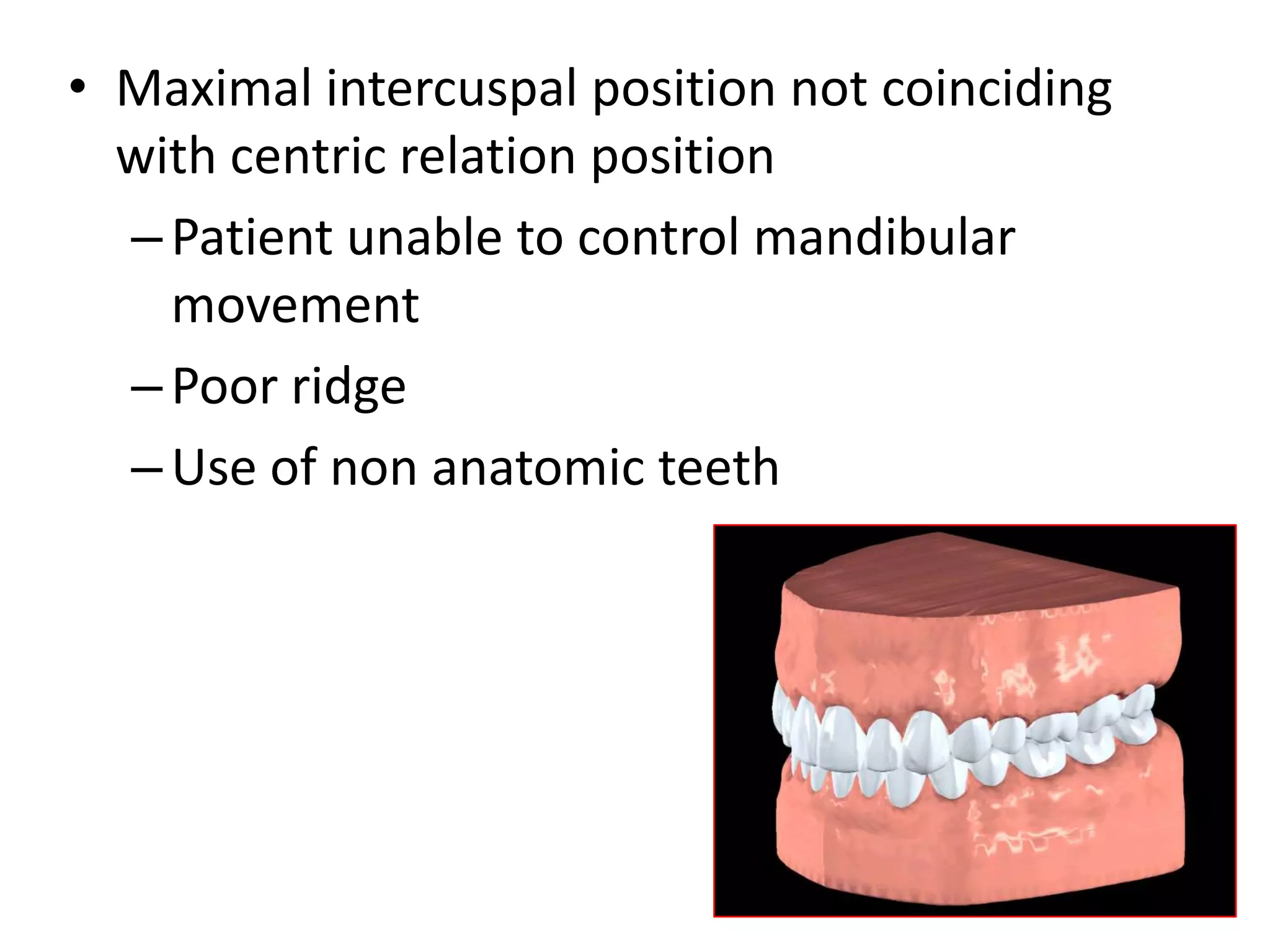
• Maximal intercuspal position not coinciding
with centric relation position
–Patient unable to control mandibular
movement
–Poor ridge
–Use of non anatomic teeth
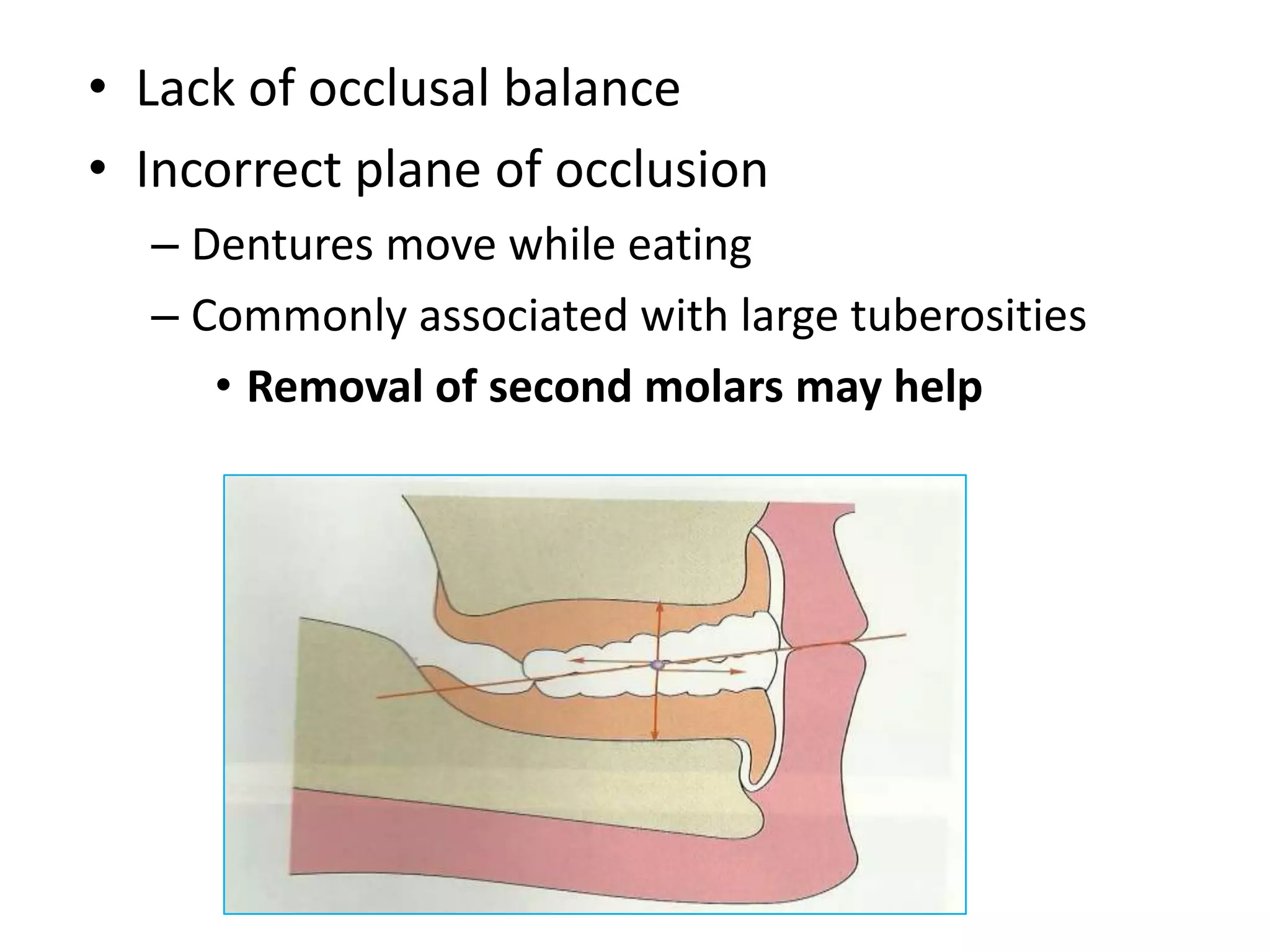
• Lack of occlusal balance
• Incorrect plane of occlusion
– Dentures move while eating
– Commonly associated with large tuberosities
• Removal of second molars may help
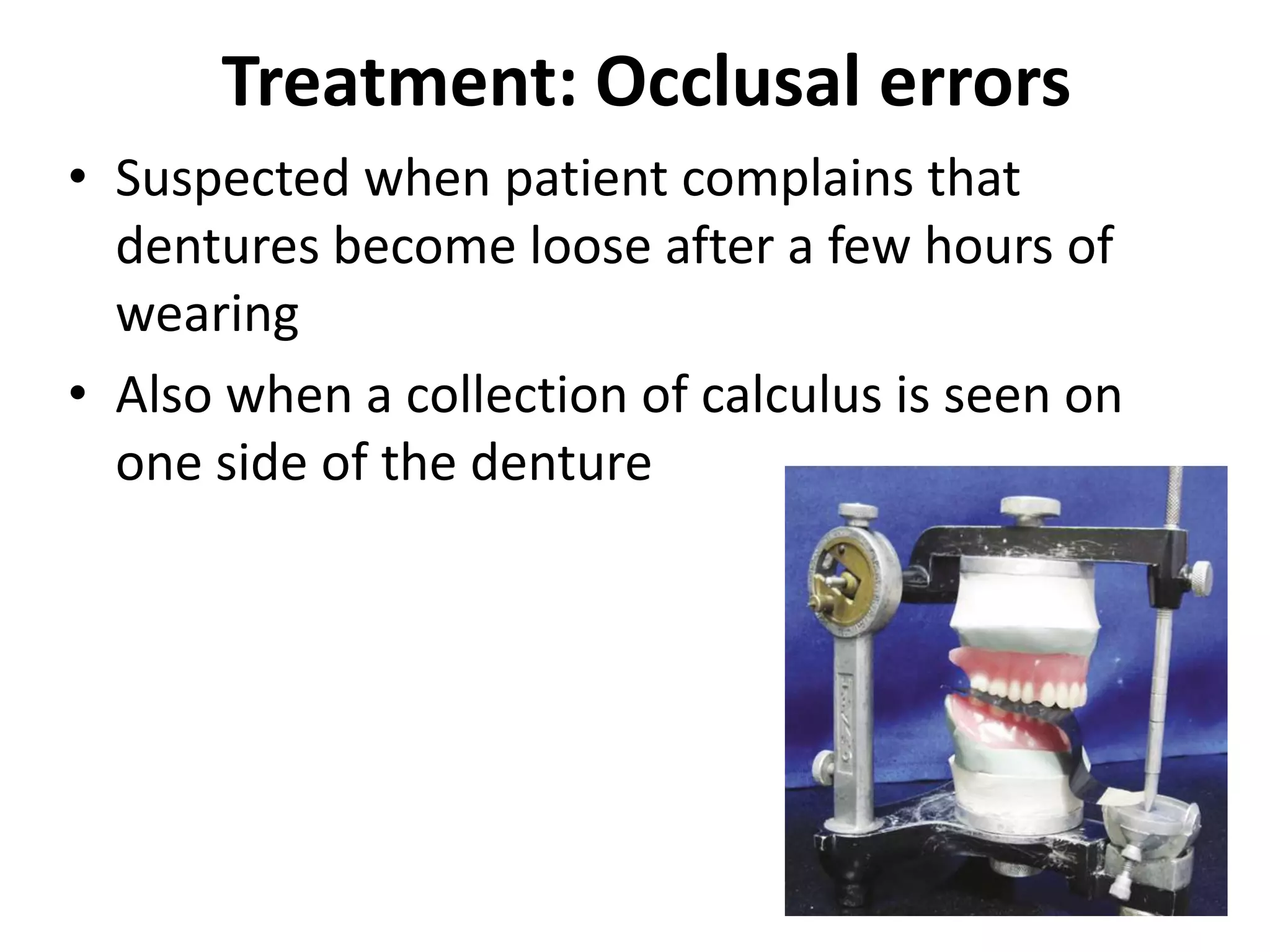
Treatment: Occlusal errors
• Suspected when patient complains that
dentures become loose after a few hours of
wearing
• Also when a collection of calculus is seen on
one side of the denture
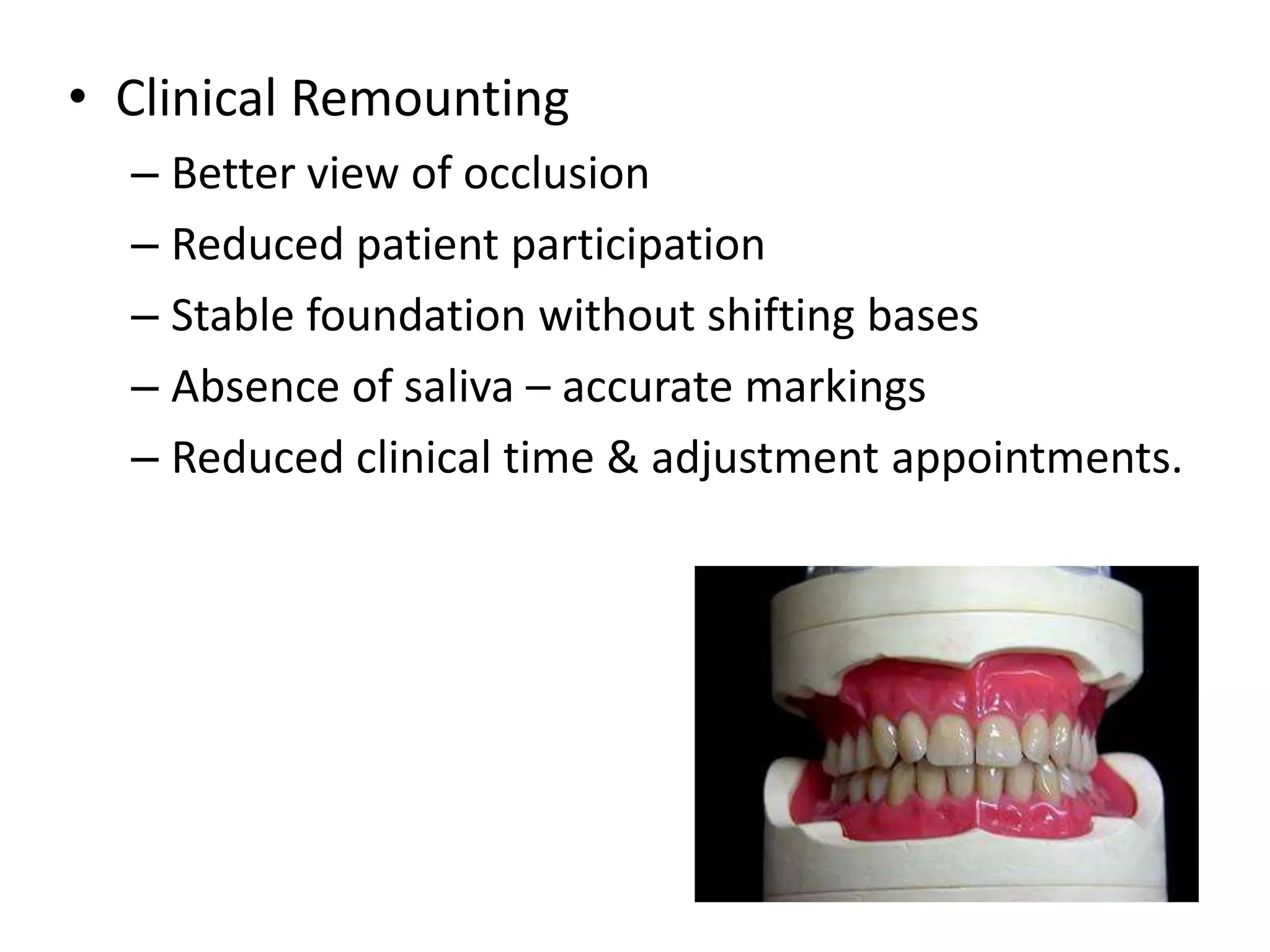
• Clinical Remounting
– Better view of occlusion
– Reduced patient participation
– Stable foundation without shifting bases
– Absence of saliva – accurate markings
– Reduced clinical time & adjustment appointments.
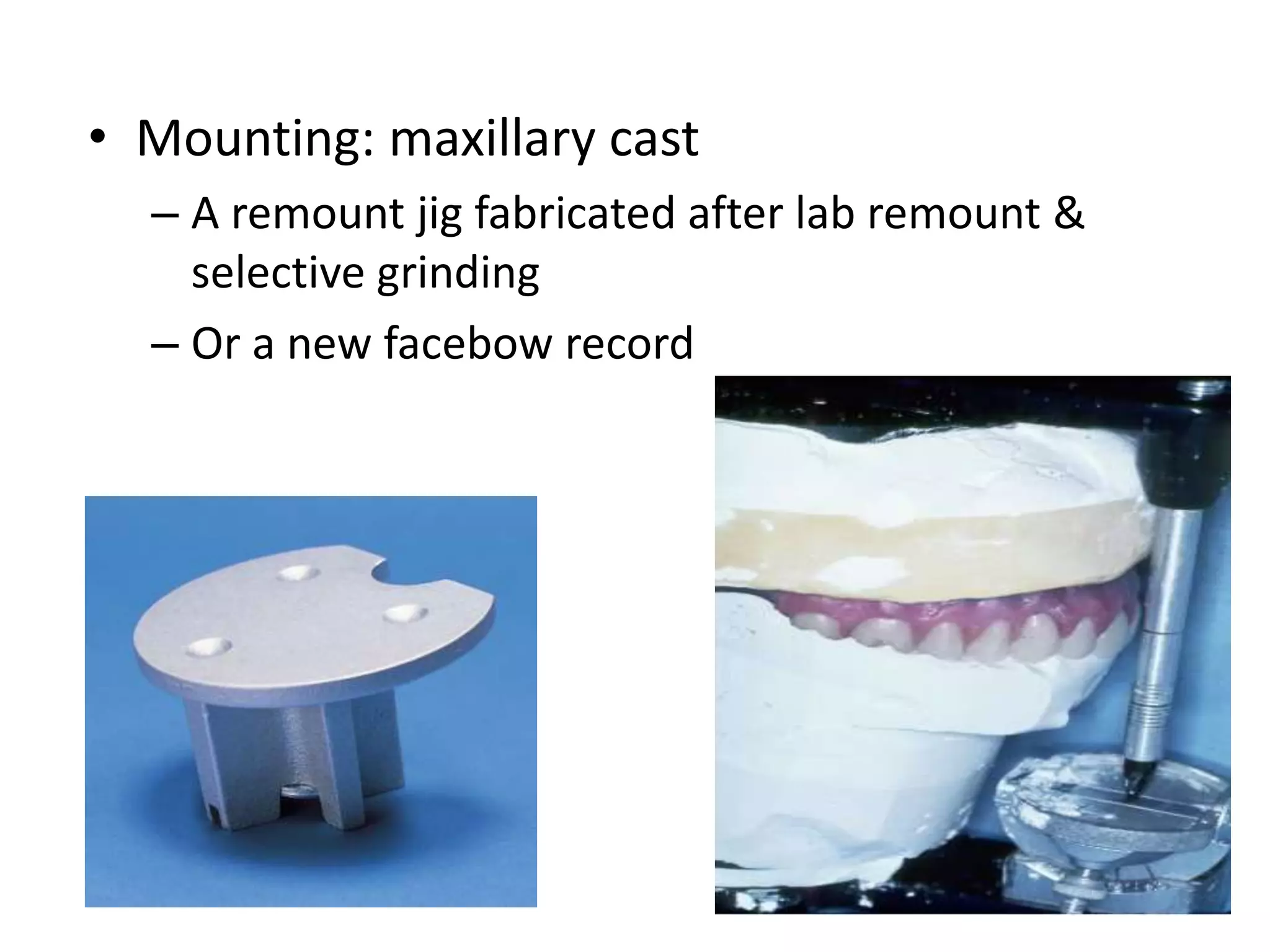
• Mounting: maxillary cast
– A remount jig fabricated after lab remount &
selective grinding
– Or a new facebow record
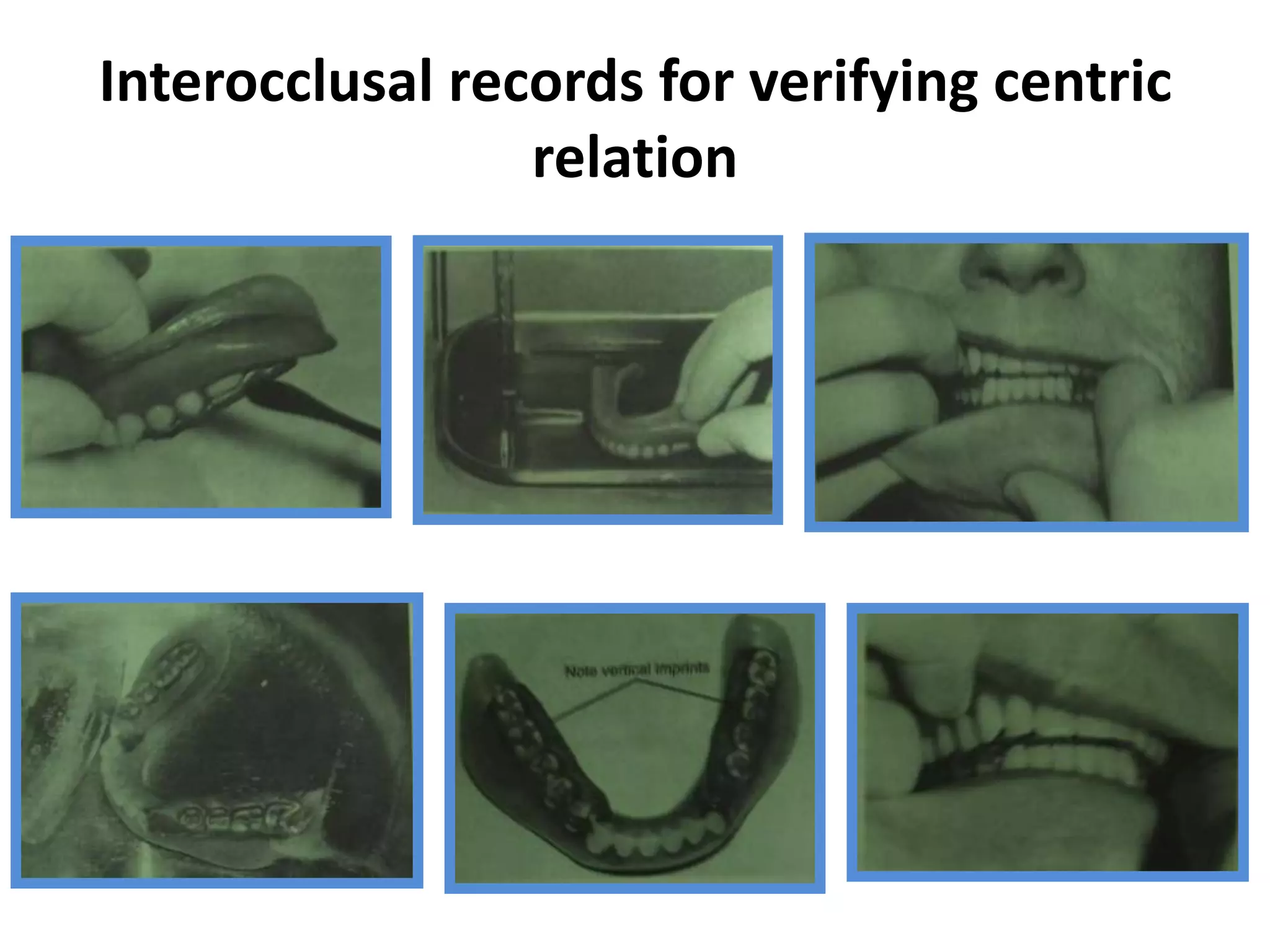
Interocclusal records for verifying centric
relation
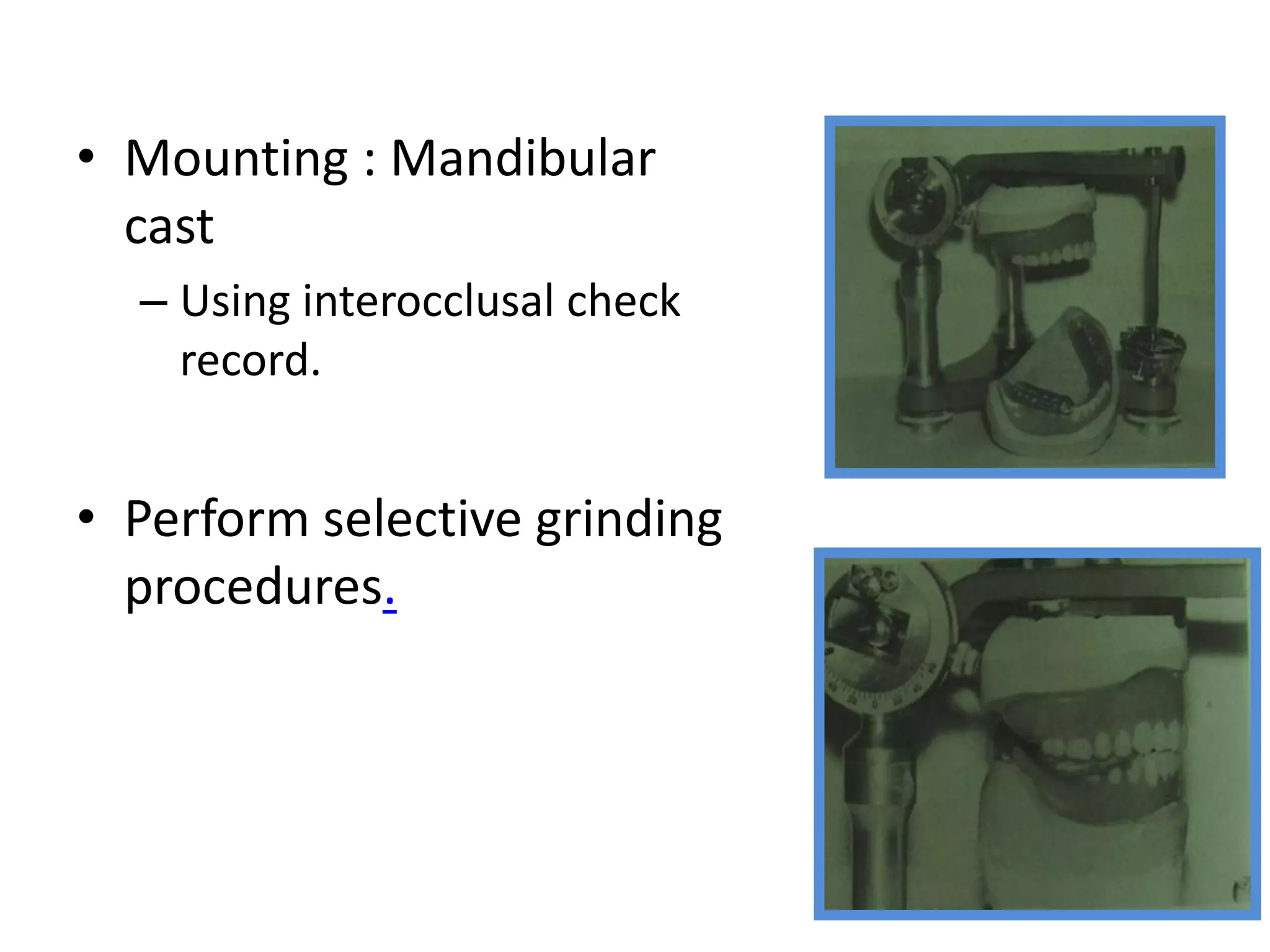
• Mounting : Mandibular
cast
– Using interocclusal check
record.
• Perform selective grinding
procedures.
Discomfort: Symptoms
• Pain
• Altered sensation
• Difficulty in chewing / swallowing.
.
Treatment
• Pain on eating – premature contacts / lack of
occlusal balance
– Use articulating paper to identify offending area
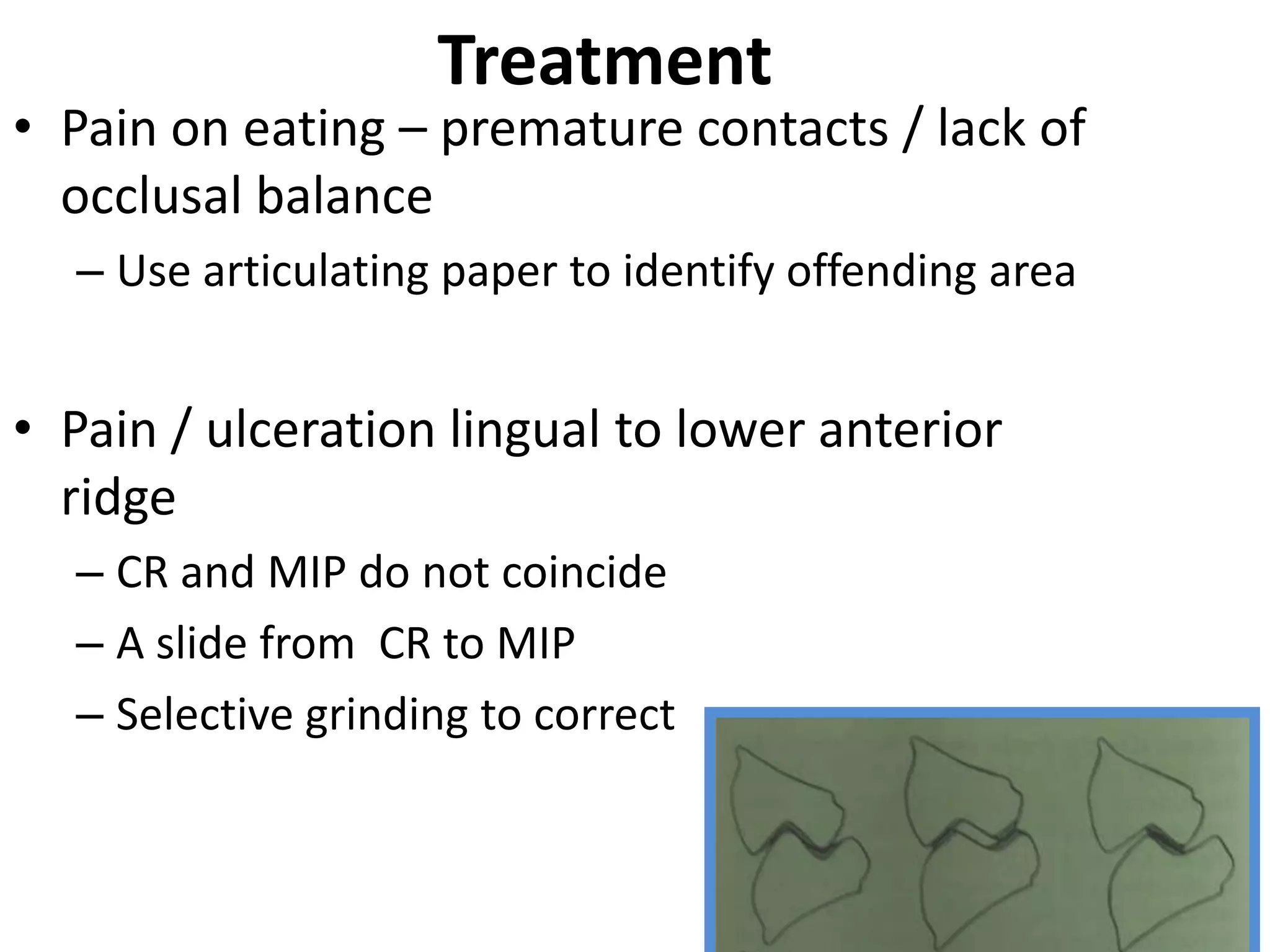
• Pain / ulceration lingual to lower anterior
ridge
– CR and MIP do not coincide
– A slide from CR to MIP
– Selective grinding to correct
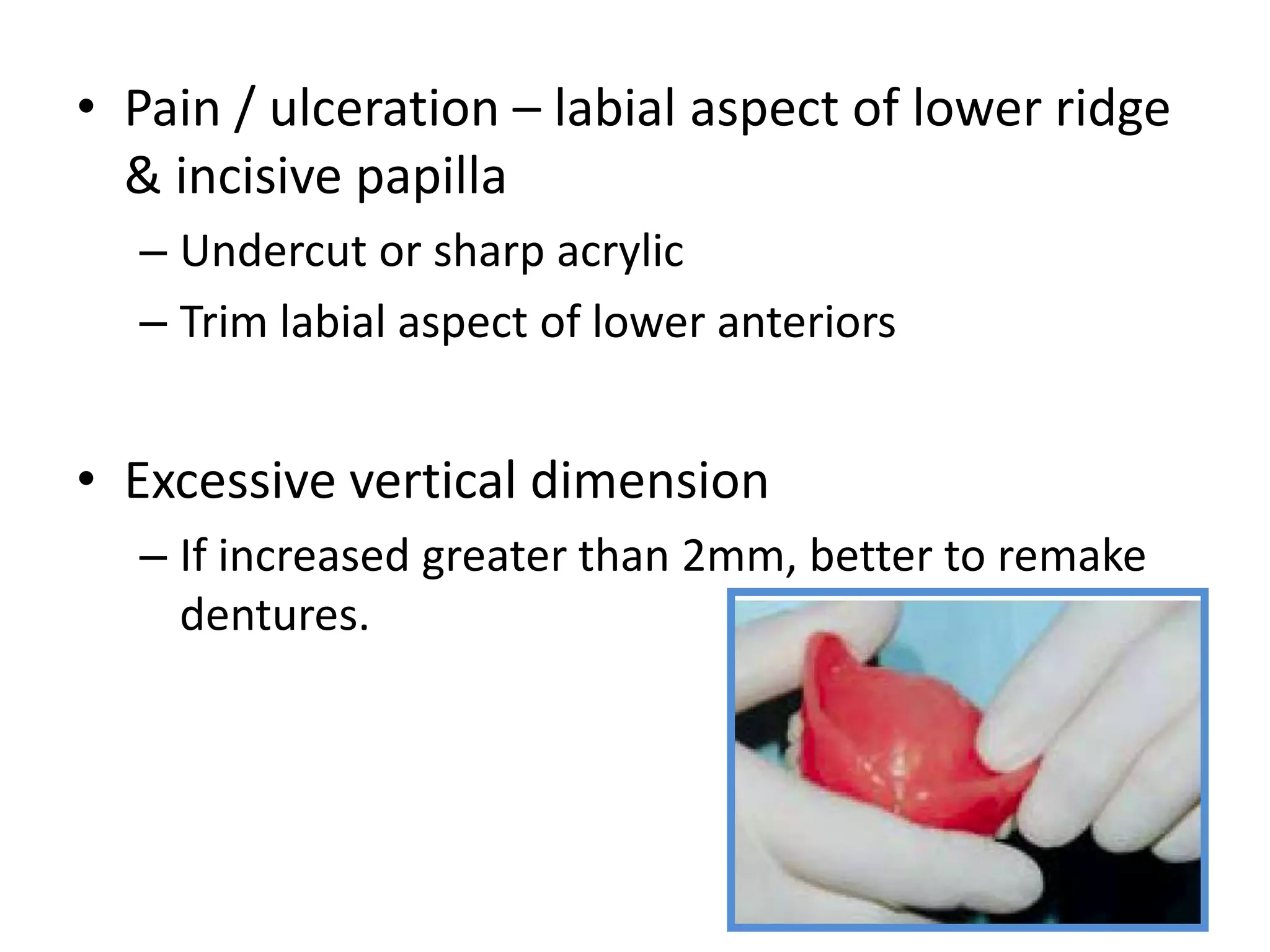
• Pain / ulceration – labial aspect of lower ridge
& incisive papilla
– Undercut or sharp acrylic
– Trim labial aspect of lower anteriors
• Excessive vertical dimension
– If increased greater than 2mm, better to remake
dentures.
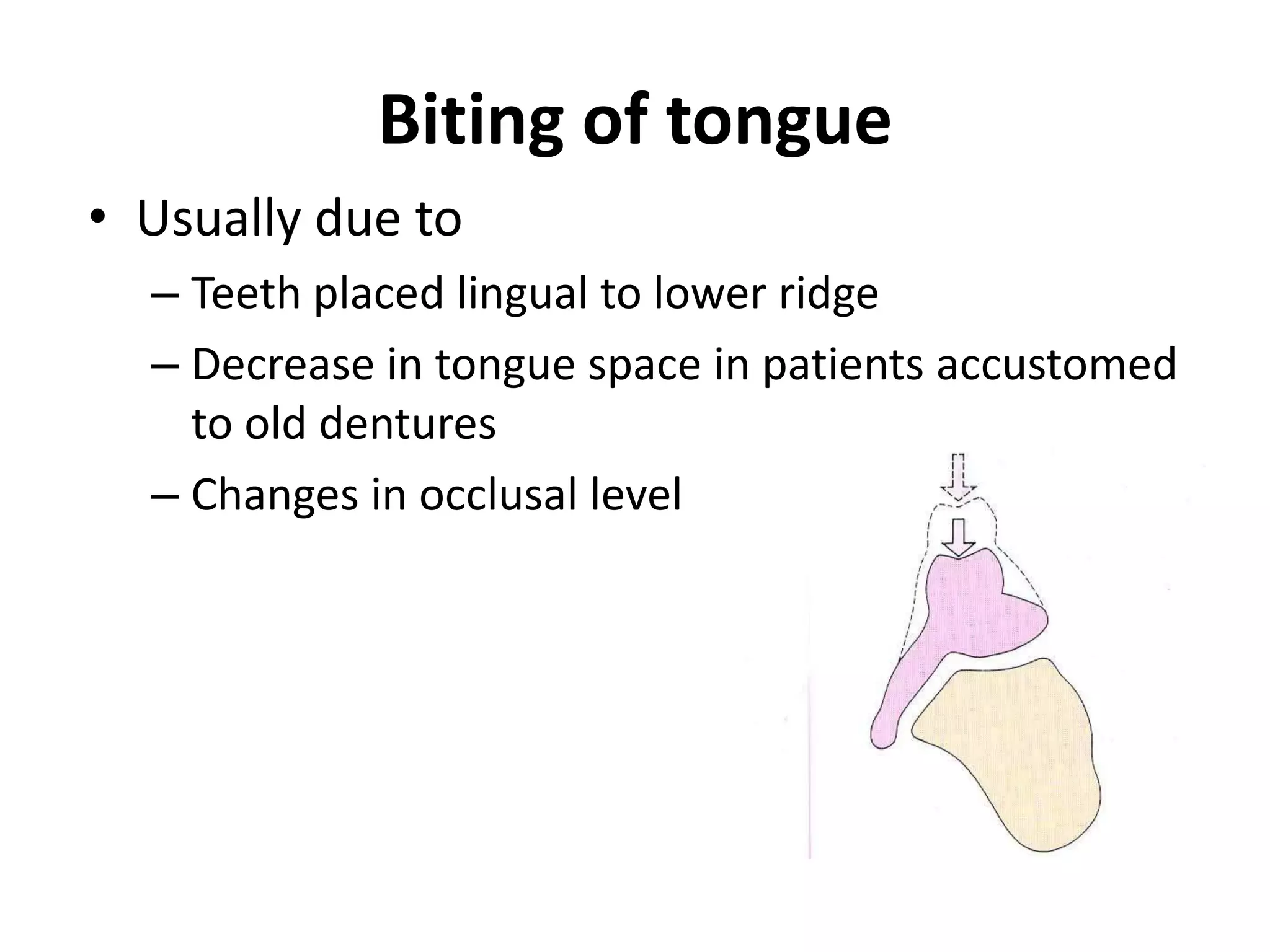
Biting of tongue
• Usually due to
– Teeth placed lingual to lower ridge
– Decrease in tongue space in patients accustomed
to old dentures
– Changes in occlusal level
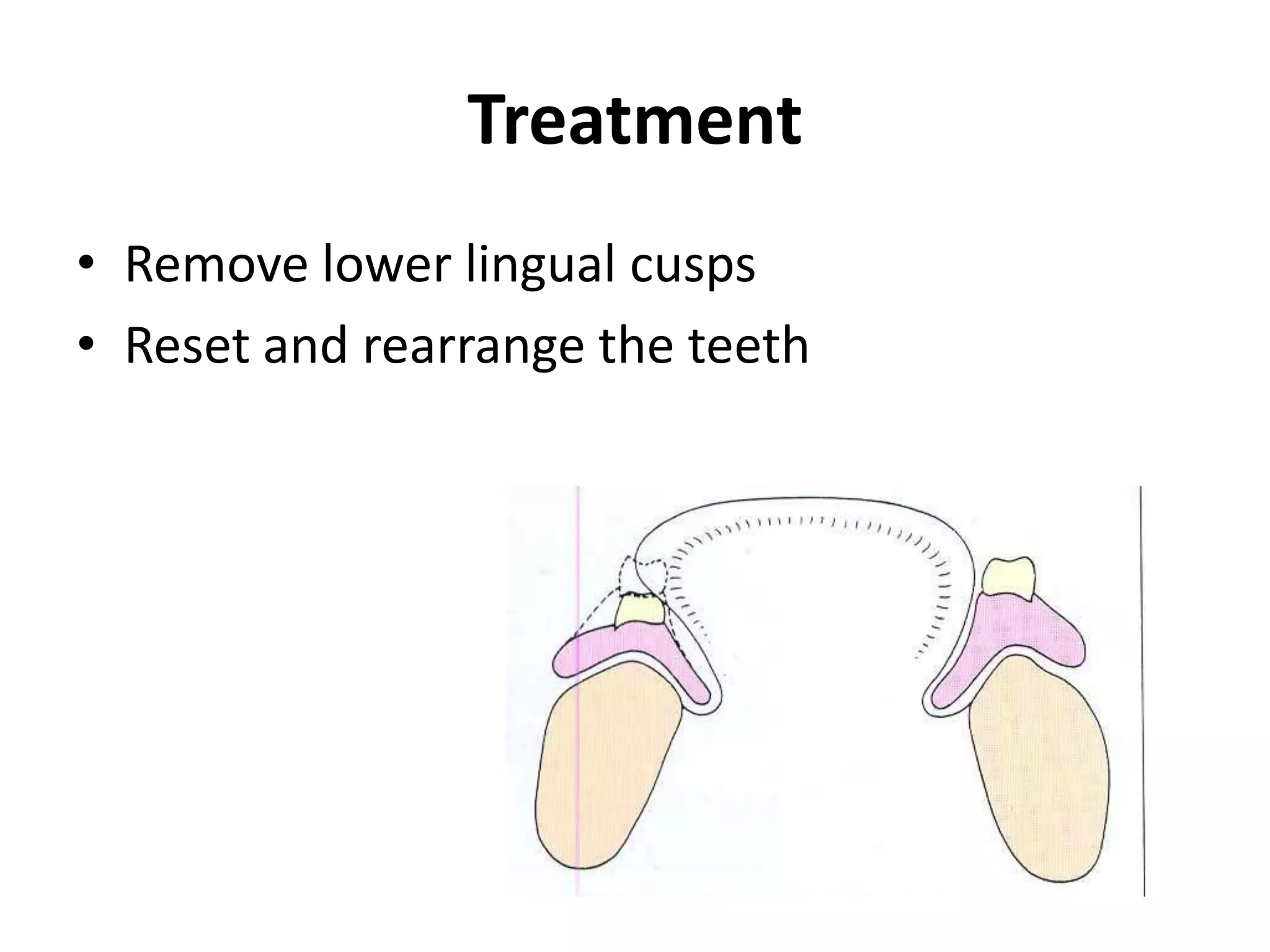
Treatment
• Remove lower lingual cusps
• Reset and rearrange the teeth
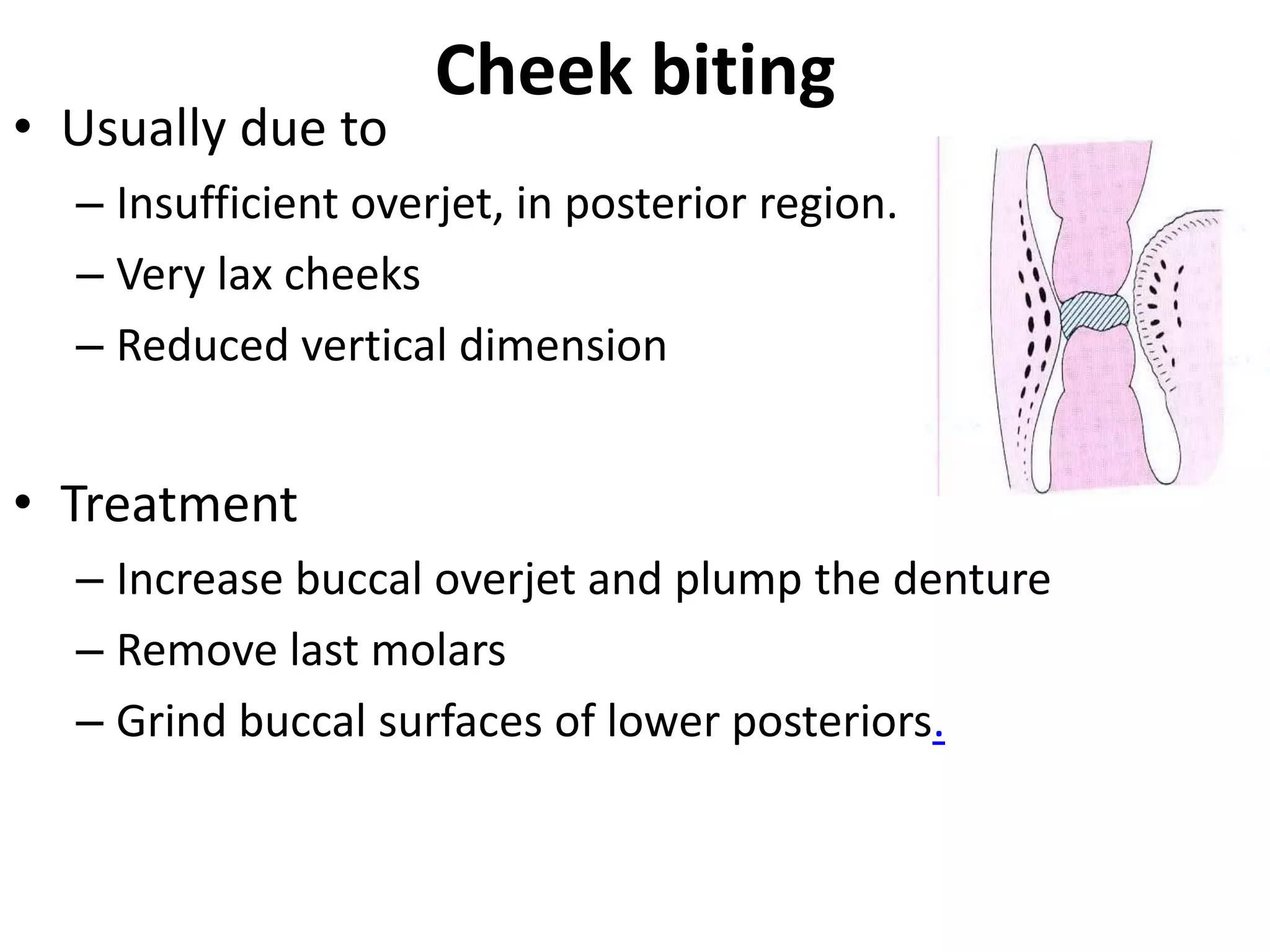
Cheek biting
• Usually due to
– Insufficient overjet, in posterior region.
– Very lax cheeks
– Reduced vertical dimension
• Treatment
– Increase buccal overjet and plump the denture
– Remove last molars
– Grind buccal surfaces of lower posteriors.
Insufficient / Excessive tooth visibility
• Can be due to improper
– Orientation of occlusal plane
– Vertical dimension
– Labiolingual & labiopalatal positioning of anterior
teeth.
• Difficult to correct appearance without
remaking dentures
Creases at Corner of Mouth
• Can be due to
– Decreased labial fullness
– Decreased vertical dimension
• May require remaking of dentures
• Important to verify and take patient consent
for aesthetics at time of try-in.
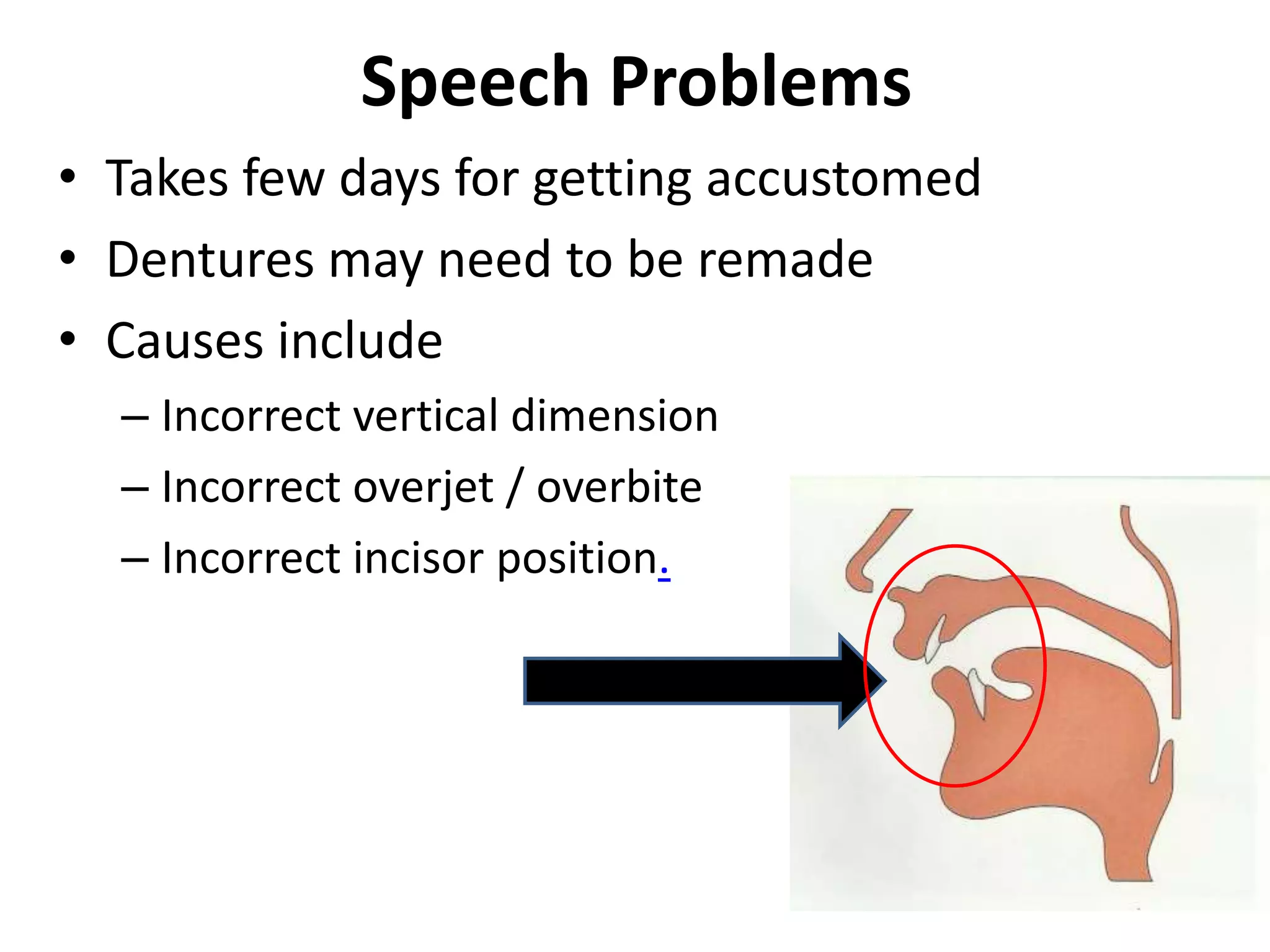
Speech Problems
• Takes few days for getting accustomed
• Dentures may need to be remade
• Causes include
– Incorrect vertical dimension
– Incorrect overjet / overbite
– Incorrect incisor position.

Post insertion problems in complete dentures

  • 1.
    Post Insertion ProblemsIn Complete Dentures Dr .Rohan Bhoil Hyperlinks present in this like .
  • 2.
    Contents • Introduction • Reviewof Literature • Causes • Complaints • Conclusion • References
  • 3.
    Introduction • Recall appointmentspost insertion • Eliminate problems faced in wearing of dentures • Listen, examine & treat
  • 4.
    Examination • 24 houroral examination & treatment • Visual and digital examination of oral cavity • 1-3 day adjustment • Critical period • Periodic recall – 3 to 4 months for difficult patients – 12 month interval for most
  • 5.
    Review of DentureRequirements Compatibility Restoration Harmony Esthetics Preservation
  • 6.
    Review of Literature •Basker RM, Beck CB, et al 1993 did a survey of the dissatisfied denture patient. In the majority of cases technical errors in denture construction accounted for the presenting complaint.
  • 7.
    • Champion Het al in 1995 investigated into the problems experienced by 114 referred patients with complete. The commonest problems were those of pain and lack of retention, mainly due to occlusal discrepancies and excessive VDO.
  • 8.
    • Muller Fet al, 1995 did a study on adaptation to complete dentures. They concluded that good denture retention facilitates the adaptation process.
  • 9.
    • Yoshida M,Sato Y, Akagawa Y. 2001 did a study on the correlation between the quality of life, and denture satisfaction in elderly complete denture wearers and concluded that people who are well satisfied with their daily lives are also satisfied with their complete dentures.
  • 10.
    • Dervis E.et al 2002 did a study to investigate relationships between patient complaints with complete dentures and several factors such as age, gender, medical status and denture faults.
  • 11.
    • No significantrelationship was found when age, gender, and medical status were compared but, statistically significant relationships were observed between denture construction faults or the condition of the patient's denture bearing mucosa and patient complaints.
  • 12.
    • Roessler DMet al. 2003 Before treatment even begins, the patient's motivation for denture treatment and emotional attitude towards dentures must be evaluated.
  • 13.
    –Patients will therebygain realistic expectations of what can and cannot be achieved, and dentists will understand what the patient really wants. – Finally, patients must be informed that continued success depends on regular denture maintenance at home, combined with periodic consultation with the dentist .
  • 14.
    Causes For PostInsertion Problems • Inaccuracies in various denture construction steps
  • 15.
    Border Moulding inOpen Mouth Technique • Vertical dimension and Support to muscles • Reduced force • Overextended flanges
  • 16.
    Jaw Relation Recording •Inaccurate record bases • Flabby & displaceable tissue • Use of existing dentures • Excessive or unequal pressure • Patient inability to give proper registration
  • 17.
    Mounting Errors • Recordbases not properly seated • Interferences in Heel region • Occlusal rims not properly keyed in correct orientation position.
  • 18.
    Laboratory Processing • Teethdisplacement • Incomplete flask closure • Overheating
  • 19.
    Loose Dentures Discomfort PoorAppearance Miscellaneous Complaints
  • 20.
  • 21.
    Decreased retentive forces LackOf Seal • Under Extended orders – Depth or Width. • Incorrect Posterior Palatal Seal. • Inelasticity of Cheeks. Air beneath Impression Surface • Poor Fit. • Undercut Ridge • Excessive Relief.
  • 22.
    Xerostomia •Diabetes, drugs, menopause, irradiation. Poor Neuromuscular Control •Incorrect denture shape • Changed shape relative to old dentures • Motor – Neuron disorders.
  • 23.
    Increased Displacing Forces Overextended Borders. PoorFit Denture not in Optimal Position Occlusal Problems. • Prematurities , MIP – CR, Occlusal Balance, Incorrect plane of Occlusion
  • 24.
    Support Problems • FibrousDisplaceable Ridge • Lack of Ridge • Bony Prominence
  • 25.
  • 26.
    Related to ImpressionSurface • Sharp Acrylic Nodules • Un-relieved undercut areas • Overextension • Lower knife-edged ridge. • Deep Postdam- sore throat, difficulty in swallowing
  • 27.
    Related to PolishedSurface • Thick distobuccal flange of upper denture
  • 28.
    Related to OcclusalSurface • Pain on eating • Pain / Ulceration lingual to lower anterior ridge • Pain / ulceration labial aspect of lower ridge and incisive papilla • Excessive vertical dimension • Cheek / lip biting • Tongue biting.
  • 29.
    Poor Appearance • Insufficientor too much tooth visibility • Creases at corner of mouth.
  • 30.
  • 31.
    Speech problems – Sibliants: S – Bilabial: P & B – Labiodental: F & V.
  • 32.
    Difficulty in Eating •Instability • Too narrow occlusal table • Increased or decreased vertical dimension
  • 33.
    Clattering of teethwhile eating / speaking • Porcelain teeth • Increased vertical dimension • Increased incisor overlap • Loose dentures • Cuspal interferences and lack of balance
  • 34.
    Nausea & Gagging •Loose dentures • Poor occlusion • Thick distal termination in upper dentures • Palatal placement of upper posteriors • Low occlusal plane • Overextended retromylohyoid area • Underextended denture borders • Psychogenic
  • 35.
    Commissural Cheilitis • Excessiveinterocclusal distance • Occlusal plane of lower teeth is too high • Elimination of Buccal Corridor • New Dentures
  • 36.
    Burning Tongue &Palate • Anterior third of palate • Association with menopause
  • 37.
    Tingling or Numbingsensation • Felt at corner of mouth / lower lip • Excessive pressure from mandibular buccal flange • Impingement of mental nerve • Excessive resorption
  • 38.
    Food under thedenture • Usually by first time denture wearers • A perfect peripheral seal is rarely attained • Failure to keep dentures clean • Failure to polish denture surfaces
  • 39.
    Care Of TheDenture • To avoid dropping of denture • To avoid self adjustments • Good oral and denture hygiene – Cleaned after each meal – Not to use boiling water – Denture should be kept in water or dilute antiseptic solution
  • 40.
    Conclusion • Patient education •Forewarning • Explanations
  • 41.
    References • Arthur ORahn, Charles M. Heartwell: Textbook of complete Dentures, ed 5, London, 1993. • George A. Zarb, Charles L.Bolender, Judson C. Hickey, Gunnar E. Carlsson: Boucher’s prosthodontic treatment for edentulous patients, ed 10, B.I Publications Pvt Ltd. • John J. Sharry: Complete Denture Prosthodontics, McGrawhill Book Company, Inc. 1962. • Sheldon Winkler: Essentials of complete Denture Prosthodontics, ed 2, Ishiyaku Euro America Inc.
  • 42.
  • 44.
  • 45.
  • 46.
  • 47.
    PPS • Under extension– Loose denture • Overextension – loose while talking • Insufficient depth – loose while eating.
  • 48.
    Causes of PoorFit • Deficient impression • Damaged cast • Warped denture • Over adjustment of impression surface.
  • 49.
    Treatment: Lack ofSeal • Under extended borders – soft tracing compound • Incorrect posterior palatal seal – correct placement of border • Inelasticity of Cheeks – incremental border moulding and functional movements.
  • 50.
    Treatment: Air beneathImpression Surface • Relining the denture • Remaking the dentures • A rotational path of insertion in case of unilateral undercuts.
  • 51.
    Treatment: Xerostomia • Presence/ Absence of glandular function • Artificial saliva substitutes • Sucking on sour candy • Intermittent sips of water • Pilocarpine hydrochloride.
  • 52.
    Treatment: Poor Neuromuscular Control •Polished surface should occupy the neutral zone • Use of denture adhesives.
  • 53.
  • 54.
    Occlusal Problems • Anteriorand posterior prematurities
  • 55.
    • Maximal intercuspalposition not coinciding with centric relation position –Patient unable to control mandibular movement –Poor ridge –Use of non anatomic teeth
  • 56.
    • Lack ofocclusal balance • Incorrect plane of occlusion – Dentures move while eating – Commonly associated with large tuberosities • Removal of second molars may help
  • 57.
    Treatment: Occlusal errors •Suspected when patient complains that dentures become loose after a few hours of wearing • Also when a collection of calculus is seen on one side of the denture
  • 58.
    • Clinical Remounting –Better view of occlusion – Reduced patient participation – Stable foundation without shifting bases – Absence of saliva – accurate markings – Reduced clinical time & adjustment appointments.
  • 59.
    • Mounting: maxillarycast – A remount jig fabricated after lab remount & selective grinding – Or a new facebow record
  • 60.
    Interocclusal records forverifying centric relation
  • 61.
    • Mounting :Mandibular cast – Using interocclusal check record. • Perform selective grinding procedures.
  • 62.
    Discomfort: Symptoms • Pain •Altered sensation • Difficulty in chewing / swallowing.
  • 63.
  • 64.
    Treatment • Pain oneating – premature contacts / lack of occlusal balance – Use articulating paper to identify offending area • Pain / ulceration lingual to lower anterior ridge – CR and MIP do not coincide – A slide from CR to MIP – Selective grinding to correct
  • 65.
    • Pain /ulceration – labial aspect of lower ridge & incisive papilla – Undercut or sharp acrylic – Trim labial aspect of lower anteriors • Excessive vertical dimension – If increased greater than 2mm, better to remake dentures.
  • 66.
    Biting of tongue •Usually due to – Teeth placed lingual to lower ridge – Decrease in tongue space in patients accustomed to old dentures – Changes in occlusal level
  • 67.
    Treatment • Remove lowerlingual cusps • Reset and rearrange the teeth
  • 68.
    Cheek biting • Usuallydue to – Insufficient overjet, in posterior region. – Very lax cheeks – Reduced vertical dimension • Treatment – Increase buccal overjet and plump the denture – Remove last molars – Grind buccal surfaces of lower posteriors.
  • 69.
    Insufficient / Excessivetooth visibility • Can be due to improper – Orientation of occlusal plane – Vertical dimension – Labiolingual & labiopalatal positioning of anterior teeth. • Difficult to correct appearance without remaking dentures
  • 70.
    Creases at Cornerof Mouth • Can be due to – Decreased labial fullness – Decreased vertical dimension • May require remaking of dentures • Important to verify and take patient consent for aesthetics at time of try-in.
  • 71.
    Speech Problems • Takesfew days for getting accustomed • Dentures may need to be remade • Causes include – Incorrect vertical dimension – Incorrect overjet / overbite – Incorrect incisor position.