Principles of Psychology
Dr. Cervantes
 Psychology is the scientific study of the mind,
brain, and behavior.
What is Psychology?
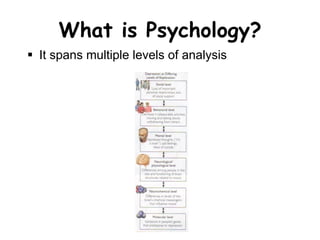
 It spans multiple levels of analysis
What is Psychology?
 All actions are determined by many
factors, the factors are rarely
independent.
 Individual differences can also help
explain how two people react differently
to the same situation.
 People influence one another.
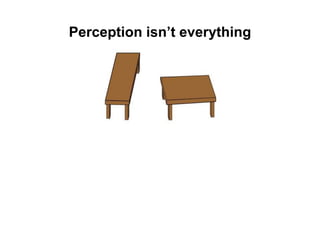
Perception isn’t everything
Foundations of Psychology
 Influenced by trends, issues, &
values
 Interacting factors
 Heredity & environment – reciprocal
impact of nature/nurture
Philosophy
 “contemplation” of the human mind
 1649: Descartes
 Father of modern philosophy
 The human body is an “animal machine”
 Cogito ergo sum
 Dualism
 Mind-Body
Empiricism vs Rationalism
 Aristotle’s tabula rasa
 John Locke
 Plato and nativism
 Rationalist
 People begin life with mental
structures that provide constraints on
how we experience the world
Rationalism and Empiricism raise two
philosophical issues that are critical
for psychology
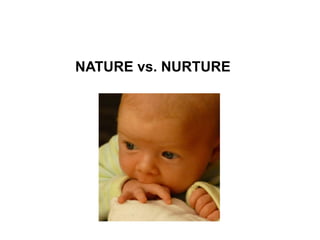
NATURE vs. NURTURE
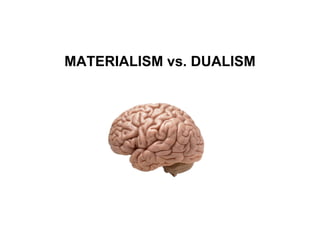
MATERIALISM vs. DUALISM
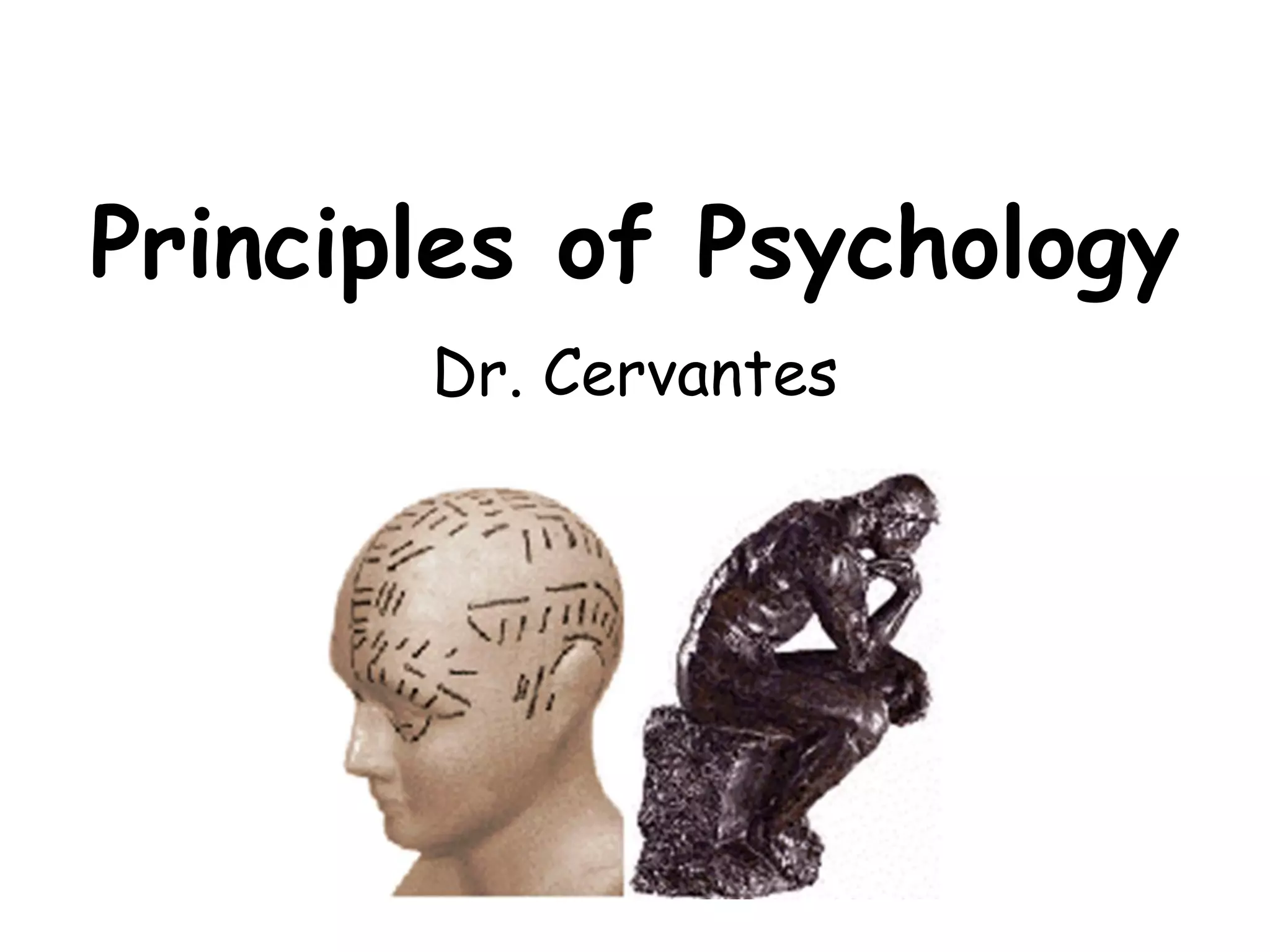
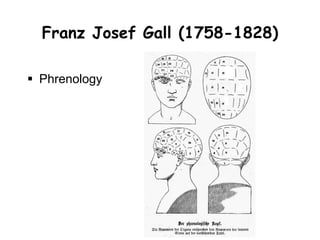
Franz Josef Gall (1758-1828)
 Phrenology
Franz Josef Gall (1758-1828)
 Phrenology
 Discredited when a scientist, Pierre
Flourens, lesioned animal brains
 Popularized the idea of cerebral
localization of function
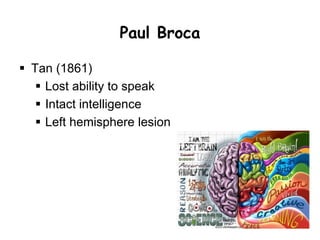
Paul Broca
 Tan (1861)
 Lost ability to speak
 Intact intelligence
 Left hemisphere lesion
Psychophysics
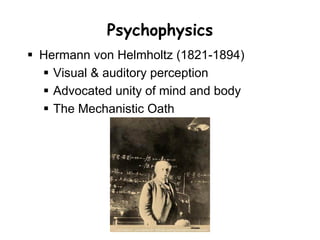
 Hermann von Helmholtz (1821-1894)
 Visual & auditory perception
 Advocated unity of mind and body
 The Mechanistic Oath
Origin of Modern Psychology
 Wilhelm Wundt (1832-1920)
University of Leipzig, Germany
 Established the first laboratory for the
study of psychology in 1879
 Main focus: using reaction time, self-
report, etc for measurement of
immediate conscious experience
 Structuralism – Edward Titchener
 Analyze consciousness into basic
elements
 e.g. taste
 Introspection – careful, systematic
observations of one’s own conscious
experience
The Battle of the “Schools” in the
U.S.: Structuralism vs. Functionalism
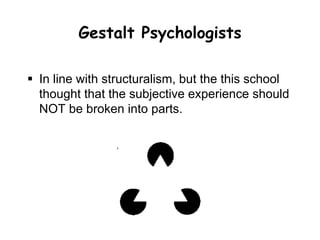
Gestalt Psychologists
 In line with structuralism, but this school
thought that the subjective experience
should NOT be broken into parts.
 Functionalism – William James
(1842-1910)
 Investigate function of consciousness
 Adaptive purposes – greatly
influenced by Darwin
The Battle of the “Schools” in the
U.S.: Structuralism vs. Functionalism
Behaviorism: Redefining
Psychology
 John B. Watson (1878-1958): United
States
 Founder of Behaviorism
 Behavior = overt or observable
responses or activities
 Rejected introspection and mental states
 Emphasis on animal behavior
 Stimulus-Response
Sigmund Freud and the Concept
of the Unconscious Mind
 Sigmund Freud (1856-1939): Austria
 Founded Psychoanalytic school of
thought
 Emphasis on unconscious processes
influencing behavior
 Unconscious = outside awareness
The 1950’s: Opposition to
Psychoanalytic Theory and Behaviorism
 Charges that both were de-humanizing
 A new school of thought emerged -
Humanism
 Abraham Maslow (1908-1970) &
 Carl Rogers (1902-1987)
 Emphasis on the unique qualities of
humans: freedom and personal growth
The Cognitive Revolution
 1950’s and 60’s – Part of the shift back
towards the internal mental processing
 Piaget, Chomsky, and Simon
 Application of scientific methods to
studying internal mental events
 Cognition = mental processes involved
in acquiring knowledge
Biological Psychology:
The Biological Basis of Behavior
 Biological Perspective - Behavior explained
in terms of physiological processes
 James Olds (1956)
 Electrical stimulation of the brain evokes
emotional responses in animals
 Roger Sperry (1981)
 Left and right brain specialization
 Synthesized approaches & Convergent
methods
 Modern experimental psychologists break
psychological phenomena (incl subjective
states) into their component processes
 Study function
 Observe relationships between stimuli,
mental processes AND behavior
 We also link these mental processes to the
nervous system (e.g. cognitive
neuroscience).
 How does the way we look at a
question impact the answers we
get?
 What does it mean to empirically
study a question? How does this
differ from Introspection like that
done by Philosophers?
Scientific vs Non-scientific
Approaches
 Science isn’t a body of knowledge.
 Its’ a systematic approach to evidence.
 Empiricism = knowledge should be acquired
through observation
 But then subjected to strict tests & revised
as needed = the scientific method!
What is scientific theory?
 An explanation for a large number of findings
in the natural world, including the
psychological world.
 Accounts for existing data AND
 Generates predictions
 A testable prediction is called a hypothesis.
Types of Research
 Basic Research
 Theoretical
 Applied Research
 Practical application
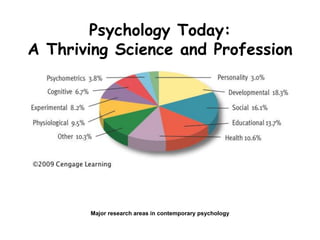
Major research areas in contemporary psychology
Psychology Today:
A Thriving Science and Profession
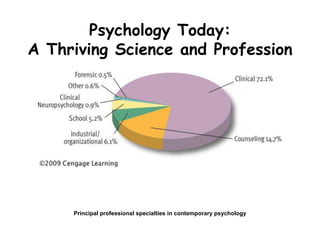
Principal professional specialties in contemporary psychology
Psychology Today:
A Thriving Science and Profession
Summary
 Before psychological science we had to rely on
intuitions and life observations to tell us about the
mind.
 Intuitions are fallible because brains get selective
information. Also, even with “good” information,
brains can cause mental errors and illusions.
 Historical pioneers in philosophy, physiology, and
physics paved the way for psychological science to
emerge.
 Psychology does more than just aim to describe
behavior, but also explain, determine cause, and
predict future behavior

PoP wk 1

  • 1.
  • 2.
     Psychology isthe scientific study of the mind, brain, and behavior. What is Psychology?
  • 3.
     It spansmultiple levels of analysis What is Psychology?
  • 4.
     All actionsare determined by many factors, the factors are rarely independent.  Individual differences can also help explain how two people react differently to the same situation.  People influence one another.
  • 5.
  • 6.
    Foundations of Psychology Influenced by trends, issues, & values  Interacting factors  Heredity & environment – reciprocal impact of nature/nurture
  • 7.
    Philosophy  “contemplation” ofthe human mind  1649: Descartes  Father of modern philosophy  The human body is an “animal machine”  Cogito ergo sum  Dualism  Mind-Body
  • 8.
    Empiricism vs Rationalism Aristotle’s tabula rasa  John Locke  Plato and nativism  Rationalist  People begin life with mental structures that provide constraints on how we experience the world
  • 9.
    Rationalism and Empiricismraise two philosophical issues that are critical for psychology
  • 10.
  • 11.
  • 12.
    Franz Josef Gall(1758-1828)  Phrenology
  • 13.
    Franz Josef Gall(1758-1828)  Phrenology  Discredited when a scientist, Pierre Flourens, lesioned animal brains  Popularized the idea of cerebral localization of function
  • 14.
    Paul Broca  Tan(1861)  Lost ability to speak  Intact intelligence  Left hemisphere lesion
  • 15.
    Psychophysics  Hermann vonHelmholtz (1821-1894)  Visual & auditory perception  Advocated unity of mind and body  The Mechanistic Oath
  • 16.
    Origin of ModernPsychology  Wilhelm Wundt (1832-1920) University of Leipzig, Germany  Established the first laboratory for the study of psychology in 1879  Main focus: using reaction time, self- report, etc for measurement of immediate conscious experience
  • 17.
     Structuralism –Edward Titchener  Analyze consciousness into basic elements  e.g. taste  Introspection – careful, systematic observations of one’s own conscious experience The Battle of the “Schools” in the U.S.: Structuralism vs. Functionalism
  • 18.
    Gestalt Psychologists  Inline with structuralism, but this school thought that the subjective experience should NOT be broken into parts.
  • 19.
     Functionalism –William James (1842-1910)  Investigate function of consciousness  Adaptive purposes – greatly influenced by Darwin The Battle of the “Schools” in the U.S.: Structuralism vs. Functionalism
  • 20.
    Behaviorism: Redefining Psychology  JohnB. Watson (1878-1958): United States  Founder of Behaviorism  Behavior = overt or observable responses or activities  Rejected introspection and mental states  Emphasis on animal behavior  Stimulus-Response
  • 21.
    Sigmund Freud andthe Concept of the Unconscious Mind  Sigmund Freud (1856-1939): Austria  Founded Psychoanalytic school of thought  Emphasis on unconscious processes influencing behavior  Unconscious = outside awareness
  • 22.
    The 1950’s: Oppositionto Psychoanalytic Theory and Behaviorism  Charges that both were de-humanizing  A new school of thought emerged - Humanism  Abraham Maslow (1908-1970) &  Carl Rogers (1902-1987)  Emphasis on the unique qualities of humans: freedom and personal growth
  • 23.
    The Cognitive Revolution 1950’s and 60’s – Part of the shift back towards the internal mental processing  Piaget, Chomsky, and Simon  Application of scientific methods to studying internal mental events  Cognition = mental processes involved in acquiring knowledge
  • 24.
    Biological Psychology: The BiologicalBasis of Behavior  Biological Perspective - Behavior explained in terms of physiological processes  James Olds (1956)  Electrical stimulation of the brain evokes emotional responses in animals  Roger Sperry (1981)  Left and right brain specialization
  • 25.
     Synthesized approaches& Convergent methods  Modern experimental psychologists break psychological phenomena (incl subjective states) into their component processes  Study function  Observe relationships between stimuli, mental processes AND behavior  We also link these mental processes to the nervous system (e.g. cognitive neuroscience).
  • 26.
     How doesthe way we look at a question impact the answers we get?  What does it mean to empirically study a question? How does this differ from Introspection like that done by Philosophers?
  • 27.
    Scientific vs Non-scientific Approaches Science isn’t a body of knowledge.  Its’ a systematic approach to evidence.  Empiricism = knowledge should be acquired through observation  But then subjected to strict tests & revised as needed = the scientific method!
  • 28.
    What is scientifictheory?  An explanation for a large number of findings in the natural world, including the psychological world.  Accounts for existing data AND  Generates predictions  A testable prediction is called a hypothesis.
  • 29.
    Types of Research Basic Research  Theoretical  Applied Research  Practical application
  • 30.
    Major research areasin contemporary psychology Psychology Today: A Thriving Science and Profession
  • 31.
    Principal professional specialtiesin contemporary psychology Psychology Today: A Thriving Science and Profession
  • 32.
    Summary  Before psychologicalscience we had to rely on intuitions and life observations to tell us about the mind.  Intuitions are fallible because brains get selective information. Also, even with “good” information, brains can cause mental errors and illusions.  Historical pioneers in philosophy, physiology, and physics paved the way for psychological science to emerge.  Psychology does more than just aim to describe behavior, but also explain, determine cause, and predict future behavior