Polyploidy and It’s
Application in plant breeding
PRESENTED BY:
Pawan Nagar
Reg. no.: 04-2690-
2015
M.Sc.(Fruit Science)
Introduction
 Polyploidy involves three or more sets of chromosomes ,
and may occur naturally or by induction.
 Nearly all plants and animals probably have some polyploid
tissues. Examples:
i. Plant endosperm is triploid.
ii. Liver of mammals (and perhaps other vertebrates) is
polyploid.
iii. Wheat is hexaploid (6N) and the strawberry is
octaploid (8N).
Origin of polyploids
There are various modes for the origin of polyploids. These
mainly include mechanisms such as
1. Somatic doubling during mitosis,
2. Non-reduction in meiosis leading to the production of
unreduced gametes,
3. Polyspermaty (fertilization of the egg by two male
nuclei)
4. Endoreplication (replication of the DNA but no
cytokinesis).
somatic doubling during mitosis,
 Chromosome doubling can occur either in the zygote to
produce a completely polyploid individual or locally in
some apical meristem to give polyploid chimeras.
 In somatic doubling the main cause is mitotic non-
disjunction. This doubling may occur in purely vegetative
tissues (as in root nodules of some leguminous plants) or
at times in a branch that may produce flowers or in early
embryos (and may therefore be carried further down).
Non-reduction in meiosis leading
to the production of unreduced
gametes
 Non reduction could be due to meiotic non-
disjunction (failure of the chromosome to separate
and subsequent reduction in chromosome
number), failure of cell wall formation or formation
of gametes by mitosis instead of meiosis. The
classic example, Raphanobrassica, originated by a
one step process of fusion of two non- reduced
gametes.
Polyspermaty (fertilization of the egg by two male
nuclei)
 Polyspermy is observed in many plants but its
contribution as a mechanism for polyploid formation is
rather rare except perhaps in some orchids .
Endoreplication (replication of the DNA but no
cytokinesis).
 Endoreduplication is a form of nuclear polyploidization
resulting in multiple uniform copies of chromosomes. It
has been known to occur in the endosperm and the
cotyledons of developing seeds, leaves and stems of
plants
Miscellaneous factors
promoting polyploidy
There are a number of other factors favoring polyploidy
include ,
 The mode of reproduction
 The mode of fertilization
 The breeding system present
 The growth habit of the plant
 Size of chromosomes etc.
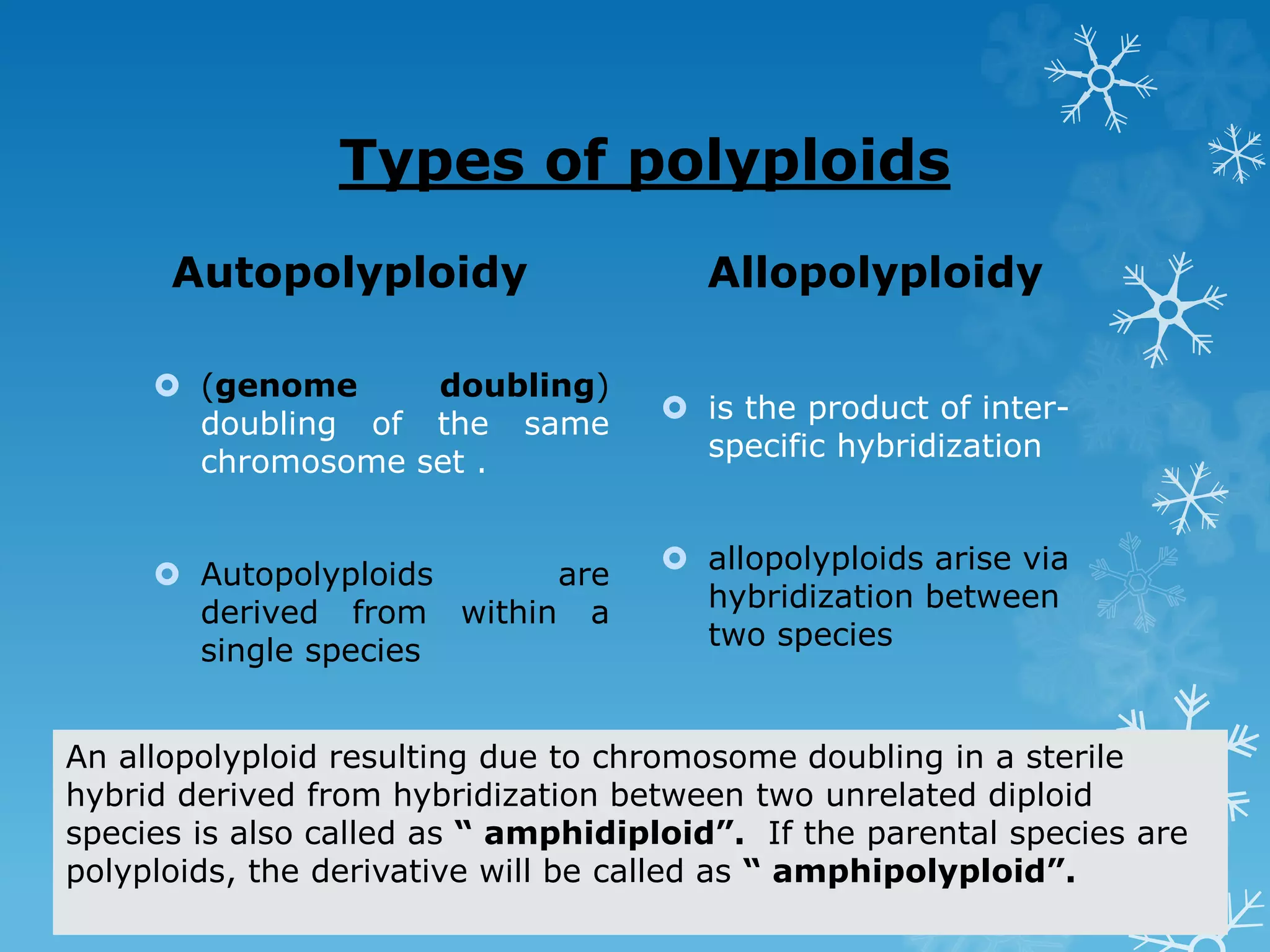
Types of polyploids
Autopolyploidy
 (genome doubling)
doubling of the same
chromosome set .
 Autopolyploids are
derived from within a
single species
Allopolyploidy
 is the product of inter-
specific hybridization
 allopolyploids arise via
hybridization between
two species
An allopolyploid resulting due to chromosome doubling in a sterile
hybrid derived from hybridization between two unrelated diploid
species is also called as “ amphidiploid”. If the parental species are
polyploids, the derivative will be called as “ amphipolyploid”.
 One of the early examples of a natural polyploid was one of
original mutations of Oenothera lamarckiana (Hindi
:Dheriani, English : Evening Primerose).
 The first example of an artificial polyploid was by Winkler
(1916) who in fact introduced the term polyploidy. Winkler
was working on vegetative grafts and chimeras of Solanum
nigrum and found that callus regenerating from cut surfaces
of stem explants were teratploid.
Bread
Wheat
Evolutionof naturalpolyploids
Artificial Allopolyploid
 Artificial or synthetic allopolyploids have been
synthesized in some crops with two main objectives,
viz.
1)Either to study the origin of naturally available
alloploids or
2) To explore the possibilities of creating new species.
Radish
(Raphanus
sativus, n = 9)
cabbage
(Brassica
oleracea, n = 9)
Raphanobrassica
Amphidiploid
(4n = 36)
Raphanobrassica
Some Terminology of Heteroplody
 Heteroplody : Individuals carrying chromosome number
other than the diploid.
 Aneuploidy : change in one or few chromosome of the
genome.
1. Nullisomic : one chromosome pair missing (2n-2)
2. Monosomic : one chromosome missing (2n-1)
3. Double monosomic : one chromosome from each of two
diff. chromosome pair missing (2n-1-1)
4. Trisomic : one extra chromosome (2n+1)
5. Tetrasomic : one extra pair of chromosome (2n+2)
 Euploid : Involve one or more complete genome.
1. Monoploid : one copy of a single genome (x)
2. Haploid : Gametic chromosome complement
 Polyploid : More than 2 copy of genome
 Autopolyploid : Genome identical with each other
1. Autotriploid : Three copies of one genome (3x)
2. Autotetraploid : four copies of one genome (4x)
 Allopolyploid : two or more distinct genome
 Allohexaploid : Three distinct genome(2x1 +2x2+2x3)
Breeding of Autopolyploids
Cells/individuals having autopolyploid (doubled)
chromosome numbers may originate in one of the
following several ways:
(1) Spontaneous
(2) Due to treatment with physical agents
(3) Regeneration in vitro
(4) Colchicine treatment
(5) Other chemical agents.
Spontaneous :
Chromosome doubling occurs occasionally in
somatic tissues and unreduced gametes are also
produced in low frequencies.
Production of Adventitious buds:
Decapitation in some plants leads to callus
development at the cut end of stem. Such a callus has
some polyploid cells, and some of the Shoot buds
regenerated from the callus may be polyploid. This is of
common occurrence in Solanaceae where 6-36 per cent
of adventitious shoot buds are reported to be tetraploid.
Physical agents:
Heat or cold treatments, centrifugation and X-ray or
gamma ray irradiation may produce polyploids in low
frequencies. Tetraploid branches were produced in
Datura in response to cold treatment.
Regeneration in Vitro:
Polyploidy is a common feature of the cells cultured
in vitro. Plants of various ploidy have been regenerated
from callus cultures of Nicotiana, Datura, rice and several
other species.
Colchicine Treatments :
Colchicine treatment is the most effective and the
most widely used treatment for chromosome doubling. At
any given time, only a small proportion of the cells would
be in division; therefore, repeated treatments should be
given at brief intervals to double the chromosome number
in a large number of cells of the shoot apex. The polyploid
and diploid cells present in a shoot-tip compete with each
other and diploid cells may often out compete the polyploid
ones.
Application of Allopolyploidy in Crop
Improvement
1. Bridging cross: Amphidiploids can be used
as a bridge where direct cross between two
species is not possible due to sterility in F1.
2.Creation of new crop species: Alloploidy
sometimes helps in creation of new crop
species. Such as Triticale, Raphanobrassica,
triploid (AAC), tetraploids .
3.Interspecific Gene Transfer: In case of
unavailability the desirable characters within
the species, it is transferred from the related
species.
4.Tracing the origin of crop species:
Alloploidy study is used to identify the origin of
natural alloploidy plants.
Conclusion
 With knowledge of the origins, variations and
characteristics of different types of polyploids,
there are many opportunities for developing and
utilizing polyploids in plant improvement
programmes.
 Significant opportunities include developing sterile
cultivars, overcoming barriers to hybridization,
restoring fertility in wide hybrids, enhancing flower
size, increasing heterosis and vigor, and improving
pest resistance and tolerance to environmental
stresses.
Thank you….

Polyploidy breeding

  • 1.
    Polyploidy and It’s Applicationin plant breeding PRESENTED BY: Pawan Nagar Reg. no.: 04-2690- 2015 M.Sc.(Fruit Science)
  • 2.
    Introduction  Polyploidy involvesthree or more sets of chromosomes , and may occur naturally or by induction.  Nearly all plants and animals probably have some polyploid tissues. Examples: i. Plant endosperm is triploid. ii. Liver of mammals (and perhaps other vertebrates) is polyploid. iii. Wheat is hexaploid (6N) and the strawberry is octaploid (8N).
  • 3.
    Origin of polyploids Thereare various modes for the origin of polyploids. These mainly include mechanisms such as 1. Somatic doubling during mitosis, 2. Non-reduction in meiosis leading to the production of unreduced gametes, 3. Polyspermaty (fertilization of the egg by two male nuclei) 4. Endoreplication (replication of the DNA but no cytokinesis).
  • 4.
    somatic doubling duringmitosis,  Chromosome doubling can occur either in the zygote to produce a completely polyploid individual or locally in some apical meristem to give polyploid chimeras.  In somatic doubling the main cause is mitotic non- disjunction. This doubling may occur in purely vegetative tissues (as in root nodules of some leguminous plants) or at times in a branch that may produce flowers or in early embryos (and may therefore be carried further down).
  • 5.
    Non-reduction in meiosisleading to the production of unreduced gametes  Non reduction could be due to meiotic non- disjunction (failure of the chromosome to separate and subsequent reduction in chromosome number), failure of cell wall formation or formation of gametes by mitosis instead of meiosis. The classic example, Raphanobrassica, originated by a one step process of fusion of two non- reduced gametes.
  • 6.
    Polyspermaty (fertilization ofthe egg by two male nuclei)  Polyspermy is observed in many plants but its contribution as a mechanism for polyploid formation is rather rare except perhaps in some orchids . Endoreplication (replication of the DNA but no cytokinesis).  Endoreduplication is a form of nuclear polyploidization resulting in multiple uniform copies of chromosomes. It has been known to occur in the endosperm and the cotyledons of developing seeds, leaves and stems of plants
  • 7.
    Miscellaneous factors promoting polyploidy Thereare a number of other factors favoring polyploidy include ,  The mode of reproduction  The mode of fertilization  The breeding system present  The growth habit of the plant  Size of chromosomes etc.
  • 8.
    Types of polyploids Autopolyploidy (genome doubling) doubling of the same chromosome set .  Autopolyploids are derived from within a single species Allopolyploidy  is the product of inter- specific hybridization  allopolyploids arise via hybridization between two species An allopolyploid resulting due to chromosome doubling in a sterile hybrid derived from hybridization between two unrelated diploid species is also called as “ amphidiploid”. If the parental species are polyploids, the derivative will be called as “ amphipolyploid”.
  • 9.
     One ofthe early examples of a natural polyploid was one of original mutations of Oenothera lamarckiana (Hindi :Dheriani, English : Evening Primerose).  The first example of an artificial polyploid was by Winkler (1916) who in fact introduced the term polyploidy. Winkler was working on vegetative grafts and chimeras of Solanum nigrum and found that callus regenerating from cut surfaces of stem explants were teratploid.
  • 10.
  • 11.
    Artificial Allopolyploid  Artificialor synthetic allopolyploids have been synthesized in some crops with two main objectives, viz. 1)Either to study the origin of naturally available alloploids or 2) To explore the possibilities of creating new species.
  • 13.
    Radish (Raphanus sativus, n =9) cabbage (Brassica oleracea, n = 9) Raphanobrassica Amphidiploid (4n = 36) Raphanobrassica
  • 14.
    Some Terminology ofHeteroplody  Heteroplody : Individuals carrying chromosome number other than the diploid.  Aneuploidy : change in one or few chromosome of the genome. 1. Nullisomic : one chromosome pair missing (2n-2) 2. Monosomic : one chromosome missing (2n-1) 3. Double monosomic : one chromosome from each of two diff. chromosome pair missing (2n-1-1) 4. Trisomic : one extra chromosome (2n+1) 5. Tetrasomic : one extra pair of chromosome (2n+2)
  • 15.
     Euploid :Involve one or more complete genome. 1. Monoploid : one copy of a single genome (x) 2. Haploid : Gametic chromosome complement  Polyploid : More than 2 copy of genome  Autopolyploid : Genome identical with each other 1. Autotriploid : Three copies of one genome (3x) 2. Autotetraploid : four copies of one genome (4x)  Allopolyploid : two or more distinct genome  Allohexaploid : Three distinct genome(2x1 +2x2+2x3)
  • 16.
    Breeding of Autopolyploids Cells/individualshaving autopolyploid (doubled) chromosome numbers may originate in one of the following several ways: (1) Spontaneous (2) Due to treatment with physical agents (3) Regeneration in vitro (4) Colchicine treatment (5) Other chemical agents.
  • 17.
    Spontaneous : Chromosome doublingoccurs occasionally in somatic tissues and unreduced gametes are also produced in low frequencies. Production of Adventitious buds: Decapitation in some plants leads to callus development at the cut end of stem. Such a callus has some polyploid cells, and some of the Shoot buds regenerated from the callus may be polyploid. This is of common occurrence in Solanaceae where 6-36 per cent of adventitious shoot buds are reported to be tetraploid. Physical agents: Heat or cold treatments, centrifugation and X-ray or gamma ray irradiation may produce polyploids in low frequencies. Tetraploid branches were produced in Datura in response to cold treatment.
  • 18.
    Regeneration in Vitro: Polyploidyis a common feature of the cells cultured in vitro. Plants of various ploidy have been regenerated from callus cultures of Nicotiana, Datura, rice and several other species. Colchicine Treatments : Colchicine treatment is the most effective and the most widely used treatment for chromosome doubling. At any given time, only a small proportion of the cells would be in division; therefore, repeated treatments should be given at brief intervals to double the chromosome number in a large number of cells of the shoot apex. The polyploid and diploid cells present in a shoot-tip compete with each other and diploid cells may often out compete the polyploid ones.
  • 19.
    Application of Allopolyploidyin Crop Improvement
  • 20.
    1. Bridging cross:Amphidiploids can be used as a bridge where direct cross between two species is not possible due to sterility in F1. 2.Creation of new crop species: Alloploidy sometimes helps in creation of new crop species. Such as Triticale, Raphanobrassica, triploid (AAC), tetraploids . 3.Interspecific Gene Transfer: In case of unavailability the desirable characters within the species, it is transferred from the related species. 4.Tracing the origin of crop species: Alloploidy study is used to identify the origin of natural alloploidy plants.
  • 21.
    Conclusion  With knowledgeof the origins, variations and characteristics of different types of polyploids, there are many opportunities for developing and utilizing polyploids in plant improvement programmes.  Significant opportunities include developing sterile cultivars, overcoming barriers to hybridization, restoring fertility in wide hybrids, enhancing flower size, increasing heterosis and vigor, and improving pest resistance and tolerance to environmental stresses.
  • 22.