POLYNOMIALSLearning with fun
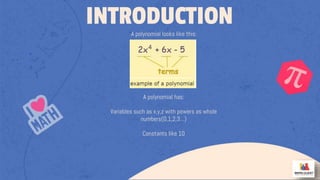
A polynomial looks like this:
INTRODUCTION
A polynomial has:
Variables such as x,y,z with powers as whole
numbers(0,1,2,3…)
Constants like 10
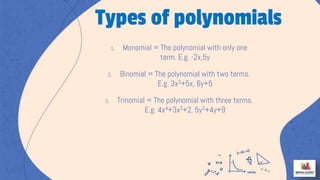
1. Monomial = The polynomial with only one
term. E.g. -2x,5y
2. Binomial = The polynomial with two terms.
E.g. 3x3+5x, 6y+5
3. Trinomial = The polynomial with three terms.
E.g. 4x4+3x2+2, 5y3+4y+9
Types of polynomials
When we know the degree we can also give the
polynomial a name:
The Degree of a Polynomial with
one variable is ...
... the largest exponent of that
variable.
DEGREE OF A POLYNOMIAL
Solving a
polynomial…
"Solving" means finding the "roots" ...
... a "root" (or "zero") is where the function is equal to zero:
WAYS TO FIND ZEROES
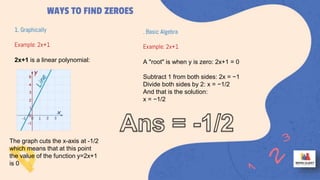
1. Graphically
Example: 2x+1
2x+1 is a linear polynomial:
The graph cuts the x-axis at -1/2
which means that at this point
the value of the function y=2x+1
is 0
. Basic Algebra
Example: 2x+1
A "root" is when y is zero: 2x+1 = 0
Subtract 1 from both sides: 2x = −1
Divide both sides by 2: x = −1/2
And that is the solution:
x = −1/2
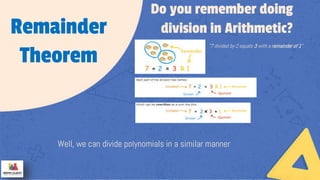
Do you remember doing
division in Arithmetic?
"7 divided by 2 equals 3 with a remainder of 1"
Well, we can divide polynomials in a similar manner
Remainder
Theorem
POLYNOMIAL DIVISION EXAMPLE
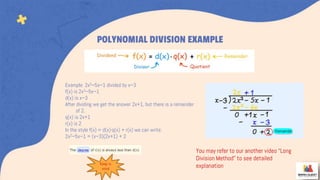
Example: 2x2−5x−1 divided by x−3
f(x) is 2x2−5x−1
d(x) is x−3
After dividing we get the answer 2x+1, but there is a remainder
of 2.
q(x) is 2x+1
r(x) is 2
In the style f(x) = d(x)·q(x) + r(x) we can write:
2x2−5x−1 = (x−3)(2x+1) + 2
You may refer to our another video “Long
Division Method” to see detailed
explanationKeep in
mind
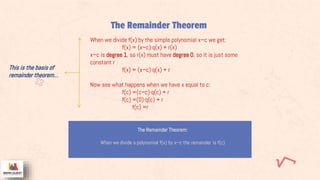
The Remainder Theorem
The Remainder Theorem:
When we divide a polynomial f(x) by x−c the remainder is f(c)
When we divide f(x) by the simple polynomial x−c we get:
f(x) = (x−c)·q(x) + r(x)
x−c is degree 1, so r(x) must have degree 0, so it is just some
constant r :
f(x) = (x−c)·q(x) + r
Now see what happens when we have x equal to c:
f(c) =(c−c)·q(c) + r
f(c) =(0)·q(c) + r
f(c) =r
This is the basis of
remainder theorem…
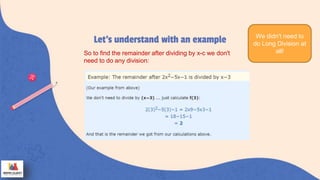
Let’s understand with an example
So to find the remainder after dividing by x-c we don't
need to do any division:
Just find f(c)
We didn't need to
do Long Division at
all!
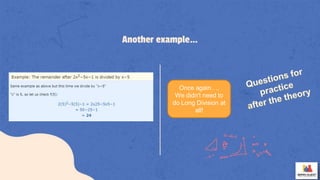
Another example…
Once again…,
We didn't need to
do Long Division at
all!
The Factor
Theorem
Now ...
We see this when dividing whole numbers. For example 60 ÷ 20
= 3 with no remainder. So 20 must be a factor of 60.
The Factor
Theorem:
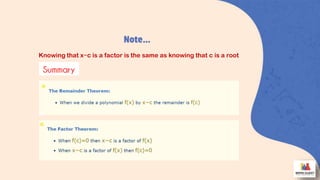
When f(c)=0 then x−c
is a factor of f(x)
And the other way
around, too:
When x−c is a factor
of f(x) then f(c)=0
Note…
Knowing that x−c is a factor is the same as knowing that c is a root
Does anyone have any questions?
brainquest0127@gmail.com
DM us on Instagram
@brainquestclasses
THANKS!

Polynomials

  • 1.
  • 2.
    A polynomial lookslike this: INTRODUCTION A polynomial has: Variables such as x,y,z with powers as whole numbers(0,1,2,3…) Constants like 10
  • 3.
    1. Monomial =The polynomial with only one term. E.g. -2x,5y 2. Binomial = The polynomial with two terms. E.g. 3x3+5x, 6y+5 3. Trinomial = The polynomial with three terms. E.g. 4x4+3x2+2, 5y3+4y+9 Types of polynomials
  • 4.
    When we knowthe degree we can also give the polynomial a name: The Degree of a Polynomial with one variable is ... ... the largest exponent of that variable. DEGREE OF A POLYNOMIAL
  • 5.
    Solving a polynomial… "Solving" meansfinding the "roots" ... ... a "root" (or "zero") is where the function is equal to zero:
  • 6.
    WAYS TO FINDZEROES 1. Graphically Example: 2x+1 2x+1 is a linear polynomial: The graph cuts the x-axis at -1/2 which means that at this point the value of the function y=2x+1 is 0 . Basic Algebra Example: 2x+1 A "root" is when y is zero: 2x+1 = 0 Subtract 1 from both sides: 2x = −1 Divide both sides by 2: x = −1/2 And that is the solution: x = −1/2
  • 7.
    Do you rememberdoing division in Arithmetic? "7 divided by 2 equals 3 with a remainder of 1" Well, we can divide polynomials in a similar manner Remainder Theorem
  • 8.
    POLYNOMIAL DIVISION EXAMPLE Example:2x2−5x−1 divided by x−3 f(x) is 2x2−5x−1 d(x) is x−3 After dividing we get the answer 2x+1, but there is a remainder of 2. q(x) is 2x+1 r(x) is 2 In the style f(x) = d(x)·q(x) + r(x) we can write: 2x2−5x−1 = (x−3)(2x+1) + 2 You may refer to our another video “Long Division Method” to see detailed explanationKeep in mind
  • 9.
    The Remainder Theorem TheRemainder Theorem: When we divide a polynomial f(x) by x−c the remainder is f(c) When we divide f(x) by the simple polynomial x−c we get: f(x) = (x−c)·q(x) + r(x) x−c is degree 1, so r(x) must have degree 0, so it is just some constant r : f(x) = (x−c)·q(x) + r Now see what happens when we have x equal to c: f(c) =(c−c)·q(c) + r f(c) =(0)·q(c) + r f(c) =r This is the basis of remainder theorem…
  • 10.
    Let’s understand withan example So to find the remainder after dividing by x-c we don't need to do any division: Just find f(c) We didn't need to do Long Division at all!
  • 11.
    Another example… Once again…, Wedidn't need to do Long Division at all!
  • 12.
    The Factor Theorem Now ... Wesee this when dividing whole numbers. For example 60 ÷ 20 = 3 with no remainder. So 20 must be a factor of 60. The Factor Theorem: When f(c)=0 then x−c is a factor of f(x) And the other way around, too: When x−c is a factor of f(x) then f(c)=0
  • 13.
    Note… Knowing that x−cis a factor is the same as knowing that c is a root
  • 14.
    Does anyone haveany questions? brainquest0127@gmail.com DM us on Instagram @brainquestclasses THANKS!