CCS Options for Co-production of Electricity and Synthetic Fuels from indigenous Coal in an Indian Context   Presented at the International Conference on Advances in Energy Research, ICAER-07, Mumbai, India, 12-14 December 2007  Jens Hetland, PhD, Senior Scientist, SINTEF Energy Research, Norway [email_address] Co-author Rahul Anantharaman The Norwegian University of Science and Technology, Trondheim, Norway
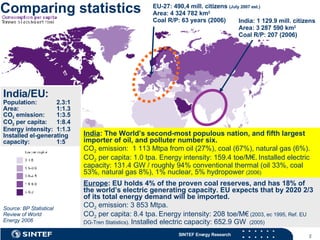
Source: BP Statistical Review of World  Energy 2006 Europe : EU holds 4% of the proven coal reserves, and has 18% of the world’s electric generating capacity.   EU expects that by 2020 2/3 of its total energy demand will be imported.  CO 2  emission: 3 853 Mtpa.  CO 2  per capita: 8.4 tpa.   Energy intensity: 208 toe/M€  (2003, ec 1995, Ref. EU DG-Tren Statistics).  Installed electric capacity: 652.9 GW   (2005) EU-27: 490,4 mill. citizens  (July 2007 est.) Area: 4 324 782 km 2 Coal R/P: 63 years (2006) India: 1 129.9 mill. citizens Area: 3 287 590 km 2 Coal R/P: 207 (2006) Comparing statistics India/EU: Population:  2.3:1 Area:  1:1.3 CO 2  emission:  1:3.5 CO 2  per capita:  1:8.4 Energy intensity:  1:1.3 Installed el-generating capacity:  1:5 India : The World’s second-most populous nation, and fifth largest importer of oil, and polluter number six.   CO 2  emission:  1 113 Mtpa from oil (27%), coal (67%), natural gas (6%).  CO 2  per capita: 1.0 tpa. Energy intensity: 159.4 toe/M€.   Installed electric capacity: 131.4 GW / roughly 94% conventional thermal (oil 33%, coal 53%, natural gas 8%), 1% nuclear, 5% hydropower  (2006)
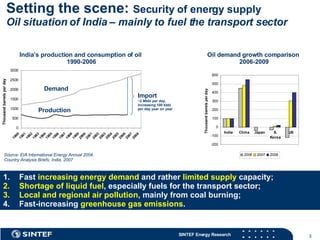
Setting the scene:  Security of energy supply Oil situation of India – mainly to fuel the transport sector Fast  increasing energy demand  and rather  limited supply  capacity;  Shortage of liquid fuel , especially fuels for the transport sector;  Local and regional air pollution , mainly from coal burning;  Fast-increasing  greenhouse gas emissions .  Production Demand Import ~2 Mbbl per day, increasing 100 kbbl  per day year on year Source: EIA International Energy Annual 2004, Country Analysis Briefs, India, 2007 Oil demand growth comparison  2006-2009 India’s production and consumption of oil  1990-2006
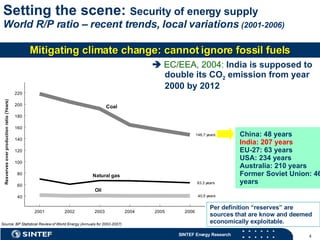
Setting the scene:  Security of energy supply   World R/P ratio – recent trends, local variations  (2001-2006) Per definition “reserves” are sources that are know and deemed economically exploitable. China: 48 years India: 207 years EU-27: 63 years USA: 234 years Australia: 210 years Former Soviet Union: 464 years    EC/EEA, 2004:  India is supposed to double its CO 2  emission from year 2000 by 2012 Mitigating climate change: cannot ignore fossil fuels
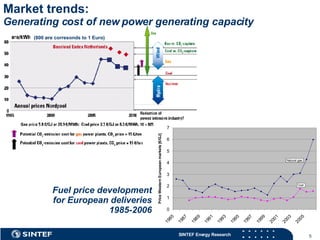
Market trends:  Generating cost of new power generating capacity Fuel price development for European deliveries   1985-2006
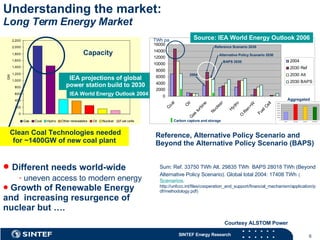
Understanding the market: Long Term Energy Market Different needs world-wide uneven access to modern energy   Growth of Renewable Energy and  increasing resurgence of nuclear but ….  IEA projections of global power station build to 2030 Capacity IEA World Energy Outlook 2004 Clean Coal Technologies needed for ~1400GW of new coal plant Courtesy ALSTOM Power Sum: Ref. 33750 TWh Alt. 29835 TWh  BAPS 28018 TWh (Beyond Alternative Policy Scenario). Global total 2004: 17408 TWh   ( Scenarios : http://unfccc.int/files/cooperation_and_support/financial_mechanism/application/pdf/methodology.pdf) Source: IEA World Energy Outlook 2006 Reference, Alternative Policy Scenario and Beyond the Alternative Policy Scenario (BAPS)
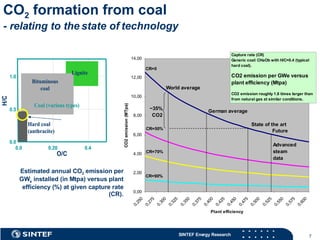
CO 2  formation from coal - relating to the state of technology Estimated annual CO 2  emission per GW e  installed (in Mtpa) versus plant efficiency (%) at given capture rate (CR).
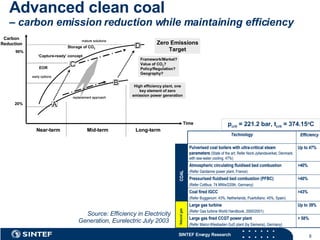
Advanced clean coal –  carbon emission reduction while maintaining efficiency p crit  = 221.2 bar, t crit  = 374.15 o C Source: Efficiency in Electricity Generation, Eurelectric July 2003
CCS  technology options Hydrogen Chemicals Retrofit options Alternative power cycles Polygeneration Efficiency reduction: goal < 5%-points Cost of CO 2  avoided: goal < 20 €/t CO2
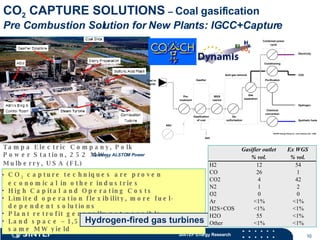
CO 2  CAPTURE SOLUTIONS   –  Coal gasification Pre Combustion Solution for New Plants: IGCC+Capture CO 2  capture techniques are proven economical in other industries High Capital and Operating Costs Limited operation flexibility, more fuel-dependent solutions  Plant retrofit generally not possible Land space ~ 1,5 x post-combustion plant for same MW yield Tampa Electric Company, Polk Power Station, 252 MW e , Mulberry, USA (FL) Hydrogen-fired gas turbines Courtesy ALSTOM Power
COACH - Overall objective To   prepare for large-scale polygeneration [1]  from coal with CO 2  capture and storage with special impact on China .     T opical areas: Coal gasification  facilitating  polygeneration schemes combined with carbon capture and storage . Improved power cycles   requiring a large-scale topping cycle based on gas turbines that operate on hydrogen-rich fuels (still to be developed for their intended purpose). Identification of reliable storage of CO 2  in China ,  via capture, pre-treatment, transport, and injection of CO 2  into geological structures with - optionally - enhanced oil/gas and coal-bed methane recovery stages (EOR/EGR/ECMB). Societal anchorage ,  including legal, regulatory, funding and economic aspects, and public issues. [1]   Options for electric power and hydrogen production as well as production of synthetic fuels with provisions for heat integration with surrounding industries. Courtesy TPRI
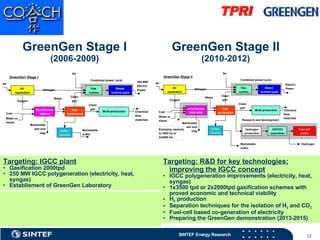
GreenGen Stage II (2010-2012) Targeting: R&D for key technologies; improving the IGCC concept IGCC polygeneration improvements (electricity, heat, syngas) 1x3500 tpd or 2x2000tpd gasification schemes with proved economic and technical viability H 2  production Separation techniques for the isolation of H 2  and CO 2 Fuel-cell based co-generation of electricity Preparing the GreenGen demonstration (2013-2015) GreenGen Stage I (2006-2009) Targeting: IGCC plant Gasification 2000tpd 250 MW IGCC polygeneration (electricity, heat, syngas) Establisment of GreenGen Laboratory
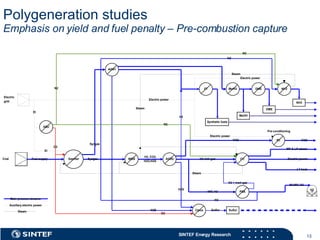
Polygeneration studies  Emphasis on yield and fuel penalty – Pre-combustion capture
East China sedimentary basins  (Courtesy GeoCapacity) Bohai Basin and Shandong Provins Source: Point sources refer to IEAGHG 2006, Oil fields refer to Geocarto International Centre 1988. GIS information is made available by BGS
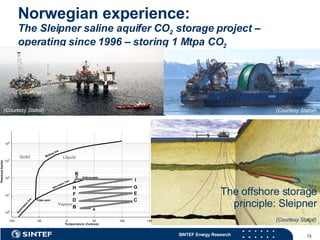
Norwegian experience: The Sleipner saline aquifer CO 2  storage project – operating since 1996 – storing 1 Mtpa CO 2 The offshore storage principle: Sleipner (Courtesy Statoil) (Courtesy Statoil) (Courtesy Statoil)
Concluding remarks The  energy situation  in India is a matter of growing concern especially in terms of  security of energy supply , which may bring India into  advanced coal-gasification technology  to co-produce electricity and synthetic fuels    polygeneration.  Whereas the relative importance of greenhouse gas emissions is rather high in Europe,  India  is evenly  concerned because of severe impacts  of global warming.  In addition India is (probably) more concerned about  cost  and the continued use of  domestic coal reserves .  As the isolation of CO 2  constitutes an inherent feature  in polygeneration ,  capture is a logical step  to pursue.  CCS offers the  option  of extending the fossil era , and to justify the harnessing of carbonaceous fuels and indigenous coal as a  compatible option within a sustainable framework .
Acknowledgements The  European Commission  for sponsoring the COACH project (EC/FP6 Contract #038966, Cooperation Action within CCS China-EU) backed by the  Chinese Ministry of Science and Technology  (MOST) of Peoples’ Republic of China

Polygeneration and CCS India

  • 1.
    CCS Options forCo-production of Electricity and Synthetic Fuels from indigenous Coal in an Indian Context Presented at the International Conference on Advances in Energy Research, ICAER-07, Mumbai, India, 12-14 December 2007 Jens Hetland, PhD, Senior Scientist, SINTEF Energy Research, Norway [email_address] Co-author Rahul Anantharaman The Norwegian University of Science and Technology, Trondheim, Norway
  • 2.
    Source: BP StatisticalReview of World Energy 2006 Europe : EU holds 4% of the proven coal reserves, and has 18% of the world’s electric generating capacity. EU expects that by 2020 2/3 of its total energy demand will be imported. CO 2 emission: 3 853 Mtpa. CO 2 per capita: 8.4 tpa. Energy intensity: 208 toe/M€ (2003, ec 1995, Ref. EU DG-Tren Statistics). Installed electric capacity: 652.9 GW (2005) EU-27: 490,4 mill. citizens (July 2007 est.) Area: 4 324 782 km 2 Coal R/P: 63 years (2006) India: 1 129.9 mill. citizens Area: 3 287 590 km 2 Coal R/P: 207 (2006) Comparing statistics India/EU: Population: 2.3:1 Area: 1:1.3 CO 2 emission: 1:3.5 CO 2 per capita: 1:8.4 Energy intensity: 1:1.3 Installed el-generating capacity: 1:5 India : The World’s second-most populous nation, and fifth largest importer of oil, and polluter number six. CO 2 emission: 1 113 Mtpa from oil (27%), coal (67%), natural gas (6%). CO 2 per capita: 1.0 tpa. Energy intensity: 159.4 toe/M€. Installed electric capacity: 131.4 GW / roughly 94% conventional thermal (oil 33%, coal 53%, natural gas 8%), 1% nuclear, 5% hydropower (2006)
  • 3.
    Setting the scene: Security of energy supply Oil situation of India – mainly to fuel the transport sector Fast increasing energy demand and rather limited supply capacity; Shortage of liquid fuel , especially fuels for the transport sector; Local and regional air pollution , mainly from coal burning; Fast-increasing greenhouse gas emissions . Production Demand Import ~2 Mbbl per day, increasing 100 kbbl per day year on year Source: EIA International Energy Annual 2004, Country Analysis Briefs, India, 2007 Oil demand growth comparison 2006-2009 India’s production and consumption of oil 1990-2006
  • 4.
    Setting the scene: Security of energy supply World R/P ratio – recent trends, local variations (2001-2006) Per definition “reserves” are sources that are know and deemed economically exploitable. China: 48 years India: 207 years EU-27: 63 years USA: 234 years Australia: 210 years Former Soviet Union: 464 years  EC/EEA, 2004: India is supposed to double its CO 2 emission from year 2000 by 2012 Mitigating climate change: cannot ignore fossil fuels
  • 5.
    Market trends: Generating cost of new power generating capacity Fuel price development for European deliveries 1985-2006
  • 6.
    Understanding the market:Long Term Energy Market Different needs world-wide uneven access to modern energy Growth of Renewable Energy and increasing resurgence of nuclear but …. IEA projections of global power station build to 2030 Capacity IEA World Energy Outlook 2004 Clean Coal Technologies needed for ~1400GW of new coal plant Courtesy ALSTOM Power Sum: Ref. 33750 TWh Alt. 29835 TWh BAPS 28018 TWh (Beyond Alternative Policy Scenario). Global total 2004: 17408 TWh ( Scenarios : http://unfccc.int/files/cooperation_and_support/financial_mechanism/application/pdf/methodology.pdf) Source: IEA World Energy Outlook 2006 Reference, Alternative Policy Scenario and Beyond the Alternative Policy Scenario (BAPS)
  • 7.
    CO 2 formation from coal - relating to the state of technology Estimated annual CO 2 emission per GW e installed (in Mtpa) versus plant efficiency (%) at given capture rate (CR).
  • 8.
    Advanced clean coal– carbon emission reduction while maintaining efficiency p crit = 221.2 bar, t crit = 374.15 o C Source: Efficiency in Electricity Generation, Eurelectric July 2003
  • 9.
    CCS technologyoptions Hydrogen Chemicals Retrofit options Alternative power cycles Polygeneration Efficiency reduction: goal < 5%-points Cost of CO 2 avoided: goal < 20 €/t CO2
  • 10.
    CO 2 CAPTURE SOLUTIONS – Coal gasification Pre Combustion Solution for New Plants: IGCC+Capture CO 2 capture techniques are proven economical in other industries High Capital and Operating Costs Limited operation flexibility, more fuel-dependent solutions Plant retrofit generally not possible Land space ~ 1,5 x post-combustion plant for same MW yield Tampa Electric Company, Polk Power Station, 252 MW e , Mulberry, USA (FL) Hydrogen-fired gas turbines Courtesy ALSTOM Power
  • 11.
    COACH - Overallobjective To prepare for large-scale polygeneration [1] from coal with CO 2 capture and storage with special impact on China .  T opical areas: Coal gasification facilitating polygeneration schemes combined with carbon capture and storage . Improved power cycles requiring a large-scale topping cycle based on gas turbines that operate on hydrogen-rich fuels (still to be developed for their intended purpose). Identification of reliable storage of CO 2 in China , via capture, pre-treatment, transport, and injection of CO 2 into geological structures with - optionally - enhanced oil/gas and coal-bed methane recovery stages (EOR/EGR/ECMB). Societal anchorage , including legal, regulatory, funding and economic aspects, and public issues. [1] Options for electric power and hydrogen production as well as production of synthetic fuels with provisions for heat integration with surrounding industries. Courtesy TPRI
  • 12.
    GreenGen Stage II(2010-2012) Targeting: R&D for key technologies; improving the IGCC concept IGCC polygeneration improvements (electricity, heat, syngas) 1x3500 tpd or 2x2000tpd gasification schemes with proved economic and technical viability H 2 production Separation techniques for the isolation of H 2 and CO 2 Fuel-cell based co-generation of electricity Preparing the GreenGen demonstration (2013-2015) GreenGen Stage I (2006-2009) Targeting: IGCC plant Gasification 2000tpd 250 MW IGCC polygeneration (electricity, heat, syngas) Establisment of GreenGen Laboratory
  • 13.
    Polygeneration studies Emphasis on yield and fuel penalty – Pre-combustion capture
  • 14.
    East China sedimentarybasins (Courtesy GeoCapacity) Bohai Basin and Shandong Provins Source: Point sources refer to IEAGHG 2006, Oil fields refer to Geocarto International Centre 1988. GIS information is made available by BGS
  • 15.
    Norwegian experience: TheSleipner saline aquifer CO 2 storage project – operating since 1996 – storing 1 Mtpa CO 2 The offshore storage principle: Sleipner (Courtesy Statoil) (Courtesy Statoil) (Courtesy Statoil)
  • 16.
    Concluding remarks The energy situation in India is a matter of growing concern especially in terms of security of energy supply , which may bring India into advanced coal-gasification technology to co-produce electricity and synthetic fuels  polygeneration. Whereas the relative importance of greenhouse gas emissions is rather high in Europe, India is evenly concerned because of severe impacts of global warming. In addition India is (probably) more concerned about cost and the continued use of domestic coal reserves . As the isolation of CO 2 constitutes an inherent feature in polygeneration , capture is a logical step to pursue. CCS offers the option of extending the fossil era , and to justify the harnessing of carbonaceous fuels and indigenous coal as a compatible option within a sustainable framework .
  • 17.
    Acknowledgements The European Commission for sponsoring the COACH project (EC/FP6 Contract #038966, Cooperation Action within CCS China-EU) backed by the Chinese Ministry of Science and Technology (MOST) of Peoples’ Republic of China