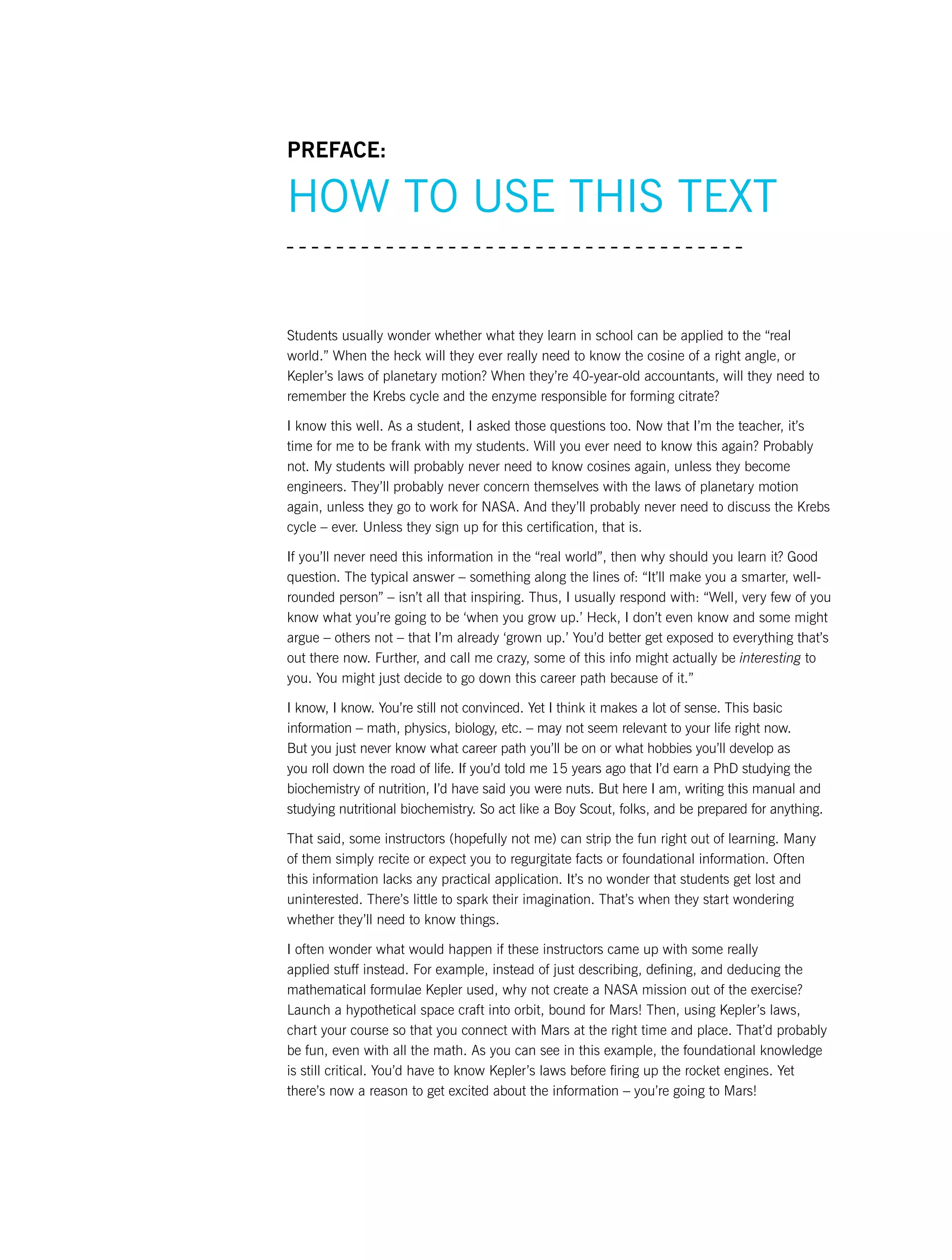
The Essentials
of Sport and
Exercise Nutrition
Certification Manual
By John Berardi, PhD; Ryan Andrews, MS, MA, RD
www.precisionnutrition.com
Designed by Seesaw Creative Communications
Illustrated by Alison Dungey
Edited by Krista Scott-Dixon
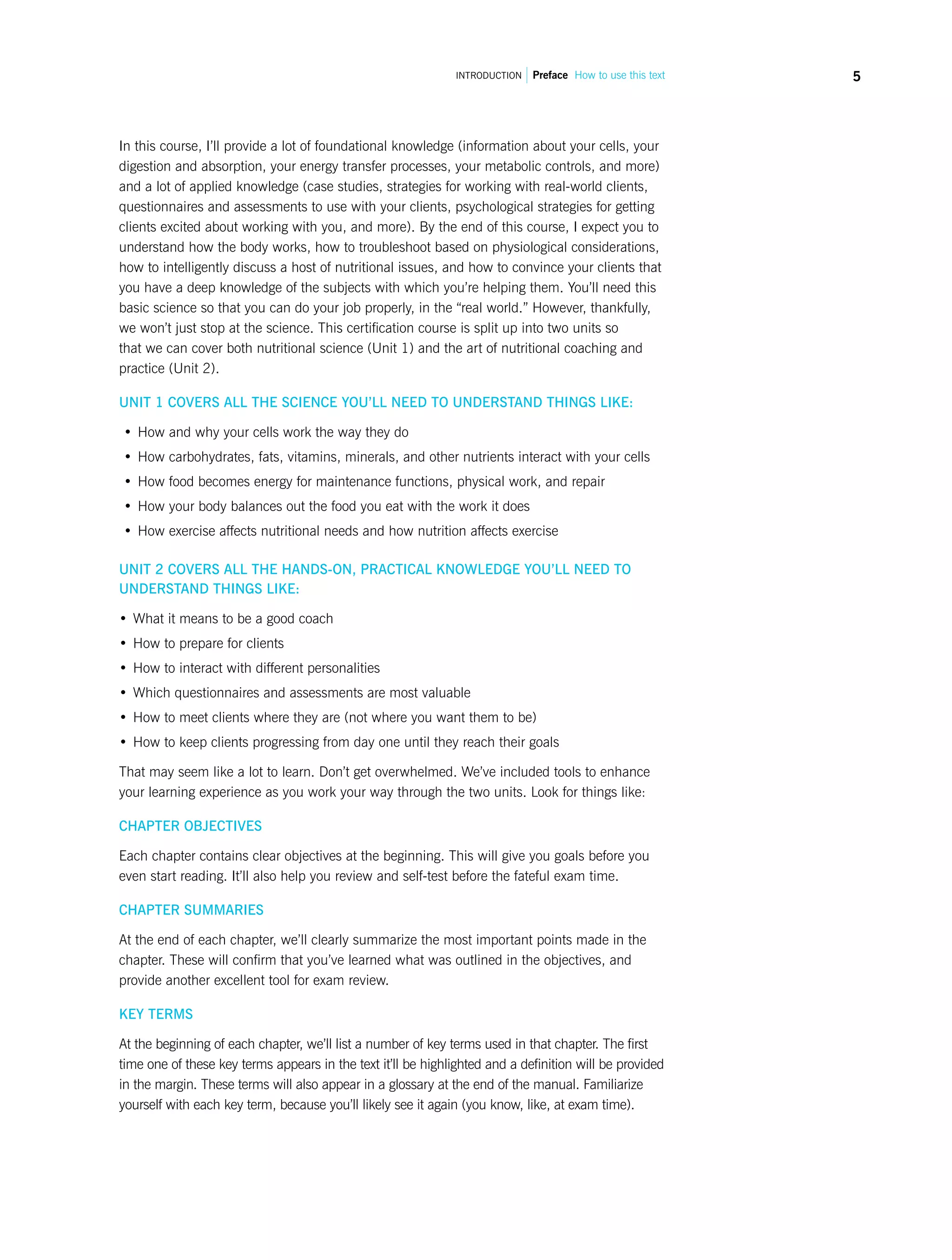
About the Authors
Dr. John Berardi has been recognized as one of the top exercise nutrition experts in the
world. His work has been published in numerous textbooks, peer-reviewed academic
journals, and countless popular exercise and nutrition books and magazines.
Dr. Berardi has worked with over 50,000 clients in over 100 countries through his company,
Precision Nutrition. These clients range from recreational exercisers to elite athletes, and
include the Cleveland Browns, the Toronto Maple Leafs, the Texas Longhorns, world
champion UFC fighters, and Olympic athletes, including the Canadian Olympic ski teams,
bobsleigh and skeleton racers, and speed skaters.
No stranger to elite athletics himself, Dr. Berardi has competed at a high level in football,
track and field, rugby, and powerlifting. He is a former Jr. Mr. USA bodybuilding champion.
In addition to this work, Dr. Berardi is active in two important, not-for-profit organizations devoted
to providing healthy food for those in need: the Healthy Food Bank and Spezzatino magazine.
Ryan Andrews is a world-leading educator in the fields of Exercise Science and Nutrition.
Apart from having earned nearly every accreditation available (Registered Dietician, Certified
Strength and Conditioning Specialist, two Masters degrees, and more), Ryan was a nationally
ranked competitive bodybuilder from 1996-2001.
He’s also an expert coach who has trained and worked at the Johns Hopkins Weight
Management Center, one of the most recognized and awarded research institutions in
the world. He’s also the Director of Education for Precision Nutrition, Inc., overseeing the
Precision Nutrition Lean Eating Coaching Program, a coaching initiative that works with more
than 2,000 clients every year.
In his spare time, Ryan volunteers with a host of non-profit organizations to help promote a
sustainable future.
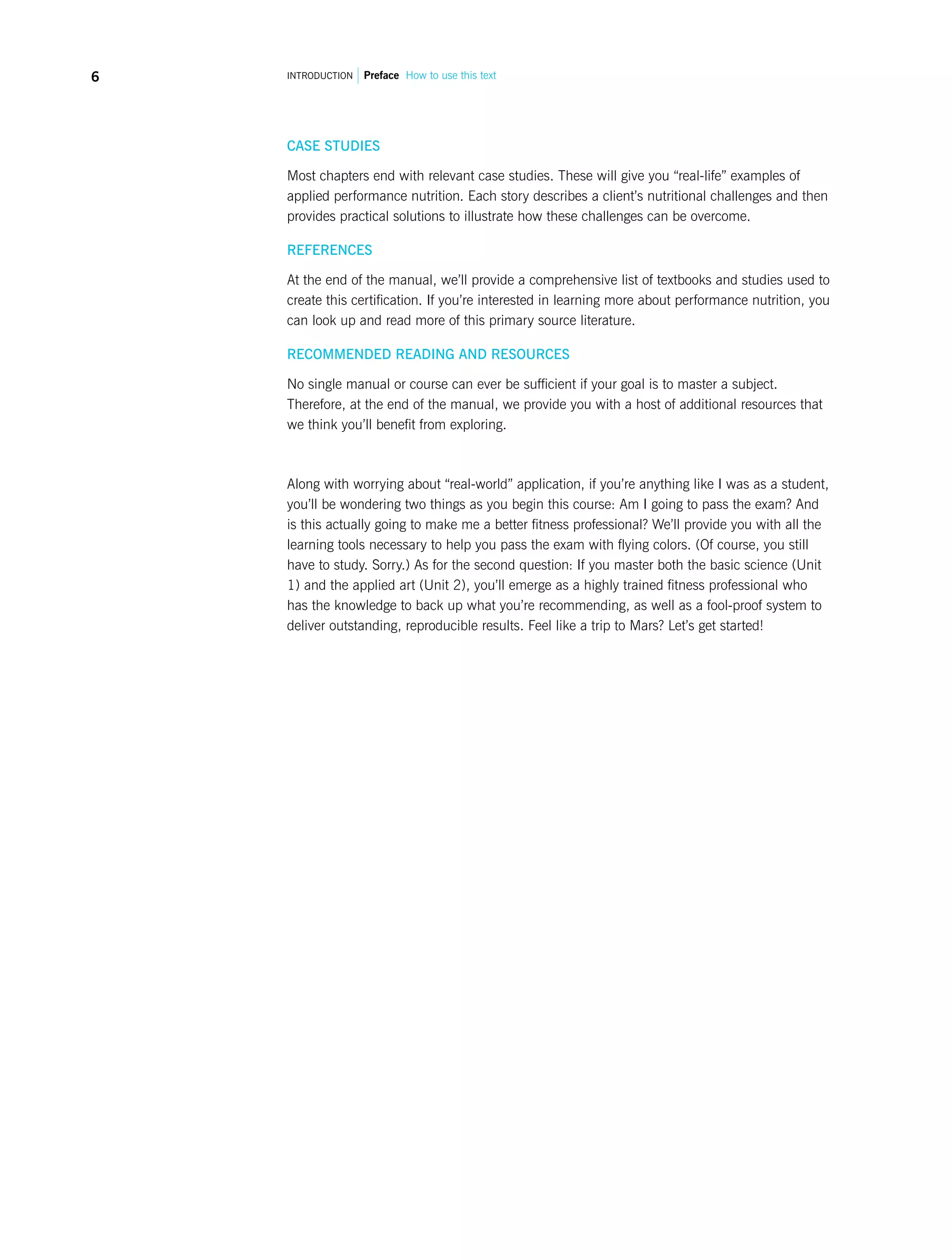
Preface 4
Introduction
What is good nutrition? 7
Introductory case study 21
Unit 1
Nutritional science 23
Chapter 1
Cell structure and function 25
Chapter 2
Food intake, digestion and absorption 41
Case study 65
Chapter 3
Energy transformation and metabolism 67
Case study 94
Chapter 4
Energy balance in the body 97
Case study 116
Chapter 5
Aerobic and anaerobic metabolism 119
Case study 136
Chapter 6
Macronutrients 139
Case study 162
Chapter 7
Micronutrients 165
Case study 189
Chapter 8
Water and fluid balance 191
Case study A 205
Case study B 207
Chapter 9
Special needs 209
Case study 240
Unit 2
Nutritional practice 243
Chapter 10
Step 1: Preparing for your client 245
Case study 264
Chapter 11
Step 2: Collecting preliminary
client information 267
Case study 301
Chapter 12
Step 3: Interpreting client information 303
Case study 323
Chapter 13
Step 4: Providing a nutrition plan 325
Case study 361
Chapter 14
Step 5: Nutritional supplementation 363
Case study 372
Chapter 15
Step 6: Setting behavior goals
and monitoring 375
Case study 395
Chapter 16
Step 7: Making nutritional
adjustments 397
Case study 420
Chapter 17
Step 8: Providing continuing
education and support 423
Case study 441
Glossary 443
Appendices 455
References
Unit 1 462
Unit 2 470
Table of contents
Preface:
How to use this text
Students usually wonder whether what they learn in school can be applied to the “real
world.” When the heck will they ever really need to know the cosine of a right angle, or
Kepler’s laws of planetary motion? When they’re 40-year-old accountants, will they need to
remember the Krebs cycle and the enzyme responsible for forming citrate?
I know this well. As a student, I asked those questions too. Now that I’m the teacher, it’s
time for me to be frank with my students. Will you ever need to know this again? Probably
not. My students will probably never need to know cosines again, unless they become
engineers. They’ll probably never concern themselves with the laws of planetary motion
again, unless they go to work for NASA. And they’ll probably never need to discuss the Krebs
cycle – ever. Unless they sign up for this certification, that is.
If you’ll never need this information in the “real world”, then why should you learn it? Good
question. The typical answer – something along the lines of: “It’ll make you a smarter, well-
rounded person” – isn’t all that inspiring. Thus, I usually respond with: “Well, very few of you
know what you’re going to be ‘when you grow up.’ Heck, I don’t even know and some might
argue – others not – that I’m already ‘grown up.’ You’d better get exposed to everything that’s
out there now. Further, and call me crazy, some of this info might actually be interesting to
you. You might just decide to go down this career path because of it.”
I know, I know. You’re still not convinced. Yet I think it makes a lot of sense. This basic
information – math, physics, biology, etc. – may not seem relevant to your life right now.
But you just never know what career path you’ll be on or what hobbies you’ll develop as
you roll down the road of life. If you’d told me 15 years ago that I’d earn a PhD studying the
biochemistry of nutrition, I’d have said you were nuts. But here I am, writing this manual and
studying nutritional biochemistry. So act like a Boy Scout, folks, and be prepared for anything.
That said, some instructors (hopefully not me) can strip the fun right out of learning. Many
of them simply recite or expect you to regurgitate facts or foundational information. Often
this information lacks any practical application. It’s no wonder that students get lost and
uninterested. There’s little to spark their imagination. That’s when they start wondering
whether they’ll need to know things.
I often wonder what would happen if these instructors came up with some really
applied stuff instead. For example, instead of just describing, defining, and deducing the
mathematical formulae Kepler used, why not create a NASA mission out of the exercise?
Launch a hypothetical space craft into orbit, bound for Mars! Then, using Kepler’s laws,
chart your course so that you connect with Mars at the right time and place. That’d probably
be fun, even with all the math. As you can see in this example, the foundational knowledge
is still critical. You’d have to know Kepler’s laws before firing up the rocket engines. Yet
there’s now a reason to get excited about the information – you’re going to Mars!
5
introduction | Preface How to use this text
In this course, I’ll provide a lot of foundational knowledge (information about your cells, your
digestion and absorption, your energy transfer processes, your metabolic controls, and more)
and a lot of applied knowledge (case studies, strategies for working with real-world clients,
questionnaires and assessments to use with your clients, psychological strategies for getting
clients excited about working with you, and more). By the end of this course, I expect you to
understand how the body works, how to troubleshoot based on physiological considerations,
how to intelligently discuss a host of nutritional issues, and how to convince your clients that
you have a deep knowledge of the subjects with which you’re helping them. You’ll need this
basic science so that you can do your job properly, in the “real world.” However, thankfully,
we won’t just stop at the science. This certification course is split up into two units so
that we can cover both nutritional science (Unit 1) and the art of nutritional coaching and
practice (Unit 2).
Unit 1 covers all the science you’ll need to understand things like:
• How and why your cells work the way they do
• How carbohydrates, fats, vitamins, minerals, and other nutrients interact with your cells
• How food becomes energy for maintenance functions, physical work, and repair
•	
How your body balances out the food you eat with the work it does
• How exercise affects nutritional needs and how nutrition affects exercise
Unit 2 covers all the hands-on, practical knowledge you’ll need to
understand things like:
• What it means to be a good coach
• How to prepare for clients
• How to interact with different personalities
• Which questionnaires and assessments are most valuable
• How to meet clients where they are (not where you want them to be)
• How to keep clients progressing from day one until they reach their goals
That may seem like a lot to learn. Don’t get overwhelmed. We’ve included tools to enhance
your learning experience as you work your way through the two units. Look for things like:
Chapter objectives
Each chapter contains clear objectives at the beginning. This will give you goals before you
even start reading. It’ll also help you review and self-test before the fateful exam time.
Chapter summaries
At the end of each chapter, we’ll clearly summarize the most important points made in the
chapter. These will confirm that you’ve learned what was outlined in the objectives, and
provide another excellent tool for exam review.
Key terms
At the beginning of each chapter, we’ll list a number of key terms used in that chapter. The first
time one of these key terms appears in the text it’ll be highlighted and a definition will be provided
in the margin. These terms will also appear in a glossary at the end of the manual. Familiarize
yourself with each key term, because you’ll likely see it again (you know, like, at exam time).
6 introduction | Preface How to use this text
Case studies
Most chapters end with relevant case studies. These will give you “real-life” examples of
applied performance nutrition. Each story describes a client’s nutritional challenges and then
provides practical solutions to illustrate how these challenges can be overcome.
References
At the end of the manual, we’ll provide a comprehensive list of textbooks and studies used to
create this certification. If you’re interested in learning more about performance nutrition, you
can look up and read more of this primary source literature.
Recommended reading and resources
No single manual or course can ever be sufficient if your goal is to master a subject.
Therefore, at the end of the manual, we provide you with a host of additional resources that
we think you’ll benefit from exploring.
Along with worrying about “real-world” application, if you’re anything like I was as a student,
you’ll be wondering two things as you begin this course: Am I going to pass the exam? And
is this actually going to make me a better fitness professional? We’ll provide you with all the
learning tools necessary to help you pass the exam with flying colors. (Of course, you still
have to study. Sorry.) As for the second question: If you master both the basic science (Unit
1) and the applied art (Unit 2), you’ll emerge as a highly trained fitness professional who
has the knowledge to back up what you’re recommending, as well as a fool-proof system to
deliver outstanding, reproducible results. Feel like a trip to Mars? Let’s get started!

PN-Cert-TOC-and-Preface.pdf

  • 1.
    The Essentials of Sportand Exercise Nutrition Certification Manual By John Berardi, PhD; Ryan Andrews, MS, MA, RD www.precisionnutrition.com Designed by Seesaw Creative Communications Illustrated by Alison Dungey Edited by Krista Scott-Dixon
  • 2.
    About the Authors Dr.John Berardi has been recognized as one of the top exercise nutrition experts in the world. His work has been published in numerous textbooks, peer-reviewed academic journals, and countless popular exercise and nutrition books and magazines. Dr. Berardi has worked with over 50,000 clients in over 100 countries through his company, Precision Nutrition. These clients range from recreational exercisers to elite athletes, and include the Cleveland Browns, the Toronto Maple Leafs, the Texas Longhorns, world champion UFC fighters, and Olympic athletes, including the Canadian Olympic ski teams, bobsleigh and skeleton racers, and speed skaters. No stranger to elite athletics himself, Dr. Berardi has competed at a high level in football, track and field, rugby, and powerlifting. He is a former Jr. Mr. USA bodybuilding champion. In addition to this work, Dr. Berardi is active in two important, not-for-profit organizations devoted to providing healthy food for those in need: the Healthy Food Bank and Spezzatino magazine. Ryan Andrews is a world-leading educator in the fields of Exercise Science and Nutrition. Apart from having earned nearly every accreditation available (Registered Dietician, Certified Strength and Conditioning Specialist, two Masters degrees, and more), Ryan was a nationally ranked competitive bodybuilder from 1996-2001. He’s also an expert coach who has trained and worked at the Johns Hopkins Weight Management Center, one of the most recognized and awarded research institutions in the world. He’s also the Director of Education for Precision Nutrition, Inc., overseeing the Precision Nutrition Lean Eating Coaching Program, a coaching initiative that works with more than 2,000 clients every year. In his spare time, Ryan volunteers with a host of non-profit organizations to help promote a sustainable future.
  • 3.
    Preface 4 Introduction What isgood nutrition? 7 Introductory case study 21 Unit 1 Nutritional science 23 Chapter 1 Cell structure and function 25 Chapter 2 Food intake, digestion and absorption 41 Case study 65 Chapter 3 Energy transformation and metabolism 67 Case study 94 Chapter 4 Energy balance in the body 97 Case study 116 Chapter 5 Aerobic and anaerobic metabolism 119 Case study 136 Chapter 6 Macronutrients 139 Case study 162 Chapter 7 Micronutrients 165 Case study 189 Chapter 8 Water and fluid balance 191 Case study A 205 Case study B 207 Chapter 9 Special needs 209 Case study 240 Unit 2 Nutritional practice 243 Chapter 10 Step 1: Preparing for your client 245 Case study 264 Chapter 11 Step 2: Collecting preliminary client information 267 Case study 301 Chapter 12 Step 3: Interpreting client information 303 Case study 323 Chapter 13 Step 4: Providing a nutrition plan 325 Case study 361 Chapter 14 Step 5: Nutritional supplementation 363 Case study 372 Chapter 15 Step 6: Setting behavior goals and monitoring 375 Case study 395 Chapter 16 Step 7: Making nutritional adjustments 397 Case study 420 Chapter 17 Step 8: Providing continuing education and support 423 Case study 441 Glossary 443 Appendices 455 References Unit 1 462 Unit 2 470 Table of contents
  • 4.
    Preface: How to usethis text Students usually wonder whether what they learn in school can be applied to the “real world.” When the heck will they ever really need to know the cosine of a right angle, or Kepler’s laws of planetary motion? When they’re 40-year-old accountants, will they need to remember the Krebs cycle and the enzyme responsible for forming citrate? I know this well. As a student, I asked those questions too. Now that I’m the teacher, it’s time for me to be frank with my students. Will you ever need to know this again? Probably not. My students will probably never need to know cosines again, unless they become engineers. They’ll probably never concern themselves with the laws of planetary motion again, unless they go to work for NASA. And they’ll probably never need to discuss the Krebs cycle – ever. Unless they sign up for this certification, that is. If you’ll never need this information in the “real world”, then why should you learn it? Good question. The typical answer – something along the lines of: “It’ll make you a smarter, well- rounded person” – isn’t all that inspiring. Thus, I usually respond with: “Well, very few of you know what you’re going to be ‘when you grow up.’ Heck, I don’t even know and some might argue – others not – that I’m already ‘grown up.’ You’d better get exposed to everything that’s out there now. Further, and call me crazy, some of this info might actually be interesting to you. You might just decide to go down this career path because of it.” I know, I know. You’re still not convinced. Yet I think it makes a lot of sense. This basic information – math, physics, biology, etc. – may not seem relevant to your life right now. But you just never know what career path you’ll be on or what hobbies you’ll develop as you roll down the road of life. If you’d told me 15 years ago that I’d earn a PhD studying the biochemistry of nutrition, I’d have said you were nuts. But here I am, writing this manual and studying nutritional biochemistry. So act like a Boy Scout, folks, and be prepared for anything. That said, some instructors (hopefully not me) can strip the fun right out of learning. Many of them simply recite or expect you to regurgitate facts or foundational information. Often this information lacks any practical application. It’s no wonder that students get lost and uninterested. There’s little to spark their imagination. That’s when they start wondering whether they’ll need to know things. I often wonder what would happen if these instructors came up with some really applied stuff instead. For example, instead of just describing, defining, and deducing the mathematical formulae Kepler used, why not create a NASA mission out of the exercise? Launch a hypothetical space craft into orbit, bound for Mars! Then, using Kepler’s laws, chart your course so that you connect with Mars at the right time and place. That’d probably be fun, even with all the math. As you can see in this example, the foundational knowledge is still critical. You’d have to know Kepler’s laws before firing up the rocket engines. Yet there’s now a reason to get excited about the information – you’re going to Mars!
  • 5.
    5 introduction | PrefaceHow to use this text In this course, I’ll provide a lot of foundational knowledge (information about your cells, your digestion and absorption, your energy transfer processes, your metabolic controls, and more) and a lot of applied knowledge (case studies, strategies for working with real-world clients, questionnaires and assessments to use with your clients, psychological strategies for getting clients excited about working with you, and more). By the end of this course, I expect you to understand how the body works, how to troubleshoot based on physiological considerations, how to intelligently discuss a host of nutritional issues, and how to convince your clients that you have a deep knowledge of the subjects with which you’re helping them. You’ll need this basic science so that you can do your job properly, in the “real world.” However, thankfully, we won’t just stop at the science. This certification course is split up into two units so that we can cover both nutritional science (Unit 1) and the art of nutritional coaching and practice (Unit 2). Unit 1 covers all the science you’ll need to understand things like: • How and why your cells work the way they do • How carbohydrates, fats, vitamins, minerals, and other nutrients interact with your cells • How food becomes energy for maintenance functions, physical work, and repair • How your body balances out the food you eat with the work it does • How exercise affects nutritional needs and how nutrition affects exercise Unit 2 covers all the hands-on, practical knowledge you’ll need to understand things like: • What it means to be a good coach • How to prepare for clients • How to interact with different personalities • Which questionnaires and assessments are most valuable • How to meet clients where they are (not where you want them to be) • How to keep clients progressing from day one until they reach their goals That may seem like a lot to learn. Don’t get overwhelmed. We’ve included tools to enhance your learning experience as you work your way through the two units. Look for things like: Chapter objectives Each chapter contains clear objectives at the beginning. This will give you goals before you even start reading. It’ll also help you review and self-test before the fateful exam time. Chapter summaries At the end of each chapter, we’ll clearly summarize the most important points made in the chapter. These will confirm that you’ve learned what was outlined in the objectives, and provide another excellent tool for exam review. Key terms At the beginning of each chapter, we’ll list a number of key terms used in that chapter. The first time one of these key terms appears in the text it’ll be highlighted and a definition will be provided in the margin. These terms will also appear in a glossary at the end of the manual. Familiarize yourself with each key term, because you’ll likely see it again (you know, like, at exam time).
  • 6.
    6 introduction |Preface How to use this text Case studies Most chapters end with relevant case studies. These will give you “real-life” examples of applied performance nutrition. Each story describes a client’s nutritional challenges and then provides practical solutions to illustrate how these challenges can be overcome. References At the end of the manual, we’ll provide a comprehensive list of textbooks and studies used to create this certification. If you’re interested in learning more about performance nutrition, you can look up and read more of this primary source literature. Recommended reading and resources No single manual or course can ever be sufficient if your goal is to master a subject. Therefore, at the end of the manual, we provide you with a host of additional resources that we think you’ll benefit from exploring. Along with worrying about “real-world” application, if you’re anything like I was as a student, you’ll be wondering two things as you begin this course: Am I going to pass the exam? And is this actually going to make me a better fitness professional? We’ll provide you with all the learning tools necessary to help you pass the exam with flying colors. (Of course, you still have to study. Sorry.) As for the second question: If you master both the basic science (Unit 1) and the applied art (Unit 2), you’ll emerge as a highly trained fitness professional who has the knowledge to back up what you’re recommending, as well as a fool-proof system to deliver outstanding, reproducible results. Feel like a trip to Mars? Let’s get started!