Case study on P & G
   Prasad Kumar Nayak
       7207378840
Introduction to P & G
• P & G India is the subsidiary of world’s largest
  consumer goods company Procter & Gamble .
• It is ranked 86 in the 2012 fortune 500 list with a
  revenue of $ 82.5 billion.
• P&G India is one of the largest and amongst the
  fastest growing consumer goods companies in
  India.
• It was established in 1964,
• P&G India now serves over 650 million
  consumers across India.
P & G India Products
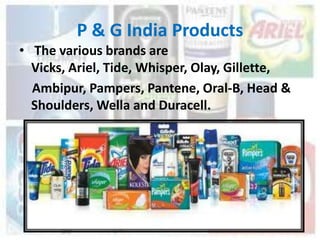
• The various brands are
  Vicks, Ariel, Tide, Whisper, Olay, Gillette,
  Ambipur, Pampers, Pantene, Oral-B, Head &
  Shoulders, Wella and Duracell.
Introduction to P & G
 Its presence pans across the Beauty & Grooming
  segment, the Household Care segment as well as
  the Health & Well Being segment.
 P&G operates under three entities in India - two
  listed entities
1. “Procter & Gamble Hygiene and Health Care
    Limited” and
2. ‘Gillette India Limited’,
as well as one 100% subsidiary of the parent
    company in the U.S. called
3. ‘Procter & Gamble Home Products’.
Introduction to P & G
Now it has a direct reach of 1.3 million outlets
 across India.
At present, India is one of the smallest markets
 for P&G with just $1-billion sales across three
 subsidiaries -Procter & Gamble Health &
 Hygiene, Gillette India and Procter & Gamble
 Home Products
P & G currently invested in the country via its five
 plants and over nine contract manufacturing sites
It creates 26,000 jobs directly and indirectly.
Procter & Gamble, will build its largest
 manufacturing plant in the Indian sub-continent
 in Hyderabad by investing 345 crore.
Project 2-3-4
To strengthen its presence in India, and increase
  sales 20 times from its current $ 1b level, P&G
  India has formulated a 'Project 2-3-4'.
P&G's 'Project 2-3-4,' is aimed at
2:doubling the number of Indians who use its
  products,
3:trebling per capita spending by Indians on its
  products and
4:quadrupling net sales of its India operations by
  2015.
Why Project 2-3-4
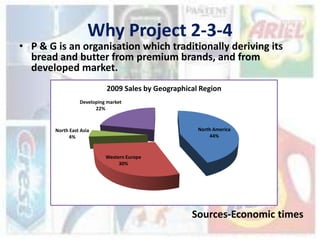
• P & G is an organisation which traditionally deriving its
  bread and butter from premium brands, and from
  developed market.
                            2009 Sales by Geographical Region
                  Developing market
                        22%


        North East Asia                               North America
              4%                                          44%


                            Western Europe
                                 30%


                                                    Sources-Economic times
• Globally and within India, the company is
  investing heavily in innovation, R&D and
  distribution. The strategy is to make several of
  its     billion     dollar      brands     more
  localised, accessible and affordable for
  consumers.
• The company is trying to strengthen its portfolio
  by bringing many more brands into the country.
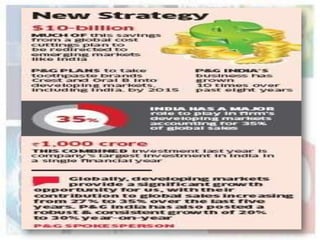
• The parent company also plans to launch
  toothpaste brands Crest and Oral B in emerging
  markets, including India by 2015.
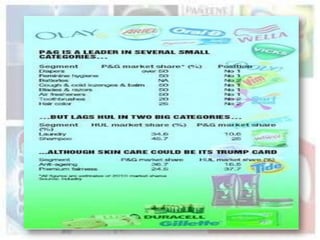
• P & G is trying to cater the gaps in its Indian
  portfolio include toothpaste (a 3,000 crore
  market) and soaps ( 7,000 crore).
“Thank You, Mom” Campaign
 P&G's corporate campaign kicked off in April with its
  first ``Thank You, Mom'' TV spot.
 It     also   has   a    dedicated     ``Thank,   You
  Mom'' Facebook page and app that allows people to
  send ``Thank you'' messages to their mothers.
 P&G is sponsoring more than 150 global athletes.
 P&G is sponsoring a few athletes like boxer Mary Kom
  and runner Kavita Raut, giving their mothers a chance
  to see them perform and hopefully win at London
  this year.
 P&G expects the campaign to drive $500 million in
  sales.
1. Analyze the sales and Distribution System of P&G?
P&G keeping broaden the market by slashing it’s no. of
distributors down to one-tenth of it’s size .
85% of it’s sales come from the top 30 towns & it’s
current volume did not justify a large distributor network.
So P&G will now have one distributer who will operate
like superstockist., which help to replenish it’s
distributors more frequently and reduce their average
stock level.
P&G keep growing on ROI(Return On Investment) which
resulted in each distributer trying to extend it’s reach to
push up volumes.
 With a limited number of distributers, P&G will
  also not need to invest in C&F agents.
 P & G follows wholesale format of distribution
  for Vicks.
 P&G is giving 6% margin to the distributor
 P & G is spending 30-35 % of its sales in
  Advertisement and Promotion which is
  highest in the industry, HUL expends only
  15% of sales on Advertisement and
  Promotion.
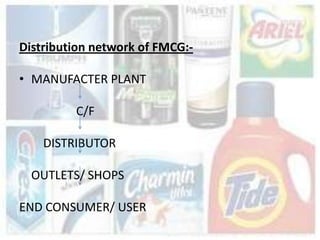
Distribution network of FMCG:-

• MANUFACTER PLANT

         C/F

    DISTRIBUTOR

  OUTLETS/ SHOPS

END CONSUMER/ USER
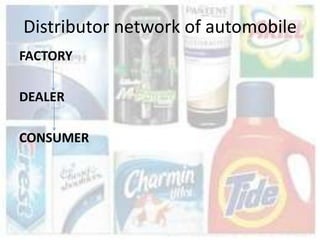
Distributor network of automobile
FACTORY

DEALER

CONSUMER
THANK YOU

Distribution system of P&G

  • 1.
    Case study onP & G Prasad Kumar Nayak 7207378840
  • 2.
    Introduction to P& G • P & G India is the subsidiary of world’s largest consumer goods company Procter & Gamble . • It is ranked 86 in the 2012 fortune 500 list with a revenue of $ 82.5 billion. • P&G India is one of the largest and amongst the fastest growing consumer goods companies in India. • It was established in 1964, • P&G India now serves over 650 million consumers across India.
  • 3.
    P & GIndia Products • The various brands are Vicks, Ariel, Tide, Whisper, Olay, Gillette, Ambipur, Pampers, Pantene, Oral-B, Head & Shoulders, Wella and Duracell.
  • 4.
    Introduction to P& G  Its presence pans across the Beauty & Grooming segment, the Household Care segment as well as the Health & Well Being segment.  P&G operates under three entities in India - two listed entities 1. “Procter & Gamble Hygiene and Health Care Limited” and 2. ‘Gillette India Limited’, as well as one 100% subsidiary of the parent company in the U.S. called 3. ‘Procter & Gamble Home Products’.
  • 5.
    Introduction to P& G Now it has a direct reach of 1.3 million outlets across India. At present, India is one of the smallest markets for P&G with just $1-billion sales across three subsidiaries -Procter & Gamble Health & Hygiene, Gillette India and Procter & Gamble Home Products P & G currently invested in the country via its five plants and over nine contract manufacturing sites It creates 26,000 jobs directly and indirectly. Procter & Gamble, will build its largest manufacturing plant in the Indian sub-continent in Hyderabad by investing 345 crore.
  • 6.
    Project 2-3-4 To strengthenits presence in India, and increase sales 20 times from its current $ 1b level, P&G India has formulated a 'Project 2-3-4'. P&G's 'Project 2-3-4,' is aimed at 2:doubling the number of Indians who use its products, 3:trebling per capita spending by Indians on its products and 4:quadrupling net sales of its India operations by 2015.
  • 7.
    Why Project 2-3-4 •P & G is an organisation which traditionally deriving its bread and butter from premium brands, and from developed market. 2009 Sales by Geographical Region Developing market 22% North East Asia North America 4% 44% Western Europe 30% Sources-Economic times
  • 8.
    • Globally andwithin India, the company is investing heavily in innovation, R&D and distribution. The strategy is to make several of its billion dollar brands more localised, accessible and affordable for consumers. • The company is trying to strengthen its portfolio by bringing many more brands into the country. • The parent company also plans to launch toothpaste brands Crest and Oral B in emerging markets, including India by 2015. • P & G is trying to cater the gaps in its Indian portfolio include toothpaste (a 3,000 crore market) and soaps ( 7,000 crore).
  • 11.
    “Thank You, Mom”Campaign  P&G's corporate campaign kicked off in April with its first ``Thank You, Mom'' TV spot.  It also has a dedicated ``Thank, You Mom'' Facebook page and app that allows people to send ``Thank you'' messages to their mothers.  P&G is sponsoring more than 150 global athletes.  P&G is sponsoring a few athletes like boxer Mary Kom and runner Kavita Raut, giving their mothers a chance to see them perform and hopefully win at London this year.  P&G expects the campaign to drive $500 million in sales.
  • 12.
    1. Analyze thesales and Distribution System of P&G? P&G keeping broaden the market by slashing it’s no. of distributors down to one-tenth of it’s size . 85% of it’s sales come from the top 30 towns & it’s current volume did not justify a large distributor network. So P&G will now have one distributer who will operate like superstockist., which help to replenish it’s distributors more frequently and reduce their average stock level. P&G keep growing on ROI(Return On Investment) which resulted in each distributer trying to extend it’s reach to push up volumes.
  • 13.
     With alimited number of distributers, P&G will also not need to invest in C&F agents.  P & G follows wholesale format of distribution for Vicks.  P&G is giving 6% margin to the distributor  P & G is spending 30-35 % of its sales in Advertisement and Promotion which is highest in the industry, HUL expends only 15% of sales on Advertisement and Promotion.
  • 14.
    Distribution network ofFMCG:- • MANUFACTER PLANT C/F DISTRIBUTOR OUTLETS/ SHOPS END CONSUMER/ USER
  • 15.
    Distributor network ofautomobile FACTORY DEALER CONSUMER
  • 16.