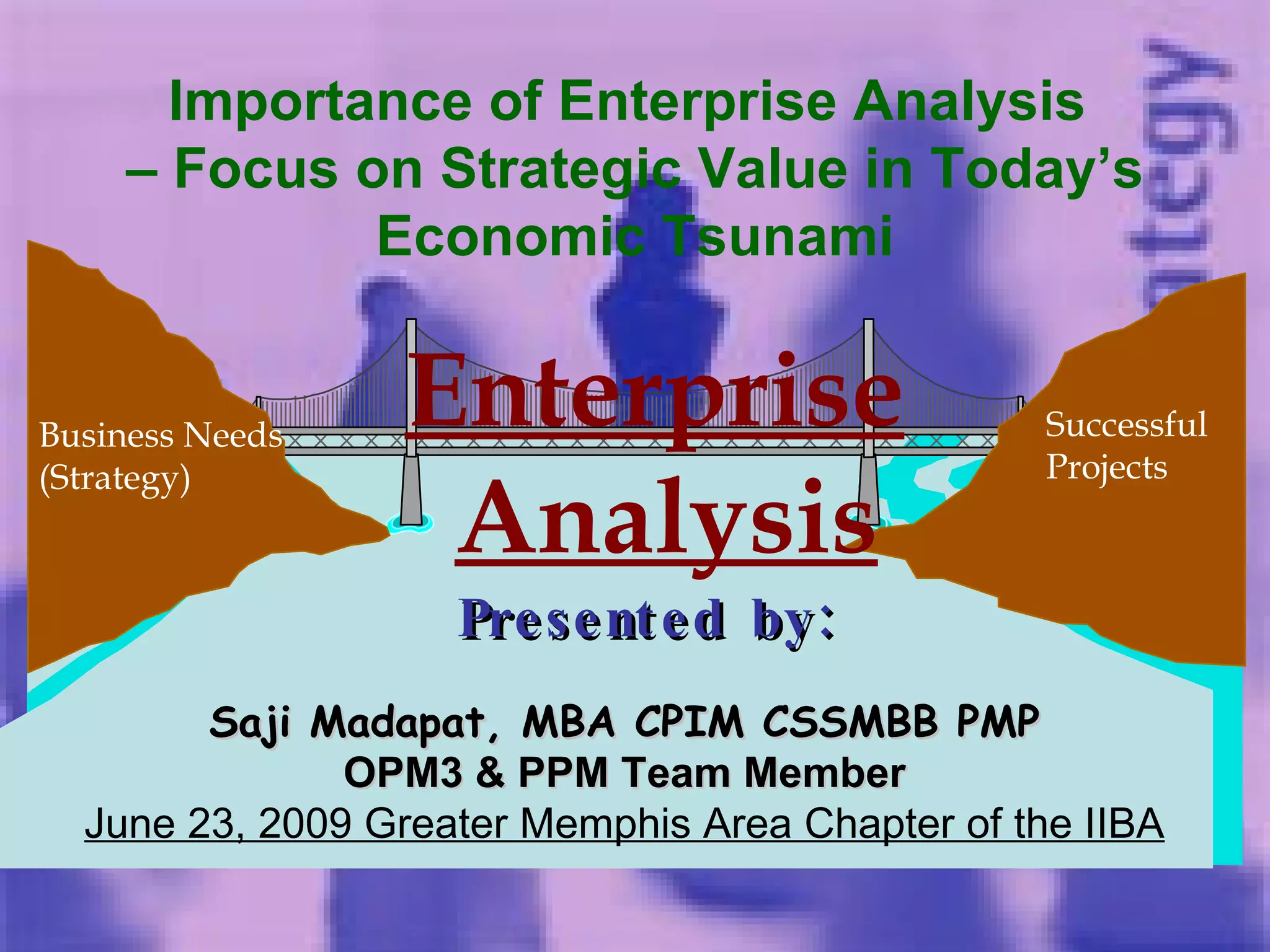
Business Needs (Strategy) Successful  Projects Enterprise Analysis Presented by: Saji Madapat, MBA CPIM CSSMBB PMP OPM3 & PPM Team Member June 23, 2009 Greater Memphis Area Chapter of the IIBA Importance of Enterprise Analysis  –  Focus on Strategic Value in Today’s Economic Tsunami
Presentation Outline • Irrational Exuberance • Aftermath • Why Enterprise Analysis? • Enterprise Analysis Defined - BABOK® 2.0 • Examples from “Real Life” – Case Study on Buckman Laboratories International Inc. • Q & A PARKING LOT: Enterprise Analysis Execution Approaches  • What is in Enterprise Analysis for my organization?
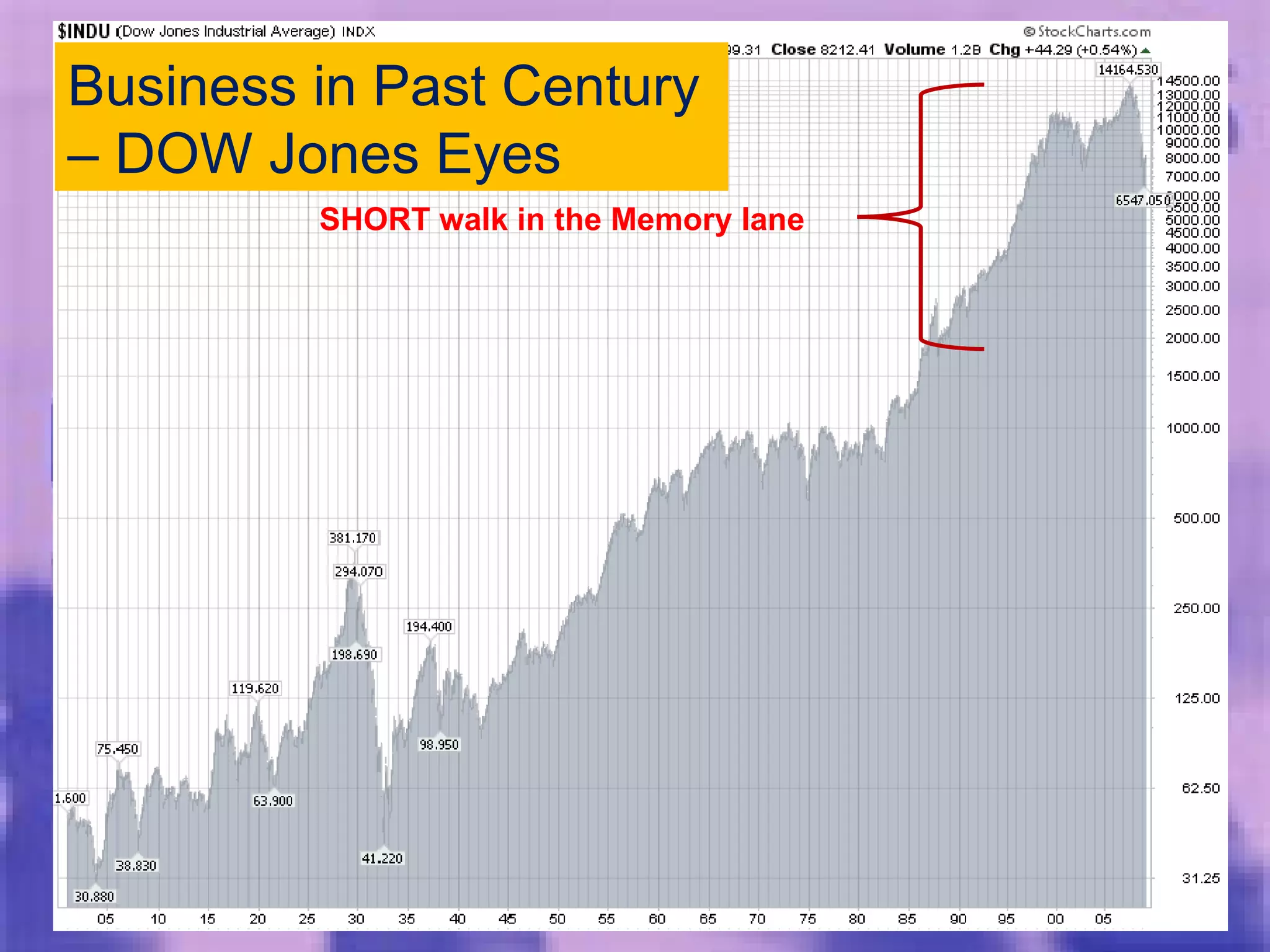
SHORT walk in the Memory lane Business in Past Century  –  DOW Jones Eyes
“ En”visioning Tomorrow “ The corporation as we know it,  which is now 120 years old,  Is not likely to Survive the  next 25 years. Legally & Financially, Yes, But not Structurally & Economically.” -Peter Drucker,  Business 2.0, August 2002
Immediate Past -“Irrational Exuberance” In the era of economic boom: Exciting new investments and acquisitions! BIG PERKS!  “ Creative Accounting”  (book cooking)
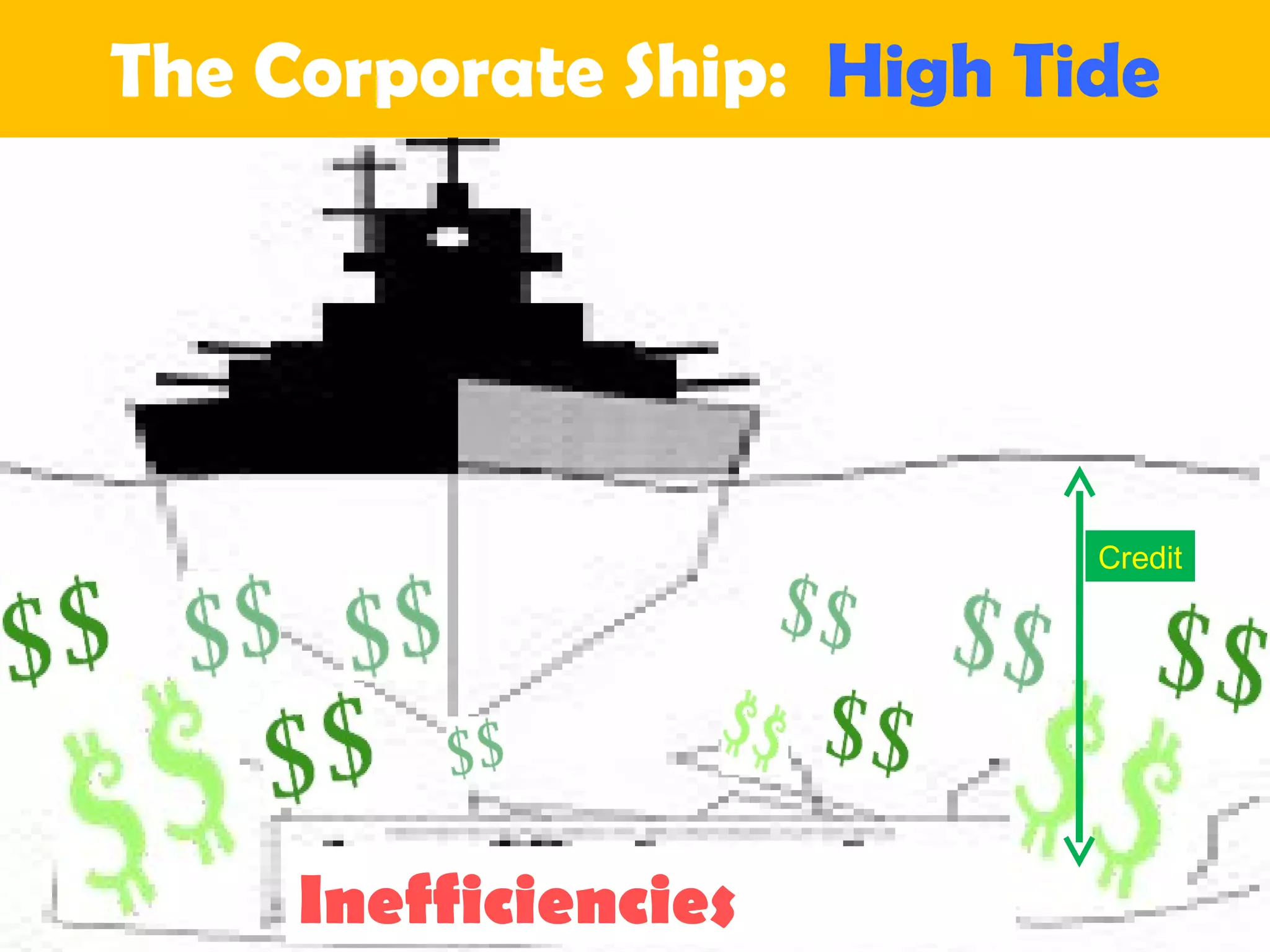
The Corporate Ship:  High Tide Inefficiencies Credit
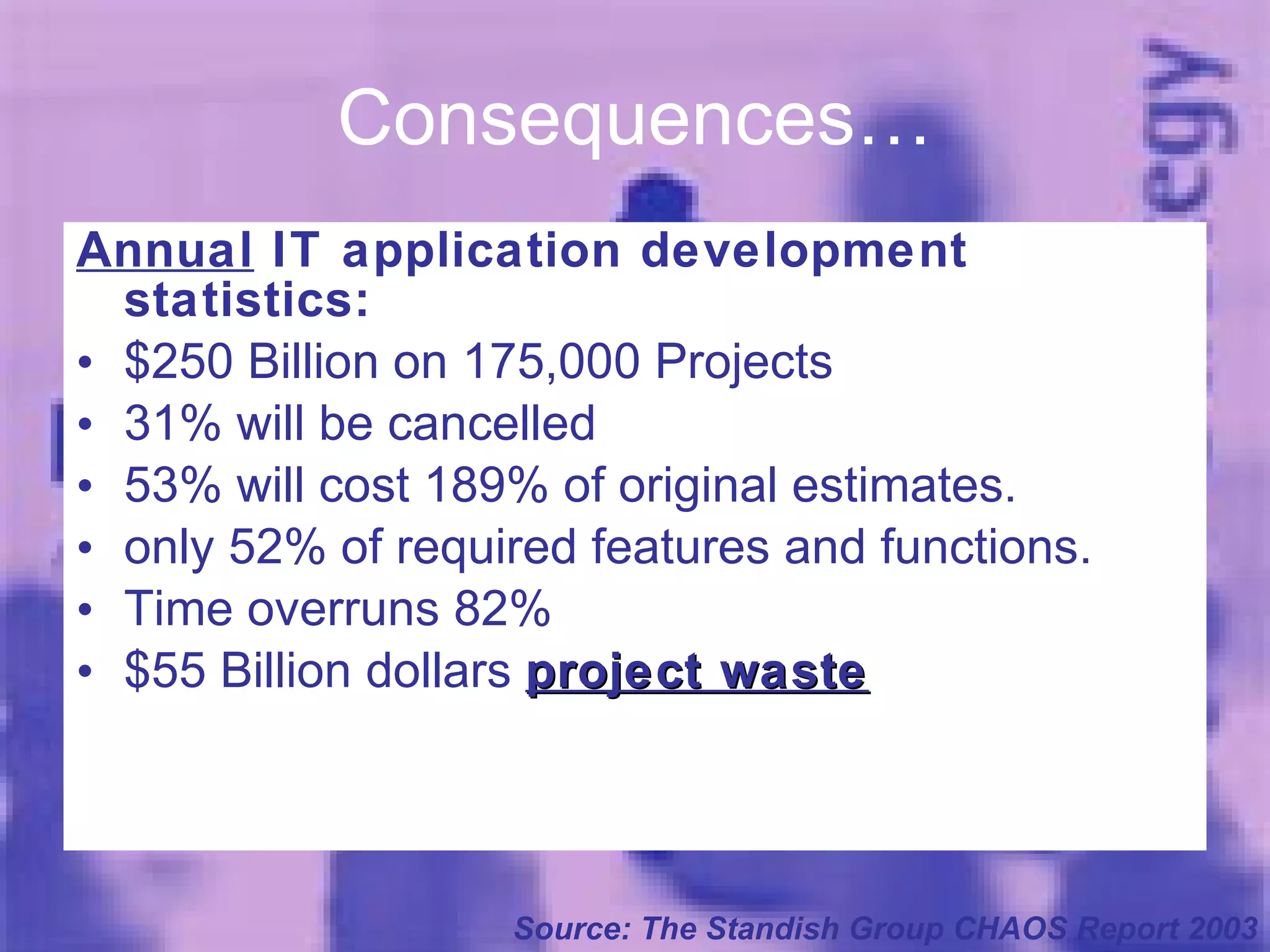
Consequences… Annual  IT application development statistics: $250 Billion on 175,000 Projects 31% will be cancelled 53% will cost 189% of original estimates. only 52% of required features and functions.  Time overruns 82% $55 Billion dollars  project waste Source: The Standish Group CHAOS Report 2003
PMI conducted 5 Global studies: involving 30,000+ practitioners  including C level executives In their business environment: Desired project results were seldom achieved Project evaluation often not linked to business value Despite selection criteria, & processes in place to align projects to strategy, projects  still failed Why Enterprise Analysis?
Why Enterprise Analysis? Significant findings:  75% do not believe their organizations are delivering the projects necessary to achieve organizational strategies!
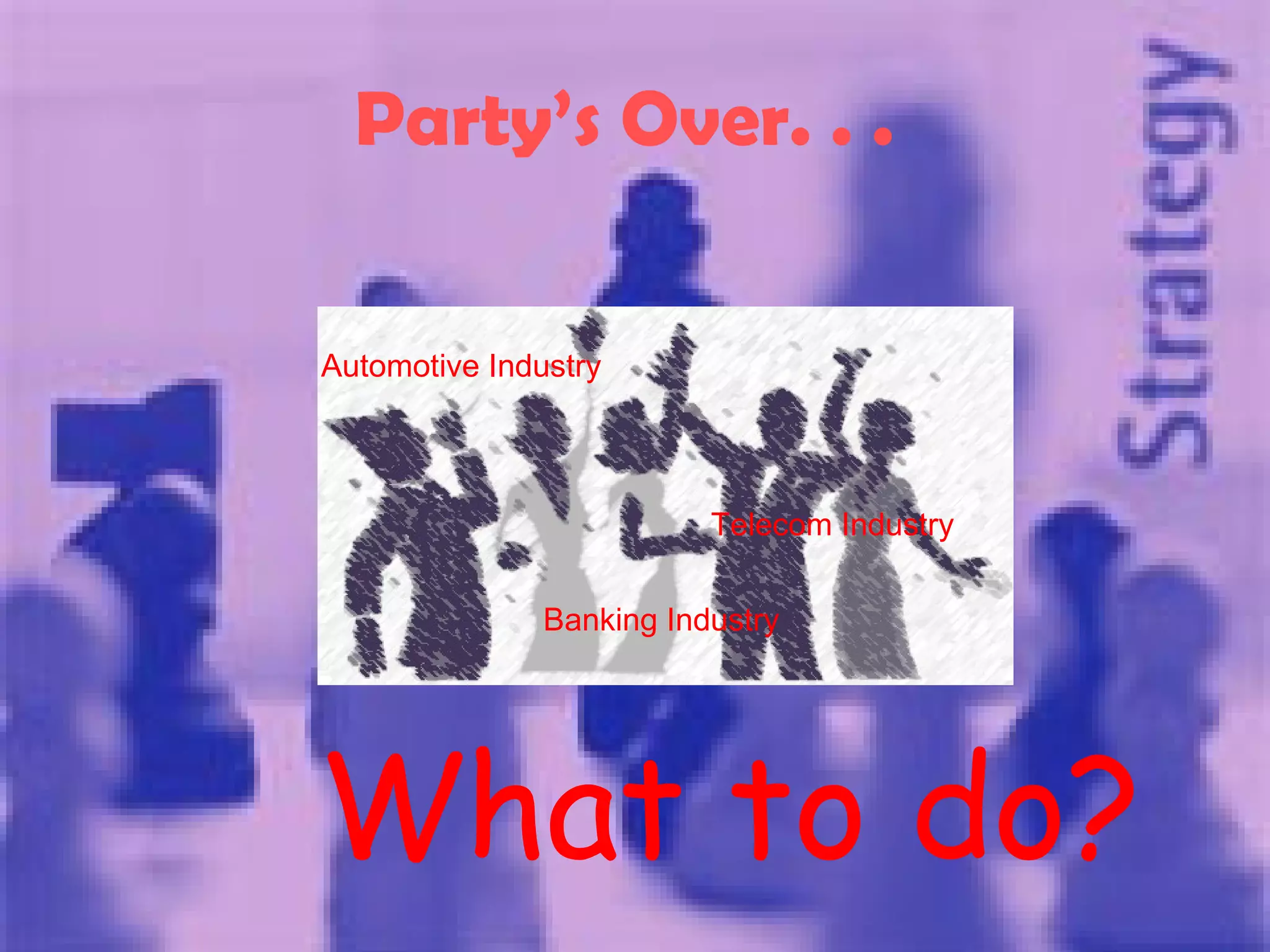
Party’s Over. . .   What to do? Automotive Industry Banking Industry Telecom Industry
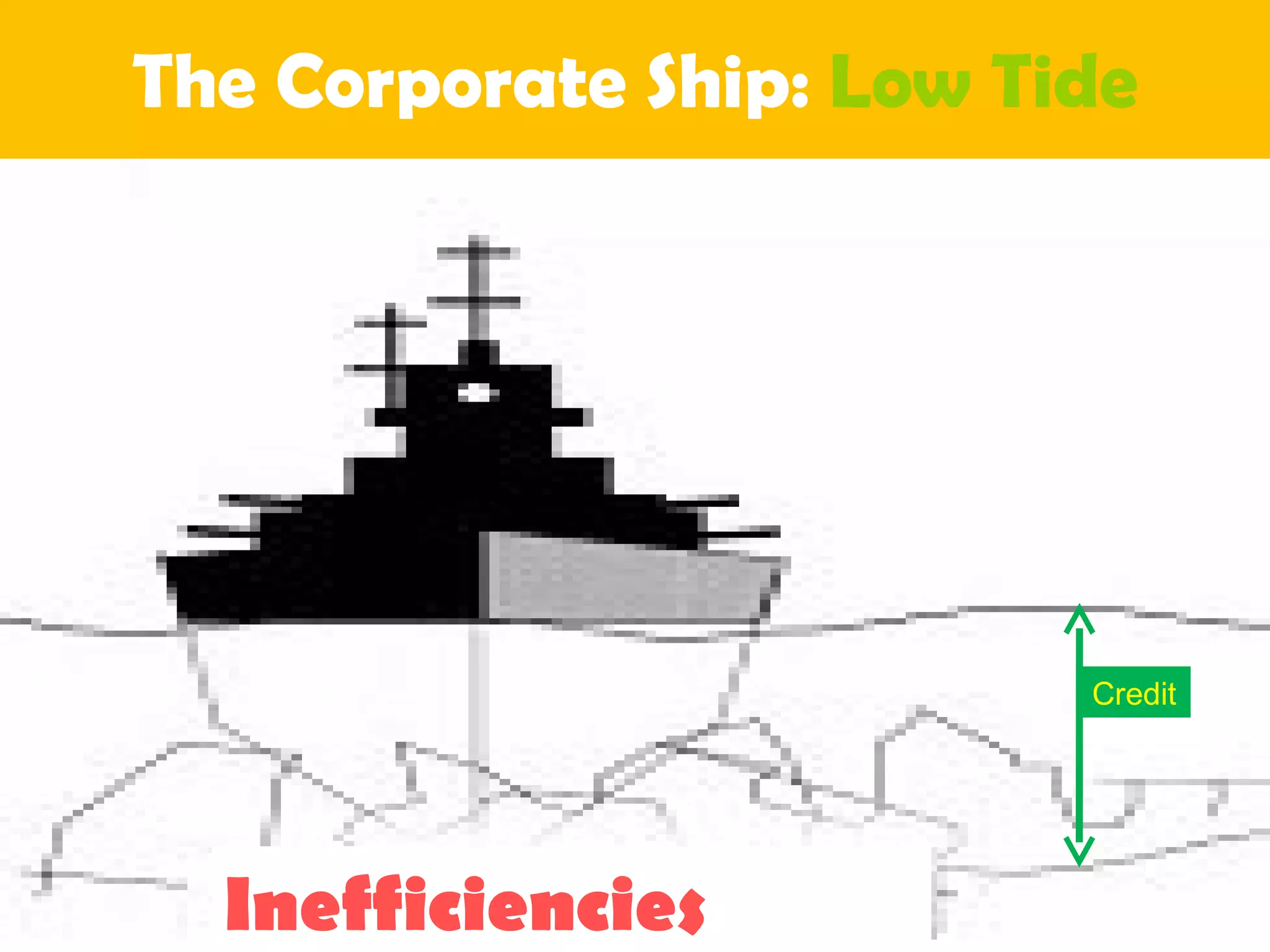
The Corporate Ship:  Low Tide Inefficiencies Credit
 
 
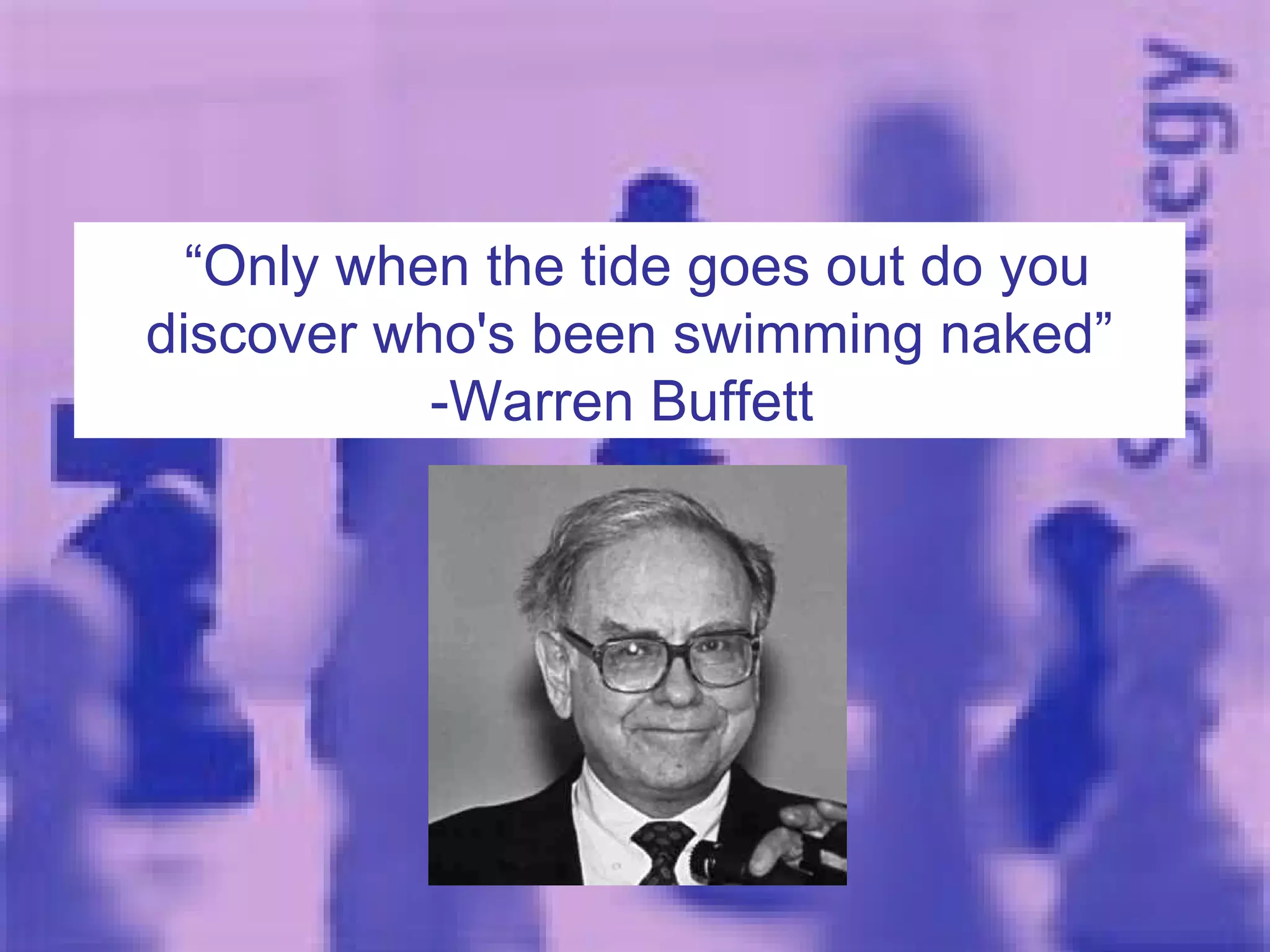
“ Only when the tide goes out do you discover who's been swimming naked” -Warren Buffett
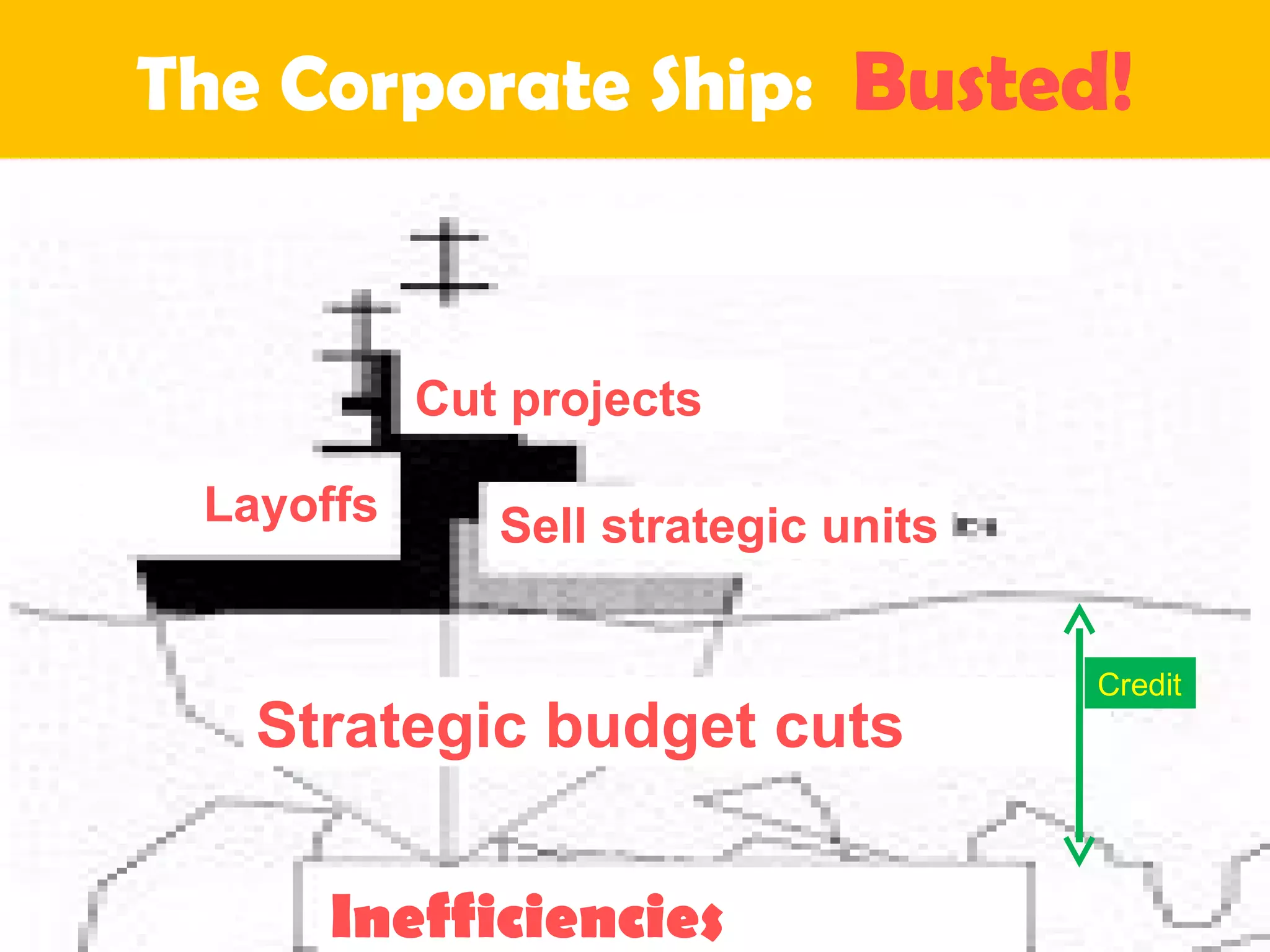
The Corporate Ship:  Busted! Sell strategic units Layoffs Cut projects Strategic budget cuts Inefficiencies Credit
DUMP??? Strategic Projects Core Assets Strategic initiatives (R&D) Vendors Knowledge Capital -Employees OR . . .
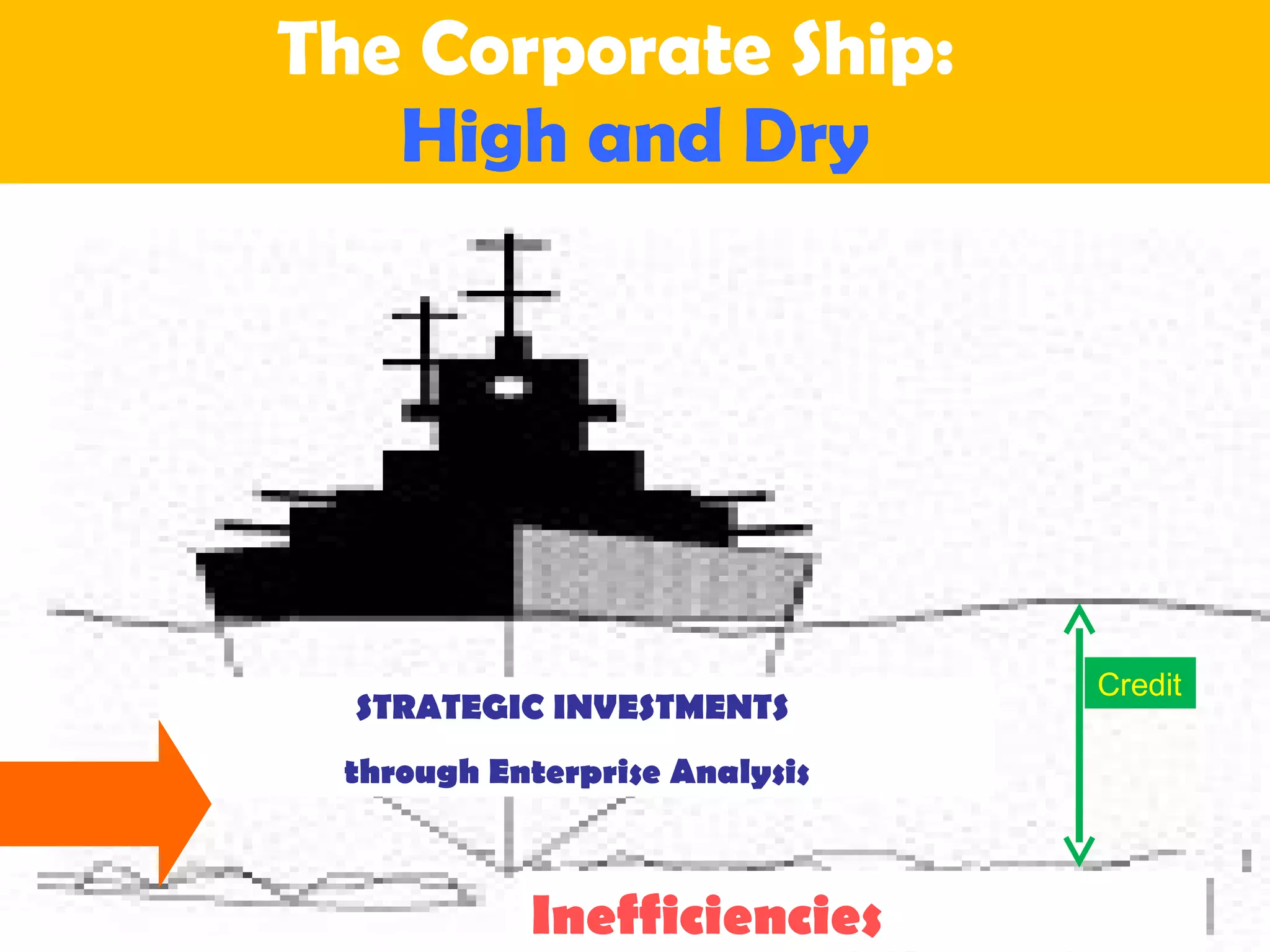
The Corporate Ship:  High and Dry STRATEGIC INVESTMENTS  through Enterprise Analysis Inefficiencies Credit
Enterprise Analysis Defined  - BABOK ®  2.0 Version  The business analysis activities necessary to identify a business need, problem, or opportunity, define the nature of a solution that meets that need, and justify the investment necessary to deliver that solution.  Enterprise analysis outputs provide context to requirements analysis and to solution identification for a given initiative or for long-term planning. Enterprise analysis is often the starting point for initiating a new project… -A Guide to the Business Analysis Body of Knowledge® (BABOK® Guide)Version 2.0
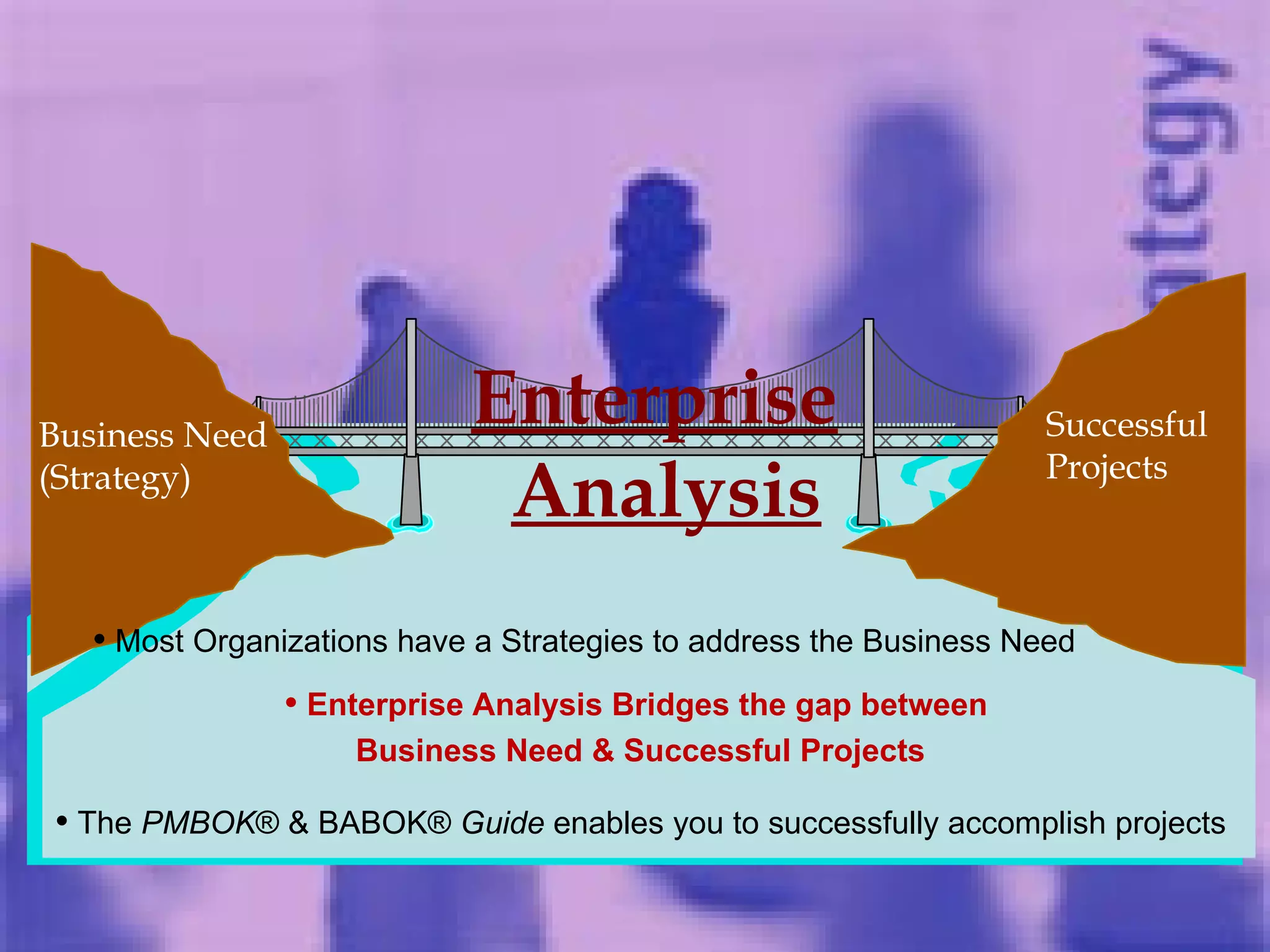
Business Need (Strategy) Successful  Projects Enterprise Analysis Most Organizations have a Strategies to address the Business Need Enterprise Analysis Bridges the gap between  Business Need & Successful Projects The  PMBOK ® & BABOK®  Guide  enables you to successfully accomplish projects
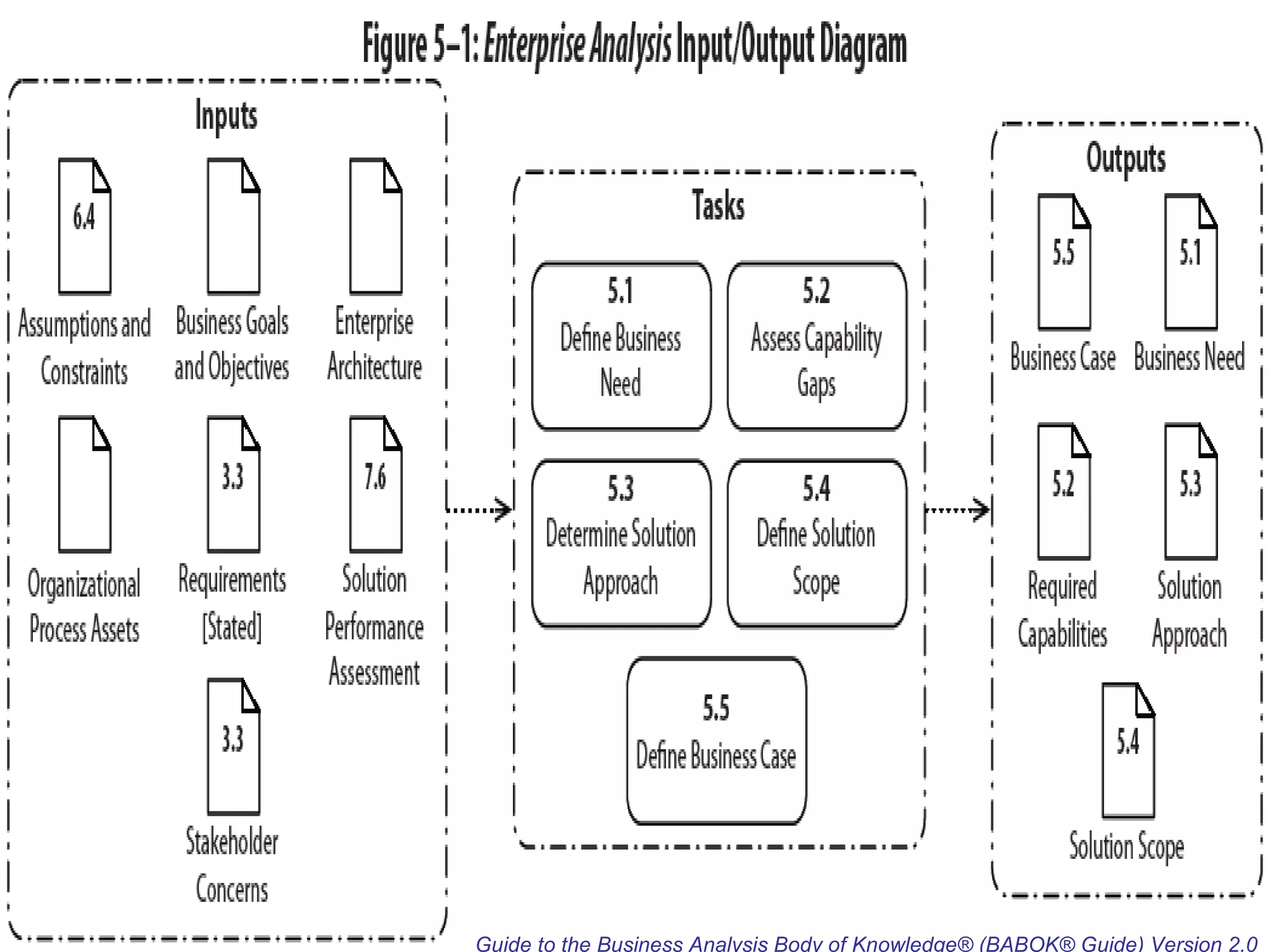
Enterprise Analysis  - Activities 5.1 Define Business Need 5.2 Assess Capability Gaps 5.3 Determine Solution Approach 5.4 Define Solution Scope 5.5 Define Business Case
“ How would you like to. . .   see your organization weather the recession in excellent financial health . . .” with increased sales . . .” an improved competitive  position  . . .” and enhanced employee loyalty?” How would you like to see costs for business system projects drop by over 70%?
It’s not a dream! It’s a  CHOICE  through Enterprise Analysis
Examples from   “Real Life”
Dedicated to Father of Knowledge Management  (Robert (Bob) H. Buckman) “ Communications is human nature; Knowledge sharing is human nurture!”*
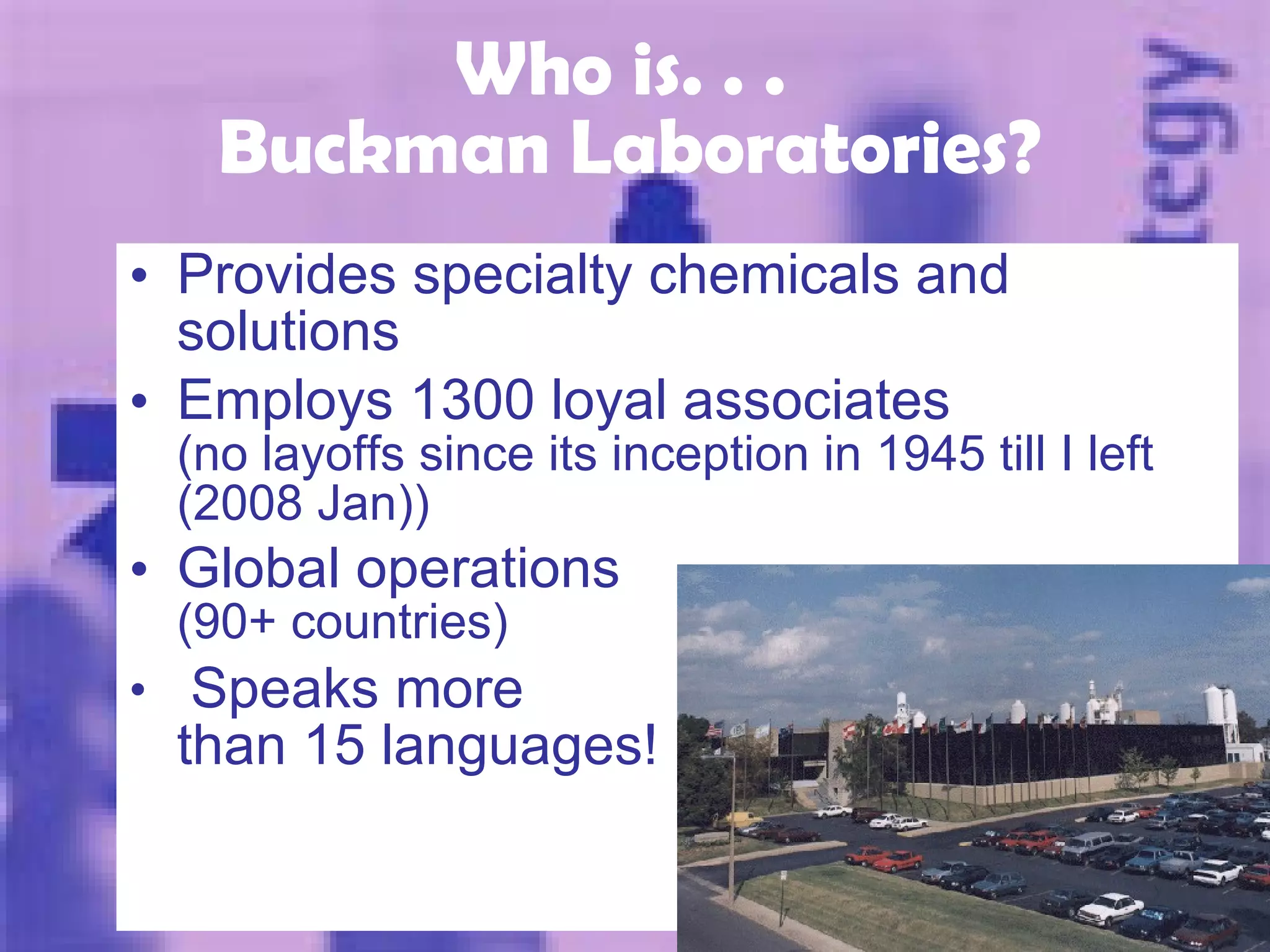
Who is. . .  Buckman Laboratories? Provides specialty chemicals and solutions  Employs 1300 loyal associates (no layoffs since its inception in 1945 till I left (2008 Jan))  Global operations (90+ countries) Speaks more than 15 languages!
5.1 Business Need  - Clouds in the horizon Recession in 2002 Paper Industry Consolidation Commoditization of Specialty Chemicals Raw Material Price hikes Transportation Costs hikes Global Competition Regulatory Requirements Inability to meet the existing Business System Platforms
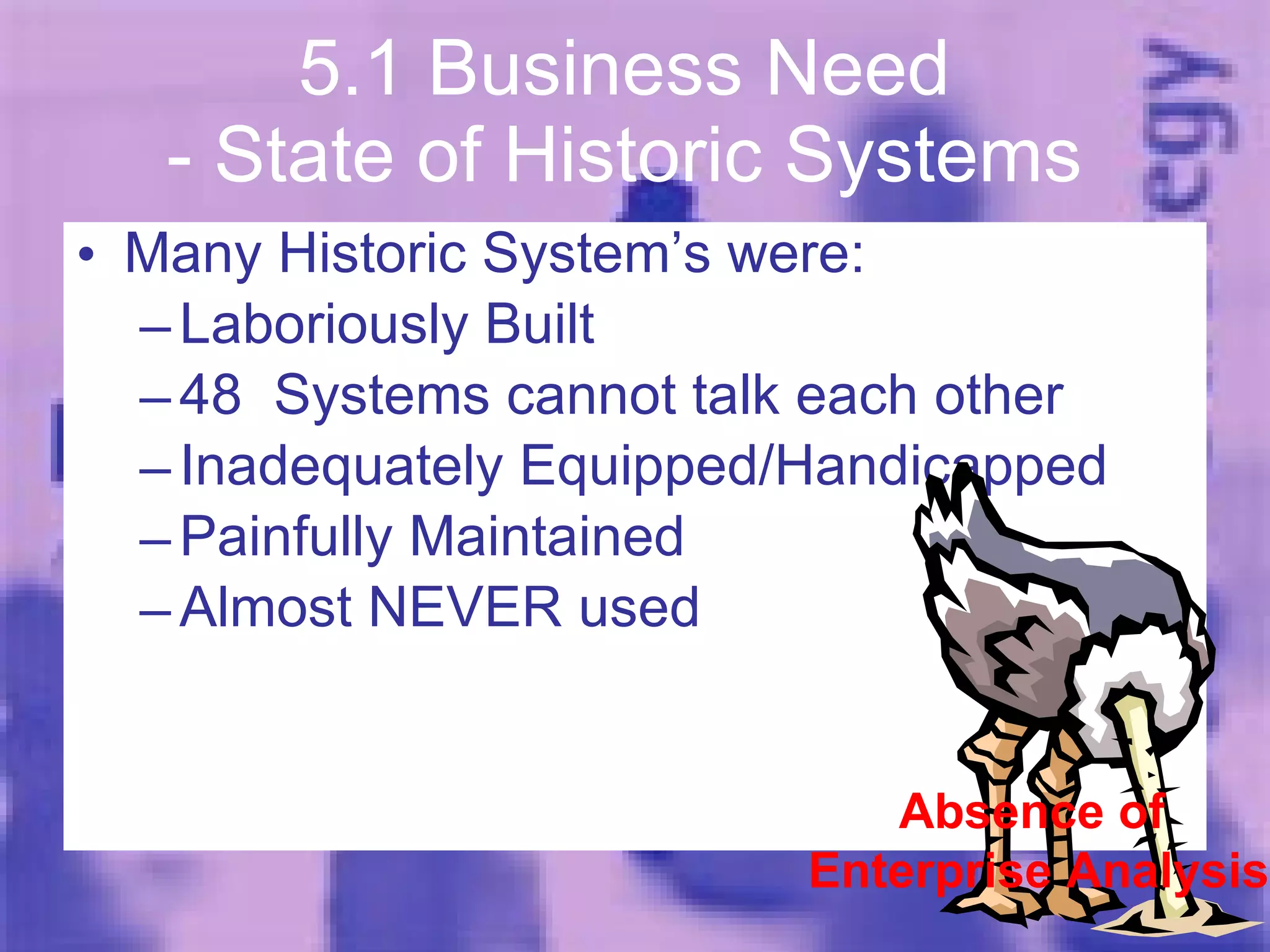
5.1 Business Need  - State of Historic Systems  Many Historic System’s were: Laboriously Built 48  Systems cannot talk each other Inadequately Equipped/Handicapped Painfully Maintained Almost NEVER used Absence of  Enterprise Analysis
5.1 Business Need  -  Historic  Business System: Run by a group of feudal Autonomous Managers. Each Organization sets its own objectives and business processes, using its own System. RESULT: Fragmented data, lack of visibility, impossible to co-ordinate Organization as a whole.
5.1 Define the Business Need   “Global Enterprise Point” ORP = Organization-wide Re-engineered Process & BS Project Portfolio Management : One Flexible Global Business System One Global Core Knowledge Project Team One Global Infrastructure Project Portfolio Management & Outsourcing non-core Business Processes.
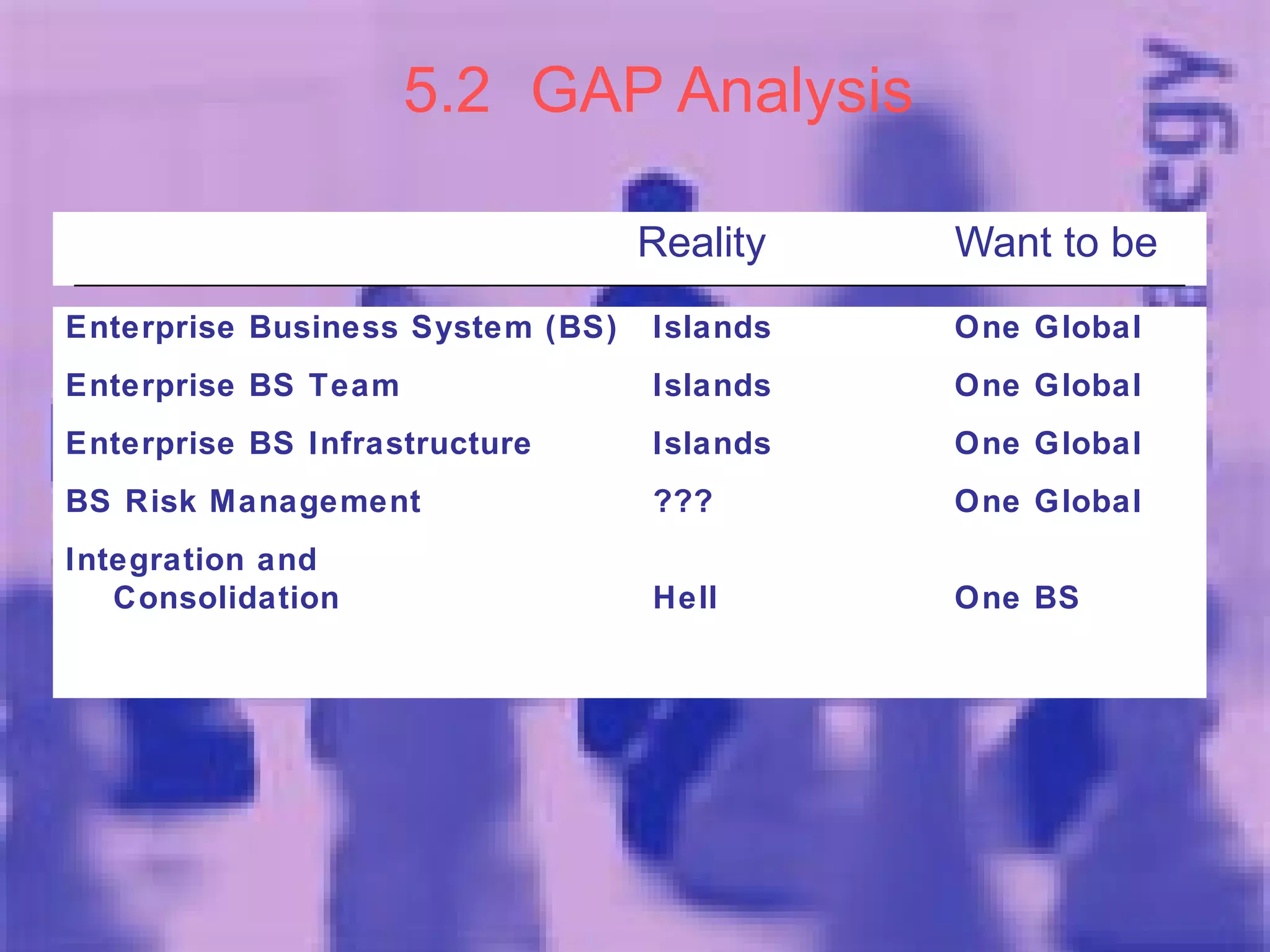
5.2  GAP Analysis Reality Want to be Enterprise Business System (BS) Islands One Global Enterprise BS Team Islands One Global Enterprise BS Infrastructure Islands One Global BS Risk Management ??? One Global Integration and Consolidation Hell One BS
5.3 Solution Approach Global Business System One Business System for one organization! Global Buckman BS Model through ERP – BaaN In Sixteen nations around the globe Global Consolidation & Business Performance Reporting (Hyperion)
5.3 Solution Approach  Global   Core Knowledge Enterprise Team Based in Memphis Supports the worldwide Buckman organization.  Responsible for: developing a Global Enterprise Business Model implementation,  support and optimization
5.3 Solution Approach  Global Enterprise Infrastructure Business System server based in Memphis & take the advantage of Time Zone differences by sharing:  Concurrent Licenses Support Infrastructure Specialized Professionals.
5.3 Solution Approach  -  Risk Management World Class  Business Continuation plan rollout -developed even before 9/11. In case of Disaster, all IT operations will shift to Philadelphia.
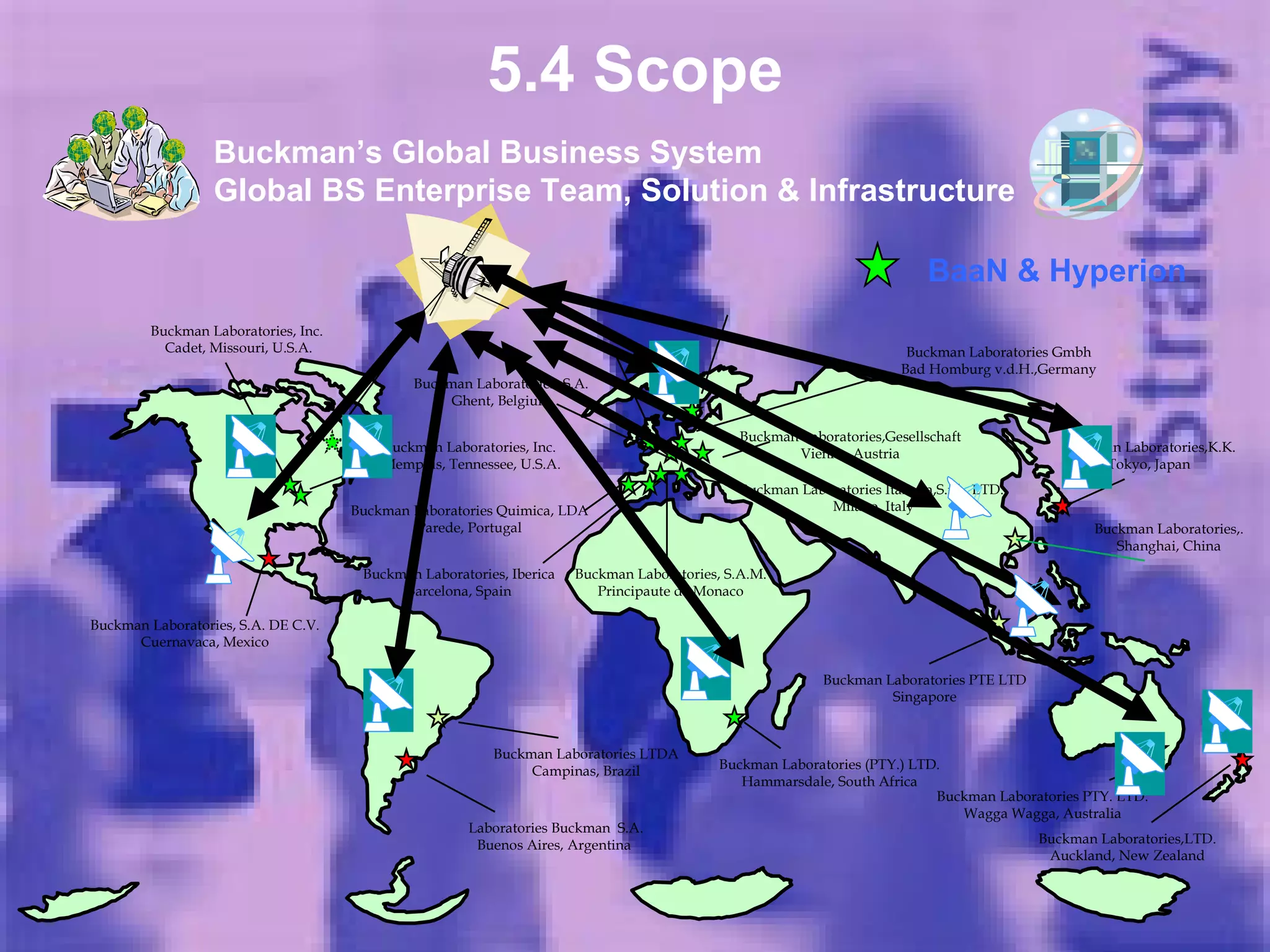
Buckman’s Global Business System  Global BS Enterprise Team, Solution & Infrastructure Buckman Laboratories, Inc. Memphis, Tennessee, U.S.A. Buckman Laboratories, Inc. Cadet, Missouri, U.S.A. Buckman Laboratories, S.A. DE C.V. Cuernavaca, Mexico Buckman Laboratories LTDA Campinas, Brazil Laboratories Buckman  S.A. Buenos Aires, Argentina Buckman Laboratories (PTY.) LTD. Hammarsdale, South Africa Buckman Laboratories PTE LTD Singapore Buckman Laboratories,K.K. Tokyo, Japan Buckman Laboratories PTY. LTD. Wagga Wagga, Australia Buckman Laboratories,LTD. Auckland, New Zealand Buckman Laboratories Italiana,S.r.l., LTD. Milano, Italy Buckman Laboratories Quimica, LDA Parede, Portugal Buckman Laboratories, S.A.M. Principaute de Monaco Buckman Laboratories, Iberica Barcelona, Spain Buckman Laboratories, S.A. Ghent, Belgium Buckman Laboratories,Gesellschaft Vienna, Austria Buckman Laboratories Gmbh Bad Homburg v.d.H.,Germany BaaN & Hyperion Buckman Laboratories,. Shanghai, China 5.4 Scope
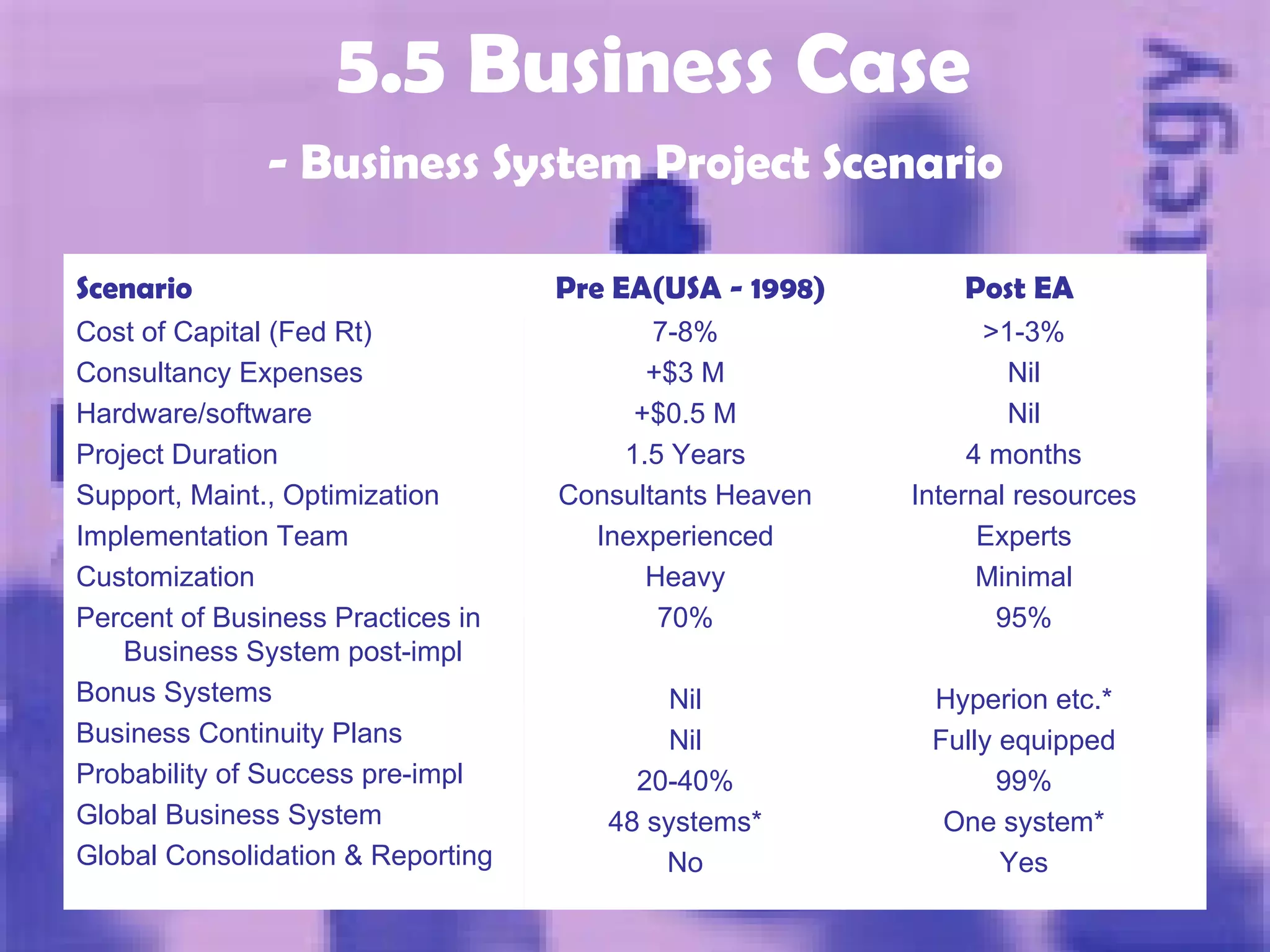
- Business System Project Scenario 5.5 Business Case Scenario   Pre EA(USA - 1998)  Post EA Cost of Capital (Fed Rt) Consultancy Expenses Hardware/software Project Duration Support, Maint., Optimization Implementation Team Customization Percent of Business Practices in Business System post-impl Bonus Systems Business Continuity Plans Probability of Success pre-impl Global Business System Global Consolidation & Reporting 7-8% +$3 M +$0.5 M 1.5 Years Consultants Heaven Inexperienced Heavy 70% Nil Nil 20-40% 48 systems* No >1-3% Nil Nil 4 months Internal resources Experts Minimal 95% Hyperion etc.* Fully equipped 99% One system* Yes
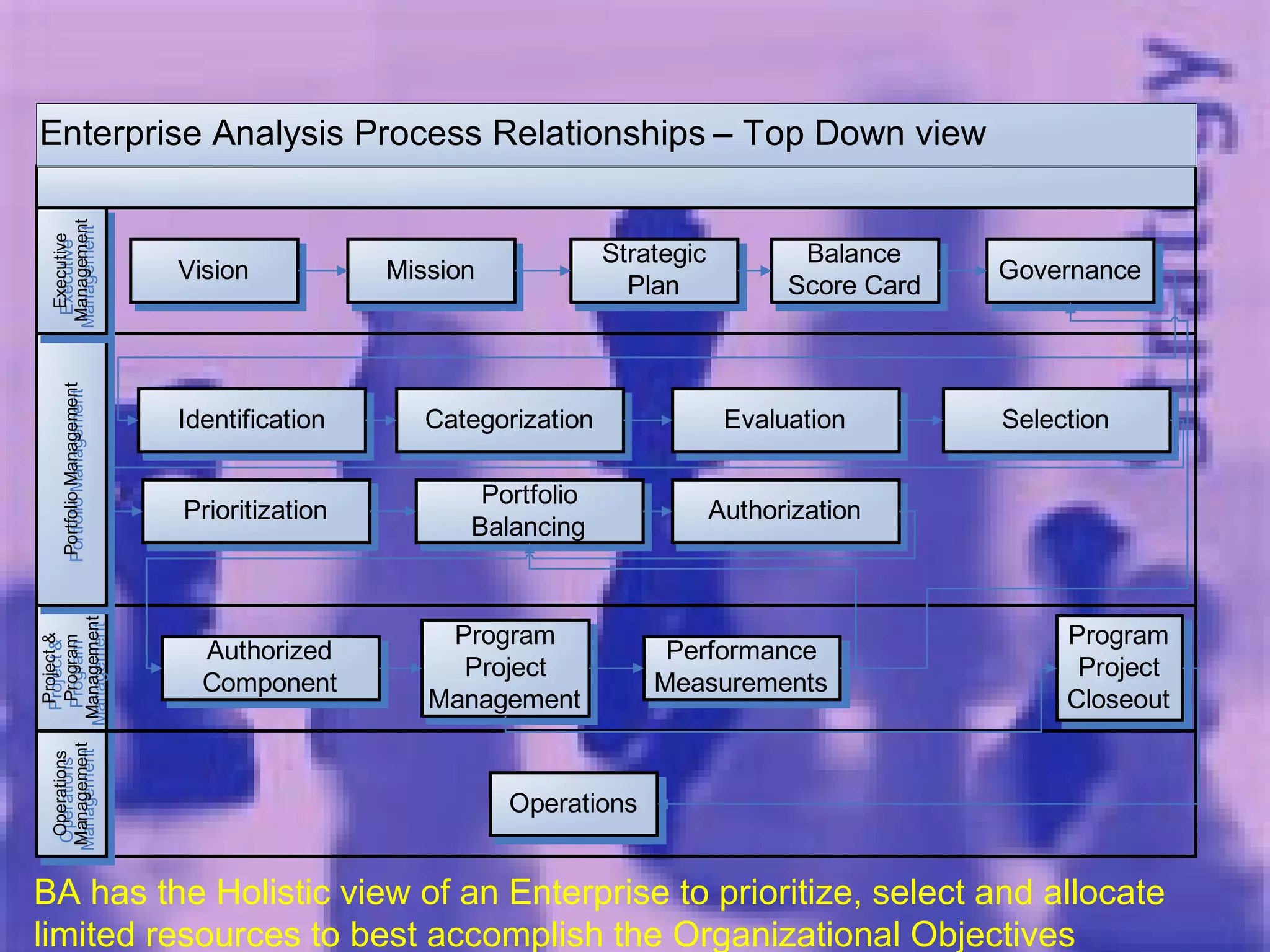
BA has the Holistic view of an Enterprise to prioritize, select and allocate  limited resources to best accomplish the Organizational Objectives
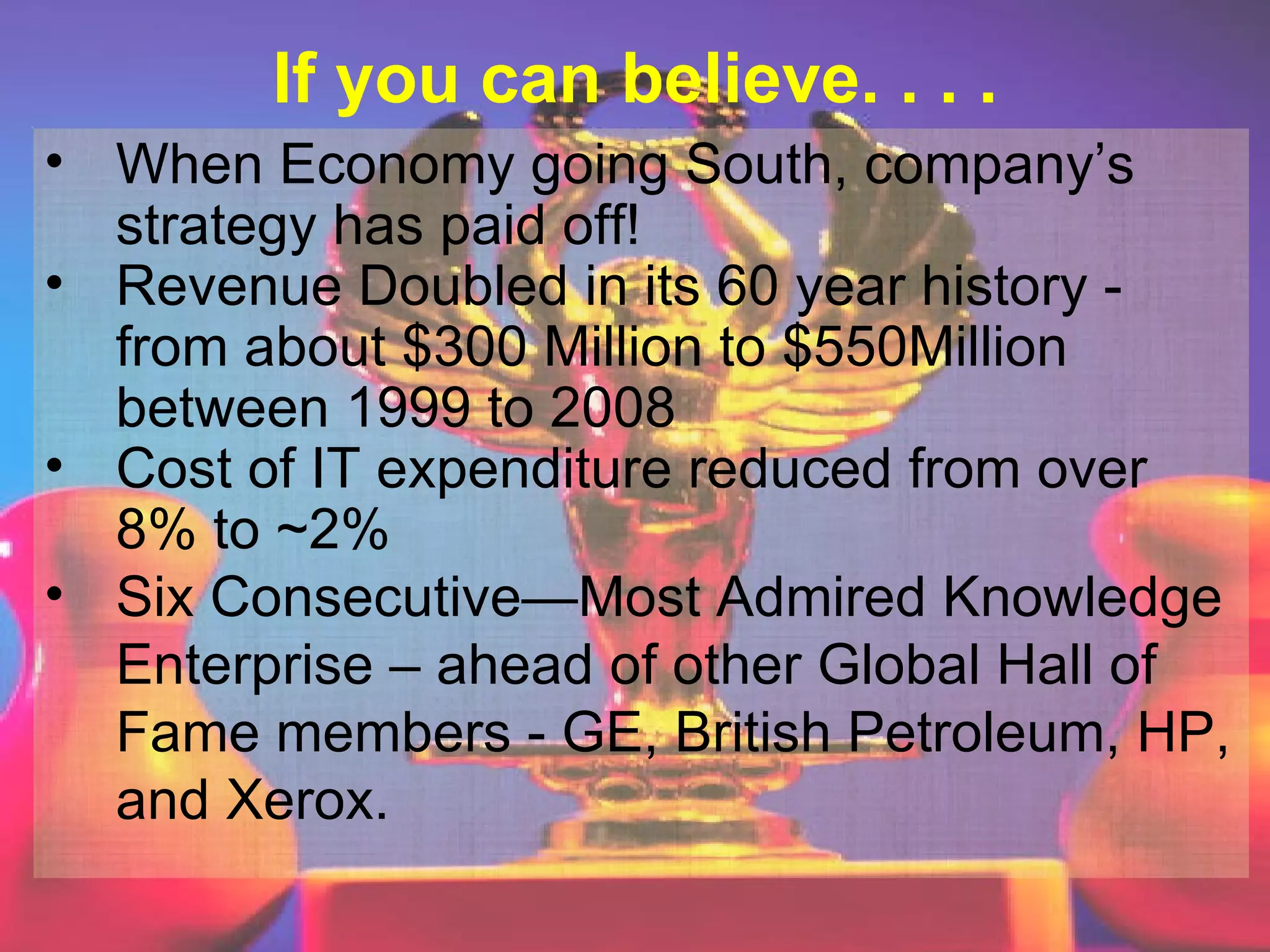
If you can believe. . . . When Economy going South, company’s strategy has paid off! Revenue Doubled in its 60 year history - from about $300 Million to $550Million between 1999 to 2008 Cost of IT expenditure reduced from over 8% to ~2% Six Consecutive—Most Admired Knowledge Enterprise – ahead of other Global Hall of Fame members - GE, British Petroleum, HP, and Xerox.
Any Questions?  Carrot and sticks or Tomato’s to : Saji Madapat [email_address]
Saji K. Madapat CPIM, CIPPM, PMP, CSSMBB http://www.linkedin.com/in/goodtogreat  -  [email_address]   Mobile: 001-214-454-7254 Saji made significant contribution to PMI’s various strategic initiatives including global standard Books on Portfolio & Program Management Standards, OPM3, PMBOK® Guide and PMCD Framework. As an Advisor- Portfolio Management Office, Saji played an instrumental role in setting up Portfolio Management office by mapping organization strategies and balance score card of $5B FedEx Freight corporation to its IT & Non IT projects & programs throughout the organization. Saji was featured in Gartner Global PPM Summit 2008 as an executive BOD room member and published & presented over 30 papers globally including on PPM and OPM3. Saji had the project portfolio responsibility for Global Business Systems (ERP&BI) in 20 countries in North & South America, Europe, Africa and Asia Pacific of Buckman (a globally Most Admired Knowledge Enterprise -6 time MAKE award winner). Saji also associated with Bearing Point (KPMG), Ernst & Young (Cap Gemini), Arthur Anderson, BaaN (Vanenburg) Business System and CroweChizek on various strategic projects. Saji’s experience includes Project Feasibility Studies, Appraisals, Industry & Company Analysis and Strategic Financial Planning.  Saji has a  Masters from PMI’s Leadership Institute. He served as a PMI Component Mentor in PMI’s most crucial region (Asia) and prior to that three terms as VP, Finance PMI Memphis TN Chapter. He also served as a Judge of PMI's 2004, 2005 & 2007 Project of the Year (POY). Saji is currently serving his 2nd term in PMI Code of Ethics Implementation Advisory Committee (CIAC) - a committee of the PMI global Board, advising on Ethics strategies.
PARKING LOT
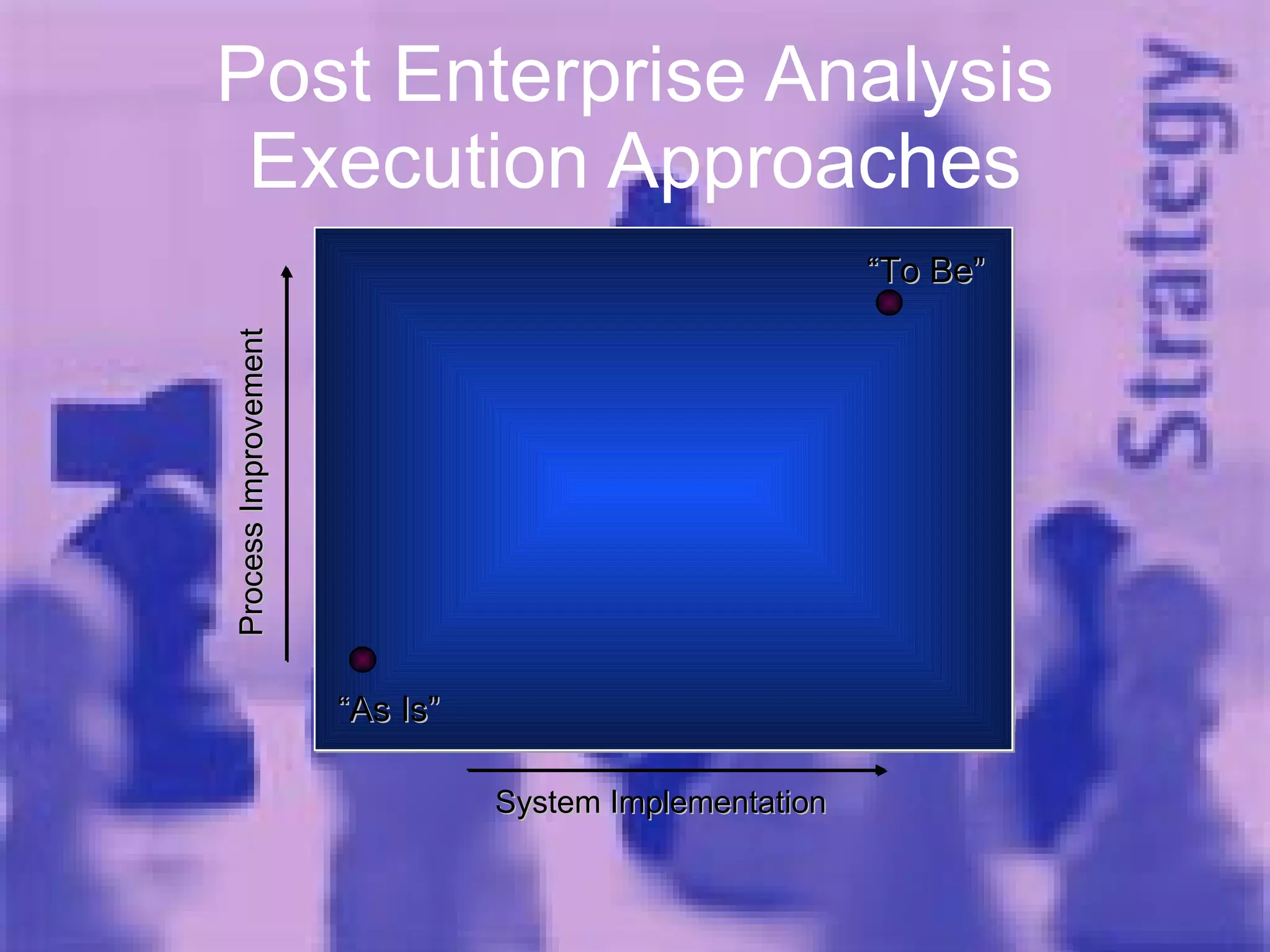
Post Enterprise Analysis Execution Approaches Process Improvement System Implementation “ To Be” “ As Is”
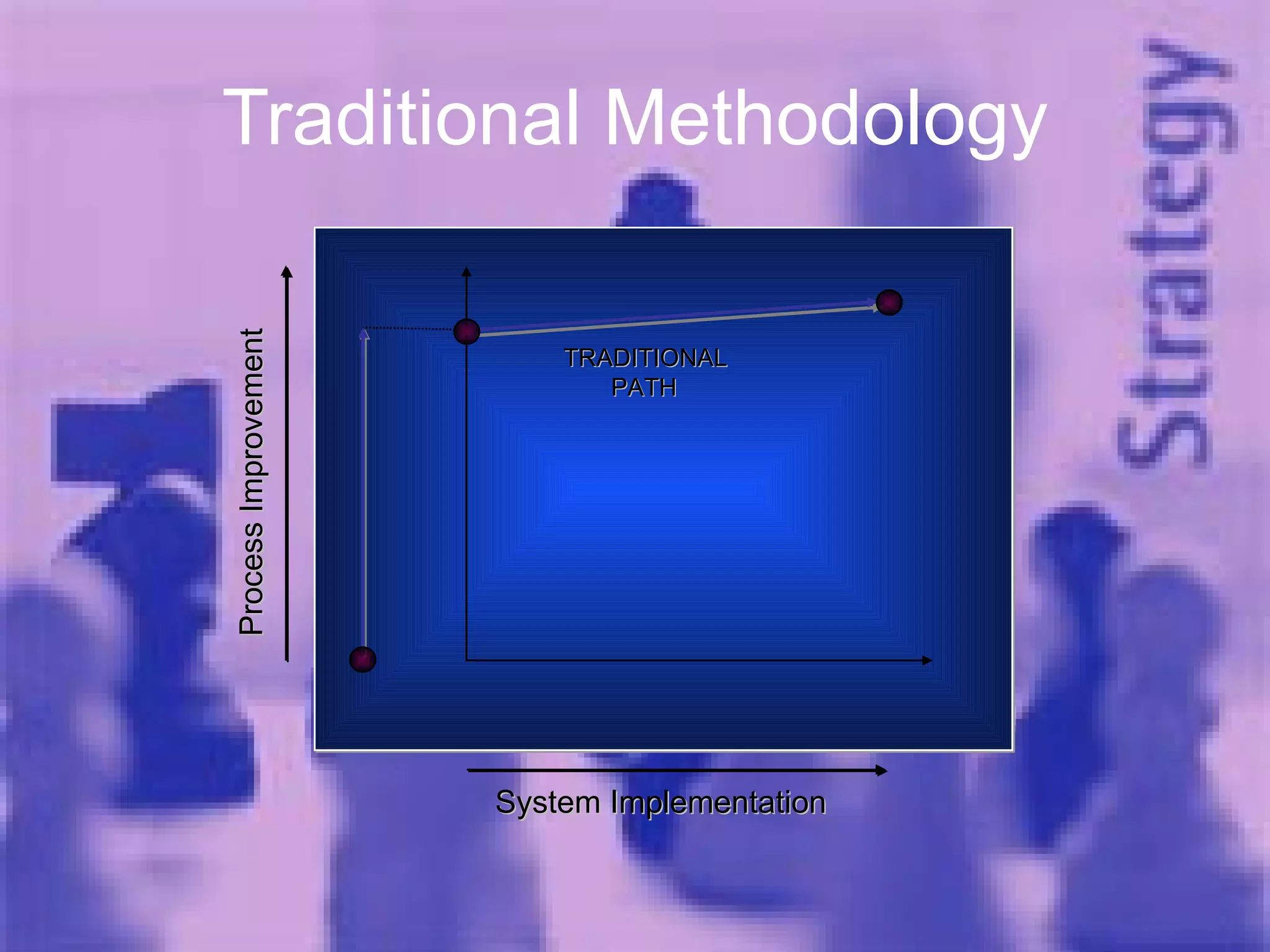
Traditional Methodology Process Improvement System Implementation TRADITIONAL  PATH
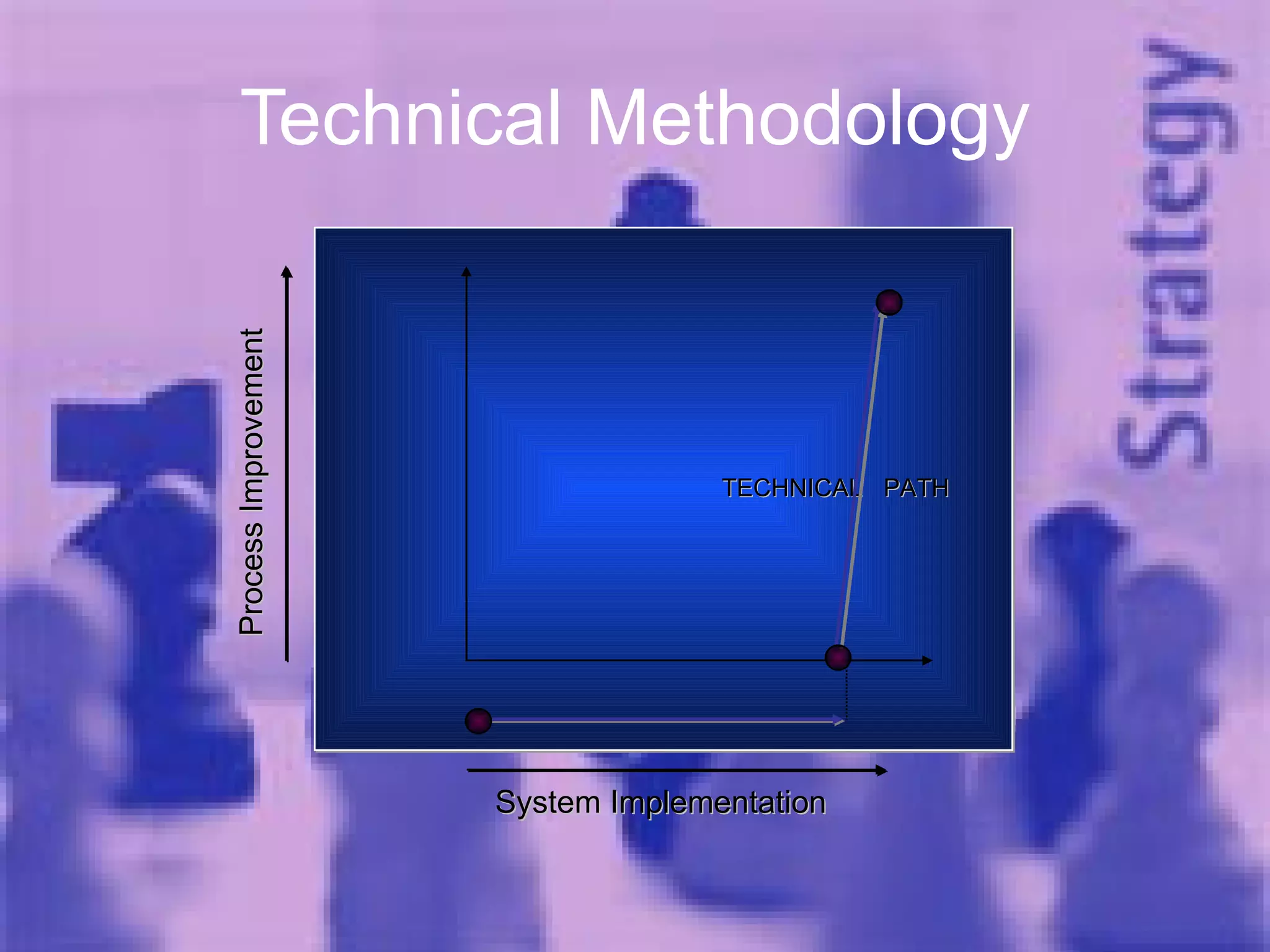
Technical Methodology Process Improvement System Implementation TECHNICAL  PATH
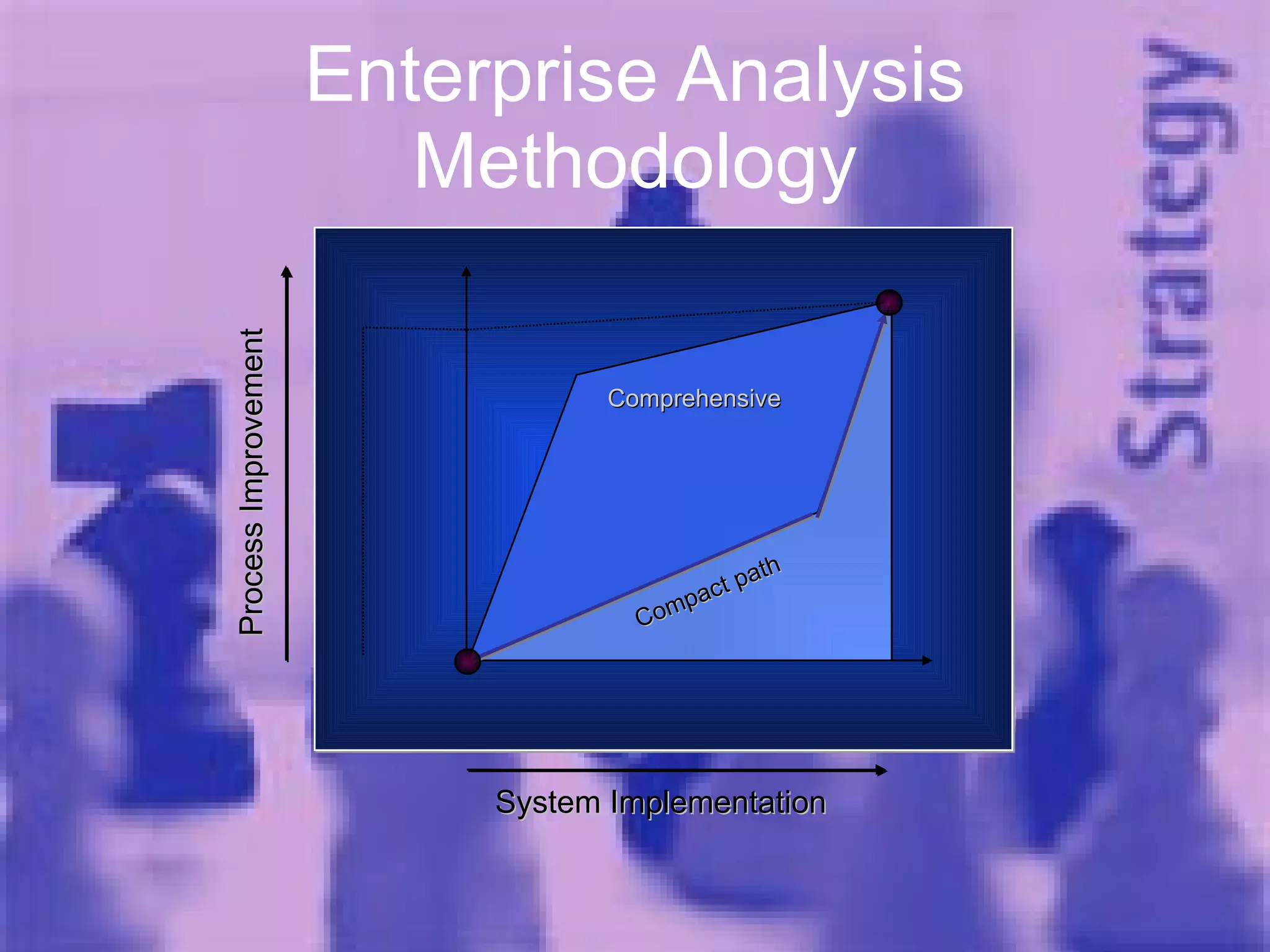
Enterprise Analysis Methodology Compact path Process Improvement System Implementation Comprehensive
Guide to the Business Analysis Body of Knowledge® (BABOK® Guide) Version 2.0
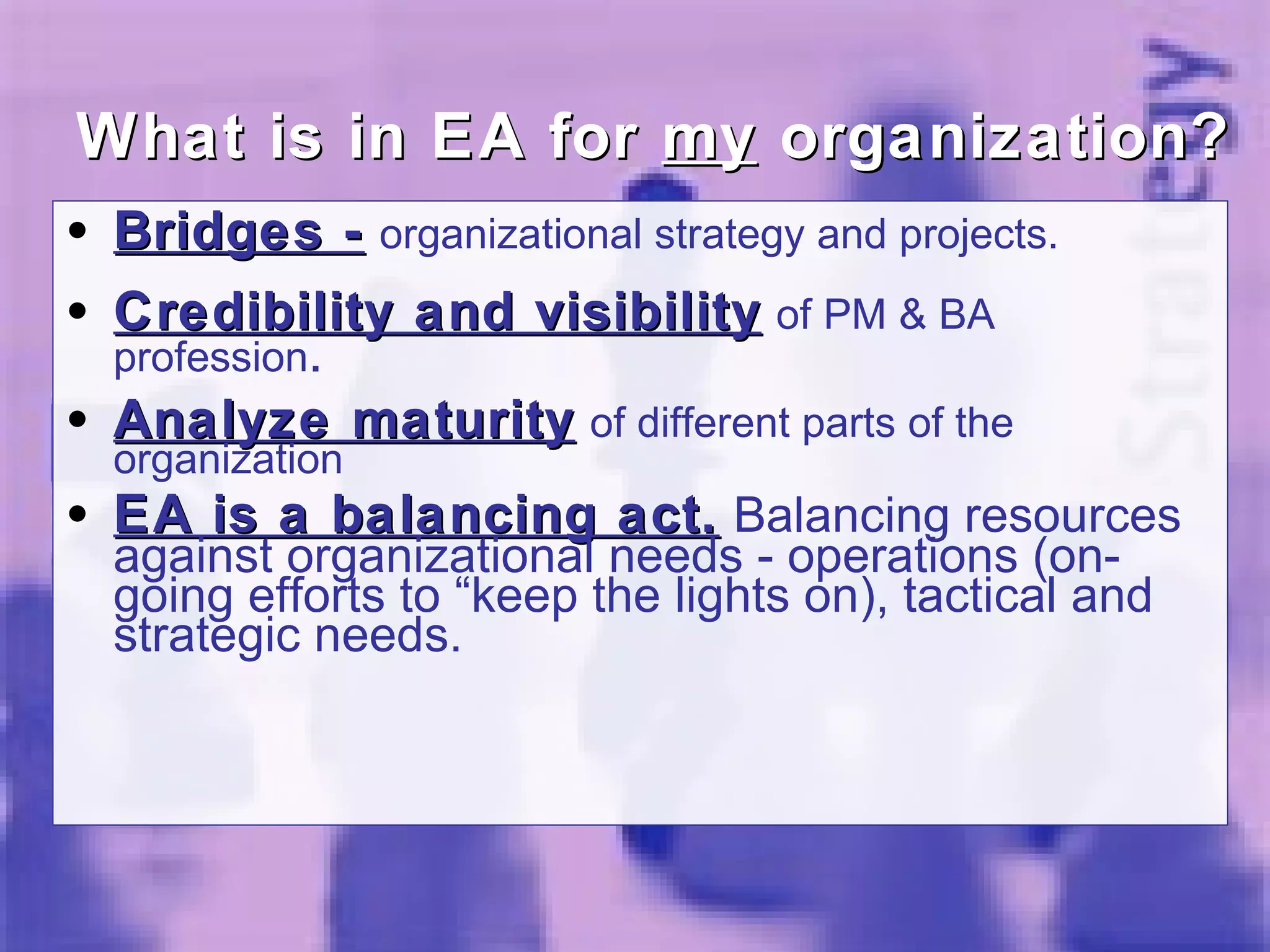
Bridges -   organizational strategy and projects. Credibility and visibility   of PM & BA profession . Analyze maturity   of different parts of the organization EA is a balancing act.  Balancing resources against organizational needs - operations (on-going efforts to “keep the lights on), tactical and strategic needs.  What is in EA for  my  organization?
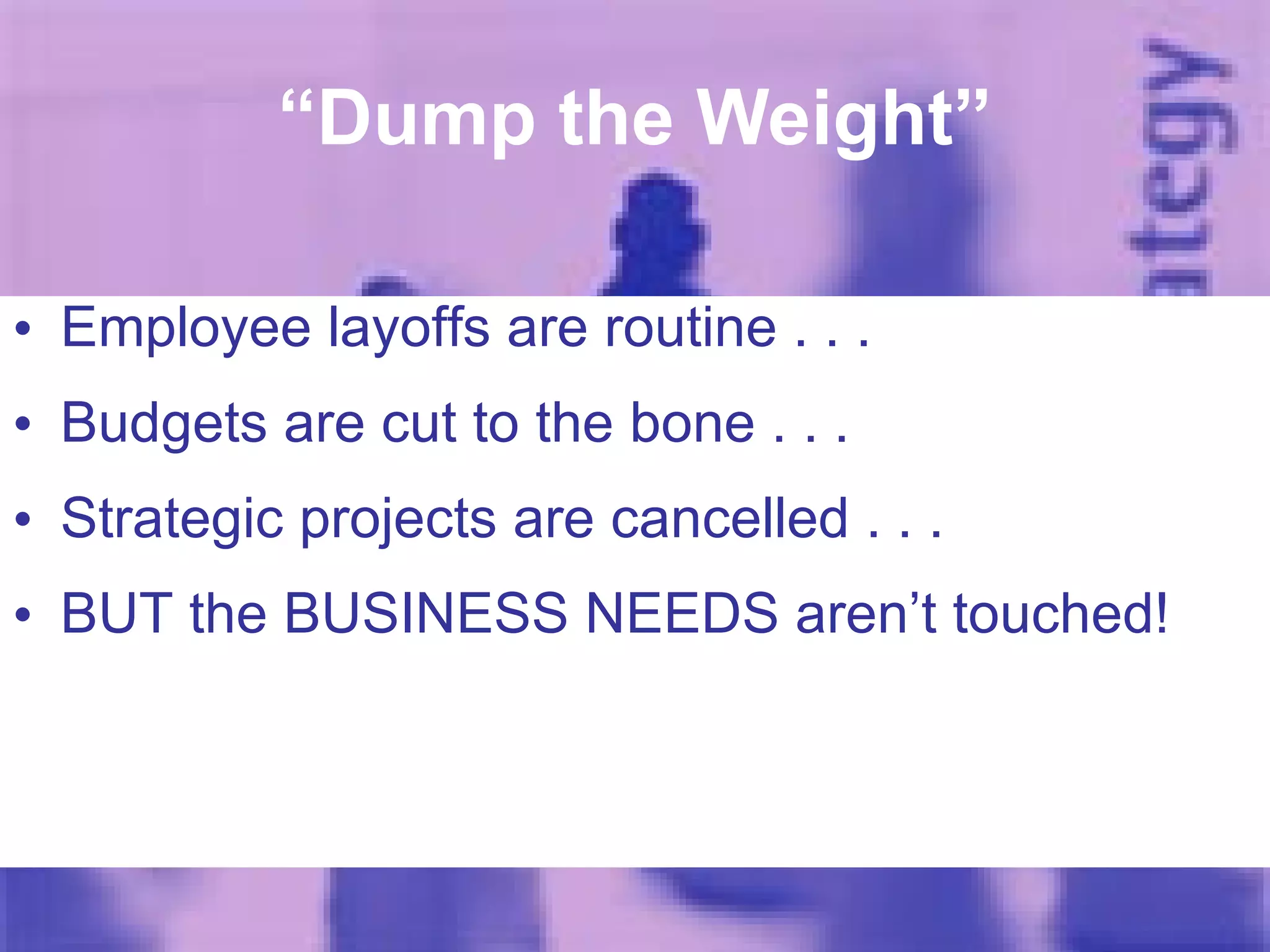
“ Dump the Weight” Employee layoffs are routine . . . Budgets are cut to the bone . . . Strategic projects are cancelled . . . BUT the BUSINESS NEEDS aren’t touched!
Dig More about  GBS & ORP? Please Visit “ The Mystery of Irrational Exuberance to Fast & Furious”  Journal Of Research Findings Of ERP Systems And Enterprise Resource Management , June 2002. “ Excelling in A Recession Driven Economy – Project Portfolio Management and Business System Investment ”: “ Milestone ”, Project Management Institute, Memphis, April 2002 issue .  http://www.pmimemphis.org/files/milestone_0302.pdf " Organization-wide Re-Engineered Process (ORP) -RIP to ERP:  Buckman’s Holistic Approach ,”  Journal Of Research Findings Of ERP Systems And Enterprise Resource Management , June 2001. (Later published on CIBRES.COM as featured paper  http://www.cibres.com/articles/20011001-rip to orp.htm.)  "In the Whirlpool ERP Horror Stories:  The Classic Buckman Success Story ,”  Journal Of Research Findings Of ERP Systems And Enterprise Resource Management , January 2001.  (Later published on CIBRES.COM as featured paper  http://www.cibres.com/articles/20010501 .)

Importance of Enterprise Analysis

  • 1.
    Business Needs (Strategy)Successful Projects Enterprise Analysis Presented by: Saji Madapat, MBA CPIM CSSMBB PMP OPM3 & PPM Team Member June 23, 2009 Greater Memphis Area Chapter of the IIBA Importance of Enterprise Analysis – Focus on Strategic Value in Today’s Economic Tsunami
  • 2.
    Presentation Outline •Irrational Exuberance • Aftermath • Why Enterprise Analysis? • Enterprise Analysis Defined - BABOK® 2.0 • Examples from “Real Life” – Case Study on Buckman Laboratories International Inc. • Q & A PARKING LOT: Enterprise Analysis Execution Approaches • What is in Enterprise Analysis for my organization?
  • 3.
    SHORT walk inthe Memory lane Business in Past Century – DOW Jones Eyes
  • 4.
    “ En”visioning Tomorrow“ The corporation as we know it, which is now 120 years old, Is not likely to Survive the next 25 years. Legally & Financially, Yes, But not Structurally & Economically.” -Peter Drucker, Business 2.0, August 2002
  • 5.
    Immediate Past -“IrrationalExuberance” In the era of economic boom: Exciting new investments and acquisitions! BIG PERKS! “ Creative Accounting” (book cooking)
  • 6.
    The Corporate Ship: High Tide Inefficiencies Credit
  • 7.
    Consequences… Annual IT application development statistics: $250 Billion on 175,000 Projects 31% will be cancelled 53% will cost 189% of original estimates. only 52% of required features and functions. Time overruns 82% $55 Billion dollars project waste Source: The Standish Group CHAOS Report 2003
  • 8.
    PMI conducted 5Global studies: involving 30,000+ practitioners including C level executives In their business environment: Desired project results were seldom achieved Project evaluation often not linked to business value Despite selection criteria, & processes in place to align projects to strategy, projects still failed Why Enterprise Analysis?
  • 9.
    Why Enterprise Analysis?Significant findings: 75% do not believe their organizations are delivering the projects necessary to achieve organizational strategies!
  • 10.
    Party’s Over. .. What to do? Automotive Industry Banking Industry Telecom Industry
  • 11.
    The Corporate Ship: Low Tide Inefficiencies Credit
  • 12.
  • 13.
  • 14.
    “ Only whenthe tide goes out do you discover who's been swimming naked” -Warren Buffett
  • 15.
    The Corporate Ship: Busted! Sell strategic units Layoffs Cut projects Strategic budget cuts Inefficiencies Credit
  • 16.
    DUMP??? Strategic ProjectsCore Assets Strategic initiatives (R&D) Vendors Knowledge Capital -Employees OR . . .
  • 17.
    The Corporate Ship: High and Dry STRATEGIC INVESTMENTS through Enterprise Analysis Inefficiencies Credit
  • 18.
    Enterprise Analysis Defined - BABOK ® 2.0 Version The business analysis activities necessary to identify a business need, problem, or opportunity, define the nature of a solution that meets that need, and justify the investment necessary to deliver that solution. Enterprise analysis outputs provide context to requirements analysis and to solution identification for a given initiative or for long-term planning. Enterprise analysis is often the starting point for initiating a new project… -A Guide to the Business Analysis Body of Knowledge® (BABOK® Guide)Version 2.0
  • 19.
    Business Need (Strategy)Successful Projects Enterprise Analysis Most Organizations have a Strategies to address the Business Need Enterprise Analysis Bridges the gap between Business Need & Successful Projects The PMBOK ® & BABOK® Guide enables you to successfully accomplish projects
  • 20.
    Enterprise Analysis - Activities 5.1 Define Business Need 5.2 Assess Capability Gaps 5.3 Determine Solution Approach 5.4 Define Solution Scope 5.5 Define Business Case
  • 21.
    “ How wouldyou like to. . . see your organization weather the recession in excellent financial health . . .” with increased sales . . .” an improved competitive position . . .” and enhanced employee loyalty?” How would you like to see costs for business system projects drop by over 70%?
  • 22.
    It’s not adream! It’s a CHOICE through Enterprise Analysis
  • 23.
    Examples from “Real Life”
  • 24.
    Dedicated to Fatherof Knowledge Management (Robert (Bob) H. Buckman) “ Communications is human nature; Knowledge sharing is human nurture!”*
  • 25.
    Who is. .. Buckman Laboratories? Provides specialty chemicals and solutions Employs 1300 loyal associates (no layoffs since its inception in 1945 till I left (2008 Jan)) Global operations (90+ countries) Speaks more than 15 languages!
  • 26.
    5.1 Business Need - Clouds in the horizon Recession in 2002 Paper Industry Consolidation Commoditization of Specialty Chemicals Raw Material Price hikes Transportation Costs hikes Global Competition Regulatory Requirements Inability to meet the existing Business System Platforms
  • 27.
    5.1 Business Need - State of Historic Systems Many Historic System’s were: Laboriously Built 48 Systems cannot talk each other Inadequately Equipped/Handicapped Painfully Maintained Almost NEVER used Absence of Enterprise Analysis
  • 28.
    5.1 Business Need - Historic Business System: Run by a group of feudal Autonomous Managers. Each Organization sets its own objectives and business processes, using its own System. RESULT: Fragmented data, lack of visibility, impossible to co-ordinate Organization as a whole.
  • 29.
    5.1 Define theBusiness Need “Global Enterprise Point” ORP = Organization-wide Re-engineered Process & BS Project Portfolio Management : One Flexible Global Business System One Global Core Knowledge Project Team One Global Infrastructure Project Portfolio Management & Outsourcing non-core Business Processes.
  • 30.
    5.2 GAPAnalysis Reality Want to be Enterprise Business System (BS) Islands One Global Enterprise BS Team Islands One Global Enterprise BS Infrastructure Islands One Global BS Risk Management ??? One Global Integration and Consolidation Hell One BS
  • 31.
    5.3 Solution ApproachGlobal Business System One Business System for one organization! Global Buckman BS Model through ERP – BaaN In Sixteen nations around the globe Global Consolidation & Business Performance Reporting (Hyperion)
  • 32.
    5.3 Solution Approach Global Core Knowledge Enterprise Team Based in Memphis Supports the worldwide Buckman organization. Responsible for: developing a Global Enterprise Business Model implementation, support and optimization
  • 33.
    5.3 Solution Approach Global Enterprise Infrastructure Business System server based in Memphis & take the advantage of Time Zone differences by sharing: Concurrent Licenses Support Infrastructure Specialized Professionals.
  • 34.
    5.3 Solution Approach - Risk Management World Class Business Continuation plan rollout -developed even before 9/11. In case of Disaster, all IT operations will shift to Philadelphia.
  • 35.
    Buckman’s Global BusinessSystem Global BS Enterprise Team, Solution & Infrastructure Buckman Laboratories, Inc. Memphis, Tennessee, U.S.A. Buckman Laboratories, Inc. Cadet, Missouri, U.S.A. Buckman Laboratories, S.A. DE C.V. Cuernavaca, Mexico Buckman Laboratories LTDA Campinas, Brazil Laboratories Buckman S.A. Buenos Aires, Argentina Buckman Laboratories (PTY.) LTD. Hammarsdale, South Africa Buckman Laboratories PTE LTD Singapore Buckman Laboratories,K.K. Tokyo, Japan Buckman Laboratories PTY. LTD. Wagga Wagga, Australia Buckman Laboratories,LTD. Auckland, New Zealand Buckman Laboratories Italiana,S.r.l., LTD. Milano, Italy Buckman Laboratories Quimica, LDA Parede, Portugal Buckman Laboratories, S.A.M. Principaute de Monaco Buckman Laboratories, Iberica Barcelona, Spain Buckman Laboratories, S.A. Ghent, Belgium Buckman Laboratories,Gesellschaft Vienna, Austria Buckman Laboratories Gmbh Bad Homburg v.d.H.,Germany BaaN & Hyperion Buckman Laboratories,. Shanghai, China 5.4 Scope
  • 36.
    - Business SystemProject Scenario 5.5 Business Case Scenario Pre EA(USA - 1998) Post EA Cost of Capital (Fed Rt) Consultancy Expenses Hardware/software Project Duration Support, Maint., Optimization Implementation Team Customization Percent of Business Practices in Business System post-impl Bonus Systems Business Continuity Plans Probability of Success pre-impl Global Business System Global Consolidation & Reporting 7-8% +$3 M +$0.5 M 1.5 Years Consultants Heaven Inexperienced Heavy 70% Nil Nil 20-40% 48 systems* No >1-3% Nil Nil 4 months Internal resources Experts Minimal 95% Hyperion etc.* Fully equipped 99% One system* Yes
  • 37.
    BA has theHolistic view of an Enterprise to prioritize, select and allocate limited resources to best accomplish the Organizational Objectives
  • 38.
    If you canbelieve. . . . When Economy going South, company’s strategy has paid off! Revenue Doubled in its 60 year history - from about $300 Million to $550Million between 1999 to 2008 Cost of IT expenditure reduced from over 8% to ~2% Six Consecutive—Most Admired Knowledge Enterprise – ahead of other Global Hall of Fame members - GE, British Petroleum, HP, and Xerox.
  • 39.
    Any Questions? Carrot and sticks or Tomato’s to : Saji Madapat [email_address]
  • 40.
    Saji K. MadapatCPIM, CIPPM, PMP, CSSMBB http://www.linkedin.com/in/goodtogreat - [email_address] Mobile: 001-214-454-7254 Saji made significant contribution to PMI’s various strategic initiatives including global standard Books on Portfolio & Program Management Standards, OPM3, PMBOK® Guide and PMCD Framework. As an Advisor- Portfolio Management Office, Saji played an instrumental role in setting up Portfolio Management office by mapping organization strategies and balance score card of $5B FedEx Freight corporation to its IT & Non IT projects & programs throughout the organization. Saji was featured in Gartner Global PPM Summit 2008 as an executive BOD room member and published & presented over 30 papers globally including on PPM and OPM3. Saji had the project portfolio responsibility for Global Business Systems (ERP&BI) in 20 countries in North & South America, Europe, Africa and Asia Pacific of Buckman (a globally Most Admired Knowledge Enterprise -6 time MAKE award winner). Saji also associated with Bearing Point (KPMG), Ernst & Young (Cap Gemini), Arthur Anderson, BaaN (Vanenburg) Business System and CroweChizek on various strategic projects. Saji’s experience includes Project Feasibility Studies, Appraisals, Industry & Company Analysis and Strategic Financial Planning. Saji has a Masters from PMI’s Leadership Institute. He served as a PMI Component Mentor in PMI’s most crucial region (Asia) and prior to that three terms as VP, Finance PMI Memphis TN Chapter. He also served as a Judge of PMI's 2004, 2005 & 2007 Project of the Year (POY). Saji is currently serving his 2nd term in PMI Code of Ethics Implementation Advisory Committee (CIAC) - a committee of the PMI global Board, advising on Ethics strategies.
  • 41.
  • 42.
    Post Enterprise AnalysisExecution Approaches Process Improvement System Implementation “ To Be” “ As Is”
  • 43.
    Traditional Methodology ProcessImprovement System Implementation TRADITIONAL PATH
  • 44.
    Technical Methodology ProcessImprovement System Implementation TECHNICAL PATH
  • 45.
    Enterprise Analysis MethodologyCompact path Process Improvement System Implementation Comprehensive
  • 46.
    Guide to theBusiness Analysis Body of Knowledge® (BABOK® Guide) Version 2.0
  • 47.
    Bridges - organizational strategy and projects. Credibility and visibility of PM & BA profession . Analyze maturity of different parts of the organization EA is a balancing act. Balancing resources against organizational needs - operations (on-going efforts to “keep the lights on), tactical and strategic needs. What is in EA for my organization?
  • 48.
    “ Dump theWeight” Employee layoffs are routine . . . Budgets are cut to the bone . . . Strategic projects are cancelled . . . BUT the BUSINESS NEEDS aren’t touched!
  • 49.
    Dig More about GBS & ORP? Please Visit “ The Mystery of Irrational Exuberance to Fast & Furious” Journal Of Research Findings Of ERP Systems And Enterprise Resource Management , June 2002. “ Excelling in A Recession Driven Economy – Project Portfolio Management and Business System Investment ”: “ Milestone ”, Project Management Institute, Memphis, April 2002 issue . http://www.pmimemphis.org/files/milestone_0302.pdf " Organization-wide Re-Engineered Process (ORP) -RIP to ERP: Buckman’s Holistic Approach ,” Journal Of Research Findings Of ERP Systems And Enterprise Resource Management , June 2001. (Later published on CIBRES.COM as featured paper http://www.cibres.com/articles/20011001-rip to orp.htm.) "In the Whirlpool ERP Horror Stories: The Classic Buckman Success Story ,” Journal Of Research Findings Of ERP Systems And Enterprise Resource Management , January 2001. (Later published on CIBRES.COM as featured paper http://www.cibres.com/articles/20010501 .)

Editor's Notes

  • #2 06/24/09 In our increasingly global economy – which is TILTED , in which we are all competing with organizations about which we often know very little, in parts of the world with which we may not be at all familiar, it is becoming clear that one critical competitive advantage is the ability to translate strategy into organizational success through projects
  • #3 06/24/09 Demand almost always outweighs supply. How do we achieve balance? We make trade off decisions while prioritizing work. Currently, We are not always able to compare projects across the entPPMrise.
  • #4 I believe I am part of generation "L" - Lucky generation. I was born in 72 and since then the world has seen UNPRECEDENTED growth. I came to this country with a few $'s in my pocket & 2 suitcase full of books. Since that time I've seen 15 countries that my father only used to read about in books. BUT now I am afraid that there are going to be significant challenges unless I act strategically. I believe this is not only the case for me as an individual - but for the general business environment in today's market. Today I am facing unprecedented challenges, which were not by my own choice - I believe I will overcome it by looking at it strategically and turn it as another opportunity. 06/24/09
  • #5 06/24/09
  • #6 Chrysler – Benz CEO’s are paid over 400 times of an average employee salary Enron, World com, Satyam 06/24/09
  • #7 SAJI If you imagine your organization or project portfolio as a ship. During boom times, your business floats in a tide of general prosperity; your customers/clients pay the price for any inefficiency in your business systems or project portfolio without any analysis including ROI.
  • #8 06/24/09 http://www1.standishgroup.com/press/article.php?id=2 More than$250 billion is spent each year in the united states
  • #9 06/24/09 OPM3 ’s research also include research targeted at C level executives as well as project management practitioners. 5 global studies were completed, involving a large number of participants. 30,000+ practitioners were polled to glean what works and what doesn’t in their business environment. From a survey conducted for the:
  • #10 06/24/09 Foundation for the Malcolm Baldrige National Quality Award Data Collection: February-April, 1998 by NIST…. By almost a three-to-one majority (72% to 26%), most CEOs believe that US companies’ execution of their chosen strategies requires more improvement than the development of appropriate strategies. Research indicated that issues raised here tie directly to the organizational issues that PPM, can help organizations address.
  • #11 GM, Chrysler, Forrd GE CITY BANK, Bank of America Sprint, Nortel 06/24/09
  • #12 When the boom goes bust, it’s not a seller’s market anymore. Now, your organization is STUCK ON ROCKS OF INEFFICIENCIES. NEED PAY ITS PRICE
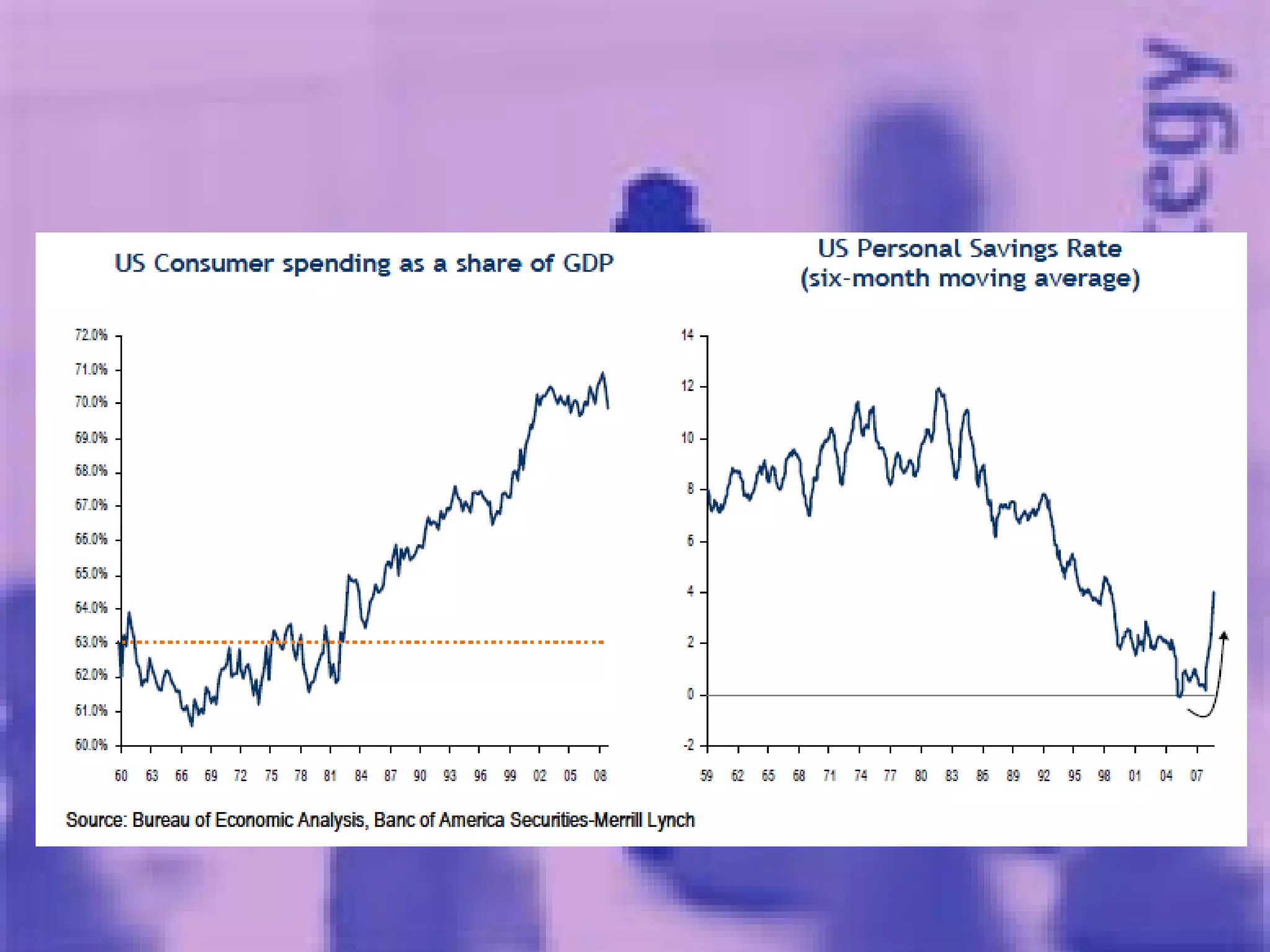
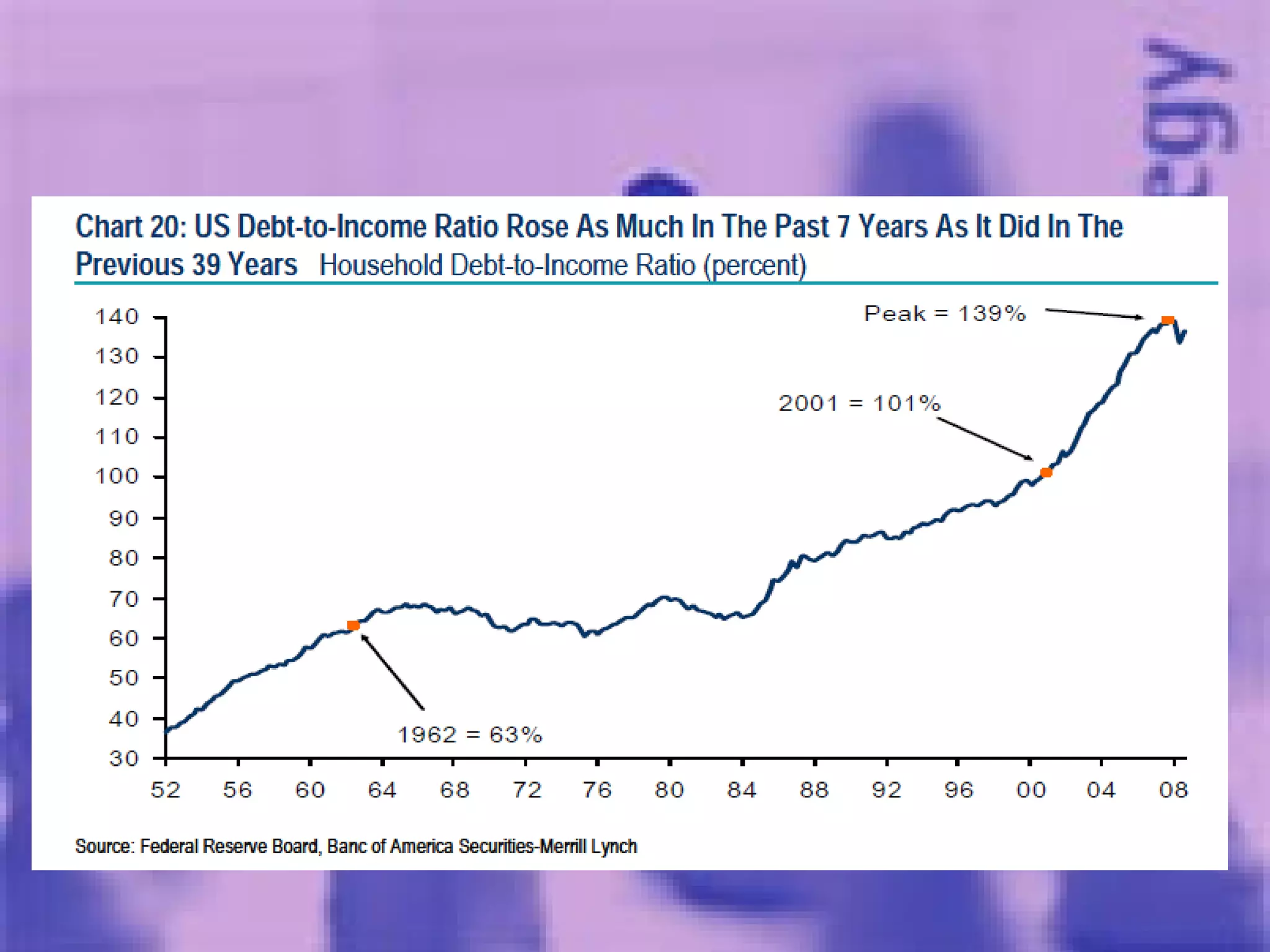
  • #13 Over 70% of US economy is based on CONSUMER SPENDING. NOW it is FREE FALLING thus the business to 06/24/09
  • #15 Bad times like this environment will reveal the skeletons in the closet PMI Code of Ethics and Professional Conduct Implementation Advisory Committee [CIAC] 20 August 2007
  • #16 What to do? The conventional, reactive approach to a recession is to employ “dump the weight” tactics—and the ax is often wielded ruthlessly on the organizational achievements so far. Employee layoffs, business unit sell offs, budget cuts, and strategic project cancellations are all well-known earmarks of this approach. These quick fixes may restore profitability temporarily, but inefficiencies in the system aren’t touched and this can often back fire, leading to destabilization, leakage and perhaps even to sinking the ship itself.
  • #17 06/24/09
  • #18 There’s a better way. Instead of dumping assets, dredge the rocks of inefficiencies in your organization. It is proactive, not reactive . take advantage of the unique internal investment opportunities that are provided by our current economic downturn It results in a stronger, competitively enhanced organization, In the short term, the ship remains afloat—not by dumping resources, but by dredging the rocks of poor integration, flawed policy, inflexibility, and diseconomy of scale with the help of ORP and Portfolio Management. In the long term, the organization emerges from the downturn stronger and positioned to lead. it means changing your corporate culture.
  • #19 06/24/09
  • #20 06/24/09 In our increasingly global economy – which is FLAT/TILTED , in which we are all competing with organizations about which we often know very little, in parts of the world with which we may not be at all familiar, it is becoming clear that one critical competitive advantage is the ability to translate strategy into organizational success through projects
  • #21 NEED: Top down, bottom-up, Middle management, External Drivers. ELEMENTS: Bus. Goals & Objectives (SMART), Problem or Opportunity and Desired outcome. TECH: Benchmarking, Brainstorming, Business Rules Analysis, focus groups, functional decomposition and Root cause analysis. Assess the capabilities : ELEMENTS: Current Capability analysis, Assessment of new capability requirements. TECH: SWOT, Current Capabilities, New Capabilities Requirements etc. Solution approach: ELEMENTS: Alternatives, Assumptions & constraints, Ranking & selection. TECH: Feasibility Analysis, Benchmarking, Brainstorming, Decision Analysis, SWOT Analysis etc. solution scope: ELEMENTS: scope definition, implementation approach and Dependencies. TECH: Functional Decomposition, Scope Modeling, User stories, interface analysis etc. Business Case: Benefits, Costs, Risks. 06/24/09
  • #25 This Presentation is Dedicated to “ Father of Knowledge Management ” for giving me the opportunity to Explore & Excel through Knowledge Management. Buckman is an organization dedicated to knowledge management. Its former Chairman, Robert H Buckman is honored as the ‘Father of Knowledge Management’ .
  • #26 Buckman Laboratories is a $600 million group of affiliated companies operating around the world providing specialty chemicals & solutions to the pulp & paper, leather, water treatment, coatings and paint industries. Buckman associate companies spanning over 20 countries, speak more than 15 different languages and have 1300 associates providing solutions to our global business partners in over 90 countries.
  • #28 06/24/09 YOU know mostly it is because built by IT without the ownership from Executives and ITS real owners - BUSINESS
  • #29 Traditionally many Multinational companies are run by a group of feudal Autonomous Managers. Each Organization sets its own objectives and process of doing business. Each one of the companies in different countries, with their own departments – Finance, Manufacturing, Marketing, etc. have their own Software System. Each Software System has its own Database. As long as they delivered adequate profit, the Corporate headquarters let them alone to run the business. RESULT?? The organization’s data are so fragmented that visibility suffers and it is difficult to do business for the Organization as a whole. In a global organization, the data fragmentation issue multiplies. Due to lack of data integration, Finance cannot co-operate with Manufacturing and the USA cannot co-operate with South Africa. This would have been okay under the old environment but with the coming of the globalization of business, competition, Internet and now recession.
  • #30 This achievement from “Global Business System” Point: Portfolio Management is all about Aligns projects with strategic objectives and Enabling optimal use of assets Buckman accomplishes this with its Project Portfolio Management of its Global Business system, and organization-wide re-engineered process (ORP) We will see the details in coming slides.
  • #32 One Adaptable Flexi-Business Solution to meet worldwide organizational requirements. The Business system should be capable of tackling the issues including: Proven System : Configurable System: Currency Issues &Languages: Localization: Country Specific Support: Internal & External Implementation/Support Issues ROI:
  • #33 Core Global Knowledge Team should have the following capabilities: Holistic View : Intricacies of International Business : Global Business Model : Beyond Boundaries : Interpersonal Skills: Onsite Support : Low Implementation cost : Optimization :.
  • #34 In order to efficiently meet the challenging demands of the organization’s global customers and support one solution, a well managed and fault-tolerant global infrastructure needs to be implemented. Buckman Laboratories has a state-of-the-art global infrastructure including the BaaN Server based in Memphis and connected through Frame relay.
  • #36 What it looks like! Now, Buckman Laboratories is successfully reaching a strategic global vision of one Global Business Solution for one organization. Buckman successfully implemented the Global Business System (ERP - BaaN) in over 16 countries in many languages around the globe: Austria, Belgium, France, Germany, Italy, Norway, Portugal, Sweden, South Africa, UK and USA. The information from the BaaN System is used for Global Financial Reporting (through Hyperion Essbase) and Global Marketing/Sales Reports.
  • #37 Boom Bust 9 software systems: on 7 platforms in 20 countries Bonus systems CAN: Hyperion Essbase, eSales, Chemmate etc.
  • #38 06/24/09 Project Portfolio Governance is the process by which an organization prioritizes, selects and allocates limited internal resources to best accomplish organizational objectives. We were managing Business Systems in 20 countries with about a dozen associates. As you can imagine, were not in a position to handle all the requests from all around the world. High level we followed this proctce.
  • #40 06/24/09 So did we help, where we on target, or is your head spinning still . . . .
  • #41 06/24/09
  • #43 06/24/09 The traditional approach for implementing a new IT system is to start with Business Process Re- Engineering. Usually, this takes a considerable amount of time. When the BPR process is finished, the PPM software that was originally selected for implementation may not be able to support all the defined Business Processes. Therefore, by the time you actually want to implement the PPM software, some processes will have to be re-engineered again. That may also be true for those processes that were defined at the beginning of the project, and have changed in the mean time. It is okay if a customer already finished the BPR before an PPM package will be implemented. It is not recommended to include BPR in the implementation of an PPM package, since it in that case it usually becomes virtually impossible to commit to “go live” dates.
  • #44 06/24/09 The traditional approach for implementing a new IT system is to start with Business Process Re- Engineering. Usually, this takes a considerable amount of time. When the BPR process is finished, the PPM software that was originally selected for implementation may not be able to support all the defined Business Processes. Therefore, by the time you actually want to implement the PPM software, some processes will have to be re-engineered again. That may also be true for those processes that were defined at the beginning of the project, and have changed in the mean time. It is okay if a customer already finished the BPR before an PPM package will be implemented. It is not recommended to include BPR in the implementation of an PPM package, since it in that case it usually becomes virtually impossible to commit to “go live” dates.
  • #45 06/24/09 The traditional approach for implementing a new IT system is to start with Business Process Re- Engineering. Usually, this takes a considerable amount of time. When the BPR process is finished, the PPM software that was originally selected for implementation may not be able to support all the defined Business Processes. Therefore, by the time you actually want to implement the PPM software, some processes will have to be re-engineered again. That may also be true for those processes that were defined at the beginning of the project, and have changed in the mean time. It is okay if a customer already finished the BPR before an PPM package will be implemented. It is not recommended to include BPR in the implementation of an PPM package, since it in that case it usually becomes virtually impossible to commit to “go live” dates.
  • #46 06/24/09 The traditional approach for implementing a new IT system is to start with Business Process Re- Engineering. Usually, this takes a considerable amount of time. When the BPR process is finished, the PPM software that was originally selected for implementation may not be able to support all the defined Business Processes. Therefore, by the time you actually want to implement the PPM software, some processes will have to be re-engineered again. That may also be true for those processes that were defined at the beginning of the project, and have changed in the mean time. It is okay if a customer already finished the BPR before an PPM package will be implemented. It is not recommended to include BPR in the implementation of an PPM package, since it in that case it usually becomes virtually impossible to commit to “go live” dates.
  • #47 06/24/09
  • #48 06/24/09 PPM Provides a way to advance an organization’s strategic goals through the application of project management principles and practices. In other words, it bridges the gap between organizational strategy and individual projects. Promote project management awareness among senior management Increase the perceived value of the “project” based approach and add credibility to the Project Management profession Help you understand organizational project management maturity; and assess organizational project management maturity within your organization By using PPM, an organization can determine exactly which organizational project management best practices and capabilities it has and has not achieved – in other words its organizational project management maturity.
  • #49 RESULT? destabilizing to the business itself demoralizing and carve a permanent scar on employees and other stake holders (financial institutions, share holders, customers, suppliers etc.). Most executives don’t realize that if they resort to such tactics, in this information driven economy, the organization loses its most crucial knowledge assets - their talented most capable and creative employees. Just as damaging is the opportunity loss for progress toward the company’s long-term strategic goals.