Plone Hosting:
A Panel Discussion
2014 Plone Conference
Bristol
Friday, October 31, 14
Steve McMahon
Ansible
Goals:
• Repeatable, fast provisioning of servers/
VMs
• Never change configuration via login
Friday, October 31, 14
Steve McMahon
Ansible
Pros:
• Uses SSH for transport - no client requirements
beyond SSH
• Easy to understand, extend
• Good documentation, example playbooks
• UsesYAML for playbooks, written in Python
• Ansible Galaxy
• Plays well withVagrant
Friday, October 31, 14
Steve McMahon
Ansible
Cons:
• Ansible Tower, the mass management
tool, is commercial
• Server orVM is smallest unit of
configuration
Friday, October 31, 14
Cris Ewing
AWS OpsWorks
• Provides a way to reliably and repeatably
provision clusters of EC2 servers (aka Stacks)
using Chef
• Uses standard recipes as much as possible
• Intended for fully automated production
deployments: includes features like automated
disk snapshotting, server monitoring and
support for high availability configurations
Friday, October 31, 14
Cris Ewing
AWS OpsWorks
Pros:
• Centralized server management via a nice Web UI with no
additional costs
• Allows defining layers of functionality which may be deployed
across multiple server instances
• Automated discovery of services within a cluster of instances
(e.g. new instances with ZEO Clients being discovered by a load
balancing layer)
• Most configuration can be done via JSON settings or simple web
forms (including managing Git SSH and HTTP SSL keys)
• Uses Chef and Berkshelf: many open source recipes are available
for extending the platform
Friday, October 31, 14
Cris Ewing
AWS OpsWorks
More Pros:
• Chef recipes for deploying Plone can be used outside of
AWS
• Easy to clone a multi-instance production stack to make a
single instance staging/development stack and vice versa
• OpsWorks and Chef documentation is extensive and
comprehensive (perhaps to the point of being
intimidating)
• OpsWorks is a relatively new service and has been
getting new and useful features added frequently
Friday, October 31, 14
Cris Ewing
AWS OpsWorks
Cons:
• AWS/EC2 only
• Uses Chef: extending functionality may require writing custom
Chef/Ruby code (yuck)
• Developing and testing custom recipes (usingVagrant) tends to
be time-consuming and un-fun
• Provisioning new instances can take some time (15 - 45
minutes): neither EC2 nor chef nor buildout are very fast in
that regard
• Current implementation expects a particular buildout
structure for deploying Plone in a horizontally scalable manner
Friday, October 31, 14
Cris Ewing
AWS OpsWorks
https://github.com/alecpm/opsworks-web-python
Thanks to Alec Mitchell with help from
David Glick, Carlos de la Guardia, Cris Ewing
Friday, October 31, 14
Sven Strack
Nix, Docker, OpenVZ
I don’t believe in
“Devops”
Friday, October 31, 14
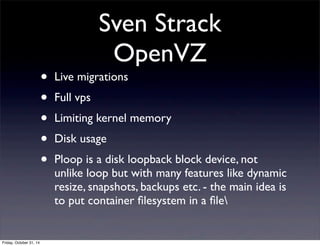
Sven Strack
OpenVZ
• Live migrations
• Full vps
• Limiting kernel memory
• Disk usage
• Ploop is a disk loopback block device, not
unlike loop but with many features like dynamic
resize, snapshots, backups etc. - the main idea is
to put container filesystem in a file
Friday, October 31, 14
Sven Strack
OpenVZ
Cons:
• Works better with custom OpenVZ
kernel
Friday, October 31, 14
Sven Strack
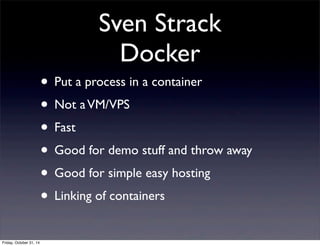
Docker
• Put a process in a container
• Not aVM/VPS
• Fast
• Good for demo stuff and throw away
• Good for simple easy hosting
• Linking of containers
Friday, October 31, 14
Sven Strack
Docker
Cons:
• Debugging can be hard
• Building a 'proper image' can be hard
• Linking containers together, creates lots
of bottlenecks
Friday, October 31, 14
Sven Strack
Nix
• Reliable: really hard to break packages
• Reproducible: Nix builds packages in isolation from
each other.This ensures that they are reproducible
and don’t have undeclared dependencies, so if a
package works on one machine, it will also work on
another.
• Portable: Nix runs on Linux, Mac OS X and other
systems. Nixpkgs, the Nix Packages collection,
contains thousands of packages, many pre-compiled.
Friday, October 31, 14
Sven Strack
Nix
Cons:
• Small community (slowly growing)
• Bad docs (slowly getting better)
Cool kid:
• nix in docker works like a charm
Friday, October 31, 14
Nejc Zupan
Heroku
Pros:
• Fully managed stack, you can focus on delivering
• Backend, logging, search, email, auth, geo, etc. services
are a click away
• Forces best practices
• Very generous free tier (unlimited one-dyno apps for
unlimited time)
• One-click app and db rollbacks
• Easy to do continuous delivery
Friday, October 31, 14
Nejc Zupan
Heroku
Cons:
• No persistent filesystem (only a
drawback for the Plone ecosystem)
• Forces best practices (sometimes you are
in a hurry)
• Can get expensive when you breach the
free tier
Friday, October 31, 14
Nate Aune
PaaS Providers
Pros:
• Easy to get started
• Don't need to understand the
complexities of server admin
• Many PaaS can auto-scale as traffic
increases
Friday, October 31, 14
Nate Aune
PaaS Providers
Cons:
• Persistence of disk files (ZODB) can
sometimes be an issue
• No real insight into mechanics of
infrastructure if forensic debugging is
needed
• Short timeouts windows can be a problem
for long-running buildout
Friday, October 31, 14
Nate Aune
PaaS Providers
Plone on Dotcloud (by David Bain aka pigeonflight)
https://github.com/pigeonflight/stack-python-plone
Plone on Redhat's OpenShift (by Izhar Firdaus aka kagesenshi)
http://blog.kagesenshi.org/2012/07/plone-on-openshift-
quickstart-using-diy.html
Plone on Heroku
https://github.com/niteoweb/heroku-buildpack-plone
Friday, October 31, 14
Questions
Discussion
Friday, October 31, 14

Plone Hosting: A Panel Discussion

  • 1.
    Plone Hosting: A PanelDiscussion 2014 Plone Conference Bristol Friday, October 31, 14
  • 2.
    Steve McMahon Ansible Goals: • Repeatable,fast provisioning of servers/ VMs • Never change configuration via login Friday, October 31, 14
  • 3.
    Steve McMahon Ansible Pros: • UsesSSH for transport - no client requirements beyond SSH • Easy to understand, extend • Good documentation, example playbooks • UsesYAML for playbooks, written in Python • Ansible Galaxy • Plays well withVagrant Friday, October 31, 14
  • 4.
    Steve McMahon Ansible Cons: • AnsibleTower, the mass management tool, is commercial • Server orVM is smallest unit of configuration Friday, October 31, 14
  • 5.
    Cris Ewing AWS OpsWorks •Provides a way to reliably and repeatably provision clusters of EC2 servers (aka Stacks) using Chef • Uses standard recipes as much as possible • Intended for fully automated production deployments: includes features like automated disk snapshotting, server monitoring and support for high availability configurations Friday, October 31, 14
  • 6.
    Cris Ewing AWS OpsWorks Pros: •Centralized server management via a nice Web UI with no additional costs • Allows defining layers of functionality which may be deployed across multiple server instances • Automated discovery of services within a cluster of instances (e.g. new instances with ZEO Clients being discovered by a load balancing layer) • Most configuration can be done via JSON settings or simple web forms (including managing Git SSH and HTTP SSL keys) • Uses Chef and Berkshelf: many open source recipes are available for extending the platform Friday, October 31, 14
  • 7.
    Cris Ewing AWS OpsWorks MorePros: • Chef recipes for deploying Plone can be used outside of AWS • Easy to clone a multi-instance production stack to make a single instance staging/development stack and vice versa • OpsWorks and Chef documentation is extensive and comprehensive (perhaps to the point of being intimidating) • OpsWorks is a relatively new service and has been getting new and useful features added frequently Friday, October 31, 14
  • 8.
    Cris Ewing AWS OpsWorks Cons: •AWS/EC2 only • Uses Chef: extending functionality may require writing custom Chef/Ruby code (yuck) • Developing and testing custom recipes (usingVagrant) tends to be time-consuming and un-fun • Provisioning new instances can take some time (15 - 45 minutes): neither EC2 nor chef nor buildout are very fast in that regard • Current implementation expects a particular buildout structure for deploying Plone in a horizontally scalable manner Friday, October 31, 14
  • 9.
    Cris Ewing AWS OpsWorks https://github.com/alecpm/opsworks-web-python Thanksto Alec Mitchell with help from David Glick, Carlos de la Guardia, Cris Ewing Friday, October 31, 14
  • 10.
    Sven Strack Nix, Docker,OpenVZ I don’t believe in “Devops” Friday, October 31, 14
  • 11.
    Sven Strack OpenVZ • Livemigrations • Full vps • Limiting kernel memory • Disk usage • Ploop is a disk loopback block device, not unlike loop but with many features like dynamic resize, snapshots, backups etc. - the main idea is to put container filesystem in a file Friday, October 31, 14
  • 12.
    Sven Strack OpenVZ Cons: • Worksbetter with custom OpenVZ kernel Friday, October 31, 14
  • 13.
    Sven Strack Docker • Puta process in a container • Not aVM/VPS • Fast • Good for demo stuff and throw away • Good for simple easy hosting • Linking of containers Friday, October 31, 14
  • 14.
    Sven Strack Docker Cons: • Debuggingcan be hard • Building a 'proper image' can be hard • Linking containers together, creates lots of bottlenecks Friday, October 31, 14
  • 15.
    Sven Strack Nix • Reliable:really hard to break packages • Reproducible: Nix builds packages in isolation from each other.This ensures that they are reproducible and don’t have undeclared dependencies, so if a package works on one machine, it will also work on another. • Portable: Nix runs on Linux, Mac OS X and other systems. Nixpkgs, the Nix Packages collection, contains thousands of packages, many pre-compiled. Friday, October 31, 14
  • 16.
    Sven Strack Nix Cons: • Smallcommunity (slowly growing) • Bad docs (slowly getting better) Cool kid: • nix in docker works like a charm Friday, October 31, 14
  • 17.
    Nejc Zupan Heroku Pros: • Fullymanaged stack, you can focus on delivering • Backend, logging, search, email, auth, geo, etc. services are a click away • Forces best practices • Very generous free tier (unlimited one-dyno apps for unlimited time) • One-click app and db rollbacks • Easy to do continuous delivery Friday, October 31, 14
  • 18.
    Nejc Zupan Heroku Cons: • Nopersistent filesystem (only a drawback for the Plone ecosystem) • Forces best practices (sometimes you are in a hurry) • Can get expensive when you breach the free tier Friday, October 31, 14
  • 19.
    Nate Aune PaaS Providers Pros: •Easy to get started • Don't need to understand the complexities of server admin • Many PaaS can auto-scale as traffic increases Friday, October 31, 14
  • 20.
    Nate Aune PaaS Providers Cons: •Persistence of disk files (ZODB) can sometimes be an issue • No real insight into mechanics of infrastructure if forensic debugging is needed • Short timeouts windows can be a problem for long-running buildout Friday, October 31, 14
  • 21.
    Nate Aune PaaS Providers Ploneon Dotcloud (by David Bain aka pigeonflight) https://github.com/pigeonflight/stack-python-plone Plone on Redhat's OpenShift (by Izhar Firdaus aka kagesenshi) http://blog.kagesenshi.org/2012/07/plone-on-openshift- quickstart-using-diy.html Plone on Heroku https://github.com/niteoweb/heroku-buildpack-plone Friday, October 31, 14
  • 22.