What is PLC?
PLC is a microprocessor based
specialized computer that is
designed for use in industrial
environment which uses its
programmable memory for the
internal storage of instructions for
implementing specific function to
control various types of process.
2
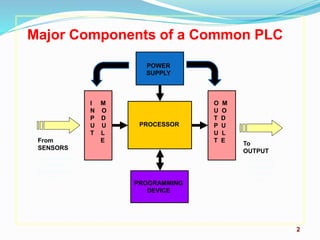
Major Components of a Common PLC
PROCESSOR
POWER
SUPPLY
I M
N O
P D
U U
T L
E
O M
U O
T D
P U
U L
T E
PROGRAMMING
DEVICE
From
SENSORS
Pushbuttons,
contacts,
limit switches,
etc.
To
OUTPUT
Solenoids,
contactors,
alarms
etc.
3
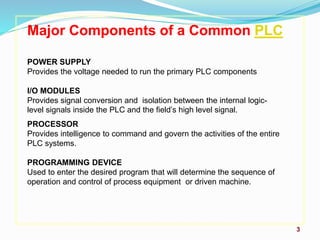
Major Components of a Common PLC
POWER SUPPLY
Provides the voltage needed to run the primary PLC components
I/O MODULES
Provides signal conversion and isolation between the internal logic-
level signals inside the PLC and the field’s high level signal.
PROCESSOR
Provides intelligence to command and govern the activities of the entire
PLC systems.
PROGRAMMING DEVICE
Used to enter the desired program that will determine the sequence of
operation and control of process equipment or driven machine.
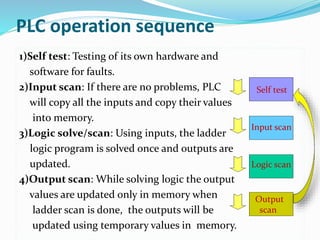
PLC operation sequence
1)Self test: Testing of its own hardware and
software for faults.
2)Input scan: If there are no problems, PLC
will copy all the inputs and copy their values
into memory.
3)Logic solve/scan: Using inputs, the ladder
logic program is solved once and outputs are
updated.
4)Output scan: While solving logic the output
values are updated only in memory when
ladder scan is done, the outputs will be
updated using temporary values in memory.
Self test
Input scan
Logic scan
Output
scan
Programming Languages of PLC
Most common languages encountered in PLC
programming are:
1) Ladder Logic
2) Functional Block Diagram
3) Sequential Function Chart
4) Structured text
5) Instruction list
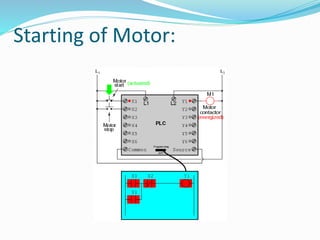
Starting of Motor:
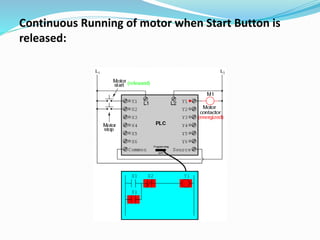
Continuous Running of motor when Start Button is
released:
 Reliability.
 Flexibility in programming and reprogramming.
 Cost effective for controlling complex systems.
 Small physical size, shorter project time.
 High speed of operation.
 Ability to communicate with computer systems in the
plant.
 Ease of maintenance /troubleshooting.
 Reduced space.
 Energy saving.
Few examples of industries where PLCs are used :
1) Robots manufacturing and control
2) Car park control
3) Train control station system
4) Food processing
5) Materials handling
6)Machine tools
7)Conveyer system etc.

PLC TRAINING

  • 1.
    What is PLC? PLCis a microprocessor based specialized computer that is designed for use in industrial environment which uses its programmable memory for the internal storage of instructions for implementing specific function to control various types of process.
  • 2.
    2 Major Components ofa Common PLC PROCESSOR POWER SUPPLY I M N O P D U U T L E O M U O T D P U U L T E PROGRAMMING DEVICE From SENSORS Pushbuttons, contacts, limit switches, etc. To OUTPUT Solenoids, contactors, alarms etc.
  • 3.
    3 Major Components ofa Common PLC POWER SUPPLY Provides the voltage needed to run the primary PLC components I/O MODULES Provides signal conversion and isolation between the internal logic- level signals inside the PLC and the field’s high level signal. PROCESSOR Provides intelligence to command and govern the activities of the entire PLC systems. PROGRAMMING DEVICE Used to enter the desired program that will determine the sequence of operation and control of process equipment or driven machine.
  • 4.
    PLC operation sequence 1)Selftest: Testing of its own hardware and software for faults. 2)Input scan: If there are no problems, PLC will copy all the inputs and copy their values into memory. 3)Logic solve/scan: Using inputs, the ladder logic program is solved once and outputs are updated. 4)Output scan: While solving logic the output values are updated only in memory when ladder scan is done, the outputs will be updated using temporary values in memory. Self test Input scan Logic scan Output scan
  • 5.
    Programming Languages ofPLC Most common languages encountered in PLC programming are: 1) Ladder Logic 2) Functional Block Diagram 3) Sequential Function Chart 4) Structured text 5) Instruction list
  • 6.
  • 7.
    Continuous Running ofmotor when Start Button is released:
  • 8.
     Reliability.  Flexibilityin programming and reprogramming.  Cost effective for controlling complex systems.  Small physical size, shorter project time.  High speed of operation.  Ability to communicate with computer systems in the plant.  Ease of maintenance /troubleshooting.  Reduced space.  Energy saving.
  • 9.
    Few examples ofindustries where PLCs are used : 1) Robots manufacturing and control 2) Car park control 3) Train control station system 4) Food processing 5) Materials handling 6)Machine tools 7)Conveyer system etc.