Solving a Transportation Planning Problem
Through the Programming Language “C”

Presented by
Yousuf Mahid(0615012)
Shahadat Hossain Shakil(0615020)
Khadija Akhter(0615027)
Calculation of Inter-Zonal Trips (Gravity Model)
 Problem:Calculation of inter-zonal trips in a town.(Gravity Model)
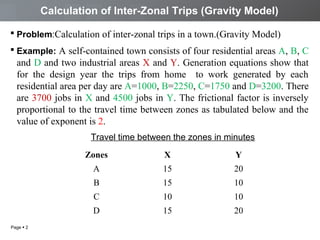
 Example: A self-contained town consists of four residential areas A, B, C

and D and two industrial areas X and Y. Generation equations show that
for the design year the trips from home to work generated by each
residential area per day are A=1000, B=2250, C=1750 and D=3200. There
are 3700 jobs in X and 4500 jobs in Y. The frictional factor is inversely
proportional to the travel time between zones as tabulated below and the
value of exponent is 2.
Travel time between the zones in minutes
Zones

Y

A

15

20

B

15

10

C

10

10

D
Page  2

X

15

20
Calculation of Inter-Zonal Trips (Gravity Model)
Destination

Y

A

TAX

TAY

B

Origin

X

TBX

TBY

TCX

TCY

TDX

TDY

3700

4500

C
D
Total

Total
1000
2250
1750
3200
8200

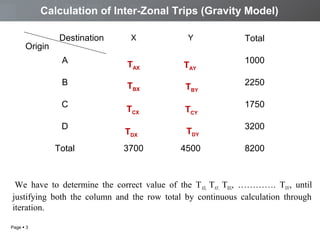
We have to determine the correct value of the T AX, TAY, TBX, …………. TDY, until
justifying both the column and the row total by continuous calculation through
iteration.
Page  3
Calculation of Inter-Zonal Trips (Gravity Model)
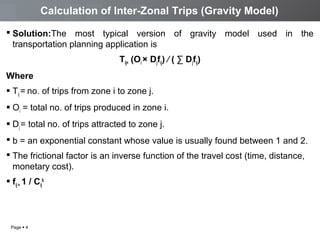
 Solution:The most typical version of gravity model used in the
transportation planning application is
Tij= (Oi × Djfij) ∕ ( ∑ Djfij)
Where
 Tij = no. of trips from zone i to zone j.
 Oi = total no. of trips produced in zone i.
 Dj = total no. of trips attracted to zone j.
 b = an exponential constant whose value is usually found between 1 and 2.
 The frictional factor is an inverse function of the travel cost (time, distance,
monetary cost).
 fij = 1 / Cijb

Page  4
Calculation of Inter-Zonal Trips (Gravity Model)
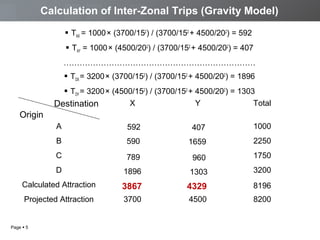
 TAX = 1000 × (3700/152) / (3700/152 + 4500/202) = 592
 TAY = 1000 × (4500/202) / (3700/152 + 4500/202) = 407
………………………………………………………………
 TDX = 3200 × (3700/152) / (3700/152 + 4500/202) = 1896
 TDY = 3200 × (4500/152) / (3700/152 + 4500/202) = 1303
X
Y
Total
Destination

Origin
A

592

407

1000

B

590

1659

2250

C

789

960

1750

D

1896

1303

3200

Calculated Attraction

3867

4329

8196

Projected Attraction

3700

4500

8200

Page  5
Calculation of Inter-Zonal Trips (Gravity Model)
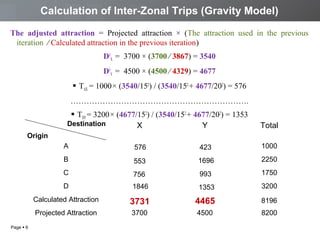
The adjusted attraction = Projected attraction × (The attraction used in the previous
iteration ∕ Calculated attraction in the previous iteration)
D1X = 3700 × (3700 ∕ 3867) = 3540
D1Y = 4500 × (4500 ∕ 4329) = 4677
 TAX = 1000 × (3540/152) / (3540/152 + 4677/202) = 576
………………………………………………………….
 TDY = 3200 × (4677/152) / (3540/152 + 4677/202) = 1353
Destination
X
Y

Total

Origin
A

423

1000

B

553

1696

2250

C

756

993

1750

D

1846

1353

3200

Calculated Attraction

3731

4465

8196

Projected Attraction
Page  6

576

3700

4500

8200
Calculation of Inter-Zonal Trips (Gravity Model)
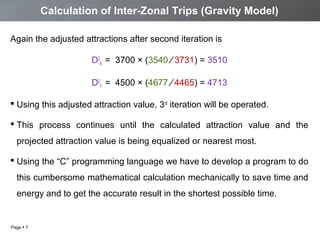
Again the adjusted attractions after second iteration is
D2X = 3700 × (3540 ∕ 3731) = 3510
D2Y = 4500 × (4677 ∕ 4465) = 4713
 Using this adjusted attraction value, 3rd iteration will be operated.
 This process continues until the calculated attraction value and the
projected attraction value is being equalized or nearest most.
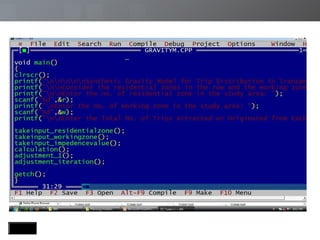
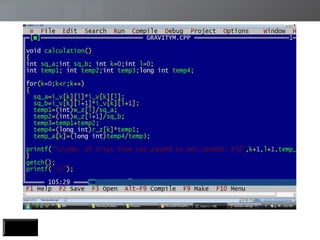
 Using the “C” programming language we have to develop a program to do
this cumbersome mathematical calculation mechanically to save time and
energy and to get the accurate result in the shortest possible time.

Page  7
Making Procedure of the Program in “C”
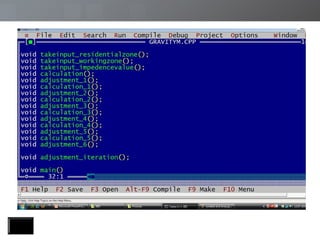
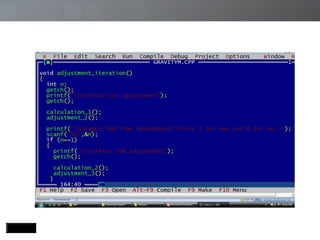
 Divide the whole task among different functions.
 Function declaration.
 Declaring functions prototype before main function.

 Then subdivide the claculation of a specific function into more smaller p
 Variable Declaration-(Local and Global).
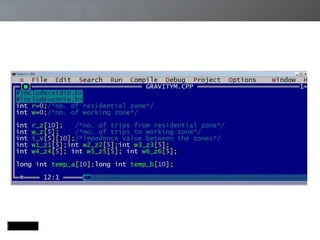
 Global Array Declaration- (1D and 2D)-to store and manipulate same
kind of data.
 Function calling - inside the main function and also inside the called
function.

Page  8
Making Procedure of the Program in “C”
 Library function used – main(); clrscr(); printf();scanf(); fflush(stdin);
getch(); (including related header files)
 Type of variables used – int; long int; float;
(including ralated format specifier)
 Operator used – arithmatic (addition, multiplication, division)
– assignment(=), relational(==),increment(++)
 Control Statement Used – if statement;
– for loop;
A progarm largely dependent on the use of array and continuous
iteration.
Limitations – deigned for 10 residential zone and 2 working zone.
Failure of converting the fraction trip value into the next higher
integer number.
Page  9
Thanks for your patience.

Q/A

Page  10
Page  11
Page  12
Page  13
Page  14
Page  15

Solving a “Transportation Planning” Problem through the Programming Language “C”

  • 1.
    Solving a TransportationPlanning Problem Through the Programming Language “C” Presented by Yousuf Mahid(0615012) Shahadat Hossain Shakil(0615020) Khadija Akhter(0615027)
  • 2.
    Calculation of Inter-ZonalTrips (Gravity Model)  Problem:Calculation of inter-zonal trips in a town.(Gravity Model)  Example: A self-contained town consists of four residential areas A, B, C and D and two industrial areas X and Y. Generation equations show that for the design year the trips from home to work generated by each residential area per day are A=1000, B=2250, C=1750 and D=3200. There are 3700 jobs in X and 4500 jobs in Y. The frictional factor is inversely proportional to the travel time between zones as tabulated below and the value of exponent is 2. Travel time between the zones in minutes Zones Y A 15 20 B 15 10 C 10 10 D Page  2 X 15 20
  • 3.
    Calculation of Inter-ZonalTrips (Gravity Model) Destination Y A TAX TAY B Origin X TBX TBY TCX TCY TDX TDY 3700 4500 C D Total Total 1000 2250 1750 3200 8200 We have to determine the correct value of the T AX, TAY, TBX, …………. TDY, until justifying both the column and the row total by continuous calculation through iteration. Page  3
  • 4.
    Calculation of Inter-ZonalTrips (Gravity Model)  Solution:The most typical version of gravity model used in the transportation planning application is Tij= (Oi × Djfij) ∕ ( ∑ Djfij) Where  Tij = no. of trips from zone i to zone j.  Oi = total no. of trips produced in zone i.  Dj = total no. of trips attracted to zone j.  b = an exponential constant whose value is usually found between 1 and 2.  The frictional factor is an inverse function of the travel cost (time, distance, monetary cost).  fij = 1 / Cijb Page  4
  • 5.
    Calculation of Inter-ZonalTrips (Gravity Model)  TAX = 1000 × (3700/152) / (3700/152 + 4500/202) = 592  TAY = 1000 × (4500/202) / (3700/152 + 4500/202) = 407 ………………………………………………………………  TDX = 3200 × (3700/152) / (3700/152 + 4500/202) = 1896  TDY = 3200 × (4500/152) / (3700/152 + 4500/202) = 1303 X Y Total Destination Origin A 592 407 1000 B 590 1659 2250 C 789 960 1750 D 1896 1303 3200 Calculated Attraction 3867 4329 8196 Projected Attraction 3700 4500 8200 Page  5
  • 6.
    Calculation of Inter-ZonalTrips (Gravity Model) The adjusted attraction = Projected attraction × (The attraction used in the previous iteration ∕ Calculated attraction in the previous iteration) D1X = 3700 × (3700 ∕ 3867) = 3540 D1Y = 4500 × (4500 ∕ 4329) = 4677  TAX = 1000 × (3540/152) / (3540/152 + 4677/202) = 576 ………………………………………………………….  TDY = 3200 × (4677/152) / (3540/152 + 4677/202) = 1353 Destination X Y Total Origin A 423 1000 B 553 1696 2250 C 756 993 1750 D 1846 1353 3200 Calculated Attraction 3731 4465 8196 Projected Attraction Page  6 576 3700 4500 8200
  • 7.
    Calculation of Inter-ZonalTrips (Gravity Model) Again the adjusted attractions after second iteration is D2X = 3700 × (3540 ∕ 3731) = 3510 D2Y = 4500 × (4677 ∕ 4465) = 4713  Using this adjusted attraction value, 3rd iteration will be operated.  This process continues until the calculated attraction value and the projected attraction value is being equalized or nearest most.  Using the “C” programming language we have to develop a program to do this cumbersome mathematical calculation mechanically to save time and energy and to get the accurate result in the shortest possible time. Page  7
  • 8.
    Making Procedure ofthe Program in “C”  Divide the whole task among different functions.  Function declaration.  Declaring functions prototype before main function.  Then subdivide the claculation of a specific function into more smaller p  Variable Declaration-(Local and Global).  Global Array Declaration- (1D and 2D)-to store and manipulate same kind of data.  Function calling - inside the main function and also inside the called function. Page  8
  • 9.
    Making Procedure ofthe Program in “C”  Library function used – main(); clrscr(); printf();scanf(); fflush(stdin); getch(); (including related header files)  Type of variables used – int; long int; float; (including ralated format specifier)  Operator used – arithmatic (addition, multiplication, division) – assignment(=), relational(==),increment(++)  Control Statement Used – if statement; – for loop; A progarm largely dependent on the use of array and continuous iteration. Limitations – deigned for 10 residential zone and 2 working zone. Failure of converting the fraction trip value into the next higher integer number. Page  9
  • 10.
    Thanks for yourpatience. Q/A Page  10
  • 11.
  • 12.
  • 13.
  • 14.
  • 15.